A Daily History of Holes, Dots, Lines, Science, History, Math, Physics, Art, the Unintentional Absurd, Architecture, Maps, Data Visualization, Blank and Missing Things, and so on. |1.6 million words, 7500 images, 4.9 million hits| Press & appearances in The Times, Le Figaro, Mensa, The Economist, The Guardian, Discovery News, Slate, Le Monde, Sci American Blogs, Le Pont, and many other places… 5000+ total posts since 2008.

Book Category: Physics

  • The General Theory of Relativity, 1916

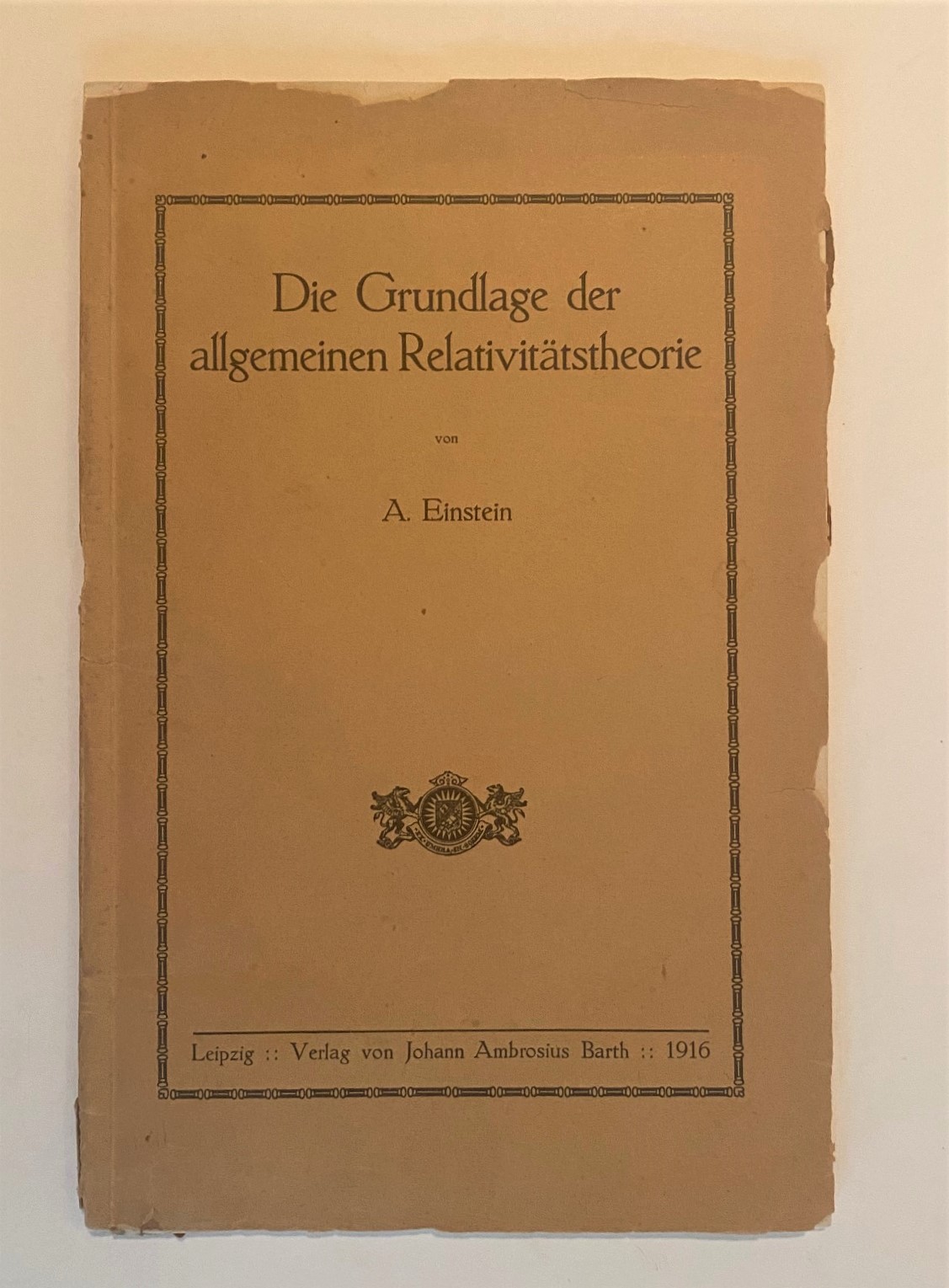
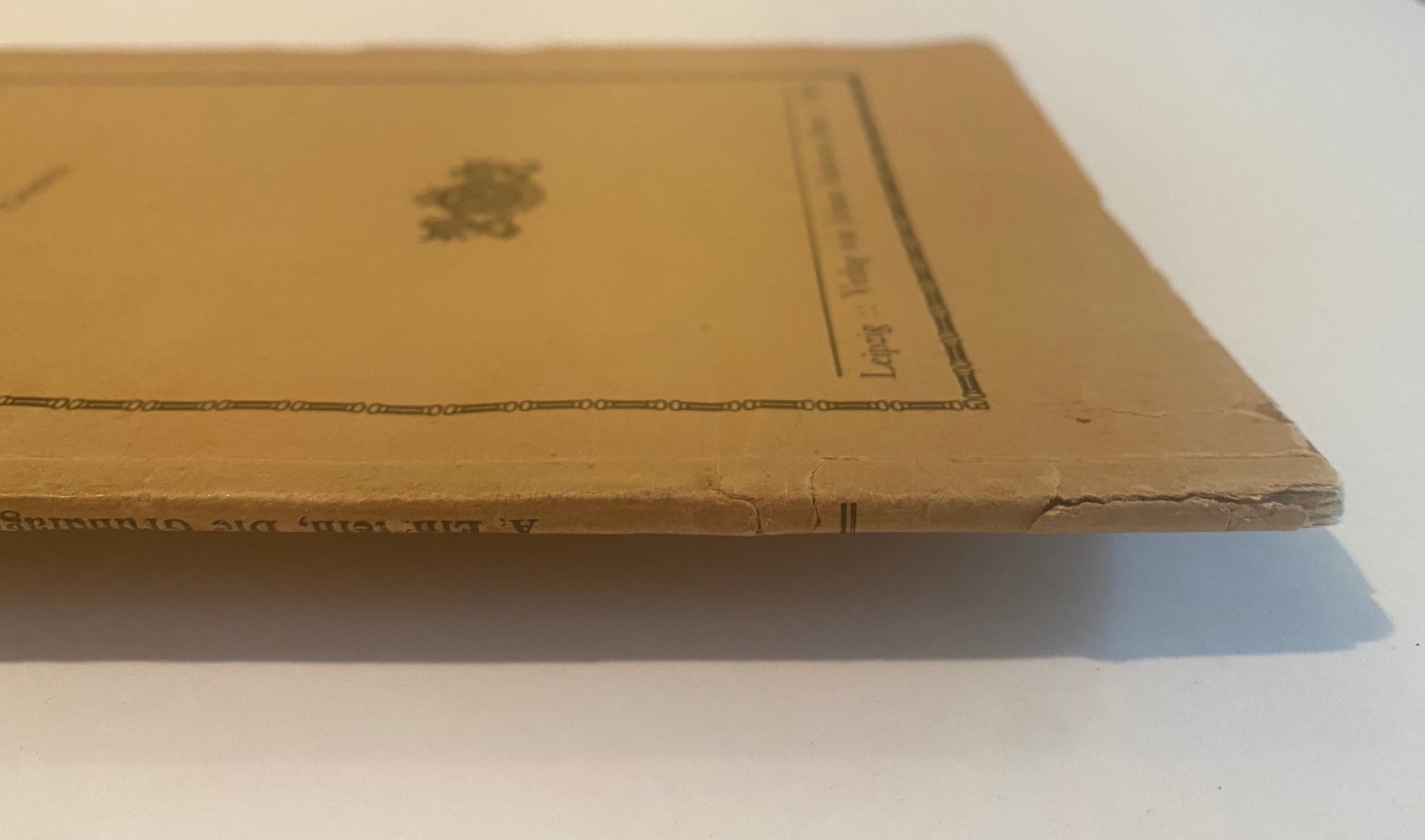
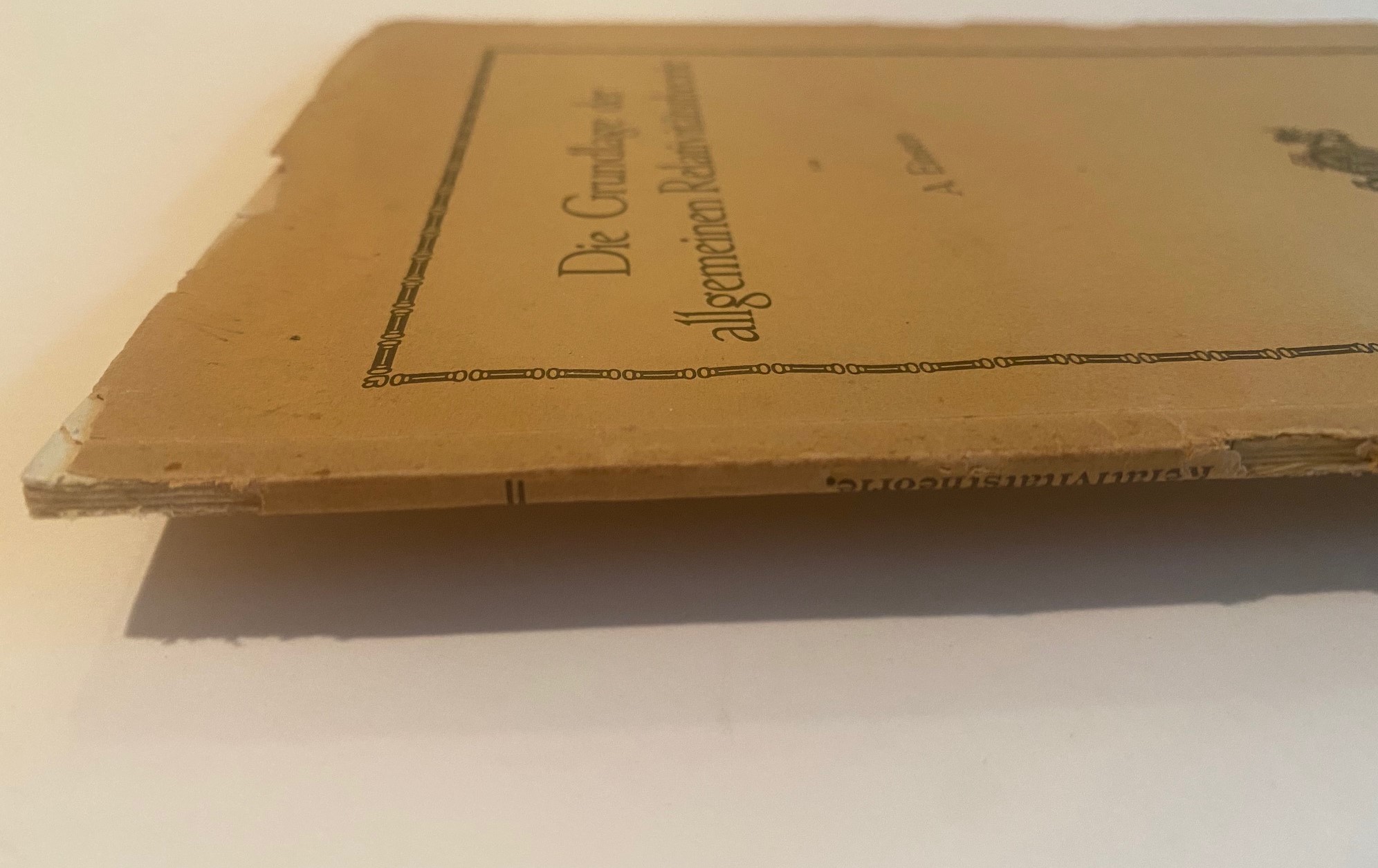
    IMG_7019EINSTEIN, Albert. “Die Grundlagen der Allgemeinen Relativitatstheorie,” Sonderdruck aus den Annalen Der Physik, 1916, series IV, volume 49, 1916. First edition, first issue of the monograph issue, of Einstein’s “Grundlagen…”, the “greatly expanded and detailed memoir…which, so to speak, became the Authorized Version” of the general theory of relativity–(Complete DSB online) Original wrappers. 9″x6″, 64pp. Condition: the wrappers have little chips out here and there (see photos) along the cover edges. There are also three small chips along the paper spine, two being about a half-inch and the third (at bottom) being ¾”. Owner’s name appears at top right title page, dated 1921. Overall, a solid copy. VG. Weil 80a, PMM 408, Grolier/Horblit 26c, Boni 78.1, Schilpp-Schields 86. $3750

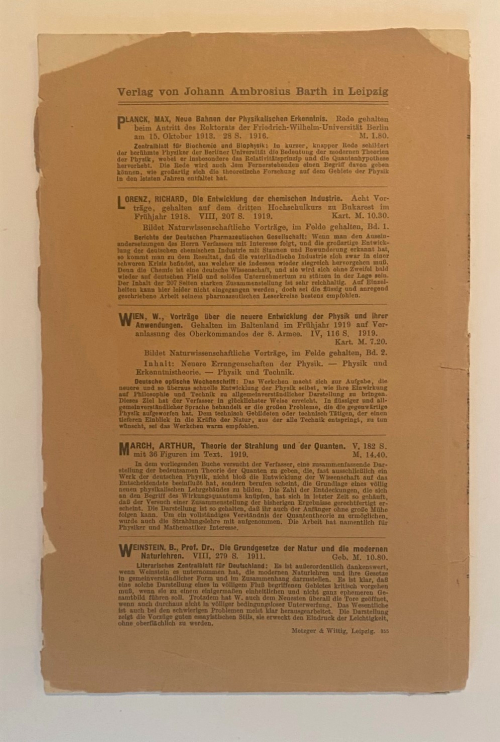
    The printer’s imprint identifying this as the first issue reads “Druck von Metzger & Wittig in Leipzig” on the verso of the title page; it also has the other first issue point, “Metzger & Wittig, Leipzig” printed on the rear cover. (The 2nd issue is mostly identical except that it has “Omnitypie-Ges.” imprinted on verso of title and was actually printed in 1919 even though the title page and cover dates the puiblication as 1916.) It is noted that the monograph issue is not an offprint from the Annalen–it is the first separate edition of this paper, Einstein’s general theory of relativity. It also contains additional material not in the offprint from the Annalen—namely a table of contents (“Inhalt”, pp 3-5) as well as an introduction (“Einleitung” pp 5-6).
    IMG_7020

    What can I say about this paper that hasn’t been said thousands of times before? I can go on and on about it, repeating everything, but the reader already knows all of it. But one does need to say/quote something, one or two things, at least, and so I will simply say that this work is one of the greatest feats of scientific thinking for a period of several hundred years. “The theory of relativity has transformed astrophysics, and indeed the whole scientific outlook,” which is a basic and core statement made about this work, this one being found its description in PMM 408. Perhaps a more richly textured statement on this Einstein was made on the front page of the 7 November 1919 issue of the London Times reporting the announcement at the joint meeting of the Royal Society and Royal Astronomical Society of 6 November of the 29 May eclipse expedition of Eddington/Dyson/Davidson eclipse/bent light experiment that verified general relativity, the headline loudly declaring : “Revolution in Science. New Theory of the Universe. Newtonian Ideas Overthrown,” which I think was very bubbly and excitable for the Brits, given all of it…
    IMG_7023
    IMG_7023

    ·Posted by :

    ·in:


  • A.A. Michelson Papers on the Velocity of Light, 1878-1885

    MICHELSON, Albert A. Four papers on Michelson’s famous experiments determining the speed of light (the established velocity standing for 40 years). This includes the paper (#3) in which his outstanding result is established and reported.

    (1) MICHELSON, A.A. “Velocity of Light”, in Nature, volume 18, #451, June 20, 1878, page 195. This is the preliminary announcement of Michelson’s great speed of light experiment.  Very nice copy, removed from a larger bound copy.

    The Michelson bibliography in the Biographical Memoirs of the National Academy of Sciences (page 142) states the publication on the big paper as so: “(a) “On a Method of Measuring the Velocity of Light,” Am. J. Sci. (3) 394-95 (1878) ; (b) “Velocity of Light (Preliminary Announcement),” Nature 18, 195 (1878), differs from (a) in the addition of a paragraph.

    Offered with: (2) MICHELSON, A.A.  “Experimental Determination of the Velocity of Light” [Part I], in Nature, volume 21 no. 526, November 27, 1879, pp 94-96, in the issue of pp 77-100, with six figures in text, including two optics plans, two instrument profiles, and another two instrument plans. Offered in the original wrappers

    With: (3) MICHELSON, A.A. “Experimental Determination of the Velocity of Light, II”, in Nature, vol 21 no. 527, December 4, 1879, pp 120-122, with two schematics, in the issue of pp 101-124. With the original front wrapper. Removed from a larger bound volume. Clean and tidy issue.

    NOTE: In the interest of fullness I should say that there is a short addendum/corrigeda to these two papers “Velocity of Light” that appeared in Nature 21, 226-226 (08 January 1880) that I do NOT offer. It seems that the full text is limited to: “IF you can spare the space please state that the corrected result for the velocity of light (NATURE, vol. xxi. p. 94) is— 299944 ± 50 kilometres, or 186380 ± 33 miles per second.” It IS however a very significant publication correcting his great standard.

    (4) Michelson, A.A. “On M. Wolf’s Modification of Foucault’s Apparatus for the Measurement of the Velocity of Light”, in Nature, vol 32 no. 810, 7 May 1885, pp 6-7 in the issue of pp 1-24. This issue offered without the outer wrappers. Removed from a larger bound volume. VG copy, crisp.

    The four papers: $950.00

    ·Posted by :

    ·in:


  • One of the Earliest Efforts on Global Warming (1785)

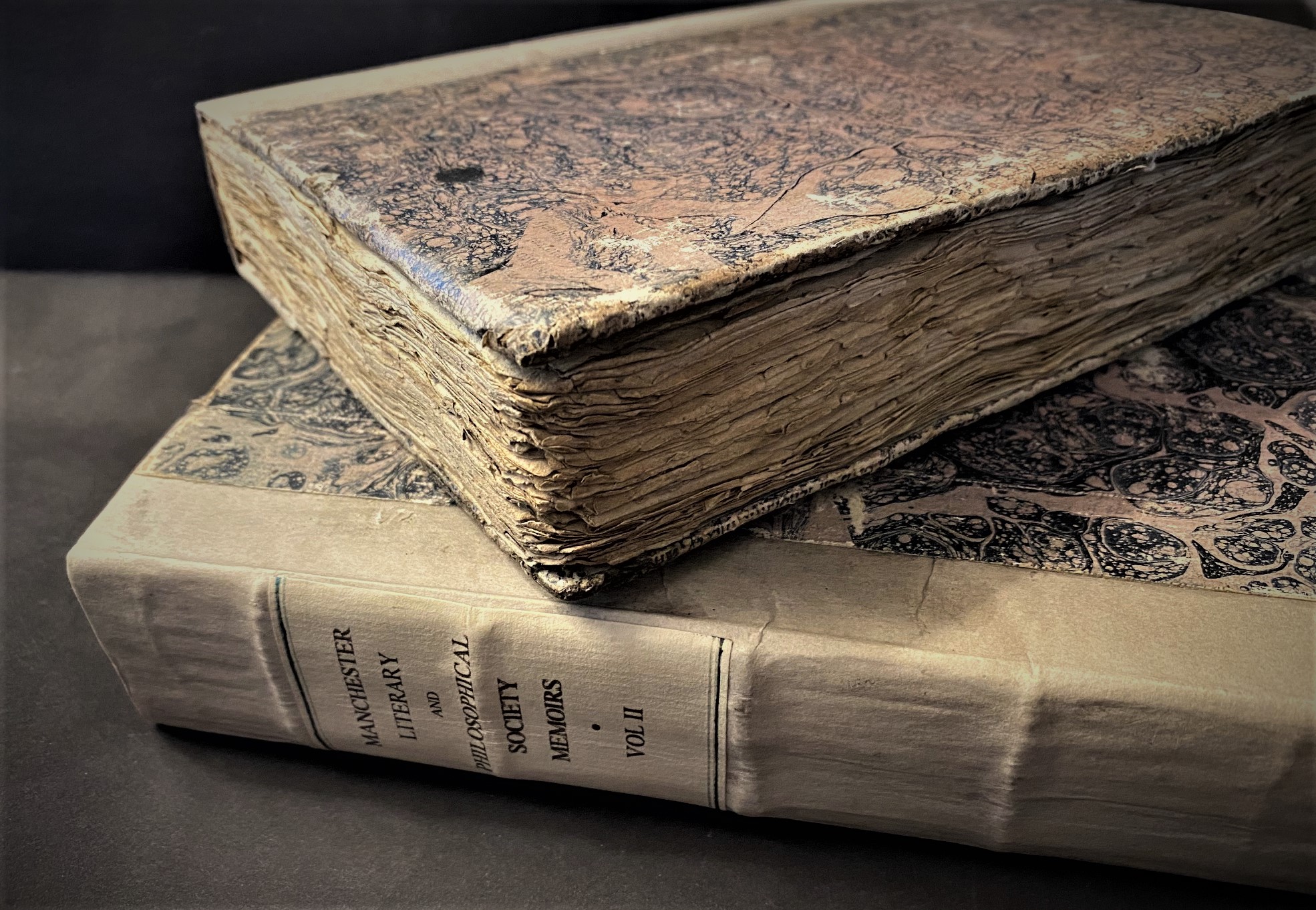
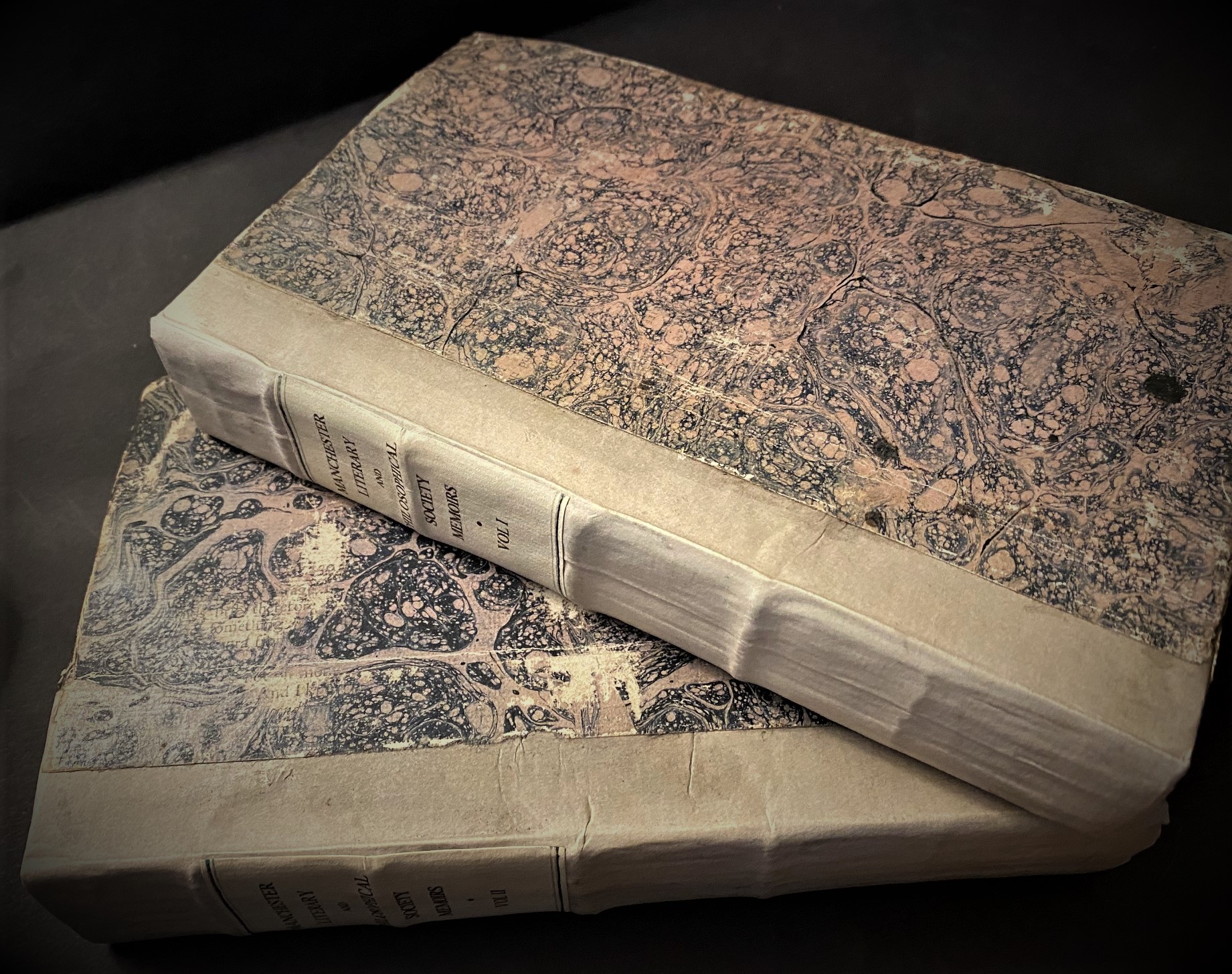
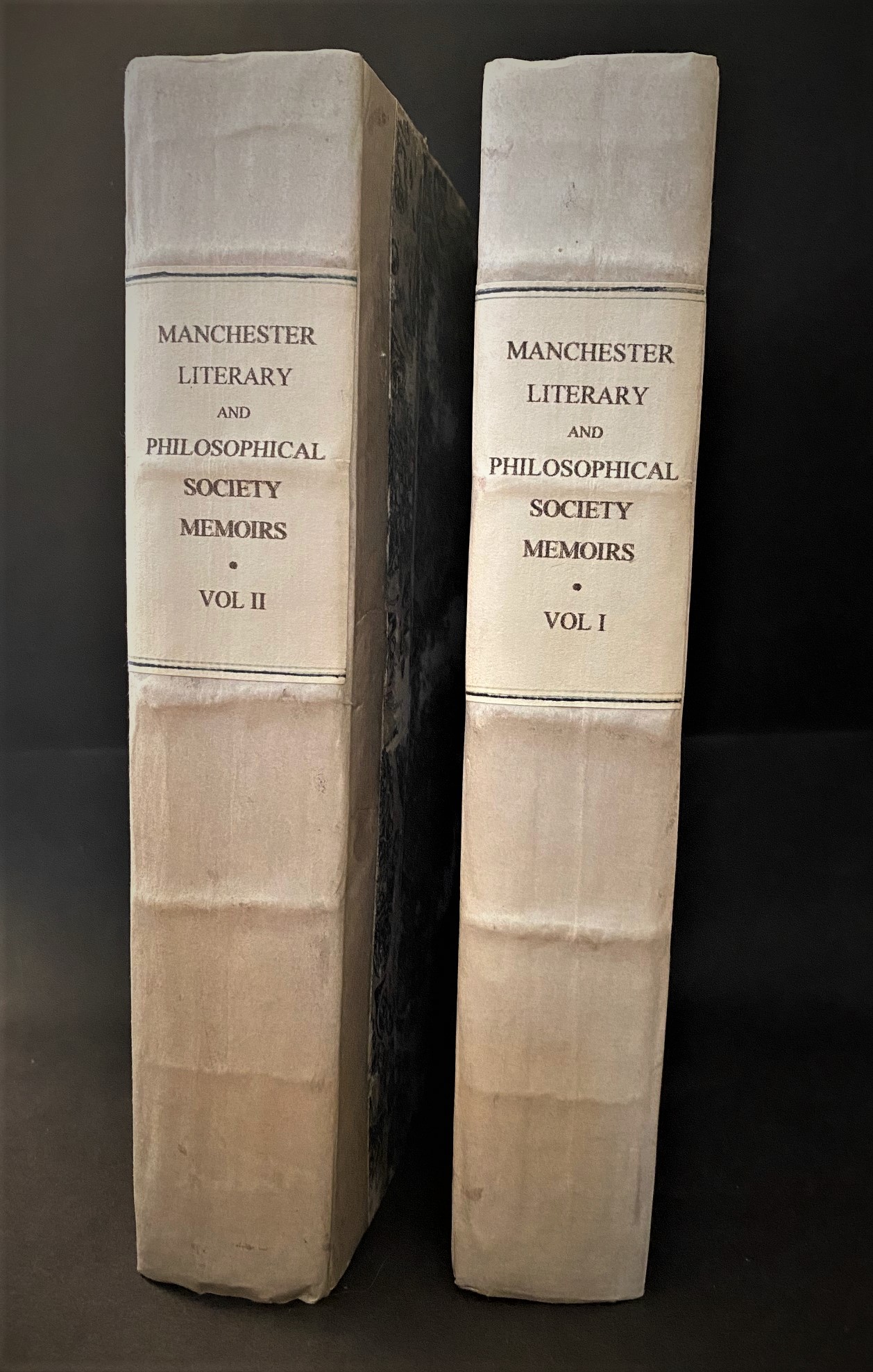
    FRANKLIN, Benjamin. “Meteorological Imaginations and Conjectures” in Memoirs of the Literary and Philosophical Society of Manchester, Warrington, printed by W. Eyres for T. Cadel in London, 1785. xxiii, (I), 473, (12)pp plus 3 engraved plates (two folding); viii,514,(12), plus 2 folding plates. Vellum-like spine, marbled boards; paper spine labels professionally replaced; text edges untrimmed. Original (or 18th c) owner’s name written in ink on title page of each volume. Lovely copies of this scarce title. VG condition. SOLD

    IMG_4139The Franklin contribution occupies 357-361.

    Franklin also contributes the following: “On the Different Quantities of Rain which Fall, at Different Heights, over the same spot of ground, with a letter from Benjamin Franklin…by Thomas Percival”, pp 106-113, with the extract from the Franklin letter on pp 110-113.

    According to the American Institute of Physics website pages on the “Discovery of Global Warming”, this is the earliest paper in the field. (It is the first listed in their chronological bibliography, and is the only 18th century notation, and is also only one of seven papers listed printed before 1850.)

    “The “dry fog” that blanketed much of Europe during the summer of 1783 had occasioned much scientific speculation, but its cause was as yet unknown. In this paper, written nearly a year after the fog first appeared, Franklin was less concerned with its cause (though he did propose a theory that would turn out to be correct) than with its effect, proposing a connection between the summer’s fog and the exceptionally cold winter that followed.–” National Archives Founders online

    IMG_4141

    “In 1783 a volcanic fissure in Iceland erupted with enormous force, pouring out cubic kilometers of lava. Layers of poisonous ash snowed down upon the island. The grass died, and three-quarters of the livestock starved to death, followed by a quarter of the people. A peculiar haze shadowed western Europe for months. Benjamin Franklin, visiting France, noticed the unusual cold that summer and speculated that it might have been caused by the volcanic ‘fog’ that visibly dimmed the sunlight” American Institute of Physics online

    “During several of the summer months of the year 1783, when the effect of the sun’s rays to heat the earth in these northern regions should have been greatest, there existed a constant fog over all Europe, and great part of North America.” He observed the effect the fog had on the sun’s rays: “They were indeed rendered so faint in passing through it, that when collected in the focus of a burning glass, they would scarce kindle brown paper. Of course, their summer effect in heating the earth was exceedingly diminished.”

    “He drew some important conclusions: ‘Hence the surface was early frozen. Hence the first snows remained on it unmelted, and received continual additions. Hence the air was more chilled, and the winds more severely cold. Hence perhaps the winter of 1783-4 was more severe, than any that had happened for many years.’ Franklin was arguably the first American scientist to recognize the sensitivity of climate to changes in radiative forcing, and to propose that the Earth can respond in a way that reinforces the change (now known as ice-albedo feedback).

    IMG_4140

    “Franklin’s logic is clear. Changes in the atmosphere’s radiative properties can affect weather and climate. The response of the Earth can amplify those changes. This can lead to problems, even if the details of the causes are uncertain. Resources should be spent on research to understand and predict changes to anticipate and avoid negative consequences to the extent we are able. –Mark Boslough, Contributor, HuffPost, “Ben Franklin, Climate Science, and National Security”, 2017

    Many other papers of interest can be found in these volumes as well.

    ·Posted by :

    ·in:


  • Reissner’s Working Copy of his Great Paper

    Reissner, Hans J.  

    • Offering two copies of the famous paper–the offprint is certainly very scarce, and Reissner’s own copy of course is probably a unique. Provenance: Hans J. Reissner pamphlet collection.  

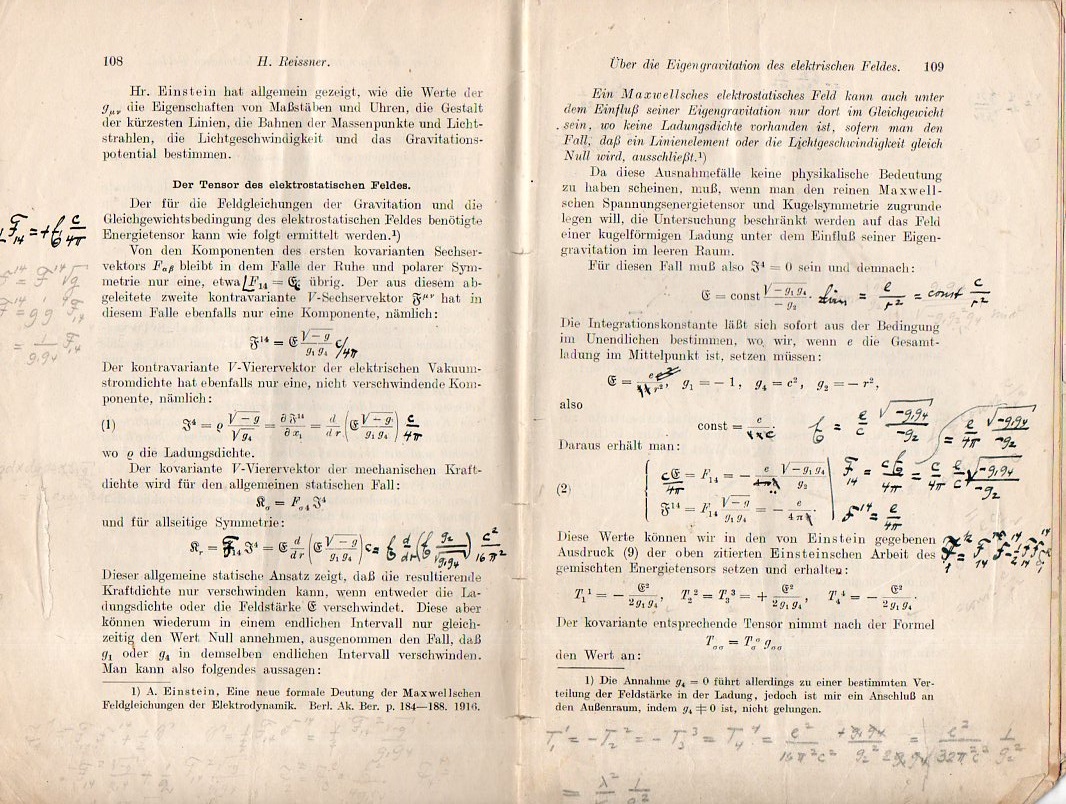
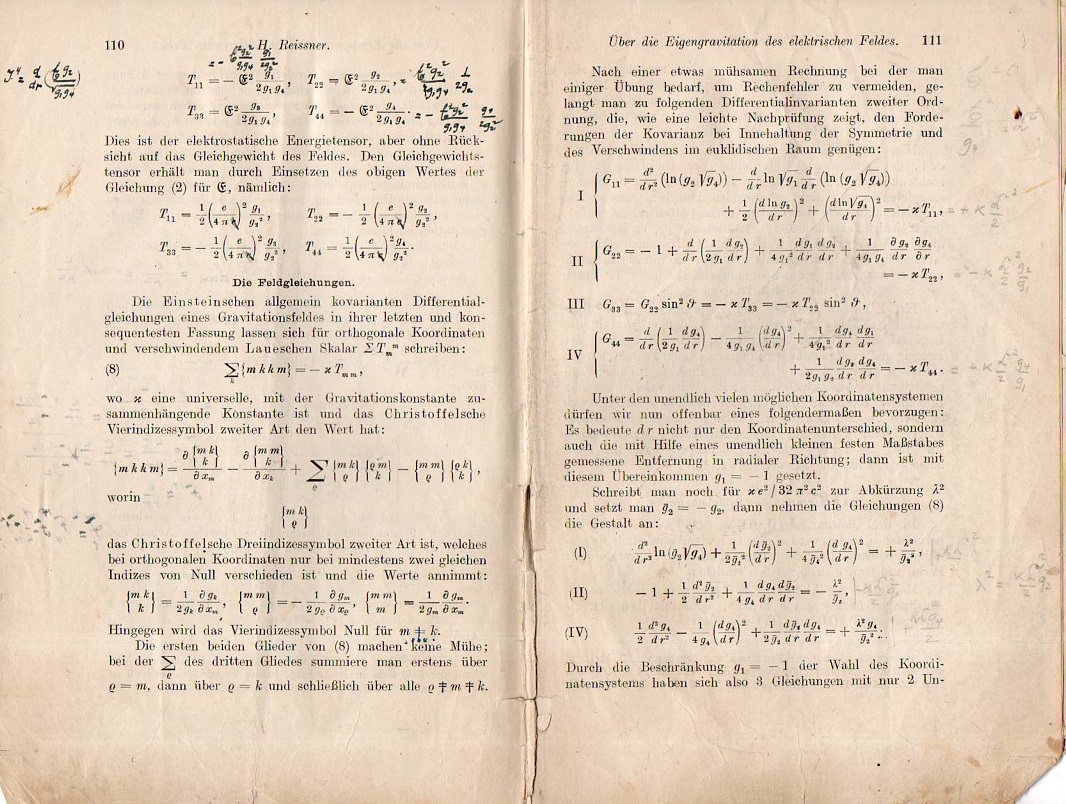
    “Ueber die Eigengravitation des elektrischen Feldes nach der Einsteinschen Theorie” Offprint: Annalen der Physik, 4/50, 1916. Pp 106-120. Without the original outer wrappers. Numerous annotations and calculations on pp 108—111-113, 117, 118, 119. A Good copy, only, of a working issue of the paper. From what I can see none of the annotations were incorporated in the final version of the paper.

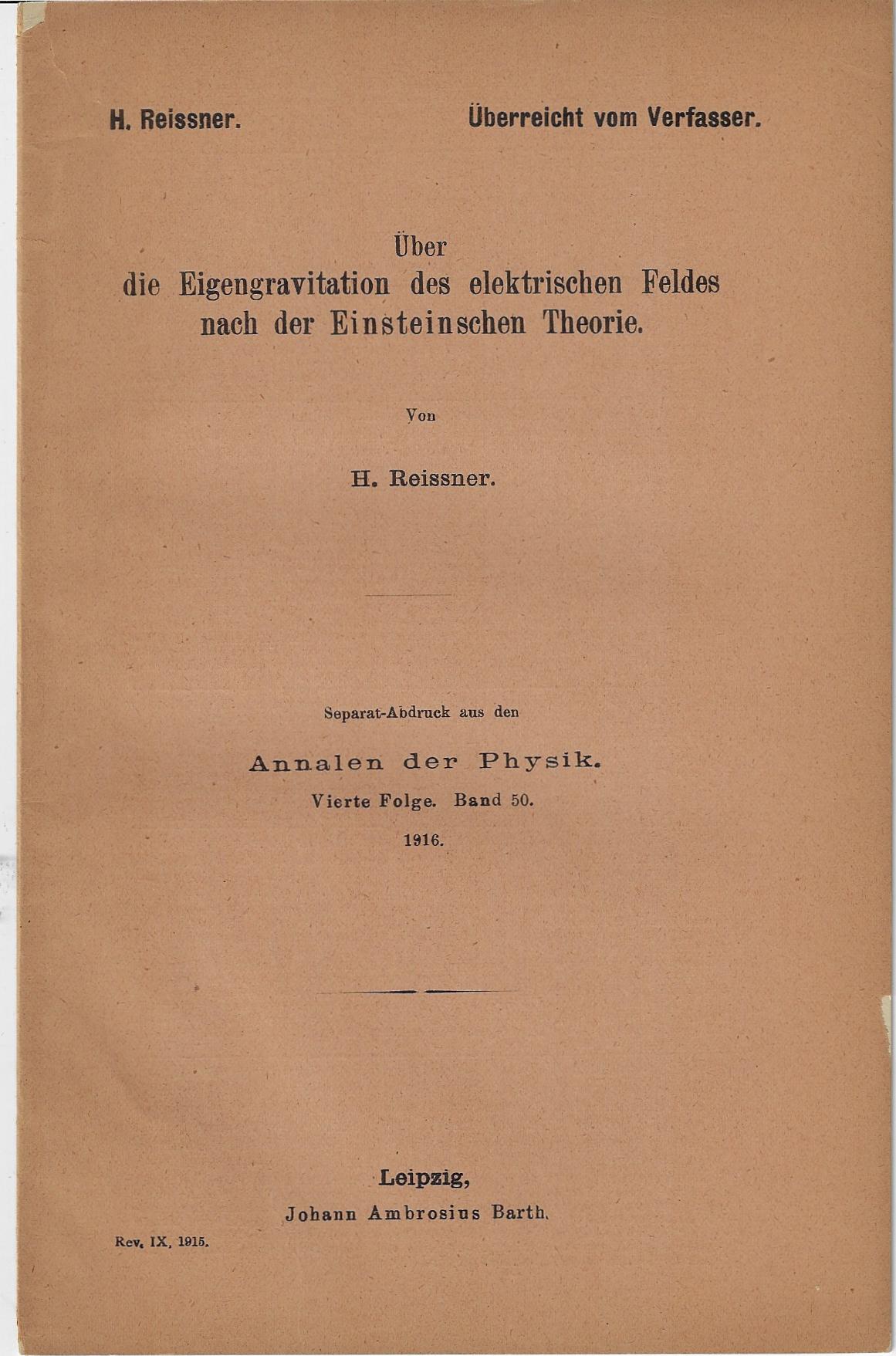
    Offered with:  another offprint copy of the same paper (“Ueber die Eigengravitation des elektrischen Feldes nach der Einsteinschen Theorie”) from Annalen der Physik, 4/50, 1916. Pp 106-120, in the original wrappers, which is the standard (and uncommon) offprint format. 

    The pair: $On hold.

    Reissner098


    “1916 : Hans Reissner (1874-1923) extends the Schwarzschild solution to the case of a charged mass in “Uber die Eigengravitation des elektrischen Feldes nach Einsteinschen Theorie.” Ann. Phys. 59, 106-120,1916. 191”–(See: Nathalie Deruelle, “Black Hole Chronology”  “Six Lectures on Black Holes in General Relativity”, IPhT-CEA, Saclay, January-February 2009.) See Eric Reissner’s appreciation of his father, and  see also Shapiro, S. L. and Teukolsky, S. A. Black Holes, White Dwarfs, and Neutron Stars: The Physics of Compact Objects. New York: Wiley, p. 357, 1983

    Reissner099


    Reissner 1916 _1_


    See also: “Journey into and through a Reissner-Nordstrom black hole”, Andrew Hamilton’s contribution on the University of Colorado site, here: 

    http://jila.colorado.edu/~ajsh/insidebh/rn.html#ref2

    ·Posted by :

    ·in:


  • On Naming Clouds: Luke Howard, 1815

    HowardHOWARD, Luke. Versuch einer Naturegeschichte und Physik der Wolken, von Lukas Howard…in Annalen der Physik, series I/51, band 3- (vi), 442pp, 6 plates. The Howard article appears on pp 1-42. Also included in the volume: Eine Probe von Lukas Howard’s meteorologischen Monatsberichten”, pp 66-72

    And with:Thomas Forster, pp 73-78 “Einigemrteorlogische Beobachtungen in Beziehung auf Lukas Howard’s und De Luc’s ideen.

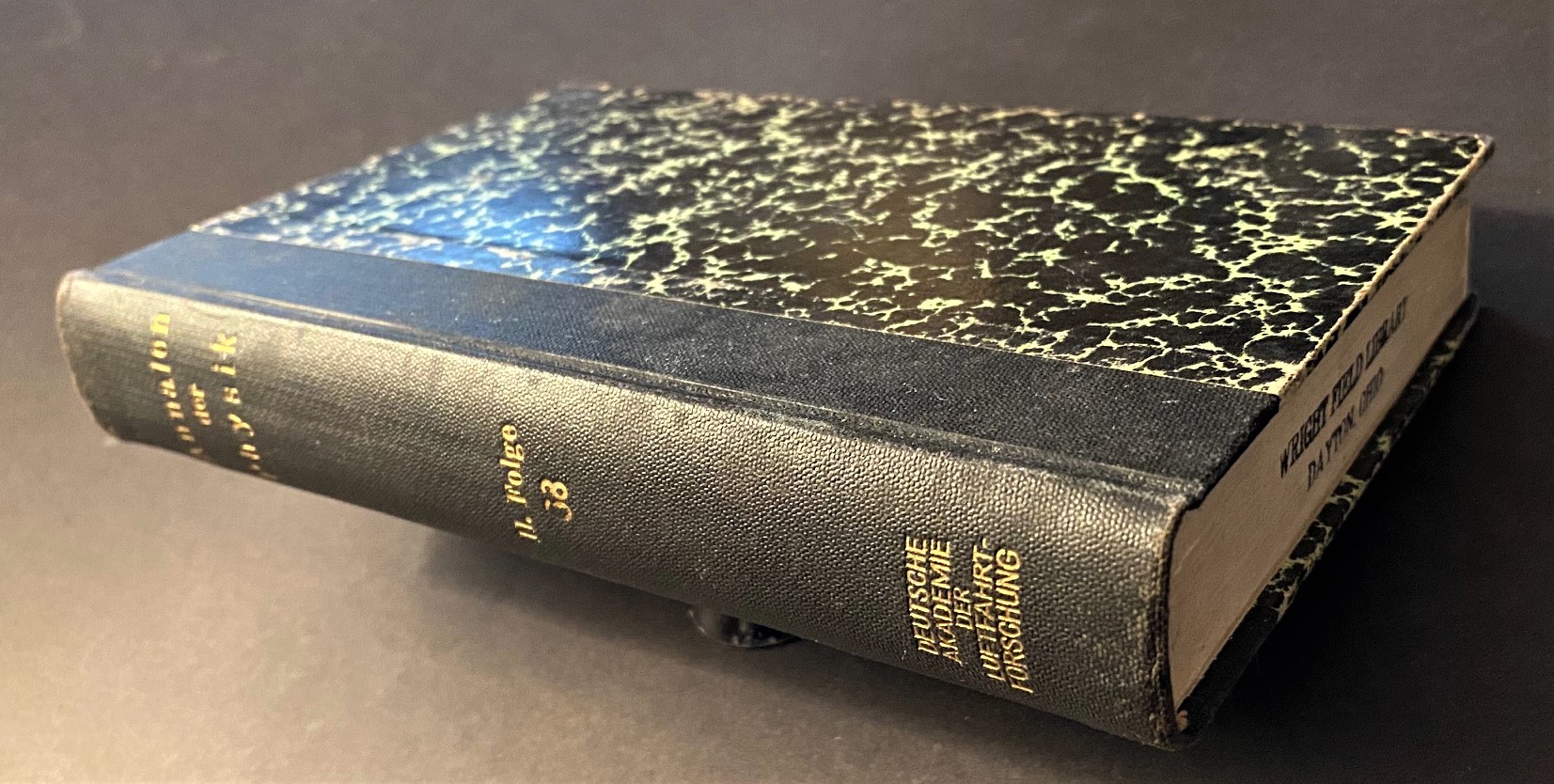
    Provenance: (a) Provinzial Gewebbschele zu Aachen, then (b) Deutsche Akademie der Luftfahrtforschung, and then (c) Wright Field Library (Dayton, Ohio), and finally (d) the Library of Congress. There are ownership rubber stamps on text block page edge at top and bottom, a stamped gilt title on the bottom of the spine, and two scant stamps on the contents page, and that’s it. Very nice, tight, fresh copy.  $350

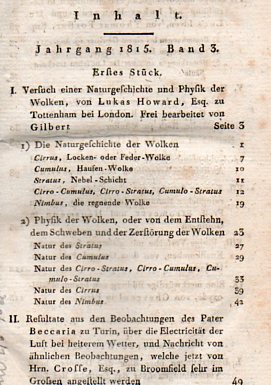
    It is interesting to note that this very important work wasn’t really discussed in the German language for another dozen years, appearing in the Annalen der Physik (series I volume 51) in 1815.  It is also interesting to see that–unlike the English original–there are no illustrations, which in some sense provide a scent of defeat in trying to display these groundbreaking classification ideas. The paper does present the names and descriptions of clouds (as you can see in the attached pic of the table of contents).

    Also contains works by H. Davy (Ueber die Ursaxhe der Farben) and another dozen or so contributors.

    ·Posted by :

    ·in:


  • Dalton John Four Papers 1 Versuche ÜBer WäRme KäLte Die Bei Mechanischer Verdichtung Und VerdüNnung Der Luft Entste

    DALTON, John. Four papers: (1) Versuche über Wärme Kälte, die bei mechanischer Verdichtung und Verdünnung der Luft entstehen. (2) Ueber die Kraft der Flüssigkeiten, Wärme zu leiten, in Beziehung auf des Grafen von Rumford siebenten Essay. (3) Ueber den absoluten Nullpunkt der Wärme und verwandte Betrachtungen. (4) Versuche über die Ausdehnung des Wasser’s durch Wärme. All in Annalen der Physik, Series I, vol 14, (viii), 512pp, 5 plates (the last of which is provided in facsimile). Halle, Rengerschen Buchhandlung, 1803. The volume is bound in black half-cloth and very dark green/black marbled boards.

    Provenance exlibris (a) Provinzial Gewebbschele zu Aachen, then (b) Deutsche Akademie der Luftfahrtforschung, and then (c) Wright Field Library (Dayton, Ohio), and finally (d) the Library of Congress. There are ownership rubber stamps on text block page edge at top and bottom, a stamped gilt title on the bottom of the spine, and two scant stamps on the contents page, and that’s it. Very nice, tight, fresh copy. 

    Each section (stuck 5-8) is offered with their original wrappers bound in (save section 8 which lacks the rear wrapper). The original wrappers for the AdP are uncommon. $750

    Four early and significant papers by Dalton (their first appearance in German) occupying pp 101-11, then pp 184-198, then pp 287-292, an then lastly pp 293-96.

    “Three papers that Dalton read to the Manchester Literary and Philosophical Society in 1799 and 1800 (in which year he became the Society’s secretary) show how much the question of water vapor continued to exercise him. In the first paper he discusses the balance in nature between rain, dew, river-water runoff, and evaporation. In the course of this discussion, he provided the earliest definition of the dew point. Then followed two competent, but more pedestrian, papers on heat, in which his firm belief in a fluid of heat is well-displayed and his complete acceptance of the particular caloric theory of William Irvine an Adair Crawford is apparent.  The really dramatic development came in the summer of 1801. By 14 September, Dalton was confident enough in his ideas to write to William Nicholson’s recently established monthly Journal of Natural Philosophy, Chemistry and the Arts. It showed no hesitation in publishing his “New Theory of the Constitution of Mixed Aeriform Fluids, and Particularly of the Atmosphere.”–Dictionary of Scientific Biography online.

    ·Posted by :

    ·in:


  • Ohm’s Law (1826)

    OHM, Simon. 3 papers: (1) “Versuch über einer Theorie der durch galvanische Kräfte hervorgebrachten elektroskopischen Erscheinungen” , plus (2) “Versuch über einer Theorie der durch galvanische Kräfte hervorgebrachten elektroskopischen Erscheinungen (Beschluss)”, plus (3) “Ein Nachtrag zu dem vorsthenden Aufsatz des Hrn. Dr. Ohm”. Paper (1) in Annalen der Physik und Chemie, volume 6, section 4, pp. 369-514, with 1 engraved plate, with the Ohm in section 4, pp 459-469. Paper (2), in Annalen der Physik und Chemie, volume 7, section 45, pp 45-55 in the issue of pp 1-136. Paper (3) same issue as paper 2, pp 117-118. Each section removed from a larger bound volume, though complete in itself. VG copies.  $1750

    “In February an April 1826, Ohm published two important papers that dealt separately with the two major aspects of his ultimately unified theory of galvanic electricity…the second paper, “Versuch einer Theorie der durch galvanische Kräfte hervorgebrachten elektroskopischen Erscheinungen,” broke new ground in associating an electric tension with both open and closed galvanic circuits.” –Dictionary of Scientific Biography (online)

    “Ohm’s second major paper of 1826 [this paper] announced the beginnings of a comprehensive theory of galvanic electricity based, he said, on the fact that the contact of heterogeneous bodies produced and maintained a constant electric tension (Spannung). He deferred the systematic exposition of this theory to a later work, however, and limited himself to stating without derivation the two equations that constituted its heart: X = kw(a/l) and u − c = ±(x/l)a, where X is the strength of the electric current in a conductor of length l, cross section w, and conductibility (Leitungs-vermögen) k produced by a difference in electric tension a at its end points; where u is the electroscopic force at a variable point x of the conductor; and where c is a constant independent of x. By means of the first equation one can, with respect to overall conducting power (or resistance), reduce the actual length of a wire of whatever cross section and conductibility to the equivalent length of one wire chosen arbitrarily as a standard. Letting l now be this equivalent length—called the reduced length (reducirte Länge) of the conductor—Ohm wrote his first law in the simpler form X = a/l, the expression which has become known as Ohm’s law. After pointing out briefly how this law, which corresponded to the one he had developed in his previous paper, embraced his and others’ findings on the conductibility of different wires, Ohm devoted the rest of the paper to developing the implications of the second, electroscopic law and to comparing these implications with previously known facts. In this work he showed that his formula successfully explained those experiments which measured the electroscopic force at different points (especially the poles) of open and closed, and grounded and ungrounded, circuits. Here again the explanatory power of his law was impressive. The fully developed presentation of his theory of electricity appeared in Ohm’s great work, Die galvanische kette, mathematisch bearbeitet (Berlin, 1827). –DSB online

    ·Posted by :

    ·in:


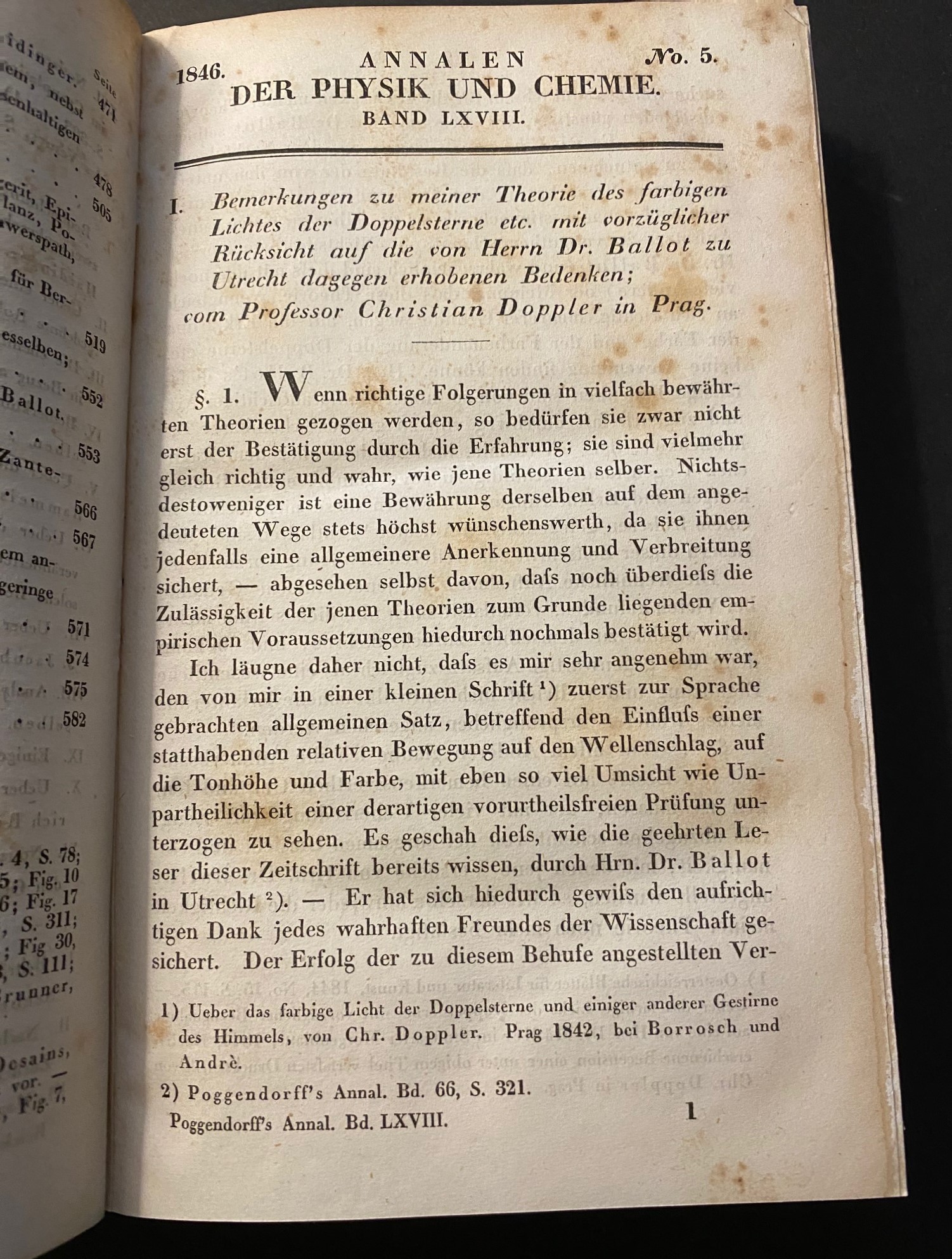
  • An Extension of Doppler’s Great Paper of 1842 (1846)

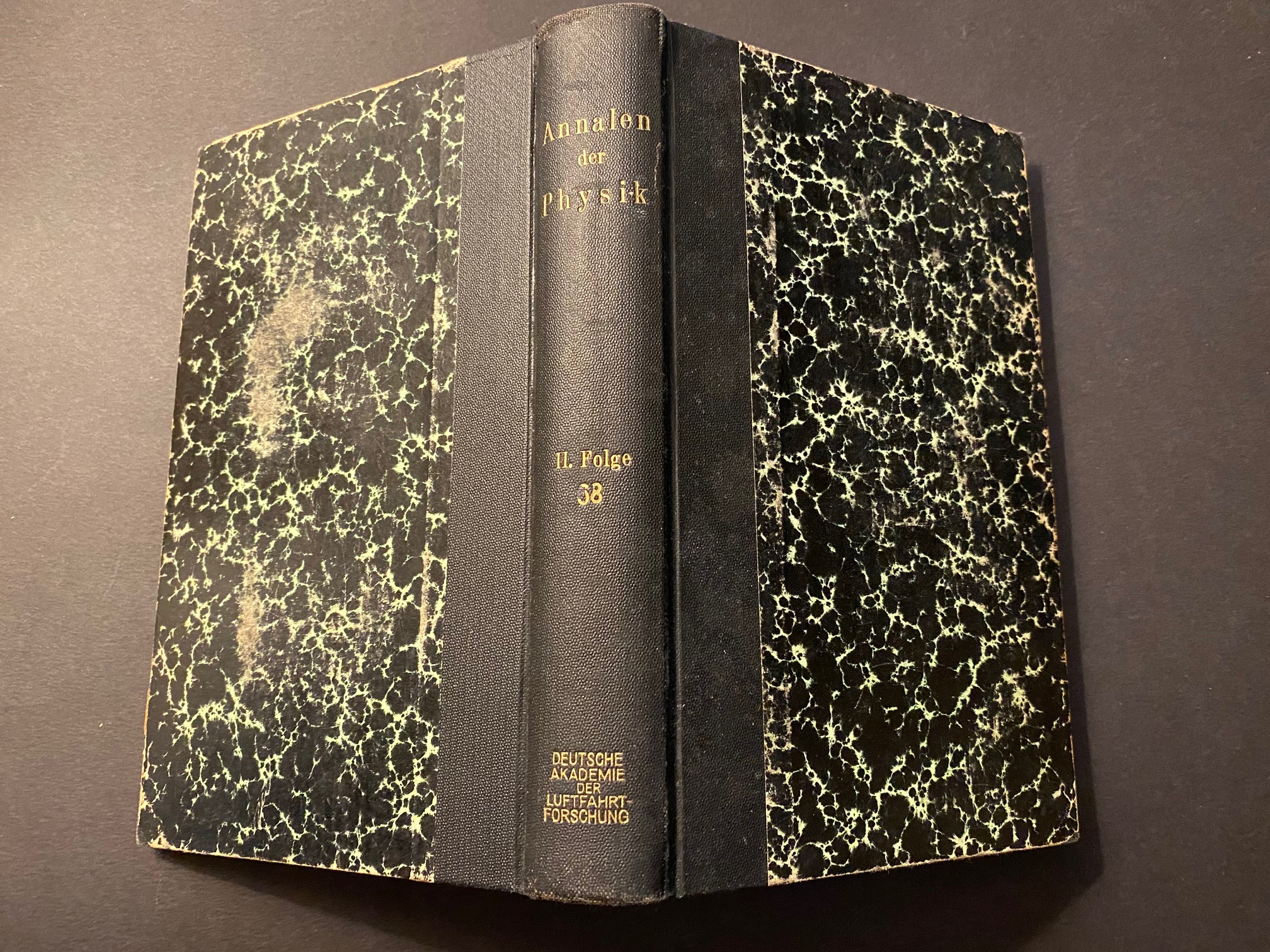
    Christian Doppler. “Bemerkungen zu meiner Theorie des farbigen Lichtes der Doppelsterne etc. mit vorzüglicher Rücksicht auf die von Herrn Dr. Ballot zu Utrecht dagegen erhobenen Bedenken”. Published in the Annalen der Physik, by the publisher Johann Ambrosius Barth, in Leipzig, 1846, band 68, no. 5, part 1, pages 1-35. ¶ First edition. Offered as part of the entire half-year of the publication, numbering 582pp. The volume is bound in black half-cloth and very dark green/black marbled boards. Exlibris (a) Provinzial Gewebbschele zu Aachen, then (b) Deutsche akademie der Luftfahrtforschung, and then (c) Wright Field Library (Dayton, Ohio), and finally (d) the Library of Congress. There are ownership rubber stamps on text block page edge at top and bottom, a stamped gilt title on the bottom of the spine, and two scant stamps on the contents page, and that’s it. Very nice, tight, fresh copy.   $1500

    IMG_2384

    This is an extention of Doppler’s epochal “Ueber das farbige Licht der Doppelsterne und einiger anderer Gestirne des Himmels,” which appeared in Abhandlungen der Konigl. Böhmischen Gesellschaft derWissenschaften, (5th ser., 2 (1842), 465, and which was also published separately in Prague in the same year, (1842) in which the idea of motion is expressed to both source and observer, based on the experimental work of Buys-Ballot. “ The Doppler Theory/Doppler shift is of monumental applicability and importance, providing the foundation for sonar and radar, as well as for the general acceptance of the cosmological theory of the Big Bang (showing how the shift in the spectra of astronomical entities allows for the measurement of the rate of recession relative to the Earth.

    “Buys-Ballot [Buys-Ballot, Christophorus Henricus Didericus (1817-1890)] also conducted one of the most famous experiments to confirm the Doppler shift.  He put a group of musicians on a train and took up his position on a station platform. He asked the train driver to rush past him as fast as he could while the musicians played and held a constant note, and was able to detect the Doppler shift (as a change in pitch) as the train passed him (Filkin and Hawking 1997, p. 65).” –Eric Weisstein’s Science Biography pages on the Wolfram Research website

     “In 1845, Christophe Ballot, a Dutch meteorologist, conducted a public demonstration to prove it. Ballot lived beside a train line, and he noticed the change in pitch in whistles and sounds as the train passed him by. He pulled a few strings and got a train to pull along an open-air cart filled with trumpet players. Meanwhile, more trumpet players stood in a station. Ballot checked the pitch of their instruments, and then got each section to play the same note as the train hurtled — at an astonishing forty miles per hour — past the station. Although the players in the station stayed right on the note, the players in the train by seemed to be pitched a little too high, and dropped a little too low as the train passed the station. Everyone in the station could hear the changing notes as the trained passed, and one of the most useful tools in all of physics was finally recognized.” Esther Inglis-Arkell, Gizmodo (2013)

    “In 1846 Doppler published a revised version of his principle where he considered both the motion of the source and the motion of the observer. Later, a French physicist, Armand Hippolyte Louis Fizeau (1818–1896), who made one of the first measurements of the velocity of light, generalized Doppler’s work by applying his theory not only to sound but also to light.”– A. Roguin, “Christian Doppler, the Man Behind the Effect”. The British Journal of Radiology, 75 (2002), 615–619

    • Bibliography of Doppler’s work. In: Stoll I, editor. The Phenomenon of Doppler. Prague, Czechoslovakia: Czech Technical University, 1992:76–80.

    This volume also contains significant paper by Michael Faraday, the first German edition of “Thoughts on Ray Vibration”, which suggests that no ether or other vibrating material is responsible for the transmission of light. 

    IMG_2386 (1)
    IMG_2386 (1)

    ·Posted by :

    ·in:


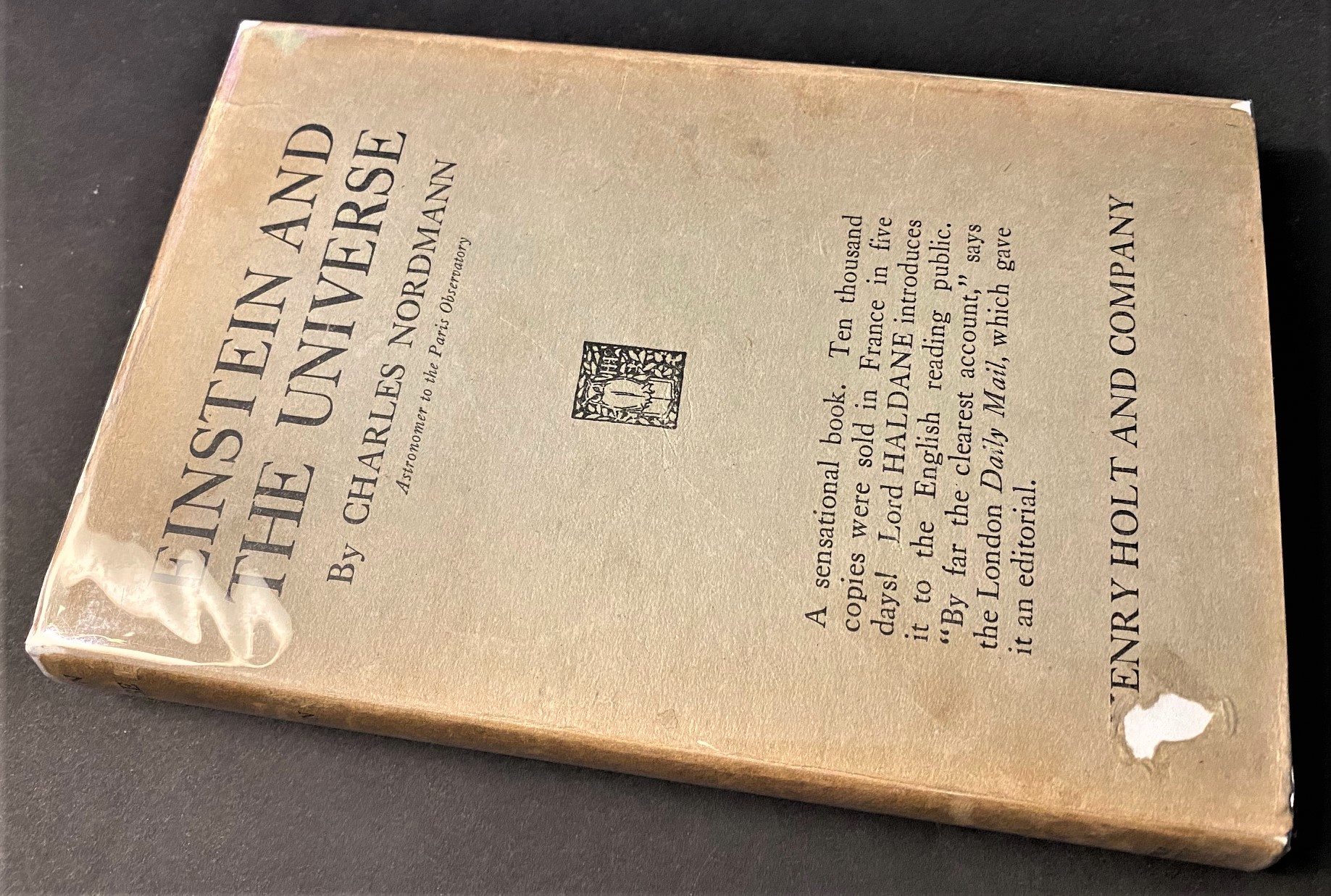
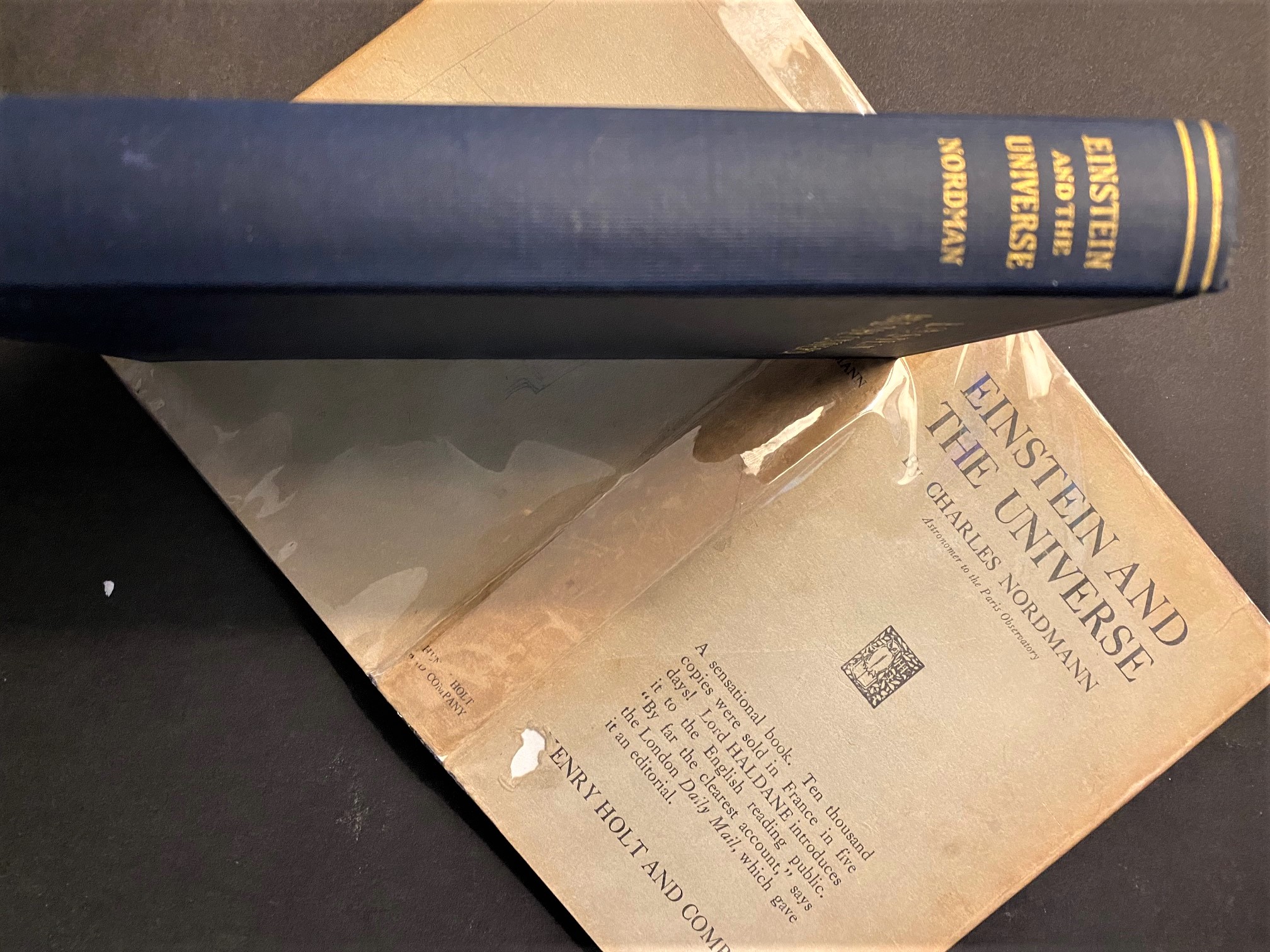
  • Einstein and the Universe (1922)

    Charles Nordmann, Einstein and the Universe. Henry Holt & Co., NYC, 1922, First U.S. Edition. Xvi, 240pp. Original cloth. Excellent copy in a VG dust jacket. $250 (The first printing of the book was in Paris earlier in 1922; there was also a British and German edition in 1922 as well.)

    The dj has some chips here and there, as well as a hole (as you can see in the pic) in the front panel—otherwise (as they say) this is in good shape. The book itself is Fine.

    “Charles Nordmann was an early pioneer of radio astronomy, the creator of multicolor photometry techniques, and a noted popularizer of astronomy. After receiving his Licencié ès sciences in 1899, he spent the following year at the Meudon Observatory, near Paris, under the directorship of Pierre Janssen . There, Nordmann began a study of the Sun, its activity, and effects on the Earth’s magnetic field. From 1902 to 1903, he worked in the magnetic service at the Nice Observatory. For his doctoral research at the University of Paris, Nordmann attempted to test the prediction of Henri Deslandres that the Sun ought to emit Hertzian (i. e., radio) waves. He constructed a horizontal antenna, 175 m long, and installed it on the glacier of the Bossons (on Mont Blanc). Despite Nordmann’s best efforts, no definite signals were ever received….”–The Biographical Encyclopedia of Astronomers (online), Springer Verlag

    IMG_2379
    IMG_2379

    And the German first edition:

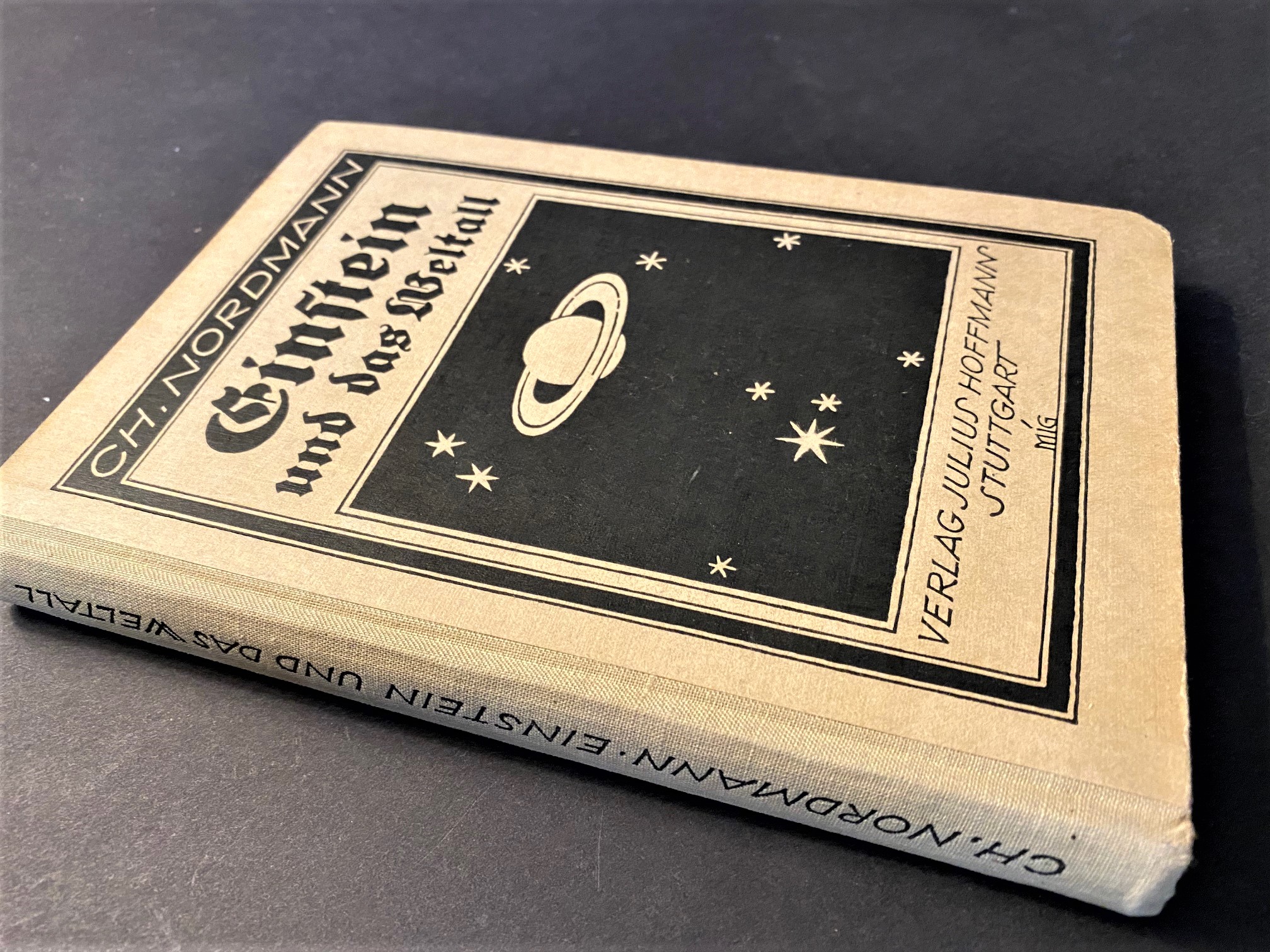
    Charles Nordmann. Einstein und das Weltall. Stuttgart, Verlag von Julius Hoffmann, 1922. 8”x 5”, 199pp. Decorated paper boards and a cloth spine. VG copy. $50

    IMG_2383

    ·Posted by :

    ·in:


  • The Raman Effect (Nobel Prize, 1930)

    RAMAN, Sir Chandrasekhara Venkata, and K. S. Krishnan, “The Production of New Radiations by Light Scattering. Part I” , in Proceedings of the Royal Society A 122 pp. 23-35, 1929, in the volume of vi, 719, xxii, vipp. Beautifully bound in leather and boards, marbled page edges. Very slightly ex-lib with edge stamps and stamp on title, otherwise this is a fresh, clean copy. A handsome volume even with the page edge stamps. [There was no”part II” to this paper.] $350

    Also bound with A.S. Eddington, “The Charge of an Electron”, pp 358-369 and A.H. Wilson, “Perturbation Theory in Quantum Mechanics”, pp 589-598. Leading the volume is an interesting review of recent work by Ernest Rutherford, “Anniversary Address…:, pp 1-23.

    This is an expanded description of the Raman effect, the work for which Raman received the Nobel Prize for Physics in 1930 “for his work on the scattering of light and for the discovery of the effect named after him” (Nobel site), “that when light traverses a transparent material, some of the light that is deflected changes in wavelength…(a) phenomenon…called Raman scattering the result being the Raman effect”.–Encyclopedia Britannica

    Raman publishes his paper for the first time a few months earlier in the Indian Journal of Physics, which led to a huge run of publications on the discovery—at least 160 in the 1928-1929 period according to the bibliography on papers published on the Raman effect “Bibliography of 150 Papers on the Raman Effect, 1928-1929”, by Dr. A. S. Ganesan. Of the 160 papers 12 are by Raman, and it was in the paper offered here (#62 in the bibliography) where he offers material not addressed in his previous papers.

    ”After Compton had discovered the Compton effect Heisenberg (1925) pointed out …that this ought to be true for any em radiation, including visible light. That it was so in practice was shown in 1928 by…Raman…Raman spectra proved to be useful in determining some of the fine details of molecular structure.”–Asimov Chronology

    “One of the most convincing proofs of the quantum theory of light.”–R.W. Wood

    “In the Raman effect, a small fraction of light (approximately 1 in 10 million photons) is scattered through inelastic scattering, in which the energy of the scattered photon is not conserved. The Raman effect demonstrates the wave–particle duality of light a bit like the Compton effect, but the Raman effect differs from the Compton effect in the nature of the photons used (Raman uses visible light and Compton uses much higher energy X-rays) and the effect on the electron that scatters the light (the Raman effect changes the energy level of within an atom or molecule while the Compton effect ejects the electron from the material through the photoelectric effect).”

    “Optical studies remained his chief concern, however. With his associates Raman studied the scattering of light of available frequencies by a number of substances, particularly fluids. In April 1923 Raman’s associate K. R. Ramanathan observed a weak secondary radiation, shifted in wavelength along with normally scattered light, which was attributed to “fluorescence.” S. Venkateswaran then noticed that highly purified glycerin does not appear blue under sunlight, but rather radiates a strongly polarized, brilliant green light.

    “Raman and K. S. Krishnan then undertook to isolate the effect under impeccable experimental conditions. They employed complementary light filters placed in the paths of the incident and scattered light, respectively, and observed a “new type of secondary radiation” from the scattering of focused beams of sunlight in both carefully purified liquid and dust-free air. They reported this discovery in a letter to Nature in February 1928. Raman then refined the experiment by using a mercury arc as the source of light; the effect was thus clearly seen for the first time on 28 February 1928 and was reported to the Science Congress at Bangalore the following month. The secondary radiation showed several lines shifted toward longer wavelengths, the shifts being characteristic of the substances being examined, and indicated the absorption of energy by the scattering molecule—the precise effect that had been predicted by A. Smekal in 1923. G. Landsberg and L. Mandelshtam, in the U.S.S.R., independently observed the same phenomenon in quartz, shortly after Raman and Krishnan made their discovery, but Raman’s account of the effect reflected a much more detailed investigation. In 1929 Raman was knighted in recognition of his work, and the following year he was awarded the Nobel Prize for physics.”–Complete Dictionary of Scientific Biography

    ·Posted by :

    ·in: