A Daily History of Holes, Dots, Lines, Science, History, Math, Physics, Art, the Unintentional Absurd, Architecture, Maps, Data Visualization, Blank and Missing Things, and so on. |1.6 million words, 7500 images, 4.9 million hits| Press & appearances in The Times, Le Figaro, Mensa, The Economist, The Guardian, Discovery News, Slate, Le Monde, Sci American Blogs, Le Pont, and many other places… 5000+ total posts since 2008.

Book Category: Physics

  • Unified Field Theory (1927)

    EINSTEIN, Albert. “Zu Kaluzas Theorie des Zusammenhanges von Gravitation und Elektrizität – Erste Mittelung”, pp 23-25; with in the same issue, “Zu Kaluzas Theorie des Zusammenhanges von Gravitation und Elektrizität – Zweite Mitteilung”, pp 26-30, in Sitzungsberichte der Königlich Preussischen Akademie der Wissenschaften, Physikalisch-mathematische Klasse VI, Berlin 1927, pp. 17–30, February 17, 1927). Individual issue in original wrappers.

    • Wrappers are a bit sunned along the edges, otherwise fine. $500.00

    Theodor Franz Eduard Kaluza (1885-1954) was a German mathematician and physicist known for the Kaluza–Klein theory (“the two pioneers of unified field theory”, A Pais, Subtle is the Lord, pp 329). Einstein thought very highly of Kaluza (according to MacTutor) and in 1921 encouraged him to publish his paper in which he solved Einstein’s equations of general relativity by using field equations in five-dimensional space-time. (Nordstrom had proposed “to use a five dimensional space for the unification of em with a scalar gravitational field” (A.Pais) publishing in Phys Zeit 15, p 504, 1914.) Of Kaluza’s work Einstein writes to Lorentz: ”It appears that the union of gravitation and Maxwell’s theory is achieved in a completely satisfactory way by the five-dimensional theory (Kaluza-Klein-Foch)”–Pais, Subtle..., p 333.

    Again according to Pais, Einstein wrote to Kaluza in 1921 saying “the formal unity of your theory is startling” (Subtle…, p330) after which he communicated the K paper to the Prussian Academy. It was in these two papers presented above that Einstein wrote on Kaluza’s work—this some four years after an earlier paper Einstein wrote with Grommer. (Einstein would return to Kaluza in a paper with Peter Bergmann, “On a generalization of Kaluza’s theory of electricity” in the Annals of Mathematics, Vol. 39, no. 3, in July 1938 and which he would address again in Science in 1931 with Meyer and in the Prussian Academy the same year.)

    “[Kaluaza] was teaching at Königsberg in April 1919 when he wrote to Einstein and told him about his ideas to unify Einstein’s theory of gravity and Maxwell’s theory of light. Einstein encouraged him to publish his highly original ideas which he did in 1921 in his paper on the unity problem of physics…Kaluza’s ideas involved the introduction of a fifth dimension and, although he has been criticised for introducing this as a purely mathematical idea, his work is important and was explored by others…Kaluza is remembered for this in Kaluza-Klein (named after the mathematician Oskar Klein) field theory, which involved field equations in five-dimensional space. The theory, initially a popular topic of research, quickly lost favour with the introduction of quantum mechanics.”–MacTutor, St. Andrew’s Math History.

    “As is so often the case, string theory arose from a collection of discredited ideas… When string theory became mainstream, physicists realised that these early insights were extraordinarily prescient. The story begins in 1919 with a little known Polish mathematician, Theodor Kaluza. Inspired by Einstein’s revolutionary ideas, he attempted to overthrow a central tenet of physics. “What if there are extra dimensions we just can’t see?” he asked. Working alone, he attempted to incorporate a hidden dimension into Einstein’s model for gravity. Unsurprisingly, his five-dimensional theory had more equations than the usual four-dimensional approach. Looking closely at the extra equations he had found, Kaluza spotted something remarkable. They were precisely Maxwell’s equations governing the electromagnetic field…”–”Whystringtheory” (supported by Oxford and the Royal Society)

    ·Posted by :

    ·in:


  • Wheeler’s Classic Work on Geometrodynamics (1962)

    Wheeler, John A. Geometrodynamics. Academic Press, Italian Physical Society, Topics in Modern Physics 1, 1962. xxiii,334pp. Original cloth. Near-fine condition. $750

    Contains: Wheeler, “Neutrinos, Gravitation and Geometry”, pp 1-129; “Geons”, pp 131-184 (Physical Review, vol 97, pp 511-536; “Thermal Geons”, (reprinted from Review of Modern Physics, 29, pp 480-495, 1957; “Classical Physics as Geometry”, with Charles Miser, from Annals of Physics, vol 2, 1957, pp 233-331.

    “Classical gravitation, electromagnetism, charge, and mass are described in a preceding article in terms of curved empty space and nothing more. In advance of the detailed quantization of this pure Einstein-Maxwell geometrodynamics, an attempt is made here (1) to bring to light some of the most important properties to be expected for quantized geometrodynamics and (2) to assess whether this theory, without addition of any inventive elements, can contribute anything to the understanding of the elementary particle problem.”–Wheeler, John A. On the nature of quantum geometrodynamics” in Annals of Physics, volume 2, Issue 6, December 1957, Pages 604-614

    “In theoretical physics, geometrodynamics is an attempt to describe spacetime and associated phenomena completely in terms of geometry. Technically, its goal is to unify the fundamental forces and reformulate general relativity as a configuration space of three-metrics, modulo three-dimensional diffeomorphisms. It was enthusiastically promoted by John Wheeler in the 1960s, and work on it continues in the 21st century…The term geometrodynamics is as a synonym for general relativity “–Wikipedia

    “Wheeler wanted to reduce physics to geometry in an even more fundamental way than the ADM reformulation of general relativity with a dynamic geometry whose curvature changes with time. It attempts to realize three concepts:

    • mass without mass

    • charge without charge

    • field without field.

    He wanted to lay the foundation for quantum gravity and unify gravitation with electromagnetism (the strong and weak interactions were not yet sufficiently well understood in 1960 to be included).

    Wheeler introduced the notion of geons, gravitational wave packets confined to a compact region of spacetime and held together by the gravitational attraction of the (gravitational) field energy of the wave itself. Wheeler was intrigued by the possibility that geons could affect test particles much like a massive object, hence mass without mass.” Encyclopedia Britannica

    ·Posted by :

    ·in:


  • The First Appearance of the Compton Effect (1923)

    Arthur H. Compton, “A Quantum Theory of the Scattering of X-Rays by Light Elements”, in Physical Review, 1927, vol 21 (second series) no.5. May 1923, pp 483-502. Offered in a very simple library quick-binding cloth-backed paper-covered boards (serviceable if not attractive) containing the issues for April – June, pp 391-722. Exlibrary, with a stamp on the cover and a stamp of several interior pages though not on the title page of the Compton (which was the lead article for May). So, a GOOD copy. $950

    Compton shared the Nobel Prize in physics in 1927 “for his discovery of the effect named after him” and Charles Thomson Rees Wilson “for his method of making the paths of electrically charged particles visible by condensation of vapour.”

    “Arthur Holly Compton will always be remembered as one of the world’s great physicists. His discovery of the Compton effect, so vital in the development of quantum physics, has ensured him a secure place among the great scientists” (DSB)

    ·Posted by :

    ·in:


  • First Published Proof of the Hellmann-FeynmanTheory

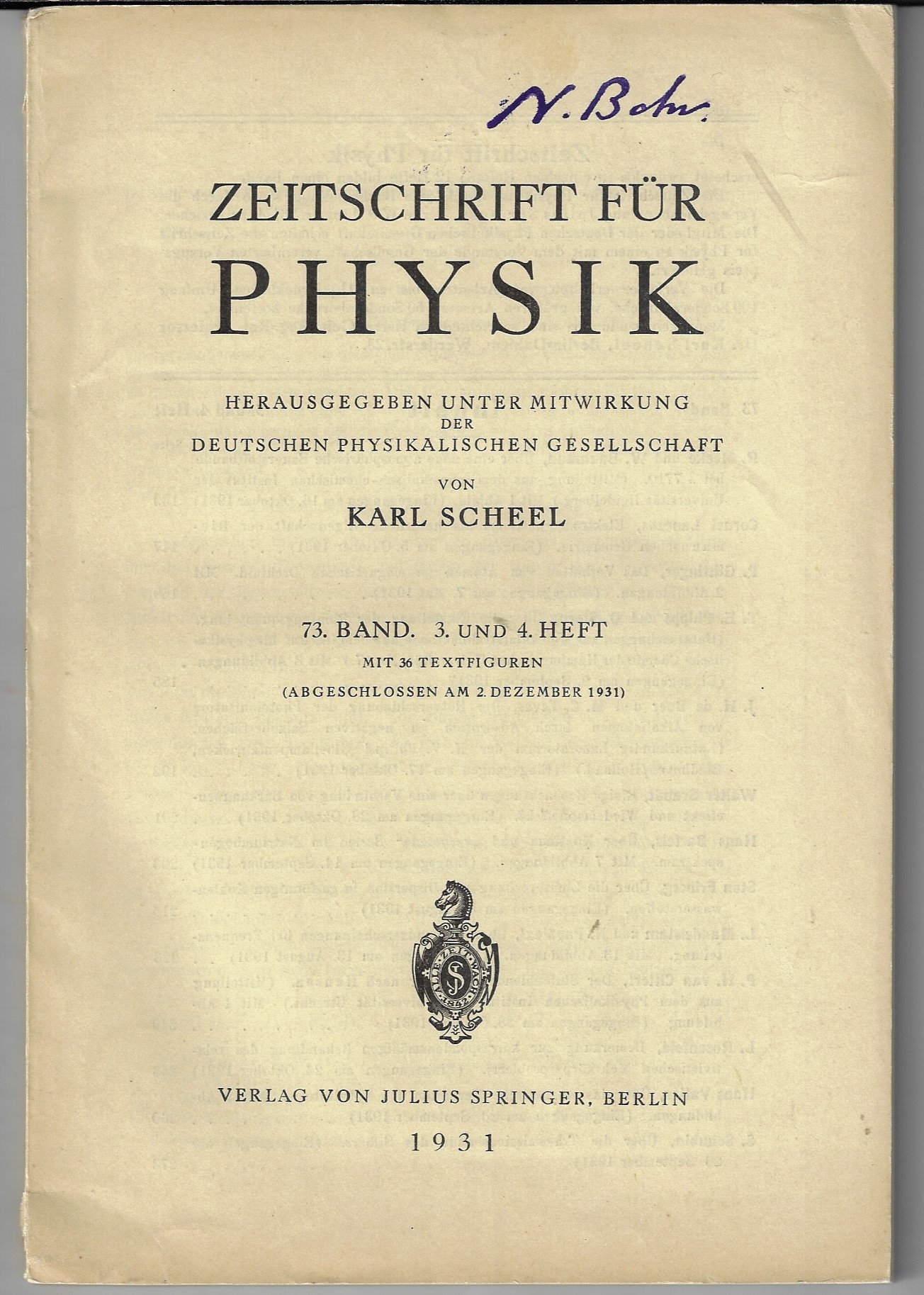
    Güttinger , P. (1932). “Das Verhalten von Atomen im magnetischen Drehfeld”. In: Zeitschrift für Physik, vol 73 (3–4),  pp 169–184 in the issue of pp 139-280. Original wrappers. Lovely copy.

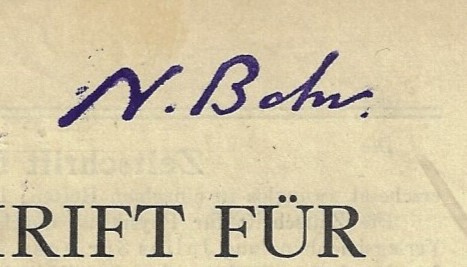
    This is Niels Bohr’s copy, with his name printed at the top right. $500

    Guttinger 1933 Bohr sig

    Guttinger 1933 ZfP “The Hellmann-Feynman theorem has an illustrious albeit somewhat complicated lineage, which includes three Nobel Laureates. The key relationship was reported by Schrödinger in one of his landmark 1926 papers, by Güttinger [who took his Ph.D. at ETH Zurich under Scherrer and Pauli in 1932] in 1932 and by both Pauli and Hellmann in 1933. Feynman presented it, apparently independently, in 1939. It was Hellmann and Feynman who arrived separately at one of the best known consequences of the theorem, which is presumably why their names are attached to it. Over the years, the approval rating of the Hellmann-Feynman theorem has fluctuated wildly. In a 1945 paper, Coulson and Bell concluded that it was invalid; however, Berlin rescued it in 1951…He also showed how the theorem could be used to obtain insight into bonding forces in molecules, an approach that Bader et al. followed successfully a few years later. In 1962, Wilson used the theorem to derive an exact formula for molecular energies. Nevertheless, Musher claimed in 1966 that many find the theorem to be “too trivial to merit the term ‘theorem’”. Yet only six years later, no less an authority than Slater proclaimed the Hellmann-Feynman theorem to be one of the “two most powerful theorems applicable to molecules and solids”, the other being the virial theorem.”–Politzer, P., Murray, J.S. “The Hellmann-Feynman theorem: a perspective”,  J Mol Model 24, 266 (2018).

    “In quantum mechanics, the Hellmann–Feynman theorem relates the derivative of the total energy with respect to a parameter, to the expectation value of the derivative of the Hamiltonian with respect to that same parameter. According to the theorem, once the spatial distribution of the electrons has been determined by solving the Schrödinger equation, all the forces in the system can be calculated using classical electrostatics. The theorem has been proven independently by many authors, including Paul Güttinger (1932), Wolfgang Pauli (1933), Hans Hellmann (1937), and Richard Feynman (1939) [The Feynman contribution appears in his first published paper, “Forces in Molecules”, in the PR in 1939.


    ·Posted by :

    ·in:


  • Nuclear Fission in 1939 from Three Major Journal Sources

    Here we three get collections of papers on nuclear fission (and more) in the 1939 volumes of three leading physics journals: The Physical Review, Revue Scientifique, and the Comptes Rendus…de l’Academie des Sciences.  

    Oppenheimer, Gamow, Feynman, Szilard, Bohr, Bethe, Rabi, and others all in the Physical Review, 1939

    “On continued gravitational contraction” and many other papers offered in one monumental year of the Physical Review for 1939.

    American Physical Society, Lancaster Pa., January-December 1939. Two volumes: x, 1294pp & x,1300pp. The two volumes, complete. Finely and sturdily rebound in cloth and marbled boards. Very stout, readable volumes. Fine condition. Few scant ownership stamps on some of the individual issues’ first page. $2250

    This is a remarkable volume for one of the most electrifying years in the history of modern phsyics, ranking alongside the great years of 1859, 1932, and 1948 for the sheer weight of highly significant papers from many sources. Included are papers by Oppenheimer, Gamow, Feynman, Szilard, Bethe, Rabi, Anderson, Tolman, Morrison, Kusch, Abelson, and many others. Astonishing, really.

    Some of the most significant papers include:

    OPPENHEIMER, Robert and Hartland Snyder, “On continued gravitational contraction”, September 1, 1939, Vol. 56, #5, pp. 426-50

    The Oppenheimer and Snyder (a graduate assistant) paper is one of the most prescient in the history of modern physics, correctly physically describing (where Chandrasekhar and Eddington in their discussions did not) what happens in a particular collapse of a neutron star, and still today reads as fresh and and brightly as it did in 1939.  Really, it is an extraordinary work, and a foundation paper in the history of gravitation, the application of RT, singularity, and astrophysics.  (The Southampton GR Explorer site nicely states it this way: “This paper has strong claims to being one of the most prophetic ever written in this field of research. Today, 60 years later, this paper needs little revision – even the terminology is undated!”)

    In an often-repeated quotation, they write, somewhat in irony and in a certain and understated manner on page 456: “The star thus tends to close itself off from any communication with a distant observer; only its gravitational field persists”. And later: “When all thermonuclear sources of energy are exhausted, a sufficiently heavy star will collapse. Unless fission due to rotation, the radiation of mass, or the blowing off of mass by radiation, reduce the star’s mass to the order of that of the sun, this contraction will continue indefinitely”, they wrote.

    BOHR, Niels and J.A. Wheeler, “The mechanism of nuclear fission”, September 1, 1939, Vol. 56, pp. 455-459. This is the experimental foundation stone (on the basis of the liquid drop model of atomic nuclei) of nuclear fission and the great leap forward in the construction of the atomic bomb.

    From the abstract: “On the basis of the liquid drop model of atomic nuclei, an account is given of the mechanism of nuclear fission. In particular, conclusions are drawn regarding the variation from nucleus to nucleus of the critical energy required for fission, and regarding the dependence of fission cross section for a given nucleus on energy of the exciting agency. A detailed discussion of the observations is presented on the basis of the theoretical considerations. Theory and experiment fit together in a reasonable way to give a satisfactory picture of nuclear fission”.

    BOHR, Niels. “Resonance in Uranium and Thorium Disintegrations and the Phenomenon of Nuclear Fission”;

    BETHE,  Hans.  “Meson Theory of Nuclear Forces.”  Lancaster, PA:  American Physical Society,  1939.  1st edition.  Physical Review, Vol 55, 2nd series, number 12; June 15, 1939.  1261-1264

    BETHE, Hans. “Energy Production in Stars” no 1. January 1, 1939 -and- Energy Production in Stars IIno. 5 March 1, 1939). Awarded the Nobel Prize (the first time the award was given for astrophysics) 1967 “for his contributions to the theory of nuclear reactions, especially his discoveries concerning the energy production in stars”)

    OPPENHEIMER, J. Robert and G.M. Volkhoff in the 15 February 1939 issue. Here (along with a preceding paper by Richard C. Tolman, issued in the same issue just above Oppenheimer, which were the analytic analysis used by O+V to base their estimates of nuclear forces) was established the Tolman-Oppenheimer-Volkhoff limit, which stated that if the state of evolution of  neutrons forming a degenerate Fermi gas of extremely dense masses in neutron stars was more  massive than .07 solar masses that it would collapse into a black hole or exotic/quark star; if the mass was below that limit, the star would not collapse due to the degeneracy pressure of neutrons and the strong force.  The black hole part was left really to a second paper of 1 September 1939 (the day that the Nazis attacked Poland and the fighting began in World War II in Europe) .

    GAMOW, George and Edward Teller, “On the Origin of Great Nebulae”, in Physical Review, volume 55, number 7, April 1, 1939, pp 654-657, in the weekly issue of pp 609-671. 

    FEYNMAN, Richard. “Forces in Molecules”, pp. 340-43. Feynman’s undergraduate thesis at MIT, know known as Feynman-Hellmann theorem – “This work treated the problem of molecular forces from a thoroughly quantum-mechanical point of view, arriving at a simple means of calculating the energy of a molecular system that continues to guide quantum chemists.” (Complete DSB online)

    SLIZARD, Leo and ZINN’s landmark “Instantaneous Emission of Fast Neutrons in the Interaction of Slow Neutrons with Uranium” confirmed ‘instantaneous’ neutron multiplication, showing that it meets the requirement for nuclear bombs. Some argue this is one of the most important papers in atomic/nuclear physic

    ANDERSON, Herbert L, Fermi, Enrico & Hanstein, H. B. “Production of Neutrons in Uranium Bombarded by Neutrons”, vol 55, pp. 415-419;

    TOLMAN, Richard, “Static Solutions of Einstein’s Field Equations for Spheres of Fluid”, vol 55, pp. 799-800;

    RABI, I, Millman, S., Kusch, P. & Zacharias J. R. “The Molecular Beam Resonance Method for Measuring Nuclear Magnetic Moments ()”, vol 55, pp 526-535, vol 55, 1939

    WEISSKOPF, Viktor. “On the Self-Energy and the Electromagnetic Field of the Electron”, 56 No. 1 pp. 72–85, July 1, 1939 . Also bound in the same issue with:   “Weisskopf demonstrates that QED diverges at all levels of perturbation theory.”  “Weisskopf was a major figure in the golden age of quantum mechanics, who made seminal contributions to the quantum theory of radiative transitions, the self-energy of the electron, the electrodynamic properties of the vacuum, and to the theory of nuclear reactions.”– “Vicktor Weisskop 1908—2002”  by J. David Jackson and Kurt Gottfried, in Memoirs of the National Academy of Sciences.

    This paper reproduced in full as paper 6 in Julian Schwinger’s Selected Papers on Quantum Electrodynamics. See also Jo Bovy (Ghent University), 

    ABELSON, Philip. “Investigation of the Products of the Disintegration of Uranium by Neutrons”, July 1, 1939, pp 1-9.

    RABI, I.I., Kellogg, J. M. B. “The magnetic moment of the proton and the deuteron. The radiofrequency spectrum of H2 in various magnetic fields” , vol. 56, No. 8., pp 728-743.


    Nuclear Fission/Atomic Bomb in the Revue Scientifique, 1939

    Revue Scientifique, January-August, 1939, volume 77, numbers 1-8, quarto, 551pp. Wrappers (front and back) bound in at the rear of the volume, with supplemental ads throughout the volume. Bound in an attractive red cloth. Tidy institutional bookplate; institutional rubber stamp on first page of each monthly issue as well as one rubber stamp on wrapper covers. Fine copy, very tight and fresh. $750.

    This volume contains a couple of original articles of interest to the development of nuclear fission as well as 16 articles that are reviewed/abstracted/somewhat reprinted from other journals (in the February, March, and April issues), and when not in French written in or translated into French, which in many cases are the first translations of some of the great papers in this period of nuclear physics. The great majority are one or two columns in length.

    Included are works by Thibaud, Savitch, Joliot, Frisch, von Halban, Meitner, Feather, Bretscher, Heyn, Strassmann, Curie and others–these are rapidly published translations/reviews, in many cases coming jsut weeks after the original paper was published.  

    • Issue for February, 1939 

    VEIL, S. “Les controls chimiques de transmutations d’atomes”, p 111-112.

    And unattributed in the “echos” section:

    “La Rupture Explosive des noyaux d’uranium et de throium dans l’Action des Neutrons”. One column article on page 133, citing Fermi/Amaldi 1934, Curie/Savitch 1938, Hahn and Strassmann (Jan 1939).

    Then:

    “Un nouveau type de reaction nucleaire”, Nature, 143, 233, 1939, translated by S. Veil—this is the “introductory” statement in Nature preceding the Meitner/Frisch paper a few pages later.

    MEITNER, Lise and O. Frisch. “Disintegration de l’uranium par les neutrons: un nouveau type de reaction nucleaire”, translated by S. Veil, pp 133-4, and which appeared in Nature, 143, 233, 1939.

    JOLIOT, F and J. Perrin. “Preuve experimentale de la rupture, explosive des noyaux d’uranium et de thorium sous l’action des neutrons”, from Comptes Rendus, vol 208, 199, 341-343, and here appearing in two columns on one full page (135).

    CURIE, I. And P. Savitch. “Sur les radioelements formes dans l’uranium et le thorium irradies par les neutrons”, from Comptes Rendus, volume 208, 1939, p 343-346, and here on one full page (136).

    • The issue for March, 1939 77/3, pp (139)-218 is very interesting:

    THIBAUD, Jean and A. Moussa. “La cassure de l’uranium, la formation d’un halogene et la liberation d’energie qui en resulte”, pp 182-185.

    And then, in the “echo et information” section, which is basically a reporting section on work that was published elsewhere (though not necessarily in French), we find abstracts and announcements of a number of very significant publications:

    THIBAUD, Jean and Andre Moussa. “Sur la rupture des noyaux d’uranium sous l’action des neutrons et la liberation d’energie qui en resulte”, from the Comptes Rendus 208, 1939, pp 744-6, p 211-212.

    SAVITCH, Paul. “Sur un radioelement gazeux forme dans l’Uraium bombarde par les neutrons”, from Comptes Rendus, 208, 1939, pp 646-647, this all on a long columns on page 212.

    JOLIOT, F. “Observation par la methode de Wilson des trajectoires de brouillard des produits de l’explosion des noyaux d’uranium”, from Comptes Rendus, vol 208, 1939, pp 647-649. one and a half columns, with photo illustration.

    FRISCH, O. “Evidence physique de rupture du noyaux lourds sous bombardement de neutrons”, in Nature, 143, 1939, p 276. This 1.25 columns.

    Von HALBAN, H. and F. Joliot. “Liberation de neutrons dans l’explosion nucleaire de l’uranium”, from Nature, 143, 1939, p 470. This pp 214-215.

    MEITNER, L. and O.R. Frisch. “Les Produits de rupture du noyaux f’uranium”, in Nature143, p 471, 1939. This is all on page 215, in two full columns.

    • The issue for April, 1939: pp 186-298

    FEATHER, N. and E. Bretscher. “La Rupture Explosive des Noyaux d’Uranium”, from Nature, 143, p 516, 1939. Here occupies 1 column.

    HEYN, F. and Aten and Bakker. “Transmutations d’uranium et de thorium par neutrons”, from Nature, 143, 516, 1939. Here occupies two full columns.

    BRETWCHER, E. and L.G. Cook. “Transmutations de noyaux d’uraniumet de thorium en moyen de neutrons”, from Nature, 143, p 559, 1939. Here the work occupies a full column.

    FEATHER, N. “La duree du processis de rupture nucleaire”, from Nature, 143, p 597, 1939. Here the work occupies two columns.

    THIBAUD, J. and A.Moussa. “La disintegration de l’uranium par l;effet des neutrons et la partition de cet element”, from Comptes Rendus, 208, 652-4, 1939. Here the artcile occupies two columns on page 293.

    DODE, M. and von Halban and Joliot. “Sur l’energies des neutrons libertes lors de la partition nucleaire de l’uranium”, (no mention of origin). This is one full column on page 294. 

    • Issue for June-July 1939, pp 371-455

    COUFFIGNAL, L. reviews/abstracts/summarizes A. Einstein and L Infeld “L’Evolution des Idees en Physique”, pp 427-8

    Also for interest in the history of computer science: Nice article on Maurice d’Ocagne (1862-1938) by Louis COUFFIGNAL and Rene Harmegnies.Fe 1939, p 70 p. 67-76 Feb 1939


    The Atomic Bomb–the French Contribution in the Comptes Rendus, 1939

    14 major papers (in 12 different weekly issues) in the history of nuclear fission, all published in Comptes Rendus hebdomadaires des Séances de l’Academie des Sciences, volume 208, January-June 1939, 2250pp, a single bound volume, thick and stout. Ex-libris, with a bookplate–also, each title-page of each weekly issue (of which there are 26 in this volume), has a small round rubber stamp of the library. Cloth binding. ca. 1950. Nice condition.  There is a faded, old vertical fold that extends through the text, no doubt from when the original owner folded the issues in half…over the years in binding, the fold is mostly gone.   $1500

    Included are the following:

    BECK, Guido and Peter Havas, “La dissymetrie de la rupture de l’uranium”, 3 April 1939, no. 14,  pp 1084-1086

    BECK, Guido and Peter Havas, “Sur le ralentissement dans l’air des fragments atomique résultant de l’explosion de l’uranium”,  22 May 1939, no. 21, pp 1643-1645;

    *CURIE, Irene and Paul Savitch. “Sur les radioelements formes dans l’uranium et le thorium irradies par les neutrons”, 30 January 1939 (one of two papers in this issue), pp 343-346; 

    DODE, Maurice, Hans von Halban, Frederic Joliot, Lew Kowarski. “Sur l’energie des neutrons liberes lors de la partion nucleairede l’uranium”, 27 March 1939,  p 995-997

    HAENNY, Charles and Albert Rosenberg. “Émission de neutrons lors de la rupture provoquée du noyau d’uranium. Possibilité de réaction par chaine” “20 March 1939, no 12, pp 898-900;  

    **JOLIOT, Frederic. “Preuve experimentale de la rupture explosive des nayaux d’uranium et de thoriumsous l’action des neutrons” 30 January 1939,  p 341-343– THE FIRST INDEPENDENT CONFIRMATION OF NUCLEAR FISSION. 

    *JOLIOT, Frederic. “Observations par la methode de Wilson des trajecoires de brouillard des produits de l’explosion des noyaux d’uranium”, 27 February 1939, p 647-649

    MAGNAN, Claude, “Sur la cassure des noyaux éléments plus légers que l’uranium, sous le bombardement des neutrons”, 6 March 1939, no. 10, pp 742-4;

    MAGNAN, Claude. “Sur les neutrons emis lors de la bipartition de l’uraniumsous l’action des neutrons”, 17 April 1939, pp 1218-1220

    *PERRIN, Francis. “Calcul relatif aux conditions éventuelles de transmutation en chaine de l’uranium”, 1 May 1939, no 18,  pp 1394-1396; 

    *PERRIN, Francis. “Calcul relatif aux conditions éventuelles de transmutation en chaine de l’uranium”, 15 May 1939, no. 20, pp 1573-1575; 

    *THIBAUD, Jean Thibaud and Andre Moussa. “Sur la rupture des noyaux d’uranium sous l’action des neutrons et la libération d’énergie qui en résulte”,  6 March 1939, no. 10 (second article of the issue) 744-6;

    von HALBAN, Hans, Lew Kowarski, Paul Savitch. ” Sur la capture simple des neutrons thermiques et des neutrons de resonance par l’uranium”, 1 May 1939, no 18 (second article in this issue) pp 1396-1398; 

    von Halban, Hans, Lew Kowarski, Michael Magot. “Sur l’intensite des neutrons dans le radiation cosmique”, 20 February 1939, pp 572-574.
     

    ·Posted by :

    ·in:


  • Einstein Albert Quantentheorie Des Einatomigen Idealen Gases Quantum Theory Of The Monatomic Ideal Gas In Sit

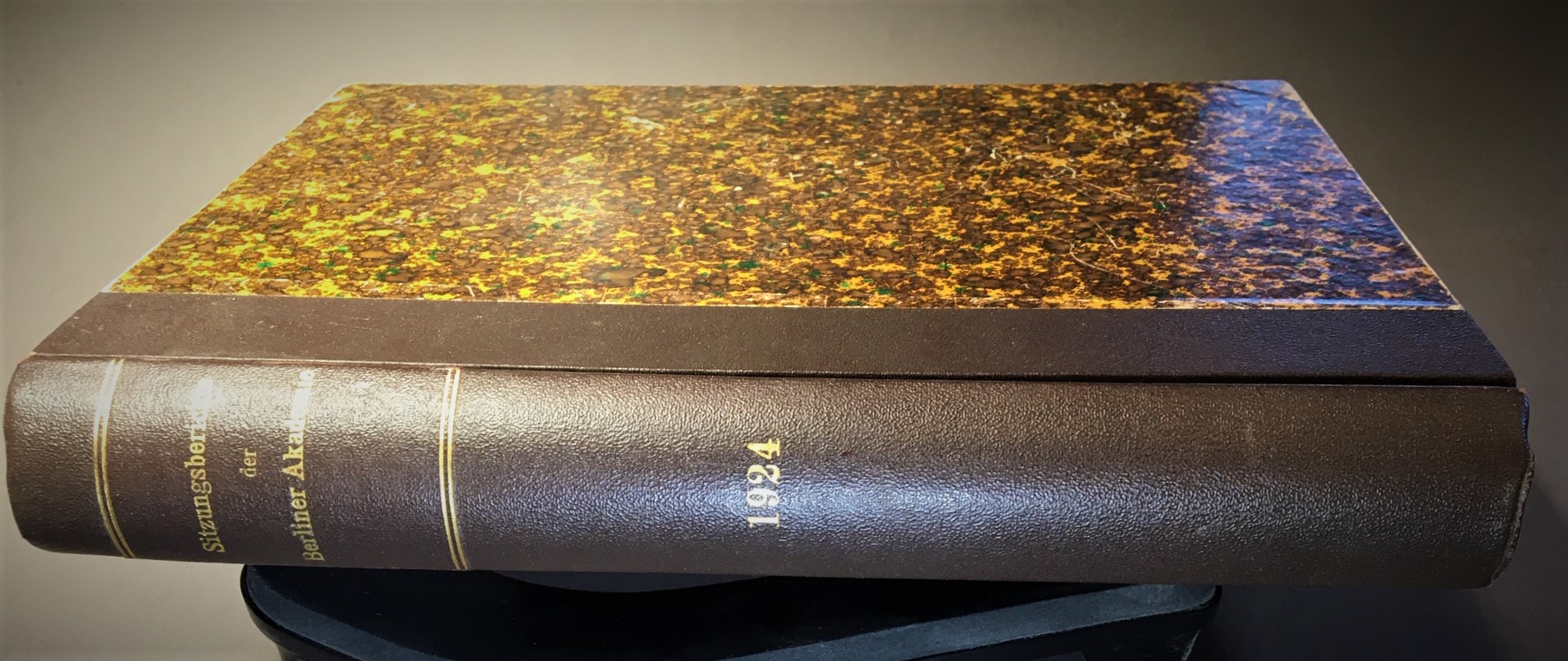
    EINSTEIN, Albert. “Quantentheorie des einatomigen idealen Gases” (“Quantum Theory of the Monatomic Ideal Gas”) in Sitzungsberichte der Königlich Preussischen Akademie der Wissenschaften, Physikalisch-mathematische Klasse, 1924, pp. 261–267 in the volume of pp CXLIX, 360. .Bound in the original publisher’s cloth and marbled boards with cloth tips, in near fine condition. $500.00

    “This is the first of three papers by Einstein on Bose-Einstein condensation, the phenomenon that causes bosons to become a superfluid at low temperatures.”

    Einstein 1924 Wenner

    ·Posted by :

    ·in:


  • First French Edition of the First Weather Map (1687)

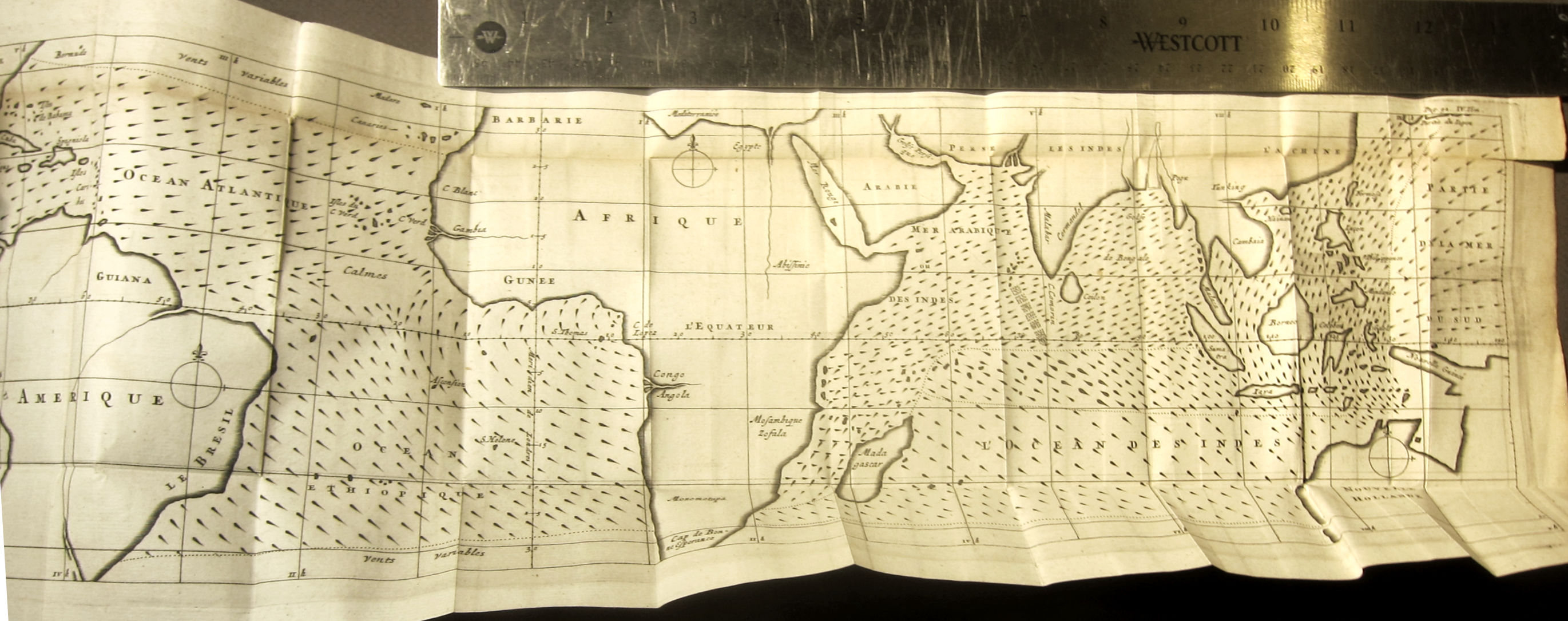
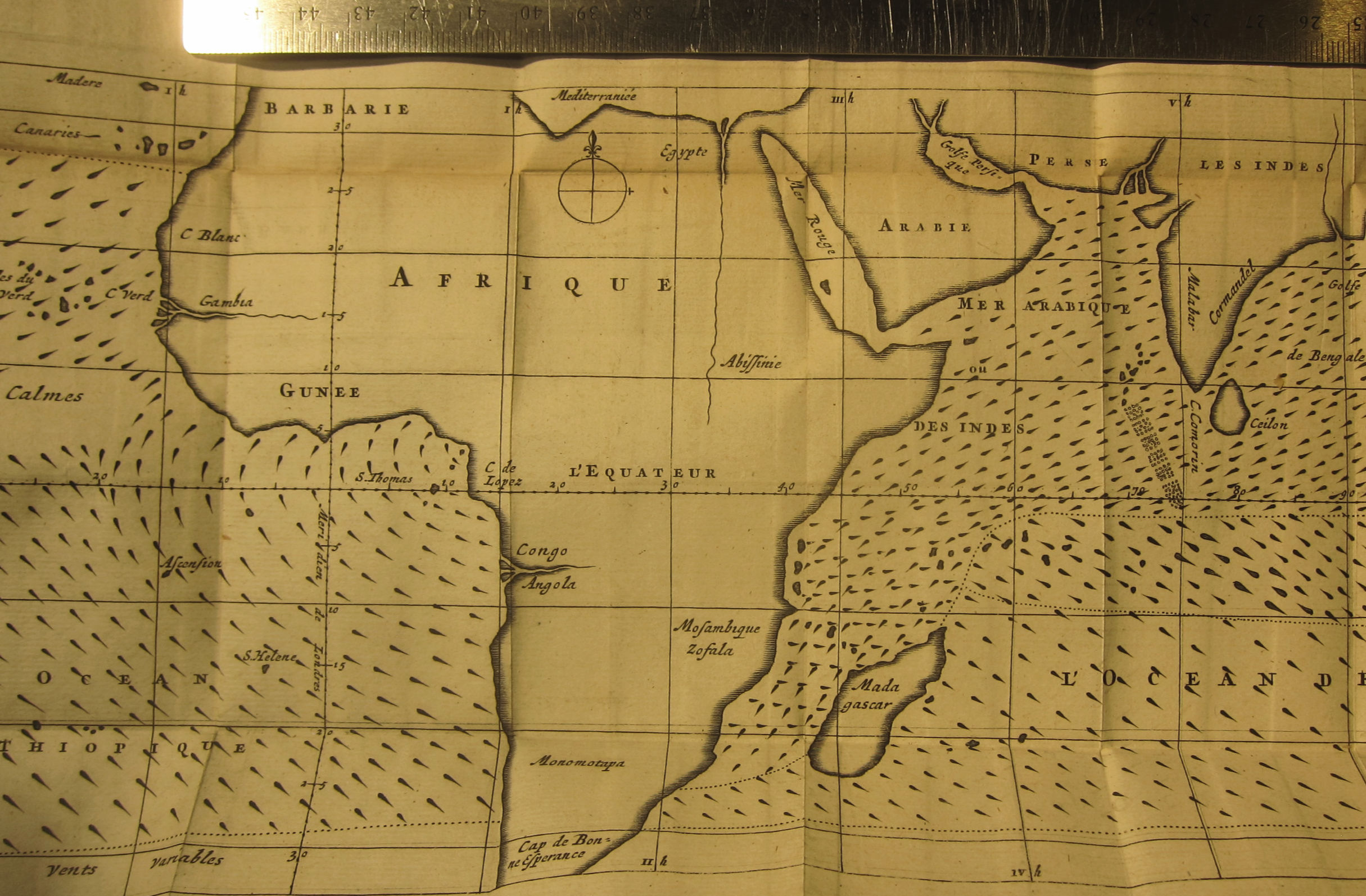
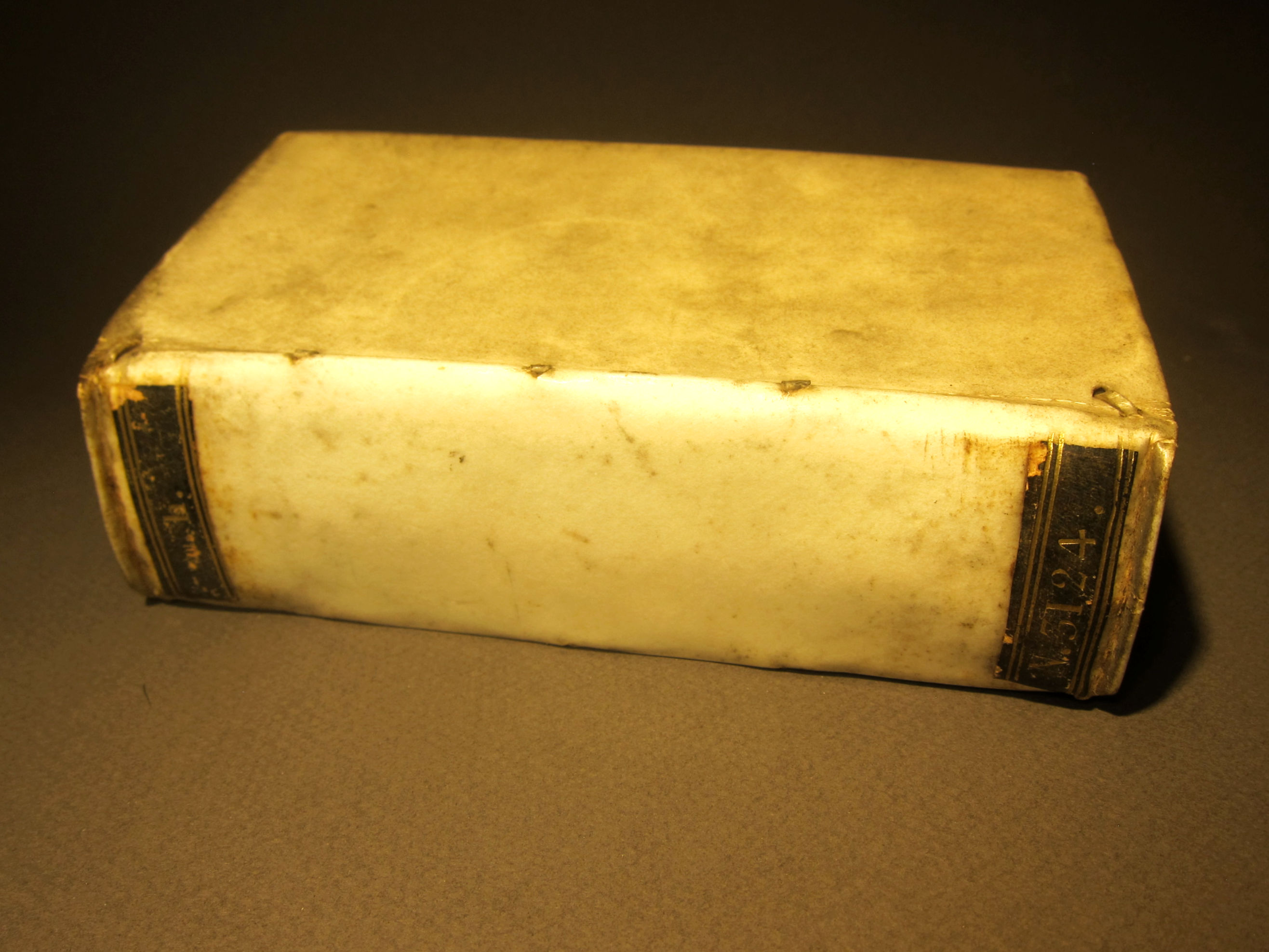
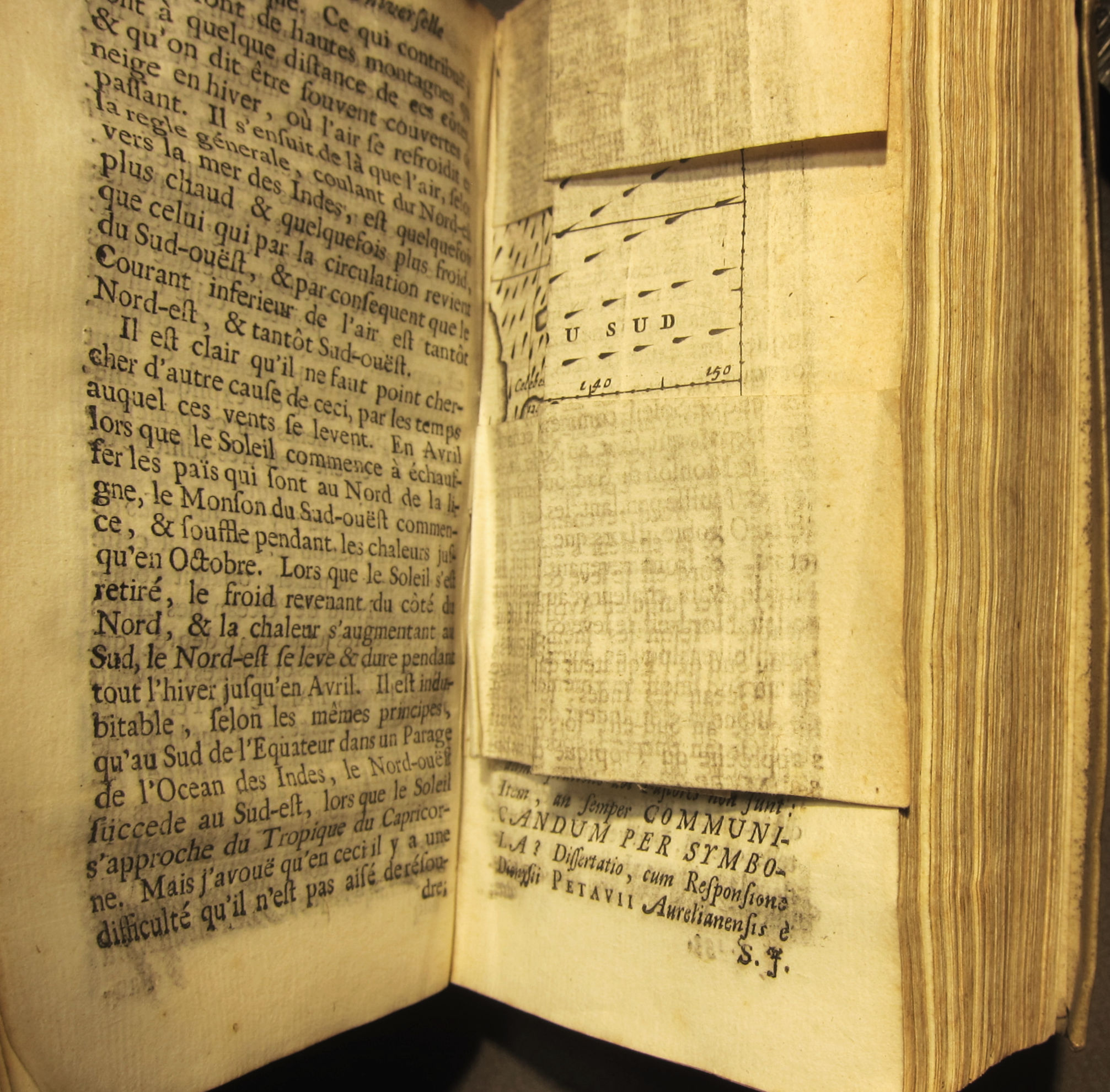
    HALLEY, Edmund. “Extrait du Journal D’Angleterre, contenant one Relation Historique des Vents reglez & des Monsons que l’on remarque dans les Mers qui sont entre les Tropiques, ou qui n’en sont pas éloignées, avec un Essai de Physique touchant leurs causes naturelles par Mr. Halley”, in Bibliothèque universelle et historique, Amsterdam, 1687, published by Warsbergew, Boom, and VanSomeren; vol 4, pp. 66-93 in the volume of (18), 552, (22)pp, with two folding plates, one of which is the first weather map. 142X80mm, bound in vellum.   $1250

    The famous map (14.8 × 48 cm) is very fresh and strong, and has only one minor defect—a small 1/2” teat at upper right edge. Other than that it is in excellent condition.

    Halley _4_


    This is the French translation of Halley’s “An Historical Account of the Trade Winds, and Monsoons, Observable in the Seas between and near the Tropicks, with an Attempt to Assign the Phisical Cause of the Said Wind,” that appeared several months earlier in the Philosophical Transactions of the Royal Society (1686, in issue no. 183).

    Here is a summary of the map from the Princeton University site dedicated to thematic maps:

    • “First meteorological map, charting the directions of trade winds and monsoons. Having collected information from navigators familiar with ocean transits, and also from his own tropical experience on St. Helena (1677–1678), Halley sought to rectify the work of earlier writers on the subject. He attributes the circulation of prevailing winds to the solar heating of volumes of atmosphere as the earth revolves, which thus draw air after them, forming a generally easterly wind; as the sun departs, the air reverses direction to establish equilibrium. He argues that the effects of continents (and other landmasses) and latitudes complicate but do not compromise the basic principle. (Today, of course, solar heating is viewed as only a piece in the puzzle of winds; ocean currents would be another. Adding Halley’s wind map data to Eberhard Happel’s 1675 map of ocean currents [see his entry in the Hydrography section] would make an interesting thematic map.) Elsewhere in the article, Halley correctly identifies the West Indies as the source of hurricanes in the Atlantic.

    “On the map, rows of brief lines show the course of the winds; the sharp ends of those lines point to wind sources. Where winds go back and forth, notably in the monsoon-prone area of the Indian Ocean, the lines are thicker than elsewhere and point both ways.”

    Had Halley–called Father of Dynamical Meteorology—not made his important contributions to astronomy and other fields he would have been remember for being the first geophysicist, and also perhaps the earliest thematic mapmaker.

    Halley _4_
    Halley _4_

    Halley _4_

    ·Posted by :

    ·in:


  • Balmer Johann Notiz ÜBer Die Spectrallinien Des Wasserstoffs Note On The Spectral Lines Of Hydrogen In Annalen

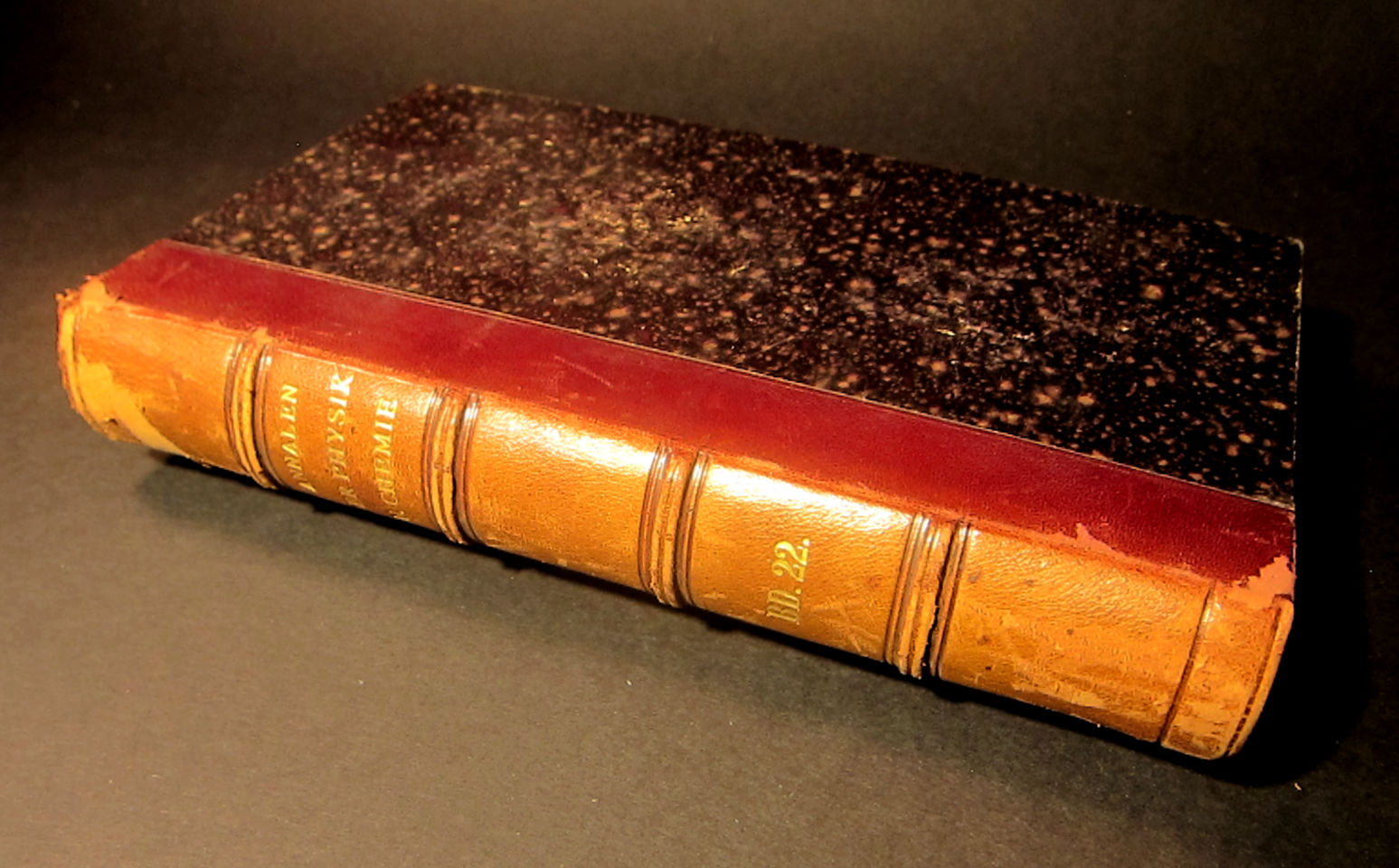
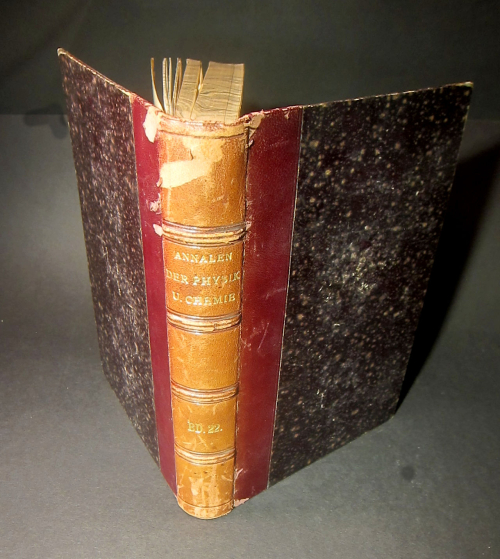
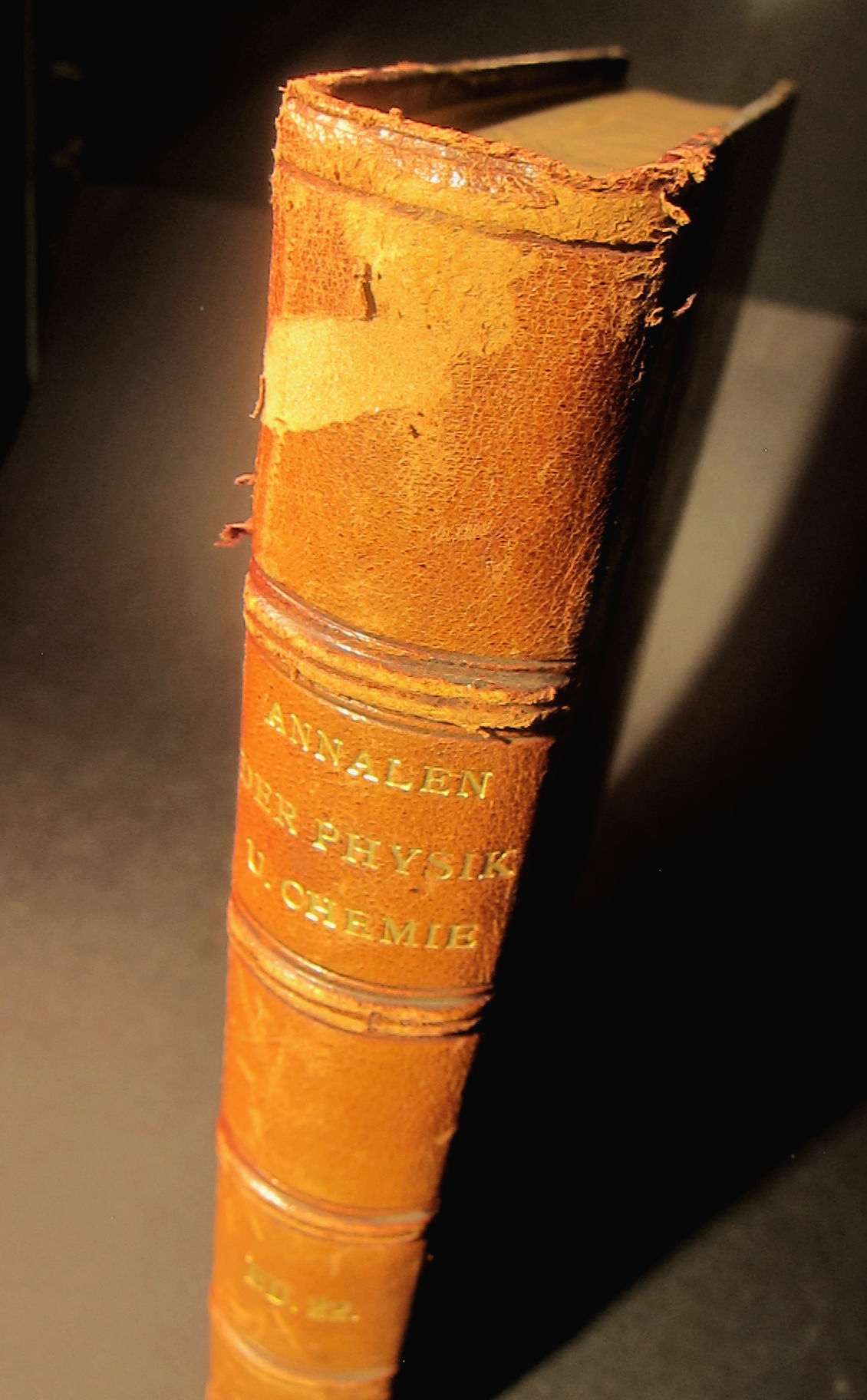
    BALMER, Johann. “Notiz über die Spectrallinien des Wasserstoffs” (“Note on the spectral lines of hydrogen”) in Annalen der Physik und Chemie, 1885, 25 pp. 80–87, 1885). Volume in contemporary cloth and boards. Small sticker to spine. Interior clean  and fresh and with no marks. Almost fine. $600

    “In 1885…Balmer create(d) a simple mathematical formula to list the particular wavelengths at which a hydrogen atom radiates light and publishes it in [this paper].” Claire Parkinson, Breakthroughs p. 409.

    “In 1885, Johann Jakob Balmer (1825–1898), a Swiss mathematics teacher, published the “Balmer formula” for the spectral lines in the hydrogen spectrum without stating any underlying physical theory. He had noticed that every line in the hydrogen spectrum in the visible light region was related to a single number (364.56 nanometers), and from this concocted a formula that correctly predicted other spectral lines in the visible and infrared spectrum (the “Balmer series”).” Wenner, History of Physics

    “Balmer’s major article on the hydrogen spectrum is “Notiz ūber die Spektrallinien desPage Wasserstoffs,” in Verhandlungen der Naturforschenden Gesellschaft in Basel, 7 (1885), 548-560, 750-752; also in Annalen der Physik, 3rd ser., 25 (1885), 80-87.”–DSB online

    “The Balmer series, or Balmer lines in atomic physics, is one of a set of six named series describing the spectral line emissions of the hydrogen atom. The Balmer series is calculated using the Balmer formula, an empirical equation discovered by Johann Balmer in 1885.”–Wikipedia

    ”Although physicists were aware of atomic emissions before 1885, they lacked a tool to accurately predict where the spectral lines should appear. The Balmer equation predicts the four visible spectral lines of hydrogen with high accuracy. Balmer’s equation inspired the Rydberg equation as a generalization of it, and this in turn led physicists to find the Lyman, Paschen, and Brackett series, which predicted other spectral lines of hydrogen found outside the visible spectrum.”–Wolfram

    “In 1913 Bohr proposed his quantized shell model of the atom (see Bohr atomic model) to explain how electrons can have stable orbits around the nucleus. The motion of the electrons in the Rutherford model was unstable because, according to classical mechanics and electromagnetic theory, any charged particle moving on a curved path emits electromagnetic radiation; thus, the electrons would lose energy and spiral into the nucleus…Bohr’s model accounts for the stability of atoms because the electron cannot lose more energy than it has in the smallest orbit, the one with n = 1. The model also explains the Balmer formula for the spectral lines of hydrogen. The light energy is the difference in energies between the two orbits in the Bohr formula. Using Einstein’s formula to deduce the frequency of the light, Bohr not only explained the form of the Balmer formula but also explained accurately the value of the constant of proportionality R.”–Encyclopedia Britannica

    ·Posted by :

    ·in:


  • Dirac Pam Quantum Theory Of Localizable Dynamic Systems American Physical Society In The Physical Review 739 1 May 1

    DIRAC, P.A.M. “Quantum Theory of Localizable Dynamic Systems”, American Physical Society, in the Physical Review, 73/9, 1 May 1948. Original printed wrappers. Very good condition. $250

    Abstract from AIP’s great PROLA website: “A dynamical system is called localizable if its wave functions can be expressed in terms of variables, each referring to physical conditions at only one point in space-time. These variables may be at points on any three-dimensional space-like surface in space-time. A general investigation is made of how the wave function varies when the surface is varied in any way. The variation of the wave function is given by equations of the Schroedinger type involving certain operators Hn(u) which play the role of Hamiltonians. The commutation relations for these operators are obtained. The theory works entirely with relativistic concepts and it provides the general pattern which any relativistic quantum theory must conform to, provided the dynamical system is localizable.”

    AND: “Dirac was also original in his conception of the role of probability in quantum mechanics. He thought that probabilities entered into the description of quantum phenomena only in the determination of the initial state (still described in terms of p s and q s), and not necessarily in the behavior of an isolated system. But, as Bohr had said at the Solvay Conference in 1927, isolated systems were unobservable. Dirac then assumed that the state of the world was represented by its wave function …; and that it changed abruptly during a measurement, whereupon nature made a choice.” — Complete Dictionary of Scientific Biography, vol. 17, Charles Scribner’s Sons, 2008, pp. 224-233. 

    ·Posted by :

    ·in:


  • Boltzmannludwig ÜBer Eine Von Hrn Bartoli Entdeckte Beziehung Der WäRmestrahlung Zum Zweiten Hauptsatze And With

    BOLTZMANN,Ludwig. “Über eine von Hrn. Bartoli entdeckte Beziehung der Wärmestrahlung zum zweiten Hauptsatze” AND WITH “Ableitung des Stefan’schen Gesetzes, betreffend die Abhängigkeit der Wärmestrahlung von der Temperatur aus der electromagnetischen Lichttheorie” [Derivation of Stefan’s law, concerning the dependency of heat radiation on temperature, from the electromagnetic theory of light], both in Annalen der Physik und Chemie, 1884, vol 22 pp. 31–39 and 291-294 in the volume of 616pp (with 9 folding plates).


    Boltzmann _1_

    Bound in contemporary calf with raised bands, and decorated boards, marbled edges. There is some small bit of rubbing two scrapes, but the volume still has a very nice appearance, and is quite tight and fresh. A near-fine copy, overall. $650

    These two papers by Ludwig Boltzmann leading to the derivation of the Stefan-Boltzmann law. “A derivation of the law from theoretical considerations was presented by Ludwig Boltzmann (1844–1906) in 1884, drawing upon the work of Adolfo Bartoli…(who) in 1876 had derived the existence of radiation pressure from the principles of thermodynamics. Following Bartoli, Boltzmann considered an ideal heat engine using electromagnetic radiation instead of an ideal gas as working matter.”–Wikipedia

    Boltzmann _1_

    “Bartoli’s reasoning stimulated Boltzmann to work out a theoretical derivation, based on the second law of thermodynamics and Maxwell’s electromagnetic theory, of the fourth—power law previously found experimentally by Stefan…Although at the time the “Stefan-Boltzmann law” for radiation seemed to be an isolated result with no further consequences, it did at least show a possible connection between thermodynamics and electromagnetism that was exploited in the later quantum theory. In the 1920’s it was applied by Eddington and others in explaining the equilibrium of stellar atmospheres.”–Complete Dictionary of Scientific Biography online

    (“The Stefan–Boltzmann law describes the power radiated from a black body in terms of its temperature. Specifically, the Stefan–Boltzmann law states that the total energy radiated per unit surface area of a black body across all wavelengths per unit time  (also known as the black-body radiant emittance) is directly proportional to the fourth power of the black body’s thermodynamic temperature T”–Wikipedia)

    Boltzmann _1_

    ·Posted by :

    ·in: