A Daily History of Holes, Dots, Lines, Science, History, Math, Physics, Art, the Unintentional Absurd, Architecture, Maps, Data Visualization, Blank and Missing Things, and so on. |1.6 million words, 7500 images, 4.9 million hits| Press & appearances in The Times, Le Figaro, Mensa, The Economist, The Guardian, Discovery News, Slate, Le Monde, Sci American Blogs, Le Pont, and many other places… 5000+ total posts since 2008.

Book Category: Physics

  • Einstein Albert Quantentheorie Des Einatomigen Idealen Gases Quantum Theory Of The Monatomic Ideal Gas In Sit

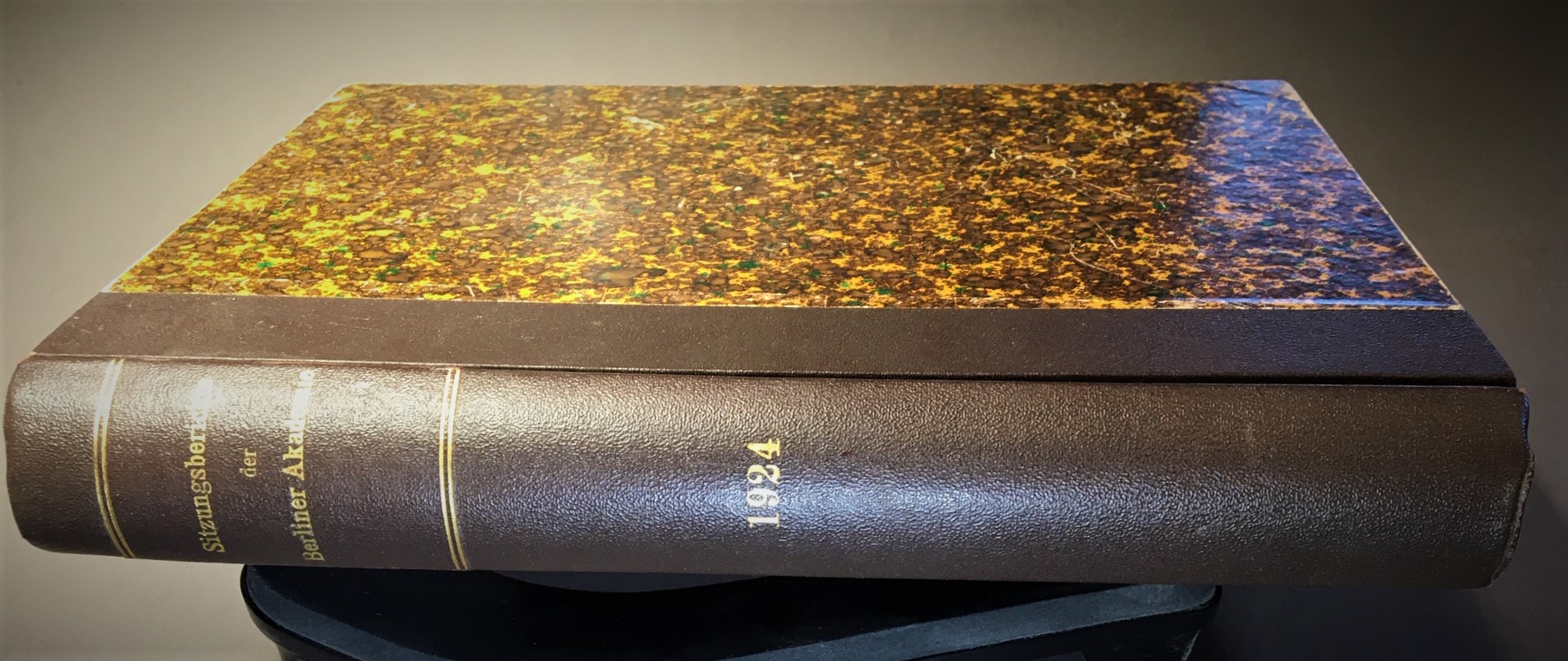
    EINSTEIN, Albert. “Quantentheorie des einatomigen idealen Gases” (“Quantum Theory of the Monatomic Ideal Gas”) in Sitzungsberichte der Königlich Preussischen Akademie der Wissenschaften, Physikalisch-mathematische Klasse, 1924, pp. 261–267 in the volume of pp CXLIX, 360. .Bound in the original publisher’s cloth and marbled boards with cloth tips, in near fine condition. $500.00

    “This is the first of three papers by Einstein on Bose-Einstein condensation, the phenomenon that causes bosons to become a superfluid at low temperatures.”

    Einstein 1924 Wenner

    ·Posted by :

    ·in:


  • First French Edition of the First Weather Map (1687)

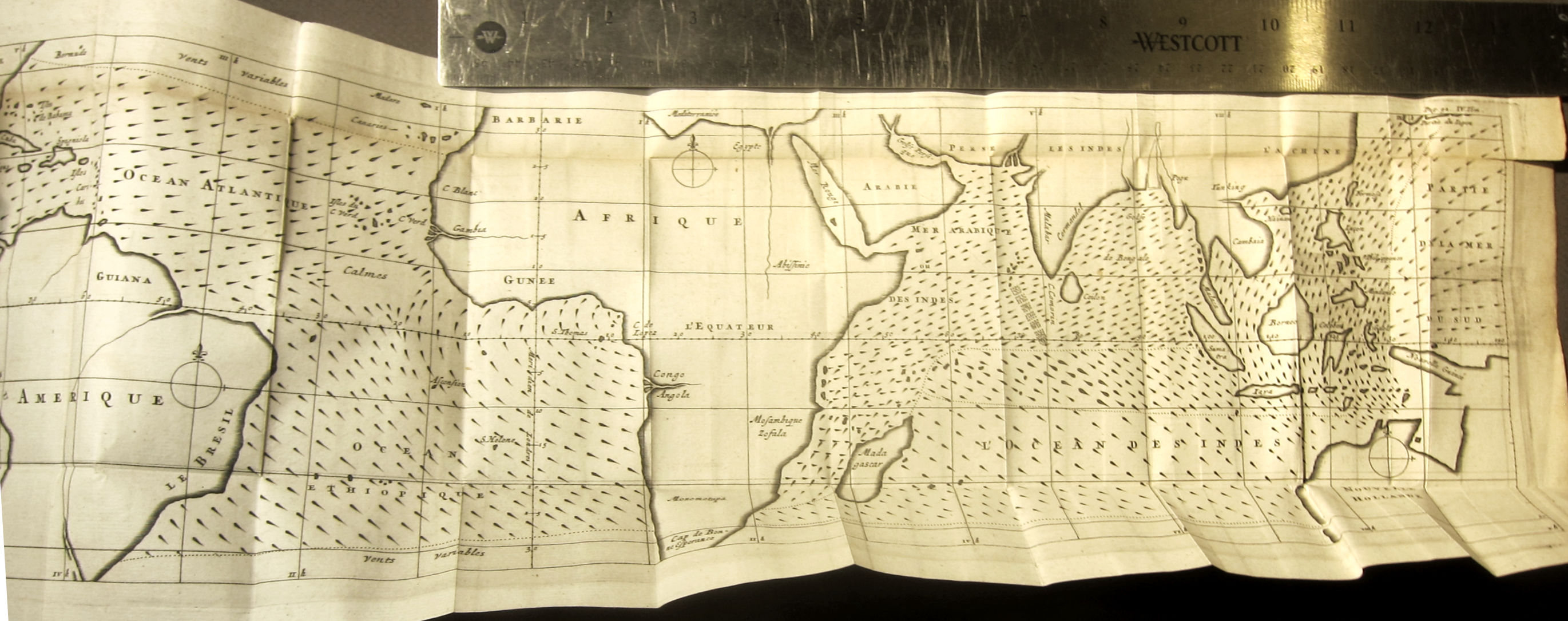
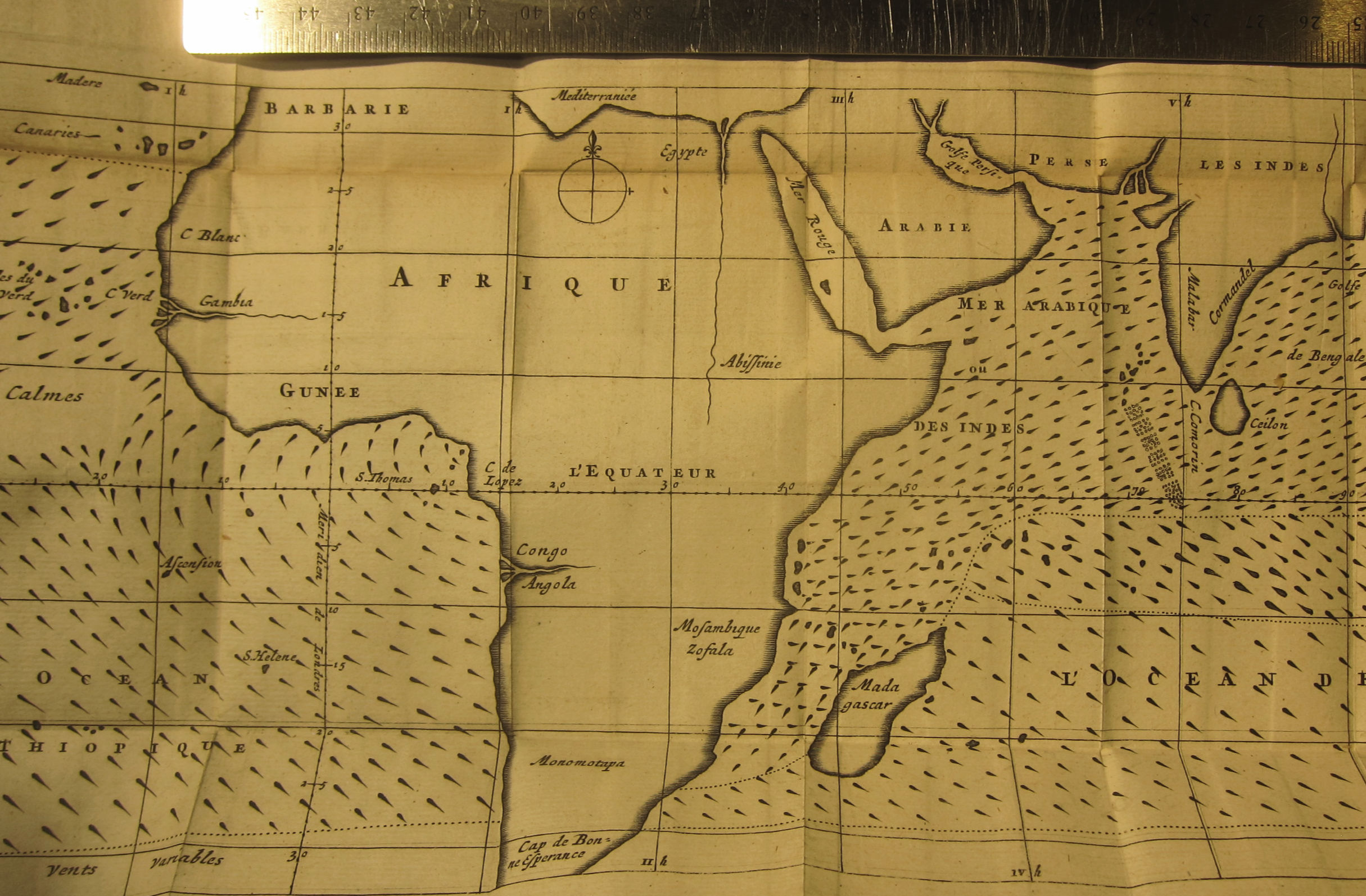
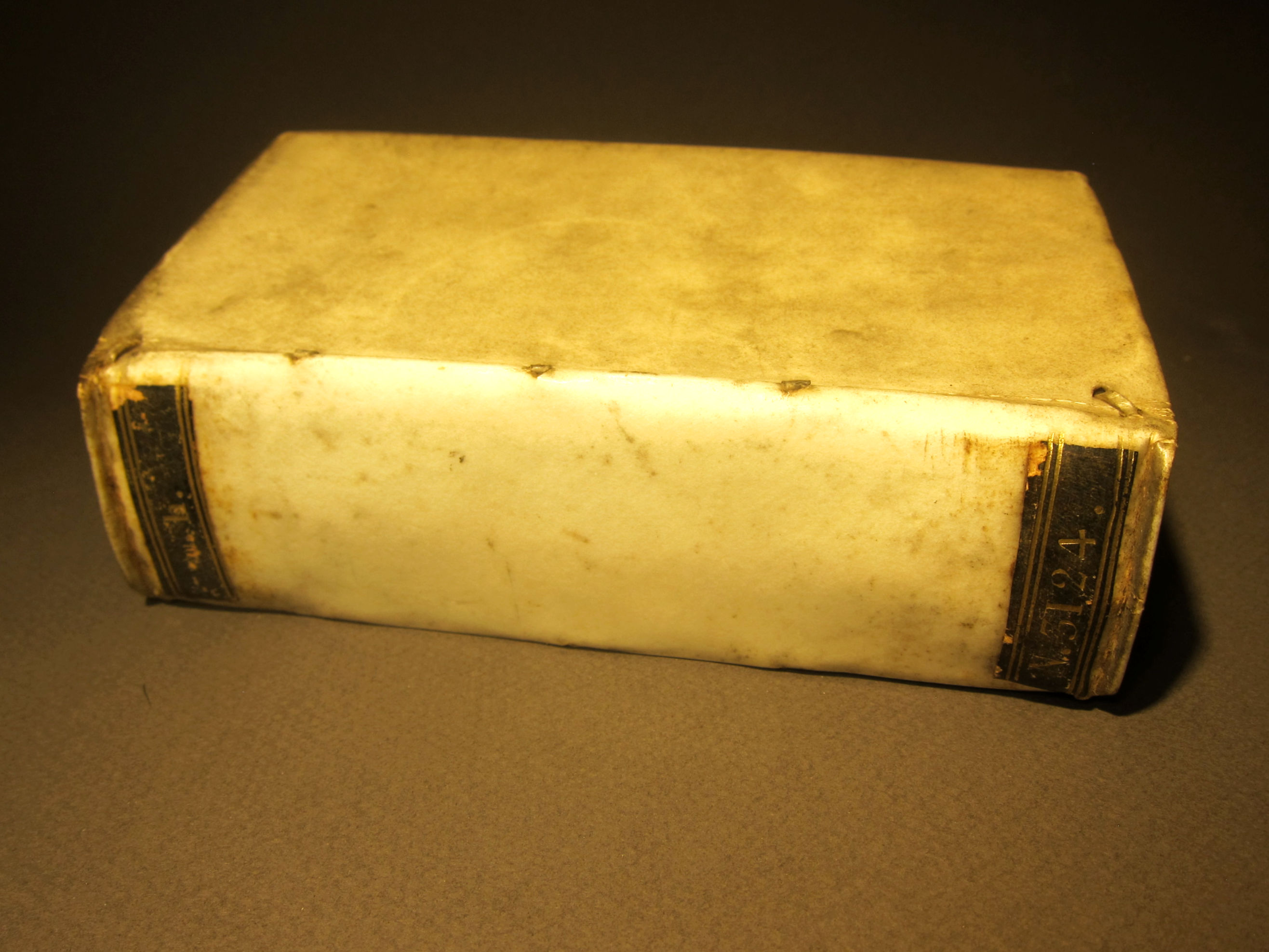
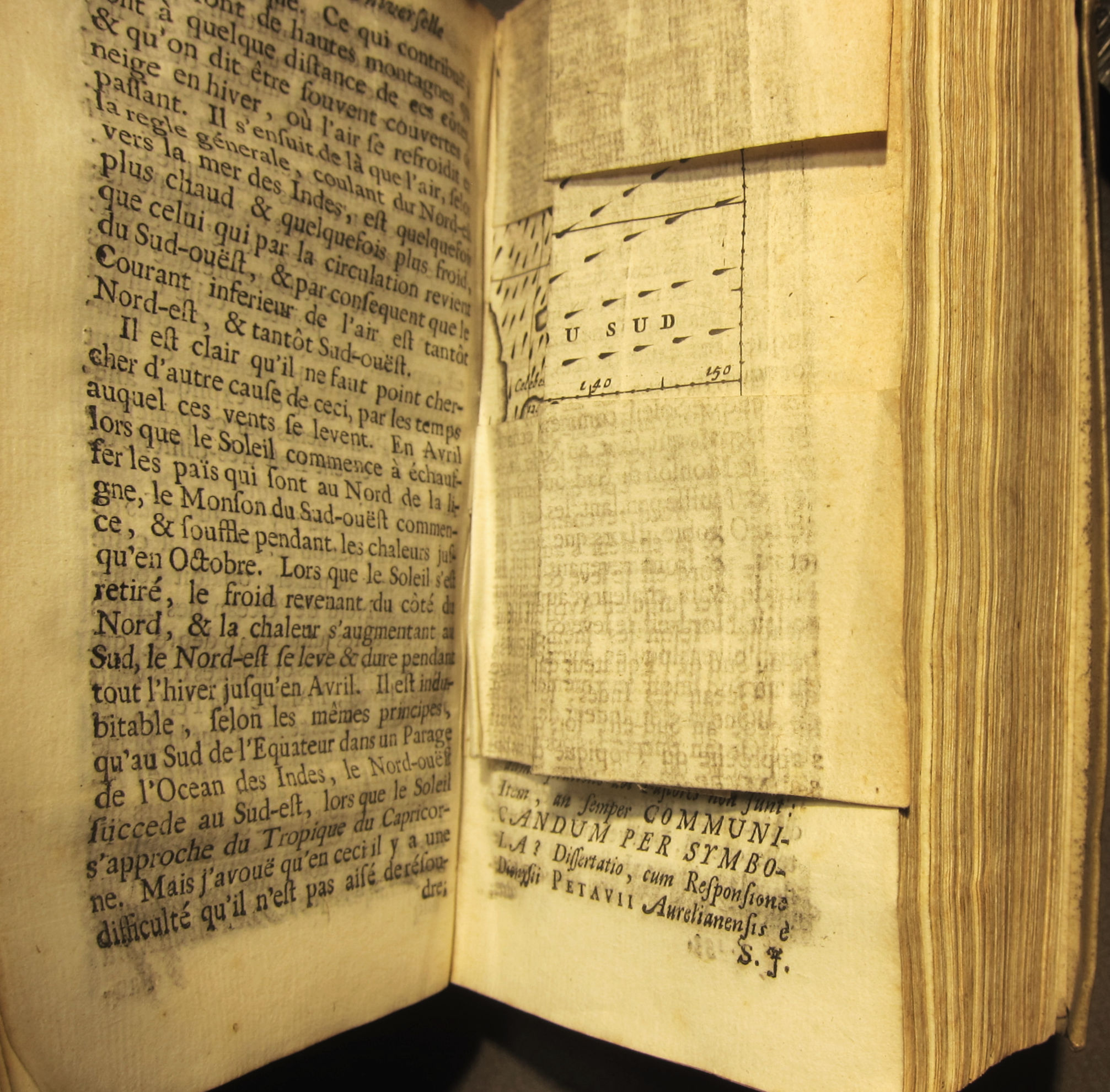
    HALLEY, Edmund. “Extrait du Journal D’Angleterre, contenant one Relation Historique des Vents reglez & des Monsons que l’on remarque dans les Mers qui sont entre les Tropiques, ou qui n’en sont pas éloignées, avec un Essai de Physique touchant leurs causes naturelles par Mr. Halley”, in Bibliothèque universelle et historique, Amsterdam, 1687, published by Warsbergew, Boom, and VanSomeren; vol 4, pp. 66-93 in the volume of (18), 552, (22)pp, with two folding plates, one of which is the first weather map. 142X80mm, bound in vellum.   $1250

    The famous map (14.8 × 48 cm) is very fresh and strong, and has only one minor defect—a small 1/2” teat at upper right edge. Other than that it is in excellent condition.

    Halley _4_


    This is the French translation of Halley’s “An Historical Account of the Trade Winds, and Monsoons, Observable in the Seas between and near the Tropicks, with an Attempt to Assign the Phisical Cause of the Said Wind,” that appeared several months earlier in the Philosophical Transactions of the Royal Society (1686, in issue no. 183).

    Here is a summary of the map from the Princeton University site dedicated to thematic maps:

    • “First meteorological map, charting the directions of trade winds and monsoons. Having collected information from navigators familiar with ocean transits, and also from his own tropical experience on St. Helena (1677–1678), Halley sought to rectify the work of earlier writers on the subject. He attributes the circulation of prevailing winds to the solar heating of volumes of atmosphere as the earth revolves, which thus draw air after them, forming a generally easterly wind; as the sun departs, the air reverses direction to establish equilibrium. He argues that the effects of continents (and other landmasses) and latitudes complicate but do not compromise the basic principle. (Today, of course, solar heating is viewed as only a piece in the puzzle of winds; ocean currents would be another. Adding Halley’s wind map data to Eberhard Happel’s 1675 map of ocean currents [see his entry in the Hydrography section] would make an interesting thematic map.) Elsewhere in the article, Halley correctly identifies the West Indies as the source of hurricanes in the Atlantic.

    “On the map, rows of brief lines show the course of the winds; the sharp ends of those lines point to wind sources. Where winds go back and forth, notably in the monsoon-prone area of the Indian Ocean, the lines are thicker than elsewhere and point both ways.”

    Had Halley–called Father of Dynamical Meteorology—not made his important contributions to astronomy and other fields he would have been remember for being the first geophysicist, and also perhaps the earliest thematic mapmaker.

    Halley _4_
    Halley _4_

    Halley _4_

    ·Posted by :

    ·in:


  • 21 Papers by Fizeau and Foucault (1843-1862)

    Fizeau, Armand Hippolyte Louis. “Ueber die zur Erzeugung der Moser’schen Bilder-beitragenden Ursachen”, which is the first German edition of “Sur les causes qui concouraent a la production des images de Moser” from the Comptes Rendus de l’Academie des Sciences 1842, volume 15. In Annalen der Physik, volume 58, 1843, No. 4, part VII, pp 592-593 in the issue of pp (521)-668 (with one folding plate). This issue is removed from a larger bound volume, with no outer wrappers. Very Good. Other works include those of C.F. Naumann, G.B. Airy, Faraday, Arago, and a longer piece by Daguerre. (“Ueber ein neues Versahren, die zu photographischen Bildern bestimmten Platten zu poliren, welches, so lange di eSufsern Umstande gleich bleiben, einerlei Resultate gicht”, pp 586-592, translated from the Comptes Rendus de l’Academie des Sciences volume 16, p. 588.) SOLD

    Fizeau, Armand Hippolyte Louis. “Sur les effets resultant de certaines procedes employes pour abreger le temps necessaire a la formation des images photographiques”, in Comptes Rendus de l’Academie des Sciences, 1843, volume 16, pp 759-761. This is offered in the weekly issue, removed from a larger bound volume, and without wrappers. Very Good. $175

    • “On 19 August 1839 Arago made public a description of a new process of “light painting” or heliography that had been invented by L.-J.-M. Daguerre. The daguerrotype, as the result of this process soon came to be called, was a crude forerunner of the modern photograph. Fitzeau’s earliest work in science was an attempt to improve Daguerre’s process and to make the heliograph an instrument of science. He showed that by covering the surface of the developed plate with a salt of gold, oxidation of the surface chemicals could be prevented and the contrasts between light and dark could be considerably heightened. He is often credited with the first use of bromine vapors to hasten the development of the photographic image, but this seems uncertain. Fizeau also introduced a widely used but unpatented method for turning a photograph into a photoetching.”–Dictionary of Scientific Biography

    Fizeau, Armand Hippolyte Louis. “Sur le phenomene des interferences entre deux rayons de lumiere dans le case de randes differences de marche”, in Comptes Rendus de l’Academie des Sciences de l’Academie des Sciences, 1845, volume 21, offered in the weekly issue, the article occupying pp 1155-1158. The issue is removed from a larger bound volume, and offered with the wrappers. Very Good. $300

    • “From 1844 Fizeau and Foucault undertook a series of precise and mechanically ingenious optical experiments that would ultimately have a profound effect on the course of physics. By the middle of the nineteenth century, most scientists had come to accept the wave theory of light, formulated near the beginning of the century by Thomas Young and Augustin Fresnel. There remained, however, several gaps in the investigation of the experimental consequences of the theory. For example, in the study of interference fringes produced by two rays of light issuing from the same source, only several dozen fringes on each side of the central band had been observed.”–Dictionary of Scientific Biography

    Fizeau, Armand Hippolyte Louis. “L’Action des rayons rouges sur les plaques daguerriennes”, in Comptes Rendus de l’Academie des Sciences, 1846, the article occupying pp 679-682 in the weekly issue, and removed from a larger bound volume. There is some water staining to this volume, and so is in GOOD condition, only. $100

    ·Posted by :

    ·in:


  • Scarce Princeton Title in Physics (1935)

    CONDON, Edward U. Selected Topics in Theoretical Physics. Notes by Rubby Sherr. 1935.  

    This is an offset and stapled low-run production of lecture notes taken by Rubby Sherr of a course given by E.U. Condon at Princeton in 1935. Condon was at Princeton from 1928-1937, and the very young Sherr (only 22 at the time) would go on to make his mark for decades in the physics community at Los Alamos and Princeton.  Condon of course was a mega-figure in the world physics community.  

    11″ x 8.5″, mimeographed from typed sheets with reproductions of manuscript equations; stapled.  GOOD copy, only.  

    Provenance: Library of Congress (with their surplus stamp on the front cover), given to them (as noted by a penciled note on the back of the cover) from the Institute for Advanced Study, Feb 1 1937.  
    Nice association copy of a very scarce document.  $150

    “In 1942, Sherr joined the MIT Radiation Laboratory, where he worked to develop new airborne radar systems. In 1944, he became involved with the Manhattan Project, which was tasked with creating the first nuclear weapon. Together with Klaus Fuchs, Sherr developed a key component of the bomb’s triggering mechanism, the Fuchs–Sherr polonium-beryllium modulated neutron initiator. On July 16, 1945, Sherr was present at the Trinity nuclear test in New Mexico. He later recalled thinking during the test, “‘This is the greatest scientific experiment of all time’ – it was certainly the biggest. Then the horror sank in that the thing had actually worked, followed by relief that the atmosphere hadn’t ignited, as some had feared it would.”–Wikipedia

    “Edward Uhler Condon (March 2, 1902 – March 26, 1974) was a distinguished American nuclear physicist, a pioneer in quantum mechanics, and a participant in the development of radar and nuclear weapons during World War II as part of the Manhattan Project. The Franck–Condon principle and the Slater–Condon rules are co-named after him. He was the director of the National Bureau of Standards (now NIST) from 1945 to 1951. In 1946, Condon was president of the American Physical Society, and in 1953 was president of the American Association for the Advancement of Science.”

    WorldCat locates only 6 copies–none at Princeton. 

    ·Posted by :

    ·in:


  • Several Papers by Bohr in “Zeitschrift fur Physik”, 1920-1923

    BOHR, Niels. “Zur Frage der Polarisation der Strahlung in der Quantentheorie”, in Zeitschrift fur Physik, 1921, vol. 6., pp 1-9, offered in the entire volume of pp iv, 416pp. This is an institutional copy, with (tasteful) bookplate and a few round rubber stamps on the interior–no exterior markings.  This is a FINE copy, and it feels as though it was very infrequently used. .  A very nice copy.  $300

    “[T]here was rarely in the history of physics a comprehensive theory which owed so much to one principle as quantum mechanics owed to Bohr’s correspondence principle” (Jammer 1966, p. 118), from the Stanford Encyclopedia of Philosophy, here.

     A faint damp stain in right margin. First edition. “.in the hands of Bohr and his school the correspondence principle was like “a magic wand that allowed the results of the classical wave theory to be of use for the quantum theory.but a costly price had to be paid. For taking resort to classical physics in order to establish quantum-theoretic predictions, or in other words, constructing a theory whose corroboration depends on premises which conflict with the substance of the theory, is of course a serious inconsistency from the logical point of view. Being fully aware of this difficulty, Bohr attempted repeatedly to show “the correspondence principle must be regarded purely as a law of quantum theory, which can in no way diminish the contrast between the postulates and electrodynamic theory.” The earliest allusion to such a conception may perhaps be found as early as 1921 in a paper (the paper offered) in which Bohr briefly discussed the function of the principle.”(Max Jammer).

    The First Appearance of  “Correspondence Principle”

    BOHR, Niels.  “Über die Serienspektra der Element”, in Zeitschrift für Physik, 1920, volume 2, pp 423-478.   Very prettily bound in reddish cloth and matching marbled boards, red cloth tips. This is an institutional copy, with (tasteful) bookplate and a few round rubber stamps on the interior–no exterior markings.  This is a FINE copy, and it feels as though it was very infrequently used. 

    “[T]here was rarely in the history of physics a comprehensive theory which owed so much to one principle as quantum mechanics owed to Bohr’s correspondence principle” (Jammer, The Conceptual Development of Quantum Mechanics, p 118, 1966)  The correspondence principle was first articulated (Stanford Encyclopedia of Philosophy) in 1913 in “On the constitution of atoms and molecules”, Philosophical Magazine, 26: 1–25, 476–502, 857–75, then again in 1918, and then formulated here in the 1920 paper (“On the series spectra of the elements”), In  where the terms “correspondence” and “correspondence principle” first appear (Nielsen, “Introduction to Niels Bohr Collected Works, Vol. 3”, in Bohr (1976), pp. 3–46. 1976, p. 21, and Stanford Encyclopedia of Philosophy.)

    BOHR, Niels. Ueber die Anwendung der Quantentheorie auf den Atombau. I. Die Grundpostulate der Quantentheorie. In Zeitschrift fur Physik, volume 13, 1923, pp 117-165. (“On the application of the quantum theory to atomic structure,” Proceedings of the Cambridge Philosophical Society (supplement), Cambridge: Cambridge University Press, pp. 1–42. First published in Zeitschrift für Physik, 13 (1923)) Very prettily bound in reddish cloth and matching marbled boards, red cloth tips. This is an institutional copy, with (tasteful) bookplate and a few round rubber stamps on the interior–no exterior markings.  This is a FINE copy, and it feels as though it was very infrequently used. $350
    ·Posted by :

    ·in:


  • A Lovely Paper and its Display of Speech Waveforms (1931)

    Harvey Fletcher. “Some Physical Characteristics of Speech  and Music”, in Reviews of Modern Physics, volume 3 issue 2, pp 258-279, numerous illustrations, 1931. Original front wrapper.  This issue of RMP has been removed from a larger bound volume, and include the front wrapper only. The issue is an extract and is bound in itself but shows signs of removal on the spine.  Fresh copy.  $200 
    
    Fascinating article by a contributor to many fields, not the least of which is acoustics—their the physicist (whose thesis adviser was Robert Millikan) is widely recognizing as the father of stereophonic sound. This paper is of particular interest for the gathering and display of data and its depiction of speech and the graphical illustration of its waveforms.  

    Abstract: “Kinematic and statistical descriptions of the physical aspects of speech and music are given in this paper. As the speech or music proceeds, the kinematic description consists in giving the principal melodic stream, namely, the pitch variation and also the intensity and the quality variations. For speech and song, the quality changes are principally described by giving, besides the main melodic stream, two secondary melodic streams corresponding, respectively, to the resonant pitches of the throat and mouth cavities. To this must also be added the positions of the stops and the high pitched components of the fricative consonant sounds as functions of the time. The statistical description consists in giving the average, the peak, and the probable variations of the power involved as the various kinds of speech and music proceed. These general ideas are illustrated by numerous experimental data taken by various instrumental devices which have been evolved in the Laboratories during the past fifteen years.”

    “An example of how this analysis of speech may be made consider the sentence “Joe took father’s shoe bench out”…this silly sentence was chosen because it is used in our laboratory for making tests on the efficiency of telephonic transmitters…Speech then consists of a series of comparatively steady states of vibrations joined together in time…each one of these steady states is characterized by a pitch and tone quality, and the sequence is essentially a melody.”

    The contents of this issue includes: Irving Langmuir and Karl T. Compton   Electrical Discharges in Gases Part II.   Fundamental Phenomena in Electrical Discharges,
    191—257; Harvey Fletcher Some Physical Characteristics of Speech and Music, 258—279; David M. Dennison The Infrared Spectra of Polyatomic Molecules
    Part I, 280—345.

     “As a graduate student at the University of Chicago, his dissertation research was on methods to determine the charge of an electron. This included the now famous oil drop experiment commonly attributed to his advisor and collaborator, Robert Andrews Millikan. Professor Millikan took sole credit, in return for Fletcher claiming full authorship on a related result for his dissertation. Fletcher’s contributions were detail-oriented but necessary for a successful experiment, in which he incorporated, among other things, experience with projection lanterns. Millikan went on to win [be awarded] the 1923 Nobel Prize for Physics, in part for this work, and Fletcher kept the agreement a secret until his death .”–Wiki, citing  Harvey Fletcher (June 1982). “My Work with Millikan on the Oil-drop Experiment”. Physics Today: 43.


    ·Posted by :

    ·in:


  • A Wealth of Papers on Foucault and Fizeau (1851)

    [FOUCAULT & Fizeau] Fizeau, “Upon the hypotheses relative to Luminous Ether, and upon an experiment which seems to demonstrate that the motion of Bodies changes the velocity with which light is propagated within them”, appearing in the December issue and translating the Fizeau paper of September 1851 (. “Sur les hypothèses relatives à l’éther lumineux”. Comptes Rendus. 33: 349–355). It seems as though the first English translation appears in the Philosophical Magazine Series 4 vol 2 pp 568-573; this JFI appearance seems to be the first English translation published in the U.S. In:  Journal of the Franklin Institute, 1851, vol 22 (third series, and vol 52 overall). Half-calf and marbled boards. Ex-library, with a few stamps on the title page, plus bookplate; the front joint is sprung but the book is still quite tight and intact. Good solid copy. $450

    Also: John Tyndall, “On the Velocity of Light—experimental Proof of the Theory of Undulation”, pp 104-108, in which Tyndall reviews the two excellent Comptes Rendus papers of Foucault and Hippolyte Fizeau (from May 6 1850 and June 17 1850, respectively). The Foucault is a big paper on the particle v. wave theories of light, part of the issues of which lie int eh experimental measure of the speed of light, and in this paper he succeeds in establishing the fundamental constant at 2.98 x 1010 cm/sec. .

    And another “Exposition of Foucault’s Experiment, pp 352-355;

    And another, On Foucault’s Pendulum Experiments, pp 419-421;

    ALSO: Charles Allen, “Investigation of Foucault’s Pendulum” AND “Demonstration of Foucault’s Experiment”, The Foucault experiment occupies pp 38-42 in the July issue and pp 103-104. On the Charles Allen papers: the news of Foucault’s experiment (released to the world just a few months earlier in February) raced through the U.S., the news of the experiment reported in dozens of newspapers within just a couple of months. It has been written that0 for some reason the news and subsequent U.S.-based reproductions of the experiment were lagging in the New England and mid-Atlantic regions—for what reasons, I don’t know. The Franklin Institute contribution to the Foucault phenomenon was significant because it was among the very early reports on the evaluation of the experiment that was published in a scientific/technical journal. It is not the very first, but it is quite early.

    There are of course a hundred interesting entries in this volume, including:

    Michael Faraday, On Atmospheric Magnetism, pp 115-118;

    John C. Trautwine, A New Method of Calculating the Cubic Contents of Excavations and Embankments, pp (1)-13, 146-158;

    B.F, Isherwood, Remarks on Nystrom’s Screw Propeller, pp42-48;

    Turnbull, A Series of Lectures on the Telegraph, pp 118-128, 185-194, 256-266, 335-339, 406-414 (with a beautiful plate of a printing telegraph);

    Robert Hunt, Recent Improvements in Photography, pp 196-202;

    John Nystrom, A Few Suggestions as to the Manner of Laying out a Propeller…, pp 321-332, with two beautiful plates.


    ·Posted by :

    ·in:


  • Rare and Early Version of a Significant Work on Electrodynamics and Antennas

    KING, Ronald W.P. An Introduction to Advanced Electrodynamics for Physicists and Engineers, Part I, General Theory. Part II, Antennas. Two volumes, 261, xv+207,2pp.  Mimepographed from typed originals. Croft Laboratory, Harvard University, 1940.  Very Good condition. $200

    Bound in manila  wrappers, brass gather pin for the binding.  This is an unusual publication, with only ONE copy of each found in WorldCat (Part I at Kansas State and Part II at Diban Library, Santiago,Chile. The volumes together are unlocated.) Part I contains chapters 1-5; Part II contains 6-9.


    ·Posted by :

    ·in:


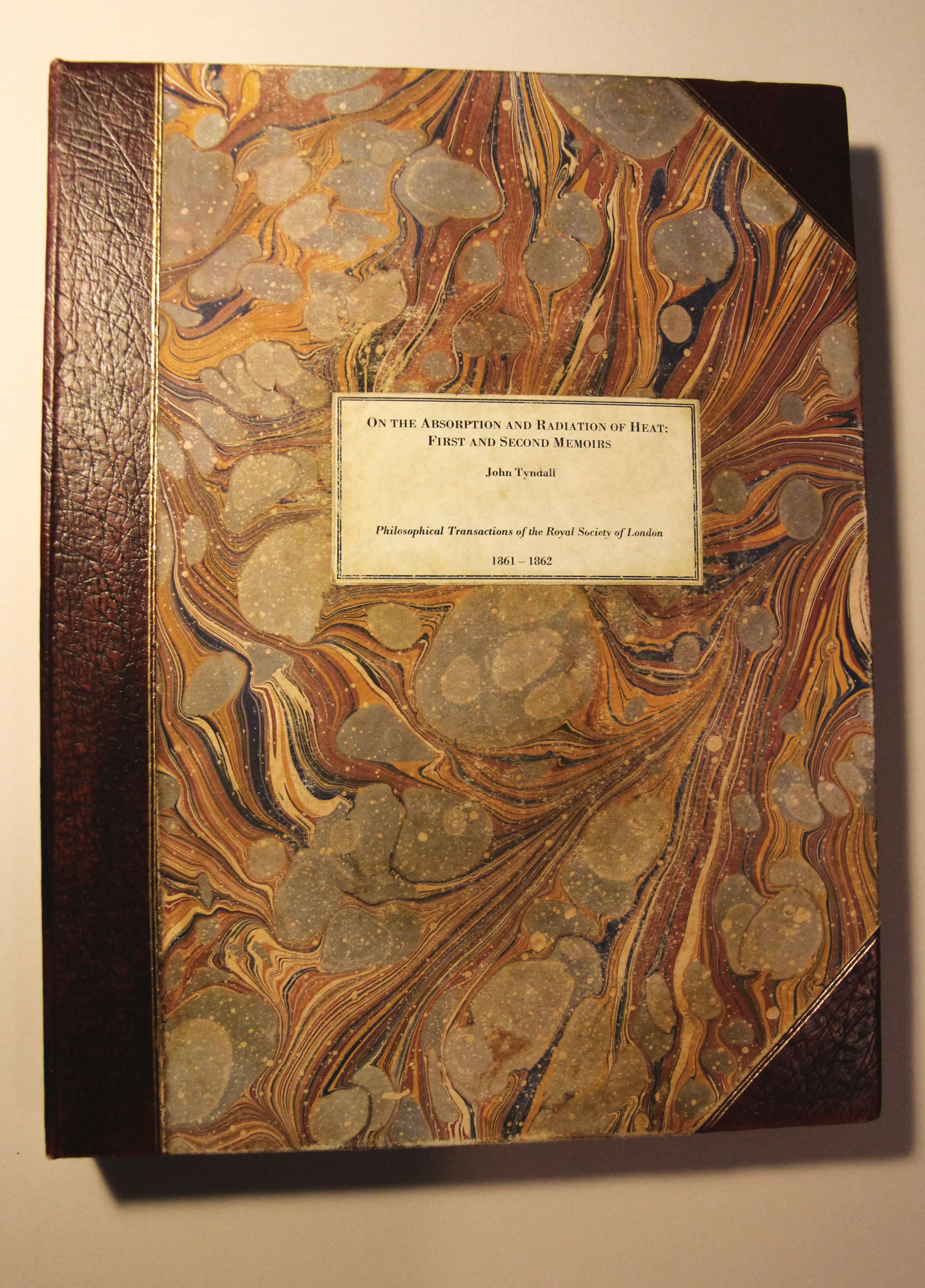
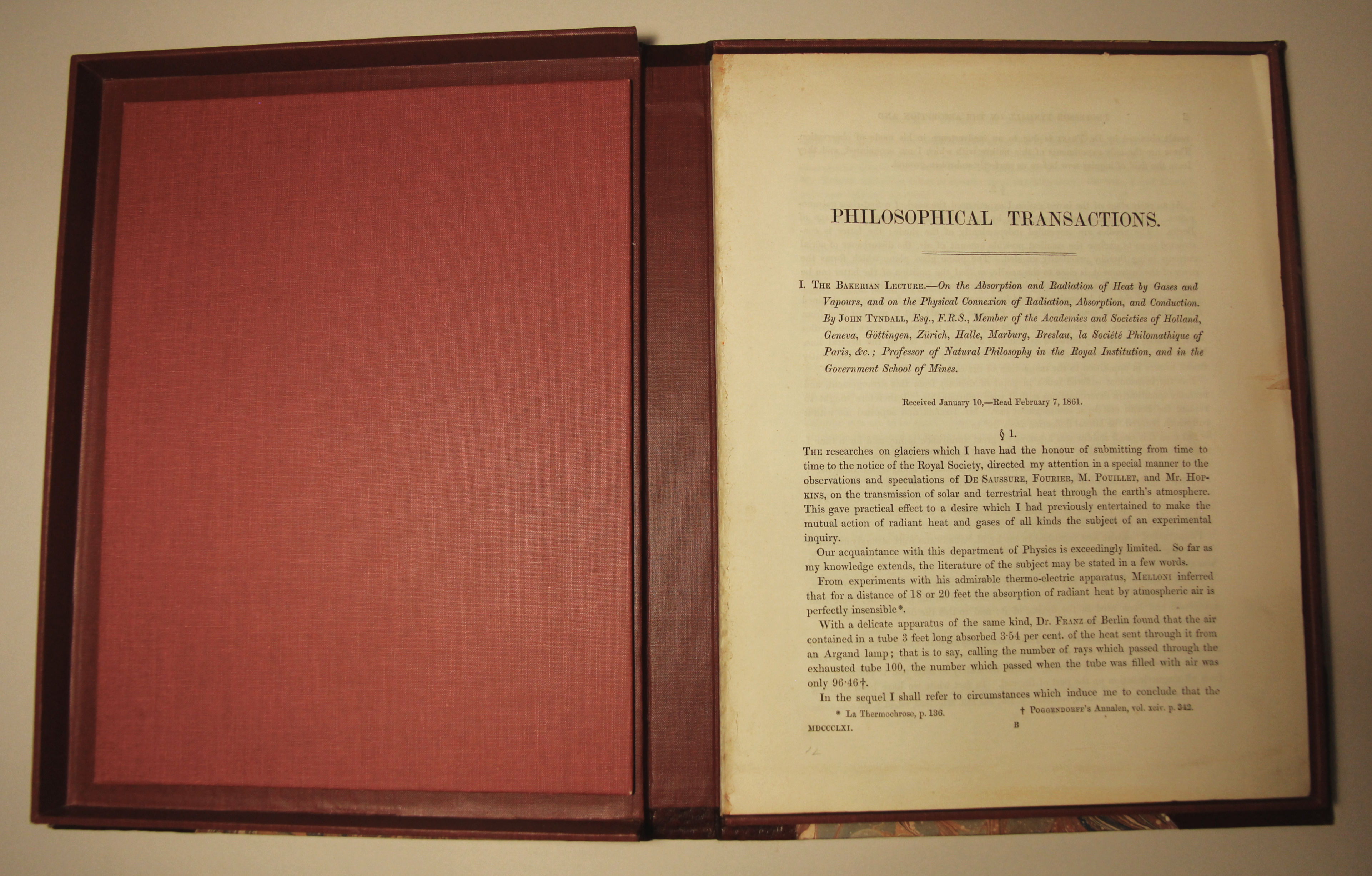
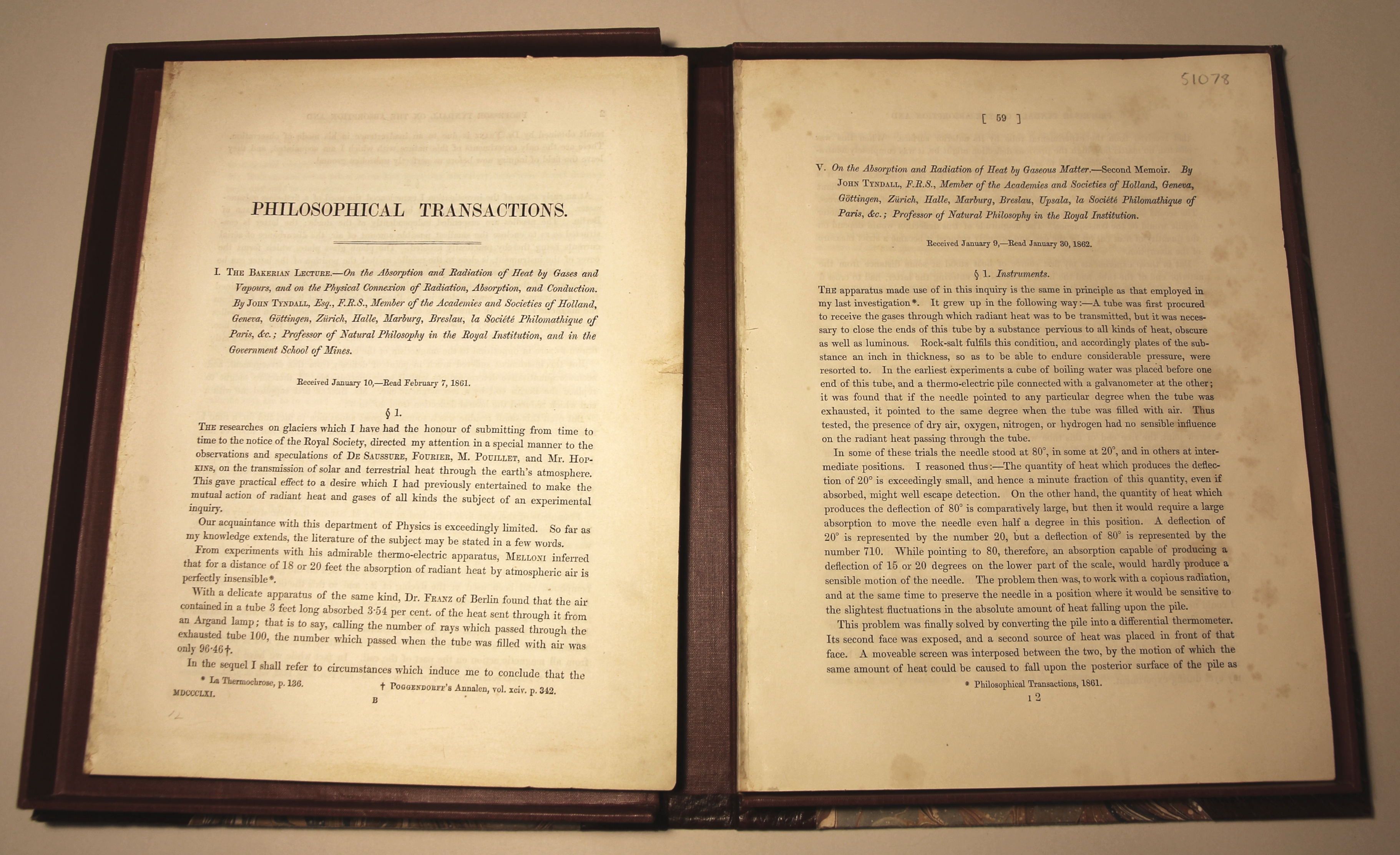
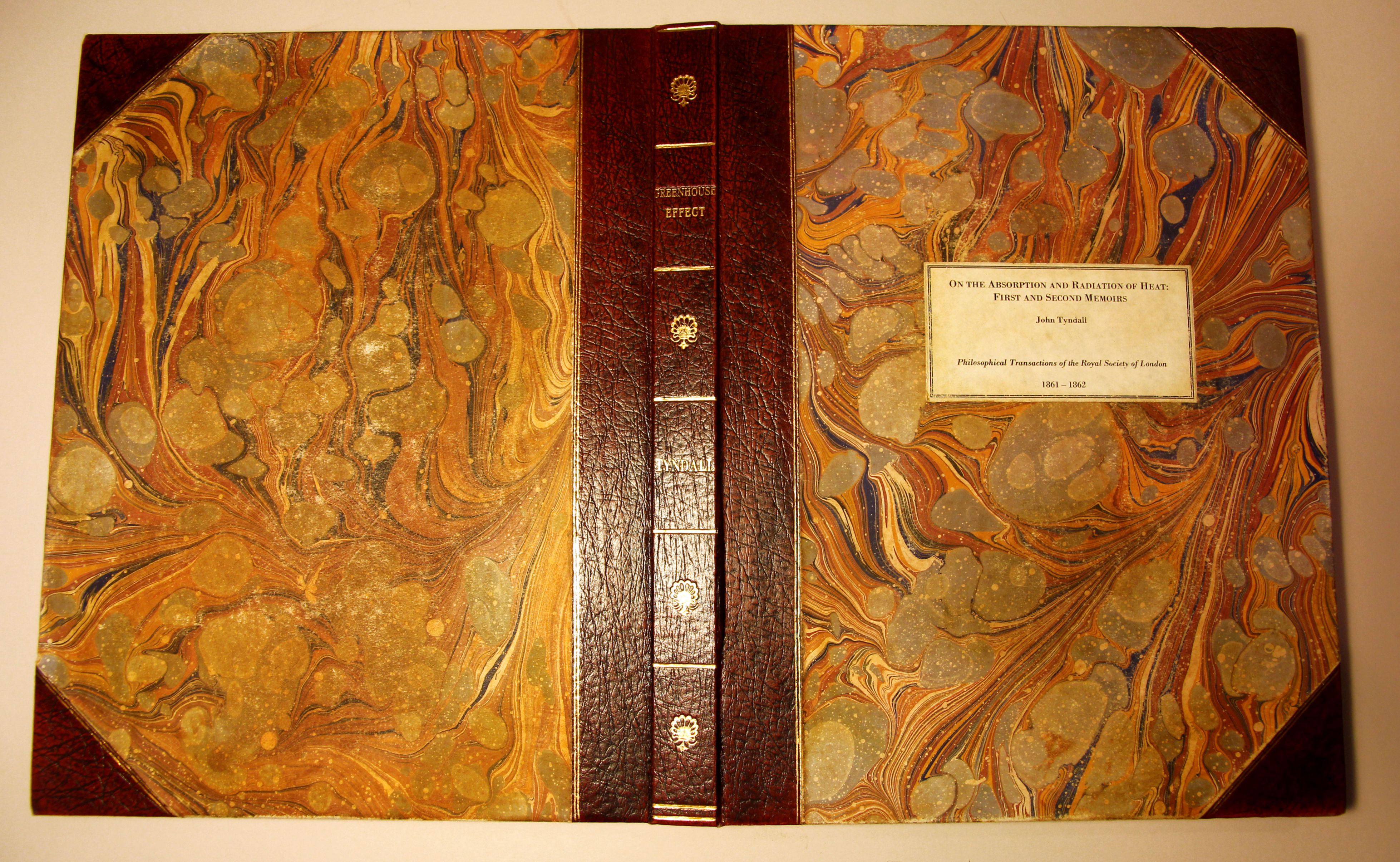
  • Tyndall’s Experiments with Greenhouse Gases (1861-2)

    John Tyndall. Two papers, as follows:

    “The Bakerian Lecture: On the Absorption and Radiation of Heat by Gases and Vapours, and on the Physical Connexion of Radiation, Absorption and Conduction” , in Philosophical Transactions of the Royal Society 151, pp 1-36, 1861.

    • And with:

    “On the Absorption and Radiation of Heat by Gases and Vapours—Second Memoir”, Philosophical Transactions of the Royal Society of London 152 pp. 59-97, 1862.

    Both papers, extracted from the bound volume, and housed in a luxurious clamshell box, bound in calf-backed paper covered boards, leather corners. Lovely, and in Very Fine condition. $1100


    Tyndall greenhouse _2_

    “Tyndall described the most important findings and conclusions from his greenhouse gas experiments in [these two] papers…John Tyndall was an English physicist best known for his study of thermal radiation. In 1852, Tyndall developed the first “ratio spectrophotometer” and used it to test the heat absorption of gases. He found that only a few gases, water vapor and a few trace gases (CO2 and hydrocarbon vapors like methane and ozone), absorb infrared radiation to any measurable degree. He also found that these gases also re-emit this heat, creating the reflection/absorption/re-reflection cycle that causes the greenhouse effect.”–David Wenner, History of Physics Collection

    Tyndall greenhouse _2_

    “The enormous range of Tyndall’s inquiries reflected many different intellectual influences. An explicit discussion of these influences in their context has yet to be undertaken. We lack any comprehensive review of Tyndall’s work on optical and crystalline structure; on magnetism, radiation, and mountaineering; and on the relationship between his several research programs. Tyndall is remembered chiefly for his efforts to verify the high absorptive and radiative power of aqueous vapor; to measure the absorption and transmission of heat by many different gases and liquids; to explain the selective influence of the atmosphere on different sounds; and to establish the principle of “discontinuous heating”–Complete Dictionary of Scientific Biography, online

    Tyndall greenhouse _2_

    “His work suggested the possibility that by altering concentrations of these gases in the atmosphere, human activities could alter the temperature regulation of the planet. Tyndall could forsee such a possibility already in 1861. Changes in the amount of any of the radiatively active constituents of the atmosphere may have produced all the mutations of climate which the researches of geologists reveal (Tyndall, 1861), although he was a long way from developing a coherent account of how human actions could induce significant changes in climate on much shorter timescales.”–Mike Hulme, “On the origin of ‘the greenhouse effect’: John Tyndall’s 1859 interrogation of nature”, in Royal Meteorological Society, 27 April 2009.

    Tyndall greenhouse _2_

    ·Posted by :

    ·in:


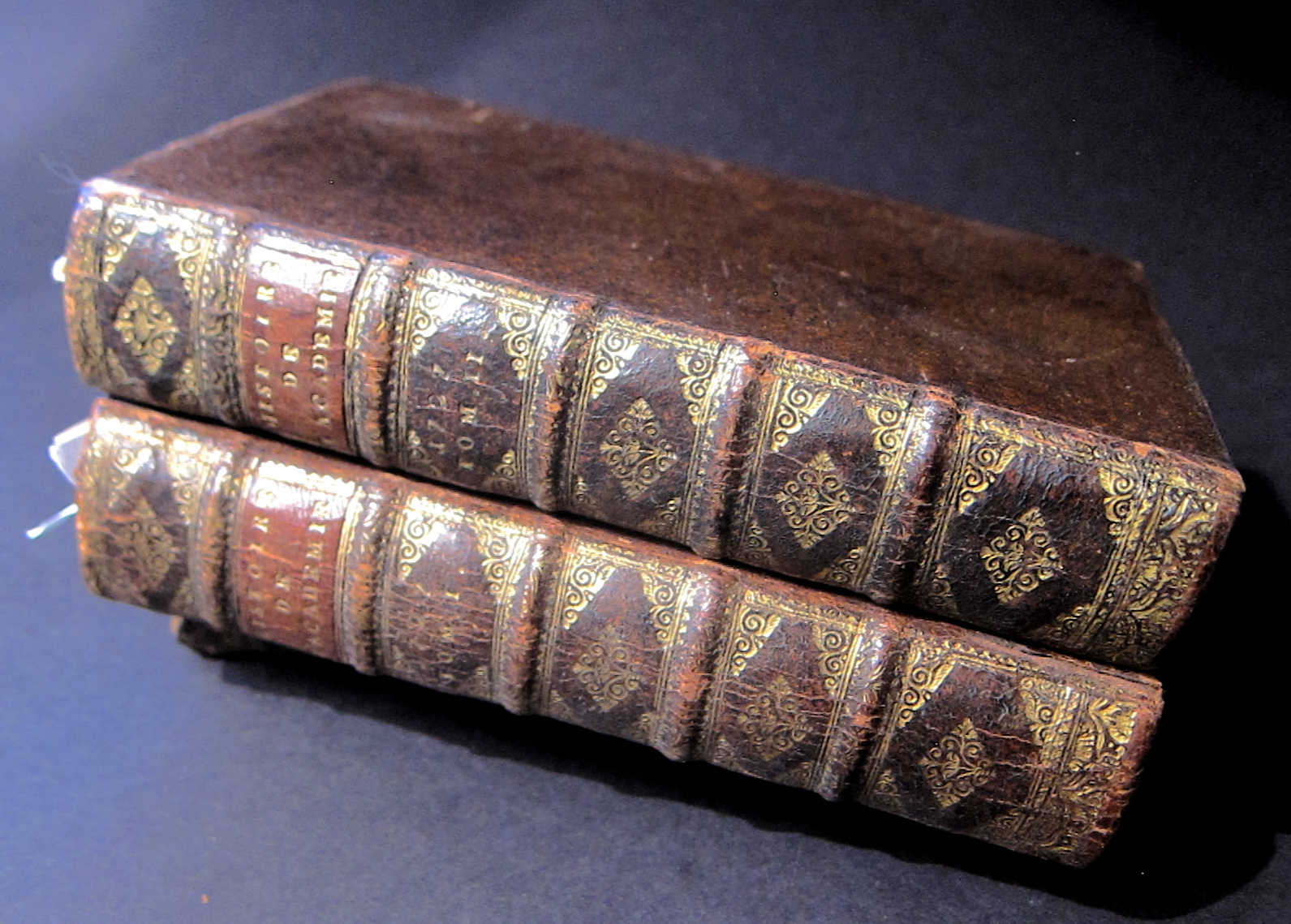
  • Histoire De L Academie Royale Des Sciences Annee M Dccxxii Avec Le Memoires De Mathematique De Physique Pour La Meme Ann

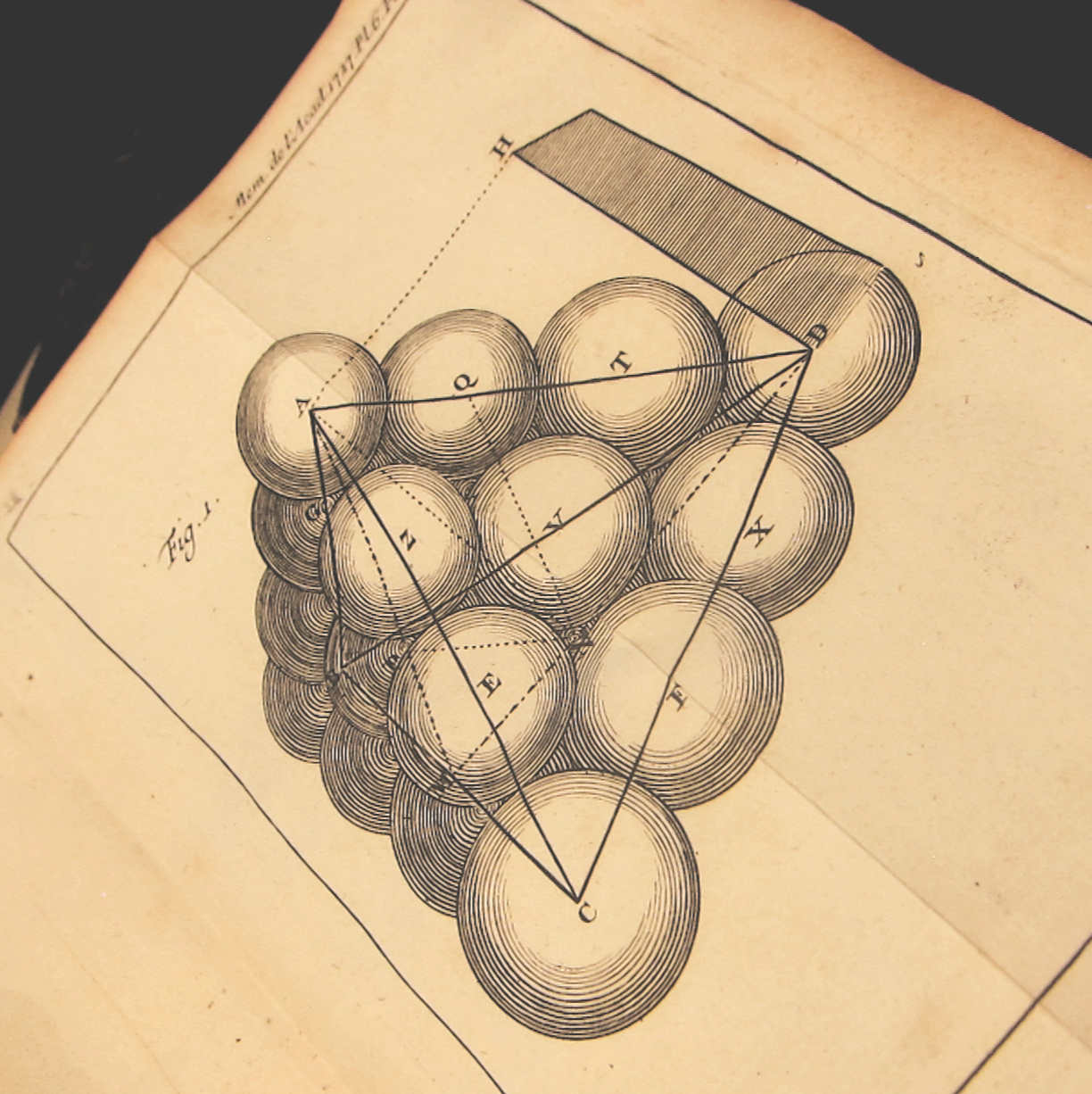
    Histoire de l’ Academie Royale des Sciences. Annee M. DCCXXII. Avec le memoires de mathematique & de physique, pour la meme annee. Tires des registres de cette academie. Printed in Amsterdam by Pierre Coup, 1727, three years after the first French edition (Paris 1724, which is 4to and 439pp compared to this 12mo and 204+526pp). [Histoire de l’ Academie Royale des Sciences] vii, 204pp; [Memoires de mathematique & de physique] 526pp, plus 18 folding engraved plates.
    Lovely copy, bound in full leather, with decorated spine and raised bands. Very Good. $300
    Includes work by Maraldi, Mairan, Cassini, Reamur, Morand, and several others:
    Giacomo Maraldi, “Observations sur differents Meteors de l’Annee 1721, pp 1-7;
    Jean-Jacques Dortous de Mairan (1678-1771,”was a mathematician and an enthusiastic experimenter whose major works were on the formation of ice and on the aurora borealis. However, he was also interested in all the important topics addressed the scientific community in the eighteenth century, among them, the shape of Earth, light, colors, sound, the composition of matter, and vis viva (the debate around the force of moving bodies and the conservation of matter).”–DSB  “Recherches Physico-Mathematiques sur la Reflexion des Corps”, pp 8-68;
    Giovanni Cassini, “Reflexions sur les Observations Astronomiques faites par le P. Feuillee, pp 68-76; 
    Saurin, “Eclaireissement sur une difficulte proposee aux Mathematiciens par M. le Cheavlier de Louville…”, pp 94-129;
    Louvlle, le Chevalier (Jacques d’Allonville, 1671-1732, mathematician and astronomer), “Eclaircissement sur une difficulte de Statitque propossee a l’Academie”, pp 174-194; 
    Morand, “Observations sur des Sacs membraneux pleins d’Hydatides sans nombre, attachés à plusieurs Visceres du bas Ventre, et découverts par l’ouverture d’un Cadavre”, pp 215-224;
    De Lagny, “Traité des progressions arithmetiques de tous les degrés à l’infinii”; 
    Maraldi and Cassini, “Observation de l’Eclipse de Soleil du 8. Decembre 1722. faite en presence du Roy”, pp 453-456; 
    Winslow, “Explication de l’enfoncement apparent d’un grand Clou dans le Cerveau par les narines. Conformation particuliere du Crane d’un Sauvage de l’Amerique Septentrionale. Observations Osteologiques. Avertissement sur un Memoire de 1720″, pp 411-453; 
    Vaillant, “Suite de l’Establissement de nouveaux caracteres de Plantes”, pp 233-293.


    ·Posted by :

    ·in: