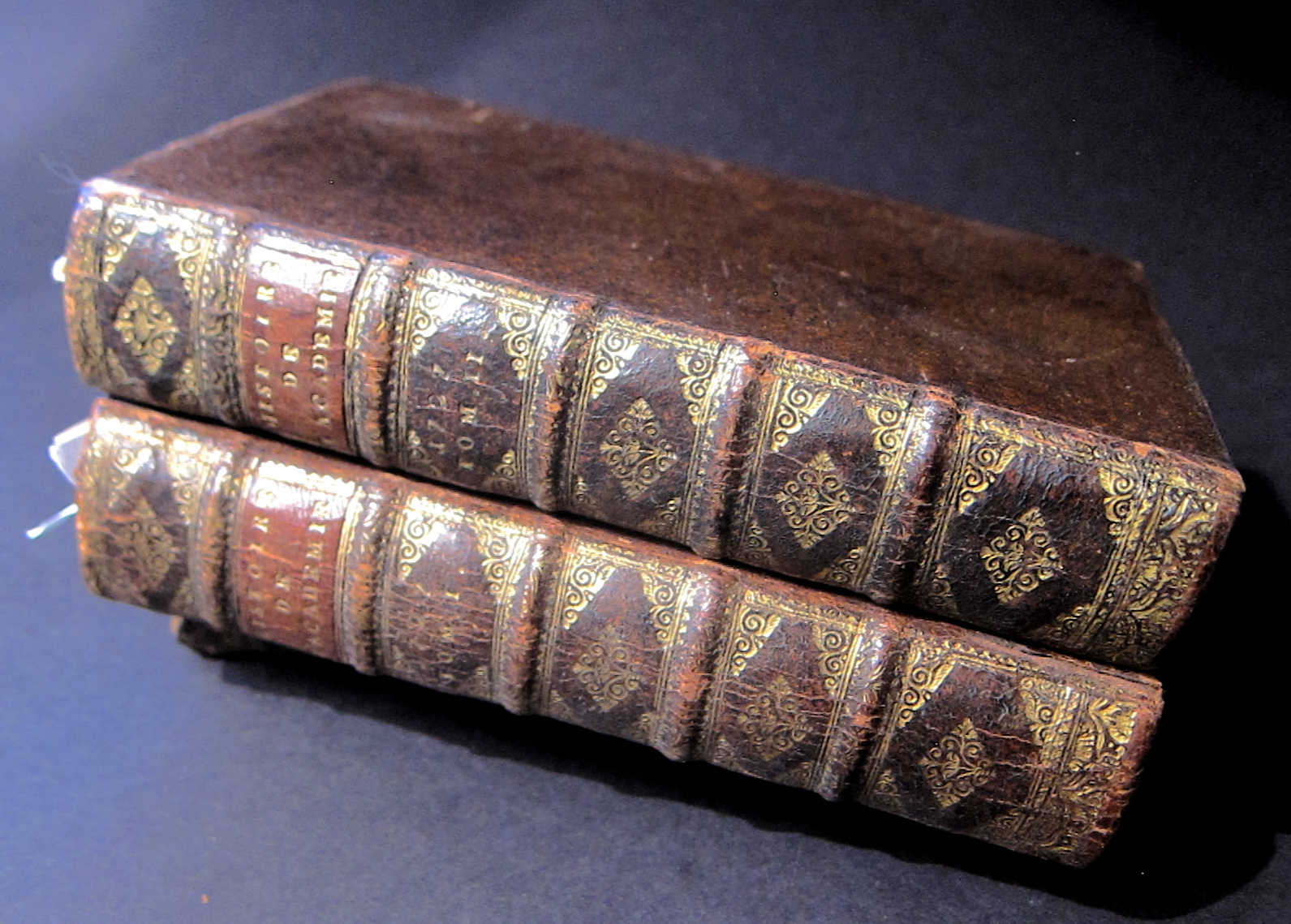
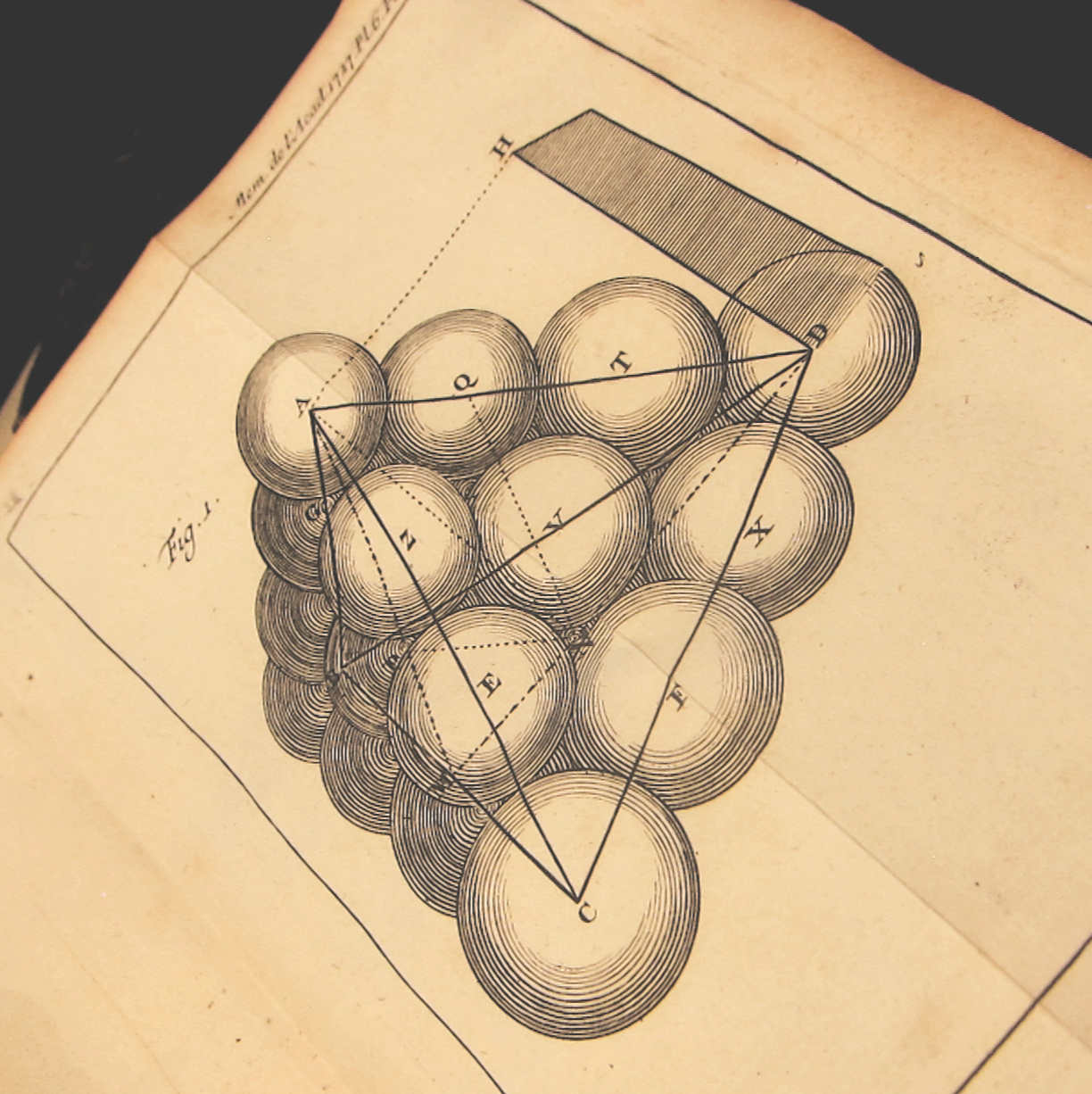
Histoire de l’ Academie Royale des Sciences. Annee M. DCCXXII. Avec le memoires de mathematique & de physique, pour la meme annee. Tires des registres de cette academie. Printed in Amsterdam by Pierre Coup, 1727, three years after the first French edition (Paris 1724, which is 4to and 439pp compared to this 12mo and 204+526pp). [Histoire de l’ Academie Royale des Sciences] vii, 204pp; [Memoires de mathematique & de physique] 526pp, plus 18 folding engraved plates.
Lovely copy, bound in full leather, with decorated spine and raised bands. Very Good. $300
Includes work by Maraldi, Mairan, Cassini, Reamur, Morand, and several others:
Giacomo Maraldi, “Observations sur differents Meteors de l’Annee 1721, pp 1-7;
Jean-Jacques Dortous de Mairan (1678-1771,”was a mathematician and an enthusiastic experimenter whose major works were on the formation of ice and on the aurora borealis. However, he was also interested in all the important topics addressed the scientific community in the eighteenth century, among them, the shape of Earth, light, colors, sound, the composition of matter, and vis viva (the debate around the force of moving bodies and the conservation of matter).”–DSB “Recherches Physico-Mathematiques sur la Reflexion des Corps”, pp 8-68;
Giovanni Cassini, “Reflexions sur les Observations Astronomiques faites par le P. Feuillee, pp 68-76;
Saurin, “Eclaireissement sur une difficulte proposee aux Mathematiciens par M. le Cheavlier de Louville…”, pp 94-129;
Louvlle, le Chevalier (Jacques d’Allonville, 1671-1732, mathematician and astronomer), “Eclaircissement sur une difficulte de Statitque propossee a l’Academie”, pp 174-194;
Morand, “Observations sur des Sacs membraneux pleins d’Hydatides sans nombre, attachés à plusieurs Visceres du bas Ventre, et découverts par l’ouverture d’un Cadavre”, pp 215-224;
De Lagny, “Traité des progressions arithmetiques de tous les degrés à l’infinii”;
Maraldi and Cassini, “Observation de l’Eclipse de Soleil du 8. Decembre 1722. faite en presence du Roy”, pp 453-456;
Winslow, “Explication de l’enfoncement apparent d’un grand Clou dans le Cerveau par les narines. Conformation particuliere du Crane d’un Sauvage de l’Amerique Septentrionale. Observations Osteologiques. Avertissement sur un Memoire de 1720″, pp 411-453;
Vaillant, “Suite de l’Establissement de nouveaux caracteres de Plantes”, pp 233-293.
Book Category: Physics
-
Histoire De L Academie Royale Des Sciences Annee M Dccxxii Avec Le Memoires De Mathematique De Physique Pour La Meme Ann
·Posted by :
·in:
-
Scientific Journal Including an Early Elegy on Isaac Newton (1727)
Histoire de l’Academie Royale des Sciences, annee M.DCCXXVII and bound with Memoires de Mathematique et de Physique. Both: Amsterdam, Pierre Mortier, 1732. 2 volumes: xiv, 1-239; and bound in the same vol, Memoires de Mathematique et de Physique., pp 1-186. And the second volume, pp 189-564. Bound in full calf, raised bands, gilt demtelles. Lovely copies.
There are a number of interesting papers here, not the least of which includes this long elegy on Newton by the pre-eminent de Fontenelle: Bernard de Fontenelle (1657-1757), Eloge de Newton, pp 209-239 (delivered at the Academy on 12 November 1727 and then published first in Paris in 1729.
- Also:
- de Mairan, Dissertation Astronomiques sur le Mouvement de la Lune, et de la Terre , pp 90-152. Cassini, De la Theorie des Cometes , pp 321-345, with two folding plates.
- Petit, Pour quoi les Enfansne voyentpas clair en venant au monde et quelque tems aprils qu’ils sont nes, pp 346-360;
- Saurin, Recherches sur la rectification des Barometres , pp 396-417, 2 folding plates.
- Sloane, Hans. Memoie sur les dents et autres Ossen]mens de l’Elephant, tourves dans Terre.pp 429-472, 2 plates .
- Maraldi, Explication des tables du premier satellite de Jupiter, pp 493-527.
·Posted by :
·in:
-
Histoire De Lacademie Royale Des Sciences Annee Mdccxxx And Bound With Memoires De Mathematique Et De Physique Both Amste
Histoire de l’Academie Royale des Sciences, annee M.DCCXXX and bound with Memoires de Mathematique et de Physique. Both: Amsterdam, Pierre Mortier, 1733. 2 volumes: xiv, 1-194; bound in the same vol, Memoires de Mathematique et de Physique…, pp1-328, plus the second volume, pp (iv), 333-824. 41 folding plates. Bound in full calf, raised bands, gilt demtelles. Lovely copies. $400
Of interest among the 41 papers appearing in the Memoires section are:
Christophe-Bernard de Bragelongne, Examen des lignes du quatrième ordre ou courbes du troisième genre.
Bernouilli, Methode pour trouver les Tautochrones, dans des milieux résistants, comme la quarré des vitesses. L’abbé de Bragelongne, Examen des ligne du quatrième ordre, ou courbes du troisième genre,
Godin, Solution fort simple d’un problème astronomique d’où l’on tire une méthode nouvelle de déterminer les noeuds des planètes;
de Maupertuis, La courbe Descensus aequabilis dans un milieu résistant comme une puissance quelconque de la vitesse.
Nicole, Méthode pour déterminer le sort de tant de joueurs que l’on voudra.
Pitot Nouvelles propriétés de l’hyperbole, par M. Mahieu. Réflexions sur le mouvement des eau.
Maraldi, Observations Meteorologiques faites pendant l’annee MDCXXX
Reaumur, De la Nature de la Terre en generale, et du caractere des differentes especes de Terres.
Reaumur, Regles pour construire des Thermometres…
Mahieu, Nouvelles Proprietes de l’Hyperbole.
Pitot, Reflexions sur le mouvement des Eaux.
Nicole, Examen et Resolutin de quelques Questions sur les Jeux.
Cassini, Suite des Observations de la Comete qui a commence a paroitre a la fin de Julliet de l’annee 1729.
Cassini, Observation de l’eclipse du Soleil, faite a son lever, le 15 Juillet de cette annee 1730.
·Posted by :
·in:
-
Hans Reichenbach Uber Die Physikalischen Konsequenzen Der Relativitischen Axiomatik Offprint From Zeitschrift Fur Phy
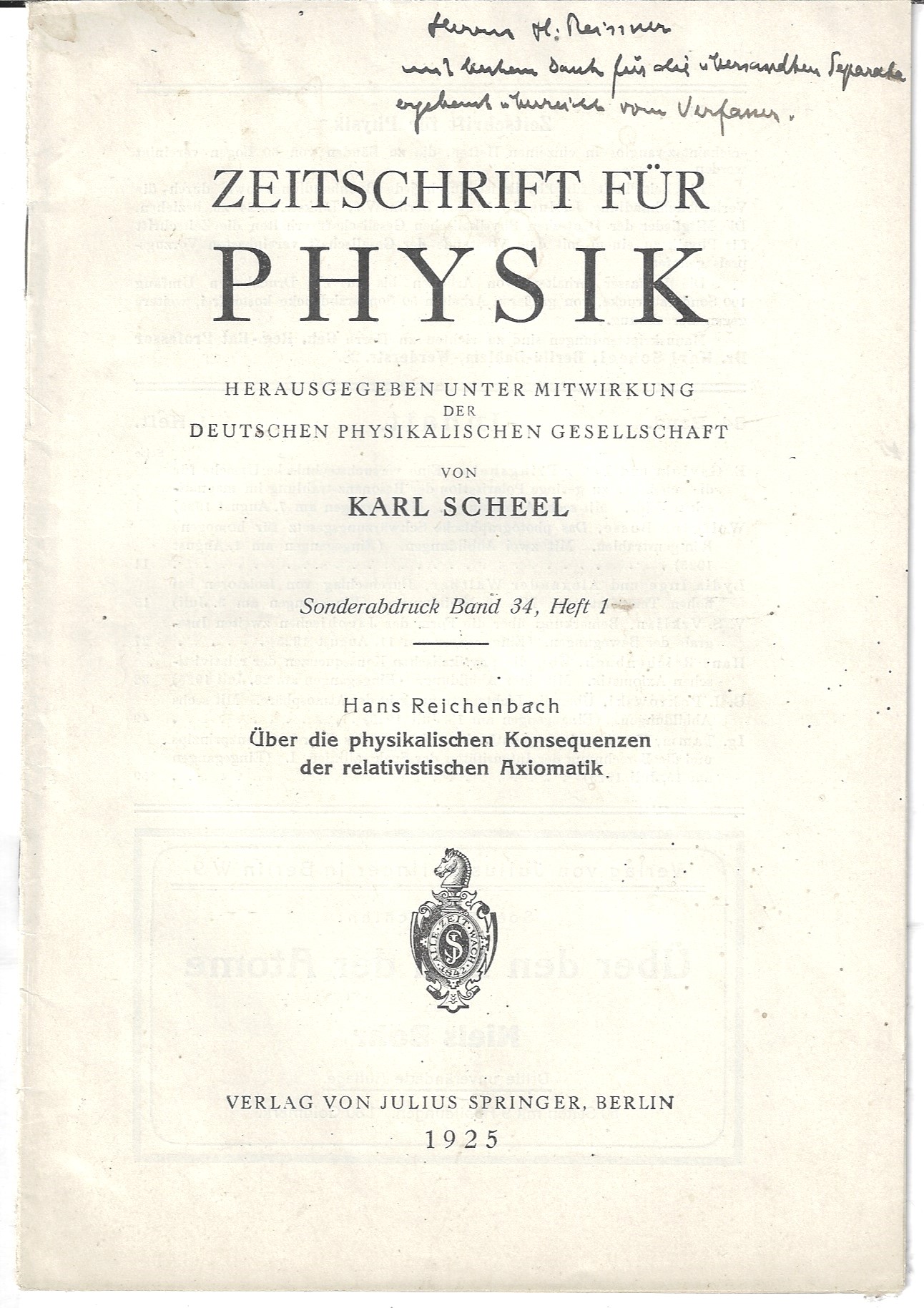
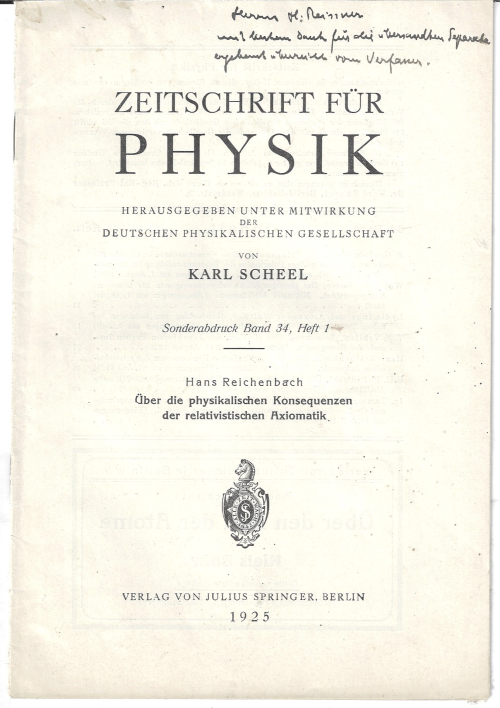 Hans Reichenbach, “Uber die physikalischen Konsequenzen der relativitischen Axiomatik”, offprint from Zeitschrift fur Physik, v34 section 1, printed in Berlin by Springer, 1925. Original wrappers, pp (31)-48. Nice presentation to Hans J. Reissner (Reissner-Nordstrom metric), “vom Verfassser”. $250
“Described as perhaps “the greatest empiricist of the 20th century” (Salmon, 1977a), the work of Hans Reichenbach (1891–1953) provides one of the main statements of empiricist philosophy in the 20th century…Reichenbach’s contributions cover large swathes of formal philosophy, especially in philosophy of physics, logic, induction and the foundations of probability, and his later work encompassed linguistics, philosophical logic, and ethics.”–Stanford Encyclopedia of Philosophy
·Posted by :
·in:
-
Linde Andrei Eternally Existing Self Reproducing Chaotic Inflationary Universe In Physics Letters B 175 Pp 39540
LINDE, Andrei. “Eternally Existing Self-Reproducing Chaotic Inflationary Universe”, in Physics Letters B 175 pp. 395–400 in the volume of 502pp, 1986. With the front wrapper of each of the four issues bound in. $300
“Linde proposes “eternal chaotic inflation.” In 1983, Andrei Linde had demonstrated that quantum fluctuations could begin inflation without the highly unlikely condition of a high plateau in the energy potential hill, and he named the result “chaotic inflation.” In 1986, Linde extended his theory to include the notion of eternal inflation. When begun, “eternal chaotic inflation” would continue to grow in random (chaotic) ways through other quantum fluctuations, and thus be eternal. This theory remains the standard model of inflation more than 20 years after its conception.”–David Wenner, History of Physics Collection.
Abstract: “It is shown that the large-scale quantum fluctuations of the scalar field cp generated in the chaotic-inflation scenario lead to an infinite process of self-reproduction of inflationary mini-universes. A model of an eternally existing chaotic inflationary universe is suggested. “
·Posted by :
·in:
-
Amaldi Ugo With Wim De Boer And Hermann Furstenau Comparison Of Grand Unified Theories With Electroweak And Strong Coupl
AMALDI, Ugo with Wim de Boer and Hermann Furstenau: “Comparison of Grand Unified Theories with Electroweak and Strong Coupling Constants Measured at LEP”, in Physics Letters B 260 pp. 447–455, 1991, published by North Holland. Nicely bound in blue cloth, with two owner stamps on title page. A FINE copy. $225
- Abstract: “Using the renormalization group equations one can evolve the electroweak and strong coupling constants, as measured at LEP, to higher energies in order to test the ideas of grand unified theories, which predict that the three coupling constants become equal at a single unification point. With data from the DELPHI Collaboration we find that in the minimal non-supersymmetric standard model with one Higgs doublet a single unification point is excluded by more than 7 standard deviations. In contrast, the minimal supersymmetric standard model leads to good agreement with a single unification scale of 1016.0±0.3 GeV. Such a large scale is compatible with the present lower limits on the proton lifetime. The best fit is obtained for a SUSY scale around 1000 GeV and limits are derived as function of the strong coupling constant. The unification point is sensitive to the number of Higgs doublets and only the minimal SUSY model with two Higgs doublets is compatible with GUT unification, if one takes the present limits on the proton lifetime into account. “
This is a significant paper (cited over 2200 times) that showed that unification between strong, weak and electromagnetic forces can occur through suppersymmetry.
The paper begins: ““Since LEP–the powerful electron-positron collider at CERN, Europe’s laboratory for particle physics–has begun operating, physicists have got some hint that, indeed, all forces might have been unified during the very first moment of the creation of the universe, the Big Bang, when particles supposedly interacted with each other at energies well above 10-16 GeV…”
See also: Peter Rodgers, Super symmetry, on the Nature site, Nature’s “Milestone 13”, in Nature Physics 4, S13 (2009)
·Posted by :
·in:
-
Early and Important Work on the Atmosphere (1803)
DALTON, John. Five papers in: Annalen der Physik, volume 15, 1803, Rengerschen Buchhandlung, 1803. (vi), 504pp, 4 folding plates. Cloth-backed marbled boards. The full volume offered with the scarce original wrappers, bound-in. Black cloth; dark marbled boards with cloth tips. Ex-libris Deutsche Akademie der Luftfahrtforschung, then Wright Patterson Field Library (USAF), then Library of Congress. Library markings: small gilt-stamped “Akademie der Luftfahrtforschung”, page edges stamped “Wright Field Library/Dayton, Ohio” on top and bottom. Very good condition. $750
- “Versuche über die Expansivkraft der Dämpfe von Wasser und andern Flüssigkeiten, so wohl im luftleeren Raume als in der Luft”, p 1-24;
- “Versuche über die Verdünstung”, pp 121-143;
- “Meteorologische Beobachtungen angestellt zu Manchester”, pp 197-205
- “Versuche und Beobachtungen angestellt, und zu beurtheilen, ob die Menge von Wasser gleich ist, welches die Flüsse und die Verdünstung fortführen. Und etwas über den Ursprung der Quellen”, pp 249-277.
The four papers in two sections (9 & 10) of volume 15 of the Annalen, all translated from Dalton’s “Experimental Essays on the Constitution of mixed Gases on the Force of Steam or Vapour from Water and other Liquids in different Temperatures both in a Torricellian Vacuum and in Air on Evaporation and on the Expansion of Elastic Fluids by Heat” in Memoirs of the Literary and Philosophical Society of Manchester, volume 5/2). These are the first appearances on the Continent of this significant work.
Also in this volume:
Dalton: “Versuche und Beobachtungen, angestellt, um zu beurtheilen, ob die Menge des fallenden Regens und Thaues der Menge von Wasser gleich ist, welches die Flüsse und die Verdünstung fortführen. Und etwas über den Ursprung der Quellen”, section 11, pp 249-277;
Chladni, “Chronologisches Verzeichnis der mit einem Feuermeteor niedergefallenen Stein- und Eisenmassen, nebst einigen Bermerkungen”, section11, pp 307-328 (a chronology of meteor falls inm support of his theory that meteorites were of cosmic rather than atmospheric origin).
AND:
Poisson, Simon Dennis. “Berechnung der Bewegung eines Körpers, der von der Oberfläche des Mondes fortgeschleudert wird”, pp 329-339. (One of Poisson’s first published papers.)
·Posted by :
·in:
-
Schrodinger’s Treatment of the Compton Effect (1927)
SCHRODINGER, Erwin. “Uber den Comptoneffekt” and “Der Energieimpulssatz der Materiewellen”, two papers in Annalen der Physik, volume 82 pp. 257-264, and pp. 265-272; offered in the whole volume of viii, 1168 pp., with 14 plates, printed in 1927. Bound in library cloth with a few usual ex-library markings; the text though is clean and fine, very attractive copy in a solid binding. Near-fine overall. $275
Schrödinger introduces his treatment of the Compton effect (“…the increase in wavelength of X-rays and other energetic electromagnetic radiations that have been elastically scattered by electrons; it is a principal way in which radiant energy is absorbed in matter. The effect has proved to be one of the cornerstones of quantum mechanics, which accounts for both wave and particle properties of radiation as well as of matter”--Encyclopedia Britannica) in which he uses the the Klein-Gordon (“…the linear partial differential equation which is the equation of motion of a free scalar field of possibly non-vanishing mass mm on some (possibly curved) spacetime (Lorentzian manifold”–Ncat Lab) formulation of his wave equation to demonstrate the conservation of energy in quantum mechanics.
·Posted by :
·in:
-
Introducing the Raman Effect and the Geiger-Muller Counter (1928)
LANDSBERG, Grigory and Leonid Mandelstam, “Eine neue Erscheinung bei der Lichtzerstreuung in Krystallen”, in the whole volume of Die Naturwissenschaften, vol 16, 1928, p. 557. AND offered with: Hans Geiger and Walther Müller, “Elektronenzählrohr zur Messung schwächster Aktivitäten” in the same vol 16, pp. 617–618. Volume 16 contains 1,201pp and is in a lovely half-leather binding with leather tips. Fine condition. $350
Russian physicists G. S. Landsberg (1890-1957) and L. I. Mandelstam (1879-1944) describe in this paper their discovery of the Raman effect—discovered virtually simultaneously by Chandrasekhar Venkata Raman (1888-1970), though the two did not share in the Nobel Prize awarded to Raman in 1930. (Why? “As for Landsberg and Mandelstam, they had published their results after Raman’s were in print. In addition, their paper cited previous works by Raman; although these corresponded to articles that had been published prior to Raman’s March 1928 Nature article detailing his discovery, these references perhaps confused the Nobel Committee and led them to believe that the Russians’ work did not represent an independent and simultaneous discovery. Moreover, Landsberg and Mandelstam did not at first publish their results of scattering at a shifted frequency; instead they gave an oral presentation at a conference in Moscow in April 1928 based on their measurements, which were taken in February of that year. By the time they submitted their results in May 1928 and published them in July, 16 papers had been published on the Raman effect, many by Raman and his colleagues. Still, many Austrian, German and Russian physicists felt strongly that credit should be shared. They refused to adopt the name “the Raman effect,” and referred instead to “combination scattering” or “the Smekal-Mandelstam-Raman scattering.” In 1931, K.W.F. Kohlrausch, an Austrian physicist, gave his book a title that recognized both Smekal and Raman: Der Smekal-Raman Effekt.”–Barry R. Masters, “C.V. Raman and the Raman Effect” in the Optical Society’s “Optics and Photonics News” (March 2009).
AND with:
The second paper in this volume is the announcement of the invention of the Geiger-Muller counter, by it inventors. “The Geiger–Müller tube or G–M tube is the sensing element of the Geiger counter instrument used for the detection of ionizing radiation. It was named after Hans Geiger, who invented the principle in 1908,[1] and Walther Müller, who collaborated with Geiger in developing the technique further in 1928 to produce a practical tube that could detect a number of different radiation types.” –Wikipedia
·Posted by :
·in:
-
Chandrasekhar Subrahmanyan On A New Theory Of Weizsaker On The Origin Of The Solar System In Reviews Of Modern Physics Am
CHANDRASEKHAR, Subrahmanyan. “On a New Theory of Weizsaker on the Origin of the Solar System”, in Reviews of Modern Physics, American Physical Society, vol 18/1, January 1946, pp 94-102 in the issue of pp 1-149. Original wrappers. Fine copy. $200
“A Nobel Laureate [awarded in 1983 “for his theoretical studies of the physical processes of importance to the structure and evolution of the stars”] honored for his extraordinarily wide-ranging contributions to physics, astrophysics, and applied mathematics, Chandrasekhar is well known for his discovery of the limiting mass (Chandrasekhar limit) of a star that could become a white dwarf.”–Complete Dictionary of Scientific Biography, online.
“In 1938, Weizsäcker developed a theory on the formation of the Solar System, based on considerations regarding the unequal share of lighter and heavier elements in the Sun and the Solar System’s terrestrial planets….According to the theory, the Sun and its planets evolved from a gas cloud made up of 99% hydrogen and helium, and 1% of heavier elements. Some 10% of the cloud remained around the Sun as an extensive atmosphere during an initial phase, and the 1% of heavier elements within this 10% of the total mass of the cloud would tally with the fraction of roughly 1% that the planets contribute to the mass of the Solar System today….”–Wikipedia
Also: a 2pp paper of corrections by Einstein and E.G. Straus “The Influence of the Expansion of Space on the Gravitation Fields Surrounding the Individual Stars”, pp 148-9.
·Posted by :
·in: