A Daily History of Holes, Dots, Lines, Science, History, Math, Physics, Art, the Unintentional Absurd, Architecture, Maps, Data Visualization, Blank and Missing Things, and so on. |1.6 million words, 7500 images, 4.9 million hits| Press & appearances in The Times, Le Figaro, Mensa, The Economist, The Guardian, Discovery News, Slate, Le Monde, Sci American Blogs, Le Pont, and many other places… 5000+ total posts since 2008.

Book Category: Mathematics

  • Flatland, a Romance of Many Directions, by a Square. First Edition, 1884.

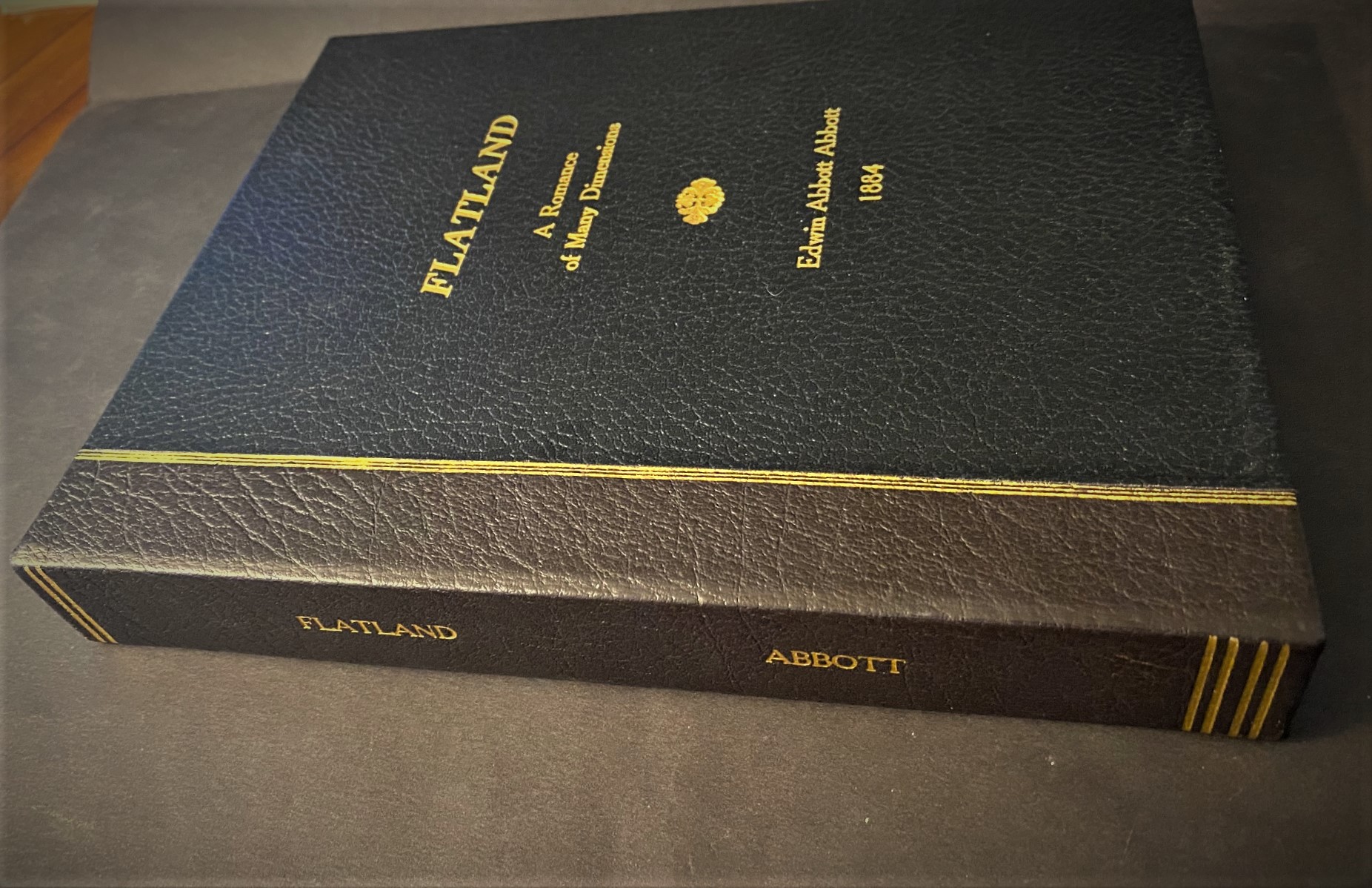
    (ABBOTT, Edwin Abbott). Flatland, a Romance of Many Directions, by a Square. London, Seeley & Co., 1884. First edition. 8.5″x 7″ (22x18cm), viii, 100pp, with very occasional diagrams in text. Bound in stiff vellum-like wrappers. The wrappers are browned and have had some chips expertly repaired; the joints have also been strengthened an expertly repaired. The book is housed in a lovely (and new) leather solander case. The book is in VERY GOOD condition; the solander case is new. $1750
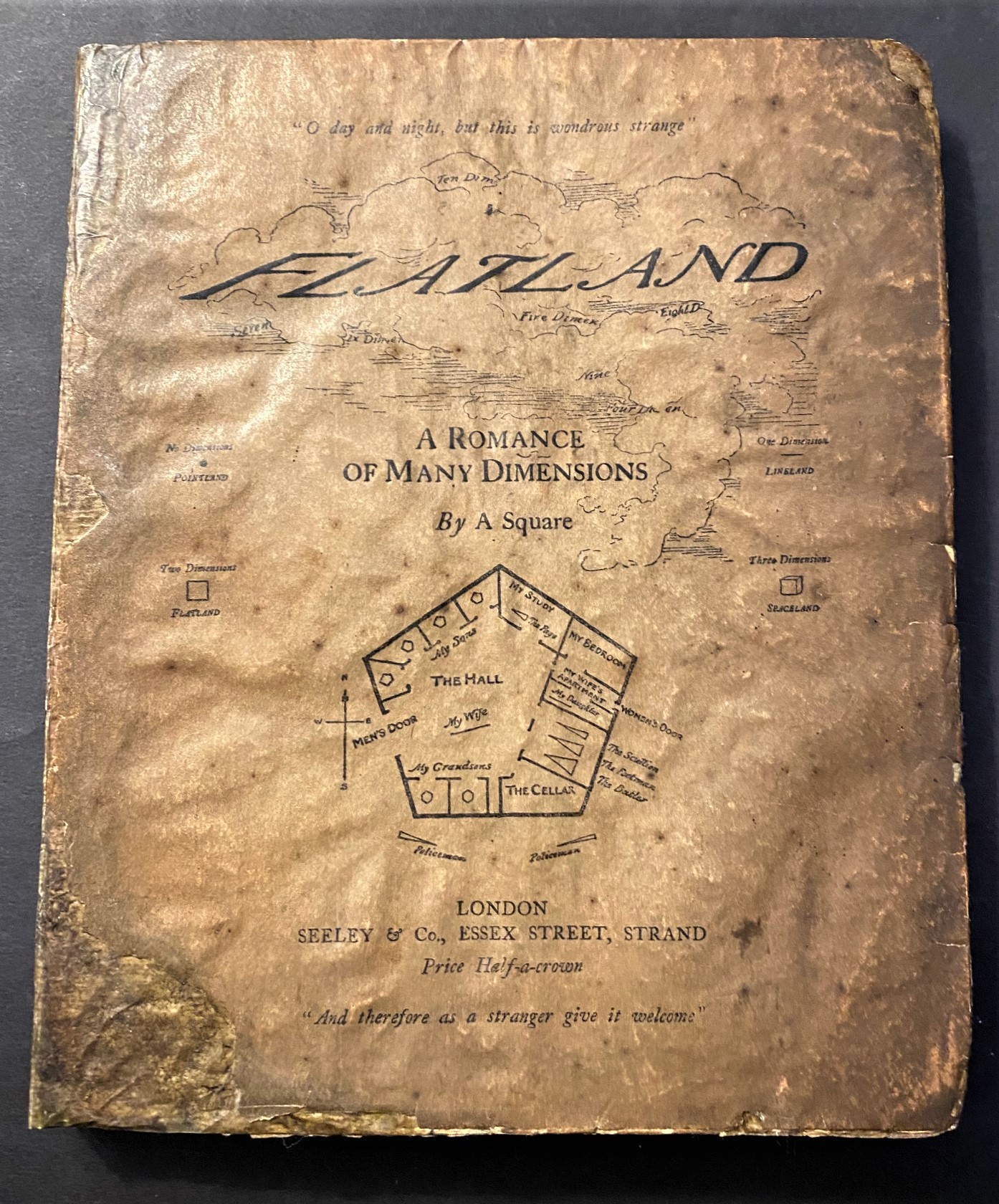
    IMG_4134I’ve read in a number of places how Abbott’s work was ostensibly an intentional social satire, but I have a hard time imaging that it this was the book’s main intention, which I see as a challenge to perception and an expanding explanation of very difficult ideas that escaped common analogs, the biggest chunk of which is Abbott’s understanding of n-dimensional geometries. Of course there are easy visible social targets all throughout the work, though I think that the book’s major contribution to the global mind is in representing the possibilities and explanation of imagination.

    I think Flatland is perhaps one of the best books ever written on perception and dimensions, a beautifully insightful book that was quick and sharp, and in spite of all it was an instant best-seller—with a second edition printed in the same year plus nine reprints to 1915–and is still in-print today. Written in 1884 when Abbott was 46 (Abbott would live another 46 years and enjoy the book’s popular reception), it introduces the reader to a two dimensional world with a social structure in which the more sides of your object equals power and esteem.  Thus the lowest class would be a triangle (three sides) while the highest (priestly) class would be mega-polygons whose shape would approach a circle.  Abbott’s magistry comes in explaining to the three-dimensional reader what it was like to be in a two-dimensional world—the very idea of this sort of thinking in Flatland was strictly forbidden.
    IMG_4136

    It is a glorious introduction to wonder when a sphere lifts the hero of the adventure (a “Square”) into the three-dimensional world for the first time. The fourth dimension of course was another thing entirely—ad as it turns out the mention of 4-D in the 3-D world is as strictly verbotten as 3-D was in 2-D. The Square is ultimately imprisoned for speaking of his experiences in 3-D.
    ·Posted by :

    ·in:


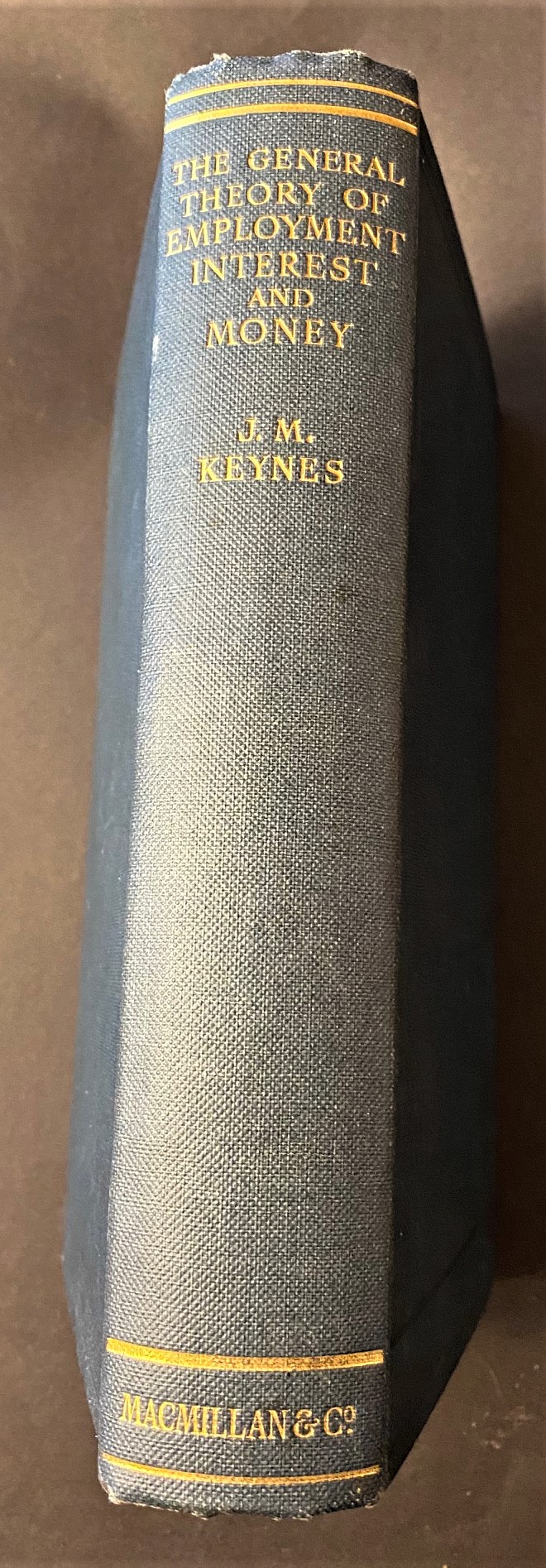
  • Keynes’ Big Book (1936)

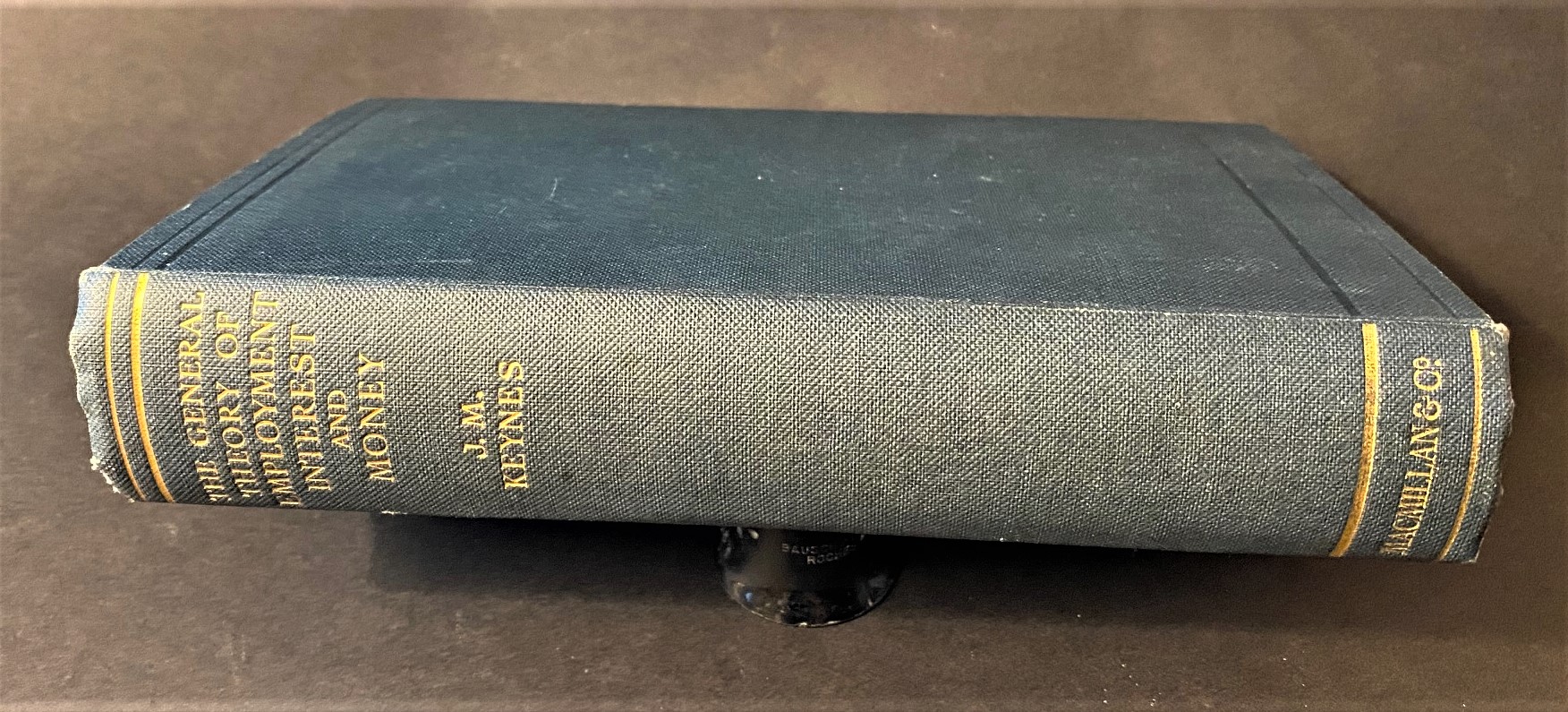
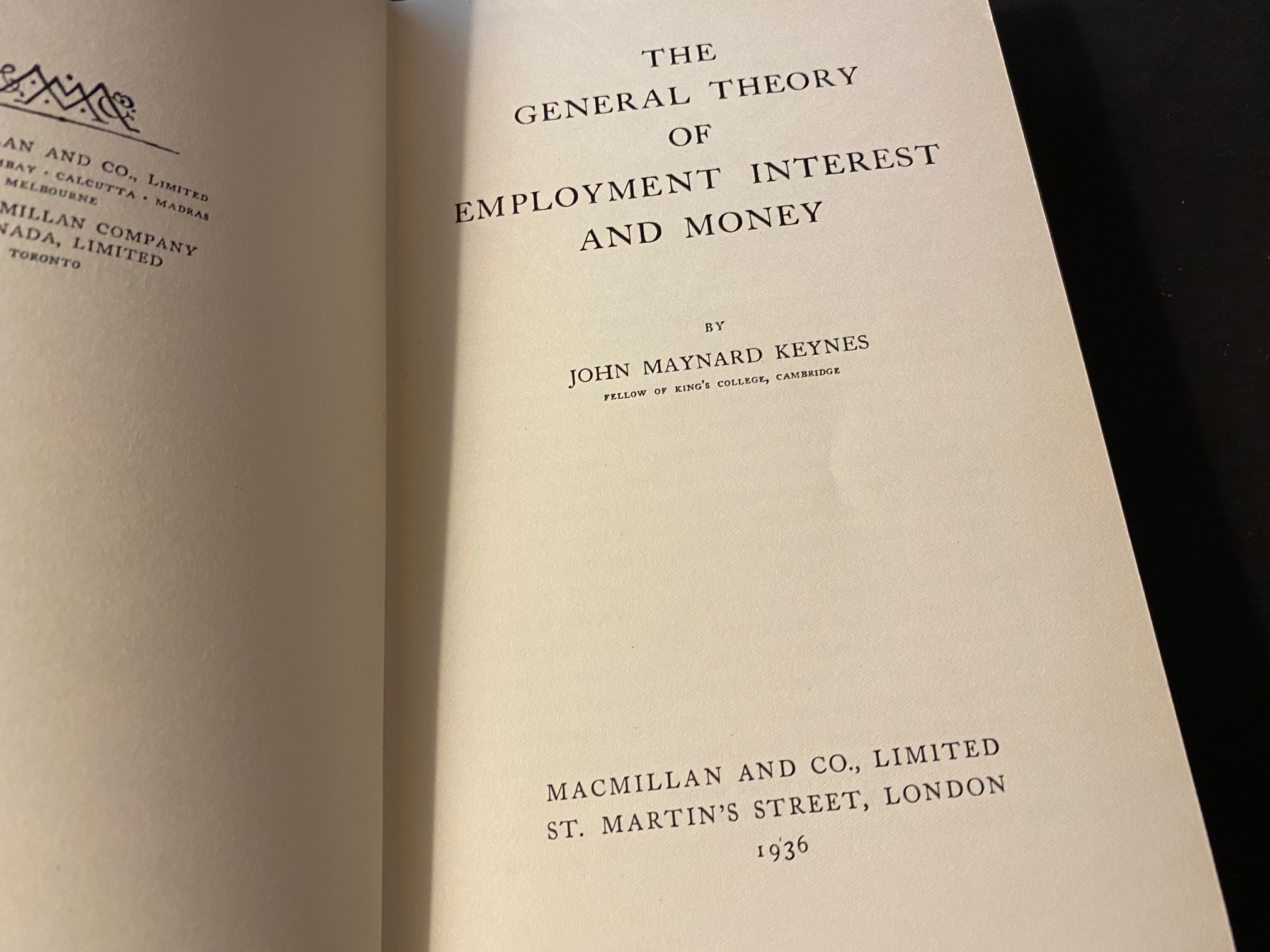
    John Maynard Keynes, The General Theory of Employment, Interest, and Money. London, Macmillan & Co.. First edition, 2nd impression, March 1936. 8vo; xii, 403pp. Diced cloth.  Lovely copy. About fine. There is a signature on the front pastedown and a name stamped on the front free endpaper. Crisp, strong, fresh, and clean copy.  $450

    IMG_2387
    IMG_2387
    IMG_2387

    ·Posted by :

    ·in:


  • An Early Appearance of an Applied Hexadecimal System (1863)

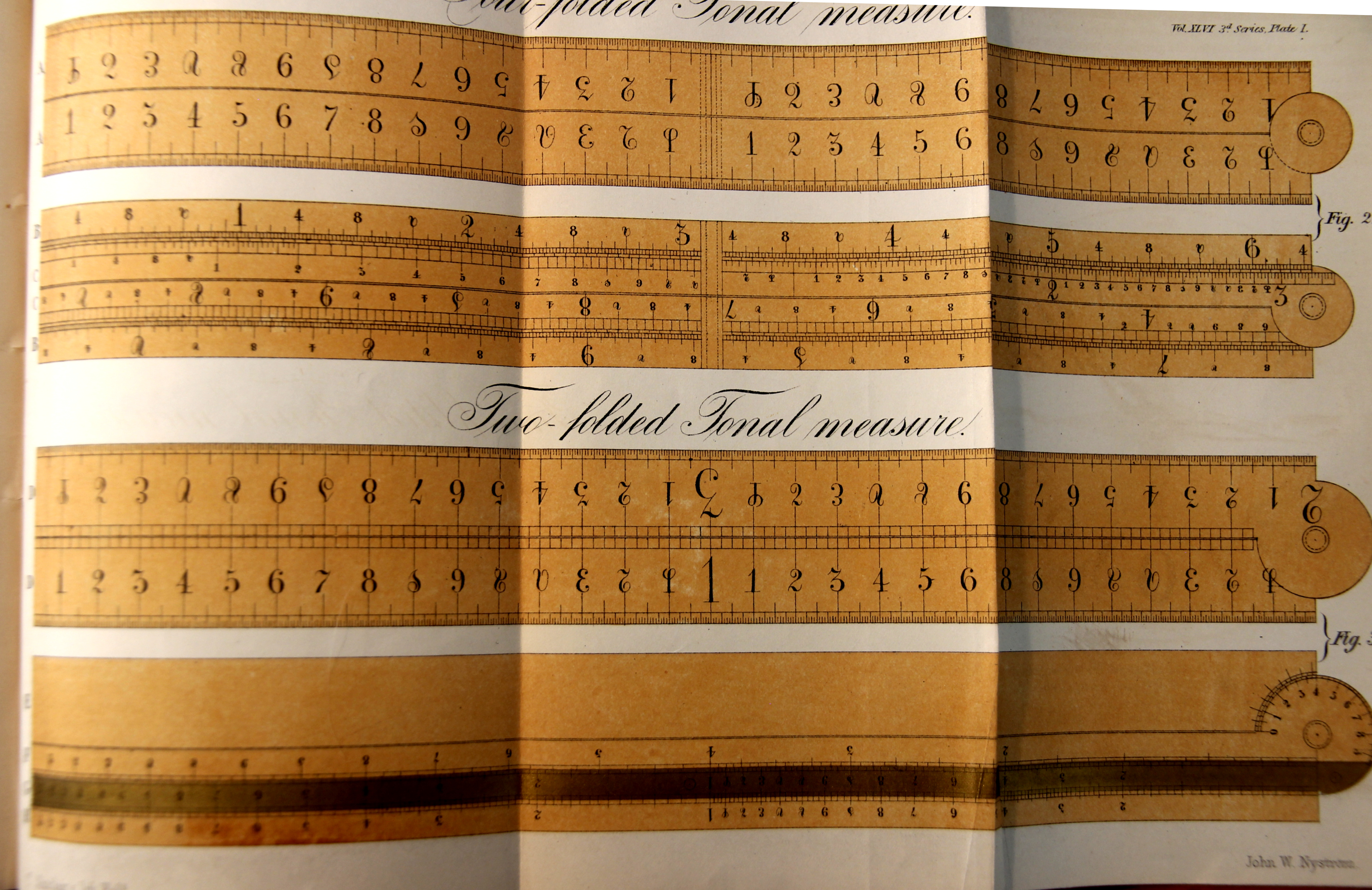
    John Nystrom, “A New System of Arithmetic and Metrology, called the Tonal System”, pp 263-275, 337-348, 402-407 (concluded), and illustrated, including a folding plate. In Journal of the Franklin Institute, third series vol 46 overall vol 76, July-December 1863, 432pp. Half-calf and marbled boards. The spine is rubbed, and the corners of the boards are quite worn. The text is bright and crisp—overall, this is a GOOD copy. $250

    Nystrom 1863 _3_

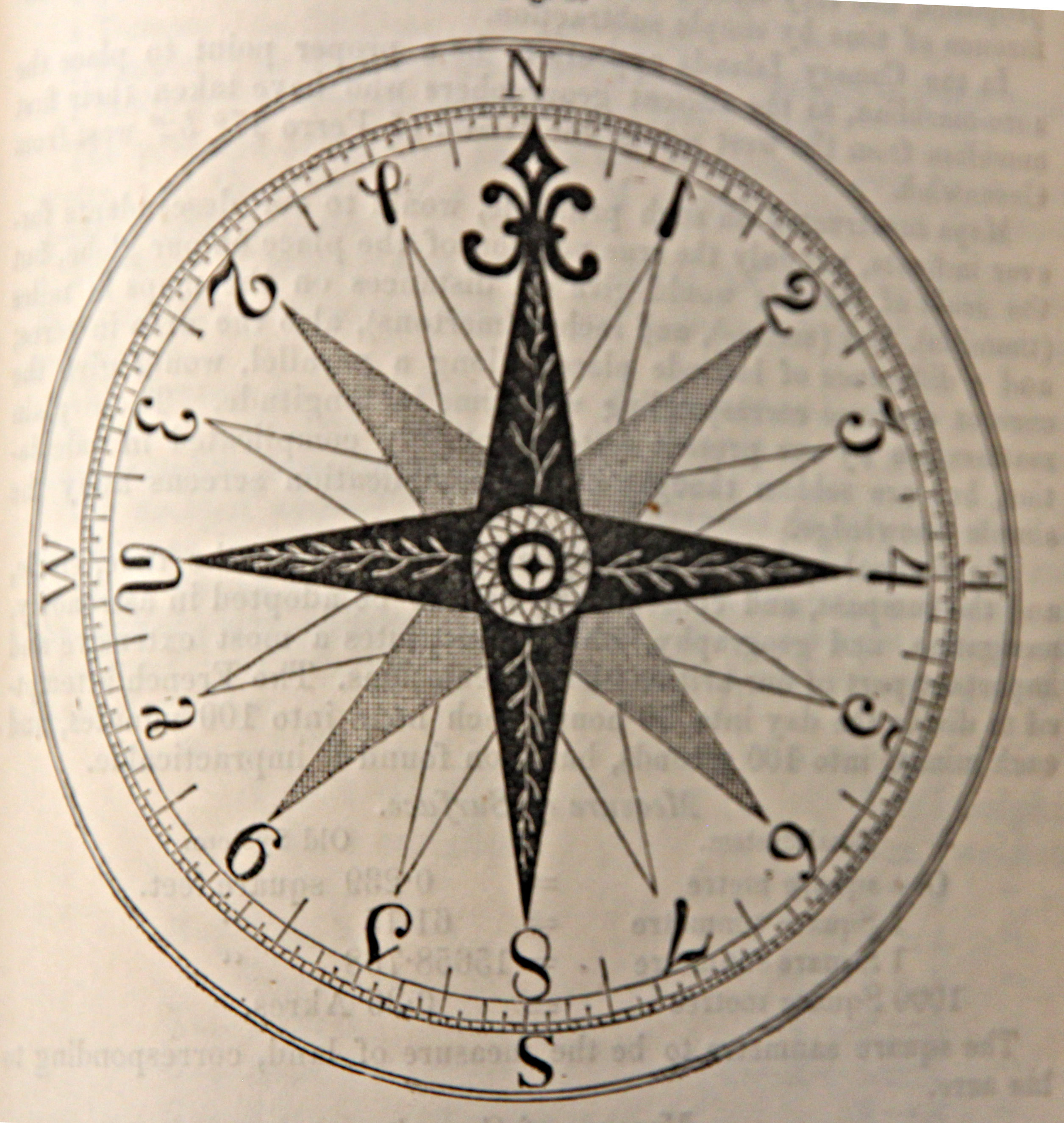
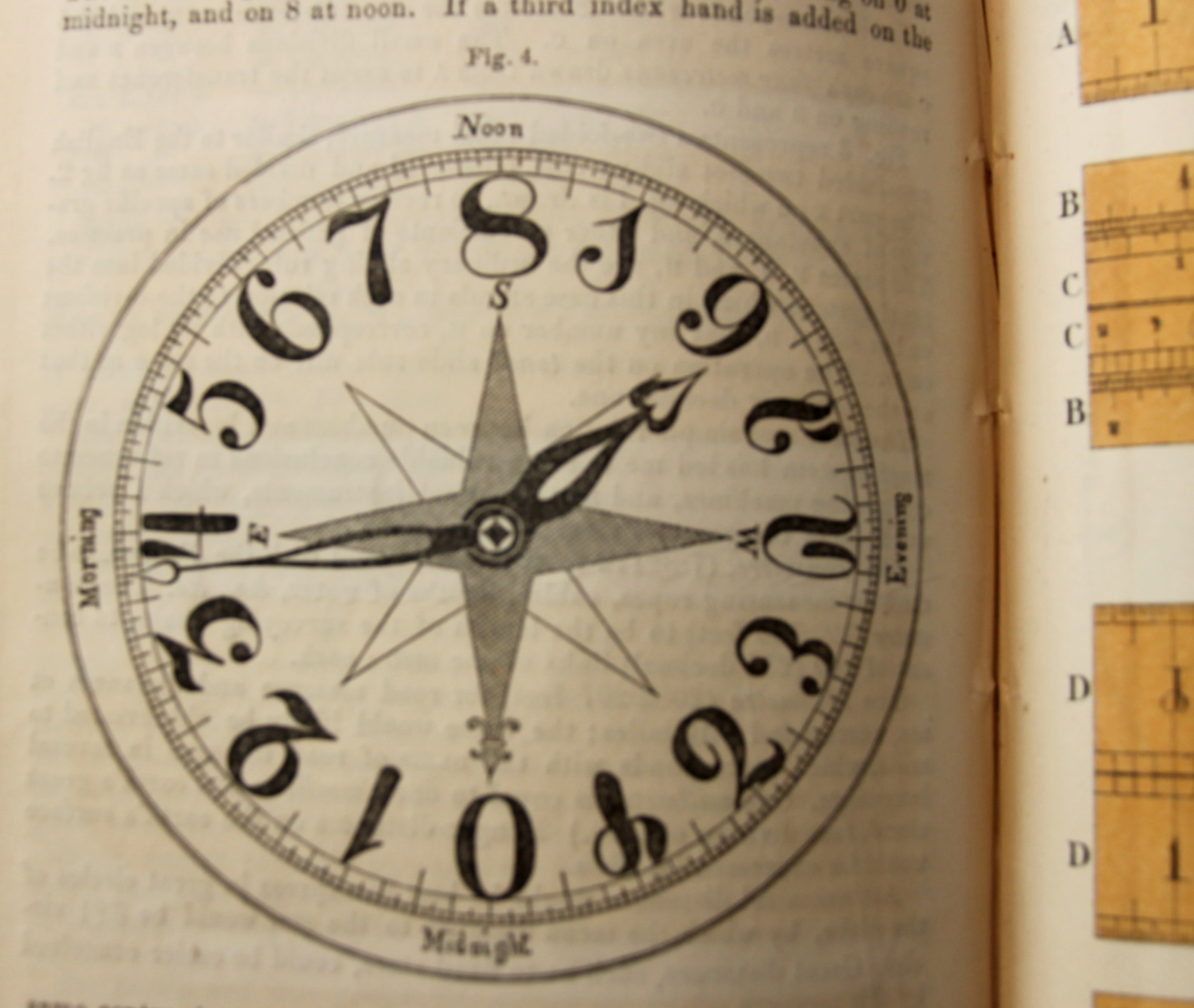
    This is a very early entry in the history of the application of the hexadecimal system. Nystrom’s plan included converting to a hex arithmetical system, and then expanded the idea to the calendar, musical notation, geography, time—an overall shift in metrology. His idea did not extend to calculators, and his name does not seem to be referenced by any of the modern compsci folks (with the major exception of Donald Knuth). Probably base-16 was not employed in programming until, I guess, around the early 1960’s. All that said, this is still a remarkable paper. ALSO: the paper is illustrated with a beautiful color-highlighted folding plate of divider-like instruments that translated hex to denary.

    “John Williams Nystrom (Swedish: Johan Vilhelm Nyström) (1825–1885) was a Swedish born, American civil engineer, inventor, and author. He served as an assistant Secretary and Chief Engineer of the United States Navy during the American Civil War. Nystrom received many patents for inventions such as a marine steam engine, a refrigerator, and calculating machines…

    Nystrom is most notable for his proposal to switch from decimal to hexadecimal as defined in his 1862 publication titled . In 1859, Nystrom proposed a hexadecimal (base 16) system of notation, arithmetic, and metrology called the Tonal system. In addition to new weights and measures, his proposal included a new calendar with sixteen months, a new system of coinage, and a hexadecimal clock with sixteen hours in a day.”–Wikipedia

    Nystrom 1863 _3_

    (“Hexadecimal is a base/positional number system used in mathematics and computer science. … Hexadecimal is an easier way to represent binary values in computer systems because they significantly shorten the number of digits, as one hexadecimal digit is equivalent to four binary digits.”)

    “If the Arabic notation employed in our present decimal arithmetic had been suggested to Moses when he wrote the ten commandments on Mount Sinai he would surely have made similar remarks as that made on the tonal system that such curious looking characters could not be understood by his people….My manuscript on the tonal system has been sent to a great many places for publication The Franklin Institute thought it would have a very serious effect on the number of subscribers of their journal The Smithsonian Institute would not publish it because they had so much of the same kind before The US Coast Survey stated they would publish it if recommended by a member of Congress And lately the Society of Philadelphia has rejected it perhaps on the remarks herein replied to but Mr D recommended its publication.”–John William Nystrom, Project of a New System of Arithmetic, Weight, Measure and Coins: Proposed ...(1862)  (Quotation: John W. Nystrom, ca. 1863) The Art of Computer Programming section 4.1, Donald Knuth.

    Nystrom 1863 _3_

     “…a prominent Swedish-American civil engineer named John W. Nystrom decided to carry Charles XII’s plans [radix-8 arithmetic] a step further, by devising a complete system of numeration, weights, and measures based on radix-16 arithmetic. He wrote, “I am not afraid, or do not hesitate, to advocate a binary system of arithmetic and metrology. I know I have nature on my side; if I do not succeed to impress upon you its utility and great importance to mankind, it will reflect that much less credit upon our generation, upon our scientific men and philosophers.” Nystrom devised special means for pronouncing hexadecimal numbers; for example, (C0160)16 was to be read “vybong, bysanton.” His entire system was called the Tonal System, and it is described in J. Franklin Inst. 46 (1863), 263–275, 337–348, 402–407. A similar system, but using radix 8, was worked out by Alfred B. Taylor [Proc. Amer. Pharmaceutical Assoc. 8 (1859), 115–216; Proc. Amer. Philosophical Soc. 24 (1887), 296–366].

    On the Nystrom calculator: “In an article of Scientific American the device was hailed as the most important one ever brought before the public. Despite all of the accolades however, it was never widely accepted, and no more than 100 devices were ever produced. This may have been because the cost (there were $10, $15, and $20 models, a huge sum in 1850s), or because the instrument was never well advertised or marketed. –history-computer.com

    ·Posted by :

    ·in:


  • A Key Advance in Number Theory (1873)

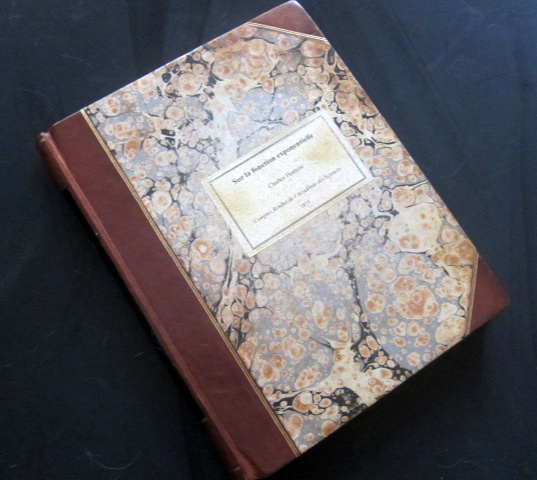
    HermiteCharles Hermite, “Sur la fonction exponentielle”, a five-part paper in Comptes Rendus Hebdomadaires des Seances de l’Academie des Sciences, 1873, vol 77, Nos 1-5, 380pp, (with the Hermite paper in issues 1,2,4,5).

    Paris: Gauthier-Villars, 1873. The Hermite papers occupy pp.18-24, 74-79, 226-233, and 285-293.

    The five issues are rebound in a finely executed half-calf and marbled boards binding, with an antiqued paper label on the front board; new end papers. Lovely binding. The text is crisp though there is some browning (not making the paper brittle by any means). The paper label on the front board is misprinted as “1875” instead of “1873”. Fine copy. $950

    • First appearance of Hermite’s very important work on the transcendence of e. “1873. Charles Hermite (1822-1901) proves that the base of natural logarithms, e = 2.718…is transcendental. This is the first familiar number to be transcendental.”–Parkinson, Breakthroughs, a Chronology of Great Achievements in Science and Mathematics.

    “One of the best-known facts about Hermite is that he first proved the transcendence of e (1873). In a sense this last is paradiematic of all of Hermite’s discoveries. By a slight adaptation of Hermite’s proof, Felix Lindemann, in 1882, obtained the much more exciting transcendence of π. Thus, Lindemann, a mediocre mathematician, became even more famous than Hermite for a discovery for which Hermite had laid all the groundwork and that he had come within a gnat’s eye of making. If Hermite’s work were scrutinized more closely, one might find more instances of Hermitean preludes to important discoveries by others, since it was his habit to disseminate his knowledge lavishly in correspondence, in his courses, and in short notes.  …Hermite’s most important results have been so solidly incorporated into more general structures and so intensely absorbed by more profound thought that they are never attributed to him. Hermite’s principle, for example, famous in the nineteenth century, has been forgotten as a special case of the Riemann-Roch theorem. Hermite’s work exerted a strong influence in his own time, but in the twentieth century a few historians, at most, will have cast a glance at it.”–by Hans Feudenthal, Complete Dictionary of Scientific Biography (online)


    ·Posted by :

    ·in:


  • Histoire De Lacademie Royale Des Sciences Annee Mdccxxx And Bound With Memoires De Mathematique Et De Physique Both Amste

    Histoire de l’Academie Royale des Sciences, annee M.DCCXXX and bound with Memoires de Mathematique et de Physique. Both: Amsterdam, Pierre Mortier, 1733. 2 volumes: xiv, 1-194; bound in the same vol, Memoires de Mathematique et de Physique…, pp1-328, plus the second volume, pp (iv), 333-824. 41 folding plates. Bound in full calf, raised bands, gilt demtelles. Lovely copies. $400

    Of interest among the 41 papers appearing in the Memoires section are:

    Christophe-Bernard de Bragelongne, Examen des lignes du quatrième ordre ou courbes du troisième genre. 

    Bernouilli, Methode pour trouver les Tautochrones, dans des milieux résistants, comme la quarré des vitesses. L’abbé de Bragelongne, Examen des ligne du quatrième ordre, ou courbes du troisième genre,

    Godin, Solution fort simple d’un problème astronomique d’où l’on tire une méthode nouvelle de déterminer les noeuds des planètes;

    de Maupertuis, La courbe Descensus aequabilis dans un milieu résistant comme une puissance quelconque de la vitesse.

    Nicole, Méthode pour déterminer le sort de tant de joueurs que l’on voudra.

    Pitot Nouvelles propriétés de l’hyperbole, par M. Mahieu. Réflexions sur le mouvement des eau.

    Maraldi, Observations Meteorologiques faites pendant l’annee MDCXXX

    Reaumur, De la Nature de la Terre en generale, et du caractere des differentes especes de Terres.

    Reaumur, Regles pour construire des Thermometres…

    Mahieu, Nouvelles Proprietes de l’Hyperbole.

    Pitot, Reflexions sur le mouvement des Eaux.

    Nicole, Examen et Resolutin de quelques Questions sur les Jeux.

    Cassini, Suite des Observations de la Comete qui a commence a paroitre a la fin de Julliet de l’annee 1729.

    Cassini, Observation de l’eclipse du Soleil, faite a son lever, le 15 Juillet de cette annee 1730.

    ·Posted by :

    ·in:


  • Godel’s Classic and Important Papers on the Continuum Hypothesis (1938-9)

    Gödel , Kurt. “The Consistency of the Axiom of Choice and of the Generalized Continuum-Hypothesis”, in Proceedings of the National Academy of Sciences, vol 24, pp.556-557, 1938, in the volume of 572pp.

    Offered with:

    _____. “Consistency-proof for the Generalized Continuum-Hypothesis”, in Proceedings of the National Academy of Sciences, vol 25 pp. 220-224, 1939, in the volume of 661pp. Both first editions, and uniformly bound in brown cloth, nicely imprinted in gilt (with the full name of the journal, which is unusual given its length). There are some rubbed places on the covers and along spine bottom, making those areas a light shade of brown. Small 6x8mm perforated stamp on title; the text is in very fine condition. Overall, a solid near-Fine on both volumes. $2500 for the pair

    • These works are arguably Gödel ‘s next most important contributions next to the incompleteness theorems, which are arguably mathematical logic’s most important achievement in the 20th century.

    Hilbert famously put forward a list of 23 important questions in mathematics, 10 of which were presented at the International Congress of Mathematics in Paris in 1900. The very first of these questions was the continuum hypothesis, a problem simply stated: “…how many points on a line are there? Strangely enough, this simple question turns out to be deeply intertwined with most of the interesting open problems in set theory, a field of mathematics with a very general focus, so general that all other mathematics can be seen as part of it, a kind of foundation on which the house of mathematics rests. Most objects in mathematics are infinite, and set theory is indeed just a theory of the infinite.”–Juliette Kennedy, “Can the Continuum Hypothesis Be Solved?”, 2011, on the IAS website.

    “In 1935 Godel had made the first breakthrough in his new area of research: set theory. During May and June 1937 he lectured at Vienna on his striking result that the axiom of choice is relatively consistent. That summer he obtained the much stronger result that the generalized continuum hypothesis is relatively consistent; and in September 1937 John von Neumann, an editor of the Princeton journal Annals of Mathematics, urged him to publish his new discoveries there. Yet Gödel did not announce them until November 1938, and then not in the Annals but in a brief summary communicated to the Proceedings of the National Academy of Sciences.”–Complete Dictionary of Scientific Biography.

    On the continuum Hypothesis: “Cantor believed the continuum hypothesis to be true and tried for many years to prove it, in vain (Dauben 1990). It became the first on David Hilbert’s list of important open questions that was presented at the International Congress of Mathematicians in the year 1900 in Paris. Axiomatic set theory was at that point not yet formulated. Kurt Gödel proved in 1940 that the negation of the continuum hypothesis, i.e., the existence of a set with intermediate cardinality, could not be proved in standard set theory. The second half of the independence of the continuum hypothesis – i.e., unprovability of the nonexistence of an intermediate-sized set – was proved in 1963 by Paul Cohen.”–Wikipedia

    On Gödel , in general: “The character and achievement of Gödel, the most important logician since Aristotle, bear comparison with those of the most eminent mathematicians. His aversion to controversy is reminiscent of Newton’s, while his relatively small number of publications — each quite precise and almost all making a major contribution—echo Gauss’s motto of “few but ripe.” Like Newton, he revolutionized a branch of mathematics—in this case, mathematical logic—giving it a structure and a Kuhnian paradigm for research. His notebooks, like those of Gauss, show him to be well in advance of his contemporaries. While Newton made substantial efforts in theology as well as in mathematical physics,…”–Complete Dictionary of Scientific Biography


    ·Posted by :

    ·in:


  • The White Hole (1916)

    CAYLEY, Arthur. “Memoir on the Theory of Matrices” and “A Supplementary Memoir on the Theory of Matrices” in Philosophical Transactions of the Royal Society of London, two extracts bound together, as follows: “Matrices” , Vol. 148 (1858), pp. 17- 37; “Supplementary Memoir”, Vol. 156 (1866), pp. 25- 35. Fine condition, bound in beautiful leather and boards of the period, offered with title page and individual title pages for each paper.  $850

    Cayley (1821-1895) introduced matrices to simplify the solution of simultaneous linear equations, along with matrix functions such as addition and multiplication, and the concepts of matrix calculus.. Cayley is responsible for another branch of algebra over and above invariant theory, the algebra of matrices. The use of determinants in the theory of equations had by his time become a part of established practice, although the familiar square notation…and although their use in geometry, such as was provided by Cayley from the first, was then uncommon. (They later suggested to him the analytical geometry of n dimensions.) Determinants suggested the matrix notation; and yet to those concerned with the history of the “theory of multiple quantity” this notational innovation, even with its derived rules, takes second place to the algebra of rotations and extensions in space (such as was initiated by Gauss, Hamilton, and Grassmann), for which determinant theory provided no more than a convenient language. Cayley’s originality consisted in his creation of a theory of matrices that did not require repeated reference to the equations from which their elements were taken. In his first systematic memoir on the subject …he established the associative and distributive laws, the special conditions under which a commutative law holds, and the principles for forming general algebraic functions of matrices. He later derived many important theorems of matrix theory. Thus, for example, he derived many theorems of varying generality in the theory of those linear transformations that leave invariant a quadratic or bilinear form. Notice that since it may be proved that there are n(n + 1)/2 relations between them, Cayley expressed the n2 coefficients of the nary orthogonal transformation in terms of n(n – 1)/2 parameters. His formulas, however, do not include all orthogonal transformations except as limiting cases .”–Complete Dictionary of Scientific Biography, online.

    ·Posted by :

    ·in:


  • Scarce Work by Mark Kac edited by Two Computer Pioneers


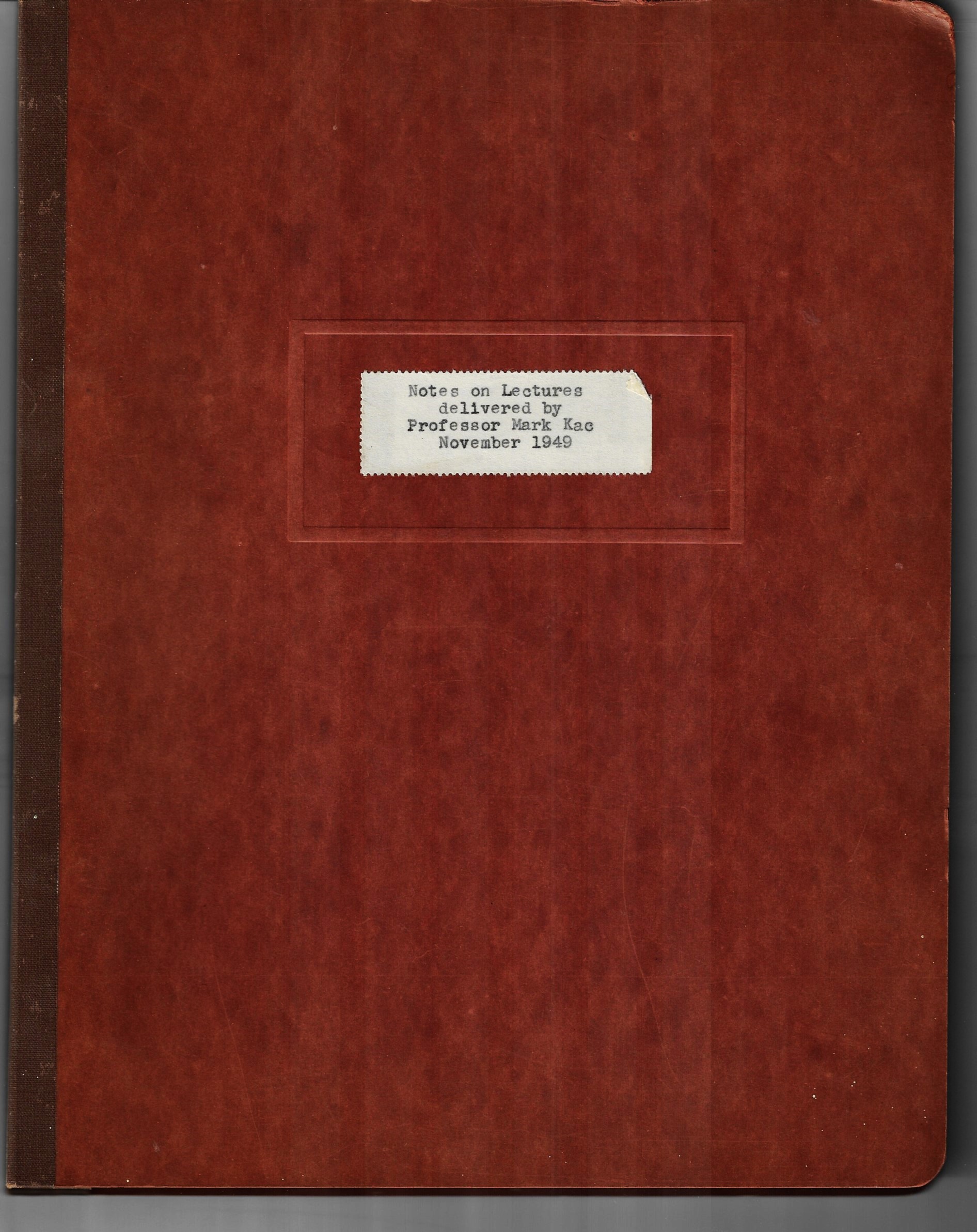
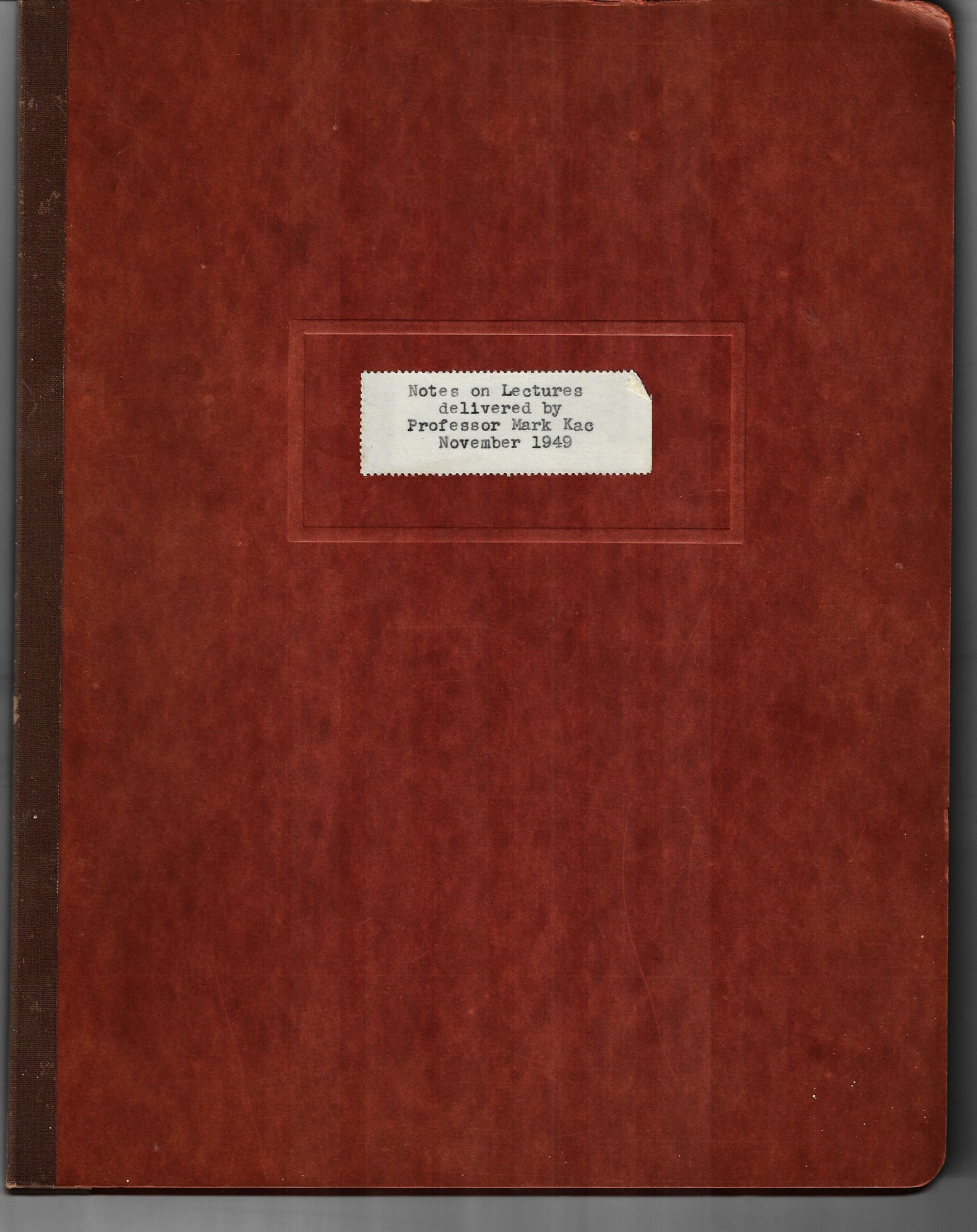
    KacMark Kac, Alan J. Perlis, John W. Carr. Notes on Lectures delivered by Professor Mark Kac, Cornell University. Applications of Statistical Methods to Differential and Integral Equations. MIT, November 1949.   1949/1950 (?) 11”x8.5”, 38 leaves, offset from typed sheets. Bound in a manila two-hole punch folder; homemade title label on cover. Very much an in-house production by two grad students producing the notes for the Kac class. Only ONE copy located by WorldCat/OCLC (Padua). Scarce $150

    On Kac: “From 1939-61 he was at Cornell University, first as an instructor, then from 1943 as assistant professor and from 1947 as full professor. While there, he became a naturalized US citizen in 1943. In the academic year 1951–1952 Kac was on sabbatical at the Institute for Advanced Study. In 1952, Kac, with Theodore H. Berlin, introduced the spherical model of a ferromagnet (a variant of the Ising model) and, with J. C. Ward, found an exact solution of the Ising model using a combinatorial method. In 1961 he left Cornell and went to The Rockefeller University in New York City. In the early 1960s he worked with George Uhlenbeck and P. C. Hemmer on the mathematics of a van der Waals gas. After twenty years at Rockefeller, he moved to the University of Southern California where he spent the rest of his career.”–Wikipedia

    Perlis (numerical analyst who would get his Ph.D. at MIT in the next year) and Carr are both prominent figures in the history of computing, Perlis especially so (particularly in the development of programming languages, ALGOL 58, ALGOL 60, etc., and  founder and first editor of ACM Computing Reviews).  and in the See JAN Lee’s Computer Pioneers.

    ·Posted by :

    ·in:


  • Alfred Tarski ÜBer Den Begriff Der Logischen Folgerung Inactes Du CongrèS International De Philosophie Scientifique

    Alfred Tarski, “Über den Begriff der logischen Folgerung”, in Actes du Congrès International de Philosophie Scientifique, fasc. 7 (Actualités Scientifiques et Industrielles, vol. 394), Paris: Hermann et Cie, , 72pp, the Tarski in pp. 1–11. Original printed wrappers; there’s a little chip missing from the bottom half-inch of spine. Largely unopened. VG copy. $75

    (Published in English as: Tarski, A. “On the Concept of Logical Consequence.” In Logic, Semantics, Metamathematics. 2d ed. By A. Tarski. Edited by J. Corcoran, 409–420. Indianapolis, Indiana.)

    Tarski’s presentation of his theory of logical consequence as universal truth-preservation over interpretations of the non-logical constants. This is a widely used translation of the 1936 German version. (Original title of the 1936 German version: “Über den Begriff der logischen Folgerung.”)–Oxford Bibliographies

    Introduced as a “Classic”, translated from the Polish and German by Magda Stroika and David Hitchcock

    “In (1936), Tarski presented for the first time, in German, his new semantic definition of logical consequence and logical truth. He starts to motivate his definition
    by critizicing traditional syntactic definitions. “–Gerhard Schurz, “Tarski and Carnap on Logical Truth — or: What Is Genuine Logic?”

    ·Posted by :

    ·in:


  • Four Papers by Jacob Marschak (1962-1967)

    MARSCHAK, JACOB.  5 works, all printed by  Western Management Science Institute, University of California, Los Angeles. All 10×8 inches,  perfect bound, with cloth tape and printed wrappers. VG-Fine. SOLD 

    “In 1937 Marschak (1897-1978) “…went to Oxford to teach at the Oxford Institute of Statistics, which was funded by the Rockefeller Foundation, allowing him to emigrate in 1940 to the United States. After teaching at the New School for Social Research, in 1943 he went to University of Chicago, where he led the Cowles Commission. He followed the Commission’s move to Yale University, then became emeritus at UCLA. Shortly before he was due to become president of the American Economic Association, he died from a stroke.”–Wiki.  

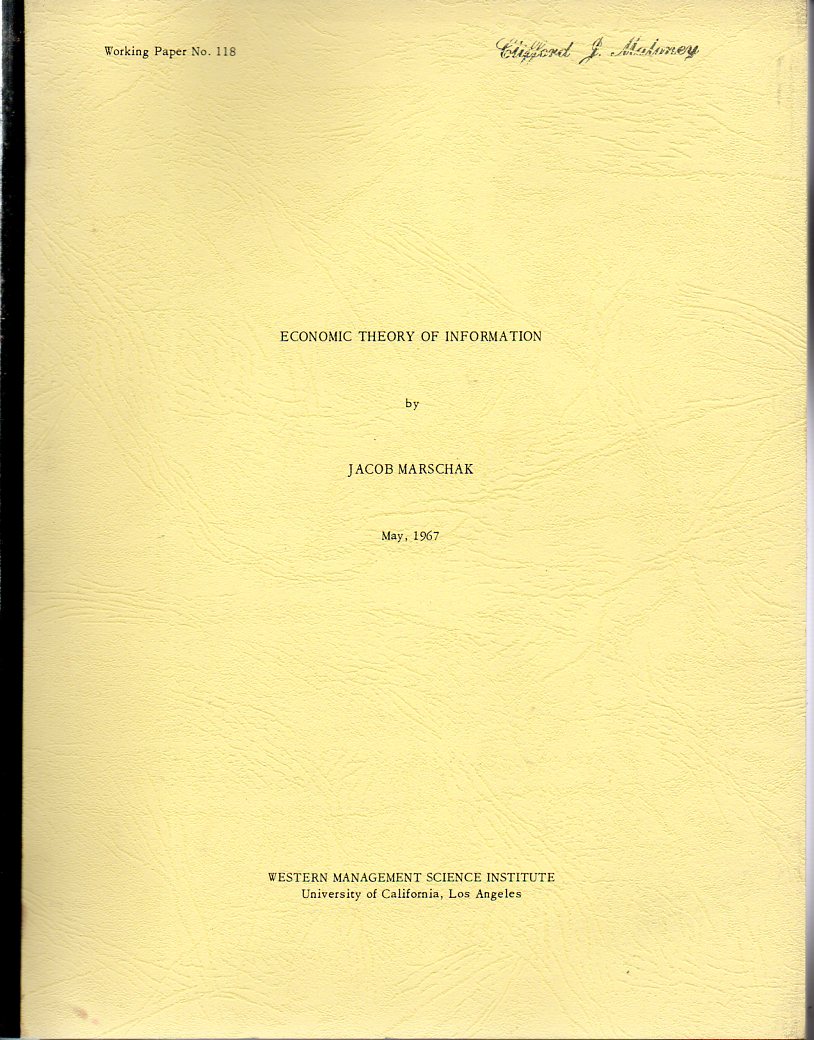
    _____. Economic Theory of Information (Lecture Notes).    May, 1967.  Working Paper 118.   Approximately 120 leaves (printed on one side only). Fine copy. Only three copies are located in WorldCat:  (university libraries at Regensburg and Munchen, and also the University of North Carolina Chapel Hill. 

    _____.  Decision-Making. revised Copy. Working Paper No. 93. July 1966. 28pp. Brass tack bound. VG

    _____.  Economics of Language. Working Paper No. 44, November 1963. 15pp.  Brass tack bound.

    _____.  Problems in Information Economics. Working Paper No. 24, November 25, 1962.  35pp.  

    Math--marschak073

    Abstract: ” Problems of statistical decision and of communication economics are shown to be special cases of the general problem of joint efficient choice of the observable, the code, the channel, and the strategy, given the payoff function and the available resources. (Author).”

    This is a set of lecture notes for a course taught by Marschak for the spring term of 1967. 

    Writing in the National Academy’s Biographical Memoirs, Kenneth J. Arrow (who received the says the following on Marschak:  “Attempts by Marschak, Albert G. Hart, and others to clarify the concept of liquidity had shown how important anticipating new information was to economic behavior and launched Marschak on a series of studies regarding the economics of information. The value, or demand price, of information in any context was governed by the additional benefit that could be obtained by its optimal use, an approach he initiated in 1954 and summarized in 1971. This subject, originally broached by Marschak, has since become a major research area” (Kenneth J. Arrow, Biographical Memoirs, Vol. 60, 1991, National Academy of Sciences, pp. 140-1). “

    ·Posted by :

    ·in: