A Daily History of Holes, Dots, Lines, Science, History, Math, Physics, Art, the Unintentional Absurd, Architecture, Maps, Data Visualization, Blank and Missing Things, and so on. |1.6 million words, 7500 images, 4.9 million hits| Press & appearances in The Times, Le Figaro, Mensa, The Economist, The Guardian, Discovery News, Slate, Le Monde, Sci American Blogs, Le Pont, and many other places… 5000+ total posts since 2008.

Book Category: Mathematics

  • An Historic Article on How A Savant Human Calculator Thinks (1856)

    Bidder, George Parker. “On Mental Calculation”, pp 251-280, in Minutes of Proceedings of he Institution of Civil Engineers with Abstracts of the Discussions, volume XV, Session 1855-6, London, published by the Institution, 540pp.  Rebound in a sturdy library cloth (ca. 1970). A very nice, very sturdy and crisp copy. Ex-library, with the library name perforated on the title page and also rubber stamp on the text block ends at top of bottom.  Still, a very nice copy. $250

    George Parker Bidder (1806-1878) gave a lecture (without notes) explaining to the audience at the Institution of Civil Engineers in 1856 his interior practices and habits in performing absolutely prodigious and complex arithmetical feats entirely in his head. He was among the first tier of performing human calculators (like Zerah Colburn, b. 1804) mental calculations enchanted large audiences from the stages, answering seemingly impossible questions with accuracy and speed. It is in the 1856 paper (which Martin Gardner refers to as “historic” and “valuable”in his article “Mathematical Games”, in Scientific American, 216/4, April 1967, p. 117. ) that he relates some of the practices which clarify his process–for example, one large element was that he would keep one fact in his head at a time, until it was finished, and then move on. Of course for people who did not have anything even remotely resembling this impossible ability, the information is interesting, though I have no idea how useful it may be…unless you were already a savant, that is.  Some things are just not to be known by mere mortals. Like the probably-apocryphal story of someone asking Hans Bethe how Richard Feynman had solved–on his feet–some impossible something, and Bethe responds: “First he thinks very very hard….and then he gets the answer”.) Something like that. 

    Also of some high interest in this volume:

    John William Heinke, “On Improvement in Diving Dresses for Working Under Water”, pp 309-348. This paper is of some consideration, and is somewhat complicated in presentation, but the bottom line here is that Heinke writes about his new diving helmet and “dress” and their evidently famous Parisian test trials of 1855. Heinke was perhaps the leading figure in this area, especially it seems in the design of the helmet (of which there are three text illustrations).  It seems as tough Heinke included this paper in its entirety in his History of Diving… which was published in 1871. 

    Evan Hopkins. “On the Vertical Structure of the Primary Rocks and the General Character of their Gold-bearing Varieties”, pp 48-74, with a folding plate of geological profiles.

    Henry Robinson, “On the Past and Present Condition of the River Thames”, pp 195-250;

    Frederick M. Kelley, “On the Junction of the Atlantic and Pacific Oceans and the Practicability of a Ship Canal, without Locks, by the Valley of the Atrato”, pp376-417, with a large folding map.  
     

    ·Posted by :

    ·in:


  • A classic paper in the developing field of non-Euclidean geometries (1870)

    Fritz Klein, “Sur uine certain famillie de courbes et de surfaces (en commun avec S. Lie)”, in Comptes Rendus…, 1870, vol 70, pp 1222 and 1275. The two weekly issues, removed from a larger bound volume. Nice copies. A classic paper in the developing field of non-Euclidean geometries. SOLD

    • Referenced in Hans Wussing, The Genesis of the Abstract Group Concept: A Contribution to the History of Mathematics…”; Thomas Hawkins, “Emergence of the Theory of Lie Groups: An Essay in the History of Mathematics…”; and David E. Rowe, John McCleary, “Ideas and Their Reception: Proceedings of the Symposium on the History of Mathematics…”

    ·Posted by :

    ·in:


  • Mathieu Functions (1868)

    Emile Mathieu (1835-1890) “Memoire sur le mouvement vibratoire d’une membrane de forme elliptique”, in Comptes Rendus..., 1868, volume 66, no. 11, pp 530-532 in he weekly issue of pp 509-564, 16 March 1868). Offered in the original weekly issue, detached from a larger bound volume, with no backstrip cover. That said, this issue does have the scarce wrappers.  $200

    “In all his work Mathieu built principally on solution methods introduced by Fourier and problems investigated by Poisson, Cauchy, and Lamé. The best-known of his achievements, directly linked with his name, are the “Mathieu functions,” which arise in solving the two-dimensional wave equation for the motion of an elliptic membrane…”–Mathieu, Émile Léonard.” Complete Dictionary of Scientific Biography, vol. 9, Charles Scribner’s Sons, 2008, pp. 174-175.

    Also published as “Mémoire sur le mouvement vibratoire d’une membrane de forme elliptique.”in J. math. pure appl. 13, 137-203, 1868—from where I sit though I cannot determine priority between the two.

    “…Mathieu’s…research on the vibrations of an elliptic membrane lead to his introduction of ellipitcal cylindrical coordinates and a set of functions appropriate to them later termed “Mathieu functions”.–C. Parkinson. Breakthroughs, p.371.

    ·Posted by :

    ·in:


  • Lewis Carroll and Long Division (1897 AND 1898)

    Two papers by Lewis Carroll: 

    DODGSON, Charles Lutwidge (‘Lewis Carroll’). “Abridged Long Division”, in Nature, page 269-271, in the weekly issue for 20 January 1898 composed of pp 265-288, with the original outer wrappers (including cover and 7pp of ads), and removed from a larger bound volume.  It is here that Carroll announces (in a long 3pp letter to the editor) his implementation of a new algorithm for division–it makes the process longer and more difficult, unfortunately. Provenance: library rubber stamp of the “Smithsonian Institution, Astrophysical Observatory”. There are shadows of two old vertical folds that run run the issue. A Good copy. $150

    AND:

    _____. “Abridged long division”, Nature 57, 269-271; “Brief method of dividing a given number by 9 or 11”, Nature  volume 56, October 14, 1897. pp 565-566 in the weekly issue of pp 561-584. Offered is the original weekly issue, removed from a larger bound volume, in Very Good condition.  $75

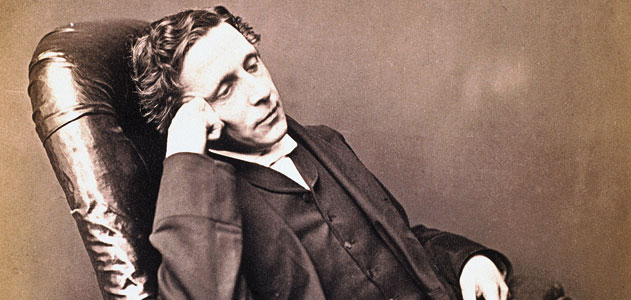
    I am probably not understanding this wonderful effort by the dead Lewis Carroll, establishing a new algorithm for doing long division.  It came into view while I was looking for a paper in Nature by A.A. Michelson on his analog computer, the harmonic analyzer, a fantastic device that he used to help measure the speed of light back in 1898.  Carroll (as Dodgson) appeared just a few pages away; his obituary appears not much after the division article, thus making the paper the last of his career here on Earth. 

    Presence-Lewis-Carroll-Charles-Dodgson-631
    It is a very interesting effort, and it perhaps is even brilliant and of a wonderful construct, but the bottom line is that it makes the process of division harder to do–perhaps it is mire understandable as a process, but the process itself is decidedly not a preferred one.  Perhaps it is appropriate for his last work to have been on mathematics, since the majority of his 20 published books relate to mathematics or logic.

    Notes

    1. The article is abstracted here, a few weeks after publication:

    Article abstract:  Nature 57, 390-391 (24 February 1898), “Abridged Long Division” abstracted by ROBT. W. D. CHRISTI:

    “HAVING been working on similar lines for some years, I was very much interested in the late Mr. Dodgson’s letter on abridged division in NATURE of January 20, and I should like to offer a few observations and to give a variation of the method which appears much simpler. It will be admitted that Mr. Dodgson’s plan is of limited application, and rather complicated for general use. There is nothing to hinder the method given below from being universally used, though it may not in all cases be the shortest. It also has the merit, I think, of directness and uniformity.”

    2. This is one of three publications of Carroll’s mathematical works that appeared in Nature, being “Abridged long division”, Nature 57, 269-271; “Brief method of dividing a given number by 9 or 11”, Nature 56, 565-566; “Pillow problems. Curiosa mathematica. Part II”, Nature XLVIII. 564. 


    ·Posted by :

    ·in:


  • Five Scarce Works by W.Edwards Deming

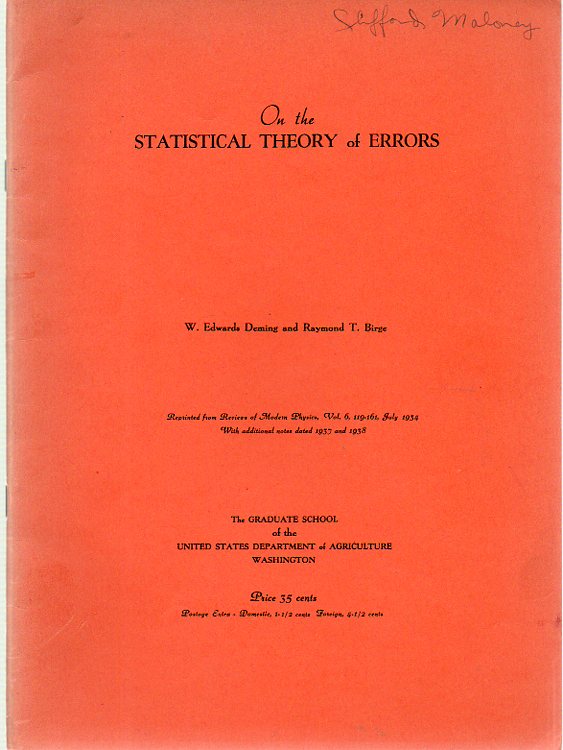
    Deming with Raymond T. Birge, “On the Statistical Theory of Errors”, offprint from Reviews of Modern Physics, volume 6, pp 119-181, July 1932, with additions and corrections dated 1937 and 1938.  “Summary. Long recognized as a leading proponent of statistical sampling and approaches to quality improvement, Deming led major efforts to bring statistical approaches and methods to bear on problems in government, science and industry.”

     Deming612

    • “In 1934, Deming published, jointly with the UC Berkeley Physicist Raymond T. Birge, an influential paper “On the Statistical Theory of Errors.” This review paper brought the methods of Fisher, Neyman and Pearson (q.v.), and Jeffreys (q.v.) to a broad audience of American physical Scientists. It was reprinted with additional notes in 1937 by the Graduate School of the USDA, and it served effectively as a textbook for over a decade. In correspondence with Deming, Fisher was generally quite complimentary, although in a 1940 letter to Maurice Frechet (q.v.) about Deming and Birge, Fisher complained that he found “these writers very often obscure.” This material also made its way into Deming’s mimeographed lecture notes on least squares which first appeared in 1938, which he later turned into the 1943 book on the adjustment of statistical data.”–Stephen E. Fienberg and Stephen M. Stigler, “W. Edwards Deming”, from StatProb, the Encyclopedia sponsored by the Statistics and Probability Societies

    Deming, W. Edwards and Raymond J. Jessen, et al. “On a Population Sample for Greece”. Offprint: Journal of the American Statistical Association, September 1947, vol 42, pp 357-384. Original printed wrappers. Very Good.  Describes a landmark effort to ascertain the fairness of the 1946 Greek elections through statistical means (this begun with the “report of the Allied Mission to Observe Greek Elections” US Dept of State, publication 2522, 1946). 

    Douglas Scates and Deming. “Education in Statistics for Participation in Current Affairs”. Offprint: The School Review, vol LVI, May 1948, pp 262-9. Yellow wrappers. Former owner’s name rubber stamped twice on cover.

    Deming and Willard Simmons. “On the Design of a Sample for Dealer’s Inventories”. Offprint: Journal American Statistical Association, March 1946, vol 41, pp 16-33. Original wrappers. VG/Fine.

    AND: sample survey–”Agenda for Meeting with XYZ Railway”. (“Problem…re-stated by statistician”: what will be the annual loss that will accrue if railways merge?. 11X8.5”, 3 leaves, offset from typed originals. Letterhead of Deming, “Consultant in Statistical Surveys” from his upper NW D.C. home address. VG.

    The five:  $600

    ·Posted by :

    ·in:


  • Rare Work by One of the Most Important Contributors to Modern Statistics

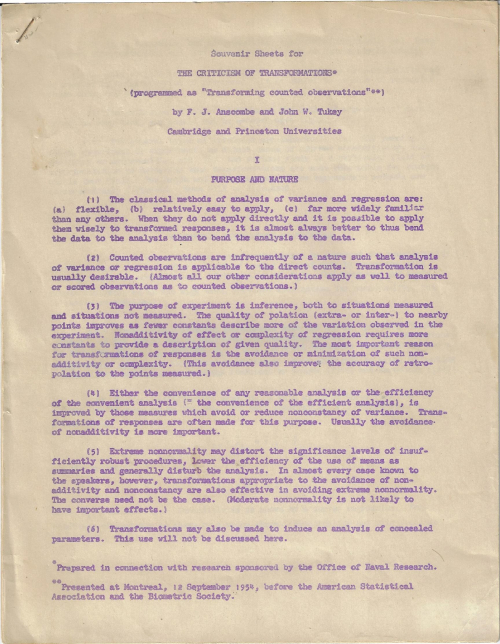
    John W. Tukey and F.J. Anscombe, “Souvenir Sheets for The Criticism of Transformations” with the continued title “(programmed as “Transforming Counted Observations”), “Souvenir Sheets” appeared for a talk at the American Statistical Association and Biometric Society, Montreal, September 12, 1954, the 114th annual meeting of the American Statistical Association. 11×8 1/2″, mimeographed sheets, stapled at top-left, 9 sheets, including two sheets of graphs. Very Good.  $250

    John Wilder Tukey (1915-2000) was a significant and prolific emeritus Princeton professor, and was considered to be one of the most important contributors to modern statistics.

    “He probably made more original contributions to statistics than anyone else since World War II,”– Frederick Mosteller, retired professor of mathematical statistics at Harvard University.

    “I believe that the whole country — scientifically, industrially, financially — is better off because of him and bears evidence of his influence,”–John A. Wheeler

    Tukey

    ·Posted by :

    ·in:


  • The Memoires of the Academy of Sciences, containing a “pioneering study of the differential geometry of space curves” 1731

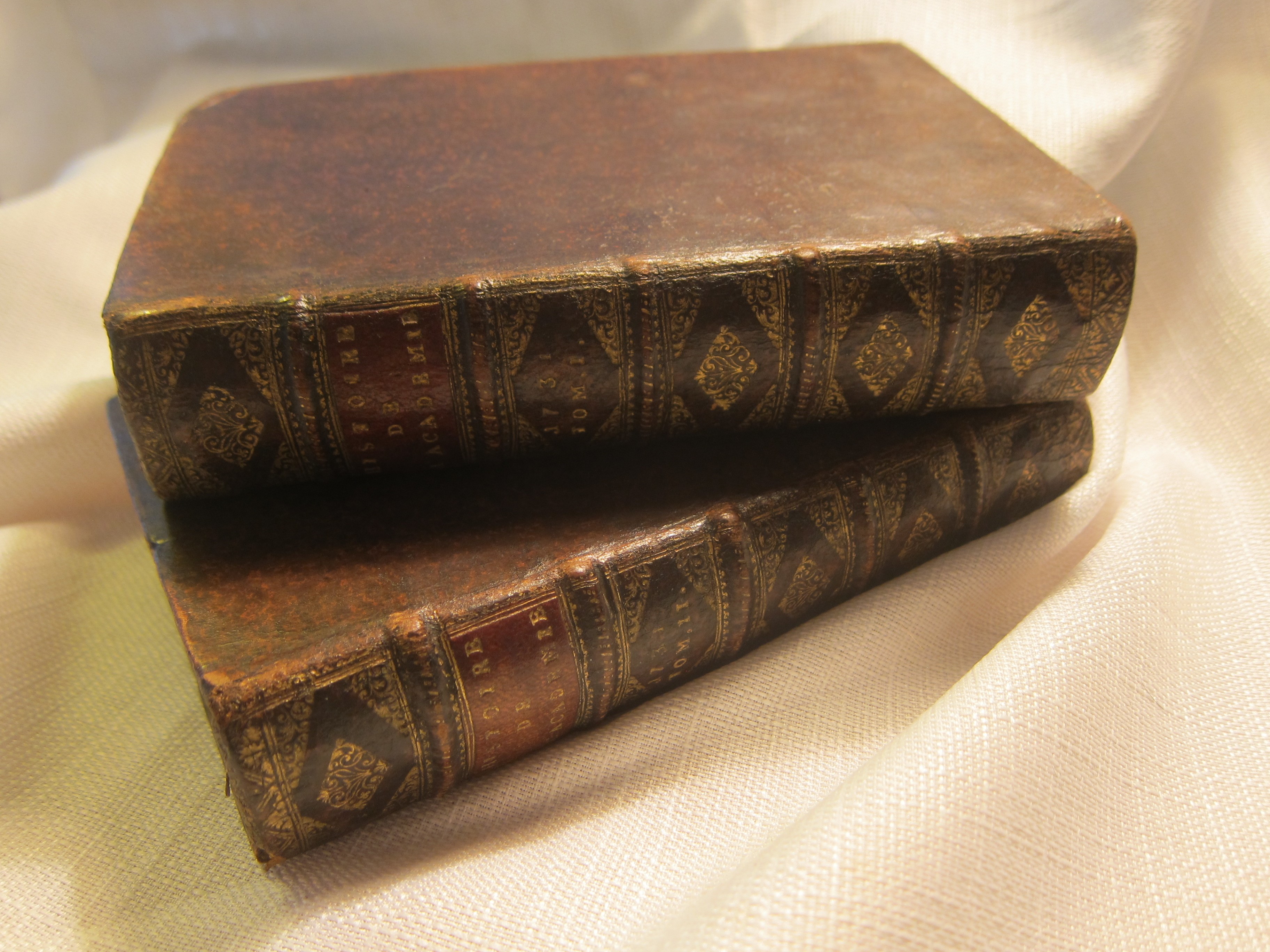
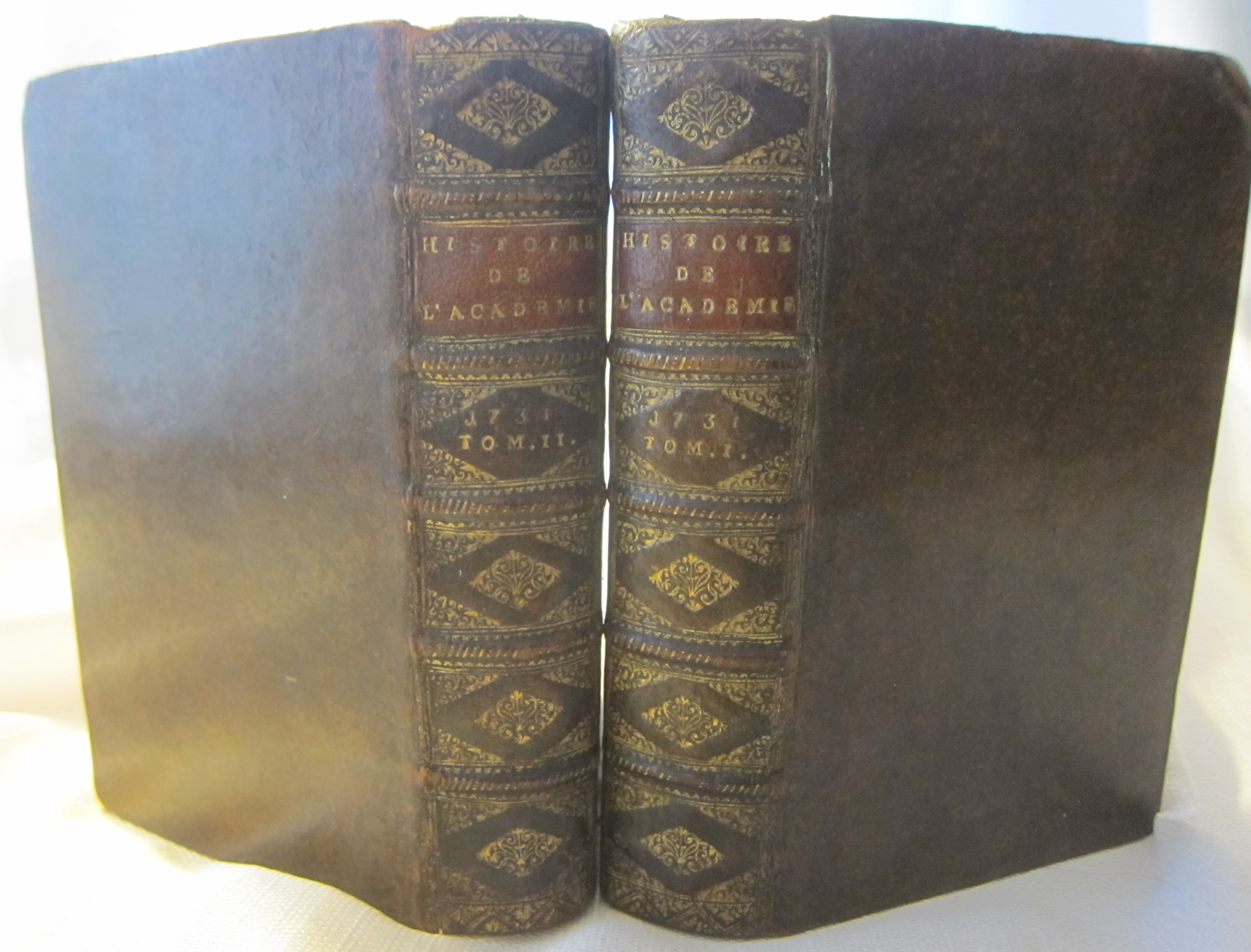
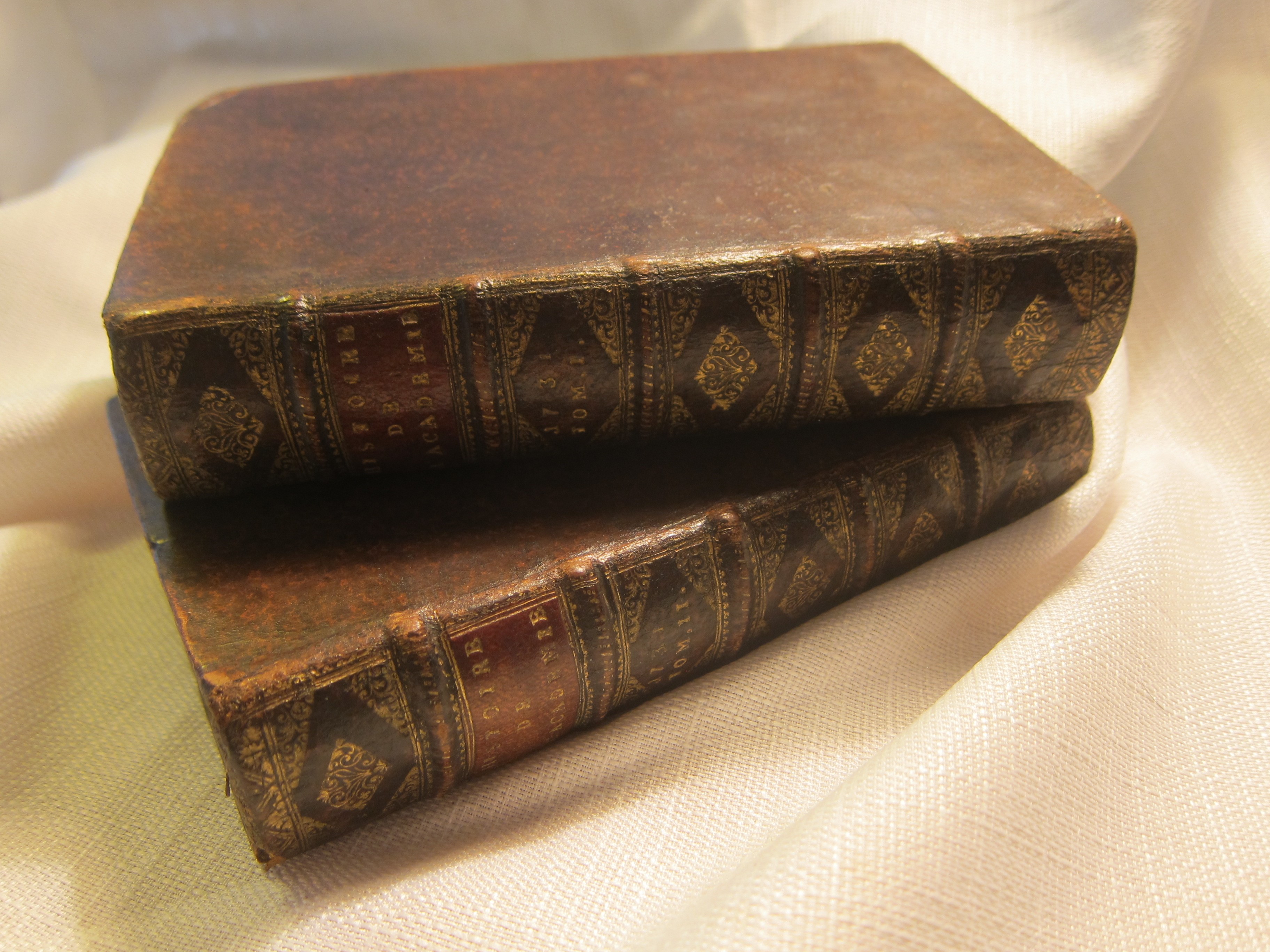
    Clairaut, Alex Claude (b 1713, making him 18 at the time of the reception of the paper in 1731), “Sur les Courbes que l’ou forme en coupant une surface courbe quelconque, par un plan donne de position”, pp 680-694. (“…on solid analytic geometry, a pioneering study of the differential geometry of space curves”–Parkinson, Breakthroughs, p. 149). Bound in:  Histoire de l’ Academie Royale des Sciences. Annee M. DCCXXXI. Avec le memoires de mathematique & de physique, pour la meme annee. Amsterdam by Pierre Mortier, 1735, 17x10cm., viii, 155pp; plus the Memoires section, pp 1-316 in this volume, and pp 317-737, with 40 folding plates. Bound in full leather, with raised bands. Lovely copies, very fresh and clean. Two volumes; Very Good condition. $450

    Memoires 1731 _1_

    In the first section, the Histoire contains a review of the recent advances in the sciences (physics, math, geography, geology, biology, “Sur Quelques Experiences de l’Aiman”, “Sur le Nouveau Thermometre”, “Observations de Physique Generale”, “Sur une Nouvelle Espece de Vegetation Metalliques), and then proceeds to the Memoires (scientific contributions section) including:

    Clairaut, Alex Claude, “Nouvelle Maniere de trouver les formules des centres de gravite”, pp 226-231. (In his letters Clairut states “Here is a new way of finding the formulas of the centers of gravity that I read there is hardly at the Academy  I do not give it to you as a new way of having the centers of gravity, for it is not one, but only as a new way of having the formulas already found.”

    Memoires 1731 _2_

    Mairan, “Observations de quelques Aurores Boreales…”, pp 531-545. (This is areport supplement to an entire volume published on thi ssame topic, one of the earliest of its kind, offered elsewhere on this blog under Mairan’s name. It was published as volume III of this set for the Memoires of 1731, and stands complete in itself.)

    Couplet, “Recherches sur la Construction des Combles de Charpentier”, p 999-102;

    Petit, “Dissertations sur la maniere le Sang dans les Hemorragies…”, pp 122-146;

    de Maupertius, “Experiences sur les Scorpions”, pp 317-326

    d’Onzembray, “ Machine pour coonoitre sur Mer l’Angle de la Lgine du Vent et de la Quille du Vaisseau…” pp 335-340 (with plate!);

    Maupertius, “Sur la separation des Intetermindes dans les Equations differnetielles”, pp 147-157;

    Maupertius, “Balistique arithmetique”, pp 419-422;

    Maupertius, “Probleme Astronomique”, pp 652-655;

    de la Condamine, “Sur une nouvelle Maniere de considerer les Sections Coniques”, pp 340-35.


    Memoires 1731 _3_

    Condamine, “ Sur une nouvelleespece de Vegetation Metaliiques” (with a glorious plate), pp 655-680;

    Pitot, “Methode d’Analytique de tracer les Lignescorrespondentes ou des Minutes aux grande Meridiennes”, pp 519-531;

    Nicole, “ Sur les Sections Coniques”, pp 157-176.


    ·Posted by :

    ·in: