A Daily History of Holes, Dots, Lines, Science, History, Math, Physics, Art, the Unintentional Absurd, Architecture, Maps, Data Visualization, Blank and Missing Things, and so on. |1.6 million words, 7500 images, 4.9 million hits| Press & appearances in The Times, Le Figaro, Mensa, The Economist, The Guardian, Discovery News, Slate, Le Monde, Sci American Blogs, Le Pont, and many other places… 5000+ total posts since 2008.

Book Category: Mathematics

  • The Aritmometer, 1873

    THOMAS, Charles Xavier de Colmar.”The Arithmometer“, in Nature, August 21, 1873, pp 326-327, the weekly issue of pp 317-336, removed from a larger bound volume.  $150/.

    There is also a nice line drawing of the instrument, which appears here–in 1873–pretty much the way it looked when Thomas first began to make the thing back in 1820.  The big deal about the arithmometer is that it became the first mass-produced calculating machine when it entered into production in 1852–it was, basically, the birth of the calculating machine business. And not of course simply because of the mass production but because it was so reliable and dependable, and did the job. 

    Also in this issue: J. Herschel’s “The Flight of Birds” and Henry Proctor’s “The Origin of the Nerve Force”.  

    ·Posted by :

    ·in:


  • Jevons on Numerical Discrimination (1871)

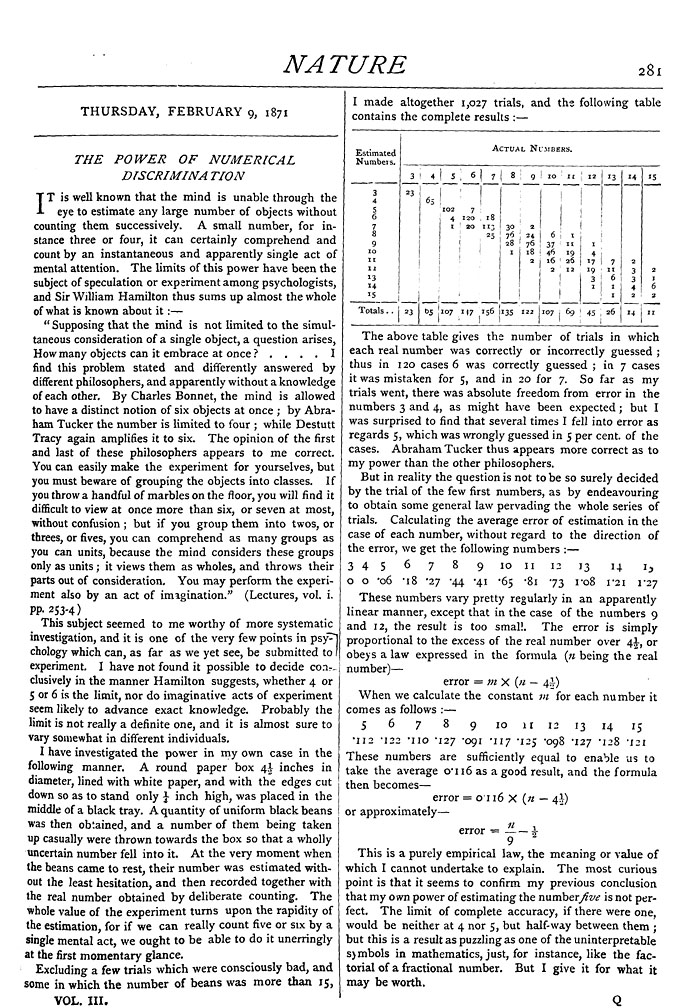
    William Stanley Jevons.  “The Power of Numerical Discrimination”, an article in Nature, 9 February 1871, occupying pp 281-283 (but a tightly-packed, tightly-printed 4,000 words) in the issue of pp 281-300.  Offered in the original weekly issue, removed from a larger bound volume, but with the original front wrapper and 4-pp of ads.  Scarce in this format.  VG condition.  $250

    “IN an article with this title in a recent number of NATURE, Mr. W. S.
    Jevons offered the results of some ingenious experiments he had been
    making to determine how many objects the human mind could count by an
    instantaneous and apparently single act of attention. He comes to the
    conclusion that the power of his mind was limited to something less than
    five.”–review in Nature 3, 367-367 (09 March 1871)

    http://www.nature.com/nature/journal/v3/n71/abs/003367b0.html 

    “In a remarkable brief note in Nature, 1871, W. Stanley Jevons described the results of an experiment he had conducted on himself to determine the limits of the number of objects an observer could comprehend immediately without counting them.  This was an important philosophical question: How many objects can the mind embrace at once?”

    “He carried out 1027 trials in which he tossed an “uncertain number” of
    uniform black beans into a box and immediately attempted to estimate the number
    “without the least hesitation”.  His questions, procedure and analysis anticipated
    by 75 years one of the most influential papers in modern cognitive psychology
    by George Miller (1956), “The magical number 7 plus or minus 2: Some limits on
    …”
    For Jevons, the magical number was 4.5, representing an empirical law of
    complete accuracy.”– By Vincent Arel-Bundock, http://vincentarelbundock.github.io/Rdatasets/doc/HistData/Jevons.html

    Jevons numerical 1

    ·Posted by :

    ·in:


  • Histoire de l’ Academie Royale des Sciences, 1728

    Histoire de l’ Academie Royale des Sciences. Annee M. DCCXXVIII Avec le memoires de mathematique & de physique, pour la meme annee. Tires des registres de cette academie. Printed in Amsterdam by Pierre Moerier, 1732. volumes 1 and 2, complete. The two volume work is 6.5”x3.5” and is in two sections with three working title pages: Histoire de l’Academie Royale des Sciences… (164pp) followed by Memoires de Mathematique et de Physique tirez des registres de l’Academie Royale des Sciences…(197pp and 5 folding plates) in volume 1; volume II is Suite des Memoires de Mathematique et de Phyqiue tirez des registres de l’Academie Royale des Sciences (pp 201-605 and 17 folding plates).

    Very Good condition—lovely copies, really. $500/two volumes.

    Many interesting articles, reprinted here in 1732, and including such contributions as:

    “Sur le Mouvement de Saturne”, pp 94-100;

    “Sur la Foce des Corps des mouvement”, pp 100-134;

    C.E.L. Camus, “Du Mouvement Accelere par des Ressorts et des Forces qui resident dans les Corps en Mouvement”, pp 230-283 (A significant paper, especially influential to Lagrange—see Isaac Todhunter, “A History of the Theory of Elasticity and of the Strength of Materials”.)

    Jean-Jacques d’Ortous de Mairan (1678 – 1771, French geophysicist, astronomer and most notably, chronobiologist), “Dissertation sur l’Estimation et la mesure des forces motrices des corps”, pp 17-81.

    Giovanni Cassini (d. 1712, first observation of the moons of Saturn), “Du Mouvement de Saturne”, pp 95-124;

    Jean-Jacques Dortous de Mairan (1678-1771,”was a mathematician and an enthusiastic experimenter whose major works were on the formation of ice and on the aurora borealis. However, he was also interested in all the important topics addressed the scientific community in the eighteenth century, among them, the shape of Earth, light, colors, sound, the composition of matter, and vis viva (the debate around the force of moving bodies and the conservation of matter).”–DSB . “Eclaireissement sur le Memoire de la Cause generale du Froid en Hiver at de la Chaleur en Ete, pp 10-23.

    René Antoine Ferchault de Réaumur  (1683-1757, French entomologist and writer who contributed to many different fields, especially the study of insects), “Histoire des Teignes, ou des Insects qui Ronguet les Laines et les Pelleteries”, premiere part, pp 201-282 and parte seconde pp 439-476.

    Abbe de Molieres, “Loix Genrales du Mouvement dans le Tourbillon Spherique”, pp 349-380;

    Petit, “Observation sur la Rupture Incomplette du Tendon d’Achille”, pp 331-380;

    Geoffroy le Cadet. “Suite d’ Observations fur les Huiles ejfentielles , leur altération & la manière de reâifer celles de certains fruits , avec un examen  des changemens i]ui arrivent à l’Huile d’Anis.”M. 

    De Maupertuis, “Sur toutes les Développées qu’mie Courbe peut avoir à l’Infini”;

    Du Hamel, “Recherches sur les causes de la multiplication des Especes de Fruits”, 477-499;

    Du Fay, “ “Observations sur qualques Experiences de l’Aimant”, pp 500-520;

    Pitot, “Remarque sur les Rapports des surfaces des grands et des petits corps”, pp 521-530

    Bourdelin, “Memoire sur la Formation des sels Lixiviels”, pp 541-567;
    ·Posted by :

    ·in:


  • e is Transcendental (1873)

    Hermite, Charles. “Sur la fonction exponentielle,” WITH “Sur la fonction exponentielle (Suite), ” AND WITH “Sur la fonction exponentielle (Suite)”,  AND FINALLY “Sur la fonction exponentielle”. A four-part paper, complete, being in weekly issues of Comptes Rendus…, all found in volume 77 (#s 1,2,4 and 5) on pages 18-24, 74-79, 226-233, and 285-293. All are disbound but complete weekly issues from this journal. GOOD condition. $500

    • Stated simply and elegantly in Wolfram’s MathWorld, “Hermite’s theorem: e is transcendental”, 
    • “Theorem. (Hermite 1873). The number e, the base of natural logarithms, is transcendental.”
    • See: Scharlau and Opolka, From Fermat to Minkowski, Lectures on the Theory of Numbers and Its Historical Development, Springer, 1984; the chapter “From Hermite to Minkowski”.
    • “[1873] Charles Hermite…proves that the base of the natural logarithms, e = 2.718… is transcendental.”–Parkinson, Breakthroughs, p. 383. 

    ·Posted by :

    ·in:


  • An Early Paper by Sophie Kovalevsky (1884)

    KOVALEVSKY, Sophie (Kowalewski) “Sur la propagation de la lumiere dans un milieu cristallise”, in Comptes Rendus, volume 98, 11 February 1884, #6, pp 356-7 in the weekly issue of pp 321-391. This issue is removed/disbound from larger bound volume, and offered with its original wrappers.  Good condition.  $150

    “Sofia Vasilyevna Kovalevskaya, (1850 – 1891), was a Russian mathematician who made noteworthy contributions to analysis, partial differential equations and mechanics. She was a pioneer for women in mathematics around the world — the first woman to obtain a doctorate (in the modern sense) in mathematics, the first woman appointed to a full professorship in Northern Europe and one of the first women to work for a scientific journal as an editor. According to historian of science Ann Hibner Koblitz, Kovalevskaia was “the greatest known woman scientist before the twentieth century. Historian of mathematics Roger Cooke writes:…the more I reflect on her life and consider the magnitude of her achievements, set against the weight of the obstacles she had to overcome, the more I admire her. For me she has taken on a heroic stature achieved by very few other people in history. To venture, as she did, into academia, a world almost no woman had yet explored, and to be consequently the object of curious scrutiny, while a doubting society looked on, half-expecting her to fail, took tremendous courage and determination. To achieve, as she did, at least two major results of lasting value to scholarship, is evidence of a considerable talent, developed through iron discipline.”–Wikipedia

    “ ‘Sur la propagation de la lumière dans un milieu cristallisé’ Note de Mm Sophie Kowalevski. Dans ses Leçons sur l’élasticité lamé ramène la question de la propagation de la lumière dans un milieu cristallisé à l intégration d un système de trois équatious aux différences partielles Il a trouvé trois expressions analytiques qui satisfont à ces équations ces expressions trouvées par Lamé offrent certaines particularités qui font que le mouvement qu elles représentent est physiquement impossible sans l hypothèse de l existence d un éther impondérable qui entoure chaque molécule de la matière vibrante et joue pour ainsi dire le rôle d un coussin élastique Au contraire les formules obtenues par la savante émule de Sophie Germain représentent un certain mouvement possible physiquement sans avoir recours à l hypothèse de l éther.”–abstract from Le Cosmos, vol 33, January-April 1884. 

    ·Posted by :

    ·in:


  • A.M. Lyapunov, Six Papers, 1897-1901.

    Aleksandr Mikhailovich Lyapunov (1857 – 1918), six papers, as follows: 

    Lyapunov was a Russian mathematician, mechanician and physicist. His surname is sometimes romanized as Ljapunov, Liapunov, Liapounoff or Ljapunow. He was the son of astronomer Mikhail Lyapunov and the brother of pianist and composer Sergei Lyapunov. Lyapunov is known for his development of the stability theory of a dynamical system, as well as for his many contributions to mathematical physics and probability theory.”

    The following six papers, all in weekly issues of the Comptes Rendus, 1897-1901.  $350
    
    “Sur un theorem du calcul des probabilities” in the Comptes Rendus, vol 132#3, 21 January 1901, pp 126-128 
    in the issue of pp 101-188.
    AND WITH: “Une Proposition Generale du calcul des probabilities”, 2 April 1901, vol 132 #13, pp 814-815 in the issue of
    pp 813-868.
    Both have their original front wrapper, and both are removed/disbound from a larger bound volume.
    See: Hans Fischer, A History of the Central Limit Theorem: from Classical to Modern Probability...

    Also with the following, all from the Comptes Rendus:
    “Sur le potentiel de la double couche”, (1897) vol 125, pp 694-696; “Sur certaines questions se rattachant au probleme de Dirichlet”, (1897) vol 125, pp 808-810; “Sur une question differentielle lineare du seconde ordre”, (1899) vol 128, pp 911-913; “Sur une serie relative a la theorie d'une equation differentielle lineaire du second ordre”, (1900) vol 131,
    pp 1185-1188.
    All are detached/removed from larger bound volumes and offered in their complete weekly issues.

     There are a number of different mathematical concepts therefore bear his name: Lyapunov equation, Lyapunov exponent, Lyapunov function, Lyapunov fractal, Lyapunov stability, Lyapunov’s central, limit theorem, Lyapunov vector.

    ·Posted by :

    ·in:


  • Felix Klein

    KLEIN, Felix (1849-1925). Two papers from the Comptes rendus:

    (1) “Formes principales sur les surfaces de Riemann”, in Comptes Rendus, 21 January 1889, volume 108 #3, pp 134-136 in the issue of pp 113-156.

    (2) “Des fonctions theta sur la surface generale de Riemann”, in Comptes Rendus, 1889, volume 108 #6, pp 277-280 in the issue of pp 261-315. 

    Both weekly issues removed from a larger bound volume, and offered together at $150.  

    “Klein…saw his work on function theory as his major contribution to mathematics. As W Burau and B Schoenberg write:

    Klein considered his work in function theory to be the summit of his work in mathematics. He owed some of his greatest successes to his development of Riemann’s ideas and to the intimate alliance he forged between the later and the conception of invariant theory, of number theory and algebra, of group theory, and of multidimensional geometry and the theory of differential equations, especially in his own fields, elliptic modular functions and automorphic functions.”–St. Andrews History of Math site.

    ·Posted by :

    ·in:


  • John von Neumann, 1935


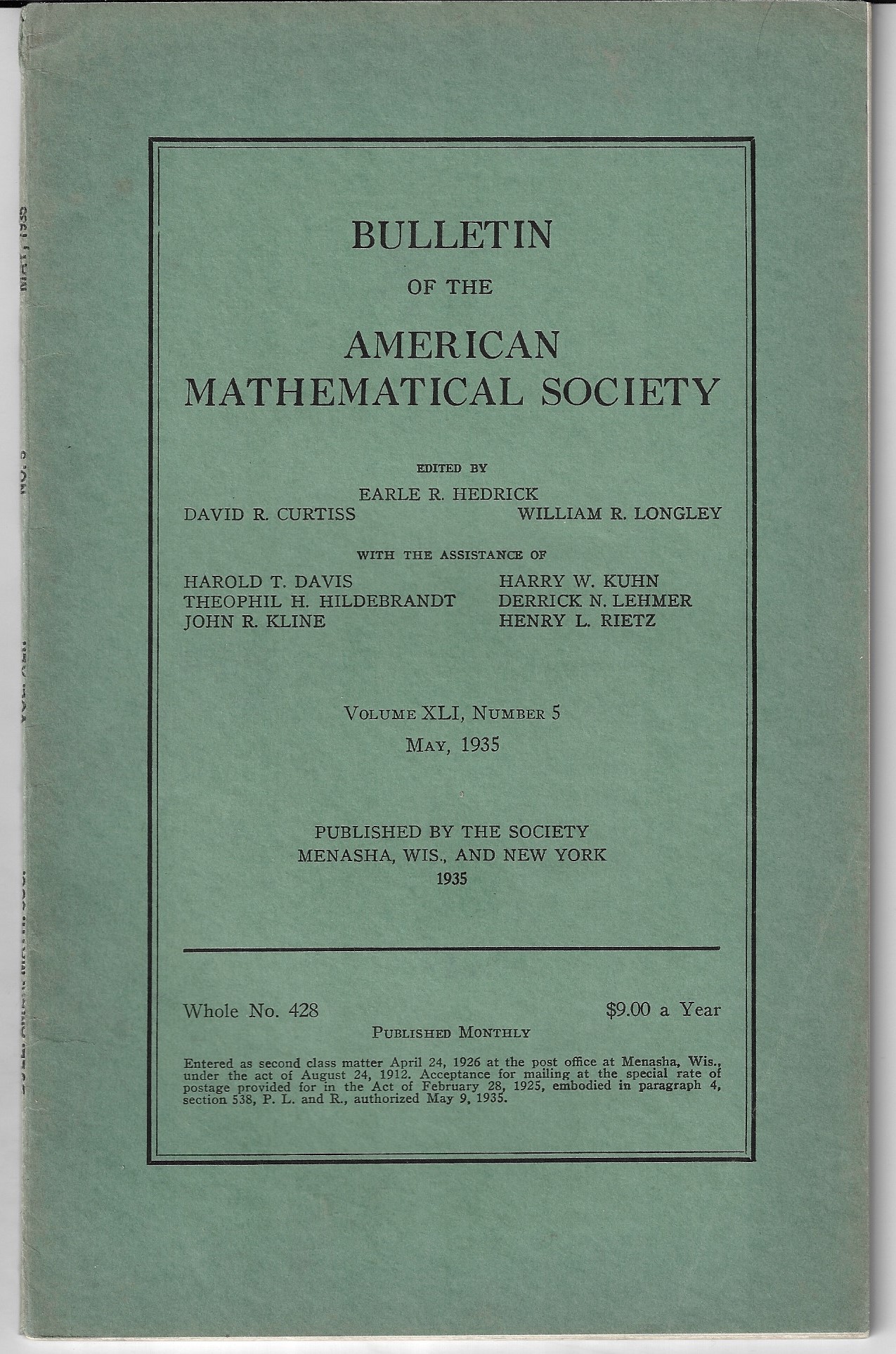
    Von Neumann AMS(John von Neumann)  “Representations and ray-representations in quantum mechanics”.  250-word abstract from the Pittsburgh Symposium on Group theory and Quantum Mechanics, published in the Bulletin of the American Mathematical Society, volume XLI, number 5, May 1935, page 350.  Offered is the entire issue pp 305-352, in the original printed wrappers. 

    Very Good copy.  $75

    See:

    Muraskin Murray, Brody F, Vamos Tibor, editors, The Neumann Compendium, appendix 2 (abstracts presented to the AMS), p 680 and p 49 #4 of bibliography.

    Hans Primas, Knowledge and Time, p 402

    ·Posted by :

    ·in:


  • The Abdank-Abakanowicz Integrator, 1881-2

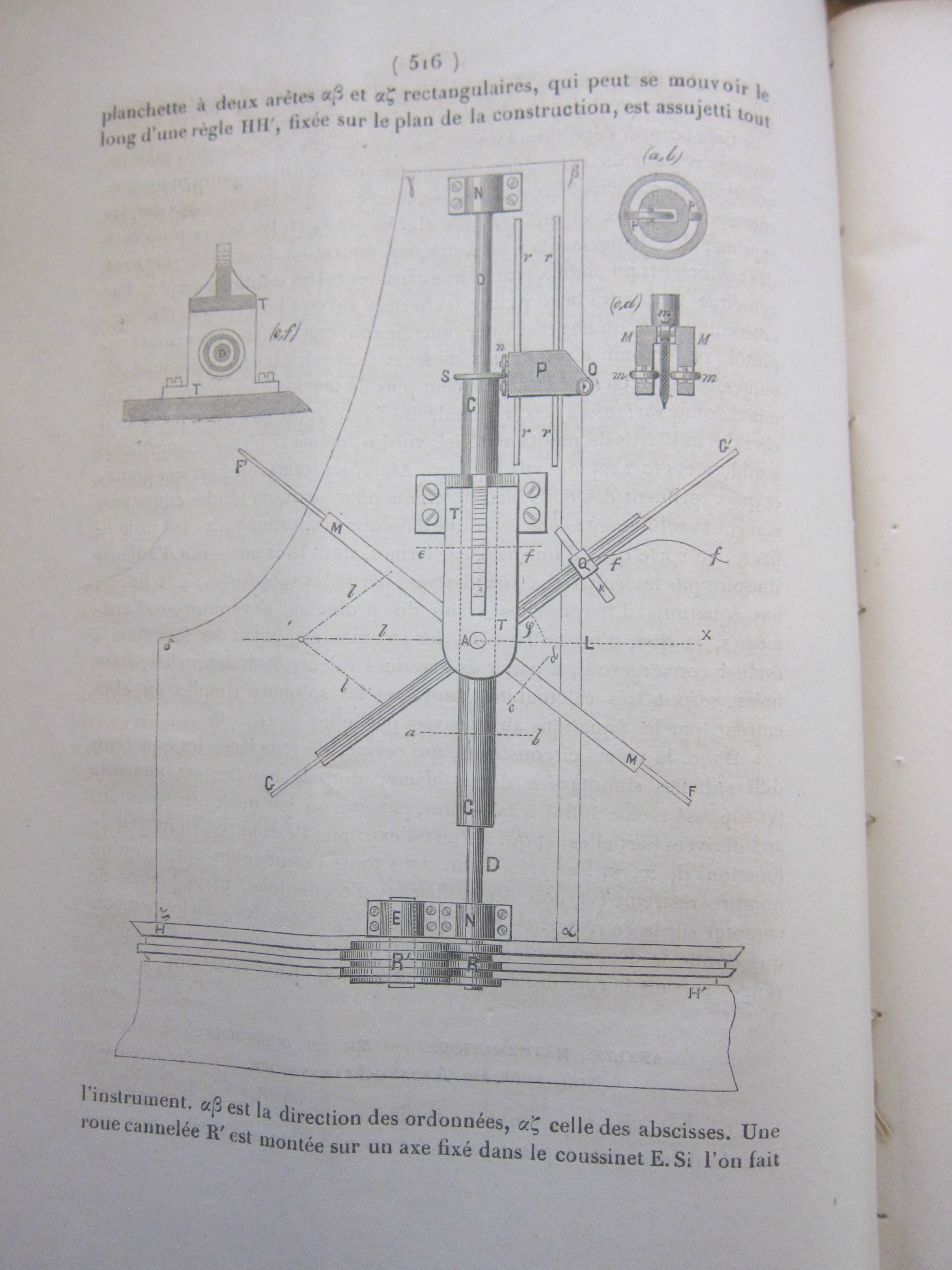
    Bruno Abdank-Abakanowicz, “Sur un integrateur. instrument servant a l’integration graphique”, vol 92, no. 8, 21 February 1881, pp 402-405 in the issue of pp 373-428;Four papers developing his analytical calculating and graphing instrument in three different numbers of the Comptes Rendus (vols 92, 94, and 95), as follows, with the three papers from volumes 92 and 95 offered with their original wrappers.  All four papers are disbound from a larger bound volume. GOOD-VERY GOOD condition.   SOLD

    _____. “Sur un integrateur. instrument servant a l’integration graphique”, vol 92, no. 10, 7 March 1881, pp 515-519 in the issue of pp 482-538;

    _____. “Sur l’integration mechanique”, vol 94, no. 12, 20 March 1882, pp 783-785 in the issue of 753-816;

    _____. “Sur un nouvel integrometre”, vol 95, no. 22, 27 November 1882,  pp 1047-1048 in the issue of pp 1017-1076.

    “Integraph, mathematical instrument for plotting the integral of a graphically defined function. Two such instruments were invented independently about 1880 by the British physicist Sir Charles Vernon Boys and the Lithuanian mathematician Bruno Abdank Abakanowicz and were later modified and improved by others. The integraph draws the graph of the integral as the user traces the graph of the given function.”–Encyclopedia Britannica

    “William Thomson. Lord Kelvin, had the powerful idea of using analog computing mechanisms tied together to solve a differential equatioms. Ten years later, AbdankAbakanowicz built an “integraph.” which had the purpose of solving one particular differential equation. Thomson’s idea was the conception of differential analyzers. which. however. did not become a practical reality until the 1930s with the work of V. Bush.’ Lord Kelvin also invented a pulley device for solving simultaneous equatioms Larger versions were built by MIT professor Wilbur in 1934 and 1935.–AB Clymer, “The mechanical analog computers of Hannibal Ford and William Newell”, IEEE Annals of the History of Computers, 15/2

    “The mechanical integraph is a noteworthy development in the history of calculating instruments, for it represents an early, albeit limited, analog approach to the solution of differential equations. It is worth noting that it was the need to solve partial differential equations with rapidity and accuracy that ultimately led to the development of the ENIAC…The integraph is an elaboration and extension of the planimeter, an earlier, simpler instrument used to measure area. It is a mechanical instrument capable of deriving the integral curve corresponding to a given curve. Hence, it is able to solve elementary differential equations graphically. Abdank-Abakanowicz concentrated on developing his integraph for several years. However, it was not until 1878 that he succeeded in developing a practical working model.”–from the Erwin Tomash Library site

    Also see H. Morin, Les appareils d’intégration: intégrateurs simples et composés; planimètres; intégromètres; intégraphes et courbes intégrales; analyse harmonique et analyseurs,pp 136-141, for descriptions of the Abdnak-Abakanowicz machines (as referred by Tomash). The full text of the Morin is found on the Cornell University classic maths books site.  


    Abdank intergrator _1_

    ·Posted by :

    ·in:


  • On the Ins and Outs of Lightning Calculation (1872)

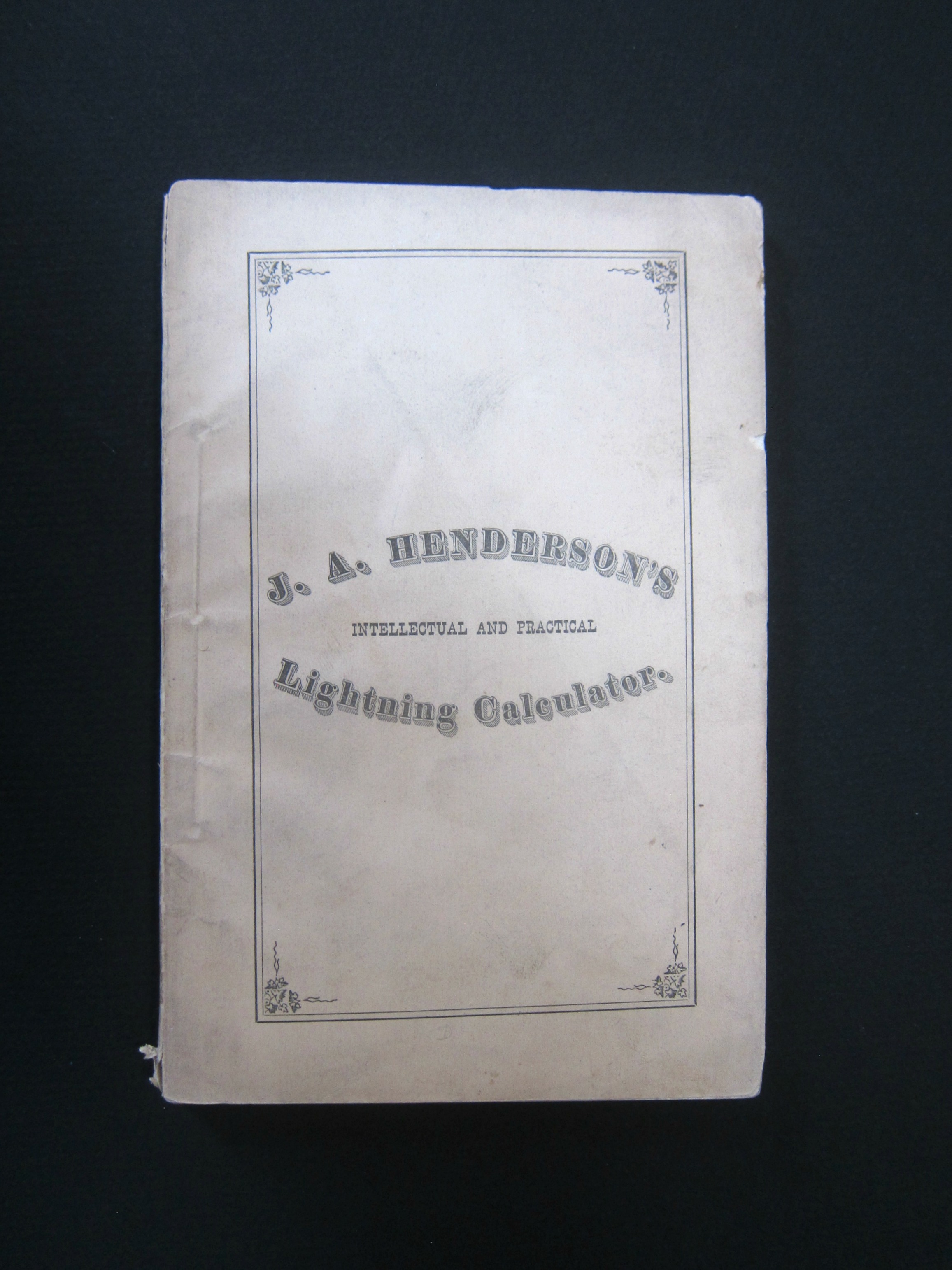
    Lightning Calculator _2_John Alexander Henderson. J.A. Henderson’s Intellectual and Practical Lightning Calculator, A.L. Bancroft, San Francisco, 1872.  First edition.  Original wrappers. 7×5″, 79pp. Provenance: Library of Congress, with their surplus stamp on the back of the front wrapper, and their 6mm “LC” perforated stamp on the title page.  $125

    The 1873 edition (below) has been identified as the “second edition” in WorldCat, and there is only this 1872 edition before it, making it (I am fairly well certain) the first edition.  There are only two copies located (NYPL and Bancroft) of this first edition.  

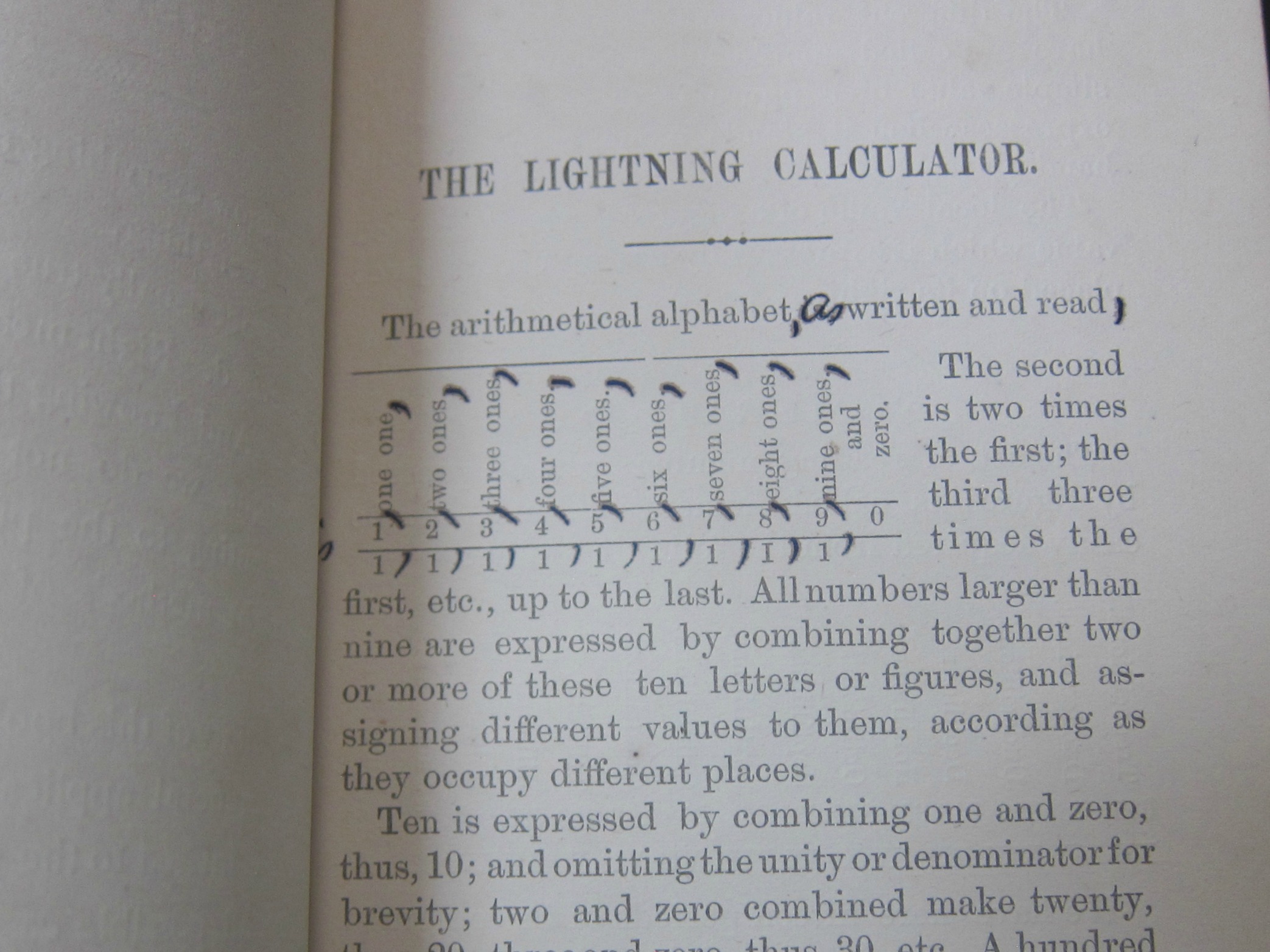
    Examining this against an 1873 printing–also San Francisco–finds that the ink corrections in the first table have been repaired in type. Also, it seems that Henderson is printing the book himself, and is acting as the “general agent”. He evidently had troubles with people pirating his work.  Also, the main block of the text from beginning to end looks to be about the same, though the 1873 version is beefed up with another 30pp of notices, translations, advertisements, and generally not very supportive (to the text) material.  The work seems to have been popular, with Henderson later claiming ten editions, with the book expanding to over 200pp. 

    Henderson was no doubt a lightning calculator and in this book offered some shortcuts, tricks, and general means for doing standard and involved calculations, written or mental. A curious work.  Henderson  evidently received a BS from Union College (Schenectady) in 1864 and a MS in 1867 (unsure of the school for this degree). 

      Lightning Calculator _1_

    ·Posted by :

    ·in: