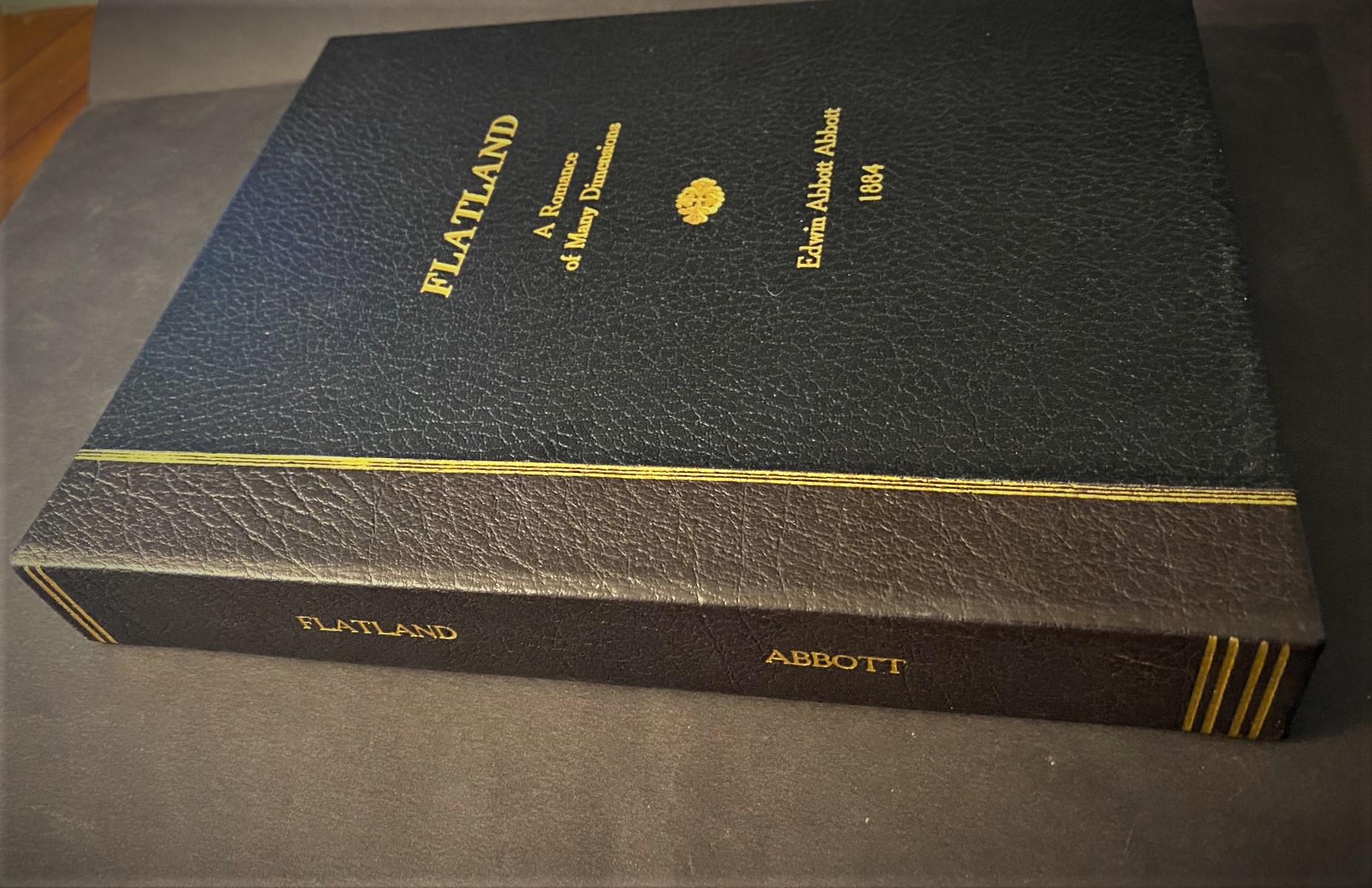
(ABBOTT, Edwin Abbott). Flatland, a Romance of Many Directions, by a Square. London, Seeley & Co., 1884. First edition. 8.5″x 7″ (22x18cm), viii, 100pp, with very occasional diagrams in text. Bound in stiff vellum-like wrappers. The wrappers are browned and have had some chips expertly repaired; the joints have also been strengthened an expertly repaired. The book is housed in a lovely (and new) leather solander case. The book is in VERY GOOD condition; the solander case is new. $1750
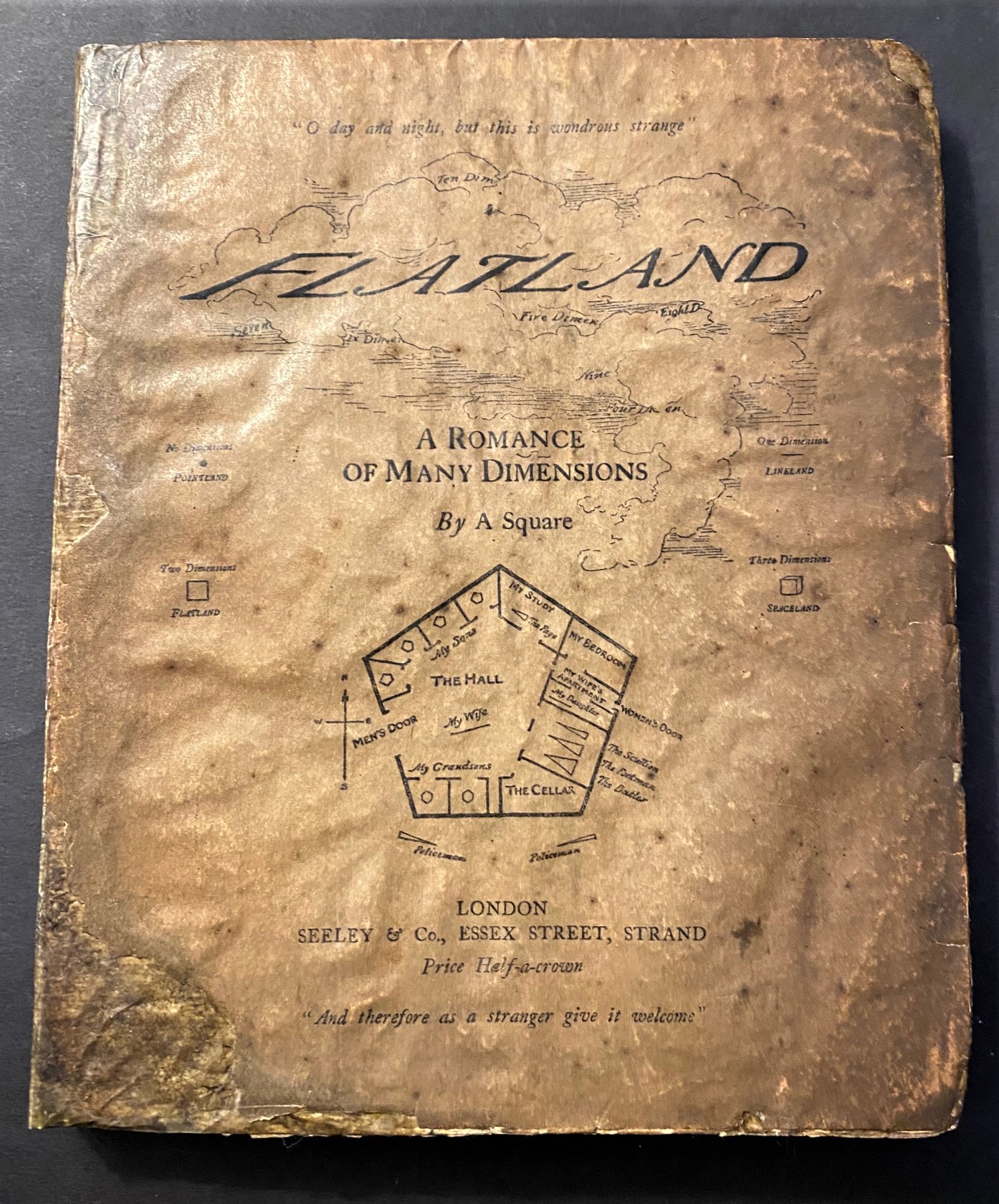 I’ve read in a number of places how Abbott’s work was ostensibly an intentional social satire, but I have a hard time imaging that it this was the book’s main intention, which I see as a challenge to perception and an expanding explanation of very difficult ideas that escaped common analogs, the biggest chunk of which is Abbott’s understanding of n-dimensional geometries. Of course there are easy visible social targets all throughout the work, though I think that the book’s major contribution to the global mind is in representing the possibilities and explanation of imagination.
I think Flatland is perhaps one of the best books ever written on perception and dimensions, a beautifully insightful book that was quick and sharp, and in spite of all it was an instant best-seller—with a second edition printed in the same year plus nine reprints to 1915–and is still in-print today. Written in 1884 when Abbott was 46 (Abbott would live another 46 years and enjoy the book’s popular reception), it introduces the reader to a two dimensional world with a social structure in which the more sides of your object equals power and esteem. Thus the lowest class would be a triangle (three sides) while the highest (priestly) class would be mega-polygons whose shape would approach a circle. Abbott’s magistry comes in explaining to the three-dimensional reader what it was like to be in a two-dimensional world—the very idea of this sort of thinking in Flatland was strictly forbidden.
It is a glorious introduction to wonder when a sphere lifts the hero of the adventure (a “Square”) into the three-dimensional world for the first time. The fourth dimension of course was another thing entirely—ad as it turns out the mention of 4-D in the 3-D world is as strictly verbotten as 3-D was in 2-D. The Square is ultimately imprisoned for speaking of his experiences in 3-D.