A Daily History of Holes, Dots, Lines, Science, History, Math, Physics, Art, the Unintentional Absurd, Architecture, Maps, Data Visualization, Blank and Missing Things, and so on. |1.6 million words, 7500 images, 4.9 million hits| Press & appearances in The Times, Le Figaro, Mensa, The Economist, The Guardian, Discovery News, Slate, Le Monde, Sci American Blogs, Le Pont, and many other places… 5000+ total posts since 2008.

Book Category: Technology, History of

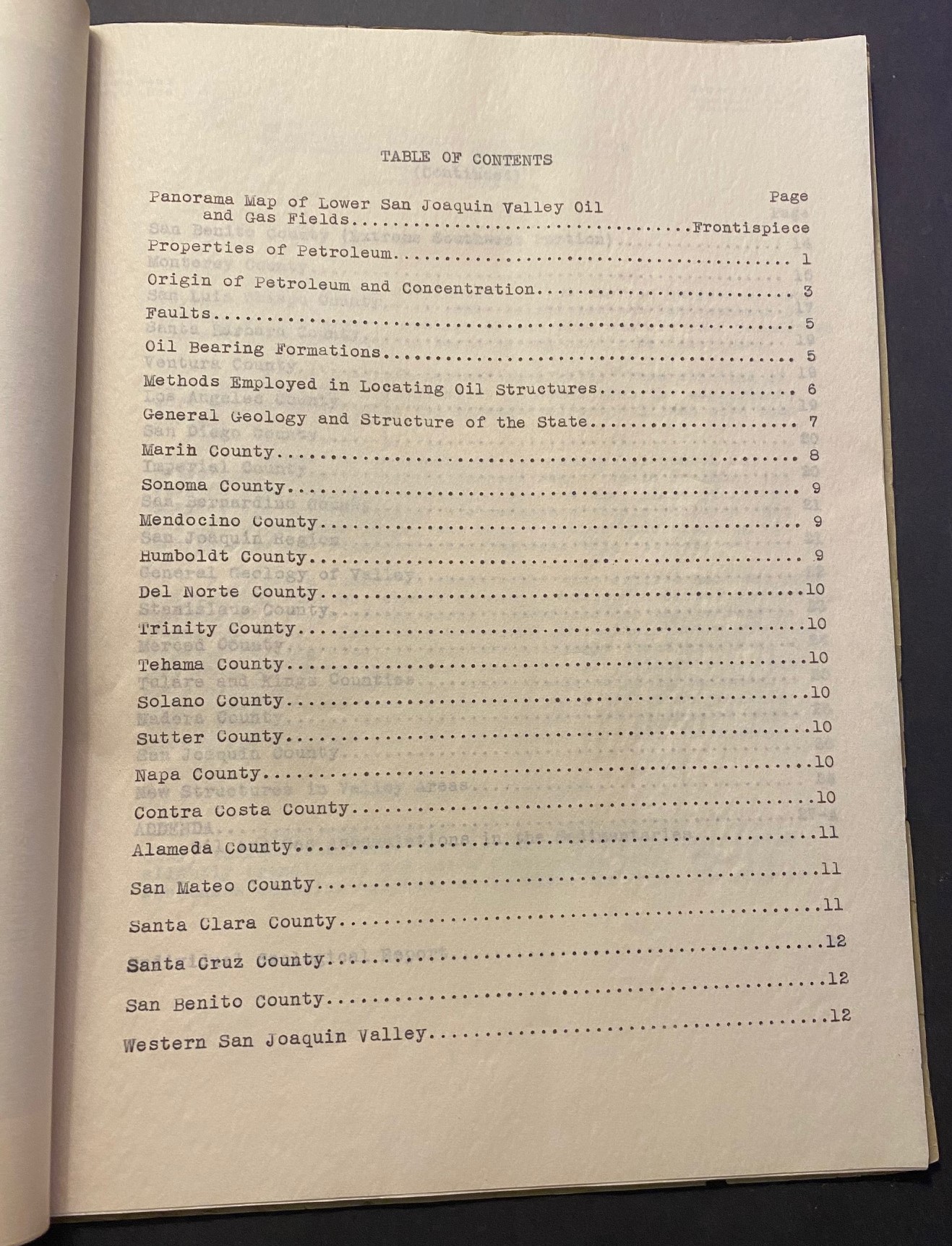
  • Rare Work on California Oil and Gas Fields–Carbon Copy

    No Copies in WorldCat

    HUDSON, George H. Geological Summary and Report of California Oil and Gas Fields, with Addenda.

    Compiled by Bureau of Geological Statistics (San Francisco). Copyrighted by J. Miller and George H. Hudson (Geologist and Petroleum Engineer). Carbon copy, with homemade paper wrappers. 11”x 8.5”, 2 (unusual) birds-eye views, ii, 27pp, 4pp appendix. Bound with brass brad fasteners. $1500.00

    Carbon copy on onion-skin-like paper—I don’t think this is the first impression (I mean the original) but an early, Provenance: Library of Congress, with their 10mm “LC” perforated stamp on the title page and rubber stamp surplus on the front wrapper. perhaps first generation, copy, as you can still feel the indentations from the typewriter-struck paper. Laid in are the LC card catalog cards.

    IMG_2789

    ·Posted by :

    ·in:


  • Outstanding Description of a Significant Industrial/Production Push in the U.S. War Effort, 1943

    Kaiser Fontana Steelworks In-House History and Overview (1943).

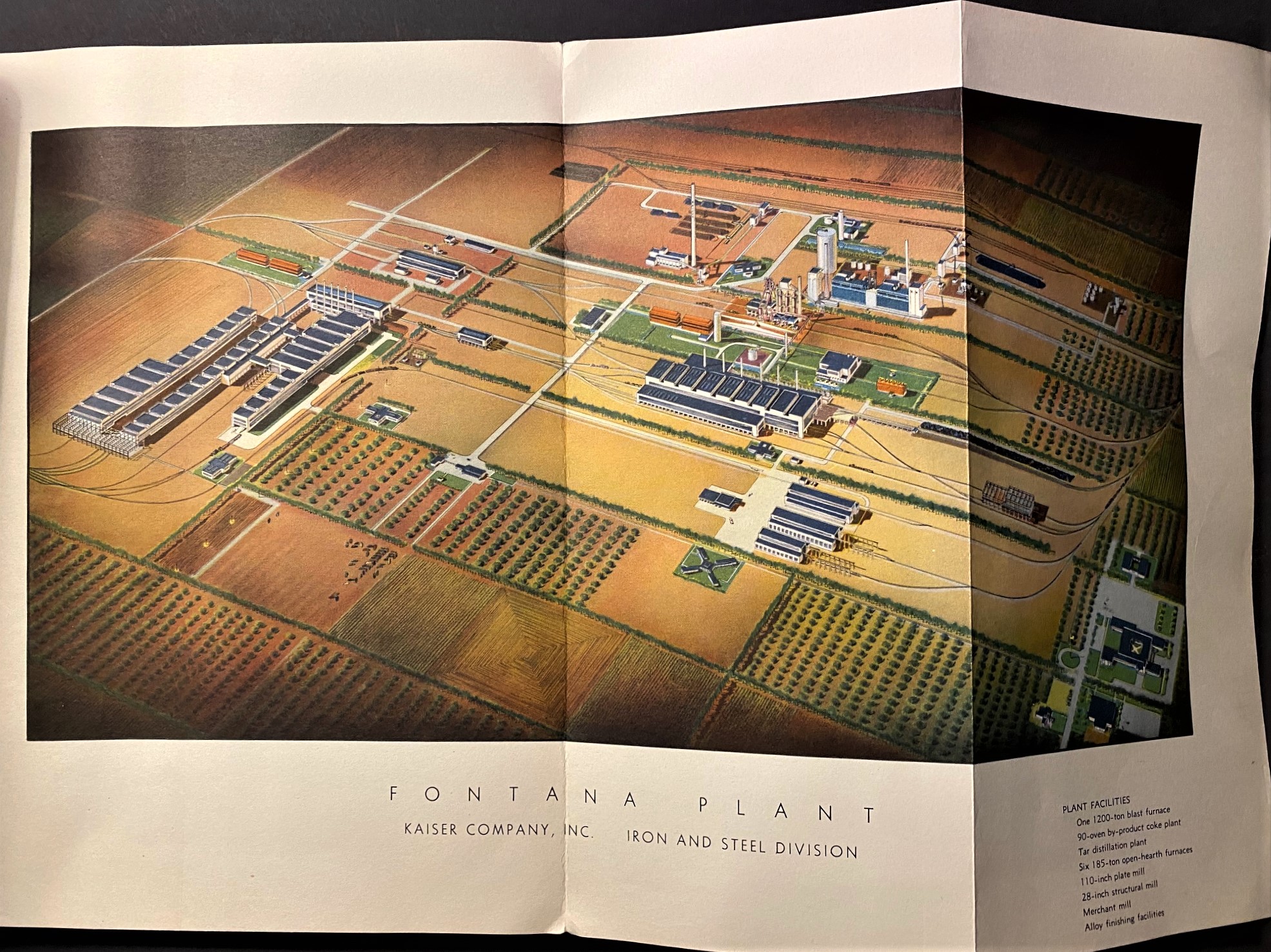
    (Kaiser Fontana Steelworks) Description of Iron and Steel Plant, Fontana California. (On the front cover of the work, “General Description/Iron and Steel Plant/Fontana, California”.) 11”x 8.5”. 42 leaves (printed on Kaiser paper), plus 4 glossy photographs, plus 18 folding plates (some wonderfully in color). Mimeographed. Rare.  $1500

    This seems to be a fabulous illustrated overview produced in-house showing the strengths of the just-opened Kaiser Tontana plant, printed in January 1943.

    “Kaiser Steel (later Kaiser Ventures and CIL&D), headquartered in Fontana, California, was founded by Henry J. Kaiser to provide steel plate for the Pacific Coast shipbuilding industry, which expanded during World War II, then shrank, then expanded again during the Korean War. California Shipbuilding Corporation on Terminal Island, California, was one of these shipyards which built hundreds of Liberty ships and Victory ships in World War II, and was also a project of Henry Kaiser. Kaiser Steel was noted for making the most of its costly steelmaking inputs, and it captured, along with the U.S. Steel plant in Utah, much of the Pacific Coast steel market by the late 1950s. Its assets included steelmaking plants in Napa, California (that it acquired from Basalt Rock Company in 1955)  and Fontana, California (now operated by California Steel Industries), and a former open-pit iron ore mine at Eagle Mountain, California. Steel manufactured was also used in Kaiser Motors.”

    IMG_2786

    ·Posted by :

    ·in:


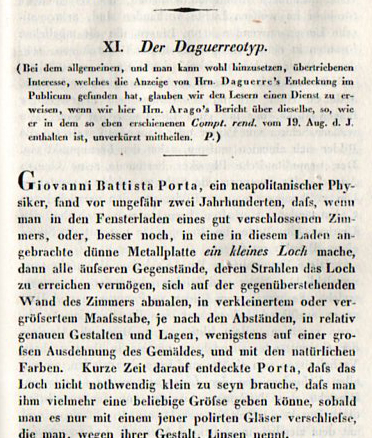
  • First Edition in German of Daguerre’s Invention of Photography (1839)

    Dag[DAGUERRE] “Der Daguerreotyp. (Bei allgeinen und man kann wohl himzusetzen, uebertriebenen Interesse, welches die Anzeige von Hrn. Daguerre’s Entdeckung im Publicum gefunden hat, glauben wir den Lesern einen Dienst zu erweisen, wenn wir hier Hrn. Arago’s Bericht uber dieselbe.. ”  Pp 193-216. 

    Bound with:

    “Daguerre’s Vorschrift zur Bereitung eines gegen Lichtairkungen empfindlichen Papiers. (Nach einer Note von Biot in den Compt. ren. T VIII p.246…)” Pp 217-221. Offered in volume 49, No. 9, 1839, Annalen der Physik, 619pp.  Bound in half cloth, marbled covers. Nice copy.  Scarce  

    An extremely early set of  publications in a German scientific journal on the newly announced discovery of photography by Louis Daguerre made in the Comptes Rendus in 15 January 1839 and the technical report made by him 13 August, 1839.

     Provenance exlibris (a) Provinzial Gewebbschele zu Aachen, then (b) Deutsche Akademie der Luftfahrtforschung, and then (c) Wright Field Library (Dayton, Ohio), and finally (d) the Library of Congress. There are ownership rubber stamps on text block page edge at top and bottom, a stamped gilt title on the bottom of the spine, and two scant stamps on the contents page, and that’s it. Very nice, tight, fresh copy. 

    Includes a significant paper in the establishment of Agricultural Chemistry by Justus von Liebig. “Ueber die Erscheinung der Gährung, Fäulniss und Verwesung, und ihre Ursachen”,  45pp.


    ·Posted by :

    ·in:


  • A Proposed Solution for Traffic Congestion, Los Angeles, 1939 (Suspended Roadways and Monorails) RARE

    A Proposed Solution for Traffic Congestion, Los Angeles, 1939

    Suspended Roadways and Monorails

    DAVINO, Alphonso (1888-1965?). A Brief analysis of the Traffic Congestion Problem and its Economical Solution. Self-published, Los Angeles, 1939. 11”x 8.5”, 8 leaves, four folding plates (two graphic displays, one map, one display of the suspended thoroughfares, the last two printed on heavy blueprint stock. Rare. No copies located in WorldCat. $4500

    Provenance: Library of Congress (with their surplus stamp on title page).

    Condition: contemporary store-bought manila document holder with flexible metal pins, title on paper pasted on cover. The blueprints are in excellent condition—there are no breaks at any of the folds, and the paper is quite heavy. The blueprints are also uniformly dark blue (the photo images I made of them make them appear a little variable though they are not—the light catches the various folds and distorts the color, and I just didn’t want to force the prints flat to make a better picture. The blueprints are lovely.)

    IMG_2251

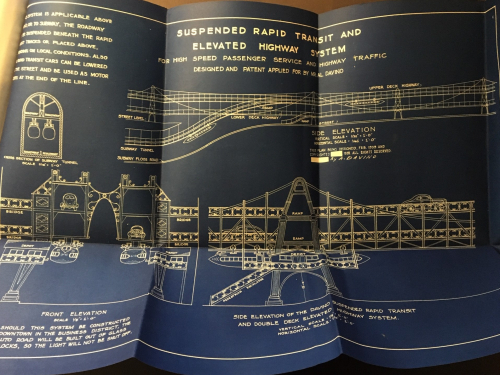
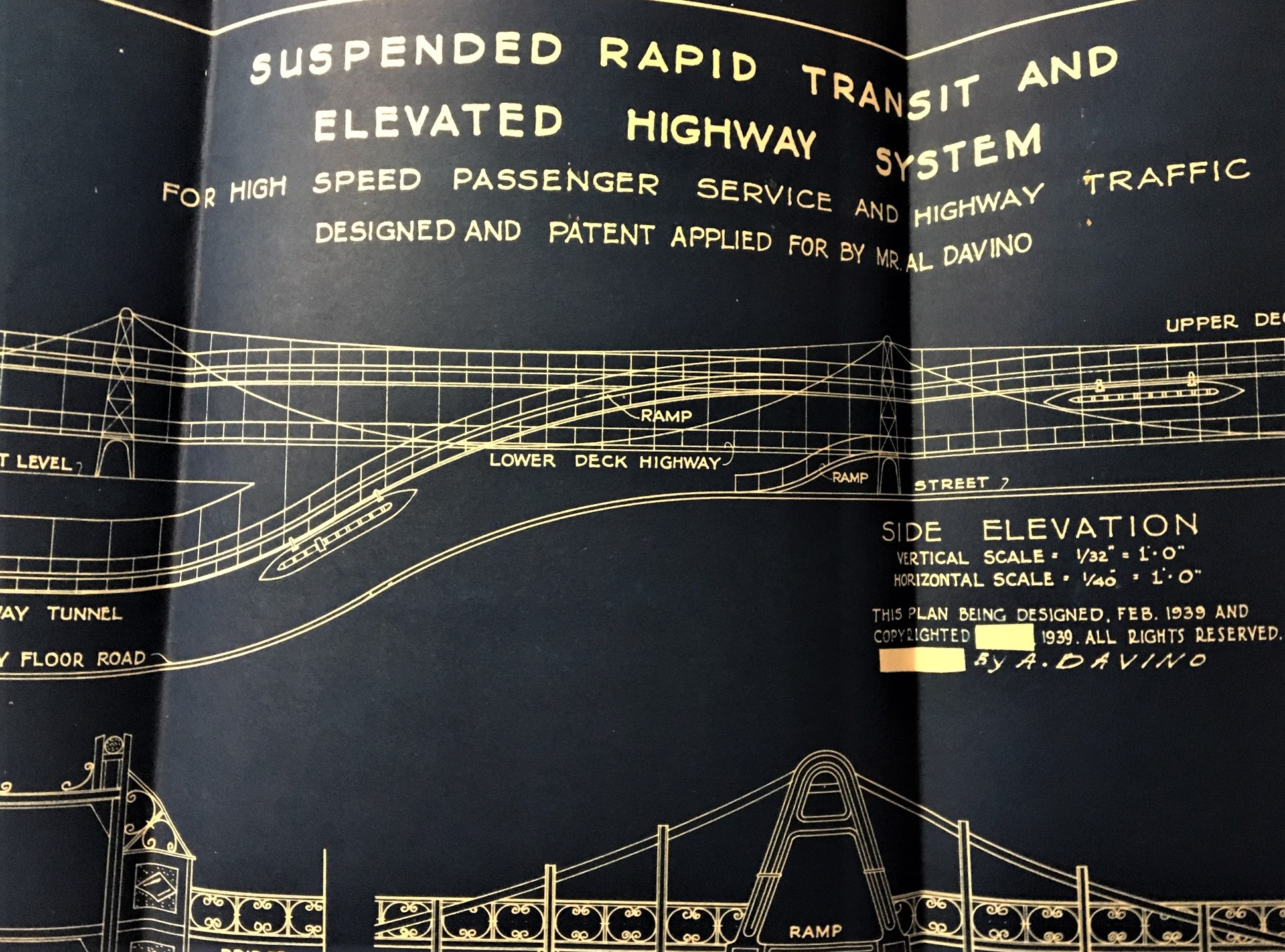
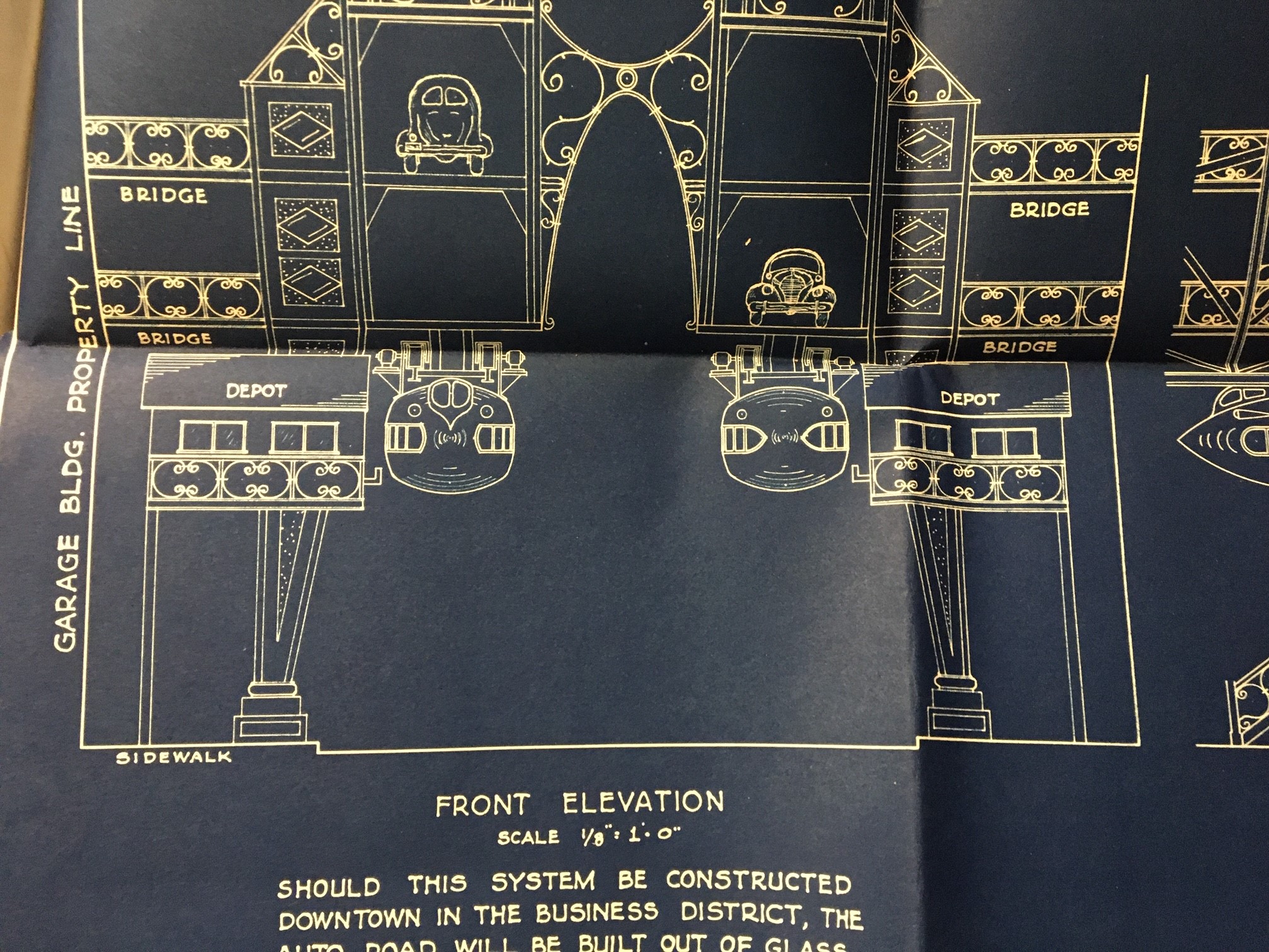
    “Suspended rapid transit and elevated highway system for high-speed passenger service” is what Mr. Davino was suggesting here, all of which was of his own design. I can not find very much at all for Mr. Davino, though he is a patent holder for at least three associated designs/ideas dating from 1926 to 1950. [Semirigid Suspended Railway Structures, 1607875, (1923);Aerial Railway Apparatus patent 2234487 (1943); Suspended Rapid Transit System 2781001A (1950), (suspended vehicles with self-propelled vehicles).] I also found a reference to a suspended transportation system of some sort offered by him through his business “Aerial Apparatus” of Los Angeles (in the Mining Journal, vol 110, 6 November 1920, p 910).

    Details of the large folding blueprint:

    IMG_2254

    The folding plates:

    1. “Graphic Time Schedule”. 17.5”x 24”. Shows difference in travel time car vs bus compared to NYC “rapid transit” for moving over the same distance, and then compared to the proposed Davino system.

    2. Graphic Table Outlining Coats of Davino’s Train System…” 11”x 15”.

    3. Blueprint. Suggestive Tentative Plan of the Davino Suspended Rapid Transit nd Elevated Highway System. Lovely!

    4. Blueprint. “Sketch Map of Los Angeles and Vicinity” showing the connections and possible routes of the Davino system. 11”x 15”.

    IMG_2254

    ·Posted by :

    ·in:


  • Early Work on Sound-on-Film Motion Pictures 1932

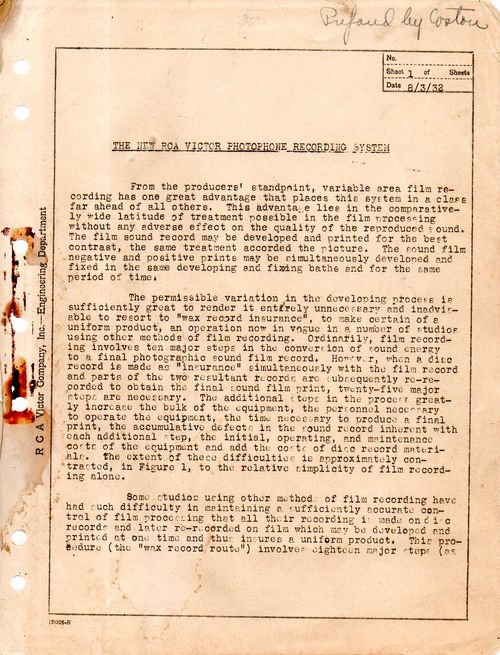
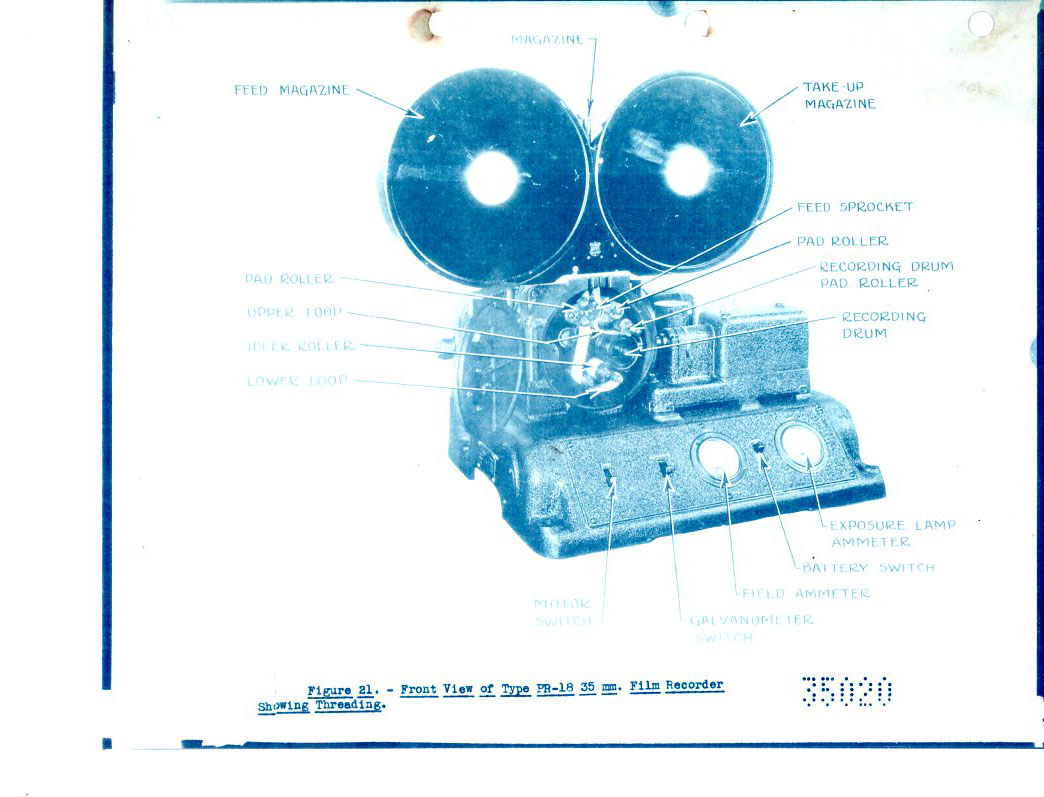
    SOund on film Photophone _1_The New RCA Victor Photophone Recording System. RCA Victory Company, 1932.  Internal RCA Document:  8vo, 45 typed mimeo leaves, with 26 pp of blue-line photographs and schematics of the  equipment.  Punch-bound at one time, though metallic binding element is not present.  Very good condition.   $3500 (1/3 to charity)

    This a sound-on-film incunable. This means the pamphlet was printed within the first few years of the first “talking”  (synchronized sound, or sound technologically coupled to image) motion picture. The first feature length film using sound throughout1 the length of the movie was The Jazz Singer, which was released in 1927 and used a sound-on-disc2 system of recording. That means that the audio portion of the film was recorded onto records, and then synchronized in playback with the film to match up the audio and video–this technology was obviously not the future.
    The technology of sound-on-film would take the day, and in very short order, leading to four different systems, of which the Photophone was one.  Photophone’s share of the prospective studio users was pretty good: the earliest major producers/licensees included Walt Disney Productions (after 1932), RKO Radio Pictures, Republic Pictures, Warner Borthers, and Pathe.

    ” From the producer’s standpoint, variable area film recording has one great advantage that places this system in a class far ahead of all others”.  

    And on the Film Phonograph Reproducing Equipment:  ”  the need for combining two or more sound tracks, the adding of sound effects to an original recording, or matching around levels of scenes in the final editing of a picture has brought re-recording into an increasingly important position in sound picture production”.

    The work is in general a technical report and sales pitch for the new system.  It includes the following sections:

    General introduction (1-7, 4 illustrations), the Ribbon Microphone (8-12, 3 illustrations); Microphone Distribution Panel, (13-14pp, 2 illustrations); Microphone Mixing Panel (15-17, 2 illustrations); Compensator Panel (18-21, 2 illustrations); Recording Amplifier (22-25pp, 2 illustrations); Ground Noise reduction Amplifier (28-30, 2 illustrations); 35mm Film Recorder (31-34, 2 illustrations); 16mm Film recorder (page 35, 2 illustrations); Film Phonograph Reproducing Equipment (36-39 pages, 2 illustrations); Phototube Amplifier (40-41pp, 1 illustration); 35mm to 16mm Film Re-recorder, 42-45pp, 2 illustrations). 

    Notes:

    1.  Earlier on in the mid-1920’s there were efforts of using sound in film but limited to music or very specific areas of the film, most of which in the end was silent. 

    2. The  movie was made with the Vitaphone system, which was not long for this world, soon to be replaced by the more sophisticated sound-on-film systems.

    “In 1925 GE started a program to develop commercial sound-on-film equipment based on Hoxie’s work. Unlike the Phonofilmand Movietone systems in which the audio modulated the intensity of a recording lamp which exposed the soundtrack, thus creating a variable-density track, the GE system employed a fast-acting mirror galvanometer to create a variable-area soundtrack. A number of demonstrations of this system, now known as Photophone, were given in 1926 and 1927. The first public screenings with this system were of a sound version (music plus sound effects only) of the silent film Wings which was exhibited as a road-show in around a dozen specially equipped theatres during 1927.”–Wiki

    SOund on film photophone _2_

    ·Posted by :

    ·in:


  • Early and Rare Work on Sound-on-Film Motion Pictures

    Photophone 1929 _3_Theatre Survey Instructions.  “Property of RCA PHOTOPHONE, INC. Its use is limited exclusively to authorized employees of RCA PHOTOPHONE, INC., and authorized employees of its associated companies.    Very good condition.  $3500 (1/3 to charity)

    “London Office, May-30-1929” 

    “Engineering Productions E.1-1.”

    10,5×8 inches, 6 typed carbon sheets.  

    “London Office, May-30-1929” 

    “Engineering Productions E.1-1.”

    10,5×8 inches, 6 carbon copy typed sheets.  Very good condition. 

    This is a short (but quite rare) document on operating the photophone (1929).

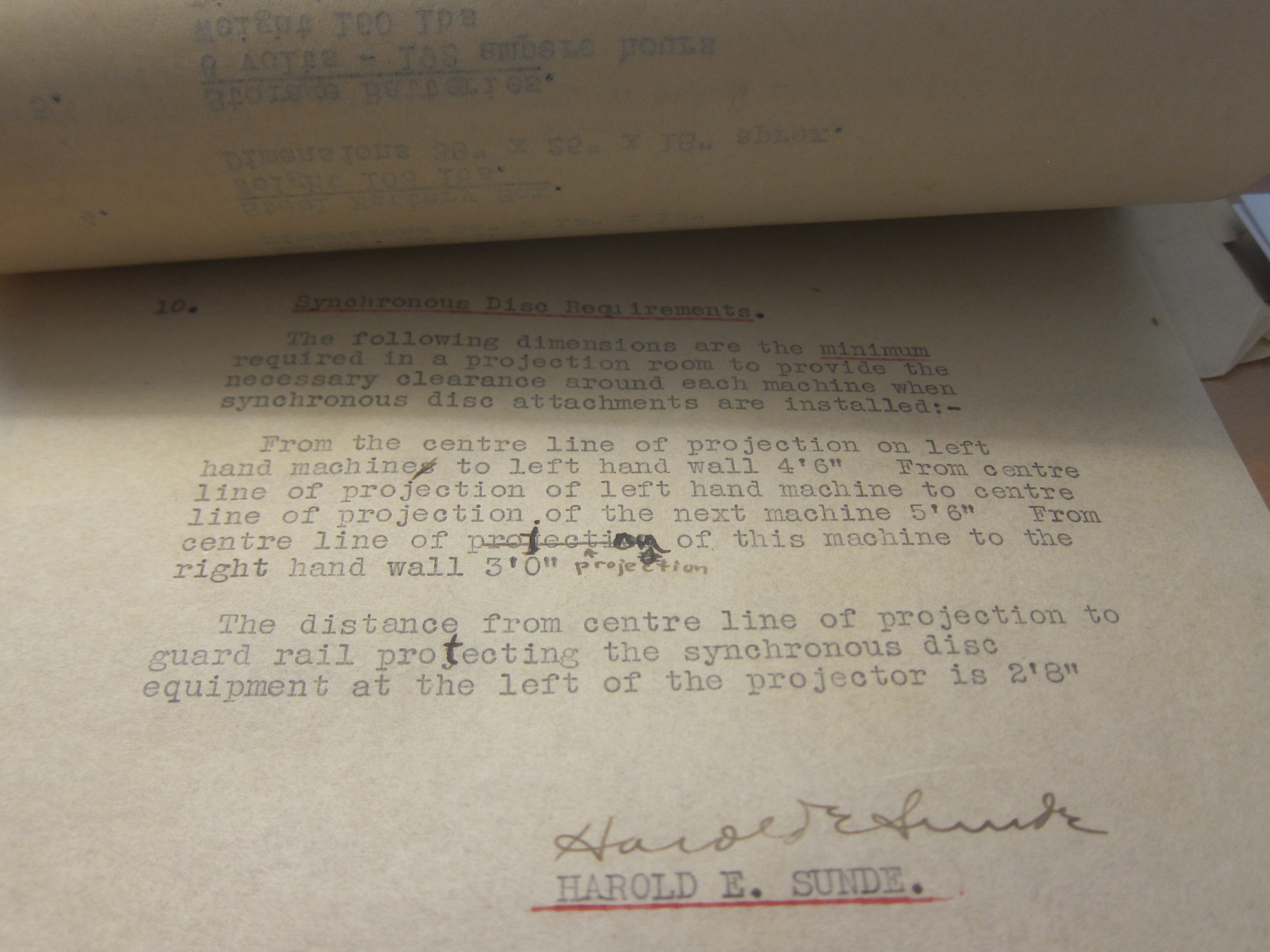
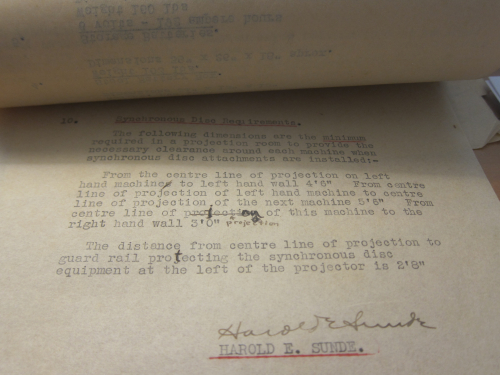
    Provenance: Harold E. Sunde, with his initials in pen at top left front cover, and signed by him on final page.  Sunde (1910-1990) was responsible for the explanation and demonstration of the RCA “Photophone” invention–one of the earliest simultaneous sound-on-film recorders and projectors, and introduced the machine to England and Russia, where true sound-on-film motion pictures were seen for the first time. He was also JHU APL, Sandia, Radiological Defense at Bureau of Ships, USAF). This document appears just a month or so before the showing of the first successful synchronized sound-on-film picture in England, A. Hitchcock’s “Blackmail”. This a sound-on-film incunable. This means the pamphlet was printed within the first few years of the first “talking”  (synchronized sound, or sound technologically coupled to image) motion picture. The first feature length film using sound throughout the length of the movie was The Jazz Singer, which was released in 1927 and used a sound-on-disc2 system of recording. That means that the audio portion of the film was recorded onto records, and then synchronized in playback with the film to match up the audio and video–this technology was obviously not the future.
    Photophone 1929 _1_

    The technology of sound-on-film would take the day, and in very short order, leading to four different systems, of which the Photophone was one.  Photophone’s share of the prospective studio users was pretty good: the earliest major producers/licensees included Walt Disney Productions (after 1932), RKO Radio Pictures, Republic Pictures, Warner Borthers, and Pathe.

    ” From the producer’s standpoint, variable area film recording has one great advantage that places this system in a class far ahead of all others”.

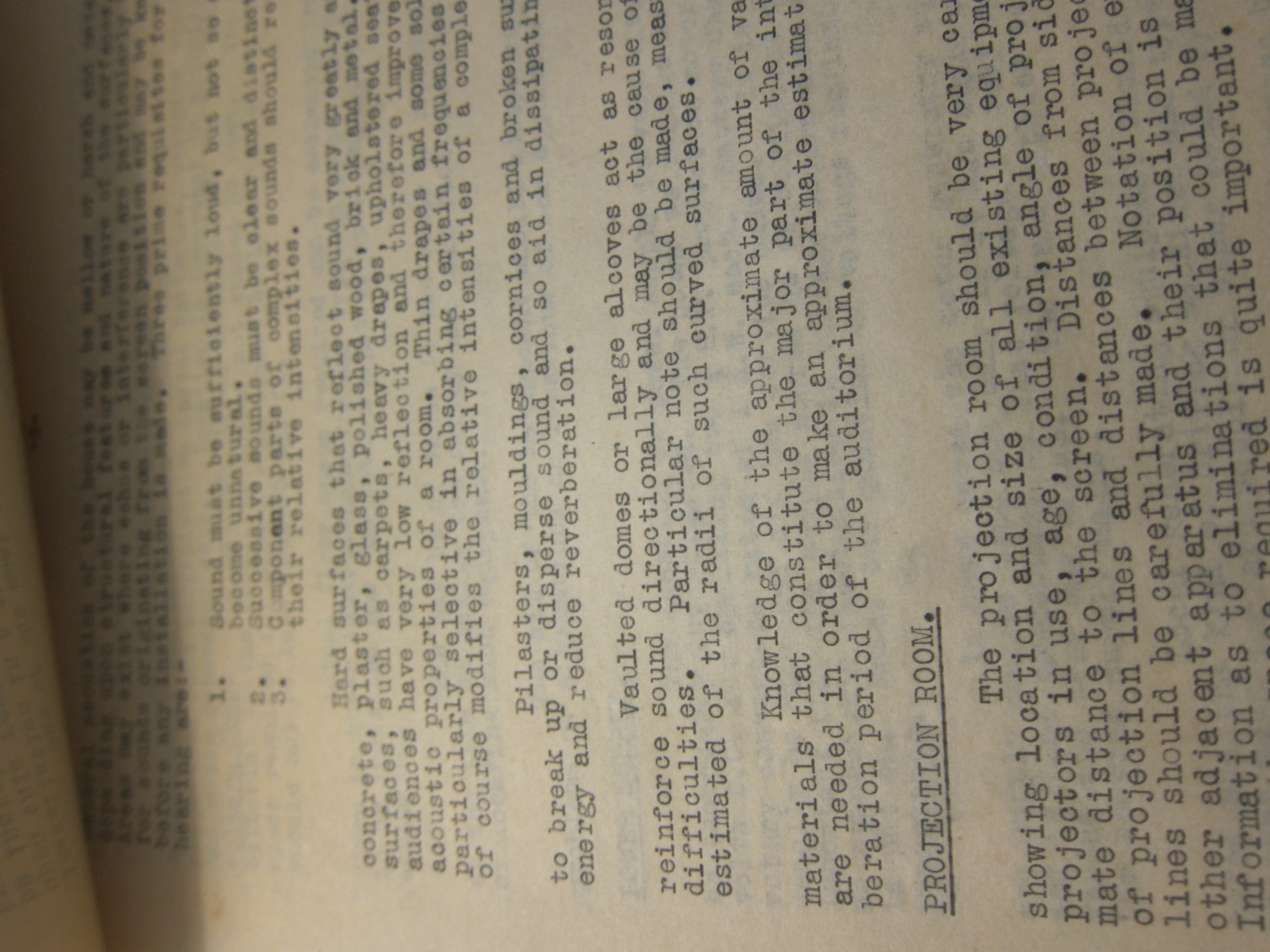
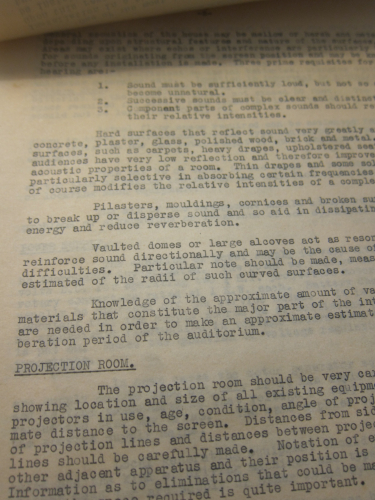
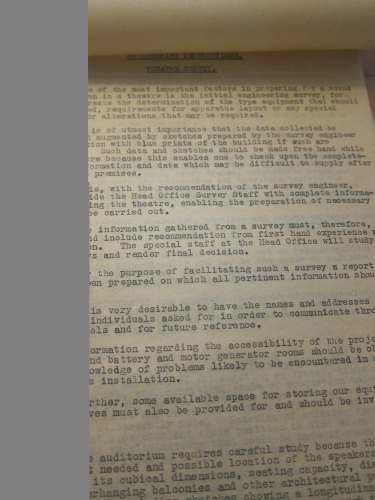
    Content: following a general intro to the equipment, which is followed by four section, including the auditorium, the projection room, the power supply, and the power equipment. The auditorium notes interestingly describe what the operator of the photophone should pay attention to in the building, touching on the location of the speaker, but particular attention was made for the architectural properties of the auditorium and how they might affect sound quality. This is followed by the projection room comments, and then the power supply needs and the power equipment itself, the ending item being the “synchronous disk requirements”.

    Sunde (1910-1990) was responsible for the explanation and demonstration of the RCA “Photophone” invention–one of the earliest simultaneous sound-on-film recorders and projectors, and introduced the machine to England and Russia, where true sound-on-film motion pictures were seen for the first time. 
    Photophone 1929 _2_

    ·Posted by :

    ·in:


  • Very Early Work on Sound-on-Film Motion Pictures

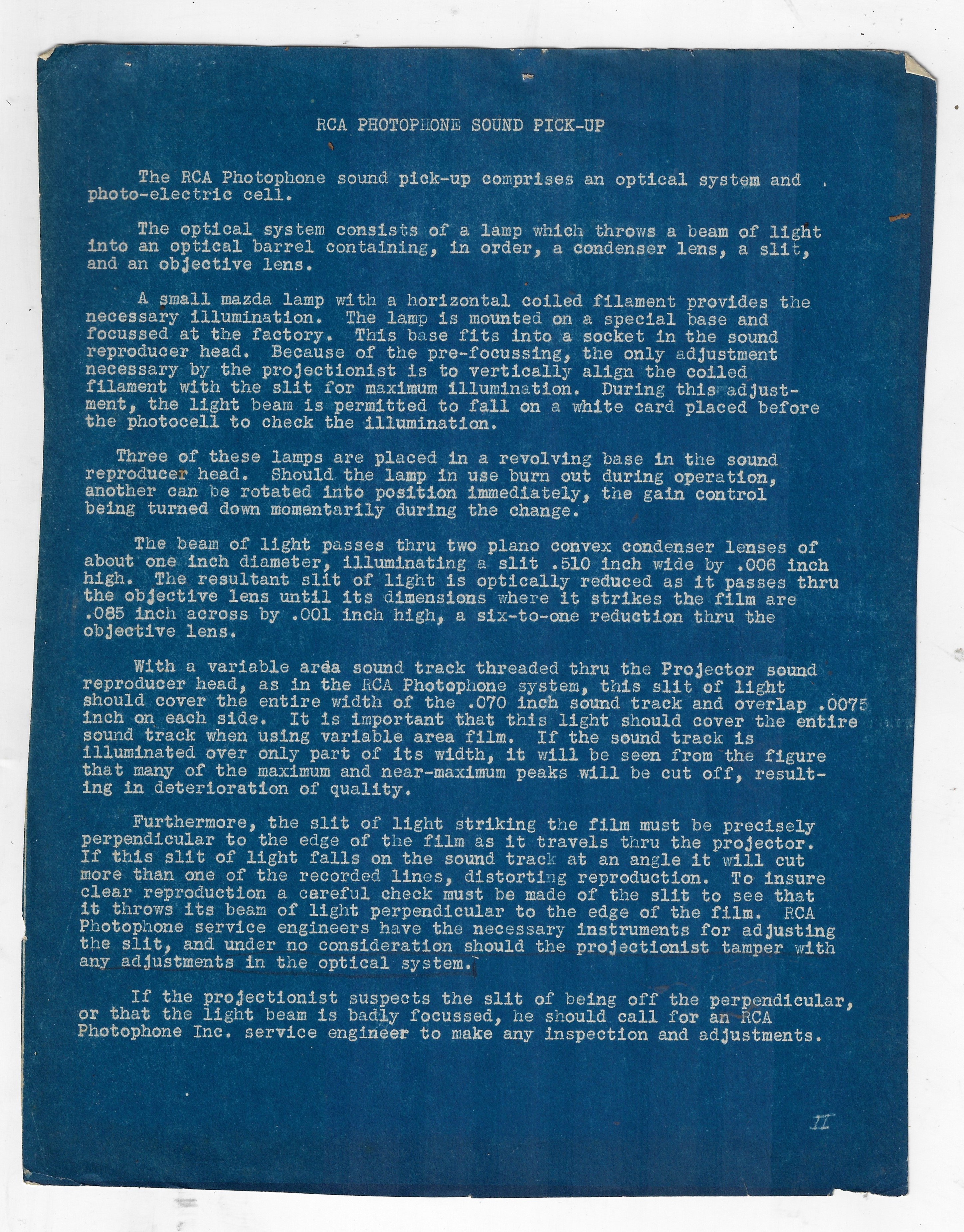
    Photophone sound repro from film _1_RCA Photophone Sound Reproduction from Film.

    11”x 8” (the first leaf slightly smaller). Undated—I’d guess that this was around 1930.

    Blueprints, printed by (Photophone) “Engineering Department”. 6 leaves, numbered (I)-(VI). Bound at the top with a brass fastener.

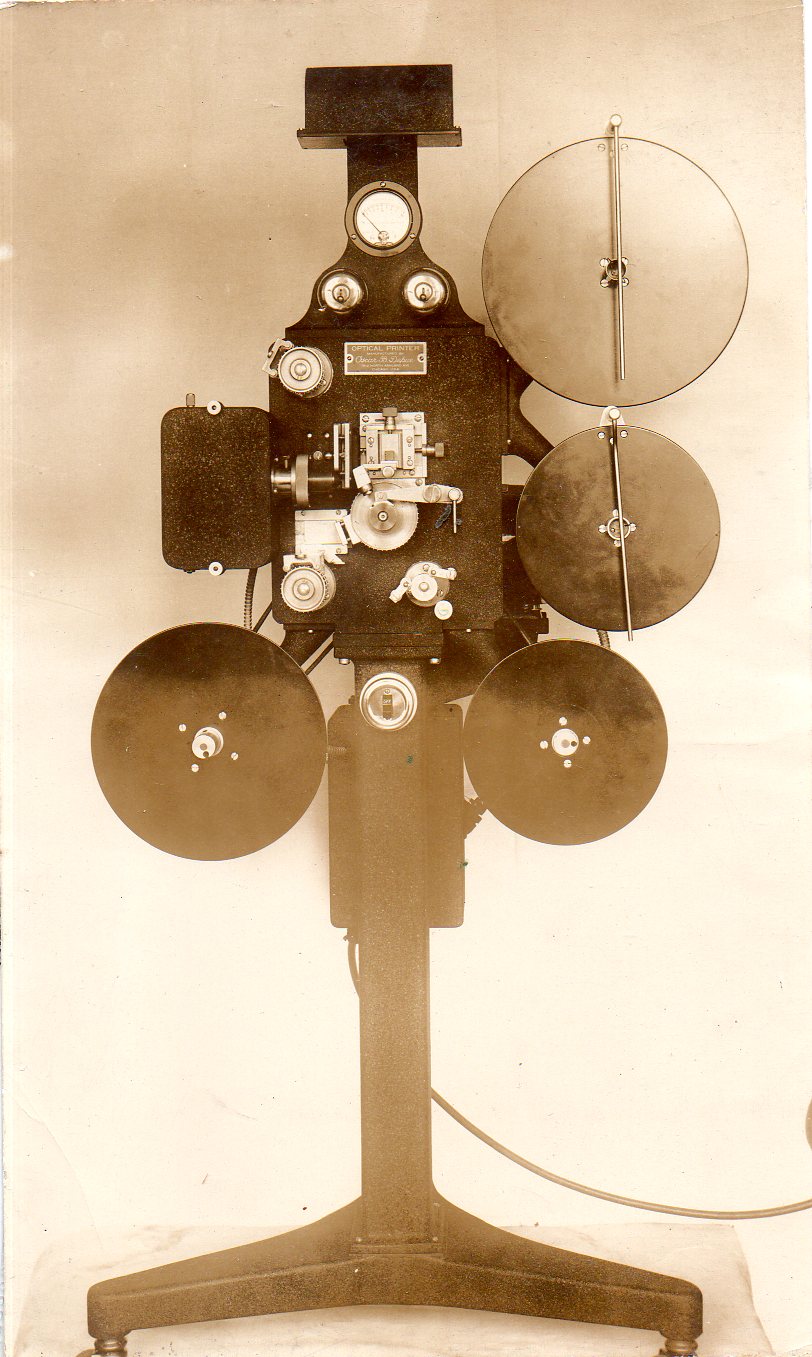
    Accompanied by a 8”x 5” original photo of the instrument.

    Rare. $2500 (1/3 to charity)

    • No copies in WorldCat.

    The publication gets right to business in the opening paragraph in the section titled “RCA Photophone Sound Pickup”: The RCA Photophone Sound pick-up comprises an optical system and photo-electric cell….”

    In short this is a short primer on how the machine functions.

    Provenance: Harold E. Sunde, with his initials in pen at top left front cover, and signed by him on final page.  Sunde (1910-1990) was responsible for the explanation and demonstration of the RCA “Photophone” invention–one of the earliest simultaneous sound-on-film recorders and projectors, and introduced the machine to England and Russia, where true sound-on-film motion pictures were seen for the first time. He was also JHU APL, Sandia, Radiological Defense at Bureau of Ships, USAF). This document appears just a month or so before the showing of the first successful synchronized sound-on-film picture in England, A. Hitchcock’s “Blackmail”.
    This a sound-on-film incunable. This means the pamphlet was printed within the first few years of the first “talking”  (synchronized sound, or sound technologically coupled to image) motion picture. The first feature length film using sound throughout the length of the movie was The Jazz Singer, which was released in 1927 and used a sound-on-disc system of recording. That means that the audio portion of the film was recorded onto records, and then synchronized in playback with the film to match up the audio and video–this technology was obviously not the future.

    The technology of sound-on-film would take the day, and in very short order, leading to four different systems, of which the Photophone was one.  Photophone’s share of the prospective studio users was pretty good: the earliest major producers/licensees included Walt Disney Productions (after 1932), RKO Radio Pictures, Republic Pictures, Warner Borthers, and Pathe

    Rca photophone575
    Rca photophone576

    ·Posted by :

    ·in:


  • Elevator Cables, 1943

    Elevator cables _1_Selection and Maintenance of Elevator Cables.  American Chain and Cable Company, Bridgeport, Ct., 1943.  8″x 5″, 64pp. Original (thick) wrappers. Very nicely designed. Provenance: Library of Congress, with their 10mm “LC” perforated stamp on bottom center front wrapper and their rubber stamp surplus on page 3.  

    Scarce. NO copies located in WorldCat. 

    $175

    ·Posted by :

    ·in:


  • Rare Work on Aviation and Meteorology–No Record in WorldCat


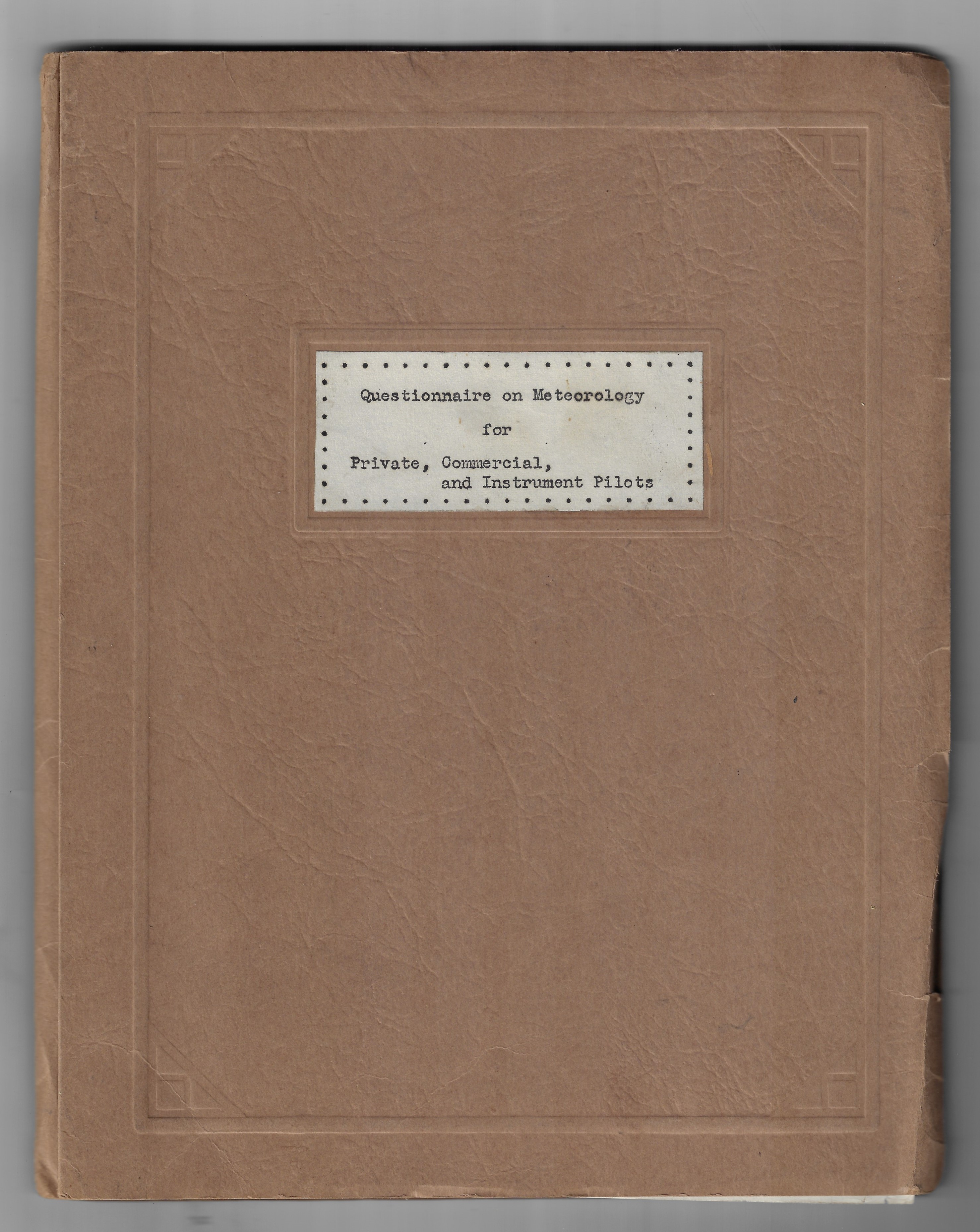
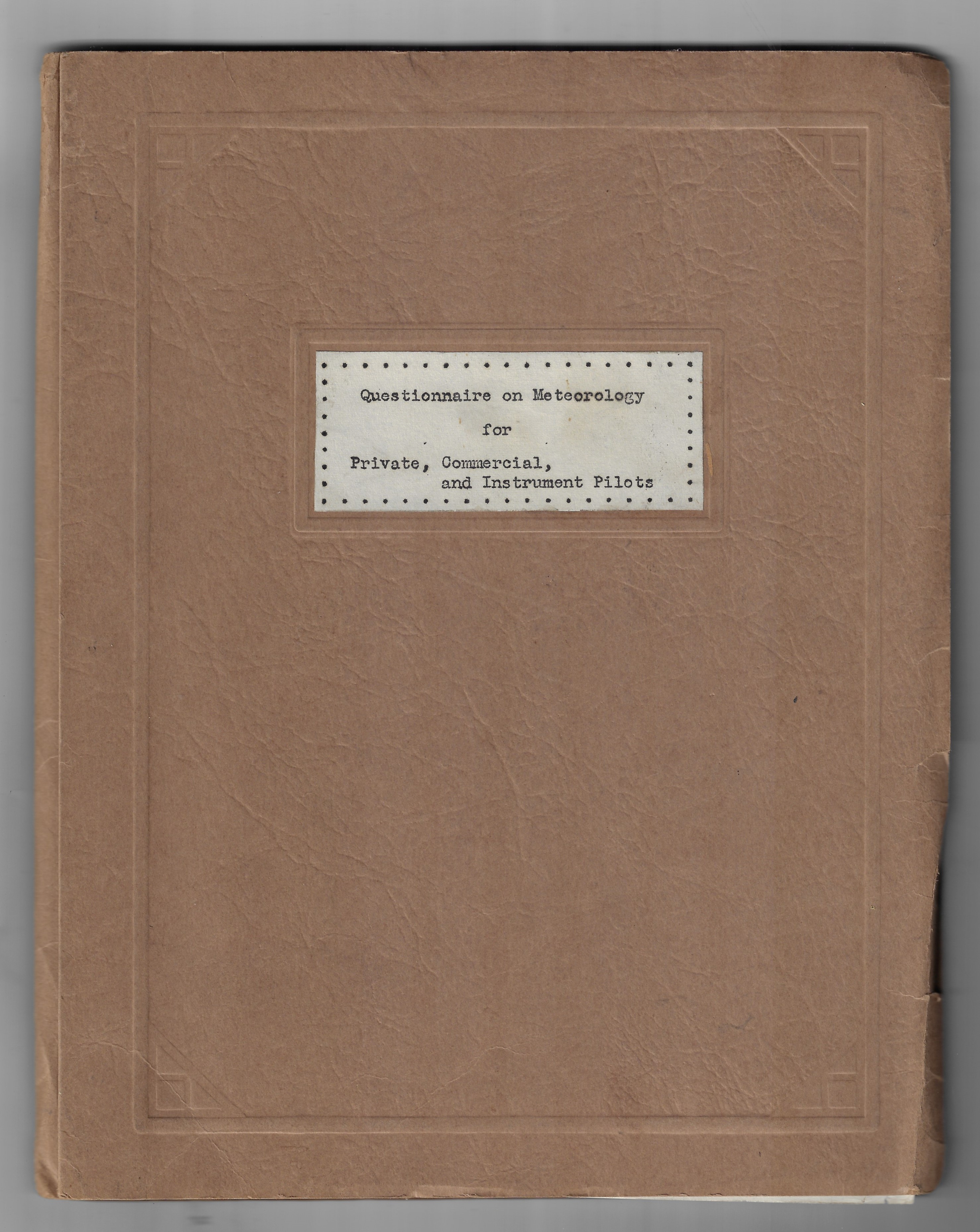
    Questionnaire meteorologyClyde H. Long, Questionnaire on Meteorology for Private, Commercial and Instrument Pilots.  Published by the Flying “L” Aero Service, Bailey, Colorado.  December 1, 1951.  11″x 8.5″, 56 leaves, printed on one side only.  Offset printed, and probably a private production.  Bound in a store-bough folder with a typed paper title.  VG copy. Provenance: Library of Congress, with their rubber stamp on inside front cover.  NO COPIES listed in WorldCat.  $150

    There are 250 multiple choice questions here for study and exam (with answers!)  These are NOT trivial questions.  

    ·Posted by :

    ·in:


  • A Copy of a “Never Published” Work on Steamboats (1940)

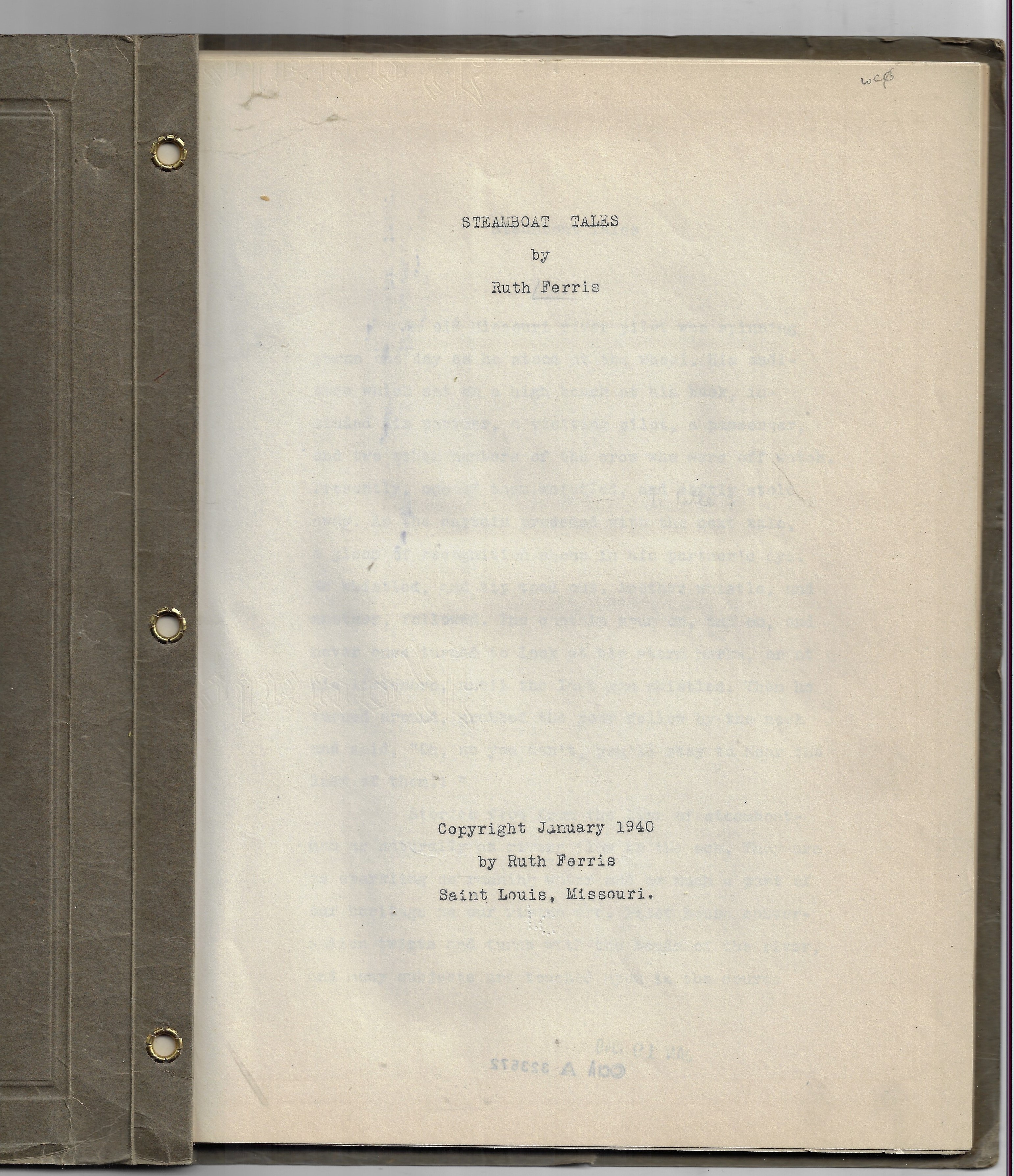
    Ferriss steamboatRuth Ferris, Steamboat Tales. Saint Louis, Missouri, 1940. Offset, privately printed. 11”x 8.5”, 38 lvs. $250

    “Ruth Ferris was one of the nation’s best known collectors of steamboat objects and history.” She was the first curator of the Missouri Historical Society’s River Room, and her writing “represent(s) a history of St. Louis during the golden age of steamboats”.

    It is noted that the work being sold here, “Steamboat Tales”, was never published before being included in “St. Louis and the Mighty Mississippi in the Steamboat Age: The Collected Writings of Ruth Ferris”, published by the St. Louis Mercantile Library in 1993, which is also the source of the preceding quotes. Very good condition, bound in a store-bought manila folder, punch bound. Provenance: Library of Congress, with their 10mm perforated “LC” stamp in the title page, plus their surplus rubber stamp on the rear cover. Also comes with a carbon copy library card of the original LC library card catalog card.

    WorldCat locates 0 copies.


    ·Posted by :

    ·in: