A Daily History of Holes, Dots, Lines, Science, History, Math, Physics, Art, the Unintentional Absurd, Architecture, Maps, Data Visualization, Blank and Missing Things, and so on. |1.6 million words, 7500 images, 4.9 million hits| Press & appearances in The Times, Le Figaro, Mensa, The Economist, The Guardian, Discovery News, Slate, Le Monde, Sci American Blogs, Le Pont, and many other places… 5000+ total posts since 2008.

Book Category: Technology, History of

  • Scarce Spaceflight and ICBM Publications (1961-1964)


    Proposal for Development and Preparation of Space Vehicle Design Criteria and Design Criteria Documentation. 7 February 1964. Submitted to Systems Engineering Group, Air Force Systems Command, USAF, Wright-Patterson AFB.  $225.00

    Volume 1, Technical. TRW Space Technology Laboratories.

    11×8.5”, 4 sections: 18, 22, 29, 121, 20pp. NO copies located in WorldCat for this title.

    The table of contents states the following, though there is one long contribution that is unstated and one that is not included:

    “Section 8. Related Publications.” 18pp

    A1—“Overall Systems Design Criteria.” 22pp.

    A2—Minuteman Structural Design Criteria. (Cover sheet “(Unclassified) Minuteman Structural Design Criteria”), 29pp

    A3—“Attitude Control of Earth Satellites” [not bound in this collection]

    A4—“Energy Sources and Power Conversion,” 20pp

    Between A2 and A3 is the following, with a separate title page:

    Whitford, R.K. Design of Attitude Control Systems for Earth Satellites, 30 June 1961. 2313-0001-RU-000 Space Technology Laboratories. 121pp. Plus two appendices, A+B, 10pp+8pp. NO copies located in WorldCat. Scarce.

    This is a little bibliographically complicated. The front wrapper states that this is “volume 1”, though it has the feel of a volume 2, particularly since it begins with “Section 8”. Some of the contents seem to be stand-alones (as with the Minuteman and the Whitford papers), though the Whitford is the only paper with a title page.

    Bound in a TRW paper wrapper with folding clips; all sections three-ring hole-punched.

    Rarity or scarcity: NO copies located in WORLDCAT/OCLC (NYPL system).

    • NO copies located in the massive database for worldwide library holdings, WorldCat. (“WorldCat is a union catalog that itemizes the collections of 17,900 libraries in 123 countries and territories that participate in the OCLC global cooperative. It is operated by OCLC, Inc. The subscribing member libraries collectively maintain WorldCat’s database, the world’s largest bibliographic database.”–Wikipedia)

    Condition:  VG, a 7.5 on a 1-10 scale, with 10 being “new”.  Nice and fresh.  $250

    • (Condition grading is compared to the condition of the publication when it was new;  to give a condition quote that states “good for its age” comparing something to a fluid state without a common denominator is almost without value, so the publication is compared to its condition when it was first published.)
    ·Posted by :

    ·in:


  • The Invention of the Scanning Electron Microscope (1935)

    Max Knoll, “Aufladepotentiel und Sekundäremission elektronenbestrahlter Körper”, an article in Zeitschrift für technische Physik, volume 16, 1935, occupying pp 467–475 of 657pp of text. The paper includes 14 text images, five of which are reproductions of imagery made by the instrument.

    Rebound in black cloth that is simple but elegant (really quite a lovely job); untrimmed. Small library rubber stamp on the back of the title page (the Technische Hochschule in Danzig, now Gdansk Technical University). $500

    • First paper (“Static potential and secondary emission of bodies under electron irradiation” ) describing the concept of a Scanning Electron Microscope. See C. W. Oatle, “The early history of the scanning electron microscope”, Journal of Applied Physics 53, R1 (1982).

    “The earliest known work describing the concept of a Scanning Electron Microscope was by M. Knoll (1935)” – Bernie C Breton, “The Early History and Development of The Scanning Electron Microscope”.

    “Fundamental research by many physicists in the first quarter of the 20th century suggested that cathode rays (i.e., electrons) might be used in some way to increase microscope resolution. French physicist Louis de Broglie in 1924 opened the way with the suggestion that electron beams might be regarded as a form of wave motion. De Broglie derived the formula for their wavelength, which showed that, for example, for electrons accelerated by 60,000 volts (or 60 kilovolts [k]), the effective wavelength would be 0.05 angstrom (Å)—i.e., 1/100,000 that of green light. If such waves could be used in a microscope, then a considerable increase in resolution would result. In 1926 it was demonstrated that magnetic or electrostatic fields could serve as lenses for electrons or other charged particles. This discovery initiated the study of electron optics, and by 1931 German electrical engineers Max Knoll and Ernst Ruska had devised a two-lens electron microscope that produced images of the electron source. In 1933 a primitive electron microscope was built that imaged a specimen rather than the electron source, and in 1935 Knoll produced a scanned image of a solid surface.”–Encyclopedia Britannica


    ·Posted by :

    ·in:


  • Internal Spec Sheets for the “China Clipper”–Flying Boat Martin Model 130 (1932)

    Glenn L. Martin Company. Detail Specification for Pan American Long Range Air Mail Flying Boat Martin Model 130. GLM Spec #17, February 23,1932.

    This looks to be some sort of odd photographic reproduction from 1932, produced by GLM Co.. 11”x 8.5”, with 20pp, 2pp, and 5pp. Numerous annotations in a contemporary hand. Rare. No copies located in WorldCat. $500

    It seems as though sheet 2 is missing, though a hand-written note seems to imply (?) that the contents of page 2 is included in an appendix, though I can’t determine that.

    Bound in a metal-clasp heavier paper wrapper, in a Glenn L. Martin portfolio. I assume that this had a very limited distribution, thinking that this was circulated much beyond GLM Co and Pan American.

    This is signed by the VP and chief engineer at GLM, Lessiter C. Milburn (who was one of the first 23 Fellows of the Institute Aeronautical Sciences, 1932, along with such headliners as Lymann Briggs, W. Diehl, Donalf Douglas, Glenn Martin, John Northrup, I. Sikorsky, T. van Karman, and others. He was later president of Balanca Aircraft Corp.)

    “The Martin M-130 was a commercial flying boat designed and built in 1935 by the Glenn L. Martin Company in Baltimore, Maryland, for Pan American Airways. Three were built: the China Clipper, the Philippine Clipper and the Hawaii Clipper…Martin named them the Martin Ocean Transports, but to the public they were the “China Clippers”, a name that became a generic term for Pan Am’s large flying boats – the Martin M-130, Sikorsky S-42, and Boeing 314.”–Wikipedia

    The contents of the work includes a (1) general section (pp 1-19); pg 20 is a list of appendices numbered I, II, and III, though only (2) appendix III (2pp) is bound here. There is a third section (3) “Supplement ‘A’ ”, 5pp., that is not listed as part of the introduction.

    ·Posted by :

    ·in:


  • A Largely Forgotten Giant of Radio and Sonar

    Fessenden, Reginald A. The Deluged Civilization of the Caucasus Isthmus, Chapter XI.

    Massachusetts Bible Society, Boston, Mass. 1927 12”x 8.75”: 4pp of maps, (ii), 21pp. Printed on very heavy stock, and bound in wrappers. Limited edition of 250 copies, this being copy #XIII. This is copy XIII, inscribed by Fessenden to the “Congressional Library” (Library of Congress”).

    Good/VG copy, the oversize pamphlet having a few bumps and short tears and dusting to the printed wrappers. The text however is FINE.  $250

    Provenance: Library of Congress, with their “surplus/duplicate” rubber stamp on the rear cover.

    Fessenden was a great figure in the history of radio (who was awarded over 500 patents), and later in life undertook a project to find and identify the pre-Noahic flood civilizations in the Caucasus. There’s not much I can say about that part of his career, so I won’t say anything. I do know that there is a somewhat tortured history to the publication of this work, bits and pieces published here and there, with a large part of the work edited and published post-death by Fessenden’s son.

    Reginald A. Fessenden (1866-1932), father of radiotelephony (which was what wireless transmission of speech was called at the time), radio and SONAR pioneer.

    Fessenden is best known for his pioneering work developing radio technology, including the foundations of amplitude modulation (AM) radio. (“In 1900 Fessenden left the university to conduct experiments in wireless telegraphy for the U.S. Weather Bureau, which wanted to adapt radiotelegraphy to weather forecasting. Impatient with the simple on-off transmission of Morse Code signals, he became interested in transmitting continuous sound, particularly that of the human voice. He developed the idea of superimposing an electric signal, oscillating at the frequencies of sound waves, upon a radio wave of constant frequency, so as to modulate the amplitude of the radio wave into the shape of the sound wave. “)==Encyclopedia Britannica

    His achievements included the first transmission of speech by radio (1900), and the first two-way radiotelegraphic communication across the Atlantic Ocean (1906). In 1932 he reported that, in late 1906, he also made the first radio broadcast of entertainment and music, although a lack of verifiable details has led to some doubts about this claim. John Scott Medal, which included a cash prize of $800, for “his invention of a reception scheme for continuous wave telegraphy and telephony”–enwikipedia

     “Canadian radio pioneer who on Christmas Eve in 1906 broadcast the first program of music and voice ever transmitted over long distances.”–Encyclopedia Britannica

    responding to the Titanic disaster in 1912 Fessenden is credited with the invention and development of the first modern transducer used in a sonar.  Thomas R. Howarth and Geoffrey R. Moss, “The Fessenden Oscillator: The first sonar transducer”, The Journal of the Acoustical Society of America 136, 2131 (2014)

    ·Posted by :

    ·in:


  • From the Earliest Period of pre-Cinematography (1894)


    MAREY, Étienne-Jules.“Des mouvements que certains animaux exécutent pour retomber sur leurs pieds, lorsqu’ils sont précipités d’un lieu élevé” by Étienne-Jules Marey (Comptes rendus 119, pp. 714–718, 1894). A big volume bound in contemporary leather and boards. Some wear to spine leather; otherwise fine inside and out. 1250.00

    “Étienne-Jules Marey was a French scientist, physiologist and chronophotographer, best known for the invention and use of a chronophotographic gun, an instrument capable of taking 12 consecutive frames a second, with all the frames recorded on the same picture. Using these pictures he studied the motion of a wide range of animals called Marey’s ‘animated zoo’”.–Wenner, History of Physics

    This paper contains the famous falling/dropped/thrown cat experiment in which Marey shows that when dropped with its back towards the ground a cat will respond and right itself via muscular reaction to land on its feet, all of the time. It was not a trick of “air pressure” or other such thing which Marey dismissed, as once the action of the fall is slowed so that the whole of the activity can be intelligently observed, and it was by the animal’s movement alone that brings it to land on its feet. It is Marey’s instrumentation that takes the day, using a camera capable of making 60 images per second, which was a huge advance over his chronophotographic gun of 1882 which made 12 images/second. Marey remarks that this animal action is true in other animals, giving the examples of rabbit and dog.

    Marey is a rather stiff writer and takes his time to explain himself in extended detail—this isn’t an entertaining story though the results are of course fantastic.

    That piece of needling aside, Marey is one of my favorite 19th century science figures. He worked across numerous fields, though I think his great importance is in the invisible-to-visible part–that he was able to make was were essentially moving pictures of complex and/or fast action, displaying motion in shockingly easy manner. His work opened as much of a new and surprising world as that of Lippershey/Galileo and Co. with the telescope and Janssen/Leeuwenhoek/ and the others with the microscope.  

    “In Marey’s view, physiology “is itself but the study of organic movements,” and the graph best represents all the variations that such phenomena undergo. Marey believed, however, that these motions ultimately were to be explained by laws of physics and chemistry. Furthermore, while he accepted the application of physiological research to medical problems, he subordinated this utilitarian purpose to a more abstract goal: “analyzing the conditions which modify the functions of life and … better determining the laws which regulate these functions.” Toward this end medicine served only as one further means of analysis.”–Complete DSB.  “Marey constructs, according to the reversible principle of the chronophotograph, an apparatus for the projection on a screen of series of pictures taken by the aforementioned apparatus and thus realizes the photographic synthesis of motion.”–Eder, History of Photography.   See: Tosi, Virgilio, Cinema before cinema : the origins of scientific cinematography. London : British Universities Film & Video Council, 2005. Also: ARTE France. Roll on, Cinema. NY, Infobase, 2014. [Video]. Also: Alder Anderson, Analysing motion. Marlborough, England: Adam Matthew Digital, [2012]. Laurent Mannoni, Marie-Sophie Corcy, Thierry Pozzo … [et al.]. Images, science, mouvement : Autour de Marey. Paris : Harmattan, 2003. 

    For further reading see G. Gbur’s Falling Felines and Fundamental Physics, Yale, 2009.


    ·Posted by :

    ·in:


  • The Photoelectric Effect (1888)

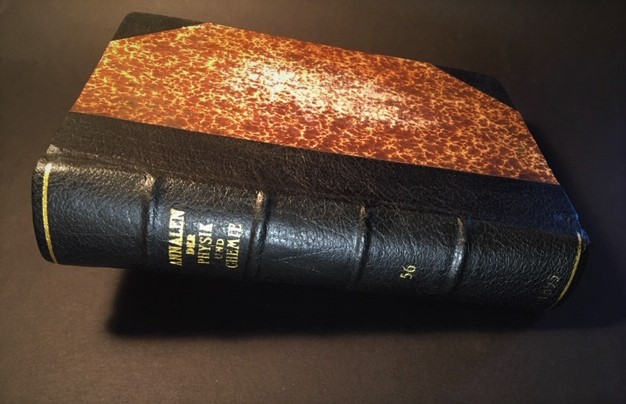
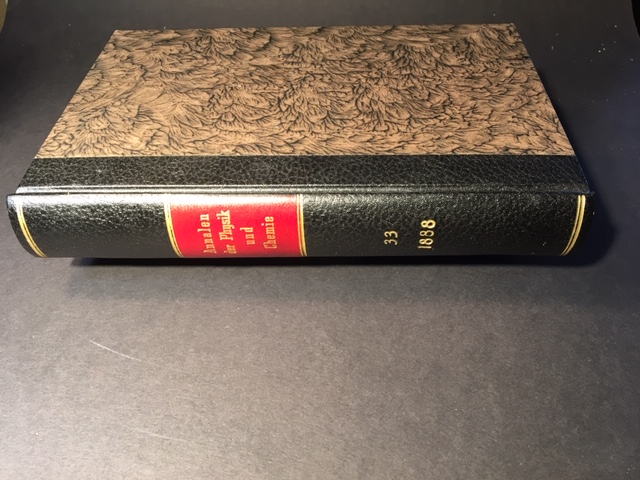
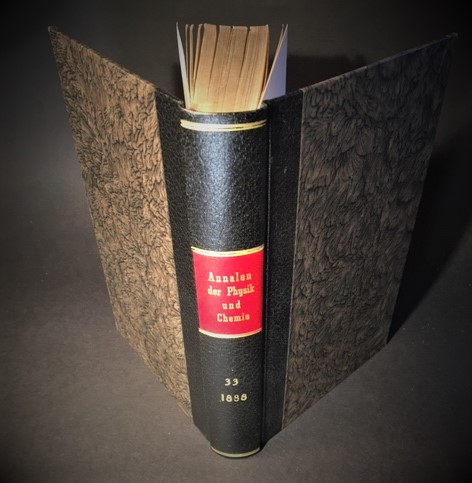
    HALLWACHS, Wihelm. “Über den Einfluss des Lichtes auf electrostatisch geladene Körper” by Wilhelm Hallwachs” in Annalen der Physik und Chemie, 1888; Leipzig, Johann Ambrosius Barth, vol 33 pp. 301– 312. Recently bound in period style leather and boards. Appears pristine other than very small very light library stamp on title page. $550

    Hallwachs 1888 _2_

    “Hallwachs (1859-1922) was one of the pioneers of modern physics. An experimental physicist, he laid the foundations for research on photoelectric processes…At Leipzig in 1888 he investigated, following the model of Heinrich Hertz’s studies, photoelectric activity, establishing that through absorption of ultraviolet light, negatively charged metal plates discharge and uncharged metal plates become positively charged. This process, which is called the photoelectric effect or Hallwachs effect, forms the basis for the physics of the photoelectric cell and was theoretically interpreted in 1905 in Einstein’s work on light quanta….”–Complete Dictionary of Scientific Biography online

     “Hallwachs wrote about 50 scientific papers. The most important are “Ueber den Einfluss des Lichtes auf electrostatisch geladene Körper,”[this paper] in Annalen der Physik und Chemie, n.s. 33 (1888), 301–312; “Ueber die Electrisierung von Metallplatten durch Bestrahlung mit electrischem Licht,” ibid., n.s. 34 (1888), 731–734; “Ueber den Zusammenhang des Electricitätsverlustes durch Beleuchtung mit der Lichtabsorption,” ibid., n.s. 37 (1889), 666–675.”–DSB

    ”In 1888 Hallwachs formulated the hypothesis that a conductive plate on which to focus ultraviolet light carries a positive charge because the electrons are gouged out. This happened with more intensity in selenium. The phenomenon was seen in the same year by A. Righi. The phenomenon was called ‘Hallwachs-Effekt’, now called the photoelectric effect. The investigation of the photoelectric effect laid the foundation for the development of the photoelectric cell, photo electricity and Albert Einstein’s quantum light hypothesis.”–Wikipedia

    “The photoelectric effect forms the basis for the physics of the photoelectric cell and was theoretically interpreted in 1905 in Einstein’s work on light quanta.  Hallwachs’ observations laid the foundation for the later development of photo cells, TV camera imaging and other light-sensitive electronic devices.”–Lisa Ann Pinkerton, “Photoelectric Effect Discovery Leads to Photo Cell Development”–Technica Communications.

    See also: Harald Goldbeck-Lowe, “The Hallwachs-Effect – The Photoelectric effect – Gate to Quantum Physics “- Poster DIN A0, 2012, Conference: IX. International Conference for the History of Science in Science Education. Project: Roots of Quantum Physics.

    Hallwachs 1888 _1_

    ·Posted by :

    ·in:


  • Einthoven Willem Eine Isolationsvorrichtung Gegen Erschutterungen Der Umgebung In Annalen Der Physik Und Chemie 1895 Vol

    EINTHOVEN, Willem. “Eine Isolationsvorrichtung gegen Erschutterungen der Umgebung”, in Annalen der Physik und Chemie, 1895, vol 56, pp. 161- 166. Bound in period style leather and boards. Number on title page; otherwise beautiful, fine and clean  $350.00

    “In 1895, after the London physiologist A. D. Waller had published the curve for the action current of the heart as deduced from the body surface and had announced that he was unable to calculate its true shape (as recorded with Lippmann’s capillary electometer), Einthoven repeated this experiment. He defined the physical constants of the capillary electrometer and calculated the true curve, which he called the electrocardiogram.” – DSB.

    EInthoven

    “The first accurate recording of the electrocardiogram ...Einthoven, using an improved electrometer and a correction formula developed independently of Burch, distinguishes five deflections which he names P, Q, R, S and T.”–ECG Libvrary

    “Einthoven derived a correction formula that compensated for the inertia and friction when using the mercury column of the Lippmann capillary electrometer….and…superimposed the mathematically corrected curve on the uncorrected curve. He had previously used ABCD to indicate the waves in the uncorrected tracing, and was forced to find other letters to label his corrected curve.”–Dr. Mike Cadogan, “History of the Electrocardiogram”.

    Einthoven received the Nobel Prize in 1924 “for his discovery of the mechanism of the electrocardiogram.” Nobel, the Man and his Prizes, pp. 262-265.

    Wasson, Nobel Prize Winners, pp. 294-295

    ·Posted by :

    ·in:


  • Scarce Prospectus for the Boulder Dam (1928)

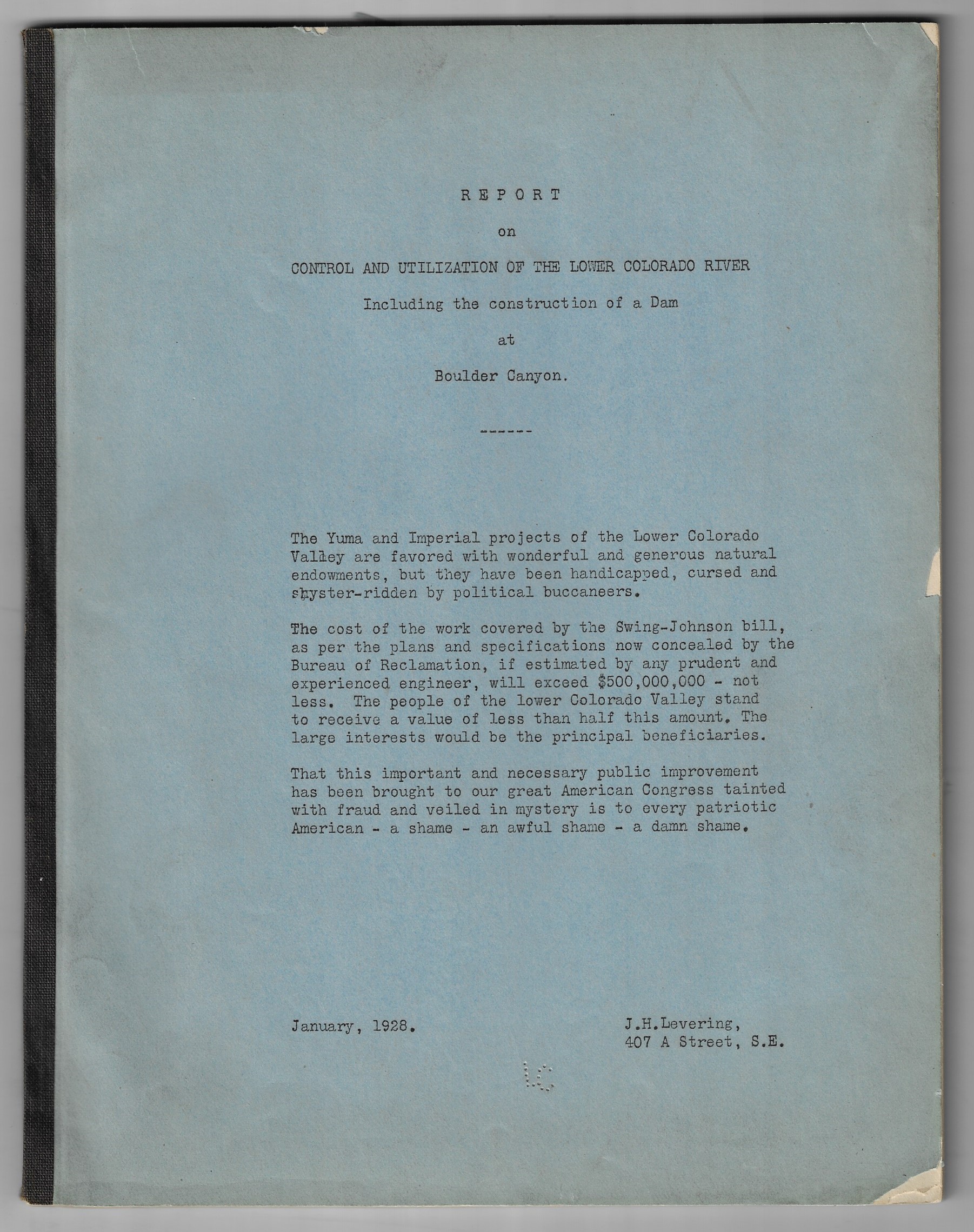
    J.H. Levering, Elwood Mead; R M Priest . Report on Control and Utilization of the Lower Colorado River including the Construction of a Dam at Boulder Canyon. Privately printed in Washington D.C. 1928. 11”x 8.5”, 28pp plus 6pp appendix, p;us 9 plates (8 photos), plus two folding plates (including one map). Printed wrapper, cloth-covered spine. VG condition. Provenance: Library of Congress, with their tiny 6mm “LC” perforated stamp on the bottom of the cover and their LC rubber atamp on rear cover. WorldCat locates only ONE copy (Arizona State Library). $175.00

    Boulder Dam

    ·Posted by :

    ·in:


  • The RCA TV Field Test, 1936

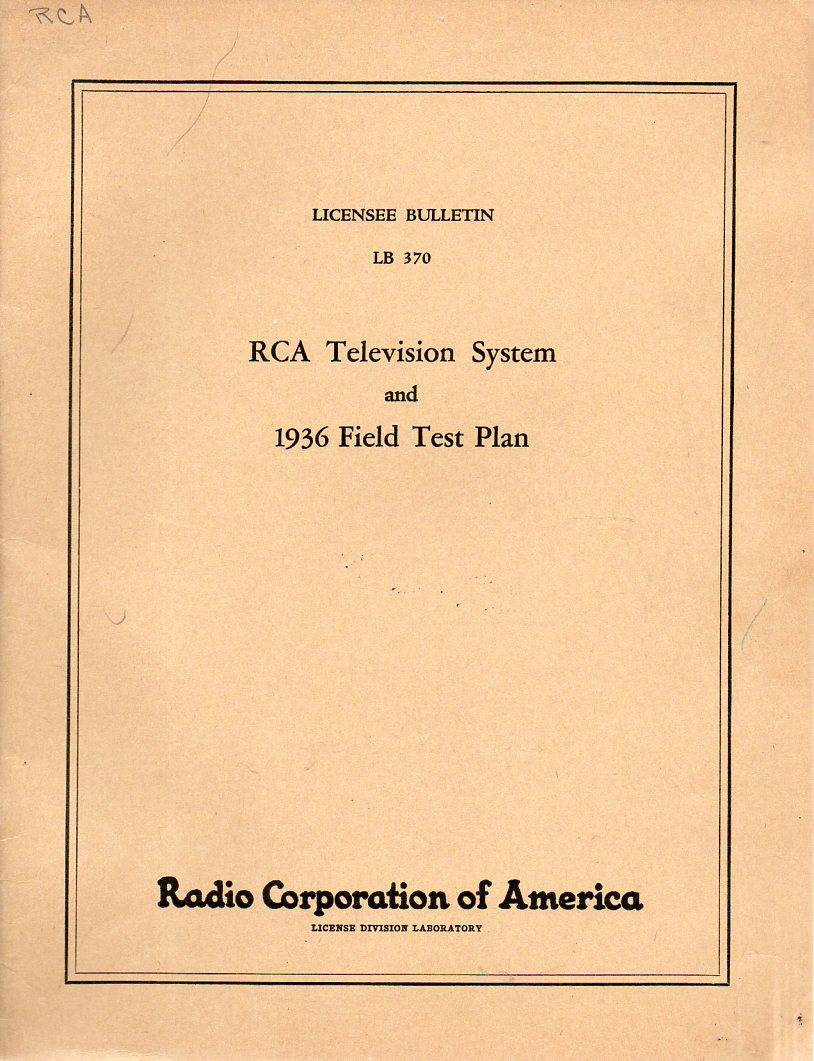
    RCA field Test _1_RCA Television and 1936 Field Test. Licensee Bulletin LB 370, Radio Corporation of America, 1936. 11” x 8.5”, 26pp, photos and schematics. Original wrapper, Fine copy. $300

    The first broadcast images in the history of television transmission were revolutionary if not very interesting in themselves.  Beginning in 1928 the first experimental Radio Corporation of America (RCA, via the National Broadcasting Company, NBC, its broadcasting division) images were of Felix the Cat, and something that would be received with 60-line clarity on a two-inch display.  For the most part, the daily two-hour broadcasts consisted of Felix or test patterns, broadcast from NYC, until 1931.  

    Image quality increased markedly by the 1932 field trials with the use of iconoscope cameras, which allowed for 240-line reception though still with very noticeable flickering. The 1934 trials were improved further to 343 lines and with some less amount of flicker. For the 1936 field test the transmitting station and offices for NBC and RCA were located in the Empire State Building (utilizing the mooring mast at the top of the building for the antenna, as well as some of the upper floors for the transmitter and offices on the 52nd floor, while the transmitting studio was located in the RCA building in Rockefeller Center).  The broadcast began on 29 June 1936 from W2XF/W2XK “to an audience of some 75 receivers in the homes of high level RCA staff and a dozen or so sets in a closed circuit viewing room…(in the RCA building)” (See: The Television Museum, at Earlytelevision DOT org.)

    The rare pamphlet [available for purchase from our blog bookstore, here] that I uncovered in the attic speaks to the first public demonstration. “The first public demonstration of these field trials took place on July 7, 1936 to RCA’s 225 licensees. Major General J. G. Harbord, chairman of the board of RCA announced that there were three sets in operation at the time, the most distant in Harrison, N. J.”2  It addresses the history of the field tests as well as the tech specs for the 1936 test, as well as the need to address the fuller and complicated issues of establishing a network of transmission capabilities:  “Television services required the creation of a system, not merely the commercial development of apparatus.”–July, 1936, RCA Field Test Plan, page 8.

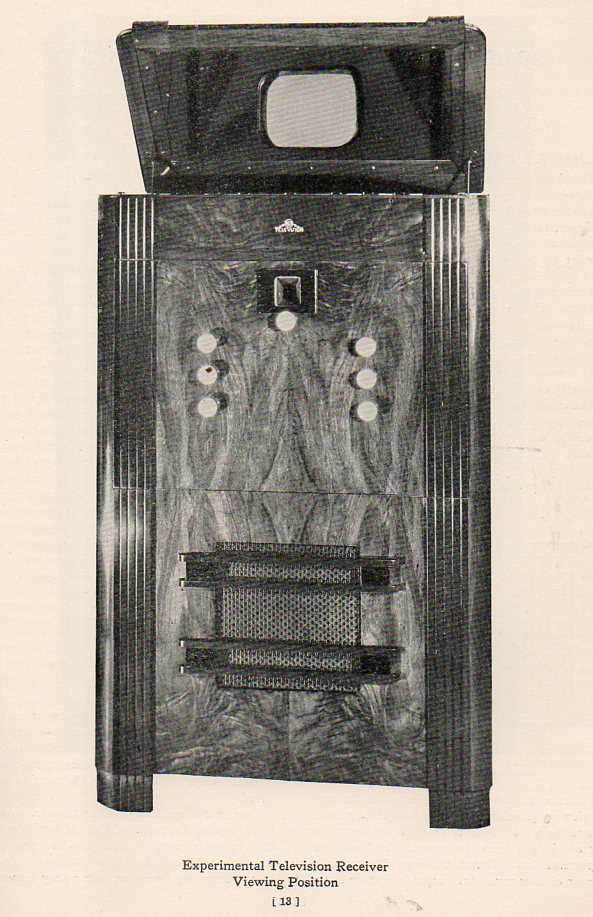
    The set on which the transmission was received was the RCA RR-359 trial set:

    RCA field test _2_

    ·Posted by :

    ·in:


  • A Wealth of Papers on Foucault and Fizeau (1851)

    [FOUCAULT & Fizeau] Fizeau, “Upon the hypotheses relative to Luminous Ether, and upon an experiment which seems to demonstrate that the motion of Bodies changes the velocity with which light is propagated within them”, appearing in the December issue and translating the Fizeau paper of September 1851 (. “Sur les hypothèses relatives à l’éther lumineux”. Comptes Rendus. 33: 349–355). It seems as though the first English translation appears in the Philosophical Magazine Series 4 vol 2 pp 568-573; this JFI appearance seems to be the first English translation published in the U.S. In:  Journal of the Franklin Institute, 1851, vol 22 (third series, and vol 52 overall). Half-calf and marbled boards. Ex-library, with a few stamps on the title page, plus bookplate; the front joint is sprung but the book is still quite tight and intact. Good solid copy. $450

    Also: John Tyndall, “On the Velocity of Light—experimental Proof of the Theory of Undulation”, pp 104-108, in which Tyndall reviews the two excellent Comptes Rendus papers of Foucault and Hippolyte Fizeau (from May 6 1850 and June 17 1850, respectively). The Foucault is a big paper on the particle v. wave theories of light, part of the issues of which lie int eh experimental measure of the speed of light, and in this paper he succeeds in establishing the fundamental constant at 2.98 x 1010 cm/sec. .

    And another “Exposition of Foucault’s Experiment, pp 352-355;

    And another, On Foucault’s Pendulum Experiments, pp 419-421;

    ALSO: Charles Allen, “Investigation of Foucault’s Pendulum” AND “Demonstration of Foucault’s Experiment”, The Foucault experiment occupies pp 38-42 in the July issue and pp 103-104. On the Charles Allen papers: the news of Foucault’s experiment (released to the world just a few months earlier in February) raced through the U.S., the news of the experiment reported in dozens of newspapers within just a couple of months. It has been written that0 for some reason the news and subsequent U.S.-based reproductions of the experiment were lagging in the New England and mid-Atlantic regions—for what reasons, I don’t know. The Franklin Institute contribution to the Foucault phenomenon was significant because it was among the very early reports on the evaluation of the experiment that was published in a scientific/technical journal. It is not the very first, but it is quite early.

    There are of course a hundred interesting entries in this volume, including:

    Michael Faraday, On Atmospheric Magnetism, pp 115-118;

    John C. Trautwine, A New Method of Calculating the Cubic Contents of Excavations and Embankments, pp (1)-13, 146-158;

    B.F, Isherwood, Remarks on Nystrom’s Screw Propeller, pp42-48;

    Turnbull, A Series of Lectures on the Telegraph, pp 118-128, 185-194, 256-266, 335-339, 406-414 (with a beautiful plate of a printing telegraph);

    Robert Hunt, Recent Improvements in Photography, pp 196-202;

    John Nystrom, A Few Suggestions as to the Manner of Laying out a Propeller…, pp 321-332, with two beautiful plates.


    ·Posted by :

    ·in: