A Daily History of Holes, Dots, Lines, Science, History, Math, Physics, Art, the Unintentional Absurd, Architecture, Maps, Data Visualization, Blank and Missing Things, and so on. |1.6 million words, 7500 images, 4.9 million hits| Press & appearances in The Times, Le Figaro, Mensa, The Economist, The Guardian, Discovery News, Slate, Le Monde, Sci American Blogs, Le Pont, and many other places… 5000+ total posts since 2008.

Book Category: Naval and Nautical

  • Original Drawing for Raising a Screw Propeller of the HMS Esk (1854)

    Original drawing on oilskin of a device used to raise the propeller of the HMS Esk, an early-use example of a modern screw propeller, 1854. 

    32×24″, in original color. There are some nicks and short tears, but in overall GOOD (or better) condition. $2250
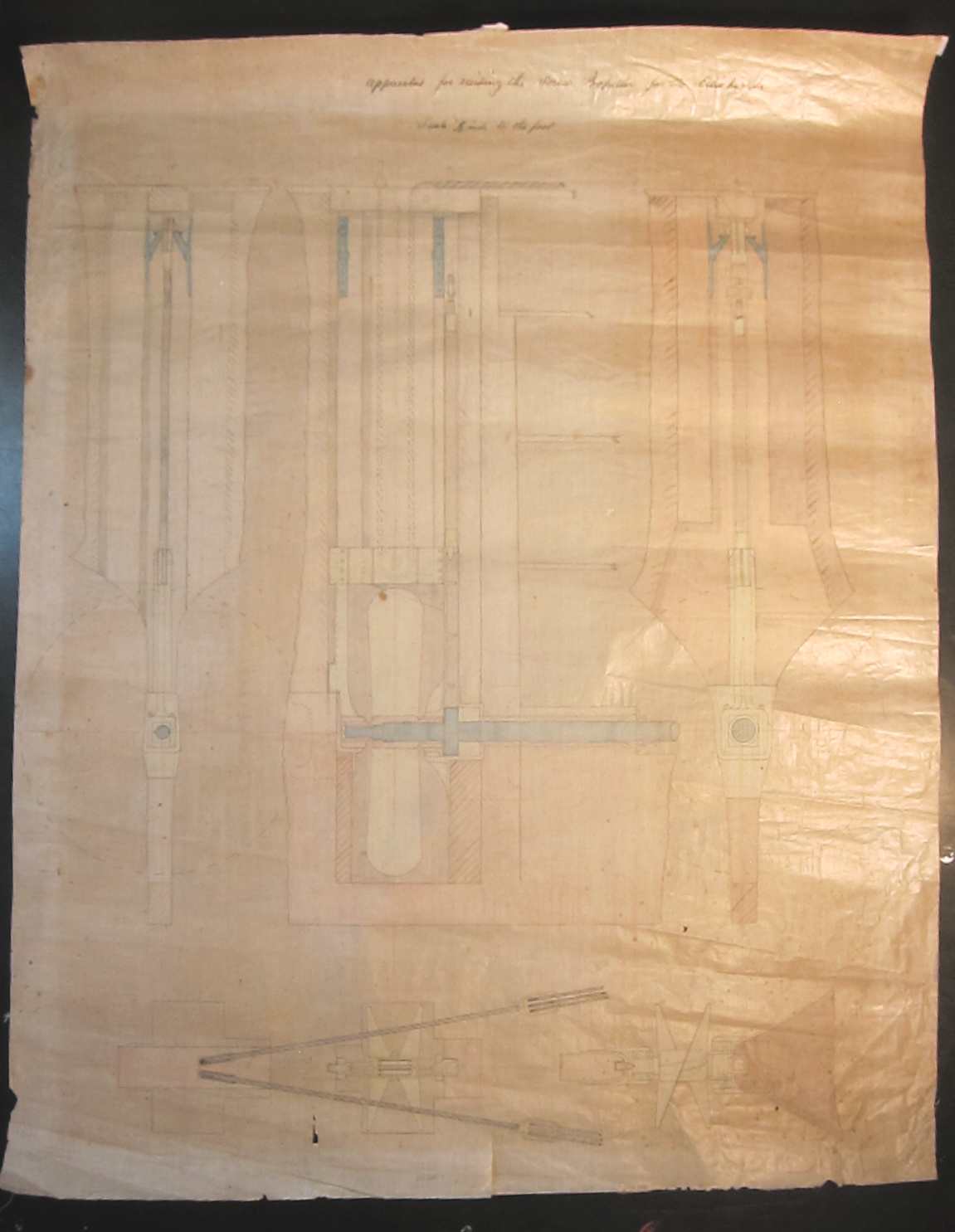
    Esk full“HMS Esk was a 21-gun Highflyer-class screw corvette launched on 12 June 1854 from J. Scott Russell & Co., Millwall…She served in the Mediterranean Station between 1854 until 1856 and was in the Black Sea during the Crimean War. She was part of the East Indies Station between 1856 until 1863, where she participated in Second Opium War at Canton. Afterwards she went to the Australia Station, where she participated in the attack on Gate Pā during the Tauranga Campaign in New Zealand. Her commanding officer Captain John Fane Charles Hamilton was killed in the attack. She left the Australia Station on 2 July 1867.”–wikipedia

    The words of the Admiralty Order stated she should be “a wood screw vessel complete of Highflyer’s… In common with other screw corvettes of the time, she was envisaged as a steam auxiliary, intended to cruise under sail with the steam engine available for assistance. Commensurately she was provided with a full square sailing rig. Her oscillating two-cylinder inclined single-expansion steam engine…drove a single screw.”

    –28 October 1854-25 February 1856: commanded  by Captain Thomas Francis Birch in the Baltic during the Russian War.
    –1 March 1856-26 June 1861: commanded by Captain Robert John le Mesurier McClure, East Indies and China (Pacific).
    –22 May 1863-29 April 1864: commanded by Captain John Fane Charles Hamilton, New Zealand.
     

    ·Posted by :

    ·in:


  • Iron Lighthouses, Aluminum, Engineering and Farm Implements, Non-photographic Photographs, and more (1856)

    Journal of the Franklin Institute, Philadelphia, Vol 31 (third series), volume 61 (overall), January-June 1856, 443 pp.,with text illustrations, and three plates, including one folding.. Half-calf, with raised bands. Ex-library, with some scuffing on the spine; also a few stamps on the title page. Nice copy. $225 Contains many articles of interest, including an early report on industrialized aluminum, “nature printing”, the McCormack reaper patent case, lighthouses, the Suez Canal, and a lot more, including:

    “Aluminum, the So-Called New Metal”, pp 27-31 and “History and Properties of Aluminium”, pp 65-7. I’d like to point out that I rarely see the hyphenated word “so-called” in the JFI. That said, aluminum had been around for 100+ years at this point, and then first truly described by Wohler, though it wasn’t until the period of this vol of the JFI that aluminum was produced in such a way as to be industrially useful.

    Henry Bradbury, “On Nature Printing”, pp 37-39. This was a style of printing in which a sample was impressed on a sheet of soft lead and then electroplated and use as a printing block, the result being some very defined imagery. Bradbury perfects a style of this printing and found it very useful even in the early age of mass-produced photo images. 

    “The Canal through the Isthmus of Suez”, pp 150-155, with a lovely litho view of the canal;

    G. Herbert, “On the Construction of Buoys, Beacons, and other stationary floating bodies”, pp79-84;

    J. Vaughan Merrick, “On the History and Construction of Iron Lighthouses, with a description of Coffin’s Patches Light”, pp 145-150, with a lovely lithographic plate.

    George Simmons, “Method of Calculating Excavation and Embankment”, pp 1-4;

    Edward Allen, “Mechanical Engineering as applied to Farm Implements”, pp 41-45, 138-142 (with text illustrations), 186-190, 258-260, 334-338, 397-406 (to be concluded in the next volume)

    C.H. McCormick vs. J.H. Manny, “Law Reports of Patent Cases: the Reaper Case”, pp 176-186;

    David Stevenson, “Remarks on Floating and Fixed Lighthouses”, pp 221-227; John W. Nystrom, “Experiments on Sound for the Application of Ringing Bells”, pp 260-266; R.D. Thomson, “On the Condition of the Atmosphere during Cholera”, pp 202-204.

    Also:

    Erastus W. Smith, “United States Steam Mailer Fulton”, pp 339-340, with a beautiful folding plate of the ship.


    ·Posted by :

    ·in:


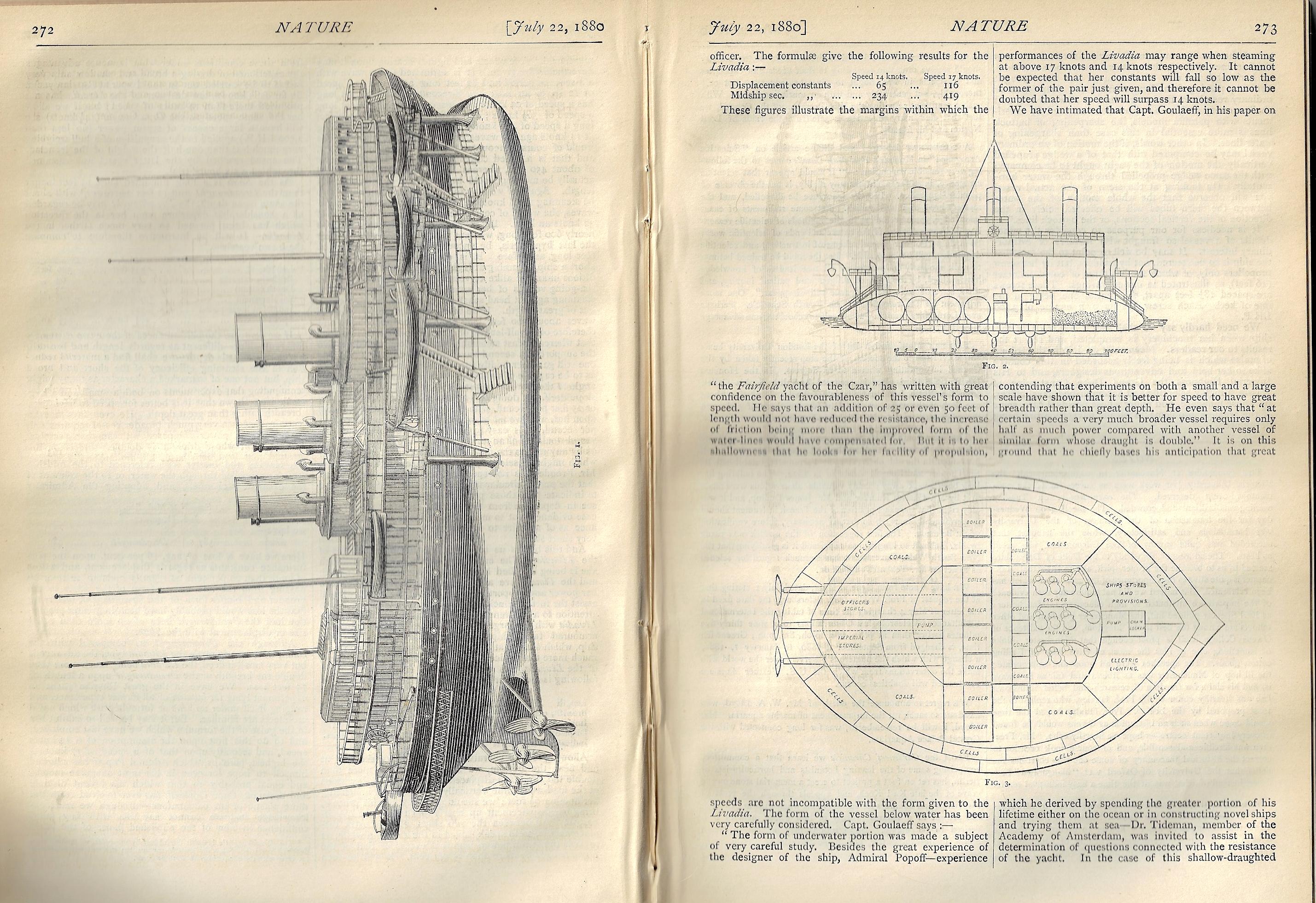
  • A Highlight of Circular Ships, 1880.

    “The Russian Imperial Yacht, ‘Livadia’”, an article in Nature, July 22, 1880, appearing on pp 270-274, with several large illustrations, including an elevation and a plan of the ship.  Offered in the weekly issue of Nature, with the (scarce) original front and rear wrappers, removed from a larger bound volume.  Very crisp copy, and an interesting assessment of this odd-looking ship.  Very Good copy. $45

    Nature 1880 Lividia

    “The Livadia was an imperial yacht of the House of Romanov built in 1879–1880…intended for service on the Black Sea…a radically novel ship conceived by Vice Admiral Andrey Popov, designed by naval architect Erast Gulyaev and built by John Elder & Co. of Govan on Clyde. The Livadia continued Popov’s line of circular shipsalthough this time Popov sacrificed geometrical perfection for seagoing capabilities. She had a beam of 153 ft (47 m) against overall length of only 259 ft (79 m). An extreme example of tumblehome architecture, she sported a conventionally shaped superstructure mounted on a wide, flat-bottomed, turbot-shaped submerged hull or pontoon. The Livadia turned out a surprisingly maneuverable and stable ship with a respectable maximum speed of 15.7 knots and her efficiency was comparable to conventional ships. Her performance at sea trials surprised most naval architects and was attributed to the favorable placement of the propellers.”–Wikipedia

    ·Posted by :

    ·in: