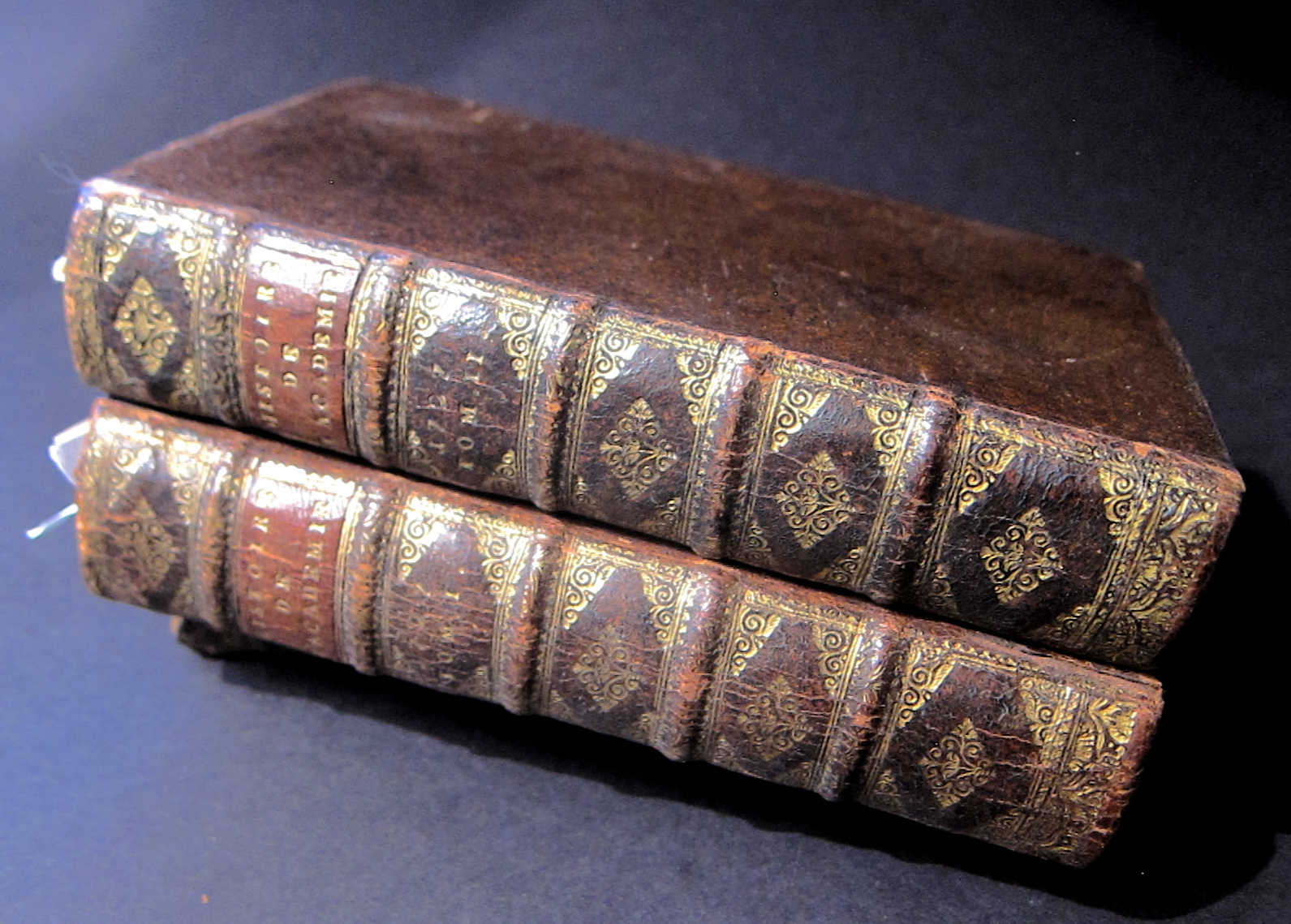
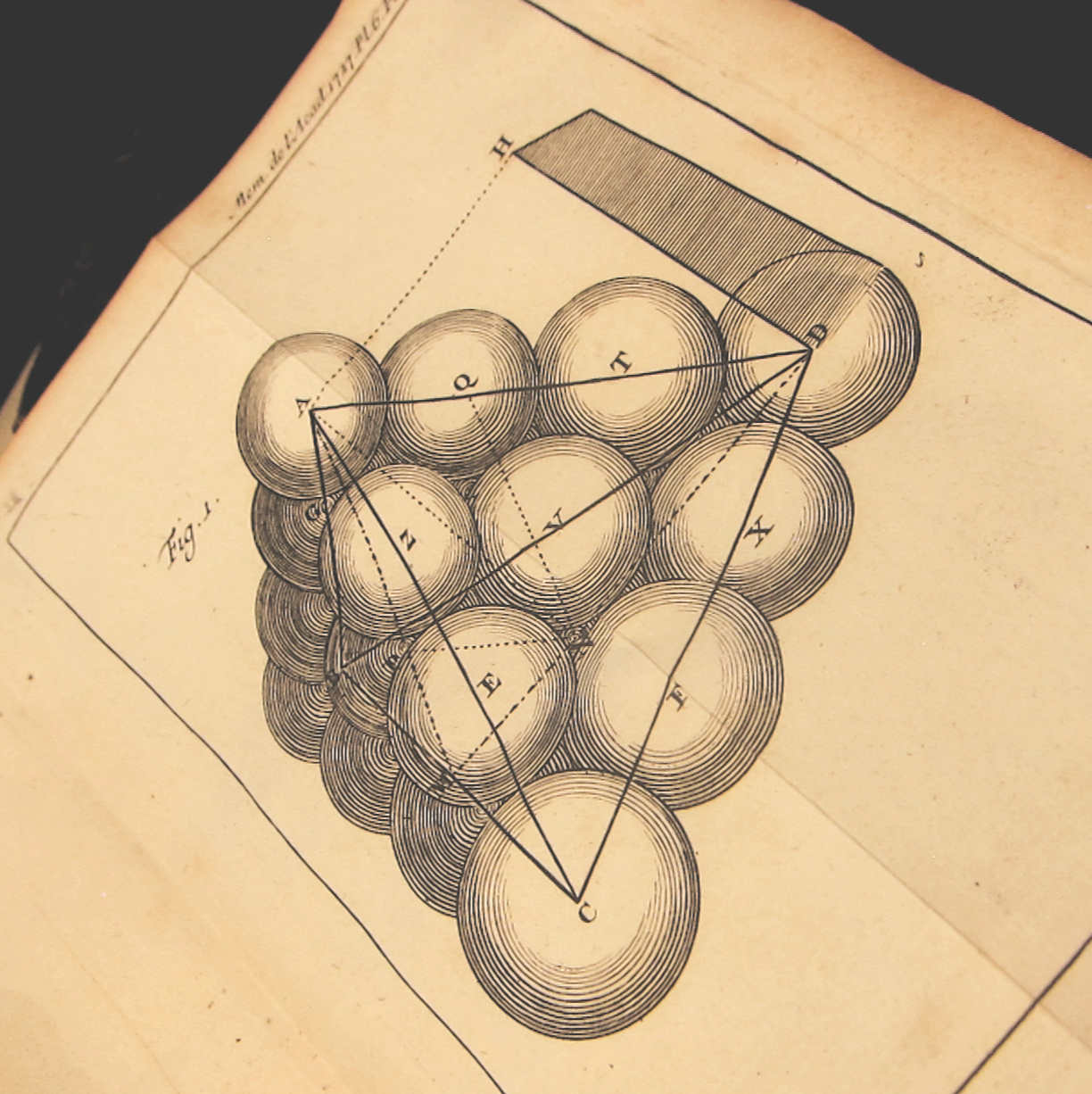
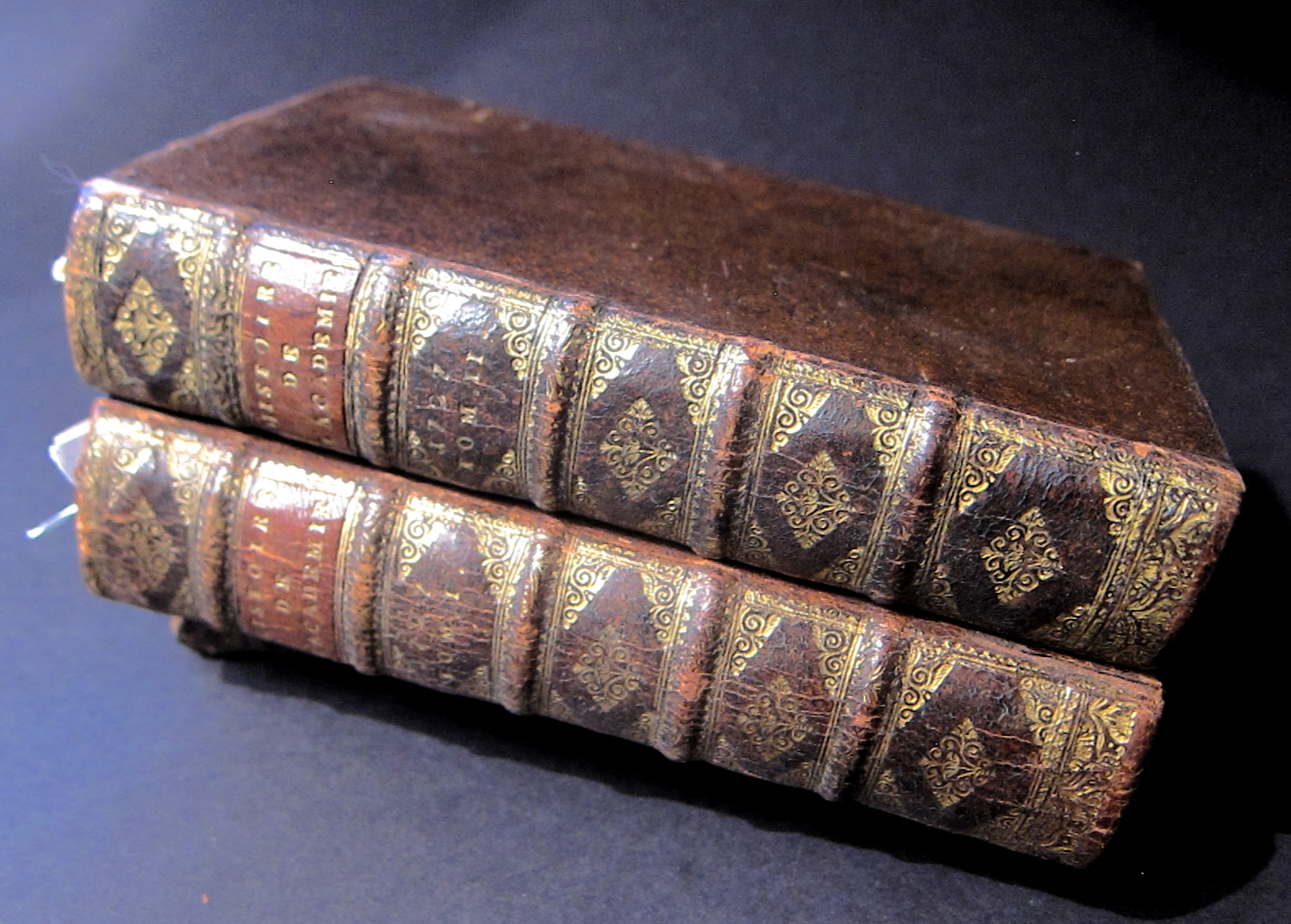
Histoire de l’ Academie Royale des Sciences. Annee M. DCCXXII. Avec le memoires de mathematique & de physique, pour la meme annee. Tires des registres de cette academie. Printed in Amsterdam by Pierre Coup, 1727, three years after the first French edition (Paris 1724, which is 4to and 439pp compared to this 12mo and 204+526pp). [Histoire de l’ Academie Royale des Sciences] vii, 204pp; [Memoires de mathematique & de physique] 526pp, plus 18 folding engraved plates.
Lovely copy, bound in full leather, with decorated spine and raised bands. Very Good. $300
Includes work by Maraldi, Mairan, Cassini, Reamur, Morand, and several others:
Giacomo Maraldi, “Observations sur differents Meteors de l’Annee 1721, pp 1-7;
Jean-Jacques Dortous de Mairan (1678-1771,”was a mathematician and an enthusiastic experimenter whose major works were on the formation of ice and on the aurora borealis. However, he was also interested in all the important topics addressed the scientific community in the eighteenth century, among them, the shape of Earth, light, colors, sound, the composition of matter, and vis viva (the debate around the force of moving bodies and the conservation of matter).”–DSB “Recherches Physico-Mathematiques sur la Reflexion des Corps”, pp 8-68;
Giovanni Cassini, “Reflexions sur les Observations Astronomiques faites par le P. Feuillee, pp 68-76;
Saurin, “Eclaireissement sur une difficulte proposee aux Mathematiciens par M. le Cheavlier de Louville…”, pp 94-129;
Louvlle, le Chevalier (Jacques d’Allonville, 1671-1732, mathematician and astronomer), “Eclaircissement sur une difficulte de Statitque propossee a l’Academie”, pp 174-194;
Morand, “Observations sur des Sacs membraneux pleins d’Hydatides sans nombre, attachés à plusieurs Visceres du bas Ventre, et découverts par l’ouverture d’un Cadavre”, pp 215-224;
De Lagny, “Traité des progressions arithmetiques de tous les degrés à l’infinii”;
Maraldi and Cassini, “Observation de l’Eclipse de Soleil du 8. Decembre 1722. faite en presence du Roy”, pp 453-456;
Winslow, “Explication de l’enfoncement apparent d’un grand Clou dans le Cerveau par les narines. Conformation particuliere du Crane d’un Sauvage de l’Amerique Septentrionale. Observations Osteologiques. Avertissement sur un Memoire de 1720″, pp 411-453;
Vaillant, “Suite de l’Establissement de nouveaux caracteres de Plantes”, pp 233-293.
Book Category: Biology
-
Histoire De L Academie Royale Des Sciences Annee M Dccxxii Avec Le Memoires De Mathematique De Physique Pour La Meme Ann
·Posted by :
·in:
-
Scientific Journal Including an Early Elegy on Isaac Newton (1727)
Histoire de l’Academie Royale des Sciences, annee M.DCCXXVII and bound with Memoires de Mathematique et de Physique. Both: Amsterdam, Pierre Mortier, 1732. 2 volumes: xiv, 1-239; and bound in the same vol, Memoires de Mathematique et de Physique., pp 1-186. And the second volume, pp 189-564. Bound in full calf, raised bands, gilt demtelles. Lovely copies.
There are a number of interesting papers here, not the least of which includes this long elegy on Newton by the pre-eminent de Fontenelle: Bernard de Fontenelle (1657-1757), Eloge de Newton, pp 209-239 (delivered at the Academy on 12 November 1727 and then published first in Paris in 1729.
- Also:
- de Mairan, Dissertation Astronomiques sur le Mouvement de la Lune, et de la Terre , pp 90-152. Cassini, De la Theorie des Cometes , pp 321-345, with two folding plates.
- Petit, Pour quoi les Enfansne voyentpas clair en venant au monde et quelque tems aprils qu’ils sont nes, pp 346-360;
- Saurin, Recherches sur la rectification des Barometres , pp 396-417, 2 folding plates.
- Sloane, Hans. Memoie sur les dents et autres Ossen]mens de l’Elephant, tourves dans Terre.pp 429-472, 2 plates .
- Maraldi, Explication des tables du premier satellite de Jupiter, pp 493-527.
·Posted by :
·in:
-
On Weather and Vegetation 1897
John CLAYTON. Effects of the Weather upon Vegetation A Lecture given by…to the Bradford Naturalists Society March 1st 1897. Byles & Sons Bradford 18978×5″, with a photograph. In the original wrappers. Provenance: from the Library of Congress Pamphlet Collection, with their deacquisition rubber stamp on the inside cover, and a 6mm “LC” perforated stamp on the title page. Otherwise a very nice copy. $120
“THIS is one of the most instructive and original lectures that we have seen for a long time Mr Clayton is evidently a keen painstaking and very original investigator and instead of the lecture being a series of platitudes and quotations as is generally the case it is almost wholly the result of investigations carried out with great care and patience during many years As is it published at a nominal price we merely specify a few of the points treated such as the relation of tree girth to amount of foliage relative growth of plants in sun and in shade followed by considerations as to the sunshine recorded in different parts of England and its influence on crops percolation gauges why trees split in times of frost and the relation between the elongation of twigs and their increase in girth When a well printed pamphlet gives information almost wholly original on all these points for sixpence we need not advise our botanical and agricultural readers what course to pursue…”–a review of the pamphlet in Meteorological Magazine, volume 32, pg 56, 1897.
“BOOK NOTICE We have hitherto omitted to notice an admirable paper by Mr JoHN CLAYTON entitled Effects of the Weather upon Vegetation being a lecture delivered to the Bradford Naturalists Society on the 1st of March 1897 it was printed in Bradford and is sixpence We presume it is obtainable of the author or of the printers Wm Byles and Sons Mr Clayton is one of our most thoughtful botanists and anything that he writes is well worth reading the present paper being no exception A collotype photograph of a thorn hedge forms a frontispiece Experiments with bean plants in shade and in sunshine made in 1891 and 1892 are discussed and the results stated and the effects of sunshine shade shower are investigated.”–The Naturalist, London, 1898.
·Posted by :
·in:
-
The Golgi Apparatus and other Papers by Golgi
The Golgi Apparatus (Golgi Body)
(1) Camillo Golgi. “Sur la structure des cellules nerveuses”, in Archives Italiennes de Biologie, Turin, Hermann Loescher, 1898, vol 30 pp 60-71 in the volume of vii, 496pp. Each of the three fascicles has the original front wrapper bound in at rear. (with 5 plates, 3 of which are folding). (This article printed November 1898, and first published in Boll. d. Soc. Medico-chirurgica di Pavia, 19 April 1898.)
And bound with:
“Sur la structure des cellules nerveuses des ganglions spinaux”, printed 27 December 1898, pp 278-286 (published in Boll. d. Soc. Medico-chirurgica di Pavia, 15 July 1898.)
And offered with:
Golgi. “Une methode pour la prompte et facile demonstration de l’appareil reticulaire interne des cellules nerveuses”. In Archives Italiennes de Biologie, Turin, Hermann Loescher, 1908, vol 49, pp 269-274 in the volume of viii, 458pp.
These volumes are rebound in black library cloth, with the gilt-stamped call number at spine bottom, below which is “SI Library” (“Smithsonian Institution”). The binding is very sturdy and relatively recent (within the last 50 years); the quality of the paper used by the journal is not high, and it suffers some tenderness and browning around the page edges. This volume gets a conservative “Good” though it may be closer to “Very Good”. Three papers in two volumes: $500
- “The GA is named after its discoverer Camillo Golgi, who first described the complex apparato reticolare interno in 1898…”–Mironov A.A., Pavelka M. (2008) “The Golgi apparatus and main discoveries in the field of intracellular transport”.. In: Mironov A.A., Pavelka M. (eds) The Golgi Apparatus. Springer, Vienna
- “On April 1898 Camillo Golgi communicated to the Medical–Surgical Society of Pavia, the discovery of the “internal reticular apparatus”, a novel intracellular organelle which he observed in nerve cells with the silver impregnation he had introduced for the staining of the nervous system. Soon after the discovery it became evident that this cellular component, which was also named the “Golgi apparatus”, was a ubiquitous structure in eukaryotic cells.”–Mazzarello Paolo,Garbarino Carla and Calligaro Alberto(2009), How Camillo Golgi became “the Golgi”, FEBS Letters, 583,
- “Golgi also reported the observation, on the surface of the nerve cell, of ‘a special very delicate covering, made of a substance clearly differentiable from that of the cell body’ (Golgi, 1898a). The existence of these perineuronal nets was forgotten until recently when it attracted great interest in neurocytology”–Paolo Mazzarello, “Camillo Golgi’s Scientific Biography” Journal of the History of the Neurosciences, 1999, Vol. 8, No. 2, pp. 121–131.
Also offered:
(2) Camillo Golgi (1843/4-1926, Italian histologist), “Considerations Anatomiques sur la Doctrine des Localisations Cerebrales, (Resume de l’auteur)”, in Archives Italiennes de Biologie, Turin, Hermann Loescher, 1882, volume II, vi, 448pp, 20 plates (mostly folding), with the Golgi occupying pp 237-253.
Bound with:
Golgi. (1843/4-1926, Italian histologist), “Considerations Anatomiques sur la Doctrine des Localisations Cerebrales” (“Suite et fin”), occupying pp 257-273.
The volume rebound in black library cloth, with the gilt-stamped call number at spine bottom, below which is “SI Library” (“Smithsonian Institution”). The binding is very sturdy and relatively recent (within the last 50 years); the quality of the paper used by the journal is not high, and it suffers some tenderness and browning around the page edges. This volume gets a conservative “Good” though it may be closer to “Very Good”. $175.00
On Malarial Fevers and the Parasites that Caused Them
(3) Camillo Golgi. “Sur le cycle evolutif des parasites malariques dans la fievre tierce. Diagnosis differnetielle entre les parasites endoglobulaires malariques de la flevre tierce et ceaux de la flevre quarte.” pp 81-100, and one plate.
BOUND WITH:
“Sur les felvres intermittentes malariques a long intervalles. Fondeemtns de la classification des flevre malariques”, pp 113-132.
Both papers are bound in Archives Italiennes de Biologie, Turin, Hermann Loescher, 1891, vol 14, vii, 443pp., 11 plates. $175
The volume rebound in black library cloth, with the gilt-stamped call number at spine bottom, below which is “SI Library” (“Smithsonian Institution”). The binding is very sturdy and relatively recent (within the last 50 years); the quality of the paper used by the journal is not high, and it suffers some tenderness and browning around the page edges. This volume gets a conservative “Good” though it may be closer to “Very Good”
- “Camillo Golgi, an Italian neurophysiologist, established that there were at least two forms of the disease, one with tertian periodicity (fever every other day) and one with quartan periodicity (fever every third day). He also observed that the forms produced differing numbers of merozoites (new parasites) upon maturity and that fever coincided with the rupture and release of merozoites into the blood stream. He was awarded a Nobel Prize in Medicine for his discoveries in neurophysiology in 1906.”–CDC site on the history of malaria.
- “In the years 1886-1892, Golgi provided fundamental contributions to the study of malaria: he elucidated the cycle of the malaria agent, the Plasmodium, in red blood cells, and the temporal coincidence between the recurrent chills and fever with the release of the parasite in the blood. Golgi also studied the efficacy of the administration of quinine during the disease.”–Nobel Prize site, biography of Golgi.
- “Between 1885 and 1892–a period in which great advances have been made in techniques and practice of the young science of microbiology–Camillo Golgi provided a notable contribution to malariology. Continuing studies and researches of Roman malariologists Ettore Marchiafava (1847-1935) and Angelo Celli (1857-1914), on the malarial parasites–described by the French military physician Alphonse Laveran–he studied the reproduction cycles of the Plasmodium in human blood (Golgi cycles) and elucidated the temporal coincidence between the recurrent chills and fever with the rupture and release of merozoites into the blood stream (Golgi law).”–Tognotti, E. “Camillo Golgi and the contribution of the Italian scientists to the development of the malariology in the last quarter of the nineteenth century”Med Secoli. 2007;19(1):101-17, Med Secoli. 2007;19(1):101-17.
·Posted by :
·in:
-
Unusual Work by Walter Elsasser
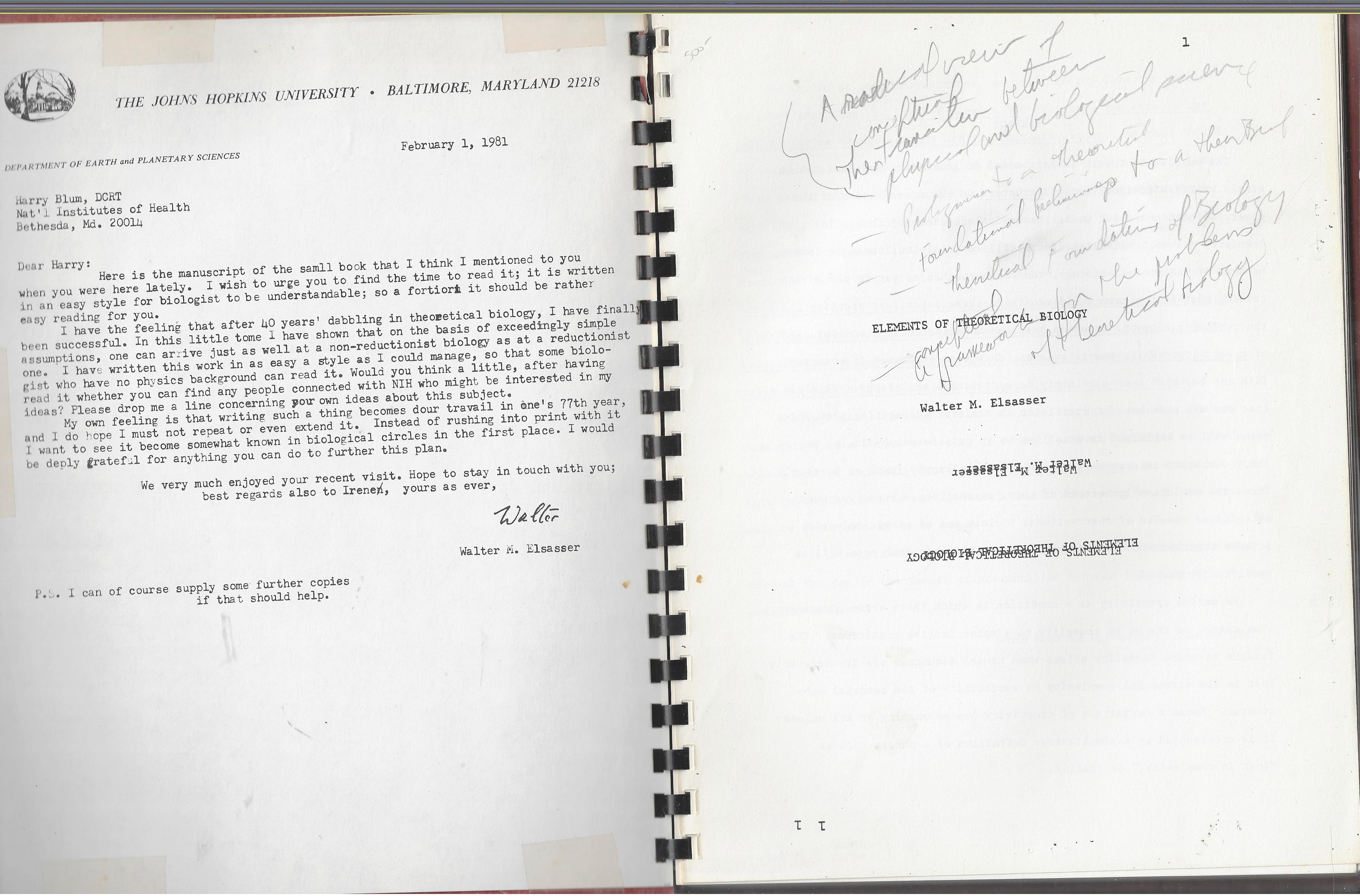
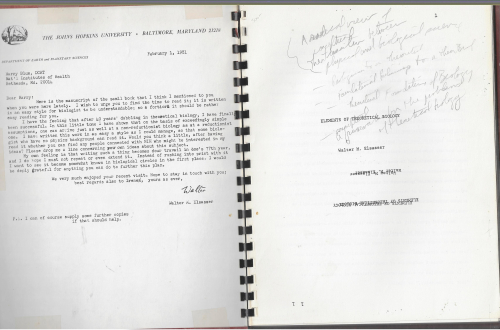
Walter M. Elsasser, Elements of Theoretical Biology. Offset printed, 133pp (printed back and front). GVC bound, the top two plastic links are broken. Bound in a thick manila stock paper, with home-made title taped on the cover and spine. Condition: Very Good. $350 This work may or may not have been published–at teh very least there are no copies of it located in WorldCat/OCLC worldwide library holdings.
There’s a photocopied cover letter from Elsasser to the document’s recipient Harry Blum (a pioneer int he field of artificial intelligence). (“Here is the manuscript of the small book…” though not a true manuscript, it is certainly a work-in-progress
The following biographical note is from Wiki: “Walter Maurice Elsasser (born March 20, 1904, in Mannheim, Germany; died October 14, 1991, in Baltimore) was a physicist and is considered “father” of the geodynamo theory. Long before he became known for his geodynamo theory, while in Göttingen in the 1920s, he has suggested the experiment to test the wave aspect of electrons. This suggestion of Elsasser was later communicated by his senior colleague from Göttingen (Nobel Prize recipient Max Born) to physicists in England. This explained the results of the Davisson-Germer and Thompson experiments later awarded with the Nobel Prize in Physics. In 1935, while working in Paris, Elsasser calculated the binding energies of protons and neutrons in heavy radioactive nuclei. Wigner, Jensen and Meyer received the Nobel in 1963 for work developing out of Elsasser’s initial formulation. Elsasser therefore came quite close to a Nobel prize on two occasions. Over 1946-1947, Elsasser published papers outlining the theory that the Earth’s electromagnetic field is powered by eddy currents at the planet’s liquid core. This had been developed from around 1941 onwards, partly in his spare time during his scientific war service with the US Signal Corps. In his later years, Elsasser became interested in what is now called systems biology and contributed a series of articles to Journal of Theoretical Biology. The final version of his thoughts on this subject can be found in his book Reflections on a Theory of Organisms, published in 1987 and again posthumously with a new forward by Harry Rubin in 1998….”
·Posted by :
·in:
-
Soem Work by the Discipline-Bending Nicholas Rashevsky
RASHEVSKY, Nicholas. “Mathematical Biology of Learning to Drive and Automobile”, in the Bulletin of Mathematical Biophysics, March, 1963, volume 25/1, pp 51-9, offered in the monthly issue of pp 1-123. Original wrappers. VG copy. SOLD
_____. “The Geometrization of Biology”, in the Bulletin of Mathematical Biophysics, volume 18/1, pp 31-57. In the full monthly issue of 87pp. Formerly from the library of the Committee on Mathematical Biology, University of Chicago,(mostly blacked-out with magic marker on the front wrapper) the publishers of the Bulletin. This was H.D. Landahl’s copy, with his name at top front wrapper. SOLD
_____. “Mathematical Biophysics of Growth”, in The Bulletin of Mathematical Biophysics, volume 1, number 3, September 1939, pp 119-128 in the monthly issue of pp 119-149. Original wrappers. Very nice copy; there’s a tear in the upper third wrapper spine. This is a scarce copy of the publication in the original (white) wrappers. SOLD
·Posted by :
·in: