A Daily History of Holes, Dots, Lines, Science, History, Math, Physics, Art, the Unintentional Absurd, Architecture, Maps, Data Visualization, Blank and Missing Things, and so on. |1.6 million words, 7500 images, 4.9 million hits| Press & appearances in The Times, Le Figaro, Mensa, The Economist, The Guardian, Discovery News, Slate, Le Monde, Sci American Blogs, Le Pont, and many other places… 5000+ total posts since 2008.

Book Category: Photography

  • First Edition in German of Daguerre’s Invention of Photography (1839)

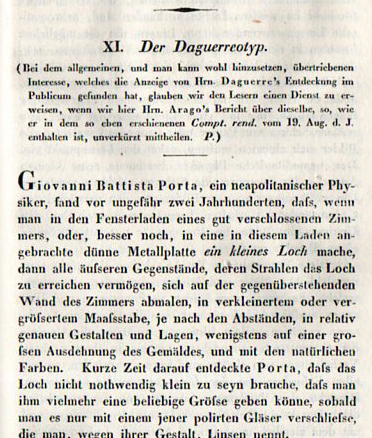
    Dag[DAGUERRE] “Der Daguerreotyp. (Bei allgeinen und man kann wohl himzusetzen, uebertriebenen Interesse, welches die Anzeige von Hrn. Daguerre’s Entdeckung im Publicum gefunden hat, glauben wir den Lesern einen Dienst zu erweisen, wenn wir hier Hrn. Arago’s Bericht uber dieselbe.. ”  Pp 193-216. 

    Bound with:

    “Daguerre’s Vorschrift zur Bereitung eines gegen Lichtairkungen empfindlichen Papiers. (Nach einer Note von Biot in den Compt. ren. T VIII p.246…)” Pp 217-221. Offered in volume 49, No. 9, 1839, Annalen der Physik, 619pp.  Bound in half cloth, marbled covers. Nice copy.  Scarce  

    An extremely early set of  publications in a German scientific journal on the newly announced discovery of photography by Louis Daguerre made in the Comptes Rendus in 15 January 1839 and the technical report made by him 13 August, 1839.

     Provenance exlibris (a) Provinzial Gewebbschele zu Aachen, then (b) Deutsche Akademie der Luftfahrtforschung, and then (c) Wright Field Library (Dayton, Ohio), and finally (d) the Library of Congress. There are ownership rubber stamps on text block page edge at top and bottom, a stamped gilt title on the bottom of the spine, and two scant stamps on the contents page, and that’s it. Very nice, tight, fresh copy. 

    Includes a significant paper in the establishment of Agricultural Chemistry by Justus von Liebig. “Ueber die Erscheinung der Gährung, Fäulniss und Verwesung, und ihre Ursachen”,  45pp.


    ·Posted by :

    ·in:


  • From the Earliest Period of pre-Cinematography (1894)


    MAREY, Étienne-Jules.“Des mouvements que certains animaux exécutent pour retomber sur leurs pieds, lorsqu’ils sont précipités d’un lieu élevé” by Étienne-Jules Marey (Comptes rendus 119, pp. 714–718, 1894). A big volume bound in contemporary leather and boards. Some wear to spine leather; otherwise fine inside and out. 1250.00

    “Étienne-Jules Marey was a French scientist, physiologist and chronophotographer, best known for the invention and use of a chronophotographic gun, an instrument capable of taking 12 consecutive frames a second, with all the frames recorded on the same picture. Using these pictures he studied the motion of a wide range of animals called Marey’s ‘animated zoo’”.–Wenner, History of Physics

    This paper contains the famous falling/dropped/thrown cat experiment in which Marey shows that when dropped with its back towards the ground a cat will respond and right itself via muscular reaction to land on its feet, all of the time. It was not a trick of “air pressure” or other such thing which Marey dismissed, as once the action of the fall is slowed so that the whole of the activity can be intelligently observed, and it was by the animal’s movement alone that brings it to land on its feet. It is Marey’s instrumentation that takes the day, using a camera capable of making 60 images per second, which was a huge advance over his chronophotographic gun of 1882 which made 12 images/second. Marey remarks that this animal action is true in other animals, giving the examples of rabbit and dog.

    Marey is a rather stiff writer and takes his time to explain himself in extended detail—this isn’t an entertaining story though the results are of course fantastic.

    That piece of needling aside, Marey is one of my favorite 19th century science figures. He worked across numerous fields, though I think his great importance is in the invisible-to-visible part–that he was able to make was were essentially moving pictures of complex and/or fast action, displaying motion in shockingly easy manner. His work opened as much of a new and surprising world as that of Lippershey/Galileo and Co. with the telescope and Janssen/Leeuwenhoek/ and the others with the microscope.  

    “In Marey’s view, physiology “is itself but the study of organic movements,” and the graph best represents all the variations that such phenomena undergo. Marey believed, however, that these motions ultimately were to be explained by laws of physics and chemistry. Furthermore, while he accepted the application of physiological research to medical problems, he subordinated this utilitarian purpose to a more abstract goal: “analyzing the conditions which modify the functions of life and … better determining the laws which regulate these functions.” Toward this end medicine served only as one further means of analysis.”–Complete DSB.  “Marey constructs, according to the reversible principle of the chronophotograph, an apparatus for the projection on a screen of series of pictures taken by the aforementioned apparatus and thus realizes the photographic synthesis of motion.”–Eder, History of Photography.   See: Tosi, Virgilio, Cinema before cinema : the origins of scientific cinematography. London : British Universities Film & Video Council, 2005. Also: ARTE France. Roll on, Cinema. NY, Infobase, 2014. [Video]. Also: Alder Anderson, Analysing motion. Marlborough, England: Adam Matthew Digital, [2012]. Laurent Mannoni, Marie-Sophie Corcy, Thierry Pozzo … [et al.]. Images, science, mouvement : Autour de Marey. Paris : Harmattan, 2003. 

    For further reading see G. Gbur’s Falling Felines and Fundamental Physics, Yale, 2009.


    ·Posted by :

    ·in:


  • Wonderful Volume on the Solar Eclipse of 1869, Illustrated with an Original Photograph

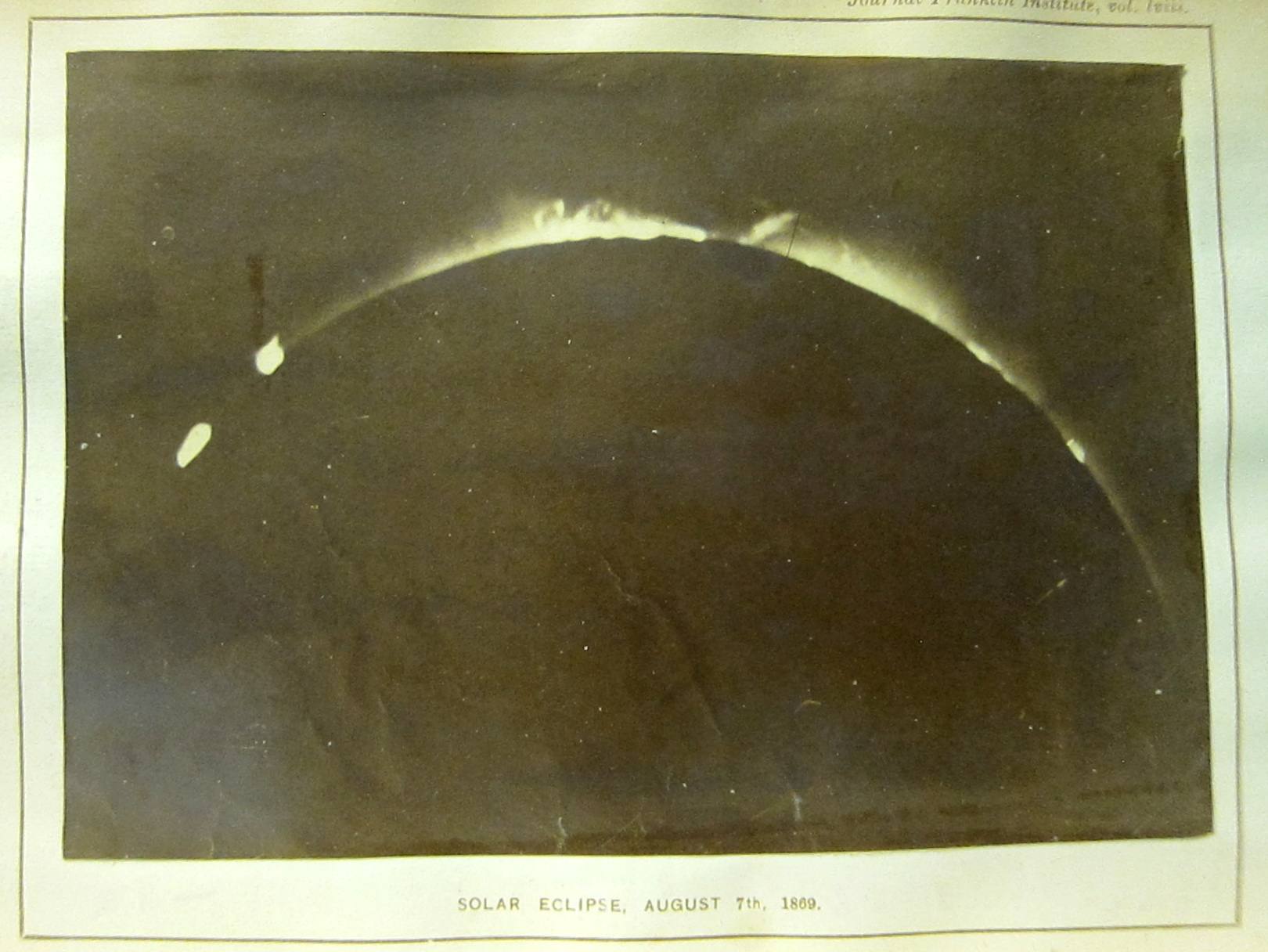
    Henry Morton, “Solar Eclipse—August 7, 1869” (The Philadelphia Expedition”), pp 200-216, 249-275 (with three full page plates), 276-288. This paper is illustrated with what I think is a Woodburytype—a photographic process—of a the solar prominence and is entitled “Solar Eclipse, August 7th, 1869”, measuring 4”x 6” on a plate. It is noted in the paper that the photo is “half of the totality picture”, and is accompanied by a fair amount of description on pp 210-211. In: Journal of the Franklin Institute, Philadelphia, Vol 58 (third series), vol 88 overall, July to December 1869, with text illustrations and illustrations; 426, x pp. Half-calf, with raised bands. Ex-library, with some scuffing on the spine; a few stamps on the title page. Very Good copy. This is an excellent volume on solar eclipses, astrophotography, and instrumentation. $350


    JFI 1869 _2_

    G.A. Majocchi made the first photograph of the partial phase of a solar eclipse in 1842; Berkowski made the first daguerreotype of a total eclipse of the Sun in 1851, and in the same year Secchi made images of the partial phases of the eclipse. Warren de la Rue (whose work is referenced in this paper) photographed the total eclipse of the Sun in Spain in 1860, which places some of the significant aspects of photography and eclipses some decade or two before the appearance of this photo in the JFI in 1869. I cannot locate however any information on the first publication of an original photo of a solar eclipse (full or partial) in a journal or book, though I suspect that the image we have here is at least quite early. The image published in the JFI was one of 13 images made during totality at three different locations (at relatively quick exposure times between 2 and 5 seconds).

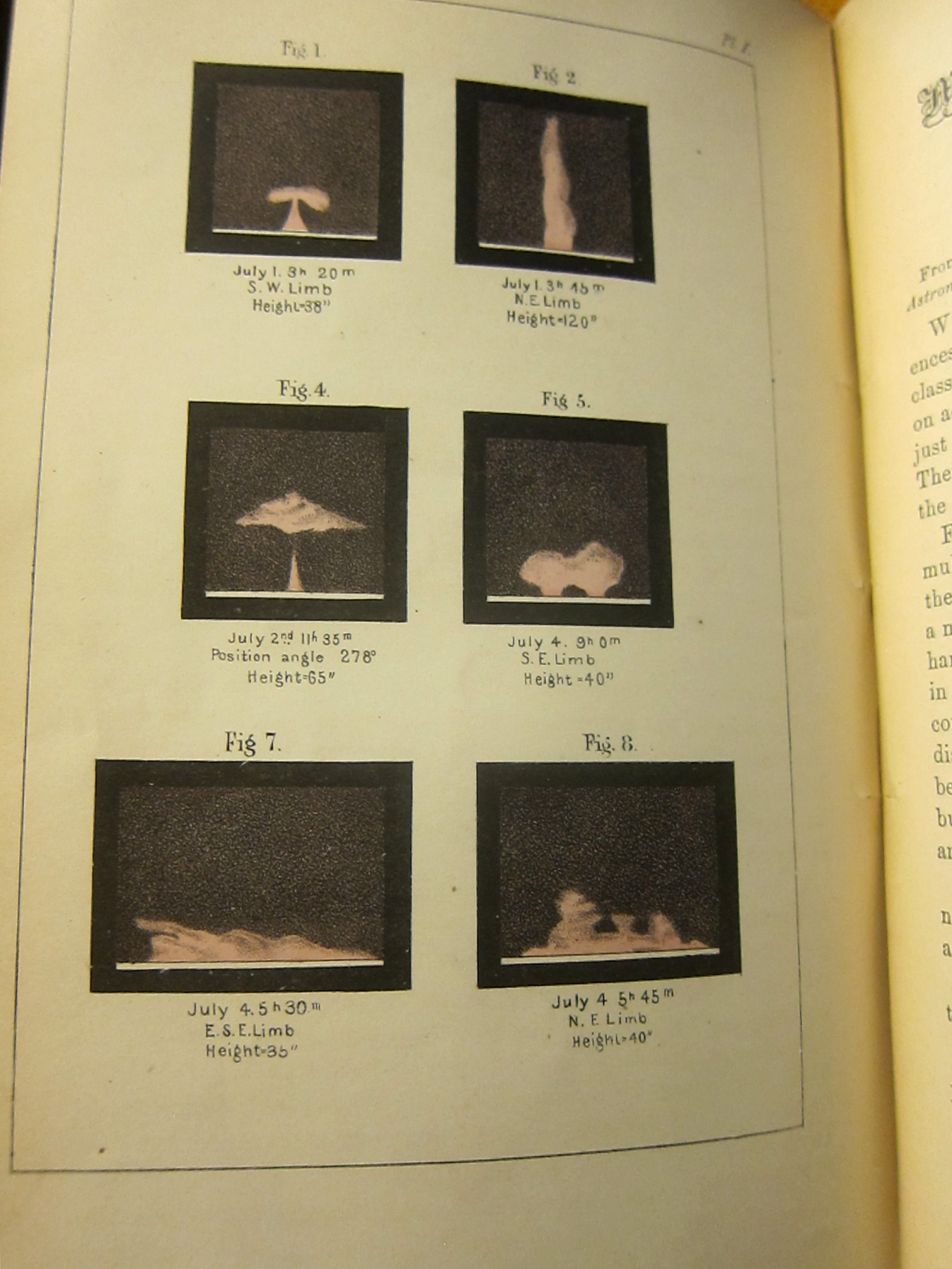
    Also appearing here: F. Zollner, “Observations of the Solar Protuberances”, pp 317-319, with two beautiful plates).

    JFI 1869 _2_

    Plus there’s an extended paper by Morton,. “Spectrum Analysis”, pp 56-62, 136-141.

    • Also in this volume are the following interesting papers:

    “The London Water Supply”, pp 169-175;

    William Crookes, “On the Measurement of the Luminous Intensity of Light”, pp 133-135;

    A.S. Herschel, “On the Methods and Recent Progress of Spectrum Analysis”, pp 49-52.

    Lastly, there’s a short notice on the beginning of the work of the New York and Brooklyn Bridge (pp 361-3, this of course would be later called the “Brooklyn Bridge”.

    ·Posted by :

    ·in:


  • A Very Early U.S. Appearance of a Significant Instructional on the Calotype Process

    Journal of the Franklin Institute, Philadelphia, Vol 8 (third series) vol 38 overall, July-December 1844, with text illustrations. 430, 8 pp., and one folding plate. Half-calf, with raised bands. Ex-library, with some scuffing on the spine and leather cover tips nearly obscuring the gilt-stamped title. The boards are detached, though binding still tight; also a few stamps on the title page. Text is Good and crisp; binding is FAIR at best. $250

    Cundell, George S. [1798-1882, and one of four brothers who together made an impact in the early history of photography] “Extracts from an Article on the Practice of the Calotype Process of Photography”, pp 43-51 (in the July 1844 issue), an extract from his major paper in the Philosophical Magazine printed two months earlier (vol. .xxiv., No. 160. May, 1844) this being one of the processes earliest appearance in print in the U.S. (The essence of the article is very much a DYI/How-to instructional.) 

    • “George Cundell’s process was a significant step forward in making the Calotype accessible to the Amateur photographer. He was referred to as “Most Worthy Master” by the great engineer of the day James Nasmyth. And indeed his instructions were still being cited well into the 1850s. One contemporary quoted in Humphrey’s Journal in 1856 that “Amateurs date their success from the time Mr Cundell published. His comprehensive instructions were printed in the London, Edinburgh and Dublin Philosophical magazine in May 1844 “.—from the Papers, Shadows and Light website.  

    Another photographic item in the volume:

    “Robert Hunt, “Energiatype, a New Photographic Process”, 283-285, a ferrotype, and an early alternative process, (from the London Rep. Pat. Inventions).

    Also:

    “Mr. Bain’s Electric Printing Telegraph”, pp 61-65;

    H.M. Denham, “Description and Structure of the Wyre (Seward) Lighthouse…” pp 3-4 AND “Specification of the above Screw Pile Light-house…”, pg 5, with two plates accompanying the two short reports);

    And two short papers on the newly-implemented modern screw propeller:

    “Remarks on the Screw Propeller”, September 1844, pp 145-154;

    “Account of some Experiments on a Vessel called “the Liverpool Screw”, fitted with Grantham’s Engine and Woodcroft’s Screw Propeller…from the Minutes of the Proceedings of the Inst of Civil Engineers), pp 86-101.

    Plus:

    “Report on the Explosion of the Gun on Board the Steam Frigate ‘Princeton’”, pp 206-216;

    G.W. Hughes, “Extracts from a report…Relative to the Working of Copper Ore”, pp 31-43, 124-133,  194-202, 261-267 (including a section on Cornish pumps, concluded);

    Scoles, J.J. “On the Pyramids of Egypt”, pp 6-12, 81-85;

    “The Dipleidoscope” (a transit instrument);

    And last but hardly the least:

    John Leonard, “Report on the Atmospheric Railway”, pp 361-367 (from the Civil Engineers and Architects Journal), this being a stationary engine that would move rail cars in a pressurized tube).

    ·Posted by :

    ·in:


  • A Very Early U.S. Printing of the Calotype Process (1842)–the Introduction of the Paper Negative Process

    Journal of the Franklin Institute, Philadelphia, Vol 3 (third series) vol 33 overall, January-June 1842, with text illustrations, folding charts, one engraved plate. 430 pp. Half-calf, with raised bands. Ex-library, with some scuffing on the spine and leather cover tips; front joint sprung though binding still tight; also a few stamps on the title page. The front board unfortunately is almost entirely detached, held on by two tie at top and bottom joint. In solid GOOD condition. $1500

    (Talbot, H.F.) “Calotype.” This is a  very early printing in the U.S. of the new process, introducing the major improvement of the paper negative. This printing seems to be done in the same year or is slightly earlier than what is possible the first Calotypes made in the United States (between 1842-4), according to G. Smith in “The First American Calotypes?” in History of Photography, vol 6/4, 1982. “Calotype, also called talbotype, early photographic technique invented by William Henry Fox Talboto f Great Britain in the 1830s. In this technique, a sheet of paper coated with silver chloride was exposed to light in a camera obscura; those areas hit by light became dark in tone, yielding a negative image. The revolutionary aspect of the process lay in Talbot’s discovery of a chemical (gallic acid) that could be used to “develop” the image on the paper—i.e., accelerate the silver chloride’s chemical reaction to the light it had been exposed to. The developing process permitted much shorter exposure times in the camera, down from one hour to one minute. The developed image on the paper was fixed with sodium hyposulfite. The “negative,” as Talbot called it, could yield any number of positive images by simple contact printing upon another piece of sensitized paper. Talbot’s process was superior in this respect to the daguerreotype, which yielded a single positive image on metal that could not be duplicated. Talbot patented his process in 1841.”—-Ency Britannica

    Some of the other articles of interest:

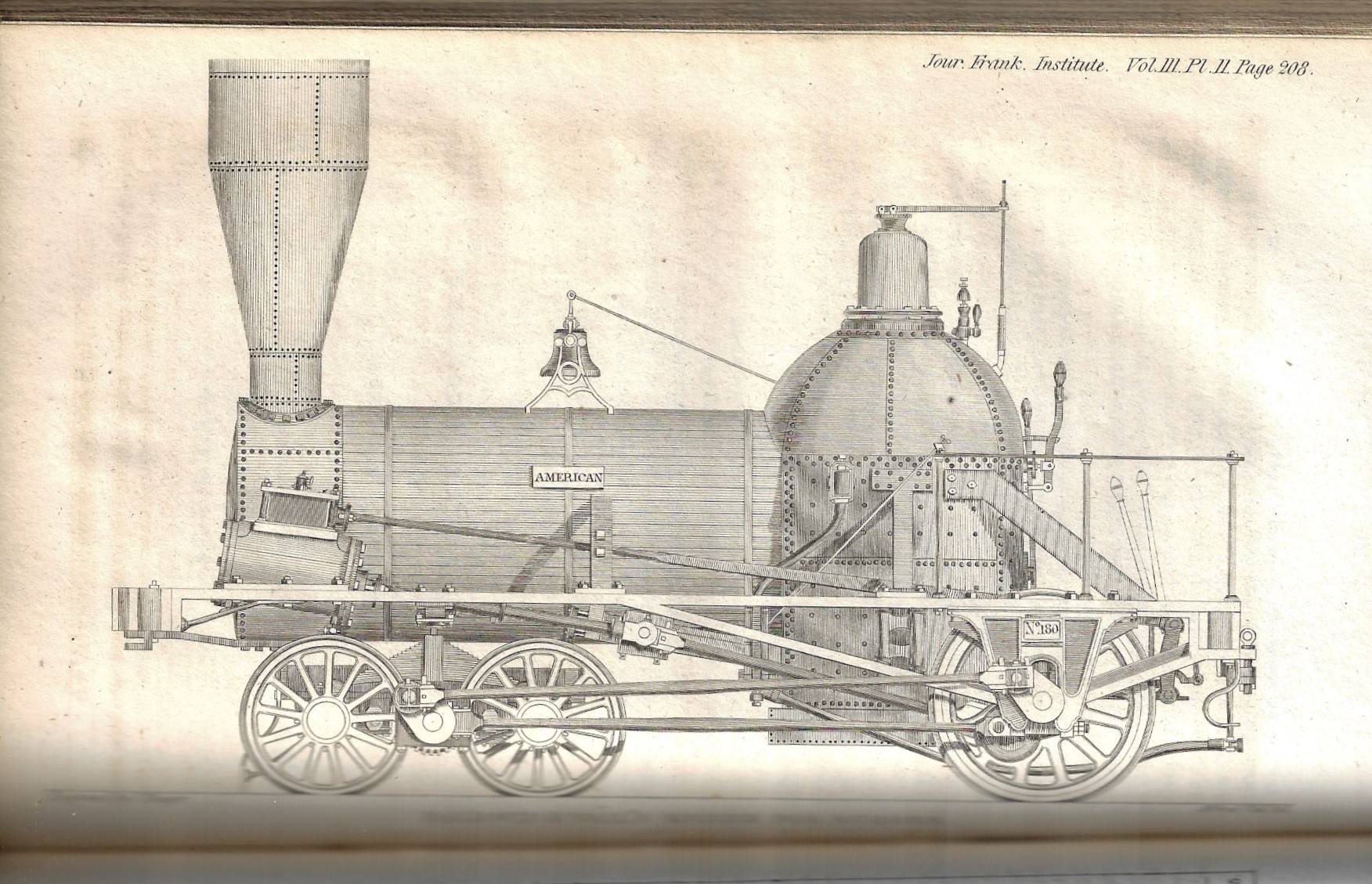
    “Baldwin’s Geared Truck Locomotive Engine”, pp 208-209 (with a lovely full page elevation of the Baldwin machine).

    Louis Daguerre, “New Photographic Discoveries”, translated from the French by Prod. F. Frazer (a half-page article on pg 109.

    Ellwood Morris, “On the Force of the Wind and Sea…”pp10-21;

    John Herapath, “Facts and Observations on Four and Six-Wheel Engines”, pp 244-249; W.A. Provis, “Effect of Wind on the Menai Suspension Bridge”, pp 210-214;

    T.R. Robinson, “History of the Reflecting Telescope”, pp392-398

    JFI 1842 Baldwin

    ·Posted by :

    ·in:


  • Good and Early Questions on the Daguerrian Process (1849)

    Claudet, Antoine Francois Jean “Mr. Claudet’s Researches on the Theory of the principal Phaenomena of Photography in the Daguerreotype Process”, in  The London, Edinburgh and Dublin philosophical magazine and journal of science. Series 3, volume 35, July-December 1849. 8vo, viii, 552pp, with the article on pp 374-385. Bound in half-calf with nicely marbled boards, the boards having the oval gilt stamp of the “Society of Writers to the Signet”. Front hinge cracked. Red and black spine labels; the small oval leather label identifying the volume number is missing. Very Good copy, otherwise. $350

    Antoine Francois Jean  Claudet, (1797-1867), began experimenting with Daguerreotype in 1840, and soon became photographer in ordinary to the Queen, being among the very first to practice Daguerrian portraiture in London. . He was very innovative and successful, and contributed many inventions and improvements in the cause of early photography, and was one of the first to use the collodion process.  “.

    “French photographer and scientist, active in England. He became an influential London portrait photographer at his Adelaide Gallery studio, licensed by the inventors to practise both the daguerreotype and the calotype. Claudet’s earliest significant technical contribution, in 1841, was in greatly increasing the sensitivity of the daguerreotype plate, thus reducing exposure times and making the process much more suitable for portraiture. In 1851 he moved to Regent Street, where he also began using the wet-plate process. Claudet published prolifically on photography, vision, and the photographic representation of sculpture. He was also one of the foremost early practitioners of stereoscopic photography, inventing a folding stereoscope and other devices. Many of Claudet’s impressive photographs survive, but his collection of historical photographic incunabula was destroyed by fire after his death.”– The Oxford Companion to the Photograph

    Claudet asks and answers the following important questions:

    • “Although the Daguerreotype process has during the last ten years been investigated by a great number of philosophers, and brought to a considerable degree of perfection by a still greater number of practitioners, it may appear surprising that the principal phaenomena upon which this new art is founded, are still enveloped in a mysterious darkness.

    1. What is the action of light on the sensitive coating?
    2. How does the mercurial vapour produce the Daguerreotype image?
    3. Which are the particular rays of light that impart to the chemical surface the affinity for mercury?
    4. What is the cause of the difference in achromatic lenses between the visual and photogenic foci? why do they constantly vary 2
    5. What are the means of measuring the photogenic rays, and of finding the true focus at which they produce the image?

    Also (among many other contributions) in the volume are:

    • Hamilton, William Rowan. “Sir W. R. Hamilton on Quaternions; or on a New System of
      Imaginaries in Algebra” and “Sir W. R. Hamilton on Quaternions; or on a New System of Imaginaries in Algebra (continued)”;
    • Hargreaves, C.J. “Mr. C. J. Hargreave’s Analytical Researches concerning Numbers”;
    • Becquerel, Antoine. “M. Becquerel on the Development of Electricity in the Act of Muscular Contraction”
    • Forbes, James David (pioneer in the study of glaciers). “Prof. J. D. Forbes on an Experiment to determine the Earth’s Density”
    • Grove, William R. “Mr. W. R. Grove on the Effect of surrounding Media on Voltaic Ignition “
    • “The Rev. B. Bronwin on the Theory of the Tides “ and “Rev. B. Bronwin on the Theory of the Tides (continued)” and “The Rev. B. Bronwin on the Theory of the Tides (concluded)”;
    • Lubbock, John W. “Sir J. W. Lubbock on Shooting Stars”


    ·Posted by :

    ·in:


  • A Very Early Photography-Related Publication (1837)

    Draper, John William. “Experiments on Solar Light”, in Journal of the Franklin Institute, Philadelphia, vols 19 and 20, 1837 (full year). Half calf and marbled boards. 9.5×6”, 490pp (8 plates), 442pp (2 plates). Condition: Scuffing and wear to spines though the gilt stamped titles are quite legible—the volumes seem to have received some use over the years. Ex-library, with stamps on the title page. The textblock is crisp and strong. Good copies. $500

    Draper articles appear in four parts and comprising 36pp with 3 plates: vol 19, June, pp 469-479, plate; vol 20, July, August, October , pp 38-46, 114-125, 250-253 (two plates).

    Also in volume 20: a significant report:

    (Samuel Morse.) “Electro-Magnetic Telegraph”, pp 323-325. Here the editor relates a successful experiment by Morse transmitting the message “Successful experiment with Telegraph”, with his one-wire (conductor) recording telegraph. (This is pre-Morse code, so the words were transmitted via numerals found in a telegraphic dictionary.)

    There is also a report on the first Russian railroad, as well as the book review of the first American edition of Lyell’s Principles of Geology.

    This is the pioneer Draper’s first paper containing sections relating to the photographic arts, though it seems to have been not much noticed or referenced, the best early ref to it coming from Draper himself. The paper appeared in four parts over two volumes of the Journal of the Franklin Institute in 1837, parts of it being published three years later in 1840 in the Philosophical Magazine, where Draper’s ideas seem to have been more widely recognized. Draper wrote in the PM:

    • “Most of these have been published in the Journal of the Franklin Institute of Philadelphia; but as they do not appear to have been noticed in England, I will ask the favour of a page or two of your excellent Magazine, to give my testimony on a subject, which now appears to excite so much interest.”

    On the 1837 appearance and the work in general, The Complete Dictionary of Scientific Biography contributes:

    • “As early as 1837, while still in Virginia, [Draper] had followed the example of Wedgwood and Davy in making temporary copies of objects by the action of light in sensitized surfaces. When the details of Daguerre’s process for fixing camera images were published in various New York newspapers on 20 September 1839, Draper was ready for the greatest remaining challenge, to take a photographic portrait. A New York mechanic, Alexander S. Wolcott, apparently won the race by 7 October. But if Draper knew of this, he persisted in his own experiments and succeeded in taking a portrait not later than December 1839. His communication to the Philosophical Magazine, dated 31 March 1840, was the first report received in Europe of any photographer’s success in portraiture. The superb likeness of his sister Dorothy Catharine, taken not later than July 1840, with an exposure of sixty-five seconds, seems to be the oldest surviving photographic portrait. In the busy winter of 1839–1840, Draper also took the first photograph of the moon and launched, in a very modest way, the age of astronomical photography.”


    ·Posted by :

    ·in:


  • Photography, Southern Railroads, and an Artificial Hand (1845)

    Claudet, Antoine.  “The Progress and Present State of the Daguerreotype Art”, pp 45-51, 113-118. In: Journal of the Franklin Institute, edited by Thomas P. Jones, volume 12, third series, vol 12; 441pp, 2 plates. Half-calf, with attractive marbled boards, raised bands, gilt dentelles. Condition: ex-library though faintly, with a ghost of a call slip on the spine bottom, bookplate, and stamps on the title page. The book was very little used. Very solid, crisp, and clean copy. VG $250

    ”If the daguerreotype had been invented before the art of painting, then we should have never doubted its accuracy, and we should not have thought we were deceived or taken by delusion. The daguerreotype plate is etched by nature, exactly (though in a more perfect manner), as is the plate of copper…by the ingenuity of the engraver.” (p 48)

    George Cayley, “Description of an Artificial Hand” with “Method of Making an Artificial Hand, that will forcibly grab substances of various sizes…” pp 57-63, with three woodcut illustrations of the device.

    Report of the Engineer in Chief of the Georgia Railroad and Banking Company…” p 85-91, 149-153;

    “Report on the Atmospheric Railway” 153-156;

    “First Annual Report of the Directors of the South Carolina Railroad Company…”p 156-164, 231-236.

    Faraday, “Anastatic Printing”, pp 143-144 (and “Anastic Printing”, pp 63-64, 2 plates).

    Thomas Guffy, “Description of the Great Britain Iron Steam Ship, with Screw Propeller; with an Account of the Trial Voyage”, pp 289-296, 361-366.

    ·Posted by :

    ·in:


  • On the Accidental Production of Colors in Photographs (1859)

    Palmer, “Palmer’s Patent Arm and Hand” a 4pp illustrated patent review in Journal of the Franklin Institute, Philadelphia, vol 67 (third series vol 37), February 1859, pp 114-118, with a full page plate (illustrated here) and three large text illustrations. Offered in the full volume of 448pp. Bound in half-calf and marbled boards, the spine being rubbed and chaffed. Ex-library, with the shadow of a call number label at spine bottom, plus large bookplate, and library stamps on title page. Overall, a solid Good copy, with a fresh and crisp text. $145

    Also appearing in this volume:

    Henry Fox Talbot, “Improvements in the Art of Engraving”, pp 193-197. (William Henry Fox Talbot (1800-1877) was among the earliest of the photographic pioneers, or pre-pioneers, as he asserted priority of his photographic method for 1835 when Daguerre revealed his own (very different) method in 1839. Talbot (or Fox Talbot)  was also a practitioner of the art, publishing a stone-cold and revolutionary work of photographically illustrated books, The Pencil of Nature.)

    W.O. O’Brien, “Canals and Canal Conveyance”, pp 16-26 and 73-80;

    M. Muguet, “Accidental Production of Colors in Photographs”, pp 126-7, translated from Cosmos. This seems an interesting note in the early history of color photography, though there is no mention of any work being done by any others in this field. (“M Muguet states to the French Academy the circumstances under which he obtained natural colors in a stereoscopic picture of ruins covered with ivy. Each glass plate had been exposed twenty seconds the sun shining brilliantly and on developing I was astonished at finding the color strongly developed the ivy was represented by a deep green tint some old timber of trees by a brown the stones by a gray all with colors in the highest degree varied. Fixing did not alter them but in drying they lost their brilliancy with the exception of the green which has remained as decided as at first. In taking a second picture the same effect was produced but with less strength…In reference to this communication of M Muguet to the Academy Paris M Bertsch reminded the hearers that every photographer had frequently observed that when the development of a positive was arrested at a certain point and the picture placed upon a black ground effects were obtained which imitated the natural color very well….”)

    1859 is a big year in the history of science, but there is no mention (nor was this the place for mentioning most of what is to follow) of Darwin, Huxley, Maxwell, Riemann, Kirchhoff, or Cayley.

    ·Posted by :

    ·in:


  • Early Photography in Journal of the Franklin Institute, 1839-1841

    Photography, 1839

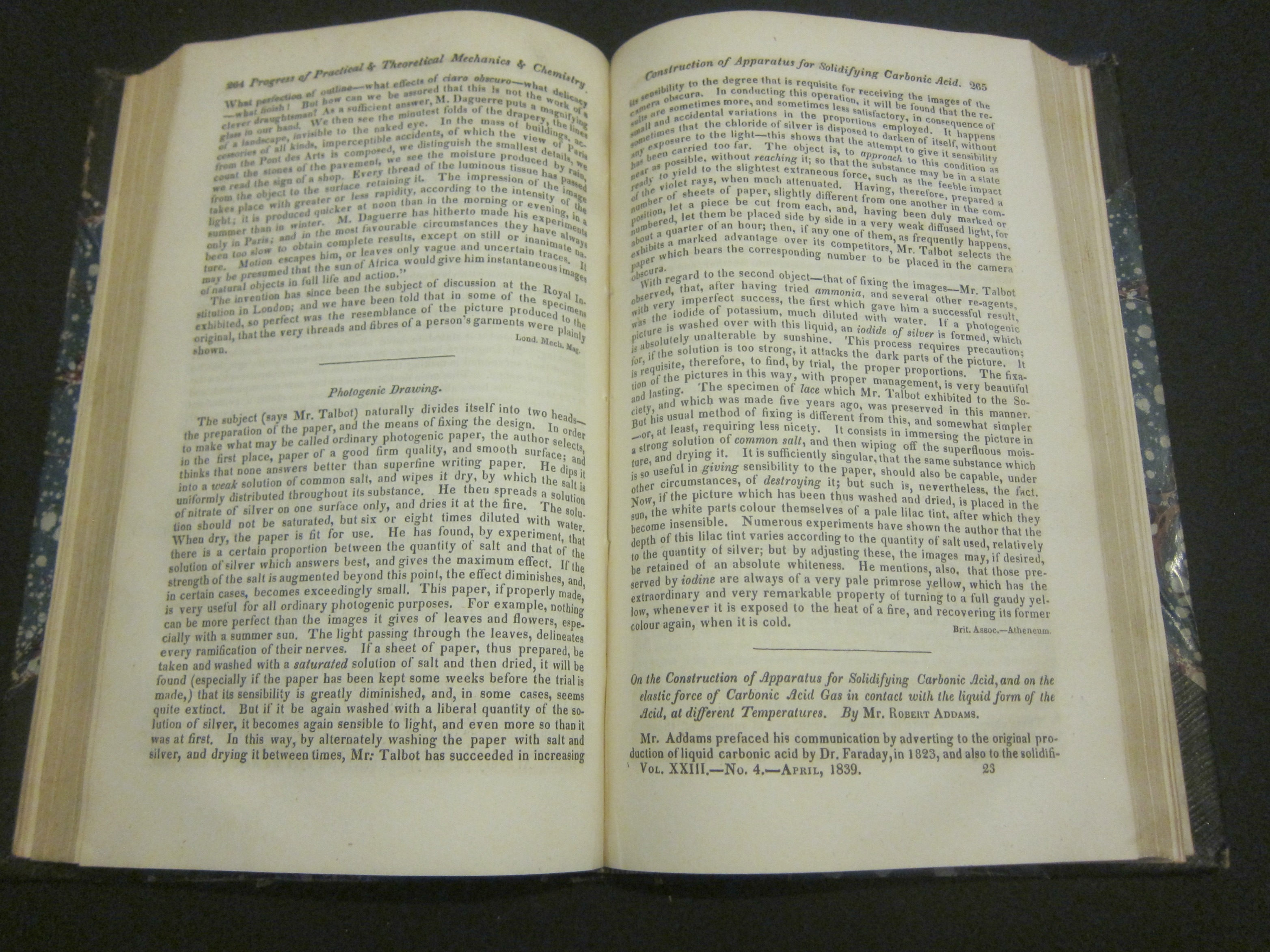
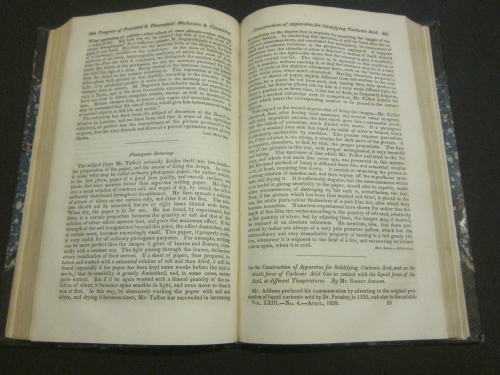
    (Daguerre and Fox Talbot) “Photogenic Drawing” followed by “Photogenic Drawings” in The Journal of the Franklin Institute, Vol. XXIII, April, 1839, No.4, pp. 263-265 (about 1500 words). Bound in half-calf and marbled boards.There are two shadows left on the spine bottom from call numbers; there are also some library marks and a stamp on the front cover, otherwise this is a very nice copy. $750

    The first paper gives an account (taken from the London Mechanical Magazine), occupying pp 263-4, of the Daguerre process; the second, pp 264-5, gives an account of the Fox Talbot method as it first appeared in the British Association/Athenaeum.
    JFI 1839 Jan

    These I believe are among the earliest of U.S. journal references for  two of the earliest photographic processes—the Fox Talbot method was much different from the Daguerre though much less known and certainly underappreciated as it was arguably the superior.

    Also in this volume: John C. Trautwin, “Some remarks on the Internal Improvement of the South”, pp 10-22, with a nice (hand-colored) folding map. AND a lovely plate of Eastwick & Harrison’s “Improved Locomotive Engine” AND a two-part paper on Espy’s Theory of Centripetal Storms, AND Col. Reid’s “Law of Storms Examined”, and much else.
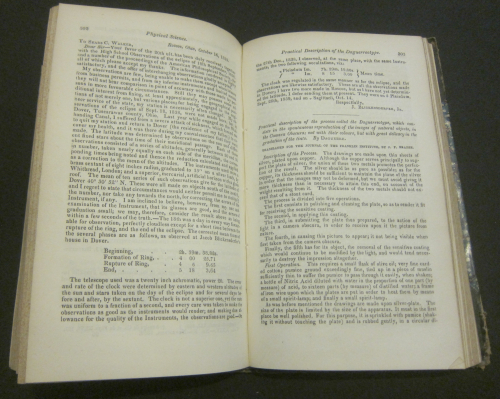
    JFI 1839 Jan text
    JFI 1839 Jan text

    • “This early period of photography cannot be passed over without mention of the name of Henry Fox Talbot of England He was a man of many sided scientific character and an independent investigator in the photographic field prior to Daguerre’s discovery and therefore not inspired by it to investigation. In 1839 January 31st he read a paper before the Royal Society entitled “Some Account of the Art of Photogenic Drawing etc” embodying a practical process on paper based on the abandoned process of Wedgewood and Davy which he improved and also completed by fixing the pictures although imperfectly…”–, JFI, Dec 1899, vol 148, p 4 11.


    Photography, 1839

    “Invention of Photogenic Drawings”, p.208, from Mechanic’s Magazine; 

    “Light Drawb Pictures”, pp 208-9, Mechanic’s Magazine;

    “The Daguerrotype Explained”, pp 209-210 (“A.D.B.”, Alexander Dallas Bache).

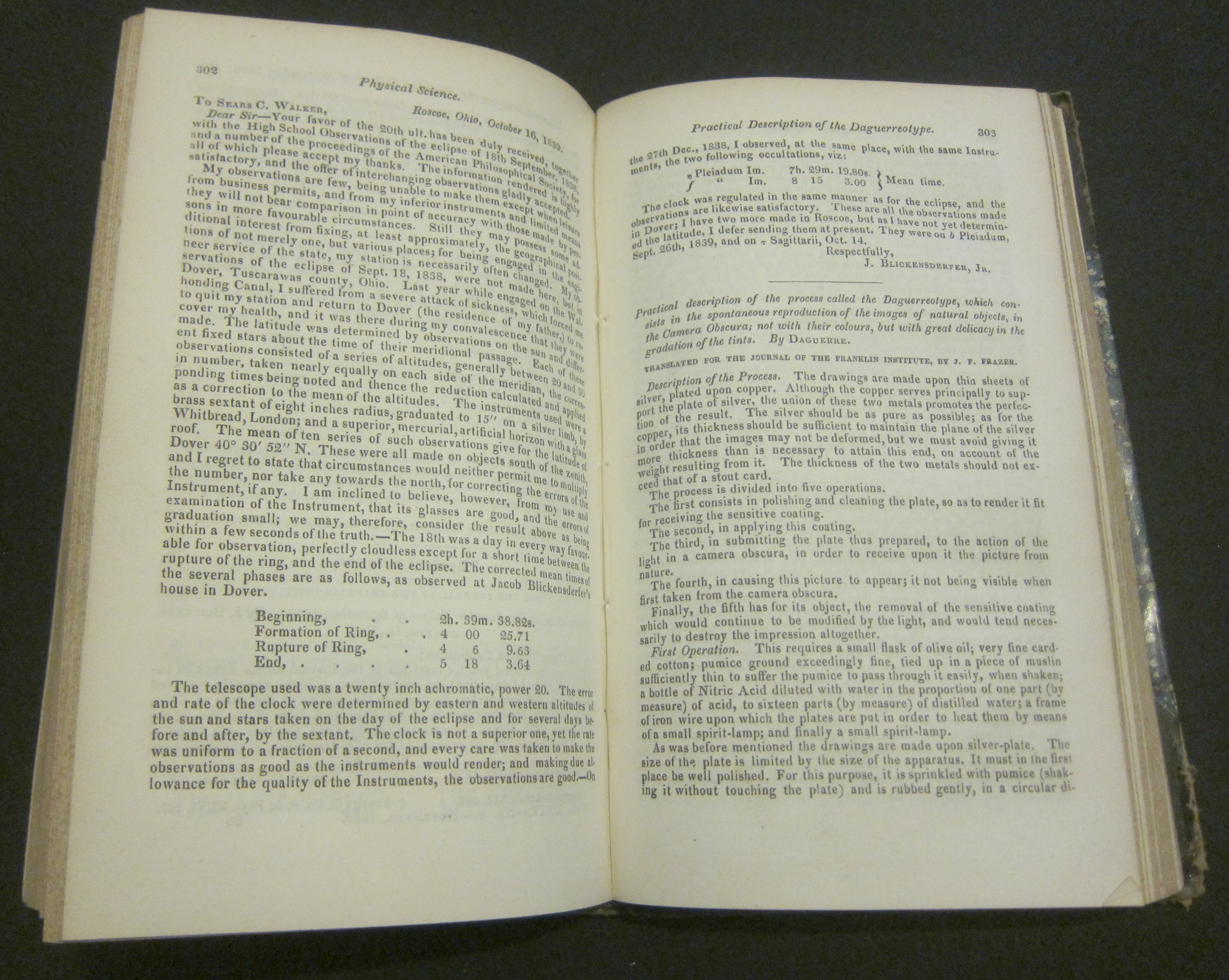
    All in the September, 1839 issue of Journal of the Franklin Institute, printed in Philadelphia by the Institute, 1839. The entire volume offered, volume 28 (new series vol 24) , (442pp). Bound in half-calf and marbled boards. The spine is scuffed and chipped at head and toe, and the front board is detached. Also, this is an ex-library copy, with stamps on the title page. All that said, the text is fresh and crisp. A GOOD copy, only. $600

    Bound with:

    Daguerre. “Practical description of the Process called the Daguerreotype, which consists of the spontaneous repductions of the images of natural objects, in the Camera Obscura…” In the November issue of the same volume, pp 303-311, with four drawings in text.

    All of these are very early journal publications on the new art of photography.
    JFI 1839 July _1_

    • “A scientific friend having kindly sent to me, from Paris, a paper containing the authorized explanation of the process of M. Daguerre, which has attracted so much attention, I have made an abstract of it, which is at your service. The condition under which M. Daguerre received a pension from the French Government was, that he should make all the steps of his process public. His communication was first made confidentially to a Committee of the Institute, and M. Arago, acting as their organ, states that some of the steps of the process are not explicable by known laws…”–from “The Daguerrotype Explained”

    Photography, 1840

    (Early Photography) “The Daguerreotype”, long paragraph on p 142 on the “great obstacle to the use of M. Daguerre’s photogenic process, is the great difficulty of preserving the pictures when completed…” in Journal of the Franklin Institute, Philadelphia, printed by the Institute, 1840. Offered in the volume of 430pp.

    There’s also a second very short notice on the daguerreotype on p 285 regarding a “curious use” for the instrument: making a landscape photo with a crowd of people in it all of whom need to stand still for five minutes.

    Condition: calf-backed marbled boards. The calf is pretty scruffy and rubbed, and the front joint is half cracked; also the hinges are both starting; lastly this is an ex-library copy with stamps on the title page. All that said, the text is crisp and clean. Overall, just a GOOD copy. $150

    Also included is this description of an early optical machine in the genre of motion pictures:

    • Description of an Optical Machine exhibited by Rd. Roberts of Manchester, to the Members of the British Association…1835 pp 221-223, 4 figures in text.
      “Trepiscope: an optical machine made by the late Richard Roberts of Manchester and first shown at the meeting of the British Association at Dublin in 1835… The machine being turned by hand or by power will cause the card on the disc to revolve from 6,000 to 40,000 times a minute on viewing the revolving disc through the eye hole the printing on the card can be read with ease and distinctness. The time given for one view of the card does not exceed the 150,000 th of a second when the disc is revolving at the highest speed ..Catalogue of the Special Loan Collection of Scientific Apparatus at the South Kensington Museum…, 1876, #979 p 140.

    Also including: M. Arago, “History of the steam engine, with a reply to the criticisms to which the first publication of the article gave rise”, pp 145-148; William Whewell, “New theory of the tides”, pp209-210.

    Photography, 1841

    “Photogenic Drawing” In: Journal of the Franklin Institute, edited by Thomas P. Jones. Philadelphia, printed by the Franklin Institute, 1841. Volume 31 (Third Series, Vol 1), pp 59-60 (about 450 words) in the volume of 429pp. Half-calf, with marbled boards. . Ex-library copy, with ghost imprint of two small rectangles of Dewey call numbers on the spine, plus bookplate, and a blindstamp owner stamp on the title page. Spine is somewhat scuffed and rubbed, and and in general a bit tatty. Good condition, only. $200

    “Professor Schafthaeutl of Munich described his mode of obtaining photogenic drawings resembling those of Mr [Henry Fox] Talbot where the lights are represented by shadows and also two new methods of procuring drawings similar to those of the Daguerreotype in which the lights and shades are represented as in nature The first is on paper prepared as follows…”

    This is the only mention of photography or Daguerre in this first half of 1841 in the JFI.
    JFI 1841 Jan June
    JFI 1841 Jan June

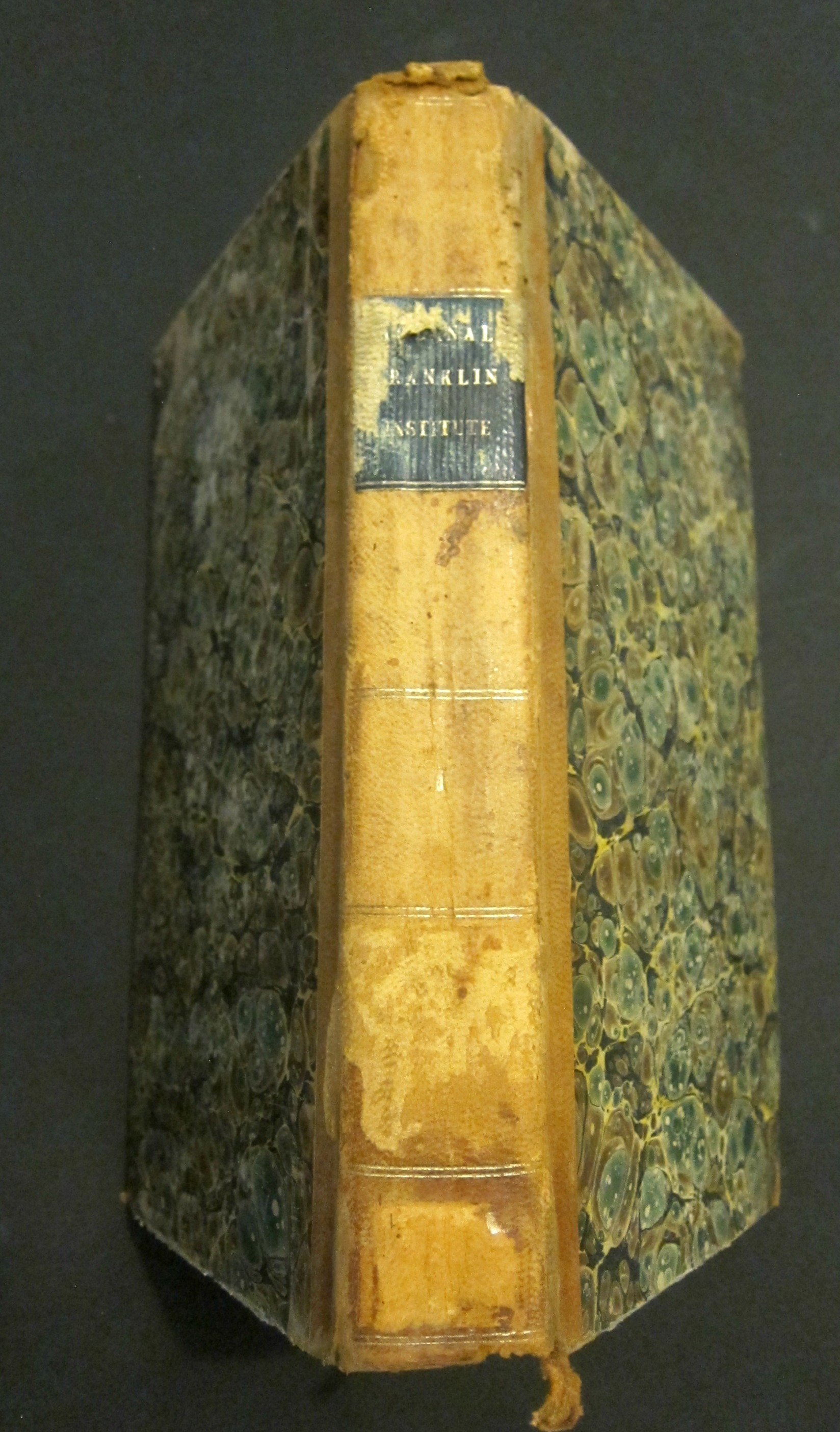
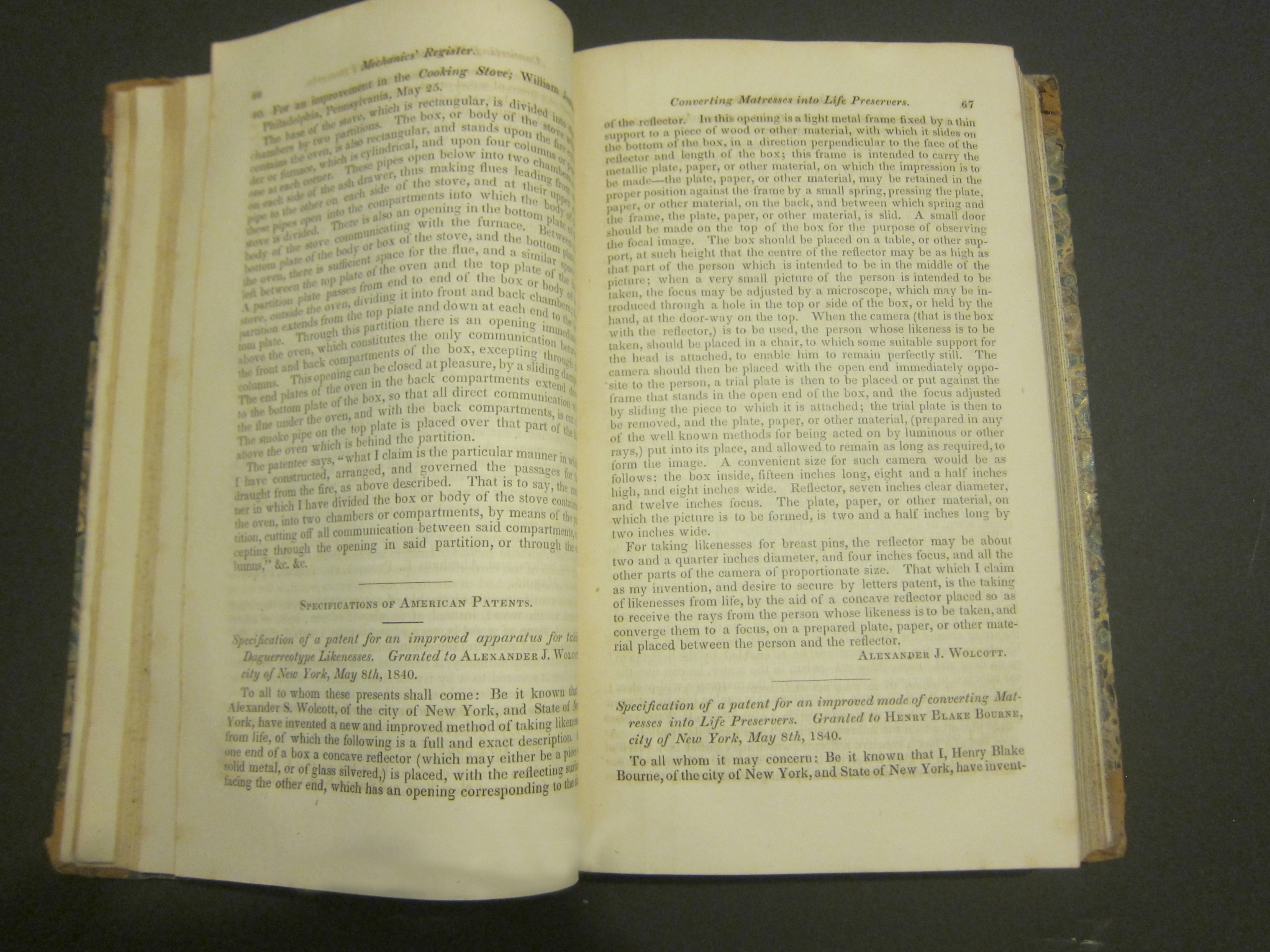
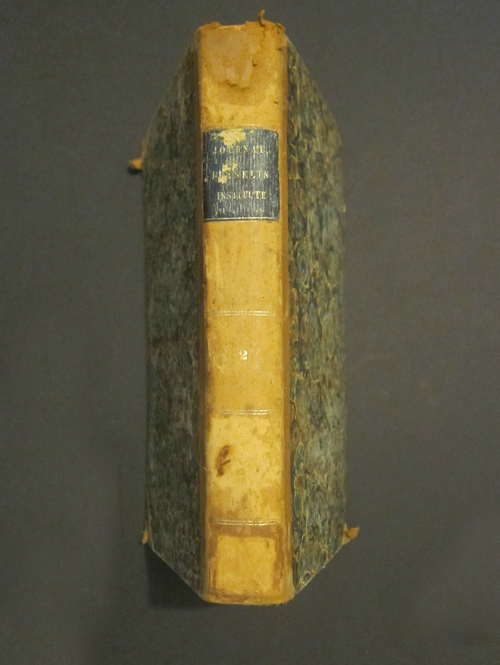
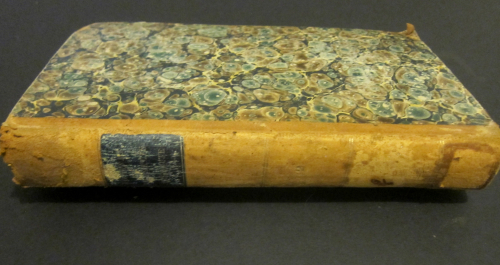
    WOLCOTT, Alexander J. Specifications of a patent for an improved apparatus for taking Daguerreotype Likeness. Granted to Alexander J. Wolcott, city of New York, May 8, 1840. In: Journal of the Franklin Institute, edited by Thomas P. Jones. Philadelphia, printed by the Franklin Institute, 1841. Volume 32 (overall), Third Series,vol II. The article occupies pp 66-7 in the issue of 430pp. Bound in half calf and marbled boards. Ex-library copy, with ghost imprint of two small rectangles of Dewey call numbers on the spine, plus bookplate, and a blind stamp owner stamp on the title page. Spine is somewhat scuffed and rubbed, and and in general a bit tatty. Good condition, only. $600

    Mr. Wolcott, a great but perhaps obscure name in the very early history of photography, had a very busy 1840—and it is a good thing, as the poor man would die young at 40 just four years later. In March of that year he and a partner would open the first U.S. Daguerrian Parlor in NYC, and evidently the world’s first commercial daguerreotype gallery. (John Hannavy, Encyclopedia of Nineteenth-Century Photography.)
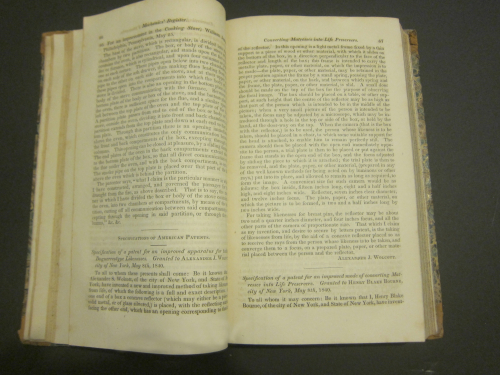
    JFI 1841 WOlcott 3

    A few months later, on May 8th, 1840, Wolcott would be granted the first patent in the United States in photography (US Patent No. 1582) —this is the subject of the article from the Franklin Institute that is being sold (above). The patent was for a variation of the Daguerre process, using a mirror instead of a lens. The great factor introduced by the new process was reducing the amount of sitting/posing time by about 75%, to somewhere in the 5-9 minute range.

    “I, Alexander S. Wolcott…have invented a new and improved method of taking likenesses from life” Wolcott begins in the article, and then proceeds in a very compact way to describe the camera and the entire process. It is one of those articles that announces so much using so few words (600 or so, I reckon).
    JFI 1841 Wolcott 2
    JFI 1841 Wolcott 2

    ·Posted by :

    ·in: