A Daily History of Holes, Dots, Lines, Science, History, Math, Physics, Art, the Unintentional Absurd, Architecture, Maps, Data Visualization, Blank and Missing Things, and so on. |1.6 million words, 7500 images, 4.9 million hits| Press & appearances in The Times, Le Figaro, Mensa, The Economist, The Guardian, Discovery News, Slate, Le Monde, Sci American Blogs, Le Pont, and many other places… 5000+ total posts since 2008.

Book Category: Photography

  • Lange’s “Migrant Mother”, 1936

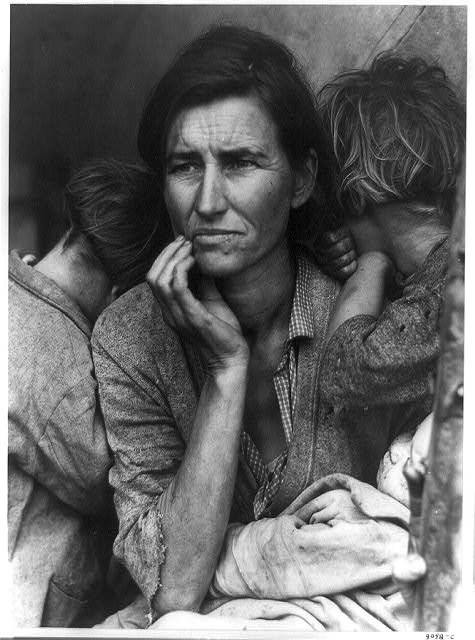
    Dorothea Lange. The Migrant Mother. Photo for Farm Security Administration, originally printed in 1936. Modern print from a large file, 47×38″, printed on archival photo rag paper. New. Beautiful image and production. $395 [FSA images are not copyrighted.] 

    On of the great innovations in a sea of great things accomplished during the Franklin Roosevelt administrations was the formation of the Farm Security Administration, a division of the government established to help farmers through the devastating Dust Bowl and Great Depression.  A subset of the FSA was a photographic unit which was set up to document the progress made by the FSA (and provide, I am sure, for some much-needed good news, a hearts-and-minds campaign).  This division was headed by Roy Emerson Stryker, who wound up hiring a collection of dream-team photographers unlike any ever assembled for a single purpose.  Esther Bubley, Marjory Collins, Mary Post Wolcott, Arthur Rothstein, Walker Evans, Russell Lee, Jack Delano, Gordon Parks, Charlotte Brooks, John Vachon, Carl Mydans, Dorothea Lange and Ben Shahn were sent out all across the country and wound up with the greatest and most beautiful photographic history ever assembled.  There were about 77,000 images made, and I recall reading (somewhere) that the total budget for the Stryker group for the years 1936-19421 was about $100,000, meaning that each completed image cost just over a dollar apiece.  
    Lange migrant mother _1_

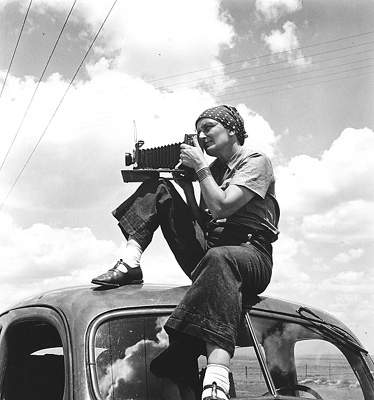
    One of the most compelling of all of these images was from a series made by the new-hire Dorothea Lange (1895-1965)  in 1936.  On the tail end of a month-long road trip she was nearing the end of her day when she spotted a hand-lettered sign reading “Pea-Pickers Camp” by the side of the road near Nipomo, California.  She briefly considered stopping but went ahead, and for the next 20 miles of hard road continuously questioned her decision.  Unable to shake her better judgment, she turned around and drove back to the turn-off for the camp.  Lange drove down the dirt road and found a ramshackle assembly of tents, one of which contained an exhausted mother sitting forlornly with her children, sheltered in a tent fashioned to the rear of the woman’s tireless car.  Lange spent only 10 minutes with the woman, making five exposures.  She learned that “the crops had frozen, and the woman and children were living on vegetables scavenged from the fields, and the few birds that the children managed to catch.  The mother could not leave; she had sold the tires from her car”. 

    Lange Migrant Mother series

    Her photograph created an American Madonna in her Migrant Mother.

    George P. Elliott, writing in the introduction for the Lange retrospective at the Museum of Modern Art (New York), grasped the essence of the image:

    “For an artist like Dorothea Lange who does not primarily aim to make photographs that are ends in themselves, the making of a great, perfect, anonymous photograph is a trick of grace, about which she can do little beyond making herself available for that gift of grace”.
    Lange migrant mother portrait of artist

    Lange describes her encounter as follows:

    “I saw and approached the hungry and desperate mother, as if drawn by a magnet. I do not remember how I explained my presence or my camera to her, but I do remember she asked me no questions. I made five exposures, working closer and closer from the same direction. I did not ask her name or her history. She told me her age, that she was thirty-two. She said that they had been living on frozen vegetables from the surrounding fields, and birds that the children killed. She had just sold the tires from her car to buy food. There she sat in that lean- to tent with her children huddled around her, and seemed to know that my pictures might help her, and so she helped me. There was a sort of equality about it”. (From: Popular Photography, Feb. 1960).  Lange’s field notes of the images read: “Seven hungry children. Father is native Californian. Destitute in pea pickers’ camp … because of failure of the early pea crop. These people had just sold their tires to buy food.”

    Roy Emerson Stryker, who was in charge of the photography project (History Section) for the FSA said of this image:

    “When Dorothea took that picture, that was the ultimate. She never surpassed it.  To me it was the picture of Farm Security. She has all the suffering of mankind in her, but all the perseverance too.  A restraint and a strange courage”.

     NOTES
    1. The photographic history unit of the FSA morphed into a propaganda arm for the Office of War Information (OWI) in late 1942.
    2. Florence OwensThompson(1903-1983)  is the real name of the Migrant Mother.
    3. The Library of Congress files for the series of photos

    ·Posted by :

    ·in:


  • Seeing a Criminal’s Face Before the Crime (1878)

     Francis Galton, “Composite Portraits” (Nature, May 23, 1878) with several text illustrations. Detached from a larger bound volume, but accompanied by its original wrappers (totaling 11pp of ads).  Very Good condition. $300

    DocFile (3)

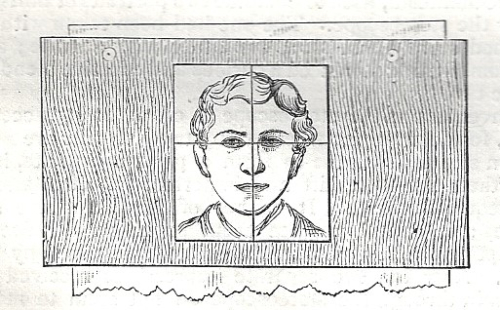
    Francis Galton’s work came early on in the prehistory of cognitive and computational aspects of face recognition, though more like an analog development in a later digital environment. In this paper he discusses his attempts to see the face of criminality before crime was committed. Galton uses a collection of photographs of criminals convicted of murder, manslaughter, and crimes of violence, creating amalgams of portraits, and stating that the “special irregularities” of each individual criminal face “disappeared and the common humanity that underlies them prevailed”, and so the images represent not the criminal “but the man who is likely to fall into crime”.  

    Galton (1822-1911), who was similar to Alphonse Bertillon who came somewhat after him, was working on a predictive manner of crime detection, with Bertillon (1853-1914) using body measurements and Galton facial characteristics. Both made significant contributions to police and forensic science, Galton doing groundbreaking work in fingerprints (1869) which proved a definitive means for identifying criminals once they had entered a justice system, and Bertillon in numerous other areas (including galvaniplastic molds for footprints and such, ballistics, and a number of different aspects of crime detection.

    See for long background:  George Pavlich, “The Subject of Criminal Identification”, in Punishment and Society, Vol 11 (2), 171-190. There are many articles referencing this early work by Galton.

    ·Posted by :

    ·in:


  • Breakthrough Papers in Color Photography (1891-1906), Gabriel Lippmann (Nobel for this work in 1908)

    LIPPMANN, Gabriel. A suite of papers on breakthrough research establishing color photograpy, 1891-1906, all published in the Comptes Rendus Hebdomadaires des Séances de l’Académie des Sciences.

    Lippmann was awarded the Nobel Prize in physics for this accomplishment (“”for his method of reproducing colours photographically based on the phenomenon of interference”) in 1908 (the only Nobel awarded for work in photography).

    • (1) “La photographie des couleurs” in Comptes Rendus , Vol. 112, No. 5, February 2, 1891, pp. 274-275;
    • (2)”Sur  la photographie des couleurs [deuxième note]” in CR Vol. 114, No. 17, April 25, 1892, pp. 961-962;
    • (3) “Photographies colorées du spectre sur albumine et sur gélatine bichromatées” in CR Vol. 115, No. 17 October 24, 1892, p. 575;
    • (4) “Sur la theorie de la photographie des couleurs simples et composees par la methode interferentielle” in CR Vol. 118, No. 3, January 15, 1894, pp. 92-102
    • (5)“De divers principes sur lesquels on peut fonder la photographie direct des couleurs…” in CR Vol 130, 1900, pp 278 (this being a very brief one-paragraph note);
    • (6) “Remarques generales sur la photographie interferentielles des coulleurs”, in CR Vol 143, No. 5, July 30 1906, pp 273-4.

    Of the 80+ papers Lippmann published in the CR for the 1885-1910 period this is the extent of his publications there on color photography, save for one short note that appears in volume 140–unfortunately that one is the very next article in the issue bearing the famous Poincare “relativity” paper of 1905.

    All six are offered in their complete weekly issues, all extracted from larger bound volumes of the CR. The issues from volumes 112, 115, and 143 are offered with their original wrappers. GOOD copies.  $950

    “Gabriel Lippmann, professor of mathematical physics at the Sorbonne invented, demonstrated and mathematically formulated the process of interference colour photography, also known as interferential photography, or Lippmann photography, in the years 1891-1894…Few photographers today are familiar with the name Gabriel Lippmann (1845-1921), even fewer have seen a Lippmann colour photograph. Lippmann was awarded the 1908 Nobel Prize in Physics for his invention of Interference Photography, an early colour technique exploiting the phenomenon of optical standing waves. Lippmann’s prize represents the only time this prestigious award has been given for a photographic invention “–”Lippmann Colour Photography”, Dr. Hans I. Bjelkhagen, alternativephotography.com

    “In 1891, Professor Gabriel Lippmann demonstrated to the French Académie des Sciences interference colour photographs of the spectrum and of stained glass windows, taken by a modification of Wiener’s method. An exceedingly fine grained, virtually transparent emulsion of silver bromide in an albumen coating on a glass plate was exposed in contact with a film of mercury, with the glass plate towards the lens. The mercury, in optical contact with the emulsion, reflected light which had passed through the emulsion back on itself, producing the standing waves and layered exposure predicted by Zenker. The developed plate appeared to be a conventional negative by transmitted light, but when viewed at a suitable angle, by reflected light the image appeared as a brilliantly coloured positive.”–(Coe, Brian (1978): Colour Photography – The first hundred years 1840-1940.

    “One of our most distinguished physicists, M. Gabriel Lippmann, Member of the Institute and Professor in the Faculty of Sciences, has accomplished a memorable experiment in photographing the solar spectrum. At the meeting of the Academy of Sciences M. Lippmann presented to his, colleagues several photographs, of the solar spectrum, with the colors fixed upon the sensitized plate with their exact sheadings and brilliancy… The way so brilliantly opened by M. Lippmann must lead to important work, and the first results of the discoverer, which we are happy to be able to present here, assure a brilliant future to the art of photography in color. “-­ Photography in Colors. In: The American Journal of Photography, 12, pp. 180-183, translated from La Nature, February 14, 1891, which appeared 12 days after the CR printing.

    Earlier work in this area was carried out by Seebeck (1810), Herschel (1839), Ed. Becquerel (1848) and others though “…the process was never of practical value”…”In 1891 G. Lippmann of Paris succeeded in carrying through these suggestions with an albumen emulsion of exceedingly fine grains.”–  Evans, Ralph Merrill; Hanson, W.T., Jr.; Brewer, W. Lyle (1953): Principles of Color Photography. New York: Wiley, pp. 275-278.

    ·Posted by :

    ·in: