A Daily History of Holes, Dots, Lines, Science, History, Math, Physics, Art, the Unintentional Absurd, Architecture, Maps, Data Visualization, Blank and Missing Things, and so on. |1.6 million words, 7500 images, 4.9 million hits| Press & appearances in The Times, Le Figaro, Mensa, The Economist, The Guardian, Discovery News, Slate, Le Monde, Sci American Blogs, Le Pont, and many other places… 5000+ total posts since 2008.

Book Category: Quantum Theory

  • First Published Proof of the Hellmann-FeynmanTheory

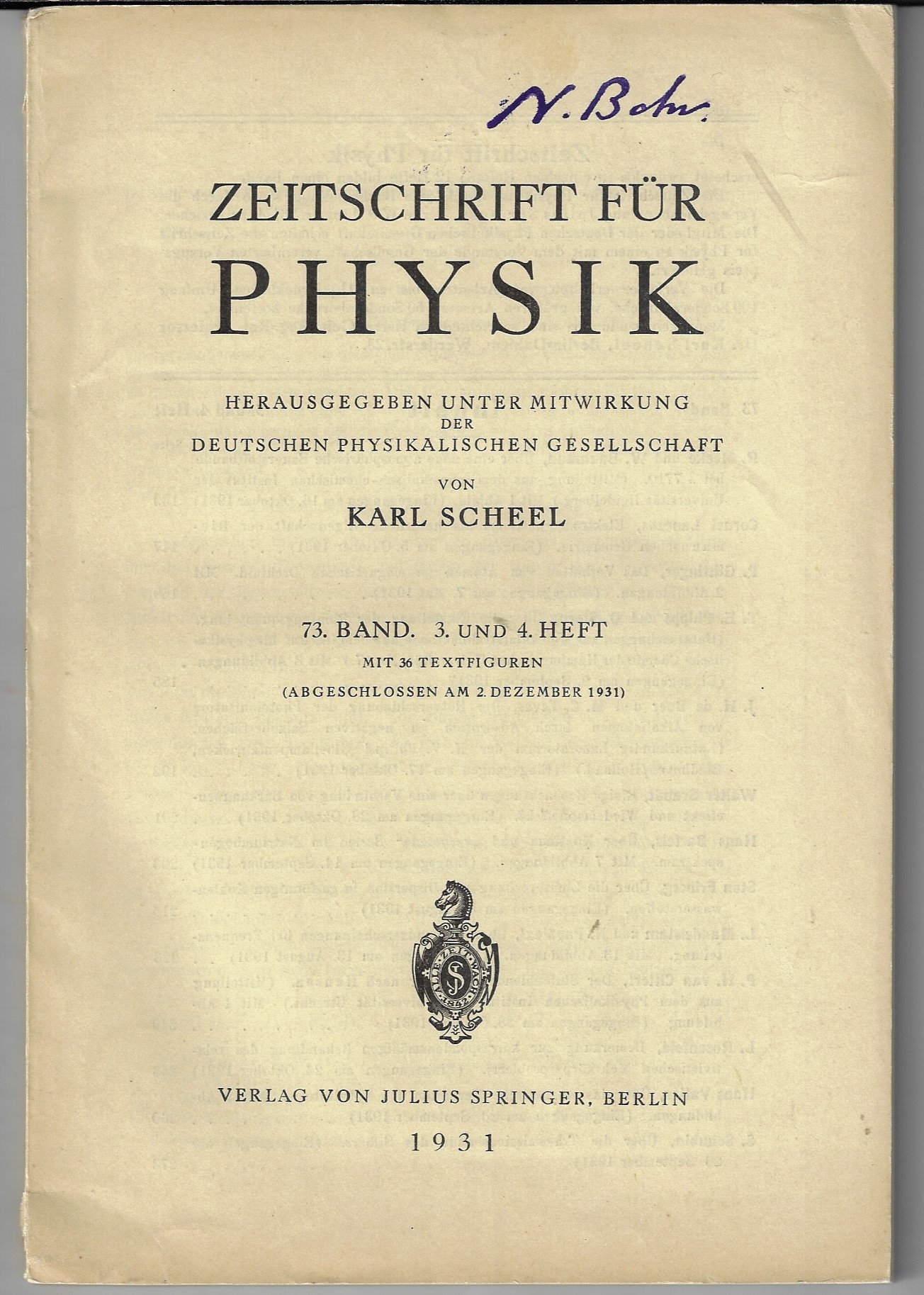
    Güttinger , P. (1932). “Das Verhalten von Atomen im magnetischen Drehfeld”. In: Zeitschrift für Physik, vol 73 (3–4),  pp 169–184 in the issue of pp 139-280. Original wrappers. Lovely copy.

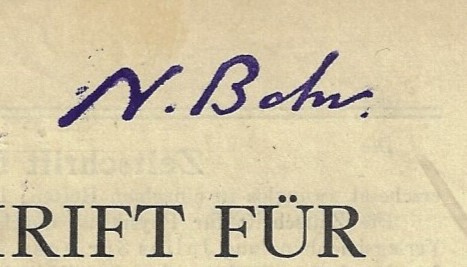
    This is Niels Bohr’s copy, with his name printed at the top right. $500

    Guttinger 1933 Bohr sig

    Guttinger 1933 ZfP “The Hellmann-Feynman theorem has an illustrious albeit somewhat complicated lineage, which includes three Nobel Laureates. The key relationship was reported by Schrödinger in one of his landmark 1926 papers, by Güttinger [who took his Ph.D. at ETH Zurich under Scherrer and Pauli in 1932] in 1932 and by both Pauli and Hellmann in 1933. Feynman presented it, apparently independently, in 1939. It was Hellmann and Feynman who arrived separately at one of the best known consequences of the theorem, which is presumably why their names are attached to it. Over the years, the approval rating of the Hellmann-Feynman theorem has fluctuated wildly. In a 1945 paper, Coulson and Bell concluded that it was invalid; however, Berlin rescued it in 1951…He also showed how the theorem could be used to obtain insight into bonding forces in molecules, an approach that Bader et al. followed successfully a few years later. In 1962, Wilson used the theorem to derive an exact formula for molecular energies. Nevertheless, Musher claimed in 1966 that many find the theorem to be “too trivial to merit the term ‘theorem’”. Yet only six years later, no less an authority than Slater proclaimed the Hellmann-Feynman theorem to be one of the “two most powerful theorems applicable to molecules and solids”, the other being the virial theorem.”–Politzer, P., Murray, J.S. “The Hellmann-Feynman theorem: a perspective”,  J Mol Model 24, 266 (2018).

    “In quantum mechanics, the Hellmann–Feynman theorem relates the derivative of the total energy with respect to a parameter, to the expectation value of the derivative of the Hamiltonian with respect to that same parameter. According to the theorem, once the spatial distribution of the electrons has been determined by solving the Schrödinger equation, all the forces in the system can be calculated using classical electrostatics. The theorem has been proven independently by many authors, including Paul Güttinger (1932), Wolfgang Pauli (1933), Hans Hellmann (1937), and Richard Feynman (1939) [The Feynman contribution appears in his first published paper, “Forces in Molecules”, in the PR in 1939.


    ·Posted by :

    ·in:


  • Dirac Pam Quantum Theory Of Localizable Dynamic Systems American Physical Society In The Physical Review 739 1 May 1

    DIRAC, P.A.M. “Quantum Theory of Localizable Dynamic Systems”, American Physical Society, in the Physical Review, 73/9, 1 May 1948. Original printed wrappers. Very good condition. $250

    Abstract from AIP’s great PROLA website: “A dynamical system is called localizable if its wave functions can be expressed in terms of variables, each referring to physical conditions at only one point in space-time. These variables may be at points on any three-dimensional space-like surface in space-time. A general investigation is made of how the wave function varies when the surface is varied in any way. The variation of the wave function is given by equations of the Schroedinger type involving certain operators Hn(u) which play the role of Hamiltonians. The commutation relations for these operators are obtained. The theory works entirely with relativistic concepts and it provides the general pattern which any relativistic quantum theory must conform to, provided the dynamical system is localizable.”

    AND: “Dirac was also original in his conception of the role of probability in quantum mechanics. He thought that probabilities entered into the description of quantum phenomena only in the determination of the initial state (still described in terms of p s and q s), and not necessarily in the behavior of an isolated system. But, as Bohr had said at the Solvay Conference in 1927, isolated systems were unobservable. Dirac then assumed that the state of the world was represented by its wave function …; and that it changed abruptly during a measurement, whereupon nature made a choice.” — Complete Dictionary of Scientific Biography, vol. 17, Charles Scribner’s Sons, 2008, pp. 224-233. 

    ·Posted by :

    ·in:


  • Einstein Albert Quantentheorie Des Einatomigen Idealen Gases Quantum Theory Of The Monatomic Ideal Gas In Sit

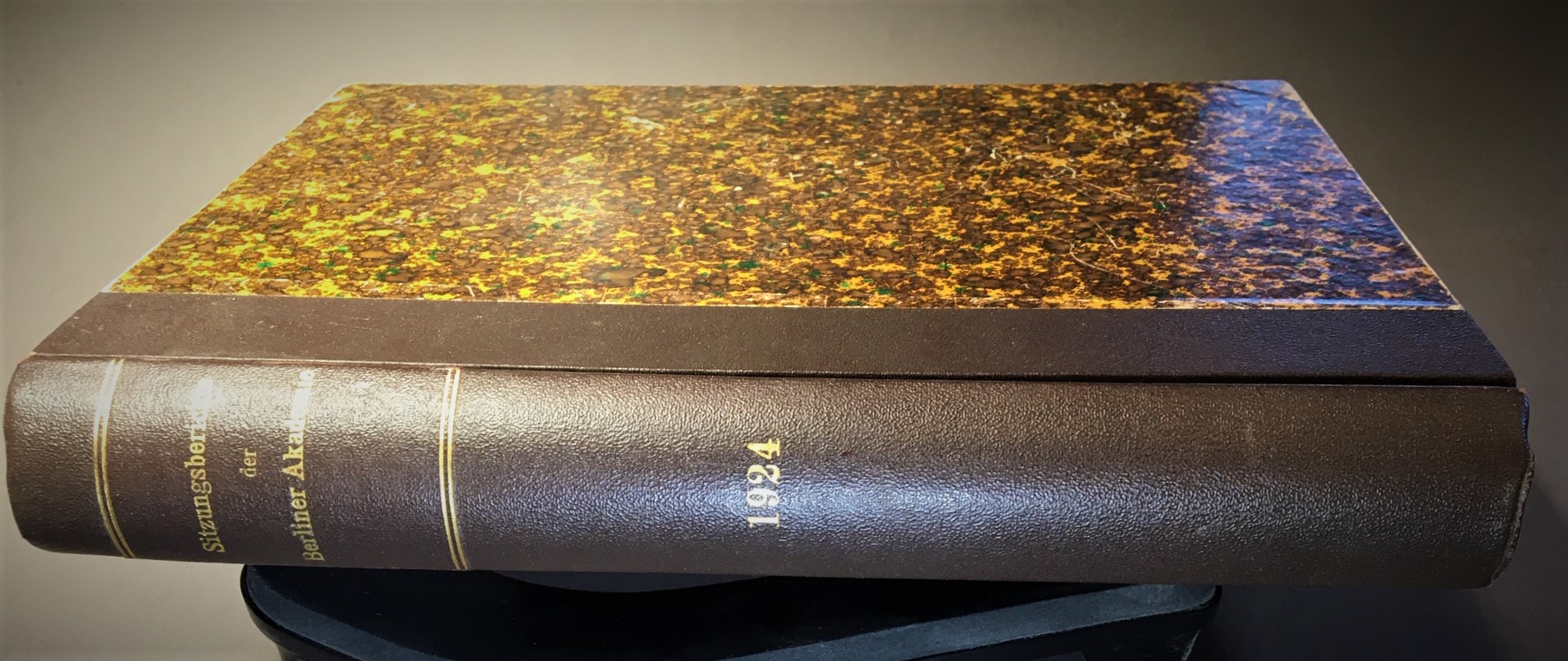
    EINSTEIN, Albert. “Quantentheorie des einatomigen idealen Gases” (“Quantum Theory of the Monatomic Ideal Gas”) in Sitzungsberichte der Königlich Preussischen Akademie der Wissenschaften, Physikalisch-mathematische Klasse, 1924, pp. 261–267 in the volume of pp CXLIX, 360. .Bound in the original publisher’s cloth and marbled boards with cloth tips, in near fine condition. $500.00

    “This is the first of three papers by Einstein on Bose-Einstein condensation, the phenomenon that causes bosons to become a superfluid at low temperatures.”

    Einstein 1924 Wenner

    ·Posted by :

    ·in:


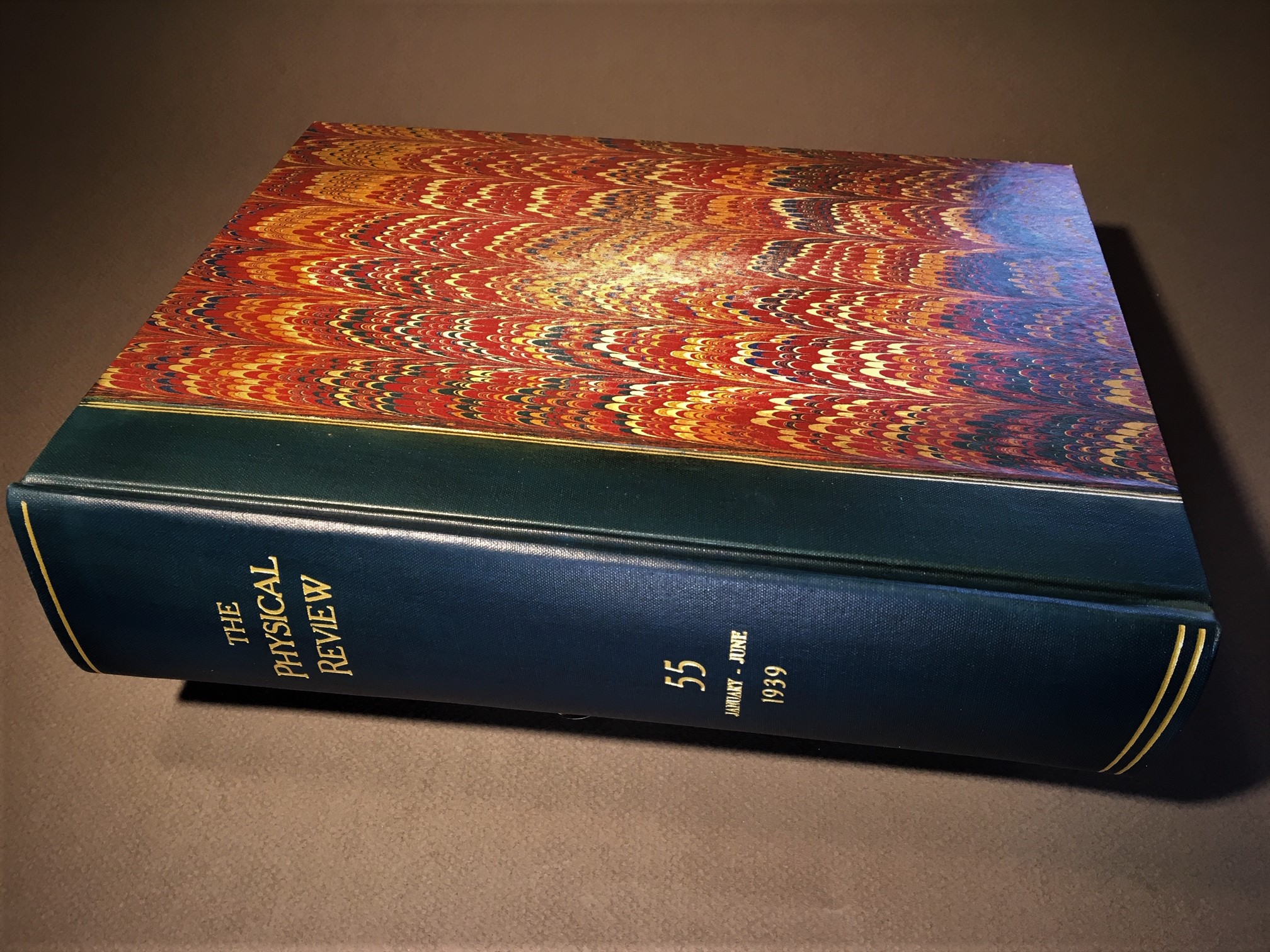
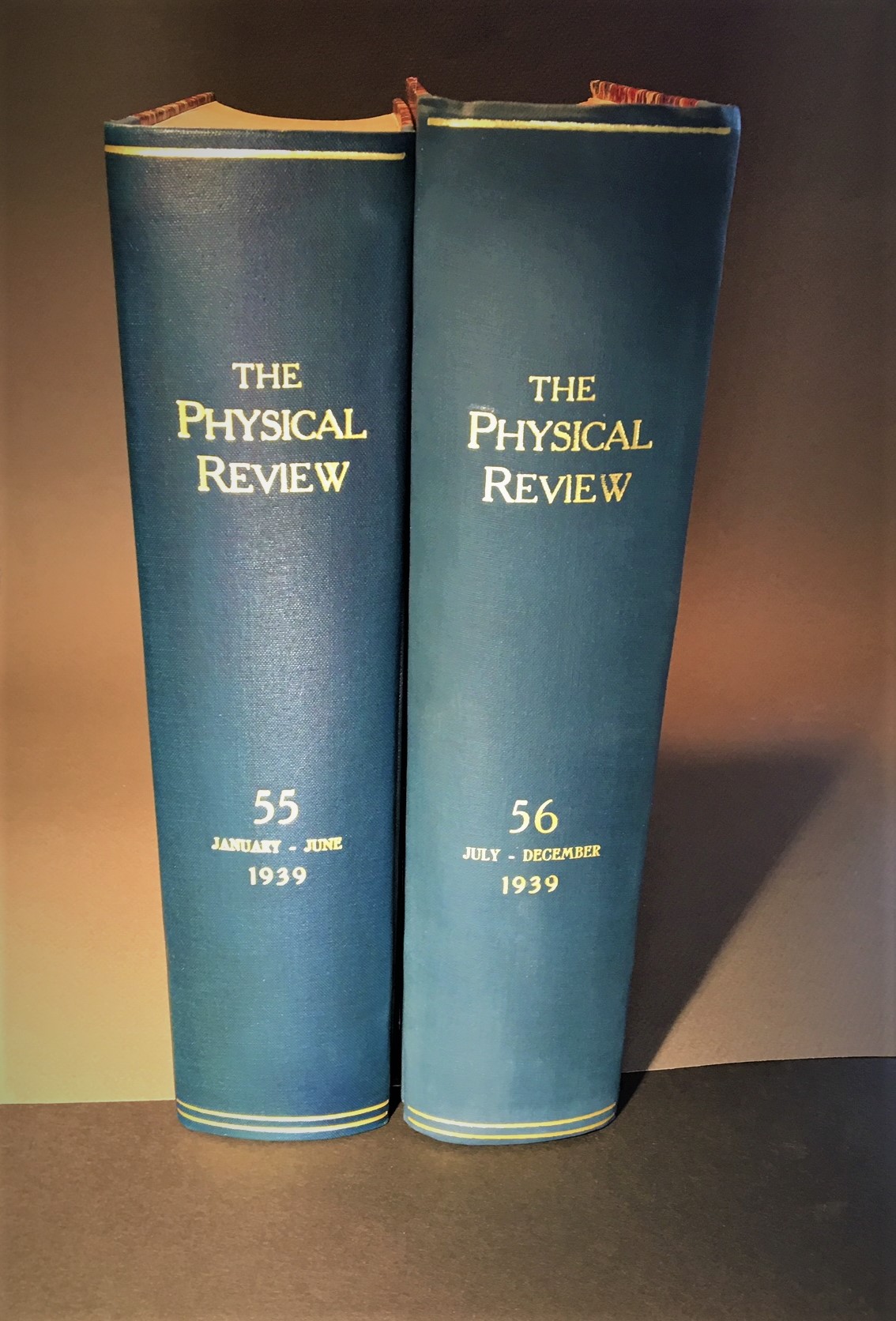
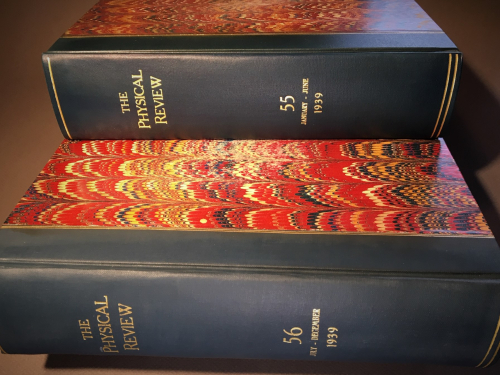
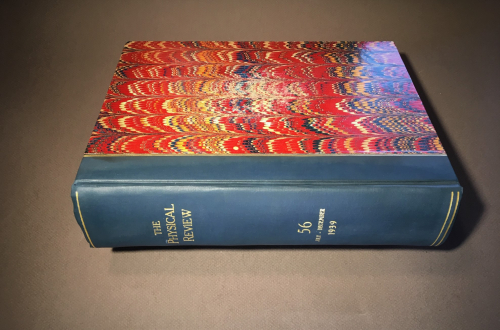
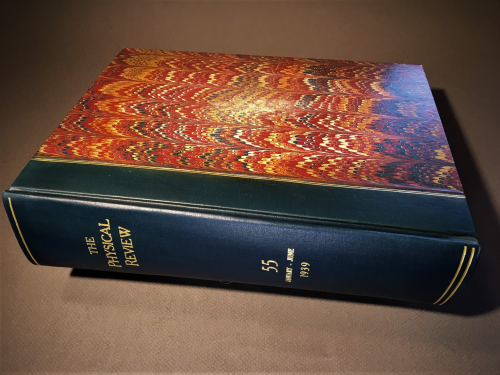
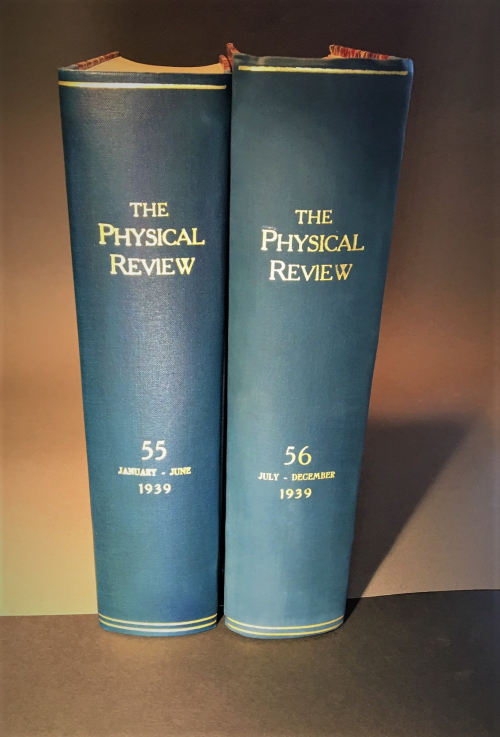
  • Oppenheimer, Gamow, Feynman, Szilard, Bohr, Bethe, Rabi, and others in the Monumental “Physical Review” for 1939


    OPPENHEIMER, J. Robert. “On continued gravitational contraction” and many other papers offered in one monumental year of the Physical Review for 1939.

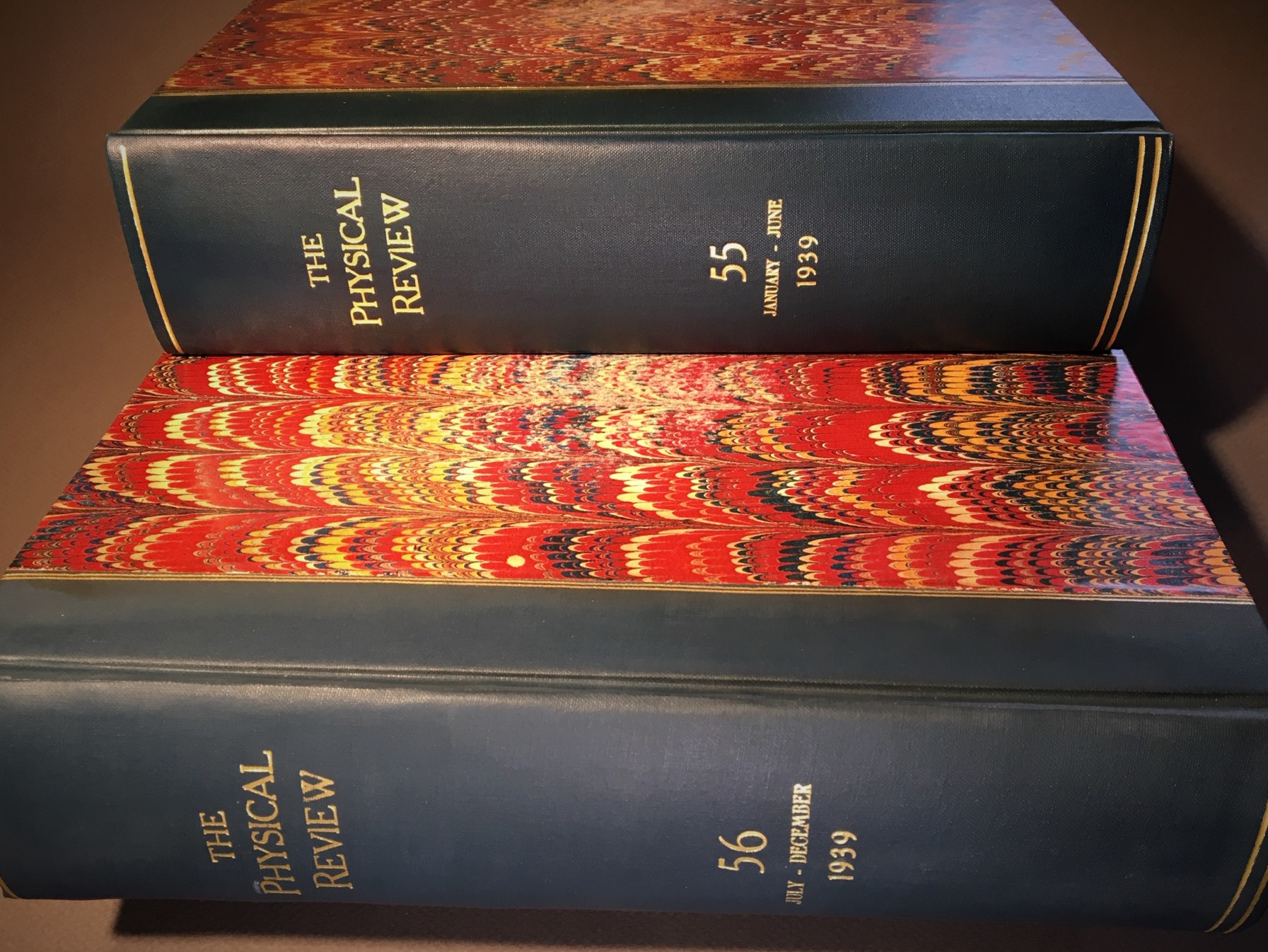
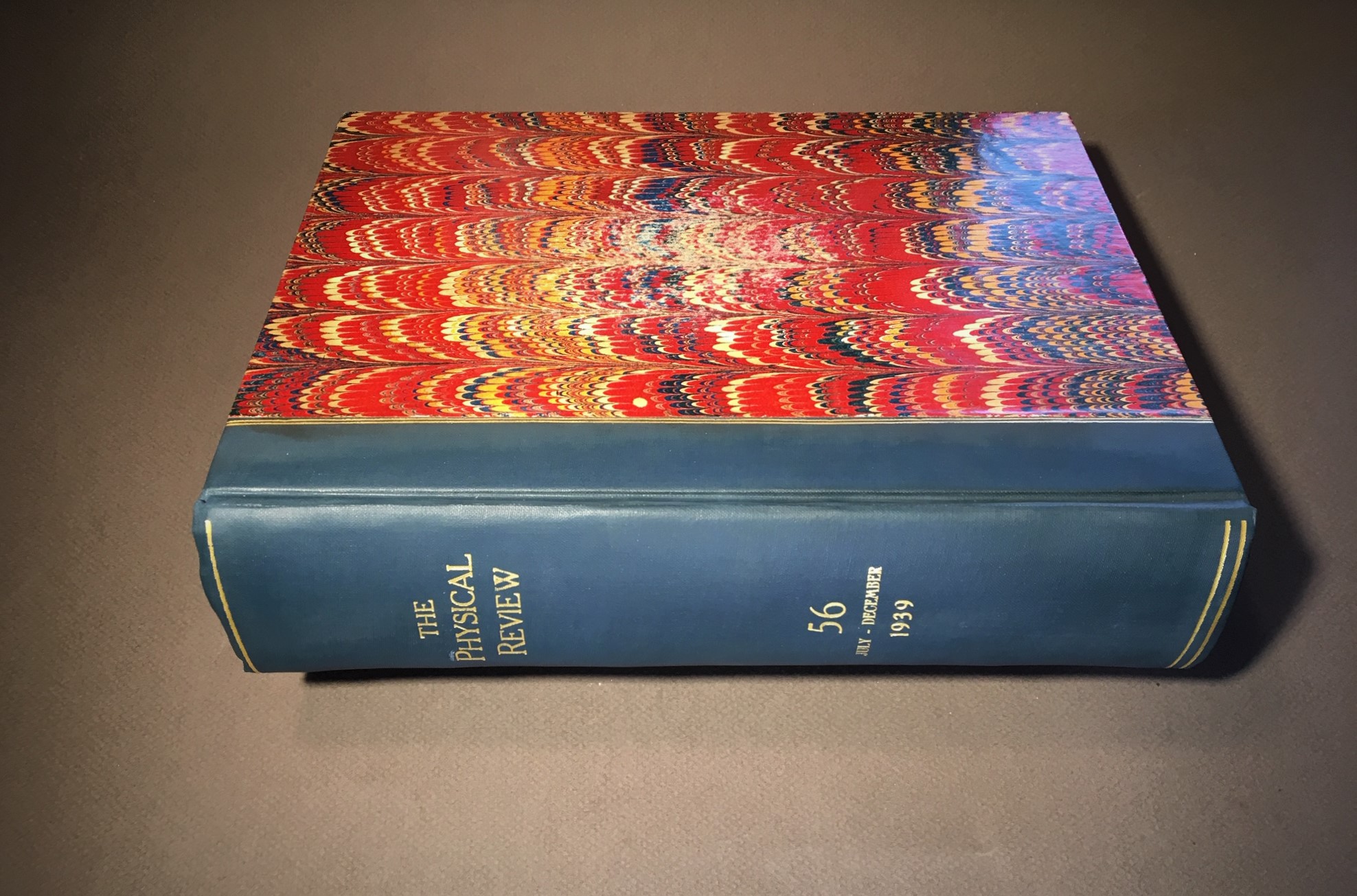
    American Physical Society, Lancaster Pa., January-December 1939. Two volumes: x, 1294pp & x,1300pp. The two volumes, complete. Finely and sturdily rebound in cloth and marbled boards. Very stout, readable volumes. Fine condition. Few scant ownership stamps on some of the individual issues’ first page. $2250

    This is a remarkable volume for one of the most electrifying years in the history of modern phsyics, ranking alongside the great years of 1859, 1932, and 1948 for the sheer weight of highly significant papers from many sources. Included are papers by Oppenheimer, Gamow, Feynman, Szilard, Bethe, Rabi, Anderson, Tolman, Morrison, Kusch, Abelson, and many others. Astonishing, really.

    Some of the most significant papers include:

    OPPENHEIMER, Robert and Hartland Snyder, “On continued gravitational contraction”, September 1, 1939, Vol. 56, #5, pp. 426-50  The Oppenheimer and Snyder (a graduate assistant) paper is one of the most prescient in the history of modern physics, correctly physically describing (where Chandrasekhar and Eddington in their discussions did not) what happens in a particular collapse of a neutron star, and still today reads as fresh and and brightly as it did in 1939.  Really, it is an extraordinary work, and a foundation paper in the history of gravitation, the application of RT, singularity, and astrophysics.  (The Southampton GR Explorer site nicely states it this way: “This paper has strong claims to being one of the most prophetic ever written in this field of research. Today, 60 years later, this paper needs little revision – even the terminology is undated!”)

    In an often-repeated quotation, they write, somewhat in irony and in a certain and understated manner on page 456: “The star thus tends to close itself off from any communication with a distant observer; only its gravitational field persists”. And later: “When all thermonuclear sources of energy are exhausted, a sufficiently heavy star will collapse. Unless fission due to rotation, the radiation of mass, or the blowing off of mass by radiation, reduce the star’s mass to the order of that of the sun, this contraction will continue indefinitely”, they wrote.

    Phys Rev Wenner _1_

    BOHR, Niels and J.A. Wheeler, “The mechanism of nuclear fission”, September 1, 1939, Vol. 56, pp. 455-459. This is the experimental foundation stone (on the basis of the liquid drop model of atomic nuclei) of nuclear fission and the great leap forward in the construction of the atomic bomb.

    From the abstract: “On the basis of the liquid drop model of atomic nuclei, an account is given of the mechanism of nuclear fission. In particular, conclusions are drawn regarding the variation from nucleus to nucleus of the critical energy required for fission, and regarding the dependence of fission cross section for a given nucleus on energy of the exciting agency. A detailed discussion of the observations is presented on the basis of the theoretical considerations. Theory and experiment fit together in a reasonable way to give a satisfactory picture of nuclear fission”.

    BOHR, Niels. “Resonance in Uranium and Thorium Disintegrations and the Phenomenon of Nuclear Fission”;

    BETHE,  Hans.  “Meson Theory of Nuclear Forces.”  Vol 55, 2nd series, number 12; June 15, 1939, 1261-1264

    BETHE, Hans. “Energy Production in Stars” no 1. January 1, 1939 -and- “Energy Production in Stars II”, no. 5 March 1, 1939). Awarded the Nobel Prize (the first time the award was given for astrophysics) 1967 “for his contributions to the theory of nuclear reactions, especially his discoveries concerning the energy production in stars”)

    OPPENHEIMER, J. Robert and G.M. Volkhoff in the 15 February 1939 issue. Here (along with a preceding paper by Richard C. Tolman, issued in the same issue just above Oppenheimer, which were the analytic analysis used by O+V to base their estimates of nuclear forces) was established the Tolman-Oppenheimer-Volkhoff limit, which stated that if the state of evolution of  neutrons forming a degenerate Fermi gas of extremely dense masses in neutron stars was more  massive than .07 solar masses that it would collapse into a black hole or exotic/quark star; if the mass was below that limit, the star would not collapse due to the degeneracy pressure of neutrons and the strong force.  The black hole part was left really to a second paper of 1 September 1939 (the day that the Nazis attacked Poland and the fighting began in World War II in Europe) .

    GAMOW, George and Edward Teller, “On the Origin of Great Nebulae”, volume 55, number 7, April 1, 1939, pp 654-657, in the weekly issue of pp 609-671. 

    FEYNMAN, Richard. “Forces in Molecules”, pp. 340-43. Feynman’s undergraduate thesis at MIT, know known as Feynman-Hellmann theorem – “This work treated the problem of molecular forces from a thoroughly quantum-mechanical point of view, arriving at a simple means of calculating the energy of a molecular system that continues to guide quantum chemists.” (Complete DSB online)
    Phys Rev Wenner _1_
    Phys Rev Wenner _1_

    SLIZARD, Leo and ZINN’s landmark “Instantaneous Emission of Fast Neutrons in the Interaction of Slow Neutrons with Uranium” confirmed ‘instantaneous’ neutron multiplication, showing that it meets the requirement for nuclear bombs. Some argue this is one of the most important papers in atomic/nuclear physic

    ANDERSON, Herbert L, Fermi, Enrico & Hanstein, H. B. “Production of Neutrons in Uranium Bombarded by Neutrons”, vol 55, pp. 415-419;

    TOLMAN, Richard, “Static Solutions of Einstein’s Field Equations for Spheres of Fluid”, vol 55, pp. 799-800;

    RABI, I, Millman, S., Kusch, P. & Zacharias J. R. “The Molecular Beam Resonance Method for Measuring Nuclear Magnetic Moments ()”, vol 55, pp 526-535;

    WEISSKOPF, Viktor. “On the Self-Energy and the Electromagnetic Field of the Electron”, 56 No. 1 pp. 72–85, July 1, 1939 . Also bound in the same issue with:   “Weisskopf demonstrates that QED diverges at all levels of perturbation theory.” –This paper reproduced in full as paper 6 in Julian Schwinger’s Selected Papers on Quantum Electrodynamics. See also Jo Bovy (Ghent University), 

    ABELSON, Philip. “Investigation of the Products of the Disintegration of Uranium by Neutrons”, July 1, 1939, pp 1-9.

    RABI, I.I., Kellogg, J. M. B. “The magnetic moment of the proton and the deuteron. The radiofrequency spectrum of H2 in various magnetic fields” , vol. 56, No. 8., pp 728-743.
     

    Phys Rev Wenner _1_

    ·Posted by :

    ·in:


  • The White Hole (1916)

    CAYLEY, Arthur. “Memoir on the Theory of Matrices” and “A Supplementary Memoir on the Theory of Matrices” in Philosophical Transactions of the Royal Society of London, two extracts bound together, as follows: “Matrices” , Vol. 148 (1858), pp. 17- 37; “Supplementary Memoir”, Vol. 156 (1866), pp. 25- 35. Fine condition, bound in beautiful leather and boards of the period, offered with title page and individual title pages for each paper.  $850

    Cayley (1821-1895) introduced matrices to simplify the solution of simultaneous linear equations, along with matrix functions such as addition and multiplication, and the concepts of matrix calculus.. Cayley is responsible for another branch of algebra over and above invariant theory, the algebra of matrices. The use of determinants in the theory of equations had by his time become a part of established practice, although the familiar square notation…and although their use in geometry, such as was provided by Cayley from the first, was then uncommon. (They later suggested to him the analytical geometry of n dimensions.) Determinants suggested the matrix notation; and yet to those concerned with the history of the “theory of multiple quantity” this notational innovation, even with its derived rules, takes second place to the algebra of rotations and extensions in space (such as was initiated by Gauss, Hamilton, and Grassmann), for which determinant theory provided no more than a convenient language. Cayley’s originality consisted in his creation of a theory of matrices that did not require repeated reference to the equations from which their elements were taken. In his first systematic memoir on the subject …he established the associative and distributive laws, the special conditions under which a commutative law holds, and the principles for forming general algebraic functions of matrices. He later derived many important theorems of matrix theory. Thus, for example, he derived many theorems of varying generality in the theory of those linear transformations that leave invariant a quadratic or bilinear form. Notice that since it may be proved that there are n(n + 1)/2 relations between them, Cayley expressed the n2 coefficients of the nary orthogonal transformation in terms of n(n – 1)/2 parameters. His formulas, however, do not include all orthogonal transformations except as limiting cases .”–Complete Dictionary of Scientific Biography, online.

    ·Posted by :

    ·in:


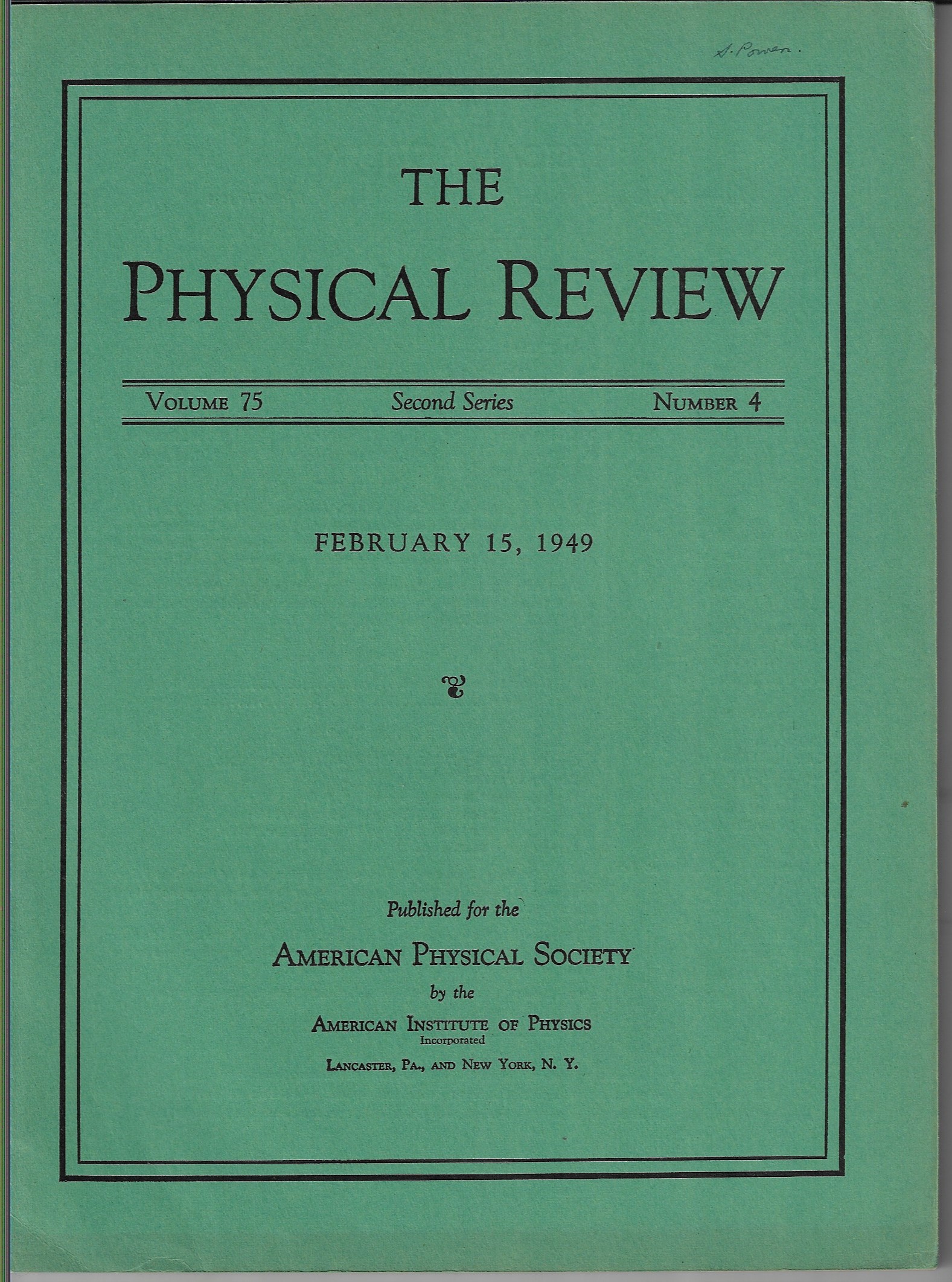
  • Julian Schwinger Quantum Electrodynamics Ii Vacuum Polarization And Self Energy In Physical Review Vol 75 No 4 Fe


    PR 1949 DW SchwingerJulian Schwinger, Quantum Electrodynamics II. Vacuum polarization and self-energy. In: Physical Review, Vol. 75, No. 4, February 15, 1949 pp 651-679. Original wrappers. Fine copy. $250

    This is the second paper (of three) of Schwinger’s great and Nobel Prize effort (shared with Richard Feynman and Sin-Itiro Tomonaga in 1965 “for their fundamental work in quantum electrodynamics, with deep-ploughing consequences for the physics of elementary particles” ) in the renominalization of QED.

    • The copy of Sheila C. Power [Tinney], with her name (signed?) at top right front cover. 

    From the Royal Irish Academy: “Erwin Schrödinger described [Power] as among the ‘best equipped and most successful of the younger generation of theoretical physicists in this country’,”

    (“Power”)…went to the University of Edinburgh to work on a doctorate [under Max Born]…and worked with him on the stability of crystal lattices, and was awarded a Ph.D. by Edinburgh in 1941. She is believed to be the first Irish woman to receive a doctorate in the mathematical sciences….In 1941 she was appointed to an assistant lectureship in UCD, at the age of 23, and also held a part-time fellowship in the Dublin Institute for Advanced Studies (DIAS). A year later, she was the only woman attending an international colloquium in the institute, at which the Nobel prize winner Paul Dirac lectured on quantum electrodynamics. From September 1948 to June 1949 she took leave of absence to go on a fellowship to the Institute for Advanced Study in Princeton, New Jersey, where she worked on aspects of nuclear physics…”

    https://www.ria.ie/news/dictionary-irish-biography-public-engagement-stem-education/100th-anniversary-birth-sheila

    ·Posted by :

    ·in:


  • The First Appearance of the “Compton Effect” 1923–Important, “Turning Point in Physics”, and Nobel Prize Effort

    Arthur H. Compton, “A Quantum Theory of the Scattering of X-Rays by Light Elements” in Physical Review, volume 21, May 1923, pp. 483-502. Offered in the full bound volume, iv, 736pp. 

    • The great paper is preceded in print by a ca. 175-word abstract of the paper given by Compton at the Chicago meeting of the American Physical Society, December 1 and 2, 1922, in the February issue, pg 207. 

    Bound in a very sturdy green cloth. Provenance: US Geological Survey, with their bookplate. There is a Library of Congress surplus stamp on the front free end paper.  This copy was evidently not or little-used, as it is nice and fresh and in great condition.    $1750

    On Compton and his “Compton Effect” 

    “Compton’s achievement in 1923 was not merely in describing the effect, but also in explaining it in the context of quantum theory. Although Compton was well acquainted with quantum theory, it was only after he read a paper by Albert Einstein (1879–1955) on the linear momentum of photons that he saw a way to demonstrate it using X-rays. A photon, according to quantum theory, was the basic unit (or quantum) of electromagnetic radiation. If an X-ray photon carried linear momentum as well as energy, Compton could treat the interaction in terms of momentum and its conservation, as an X-ray photon collides with an electron in the target substance. Assuming the conservation of energy (a fundamental principle of physics), Compton had to account for all of the energy after impact. He showed that the collision resulted in a new photon of less energy (and thus greater wavelength) being scattered after contact, while the target electron took on some of the energy as well. The total energy was conserved. The shift in wavelength depended on the mass of the electron and the angle of scattering. This work was crucial in establishing experimental evidence for conceiving of electromagnetic radiation (such as light and X-rays) as composed of quanta, with both energy and directed momentum.”

    “The Compton effect was important not only for its description of photon scattering, but also for its ramifications for understanding electrons. In the interaction just described, the electron was at rest. After a collision, however, the electron recoiled. Compton calculated the wavelength of the electron in motion after striking a photon, and the result became known as the Compton wavelength. Compton’s results, which support the notion that radiation behaves as both wave and particle, precipitated a flurry of fundamental work in quantum physics in the 1920s. The quantum mechanics that emerged at the end of the decade can be viewed in part as the theoretical explanation of the experimental evidence found in Compton’s laboratory. Even Werner Heisenberg’s (1901–1976)uncertainty principle, asserting the impossibility of locating the electron with accuracy, can trace its origins to the problems of electron recoil described by Compton in 1923.”

    “Compton’s 1927 Nobel Prize, shared with C. T. R. Wilson (1869–1959), demonstrated the international recognition of his work and cemented his leading position in the U.S. community of physicists. He turned his research from X-rays to cosmic rays, for which he led expeditions throughout the world to measure their intensity. This work ended abruptly during World War II, when Compton entered the project to build the atomic bomb.”–Science in the Early 20th Century, by Jacob Jamblin (an interesting encyclopedia I haven’t used before…”early” meaning 1900-1950). 

    See also:

    Compton, Arthur Holly. Atomic Quest: A Personal Narrative. New York: Oxford University Press, 1956

    Shankland, Robert S. “Compton, Arthur Holly.” In Gillispie, Charles Coulston, ed., Complete Dictionary of Scientific Biography, vol. III. New York: Charles Scribner’s Sons, 1971, 366–372.

    Stuewer, Roger. The Compton Effect: Turning Point in Physics. New York: Science History Publications, 1975

    ·Posted by :

    ·in:


  • John von Neumann, 1935


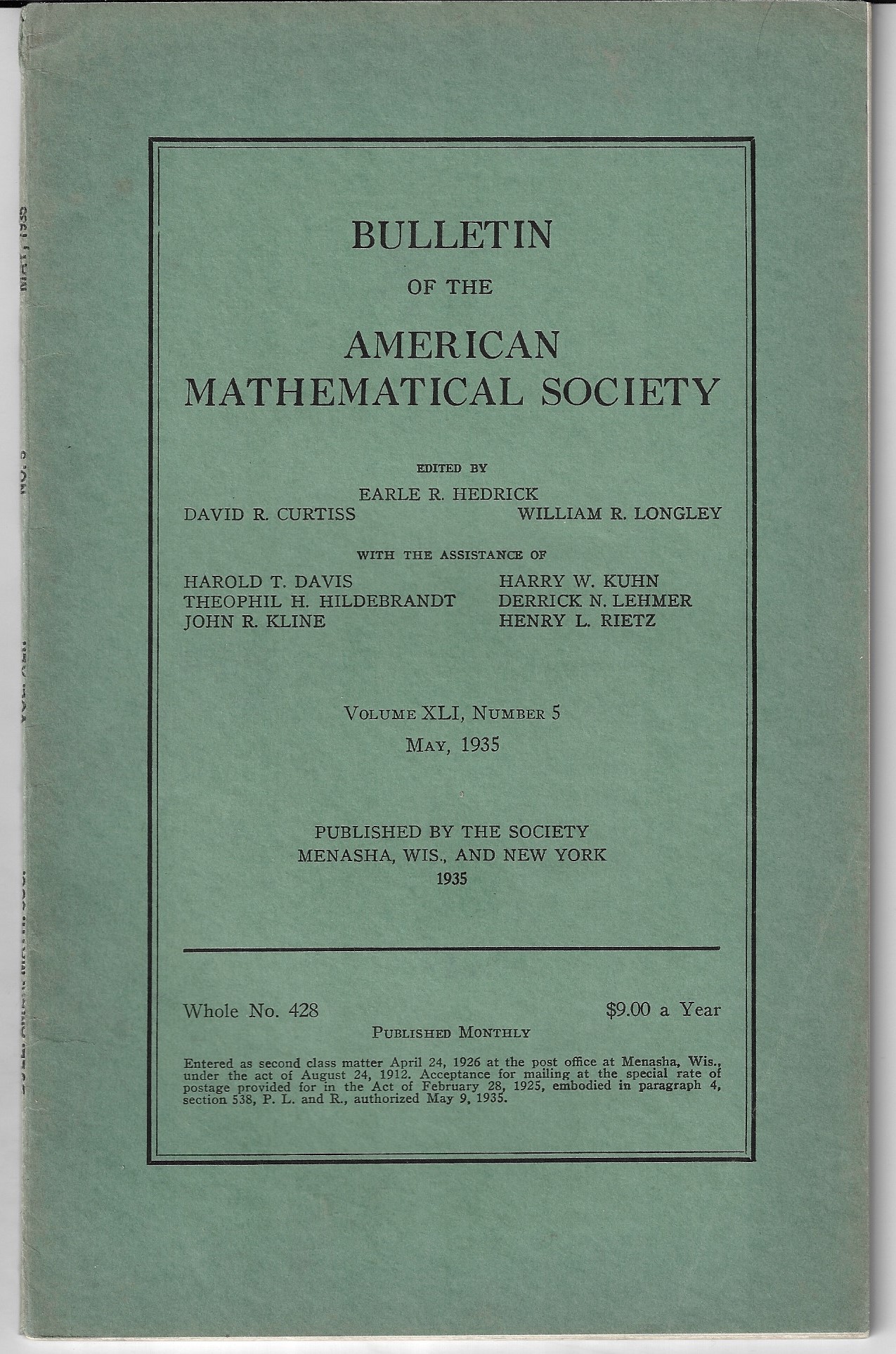
    Von Neumann AMS(John von Neumann)  “Representations and ray-representations in quantum mechanics”.  250-word abstract from the Pittsburgh Symposium on Group theory and Quantum Mechanics, published in the Bulletin of the American Mathematical Society, volume XLI, number 5, May 1935, page 350.  Offered is the entire issue pp 305-352, in the original printed wrappers. 

    Very Good copy.  $75

    See:

    Muraskin Murray, Brody F, Vamos Tibor, editors, The Neumann Compendium, appendix 2 (abstracts presented to the AMS), p 680 and p 49 #4 of bibliography.

    Hans Primas, Knowledge and Time, p 402

    ·Posted by :

    ·in:


  • The Klein-Gordon Equation (1926)

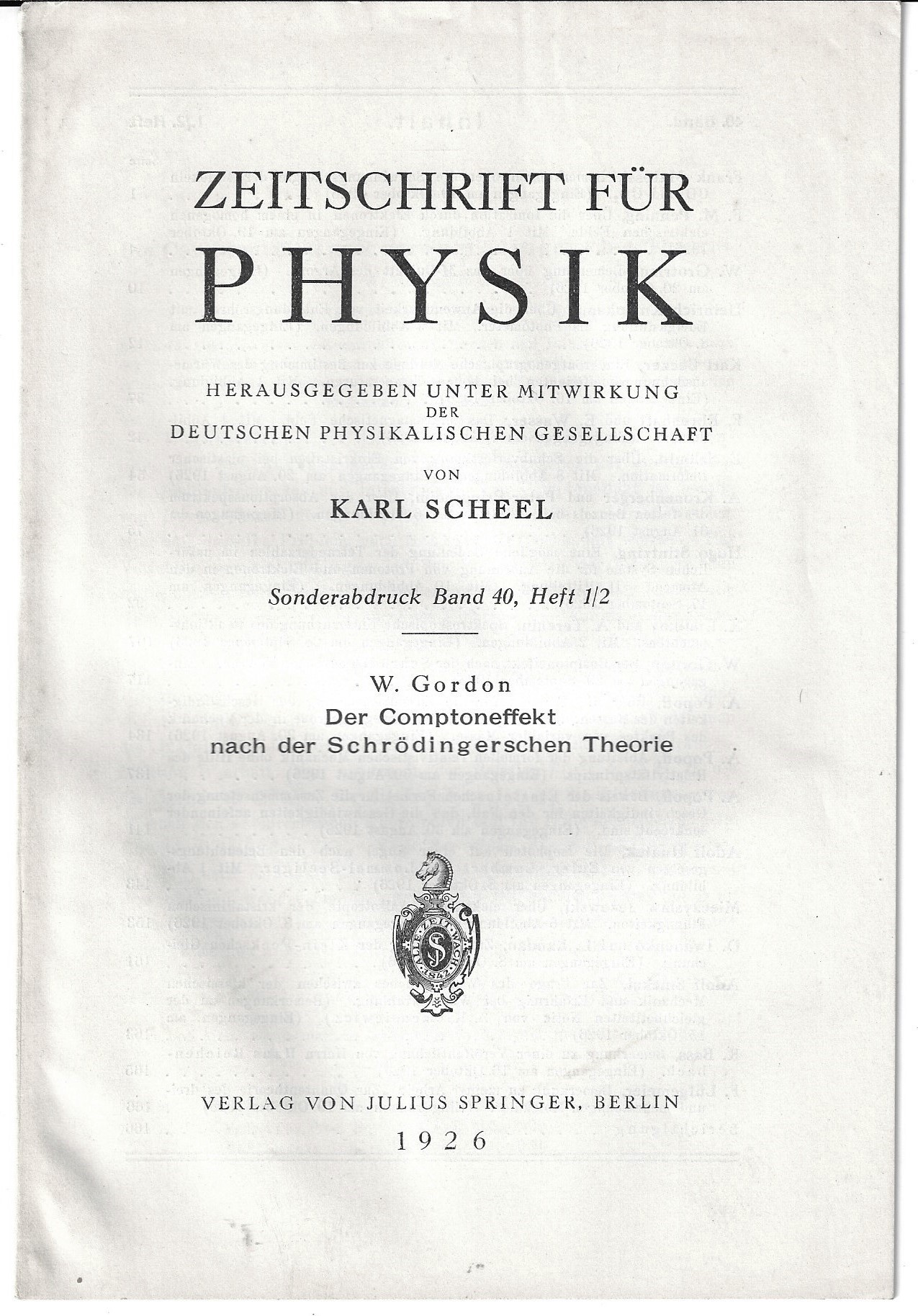
    Gordon Walter ComptoneffektW(alter) Gordon, Der Comptoneffekt nach der Schrödingerschen Theorie”, offprint from Zeitschrift fur Physik, 40, 1-2, Berlin, Julius Springer, 1926, pp 117-133. Original wrappers. Very Good.  SOLD


    “…the Klein–Gordon equation correctly describes the spinless relativisitic composite particles, like the pion. On July 4, 2012 CERN announced the discovery of the Higgs boson. Since the Higgs boson is a spin-zero particle, it is the first observed ostensibly elementary particle to be described by the Klein–Gordon equation.”–Wiki

    See also:

    • H. Kragh: “Equation with Many Fathers, the Klein-Gordon Equation in 1926”, AmJ Phys 52(100), pp 1024, 1984.  (Also citing Vladimir Fock, Johann Kudar, Théophile de Donder and Frans-H. van den Dungen, and Louis de Broglie. )
    • Weisstein, Eric W. “Klein-Gordon Equation.” From MathWorld–A Wolfram Web Resource.
    • Jiří Bičák, Tomáš Ledvinka, eds: Relativity and Gravitation: 100 Years after Einstein in Prague, p. 268.
    • Victor E. Borisenko, Stefano Ossicini, What is What in the Nanoworld: A Handbook on Nanoscience and Nanotechnology

    ALSO:

    W(alter) Gordon, “Zur Lichtfortpflanzung nach der Relativitätstheorie”, offprint from Annalen der Physik, IV/72, 1923, published by Barth in Leipzig., p (421)-456. Original wrappers. Very Good.  SOLD

    “…the main reason why Gordon’s paper should have been considered at the time of its appearance and remembered thereafter is, in our opinion, another one and, to our knowledge, it has remained completely unnoticed by everybody [in spite of 250+ citations?], if one excludes the attentive reviewer of Gordon’s article for “Physikalische Berichte”: that paper contains a clear-cut argument for selecting, through a clever reductio ad vacuum, the stress-energy-momentum tensor of the electromagnetic field in non-dispersive matter, provided that the latter be homogeneous and isotropic when considered in its rest frame “–A forgotten argument by Gordon uniquely selects Abraham’s tensor as the energy-momentum tensor for the electromagnetic field in homogeneous, isotropic matter. S. Antoci and L. Mihich Dipartimento di Fisica “A. Volta” – Pavia, Italy

    ·Posted by :

    ·in:


  • One of the Earliest Reviews on the State of Quantum Theory, 1929-1930

    KEMBLE, Edwin C. “General Principles of Quantum Mechanics, Part I.”  In: the Physical Review Supplement, Studies in Contemporary Physics, October 1929, volume 1 #2, pp 157-215 in the issue of pp 157-240.

    With: Kemble:  “General Principles of Quantum Mechanics, Part II”, in Reviews of Modern Physics, January 1930, volume 2 #1, pp 1-58 in the issue of pp 1-122. 

    Both in the their original printed wrappers.  Very good condition. There is some sort of 1/4″ plastic adhesive (?) on the front hinge of both issues…I’m not sure if these actually re-enforce the pamphlet, or not, but they don’t seem to make much of an impact appearance-wise.  $150, the pair.

    It is interesting to see these early issues of the Reviews of Modern Physics–especially the vol 1/2 issue under the Physical Review Supplement, which would soon changes its name to the RMP.  Kemble evidently did a service to the physics community with these well-received papers, coming at a time when there were not many writing in this area . (H. Krage points out in Quantum Generations  p. 171) that of the 284 papers published in that year (from among the 2400 members and fellows of the APS) that only 45 of them concerned themselves with quantum theory.)  Abraham Pais states in Subtle is the Lord that the Kemble paper is the first reviewing the state of quantum mechanics at the end of the decade…and at first blush, this seems to be not the case as a review of the subject, though that feeling (for me) is quickly disassociated. (There are some interesting references int eh footnotes, including some that are unexpected to me, at least, like a Bridgman paper cited from Harper’s Magazine from March 1929.  In any event if you’re not familiar with this paper it is available online and is at least worth a peek for the footnotes.) 

    ·Posted by :

    ·in: