A Daily History of Holes, Dots, Lines, Science, History, Math, Physics, Art, the Unintentional Absurd, Architecture, Maps, Data Visualization, Blank and Missing Things, and so on. |1.6 million words, 7500 images, 4.9 million hits| Press & appearances in The Times, Le Figaro, Mensa, The Economist, The Guardian, Discovery News, Slate, Le Monde, Sci American Blogs, Le Pont, and many other places… 5000+ total posts since 2008.

Book Category: Quantum Theory

  • The Complete Sextet of Schwinger Papers on Quantized Fields, 1951-1954

    Julian Schwinger. Theory of Quantized Fields, I-VI, six parts in five issues, 1951-1954.

    “On 13 June 1978 the Nobel laureate Chen Ning Yang wrote the following to the chairman of the physics department at the University of California, Los Angeles (UCLA) to support Julian Schwinger’s appointment as professor: ‘Professor Julian Schwinger is among the great physicists of the contemporary era. His work covers an amazing range, from nuclear physics to elementary particle physics to field theory, from synchrotron radiation to group theory to microwave propagation.… The most important work of Schwinger was his contribution to renormalization, a contribution that stands among the greatest developments in physics in mid-twentieth century. Professor Schwinger is an eminently successful teacher. He probably has graduated more influential theoretical Ph.D. students than any other living physicist’.”-DSB

    Including:

    “Theory of Quantized Fields. I”. In Physical Review, vol 82 number 6, June 15, 1951. Pp 914-927 in the issue of pp 777-1016. Original wrappers. VG/VG+ copy.  Copy of Al Wattenberg, with his “AW” in the upper right corner.  1000+ citations. 

    “Theory of Quantized Fields. II and III” In Physical Review, volume 91 number 3, August 1, 1953, pp 713-728 and 728-740 in the issue of pp 505-772. Original wrappers. This issue has some problems with the spine cover and the inch or so onto the front wrapper a sort of damp staining or some such. Copy of Al Wattenberg, with his signature on the upper right front wrapper.

    “Theory of Quantized Fields. IV.” In Physical Review,  volume 92 number 5, December 1, 1953, pp 1283-1300 in the issue of pp 1101-1329. Original wrappers. Fine copy.  

    “Theory of Quantized Fields. V.” In Physical Review, volume 93 number 3, February 1, 1954, pp 615-628 in the issue of pp 365-651.  Original wrappers. VG/VG+ copy.  

    “Theory of Quantized Fields. VI.”  In Physical Review, volume 94 number 5, June 1, 1954, pp 1362-1384 in the issue of pp 1091-1444.  Original wrappers. Fine copy. 

    The five issues: $750
    ·Posted by :

    ·in:


  • A Great Moment in the History of Quantum Mechanics (Niels Bohr, 1928)

    Niels Bohr, “Das Quantenpostulat und die neurere Entwicklung der Atomistik”, in Die Naturwissenschaften, volume 16, part 15, 13 April 1928, pp 245-255 in the issue of pp 245-268. This is the complete weekly issue, without the wrappers, removed from a larger bound volume. Very Good condition.  $500

    ”From the epistemological point of view, the discovery of the new type of logical relationship that complementarity represents is a major advance that radically changes our whole view of the role and meaning of science. In contrast with the nineteenth-century ideal of a description of the phenomena from which every reference to their observation would be eliminated, we now have the much wider and truer prospect of an account of the phenomena in which due regard is paid to the conditions under which they can actually be observed—thereby securing the full objectivity of the description, since the description is based on purey physical operations intelligible and verifiable by all observers. The role of the classical concepts in this description is obviously essential, since those concepts are the only ones adapted to our capabilities of observation and unambiguous communication.

    ·Posted by :

    ·in:


  • Nobel Prize Effort at the Beginning of Quantum Electrodynamics–the Lamb Shift, 1947

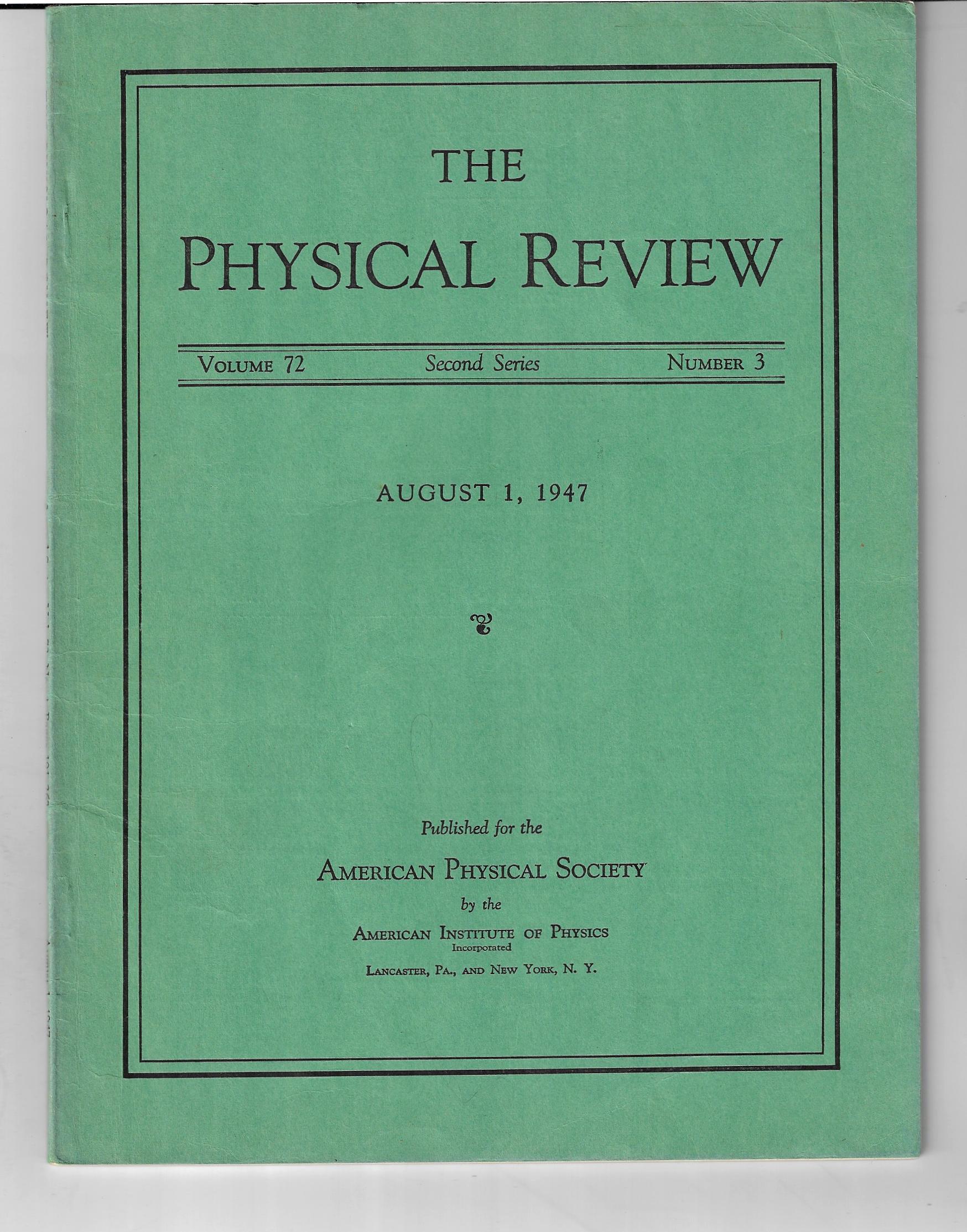
    Lamb, Willis E. And Robert C. Retherford, “Fine Structure of the Hydrogen Atom by a Microwave Method”. In Physical Review, volume 72, number 3, August 1, 1947, pp 241-243, in the issue of pp 189-261. Fine copy in the original wrappers. $1000

    _____. Another copy, not quite as nice. Very Good.  $750


    The Lamb Shift and the beginning of quantum electrodynamics. Lamb won the Nobel Prize in Physics in 1955 for his discoveries related to the Lamb shift.

    • “…it became clear that a new chapter in physics was upon us.” A. Pais, Inward Bound, relating Lamb delivering his report at Shelter Island, p 451.

    PR 1947 Lamb shift
    “This effect was first measured in 1947 in the Lamb–Retherford experiment on the hydrogen microwave spectrum and this measurement provided the stimulus for renormalization theory to handle the divergences. It was the harbinger of modern quantum electrodynamics developed by Julian Schwinger, Richard Feynman, Ernst Stueckelberg, Sin-Itiro Tomonaga and Freeman Dyson.”

    “On Lamb’s 65th birthday, Freeman Dyson addressed him as follows: “Those years, when the Lamb shift was the central theme of physics, were golden years for all the physicists of my generation. You were the first to see that this tiny shift, so elusive and hard to measure, would clarify our thinking about particles and fields.”–Wikipedia on the Lamb Shift

    Elsewhere Dyson referred to the best place for experiment in physics to be in the world at that time was Columbia, with Rabi in charge, and where Lamb (Ph.D. under Oppenheimer) was doing his work on the hydrogen atom. In an interview Dyson remarked that hydrogen was the “most deeply explored” object in science, and that “if you don’t understand the hydrogen atom, then you don’t understand anything”. When Lamb—using the new microwave measuring capacities—found that there was a discrepancy between theory and experiment regarding the hydrogen spectrum it was found to be, well, “deeply disturbing”.–quotes from Freeman Dyson on https://www.webofstories.com/play/freeman.dyson/64

    • This paper reprinted in Quantum Electrodynamics edited by Julian Schwinger (1958) paper 26.

    ·Posted by :

    ·in:


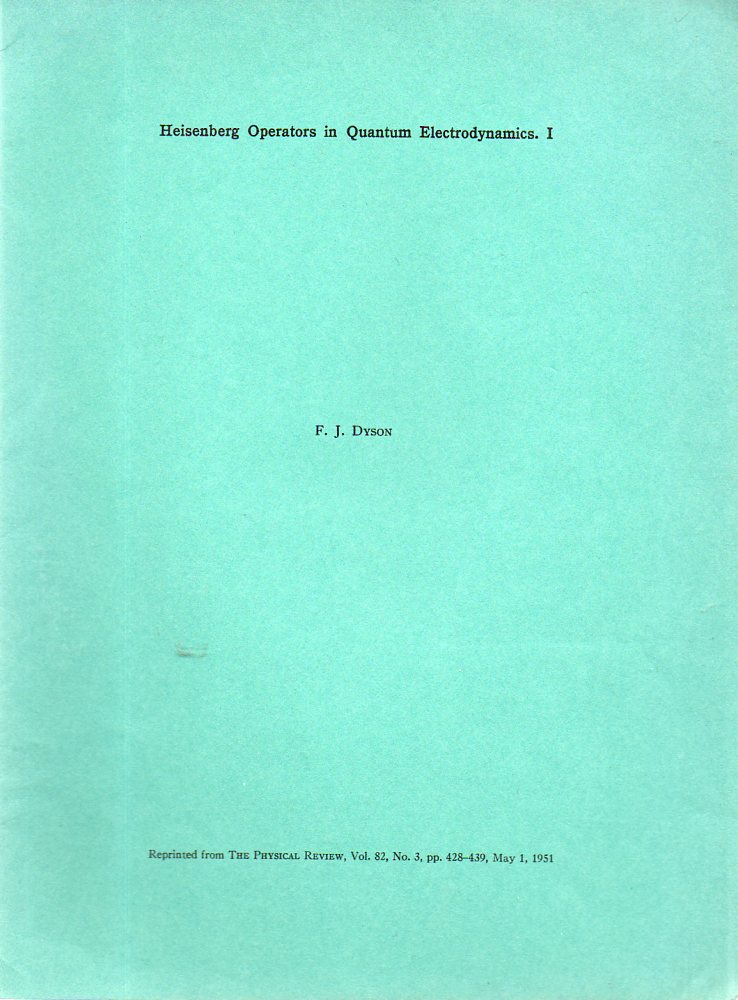
  • Freeman J Dyson Heisenberg Operators In Quantum Electrodynamics I Offprintthe Physical Review Vol 82 No 3 Pp 428 439

    Freeman J. Dyson.  “Heisenberg Operators in Quantum Electrodynamics, I.”  Offprint: The Physical Review, vol 82, no 3, pp 428-439, May 1, 1951.  Fine copy in the original wrappers.  $175  

    • “A new analytic continuation principle is described, by means of which the calculation of matrix elements of Heisenberg operators in any quantized field theory is greatly simplified. By a “Heisenberg operator” is meant an average over a finite space-time region of a field operator in the Heisenberg representation of the theory. The analytic continuation is made by varying the characteristic masses of the fields through real values. In this way a Heisenberg operator with the physically occurring masses is derived from an operator calculated with very large fictitious masses. In the region of large masses, where real creation of particles is impossible, the operator is identical with the S-matrix for a suitably chosen scattering problem. The calculation reduces to the calculation of an S-matrix, to which the techniques of Feynman are directly applicable. “–Physical review Journals abstract online.
    • Also see Silvan S. Schweber,  QED and the Men who Made it: Dyson, Feynman, Schwinger, and Tomonaga, p 556.

    Note: the faint white vertical stripe was made by the scanner and does not exist on the original. 

    Dyson314

    ·Posted by :

    ·in:


  • A Fundamental Paper in the History of Quantum Mechanics


    Bose-Einstein Statistics

    BOSE, S.N. “Plancks Gesetz und Lichtquantenhypothese”, (Planck’s Law and Light Quantum Hypothesis) in Zeitschrift für Physik , vol. 26, issue 1, pp. 178-181, 1924. Offered in the full volume, bound with volume 27, comprising 401+395pp.   Very pretty copy, in period cloth and marbled boards with cloth tips; institutional bookplate, and faded rubber stamp on the title page. About a fine copy. $1150

     “Discovery of new statistical counting rules for light quanta and a new derivation of Planck’s radiation law. Known as Bose-Einstein quantum statistics for particles with integer spins.” —Particle Physics: One Hundred Years of Discoveries

     “…the work is of the uttermost significance. As Bose himself put it when writing to Einstein:

    “Respected Sir, I have ventured to send you the accompanying article for your perusal and opinion. You will see that I have tried to deduce the coefficient .. in Planck’s law independent of classical electrodynamics.’

    “Not only did Bose try, but he succeeded spectacularly, deriving the law from which quantum mechanics sprang without any recourse to classical physics.

    “When Einstein then extended this idea to describe the monoatomic ideal gas, he deduced the existence of an exotic state of matter that is now know as Bose-Einstein condensate.  Neither Bose nor Einstein would live to see this confirmed experimentally.  It took until 1995 for technology to catch up to the theoretical insight of these titans of physics.”–from the Wavewatching website, http://wavewatching.net/lost-papers

    BOUND WITH:

    • FERMI.  “Uber die Wahrescheinlichtkeit der Quantenzustande”, vol 26, pp 54-57
    • HEISENBERG. “Uber den Einfluss der Deforierbarkeit der Ionen auf optisch und chemische Konstantin III.” Pp 196-204
    • HEISENBERG. “Ueber eine Abanderung der frmalen Regeln der Quantentheorie…” Pp 291-308
    • BORN. “Uber Quantenmechanik”. pp 379-395.
    • Plus other contributions by Hhn/Meitner, Meitner, Gerlach, Frenkel, Freundlich, Schottky, and many others.
    • ALSO bound with, in volume 27:
    • EINSTEIN. “Zur Theorie der Radioemterkrafte”, pp 1-6. 
    • And other contributions by Geiger, Nordheim, Lande, Gans, Bose and others.  

    ·Posted by :

    ·in: