A Daily History of Holes, Dots, Lines, Science, History, Math, Physics, Art, the Unintentional Absurd, Architecture, Maps, Data Visualization, Blank and Missing Things, and so on. |1.6 million words, 7500 images, 4.9 million hits| Press & appearances in The Times, Le Figaro, Mensa, The Economist, The Guardian, Discovery News, Slate, Le Monde, Sci American Blogs, Le Pont, and many other places… 5000+ total posts since 2008.

Book Category: Astronomy

  • Oppenheimer, Gamow, Feynman, Szilard, Bohr, Bethe, Rabi, and others in the Monumental “Physical Review” for 1939


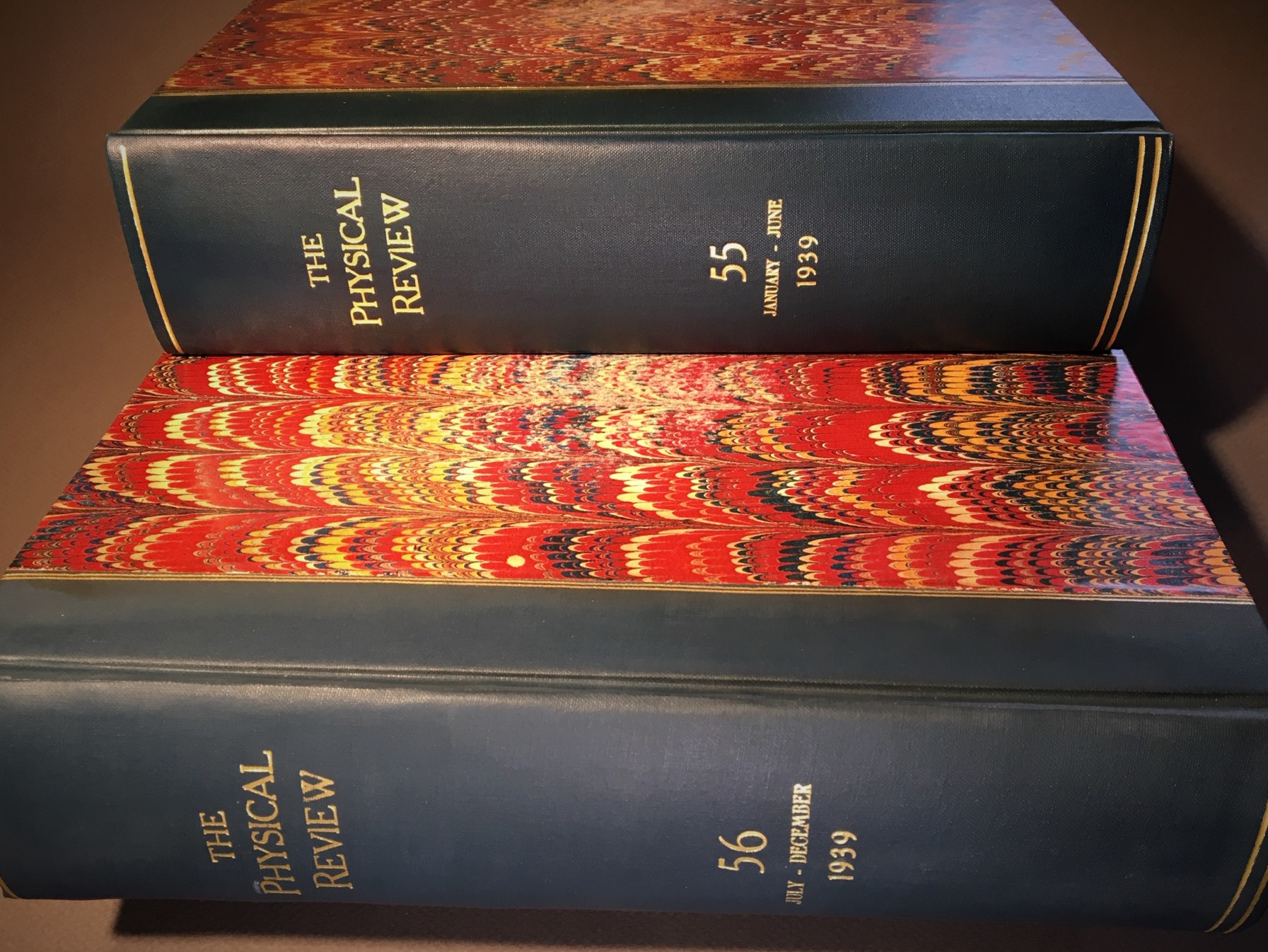
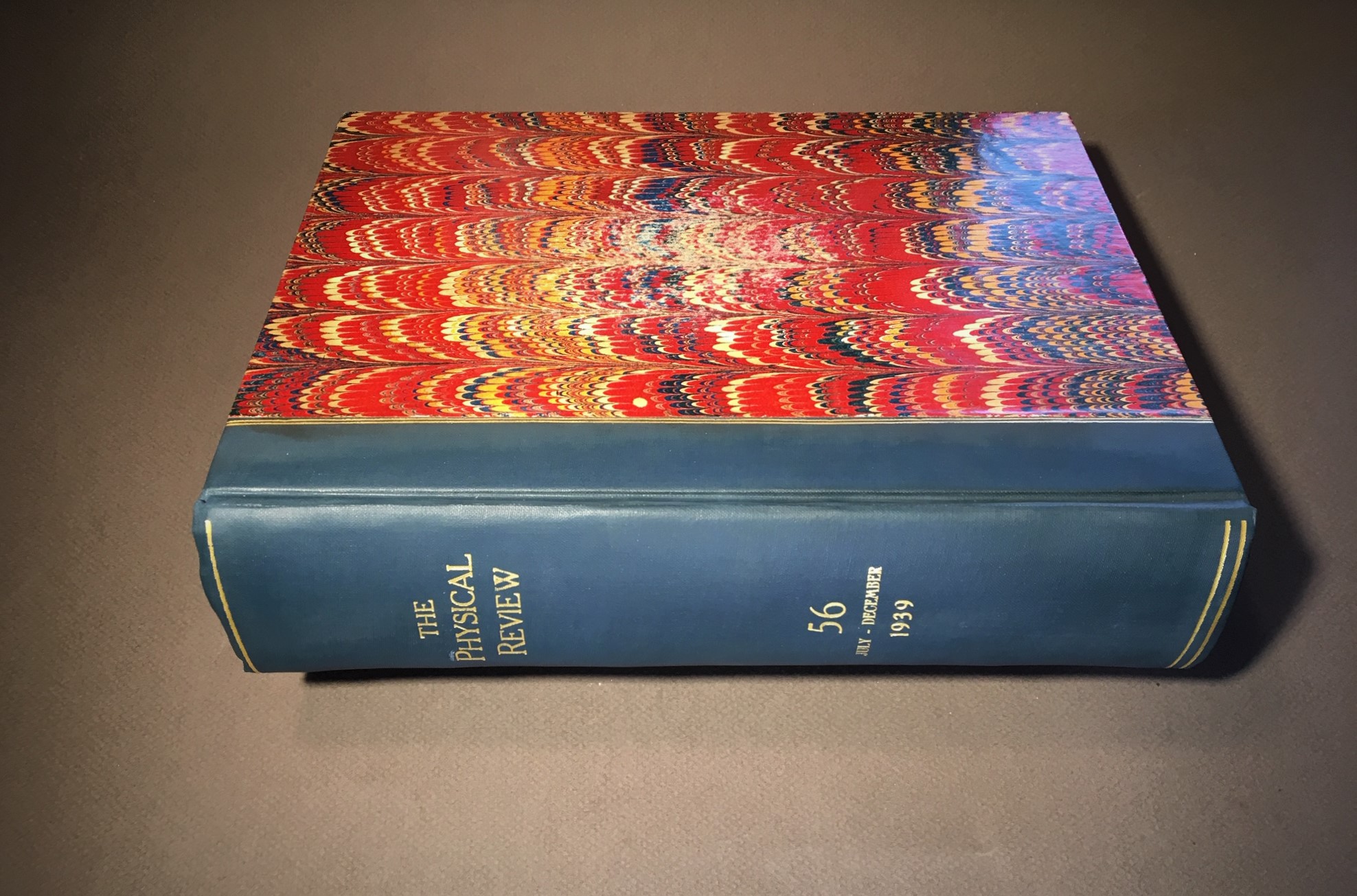
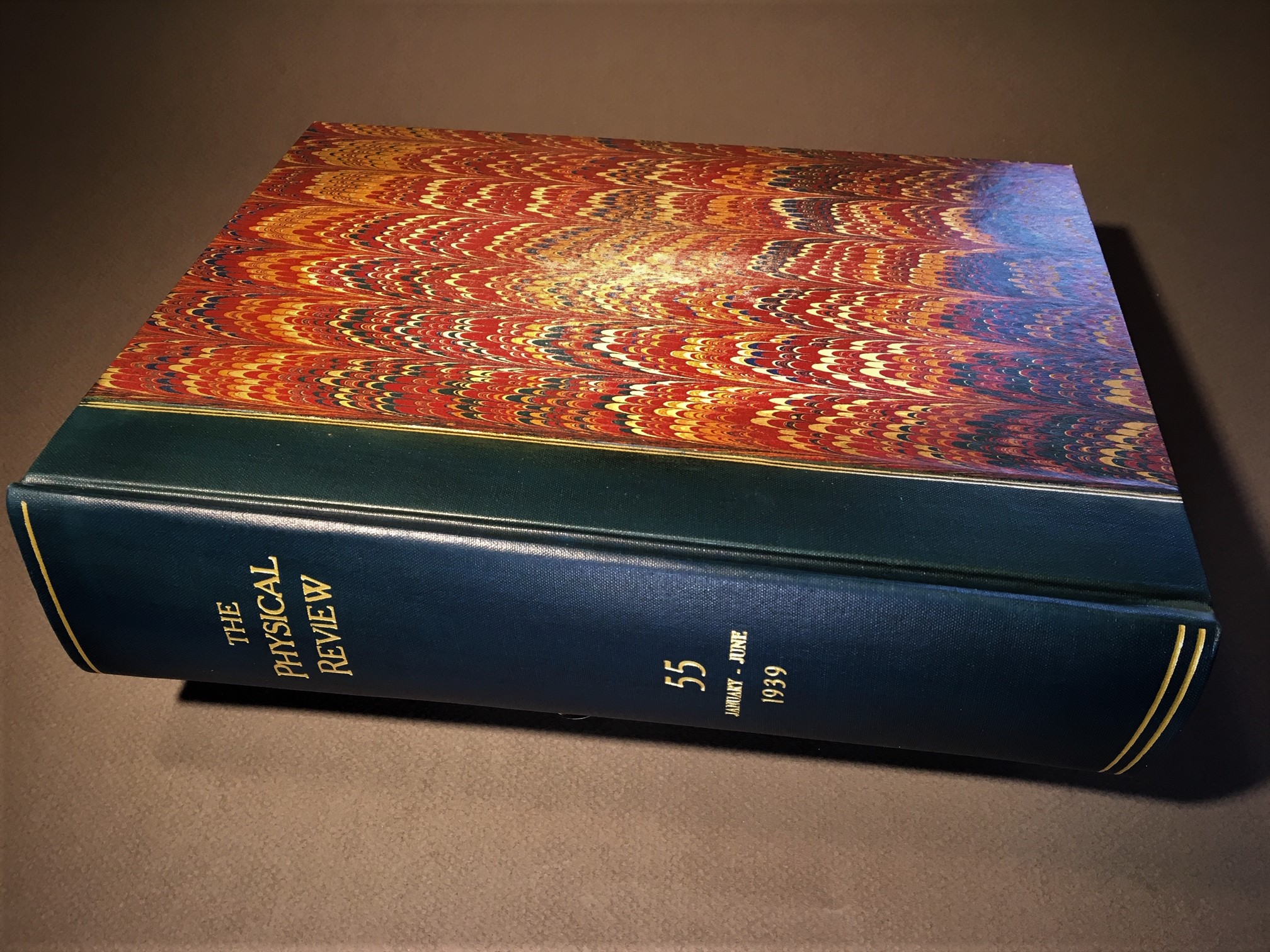
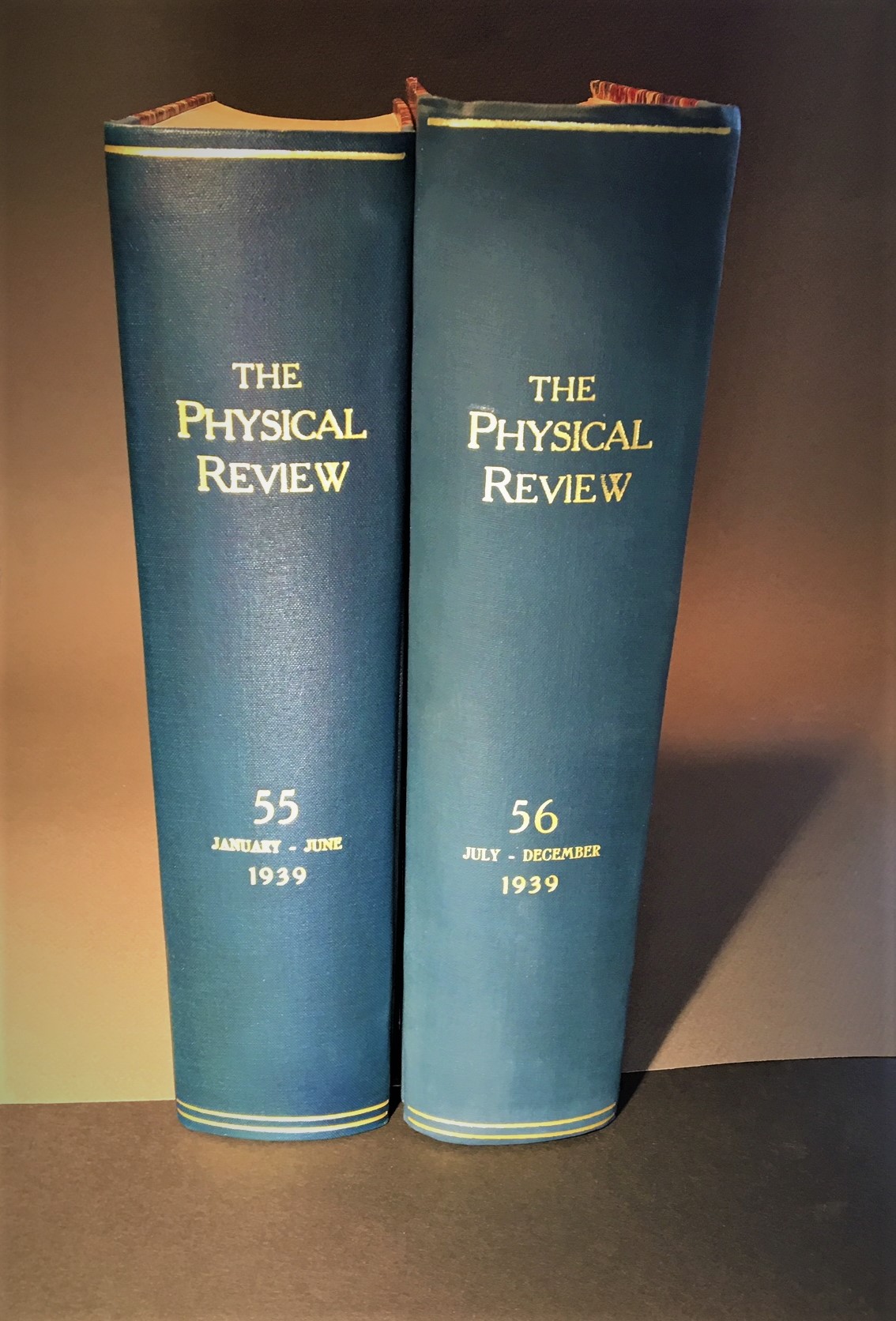
    OPPENHEIMER, J. Robert. “On continued gravitational contraction” and many other papers offered in one monumental year of the Physical Review for 1939.

    American Physical Society, Lancaster Pa., January-December 1939. Two volumes: x, 1294pp & x,1300pp. The two volumes, complete. Finely and sturdily rebound in cloth and marbled boards. Very stout, readable volumes. Fine condition. Few scant ownership stamps on some of the individual issues’ first page. $2250

    This is a remarkable volume for one of the most electrifying years in the history of modern phsyics, ranking alongside the great years of 1859, 1932, and 1948 for the sheer weight of highly significant papers from many sources. Included are papers by Oppenheimer, Gamow, Feynman, Szilard, Bethe, Rabi, Anderson, Tolman, Morrison, Kusch, Abelson, and many others. Astonishing, really.

    Some of the most significant papers include:

    OPPENHEIMER, Robert and Hartland Snyder, “On continued gravitational contraction”, September 1, 1939, Vol. 56, #5, pp. 426-50  The Oppenheimer and Snyder (a graduate assistant) paper is one of the most prescient in the history of modern physics, correctly physically describing (where Chandrasekhar and Eddington in their discussions did not) what happens in a particular collapse of a neutron star, and still today reads as fresh and and brightly as it did in 1939.  Really, it is an extraordinary work, and a foundation paper in the history of gravitation, the application of RT, singularity, and astrophysics.  (The Southampton GR Explorer site nicely states it this way: “This paper has strong claims to being one of the most prophetic ever written in this field of research. Today, 60 years later, this paper needs little revision – even the terminology is undated!”)

    In an often-repeated quotation, they write, somewhat in irony and in a certain and understated manner on page 456: “The star thus tends to close itself off from any communication with a distant observer; only its gravitational field persists”. And later: “When all thermonuclear sources of energy are exhausted, a sufficiently heavy star will collapse. Unless fission due to rotation, the radiation of mass, or the blowing off of mass by radiation, reduce the star’s mass to the order of that of the sun, this contraction will continue indefinitely”, they wrote.

    Phys Rev Wenner _1_

    BOHR, Niels and J.A. Wheeler, “The mechanism of nuclear fission”, September 1, 1939, Vol. 56, pp. 455-459. This is the experimental foundation stone (on the basis of the liquid drop model of atomic nuclei) of nuclear fission and the great leap forward in the construction of the atomic bomb.

    From the abstract: “On the basis of the liquid drop model of atomic nuclei, an account is given of the mechanism of nuclear fission. In particular, conclusions are drawn regarding the variation from nucleus to nucleus of the critical energy required for fission, and regarding the dependence of fission cross section for a given nucleus on energy of the exciting agency. A detailed discussion of the observations is presented on the basis of the theoretical considerations. Theory and experiment fit together in a reasonable way to give a satisfactory picture of nuclear fission”.

    BOHR, Niels. “Resonance in Uranium and Thorium Disintegrations and the Phenomenon of Nuclear Fission”;

    BETHE,  Hans.  “Meson Theory of Nuclear Forces.”  Vol 55, 2nd series, number 12; June 15, 1939, 1261-1264

    BETHE, Hans. “Energy Production in Stars” no 1. January 1, 1939 -and- “Energy Production in Stars II”, no. 5 March 1, 1939). Awarded the Nobel Prize (the first time the award was given for astrophysics) 1967 “for his contributions to the theory of nuclear reactions, especially his discoveries concerning the energy production in stars”)

    OPPENHEIMER, J. Robert and G.M. Volkhoff in the 15 February 1939 issue. Here (along with a preceding paper by Richard C. Tolman, issued in the same issue just above Oppenheimer, which were the analytic analysis used by O+V to base their estimates of nuclear forces) was established the Tolman-Oppenheimer-Volkhoff limit, which stated that if the state of evolution of  neutrons forming a degenerate Fermi gas of extremely dense masses in neutron stars was more  massive than .07 solar masses that it would collapse into a black hole or exotic/quark star; if the mass was below that limit, the star would not collapse due to the degeneracy pressure of neutrons and the strong force.  The black hole part was left really to a second paper of 1 September 1939 (the day that the Nazis attacked Poland and the fighting began in World War II in Europe) .

    GAMOW, George and Edward Teller, “On the Origin of Great Nebulae”, volume 55, number 7, April 1, 1939, pp 654-657, in the weekly issue of pp 609-671. 

    FEYNMAN, Richard. “Forces in Molecules”, pp. 340-43. Feynman’s undergraduate thesis at MIT, know known as Feynman-Hellmann theorem – “This work treated the problem of molecular forces from a thoroughly quantum-mechanical point of view, arriving at a simple means of calculating the energy of a molecular system that continues to guide quantum chemists.” (Complete DSB online)
    Phys Rev Wenner _1_
    Phys Rev Wenner _1_

    SLIZARD, Leo and ZINN’s landmark “Instantaneous Emission of Fast Neutrons in the Interaction of Slow Neutrons with Uranium” confirmed ‘instantaneous’ neutron multiplication, showing that it meets the requirement for nuclear bombs. Some argue this is one of the most important papers in atomic/nuclear physic

    ANDERSON, Herbert L, Fermi, Enrico & Hanstein, H. B. “Production of Neutrons in Uranium Bombarded by Neutrons”, vol 55, pp. 415-419;

    TOLMAN, Richard, “Static Solutions of Einstein’s Field Equations for Spheres of Fluid”, vol 55, pp. 799-800;

    RABI, I, Millman, S., Kusch, P. & Zacharias J. R. “The Molecular Beam Resonance Method for Measuring Nuclear Magnetic Moments ()”, vol 55, pp 526-535;

    WEISSKOPF, Viktor. “On the Self-Energy and the Electromagnetic Field of the Electron”, 56 No. 1 pp. 72–85, July 1, 1939 . Also bound in the same issue with:   “Weisskopf demonstrates that QED diverges at all levels of perturbation theory.” –This paper reproduced in full as paper 6 in Julian Schwinger’s Selected Papers on Quantum Electrodynamics. See also Jo Bovy (Ghent University), 

    ABELSON, Philip. “Investigation of the Products of the Disintegration of Uranium by Neutrons”, July 1, 1939, pp 1-9.

    RABI, I.I., Kellogg, J. M. B. “The magnetic moment of the proton and the deuteron. The radiofrequency spectrum of H2 in various magnetic fields” , vol. 56, No. 8., pp 728-743.
     

    Phys Rev Wenner _1_

    ·Posted by :

    ·in:


  • With Views from the Surface of the Moon (1868)

    Henry Morton, “Sunlight and Moonlight”, an 11-part article over two volumes in Journal of the Franklin Institute, vol 56 (third series) vol 76 (overall), 1868, 426pp overall. Bound in half calf and marbled boards. Ex-library with a few stamps on title page. The binding has a set of problems, mainly with the front board being nearly detached, and the first two pages are detached. Fair/Good condition. Two volumes, $225

    The Morton occupies is located on pp 59-64 (with a lovely plate showing a view across the crater Copernicus), 131-136 (with folding photographic map of the Moon), 201-203 (with a plate of lovely lunar shadows), 274-277 (with a beautiful plate of a lunar vista on the surface of the Moon), 349-351 (with a plate of Mars), and continued in the next volume.

    C.S. Lyman, “A New Form of Wave Apparatus”, pp 187-194.

    Octave Chanute, Pneumatic Bridge Foundations, continued from a previous vol and here occupying pp 17-28 (with three plates), 89-99; Chanute is mainly remembered for his work in aeronautics and his influence on the Wright brothers, though some of his technical work wound up being incorrect, something the Wright’s discovered on their own but were loathe to publish on it.

    John Mayer, “Nitro-Glycerine: its Claims as a New Industrial Agent”, pp 40-45, 119-123.

    And many others.

    Morton, Henry. Sunlight and Moonlight”, in the Journal of the Franklin Institute, vol 57 (third series) vol 77 (whole series), 1869, 424pp complete.  Half calf and marbled boards; nice condition, ex-library with a few stamps on the title page. G-VG condition.  The Morton article is continued from p. 418 vol 56, and occupies pp 65-69 (with a plate), 133-135, 204-208 (with a plate), 274-275, 344-347 (and a plate), 414–420 (concluded).

    De Volson Wood, “History of the Investigation on the Resistance of SOlid Bodies, pp 100-110;

    Charles Emery, The Best Modes of Testing the Power and Economy of the Steam Engine, pp 110-120, 177-184;

    Lewis Leeds, Lectures on Ventilation,  continued from vol 56, pp 65-69, 135-139, 199-204, 276-280,

    J. Norman Lockyer, “Spectroscopic Observations of the Sun”, pp 266-267;

    Total Eclipse of the Sun *August 18, 1868), with a plate, pp 268- 273

    Clemens Herschel, Gauging the Flow of Rivers, pp 305-315, with a plate of the device.


    ·Posted by :

    ·in:


  • IBM Scientific Computation Forum 1948

    COMPUTERS. Grosch, H.R.J., editor. Proceedings Scientific Computation Forum, 1948. Published by IBM, NYC, 1950. 11″x8.5″, 126.  Cloth, in the original plain brown dj. FINE copy in an excellent dust jacket.  $200

    Contributors include: Frank Verzuh, H.R.J. Grosch, Cuthbert Hurd, Francis J. Murray, L.H. Thomas, and numerous others. There is also an unusual paper by George Gamow, Jack Belzer, and Geoffrey Keller, “Dynamics of Elliptical Galaxies”, on pp 67-69.  Much of the content is on the application of computers–as in the use of computers at Naval Proving Ground, Aberdeen, Nautical Almanac Office, Beech Aircraft Corp., GE, Census, and others.

    ·Posted by :

    ·in:


  • Scientific Journal Including an Early Elegy on Isaac Newton (1727)

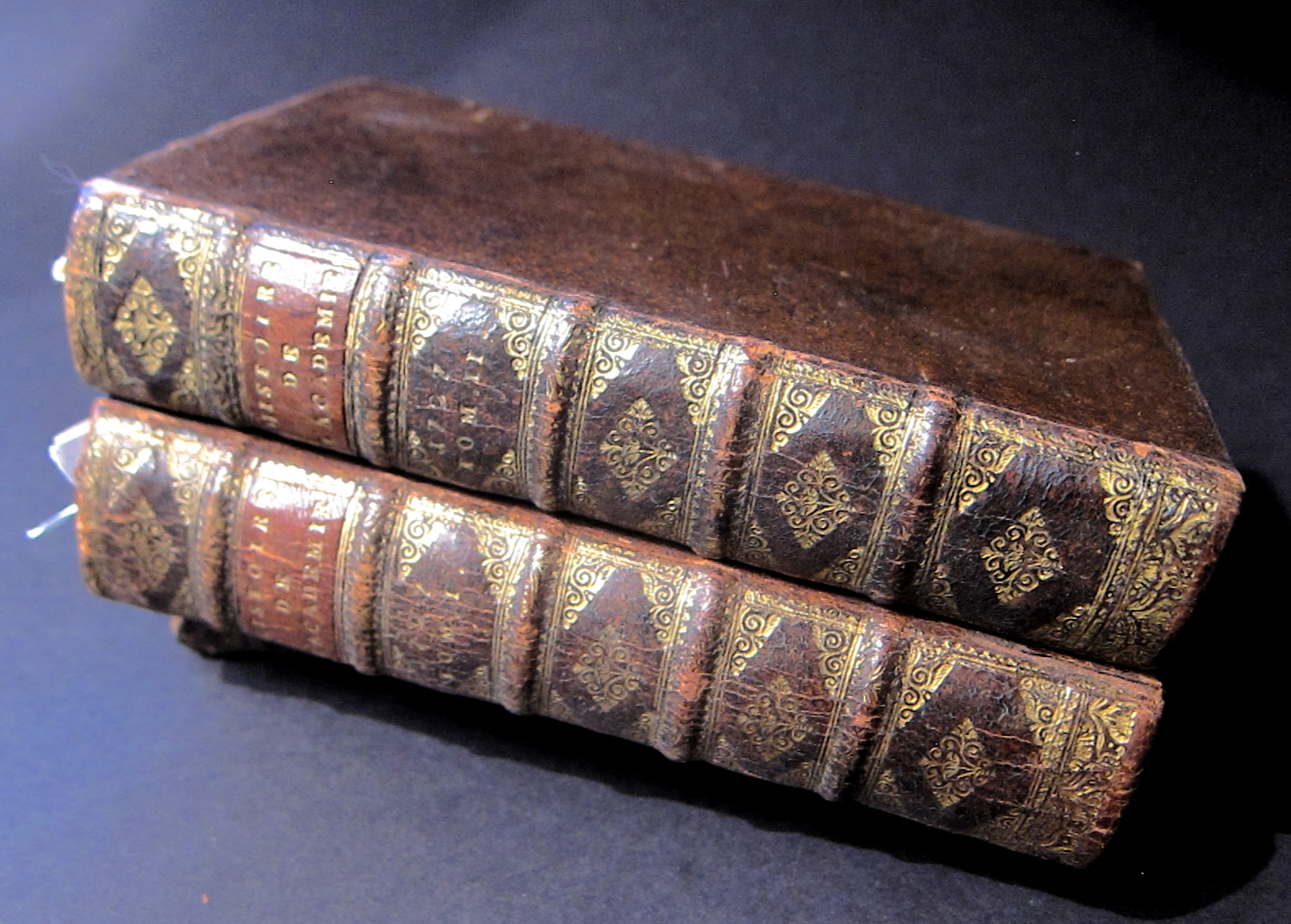
    Histoire de l’Academie Royale des Sciences, annee M.DCCXXVII and bound with Memoires de Mathematique et de Physique. Both: Amsterdam, Pierre Mortier, 1732. 2 volumes: xiv, 1-239; and bound in the same vol, Memoires de Mathematique et de Physique., pp 1-186. And the second volume, pp 189-564. Bound in full calf, raised bands, gilt demtelles. Lovely copies.

    There are a number of interesting papers here, not the least of which includes this long elegy on Newton by the pre-eminent de Fontenelle: Bernard de Fontenelle (1657-1757), Eloge de Newton, pp 209-239 (delivered at the Academy on 12 November 1727 and then published first in Paris in 1729.

    • Also:
    • de Mairan, Dissertation Astronomiques sur le Mouvement de la Lune, et de la Terre , pp 90-152. Cassini, De la Theorie des Cometes , pp 321-345, with two folding plates.
    • Petit, Pour quoi les Enfansne voyentpas clair en venant au monde et quelque tems aprils qu’ils sont nes, pp 346-360;
    • Saurin, Recherches sur la rectification des Barometres , pp 396-417, 2 folding plates.
    • Sloane, Hans. Memoie sur les dents et autres Ossen]mens de l’Elephant, tourves dans Terre.pp 429-472, 2 plates .
    • Maraldi, Explication des tables du premier satellite de Jupiter, pp 493-527. 

    ·Posted by :

    ·in:


  • Wonderful Volume on the Solar Eclipse of 1869, Illustrated with an Original Photograph

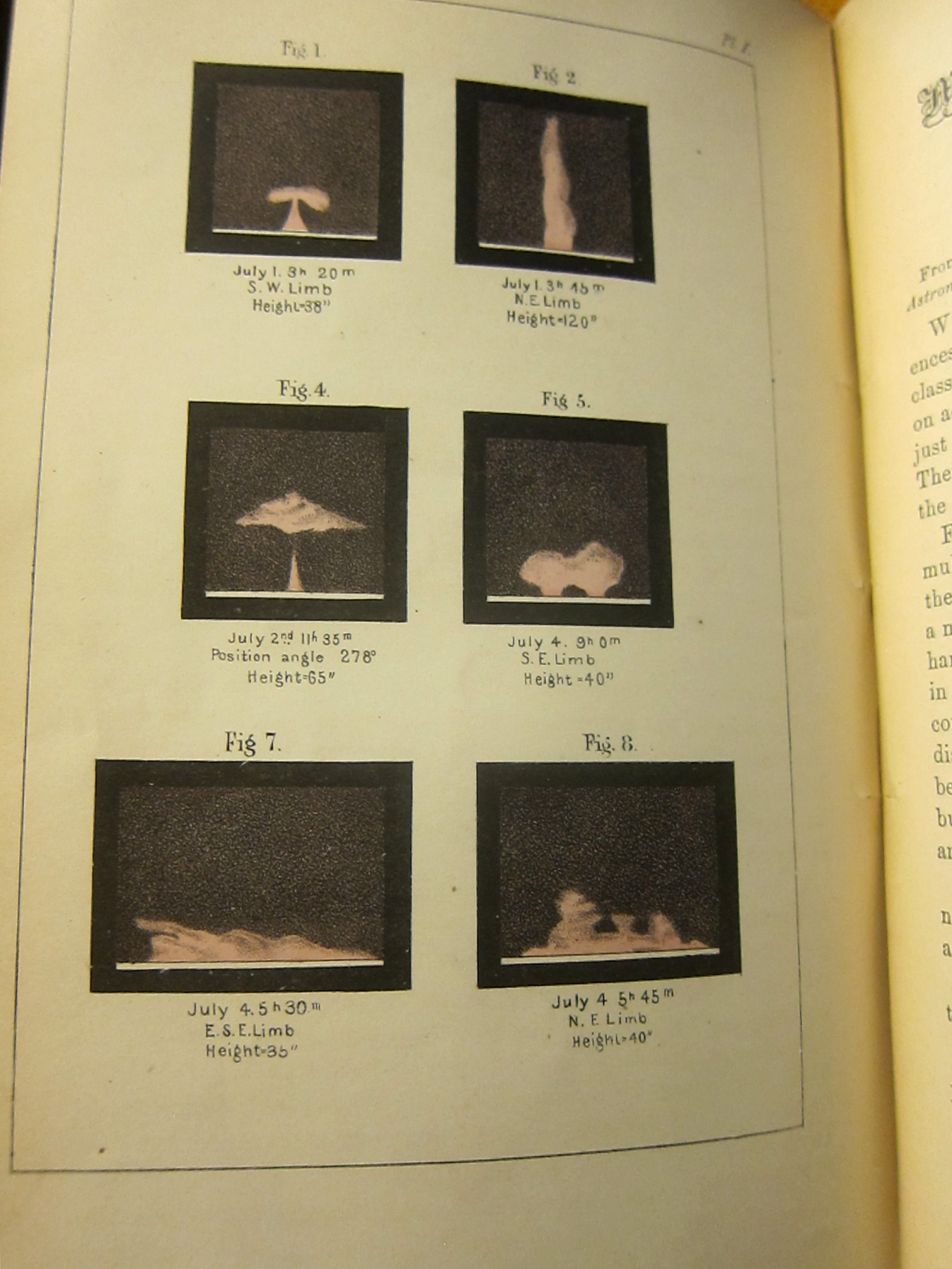
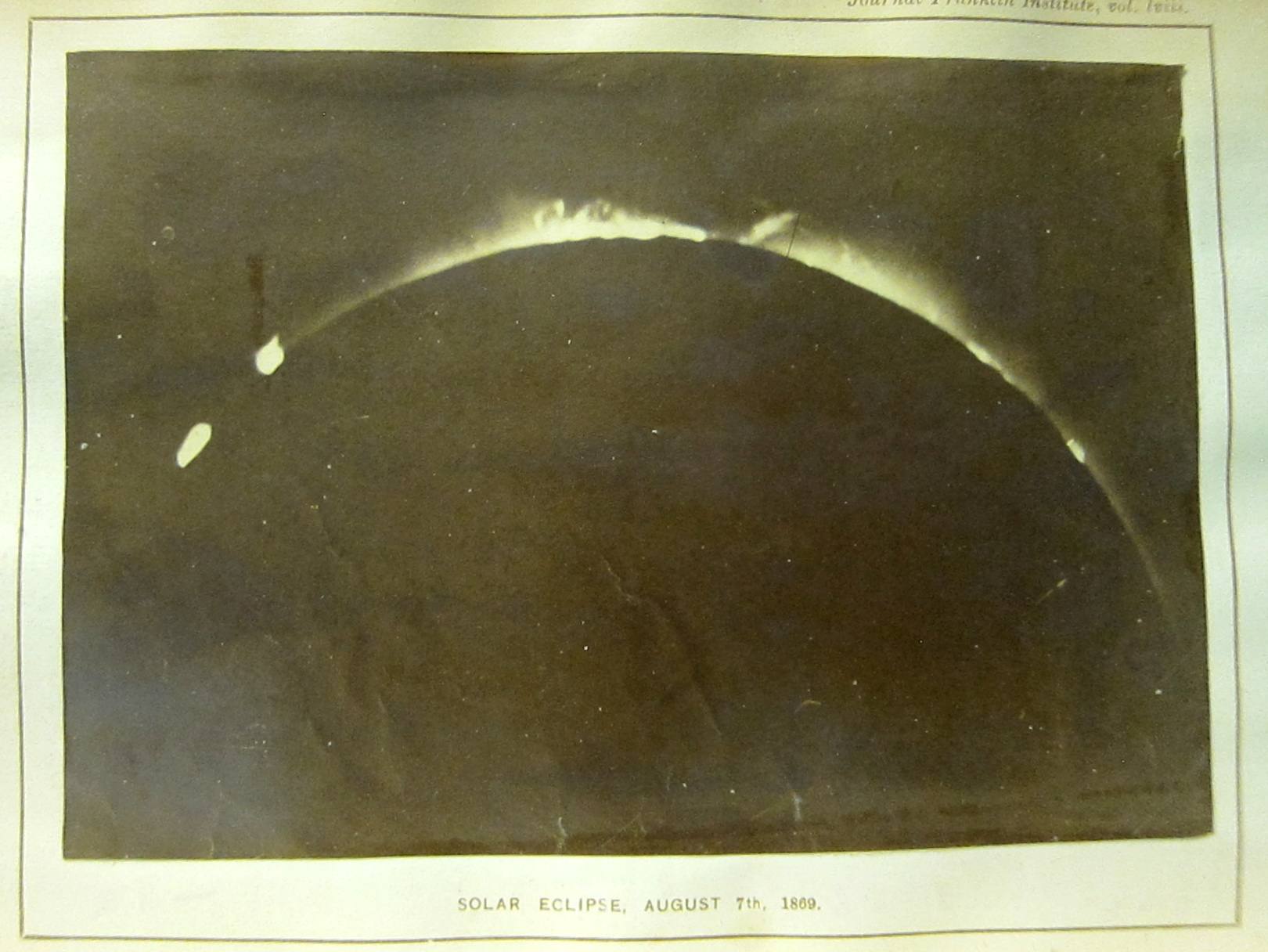
    Henry Morton, “Solar Eclipse—August 7, 1869” (The Philadelphia Expedition”), pp 200-216, 249-275 (with three full page plates), 276-288. This paper is illustrated with what I think is a Woodburytype—a photographic process—of a the solar prominence and is entitled “Solar Eclipse, August 7th, 1869”, measuring 4”x 6” on a plate. It is noted in the paper that the photo is “half of the totality picture”, and is accompanied by a fair amount of description on pp 210-211. In: Journal of the Franklin Institute, Philadelphia, Vol 58 (third series), vol 88 overall, July to December 1869, with text illustrations and illustrations; 426, x pp. Half-calf, with raised bands. Ex-library, with some scuffing on the spine; a few stamps on the title page. Very Good copy. This is an excellent volume on solar eclipses, astrophotography, and instrumentation. $350


    JFI 1869 _2_

    G.A. Majocchi made the first photograph of the partial phase of a solar eclipse in 1842; Berkowski made the first daguerreotype of a total eclipse of the Sun in 1851, and in the same year Secchi made images of the partial phases of the eclipse. Warren de la Rue (whose work is referenced in this paper) photographed the total eclipse of the Sun in Spain in 1860, which places some of the significant aspects of photography and eclipses some decade or two before the appearance of this photo in the JFI in 1869. I cannot locate however any information on the first publication of an original photo of a solar eclipse (full or partial) in a journal or book, though I suspect that the image we have here is at least quite early. The image published in the JFI was one of 13 images made during totality at three different locations (at relatively quick exposure times between 2 and 5 seconds).

    Also appearing here: F. Zollner, “Observations of the Solar Protuberances”, pp 317-319, with two beautiful plates).

    JFI 1869 _2_

    Plus there’s an extended paper by Morton,. “Spectrum Analysis”, pp 56-62, 136-141.

    • Also in this volume are the following interesting papers:

    “The London Water Supply”, pp 169-175;

    William Crookes, “On the Measurement of the Luminous Intensity of Light”, pp 133-135;

    A.S. Herschel, “On the Methods and Recent Progress of Spectrum Analysis”, pp 49-52.

    Lastly, there’s a short notice on the beginning of the work of the New York and Brooklyn Bridge (pp 361-3, this of course would be later called the “Brooklyn Bridge”.

    ·Posted by :

    ·in:


  • Chandrasekhar Subrahmanyan On A New Theory Of Weizsaker On The Origin Of The Solar System In Reviews Of Modern Physics Am

    CHANDRASEKHAR, Subrahmanyan. “On a New Theory of Weizsaker on the Origin of the Solar System”, in Reviews of Modern Physics, American Physical Society, vol 18/1, January 1946,  pp 94-102 in the issue of pp 1-149.  Original wrappers. Fine copy. $200

    “A Nobel Laureate [awarded in 1983 “for his theoretical studies of the physical processes of importance to the structure and evolution of the stars”] honored for his extraordinarily wide-ranging contributions to physics, astrophysics, and applied mathematics, Chandrasekhar is well known for his discovery of the limiting mass (Chandrasekhar limit) of a star that could become a white dwarf.”–Complete Dictionary of Scientific Biography, online. 

    “In 1938, Weizsäcker developed a theory on the formation of the Solar System, based on considerations regarding the unequal share of lighter and heavier elements in the Sun and the Solar System’s terrestrial planets….According to the theory, the Sun and its planets evolved from a gas cloud made up of 99% hydrogen and helium, and 1% of heavier elements. Some 10% of the cloud remained around the Sun as an extensive atmosphere during an initial phase, and the 1% of heavier elements within this 10% of the total mass of the cloud would tally with the fraction of roughly 1% that the planets contribute to the mass of the Solar System today….”–Wikipedia

    Also: a 2pp paper of corrections by Einstein and E.G. Straus “The Influence of the Expansion of Space on the Gravitation Fields Surrounding the Individual Stars”, pp 148-9.  

    ·Posted by :

    ·in:


  • The Universe “Before”: Two Papers by Alexander Vilenkin

    (1)  Alexander Vilenkin, “Cosmological Density Fluctuations Produced by a Goldstone Field”, in “Physical Review Letters” 48 No. 1 pp. 59–61, January 4, 1982. Original wrappers, with a repaired spine; rubber stamp on title page. Near-fine. $300

    “Russian physicist Alexander Vilenkin (born 1949) argued in this paper (cited more than 1100 times) that the universe could have tunneled from “nothing,” eliminating the requirement for the pre-existence of empty space.” The tunneling state is the first state that exists.–David Wenner, History of Physics, the Wenner Collection.

    “A cosmological model is proposed in which the Universe is created by quantum tunneling from “nothing” into a de Sitter space. The tunneling is described by a de Sitter—Hawking—Moss instanton. After the tunneling, the model evolves along the lines of the inflationary scenario. It is argued that at any time there exist parts of the Universe which are still in the de Sitter phase, while other parts have already recollapsed. This model does not have a big-bang singularity and does not require any initial or boundary conditions.”–Abstract from American Physical Society

    Alexander Vilenkin,in an interview for the Tufts U website comments (for another, later, paper on 2003) on the state of the universe in the “before” time: “We looked at three possible scenarios—all of which, by the way, were suggested by the ancient Hindus 3,000 years ago. In one scenario, which the Hindus called “the eternal universe,” multiple beginnings are happening in different places. In scientific cosmology, this more or less corresponds to an idea called eternal inflation. In this case, the universe is expanding very fast, and then Big Bangs happen here and there. These Big Bangs are localized, in bubbles. As these bubbles—each containing a discrete universe—are driven apart, space opens up between them, where new bubbles are created. We live in one such bubble. [All of these universe-containing bubbles make up what cosmologists call the multiverse.] __+__Another idea is a cyclic universe, one that expands, collapses and then starts over again.__+__The third possibility, and the main focus of this paper that I wrote with my student, Audrey Mithani, is the emergent universe, a static universe that sits forever and then somehow bursts open and starts expanding. The Hindus called this “the cosmic egg.” You need some mechanism that will trigger this event, but that’s doable.” AND continuing: “I cannot really claim that I understand the beginning of the universe. We have a picture which kind of makes sense, which I think is an achievement. Because, if you think about it, you say, “OK, what happened before the Big Bang, before inflation?” It seems you can keep asking these questions and the answer is impossible.

    But this quantum creation from “nothing” seems to avoid these questions. It has a nice mathematical description, not just words. There’s an interesting thing, though; the description of the creation of the universe from nothing is given in terms of the laws of physics. That makes you wonder, where are these laws? If the laws describe the creation of the universe, that suggests they existed prior to the universe. The question that nobody has any idea how to address is where these laws come from and why these laws in particular? So there are a lot of mysteries to keep us working.”

    (2) Alexander Vilenkin, “Birth of Inflationary Universes” in “Physical Review D” 27 No. 12 pp. 2848–2855, June 15, 1983. Back repaired. Stamp and stickers on front wrapper. $300

    “Eternal inflation” (new inflation that continues indefinitely) was proposed in 1982 and 1983 by Steinhardt Alexander Vilenkin (born 1949). In eternal inflation, multiple regions of simultaneous inflation create “bubble” or “pocket” universes, each of which creates new inflation, a process that continues ad infinitum. In this theory, our universe is only one of an infinite number of pocket universes that are eternally being created by the continuation of the inflation that created our universe.”–David Wenner, History of Physics, the Wenner Collection.

    “A cosmological model is proposed in which the Universe is created by quantum tunneling from “nothing” into a de Sitter space. The tunneling is described by a de Sitter—Hawking—Moss instanton. After the tunneling, the model evolves along the lines of the inflationary scenario. It is argued that at any time there exist parts of the Universe which are still in the de Sitter phase, while other parts have already recollapsed. This model does not have a big-bang singularity and does not require any initial or boundary conditions.” Abstract via American Physical Society.


    ·Posted by :

    ·in:


  • Riccardo Giacconi Et Al Evidence For X Rays From Sources Outside The Solar System In Physical Review Letters 9 No 1

    Riccardo Giacconi et al, “Evidence for X-Rays From Sources Outside the Solar System”, in Physical Review Letters, 9 No. 11 pp. 439–443, December 1, 1962. Original wrappers. Fine copy. $300

    “Giacconi (b. 1931) announced the discovery of X-rays emissions from the Scorpius constellation thousands of times as energetic as its emissions in the visible spectrum – the first cosmic X-ray source…thus putting (x-ray astronomy) on the map”–David Wenner, The History of Physics Collection, entry on X-Ray Astronomy.

    Giacconi shared the 2002 Nobel prize in Physics “for pioneering contributions to astrophysics, which have led to the discovery of cosmic X-ray sources.”

    ·Posted by :

    ·in:


  • The Background of the Big Bang (1948)

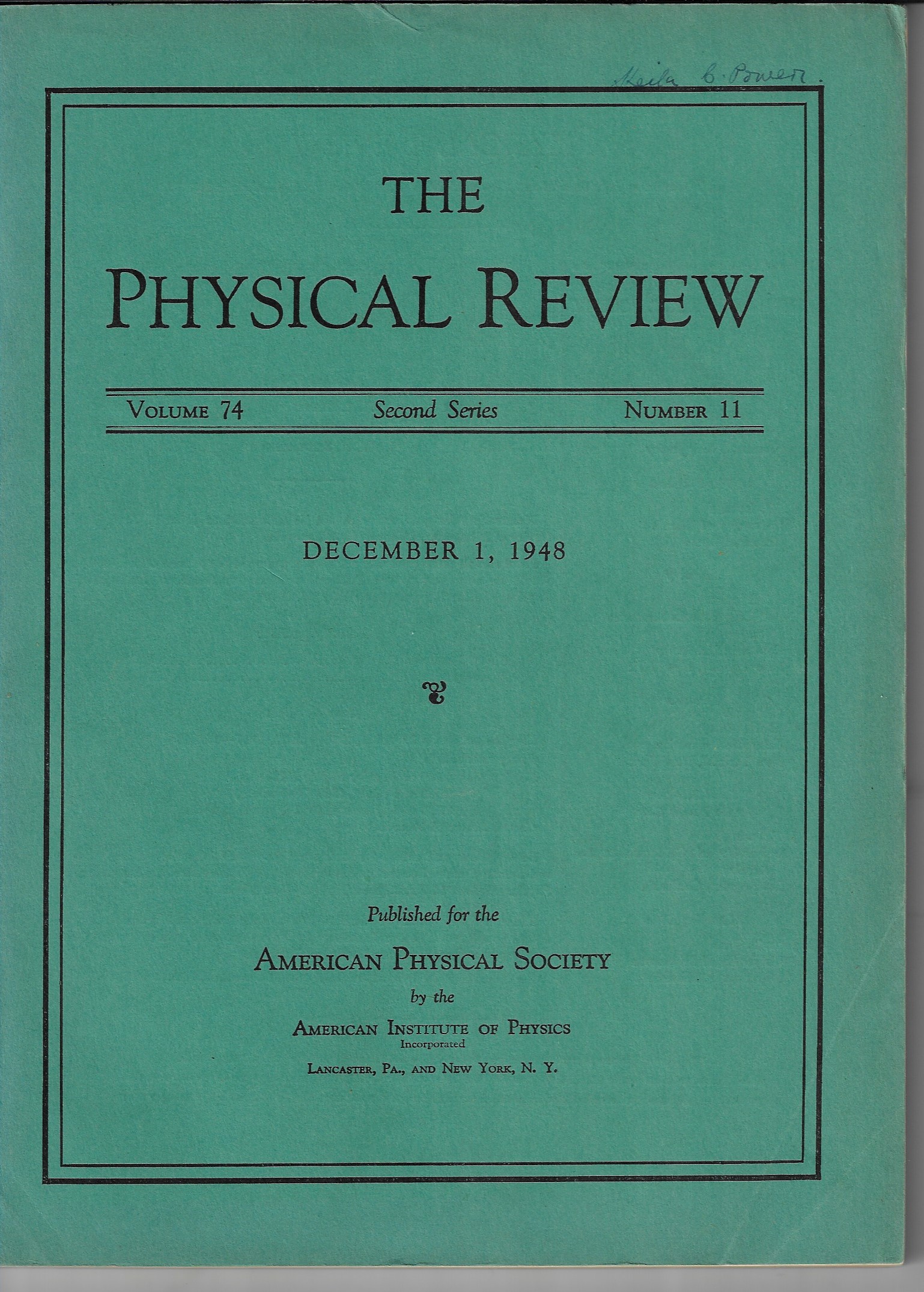
    PR 1948 DW AlpherRalph Alpher, “A Neutron-Capture Theory of the Formation and Relative Abundance of the Elements”, in Physical Review 74 No. 11 pp. 1577–1589, December 1, 1948.Original wrappers; old fold in the corner-right-bottom of the front cover, a near-fine copy. $250

    This is Alpher’s doctoral dissertation touching on some of the thinking  for the great αβγ Alpher/ Bethe/ Gamow paper, “The Origin of the Chemical Elements”, (Physical Review 73 (1948), 803, also available from this store] in which Alpher and Gamow suggested that the light elements were created by hydrogen ions capturing neutrons in the hot, dense early universe.”–Wikipedia (“Big Bang Nucleosynthesis”)

    “From 1944 through 1955, he was employed at the Johns Hopkins University Applied Physics Laboratory… In 1948 he earned his Ph.D. in Physics with a theory of nucleosynthesis called neutron-capture, and from 1948 onward collaborated with Dr. Robert C. Herman (Ph.D. in Physics, 1940, Princeton University, under E. Condon), also at APL, on predictions of the Cosmic Microwave Background Radiation.”—Wikipedia (“Ralph Alpher”)

    • The copy of Sheila C. Power [Tinney], with her name (signed?) at top right front cover. 

    From the Royal Irish Academy: “Erwin Schrödinger described [Power] as among the ‘best equipped and most successful of the younger generation of theoretical physicists in this country’,”

    (“Power”)…went to the University of Edinburgh to work on a doctorate [under Max Born]…and worked with him on the stability of crystal lattices, and was awarded a Ph.D. by Edinburgh in 1941. She is believed to be the first Irish woman to receive a doctorate in the mathematical sciences….In 1941 she was appointed to an assistant lectureship in UCD, at the age of 23, and also held a part-time fellowship in the Dublin Institute for Advanced Studies (DIAS). A year later, she was the only woman attending an international colloquium in the institute, at which the Nobel prize winner Paul Dirac lectured on quantum electrodynamics. From September 1948 to June 1949 she took leave of absence to go on a fellowship to the Institute for Advanced Study in Princeton, New Jersey, where she worked on aspects of nuclear physics…”–https://www.ria.ie/news/dictionary-irish-biography-public-engagement-stem-education/100th-anniversary-birth-sheila

    ·Posted by :

    ·in:


  • Julian Schwinger Quantum Electrodynamics Ii Vacuum Polarization And Self Energy In Physical Reviewvol 75 No 4 Feb


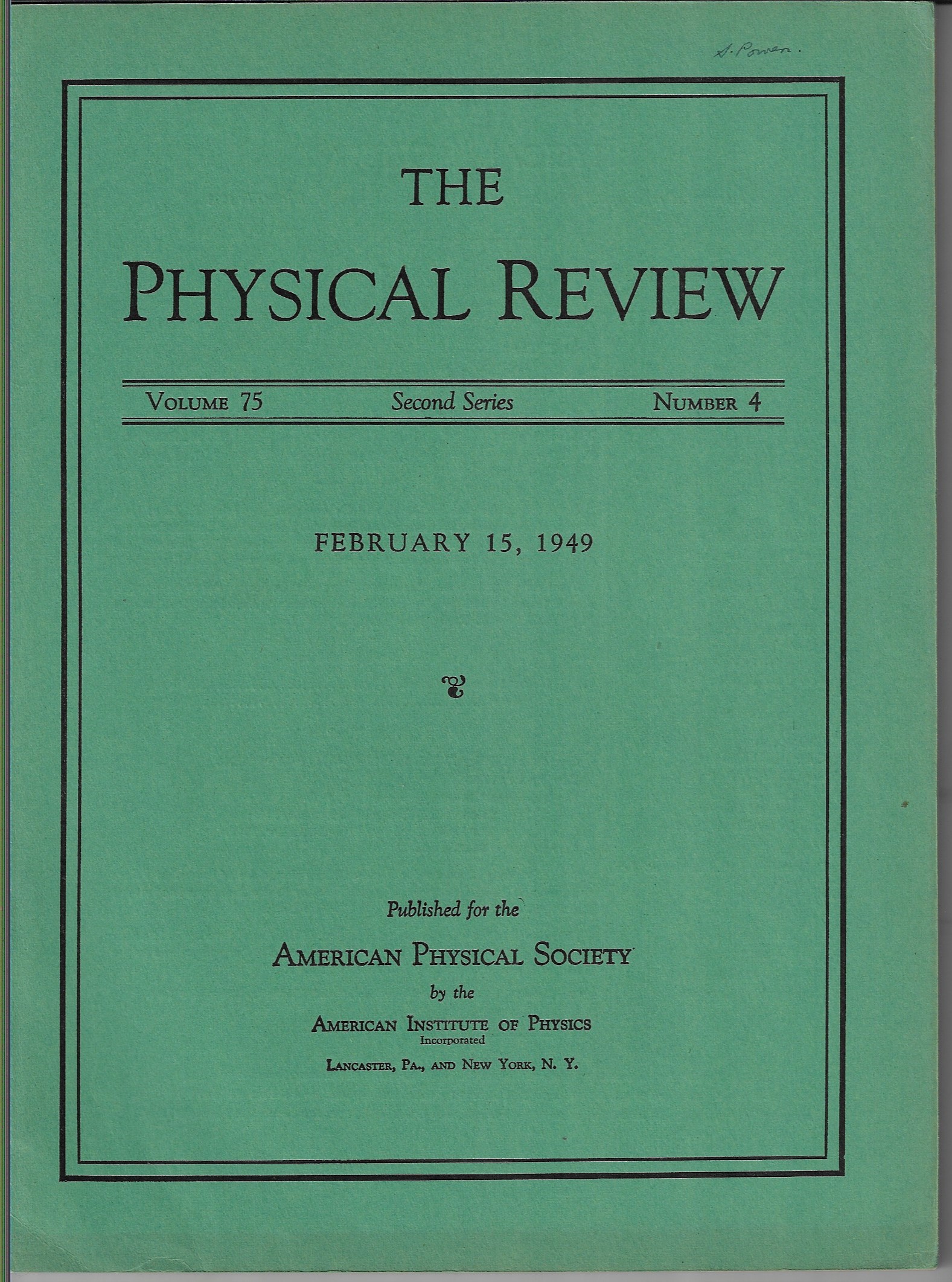
    PR 1949 DW SchwingerJulian Schwinger, Quantum Electrodynamics II. Vacuum polarization and self-energy. In: Physical Review, Vol. 75, No. 4, February 15, 1949 pp 651-679. Original wrappers. Fine copy. $200

    This is the second paper (of three) of Schwinger’s great and Nobel Prize effort (shared with Richard Feynman and Sin-Itiro Tomonaga in 1965 “for their fundamental work in quantum electrodynamics, with deep-ploughing consequences for the physics of elementary particles” ) in the renominalization of QED.

    • The copy of Sheila C. Power [Tinney], with her name (signed?) at top right front cover. 

    From the Royal Irish Academy: “Erwin Schrödinger described [Power] as among the ‘best equipped and most successful of the younger generation of theoretical physicists in this country’,”

    (“Power”)…went to the University of Edinburgh to work on a doctorate [under Max Born]…and worked with him on the stability of crystal lattices, and was awarded a Ph.D. by Edinburgh in 1941. She is believed to be the first Irish woman to receive a doctorate in the mathematical sciences….In 1941 she was appointed to an assistant lectureship in UCD, at the age of 23, and also held a part-time fellowship in the Dublin Institute for Advanced Studies (DIAS). A year later, she was the only woman attending an international colloquium in the institute, at which the Nobel prize winner Paul Dirac lectured on quantum electrodynamics. From September 1948 to June 1949 she took leave of absence to go on a fellowship to the Institute for Advanced Study in Princeton, New Jersey, where she worked on aspects of nuclear physics…”

    https://www.ria.ie/news/dictionary-irish-biography-public-engagement-stem-education/100th-anniversary-birth-sheila

    ·Posted by :

    ·in: