A Daily History of Holes, Dots, Lines, Science, History, Math, Physics, Art, the Unintentional Absurd, Architecture, Maps, Data Visualization, Blank and Missing Things, and so on. |1.6 million words, 7500 images, 4.9 million hits| Press & appearances in The Times, Le Figaro, Mensa, The Economist, The Guardian, Discovery News, Slate, Le Monde, Sci American Blogs, Le Pont, and many other places… 5000+ total posts since 2008.

Book Category: Astronomy

  • A Selection of Edwin Hubble Papers

    (Edwin Hubble) Two contributions by the astronomer/astrophysicist/cosmologist Edwin Hubble in the Astrophysical Journal, volume 76, July-December 1932. The entire volume offered with the extra treat of the front wrapper for each of the six issues bound in.  9.5×6.5″, bound in cloth, 334pp, with 14 photo plates on glossy paper. This is an ex-library copy, decently bound, and in nice condition, with the following faults: call numbers are gilt stamped on the spine, the library name is rubber stamped on the text block top and bottom; there is a bookplate on the front pastedown, and each front wrapper has a red rubber stamp of the library name in the right upper corner. That said, this is fresh, rock-solid copy.  $200

    • Edwin Hubble, “Nebulous Objects in Messier 31 Provisionally Identified as Globular Clusters”, pp 44-69, plates VII-X

    On this paper from National Academy of Science’s Biographical Memoirs (Hubble), 1970, page 198: “Hubble continued his detailed studies of the nearer spiral systems, and in this paper he reported the discovery of 140 “nebulous objects” in and around the Andromeda nebula. These objects he described as “nebulous stars— small, highly concentrated, round and perfectly symmetrical. . . . The observed characteristics of the objects appear to admit of but one interpretation. On the basis of structure, luminosity, diameters and colors, the objects are provisionally identified as globular star clusters. Their absolute magnitudes are systematically fainter by one or two magnitudes than the absolute magnitudes of the globular clusters in the galactic system derived from Shapley’s distances.” Hubble lived to learn the reason for this discrepancy: the Cepheid distance criterion as formulated by Shapley gave distances too small by a factor of two, as reported in 1952 by Baade.”

    • Edwin Hubble, “The Surface Brightness of Threshold Images”, in number 2, September 1932, pp 106-117. 

    Other contributors to this volume include Edison Pettit, Otto Struve (5), Philip Keenan, Milton Humason, and others.  

    And:

    Paul Merrill, Milton Humason, Cora Burwell, “Discovery and Observations of Stars of Class Be: second paper”,  PP 156-183. 

    Edwin Hubble. “Effects of Red Shifts on the Distribution of Nebulae.” In Astrophysical Journal, volume 84, number 5, December 1936, pp 517-555 in the issue of pp 481-622. The issue is removed from a larger bound volume though it does have the scarce wrappers. Condition: this is a nice, fresh copy; being removed from a larger volume means that this copy does not have a backstrip cover for the spine of the wrappers. In any event, this is still probably a VERY GOOD copy.  $250

    “In this paper Hubble added two additional groups of nebular counts to the three groups already discussed in his 1935 paper with Tolman. After a detailed analysis of the observational data, and a comparison with the theoretical models computed with Tolman, Hubble found that “the observations may be fitted into either of two quite different types of universes. If the red-shifts are velocity shifts, the model is closed, small and dense. It is rapidly expanding, but over a long period the rate of expansion has been steadily diminishing. Existing instruments range through a large fraction of the entire volume and, perhaps, through a considerable fraction of past time since the expansion began. “On the other hand, if red-shifts are not primarily due to velocity shifts, the Observable Region loses much of its significance. The velocity-distance relation is linear; the distribution of nebulae is uniform; there is no evidence of expansion, no trace of curvature, no restriction to the time scale. The sample, it seems, is too small to indicate the particular type of universe we inhabit.”–National Academy of Sciences, Biographical Memoirs, 1970


    Edwin Hubble. “The Luminosity Function of Nebulae. 1. The Luminosity Function of resolved Nebulae as Indicted by their Brightest Stars”. In Astrophysical Journal, volume 84, number 2, September 1936, pp 158-179 in the issue of pp 113-240. The issue comes with the original wrappers, removed from a larger bound volume. Condition: this is a crisp copy, though being removed it has no spine backstrip; also, the front wrapper is detached. Good copy. $150

    “Consider all the nebulae in a given volume of space,” Hubble wrote in The Realm of the Nebulae (p. 59). “The relative numbers of giants and dwarfs and normal objects—more precisely, the frequency-distribution of absolute magnitudes (candle powers) among these nebulae—form the ‘luminosity-function.’ It was assumed that the luminosity-function remains constant throughout the regions covered by the surveys—that the function is independent of distance or direction—that the giants do not tend to congregate in one region and the dwarfs in another region. The assumption has not been fully established by direct observations, but it seems reasonable and it is consistent with all information available at the present time.” In this paper Hubble attempted to estimate the luminosity function for the nebulae, and he did so by two separate methods: (1) the luminosity function of resolved nebulae as indicated by their brightest stars, and (2) the luminosity function as indicated by residuals in velocity-magnitude relations…”–National Academy of Sciences, Biographical Memoirs, 1970


    Hubble, 1939
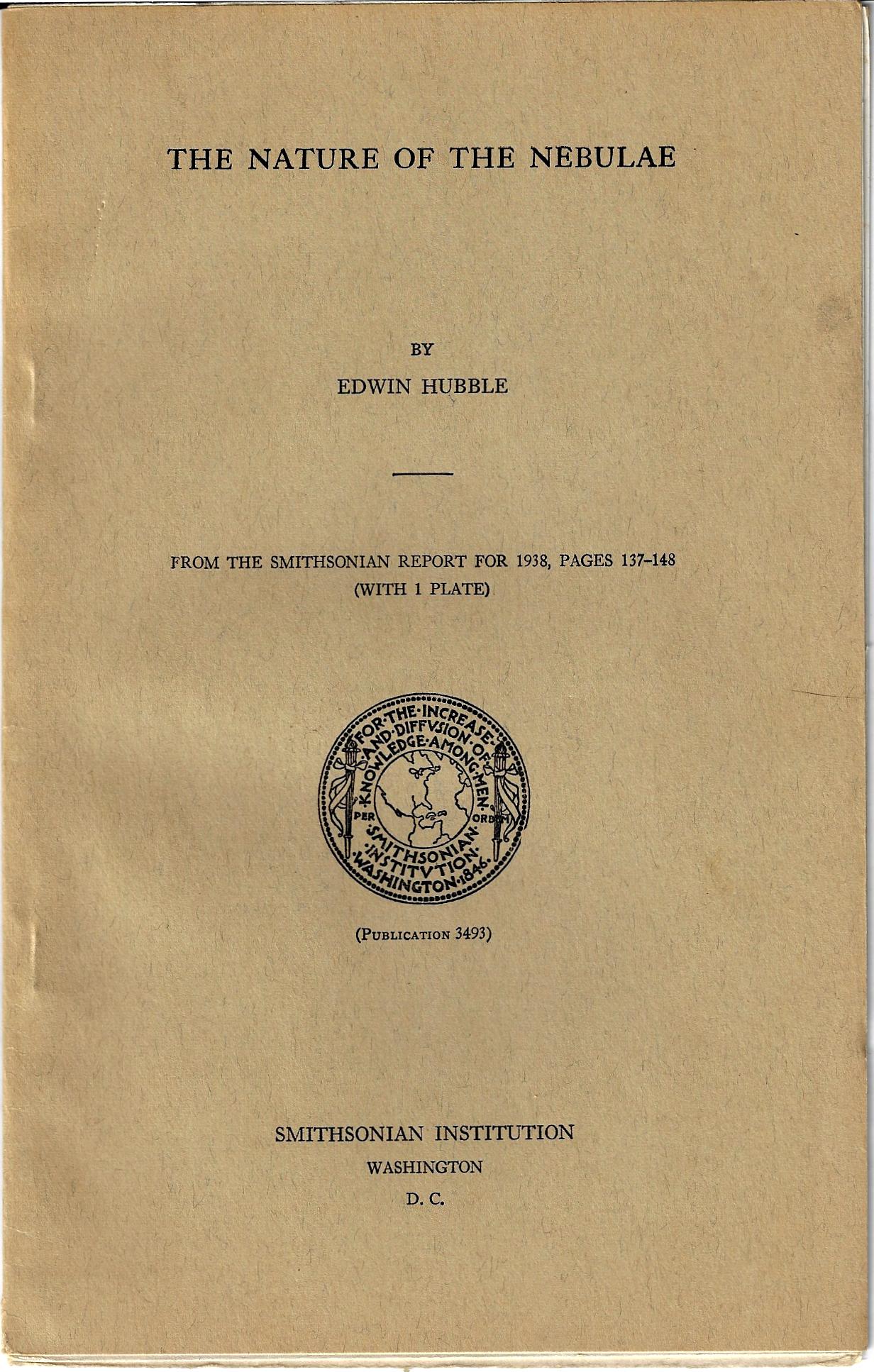
    Hubble nature nebulae

    Edwin Hubble, “The Nature of the Nebulae”, offprint from the Smithsonian Report for 1938, pages 137-148, with one plate), publication 3493. Published by the Smithsonian Institution in Washington, D.C., 1939.  24cm.

    Original wrappers.  Very fine condition, and save for a faded 5mm blemish on upper front cover right corner, in nearly new condition.  $95

    “Hubble was the founder of modern extragalactic astronomy and the first to provide observational evidence for the expansion of the universe Hubble was the first to introduce a significant classification system for galaxies  He presented this at the meeting of the International Astronomical Union at Cambridge, England, in 1925 and it was published the next year in the Astrophysical Journal… The classification was essentially empirical and independent of any assumptions concerning the evolution of galaxies. ..”

    “Despite the advance in knowledge in the last forty years, Hubble’s claim to have introduced order into the apparent confusion of nebular forms and to have shown that galaxies are closely related members of a singly family stands. It must be regarded as one of his most significant achievements.

    By 1929 Hubble had obtained distances for eighteen isolated galaxies and for four members of the Virgo cluster. In that year he used this somewhat restricted body of data to make the most remarkable of all his discoveries and the one that made his name famous far beyond the ranks of professional astronomers.”

    Hubble’s (and Humason’s ) observations on the greater distances of fainter galaxies…”Hubble’s law was extended to a distance of over 100 million light-years, the straight-line relationship between velocity and distance being maintained. This result has come to be generally regarded as the outstanding discovery in twentieth-century astronomy. It made as great a change in man’s conception of the universe as the Copernican revolution 400 years before. For, instead of an overall static picture of the cosmos, it seemed that the universe must be regarded as expanding, the rate of the mutual recession of its parts increasing with their relative distance….”–DSB

    The Problem of the Expanding Universe, 1943
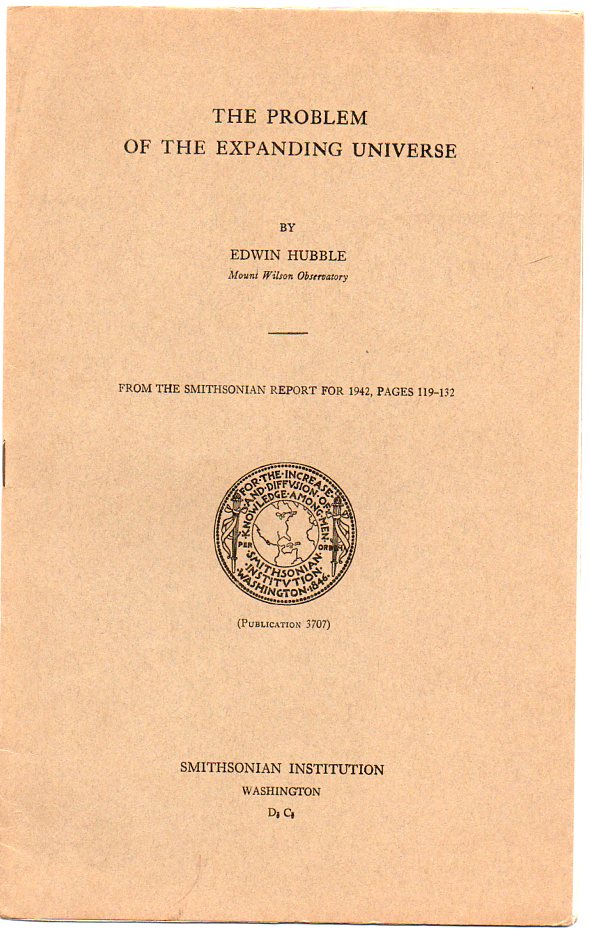
    Hubble expanding052

    In his great summary (The Problem of the Expanding Universe) of the development of the velocity-distance relation, the Big Bang and all that,  Edwin Hubble offers concise appraisal of the research to this point (in which Hubble and his assistant Milton Humason were prominent members of its founding studies). Hubble provided the first experimental data supporting the expanding universe theory of Georges Lemaitre’s cosmology (the “hypothesis of the primeval atom”), Einstein’s GRT and the mathematical equations of Alex. Friedmann, finding that the distance of galaxies were proportional to their redshifts (Hubble’s Law, 1929).  The whole thing enjoyed a bigger, more explosive life once it had been given its  more provocative and user-friendly name by Sir Fred Hoyle, who called the idea “the Big Bang” in 1949.  (Sir Fred was actually attacking the idea and must’ve thought his tag was to be demeaning, but as a proponent of the steady state theory, Hoyle’s plan backfired, a proof that irony exists.) The steady state model was more or less put to sleep when the cosmic microwave background radiation (first proposed by George Gamow, Ralph Alpher and Robert Herman in 1939) was “discovered ” in 1964 by Penzias and Wilson, this providing further experimental confirmation for the Big Bang hypothesis. 

    “Meanwhile, on the basis of the evidence now available, apparent discrepancies between theory and observation must be recognized. A choice is presented, as once before in the days of Copernicus, between a strangely small, finite universe and a sensibly infinite universe plus a new principle of nature.”

    It is an excellent approximation for a semi-general-public speech (to the Smithsonian Institution crowd during the war in 1943), and reminds me of one of his other, similarly spot-on statements, one of the greatest understatements in 20th century astrophysics The statement appears in a further report on Hubble/Humason studies in The Velocity-Distance Relation Among Extra-Galactic Nebulae  (Mount Wilson Observatory,  1931) ,  a regarding their understanding of the phenomena and the expanding universe, the authors take many steps back, and say in the concluding paragraph:

    “…the writers are constrained to describe the apparent velocity-distance displacements without venturing on the interpretation and its cosmological significance”.

    They basically lay out the functioning of the universe and the best understanding of how we got to where we are in the cosmos (Vesto Slipher notwithstanding), and how according to their understanding that the universe is expanding and is consistent with all known laws, that they decide to not say anything, um, philosophical, in the light of disrupting the idea of the creation of all things.

    Hubble did have a way with words, his own way, though he was able to communicate a difficult series of ideas simply, as we can see in the opening of his Expanding Universe paper: 

    “Mathematicians deal with possible worlds, with an infinite number of logically consistent systems. Observers explore the one particular world we inhabit. Between the two stands the theorist He studies possible worlds but only those which are compatible with the information furnished by observers. In other words, theory attempts to segregate the minimum number of possible worlds which must include the actual world we inhabit. Then the observer, with new factual information, attempts to reduce the list still further. And so it goes, observation and theory advancing together toward the common goal of science, knowledge of the structure and behavior of the physical universe.”

    And this lovely summation:

    “Current theory starts with two fundamental principles : general relativity and the cosmological principle. General relativity states that the geometry of space is determined by the contents of space, and formulates the nature of the relation. Crudely put, the principle states that space is curved in the vicinity of matter, and that the amount of curvature depends upon the amount of matter. Because of the irregular distribution of matter in our world, the small scale structure of space is highly complex. However, if the universe is sufficiently homogeneous on the large scale, we may adopt a general curvature for the universe, or for the observable region as a whole, just as we speak of the general curvature of the earth’s surface, disregarding the mountains and ocean basins. The nature of the spatial curvature, whether it is positive or negative, and the numerical value, is a subject for empirical investigation.”

    “The second, or cosmological principle is a pure assumption – the very simple postulate that, on the grand scale, the universe will appear much the same from whatever position it may be explored. In other words, there is no favored position in the universe, no center, no boundaries. If we, on the earth, see the universe expanding in all directions, then any other observer, no matter where he is located, will also see the universe expanding in the same manner. The postulate, it may be added, implies that, on the grand scale, the universe is homogeneous and isotropic – very much the same everywhere and in all directions.”

    “Modern cosmological theory attempts to describe the types of universes that are compatible with the two principles, general relativity and the cosmological principle. Profound analysis of the problem leads to the following conclusions. Such universes are unstable. They might be momentarily in equilibrium, but the slightest internal disturbance would destroy the balance, and disturbances must occur. Therefore, these possible worlds are not stationary. They are, in general, either contracting or expanding, although theory in its present form does not indicate either the direction of change or the rate of change. At this point, the theorist turned to the reports of the observers. The empirical law of red shifts was accepted as visible evidence that the universe is expanding in a particular manner and at a known rate. This arose the conception of homogeneous expanding universe of general relativity.”

    I like Hubble.

    Notes:

    The paper begins:

    “I PROPOSE to discuss the problem of the expanding universe from the observational point of view. The fact that such a venture is permissible is emphatic evidence that empirical research has definitely entered the field of cosmology. The exploration of space has swept outward in successive waves, first, through the system of the planets, then, through the stellar system, and, finally, into the realm of the nebulae. Today we study a region of space so vast and so homogeneous that it may well be a fair sample of the universe. At any rate, we are justified in adopting the assumption as a working hypothesis and attempting to infer the nature of the universe from the observed characteristics of the sample. One phase of this ambitious project is the observational test of the current theory of the expanding universes of general relativity. ” 
    ·Posted by :

    ·in:


  • James E Keeler The Spectroscope Of The Alleghany Observatory Offprint Astronomy And Astro Physics No 111 November 1893

    James E. Keeler, “The Spectroscope of the Alleghany Observatory. Offprint: Astronomy and Astro-Physics No. 111 (November 1893).  245x155mm, 11pp, 3 plates (of the instrument, plates numbered V, VI, VII). Original wrappers.  Condition: the pamphlet is in two pieces, the heavy paper plates I think were too much for the paper binding, and so it came apart in two parts at the plates. Also, there is an old vertical fold that runs through the publication.  But for that, a Good copy.  Not the best condition, but it is a rare thing. A nice contribution by a siginficant figure in teh history of modern astrophysics (see Donald E. Osterbrock, James E. Keeler: Pioneer American Astrophysicist: And the Early Development of American Astrophysics, Cambridge UP, 1984.  $100

    “The spectroscope which is illustrated in the accompanying plates is the most important recent addition to the instrumental equipment of the Allegheny Observatory. Although not strictly a universal instrument it is intended to be used for several different kinds of work and to be efficient in all of them In a previous article f I have stated the general principles which must be observed in constructing a spectroscope for any given purpose It is not an easy task to design a spectroscope which shall satisfactorily meet a number of very different requirements and in presenting the Allegheny spectroscope as one solution of this difficult problem. I wish to point out that some additions and conveniences which might easily have been added were rejected because it was thought that they might compromise the utility of the instrument in some one of its applications. After testing the spectroscope in both visual and photographic observations although as yet only in a preliminary manner there are very few changes that I should wish to make in the original design. The instrument is large and powerful enough to compare favorably with others of the highest class designed for the same kinds of work yet light enough to be readily mounted and dismounted and to be carried by a telescope of moderate dimensions…”–from the offprint

    ·Posted by :

    ·in:


  • Walter S Adams What Lies Between The Stars Offprint The Smithsonian Report For 1941 Pages 141 149 With 4 Plates Publi

    Walter S. Adams. “What Lies Between the Stars.” Offprint, the Smithsonian Report for 1941, pages 141-149 (with 4 plates), publication 3652, Smithsonian Institution, Washington DC.  Very fine copy in original wrappers.  $45

    • “Walter Sydney Adams (1876-1956, APS 1915), astronomer, explored the uses of spectroscopy, investigated sunspots and the rotation of the Sun, the velocities and distances of thousands of stars, and planetary atmospheres. Adams served as acting director and director of Mount Wilson Observatory from 1909 until 1946. Adams was the astronomer of stellar spectroscopy at Mount Wilson Observatory, 1904-1923, and Director, 1923-1946.”–http://socialarchive.iath.virginia.edu/ark:/99166/w63n23sm


    ·Posted by :

    ·in:


  • Early Astrobiology Refuting Cosmic Panspermia


    BECQUEREL, Paul.  L’Action Abiotique de l’Ultraviolet et le Hypothese de l’Origine Cosmique de la Vie”. In Comptes Rendus, volume 151, 1910, pp 86-88, January 1, 1910.  Offered with:  “Recherches Experimentales sur la Vie Latente des Spores des Mucorinees et des Ascomycetes”, in Comptes Rendus, 1910, volume 150, pp 1437-1439.  The two issues, removed from a larger bound volume, $300

    Cosmic panspermia

    –Raulin-Cerenceau, F. “From Panspermia to Bioastronomy, the Evolution of the Hypothesis of Universal Life”, Kluwer, 1998, pp 597-612.  

    ·Posted by :

    ·in:


  • An Early Paper Approaching the Cosmic Microwave Background (1946)

    DICKE, Robert H. R. Beringer, R. L. Kyhl, and A. B. Vane,  “Atmospheric Absorption Measurements with a Microwave Radiometer”, in Physical Review, volume 70/5+6, September 1 and 15, 1946.   In the original wrappers,  fine copy. $250

    •  See: Henry Stroke, The Physical Review, the First Hundred Years, 1995, reproduced in full in the Gravity Physics and Cosmology section, pp 497-505.  See also John Boslough and John Mather The Very First Light: The True Inside Story of the Scientific Journey Back to the Light at the dawn of the Universe.

      “In 1946, Robert Dicke and coworkers at MIT tested equipment that could test a cosmic microwave background of intensity corresponding to about 20K in the microwave region. However, they did not refer to such a background, but only to ‘radiation from cosmic matter’. Also, this work was unrelated to cosmology and is only mentioned because it suggests that by 1950, detection of the background radiation might have been technically possible, and also because of Dicke’s later role in the discovery”.– Kragh, H. (1999). Cosmology and Controversy: The Historical Development of Two Theories of the Universe. 

    ·Posted by :

    ·in:


  • K: Humason’s Data Supporting Expansion of the Universe//A Key Role in the Determination of the Hubble Constant (1929)

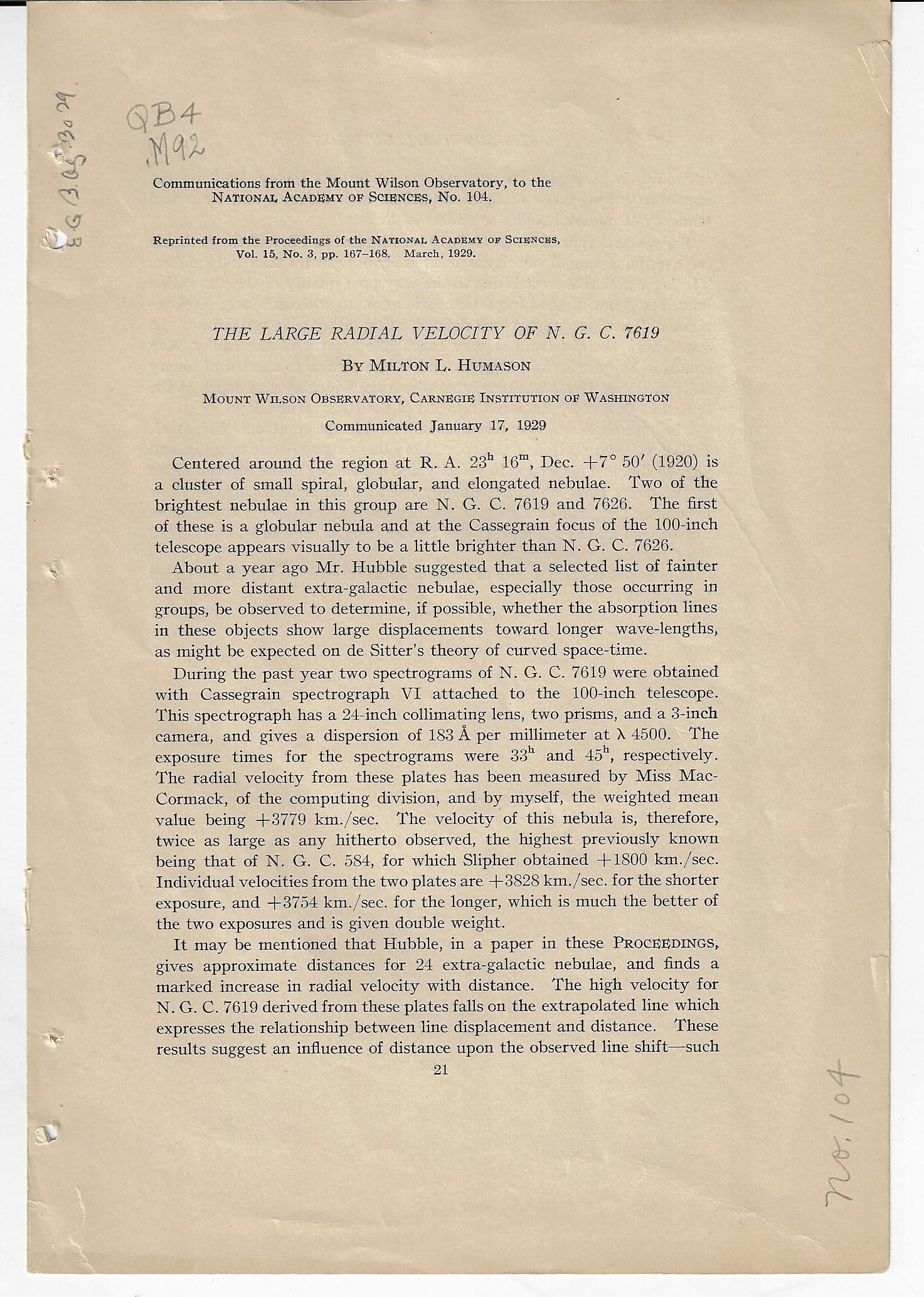
    Humanson, Milton L.  “The Large Radial Velocity of N.G.C. 7619”, Communications from the Mount Wilson Observatory, to the National Academy of Science, No. 104; reprinted from the Proceedings of the National Academy of Sciences, vol 15, no. 3, pp 167-168, March 1929. Paginated here as pp (1)-2, plus 2pp blanks. 6 small punched holes for some sort of binding, along with 3 small groups of penciled cataloging numbers.  Good copy. Scarce.  $[Hold]

    • Humason provides significant support for Hubble’s 1929 paper (” A Relation between Distance and Radial Velocity among Extra-Galactic Nebulae”)  which is nearly universally acknowledged as a turning point in 20th c astronomy and the end of the static universe theory  as well of course for the foundational work that he co-authored with Hubble in the Velocity-Distance paper of 1931. (It is interesting to note that Fred Hoyle mentioned this as “the famous Hubble-Humason velocity-distance relation”, see Helge Krage and Robert Smith, “Who Discovered the Expanding Universe?”, in Hist Sci, xli, 2003.) (“…[T]he velocities over the entire range increase directly with distances, and the linear relation holds as closely as distances can be estimated”–E. Hubble, The Realm of the Nebulae, 1936, pg 117.)
    • “Satisfied that they had the evidence they needed to promote Hubble’s new observed relationship between velocity and distance, the two decided to publish their findings separately in the proceedings of the National Academy of Sciences. The two papers were communicated to the body of the academy on January 17, 1929. In his one-page  [sic] paper, entitled “The Large Radial Velocity of NGC 7619,” Humason laid out the stellar coordinates of the galaxy and wrote briefly about the region of the sky where it sits and of Hubble’s plan to see if a relationship between velocity and distance could be observed. He mentioned Slipher’s previous velocity for NGC 584 and hinted at Hubble’s velocity to distance relationship that followed immediately after his own. Hubble’s paper, “A Relation Between Distance and Radial Velocity Among Extra-Galactic Nebulae,” exposed the world for the first time to the notion that the universe was expanding…” –Ronald Veller, The Muleskinner and the Stars, the Life and Times of Milton La Salle Humason,  Springer, 2016

    “To establish his now-famous relation between radial velocity and distance, Hubble needed data for many more extragalactic nebulae. In 1929, Humason observed a radial velocity for the galaxy NGC 7619…twice as great as the highest previously known galaxy” the results of the observation published in this (offered) paper. Encyclopedia of Cosmology (Routledge Revivals): Historical, Philosophical …edited by Norriss S. Hetherington , pg 298  

    “What is certain, is that Hubble had held his paper for over a year before submitting it for publication, 96 a delay probably due to a desire of Hubble to have available some radial velocity measurements by Humason…In 1929 he was resolved to throw his relation “into the blue”, with himself securing the distances to the galaxies and Humason the radial velocities. Hubble, then, had presented evidence for the existence of a linear redshift distance relation and further observations would reveal if it could be carried farther into extragalactic space…” The Origins of the Velocity-Distance Relation”, R. W. Smith, pg 150-151, Journal for the History of Astronomy, 1979.

    “Hubble discovered the linear law connecting redshifts and distances, but this does not mean that he also discovered the expansion of the universe. Nowhere in his paper did he conclude that the galaxies were actually receding from us or otherwise suggest that the universe was expanding. He did present the law in terms of velocities, but he referred to ‘apparent velocities’, that is, redshifts that could be conveniently transformed to velocities by means of the Doppler formula but for which other interpretations might be equally valid. ‘We [Hubble and Humason] use the term “apparent” in order to emphasize the empirical features of the correlation,’ he wrote to de Sitter in 1931. ‘The interpretation, we feel, should be left to you and the very few others who are competent to discuss the matter with authority.’ Humason followed Hubble in his cautious attitude and wrote that the observations could be explained ‘both by the apparent slowing-down of light vibrations with distance and by a real tendency of material bodies to scatter in space.”(footnote 64, this paper).–Kragh, Helge S. Conceptions of Cosmos : From Myths to the Accelerating Universe: A History of Cosmology.  Oxford, 2007, pg 146 (“Conception of Cosmos”)

    “Credits Hubble [in this paper] with having suggested this test of the expanding universe theory some time earlier”–Paul S Braterman , From Stars to Stalagmites (World Scientific, 2012, pg 283) (“It may be mentioned that Hubble, in a paper in these PROCEEDINGS, gives approximate distances for 24 extra-galactic nebulae, and finds a marked increase in radial velocity with distance. The high velocity for N. G. C. 7619 derived from these plates falls on the extrapolated line which expresses the relationship between line displacement and distance.”)

    Humason’s paper appears just four pages before Hubble’s famous 1929 paper in which appears the iconic velocity-distance graph (figure 1, pg 172, same issue as the above). See Marcia Bartusiak, The Day We Found the Universe, pg 282. 

    “This was the first time that Humason used the formula velocity equals distance time K, or more significantly distance equals velocity divided by K” and thus found that NGC 7619 was moving at the “breakneck speed” of 3,779 kilometers/hour. George Johnson, Miss Leavitt’s Stars: The Untold Story of the Woman Who Discovered How to …pg 105

    Humanson 1929


    ·Posted by :

    ·in:


  • An Interesting Note on Life in the Universe, 1933

    Frederick Leonard. “Life on Other Worlds”, in Popular Astronomy, May 1933, vol 41 no. 5., pp 260-3 in the issue of pp 239-294. Original front outer wrapper, the issue removed from a larger bound volume.  $75  Very Good.  

    In the year that the human race started its very real plunge into the Wasteland, Frederick L. Leonard (Chair of the astronomy department at UCLA) had his eyes on another prize. In a short article in Popular Astronomy, Prof. Leonard spent a few pages discussing the possibility of extraterrestrial life. He kept the discussion in one and two syllable words and was very straightforward, winding up talking about the possibilities of “life” in our own solar system. He quickly dismisses all of the planets as contenders save for Venus and mars, and then wasn’t really happy with that, at all, and opened the discussion more as to “life” might be. 

    There were several surprises in the article, including one about the authors of Astronomy ( Henry Norris Russell; Raymond Smith Dugan; John Quincy Stewart,  Astronomy: A Revision of Young’s Manual of Astronomy …) being “surprised” that there was no oxygen found on Venus. The bigger moment though was saved for Percival Lowell, who had long labored in support of advanced lifeforms on Mars, though the quote from him regarding extraterrestrial life was really very good. Leonard quotes him so:

    “If astronomy has taught us anything it is that man is but a detail in the universe, and the resemblants though diverse detail are inevitably to be expected…[humans] are destined to discover any number of cousins scattered through space.”

    The odds favor a statement like this, that human life is a “detail” of the universe and that there are not doubt other ‘details” to be found, resembling earth life or not. Odd as weren’t so much with Lowell in keeping with his intelligent lifeforms being on Mars, which is just a step or two away. In any event, I found the Lowell statement to be a pretty sober appraisal of the possibility of Life Elsewhere.  

    ·Posted by :

    ·in:


  • A Smart Piece of Thinking that also Touches on Extraterrestrial Origins of Life on Earth (1875)

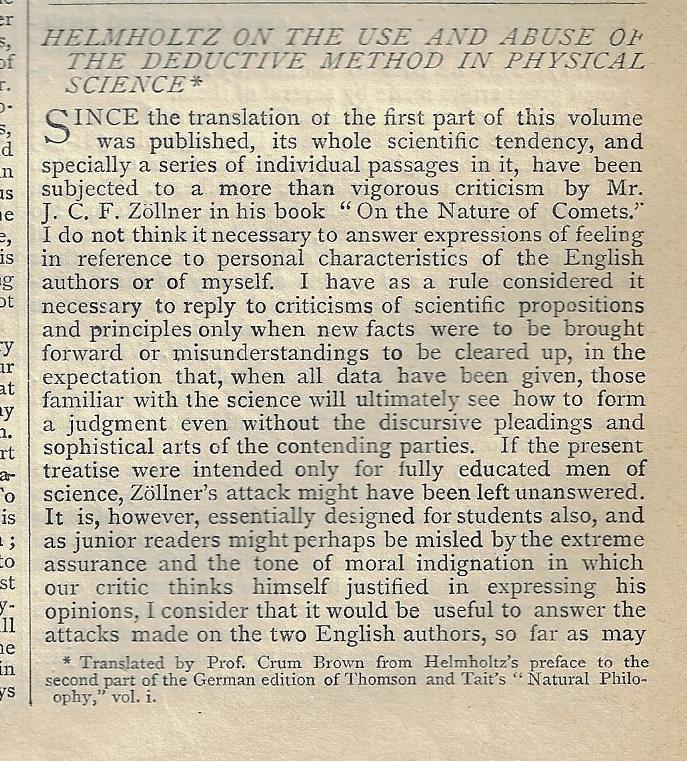
    Hermann von Helmholtz. “On the Use and Abuse of the Deductive Method in Physical Science”, in a two-part article over two months in Nature:

    • December 24, 1874, pp 149-151 in the issue of pp 141-160 and
    • January 14, 1875,  pp 211-212 in the January 14, 1875 of 201-220pp.  

    The two issues are offered together, $125  (Also the entire text is reproduced below.)

    Helmholtz pansperma one _1_

    (Translated by Crum Brown for Nature.)

    These two piece by von Helmholtz are just very nice pieces of thinking, delivering several wonderful insights into the nature of reasoning which spread out into other areas, one of which, interestingly, is on the origins of life. For example, in the first paper, in addition to defending his version of deductive reasoning he drops this bon mot into the equation in mentioning the infection of metaphysics in science:

    “Among the scientific investigators who have especially directed their efforts towards the purification of physical science from all metaphysical infection and from all arbitrary hypotheses, and, on the contrary, have striven to make it more and more a simple and faithful expression of the laws of the facts, Sir W. Thomson occupies one of the first places…”–pg 150

    In continuing in the second paper, von Helmholtz goes on to make a statement on the probable great longevity of life in the universe in general, and of the possibility that life could be as old as the universe (“whether it  [life] is as old as matter”), and that some germs could have been brought to Earth (for example) on meteorites, meaning that the origins of life could be extraterrestrial.  Helmholtz points out that William Thompson had addressed this issue in 1871, though Helmholtz himself ad spoken on the issue months before that. In any event, here is von Helmholtz again talking about the origin of life and cosmic pansperma, in 1875.

    “I will mention one other objection of similar scientific value, because it refers to Sir W. Thomson, though not to a passage of this book. The point in question is whether
    it is possible for organic germs to be present in meteoric stones, and so to be conveyed to worlds which have become cool. In his introductory address to the British Association at Edinburgh, in the autumn of 1871, Sir W. Thomson characterised this view as “not unscientific.” Here, too, if an error has been committed, I must profess myself a sharer in it. I had, in fact, indicated the same view as a possible explanation of the transmission of organisms through interstellar spaces at a somewhat earlier date than Sir W. Thomson—in a lecture which was delivered at Heidelberg and at Cologne in the spring of the same year, but is still unpublished. If anyone chooses to regard this hypothesis as highly or even as extremely improbable, I have nothing to object. But if failure attends all our efforts to obtain a generation of organisms from lifeless matter, it seems to me a thoroughly correct scientific procedure to inquire whether there has ever been an origination of life, or whether it is not as old as matter, and whether its germs, borne from one world to another, have not been developed wherever they have found a favourable soil. The physical reasons alleged by Mr. Zollner against the view in question are of very little weight. He points to the heating of the meteoric stones, and adds (p. 26) : ” Thus, even if we suppose that when the parent body was shattered, the meteoric stone covered with organisms escaped with a whole skin, and did not share the general rise of temperature, it was still necessary for it to pass through the terrestrial atmosphere before it could discharge its organisms to people the earth.”–pg 212

    There is a tremendous amount going on in just these few pages of created by one of the most able and expansive scientific minds of the 19th century.  

    ·Posted by :

    ·in:


  • William H Pickering A Method Of Measuring The Absolute Sensitiveness Of Photographic Dry Plates Offprint Proceedings Of

    William H. Pickering, “A Method of Measuring the Absolute Sensitiveness of Photographic Dry Plates”.

    Offprint, Proceedings of the American Academy of Arts and Sciences, pp 159-162. 

    • Paper a bit fragile at the edges; also, there’s an old vertical fold through the publication.  Good copy, only, though it is signed by Pickering.  
    • Signed “with the compliments of / the author”

    “[Pickering] graduated from Massachusetts Institute of Technology in 1879. He taught there for a time and was appointed an assistant professor at Harvard observatory in 1887. In 1891 he set up Harvard’s Boyden Station at Arequipa, Peru. Around 1900 he led expeditions to Jamaica, and from 1911 he was in charge of a permanent Harvard observing station here. Upon his retirement in 1924 the station became Pickering’s private observatory. Pickering was a pioneer in dry-plate celestial photography, and the Harvard photographic sky survey was undertaken at his suggestion. He took some of the earliest photographs of Mars (1888), and the lunar photographs he obtained in Jamaica (1900) were long the finest and most complete.” Dictionary of Scientific Biography

    ·Posted by :

    ·in: