A Daily History of Holes, Dots, Lines, Science, History, Math, Physics, Art, the Unintentional Absurd, Architecture, Maps, Data Visualization, Blank and Missing Things, and so on. |1.6 million words, 7500 images, 4.9 million hits| Press & appearances in The Times, Le Figaro, Mensa, The Economist, The Guardian, Discovery News, Slate, Le Monde, Sci American Blogs, Le Pont, and many other places… 5000+ total posts since 2008.

Book Category: Astronomy

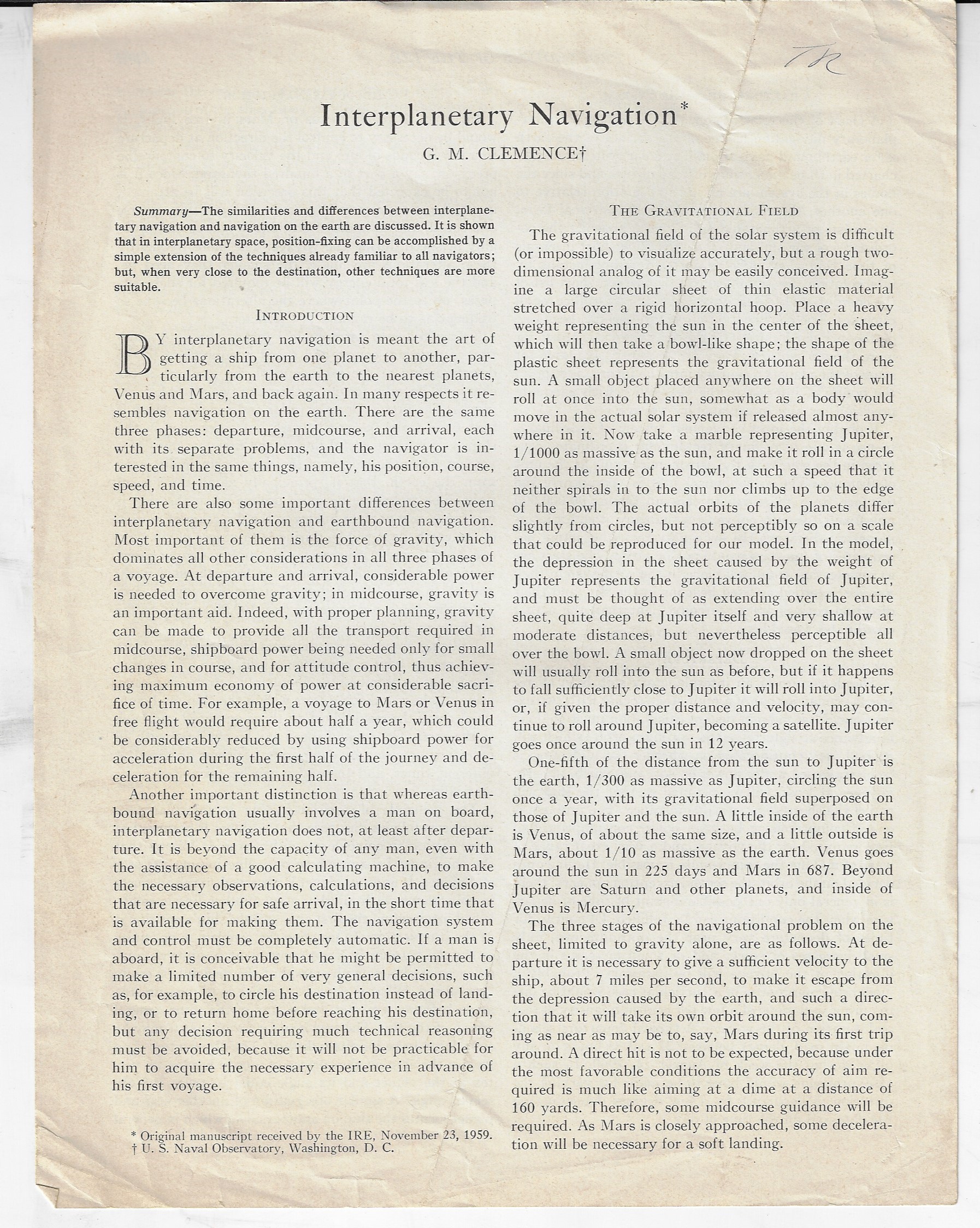
  • Interplanetary Navigation in Regards to Space Flight (1960)

    Clemence Interplanetary G.M. Clemence, “Interplanetary Navigation”, an offprint from Proceedings of the IRE ( Volume: 48 , Issue: 4 , April 1960 ), pp [497]-499

    “Summary: The similarities and differences between interplanetary navigation and navigation on the earth are discussed. It is shown that in interplanetary space, position-fixing can be accomplished by a simple extension of the techniques already familiar to all navigators; but, when very close to the destination, other techniques are more suitable.”

    Original self wrappers. Old fold running vertically across the pamphlet. VG copy, and scarce.  $95 

    ·Posted by :

    ·in:


  • Typed Letter Signed by a Mars and Life-on-Mars Visionary (1953)

    VishniacWolf Vishniac. Typed letter signed, dated October 28, 1953, on Yale University stationery, department of microbiology. written to Dr. Seymour Hutner of the Haskins Labs (NYC).  $125

    “Wolf Vladimir Vishniac (April 22, 1922 December 10, 1973) was an American microbiologist, son of famed photographer Roman Vishniac [of Warsaw Ghetto photographs fame]. Educated at Brooklyn College and Stanford University, he was a professor of biology at the University of Rochester. He died on a research trip to the Antarctic attempting to retrieve equipment in a crevice. The crater Vishniac on Mars is named in his honor. Wolf Vishniac contributed greatly to the search for life on Mars by developing a special miniature laboratory that could be transported to that planet, known as the “Wolf Trap”. This research was supported by a NASA grant started in 1959, the very first ever for the biological sciences.” –Wiki

    In his obituary for Vishniac Carl Sagan remarked that the Wolf Trap was remarkable and the first of its type, being the leader of an evolutionary development of such microbiological instrumentation, particularly for the Viking landing mission (summer of 1976) on which Vishiac worked on from 1960 forward. 

    ·Posted by :

    ·in:


  • Some Mars Items


    Henri Jules A. Perrotin (1845-1904 and Louis Thollon, 1829-1887) . “Observation des canaux de Mars; “Lettre de M. Perrotin à M. Faye.” In: Comptes rendus hebdomadaires des séances de l’Académie des sciences de Paris, vol  106 , #20,  pp. 1393–1394. Offered in the original weekly issue, removed from a larger bound volume, without the outer wrappers. $On Hold

    Perrotin’s (mostly remembered I think because of his excellent use of the Cornu apparatus in establishing the best speed of light numbers until Michelson) communication establishes that the great canals (“canaux”) he observed and reported to the Academy in 1886 were still there, as expected and as hoped for and celebrated by Schiaparelli. There were also three other rather significant observational findings:

    First, a continent had disappeared. “Clearly visible two years ago, it no longer exists today” he wrote ( “Nettement visible, il y a deux ans, il n’existe plus aujourd’hui.”). A flood, “or something else” (“Cette inondation ou autre chose…”) could well be a periodic occurrence that did away with the land mass.

    Second, there is a new arrival of a canal 20-degrees in size just north of the disappeared/extinct continent (“…au nord du continent disparu…”).

    Third, there was a sort of canal that suddenly appeared on the North Pole ice cap, connecting the two seas on either side of the pole. (“…sur la tache blanche du pôle nord, d’une sorte de canal qui semble relier, en ligne droite, à travers les glaces polaires, deux mers voisines du pôle”).

    Perrotin really doesn’t have that much to say about what caused anything, mostly restricting himself to his observations–except, as we see above, he wonders about a periodic flood.


    Lockyer, J. Norman. “La Planete Mars”, in Review Scientifique (Rose), volume 50, #17, 22 October 1892, pp 513-520, with two views of Mars, two orbital maps, and a map of the Martian surface showing “double” canals. Offered in the original weekly issue, removed from a larger bound volume, without the outer (rose-colored) wrappers. Good copy. $Oh Hold

    [I didn’t find the English version of this paper until I finished my write up—the French version is mostly but not entirely a translation of Lockyer’s “The Opposition of Mars” in the 8 September issue of Nature (the journal edited by Lockyer)].

    Lockyer starts off the essay by giving respect and credit to the work of Schiaparelli for his diligent observational duties on Mars. He does find it unfortunate though that the term “canali” of Schiaparelli has caught the popular tremor by being translated as “canals” and so “imply the idea of human work”(“Ce mot qui, en italien comme canalis en latin, signifie canal, chenal ou conduite, fut malheureusement traduit par le mot canal, qui implique l’idée de travail humain”). Lockyer discusses some of the “wonders” (“merveilles”) that are related by Schiaparelli’s new work, which includes the doubling and un-doubling of some canals, depending upon the season.

    Lockyer again addresses the current fascination with new discoveries on the planet, though he says they are based on misinterpretations, the general public thinking that the gigantic changes taking place on the planet were the result of actions undertaken by Martians/inhabitants (“l’intervention de ses habitants”) whereas Lockyer clearly believes that this is not the case.

    After a discussion of the possibility of communicating or messaging with Mars and the best time in the orbits for such a thing, Lockyer provides a rather lengthy summary of proposals of two means of interplanetary communication suggested by Francis Galton and Haweis—the former communicating or signaling by reflected sunlight during the day and the later by electric light at night (“M. Galton se sert donc de la lumière solaire et travaille dans le jour; M. Haweis, lui, propose l’emploi de la lumière électrique et opérerait la nuit”). (There were numerous other plans that seem to have captivated or at least diverted some other very bright minds, including Amos Dolbear and Charles Cros, and earlier with J. von Littrow and C.F. Gauss) such Mars was much on the minds of the general population in 1892, seeing in that year the publication of Camille Flammarion’s La Planete Mars et ses conditions d’habitabilite, and then ever more so three years later with Percival Lowell’ Mars followed in two years H.G. Wells’ blockbuster The War of the Worlds.)

    But then Lockyer draws in the speculative reins and asks the reader to consider why Galton and Haweis are reacting so—and that is because the canals of Mars can be seen by some as signaling systems, that Martians are somehow trying to tell us that they are up there. Of course they are doing that with canals that are enormous—1600 kilometers long and 320 kilometers wide. AND that they structures occasionally double, and then reduce, which means that, perhaps, Martians are filling in the canals from time to time, and then digging them out again. (“Mais il est temps de revenir aux observations récentes qui ont donné naissance aux idées que nous venons d’examiner, idées basées sur cette supposition qu’il est de toute évidence que les Martiens nous font des signaux en creusant des « canaux » de 1600 kilomètres de longueur et 320 kilomètres de largeur, puis en les doublant et en y ajoutant de nombreux signaux lumineux. L’opinion publique, persuadée que les changements qui ont été observés récemment sur la planète sont dus à l’intervention de ses habitants — idée basée, nous le verrons tout à l’heure, sur la fausse nterprétation d’un mot — s’est trouvée amenée tout naturellement à admettre que ses habitants avaient entrepris des opérations gigantesques…”)

    In any event, Lockyer’s look at Mars is pretty inclusive and sober…
    ·Posted by :

    ·in:


  • Four Cosmology Papers by R.C. Tolman, 1931-2

    Richard C. Tolman, “On the theoretical Requirements for a Periodic Behaviour of the Universe”, in Physical Review, vol 38/9, November 1, 1931,  pp 1758-1771 in the issue of pp 1575-1796.

    And offered with:

    • Tolman RC. “Nonstatic model of universe with reversible annihilation of matter.” Physical Review. 38/4, August 15, 1931. 797-814. VG+ copy
    • Tolman RC. “Possibilities in relativistic thermodynamics for irreversible processes without exhaustion of free energy.” Physical Review, vol 39/2, January 15, 1932, pp 320-336. About a 1/4-inch chip missing from top of spine. [Also contains M. True et. al., “High Speed Protons”.] VG copy
    • Tolman RC, Ehrenfest P, Podolsky B. “On the gravitational field produced by light.” Physical Review, vol 37/5, March 1, 1931, pp 602-615. VG copy.

    All in original wrappers.

    All copies are 3-hole three-ring-bound, meaning that the decrepit binding was removed to reveal  nicely preserved issues, with lovely spines (which on the Phys Rev are easily damaged), but with the three binding holes through-and-through. So, there’s that. 4 issues: $200

    Tolman was a Ph.D. MIT (1910), then positions at University Michigan (1910-11), (1912-1916), then U Cincinnati and U of Illinois before US WWI involvement, then on to  UC Berkeley, and then  CalTech (1922-1948). During World War II, “Tolman served as vice chairman of the National Defense Research Committee, as scientific adviser to General Leslie R. Groves on the Manhattan Project.”–DSB
    The main thrust of Tolman’s work in statistical mechanics, relativistic thermodynamics, and cosmology was mathematical and theoretical.  An “…early interest in relativity theory was further stimulated by Hubble’s discovery in 1929 that red shifts are proportional to distance, and led to a series of studies on the applications of the general theory to the overall structure and evolution of the universe. In his comprehensive treatise on relativistic thermodynamics, Tolman presented his theory of a universe expanding and contracting rhythmically like a beating heart, arguing that gravity has the effect of counteracting the influence of radiation, thus preventing the complete cessation of motion as predicted by the second law of thermodynamics.”–DSB

    Abstract from the first paper, “On the theoretical Requirements for a Periodic Behaviour of the Universe”: “This article investigates, on the basis of relativistic mechanics and relativistic thermodynamics, the theoretical requirements for nonstatic models of the universe to exhibit a behaviour which is periodic in time. The discussion is limited to models which can be regarded from a large-scale point of view as filled with a uniform distribution of fluid, and the time coordinate is purposely chosen so as to agree with the proper time that would be used by local observers at rest in this fluid. It is first shown that the analytical requirements which would correspond to the continuous expansion and contraction of such models between definite maximum and minimum limits, together with the thermodynamic requirement that the expansion and contraction must be reversible, could not both be simultaneously satisfied with any fluid for filling the model which has reasonable properties. Attention is then turned to models of the universe having line elements which would be quasi-periodic in the time. A wide range of possibilities is found for models which would expand from zero proper volume to a maximum and then return, the treatment failing however to provide the analytical conditions for a minimum at the lower limit. It is pointed out, nevertheless, that from a physical point of view contraction to zero proper volume could only be followed by renewed expansion, so that we might expect for such models a continued series of expansions and contractions. Furthermore, it is found possible to satisfy the analytical requirements for such quasi-periodic behaviour by models which would expand and contract at a finite rate reversibly without increase in entropy, so that we might then expect a continued series of identical expansions and contractions. It is pointed out that Einstein’s recent model of a nonstatic universe filled with incoherent matter, exerting no pressure and unaccompanied by radiation, would satisfy the thermodynamic as well as the analytical requirements for such a series of identical repetitions, and models filled solely with black-body radiation and with an equilibrium mixture of radiation and perfect gas are discussed which also satisfy these requirements. In conclusion some remarks are made concerning the bearing of such findings on the behaviour of the actual universe. “


    ·Posted by :

    ·in:


  • Outside Looking Out–Space, 1899.

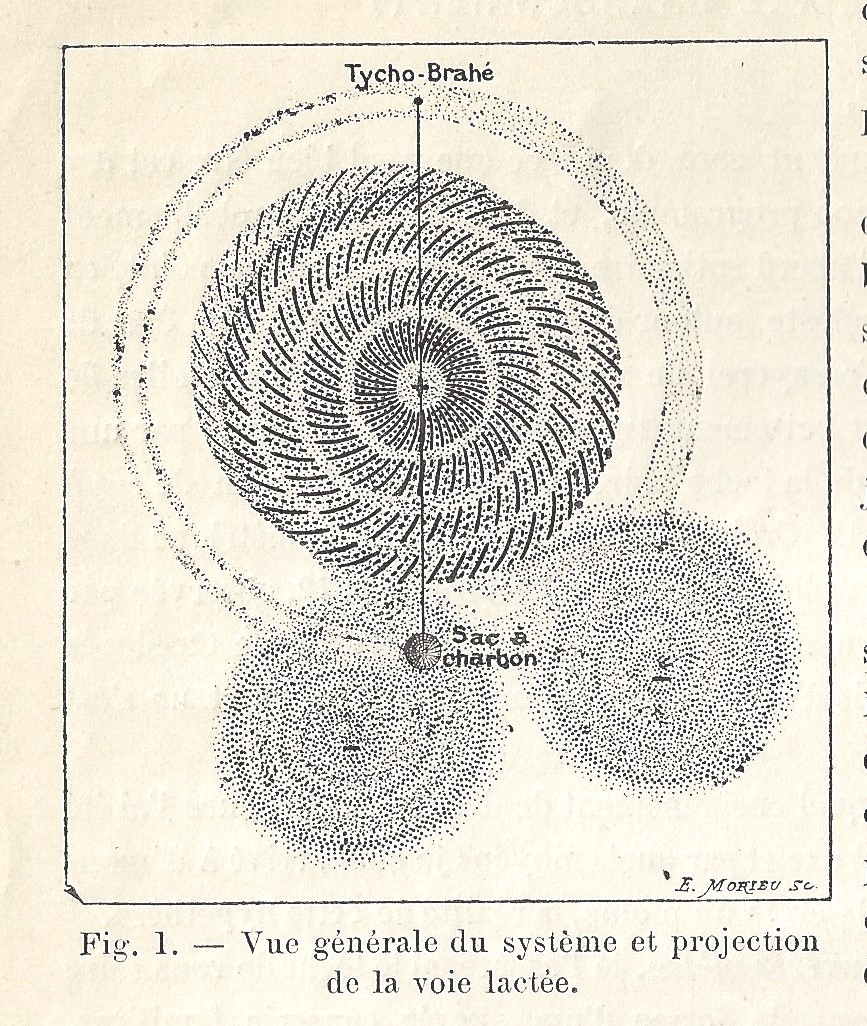
    Adolphe Duponchel,  “Circulation de notre groupe stellaire autour de l’axe charbonnier et mouvement parallactique de l’apex Solaire”. Printed by the author, in Paris, 1899, from its appearance in Societe Astronomique de France, 1 March 1899.  9×6″, 18pp.  Original wrappers. Condition: the wrappers are brittle and chipped, and detached; the text itself is quite good. Overall, though, this only gets a GOOD grade.   

    WorldCat/OCLC reports 1 copy in the U.S. And either 1 or 3 copies at the Observatoire de Paris—otherwise there are no other copies of this work located. Provenance: Smithsonian Institution, and then the Library of Congress (small mostly-faded oval stamp for the SI on front cover, and the LC surplus stamp on the back cover).   $150

    DocFile (3)

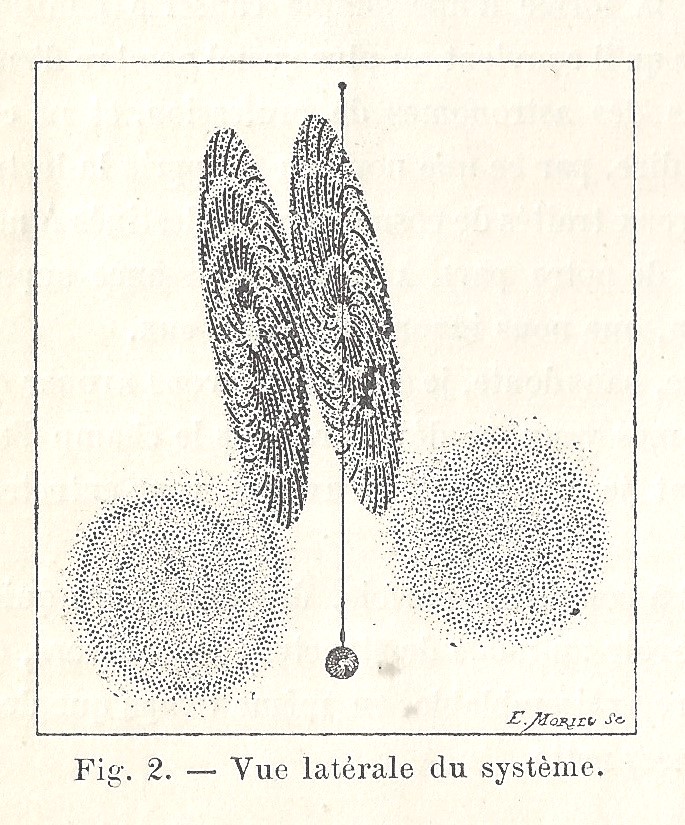
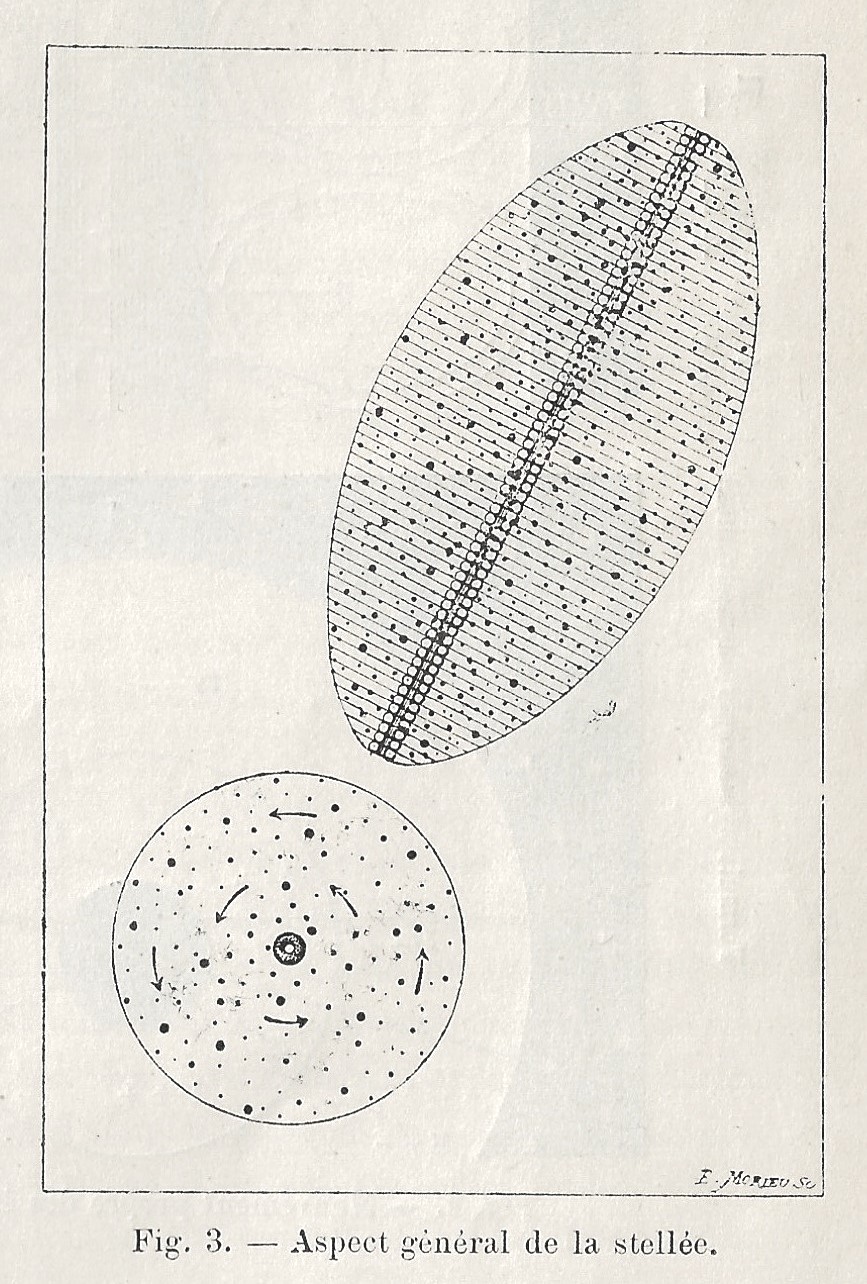
    Duponchel was an accomplished and published civil engineer, canal and bridge builder, and hydrologist, who later in life veered into cosmogony, publishing on the effects of meteors and solar activities on the distribution of stars, the structure of the galaxy, and the motions of the planets. He met with no success from what I can determine, though he seems to have been very active in his starry pursuits through the 1890’s, which was a prime period for French cosmogony. At the very least his ideas look entertaining, and some of the text figures imaging them are quite lovely.

    DocFile (4)

    The truth of the matter is that I do not understand what he is talking about, though sometimes it seems as though he is talking about black holes and the motion of stars, except that he seems to be talking about “apex charbonnier” that are dark regions of space that could not be penetrated given the optics of the day. In general though he writes about what effects the “circulation” of the stars and star clusters.  Liberally translating he states that “no astronomical problem could offer more interest, and in the absence of a solution of a rigorously demonstrated accuracy can be I am happy to have arrived at finding a plausible and at least probable explanation of the simultaneity of all these coordinated movements in the same state of general equilibrium.

    After this very pro forma and enormous statement, we arrive at the unknown stuff of his insight: 

    “…points noirs isolate correspondent a des rayons visuels qui auraient traverse les mailles des deux reseaux sans rencontrer aucune etoile sur leur passage. Dans une seule direction, sur un espace sans doute assez restreint, mais parfaitement defini par son contour piriforme, cette illumination fait reellement defaut.” (“Isolated black/dark spots correspond to visual rays that would have passed through the meshes of the two networks without encountering any stars in their path. In one direction, on a space which is doubtless rather small, but perfectly defined by its “piriforme” outline, this illumination is really lacking.” The translation doesn’t help the original too much, which left me understanding nothing.

    Then, a few pages later, he writes: 

    “…étudier ici tapissant en quelque sorte les parois du vide de l axe s y trouveraient distribuées en anneaux ou pour mieux dire en tores successifs dont chacun correspondrait à une strate particulière en forme discoi dale d étoiles extérieures. Ces to res successifs (figs 1+2) correspondant aux sphères magnétiques qui accompagnent les noyaux solides du Soleil et des planètes comprendraient chacun un certain nombre d étoiles circulant autour de l axe du tore avec un mouvement de rotation ac célérée en spirale comme celui des sphères magnétiques mais avec des vitesses alternativement de sens direct et de sens inverse de manière à assurer des vitesses concordantes de même direction aux points de tangence de deux tores consécutifs…” Or, “Firstly, to study here somehow lining the walls of the void of the axis would be distributed in rings or, to put it better, in successive tori, each of which corresponds to a particular stratum in the form of a disc of external stars. These successive rests (fig 1+2) corresponding to the magnetic spheres that accompany the solid nuclei of the Sun and planets would each include a number of stars circulating around the axis of the torus with a spiral arc rotational movement like that of the magnetic spheres but with alternately direct and reverse direction so as to ensure concordant speeds of the same direction at the points of tangency of two consecutive tori…”  Again, a not-good translation, but I really didn’t have much of an idea of what he was writing about. 

    DocFile (1)

    The pictures are pretty.


    Notes:

    “Et les individus qui participent à cet engouement pour la quête des origines cosmiques n’épargnent ni leurs efforts ni leur temps pour développer, étayer, rendre publique, et faire reconnaître leurs théories. Ainsi, l’ingénieur des Ponts et Chaussées Adolphe Duponchel (1821-1903), après avoir déposé un pli cacheté à l’Académie des sciences le 27 mars 1893 contenant le sommaire d’une brochure exposant ses « Principes de cosmogonie générale », fait imprimer celle-ci à ses frais et l’envoie à l’assemblée savante. Il n’obtient aucune réponse mais persévère et soumet six Notes ou Mémoires à l’Académie sur ce sujet entre 1893 et 1894. Ne parvenant pas à obtenir le soutien académique qu’il recherche, Duponchel va finalement publier sa théorie dans des revues populaires de science, d’abord dans la revue Cosmos le 2 septembre 1893 puis, sous une forme augmentée, dans la Revue Scientifique les 28 juillet et 4 août 1894.”Volny Fages, “Dire l’origine scientifique des astres. L’engouement pour la cosmogonie en France dans la seconde moitié du XIXe siècle”https://www.cairn.info/revue-romantisme-2014-4-page-32.htm

    See:

    ASTRONOMES FRANÇAIS 1850 – 1950 D’ABBADIE, Antoine.  www.obs-hp.fr/dictionnaire/astronomes_A-Z.pdf

    See: Agnes Mary Clerke , A Popular History of Astronomy During the Nineteenth Century, p 202, a review of some of the later 19th c solar astronomers.

    ·Posted by :

    ·in:


  • Water and Life on Mars (and elsewhere?) 1888

    “There is a Lot of Water Vapous in the Atmosphere of Mars” (1888)

    8 article in 7 papers, all from the Comptes Rendus, all relating to the possibility of life and water on Mars, and on the canals being either constructed or naturally occurring. All are offered in their weekly issues, extracted from a larger bound volume.  7 issues: $600 

    Flammarion, Camille. “Les neiges, les glaces et les eaux de la planete Mars” (Snow, Ice and Water of the Planet Mars”) In Comptes Rendus, volume 107, no. 1, 2 July 1888, the paper occupying pp 19-22 in the issue of pp 1-63.

    Flamarrion writes in the paper above:

    “Cette fusion des taches polaires penilant l’été est en contradiction manifeste avec l’hypothèse que les continents de Mars seraient des champs de glace et que la température de la planète serait inférieure à celle de la Terre. Elle prouve le contraire, si l’on admet que ces neiges et ces eaux soient de même nature que les nôtres, ce qui n’est pas absolument certain, malgré les investigations de l’Analyse spectrale, car la pression amosphérique, les points de fusion et de saturation, la composition chimique de l’atmosphère et des liquides, doivent offrir des différences originaires et permanentes avec ce qui existe sur notre planète.”

    Flammarion does state in what looks like no uncertain terms but then qualifies:

    “Il y a beaucoup de vapeur d’eau dans l’atmosphère de Mars, ce qui est démontré par les raies d’absorption de son spectre (mais la coloration de la planète n’est pas due à cette cause, puisqu’elle est plus forte au centre du disque,ou il a moins d’épaisseur à traverser que vers les bords).”

    This paper is also offered with the following, all from the Comptes Rendus

    Perrotin , Charles-Joseph, “Sur le planete Mars”, volume 107, 16 July 1888 no. 3, pp 161-164 in the issue of pp 157-164, with four illustrations of Mars;

    _____ .“Sur le planete Mars”, volume 107, 10 September 1888 no. 11, 496-500 in the issue of pp 485-512, with four illustrations of Mars.

    _____. “Sur la Planete Mars”, volume 106, 18 June 1888 no. 25, pp 1718-1719 in the issue of pp 1703-1757

    • The Charles-Joseph Perrotin contributions in the vol 107 paper are discussed in Flammarion’s The Planet Mars: As Translated by Patrick Moore )p 342ff, the drawings made for the paper showing the comings and goings of the canals by periodic “innudations”.

    Dubois, M.E. “Sur les satellites de la planete Mars”, volume 107, 20 August 1888, no. 8, pp 437-439 in the issue of pp 429-452;

    Poincare, Henri (surprise!) “Sur les satellites de Mars” (referencing the Dubois paper), volume 107, 3 December 1888 no. 23,. 890-892 in the issue of pp 887-934pp.

    And with:

    Fizeau,“Sur les canaux de la Planete Mars” volume 106, no. 26, 1759-1762 (25 June 1888) the issue of pp 1759-1817). remarks in this effort that the canals can best be explained by geophysical means rather than as creations by intelligent life forms.

    Janssen, Jules. “Remarques sur la Communication precedente” (Fizeau, same issue),1762-1764 (mentioning the discovery of water vapour by himself, Huggins, and Vogel in 1867).

    ·Posted by :

    ·in:


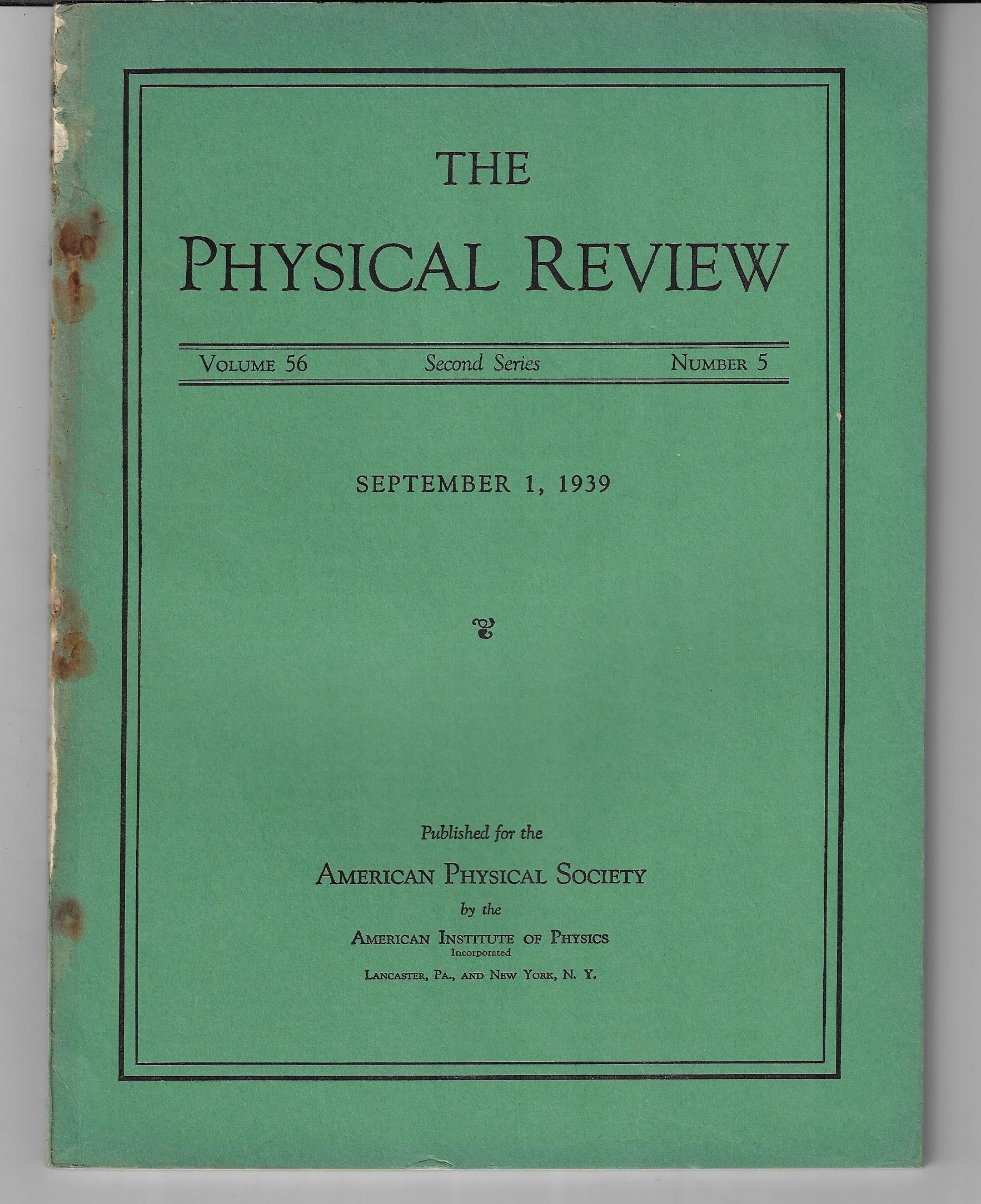
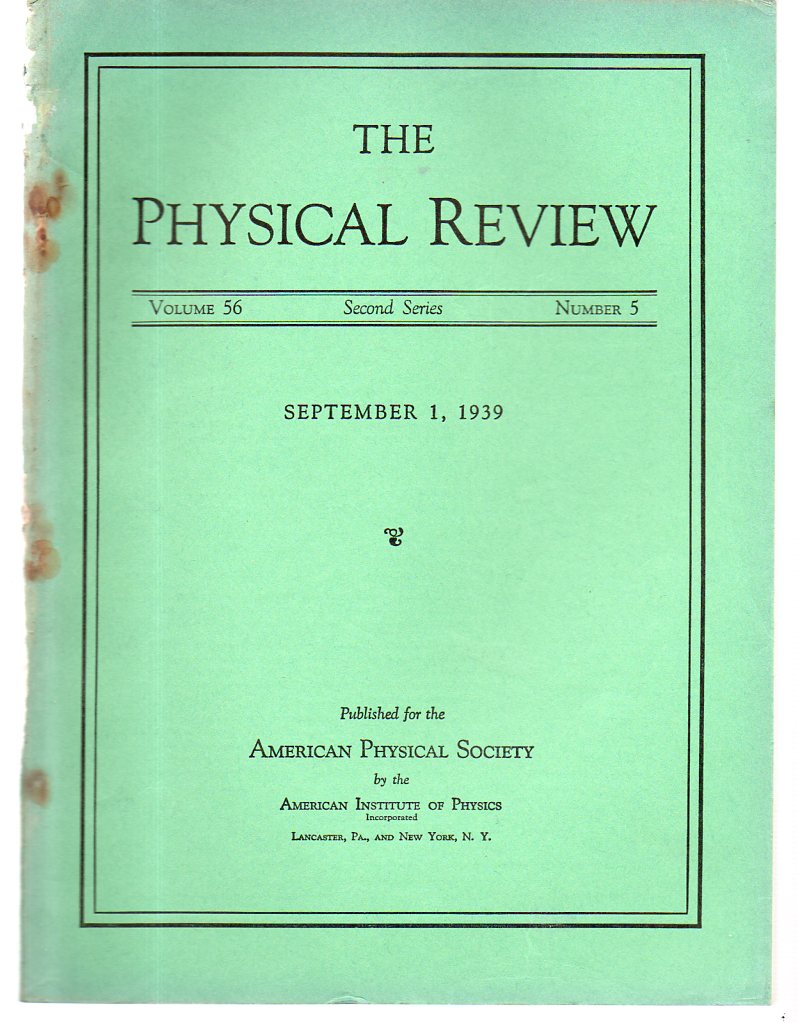
  • Two Great Papers in One Issue of the Physical Review: Oppenheimer/Snyder and Bohr/Wheeler

    Robert Oppenheimer and Hartland Snyder, “On continued gravitational contraction”,

    • AND BOUND WITH

    Niels Bohr and J.A. Wheeler, “The mechanism of nuclear fission”  both appearing in the Physical Review, September 1, 1939, Vol. 56, #5, pp. 426-50 and pp. 455-59, respectively. 

    First editions of these two papers, presented in the original wrappered issue of the great Physical Review. Condition:  the issue is not without its problems, and these are limited mostly to the spine cover, which is mostly worn away, though the spine itself is fine. THe only legible part of the lettering on the spine is the date on the spine bottom. Also there is some rust staining from the internal staples.  Other than that the issue is really quite nice. All that said, I’m offering this at a fraction of what prettier copies are being sold for presently. $1250  
     
    The two papers appear together in a single issue of the journal, a remarkable set of achievements found in one small space–remarkable even more for the fact that 1939 (as with 1859, 1543, 1932, and 1948) is one of those remarkable single years in the history of science.
     
    The Oppenheimer and Snyder (a graduate assistant) paper is one of the most prescient in the history of modern physics, correctly physically describing (where Chandrasekhar and Eddington in their discussions did not) what happens in a particular collapse of a neutron star, and still today reads as fresh and and brightly as it did in 1939.  Really, it is an extraordinary work, and a foundation paper in the history of gravitation, the application of RT, singularity, and astrophysics.  (The Southampton GR Explorer site nicely states it this way: “This paper has strong claims to being one of the most prophetic ever written in this field of research. Today, 60 years later, this paper needs little revision – even the terminology is undated!”)
    Phys Rev 1939 Oppenheimer Gravitational
    In an often-repeated quotation, they write, somewhat in irony and in a certain and understated manner on page 456: “The star thus tends to close itself off from any communication with a distant observer; only its gravitational field persists”. And later: “When all thermonuclear sources of energy are exhausted, a sufficiently heavy star will collapse. Unless fission due to rotation, the radiation of mass, or the blowing off of mass by radiation, reduce the star’s mass to the order of that of the sun, this contraction will continue indefinitely”, they wrote.
     
    Next comes Bohr and Wheeler, “The mechanism of nuclear fission” is the experimental foundation stone (on the basis of the liquid drop model of atomic nuclei) of nuclear fission and the great leap forward in the construction of the atomic bomb.
    Condition: the paper of the spine of the publication is about one-third owrn away, otherwise this is a very nice copy. 

    From the abstract: “On the basis of the liquid drop model of atomic nuclei, an account is given of the mechanism of nuclear fission. In particular, conclusions are drawn regarding the variation from nucleus to nucleus of the critical energy required for fission, and regarding the dependence of fission cross section for a given nucleus on energy of the exciting agency. A detailed discussion of the observations is presented on the basis of the theoretical considerations. Theory and experiment fit together in a reasonable way to give a satisfactory picture of nuclear fission”.

    ·Posted by :

    ·in:


  • “The Beginning of Cosmic Ray Astronomy”

    HESS, Vicktor. “Uber Beobachtungen der durchdringenden Strahlung bei sieben Freiballonfahrten”, in Physikalische Zeitschrift, volume 13, 1912, pp 1084-1091, offered in the full volume. This is the work for which Hess would (much) later receive his shared Nobel in physics in 1936. Cloth-backed marbled boards with cloth-tipped corners. Institutional copy with a bookplate and a few rubber stamps on title page, otherwise a fine copy. $450

    • “Hess took up the problem stated by Wulf in 1911. He first verified the rate of absorption of gamma rays and then, with the help of the Austrian Academy of Sciences and the Austrian Aeroclub, made ten difficult and daring balloon ascensions, collecting data with improved instrumentation. He reached a height of 5,350 meters, with striking results. He was able to establish that to a height of approximately 150 meters above sea level, radiation decreased according to known laws, while at greater heights radiation increased steadily, following approximately the same laws. He found radiation at 5,000 meters to be several times greater than that at sea level, and also that radiation at all levels was the same night or day, and therefore not the result of the direct rays of the sun. He was thus able to conclude that the radiation he recorded at high altitudes entered the atmosphere from above and was, in fact, of cosmic origin. His results were verified in an extension of his experiments made by W. Kohlhörster in1913—Kohlhörster reached a height of 9,300 meters, and recorded radiation of twelve times that at sea level—but were not acknowledged by other physicists for a number of years. (“Cosmic rays” were so named by R. A. Millikan in 1925.) In 1913 Hess himself equipped the meteorological station on Hoch Obir (2,141 meters) in Carinthia to accommodate further studies of cosmic radiation; these experiments, however, were brought to a halt by World War I. “–“Hess, Victor Franz (Francis).” Complete Dictionary of Scientific Biography. Vol. 6. Detroit: Charles Scribner’s Sons, 2008. 354-356.

    The last of the ascensions was made on August 7, 1912, with the results published in this issue of the PZ. 

    • “The results of these observations seem best explained by a radiation of great penetrating power entering the atmosphere from above..’ This was the beginning of cosmic-ray astronomy”– Harwitt, Cosmic Discovery, pg 14.

    Also contained in this volume:

    • Laue, Max. “Einande gegen die Relativitatstheorie und ihre Widerlegung”;
    • Meitner, Lisa. “Uber das Zerfallsschema des aktiven Niederschlags des Thoriums”;
    • and numerous others.


    ·Posted by :

    ·in:


  • William Huggins and Stellar Spectra (1880)

    William Huggins, “On the Photographic Spectra of Stars”, in Nature, January 22, 1880.  

    This is a short two-page abstract of the 21-page version of this significant work on stellar spectroscopy that appeared in the Philosophical Transactions at nearly the same time as the Nature publication. It is commendable that Nature reprinted the folding plate of the spectra of sevens stars here as a full page length image (one full column of the two-column page).  This paper is an extract of the weekly issue from a larger bound volume, complete with the scarce outer wrappers.  Very Good copy. $40

    ·Posted by :

    ·in:


  • On Not Being Able to See Martians (Because We Can’t See Them) (1944)

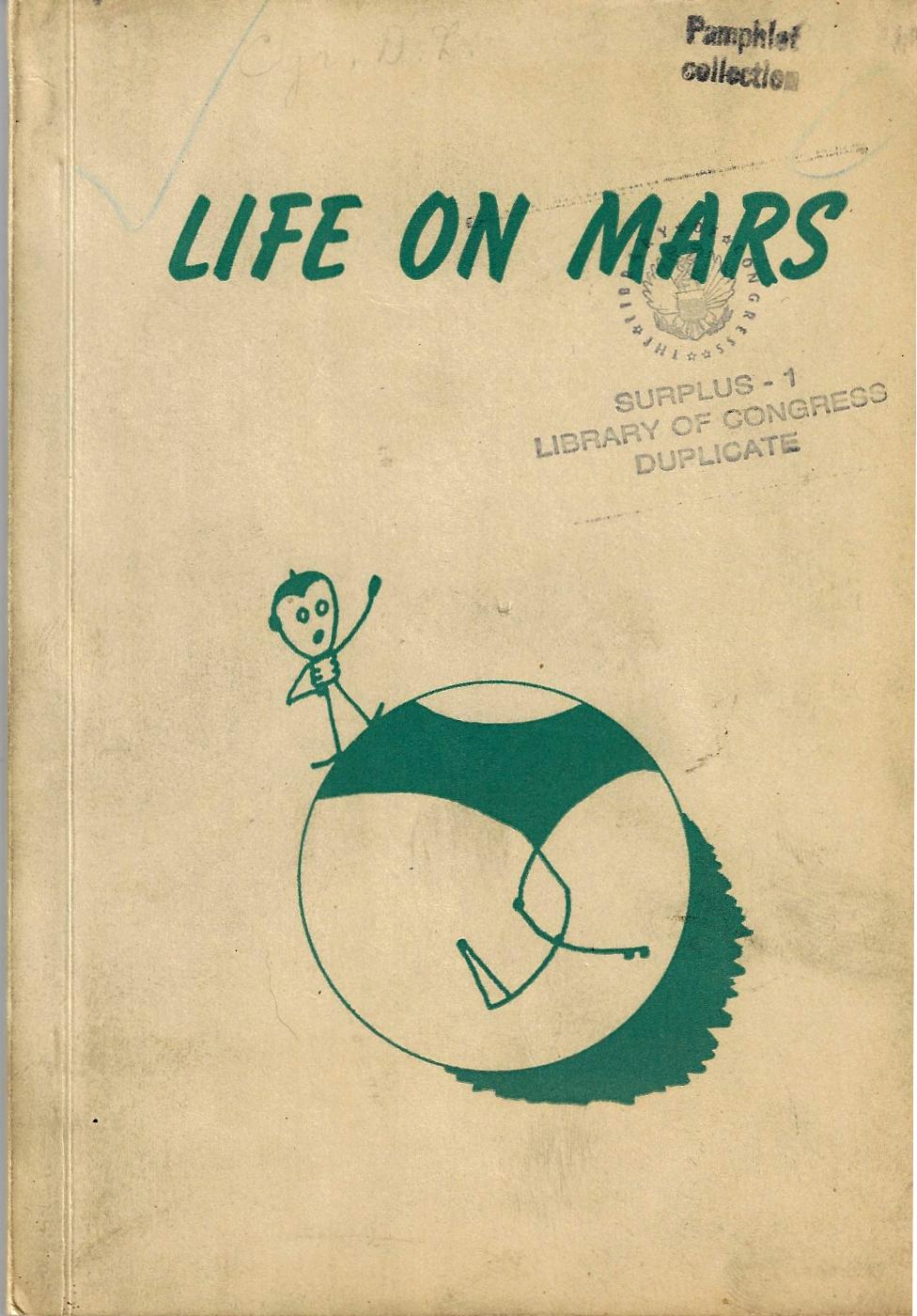
    MArs life on 1944Donald Lee Cyr. Life on Mars, printed by the Desert Magazine Press of El Centro, California, and I believe self-published by the author.  7×5″, 50pp. occasionally illustrated with drawings and maps. Original print wrappers, perfect bound. Provenance: Library of Congress, no doubt the recipient of their copy from the author. Condition: there is a 6mm “LC” perforated stamp on the title page, as well as a LC “surplus/duplicate” rubber stamp on the front cover.  But for these marks a Very Good copy. Surprisingly there are only four copies located in WorldCat/OCLC. $75

    Mr. Cyr made some very wide and radical remarks and observations in this pamphlet on life on Mars, which he is convinced exists, and on an advanced level. The problem is that we can only see the results of the civilization, and not the society itself. The Martians, I read (quickly) can’t be seen because they can’t be seen (“like atoms”), “only the collective efforts of Martians are visible”.  The canals (which run 1000′ deep and cross the planet) also cannot be seen but not because they are so small as to be invisible, but rather it is due to the vegetation growing on their walls that obscure the structures themselves. The canals are also filled with water, or they are canyonlands, with animals using them as a highway. In another found paragraph we are told that “two or more craters near each other have an economic effect on Martian inhabitants”.  And in my last bit of random reading, I saw that the canal networks of Ascraeus Lucas are more than likely built upon earlier trails, and that “the only comparable highway network on earth [sic] is that radiating outwards from Indianapolis”. 

    It seems that Mr. Cyr was an observer of Mars, and then went well beyond the observable to make his deeper observations.  

    He liked this work enough to expand it in 1959.


    ·Posted by :

    ·in: