A Daily History of Holes, Dots, Lines, Science, History, Math, Physics, Art, the Unintentional Absurd, Architecture, Maps, Data Visualization, Blank and Missing Things, and so on. |1.6 million words, 7500 images, 4.9 million hits| Press & appearances in The Times, Le Figaro, Mensa, The Economist, The Guardian, Discovery News, Slate, Le Monde, Sci American Blogs, Le Pont, and many other places… 5000+ total posts since 2008.

Book Category: Geology

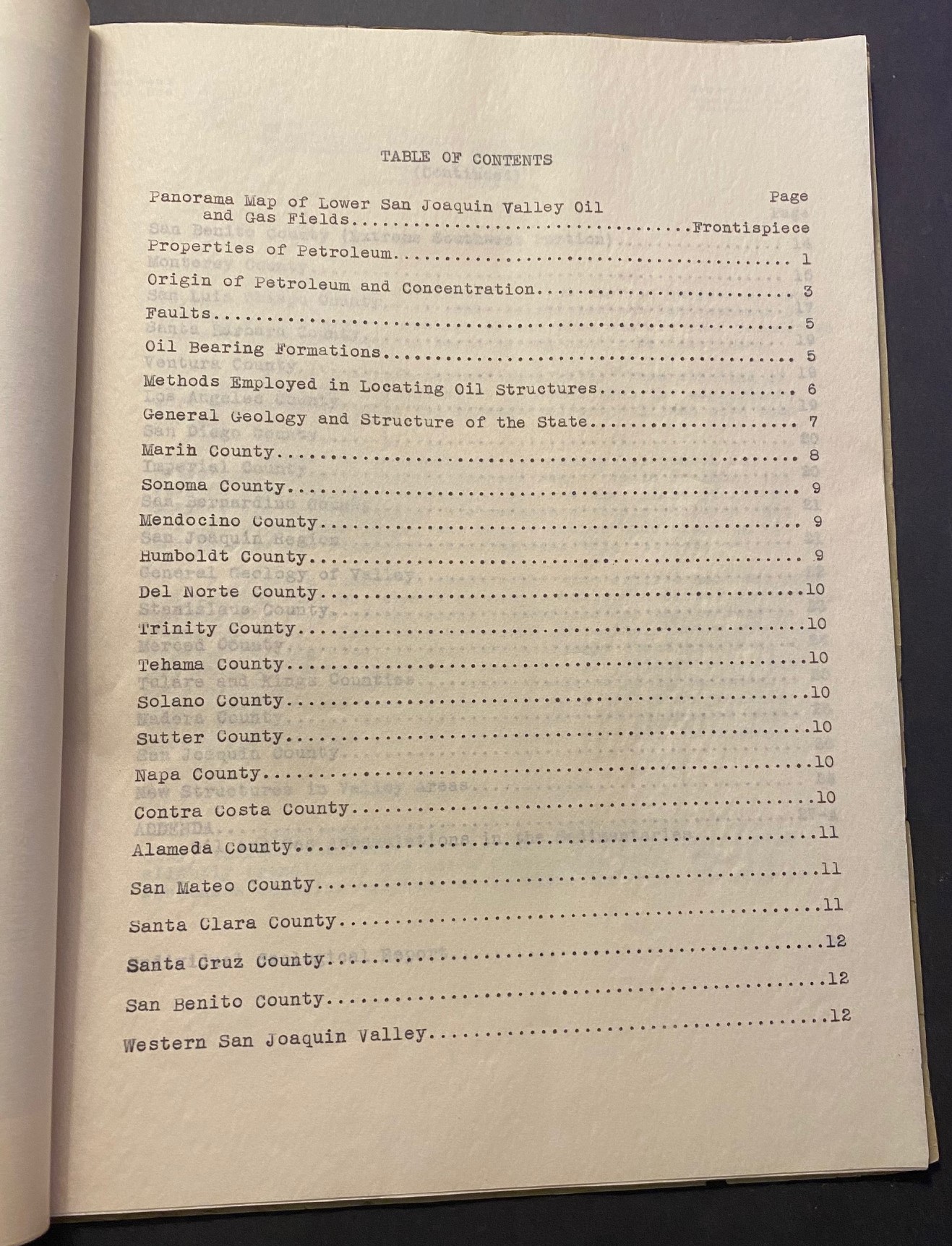
  • Rare Work on California Oil and Gas Fields–Carbon Copy

    No Copies in WorldCat

    HUDSON, George H. Geological Summary and Report of California Oil and Gas Fields, with Addenda.

    Compiled by Bureau of Geological Statistics (San Francisco). Copyrighted by J. Miller and George H. Hudson (Geologist and Petroleum Engineer). Carbon copy, with homemade paper wrappers. 11”x 8.5”, 2 (unusual) birds-eye views, ii, 27pp, 4pp appendix. Bound with brass brad fasteners. $1500.00

    Carbon copy on onion-skin-like paper—I don’t think this is the first impression (I mean the original) but an early, Provenance: Library of Congress, with their 10mm “LC” perforated stamp on the title page and rubber stamp surplus on the front wrapper. perhaps first generation, copy, as you can still feel the indentations from the typewriter-struck paper. Laid in are the LC card catalog cards.

    IMG_2789

    ·Posted by :

    ·in:


  • The Mountain “Furnace” and the Creation of Metal (1678)

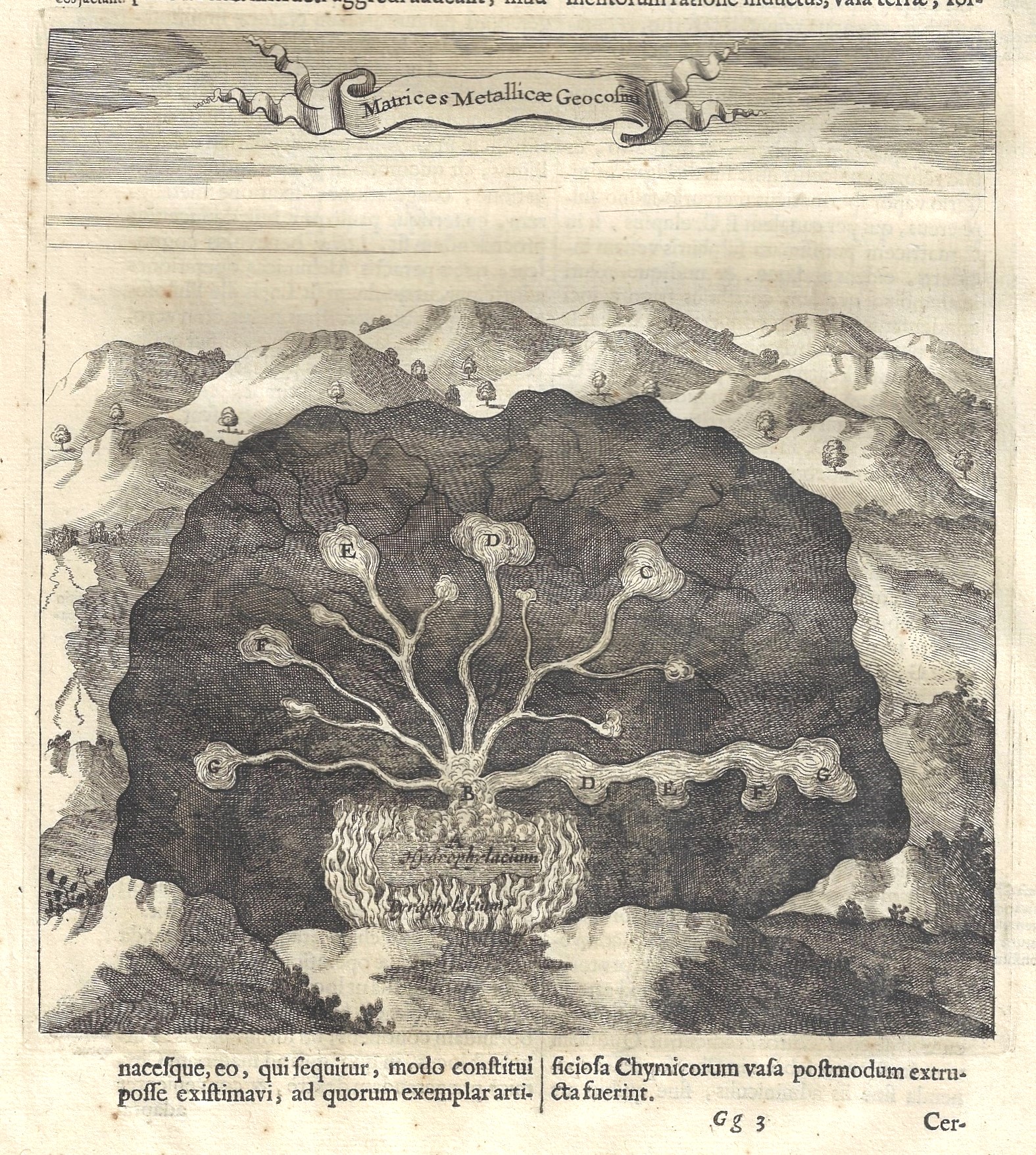
    KIRCHER, Athanasius. Matrices Metallicae Geocosmi, an engraving from a salvaged and beyond-repair copy of the great Mundus Subterraneus, (“Athanasii Kircheri Mundus subterraneus in XII libros digestus… “), 1678, from the section “De Origine Alchymiae”, p 237.

    7”x 8” image on a 15”x 9′ sheet, showing Kircher’s hypothesis for the natural formation of metals in a mountain “furnace”.

    Kircher matricies metalicae detail

    The great semi-mystifying polymath Athanasius Kircher (1602-1680) lived for a long time and filled his life with ideas and words,  producing dozens of books during his time on Earth, some of which were never published even though written, some manuscripts lost forever. His was a massive output of extraordinary breadth.  He wasted little time that I can see, writing on a spectacular range of subjects: enlightening people, confusing people, generating great theories and some occasional bad ideas. 

    The image presented here comes from his Mundus Subterraenus, published in 1678, which was concerned mainly with geology and the theory of the Earth. There is an enormous amount of wide-ranging thinking going on in these two volume, most of which were scientific and experimental, and some of that being flavored and coated by hermetic and religious influences, while some bits were entirely religio-speculative. A product of the great Jesuit institution, the Collegio Romano, he postulated and dove fearlessly into the structure of the interior of the Earth, the origin of heat, the source of the tides, the composition of light, mechanics, the structure of music, linguistics, astronomy, astrology, alchemy, fossils, fluid dynamics, mining, and of course the existence of anthropomorphic images in stone (for example, the Virgin Mary found in agate).  There was also a fair amount of work on one of his side interests that populated a number of his works, alchemy and the search for the organization of materials. He also sought a primum mobile so to speak, a force or reckoning that was beyond what he recognized as the creator’s, a cosmic pansperma, an automatic/spontaneous cosmic energy at the root of change of all things.

    ·Posted by :

    ·in:


  • Early Geological Map (1823)

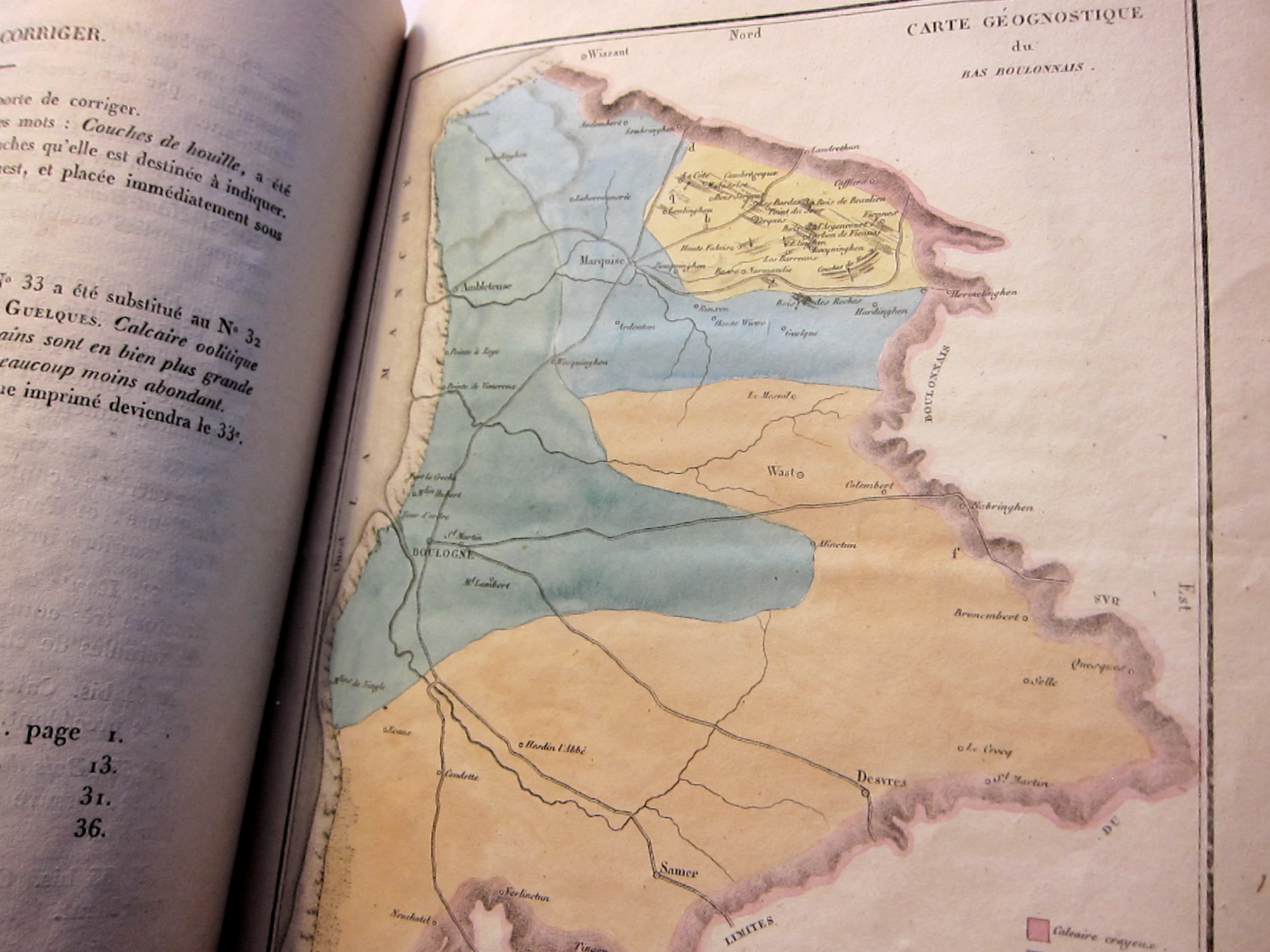
    Garnier, F. Memoire Geologique sur les Terrains du Bas-boulonnais et particulierement sur les Calcaires Compactes ou grenus qu’il Renforme. Boulogne sur Mer, published by P. Hesse, 1823. From an address at Boulonge in July 1822.  Original wrappers. Dusty. Rubber stamp ownership mark on rear wrapper.  Very Good condition. SOLD

    10×8”, 39pp, with a full-page geological map of the region, which is evidently an early geological (“Geognostique”) map of the region, and appears (as with some others) 18 years before the publication of the first full-country geological map of France (1841. Dufrenoy, PA and de Beaumont, E, Tableau d’Assemblage des six feuilles de la Carte de la France.)Maps france boulonge geo

    Book arts knot march 2019 _3_

    ·Posted by :

    ·in:


  • Petroleum in Wyoming (1885)

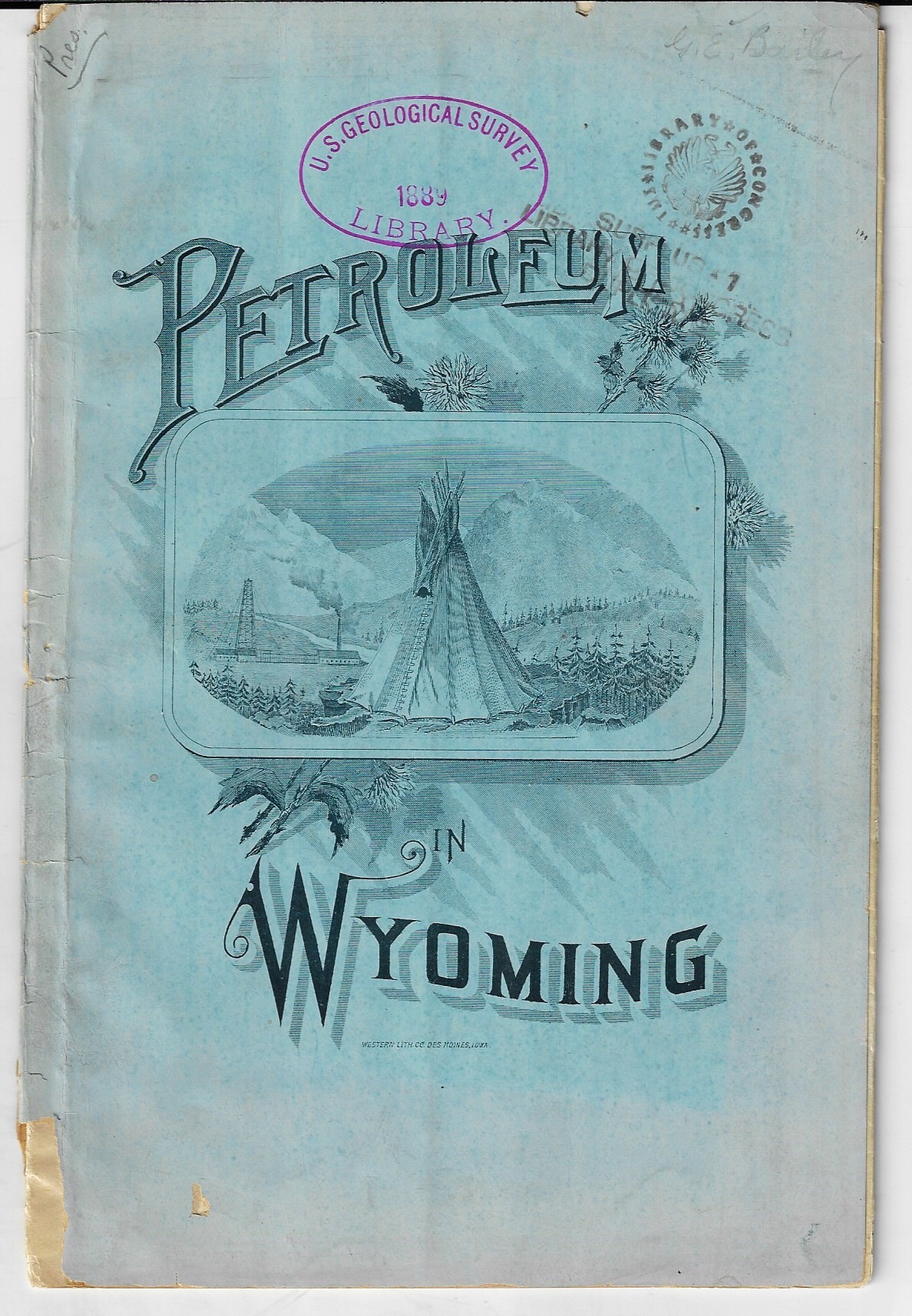
    Gilbert Ellis Bailey (former State Geologist of Wyoming). Petroleum in Wyoming Territory and special report on the Stockade oil district and the property of the Lakota oil and coal mining company in Crook County, Wyoming. No publisher or place of printing is noted. No date (though it is certainly before statehood in 1890); Stanford guesses 1885.  8.25”x5.75”, 19pp, with a small folding map of the county.  Printed wrappers. Provenance: U.S. Geological Survey Library, gifted to the Library of Congress in 1921. Few small rubber stamps on front cover for the two libraries. Outside of a few chips to the cover, and three very old fold shadows running vertically through the pamphlet, a VG copy—now at least a very solid GOOD.   SOLD


    Wyoming

    One copy only (Stanford) located by WorldCat.  

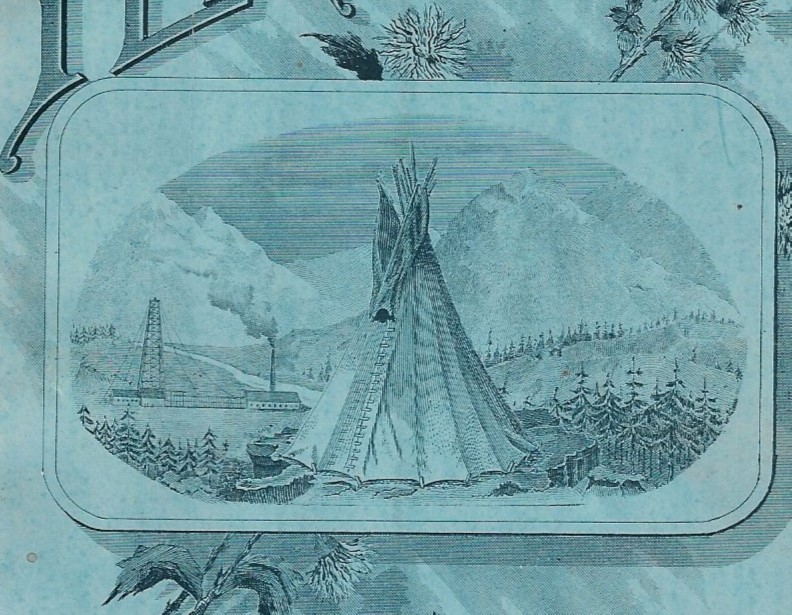
    It is worth taking a note of the cover illustration, which shows a teepee (which would be about right seeing that most of the Indians before White incursion were nomadic)—behind it though we see oil derricks, which I am sure was not the case, unless the derricks were on Indian land. In 1880 the (non-Indian) population of Crook County was 239, which “jumped” to 2,300 in 1890, (then to 6k in 1910 where it has stayed about constant since). In 1890 the Indian population in all of Wyoming was 2,063 (or thereabouts, according to the U.S.1890 census special volume Indians Taxed and Indians Not Taxed), and of that figure nearly the entirety of the population–1,861–were on reservations. And according to the census report of the 189,000 reported Indian population in the country 133,000 were on reservations, while another 50,000 were living in Indian Territory, making for something like 5,000 Indians not on reservations or I.T. territory in the entire U.S. and territories. So, picturing the teepee set before a petroleum industry scene was exceedingly prosaic.

    ·Posted by :

    ·in:


  • Histoire de l’ Academie Royale des Sciences, 1728

    Histoire de l’ Academie Royale des Sciences. Annee M. DCCXXVIII Avec le memoires de mathematique & de physique, pour la meme annee. Tires des registres de cette academie. Printed in Amsterdam by Pierre Moerier, 1732. volumes 1 and 2, complete. The two volume work is 6.5”x3.5” and is in two sections with three working title pages: Histoire de l’Academie Royale des Sciences… (164pp) followed by Memoires de Mathematique et de Physique tirez des registres de l’Academie Royale des Sciences…(197pp and 5 folding plates) in volume 1; volume II is Suite des Memoires de Mathematique et de Phyqiue tirez des registres de l’Academie Royale des Sciences (pp 201-605 and 17 folding plates).

    Very Good condition—lovely copies, really. $500/two volumes.

    Many interesting articles, reprinted here in 1732, and including such contributions as:

    “Sur le Mouvement de Saturne”, pp 94-100;

    “Sur la Foce des Corps des mouvement”, pp 100-134;

    C.E.L. Camus, “Du Mouvement Accelere par des Ressorts et des Forces qui resident dans les Corps en Mouvement”, pp 230-283 (A significant paper, especially influential to Lagrange—see Isaac Todhunter, “A History of the Theory of Elasticity and of the Strength of Materials”.)

    Jean-Jacques d’Ortous de Mairan (1678 – 1771, French geophysicist, astronomer and most notably, chronobiologist), “Dissertation sur l’Estimation et la mesure des forces motrices des corps”, pp 17-81.

    Giovanni Cassini (d. 1712, first observation of the moons of Saturn), “Du Mouvement de Saturne”, pp 95-124;

    Jean-Jacques Dortous de Mairan (1678-1771,”was a mathematician and an enthusiastic experimenter whose major works were on the formation of ice and on the aurora borealis. However, he was also interested in all the important topics addressed the scientific community in the eighteenth century, among them, the shape of Earth, light, colors, sound, the composition of matter, and vis viva (the debate around the force of moving bodies and the conservation of matter).”–DSB . “Eclaireissement sur le Memoire de la Cause generale du Froid en Hiver at de la Chaleur en Ete, pp 10-23.

    René Antoine Ferchault de Réaumur  (1683-1757, French entomologist and writer who contributed to many different fields, especially the study of insects), “Histoire des Teignes, ou des Insects qui Ronguet les Laines et les Pelleteries”, premiere part, pp 201-282 and parte seconde pp 439-476.

    Abbe de Molieres, “Loix Genrales du Mouvement dans le Tourbillon Spherique”, pp 349-380;

    Petit, “Observation sur la Rupture Incomplette du Tendon d’Achille”, pp 331-380;

    Geoffroy le Cadet. “Suite d’ Observations fur les Huiles ejfentielles , leur altération & la manière de reâifer celles de certains fruits , avec un examen  des changemens i]ui arrivent à l’Huile d’Anis.”M. 

    De Maupertuis, “Sur toutes les Développées qu’mie Courbe peut avoir à l’Infini”;

    Du Hamel, “Recherches sur les causes de la multiplication des Especes de Fruits”, 477-499;

    Du Fay, “ “Observations sur qualques Experiences de l’Aimant”, pp 500-520;

    Pitot, “Remarque sur les Rapports des surfaces des grands et des petits corps”, pp 521-530

    Bourdelin, “Memoire sur la Formation des sels Lixiviels”, pp 541-567;
    ·Posted by :

    ·in:


  • Colossal, Super Colossal, and Mega Colossal: The “Terrible Seismical Manifestation at Java” (1883)

    Krakatoa: three early papers on the eruption:

    • (1) “The Java Upheaval” in Nature, 6 September 1883, pp 443-4, in the weekly issue of pp 433-456. Includes a half-page map of the Java area of the eruption. 
    • (2) “Scientific Aspects of the Java Catastrophe”, in  Nature, 13 September 1883, pp 457-8 in the weekly issue of pp 457-480
    • (3) “The Java Eruption”, in Nature, 11 October 1883m p 577  in the issue of pp 561-584.

    Three issues removed from a larger bound volume. VG condition. $110

    I came to this terrible majesty/rex tremendae of words browsing an 1883 volume of Nature, landing on two articles on the Krakatoa eruption of 26-7 August 1883. The editors were just then coming to grips with what scant information came their way, though they knew  that what they were trying to present to their readers was a very major event.  There was little to prepare them for what they would understand the eruption to be, no doubt filling themselves with images of dread (Quantus tremor est futurus, “what horror invades the mind”, calling again–sorry!–on Mozart’s Requiem for the appropriate language).

    The eruption is well known and the subject of innumerable stories and papers, so I’ll not get into that. I do want to look at the expansive and changling vocabulary describing these events, though. The way eruptions are categorized in modern times for relative description and is the Volcanic Explosivity Index (the VEI). a logarithmic scale which runs 0-8. The basis of categorizing the terrific nature of the eruption is made in terms of the volume of ejecta, the plume height, length of eruption, and that sort. I find the defining terms of type of eruption to be very entertaining, with eruptions being described as (level VFI 0) effusive, (1) gentle, (2) explosive, (3) catastrophic, (4) cataclysmic, (5) peroxysmic, (6) colossal, and of course (7) super-colossal, and (8) mega-colossal. (Just a quick note: “colossal” appears in the OED by 1664; “supercolossal” as an unhyphenated word appears by 1875; and “mega-colossal” just doesn’t appear.)

    Krakatoa was a VFI-6, a peroxysmic event with 10 km3 of ejecta, which is 1 billion meters3, or 1 trillion litres, or 264 billion gallons (which would weigh in at 1.8 trillion pounds, or about the equivalent of 17,819.7 Titanics), or about 10 times the ejecta of the 1980 Mt. St. Helen’s eruption. These are very messy approximations as ejecta is varied, but it does give you an idea of the magnitude of what was going on.

    ·Posted by :

    ·in:


  • The Krakatoa Eruption, September 1883

    The eruption of Krakatoa–three very contemporary accounts from Nature, September-October 1883.

    “The Java Upheaval”, in: Nature, 6 September 1883, pp 443-4 in the weekly issue of pp 433-456.  Also includes a half-page map of the area of the Krakatoa eruption, which occurred about two weeks earlier on 27 August.  Original issue, removed from a larger bound volume.  Very clean and fresh. 3 issues: $150

    • “The most powerful volcanic eruption in recorded history occurs on Krakatau (also called Krakatoa), a small, uninhabited volcanic island located west of Sumatra in Indonesia, on this day in 1883. Heard 3,000 miles away, the explosions threw five cubic miles of earth 50 miles into the air, created 120-foot tsunamis…”–Wikipedia

    Also with:

    • “Scientific Aspects of the Java Catastrophe”, in Nature, 13 September 1883, pp 457-458 in the weekly issue of pp 457-480. Original issue, removed from a larger bound volume.
    • “The Java Eruption” in Nature, 11 October 1883, page 577 in the issue of pp 561-584. Very nice copy, except that ther is a small half-inch x inch jagged piece missing in the bottom margin of p 579. Original issue, removed from a larger bound volume.

    Also contained in this 6 September issue: Francis Galton’s important paper in “visual kinsip” , “Arithmetic Notation of Kinship”,  a letter to the editor, p. 435.  (“MANY writers have endeavoured to devise a simple method of describing the various forms of kinship, which, when expressed verbally, are cumbrous and puzzling in the highest degree. I suspect, however, that if we had always been as familiar with the binary system of arithmetic as we are with the decimal, that the facilities afforded by a numerical system of kinship would have been so obvious…”  And from History of Anthropology blog:  “Francis Galton was a major champion of the algebraic approach to representing genealogies, and solicited the help of the mathematician Alexander MacFarlane to that end— while Bronislaw Malinowski acidly criticized such abstract symbolism as a bloodless technique. These early attempts at mathematical systematicity foreshadow later 20th century computational analysis of kinship; Galton’s interest in binary systems in particular anticipates computer modeling of social and genetic networks. “– (histanthro dot org)

    ·Posted by :

    ·in: