A Daily History of Holes, Dots, Lines, Science, History, Math, Physics, Art, the Unintentional Absurd, Architecture, Maps, Data Visualization, Blank and Missing Things, and so on. |1.6 million words, 7500 images, 4.9 million hits| Press & appearances in The Times, Le Figaro, Mensa, The Economist, The Guardian, Discovery News, Slate, Le Monde, Sci American Blogs, Le Pont, and many other places… 5000+ total posts since 2008.

Book Category: Relativity

  • The General Theory of Relativity, 1916

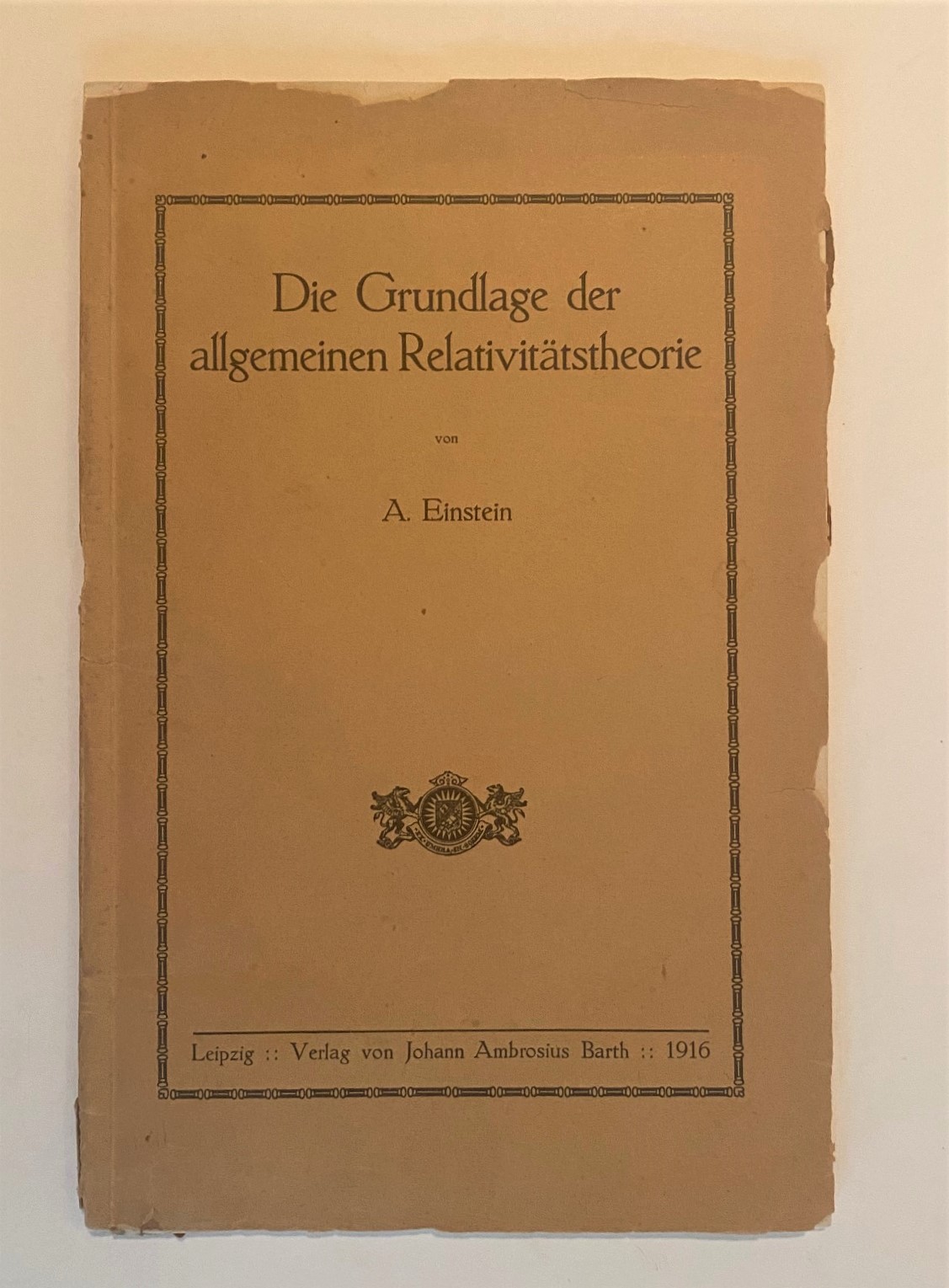
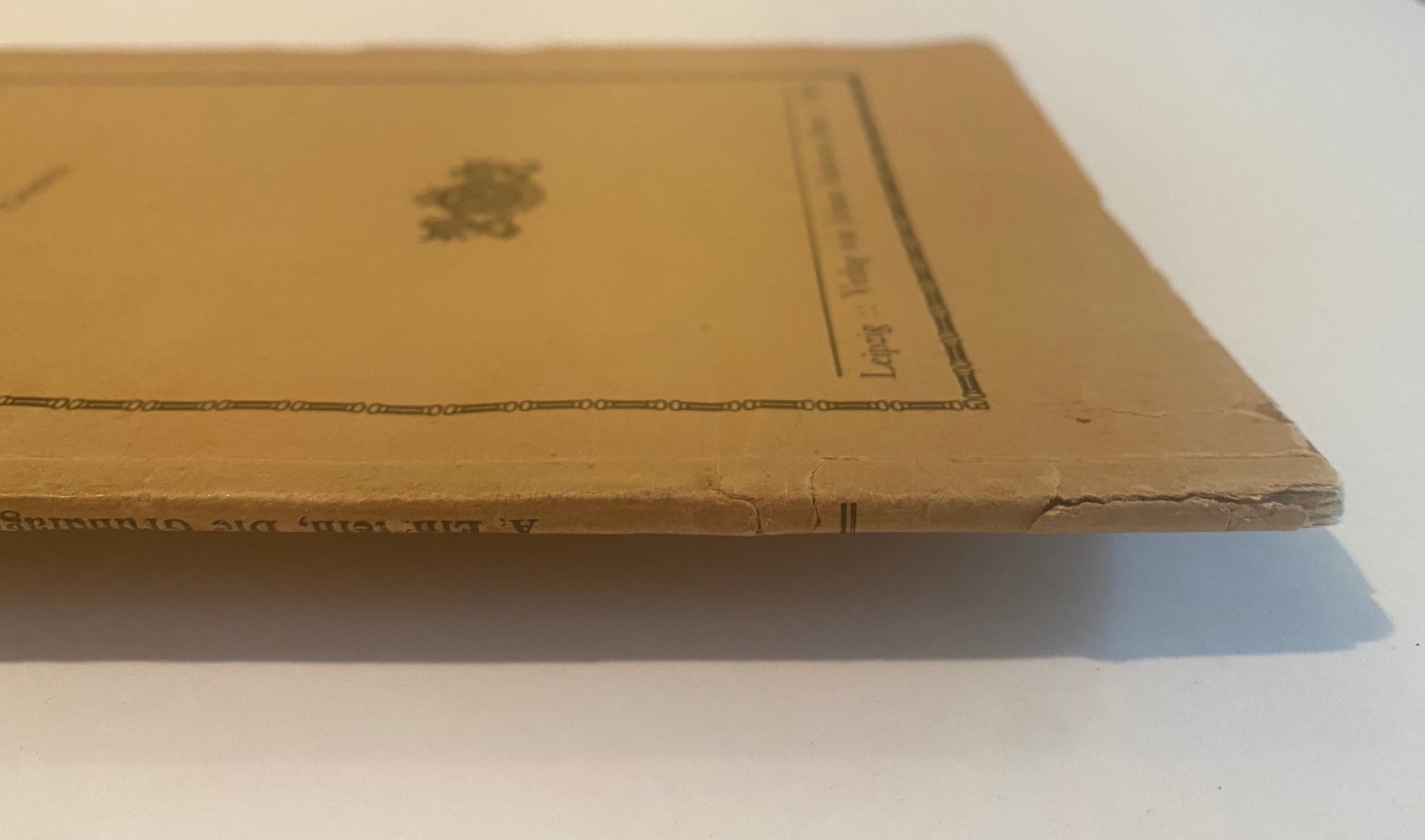
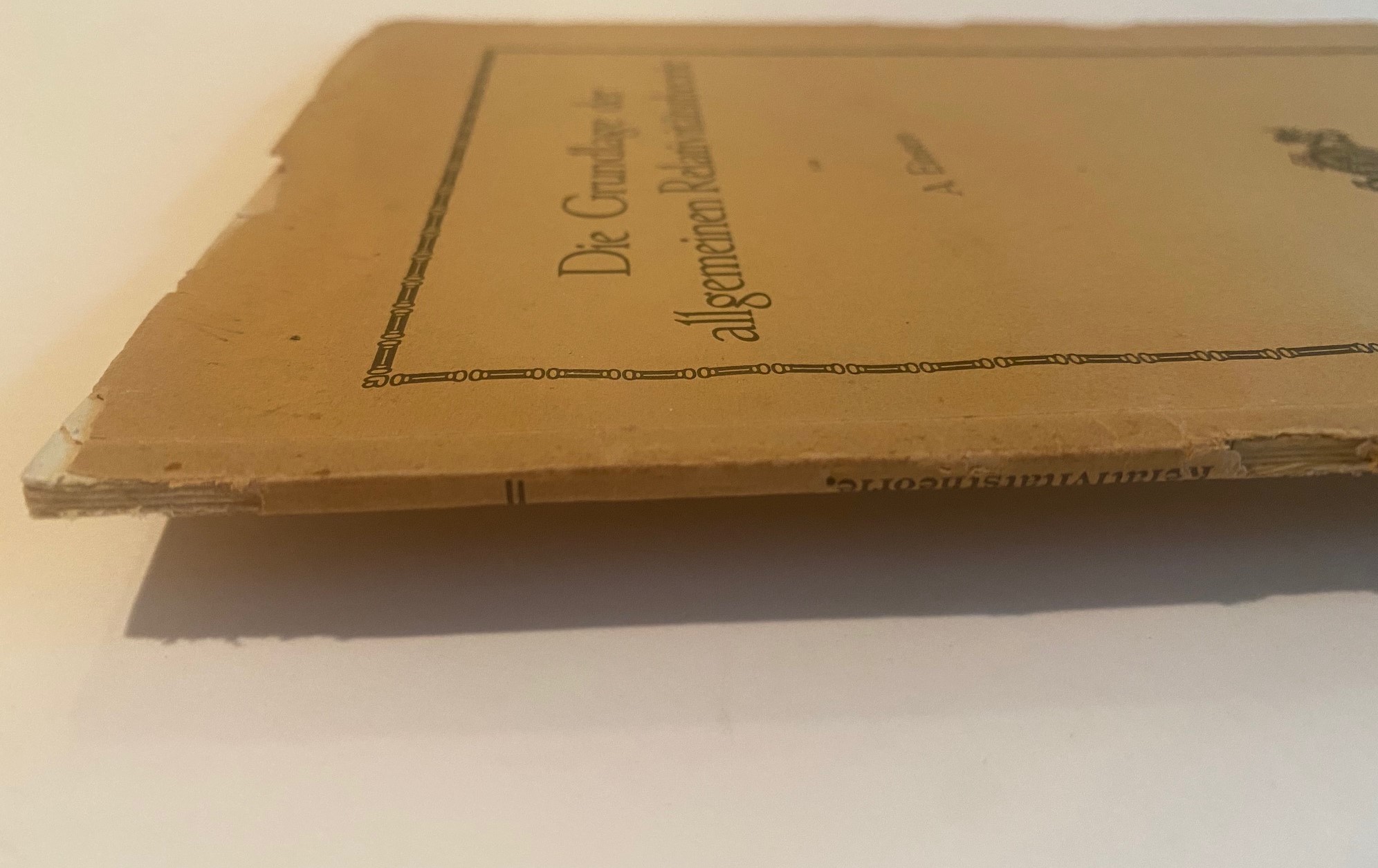
    IMG_7019EINSTEIN, Albert. “Die Grundlagen der Allgemeinen Relativitatstheorie,” Sonderdruck aus den Annalen Der Physik, 1916, series IV, volume 49, 1916. First edition, first issue of the monograph issue, of Einstein’s “Grundlagen…”, the “greatly expanded and detailed memoir…which, so to speak, became the Authorized Version” of the general theory of relativity–(Complete DSB online) Original wrappers. 9″x6″, 64pp. Condition: the wrappers have little chips out here and there (see photos) along the cover edges. There are also three small chips along the paper spine, two being about a half-inch and the third (at bottom) being ¾”. Owner’s name appears at top right title page, dated 1921. Overall, a solid copy. VG. Weil 80a, PMM 408, Grolier/Horblit 26c, Boni 78.1, Schilpp-Schields 86. $3750

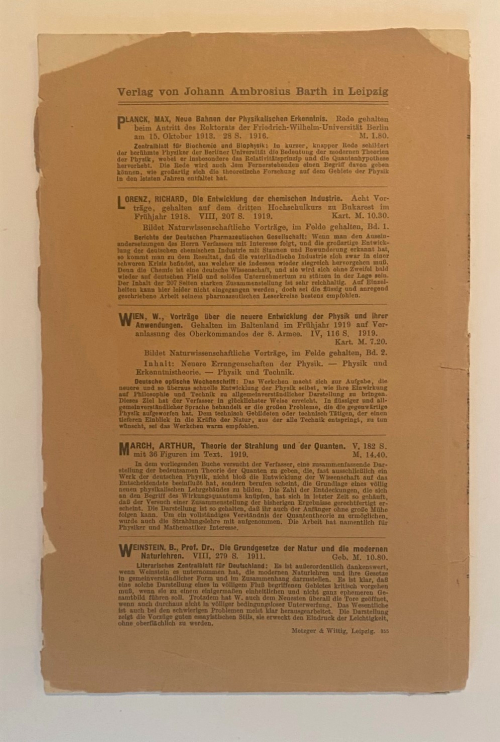
    The printer’s imprint identifying this as the first issue reads “Druck von Metzger & Wittig in Leipzig” on the verso of the title page; it also has the other first issue point, “Metzger & Wittig, Leipzig” printed on the rear cover. (The 2nd issue is mostly identical except that it has “Omnitypie-Ges.” imprinted on verso of title and was actually printed in 1919 even though the title page and cover dates the puiblication as 1916.) It is noted that the monograph issue is not an offprint from the Annalen–it is the first separate edition of this paper, Einstein’s general theory of relativity. It also contains additional material not in the offprint from the Annalen—namely a table of contents (“Inhalt”, pp 3-5) as well as an introduction (“Einleitung” pp 5-6).
    IMG_7020

    What can I say about this paper that hasn’t been said thousands of times before? I can go on and on about it, repeating everything, but the reader already knows all of it. But one does need to say/quote something, one or two things, at least, and so I will simply say that this work is one of the greatest feats of scientific thinking for a period of several hundred years. “The theory of relativity has transformed astrophysics, and indeed the whole scientific outlook,” which is a basic and core statement made about this work, this one being found its description in PMM 408. Perhaps a more richly textured statement on this Einstein was made on the front page of the 7 November 1919 issue of the London Times reporting the announcement at the joint meeting of the Royal Society and Royal Astronomical Society of 6 November of the 29 May eclipse expedition of Eddington/Dyson/Davidson eclipse/bent light experiment that verified general relativity, the headline loudly declaring : “Revolution in Science. New Theory of the Universe. Newtonian Ideas Overthrown,” which I think was very bubbly and excitable for the Brits, given all of it…
    IMG_7023
    IMG_7023

    ·Posted by :

    ·in:


  • Einstein and the Universe (1922)

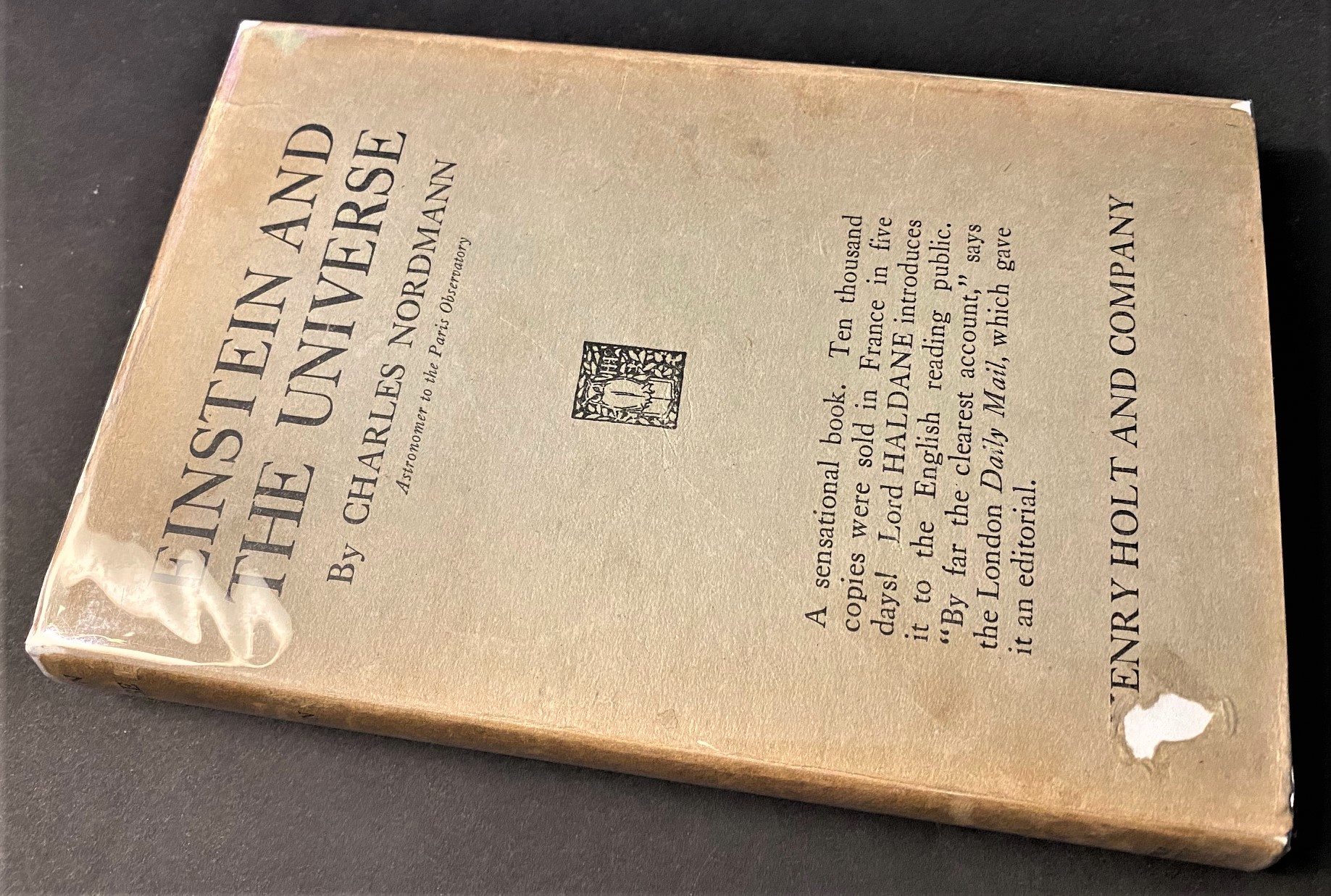
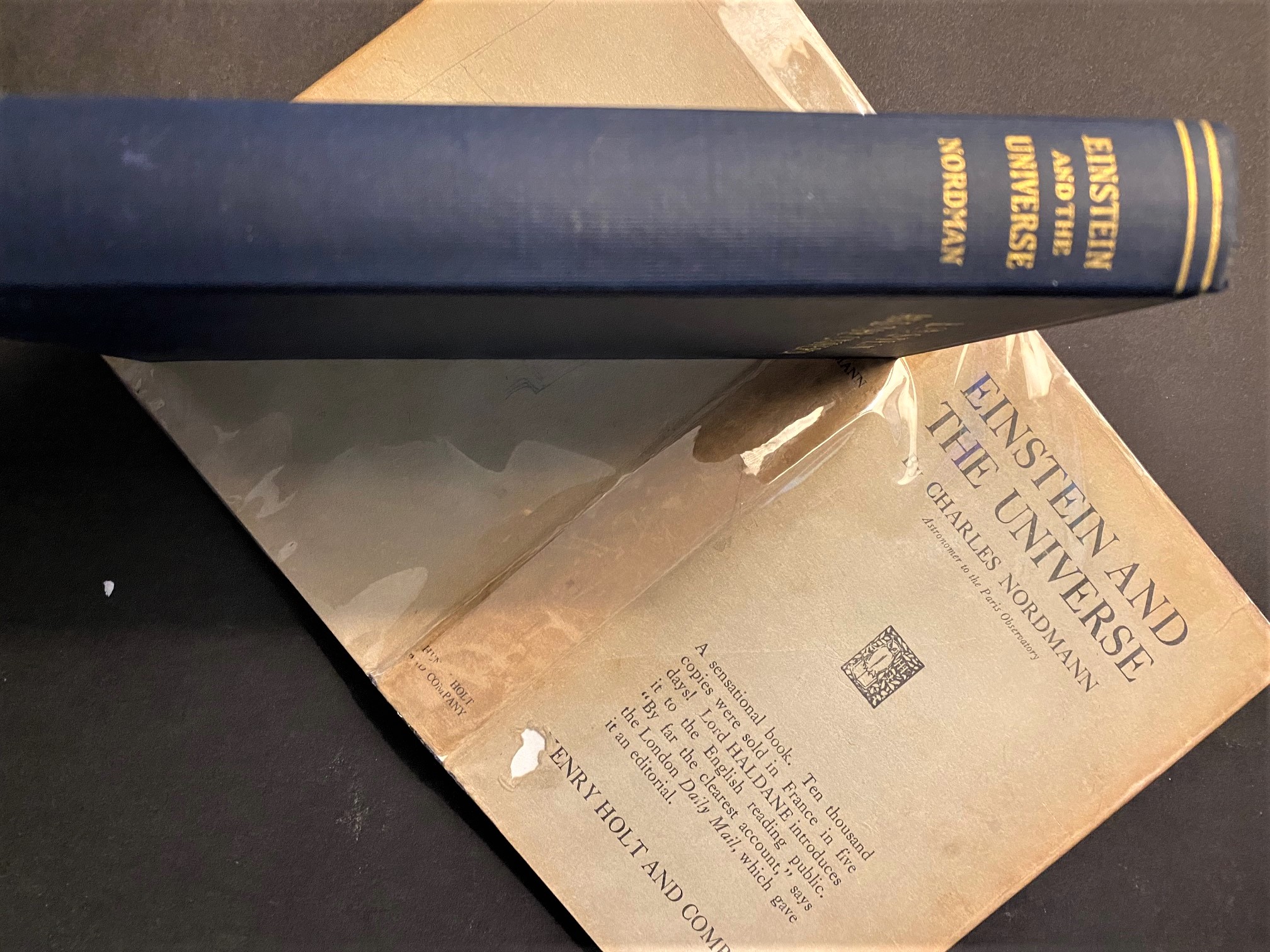
    Charles Nordmann, Einstein and the Universe. Henry Holt & Co., NYC, 1922, First U.S. Edition. Xvi, 240pp. Original cloth. Excellent copy in a VG dust jacket. $250 (The first printing of the book was in Paris earlier in 1922; there was also a British and German edition in 1922 as well.)

    The dj has some chips here and there, as well as a hole (as you can see in the pic) in the front panel—otherwise (as they say) this is in good shape. The book itself is Fine.

    “Charles Nordmann was an early pioneer of radio astronomy, the creator of multicolor photometry techniques, and a noted popularizer of astronomy. After receiving his Licencié ès sciences in 1899, he spent the following year at the Meudon Observatory, near Paris, under the directorship of Pierre Janssen . There, Nordmann began a study of the Sun, its activity, and effects on the Earth’s magnetic field. From 1902 to 1903, he worked in the magnetic service at the Nice Observatory. For his doctoral research at the University of Paris, Nordmann attempted to test the prediction of Henri Deslandres that the Sun ought to emit Hertzian (i. e., radio) waves. He constructed a horizontal antenna, 175 m long, and installed it on the glacier of the Bossons (on Mont Blanc). Despite Nordmann’s best efforts, no definite signals were ever received….”–The Biographical Encyclopedia of Astronomers (online), Springer Verlag

    IMG_2379
    IMG_2379

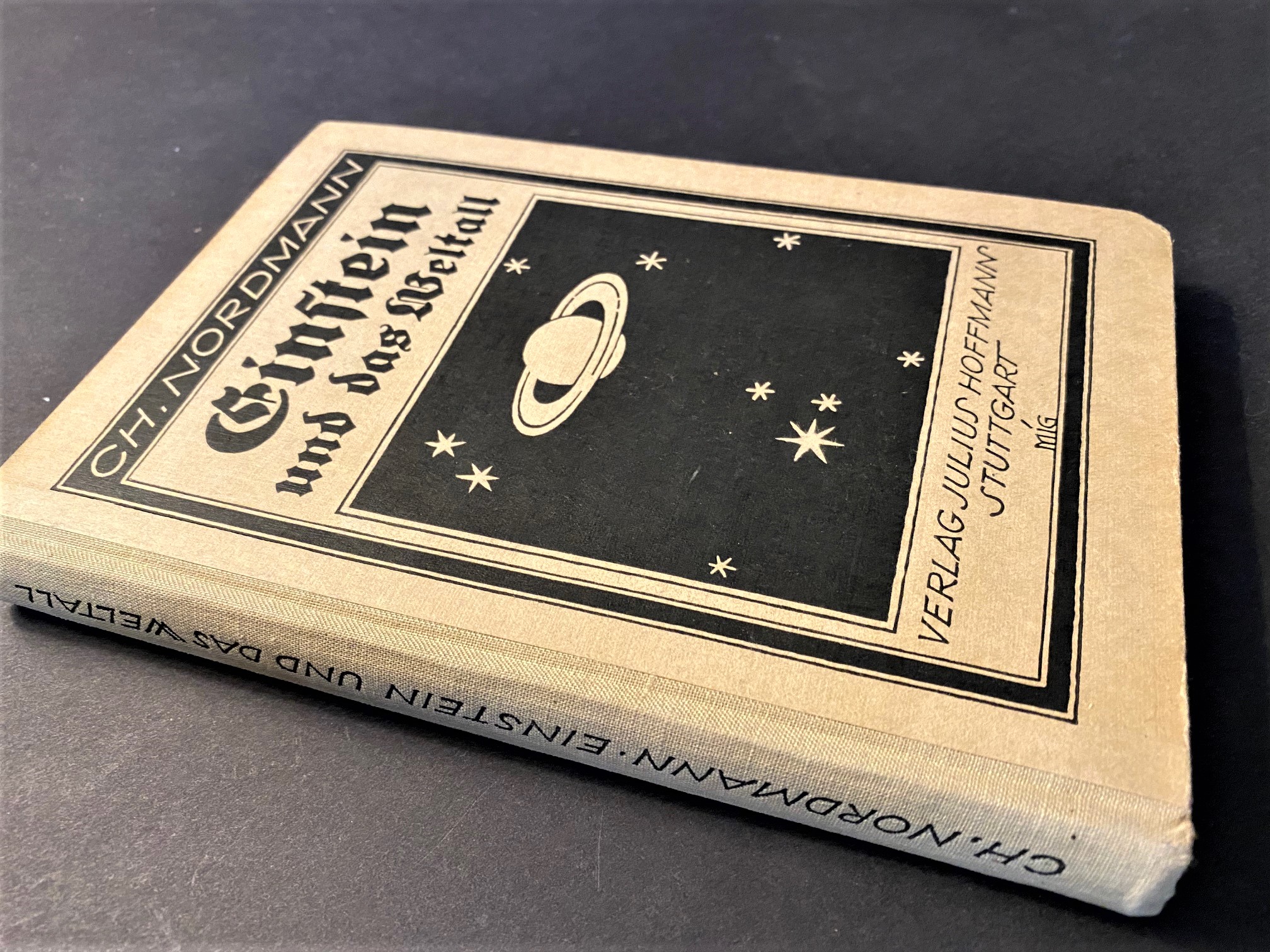
    And the German first edition:

    Charles Nordmann. Einstein und das Weltall. Stuttgart, Verlag von Julius Hoffmann, 1922. 8”x 5”, 199pp. Decorated paper boards and a cloth spine. VG copy. $50

    IMG_2383

    ·Posted by :

    ·in:


  • Resisner Hans J Uber Eine Moglichkeit Die Gravitation Als Unmittlebare Folge Der Relativitat Der Tragheit Abzuleiten

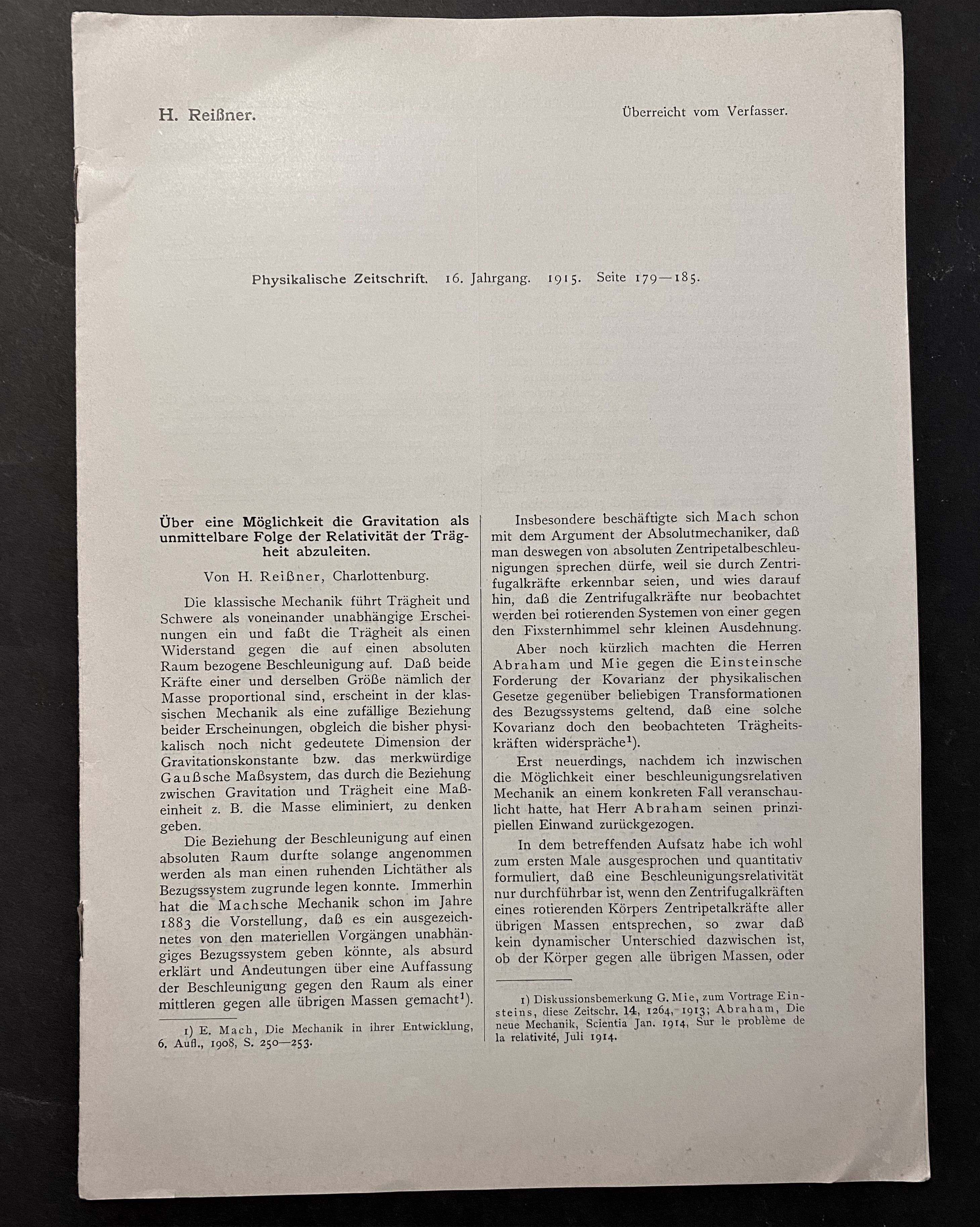
    IMG_2529RESISNER, Hans J. “Uber eine Moglichkeit die Gravitation als unmittlebare Folge der Relativitat der Tragheit abzuleiten”, in Physikalishe Zeitschrift, volume 16, 1915, pp 179-185. Original wrappers. Offprint. Fine copy. $250.

    Hans J. Reissner [1874-1967] was a leading German pioneer in aeronautics and aeronautical engineering. He was appointed to the chair vacated by Arnold Sommerfeld at the Technische Hochschul at Aachen, where he established the aerodynamics laboratory. He also designed the great experimental wind tunnel at Aachen and was its second director (after T. von Karman). He went on to the University of Berlin where he remained until 1938, when he left Germany for the United States. Reissner held a chair at the Illinois Institute of Technology and in 1944 joined the faculty at Brooklyn Polytechnic Institute… Von Karman spoke very highly of Reissner and attributed his work in aerodynamics to be as important as those advances made by Prandtl (see von Karman’s Wind and Beyond). Reissner was also celebrated with two anniversary volumes of Applied Mathematiics for his 60th and 75th birthdays (in 1934 and 1949).

    “In physics and astronomy, the Reissner–Nordström metric is a static solution to the Einstein–Maxwell field equations, which corresponds to the gravitational field of a charged, non-rotating, spherically symmetric body of mass M. The analogous solution for a charged, rotating body is given by the Kerr–Newman metric. The metric was discovered between 1916 and 1921 by Hans Reissner, Hermann Weyl, Gunnar Nordström  and George Barker Jeffery.”–Wikipedia

    ·Posted by :

    ·in:


  • Reissner’s Working Copy of his Great Paper

    Reissner, Hans J.  

    • Offering two copies of the famous paper–the offprint is certainly very scarce, and Reissner’s own copy of course is probably a unique. Provenance: Hans J. Reissner pamphlet collection.  

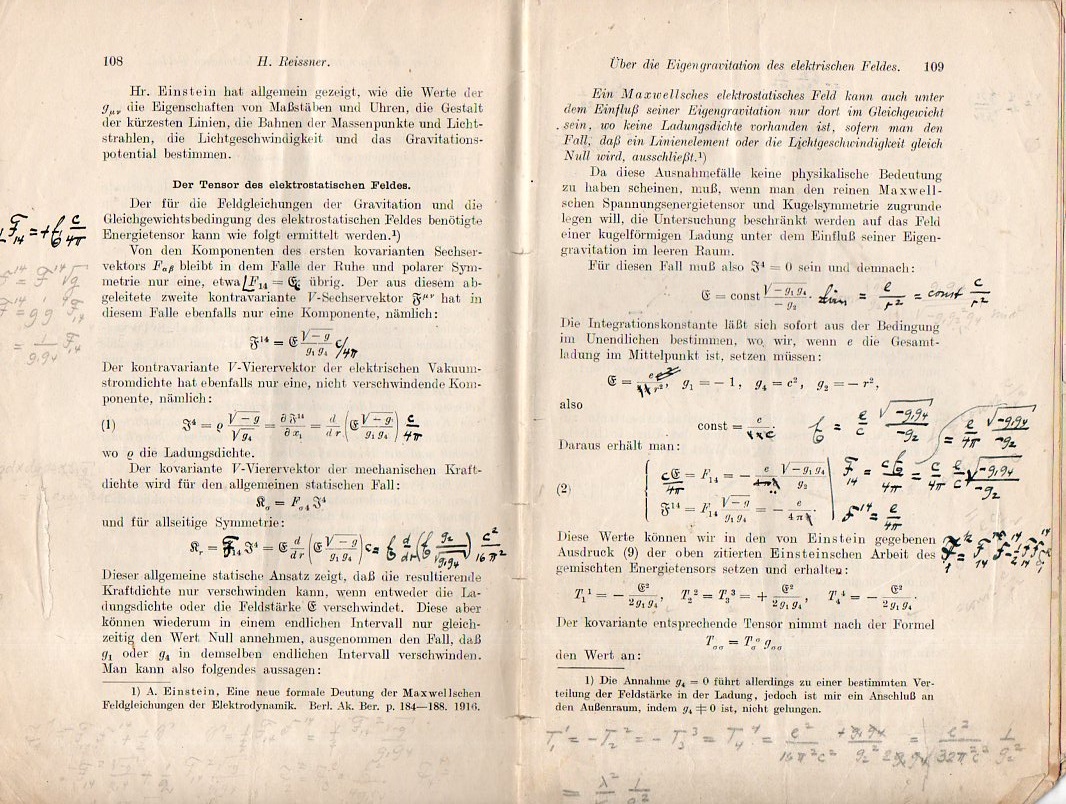
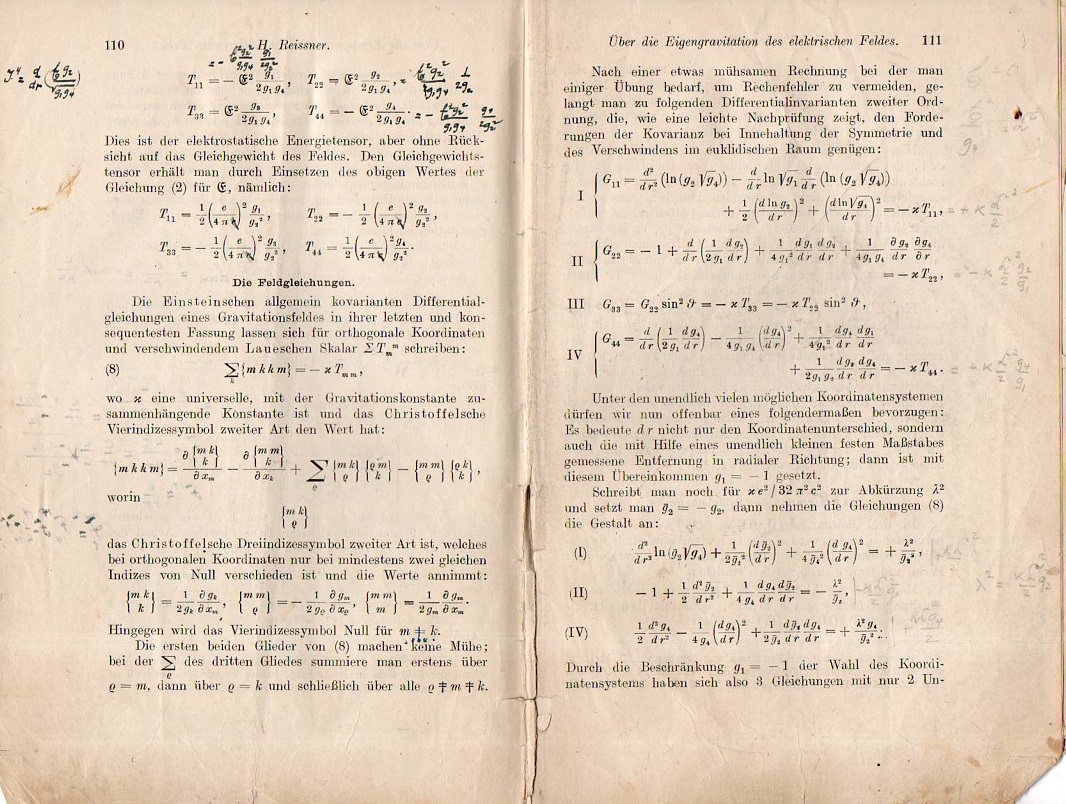
    “Ueber die Eigengravitation des elektrischen Feldes nach der Einsteinschen Theorie” Offprint: Annalen der Physik, 4/50, 1916. Pp 106-120. Without the original outer wrappers. Numerous annotations and calculations on pp 108—111-113, 117, 118, 119. A Good copy, only, of a working issue of the paper. From what I can see none of the annotations were incorporated in the final version of the paper.

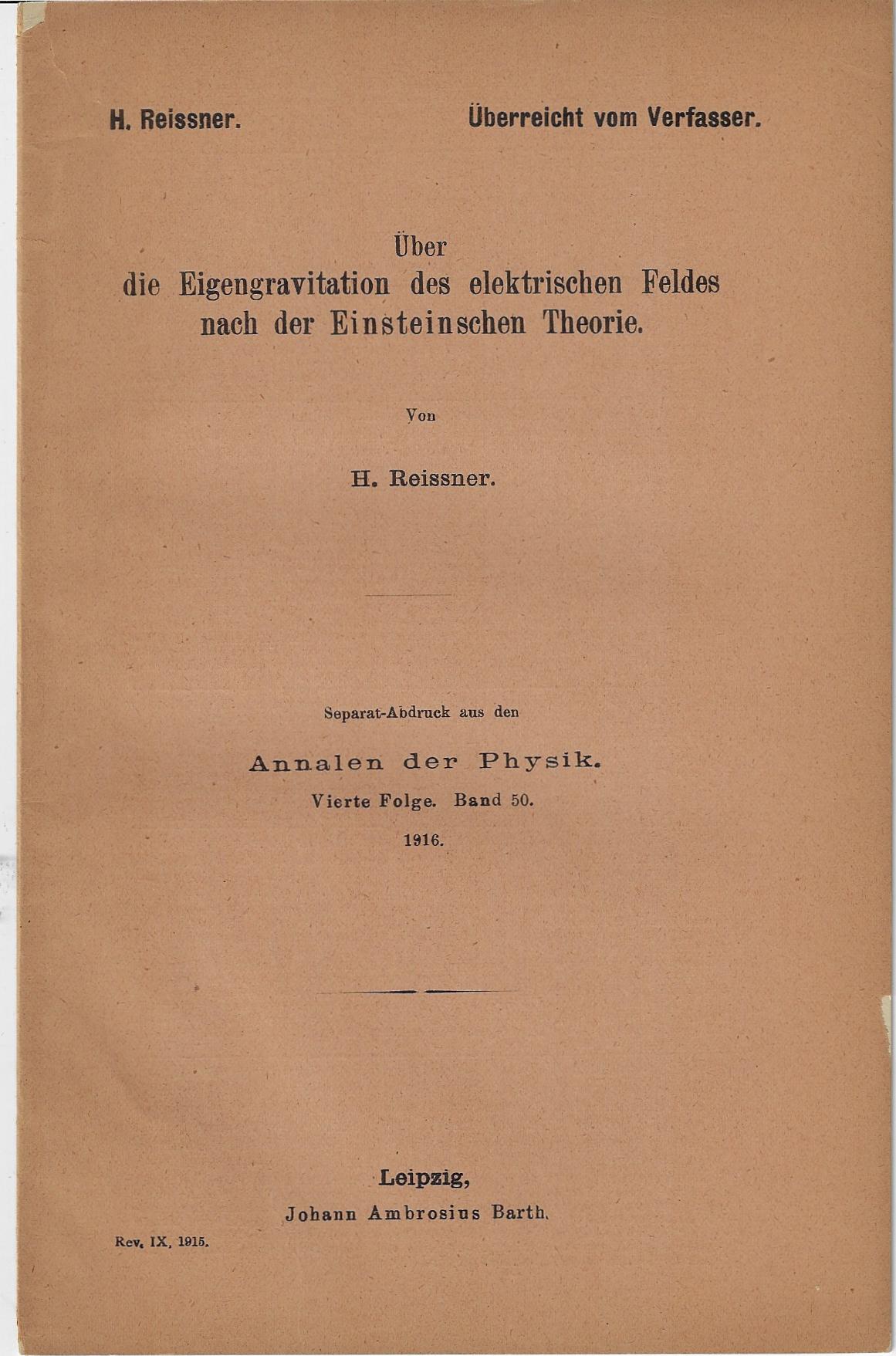
    Offered with:  another offprint copy of the same paper (“Ueber die Eigengravitation des elektrischen Feldes nach der Einsteinschen Theorie”) from Annalen der Physik, 4/50, 1916. Pp 106-120, in the original wrappers, which is the standard (and uncommon) offprint format. 

    The pair: $On hold.

    Reissner098


    “1916 : Hans Reissner (1874-1923) extends the Schwarzschild solution to the case of a charged mass in “Uber die Eigengravitation des elektrischen Feldes nach Einsteinschen Theorie.” Ann. Phys. 59, 106-120,1916. 191”–(See: Nathalie Deruelle, “Black Hole Chronology”  “Six Lectures on Black Holes in General Relativity”, IPhT-CEA, Saclay, January-February 2009.) See Eric Reissner’s appreciation of his father, and  see also Shapiro, S. L. and Teukolsky, S. A. Black Holes, White Dwarfs, and Neutron Stars: The Physics of Compact Objects. New York: Wiley, p. 357, 1983

    Reissner099


    Reissner 1916 _1_


    See also: “Journey into and through a Reissner-Nordstrom black hole”, Andrew Hamilton’s contribution on the University of Colorado site, here: 

    http://jila.colorado.edu/~ajsh/insidebh/rn.html#ref2

    ·Posted by :

    ·in:


  • Unified Field Theory (1927)

    EINSTEIN, Albert. “Zu Kaluzas Theorie des Zusammenhanges von Gravitation und Elektrizität – Erste Mittelung”, pp 23-25; with in the same issue, “Zu Kaluzas Theorie des Zusammenhanges von Gravitation und Elektrizität – Zweite Mitteilung”, pp 26-30, in Sitzungsberichte der Königlich Preussischen Akademie der Wissenschaften, Physikalisch-mathematische Klasse VI, Berlin 1927, pp. 17–30, February 17, 1927). Individual issue in original wrappers.

    • Wrappers are a bit sunned along the edges, otherwise fine. $500.00

    Theodor Franz Eduard Kaluza (1885-1954) was a German mathematician and physicist known for the Kaluza–Klein theory (“the two pioneers of unified field theory”, A Pais, Subtle is the Lord, pp 329). Einstein thought very highly of Kaluza (according to MacTutor) and in 1921 encouraged him to publish his paper in which he solved Einstein’s equations of general relativity by using field equations in five-dimensional space-time. (Nordstrom had proposed “to use a five dimensional space for the unification of em with a scalar gravitational field” (A.Pais) publishing in Phys Zeit 15, p 504, 1914.) Of Kaluza’s work Einstein writes to Lorentz: ”It appears that the union of gravitation and Maxwell’s theory is achieved in a completely satisfactory way by the five-dimensional theory (Kaluza-Klein-Foch)”–Pais, Subtle..., p 333.

    Again according to Pais, Einstein wrote to Kaluza in 1921 saying “the formal unity of your theory is startling” (Subtle…, p330) after which he communicated the K paper to the Prussian Academy. It was in these two papers presented above that Einstein wrote on Kaluza’s work—this some four years after an earlier paper Einstein wrote with Grommer. (Einstein would return to Kaluza in a paper with Peter Bergmann, “On a generalization of Kaluza’s theory of electricity” in the Annals of Mathematics, Vol. 39, no. 3, in July 1938 and which he would address again in Science in 1931 with Meyer and in the Prussian Academy the same year.)

    “[Kaluaza] was teaching at Königsberg in April 1919 when he wrote to Einstein and told him about his ideas to unify Einstein’s theory of gravity and Maxwell’s theory of light. Einstein encouraged him to publish his highly original ideas which he did in 1921 in his paper on the unity problem of physics…Kaluza’s ideas involved the introduction of a fifth dimension and, although he has been criticised for introducing this as a purely mathematical idea, his work is important and was explored by others…Kaluza is remembered for this in Kaluza-Klein (named after the mathematician Oskar Klein) field theory, which involved field equations in five-dimensional space. The theory, initially a popular topic of research, quickly lost favour with the introduction of quantum mechanics.”–MacTutor, St. Andrew’s Math History.

    “As is so often the case, string theory arose from a collection of discredited ideas… When string theory became mainstream, physicists realised that these early insights were extraordinarily prescient. The story begins in 1919 with a little known Polish mathematician, Theodor Kaluza. Inspired by Einstein’s revolutionary ideas, he attempted to overthrow a central tenet of physics. “What if there are extra dimensions we just can’t see?” he asked. Working alone, he attempted to incorporate a hidden dimension into Einstein’s model for gravity. Unsurprisingly, his five-dimensional theory had more equations than the usual four-dimensional approach. Looking closely at the extra equations he had found, Kaluza spotted something remarkable. They were precisely Maxwell’s equations governing the electromagnetic field…”–”Whystringtheory” (supported by Oxford and the Royal Society)

    ·Posted by :

    ·in:


  • Oppenheimer, Gamow, Feynman, Szilard, Bohr, Bethe, Rabi, and others in the Monumental “Physical Review” for 1939


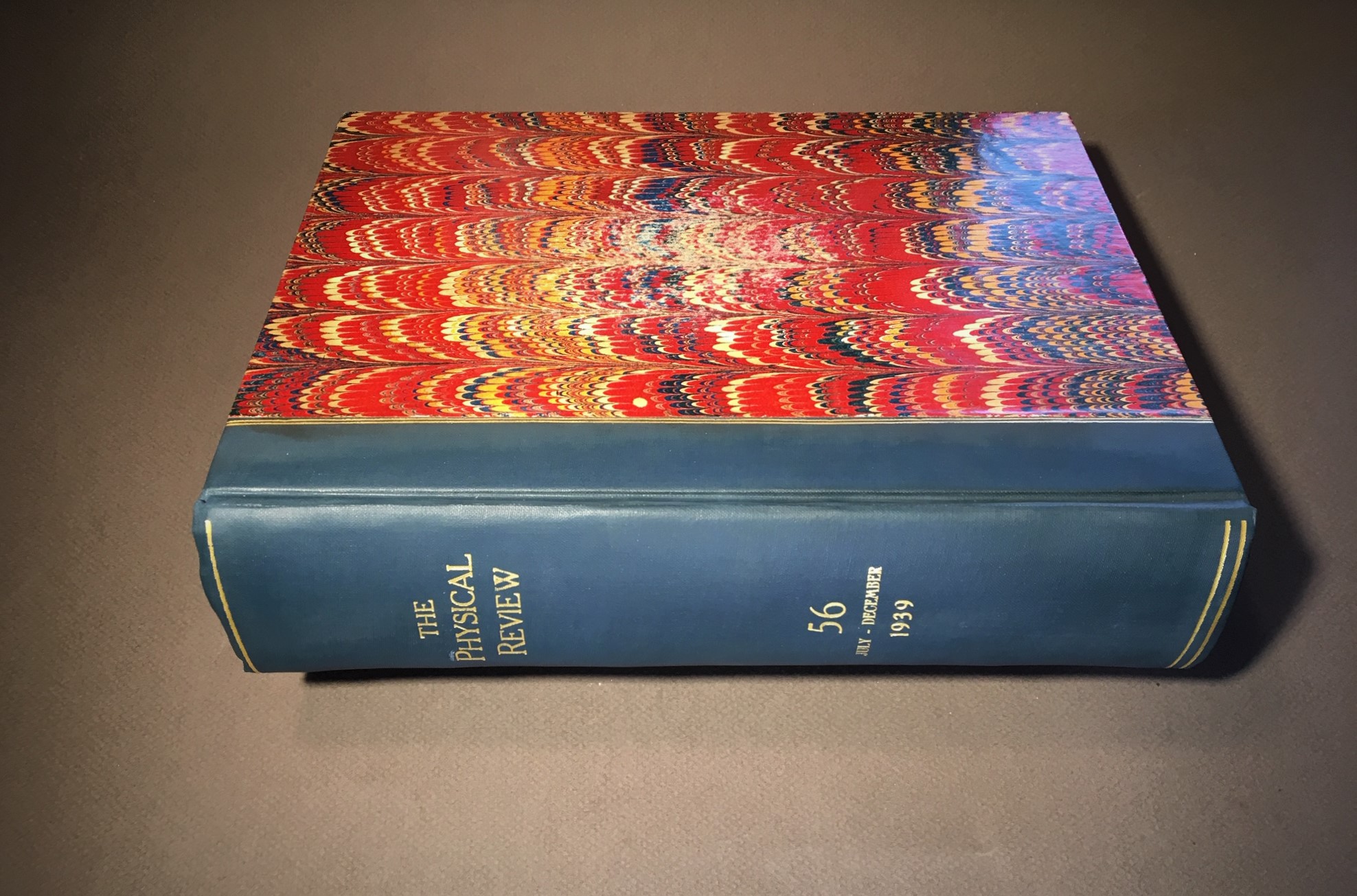
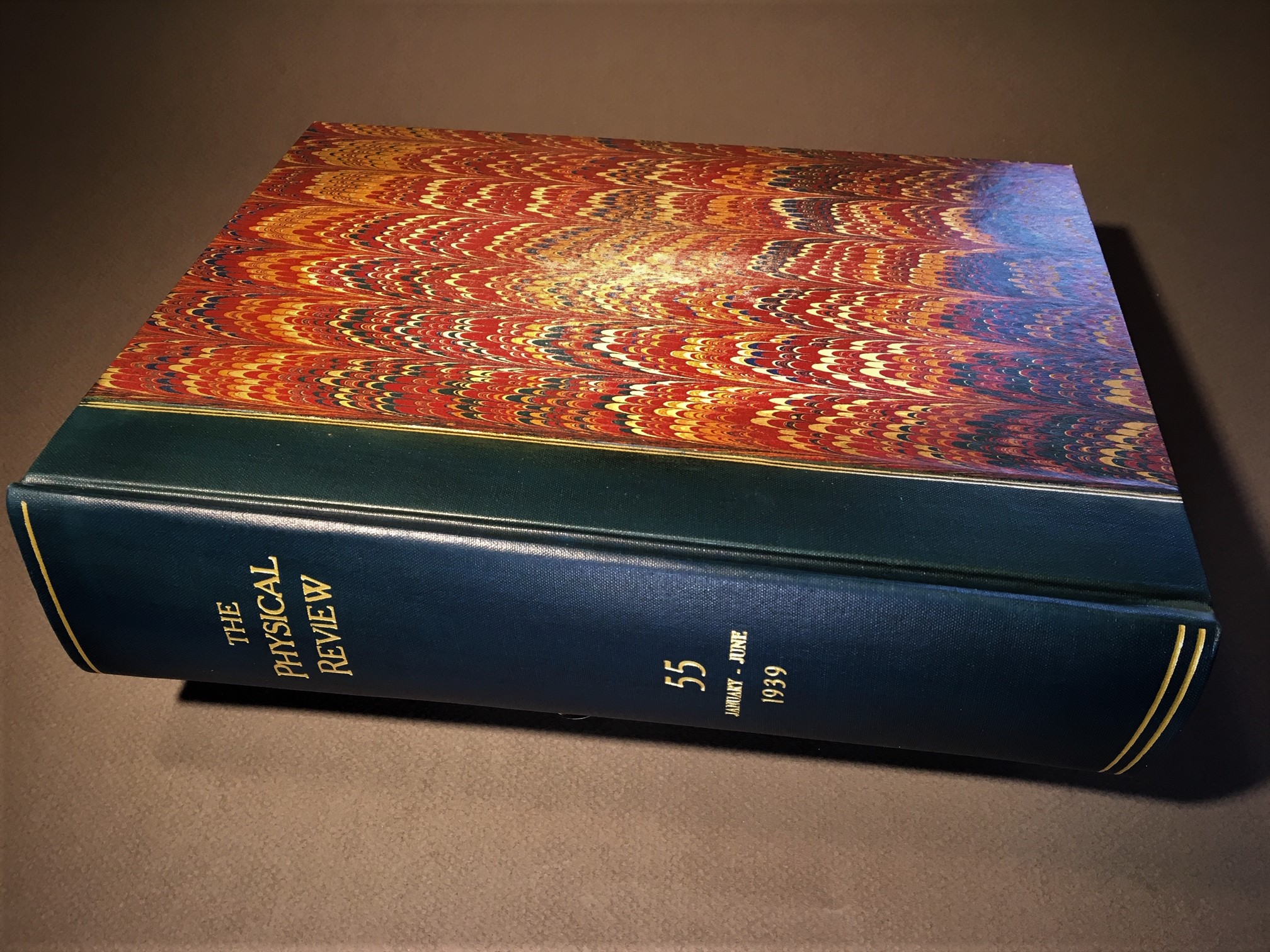
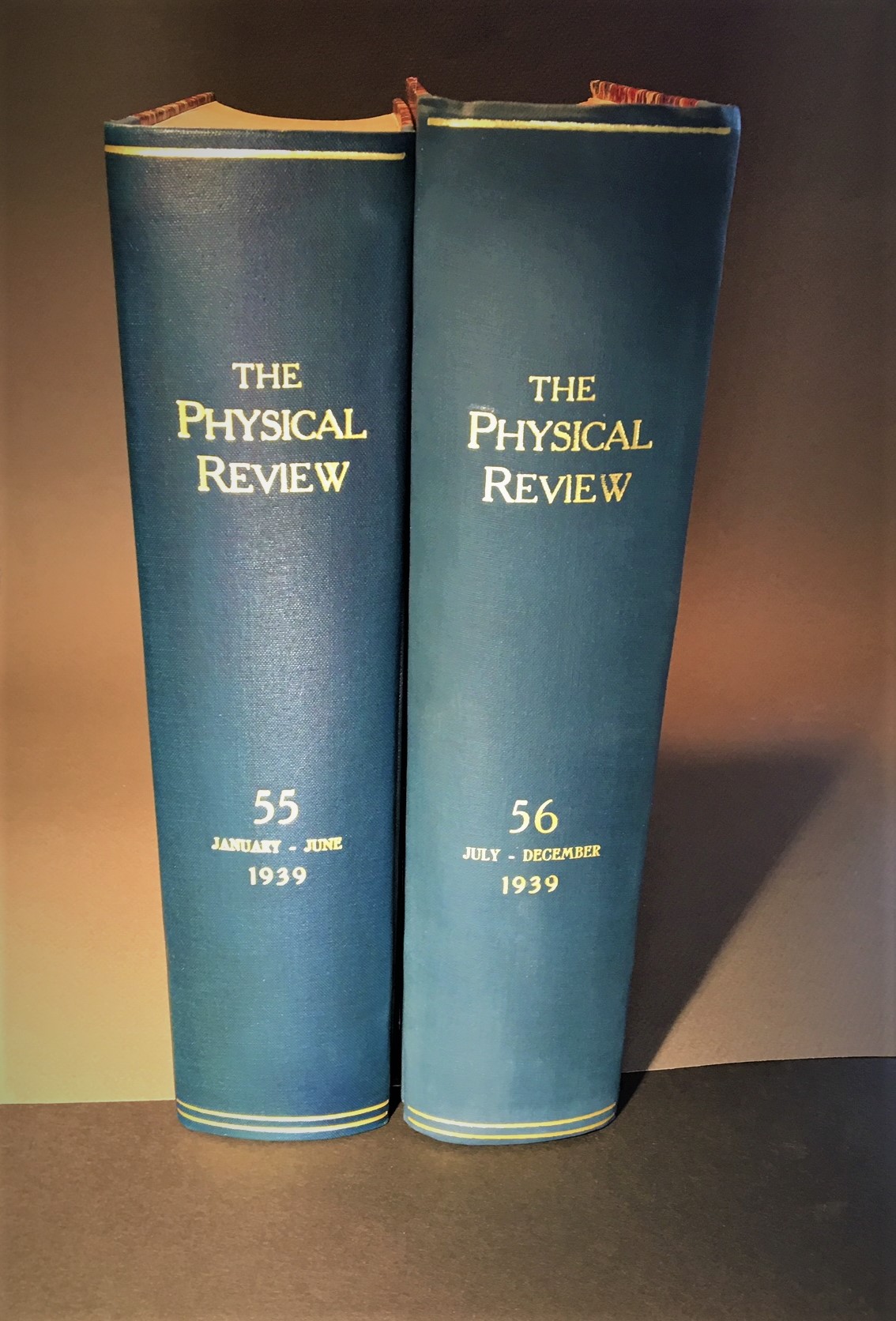
    OPPENHEIMER, J. Robert. “On continued gravitational contraction” and many other papers offered in one monumental year of the Physical Review for 1939.

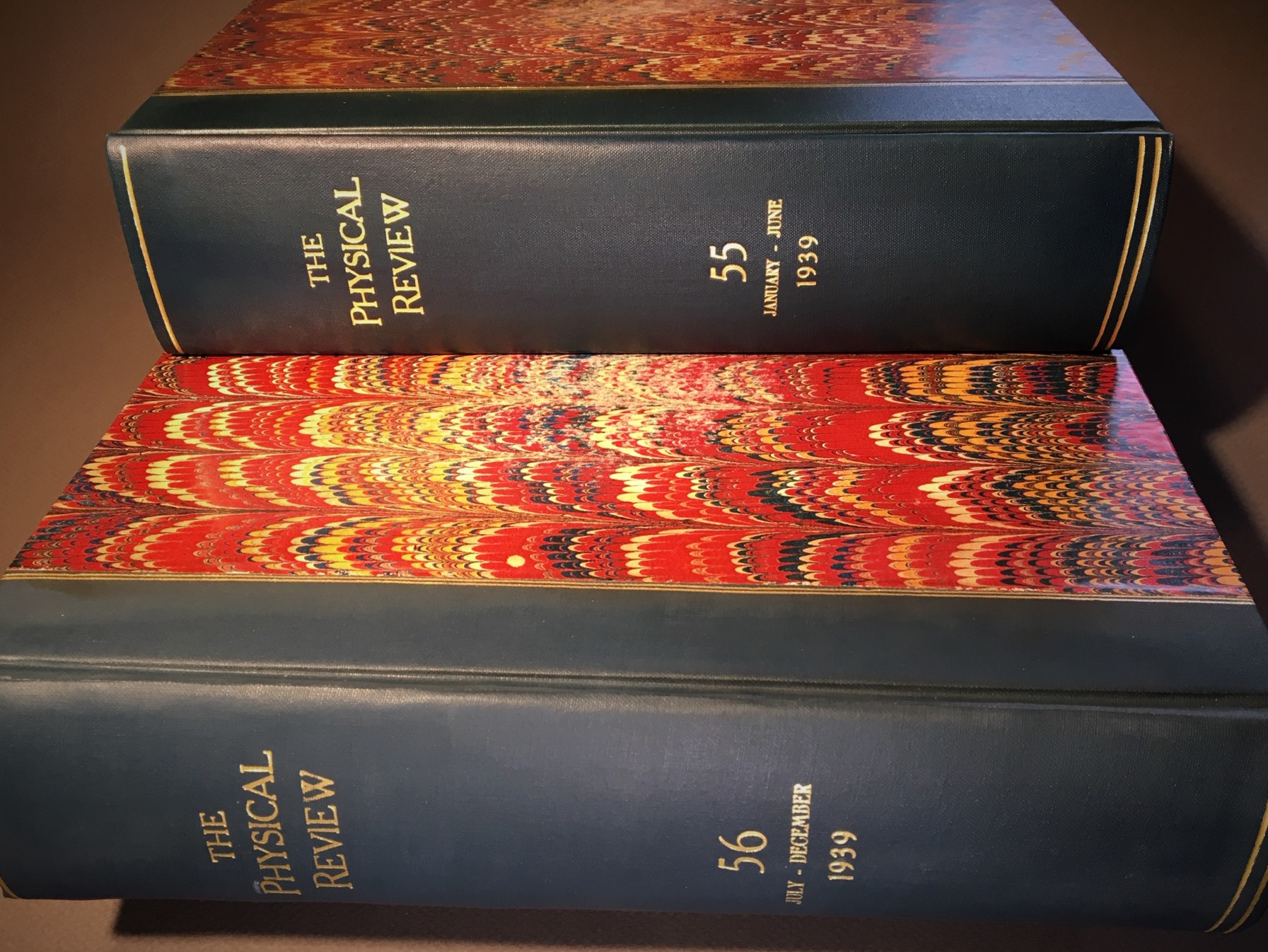
    American Physical Society, Lancaster Pa., January-December 1939. Two volumes: x, 1294pp & x,1300pp. The two volumes, complete. Finely and sturdily rebound in cloth and marbled boards. Very stout, readable volumes. Fine condition. Few scant ownership stamps on some of the individual issues’ first page. $2250

    This is a remarkable volume for one of the most electrifying years in the history of modern phsyics, ranking alongside the great years of 1859, 1932, and 1948 for the sheer weight of highly significant papers from many sources. Included are papers by Oppenheimer, Gamow, Feynman, Szilard, Bethe, Rabi, Anderson, Tolman, Morrison, Kusch, Abelson, and many others. Astonishing, really.

    Some of the most significant papers include:

    OPPENHEIMER, Robert and Hartland Snyder, “On continued gravitational contraction”, September 1, 1939, Vol. 56, #5, pp. 426-50  The Oppenheimer and Snyder (a graduate assistant) paper is one of the most prescient in the history of modern physics, correctly physically describing (where Chandrasekhar and Eddington in their discussions did not) what happens in a particular collapse of a neutron star, and still today reads as fresh and and brightly as it did in 1939.  Really, it is an extraordinary work, and a foundation paper in the history of gravitation, the application of RT, singularity, and astrophysics.  (The Southampton GR Explorer site nicely states it this way: “This paper has strong claims to being one of the most prophetic ever written in this field of research. Today, 60 years later, this paper needs little revision – even the terminology is undated!”)

    In an often-repeated quotation, they write, somewhat in irony and in a certain and understated manner on page 456: “The star thus tends to close itself off from any communication with a distant observer; only its gravitational field persists”. And later: “When all thermonuclear sources of energy are exhausted, a sufficiently heavy star will collapse. Unless fission due to rotation, the radiation of mass, or the blowing off of mass by radiation, reduce the star’s mass to the order of that of the sun, this contraction will continue indefinitely”, they wrote.


    Phys Rev Wenner _1_

    BOHR, Niels and J.A. Wheeler, “The mechanism of nuclear fission”, September 1, 1939, Vol. 56, pp. 455-459. This is the experimental foundation stone (on the basis of the liquid drop model of atomic nuclei) of nuclear fission and the great leap forward in the construction of the atomic bomb.

    From the abstract: “On the basis of the liquid drop model of atomic nuclei, an account is given of the mechanism of nuclear fission. In particular, conclusions are drawn regarding the variation from nucleus to nucleus of the critical energy required for fission, and regarding the dependence of fission cross section for a given nucleus on energy of the exciting agency. A detailed discussion of the observations is presented on the basis of the theoretical considerations. Theory and experiment fit together in a reasonable way to give a satisfactory picture of nuclear fission”.

    BOHR, Niels. “Resonance in Uranium and Thorium Disintegrations and the Phenomenon of Nuclear Fission”;

    BETHE,  Hans.  “Meson Theory of Nuclear Forces.”  Vol 55, 2nd series, number 12; June 15, 1939, 1261-1264

    BETHE, Hans. “Energy Production in Stars” no 1. January 1, 1939 -and- “Energy Production in Stars II”, no. 5 March 1, 1939). Awarded the Nobel Prize (the first time the award was given for astrophysics) 1967 “for his contributions to the theory of nuclear reactions, especially his discoveries concerning the energy production in stars”)

    OPPENHEIMER, J. Robert and G.M. Volkhoff in the 15 February 1939 issue. Here (along with a preceding paper by Richard C. Tolman, issued in the same issue just above Oppenheimer, which were the analytic analysis used by O+V to base their estimates of nuclear forces) was established the Tolman-Oppenheimer-Volkhoff limit, which stated that if the state of evolution of  neutrons forming a degenerate Fermi gas of extremely dense masses in neutron stars was more  massive than .07 solar masses that it would collapse into a black hole or exotic/quark star; if the mass was below that limit, the star would not collapse due to the degeneracy pressure of neutrons and the strong force.  The black hole part was left really to a second paper of 1 September 1939 (the day that the Nazis attacked Poland and the fighting began in World War II in Europe) .

    GAMOW, George and Edward Teller, “On the Origin of Great Nebulae”, volume 55, number 7, April 1, 1939, pp 654-657, in the weekly issue of pp 609-671. 

    FEYNMAN, Richard. “Forces in Molecules”, pp. 340-43. Feynman’s undergraduate thesis at MIT, know known as Feynman-Hellmann theorem – “This work treated the problem of molecular forces from a thoroughly quantum-mechanical point of view, arriving at a simple means of calculating the energy of a molecular system that continues to guide quantum chemists.” (Complete DSB online)

    Phys Rev Wenner _1_
    Phys Rev Wenner _1_

    SLIZARD, Leo and ZINN’s landmark “Instantaneous Emission of Fast Neutrons in the Interaction of Slow Neutrons with Uranium” confirmed ‘instantaneous’ neutron multiplication, showing that it meets the requirement for nuclear bombs. Some argue this is one of the most important papers in atomic/nuclear physic

    ANDERSON, Herbert L, Fermi, Enrico & Hanstein, H. B. “Production of Neutrons in Uranium Bombarded by Neutrons”, vol 55, pp. 415-419;

    TOLMAN, Richard, “Static Solutions of Einstein’s Field Equations for Spheres of Fluid”, vol 55, pp. 799-800;

    RABI, I, Millman, S., Kusch, P. & Zacharias J. R. “The Molecular Beam Resonance Method for Measuring Nuclear Magnetic Moments ()”, vol 55, pp 526-535;

    WEISSKOPF, Viktor. “On the Self-Energy and the Electromagnetic Field of the Electron”, 56 No. 1 pp. 72–85, July 1, 1939 . Also bound in the same issue with:   “Weisskopf demonstrates that QED diverges at all levels of perturbation theory.” –This paper reproduced in full as paper 6 in Julian Schwinger’s Selected Papers on Quantum Electrodynamics. See also Jo Bovy (Ghent University), 

    ABELSON, Philip. “Investigation of the Products of the Disintegration of Uranium by Neutrons”, July 1, 1939, pp 1-9.

    RABI, I.I., Kellogg, J. M. B. “The magnetic moment of the proton and the deuteron. The radiofrequency spectrum of H2 in various magnetic fields” , vol. 56, No. 8., pp 728-743.


    Phys Rev Wenner _1_

    ·Posted by :

    ·in:


  • Two Classic Papers in Geometrodynamics (1957)

    Charles W. Misner, John A. Wheeler, Classical physics as geometry: Gravitation, electromagnetism, unquantized charge, and mass as properties of curved empty space”, in Annals of Physics, vol 2, 1957, pp 525-603. Bound with:

    John A. Wheeler, “On the nature of quantum geometrodynamics”. Ann. Phys, same volume, pp 604–614.

    Both papers in the single bound volume of vols 1+2 of Annals of Physics, 315+629pp. Bound n cloth. Ex-library IBM, though with no library markings. Fine copy. $300

    Also bound with F.J. Belifante and J.C.Swihart, “Phenomenological Linear Theory of Gravitation, I” (pp 168-196) and part II (pp 213-220).

    • Abstract (Misner/Wheeler): “If classical physics be regarded as comprising gravitation, source free electromagnetism, unquantized charge, and unquantized mass of concentrations of electromagnetic field energy (geons), then classical physics can be described in terms of curved empty space, and nothing more. No changes are made in existing theory. The electromagnetic field is given by the Maxwell square root of the contracted curvature tensor of Ricci and Einstein. Maxwell’s equations then reduce, as shown thirty years ago by Rainich, to a simple statement connecting the Ricci curvature and its rate of change. In contrast to unified field theories, one then secures from the standard theory of Maxwell and Einstein an already unified field theory. This purely geometrical description of electromagnetism is traced out in detail. Charge receives a natural interpretation in terms of source-free electromagnetic fields that (1) are everywhere subject to Maxwell’s equations for free space but (2) are trapped in the worm holes of a space with a multiply-connected topology. Electromagnetism in such a space receives a detailed description in terms of the existing beautiful and highly developed mathematics of topology and harmonic vector fields. Elementary particles and real masses are completely excluded from discussion as belonging to the world of quantum physics.”


    ·Posted by :

    ·in:


  • The First Comprehensive Presentation of the Mathematical and Physical Ideas of Einstein (1921)

     Wolfgang Pauli. Relativitätstheorie. Sonderabdruck aus der Encyklopädie der mathematischen Wissenschaften. Mit einem Vorwort von A. Sommerfeld. Verlag und Druck von G.B. Teubner, Leipzig & Berlin, 1921. First edition. 9.75”x6.5”, pp iv, (539)-775. Paper covered boards, cloth spine. The printed cover is good and bright; the printing on the spine is mostly dulled to the point where you can barely read the title. A Very Good copy of a not-common and important, rock-solid book.  $200

    “Felix Klein was then publishing the Encyklopädie der mathematischen Wissenschaften, a monumental compilation that was to examine the current state of science from all sides. Leading scholars—mathematicians and physicists—were contributors. Klein had requested Sommerfeld to write an article on relativity theory for the Encyklopädie. Sommerfeld ventured to entrust the task to Pauli…(Sommerfeld revealed admirable courage and insight in letting a student in his fourth semester write this important article.)”

    “Pauli soon completed a monograph of about 250 pages [the book offered here], which critically presented the mathematical foundations of the theory as well as its physical significance. He took thorough account of the already very considerable literature on the subject but at the same time clearly put forth his own interpretation. Despite the necessary brevity of discussion, the monograph is a superior introduction to the special and general theories of relativity; it is in addition a first-rate historical document of science, since, together with H. Weyl’s Raum, Zeit, Materie(“Space, Time, and Matter”), it is the first comprehensive presentation of the mathematical and physical ideas of Einstein, who himself never wrote a large work about his theory.”

    “Sommerfeld was elated by this performance and wrote to Einstein that Pauli’s article was “simply masterful”—and so it has remained to the present day. Pauli showed here for the first time his art of presenting science, which marks everything he wrote.”

    “In Sommerfeld’s institute Pauli also became acquainted with the quantum theory of the atom. He wrote in his Nobel lecture:

    While, in school in Vienna, I had already obtained some knowledge of classical physics and the then new Einstein relativity theory, it was at the University of Munich that I was introduced by Sommerfeld to the structure of the atom, somewhat strange from the point of view of classical physicist, accustomed to the classical way of thinking, experienced when he came to know of Bohr’s “basic postulate of quantum theory” for the first time.”

    All of the above from the Complete Dictionary of Scientific Biography (online). 

    ·Posted by :

    ·in:


  • Four Cosmology Papers by R.C. Tolman, 1931-2

    Richard C. Tolman, “On the theoretical Requirements for a Periodic Behaviour of the Universe”, in Physical Review, vol 38/9, November 1, 1931,  pp 1758-1771 in the issue of pp 1575-1796.

    And offered with:

    • Tolman RC. “Nonstatic model of universe with reversible annihilation of matter.” Physical Review. 38/4, August 15, 1931. 797-814. VG+ copy
    • Tolman RC. “Possibilities in relativistic thermodynamics for irreversible processes without exhaustion of free energy.” Physical Review, vol 39/2, January 15, 1932, pp 320-336. About a 1/4-inch chip missing from top of spine. [Also contains M. True et. al., “High Speed Protons”.] VG copy
    • Tolman RC, Ehrenfest P, Podolsky B. “On the gravitational field produced by light.” Physical Review, vol 37/5, March 1, 1931, pp 602-615. VG copy.

    All in original wrappers.

    All copies are 3-hole three-ring-bound, meaning that the decrepit binding was removed to reveal  nicely preserved issues, with lovely spines (which on the Phys Rev are easily damaged), but with the three binding holes through-and-through. So, there’s that. 4 issues: $200

    Tolman was a Ph.D. MIT (1910), then positions at University Michigan (1910-11), (1912-1916), then U Cincinnati and U of Illinois before US WWI involvement, then on to  UC Berkeley, and then  CalTech (1922-1948). During World War II, “Tolman served as vice chairman of the National Defense Research Committee, as scientific adviser to General Leslie R. Groves on the Manhattan Project.”–DSB
    The main thrust of Tolman’s work in statistical mechanics, relativistic thermodynamics, and cosmology was mathematical and theoretical.  An “…early interest in relativity theory was further stimulated by Hubble’s discovery in 1929 that red shifts are proportional to distance, and led to a series of studies on the applications of the general theory to the overall structure and evolution of the universe. In his comprehensive treatise on relativistic thermodynamics, Tolman presented his theory of a universe expanding and contracting rhythmically like a beating heart, arguing that gravity has the effect of counteracting the influence of radiation, thus preventing the complete cessation of motion as predicted by the second law of thermodynamics.”–DSB

    Abstract from the first paper, “On the theoretical Requirements for a Periodic Behaviour of the Universe”: “This article investigates, on the basis of relativistic mechanics and relativistic thermodynamics, the theoretical requirements for nonstatic models of the universe to exhibit a behaviour which is periodic in time. The discussion is limited to models which can be regarded from a large-scale point of view as filled with a uniform distribution of fluid, and the time coordinate is purposely chosen so as to agree with the proper time that would be used by local observers at rest in this fluid. It is first shown that the analytical requirements which would correspond to the continuous expansion and contraction of such models between definite maximum and minimum limits, together with the thermodynamic requirement that the expansion and contraction must be reversible, could not both be simultaneously satisfied with any fluid for filling the model which has reasonable properties. Attention is then turned to models of the universe having line elements which would be quasi-periodic in the time. A wide range of possibilities is found for models which would expand from zero proper volume to a maximum and then return, the treatment failing however to provide the analytical conditions for a minimum at the lower limit. It is pointed out, nevertheless, that from a physical point of view contraction to zero proper volume could only be followed by renewed expansion, so that we might expect for such models a continued series of expansions and contractions. Furthermore, it is found possible to satisfy the analytical requirements for such quasi-periodic behaviour by models which would expand and contract at a finite rate reversibly without increase in entropy, so that we might then expect a continued series of identical expansions and contractions. It is pointed out that Einstein’s recent model of a nonstatic universe filled with incoherent matter, exerting no pressure and unaccompanied by radiation, would satisfy the thermodynamic as well as the analytical requirements for such a series of identical repetitions, and models filled solely with black-body radiation and with an equilibrium mixture of radiation and perfect gas are discussed which also satisfy these requirements. In conclusion some remarks are made concerning the bearing of such findings on the behaviour of the actual universe. “


    ·Posted by :

    ·in:


  • First Appearance in Print of the Terms “Relativity Theory” and “Theory of Relativity” (1906)

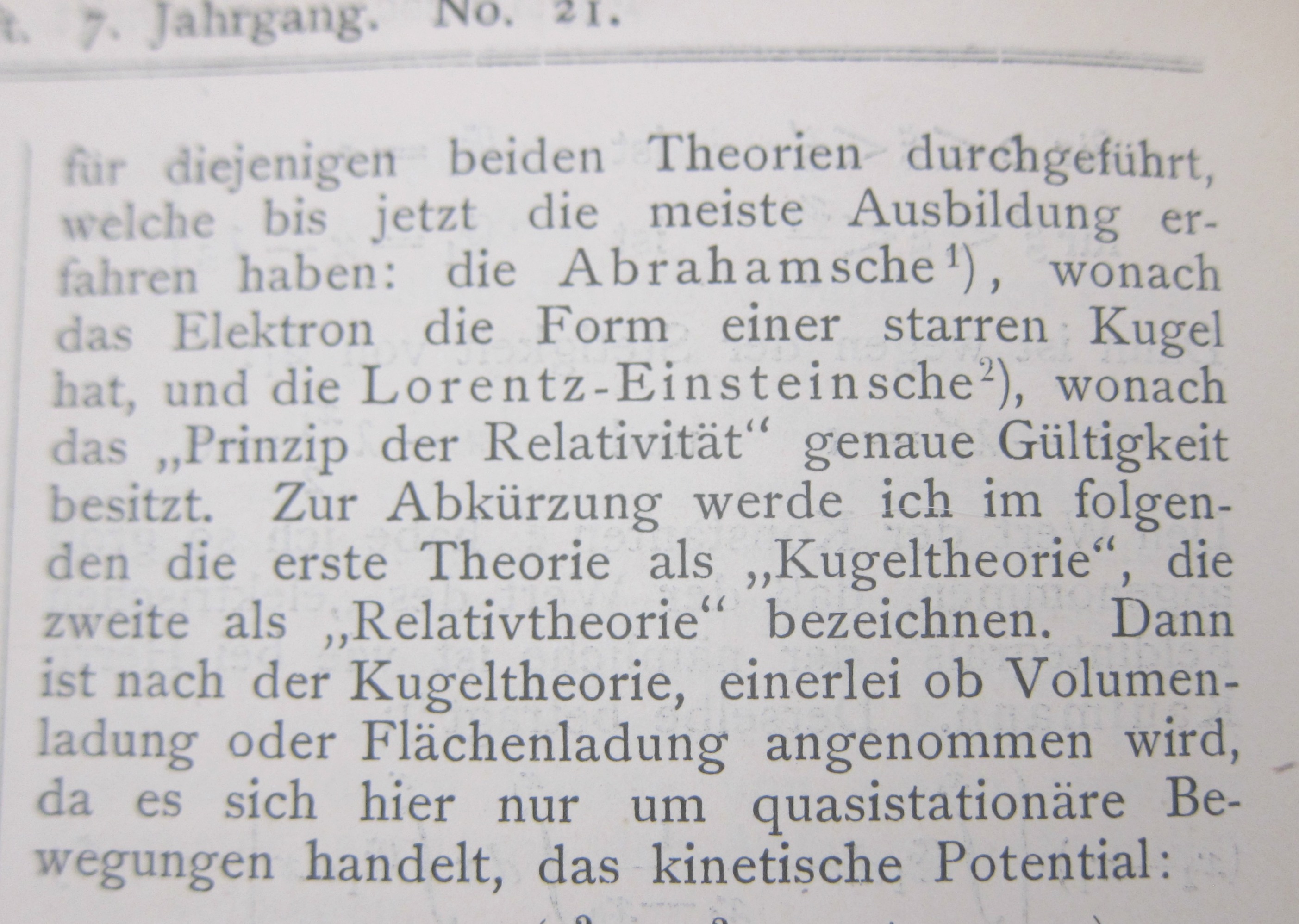
    Max Planck, “Die Kaufmannschen Messungen der Ablenkbarkeit der β-Strahlen in ihrer Bedeutung für die Dynamik der Elektronen” [The Measurements of Kaufmann on the Deflectability of β-Rays in their Importance for the Dynamics of the Electrons], in a bound volume of Physikalische Zeitschrift, 1906, volume VII, the paper occupying pp 753-761 (printed in double columns), printed in Leipzig by S. Hirzel. There are other papers of relativity in VII including Wacker (p 300), Farkas (p 654), Stark (p 353), and Wilkens (p. 846). Bound in cloth. Fine and sturdy copy.  $500

    Prior to using the words “postulate” and “principle” associated with relativity (as in “Prinzip der Relativitat”, appearing in the second paragraph of Einstein’s June 1905 “Zur Elektrodynamik bewegter Körper” in Annalen der Physik)  it is first referred to as “relativity theory” (“Relativtheorie”) by Max Planck on p. 756 (col 2 line 9 and also on pp 758+759) of this volume. Then in the “discussion” part of the Planck paper the “theory of relativity” (“Einsteinische Relativitatstheorie”) appears for the first time in print just a few pages later (p. 760 col 2 line 15) by Alfred Bucherer.

    • “The term “theory of relativity” was based on the expression “relative theory” (German: Relativtheorie) used in 1906 by Planck, who emphasized how the theory uses the principle of relativity. In the discussion section of the same paper, Alfred Bucherer used for the first time the expression “theory of relativity” (German: Relativitätstheorie).”–Wikipedia

    It was very surprising, finding this, the first time that something so familiar as “relativity theory” appeared in its most familiar form. 

    Einstein relativtheorie


    And there it is.

    ·Posted by :

    ·in: