A Daily History of Holes, Dots, Lines, Science, History, Math, Physics, Art, the Unintentional Absurd, Architecture, Maps, Data Visualization, Blank and Missing Things, and so on. |1.6 million words, 7500 images, 4.9 million hits| Press & appearances in The Times, Le Figaro, Mensa, The Economist, The Guardian, Discovery News, Slate, Le Monde, Sci American Blogs, Le Pont, and many other places… 5000+ total posts since 2008.

Book Category: Relativity

  • An Early Paper with Extended Bibliography on Special Relativity, 1910

    J. Laub, “Uber die experimentellen Grundlagen Relativitatsprinzips, in Jahnrbuch der Radioaktivitat und Elektronik, 1910, volume 7, Leipzig, S. Hirzel, 662pp.  Bound in half calf. Ex-library, U.S. Patent Office. This volume is intact, though has a number if nicks and dings, and is in Fair condition, though perhaps a little better than that.  Uncommon.  $250

    Jakob Laub–the first collaborator of Albert Einstein–wrote one of the earliest histories/retrospectives of relativity theory for the Jahrbuch der Radioaktivitat und Electronik in volume 7 for 1910: “Uber die experimentellen Grundlagen des Relativitatsprinzips”, pp 405-463. (It seems that I don’t often see/notice references on this level citing the first German edition of an integral work in another language, which Laub does here for example in two articles by Fizeau that he found in Annalen when their original publication took place in the Comptes Rendus.)  (See the reference for Laub in Physics Before and After Einstein  edited by M. Mamone Cap; also The Scientist as Philosopher: Philosophical Consequences of Great Scientific ...by F. Weinert. 

    This paper also contains a 127-item bibliography.

    On Laub, from the Dictionary of Scientific Biography, volume 17:

    “Laub attended gymnasium in Rzeszόw. In 1902, after studying briefly at the universities of Cracow and Vienna, he entered the University of Göttingen as a student of mathematics and physics. There, taking courses and seminars with David Hilbert and Hermann Minkowski, he became interested in the electron theory. He turned to experiment, and in 1905 he decided to work with Wilhelm Wien at Würzburg. Laub’s doctoral dissertation (1907) concerned secondary cathode-ray emission. At his oral defense (1906), he introduced Einstein’s special theory of relativity, which Wien had recommended to him in September 1905. For the next several years Laub remained at Würzburg and concentrated on extending Einstein’s ideas.”

    “Although by early 1908 Einstein was attracting notice from distinguished physicists, he had not yet received a university appointment. It was an unusual step, then, when in February 1908 Laub wrote to Einstein to ask if he could visit Bern to study relativity with him. Laub became Einstein’s first scientific collaborator. Together they published articles criticizing Minkowski’s notion of electromagnetic force and suggesting an experiment to decide between Einstein’s special relativity and Hendrik Lorentz’s electron theory.”

    ·Posted by :

    ·in:


  • First Appearance in Print of the Terms “Relativity Theory” and “Theory of Relativity” 1906

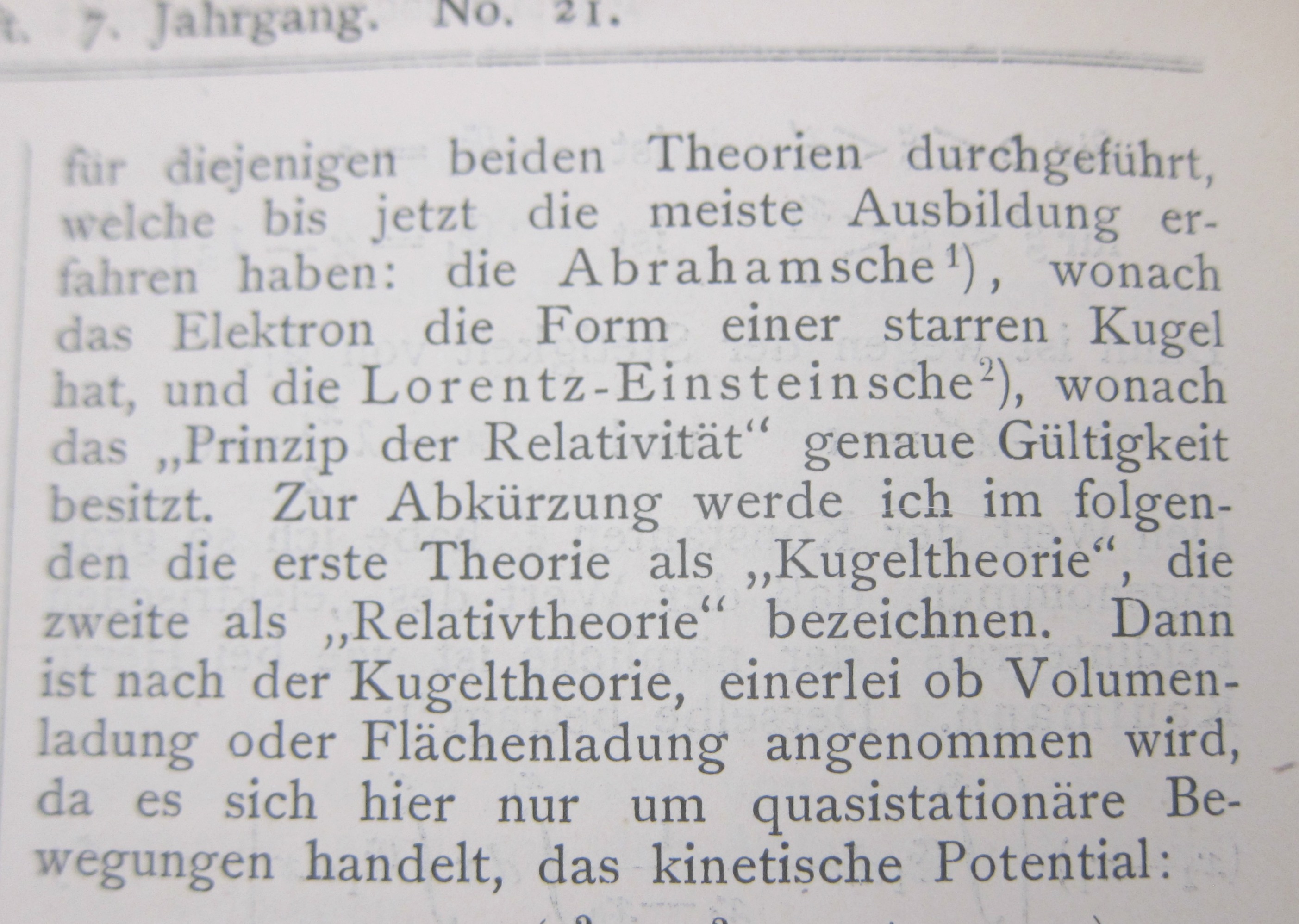
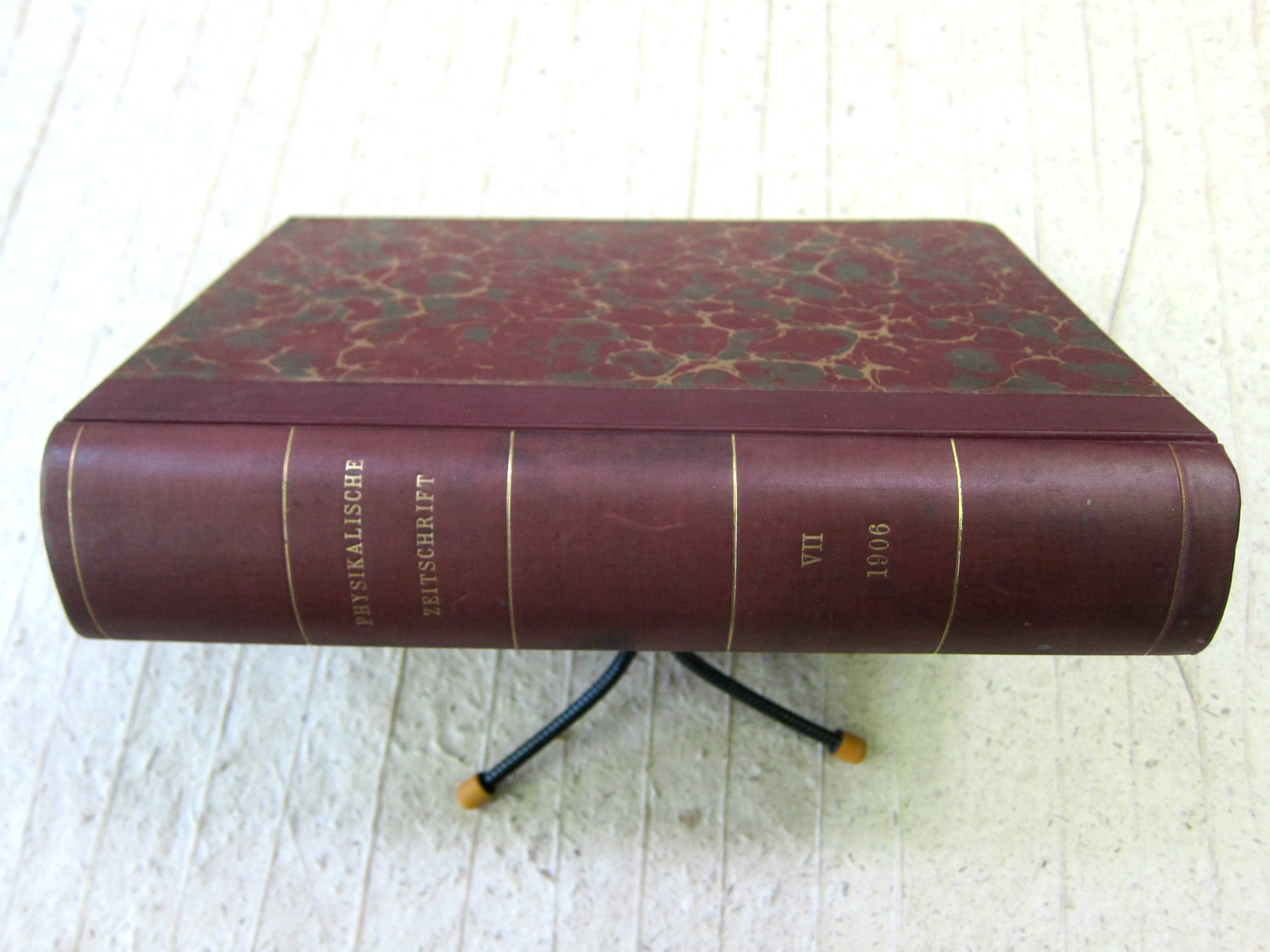
    Planck, Max. “Die Kaufmannschen Messungen der Ablenkbarkeit der β-Strahlen in ihrer Bedeutung für die Dynamik der Elektronen” [The Measurements of Kaufmann on the Deflectability of β-Rays in their Importance for the Dynamics of the Electrons], in Physikalische Zeitschrift, Leipzig, Hirzel, 1906, volume VII, the paper occupying pp 753-761 (printed in double columns). Offered in the full volume of 976pp. Period (? or thereabouts) cloth-backed marbled boards, very sturdily bound. Owner’s bookplate, plus five or so 1” rubber stamp owner’s marks on title page and a few plates, otherwise this would be a FINE copy. With those stamps being very slightly detracting, an overall VG grade. $450

    Einstein relativtheorie

    Prior to using the words “postulate” and “principle” associated with relativity (as in Prinzip der Relativitat” (appearing in the second paragraph of Einstein’s June 1905 “Zur Elektrodynamik bewegter Körper” in Annalen der Physik) is first referred to as “relativity theory” (“Relativtheorie”) by Max Planck on p. 756 (col 2 line 9 and also on pp 758+759) of this volume. Then in the “discussion” part of the Planck paper the“theory of relativity” (“Einsteinische Relativitatstheorie”) appears for the first time in print just a few pages later (p. 760 col 2 line 15) by Alfred Bucherer.

    There are other papers of relativity in VII including Wacker (p 300), Farkas (p 654), Stark (p 353), and Wilkens (p. 846).

    • “The term “theory of relativity” was based on the expression “relative theory” (German: Relativtheorie) used in 1906 by Planck, who emphasized how the theory uses the principle of relativity. In the discussion section of the same paper, Alfred Bucherer used for the first time the expression “theory of relativity” (German: Relativitätstheorie).”–Wikipedia

     An excellent resource for this period: Miller, Arthur I. (1981), Albert Einstein’s special theory of relativity. Emergence (1905) and early interpretation (1905–1911)

    Phys Zeit 1906 vol 7

    ·Posted by :

    ·in:


  • The Einstein-Cartan Theory (1922)

    Cartan, Elie. SIX gravitation papers from 1922, as follows: “Sur une définition géométrique du tenseur d’énergie d’Einstein”; bound with “Sur une généralisation de la notion de courbure de Riemann et les espaces à torsion”; bound with “Sur les espaces généralisés et la théorie de la Relativité”; bound with “Sur les espaces conformes généralisés et l’Univers optique”; bound with “Sur les équations de structure des espaces généralisés et l’éxpression analytique du tenseur d’Einstein”, all together in a two-brick-sized volume of the Comptes Rendus Hebdomadaires des Séances de L’Academie des Sciences, volume 174, January-June 1922, with the Cartan papers occupying 437-439, 593-595, 734-737, 857-60, and 1104-1107 in the volume of 1815pp.

    ALL with their ORIGINAL FRONT WRAPPERS bound at the end of the volume.

    Also offered with a sixth paper:

    Cartan, Elie. “Sur un theoreme fondamental de M.H. Weyl dans la theorie de l’espace metrique”, in Comptes Rendus, 1922, volume 175, number 2, pp 81-5. This is offered disbound from a  larger volume, but with the original front wrapper.  

    The volume bound in cloth with the previous owner/institution name gilt stamped at the spine bottom (“U.S. Weather Service”). The covers have some general wear and scuffing, and the text is printed on relatively skimpy post-war-affected paper stock (as is the case with the CR for most of the 1920’s and into the Depression years of the 1930’s). That said, this is a Good Copy. $950

    “Cartan was one of the most profound mathematicians of the last hundred years, and his influence is still one of the most decisive in the development of modern mathematics…”–Complete Dictionary of Scientific Biography

    Cartan had just attended (on 6 April 1922) the Societe Francaise de la Philosophie (founded in part by Henri Poincare) “for a discussion of the general and special theories of relativity”.   (Pais, Subtle is the Lord, p. 163) Also in attendance were Hadamard, Painleve, Jean Becquerel, Einstein, , Langevin, Bergson, Meyerson, and numerous others. Pais also points out (on page 340) that via this work that Einstein’s “labors had a major impact on mathematics”. “…Cartan was the first to introduce nonsymmetric connections…there is considerable interest by general relativitists in theories of this kind, called Einstein-Cartan theories…their main purpose is to link torsion to spin…” (Pais, p 344.)

    “Albert Einstein became affiliated with the theory in 1928 during his unsuccessful attempt to match torsion to the electromagnetic field tensor as part of a unified field theory. This line of thought led him to the related but different theory of teleparallelism…Einstein–Cartan theory has been historically overshadowed by its torsion-free counterpart and other alternatives like Brans–Dicke theory because torsion seemed to add little predictive benefit at the expense of the tractability of its equations. Since the Einstein–Cartan theory is purely classical, it also does not fully address the issue of quantum gravity. In the Einstein–Cartan theory, the Dirac equation becomes nonlinear and therefore the superposition principle used in usual quantization techniques would not work. Recently, interest in Einstein–Cartan theory has been driven toward cosmological implications, most importantly, the avoidance of a gravitational singularity at the beginning of the universe. The theory is considered viable and remains an active topic in the physics community.” –Wikipedia entry for Einstein-Cartan Theory, which also identifies the essential papers as “Cartan, E. (1922). Comptes Rendus 174, 437–439, 593–595, 734–737, 857–860, 1104–1107”.

    Three of the five papers are referenced in Lecat’s Bibliographie de la Relativite  (1924) #404-406, pg 18. 

    _____. ANOTHER Copy, without the original wrappers.  

    The volume bound in cloth and paper boards, and is from an institutional library in Baltimore, though with very minimal library markers. The text is printed on relatively skimpy post-war-affected paper stock (as is the case with the CR for most of the 1920’s and into the Depression years of the 1930’s). That said, this is a Very Good Copy. $400

    ·Posted by :

    ·in:


  • Six Early and Seldom Seen Papers Concerning the Theory of Relativity, 1905-1913

    Six papers by Victor Cremieu, all extracts from larger bound volumes of Comptes Rendus, 1905-1913.  The six: $225

    Crémieu, Victor. “Recherches sur la gravitation. Attraction observee entre gouttes liquides suspendues dans un liquid de mem densite”, in Comptes Rendus, 1905 volume 140, pp 80-83; offered with the following, all from the Comptes rendus:

    • “Recherches sur la gravitation “, volume 141, 25 October 1905, pp 653-656 (#17)
    • “Recherches sur la gravitation “, volume 141, 6 November 1905, #19, pp 713-715;
    • “Recherches sur la gravitation”, volume 143, 1906, pp 887-889
    • “Sur une ereur systematique qui limite la precision de l’experience de Caendish. Methode nouvelle pour l’etude de la gravitation”, 1910, volume 150, pp 863-866
    • “Effects de la flexion aux points d’attache du fil d’une bal;ance de torsion”, 1913, volume 156, pp 617-620;

    “Crémieu’s experiments were meant to test the dependence of gravitational attraction on the substance separating two test bodies. The experiments were of two types: in the first set, he measured the displacement of oil droplets in liquid, while in the second set, he relied on a custom-built torsion balance to measure the attraction of bodies in air and in water. Both sets of experiments produced results at odds with the Newtonian prediction, yet once again, Crémieu convinced himself that they were artifacts of his apparatus.”

    “Victor Crémieu (1872–1935) was born in Avignon, and obtained the Ph.D. in physics at the Sorbonne under Gabriel Lippmann’s direction in 1901. As a result of his experimental investigations of rotating electrified disks, Crémieu was led at first to deny the existence of a magnetic effect of convected electricity, predicted by Faraday and Maxwell, and first detected in 1876 by Henry Rowland. Crémieu later recognized the reality of Rowland’s effect, attributing his null results to an unsuspected masking phenomenon. He went on to perform delicate, but ultimately inconclusive experiments on gravitational attraction…”–from the Henri Poincare Papers website at the University of Nantes. 

    Lecat, Bibliographie de la Relativite, 479. 


    ·Posted by :

    ·in:


  • Is this the Earliest Mention in a Scientific Periodical of the Results of the 1919 Eclipse Confirming the General Theory of Relativity ?

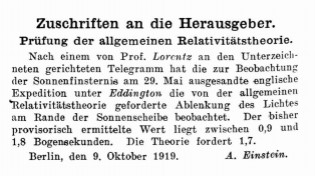
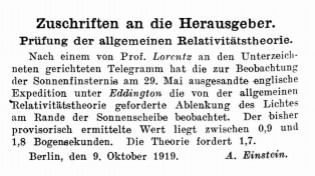
    Einstein, Albert. “Zuschriften an die Herausgeber, Prufung der allgemeinen relativitatstheorie”, in  Die Naturwissenschaften, volume 7, heft 42, October 17, 1919. p 776 in the issue of pp (761)-780, offered in the original wrappers, removed from a larger bound volume.  Condition: the wrappers are browned somewhat. given the supply of paper in the broken German economy of 1919, but the text paper is unaffected, being pretty much blemish-free, though slightly dulled to one of the myriad descriptors of “pale white” or “eggshell”…anyway, quite but not brilliantly so.  The announcement comes from Einstein himself, and is one short paragraph long. Given that the tiny notice appears in what looks like a short index on the front of the magazine that it was being given some sort of prestige, it wasn’t–every entry in the short issue is listed there, so no big deal on finding the Einstein on the front cover. Very nice copy. sold

    • This seems to be the earliest mention of confirming results of the 1919 expeditions to confirm GTR,  submitted by Einstein himself weeks before the formal announcement at the Royal Institution. There was at least one newspaper story on the eclipse–with the information again supplied by Einstein from a telegraphic communication from Lorentz–but I cannot locate the article to see if any of the figures were included in the story.  I cannot find any evidence that an article or notice appeared in a scientific journal before this and it seems unlikely that it would be so. Also a few simple Google searches on the title and author of the announcement reveals, well, almost nothing, which was unexpected.  But “unlikely” is hardly definitive, and so the qualified (and questioned) “firstness” of the announcement. 

    According to Abraham Pais, an “excited” Albert Einstein contributed a very short note (“Zuschriften an die Herausgeber, Prufung der allgemeinen relativitatstheorie”/”A Test of the General Theory of Relativity”) to the editors of the journal Die Naturwissenschaften1 reporting on the telegram he had received from H.A. Lorentz on September 22 on the impending confirmation of the theory of relativity as it was tested in the May 29, 1919 eclipse experiments organized by Sir Frank Dyson. Chandrasekhar explains the situation so: 

    • “It was some months before the two expeditions returned to England and the participants were able to measure their plates and collate their results. But rumours of the successful confirmation of Einstein’s prediction reached Einstein in early September 1919. And on 22 September 1919, the Dutch physicist Hendrik Antoon Lorentz sent Einstein a telegram confirming the rumours to which Einstein replied (also by telegram).. Einstein’s own satisfaction with the outcome of the British expeditions is shown by the postcard (dated September 27, 1919) to his ailing mother in Switzerland. It said: Dear Mother: Good news today. H. A. Lorentz has wired me that the British expeditions have actually proved the light deflection near the Sun….”

    “The telegram that had announced the news to Einstein…was an informal communication. Nothing was definitive. Yet Einstein sent almost at once a very brief note to Naturwissenschaften for the sole purpose of reporting the telegram he had received. He was excited.” (Pais, Subtle is the Lord, p 303).

    Einstein’s note in Naturwissenschaften was concise and to the point: “…the English expedition, under Eddington…has observed the deflection of light at the limb of the sun demanded by the General Theory of Relativity3…”

    The results of the experiment were read on November 6, 1919 (the presentation begun by Dyson, followed by A. C. Crommelin, the leader of the Sobral expedition)  to a joint meeting of the Royal Society and the Royal Astronomical Society, and famously published in the Philosophical transactions of the Royal Society in 1920 as “A Determination of the Deflection of Light by the Sun’s Gravitational Field, from Observations Made at the Total Eclipse of May 29, 1919”4.  J.J. Thomson (as president of the Royal Society)  closed the meeting and “pronounced the canonization [of Einstein]”: ‘This is the most important result obtained in connection with the theory of gravitation since Newton’s day, and it is fitting that it should be announced at a meeting of the society so closely connected with him. . . . The result [is] one of the highest achievements of human thought.’ (Pais, Subtle…, in the chapter “The Suddenly Famous Doctor Einstein”, p 305) R.H. Fowler, president of the Royal Astronomical, also spoke and announced ‘“The conclusion is so important that no effort should be spared in seeking confirmation in other ways.”

    The Einstein note is dated October 9 in the text and was published a week later in the issue of  October 17, 1919.  It is one of the first appearances on the confirmation of the theory, with the exception, evidently, of at least one notice in a Berlin newspaper5 just days earlier. (Again, this according to Pais.) It would be on November 6 that “Lorentz sent another telegram to Einstein, confirming the news. On November 7, 1919, the Einstein legend began.” I assume that Pais is talking about the general article that appeared in the London Times on that day (and which would be written for the New York Times on the 9th, and then it was off to the races with the news, with Einstein himself contributing an article three weeks later to The Times). Well, “off to the races” except in Germany, where the reporting beyond this notice in Naturwissenschaften was more reserved, as noted by an article on the 1919 eclipse on the Max Planck Gesellschaft website: “In contrast to the enthusiastic reception shown by the foreign press, the media in Germany were more reticent on the subject. Not until 14 December 1919 did the Berliner Illustrierte Zeitung publish a photo of Einstein and an article entitled: “A new luminary for the history of the world: Albert Einstein, whose research means a total revolution in the way we see the world and whose findings are equal to those of a Copernicus, Kepler and Newton”. 

    Here’s the entire announcement from Naturwissenschaften:
    EInstein 1919

    Writing about the eclipse on his website, Simon Singh says that J.P. McEvoy, author of Eclipse: The Science and History of Nature’s Most Spectacular Phenomenon (Fourth Estate Ltd., 1999), “encapsulated the significance of the announcement” writing of the ironies of the event:  “A new theory of the universe, the brain-child of a German Jew working in Berlin, had been confirmed by an English Quaker on a small African island.” A further bit to add here is that the expeditions were undertaken by British scientists to prove the work of a German scientist, beginning their work before the end of WWI.

    S. Chandrasekar reports that in 1933 Rutherford expounded on the eclipse and Einstein’s fame, rather more broadly and more deeply:

    “The war had just ended: and the complacency of the Victorian and the
    Edwardian times had been shattered. The people felt that all their values and
    all their ideals had lost their bearings. Now, suddenly, they learnt that an
    astronomical prediction by a German scientist had been confirmed by
    expeditions to Brazil and West Africa and, indeed, prepared for already
    during the war, by British astronomers. Astronomy had always appealed to
    public imagination; and an astronomical discovery, transcending worldly
    strife, struck a responsive cord. The meeting of the Royal Society, at which
    the results of the British expeditions were reported, was headlined in all the
    British papers; and the typhoon of publicity crossed the Atlantic. From that
    point on, the American press played Einstein to the maximum…”6

    I guess this is where the ultra-fame of Einstein begins.

    Notes:

    1.  Die Naturwissenschaften, volume 7, heft 42, October 17, 1919. p 776

    2. S. Chandrasekhar, “Verifying the Theory of Relativity”, in Notes and Records of the Royal Society of London Vol. 30, No. 2 (Jan., 1976), pp. 249-260.

    3.  The Collected Papers of Albert Einstein, Volume 7 (English).

    4. W. Dyson, A. S. Eddington, C. R. Davidson, “A Determination of the Deflection of Light by the Sun’s Gravitational Field, from Observations Made at the Solar eclipse of May 29, 1919”, Philosophical Transactions of the Royal Society,  A 220 (571-581): 291–333 (1920). Eddington had written previously on the expedition, “The total eclipse of 1919 May 29 and the influence of gravitation on light”, in The Observatory, Vol. 42, p. 119-122 (1919)

    5. “An article by Alexander Moszkopwski entitled ‘Die Sonne bracht es an den Tag’ in the Berliner Tageblatt of October 8, 1919, must presumably have been based in information from Einstein himself”. (Pais, Subtle…, footnote p 306.) Also, Andrew Claude de la Cherois Crommelin contributed  “The Eclipse Expedition to Sobral”  in The Observatory 42, 368-371, and though it published in October there is no mention of definitive results yet.  Crommelin also publishes an article in Nature on 13 November (volume 104, p. 280-1), appearing about a week after the Royal Society meeting, in which he publishes the results, all on the equivalent of a single page.  

    6.  Chandrasekhar, ibid., pg 251.

     [Interesting to note here that in Maurice Lecat’s Bibliographie de la Relativite (1924) this contribution receives only a scant placement within the Einstein section, in part 13 (c).]
    ·Posted by :

    ·in:


  • Relativity, 1915

    A.W. Conway. Relativity. London, G. Bell & Sons, 1915. Edinburgh Mathematical Tracts No3.  215x140mm, 43pp. Stiff wrappers. Good/Very Good copy. $150 This is one of the earliest separately-published works on the theory of relativity. Interestingly, Einstein’s name appears only twice in the text, in this sample (below) and at the end.

    “Here we have at once a result at variance with our hypothesis  that the aether is at rest. An explanation was put forward independently by 
    Fitzgerald and Lorentz, and developed in detail by the (... the Fitzgerald- Lorentz contraction) could compensate for the difference of
    path in such a way that the null effect of the Michelson-Morley experiment would be adequately explained. The mathematical treatment
    of this theory in the hands of Lorentz and Larmor shows that all experiments on the relative motion of matter and ether must give
    approximately a null result."
    "The interpretation of these experiments received a different
    treatment from Einstein, whose paper in the " Annalen der Physik,"
    4te Folge. 17, 1905, gave rise to most of the recent theoretical investigations which are included under the head of "Relativity."
    I shall now proceed to the deduction of the fundamental equations of this theory, following the above-named paper...”

    ·Posted by :

    ·in:


  • An Uncommon Essay on Relativity Theory, 1921

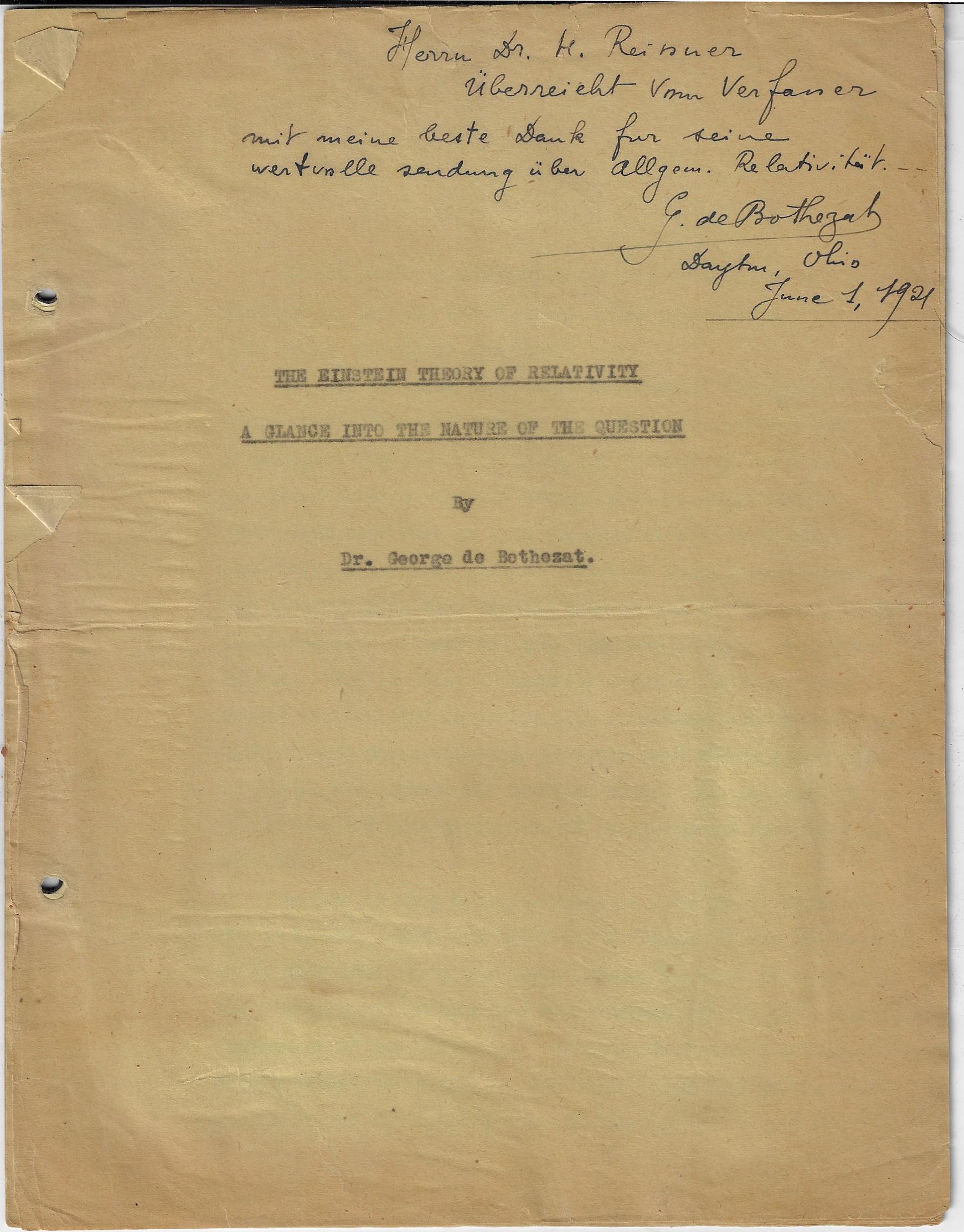
    George de Bothezat (1882-1940) The Einstein Theory of Relativity, a Glance into the Nature of the Question. Carbon copy from typed sheets, I believe, 1921. 11×8, 12 leaves. The leaves seem to be glued together as a binding along the left edge of the sheets; the cover is present but detached, or loose. There are also two punch holes for binding.  I can find only one listing for this 1921 work in WorldCat/OCLC.  $450

    BothezatPresentation copy to Prof. Hans J. Reissner (Reissner-Nordstrom metric among much else)–I imagine that de Bothezat would have been well familiar with the early flight engineering work of Reissner as well as his terrific contribution on the Einstein metric. Condition: a good copy, with perhaps either some damp staining that led to some pressure marks in the paper, or perhaps these were just pressure marks, from pressure. In any event, the paper it was printed on was inferior even when new, and so it has browning and is brittle here and there.  Apart from the general history of the theory de Bothezat seems to be very uneasy with Einstein in this paper, and I cannot find any mention of it in the usual Einstein sources.  In any event, it is a very scarce thing. (A 7pp paper by this name of was published in the journal The New World in November, 1930, pp 105-112, but I cannot locate a copy to compare the two efforts. de Bothezat would return later to Einstein in a book titled Back to Newton..., in which he refutes the theory of relativity (and a lot of modern  physics). Oh, well. 

    • George Bothezat (1882-1940) was a Russian-American engineer, mostly remembered today for his early engineering work on helicopters and aerodynamics. “In May 1918, with his homeland in the throes of the Russian Revolution, de Bothezat fled from the Bolsheviks to the United States. In June 1918, he was hired by the National Advisory Committee for Aeronautics. He lectured at the Massachusetts Institute of Technology and the Columbia University. …In 1921, the US Army Air Service hired de Bothezat to build a prototype helicopter. The quadrotor helicopter, known simply as the de Bothezat helicopter, was built by de Bothezat and Ivan Jerome in the hangars of Wright Field near Dayton, Ohio. The first flight turned out to be surprisingly successful for a machine that had been built without prototyping. In 1922, their “flying octopus” flew many times, although slowly and at low altitudes. In fact, its horizontal motion was induced by wind more than by the pilot’s controls. The Army, now more interested in autogyros, cancelled the underperforming project.”–Wiki
    • “Hans J. Reissner (1874-1967) was a leading German pioneer in aeronautics and aeronautical engineering and mathematical physics. He was appointed to the chair vacated by Arnold Sommerfeld at the Technische Hochschul at Aachen, where he established the aerodynamics laboratory and designed the great experimental wind tunnel at Aachen where he was the second director (after T. von Karman). He went on to the University of Berlin where he remained until 1938, when he left Germany for the United States. Reissner held a chair at the Illinois Institute of Technology and in 1944 joined the faculty at Brooklyn Polytechnic Institute.  Van Karman spoke very highly of Reissner and attributed his work in aerodynamics to be as important as those advances made by Prandtl (see von Karman’s Wind and Beyond). Reissner was also celebrated with two anniversary volumes of Applied Mathematiics for his 60th and 75th birthdays (in 1934 and 1949).”

    Also see:  Michael J. Hirschberg, “A Perspective on the First Century of Vertical Flight”, SAE International website.

    ·Posted by :

    ·in:


  • Poincarehenri Sur Le Dynamique De Lelectron Incomptes Rendusparis 1905 Volume 140 Pp 1504 1508 Offered In The Entire

    POINCARE, Henri. “Sur le dynamique de l’electron”, in Comptes Rendus, Paris,  1905, volume 140, pp 1504-1508, offered in the entire bound volume of 1749pp for the half year.  Bound in boards and  leather spine, the spine cover nearly detached.  A good copy.  $550  (English translation found here.)

    “HENRI POINCARE’S major work on a theory of the electron is “Sur la dynamique de l’electron”.  It is considered, by some, as evidence that POINCARE, more than anyone else in the late 19th and early 20th centuries, anticipated EINSTEIN’S 1905 theory of relativity.”

    “This study will focus on POINCARE’S attempt in “Sur la dynamique…” to formulate a purely electromagnetic theory of a deformable electron that is consonant with his conception of the principle of relativity. PPoincare believed that if all physical processes could be reduced ultimately to the interaction of charged particles which move about in LORENTZ’S all-pervasive ether, then such a theory would be an important step toward a unified description of nature. Thus,  the laws of the various branches of physics, and in particular NEWTON’S second law,  could be derived from those of electromagnetism. This scientific viewpoint (or  Weltbild) will hereafter be referred to as the “electromagnetic world-picture. ”…–From the introduction of Arthur Miller’s fine study of this paper in Archive for History of Exact Sciences, Vol. 10, No. 3/4/5 (18.IX.1973), pp. 207-328, “A Study of Henri Poincaré’s “Sur la Dynamique de l’Électron”.”

    It has always seemed strange to me that Poincare never followed up on this paper, nor did he seem publicly (?) interested in Einstein’s great work of 1905; nor did Einstein show much interest in Poincare’s work on this topic (or nearly any other), and was otherwise indisposed when he was approached to write an appreciation of Poincare upon is death six years later. 

    ·Posted by :

    ·in:


  • “Dynamical Structure and Definition of Energy in General Relativity”

    ARNOWITT, Richard L., Stanley Deser, Charles W. Misner. “Dynamical Structure and Definition of Energy in General Relativity” December,  1959 Physical Review, vol 116 (1959) 1322-1330. Nice sharp copy, in original wrappers, removed from a larger bound volume. $125

    • “In the context of general relativity, he was best known for his development (with Stanley Deser and Charles Misner) of the ADM formalism, roughly speaking a way of describing spacetime as space evolving in time, which allows a recasting of Einstein’s theory in terms of a more general formalism used in physics to describe dynamical systems, namely the Hamiltonian formalism. In the framework of that formalism, there is also a straightforward way to globally define quantities like energy or, equivalently, mass (so-called ADM mass/energy) which, in general relativity, is not trivial at all.”–Wiki

    Also:

    _____. “Canonical Variables for General Relativity”, in Physical Review, volume 117, no. 6, March 15, 1960, pp 1595-1603.  Original wrappers.  Fine copy.  $225

    ·Posted by :

    ·in: