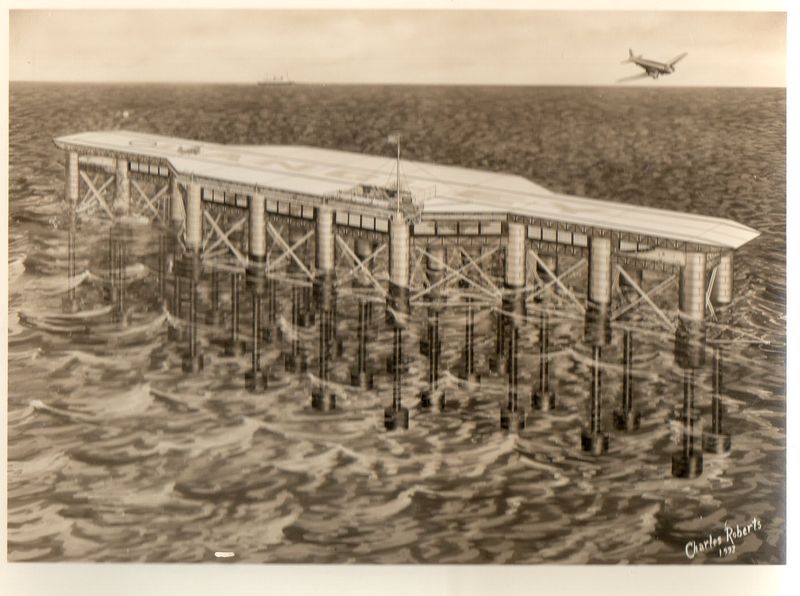
 Edward R. Armstrong (1880-1955). Application of Seadrome Ocean Dock Corporation (a private corporation) for a Loan Under the Provisions of the National Industrial Recovery Act, printed ca. 1933. 11×8 inches, 34pp. With two original photographs one of the floating airports, and a map. This copy comes from the White House Library, transferred to the Library of Congress in 1933. Printed wrappers. There is a Library of Congress surplus stamp on the rear cover, ans a tiny “LC” perforated stamp at the bottom of page one. Very nice copy. $500
The outline for this plan asks the federal government for a loan of $30 million (Depression) dollars to undertake the construction of a five floating airports transoceanic network. “It will require the work of approximately 10,000 men per month for a period of twenty-four to thirty months”. The labor figures did not include was what necessary to produce all of the material necessary for the project ( for reasons unknown). Once finished the network would enable aircraft to make it across the ocean in 18 to 36 hours.
The members of the Seadrome Corporation estimated that the entire 30 million would be paid back by 1945, and that the corporation would be completely debt-free. Perhaps all of this made sense when Armstrong first developed the plan in 1913, just ten years after the Wright brothers’ successful first in North Carolina. The idea of the floating airport girding the Atlantic was a pretty interesting idea, seeing as how the world record for sustained non-stop flight in 1913 was 11 hours (in a Maurice Farman MF-2), and that was under more-or-less optimal conditions; the speed record was 120mph, and again, optimal conditions and not sustained for hours on end. By 1933 it seems to me that it had become obvious that non-stop transoceanic flight was coming, and coming soon. That would of course make an investment in the Seadrome project superfluous, like building an antique, though an unnecessary one. The first transatlantic non-stop flight was made by John Alcock and Arthur W. Brown in 1919, averaging about 100mph; Lindbergh would come later to accomplish the first solo non-stop in 1927–by the early 1950’s jet aircraft would be making the trip with regularity, which means that for most of the life of the completed Seadrome it would have been unnecessary. I feel certain that the Seadrome–which was supposed to be paid off by 1945, though in 1933 there was no inkling on the part of the Corporation members who wrote the request for the money that a war was looming and that there would have been almost no way for them to have been made at any time between 1939 and 1945–would never have been paid for.Armstrong’s idea would get major play in the popular press from time-to-time, and discussed as a series of floating islands. Armstrong himself would organize the Seadrome Ocean Dock Corp. in the late 1930’s, his pretty but impractical idea (reported by Time Magazine1 in 1933 as little more than “a perennial gift to Sunday feature editors”) finally grinding to a salty end with greater fuel capacity and efficiency in transatlantic aircraft.