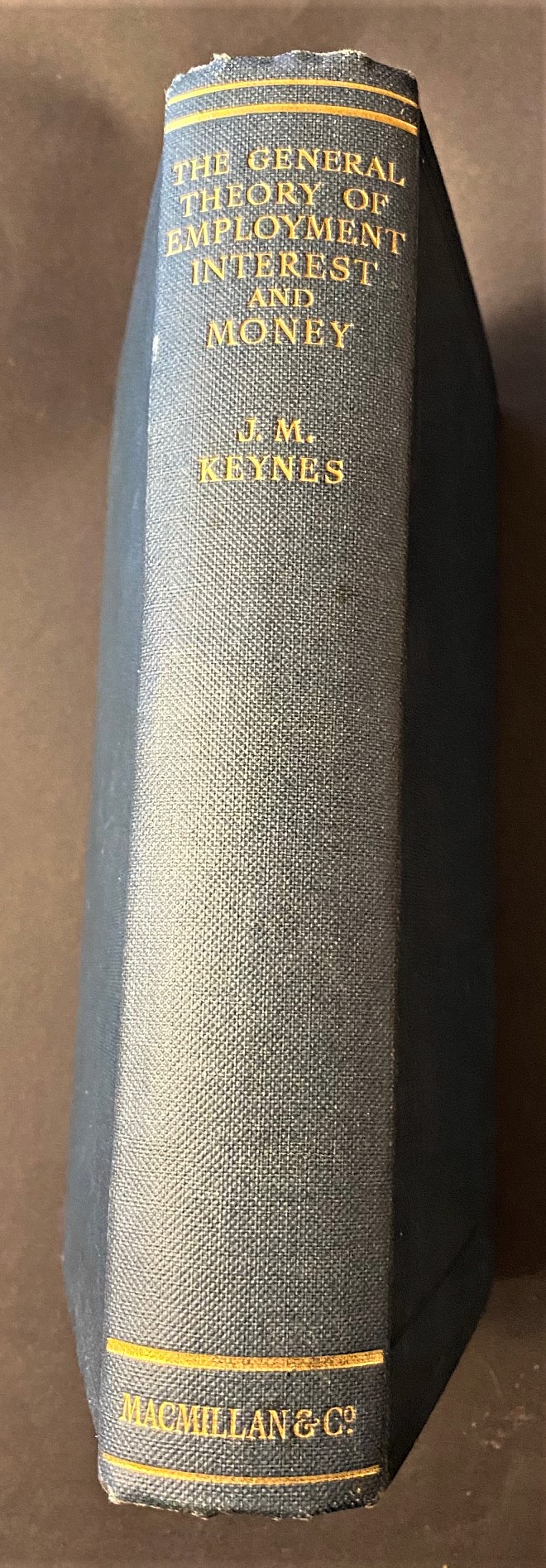
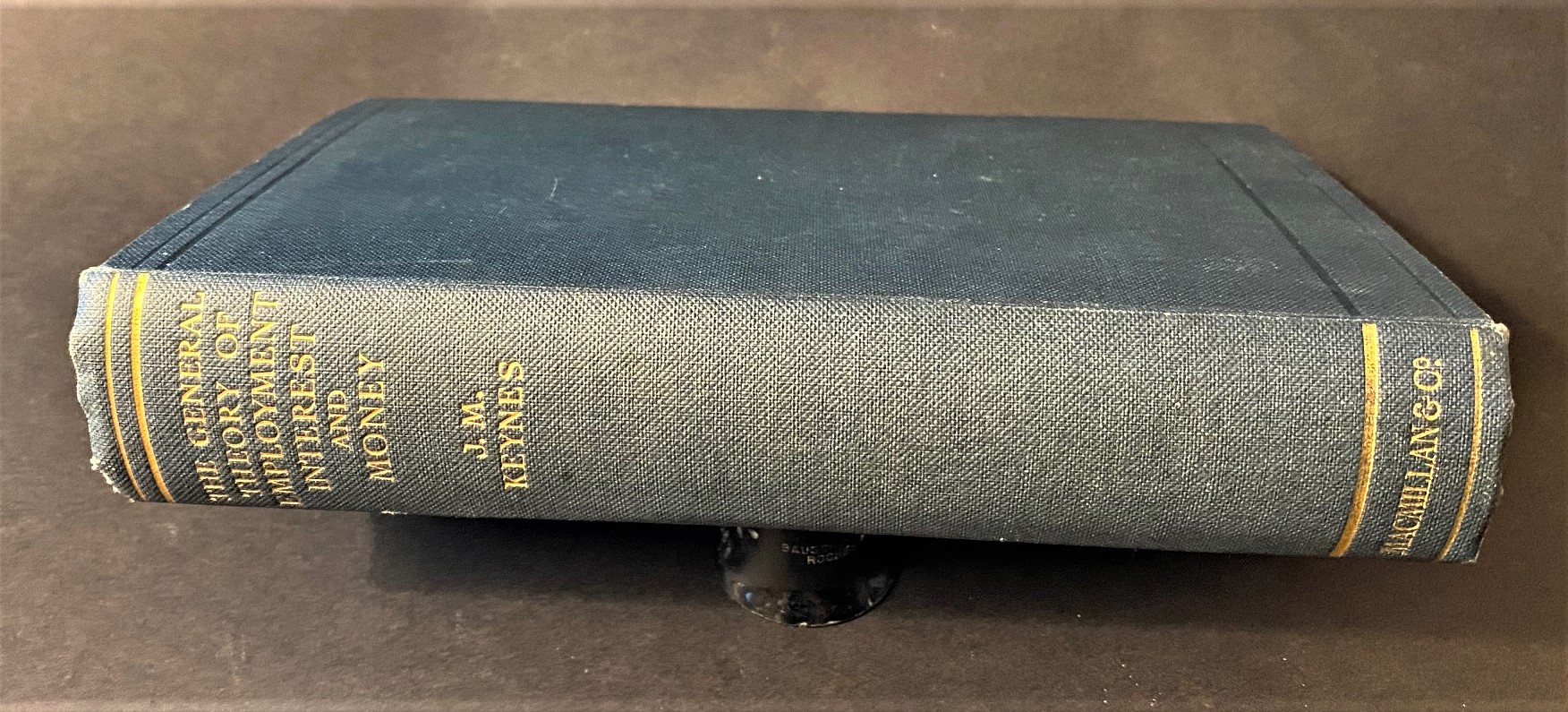
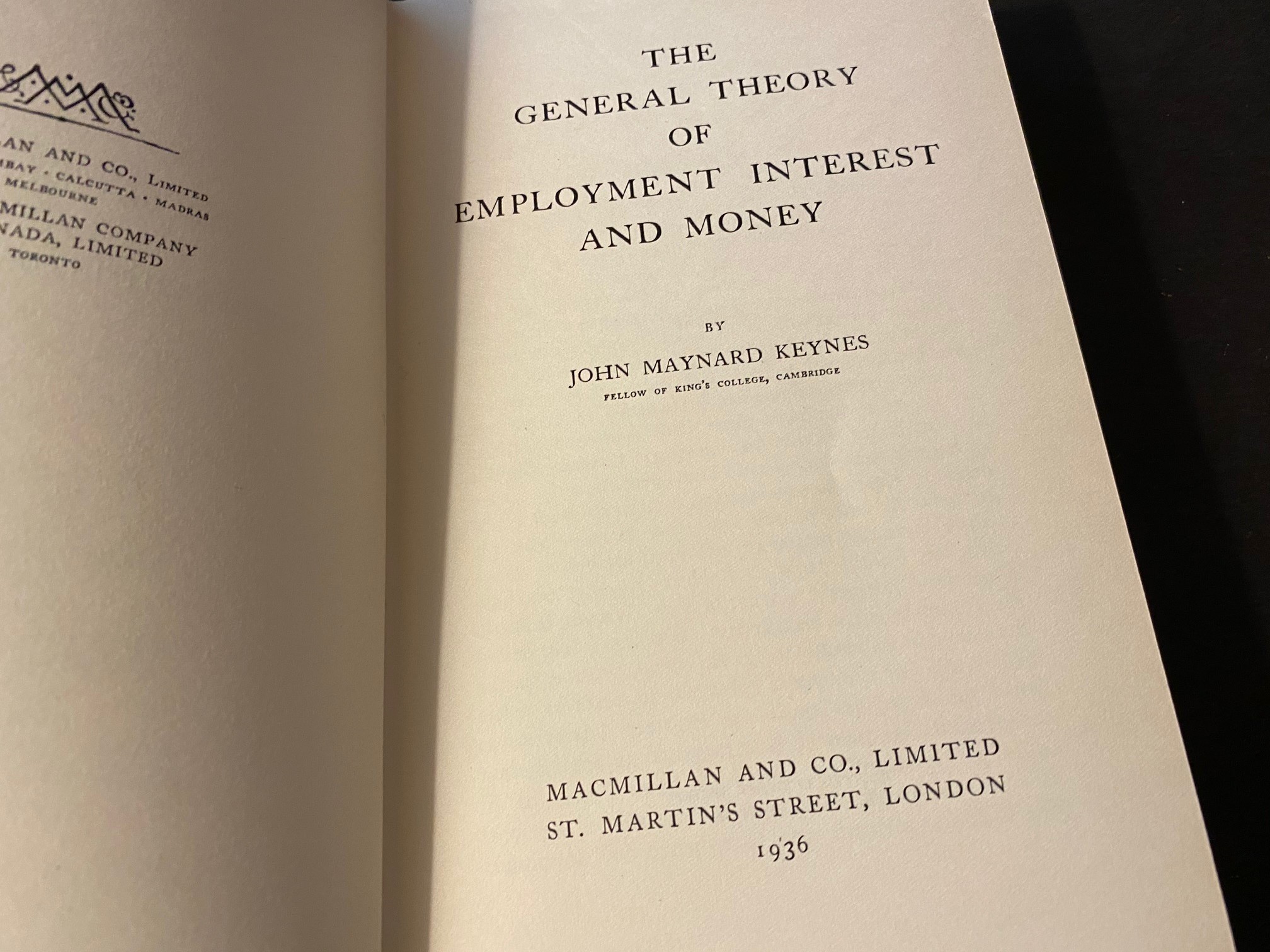
John Maynard Keynes, The General Theory of Employment, Interest, and Money. London, Macmillan & Co.. First edition, 2nd impression, March 1936. 8vo; xii, 403pp. Diced cloth. Lovely copy. About fine. There is a signature on the front pastedown and a name stamped on the front free endpaper. Crisp, strong, fresh, and clean copy. $450
-
An Extension of Doppler’s Great Paper of 1842 (1846)
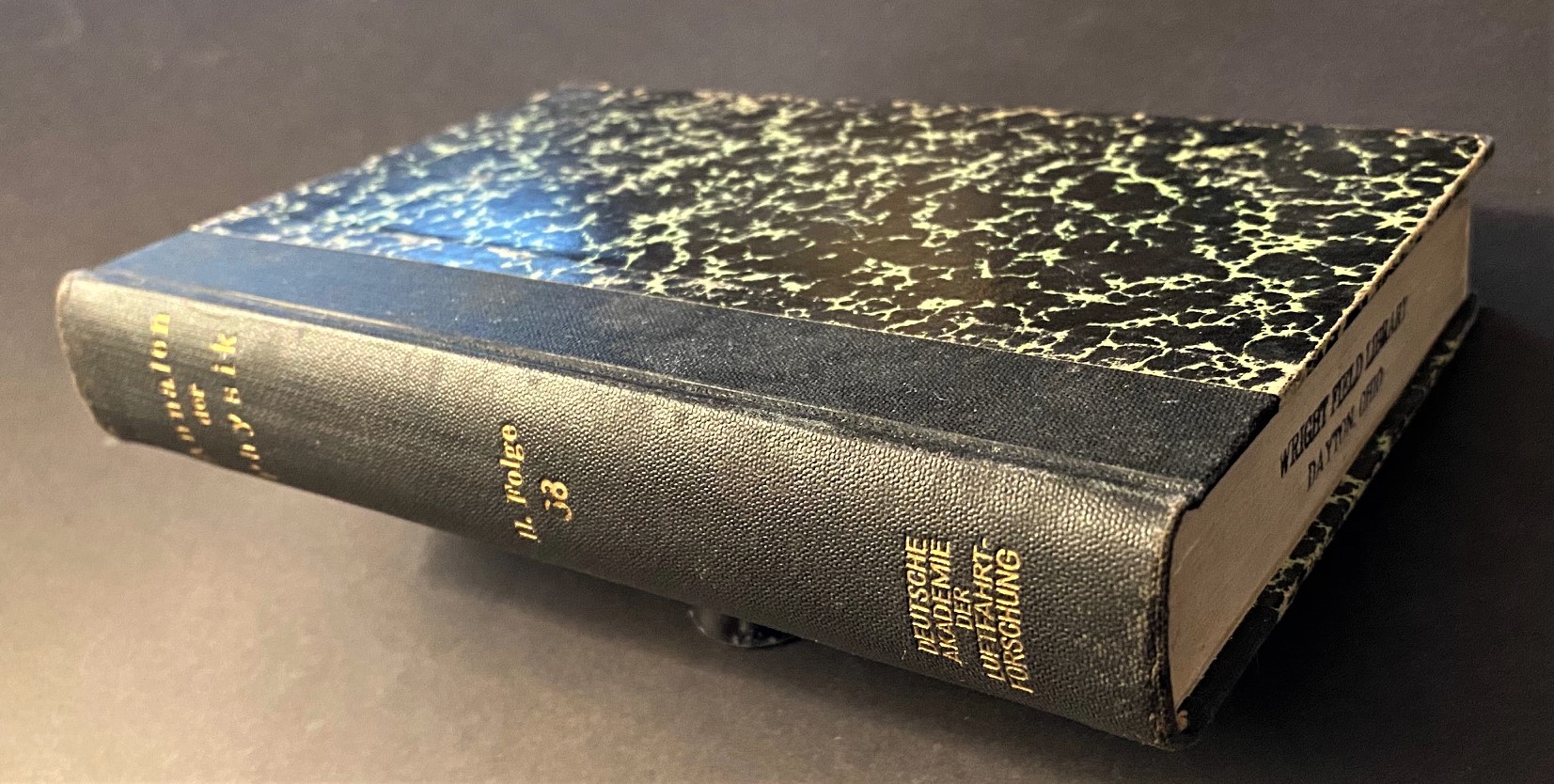
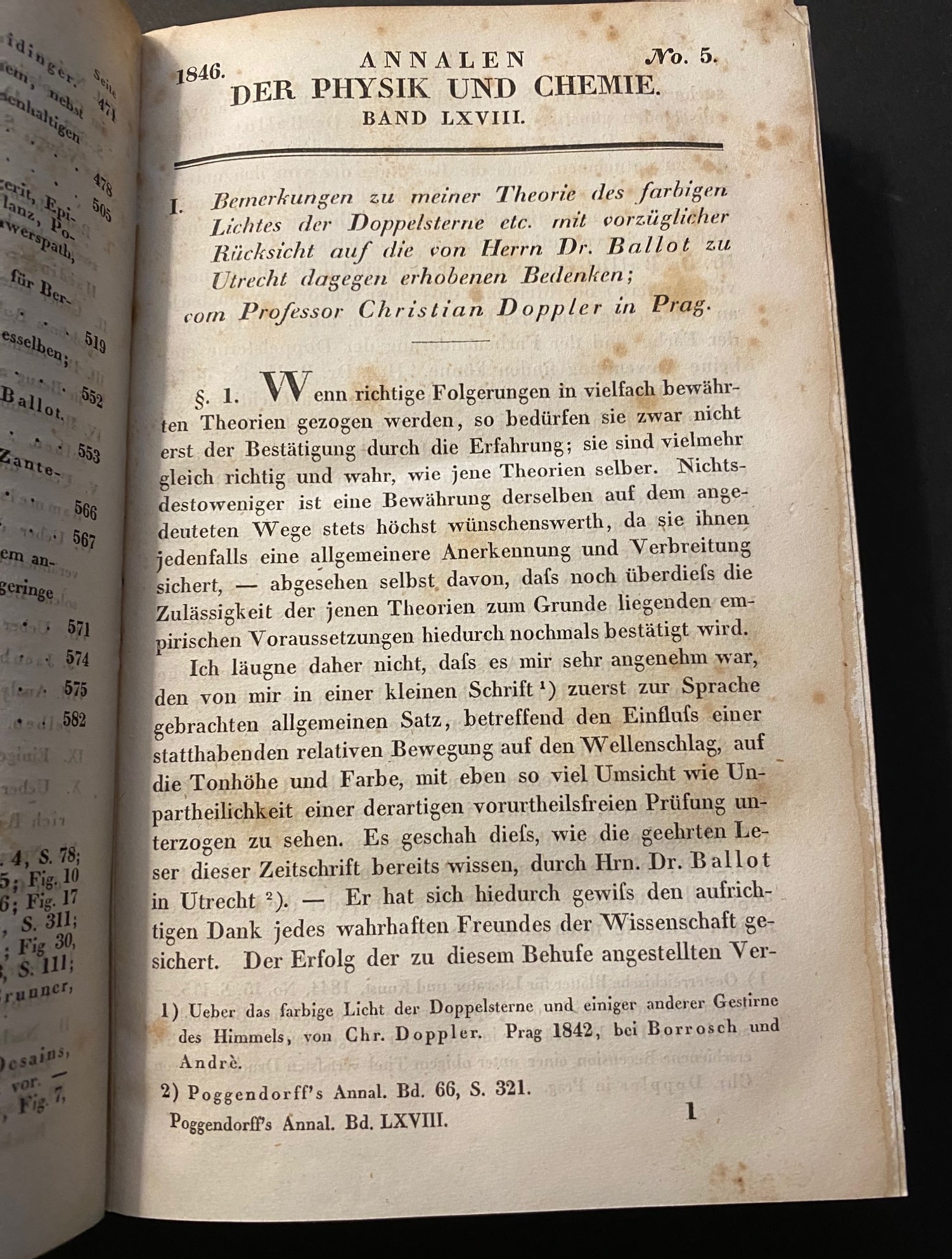
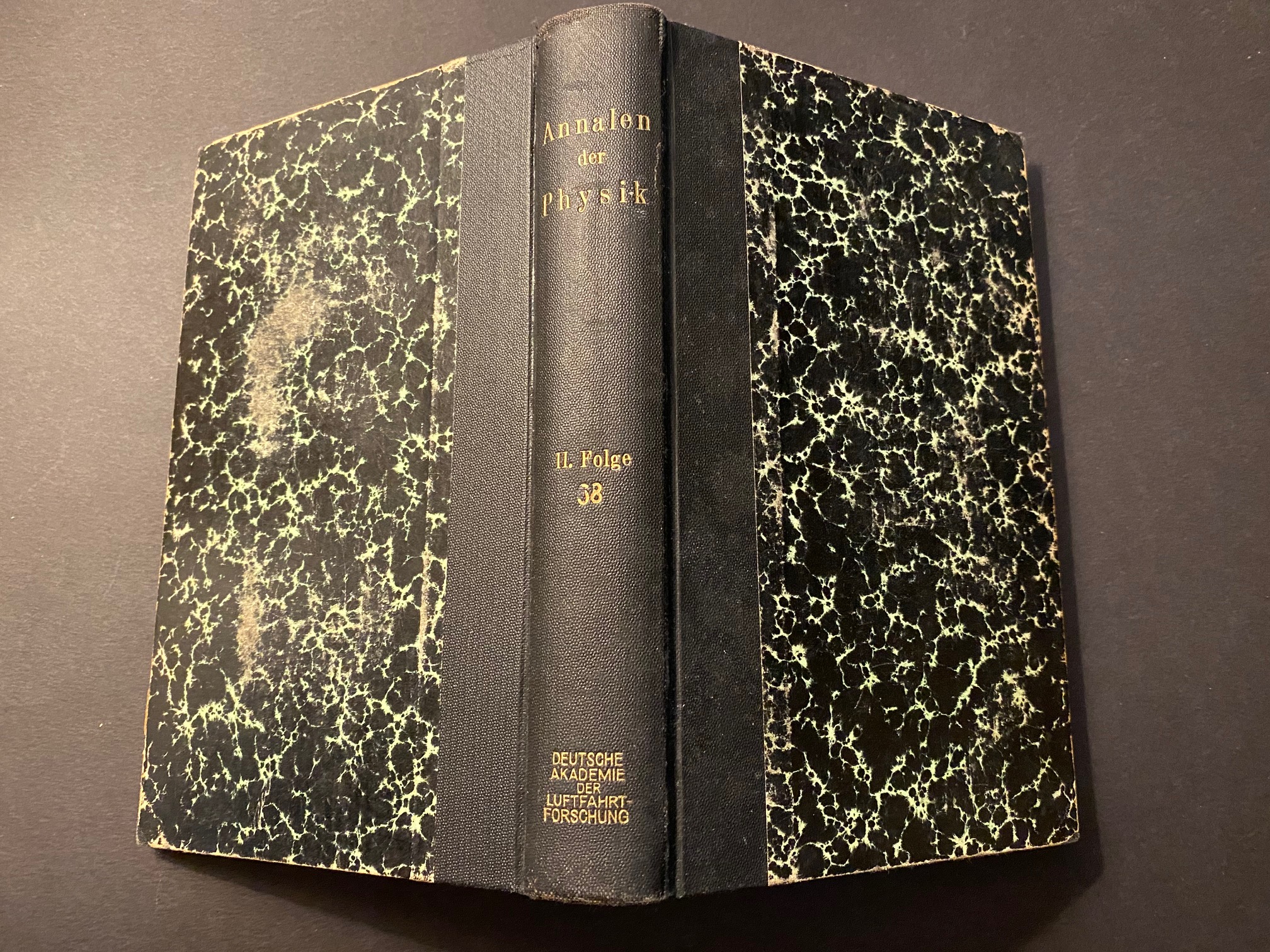
Christian Doppler. “Bemerkungen zu meiner Theorie des farbigen Lichtes der Doppelsterne etc. mit vorzüglicher Rücksicht auf die von Herrn Dr. Ballot zu Utrecht dagegen erhobenen Bedenken”. Published in the Annalen der Physik, by the publisher Johann Ambrosius Barth, in Leipzig, 1846, band 68, no. 5, part 1, pages 1-35. ¶ First edition. Offered as part of the entire half-year of the publication, numbering 582pp. The volume is bound in black half-cloth and very dark green/black marbled boards. Exlibris (a) Provinzial Gewebbschele zu Aachen, then (b) Deutsche akademie der Luftfahrtforschung, and then (c) Wright Field Library (Dayton, Ohio), and finally (d) the Library of Congress. There are ownership rubber stamps on text block page edge at top and bottom, a stamped gilt title on the bottom of the spine, and two scant stamps on the contents page, and that’s it. Very nice, tight, fresh copy. $1500
This is an extention of Doppler’s epochal “Ueber das farbige Licht der Doppelsterne und einiger anderer Gestirne des Himmels,” which appeared in Abhandlungen der Konigl. Böhmischen Gesellschaft derWissenschaften, (5th ser., 2 (1842), 465, and which was also published separately in Prague in the same year, (1842) in which the idea of motion is expressed to both source and observer, based on the experimental work of Buys-Ballot. “ The Doppler Theory/Doppler shift is of monumental applicability and importance, providing the foundation for sonar and radar, as well as for the general acceptance of the cosmological theory of the Big Bang (showing how the shift in the spectra of astronomical entities allows for the measurement of the rate of recession relative to the Earth.
“Buys-Ballot [Buys-Ballot, Christophorus Henricus Didericus (1817-1890)] also conducted one of the most famous experiments to confirm the Doppler shift. He put a group of musicians on a train and took up his position on a station platform. He asked the train driver to rush past him as fast as he could while the musicians played and held a constant note, and was able to detect the Doppler shift (as a change in pitch) as the train passed him (Filkin and Hawking 1997, p. 65).” –Eric Weisstein’s Science Biography pages on the Wolfram Research website
“In 1845, Christophe Ballot, a Dutch meteorologist, conducted a public demonstration to prove it. Ballot lived beside a train line, and he noticed the change in pitch in whistles and sounds as the train passed him by. He pulled a few strings and got a train to pull along an open-air cart filled with trumpet players. Meanwhile, more trumpet players stood in a station. Ballot checked the pitch of their instruments, and then got each section to play the same note as the train hurtled — at an astonishing forty miles per hour — past the station. Although the players in the station stayed right on the note, the players in the train by seemed to be pitched a little too high, and dropped a little too low as the train passed the station. Everyone in the station could hear the changing notes as the trained passed, and one of the most useful tools in all of physics was finally recognized.” Esther Inglis-Arkell, Gizmodo (2013)
“In 1846 Doppler published a revised version of his principle where he considered both the motion of the source and the motion of the observer. Later, a French physicist, Armand Hippolyte Louis Fizeau (1818–1896), who made one of the first measurements of the velocity of light, generalized Doppler’s work by applying his theory not only to sound but also to light.”– A. Roguin, “Christian Doppler, the Man Behind the Effect”. The British Journal of Radiology, 75 (2002), 615–619
- Bibliography of Doppler’s work. In: Stoll I, editor. The Phenomenon of Doppler. Prague, Czechoslovakia: Czech Technical University, 1992:76–80.
This volume also contains significant paper by Michael Faraday, the first German edition of “Thoughts on Ray Vibration”, which suggests that no ether or other vibrating material is responsible for the transmission of light.
-
Einstein and the Universe (1922)
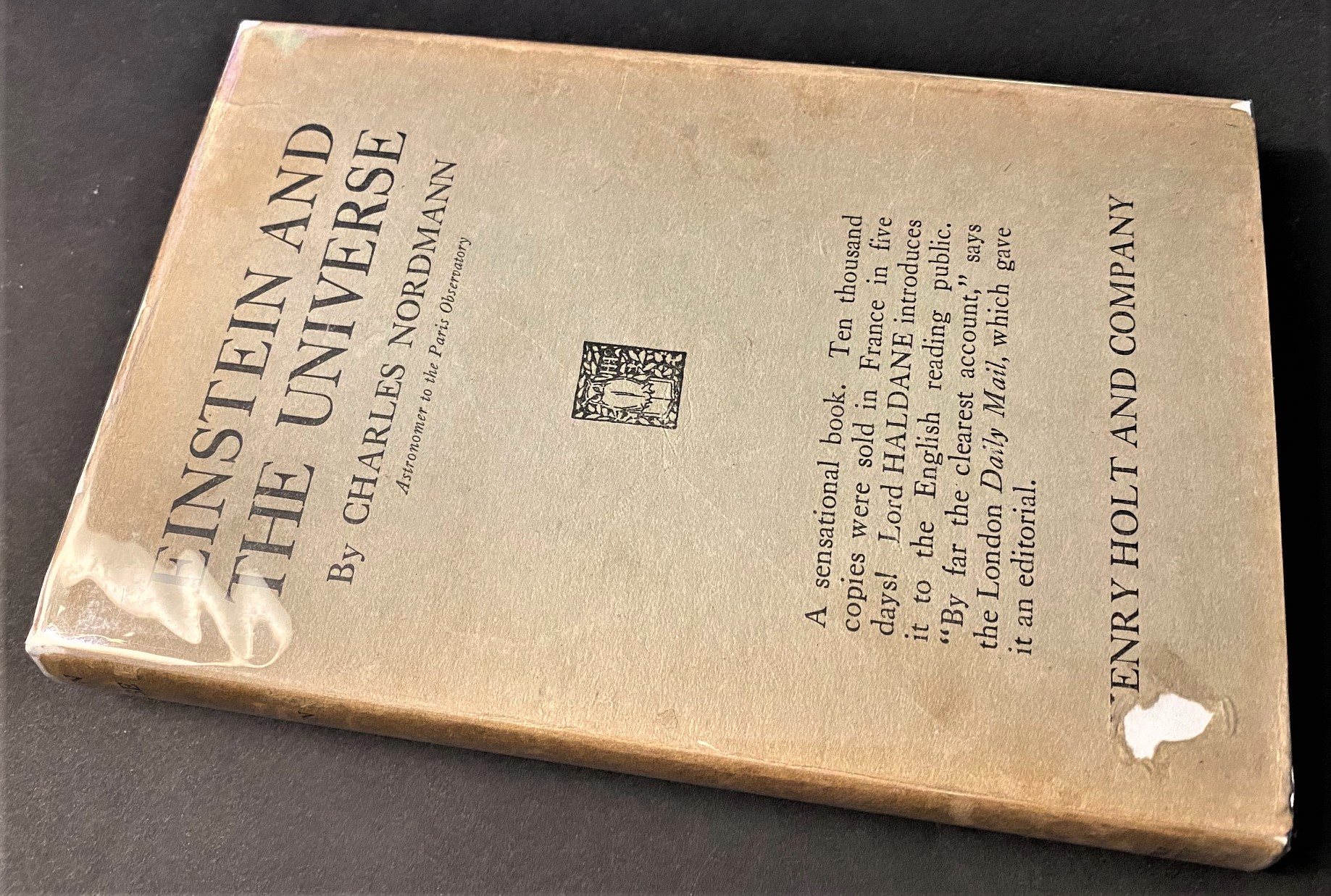
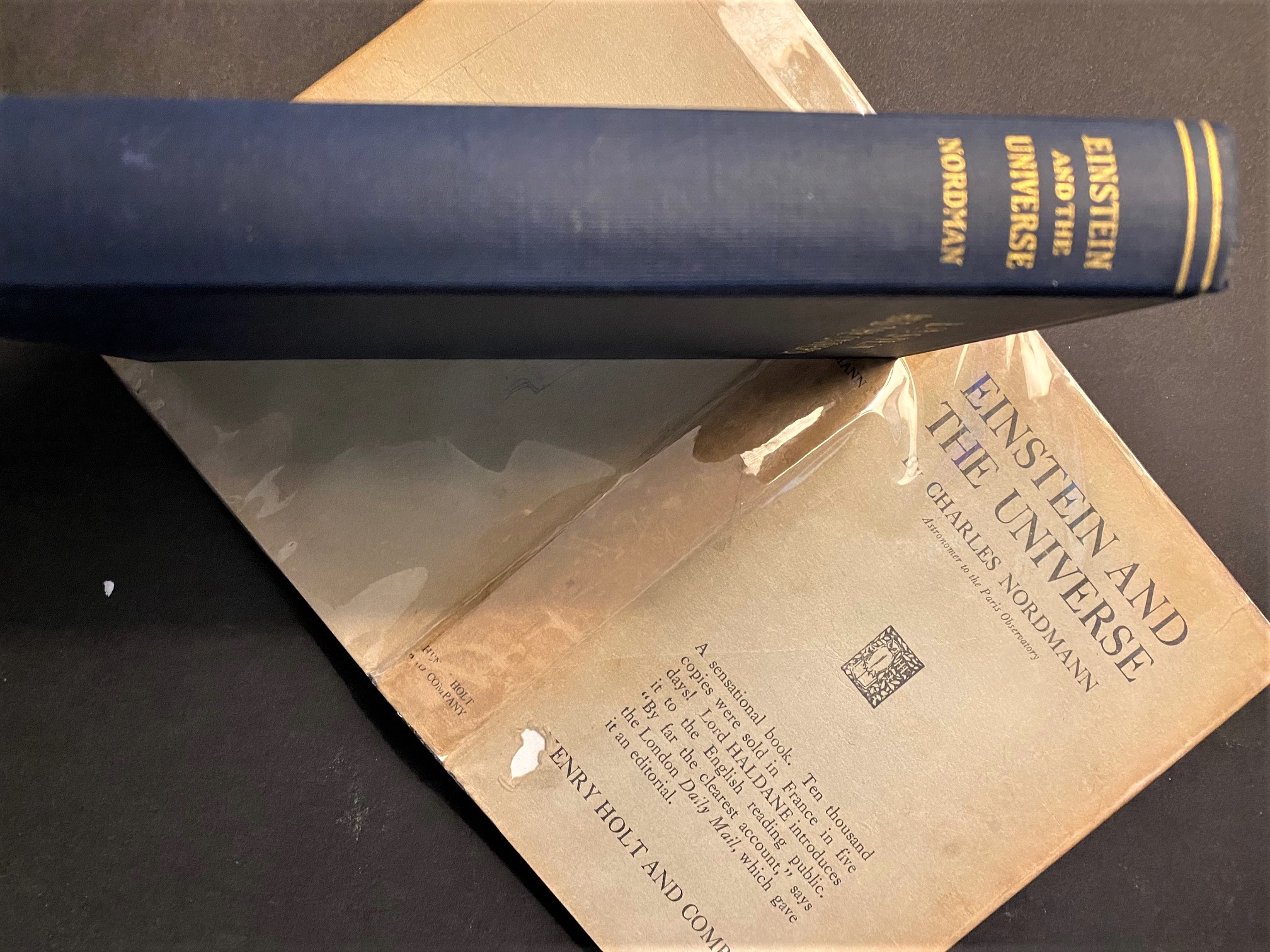
Charles Nordmann, Einstein and the Universe. Henry Holt & Co., NYC, 1922, First U.S. Edition. Xvi, 240pp. Original cloth. Excellent copy in a VG dust jacket. $250 (The first printing of the book was in Paris earlier in 1922; there was also a British and German edition in 1922 as well.)
The dj has some chips here and there, as well as a hole (as you can see in the pic) in the front panel—otherwise (as they say) this is in good shape. The book itself is Fine.
“Charles Nordmann was an early pioneer of radio astronomy, the creator of multicolor photometry techniques, and a noted popularizer of astronomy. After receiving his Licencié ès sciences in 1899, he spent the following year at the Meudon Observatory, near Paris, under the directorship of Pierre Janssen . There, Nordmann began a study of the Sun, its activity, and effects on the Earth’s magnetic field. From 1902 to 1903, he worked in the magnetic service at the Nice Observatory. For his doctoral research at the University of Paris, Nordmann attempted to test the prediction of Henri Deslandres that the Sun ought to emit Hertzian (i. e., radio) waves. He constructed a horizontal antenna, 175 m long, and installed it on the glacier of the Bossons (on Mont Blanc). Despite Nordmann’s best efforts, no definite signals were ever received….”–The Biographical Encyclopedia of Astronomers (online), Springer Verlag
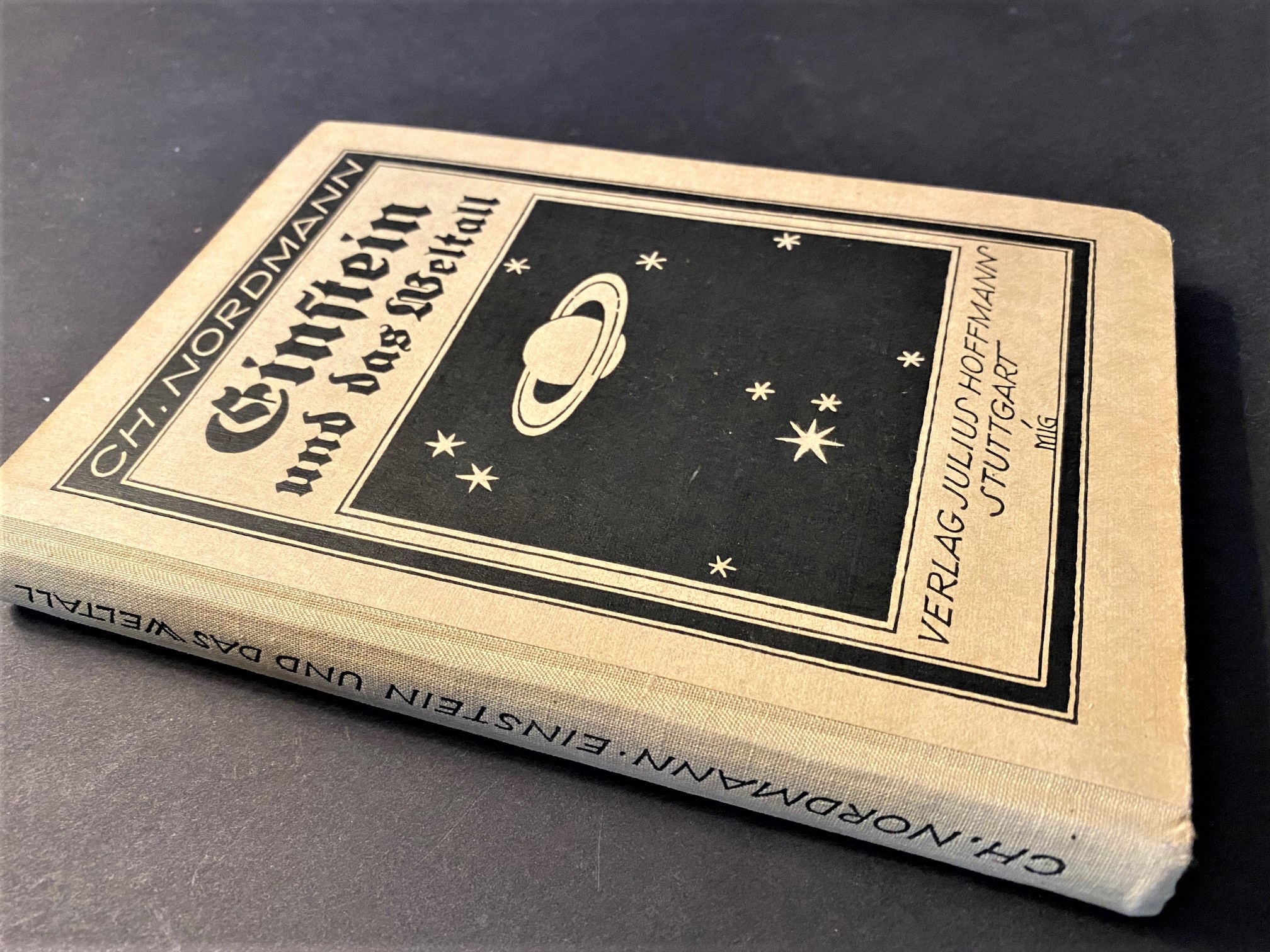
And the German first edition:
Charles Nordmann. Einstein und das Weltall. Stuttgart, Verlag von Julius Hoffmann, 1922. 8”x 5”, 199pp. Decorated paper boards and a cloth spine. VG copy. $50
-
A Call to Sabotage and to Arms of French Youth by the Communist Party of France, 1944
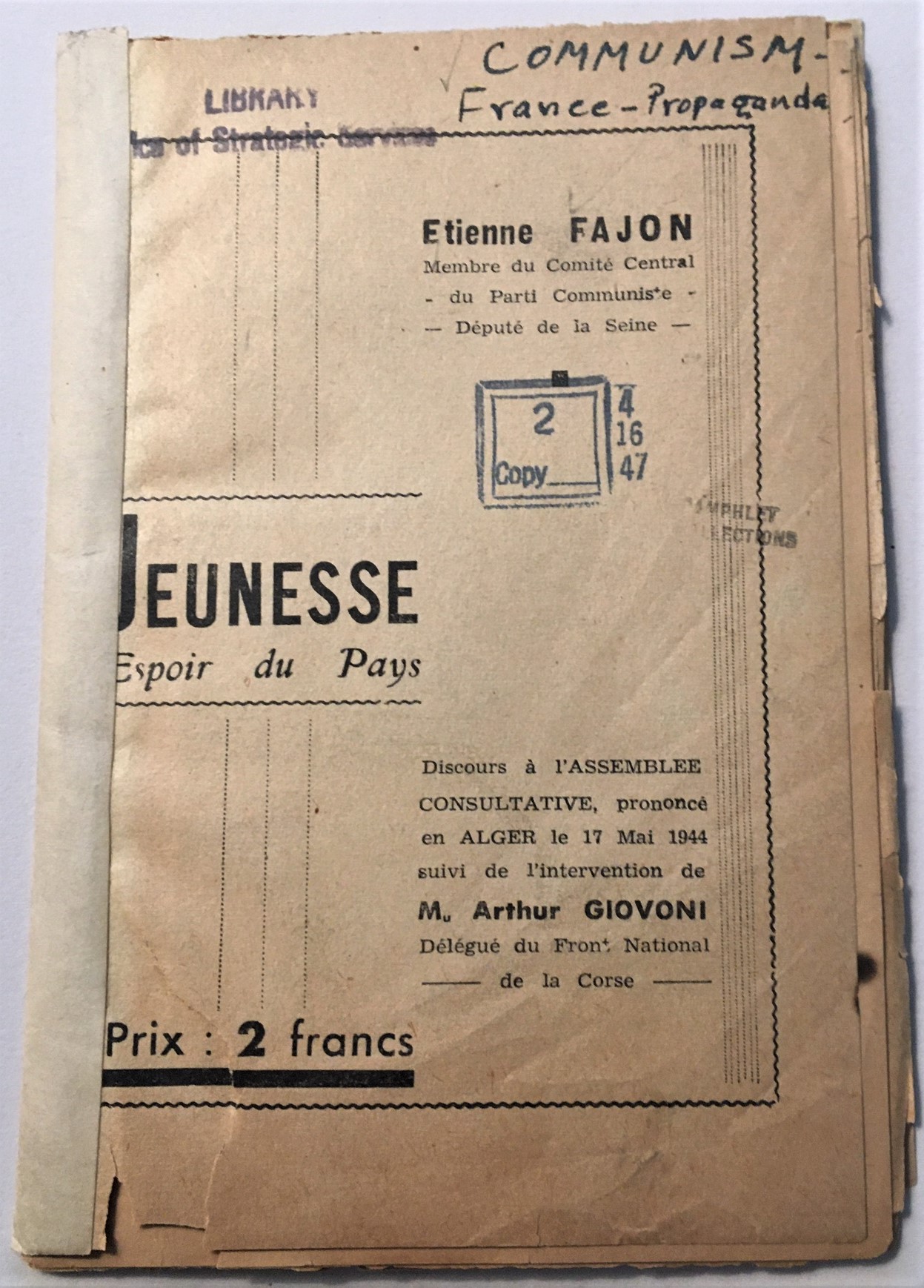
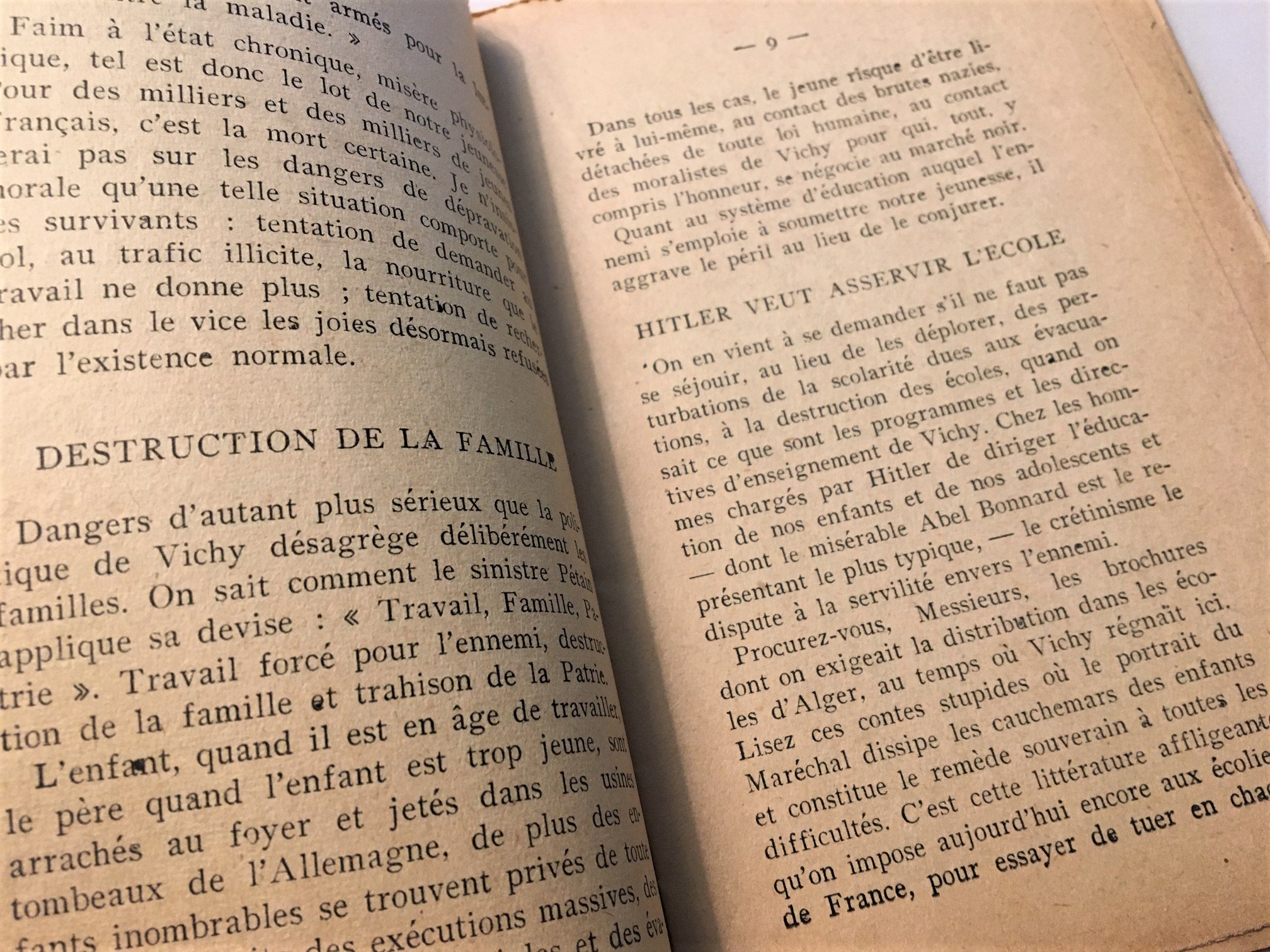
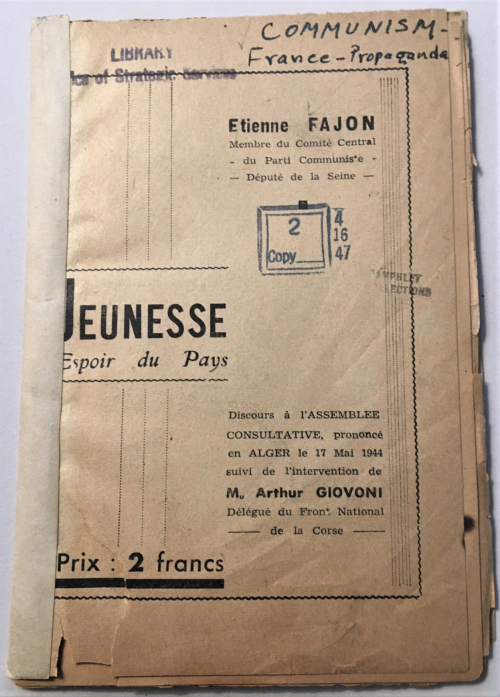
FAJON, Etienne and Arthur Giovani, and others Jeunesse, Espoir du Pays. Published meeting of the French Communist “Assemblee Consultative”. Published in Algeria (?), 1944 (?) 6.5”x 4.5”, 36pp. Printed on newsprint. Original wrappers; crude but yet charming cloth repair to the spine. Provenance: Library of the Office of Strategic Services (OSS), via the Library of Congress, each of which has contributed a rubber stamp to the pamphlet. GOOD condition, only. $250 NO Copies located in WorldCat.Well. Someone at the library of the OSS (the precursor to the CIA) labeled this “COMMUNISM—France-Propaganda”, which it is, though what it is first, I think, is a call to arms. And that clarion call is very directly aimed at the youth of France, which the Communist Party saw as being directly under attack by the Nazis.
The writers here established that “combat over slow death” was the approach to take, there in 1944.
Here’s a selection of what they were talking about:
(Section header: Helping Youth to Fight)
“We all want to save the French youth that the enemy is trying to destroy. All that, there is only one way: to help young people in France to defend themselves against the enemy, to strike him, to hasten his defeat.”
“..the rations granted to the French, from January 1943, were equivalent to the death of one in five individuals. No fight could cost our young generation so dear.”
“Helping French youth to fight that means: Replace certain wait-and-see or stupid broadcasts on our radio with specific advice to young workers to organize the sabotage of enemy production and transport with minimum risk and maximum efficiency
“…develop the struggle of prisoners and deportees in Germany who are, in their vast majority, young people doomed to death. Our radio must give directives for escapes, for sabotage, for all forms of struggle • in enemy territory. Above all, to urgently send by all means, to young soldiers without uniform, small arms, ammunition, clothing, instructors.
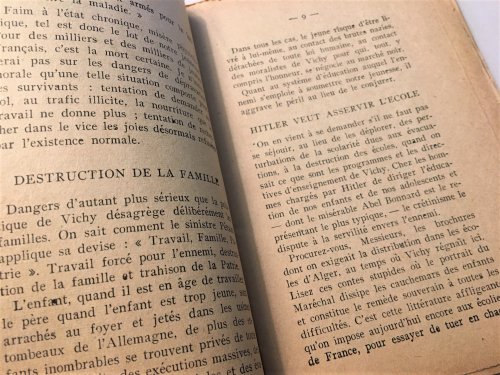
“We are concerned with restoring, upon liberation, the compromised health of millions of children and adolescents in France. In our opinion, the Government will not be able to solve this problem…”
“We all want to save the French youth that the enemy is trying to destroy. All that, there is only one way: to help young people in France to defend themselves against the enemy, to strike him, to hasten his defeat.”
“..the rations granted to the French, from January 1943, were equivalent to the death of one in five individuals. No fight could cost our young generation so dear.”
“Helping French youth to fight that means: Replace certain wait-and-see or stupid broadcasts on our radio with specific advice to young workers to organize the sabotage of enemy production and transport with minimum risk and maximum efficiency
“…develop the struggle of prisoners and deportees in Germany who are, in their vast majority, young people doomed to death. Our radio must give directives for escapes, for sabotage, for all forms of struggle • in enemy territory. Above all, to urgently send by all means, to young soldiers without uniform, small arms, ammunition, clothing, instructors.
“We are concerned with restoring, upon liberation, the compromised health of millions of children and adolescents in France. In our opinion, the Government will not be able to solve this problem…”
-
Rare Mimeographed Item on Japanese Constitutional History (1944)
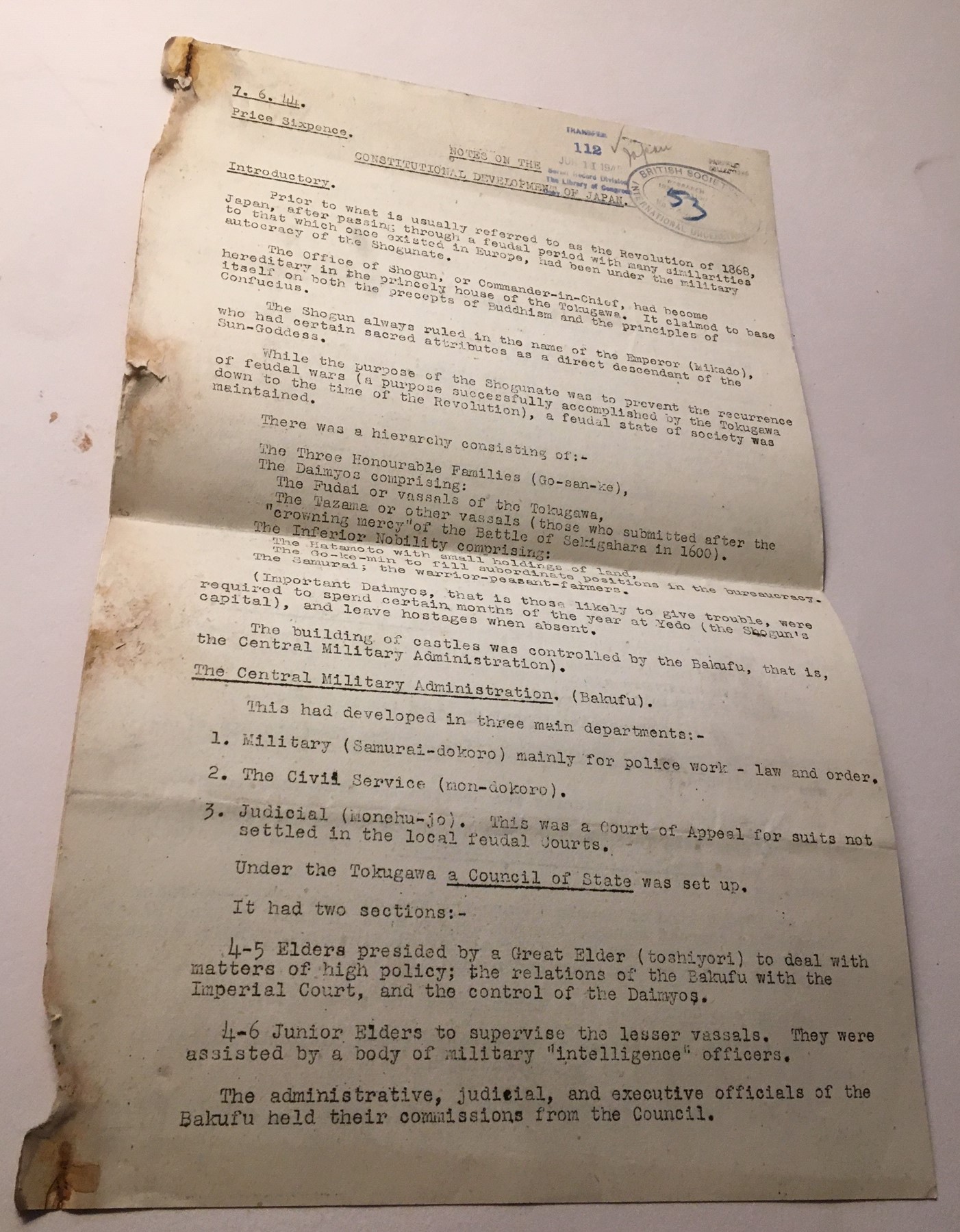
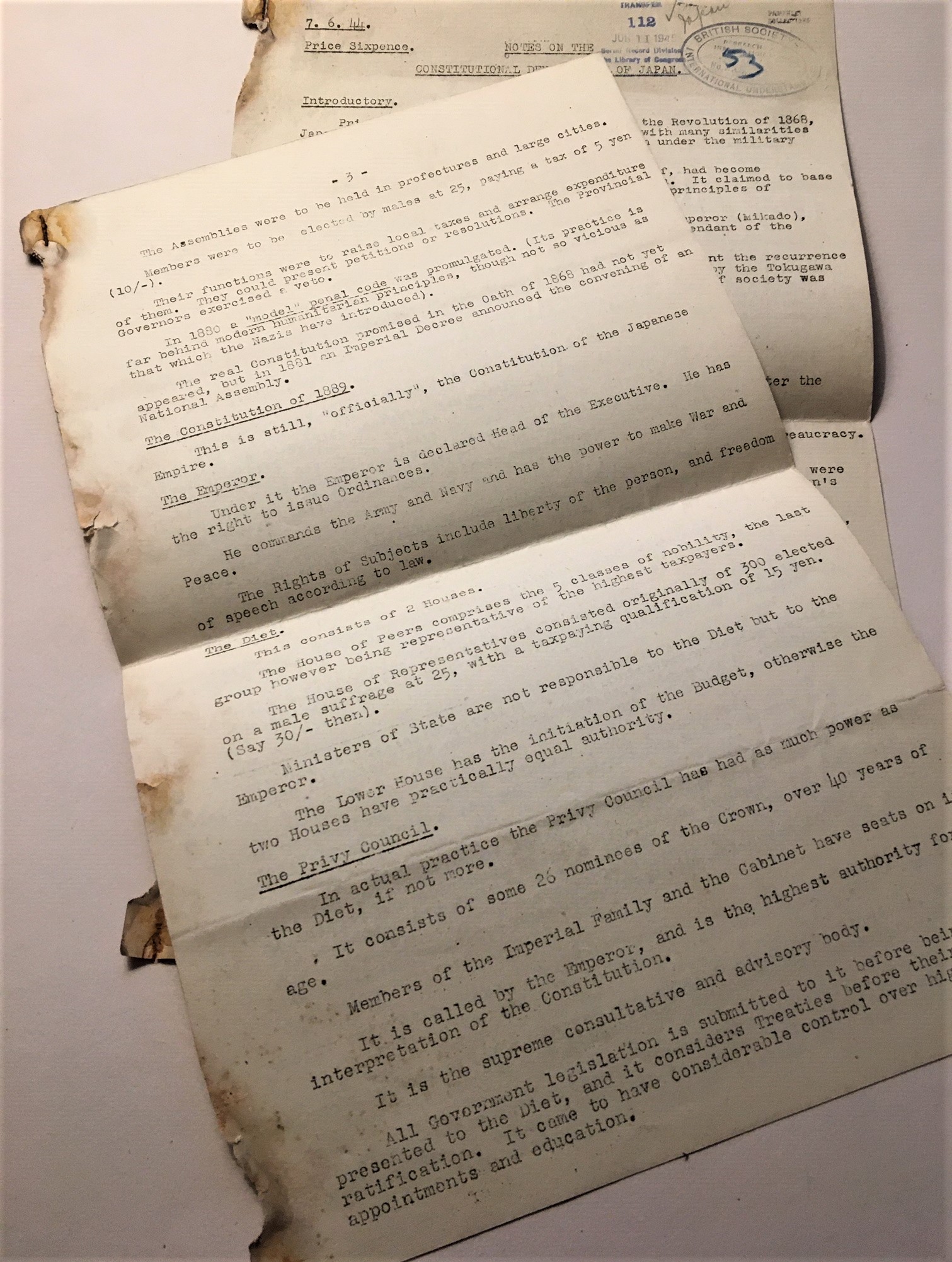
Notes on the Constitutional Development of Japan.
Unknown publisher. Dated 7 June 1944. 13”x 8”, 7pp (4 leaves). Mimeographed.
Provenance: British Society for International Understanding (the possible publisher?); then received 11 June 1945 by the Library of Congress. Rubber stamps from those two institutions on front, plus a LC surplus rubber stamp on the rear blank.
GOOD copy, only. The staple holding this together is rusted and has degenerated the paper around it (see photo). There is also some edge wear on the leaf leaf. $250
Scarcity: NO copies located in WorldCat.
Interesting note from page 6: “The Secret Societies and Fascist Bodies. These are really only carrying on an old tradition, but perhaps the first of importance in modern times was the “Black Dragon”formed from extreme reactionary elements of the Sei yu-kai about 1925. It was probably responsible for the “Death Bands” which carried out a series of political assassinations from 1952 onwards. From them came the “Back-to-Asia-” ideology. They attracted fervent youth by their claim to stand for spiritual regeneration…”
-
Fantastic Work on IBM Processing Machines 1936
[IBM] Machine Methods of Accounting. A Manual of the Basic Principles of Operation and Use of International Electric Bookkeeping and Accounting Machines. IBM, 1936-1940. 23 separately paginated sections, approximately 340pp, with illustrations throughout of machines and components, all gathered in a spring-loaded IBM binder of the same name. A fine illustrated reconnaissance of the IBM company. Fine condition, all 29 issues: $850
00. Foreword
01. Historical (in later editions, Development of International Business Machines Corporation (revised))
02. Principles of the Electronic Accounting Machine Method
03. The Tabulating Card 3a. The Electric Accounting Machine Card.
04. The Design of Tabulating Cards
05. The Preparation and Use of Codes
06. Organization and Supervision of the Tabulation Department
07. Selection and Training of Key Punch Operators
08. Accounting Control
09. Punches
10. Alphabetic Printing Punches
11. Facts to Know about Key Punches
12. Verifiers
13. Gang Punches
14. Card Operated Sorting Machines
15. Electric Tabulating Machines
16. Electric Accounting Machines (Type 285 and Type 297)
17. Alphabetic Direct Subtraction Accounting Machine
18. Interpreters 18a. Electric Punched Card Interpreter Type 552
19. Reproducing Punches (and supplement 19a) AND Reproducing Punches Type 512.20. Automatic Summary Punches (Type 285-297; 20a – Type 405) AND: Automatic Summary Punches, for Use with the Numerical Accounting Machines Type 285-297.
21. Multiplying Punches
22. Applications of Machines to Accounting Functions
23. Other International Products24. The International Automatic Carriage (Type 921)
[IBM] Machine Methods of Accounting. A Manual of the Basic Principles of Operation and Use of International Electric Bookkeeping and Accounting Machines. IBM, 1936. 10 separately paginated sections, massively illustrated throughout with images of machines and components. A fine illustrated reconnaissance of the IBM company and its early tabulating machines. Superb! Fine condition.__+__ Includes 03. the Electric Accounting Machine Card, 20pp; 04, The Design of Tabulating Cards, 16pp; 05. The Preparation and Use of Codes, 28pp; 06. Organization and Supervision of the Tabulation Department, 16pp; 07. Selection and Training of Key Punch Operators, 12pp; 08. Accounting Control, 8pp; 13, Gang Punches, 8pp; 14. Card Operated Sorting Machines, 14pp; 20. Automatic Summary Punches (Type 285-297; 20a – Type 405) , 16pp; 22. Applications of Machines to Accounting Functions, 24pp.$220
-
The Library of the Future (1960)
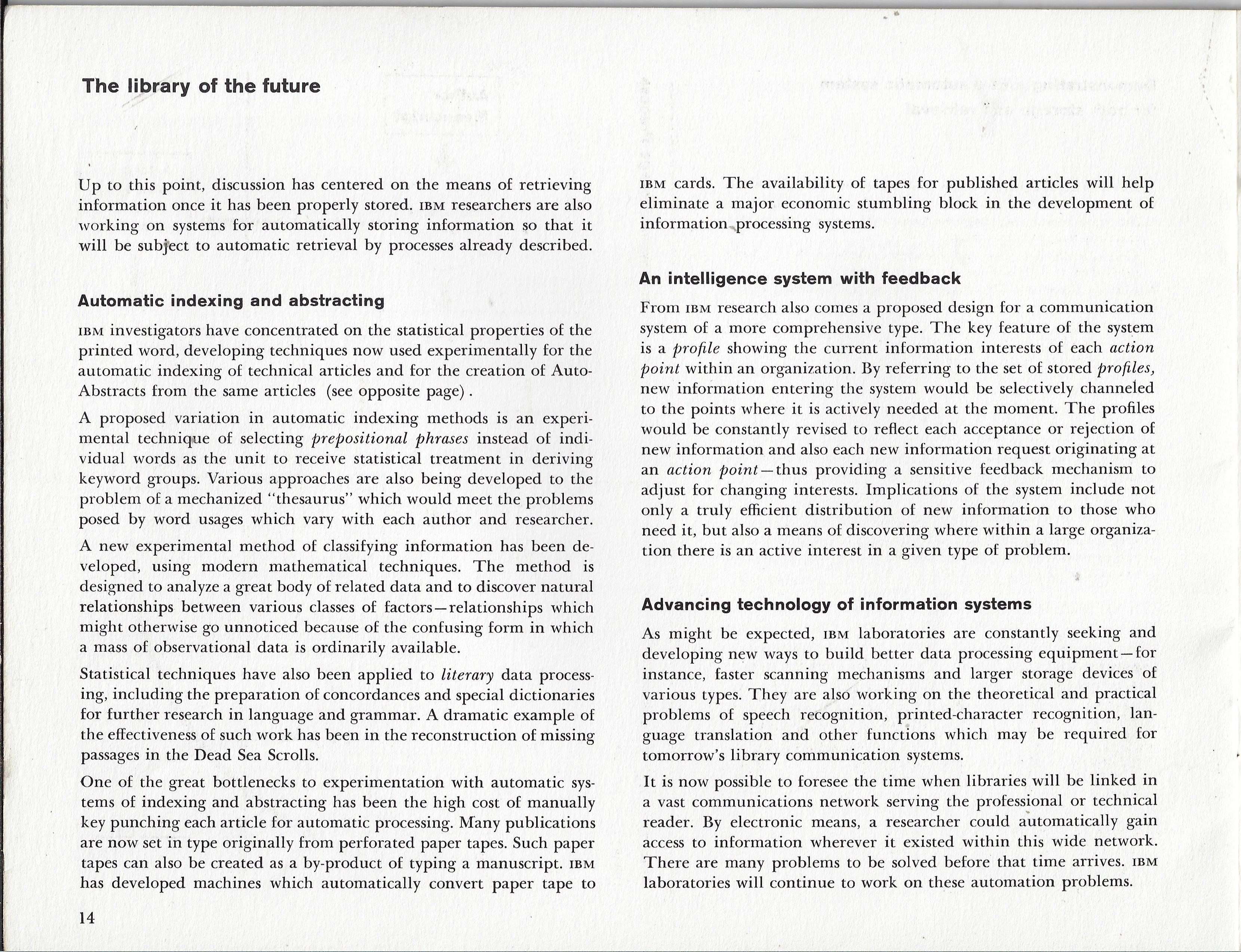
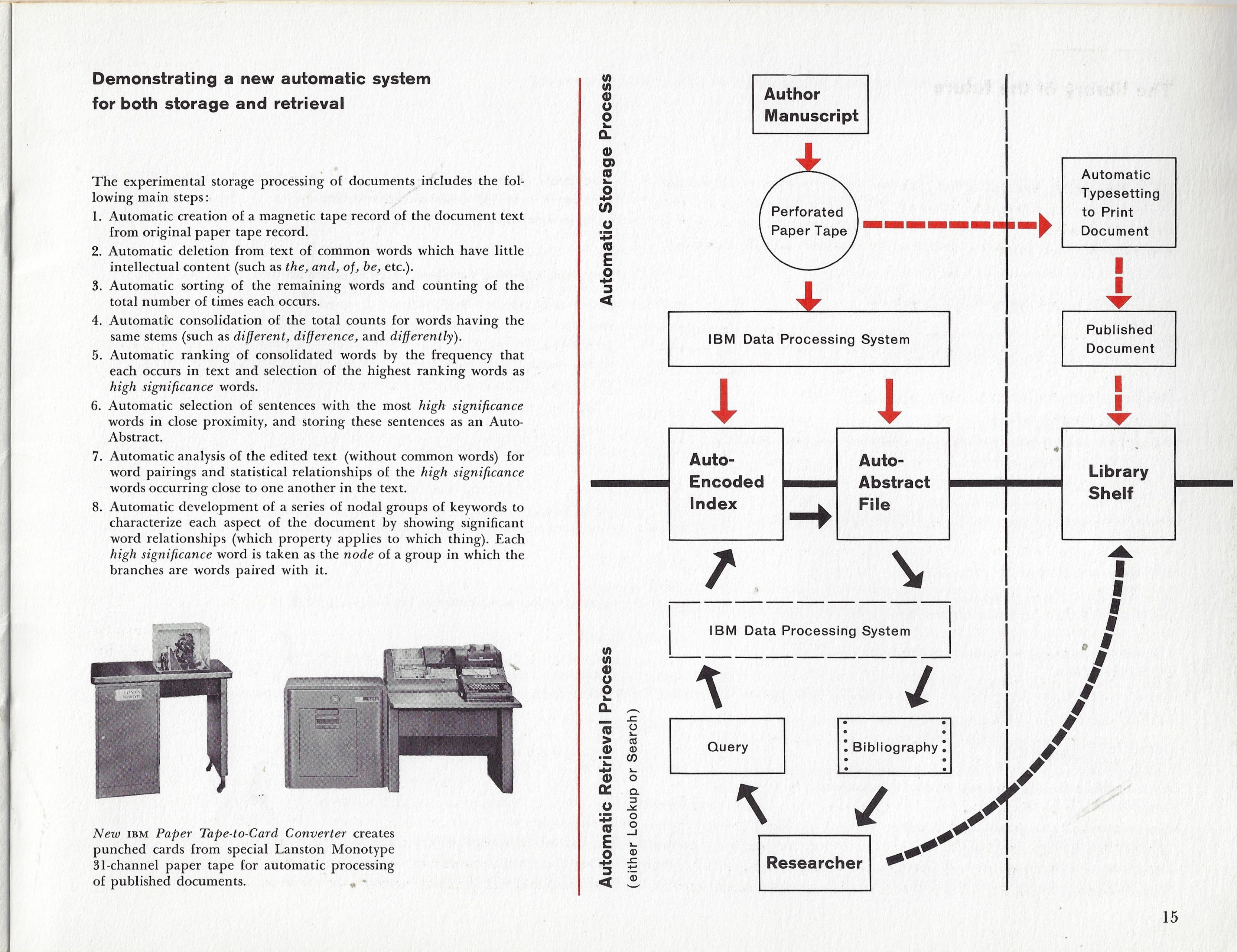
IBM Information Retrieval. IBM, NYC, ca. 1959. (No date but the bibliography cites only 1957 and 1958 “recent” works, and the IBM machine quoted here for this particular use is the RAMAC which was sold beginning 1956. I guess it is possible that this was 1960-1962, though I’d also guess there would be more recent entries in the bibliog.) 8.5”x 11”, 16 pp, illustrated. FINE condition. $125
This is summation of the current state of affairs in info storage and retrieval delivered in a how-to schematic step-by-step presentation, concentrating on library applications, and including a tail piece on “the library of the future”, with that schematic reproduced here. -
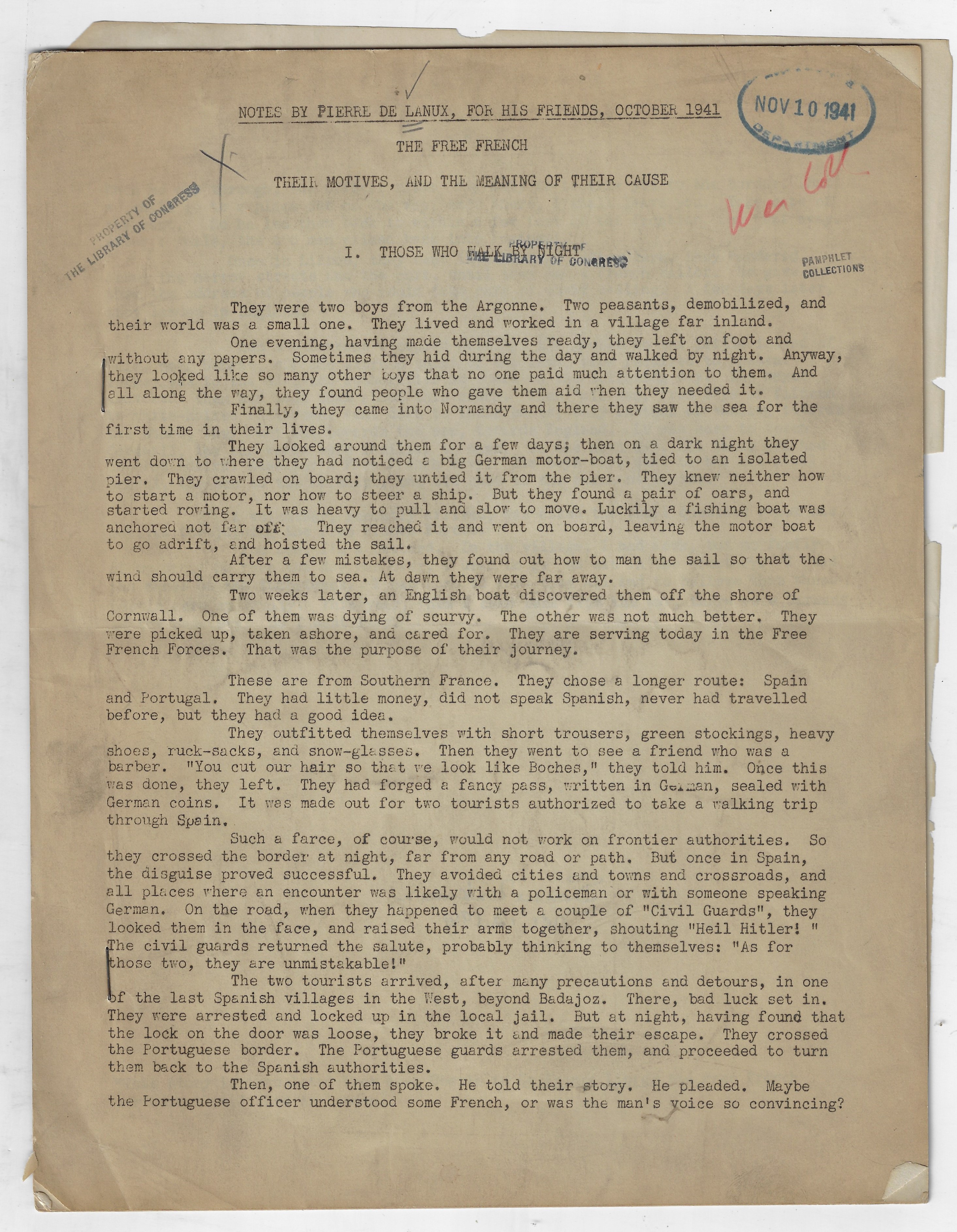
Rare Work on the Free French, 1941
Pierre de Lanux, Notes by Pierre de Lanux, for his Friends, October 1941. The Free French, their Motives, and the Meaning of their Cause. November, 1941. Received by the Library of Congress November 10, 1941. 11”x 8.5{, 11 leaves. Mimeographed. Includes he following sections: Those Who Walk by Night; A War of Independence; The F.F.F.(Free French Forces);the Invisible Army; In Terms of History. $200Provenance: Library of Congress, with a small oval stamp plus three small rubber stamps on front page; LC rubber stamp on rear page. Front page a little dusty but he rest of the ext is near-fine. Stapled, with last leaf detached. Very old and nearly gone horizontal fold at center.
NO copies located in WorldCat.
Recent Posts
Archives
Categories
- Absurd, Unintentional
- Alchemy
- American Western History
- architecture
- Art History
- Astronomy
- Atomic Bomb
- Aviation
- Aviation history
- Bad Ideas
- Biology
- Brevity and Complexity
- Chemistry
- Communication
- Computing History
- Design
- Electro-LUXurious Inventions, 1840-1940
- Geology
- History of the Future
- Illustrated Book
- Information, Artistic Display of Data &
- Maps
- Mathematics
- Medicine, History of
- Medieval and Renaissance
- Militaria
- Naval and Nautical
- Particle Physics
- Photography
- Physics
- Propaganda
- Quantum Theory
- Relativity
- Social History
- Technology, History of
- Women, History of.
- World War I Maps
- World War I–Images
- World War II