A Daily History of Holes, Dots, Lines, Science, History, Math, Physics, Art, the Unintentional Absurd, Architecture, Maps, Data Visualization, Blank and Missing Things, and so on. |1.6 million words, 7500 images, 4.9 million hits| Press & appearances in The Times, Le Figaro, Mensa, The Economist, The Guardian, Discovery News, Slate, Le Monde, Sci American Blogs, Le Pont, and many other places… 5000+ total posts since 2008.

  • US Army Transport Shipboard Newspaper, 1929

    The Cam-Breeze.

    US Transport Cambrai on Voyage from New York Nov.13, 1929 vi Panama Canal to San Francisco, Calif., Nov. 30, 1929. 13”x 8.5”, 29pp. Complete in 14 issues, about 15,000 words. Each issue has a hand-drawn banner, usually a map, This was produced shipboard on the Cambrai.

    There seem to be no copies located in WorldCat. $500

    Provenance: Library of Congress, with their stamp on the front wrapper.

    Condition: Fair. The oversize paper was also fairly cheap to begin with, so there are some rough edges all the way around, but particularly at top (as you can see in the pics). Some of the cracked bits along the top edge have been reinforced with Japanese rice paper adhesive on back. Accpetable copy of an evidently rare document.

    The Cambrai was named after the US-involved battle of Cambrai in WWI.

    The Cam-breeze reported all manner of shipboard news, where they were in the world, plus “radio news” of national and international interest. Overall, this is somewhat delightful.

    ·Posted by :

    ·in:

  • A Lovely, Interesting, and Semi-Outsider Piece of Logic

    Rare Radio, Wireless, and TV Ciphers, Codes, Language (1936-1937)

    No Listings in WorldCat

    SPARTARI, Carlo. Three items.

    (Spartari Radio Language, Sirela) Spatari Radio Language: A Word-of-mouth Code Easily Understood by Listeners of Many Nationalities Without Need of Memorizing for Use in International Radio Broadcasting. Self-published (?) 1937.

    Three items: $500

    18”x 12”, 34pp. Bound in a mini spiral metal binding, thick wrapper. The binding is beautiful in its way. The only problem is that the pamphlet had been stored folded in half (horizontally) , and even though I’ve had this in a book press for months, I cannot reduce the wave in the books structure much beyond what you see in the pics. That said, the binding and text are strong.

    Easily the tallest book on radio codes and ciphers that I have seen, Spartari invented a rather clevwer and interesting radio language. It was based upon the seven musical notes of the diatonic scale–DO, RE, MI, FA, SO, LA, and SI—which took no translation to understand, and everyone pronounces the names of the notes in about the same way, a la Italiano. On the one hand it seems to me to be whimsical, and on the other, it seems brilliant.

    Provenance: Library of Congress, with their rubber stamp on the title page.

    With:

    Spatari International and National Criminal Identification Code.

    This consists of two folding posters, each 11×17”, folded in thirds.

    The code in sheet one is such that a lot of data can be transmitted in a short, alpha-abbreviated message via radio or wireless. There are codes to describe the following characteristics of the person of interst: name, alias, nationality, build (“fat/fat and short/fat and tall”), weight, eye color, hair, scars (and their various forms and locations), moles, tattoos, birthmarks, malformations, teeth, hair/beard. Fingerprints, relatives, g\hat style, shoes, tie, and suit, all of which can be described in some detail in the code.

    And with:

    Spatari Television Code for Facsimile Transmission.

    14”x 32”, 1936. Folded in quarters.

    None of these items are found in WorldCat.

    “Back in 1905 a young musician was so impressed by the fact that the language of music is universal, that he decided to develop a language based on music. The result is the Spatari Radio Language, an ingenious system of speech based on the notes of the musical scale, capable of being understood by anyone, regardless of his native language, and requiring no study of grammar, vocabulary or syntax. The entire language consists of only the seven notes DO, RE, MI, FA, SO, LA, and SI, and the symbol BO. Capable of being combined into nearly a million different words or groups, these symbols can be pronounced on sight, and easily written down as soon as heard. The “secret” of the language is that each group of symbols represents an entire thought, or sen- tence. It is not intended that anyone memorize the symbols, as they can be written down as heard, and found quickly in the Spatari dictionary later.”–World Radio History online, Radex

    Also see On the Short Waves, 1923-1945: Broadcast Listening in the Pioneer Days of Radio

    By Jerome S. Berg
    ·Posted by :

    ·in:

  • Charles C Hawke Md Facs Winfield Kansas Castration Vs Vasectomy In The Feebleminded As A Surgical Problem 12 L

    Charles C. Hawke (M.D., F.A.C.S., Winfield, Kansas). Castration vs. Vasectomy in the Feebleminded as a Surgical Problem. 12 leaves (including a 17-item bibliography. Mimeographed. Stapled. GOOD+ copy, with little dings and short tears to sp,e page edges. Provenance: “Gift from the author, 1941” in pencil notation on the back of the first leaf, with the LC rubber stamp on the rear leaf.

    WorldCat records only ONE copy (Tozzer Libray, Harvard). $500.

    Dr. Hawke wonders—somewhat facetiously to my reading—about the relucatance of including testicles in the field of “glandular surgery”, noting that “text books in the eugenic field” teach that “this mighty king is not to be disturbed”, along with a few other purplely examples. He quickly establishes the castration (and ovariectomy) as well as vasectomy and salpingectomy may be the way to stabilize “the unstable group” (in institutions), “be they idiot, imbecile or moron” and that the procedure should “be given serious consideration”.

    He states that “the majority of our castrates will never leaves the institution. You ask—why then castrate[?]” He doesn’t seem to answer this directly, but does provide some evidence (below) that the behaqvior of 71% those castrated and confined does improve. It is not 100%, Dr. Hawke notes, and adds the corollary “…but what surgical procedure has a 100% cure [sic]”.

    There are other reports of successes in castration, including a long paragraph of Dr. (F. Hoyt) Pilcher, (Superintendent of the Kansas State Asylum for Idiotic and Imbecile Children) who began his work in the early 1890s. There is also a review of the 1917 (and 1928) laws passed by the Kansas legislature on “asexualization”. It seems that the state can uphold recommendations from medical officials recommending castration; the person in question can register a “protest” (“which are rare”). These laws extended its reach into “state penitentiaries, the boys’ reformitories, state hospitals for the insane, and the state hospital for epileptics, the state home for the feebleminded and the state industrial school for girls…”

    It is quite a document of those eugenical times.

    See: Cean T. Collins, “CHILDREN OF SORROW: A History of the Mentally Retarded in Kansas”, in Bulletin of the History of Medicine, Vol. 39, No. 1 , 1965, pp. 53-78

    ·Posted by :

    ·in:

  • On the German Versailles Reparation and Economic Crisis of 1932 by a Future Member of the German Resistance

    O.C. Kiep, German Consul General in New York, before the Eastern Regional Conference of the Savings Bank Association of the State of New York in the Hotel Roosevelt, New York, Thursday, January 28th on Germany’s Attitude Towards the Present Crisis. $500

    Mimeograph, 1932. 11”x 8.5”, 7 leaves.

    Provenance: from H.L. Mencken, to the Library of Congress, with the rubber stamp of the LC on the rear leaf. Written in pencil on the rear of the first leaf: “Gift/H.L. Mencken/Feb 5 1932”.

    This is in GOOD condition, a 4 or so out of 10. There are two ancient horizontal folds from when the paper was folded in thirds (all of the Mencken material I received in this purchase were folded one way or another). There are some short tears at these folds at the page edges on each leaf. These can be reinforced with Japanese archival tissue tape, though I haven’t yet done so.

    “From December 1926 to 1929 Kiep served as Counselor to the German Embassy in Washington,D.C. And then in 1932 he as the German Consul General in NYC. Because of his public support in 1933 of Albery Einsteoin hew was forced to resign his government position. Kiep returned to public life in 1936with the German Foreign Ministry in business negotiations in South America and East Asia, and later in the year he was chosen as the German representative to the International Committee on Non-Intervention in London, England. At the start of the war in September 1939 Kiep was recruited into the Abwehr, working with Admiral Canaris, but would soon become part of the resistance (along with Canaris and many others).”–Paraphrased from “The German Resistance: The WWII Story of Otto and Hanna Kiep” (online), adapted from Ice Set Free: The Story of Otto Kiep by Bruce Clements.

    Kiep and Canaris and many others would both be ratted out in 1943/, with Kiep turned in by Dr. Paul Reckzeh. He would face the terrible People’s Court of Roland Freisler in July 1944 and be found guilty, and was hanged two months later.

    This paper details the considerable direness of the economic situation in Germany in early 1932—part of the downfall of the German economy was due to the reparations payments demanded by the Versailles Treaty, and Kiep made a case for lifting the German debt obligations. He warned that Germany wasn’t presently in a position to make payments and suggested a temporary halt to them for one to three years. For the signatories to pursue the demands Kiep stated “that reverts to the most dangerous practices of warfare and can never hope to establish the peace and confidence necessary for a return of prosperity”.

    In another paper three months later Kiep warned that Germany was still dealing with the debt situation mildly in the political arena but that may all come to change if the debt payments were pursued. This of course turned out to be the case, with Hitler becoming chancellor in January 1933.

    ·Posted by :

    ·in:

  • Rare Work by Abraham Maslow (1962)

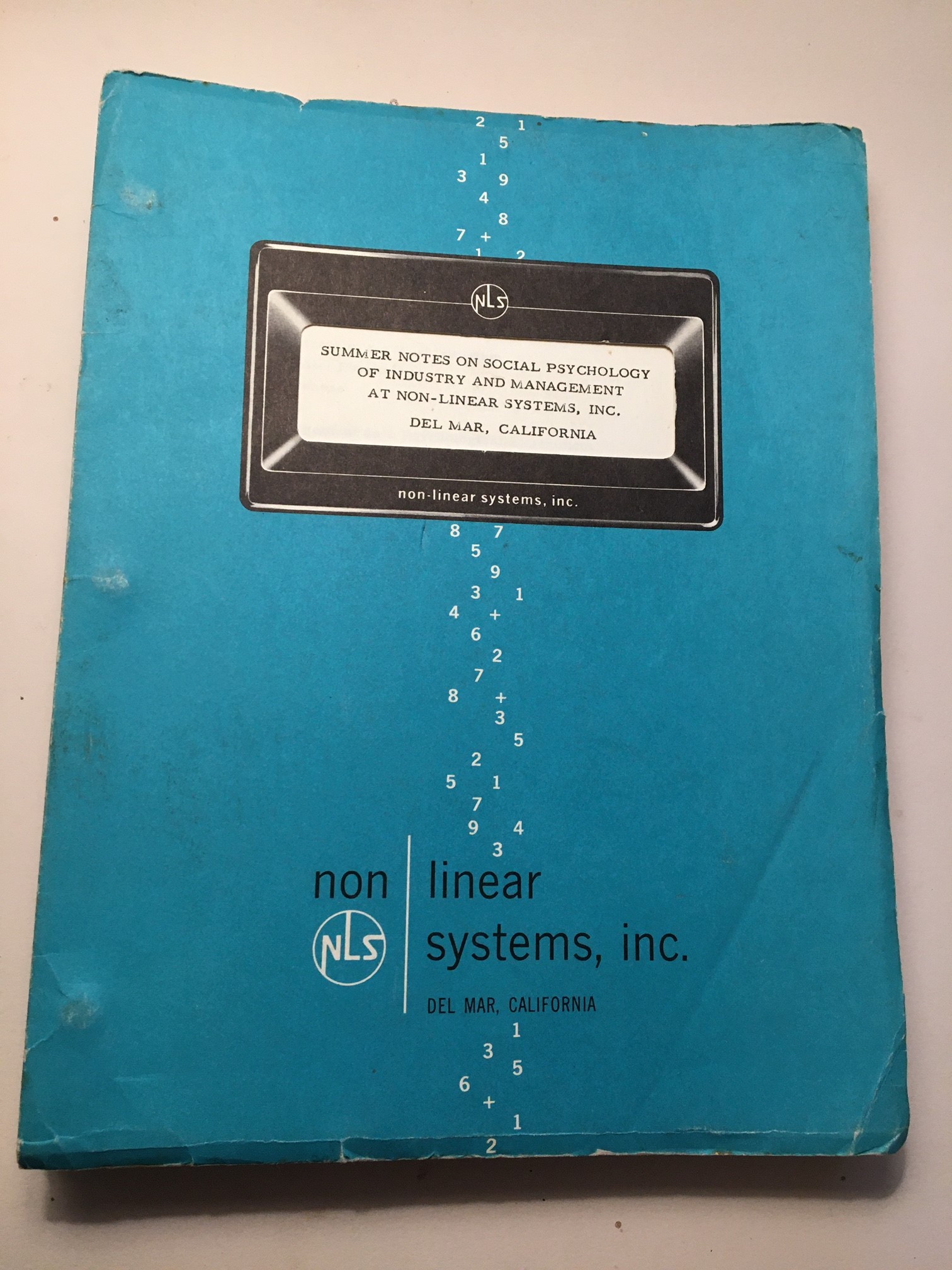
    Maslow _1_MASLOW, Abraham.  Summer Notes on Social Psychology of Industry and Management at Non-Linear Systems, Inc, Del Mar, California.  Published by Non-Linear Systems, 1962. 11.5×8″ 148 leaves.  (This is misleading: the pages are single spaced and have 50+ lines/page with 15+words/line, making this document about 100,000 words, or more along the lines of a 250pp book.) 1500.00

    Three-ring holed held together with brass holders, with thickish NLS wrappers.  Very good copy.  

    WorldCat/OCLC identifies 12 locations for the work–however, I cannot identify a paper copy, as they all may be electronic copies.  For example, St. Andrews, San Diego, and McGill (my school) identify their copies explicitly as e-books; and then the obvious ones are Google, Hathi Trust, and UC Mass Digitalization. Then there are three (like U New Mexico) where when you go to the school’s records the OCLC number is “not found” or “your OCLC number would be here” but isn’t.  The remaining three are inconclusive.  Obviously someone has an original somewhere, but I’m not sure where that is.  The OCLC 12 is therefore misleading.  At best there are three cases where maybe-but-probably-not the libraries have a paper copy. I’d say conservatively that the OCLC number is three, but it may actually be one.  

    This is an interesting document by a major psychology name poking around in a new field. I reproduce the author’s statement in (nearly) full because it tell exactly what Maslow was doing. 

    “I had never before had any contact with industrial or managerial psychology, so the possibilities for psychological theory hit me with great force as I read first the books by Drucker and McGregor that are used as “textbooks” at Non-Linear, and as I began to understand what Andrew Kay was trying to do there.I started dictating my impressions to the tape recorder. They are mimeographed here without editing, addition, subtraction, or other change, beyond correction of typographical and grammatical errors, to be passed out to my friends for discussion, because I don’t know if they will ever be published more formally.”

    “I have been told by enough people that they are interesting and useful to make me
    agree to this informal kind of communication. They should be understood as first impressions, unformed, not further worked up, of a theoretical psychologist taking his first look at a new (for him) field of knowledge and realizing that it was of great import for various of his theoretical concerns (and vice versa). I have learned in other contexts that the novice can often see things that the expert overlooks through long familiarization.”

    ·Posted by :

    ·in:

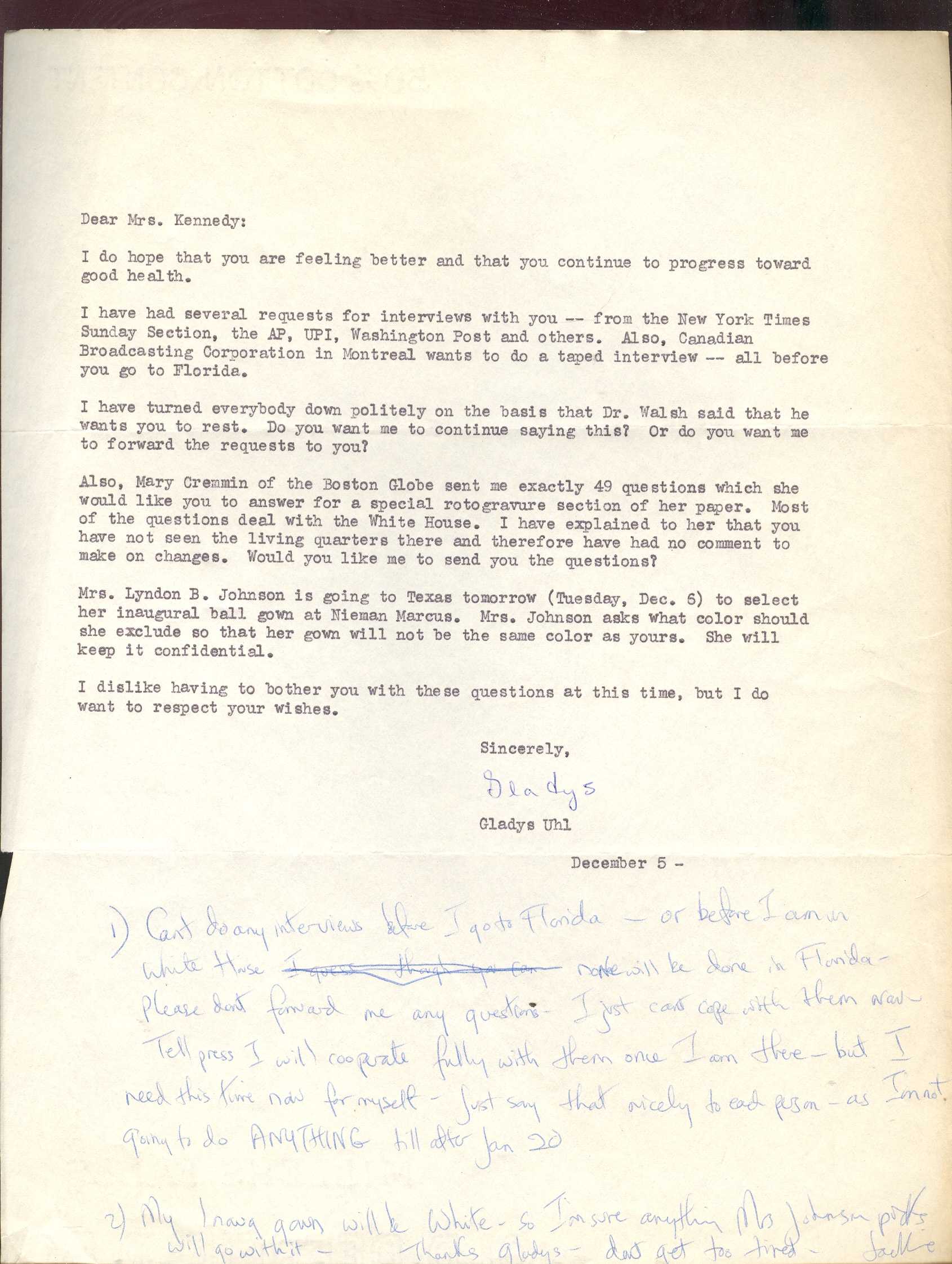
  • Jacqueline Kennedy Letter from Georgetown University Hospital, 5 December 1960

    Typed and ALs, Jacqueline Kennedy writing from the hospital, 5 December 1960.

    Date: 5 December 1960

    Pages and Size: 11”x 8.5”

    Rarity or scarcity: unique

    Provenance: from the estate of Gladys Beauchamp, press secretary to Mrs. Kennedy, 1960.

    Price: Hold

    Condition:  VG condition, with two old horizontal folds and a couple of very light old vertical fold impressions. There is also a tiny 3mm tear along the bottom left horizontal fold. (Condition grading is compared to the condition of the publication when it was new;  to give a condition quote that states “good for its age” comparing something to a fluid state without a common denominator is almost without value, so the publication is compared to its condition when it was first published.)

    The images I’ve included here accentuate the old folds–in “real life” (so to speak) the letter is nicer looking than in the scan.  (Better to be pleasantly surprised than the opposite.)  

    This is a typed letter written to Jackie Kennedy from her press secretary, Gladys Beauchamp, in December 1960. This is the period following John Kennedy’s election (3 November) and the birth of their son John Kennedy Jr. (25 November, 1960). Mrs. Kennedy was in Georgetown University Hospital from (at least) 25 Nov to her release on either 9 or 10 December following a difficulty and Cesarean delivery; the family left for Florida that day. Ms. Beauchamp reiterates that one of Mrs. Kennedy’s doctors—Dr. Walsh—wants her to rest.

    Ms. Beauchamp runs interference for Mrs. Kennedy, shielding her from inquiries and requests from correspondents and reporters for interviews and to respond to submitted questions. She does need to be clear that Mrs. Kennedy wants no interference from the media.  

    To Ms. Beauchamps’ letter Mrs. Kennedy sends her handwritten responses at the bottom of the letter:

    Mrs.. Kennedy’s response:

    • “Can’t do any interviews before I get to Florida—or before I am in White House. None will be done in Florida. Please don’t forward more any questions. I just can’t cope with them now—Tell press I will cooperate fully with them once I am there—but I need this time for myself. Just say that very nicely to each person—as I am no doing ANYTHING till after Jan 20.

    [And in response to a query about possible clashes between her inaugural gown and Lady Bird Johnson:]

    • “My Inaug gown will be White—so I’m sure that anything Mrs. Johnson (wears?) will go with it. Thanks Gladys. Don’t get too tired. Jackie”  

    Certainly Mrs. Kennedy wasn’t feeling up to the images that were portrayed of her leaving the hospital–she was clearly not well. 

    Kennedy in hospital


    ·Posted by :

    ·in:

  • A Classic in Climatology and the History of Climate Change (1920)

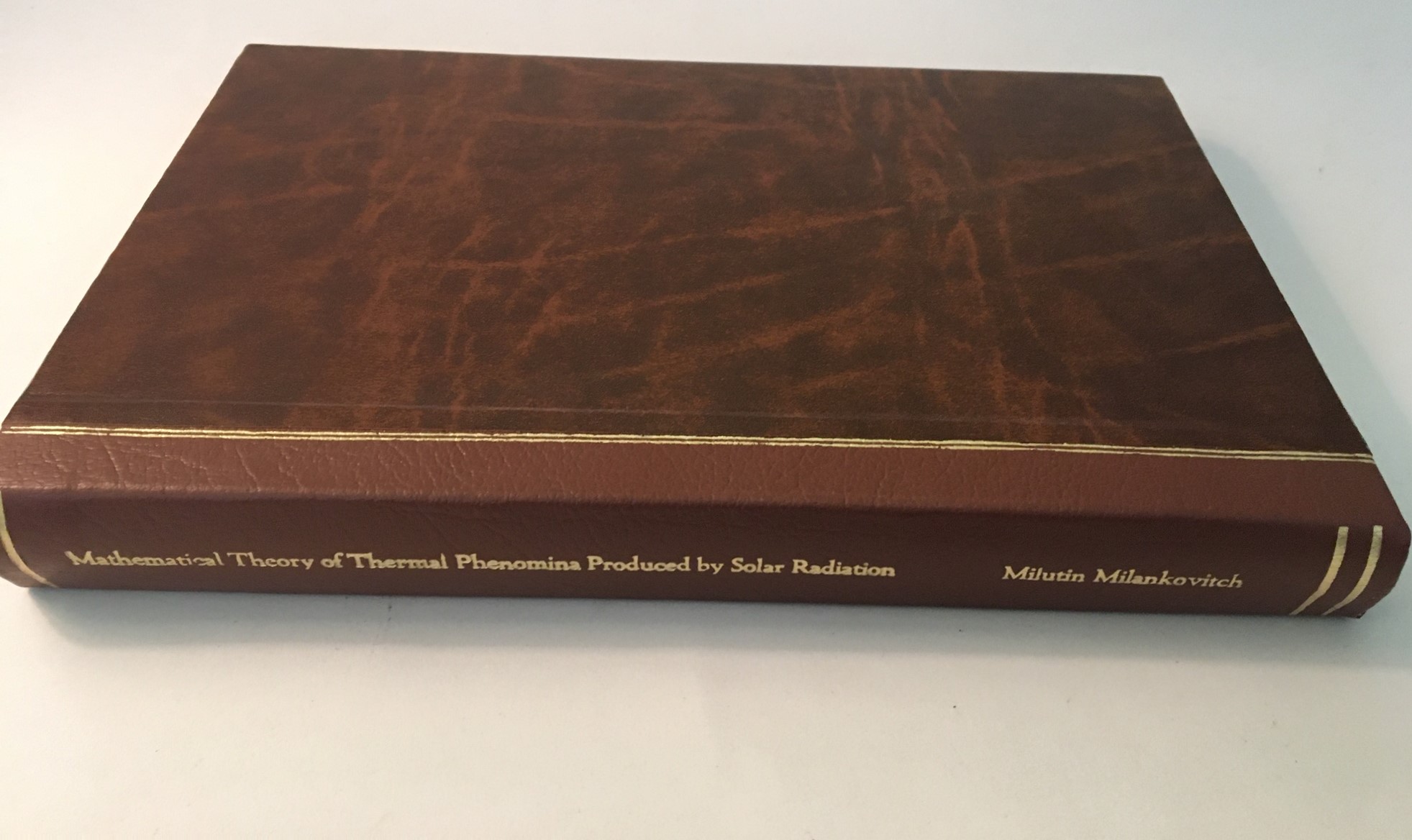
    Milutin Milankovitch. Théorie mathématique des phénomènes thermiques produits par la radiation solaire. (Mathematical theory of thermic phenomena caused by solar radiations.) SOLD

    Paris, Gauthier-Villaras, 1920. 9.5x 6.5”; xii, 338, (1)pp.

    Classic Gauthier -Villars publication, which is too big and heavy for the perfect binding—this volume has a slight crack in the spine middle from having been read (or opened many times). There is also a thin piece of rear cover missing at edge (about 1/4”x 2”). That said, still a near-Fine copy.

    Housed in a custom pamphlet case (of similar materials as the custom box housing the 1941 document, made by the same bookbinder), which is in as-new condition.

    “Milankovitch revolutionized the understanding of climate dynamics. He put the astronomical theory of climate on a firm mathematical basis and founded cosmic climatology by calculating the temperature conditions on planets of the inner solar system, and the depth of the atmosphere of the outer planets. In particular he calculated the impact of Earth’s secular orbital cycles on climate changes and explained the origin of the Pleistocene ice ages. The perennial periodic orbital variations (eccentricity, obliquity, precession) considered in his canon of insolation, along with their influence on planets’ climates, today are called Milankovitch cycles.”

    “(In this work) he resolved the problem of thermodynamics of inner planets of the solar system and attained the first reliable predictions about the present climates of Mercury, Venus, Mars, and the Moon, generally still valid, with the exception of Venus. After 1920, when cooperation with Wladimir Köppen and Alfred Wegener began, Milankovitch turned his attention exclusively to Earth’s climate, specifically the problem of ice ages. His primary focus was the insolation of Earth in the last six hundred thousand years at middle latitudes. The best-known result of the work was the “Curve of Insolation,” first published in 1924, in Köppen and Wegener’s book Die Klimate der geologischen Vorzeit. Being coincident with contemporary dating of four Alpine glacial periods, determined fifteen years earlier by Albrecht Penck and Eduard Brückner, the curve soon became widely accepted as a geological calendar for calibrating the paleoclimatological timescale.”–Complete Dictionary of Scientific Biography online

    “He formulated a precise, numerical climatological model with the capacity for reconstruction of the past and prediction of the future, and established the astronomical theory of climate as a generalized mathematical theory of insolation. When these most important problems of the theory were solved, and a firm foundation for further work built, Milanković finished a book which was published in 1920, by the Gauthier-Villars in Paris under the title “Théorie mathématique des phénomènes thermiques produits par la radiation solaire” (Mathematical Theory of Heat Phenomena Produced by Solar Radiation). Immediately after the publication of this book in 1920, meteorologists recognized it as a significant contribution to the study of contemporary climate.”–Milankovitch wikipedia entry

    “When Milankovitch received printed copies of his book from his Paris publisher, he sent one sample to Vladimir Köppen. Köppen (“…a principal founder of modern meteorology and climatology”-DSB) was so impressed by Milankoviitch’s introduction of advanced mathematics into Earth sciences that he immediately wrote him a postcard, stating, “I am impressed by the abundance of reason and clarity in your interpretation, and I am truly grateful for this precious gift…” (Köppen’s letter to Milankovitch) 1921; Milankovitch 1997, 474).

    “The father of paleoclimates”–Berger, “Milankovitch, pere de la theorie astronomiques des paleoclimats”, Theorie et Mesure, 1988, p 385.

    • There are two interesting review of this work in English published in 1923: Bulletin of the AMS by PJ Daniel, August 1923; and Nature 112, August 1923, pp 160-161.


    MM_4_

    ·Posted by :

    ·in:

  • RARE Work on the History of the 2nd Division, USAEF 1917-1918

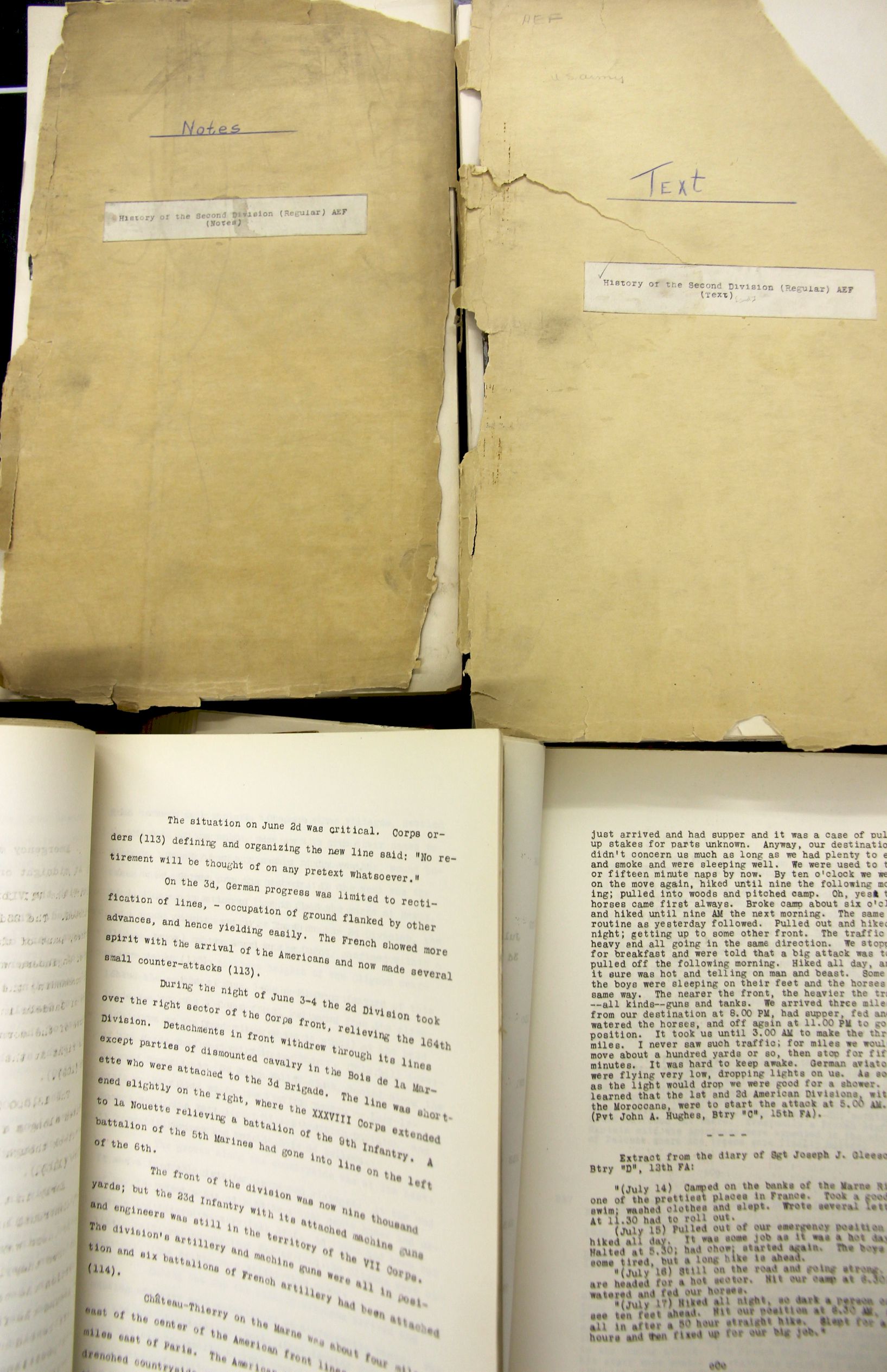
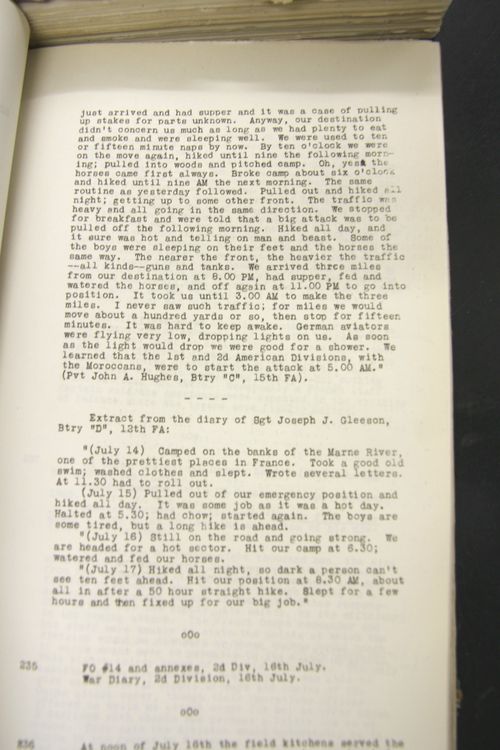
    (Colonel Oliver Lyman Spaulding and Colonel John Womack Wright.) History of the Second Division (Regular) AEF. 1936. 2 volumes, 35cm. 282 leaves+157 leaves (printed on one side only). Offset printed/mimeo printed (?), two-hole punched with metal clasps. Simple plain manila wrappers which are detached and very chipped.  $750

    This is the original version of this publication, with no mention of authors or printer. I’ve determined the book was based on the two authors listed above under the title “The Second Division, American expeditionary force in France, 1917-1919”, published in New York, by the Historical Committee, Second Division Association, The Hillman press, inc., 1937. There is a version of this online at Hathi Trust, and the two are the same.

    Second division _1_

    The published version appeared so: 2 p. l., iv, 412 p. front., illus., 6 port. on 1 pl. 24 cm. There are no illustrations or maps in the preliminary version offered here, though there is a call for illustrations and maps “to follow”. This is copyrighted by Maj. General Preston Brown (1872-1948), CoS 2nd Infantry (April-Swept 1918), CoS IV Corps, Commander 3rd Division.

    RARE. This preliminary version—printed a year before the published version appeared—is NOT LOCATED in WorldCat.

    Second Division _2_

    ·Posted by :

    ·in:

    —
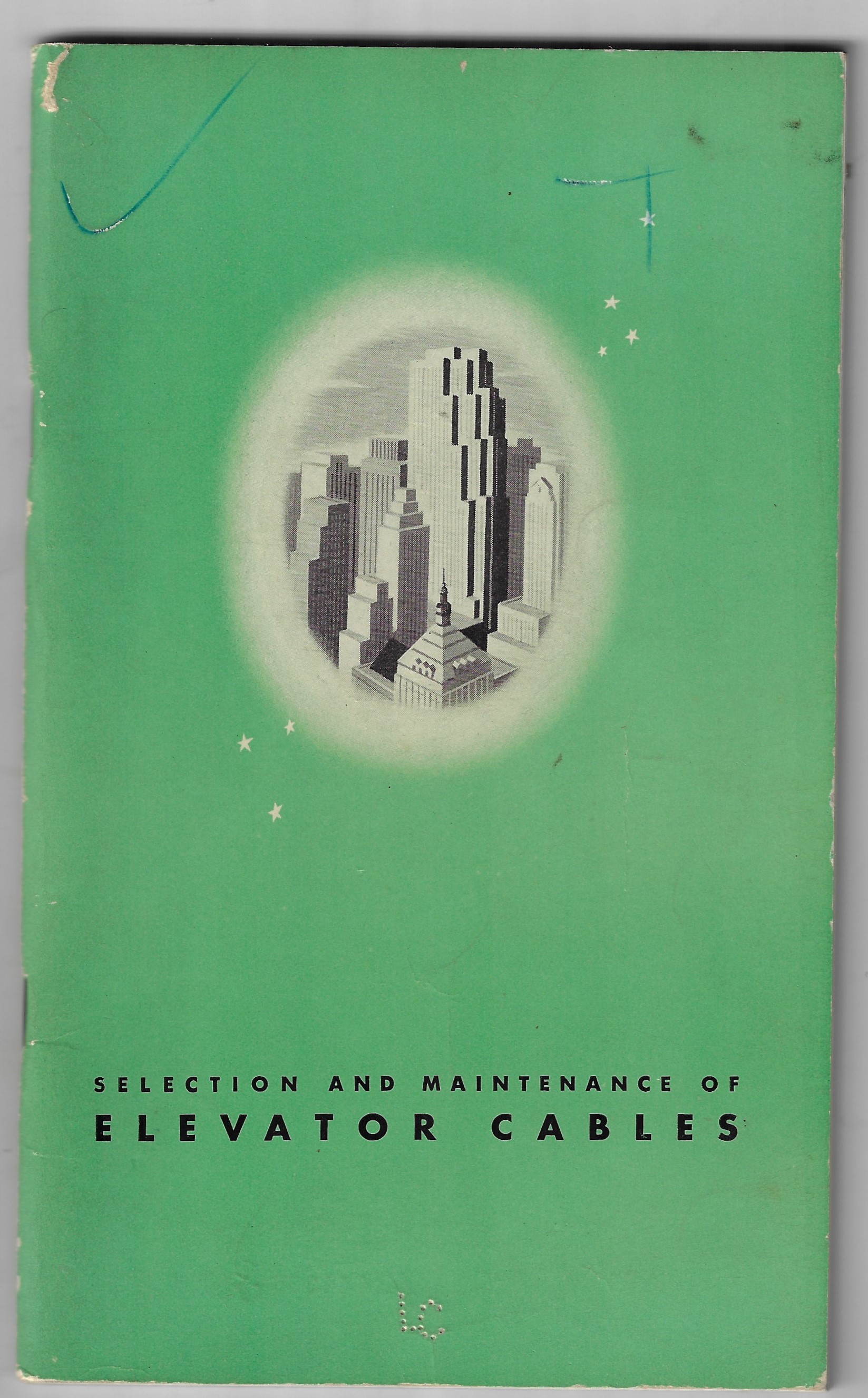
  • Elevator Cables, 1943

    Elevator cables _1_Selection and Maintenance of Elevator Cables.  American Chain and Cable Company, Bridgeport, Ct., 1943.  8″x 5″, 64pp. Original (thick) wrappers. Very nicely designed. Provenance: Library of Congress, with their 10mm “LC” perforated stamp on bottom center front wrapper and their rubber stamp surplus on page 3.  

    Scarce. NO copies located in WorldCat. 

    $175

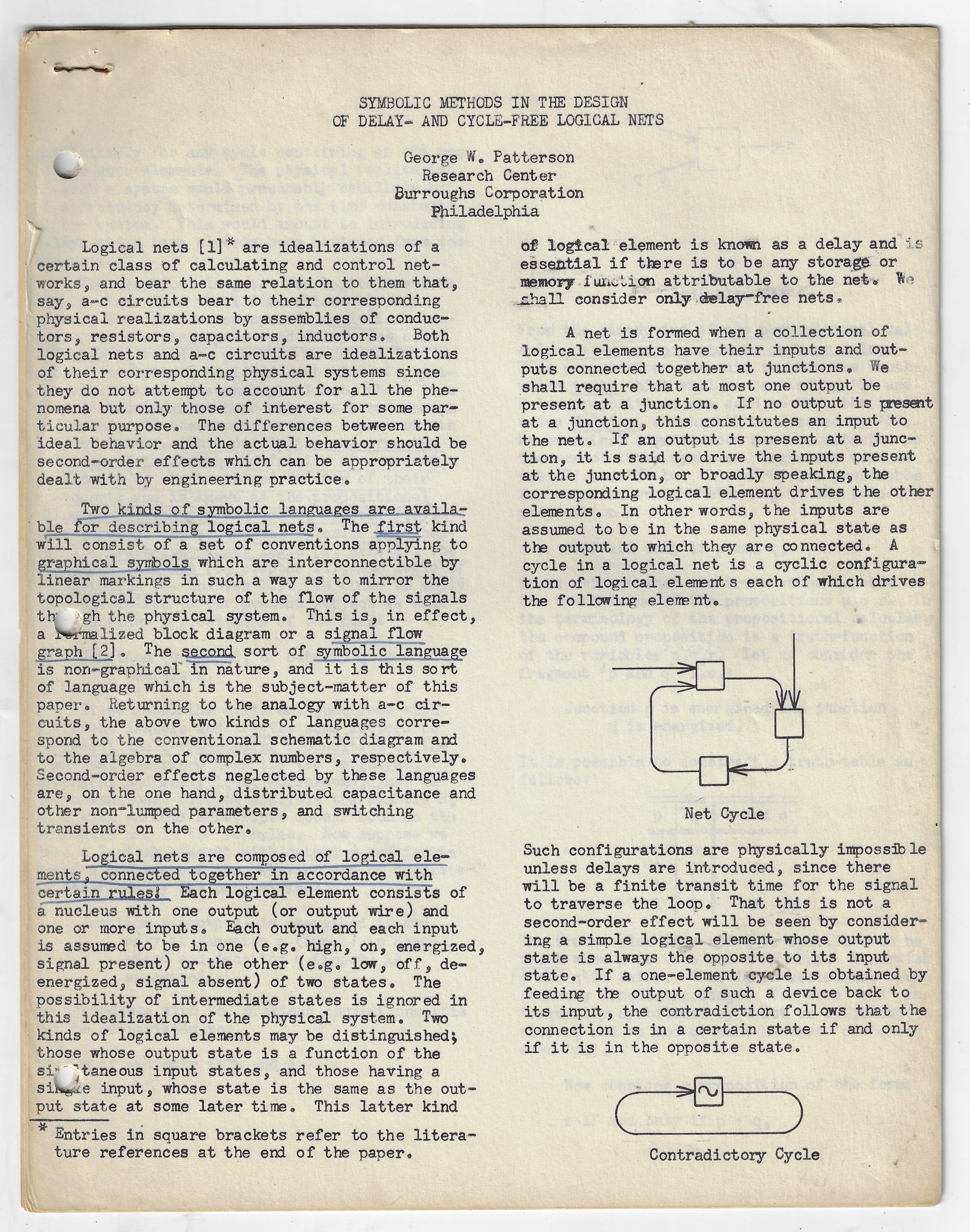
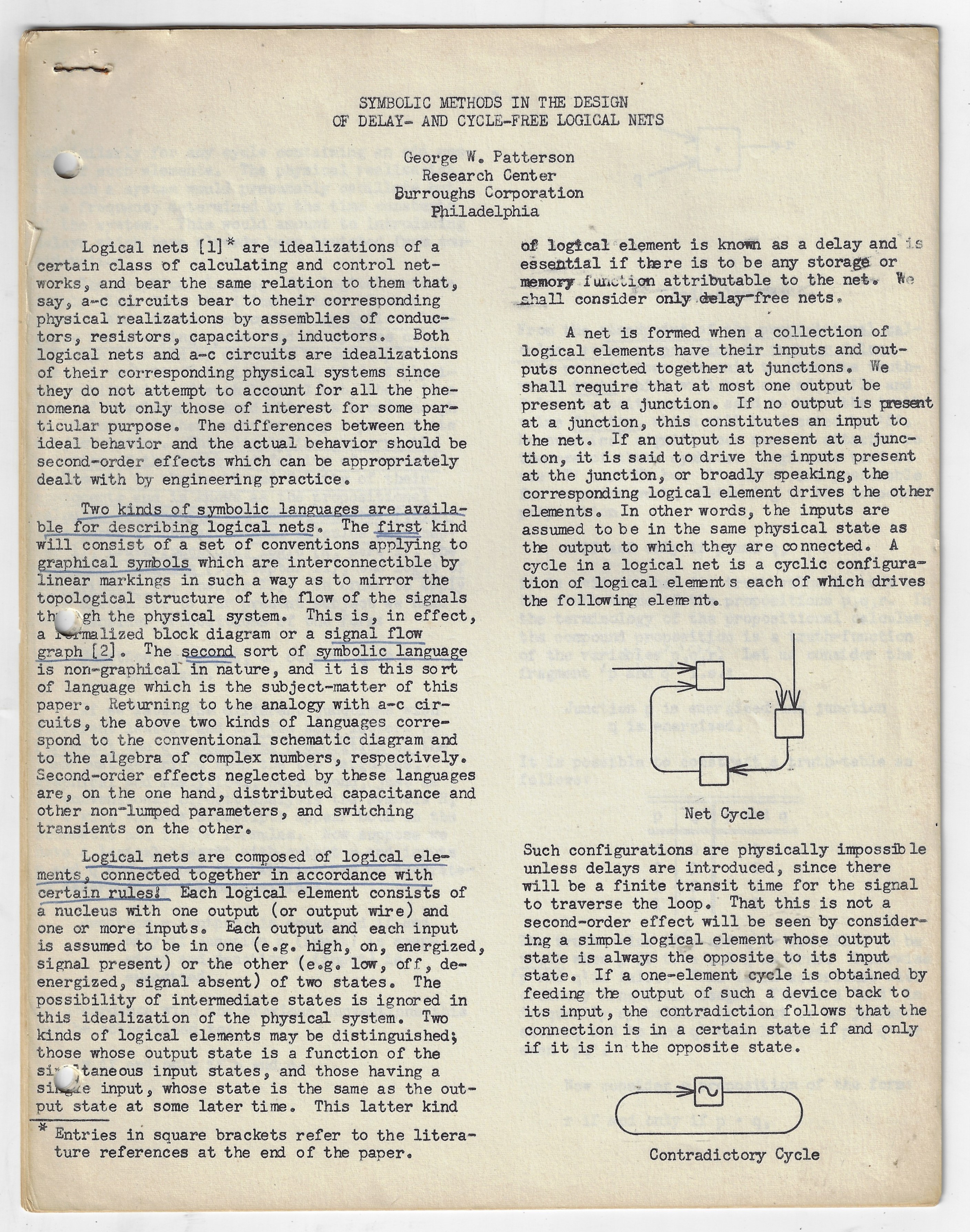
  • Patterson George Symbolic Methods In The Design Of Delay And Cycle Free Logical Nets Research Center Burroughs C


    Patterson GeorgePatterson, George. “Symbolic methods in the design of delay- and cycle-free logical nets.”

    Research Center, Burroughs Corporation, Philadelphia (1954). 11”x 8.5”. 9 leaves. Punch-bound for three-hole binder. Stapled. There is some underlining in ink in the first three pages, otherwise this is a very nice copy. $300

    “George W. Patterson (IRE J, 1931; Associate, 1949; Senior Member, 1954; and Fellow, 1959) was born in Rochester, New York, on 6 May 1912. He received the B.S.E.E. degree from the University of Vermont in Burlington, in 1934; the M.A. degree in physics from Columbia University in New York City, in 1936; and the Ph.D. degree in mathematics from the University of Pennsylvania, in Philadelphia, in 1958.”

    “In 1946, Patterson joined the staff of the Moore School of Electrical Engineering of the University of Pennsylvania, where he designed the logic for EDVAC arithmetic circuits and coordinated the logic design for the entire machine. From 1950 to 1955, Patterson was with the Research Center of the Burroughs Corporation, Paoli, Pennsylvania. Then he rejoined the faculty of the Moore School. In 1962, he was Associate Professor and Section Head for the systems logic research at the Moore School.

    “In addition to teaching and directing research on switching theory, Patterson was active in computer standardization, as a member of the Electronic Computers Committee beginning in 1949, and serving as Vice Chairman in 1962. He was also a member of the ACM committee that wrote the first programming glossary, and a member of the ASA Y32-14 task group that developed standards for computer logic systems”–Wikipedia, Engineering and Technology

    ·Posted by :

    ·in:

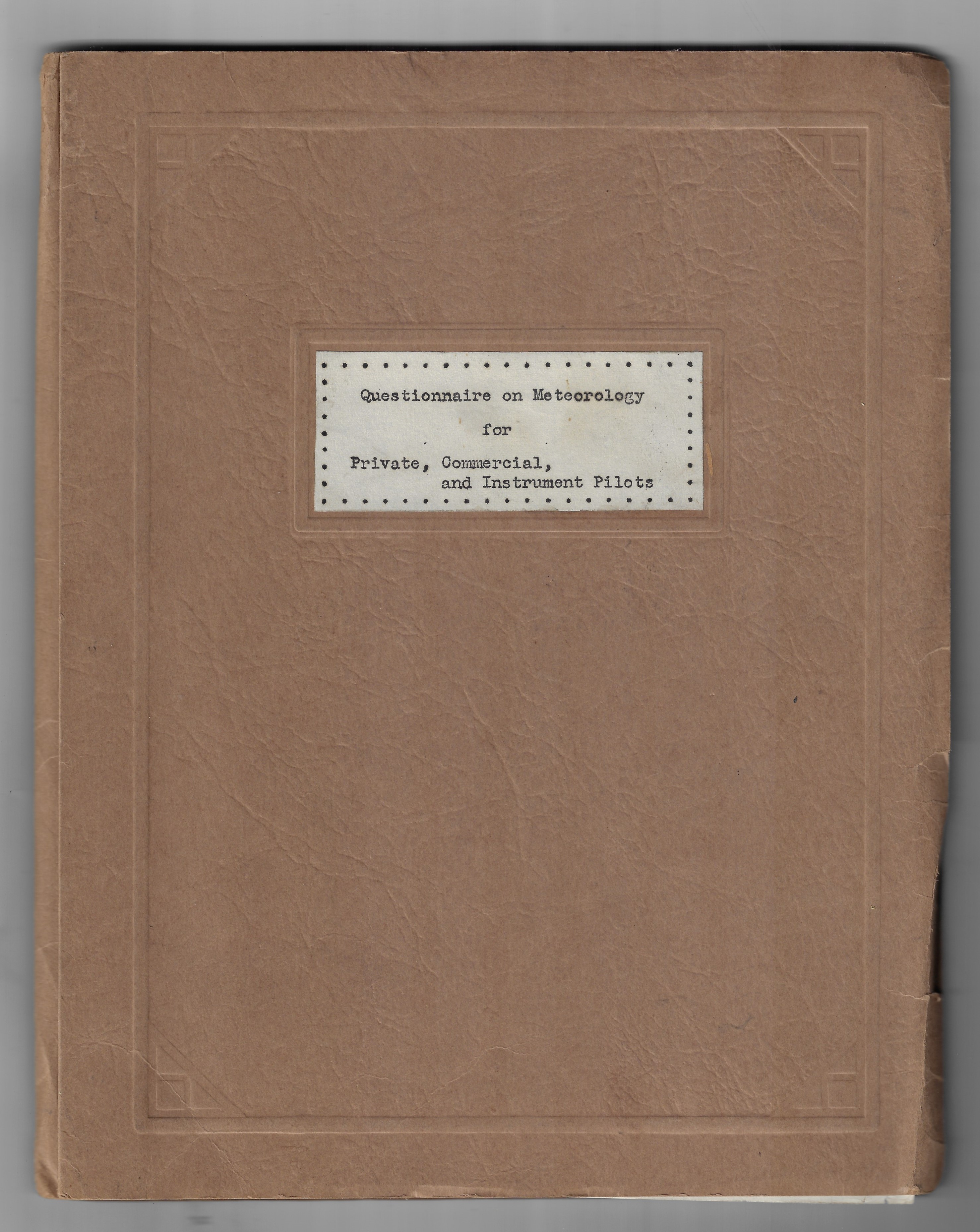
  • Rare Work on Aviation and Meteorology–No Record in WorldCat


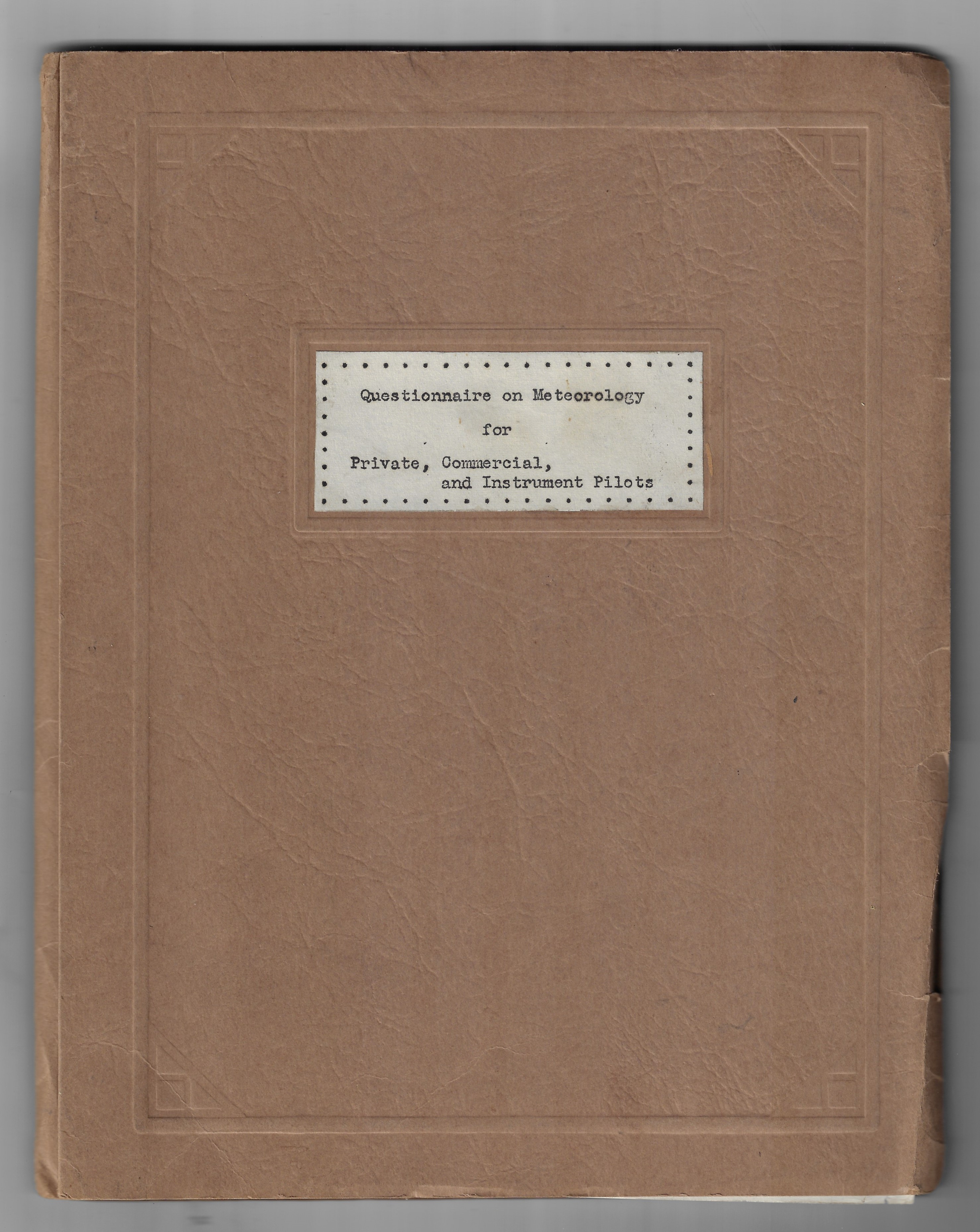
    Questionnaire meteorologyClyde H. Long, Questionnaire on Meteorology for Private, Commercial and Instrument Pilots.  Published by the Flying “L” Aero Service, Bailey, Colorado.  December 1, 1951.  11″x 8.5″, 56 leaves, printed on one side only.  Offset printed, and probably a private production.  Bound in a store-bough folder with a typed paper title.  VG copy. Provenance: Library of Congress, with their rubber stamp on inside front cover.  NO COPIES listed in WorldCat.  $150

    There are 250 multiple choice questions here for study and exam (with answers!)  These are NOT trivial questions.  

Recent Posts

Archives

Categories