A Daily History of Holes, Dots, Lines, Science, History, Math, Physics, Art, the Unintentional Absurd, Architecture, Maps, Data Visualization, Blank and Missing Things, and so on. |1.6 million words, 7500 images, 4.9 million hits| Press & appearances in The Times, Le Figaro, Mensa, The Economist, The Guardian, Discovery News, Slate, Le Monde, Sci American Blogs, Le Pont, and many othr places… 5000+ total posts since 2008.

  • A Copy of a “Never Published” Work on Steamboats (1940)

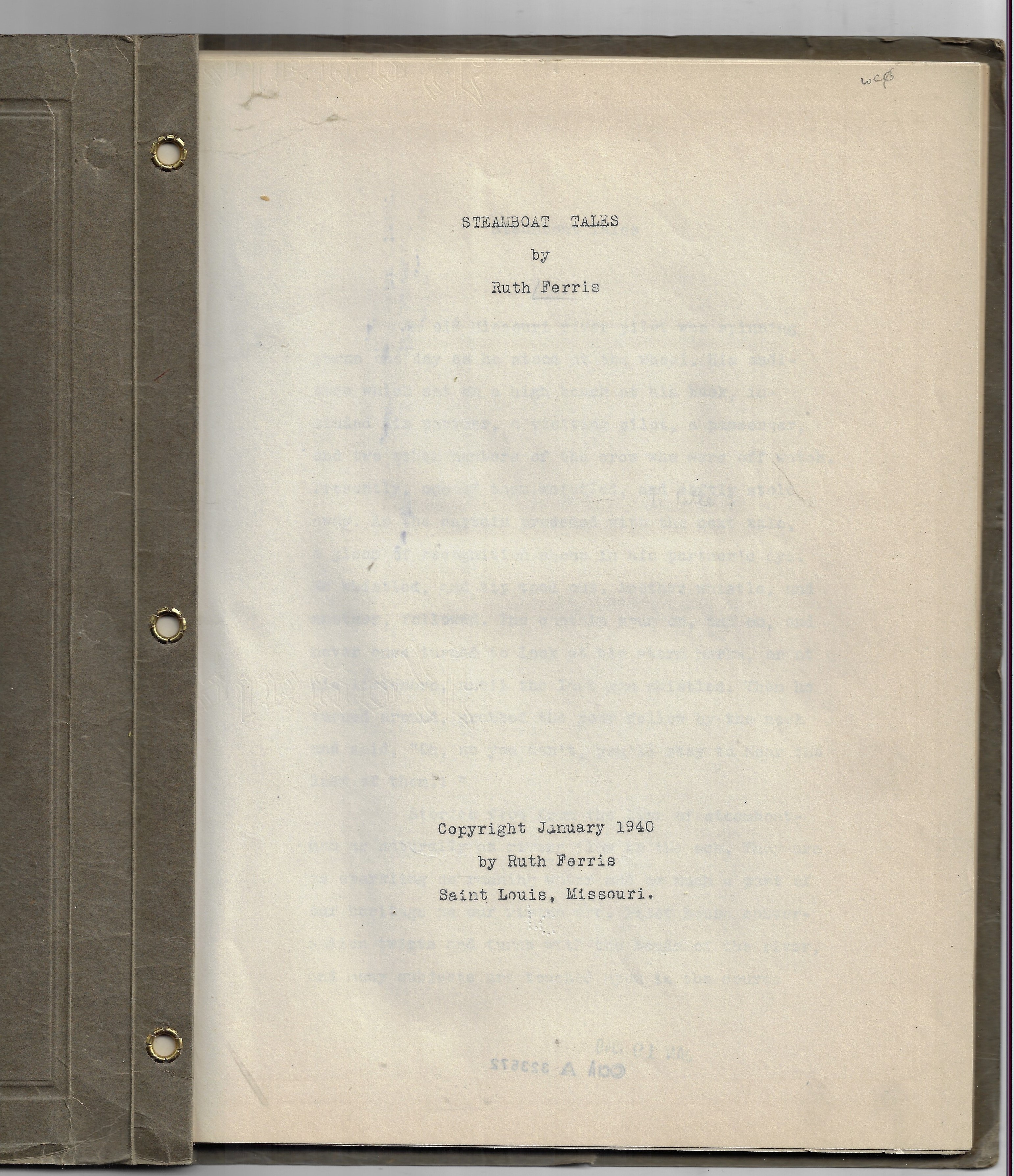
    Ferriss steamboatRuth Ferris, Steamboat Tales. Saint Louis, Missouri, 1940. Offset, privately printed. 11”x 8.5”, 38 lvs. $250

    “Ruth Ferris was one of the nation’s best known collectors of steamboat objects and history.” She was the first curator of the Missouri Historical Society’s River Room, and her writing “represent(s) a history of St. Louis during the golden age of steamboats”.

    It is noted that the work being sold here, “Steamboat Tales”, was never published before being included in “St. Louis and the Mighty Mississippi in the Steamboat Age: The Collected Writings of Ruth Ferris”, published by the St. Louis Mercantile Library in 1993, which is also the source of the preceding quotes. Very good condition, bound in a store-bought manila folder, punch bound. Provenance: Library of Congress, with their 10mm perforated “LC” stamp in the title page, plus their surplus rubber stamp on the rear cover. Also comes with a carbon copy library card of the original LC library card catalog card.

    WorldCat locates 0 copies.


    ·Posted by :

    ·in:

  • Wwii Jewish Refugees 1939 Interview With Two German Refugees A Neighborhood Guild Broadcast From Wjjd1130 Kilo

    German refugees _cvr_(WWII Jewish Refugees, 1939).

    “Interview with Two German Refugees.” A Neighborhood Guild Broadcast from WJJD—1130 kilocycles, Sunday February 26, 1939, conducted by Charles Copeland Smith. Chicago, Illinois.

    11”x 8.5”, cover+6 leaves of printed interview. Provenance: U.S. Department of State.

    GOOD condition.  $150

    This is a radio interview conducted by Charles Copeland Smith in 1939 of two German refugees (Mrs. King and a Miss Greta King”) shortly before the fighting war begins later in the year.

    Four rubber stamps on the cover (see image); last leaf detached from the stapled binding.

    Why did the Kings leave Germany? Because they were Jews. The husband, Dr. King, lost his practice and privilege on April 1933. They outlined what was happening to Jews in general in Germany—the stormtroopers, the loss of life, imprisonment. Reports on some anti-Semitism in the US towards them

    By 1935 determined to leave, the end was in sight for the Jews.

    The April 1 1933 law that is mentioned I this interview refers to “The “Law for the Restoration of the Professional Civil Service”, the first official banishment of the Jewish people as menials, second-class citizens,  banning the Jews from government jobs. The Jews had already been established by the Nazis as being the cause for the loss of WWI, the debacle at Versailles, the ruination of German culture and mortal enemy of the Aryan German. Many hundreds of laws like this would be instituted over the coming few years, establishing the legality of the supposed inferior nature of the Jewish people.  (Also in July 1933 came the underpinning legislation of some future nasty thinking, Ernst Rudin’s “Law for the Prevention of Hereditarily Diseased Offspring”, which established health courts and compulsory abortion and sterilization for a variety of physical and hereditary traits found to be unacceptable for the promulgation of a superior German race.) And this is all before the Nuremberg Laws of 1935/1936, (specifically the “Reich Citizenship Law” 1936)  which basically established the fate of the Jews, removing their citizenship and making them “subjects of the state”. Do I really need reiterate the case for the Nazi subjugation of the Jews, and their making the social and legal basis for the coming extermination policies which were codified at Wansee in 1942?  I think not–though it seems to me that for whatever reason the Smiths decided to not utilize this already well established (even by 1939) information. I think that at the very least they did not want to know.”

    ·Posted by :

    ·in:

  • Rare First-Hand Account of the Japanese Surrender in Tokyo and the Philippines (1945)


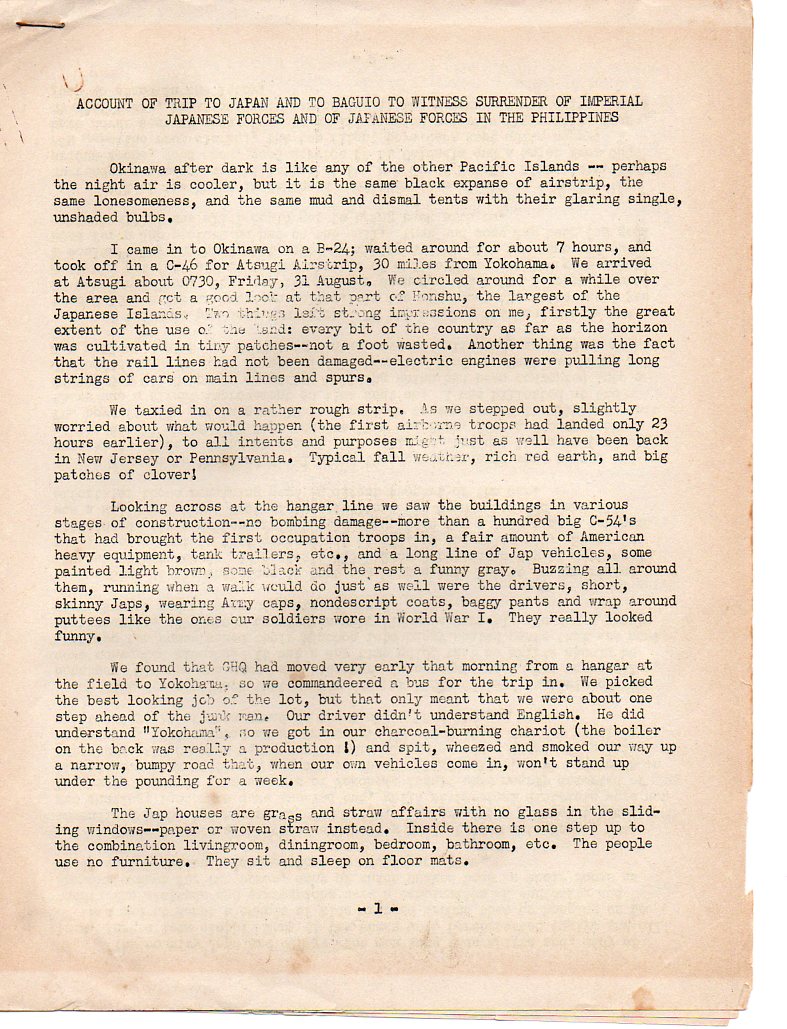
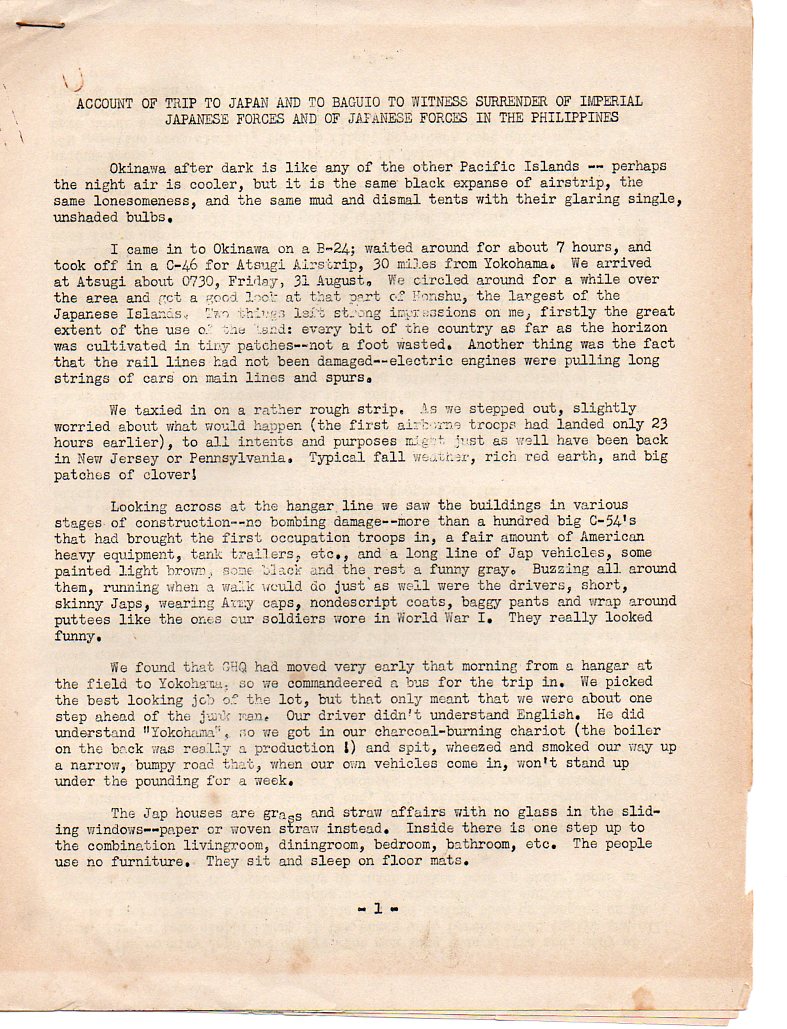
    Deglin _1_Deglin, Lt. Col T(heodore) .L.  (“PRO AFWESPAC”, Public Relations Officer, Armed Fores Western Pacific, Phillippines). Account of a Trip to Japan and to Baguio to Witness Surrender of Imperial Japanese Forces and of Japanese Forces in the Philippines. 1945  5pp.  Very good condition.  $950

    After serving as public relations director for Madison Square Garden (1935-1942), T.L. Deglin became a Lt. Col. in the U.S. Army (and later a full colonel) in a public relations capacity, finding himself a witness on 2 September 1945 to the Japanese surrender on the U.S.S. Missouri. He and his party then leaves immediately for Baguio (in the Philippines) to bear witness and report on the surrender of Japanese forces in the Philippines, including the arrest of the Beast of Manila, General Yamashita. What follows below is his five-page (1750 word) description of those events.  The report is an offset-printed production, so it did see some sort of distribution, but I can find no mention of it anywhere. 

    An example of Deglin’s reporting from the desk of the USS Missouri:

    • “General MacArthur is a terrific showman. Every move of his is dramatic and beautifully timed. He spoke briefly, then instructed the Jap foreign minister to sign for the emperor of Japan and the Japanese government. The skinny, bespectacled, top-hatted minister, Shigemitsu, limped forward, pulling his game leg after him. He sat down, facing MacArthur, and had trouble getting the leg under the table. He fiddled around, picked up a pen, put it down, looked at his watch, looked around, looked at his watch again until everyone was slightly nervous, and the general looked quite irritated. Frankly, I could think of only one thing: that a kamikaze plane was going to dive out of the clouds at this time and blow us all over Tokyo Bay. No such excitement, however; the old boy signed both copies of the surrender document and limped back to his position. Then General Umezu, chief of staff for the Imperial Japanese Army, signed quickly.”

    Here’s an example of Deglin’s reporting from Baguio:

    • “The conference room was set up with a long table. On one side were a dozen high, hand-carved chairs. On the other side were four wooden folding chairs. The newsreel cameras, still photographers, and radio broadcasters were all set up in their places. Then the Japs were brought in. They were led to the side of the table where the small chairs were and started to sit down but were instructed to remain standing. They were kept standing for nearly 10 minutes; then the top generals came in and sat down. After them came a group of 15 brigadier and major generals. Then the correspondents were herded in—about 35 of them.
      The ceremony was partially designed for the radio broadcast. The surrender document was read, Yamashita was asked if he understood the terms (an interpreter stood behind him), he answered “yes,” the documents (four copies) were signed, the generals filed out, and Yamashita was turned over to the MPs for delivery to New Bilibid Prison near Manila. Incidentally, when he left Baguio he wore a string of ribbons. Guess who has them now!

    ·Posted by :

    ·in:

  • Rare Document on Japanese Surrender in the Philippines (23 September 1945)

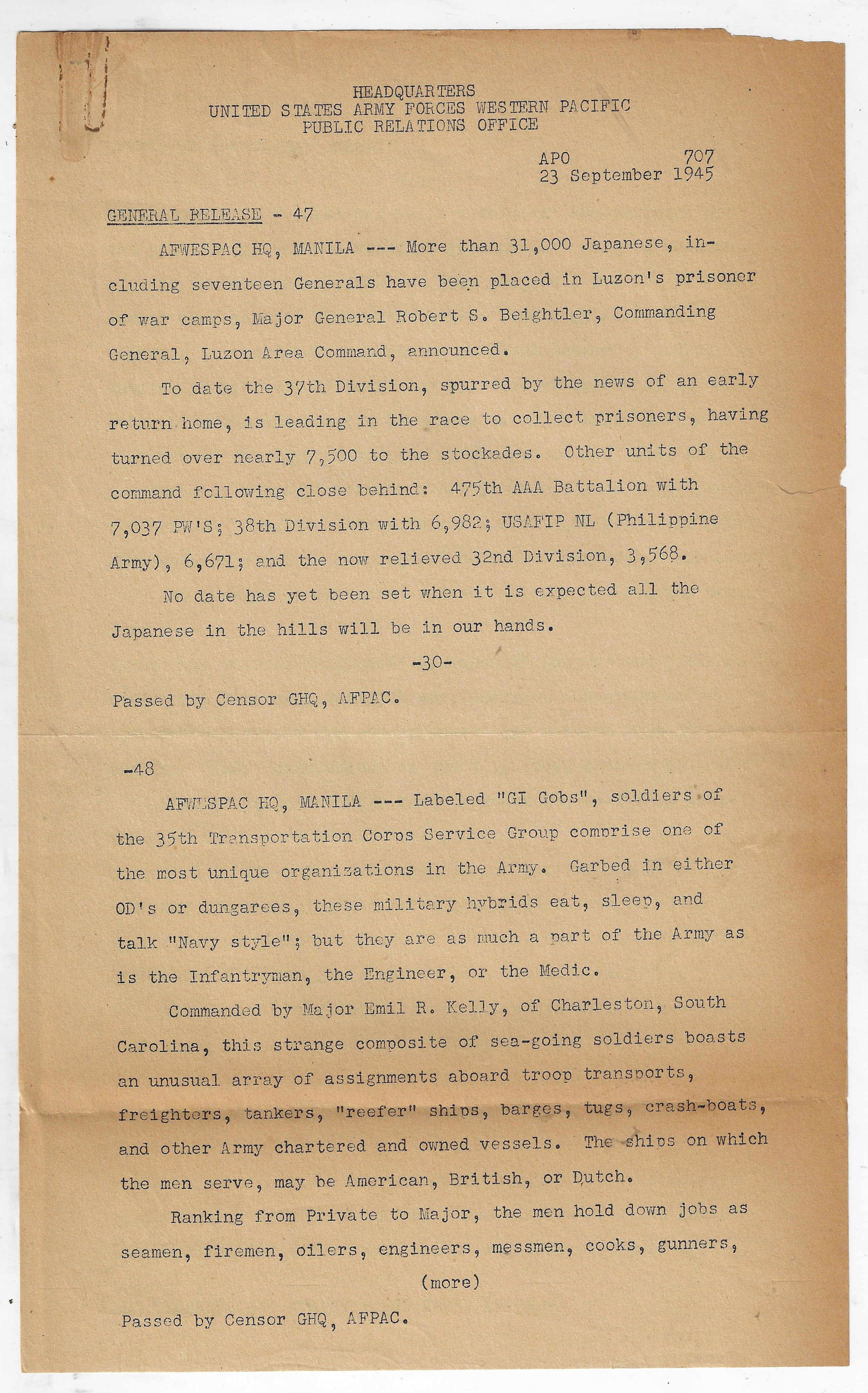
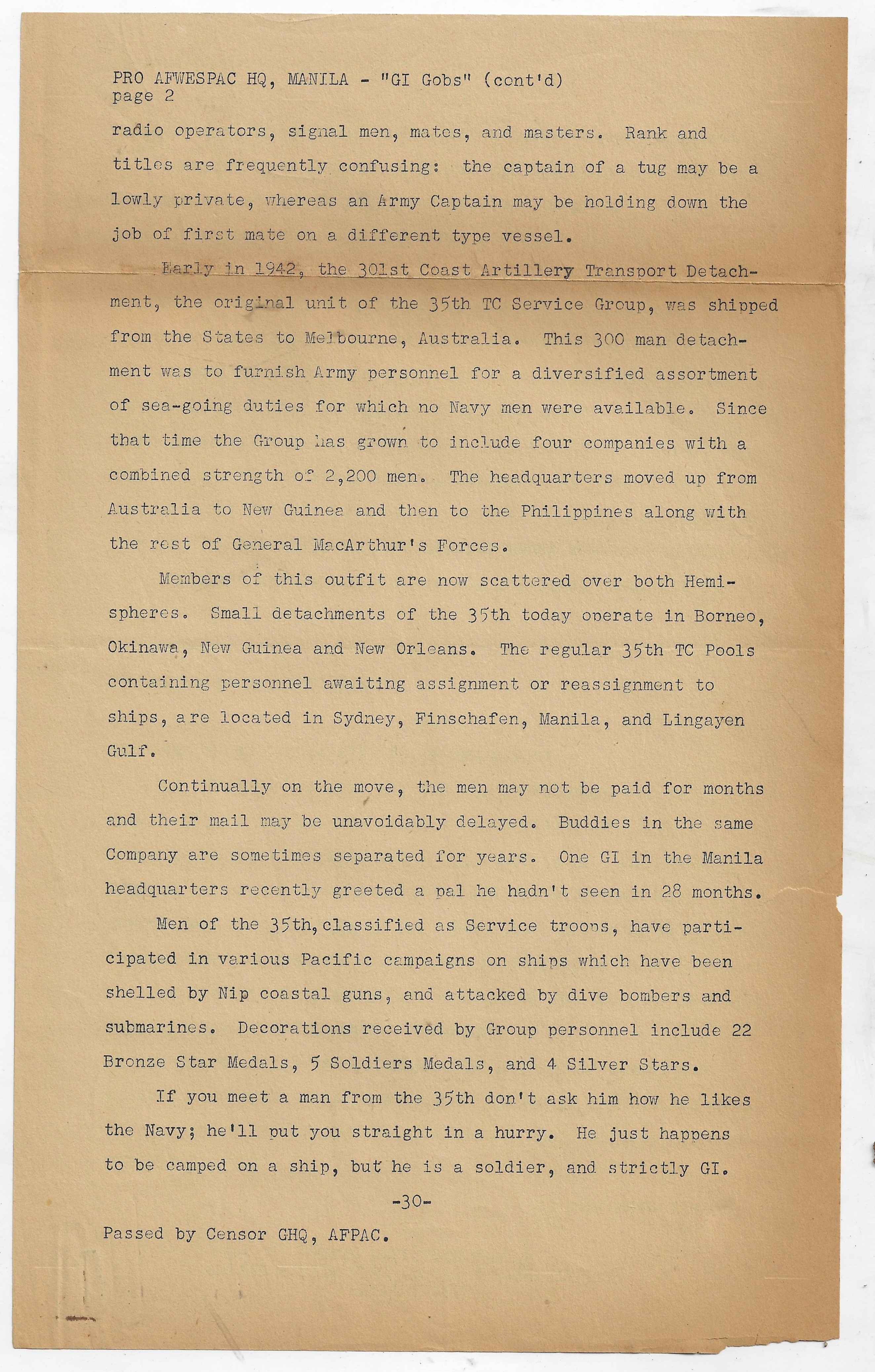
    Philippines 23 Sept 1945 “Headquarter / United States Army Forces Western Pacific / Public Relations Office / General Release – 47, APO 707, 23 September 1945”. Single sheet, offset on newspaper print. 13”x 8”, printed front and back. About 700 words. The entire document is reproduced here.

    GOOD condition, only. The document was printed on an inferior paper, which has browned and has become brittle along the edges. There is one old old (at bottom) and one short tear (at top side right). Rare. $500

    Even though WWII in the Pacific was ended on 15 August 1945 (or at least the surrender was initiated then) and the surrender papers signed aboard the USS Missouri in Tokyo Bay on 2 September 1945 (“VJ Day”), there were many elements of the Japanese Army that took weeks and in some cases months to actually lay down their weapons and submit. (There are some rare cases of individual soldiers lasting for years and decades past the surrender, refusing to give in, living their lives in remote places.)

    This document–“Headquarter / United States Army Forces Western Pacific / Public Relations Office / General Release – 47, APO 707, 23 September 1945”–released by the propaganda/public relations office of the U.S. Army Force Western Pacific, details some of the process of large forces of Japanese forces in the Philippines coming in to surrender. 

    Stating that 31,000 Japanese soldiers (and 17 generals) had already been placed under guard in Luzon’s POW camps, the three-paragraph document ends with this interesting statement:

    “No date has yet been set when it is expected all the Japanese in the hills will be in our hands.”


    Philippines 23 Sept 1945 _2_

    ·Posted by :

    ·in:

  • Early Work on Sound-on-Film Motion Pictures 1932

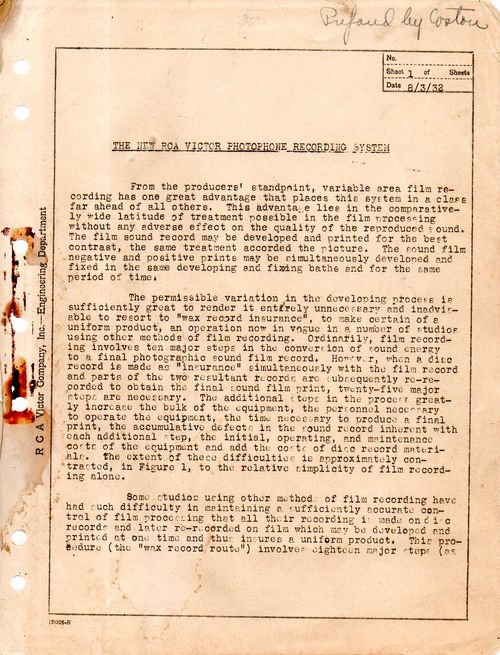
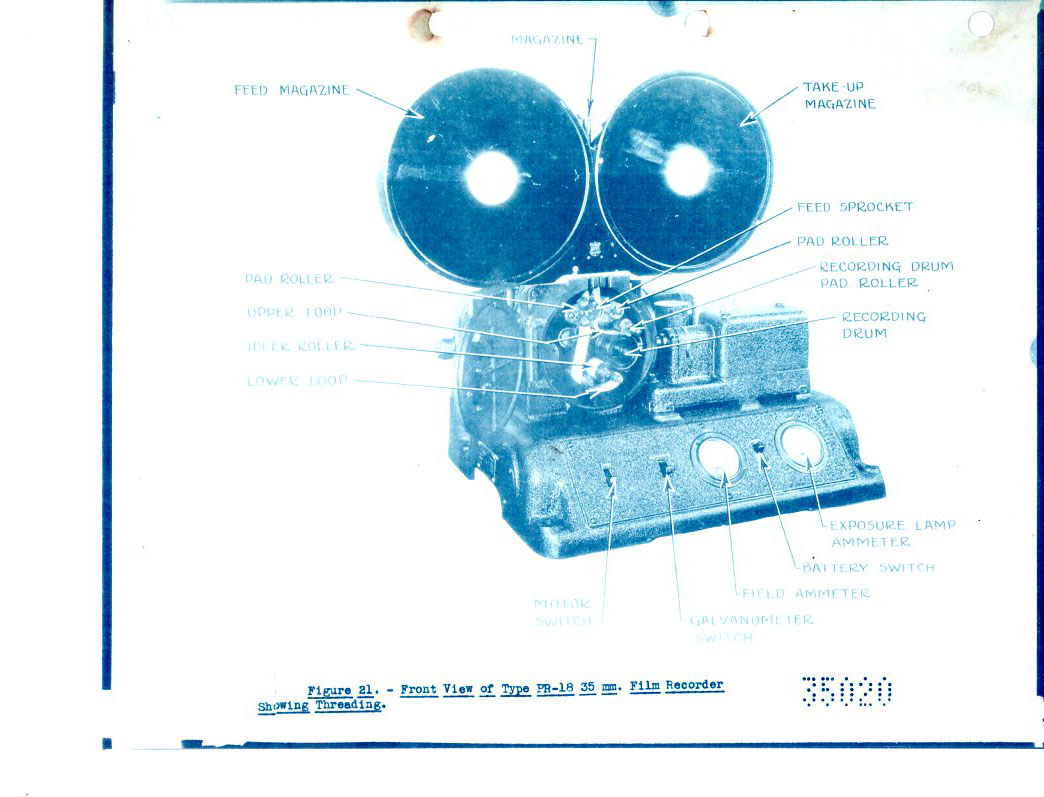
    SOund on film Photophone _1_The New RCA Victor Photophone Recording System. RCA Victory Company, 1932.  Internal RCA Document:  8vo, 45 typed mimeo leaves, with 26 pp of blue-line photographs and schematics of the  equipment.  Punch-bound at one time, though metallic binding element is not present.  Very good condition.   $3500 (1/3 to charity)

    This a sound-on-film incunable. This means the pamphlet was printed within the first few years of the first “talking”  (synchronized sound, or sound technologically coupled to image) motion picture. The first feature length film using sound throughout1 the length of the movie was The Jazz Singer, which was released in 1927 and used a sound-on-disc2 system of recording. That means that the audio portion of the film was recorded onto records, and then synchronized in playback with the film to match up the audio and video–this technology was obviously not the future.

    The technology of sound-on-film would take the day, and in very short order, leading to four different systems, of which the Photophone was one.  Photophone’s share of the prospective studio users was pretty good: the earliest major producers/licensees included Walt Disney Productions (after 1932), RKO Radio Pictures, Republic Pictures, Warner Borthers, and Pathe.

    ” From the producer’s standpoint, variable area film recording has one great advantage that places this system in a class far ahead of all others”.  

    And on the Film Phonograph Reproducing Equipment:  ”  the need for combining two or more sound tracks, the adding of sound effects to an original recording, or matching around levels of scenes in the final editing of a picture has brought re-recording into an increasingly important position in sound picture production”.

    The work is in general a technical report and sales pitch for the new system.  It includes the following sections:

    General introduction (1-7, 4 illustrations), the Ribbon Microphone (8-12, 3 illustrations); Microphone Distribution Panel, (13-14pp, 2 illustrations); Microphone Mixing Panel (15-17, 2 illustrations); Compensator Panel (18-21, 2 illustrations); Recording Amplifier (22-25pp, 2 illustrations); Ground Noise reduction Amplifier (28-30, 2 illustrations); 35mm Film Recorder (31-34, 2 illustrations); 16mm Film recorder (page 35, 2 illustrations); Film Phonograph Reproducing Equipment (36-39 pages, 2 illustrations); Phototube Amplifier (40-41pp, 1 illustration); 35mm to 16mm Film Re-recorder, 42-45pp, 2 illustrations). 

    Notes:

    1.  Earlier on in the mid-1920’s there were efforts of using sound in film but limited to music or very specific areas of the film, most of which in the end was silent. 

    2. The  movie was made with the Vitaphone system, which was not long for this world, soon to be replaced by the more sophisticated sound-on-film systems.

    “In 1925 GE started a program to develop commercial sound-on-film equipment based on Hoxie’s work. Unlike the Phonofilmand Movietone systems in which the audio modulated the intensity of a recording lamp which exposed the soundtrack, thus creating a variable-density track, the GE system employed a fast-acting mirror galvanometer to create a variable-area soundtrack. A number of demonstrations of this system, now known as Photophone, were given in 1926 and 1927. The first public screenings with this system were of a sound version (music plus sound effects only) of the silent film Wings which was exhibited as a road-show in around a dozen specially equipped theatres during 1927.”–Wiki

    SOund on film photophone _2_

    ·Posted by :

    ·in:

  • Early and Rare Work on Sound-on-Film Motion Pictures

    Photophone 1929 _3_Theatre Survey Instructions.  “Property of RCA PHOTOPHONE, INC. Its use is limited exclusively to authorized employees of RCA PHOTOPHONE, INC., and authorized employees of its associated companies.    Very good condition.  $3500 (1/3 to charity)

    “London Office, May-30-1929” 

    “Engineering Productions E.1-1.”

    10,5×8 inches, 6 typed carbon sheets.  

    “London Office, May-30-1929” 

    “Engineering Productions E.1-1.”

    10,5×8 inches, 6 carbon copy typed sheets.  Very good condition. 

    This is a short (but quite rare) document on operating the photophone (1929).

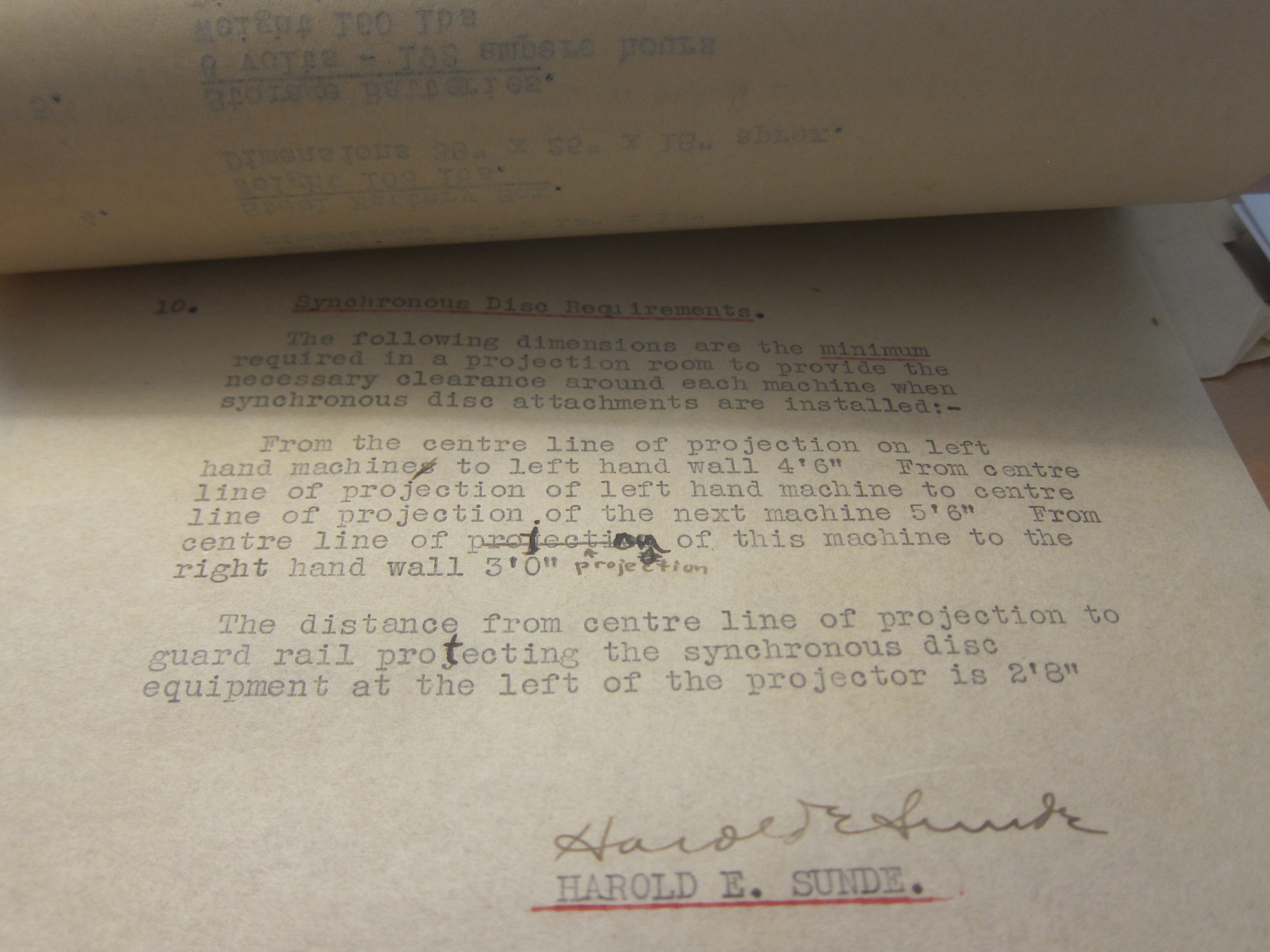
    Provenance: Harold E. Sunde, with his initials in pen at top left front cover, and signed by him on final page.  Sunde (1910-1990) was responsible for the explanation and demonstration of the RCA “Photophone” invention–one of the earliest simultaneous sound-on-film recorders and projectors, and introduced the machine to England and Russia, where true sound-on-film motion pictures were seen for the first time. He was also JHU APL, Sandia, Radiological Defense at Bureau of Ships, USAF). This document appears just a month or so before the showing of the first successful synchronized sound-on-film picture in England, A. Hitchcock’s “Blackmail”. This a sound-on-film incunable. This means the pamphlet was printed within the first few years of the first “talking”  (synchronized sound, or sound technologically coupled to image) motion picture. The first feature length film using sound throughout the length of the movie was The Jazz Singer, which was released in 1927 and used a sound-on-disc2 system of recording. That means that the audio portion of the film was recorded onto records, and then synchronized in playback with the film to match up the audio and video–this technology was obviously not the future.

    Photophone 1929 _1_

    The technology of sound-on-film would take the day, and in very short order, leading to four different systems, of which the Photophone was one.  Photophone’s share of the prospective studio users was pretty good: the earliest major producers/licensees included Walt Disney Productions (after 1932), RKO Radio Pictures, Republic Pictures, Warner Borthers, and Pathe.

    ” From the producer’s standpoint, variable area film recording has one great advantage that places this system in a class far ahead of all others”.

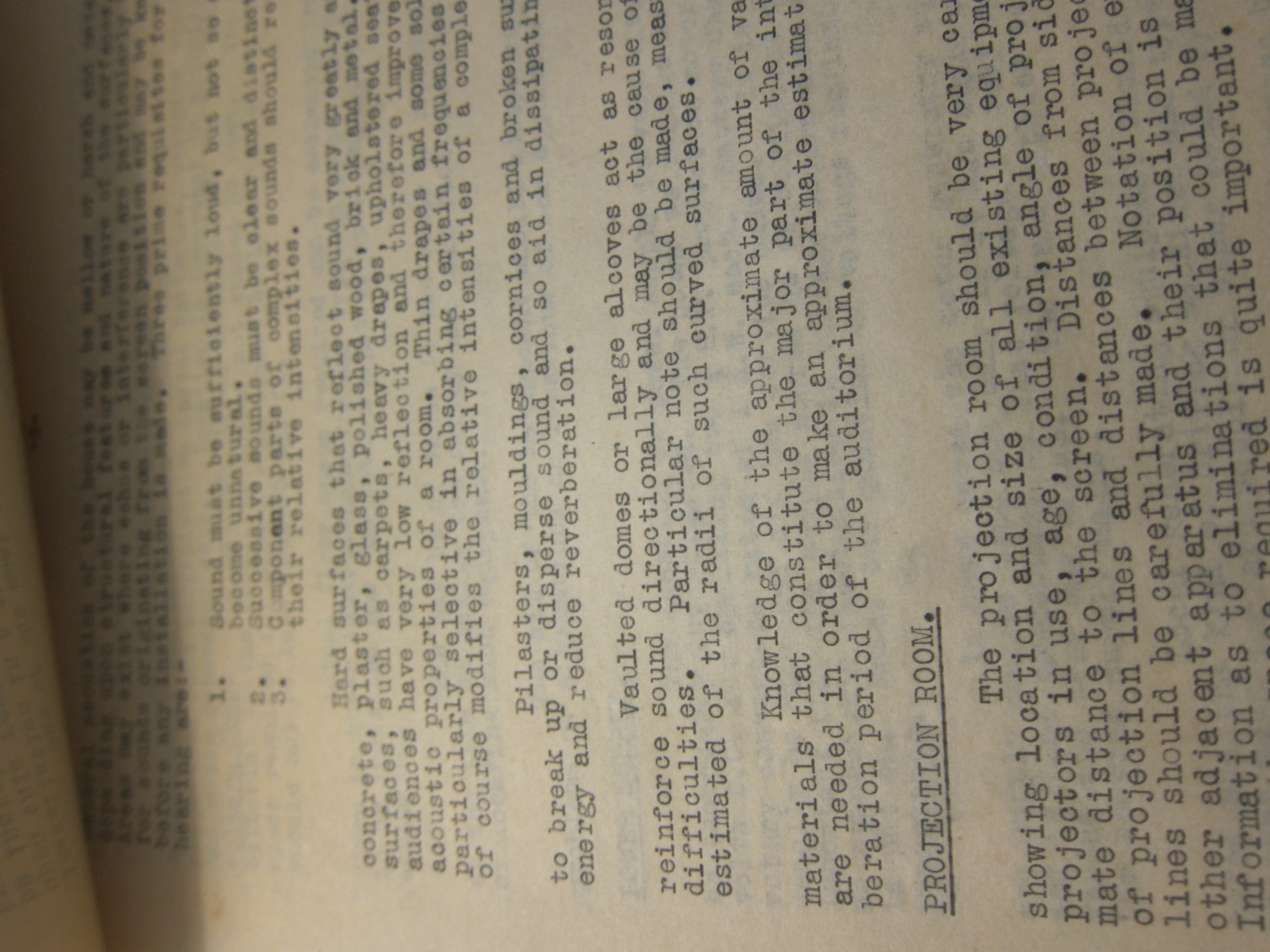
    Content: following a general intro to the equipment, which is followed by four section, including the auditorium, the projection room, the power supply, and the power equipment. The auditorium notes interestingly describe what the operator of the photophone should pay attention to in the building, touching on the location of the speaker, but particular attention was made for the architectural properties of the auditorium and how they might affect sound quality. This is followed by the projection room comments, and then the power supply needs and the power equipment itself, the ending item being the “synchronous disk requirements”.

    Sunde (1910-1990) was responsible for the explanation and demonstration of the RCA “Photophone” invention–one of the earliest simultaneous sound-on-film recorders and projectors, and introduced the machine to England and Russia, where true sound-on-film motion pictures were seen for the first time. 

    Photophone 1929 _2_

    ·Posted by :

    ·in:

  • Very Early Work on Sound-on-Film Motion Pictures

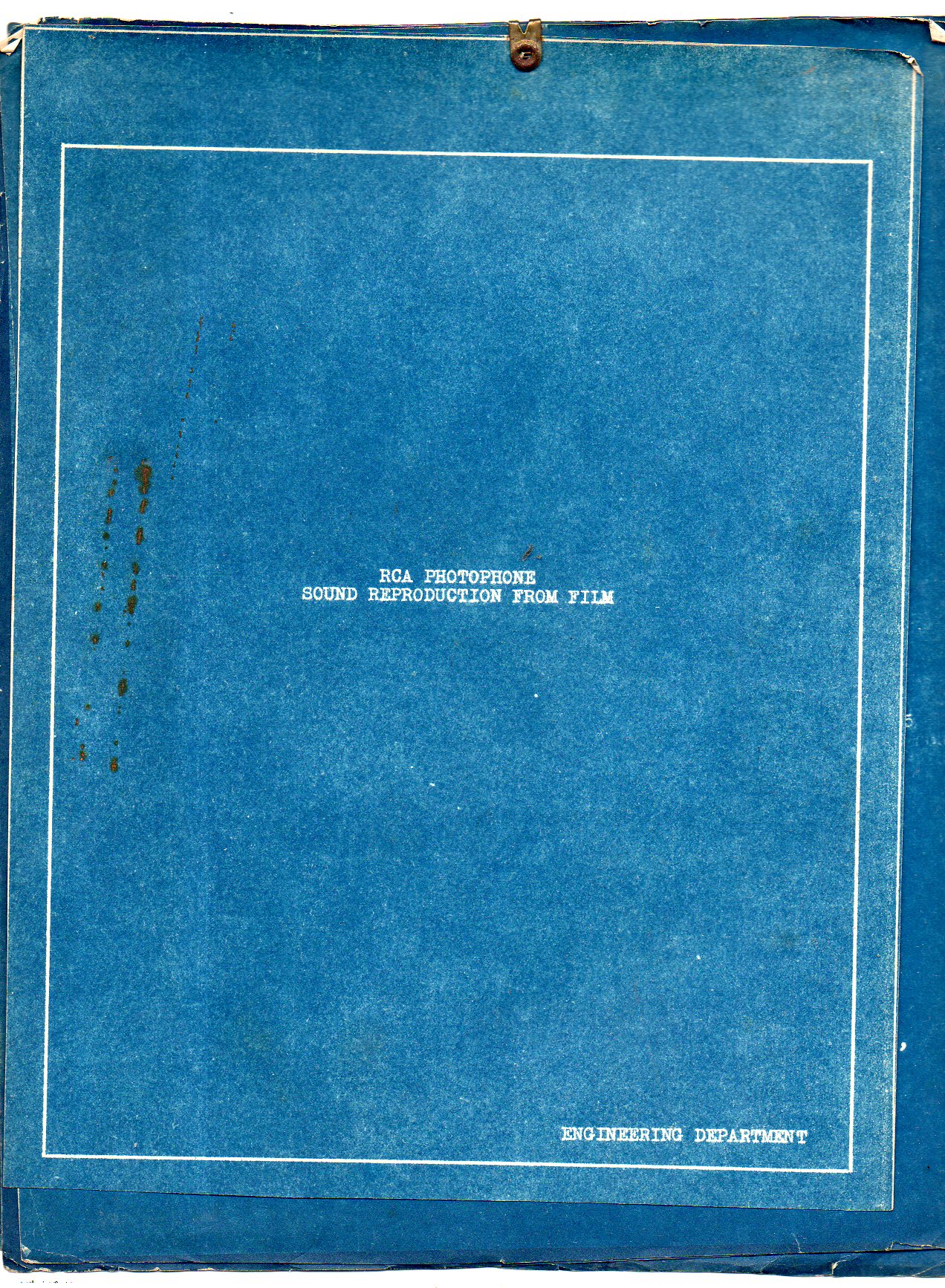
    Photophone sound repro from film _1_RCA Photophone Sound Reproduction from Film.

    11”x 8” (the first leaf slightly smaller). Undated—I’d guess that this was around 1930.

    Blueprints, printed by (Photophone) “Engineering Department”. 6 leaves, numbered (I)-(VI). Bound at the top with a brass fastener.

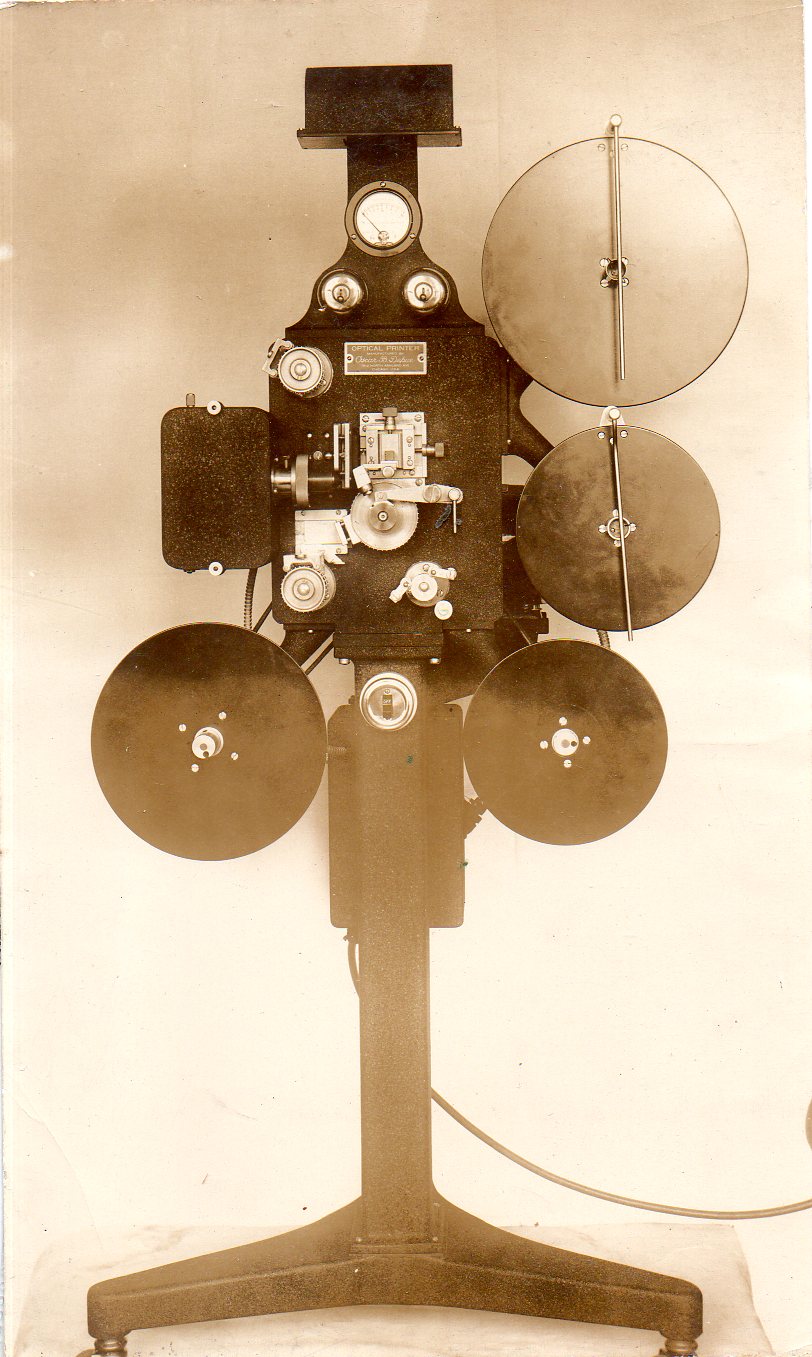
    Accompanied by a 8”x 5” original photo of the instrument.

    Rare. $2500 (1/3 to charity)

    • No copies in WorldCat.

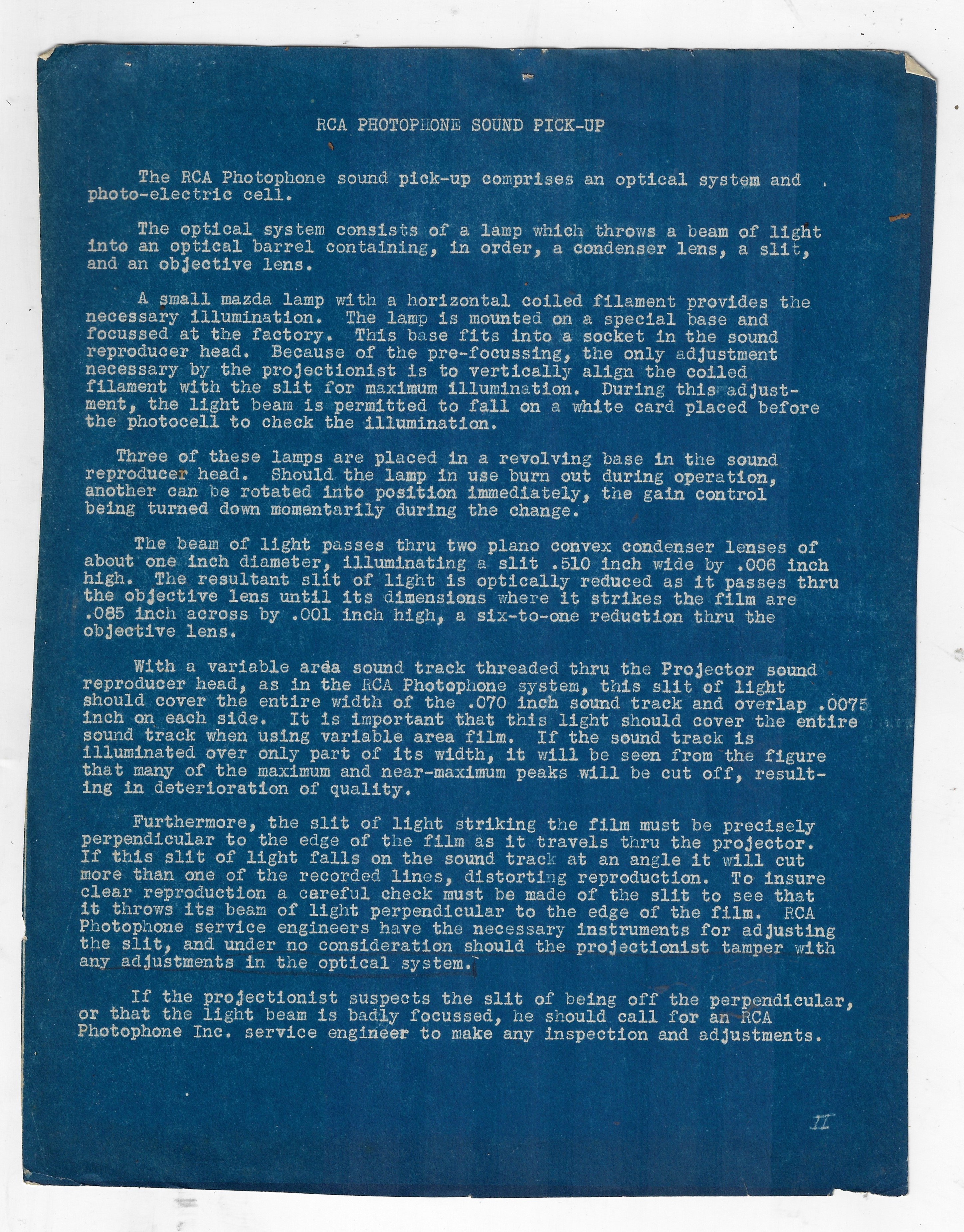
    The publication gets right to business in the opening paragraph in the section titled “RCA Photophone Sound Pickup”: The RCA Photophone Sound pick-up comprises an optical system and photo-electric cell….”

    In short this is a short primer on how the machine functions.

    Provenance: Harold E. Sunde, with his initials in pen at top left front cover, and signed by him on final page.  Sunde (1910-1990) was responsible for the explanation and demonstration of the RCA “Photophone” invention–one of the earliest simultaneous sound-on-film recorders and projectors, and introduced the machine to England and Russia, where true sound-on-film motion pictures were seen for the first time. He was also JHU APL, Sandia, Radiological Defense at Bureau of Ships, USAF). This document appears just a month or so before the showing of the first successful synchronized sound-on-film picture in England, A. Hitchcock’s “Blackmail”.

    This a sound-on-film incunable. This means the pamphlet was printed within the first few years of the first “talking”  (synchronized sound, or sound technologically coupled to image) motion picture. The first feature length film using sound throughout the length of the movie was The Jazz Singer, which was released in 1927 and used a sound-on-disc system of recording. That means that the audio portion of the film was recorded onto records, and then synchronized in playback with the film to match up the audio and video–this technology was obviously not the future.

    The technology of sound-on-film would take the day, and in very short order, leading to four different systems, of which the Photophone was one.  Photophone’s share of the prospective studio users was pretty good: the earliest major producers/licensees included Walt Disney Productions (after 1932), RKO Radio Pictures, Republic Pictures, Warner Borthers, and Pathe

    Rca photophone575
    Rca photophone576

    ·Posted by :

    ·in:

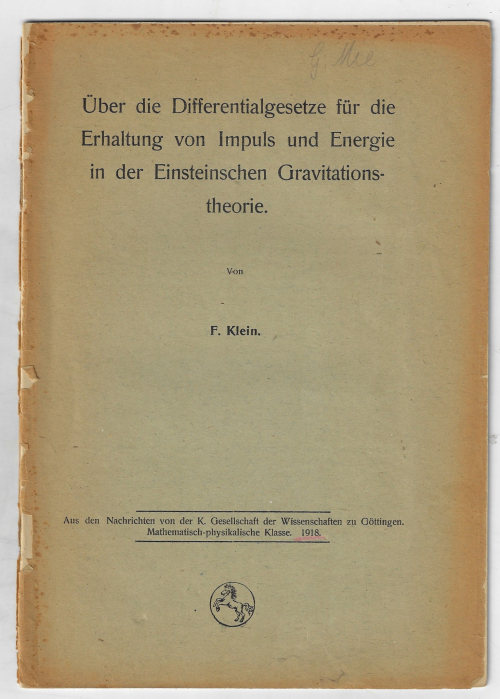
  • Klein Felix ÜBer Die Differentialgesetze FüR Die Erhaltung Von Impuls Und Energie In Der Einsteinschen Gravitationstheori

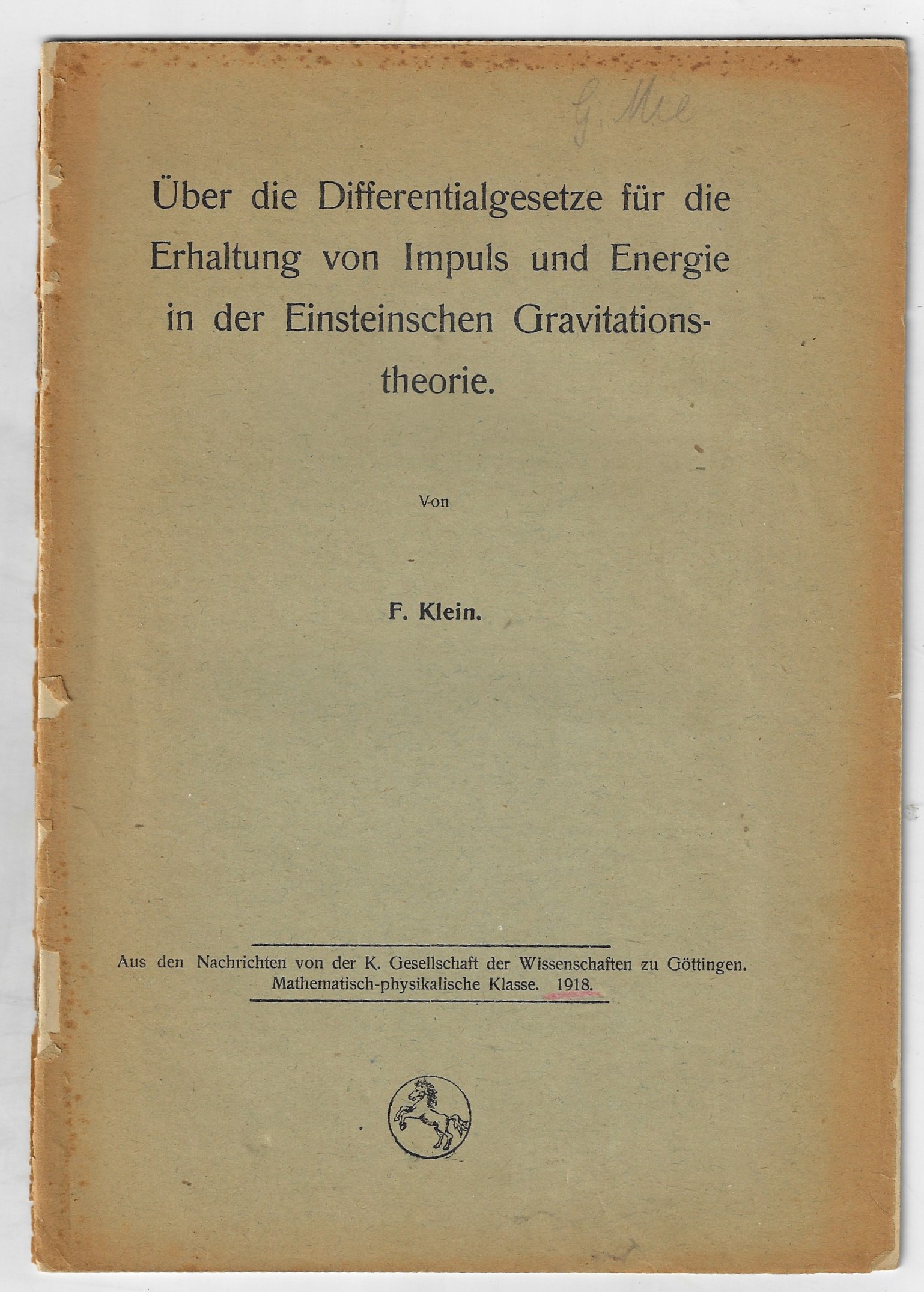
    Klein _1_ with Mie sigKLEIN, Felix. “Über die Differentialgesetze für die Erhaltung von Impuls und Energie in der Einsteinschen Gravitationstheorie”, (“ the differential laws for the conservation of momentum and energy in the Einstein theory of gravitation.”) published by Nachrichten von der Königliche Gesellschaft der Wissenschaften zu Göttingen Mathematisch-Physikalische Klasse, 1918). 19pp. $500

    In original paper wrappers. The interior is in near fine condition, but the spine is gone and the wrappers have separated from the body.

    “In an extensive memoir [this paper]…[Klein] attempted to unify the different forms of the differential laws for the conservation of energy and momentum that could be found in the papers of Einstein, Lorentz and Hilbert. The important tool which he used in doing this was the theory of invariants….Felix Kelin’s work is closely connected with the studies of Emmy Noether concerning the relations between symmetry properties and the conservation laws…” Jagdish Mehra, Einstein, Hilbert, and The Theory of Gravitation: Historical Origins of General Relativity Theory. Reidel, 1974, pp 46-49

    “I must also not omit to thank Miss Noether for encouraging participation in my new work, where the mathematical ideas which I used in the adaptation to the physical question for the integral I have in general been worked out, and will in the near future in these news be published.”–from this Klein paper, (that publication being Emmy Noether “Invariante Variationsprobleme”, Gottinger Nachrichten (1918), pp. 235–257 (presented by F. Klein at the meeting of 26 July 1918—the paper was dedicated to Klein).

    “This work, which has for too long been neglected, includes some interesting analysis regarding the gravitational energy-momentum expressions of Einstein, Hilbert, Lorentz and Weyl. The topic of gravitational energy momentum and its localization had been at that time—and, notwithstanding considerable progress, still remains a century later—an unsettled issue.”–from the 2019 translation of this paper by Chiang-Mei Chen, James M. Nester, and Walter Vogel.

    Sources:

    Brading, Katherine A.:”A note on general relativity, energy conservation, and Noether’s theorems”, in The Universe of General Relativity (Proceedings of the Conference on the History of General Relativity, Amsterdam 2002), Jean Eisenstaedt and Anne J. Kox, eds., Einstein Studies, vol. 11, Boston: Birkhauser, 2005, pp. 125–135

    Kosmann-Schwarzbach, Y., The Noether Theorems: Invariance and Conservation Laws in the Twentieth Century (Springer, New York, 2011).

    Rowe, David E.: “The Goettingen response to general relativity and Emmy Noether’s theorems”, in Gray, Jeremy J., ed. The Symbolic Universe, Geometry and Physics 1890–1930 (Milton Keynes, 1996), OxfordNew York: Oxford University Press, 1999, pp 189–233.

    Note:

    There is an inscription—quite faded but legible–”G. Mie” on the top right corner of the offprint cover. I’m quite sure that this must be the physicist Gustav Mie (1868-1957). “Mie’s main contributions to science, in addition to his oft-cited light-scattering paper, require recognition. He derived inductively the Maxwellian edifice from the empirical reality, a pursuit that still occupied Mie in his 80th year when the last and revised edition of his Handbook of Electricity and Magnetism was published.’4 His persistent search for a unified theory encompassing field and matter, although unsuccessful, nevertheless stimulated the work of other notable physicists such as Born’5 and Infeld. Other important pursuits by Mie included research into the dielectric constants of various materials using electromagnetic waves; the solution of the problem of the anomalous dispersion of water leading to the determination of the characteristic dielectric constant of that liquid; and x-ray crystallographic studies of hydrated naphthalenes, anthracenes, and polyoxymethylenes and of liquid crystals.”– “Gustav Mie: the person”, by Pedro Lilienfeld, Applied Optics, 20 November 1991 p 4696.
    ·Posted by :

    ·in:

  • The Raman Effect (Nobel Prize, 1930)

    RAMAN, Sir Chandrasekhara Venkata, and K. S. Krishnan, “The Production of New Radiations by Light Scattering. Part I” , in Proceedings of the Royal Society A 122 pp. 23-35, 1929, in the volume of vi, 719, xxii, vipp. Beautifully bound in leather and boards, marbled page edges. Very slightly ex-lib with edge stamps and stamp on title, otherwise this is a fresh, clean copy. A handsome volume even with the page edge stamps. [There was no”part II” to this paper.] $350

    Also bound with A.S. Eddington, “The Charge of an Electron”, pp 358-369 and A.H. Wilson, “Perturbation Theory in Quantum Mechanics”, pp 589-598. Leading the volume is an interesting review of recent work by Ernest Rutherford, “Anniversary Address…:, pp 1-23.

    This is an expanded description of the Raman effect, the work for which Raman received the Nobel Prize for Physics in 1930 “for his work on the scattering of light and for the discovery of the effect named after him” (Nobel site), “that when light traverses a transparent material, some of the light that is deflected changes in wavelength…(a) phenomenon…called Raman scattering the result being the Raman effect”.–Encyclopedia Britannica

    Raman publishes his paper for the first time a few months earlier in the Indian Journal of Physics, which led to a huge run of publications on the discovery—at least 160 in the 1928-1929 period according to the bibliography on papers published on the Raman effect “Bibliography of 150 Papers on the Raman Effect, 1928-1929”, by Dr. A. S. Ganesan. Of the 160 papers 12 are by Raman, and it was in the paper offered here (#62 in the bibliography) where he offers material not addressed in his previous papers.

    ”After Compton had discovered the Compton effect Heisenberg (1925) pointed out …that this ought to be true for any em radiation, including visible light. That it was so in practice was shown in 1928 by…Raman…Raman spectra proved to be useful in determining some of the fine details of molecular structure.”–Asimov Chronology

    “One of the most convincing proofs of the quantum theory of light.”–R.W. Wood

    “In the Raman effect, a small fraction of light (approximately 1 in 10 million photons) is scattered through inelastic scattering, in which the energy of the scattered photon is not conserved. The Raman effect demonstrates the wave–particle duality of light a bit like the Compton effect, but the Raman effect differs from the Compton effect in the nature of the photons used (Raman uses visible light and Compton uses much higher energy X-rays) and the effect on the electron that scatters the light (the Raman effect changes the energy level of within an atom or molecule while the Compton effect ejects the electron from the material through the photoelectric effect).”

    “Optical studies remained his chief concern, however. With his associates Raman studied the scattering of light of available frequencies by a number of substances, particularly fluids. In April 1923 Raman’s associate K. R. Ramanathan observed a weak secondary radiation, shifted in wavelength along with normally scattered light, which was attributed to “fluorescence.” S. Venkateswaran then noticed that highly purified glycerin does not appear blue under sunlight, but rather radiates a strongly polarized, brilliant green light.

    “Raman and K. S. Krishnan then undertook to isolate the effect under impeccable experimental conditions. They employed complementary light filters placed in the paths of the incident and scattered light, respectively, and observed a “new type of secondary radiation” from the scattering of focused beams of sunlight in both carefully purified liquid and dust-free air. They reported this discovery in a letter to Nature in February 1928. Raman then refined the experiment by using a mercury arc as the source of light; the effect was thus clearly seen for the first time on 28 February 1928 and was reported to the Science Congress at Bangalore the following month. The secondary radiation showed several lines shifted toward longer wavelengths, the shifts being characteristic of the substances being examined, and indicated the absorption of energy by the scattering molecule—the precise effect that had been predicted by A. Smekal in 1923. G. Landsberg and L. Mandelshtam, in the U.S.S.R., independently observed the same phenomenon in quartz, shortly after Raman and Krishnan made their discovery, but Raman’s account of the effect reflected a much more detailed investigation. In 1929 Raman was knighted in recognition of his work, and the following year he was awarded the Nobel Prize for physics.”–Complete Dictionary of Scientific Biography

    ·Posted by :

    ·in:

  • Unified Field Theory (1927)

    EINSTEIN, Albert. “Zu Kaluzas Theorie des Zusammenhanges von Gravitation und Elektrizität – Erste Mittelung”, pp 23-25; with in the same issue, “Zu Kaluzas Theorie des Zusammenhanges von Gravitation und Elektrizität – Zweite Mitteilung”, pp 26-30, in Sitzungsberichte der Königlich Preussischen Akademie der Wissenschaften, Physikalisch-mathematische Klasse VI, Berlin 1927, pp. 17–30, February 17, 1927). Individual issue in original wrappers.

    • Wrappers are a bit sunned along the edges, otherwise fine. $500.00

    Theodor Franz Eduard Kaluza (1885-1954) was a German mathematician and physicist known for the Kaluza–Klein theory (“the two pioneers of unified field theory”, A Pais, Subtle is the Lord, pp 329). Einstein thought very highly of Kaluza (according to MacTutor) and in 1921 encouraged him to publish his paper in which he solved Einstein’s equations of general relativity by using field equations in five-dimensional space-time. (Nordstrom had proposed “to use a five dimensional space for the unification of em with a scalar gravitational field” (A.Pais) publishing in Phys Zeit 15, p 504, 1914.) Of Kaluza’s work Einstein writes to Lorentz: ”It appears that the union of gravitation and Maxwell’s theory is achieved in a completely satisfactory way by the five-dimensional theory (Kaluza-Klein-Foch)”–Pais, Subtle..., p 333.

    Again according to Pais, Einstein wrote to Kaluza in 1921 saying “the formal unity of your theory is startling” (Subtle…, p330) after which he communicated the K paper to the Prussian Academy. It was in these two papers presented above that Einstein wrote on Kaluza’s work—this some four years after an earlier paper Einstein wrote with Grommer. (Einstein would return to Kaluza in a paper with Peter Bergmann, “On a generalization of Kaluza’s theory of electricity” in the Annals of Mathematics, Vol. 39, no. 3, in July 1938 and which he would address again in Science in 1931 with Meyer and in the Prussian Academy the same year.)

    “[Kaluaza] was teaching at Königsberg in April 1919 when he wrote to Einstein and told him about his ideas to unify Einstein’s theory of gravity and Maxwell’s theory of light. Einstein encouraged him to publish his highly original ideas which he did in 1921 in his paper on the unity problem of physics…Kaluza’s ideas involved the introduction of a fifth dimension and, although he has been criticised for introducing this as a purely mathematical idea, his work is important and was explored by others…Kaluza is remembered for this in Kaluza-Klein (named after the mathematician Oskar Klein) field theory, which involved field equations in five-dimensional space. The theory, initially a popular topic of research, quickly lost favour with the introduction of quantum mechanics.”–MacTutor, St. Andrew’s Math History.

    “As is so often the case, string theory arose from a collection of discredited ideas… When string theory became mainstream, physicists realised that these early insights were extraordinarily prescient. The story begins in 1919 with a little known Polish mathematician, Theodor Kaluza. Inspired by Einstein’s revolutionary ideas, he attempted to overthrow a central tenet of physics. “What if there are extra dimensions we just can’t see?” he asked. Working alone, he attempted to incorporate a hidden dimension into Einstein’s model for gravity. Unsurprisingly, his five-dimensional theory had more equations than the usual four-dimensional approach. Looking closely at the extra equations he had found, Kaluza spotted something remarkable. They were precisely Maxwell’s equations governing the electromagnetic field…”–”Whystringtheory” (supported by Oxford and the Royal Society)

    ·Posted by :

    ·in:

    —
  • The Invention of the Scanning Electron Microscope (1935)

    Max Knoll, “Aufladepotentiel und Sekundäremission elektronenbestrahlter Körper”, an article in Zeitschrift für technische Physik, volume 16, 1935, occupying pp 467–475 of 657pp of text. The paper includes 14 text images, five of which are reproductions of imagery made by the instrument.

    Rebound in black cloth that is simple but elegant (really quite a lovely job); untrimmed. Small library rubber stamp on the back of the title page (the Technische Hochschule in Danzig, now Gdansk Technical University). $500

    • First paper (“Static potential and secondary emission of bodies under electron irradiation” ) describing the concept of a Scanning Electron Microscope. See C. W. Oatle, “The early history of the scanning electron microscope”, Journal of Applied Physics 53, R1 (1982).

    “The earliest known work describing the concept of a Scanning Electron Microscope was by M. Knoll (1935)” – Bernie C Breton, “The Early History and Development of The Scanning Electron Microscope”.

    “Fundamental research by many physicists in the first quarter of the 20th century suggested that cathode rays (i.e., electrons) might be used in some way to increase microscope resolution. French physicist Louis de Broglie in 1924 opened the way with the suggestion that electron beams might be regarded as a form of wave motion. De Broglie derived the formula for their wavelength, which showed that, for example, for electrons accelerated by 60,000 volts (or 60 kilovolts [k]), the effective wavelength would be 0.05 angstrom (Å)—i.e., 1/100,000 that of green light. If such waves could be used in a microscope, then a considerable increase in resolution would result. In 1926 it was demonstrated that magnetic or electrostatic fields could serve as lenses for electrons or other charged particles. This discovery initiated the study of electron optics, and by 1931 German electrical engineers Max Knoll and Ernst Ruska had devised a two-lens electron microscope that produced images of the electron source. In 1933 a primitive electron microscope was built that imaged a specimen rather than the electron source, and in 1935 Knoll produced a scanned image of a solid surface.”–Encyclopedia Britannica


    ·Posted by :

    ·in:

Recent Posts

Archives

Categories