A Daily History of Holes, Dots, Lines, Science, History, Math, Physics, Art, the Unintentional Absurd, Architecture, Maps, Data Visualization, Blank and Missing Things, and so on. |1.6 million words, 7500 images, 4.9 million hits| Press & appearances in The Times, Le Figaro, Mensa, The Economist, The Guardian, Discovery News, Slate, Le Monde, Sci American Blogs, Le Pont, and many other places… 5000+ total posts since 2008.

  • Scarce Spaceflight and ICBM Publications (1961-1964)


    Proposal for Development and Preparation of Space Vehicle Design Criteria and Design Criteria Documentation. 7 February 1964. Submitted to Systems Engineering Group, Air Force Systems Command, USAF, Wright-Patterson AFB.  $225.00

    Volume 1, Technical. TRW Space Technology Laboratories.

    11×8.5”, 4 sections: 18, 22, 29, 121, 20pp. NO copies located in WorldCat for this title.

    The table of contents states the following, though there is one long contribution that is unstated and one that is not included:

    “Section 8. Related Publications.” 18pp

    A1—“Overall Systems Design Criteria.” 22pp.

    A2—Minuteman Structural Design Criteria. (Cover sheet “(Unclassified) Minuteman Structural Design Criteria”), 29pp

    A3—“Attitude Control of Earth Satellites” [not bound in this collection]

    A4—“Energy Sources and Power Conversion,” 20pp

    Between A2 and A3 is the following, with a separate title page:

    Whitford, R.K. Design of Attitude Control Systems for Earth Satellites, 30 June 1961. 2313-0001-RU-000 Space Technology Laboratories. 121pp. Plus two appendices, A+B, 10pp+8pp. NO copies located in WorldCat. Scarce.

    This is a little bibliographically complicated. The front wrapper states that this is “volume 1”, though it has the feel of a volume 2, particularly since it begins with “Section 8”. Some of the contents seem to be stand-alones (as with the Minuteman and the Whitford papers), though the Whitford is the only paper with a title page.

    Bound in a TRW paper wrapper with folding clips; all sections three-ring hole-punched.

    Rarity or scarcity: NO copies located in WORLDCAT/OCLC (NYPL system).

    • NO copies located in the massive database for worldwide library holdings, WorldCat. (“WorldCat is a union catalog that itemizes the collections of 17,900 libraries in 123 countries and territories that participate in the OCLC global cooperative. It is operated by OCLC, Inc. The subscribing member libraries collectively maintain WorldCat’s database, the world’s largest bibliographic database.”–Wikipedia)

    Condition:  VG, a 7.5 on a 1-10 scale, with 10 being “new”.  Nice and fresh.  $250

    • (Condition grading is compared to the condition of the publication when it was new;  to give a condition quote that states “good for its age” comparing something to a fluid state without a common denominator is almost without value, so the publication is compared to its condition when it was first published.)
    ·Posted by :

    ·in:

  • Rare Document on a Liberal-esque Position on Girls and Women by the Founder of the CIA (1930)


    Author: Donovan, William J.

    Title: Girl Scouts as a National Asset, Radio Talk of Colonel William J. Donovan over WJZ, October 31, 1930, at 2:30pm.

    Year: 1930

    Publisher: original carbon copies (?)

    Pages and Size: 11”x 8.5”, 4 lvs, approximately 800 words.

    Condition: VG/Fine, a 7.5 on a 1-10 scale, with 10 being “new”. Nice and fresh. 

    •  (Condition grading is compared to the condition of the publication when it was new; to give a condition quote that states “good for its age” comparing something to a fluid state without a common denominator is almost without value, so the publication is compared to its condition when it was first published.)
    Interesting 800-word radio address by the head of the OSS and founding father and patron saint of the CIA on the importance of teaching leadership skills to young girls and the role of the Girl Scouts in bringing home that mission. The address was made on WJZ which at the time (and by 1927) was the flagship station of NBC Blue (which had purchased the station in 1923 from RCA and which would become ABC in 1942), and seems to me to be very modern of the 57-year old Col. Donovan. Although he maintains that the female’s “stronghold” was home and motherhood, he declared that “a highly speed civilization (will) call upon her for many other capacities and activities”.

    “Any organization that can fit America’s girlhood for true American womanhood is a nation’s asset.”

    “The Scout movement [begun in 1912 by Juliette Gordon Low] meets a demand for social education and training in leadership at a period in the girl’s life when that sort of training is most vital” he writes.

    “The Nation today demands that women be as well trained and as fully adapted to the national life as men”, which to me appears to be more a more liberated position than most significant men would have in 1930 (and beyond). “The scout troop plan gives the individual girl a sense of duty, a consciousness of ability, an ideal of courage and a recognition of he necessity of remaining an individual while she functions in a group, at the same time making the group achievement greater because of her individual contribution” he continues.

    Provenance: Library of Congress Pamphlet Collection (though there are no markings attesting to that, the document did come with others from that collection). On the bottom of the back of the first page is a penciled annotation, “Gift/Author/Dec 5 1930”, which means Gen. Donovan gave this to the LC at that time.

    Rare document. I can also find no trace of it using the normal channels. Perhaps there is a record of Donovan’s opinions on this matter deep in other sources, but not being expert in this area I would not know if that was the case or not.

    ·Posted by :

    ·in:

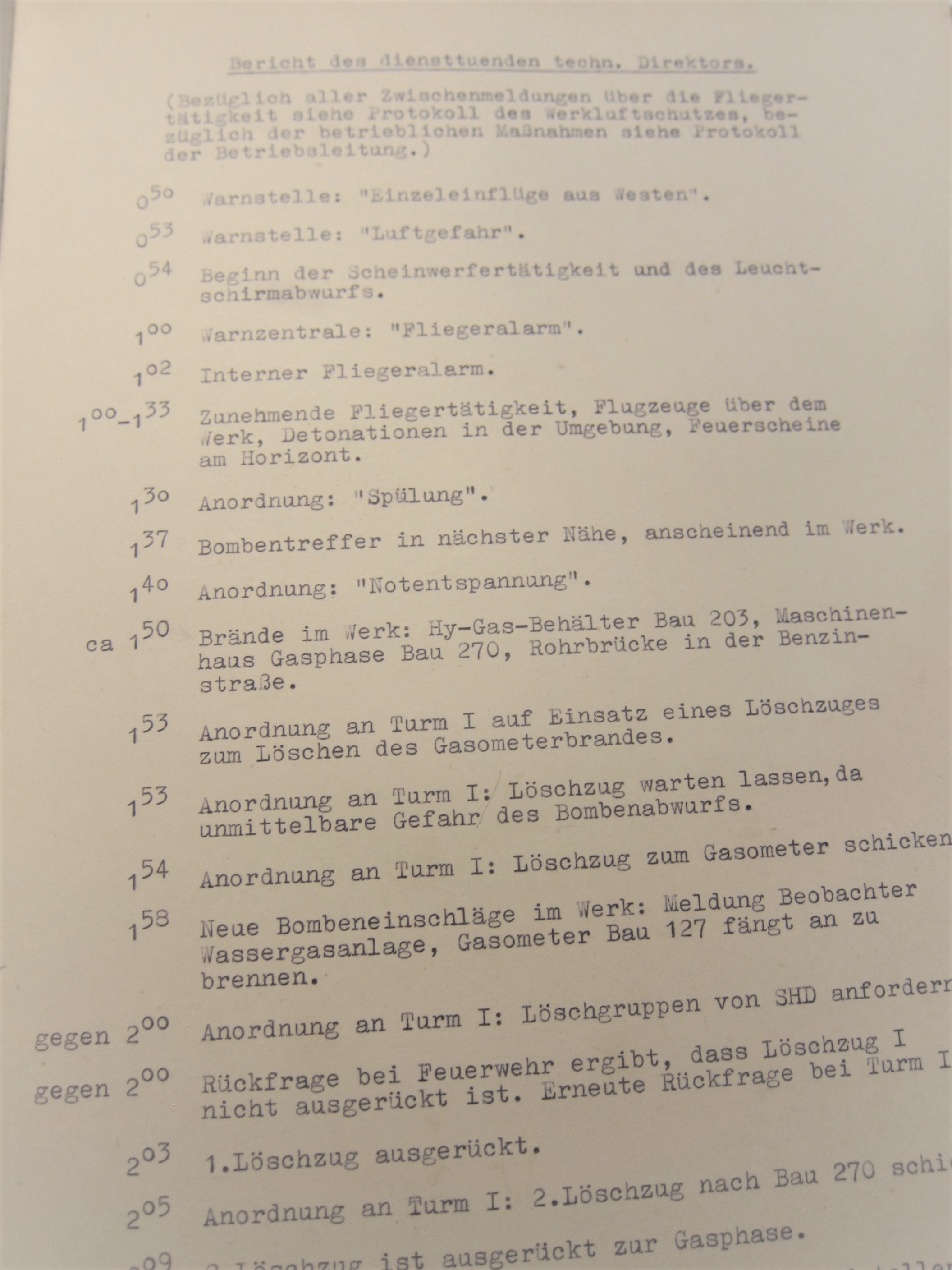
  • WWII German Bombing Report (1940)

    Title: Allied Bombing and a Report on Damage to German Industry– Fliegerangriff in der Nachct vom 17./18.8.40 auf die Hydrierwerk Scholven A.G.   1940. 

    With 27 original photographs displaying bombing damage. $750

    **NOTE: Hydrierwerk Scholven A.G. was a synthetic petroleum plant and was one of the earliest targets of the British in the Ruhr Valley. It was owned by the Hibernia Mining Company, as a hydrogenation plant in 1935. Gelsenkirchen is a city in North Rhine-Westphalia, Germany. It is located in the northern part of the Ruhr area. Publication Data: no indication of author/printer or which agency/department was responsible, but this looks like (to me) to be the beginning of a standard protocol on reporting damage from British bombing raids. It seems as though the typing under the captions is first generation.
     
    Bombing report _1_

    Publication data: there is no indication of author, place of publication, or any other printing data. Given the production values here this may be a unique work, or at worst, one copy of a very restricted number, of extremely highly limited distribution. It also seems that the typed captions under the photos is first generation.

    It seems to me that this is a standard bit of reporting made after every bombing raid (?) 

    Size: 11.5 x 8.5 inches. 20 leaves with 27 original photographic images of damage caused by the bombing. Each leave is quite thick—much more stiff and heavy than a 110-lb cover stock sheet. The photos are all 3 x 4.5 inches, and are clear and bright. Condition: fine condition. Provenance: ex-library, U.S. Library of Congress.

    Provenance: this book was part of a very large collection of 90,000 pamphlets bought of the U.S. Library of Congress. Known simply as the “Pamphlet Collection” it is identified by a distinctive and tiny 3mm perforated stamp on the title page (bottom), plus a bookplate at the front pastedown with the LC surplus/duplicate rubber stamp on it.

    Binding: bound in thick cloth boards, with heavier black cloth board tips and spine.  

    Condition: there is a bit of rubbing to the extremities, though overall the book is in Very Good condition.  

    Notes:

    “Gelsenkirchen in the time of the Third Reich In the time when the Nazis held sway in Germany, Gelsenkirchen, owing to its location in the heart of the Ruhr area, was a centre of wartime industry. In no other time has Gelsenkirchen’s industry been so highly productive. This brought about, on the one hand, after the massive job cuts in the 1920s, a short-term boost in mining and heavy-industry jobs. On the other hand, the city naturally became the target of many heavy Allied bombing raids during the Second World War, which destroyed three fourths of Gelsenkirchen. Even today, many old above-ground air-raid shelters can be found in the city, and some of the city’s official buildings such as Hans-Sachs-Haus downtown and the town hall in Buer have air-raid shelters still kept more or less in their original form. Two synagogues in Gelsenkirchen were destroyed in the anti-Jewish riots of Kristallnacht in November 1938. The one in Buer was burnt down. The one in downtown Gelsenkirchen was likewise destroyed. Exactly 66 years later, the cornerstone was laid there for a new synagogue. The Institute for City History set up a documentation site: “Gelsenkirchen in National Socialist times”. Throughout the time when Hitler was in power, from 1933 to 1945, the city’s mayor was Carl Engelbert Böhmer, an NSDAP.”

    ·Posted by :

    ·in:

  • Internal Spec Sheets for the “China Clipper”–Flying Boat Martin Model 130 (1932)

    Glenn L. Martin Company. Detail Specification for Pan American Long Range Air Mail Flying Boat Martin Model 130. GLM Spec #17, February 23,1932.

    This looks to be some sort of odd photographic reproduction from 1932, produced by GLM Co.. 11”x 8.5”, with 20pp, 2pp, and 5pp. Numerous annotations in a contemporary hand. Rare. No copies located in WorldCat. $500

    It seems as though sheet 2 is missing, though a hand-written note seems to imply (?) that the contents of page 2 is included in an appendix, though I can’t determine that.

    Bound in a metal-clasp heavier paper wrapper, in a Glenn L. Martin portfolio. I assume that this had a very limited distribution, thinking that this was circulated much beyond GLM Co and Pan American.

    This is signed by the VP and chief engineer at GLM, Lessiter C. Milburn (who was one of the first 23 Fellows of the Institute Aeronautical Sciences, 1932, along with such headliners as Lymann Briggs, W. Diehl, Donalf Douglas, Glenn Martin, John Northrup, I. Sikorsky, T. van Karman, and others. He was later president of Balanca Aircraft Corp.)

    “The Martin M-130 was a commercial flying boat designed and built in 1935 by the Glenn L. Martin Company in Baltimore, Maryland, for Pan American Airways. Three were built: the China Clipper, the Philippine Clipper and the Hawaii Clipper…Martin named them the Martin Ocean Transports, but to the public they were the “China Clippers”, a name that became a generic term for Pan Am’s large flying boats – the Martin M-130, Sikorsky S-42, and Boeing 314.”–Wikipedia

    The contents of the work includes a (1) general section (pp 1-19); pg 20 is a list of appendices numbered I, II, and III, though only (2) appendix III (2pp) is bound here. There is a third section (3) “Supplement ‘A’ ”, 5pp., that is not listed as part of the introduction.

    ·Posted by :

    ·in:

    —
  • A Largely Forgotten Giant of Radio and Sonar

    Fessenden, Reginald A. The Deluged Civilization of the Caucasus Isthmus, Chapter XI.

    Massachusetts Bible Society, Boston, Mass. 1927 12”x 8.75”: 4pp of maps, (ii), 21pp. Printed on very heavy stock, and bound in wrappers. Limited edition of 250 copies, this being copy #XIII. This is copy XIII, inscribed by Fessenden to the “Congressional Library” (Library of Congress”).

    Good/VG copy, the oversize pamphlet having a few bumps and short tears and dusting to the printed wrappers. The text however is FINE.  $250

    Provenance: Library of Congress, with their “surplus/duplicate” rubber stamp on the rear cover.

    Fessenden was a great figure in the history of radio (who was awarded over 500 patents), and later in life undertook a project to find and identify the pre-Noahic flood civilizations in the Caucasus. There’s not much I can say about that part of his career, so I won’t say anything. I do know that there is a somewhat tortured history to the publication of this work, bits and pieces published here and there, with a large part of the work edited and published post-death by Fessenden’s son.

    Reginald A. Fessenden (1866-1932), father of radiotelephony (which was what wireless transmission of speech was called at the time), radio and SONAR pioneer.

    Fessenden is best known for his pioneering work developing radio technology, including the foundations of amplitude modulation (AM) radio. (“In 1900 Fessenden left the university to conduct experiments in wireless telegraphy for the U.S. Weather Bureau, which wanted to adapt radiotelegraphy to weather forecasting. Impatient with the simple on-off transmission of Morse Code signals, he became interested in transmitting continuous sound, particularly that of the human voice. He developed the idea of superimposing an electric signal, oscillating at the frequencies of sound waves, upon a radio wave of constant frequency, so as to modulate the amplitude of the radio wave into the shape of the sound wave. “)==Encyclopedia Britannica

    His achievements included the first transmission of speech by radio (1900), and the first two-way radiotelegraphic communication across the Atlantic Ocean (1906). In 1932 he reported that, in late 1906, he also made the first radio broadcast of entertainment and music, although a lack of verifiable details has led to some doubts about this claim. John Scott Medal, which included a cash prize of $800, for “his invention of a reception scheme for continuous wave telegraphy and telephony”–enwikipedia

     “Canadian radio pioneer who on Christmas Eve in 1906 broadcast the first program of music and voice ever transmitted over long distances.”–Encyclopedia Britannica

    responding to the Titanic disaster in 1912 Fessenden is credited with the invention and development of the first modern transducer used in a sonar.  Thomas R. Howarth and Geoffrey R. Moss, “The Fessenden Oscillator: The first sonar transducer”, The Journal of the Acoustical Society of America 136, 2131 (2014)

    ·Posted by :

    ·in:

  • Wheeler’s Classic Work on Geometrodynamics (1962)

    Wheeler, John A. Geometrodynamics. Academic Press, Italian Physical Society, Topics in Modern Physics 1, 1962. xxiii,334pp. Original cloth. Near-fine condition. $750

    Contains: Wheeler, “Neutrinos, Gravitation and Geometry”, pp 1-129; “Geons”, pp 131-184 (Physical Review, vol 97, pp 511-536; “Thermal Geons”, (reprinted from Review of Modern Physics, 29, pp 480-495, 1957; “Classical Physics as Geometry”, with Charles Miser, from Annals of Physics, vol 2, 1957, pp 233-331.

    “Classical gravitation, electromagnetism, charge, and mass are described in a preceding article in terms of curved empty space and nothing more. In advance of the detailed quantization of this pure Einstein-Maxwell geometrodynamics, an attempt is made here (1) to bring to light some of the most important properties to be expected for quantized geometrodynamics and (2) to assess whether this theory, without addition of any inventive elements, can contribute anything to the understanding of the elementary particle problem.”–Wheeler, John A. On the nature of quantum geometrodynamics” in Annals of Physics, volume 2, Issue 6, December 1957, Pages 604-614

    “In theoretical physics, geometrodynamics is an attempt to describe spacetime and associated phenomena completely in terms of geometry. Technically, its goal is to unify the fundamental forces and reformulate general relativity as a configuration space of three-metrics, modulo three-dimensional diffeomorphisms. It was enthusiastically promoted by John Wheeler in the 1960s, and work on it continues in the 21st century…The term geometrodynamics is as a synonym for general relativity “–Wikipedia

    “Wheeler wanted to reduce physics to geometry in an even more fundamental way than the ADM reformulation of general relativity with a dynamic geometry whose curvature changes with time. It attempts to realize three concepts:

    • mass without mass

    • charge without charge

    • field without field.

    He wanted to lay the foundation for quantum gravity and unify gravitation with electromagnetism (the strong and weak interactions were not yet sufficiently well understood in 1960 to be included).

    Wheeler introduced the notion of geons, gravitational wave packets confined to a compact region of spacetime and held together by the gravitational attraction of the (gravitational) field energy of the wave itself. Wheeler was intrigued by the possibility that geons could affect test particles much like a massive object, hence mass without mass.” Encyclopedia Britannica

    ·Posted by :

    ·in:

  • The First Appearance of the Compton Effect (1923)

    Arthur H. Compton, “A Quantum Theory of the Scattering of X-Rays by Light Elements”, in Physical Review, 1927, vol 21 (second series) no.5. May 1923, pp 483-502. Offered in a very simple library quick-binding cloth-backed paper-covered boards (serviceable if not attractive) containing the issues for April – June, pp 391-722. Exlibrary, with a stamp on the cover and a stamp of several interior pages though not on the title page of the Compton (which was the lead article for May). So, a GOOD copy. $950

    Compton shared the Nobel Prize in physics in 1927 “for his discovery of the effect named after him” and Charles Thomson Rees Wilson “for his method of making the paths of electrically charged particles visible by condensation of vapour.”

    “Arthur Holly Compton will always be remembered as one of the world’s great physicists. His discovery of the Compton effect, so vital in the development of quantum physics, has ensured him a secure place among the great scientists” (DSB)

    ·Posted by :

    ·in:

  • First Published Proof of the Hellmann-FeynmanTheory

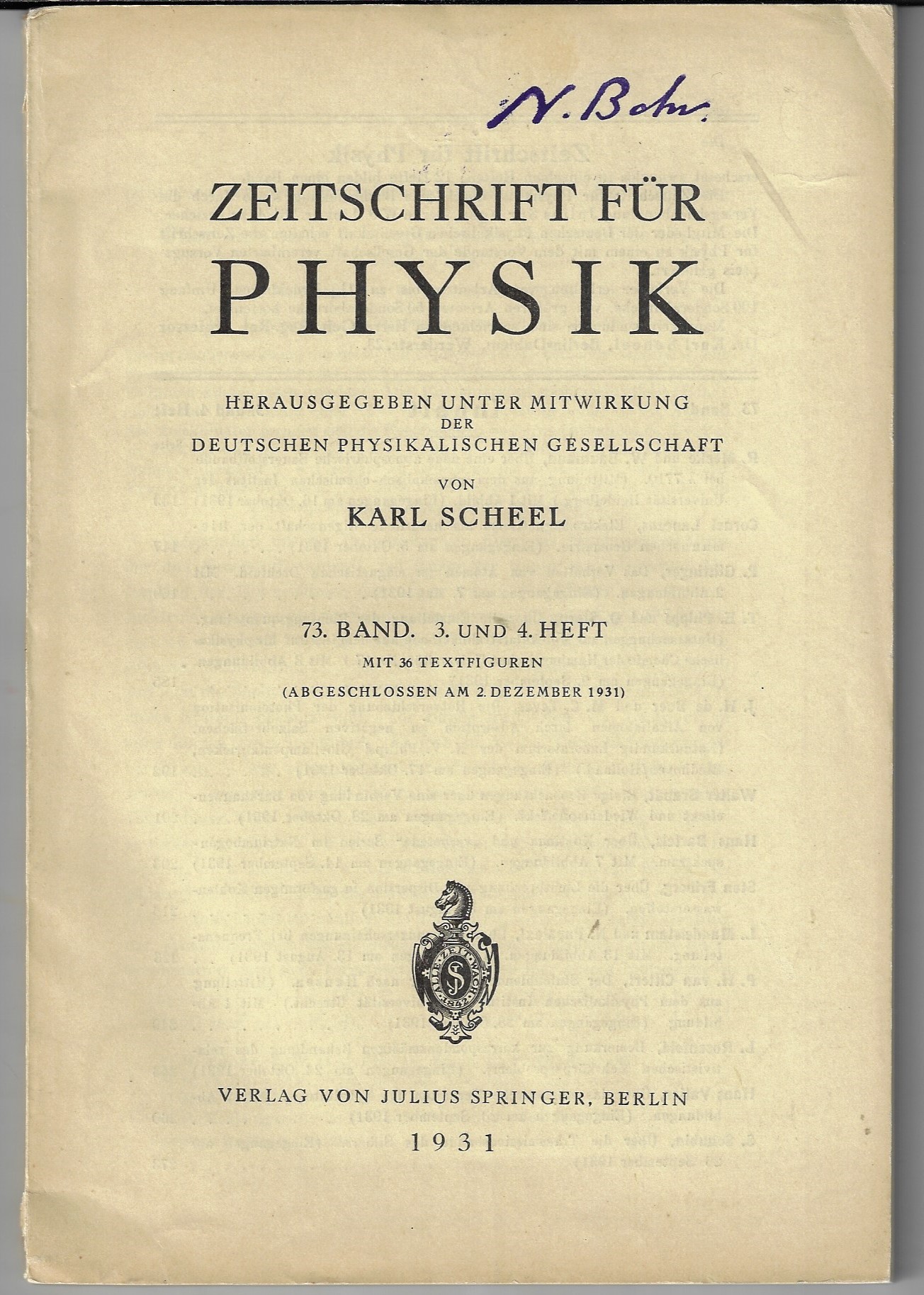
    Güttinger , P. (1932). “Das Verhalten von Atomen im magnetischen Drehfeld”. In: Zeitschrift für Physik, vol 73 (3–4),  pp 169–184 in the issue of pp 139-280. Original wrappers. Lovely copy.

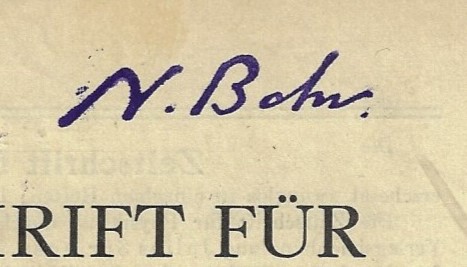
    This is Niels Bohr’s copy, with his name printed at the top right. $500

    Guttinger 1933 Bohr sig

    Guttinger 1933 ZfP “The Hellmann-Feynman theorem has an illustrious albeit somewhat complicated lineage, which includes three Nobel Laureates. The key relationship was reported by Schrödinger in one of his landmark 1926 papers, by Güttinger [who took his Ph.D. at ETH Zurich under Scherrer and Pauli in 1932] in 1932 and by both Pauli and Hellmann in 1933. Feynman presented it, apparently independently, in 1939. It was Hellmann and Feynman who arrived separately at one of the best known consequences of the theorem, which is presumably why their names are attached to it. Over the years, the approval rating of the Hellmann-Feynman theorem has fluctuated wildly. In a 1945 paper, Coulson and Bell concluded that it was invalid; however, Berlin rescued it in 1951…He also showed how the theorem could be used to obtain insight into bonding forces in molecules, an approach that Bader et al. followed successfully a few years later. In 1962, Wilson used the theorem to derive an exact formula for molecular energies. Nevertheless, Musher claimed in 1966 that many find the theorem to be “too trivial to merit the term ‘theorem’”. Yet only six years later, no less an authority than Slater proclaimed the Hellmann-Feynman theorem to be one of the “two most powerful theorems applicable to molecules and solids”, the other being the virial theorem.”–Politzer, P., Murray, J.S. “The Hellmann-Feynman theorem: a perspective”,  J Mol Model 24, 266 (2018).

    “In quantum mechanics, the Hellmann–Feynman theorem relates the derivative of the total energy with respect to a parameter, to the expectation value of the derivative of the Hamiltonian with respect to that same parameter. According to the theorem, once the spatial distribution of the electrons has been determined by solving the Schrödinger equation, all the forces in the system can be calculated using classical electrostatics. The theorem has been proven independently by many authors, including Paul Güttinger (1932), Wolfgang Pauli (1933), Hans Hellmann (1937), and Richard Feynman (1939) [The Feynman contribution appears in his first published paper, “Forces in Molecules”, in the PR in 1939.


    ·Posted by :

    ·in:

    —
  • The Origin of all Great European Rivers (1678)

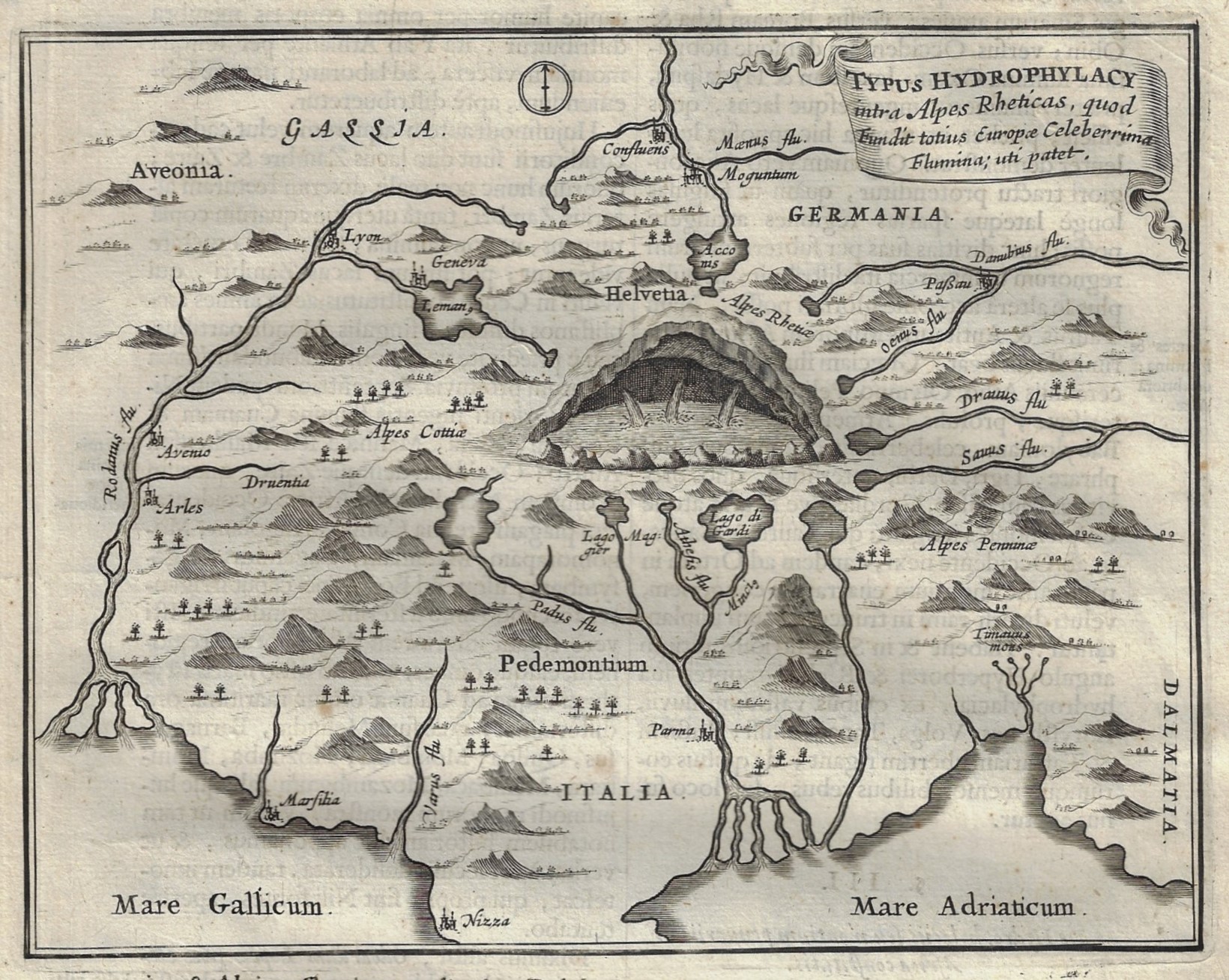
    KIRCHER, Athanasius. “Typus Hydrophylacy intra Alpes Rheticas, quod Fundit totius Europae Celeberrima Flumina uti patet”, being a map salvaged from a beyond-repair copy of the great Mundus Subterraneus, (“Athanasii Kircheri Mundus subterraneus in XII libros digestus… “), 1678, from the second section “Officium Globi Terreni”, p. 71; 6”x 8” on a 15”x 9” sheet. Very Good condition. $175

    “The foundations of the whole of the famous European rivers” or so the title reads.

    The great semi-mystifying polymath Athanasius Kircher (1602-1680) lived for a long time and filled his life with ideas and words,  producing dozens of books during his time on Earth, some of which were never published even though written, some manuscripts lost forever. His was a massive output of extraordinary breadth.  He wasted little time that I can see, writing on a spectac Kircher typus european rivers detail
    ular range of subjects: enlightening people, confusing people, generating great theories and some occasional bad ideas. 

    The images presented here comes from his Mundus Subterraenus , published in 1678, which was concerned mainly with geology and the theory of the Earth. There is an enormous amount of wide-ranging thinking going on in these two volume, most of which were scientific and experimental, and some of that being flavored and coated by hermetic and religious influences, while some bits were entirely religio-speculative. A product of the great Jesuit institution, the Collegio Romano, he postulated and dove fearlessly into the structure of the interior of the Earth, the origin of heat, the source of the tides, the composition of light, mechanics, the structure of music, linguistics, astronomy, astrology, alchemy, fossils, fluid dynamics, mining, and of course the existence of anthropomorphic images in stone (for example, the Virgin Mary found in agate).  There was also a fair amount of work on one of his side interests that populated a number of his works, alchemy and the search for the organization of materials. He also sought a primum mobile so to speak, a force or reckoning that was beyond what he recognized as the creator’s, a cosmic pansperma, an automatic/spontaneous cosmic energy at the root of change of all things.

    ·Posted by :

    ·in:

  • On the Origins of the Black and Caspian Seas (1678)

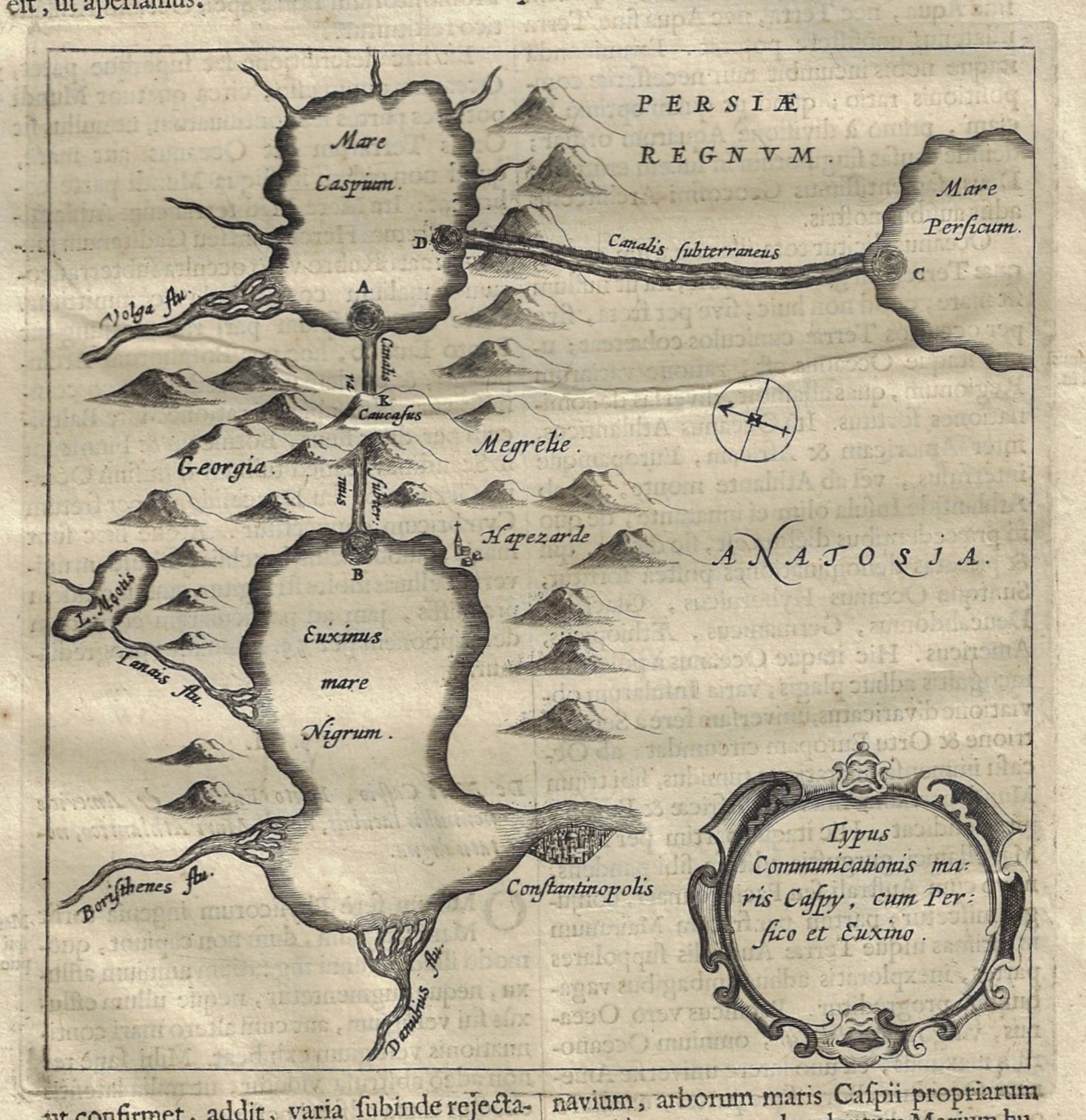
    KIRCHER, Athanasius. “Typus Communicationis maris Caspy, cum Perscio et Euximo”, being a map salvaged from a beyond-repair copy of the great Mundus Subterraneus, (“Athanasii Kircheri Mundus subterraneus in XII libros digestus… “), 1678, from the second section, “Liber Secundus Technicus”, p 86. 6.5”x 6.5” on a 15”x 9” sheet. Very Good condition. $175

    This map depicts Kircher’s theory for the origins and maintenance of the Capsian and Black Seas, with an involvement somehow of the Persian Gulf, all connected via underground canals. (“…map of the Pontocaspian region after Kircher (1678), who in his “Mundus Subterraneus” already envisaged that the Caspian Basin must have been connected to the open ocean to explain its relatively high salinity (> 10 ‰) today. The Caspian Sea is in fact an isolated long-lived lake since at least 2.6 Ma. Kircher considered a subterraneous channel to the Persian Gulf for the marine connection. The location of this marine connection is still enigmatic today.”–Quaternary time scales for the Pontocaspian domain: Interbasinal connectivity and faunal evolution, Earth Science Reviews, 188 10, 1016, 2018 10 013.)

    The great semi-mystifying polymath Athanasius Kircher (1602-1680) lived for a long time and filled his life with ideas and words,  producing dozens of books during his time on Earth, some of which were never published even though written, some manuscripts lost forever. His was a massive output of extraordinary breadth.  He wasted little time that I can see, writing on a spectacular range of subjects: enlightening people, confusing people, generating great theories and some occasional bad ideas. 

    The images presented here comes from his Mundus Subterraenus, published in 1678, which was concerned mainly with geology and the theory of the Earth. There is an enormous amount of wide-ranging thinking going on in these two volume, most of which were scientific and experimental, and some of that being flavored and coated by hermetic and religious influences, while some bits were entirely religio-speculative. A product of the great Jesuit institution, the Collegio Romano, he postulated and dove fearlessly into the structure of the interior of the Earth, the origin of heat, the source of the tides, the composition of light, mechanics, the structure of music, linguistics, astronomy, astrology, alchemy, fossils, fluid dynamics, mining, and of course the existence of anthropomorphic images in stone (for example, the Virgin Mary found in agate).  There was also a fair amount of work on one of his side interests that populated a number of his works, alchemy and the search for the organization of materials. He also sought a primum mobile so to speak, a force or reckoning that was beyond what he recognized as the creator’s, a cosmic pansperma, an automatic/spontaneous cosmic energy at the root of change of all things.

    Kircher Caspian detail

    ·Posted by :

    ·in:

  • The Underground Canals of the Middle East (1678)

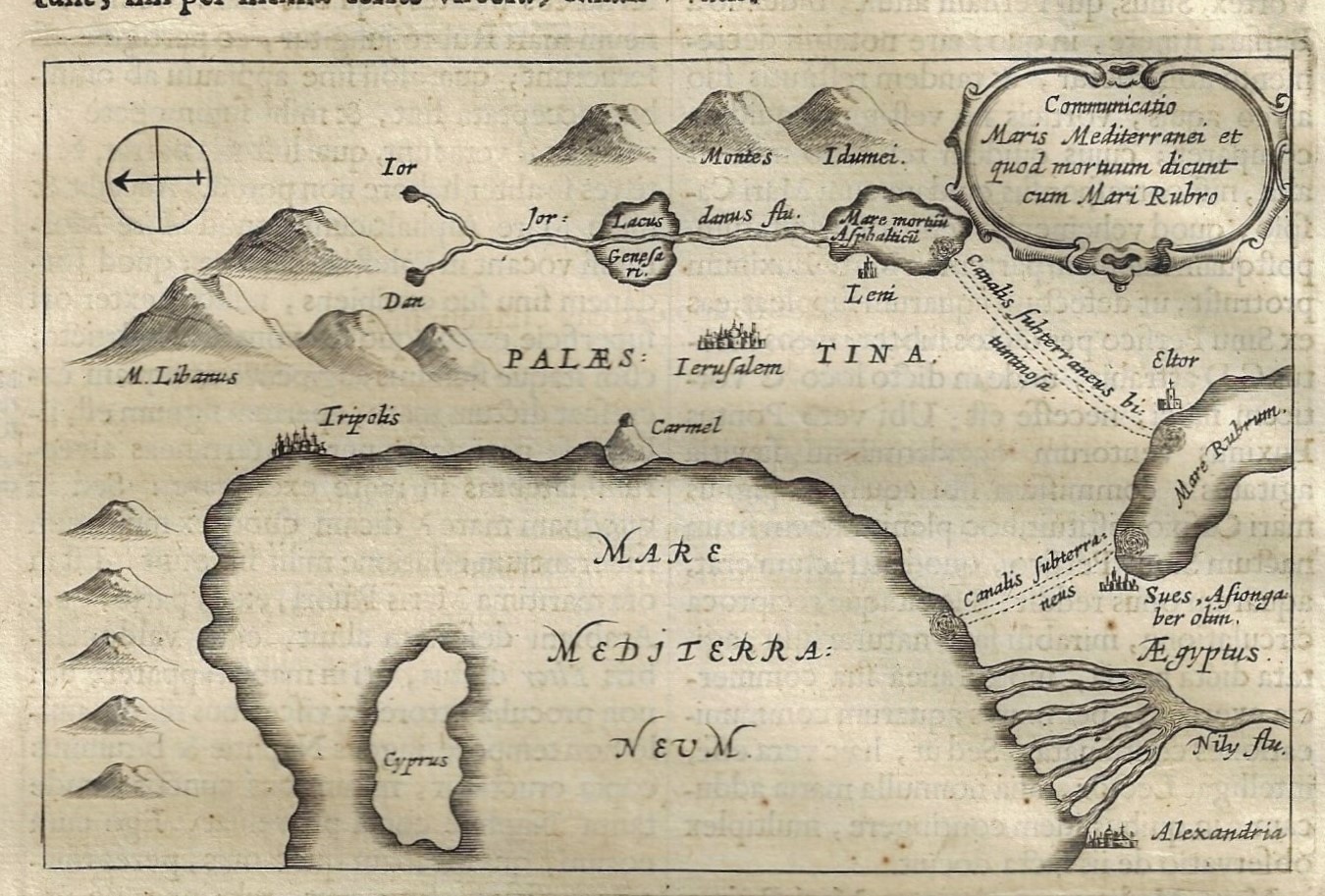
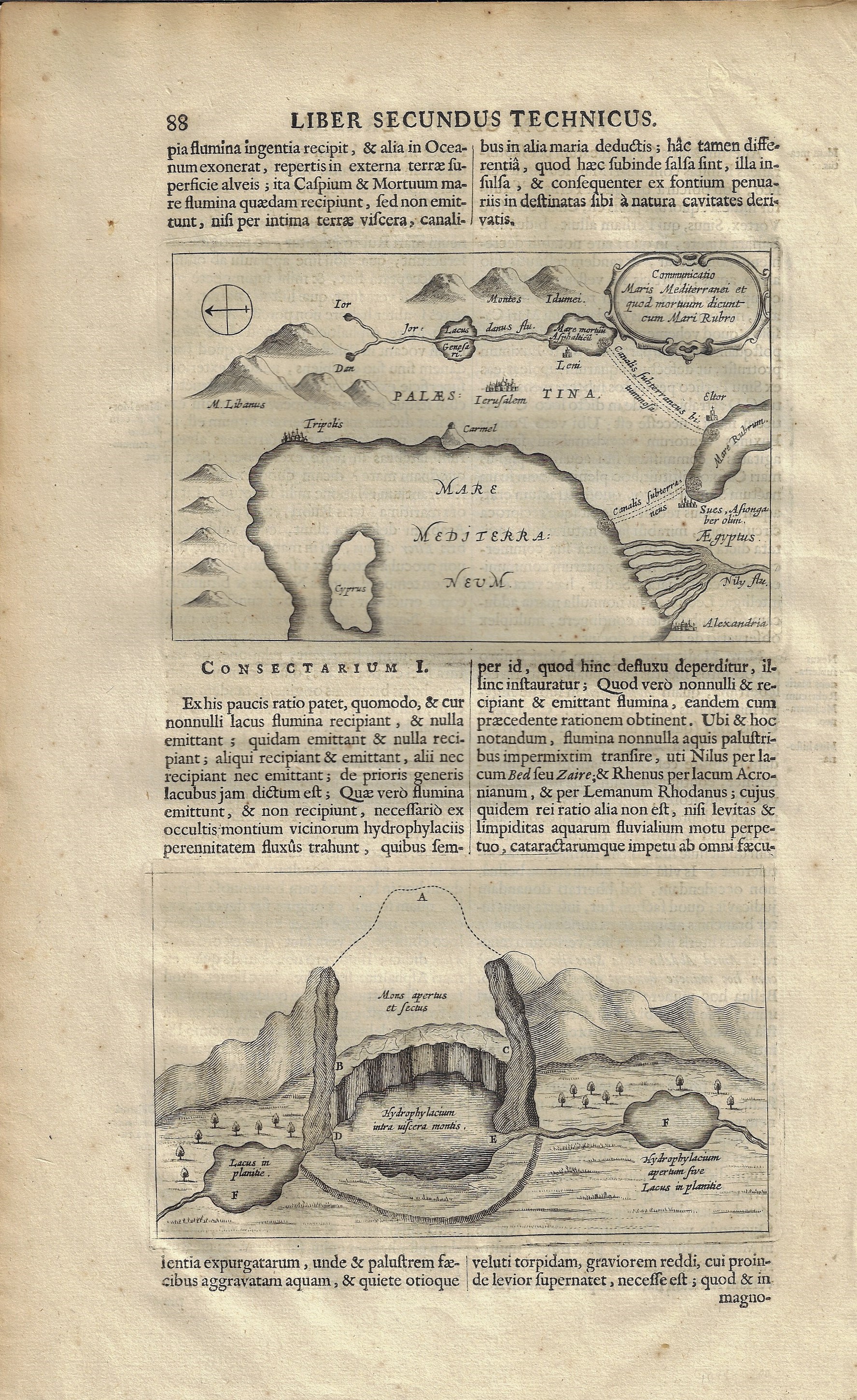
    KIRCHER, Athanasius. “Communicatio Maris Mediterranei et quod Mortuum dicunt cum Mari Rubro”, being an engraved map of the Middle East salvaged from a beyond-repair copy of the great Mundus Subterraneus, (“Athanasii Kircheri Mundus subterraneus in XII libros digestus… “), 1678, from the second book, “Liber Secundus Technicus”, page 88.  $150

    4”x 6.5” image on a 15”x 9′ sheet, showing Kircher’s hypothesis for the existence of underground canals connecting the Mediterranean with the Red Sea to the Dead Sea.

    Kircher holy land detail;

    The great semi-mystifying polymath Athanasius Kircher (1602-1680) lived for a long time and filled his life with ideas and words,  producing dozens of books during his time on Earth, some of which were never published even though written, some manuscripts lost forever. His was a massive output of extraordinary breadth.  He wasted little time that I can see, writing on a spectacular range of subjects: enlightening people, confusing people, generating great theories and some occasional bad ideas. 

    The images presented here comes from his Mundus Subterraenus , published in 1678, which was concerned mainly with geology and the theory of the Earth. There is an enormous amount of wide-ranging thinking going on in these two volume, most of which were scientific and experimental, and some of that being flavored and coated by hermetic and religious influences, while some bits were entirely religio-speculative. A product of the great Jesuit institution, the Collegio Romano, he postulated and dove fearlessly into the structure of the interior of the Earth, the origin of heat, the source of the tides, the composition of light, mechanics, the structure of music, linguistics, astronomy, astrology, alchemy, fossils, fluid dynamics, mining, and of course the existence of anthropomorphic images in stone (for example, the Virgin Mary found in agate).  There was also a fair amount of work on one of his side interests that populated a number of his works, alchemy and the search for the organization of materials. He also sought a primum mobile so to speak, a force or reckoning that was beyond what he recognized as the creator’s, a cosmic pansperma, an automatic/spontaneous cosmic energy at the root of change of all things.

    Kircher holy land

    ·Posted by :

    ·in:

Recent Posts

Archives

Categories