A Daily History of Holes, Dots, Lines, Science, History, Math, Physics, Art, the Unintentional Absurd, Architecture, Maps, Data Visualization, Blank and Missing Things, and so on. |1.6 million words, 7500 images, 4.9 million hits| Press & appearances in The Times, Le Figaro, Mensa, The Economist, The Guardian, Discovery News, Slate, Le Monde, Sci American Blogs, Le Pont, and many other places… 5000+ total posts since 2008.

  • The Mountain “Furnace” and the Creation of Metal (1678)

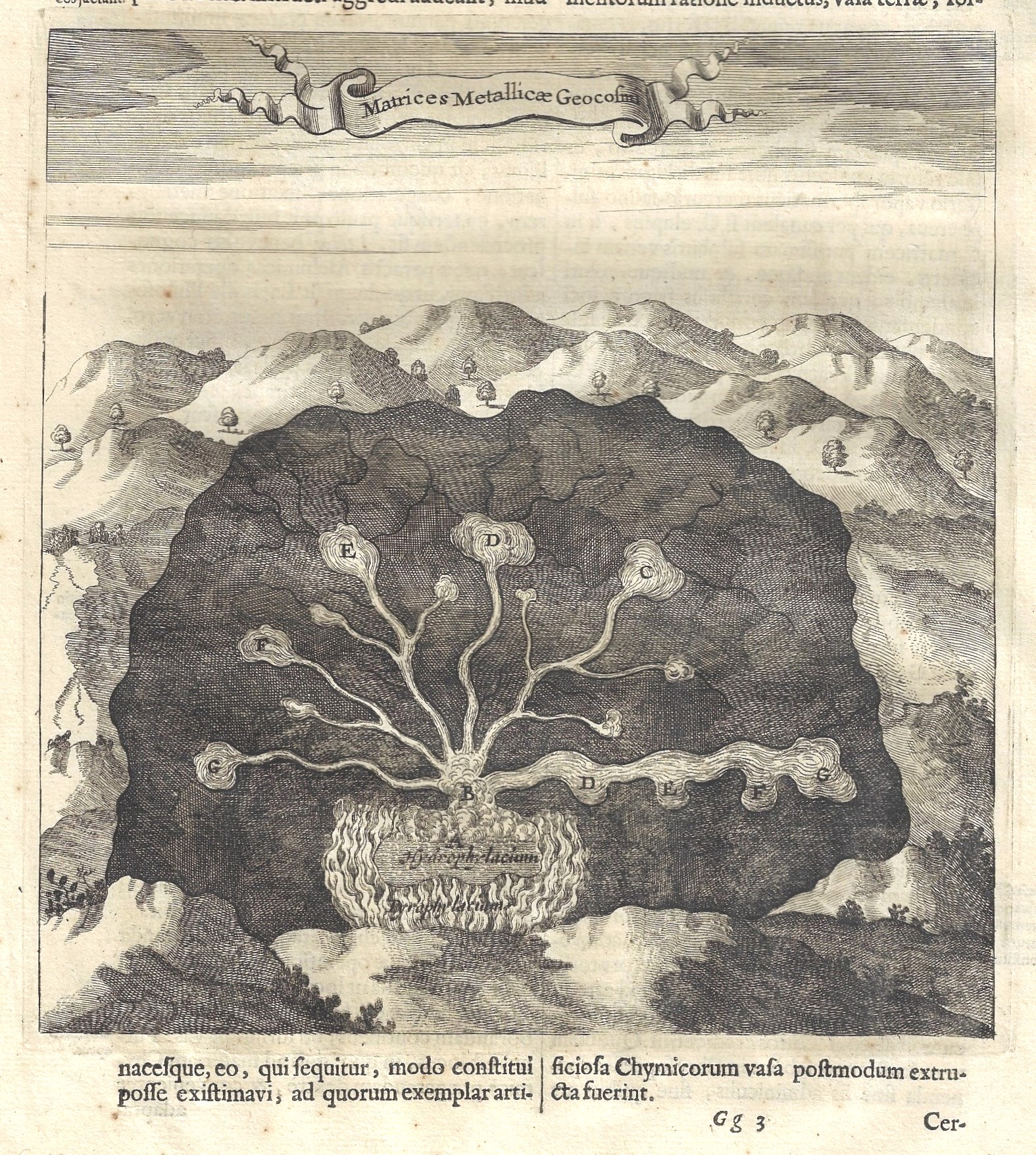
    KIRCHER, Athanasius. Matrices Metallicae Geocosmi, an engraving from a salvaged and beyond-repair copy of the great Mundus Subterraneus, (“Athanasii Kircheri Mundus subterraneus in XII libros digestus… “), 1678, from the section “De Origine Alchymiae”, p 237.

    7”x 8” image on a 15”x 9′ sheet, showing Kircher’s hypothesis for the natural formation of metals in a mountain “furnace”.
    Kircher matricies metalicae detail

    The great semi-mystifying polymath Athanasius Kircher (1602-1680) lived for a long time and filled his life with ideas and words,  producing dozens of books during his time on Earth, some of which were never published even though written, some manuscripts lost forever. His was a massive output of extraordinary breadth.  He wasted little time that I can see, writing on a spectacular range of subjects: enlightening people, confusing people, generating great theories and some occasional bad ideas. 

    The image presented here comes from his Mundus Subterraenus, published in 1678, which was concerned mainly with geology and the theory of the Earth. There is an enormous amount of wide-ranging thinking going on in these two volume, most of which were scientific and experimental, and some of that being flavored and coated by hermetic and religious influences, while some bits were entirely religio-speculative. A product of the great Jesuit institution, the Collegio Romano, he postulated and dove fearlessly into the structure of the interior of the Earth, the origin of heat, the source of the tides, the composition of light, mechanics, the structure of music, linguistics, astronomy, astrology, alchemy, fossils, fluid dynamics, mining, and of course the existence of anthropomorphic images in stone (for example, the Virgin Mary found in agate).  There was also a fair amount of work on one of his side interests that populated a number of his works, alchemy and the search for the organization of materials. He also sought a primum mobile so to speak, a force or reckoning that was beyond what he recognized as the creator’s, a cosmic pansperma, an automatic/spontaneous cosmic energy at the root of change of all things.


    ·Posted by :

    ·in:

    —
  • German Anti-Soviet Propaganda (1942)

    Sous la faucille el le marteau (“Under the Hammer and Sickle”). (No indication of place of publication, or publisher, or date of publication, though I would guess around 1942.) 18”x 28”. One separation along 10” of a fold repaired with archival Japan tape; otherwise VG. Provenance: Library of Congress, with their rubber stamp on the front cover. WorldCat locates 10 copies—none in the U.S. (Also they estimate the publication date to be 1945, which I think is too late in the war; I would guess 1942.)

    $250

    This “pamphlet” is uncut from the original sheet, meaning that in order to read it you unfold/open the object three times: one panel to start, then two, then four are revealed, and then eight. This is an effective technique, as the images become progressively more grim; when you arrive at the “poster” portion of this pamphlet, the images are very bad.


    German propaganda poster _2_


    This is a searing and bitter piece of German anti-Soviet propaganda printed for French readers somewhere near 1942—it seems to me to be a product of the Nazi thought engineers that was made before the turning point of Operation Barbarossa, before things started to go very badly for the Germans in mid/late 1941 and advancing into 1942 (the campaign and the VI army ending in January 1943). This is something that goes far beyond a general strafing of the Soviet Union, and on into a condemnation of the system/soldiers/people as barbaric and “deviant”.

    The opening page leads with an indicting quote from Lenin and then introduces the rest of the imagery saying, in effect, “what the domination of international communism means in reality” and reporting the first-hand accounts of what “the German troops and their allies and saw…everywhere with their own eyes” which is established as the “practice, the aspect of Bolshevism that menaces Europe”.

    German propaganda hammer sickle covers poster 1_


    Then comes the hard stuff, the pamphlet opening into a poster, with grainy pictures depicting terrible things: menacing-looking portraits of men said to be the ‘deviant” USSR soldiers; depictions of hardscrabble and dilapidated villages in the “worker’s paradise”; a common sight of a sign in a park prohibiting the burial of cadavers on park grounds; profanities committed against the church, including imprisoning priests in barrels as cells, and then advancing to the terrible depiction of the “children’s paradise”, showing “the youth, neglected and abandoned, starving”, with photos of piles of small bodies.

    On the other side of the “poster” is another dire set of images, again depicting the supposed hell-hole of Bolshevism, the “Soviet paradise” nothing but misery, accompanied by the “annihilation” of intelligence/intellect. Very tough stuff, especially writ large like this.

    ·Posted by :

    ·in:

    —
  • The Situation in Poland, 1944

    Poland, a Factual Statement that Every American Ought to Read. New York, 1943. Polish Information Center, 151 East 67th Street, NYC; 9”x 6”, 16pp. Printed wrappers. Provenance, Library of Congress, with their rubber stamp on the front cover. VG copy. WorldCat locates only 5 copies. $350

    Of particular interest is the section “German Reign of Terror” [reproduced below] (pp 12-15), leading with these numbers of crimes committed by the Germans: To forced labor in Germany (1,000,000 Poles); to the Government General (700,000 Poles); shot and murdered (1,200,000 Poles), starved to death (about 500,000 Poles). “It staggers the imagination to think that every tenth human being in German occupied Poland had already been shot or hanged tortured to death, starved…or deported to Germany.”

    There are other stories of mass executions, as well as a short description of Auschwitz: “More than 60,000 Poles have been murdered in the concentration camps of the Government General and the Reich. Oswiecim is the most gruesome on Polish territory. It was set up in July 1940 and consists of ten barracks, each of which is supposed to contain 400 prisoners, but actually houses 1,000 men. Prisoners wear thin cotton uniforms in winter as in summer. They were only given shoes on October 15 and had no caps before December. On arrival they had to fill out answers to 32 questions about their life, family, health, wealth and political activities. Two weeks suffice to break men above 45 years. Younger men lose their vigor and youth within half a year…”

    Poland  factual statement

    This is the scan of the “German Reign of Terror” section:

    ·Posted by :

    ·in:

  • Report No 1 Confidential Eye Witness Reports From North Of The 38Th Parallel Russian Occupation Zone In Korea 13X8

    Russia North Korea

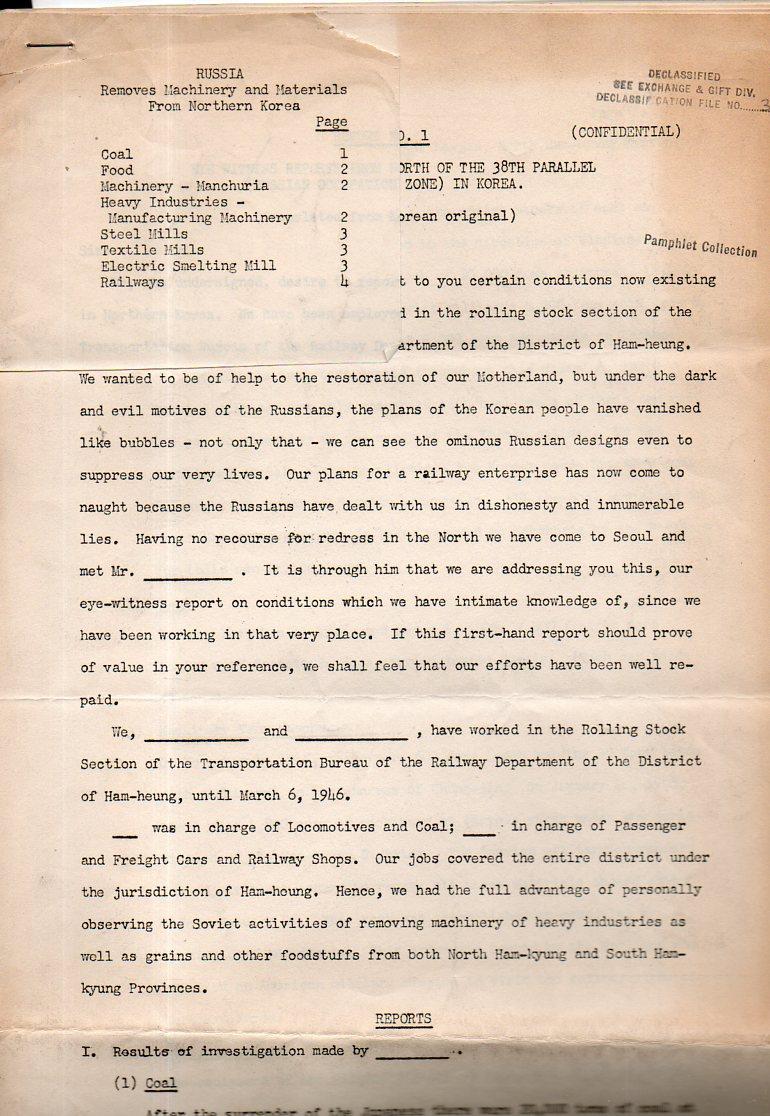
    Report No. 1. (Confidential) Eye Witness Reports from North of the 38th Parallel (Russian Occupation Zone) in Korea. 13×8″, 5 leaves, offset printed. Offset printed. WorldCat/OCLC locates NO copies. $750

    Condition: old vertical fold at the bottom quarter. Stamped “declassified” by the exchange and gift division, Library of Congress, with their surplus/duplicate stamp on the rear page.

    There are various reports with the “eyewitness” names left out, replaced by subscript lines. The materials removed are categorized so: coal, food, machinery, Manchuria, heavy industries, manufacturing machinery, steel mills, textile mills, electric smelting mill, railways, and so on.

    This document seems to offer proofs of large-scale stripping of North Korean facilities back to the Soviet Union–at just the time when it was said that there perhaps wasn’t good evidence for this. (See: The North Korean Revolution, 1945–1950 By Charles K. Armstrong, page 150, available online).

    ·Posted by :

    ·in:

    —
  • Mendeleev on the Discovery of Gallium (1876)

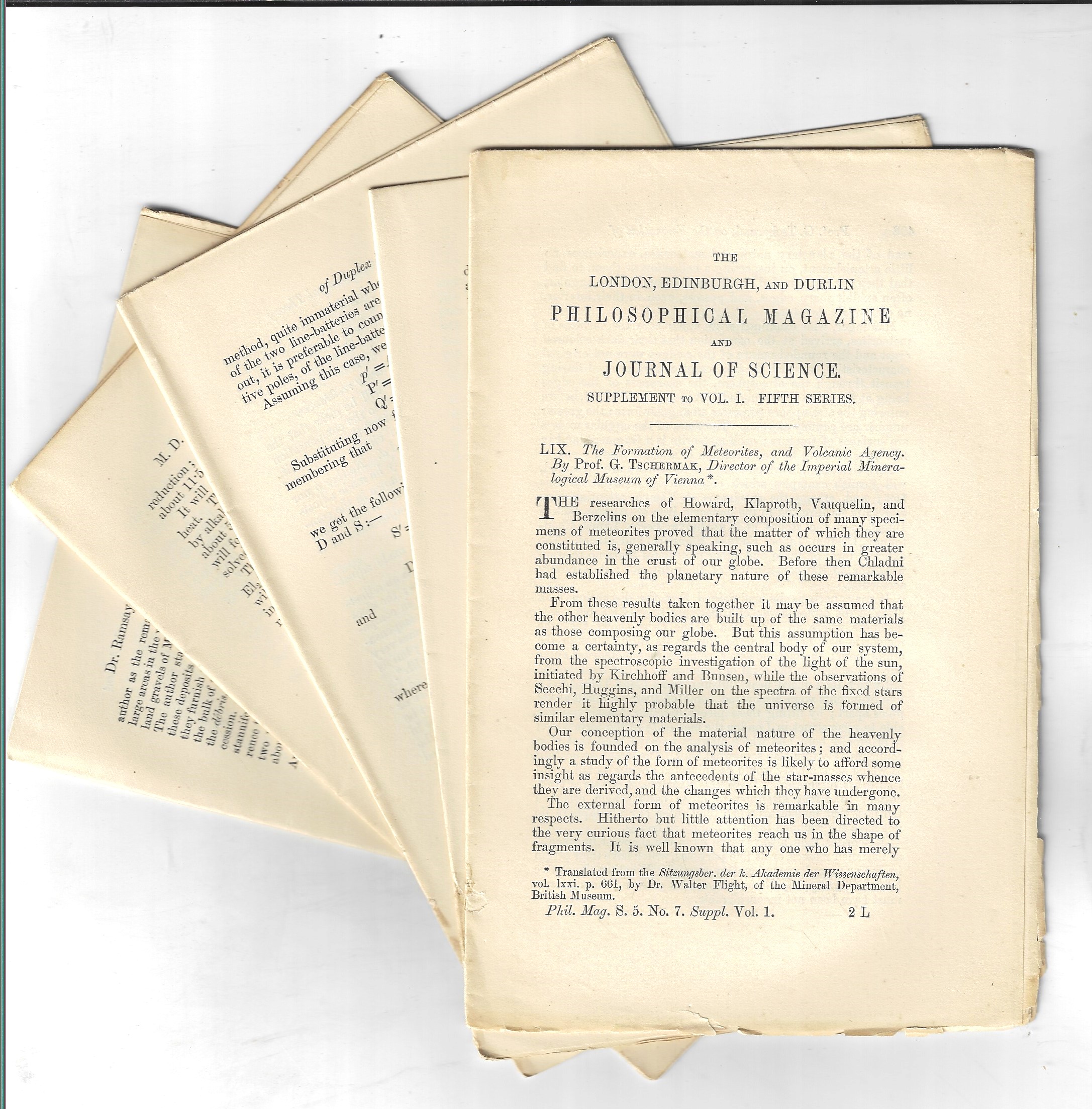
    MENDELEEV (MENDELEJEFF), Dmitri. "Remarks on the Discovery of Gallium" in The London, Edinburgh, and 
    Dublin Philosophical Magazine and Journal of Science,
    London, 1876. Supplement to vol I, fifth series, 1876,
    pp 542-546.
    Offered in the original unbound parts, pp (497)-576, in the five original quires, plus a sixth being the table of contents
    for the entire 576pp volume. Very unusual to my experience. Unopened and uncut. Fine condition. $450
    This is the first appearance in English of this work, translated from the French by Pattison Muir from “Remarques
    a propos de la devouverte du gallium; par M.D. Mendeleeff” and published in the
    Comptes Rendus. de l'Academie
    des Sciences,
    22 Novembre 1875.

    Mendeleev Gallium
    “The discovery of gallium has great significance to Mendeleev’s development of the periodic table as it was the first new element discovered since Mendeleev’s 1869 table. In 1871 Mendeleyev had prepared a table of known elements leaving gaps for those “elements yet to be discovered”, one of these being eka-aluminium. Four years later, a Frenchman Paul Emile François Lecoq de Boisbaudran discovered this element spectroscopically (two violet lines) during an examination of a zinc blende from the Pyrenees. Lecoq’s newly discovered element was found to have an atomic weight of 69 and appeared to have the properties that Mendeleev had predicted for eka-aluminium…gallium’s most important modern day use is in electronic devices. Semiconductor use is now almost the entire world market for gallium. However, new uses in alloys and fuel cells continue to be discovered…”–Luke McGuiness, Royal Australian Chemical Institute, “Gallium”.

    Mendeleev writes on the prediction of “gallium” and the verification of the periodic table:
    “In 1869 I announced the following periodic law:  "The  properties of the simple bodies, as also the properties and 
    constitution of their combinations, are periodic functions of the atomic weights of the elements....Among the
    different applications of that law I shall cite only the following :
    “1. This law constitutes the basis of a complete systematic classification of the elements...It ought to be remarked
    that, previous to the discovery of the periodic law, it was not possible to predict the existence or to foretell the
    properties of undiscovered elements...”
    “M. Lecoq de Boisbaudran has discovered, by means of spectral analysis, the existence of a new element in the
    blende of Pierrefitte (Pyrenees) ; to this element he has given the name of gallium. The manner of its discovery,
    the process for its separation (precipitation by sulphuretted hydrogen before zinc), and certain of its properties
    (precipitation by barium carbonate, solubility of the hydrate in ammonia, degree of volatility, &c), make it
    probable that the new metal is no other than eka alu-minium...If subsequent researches confirm the identity
    of the pro- perties of gallium with those which I have pointed out as belonging to eka aluminium, the discovery
    of this element will furnish an interesting example of the utility of the periodic law. Let us hope that the
    discovery of eka silicium, Es = 72, Es0 2 , the probable properties of which I have detailed in Liebig's
    Annalen, vol. viii. (Suppl.) p. 171, will not be long delayed.”--from this paper.

    “The discovery of gallium has great significance to Mendeleev’s development of the periodic table as it was the first new element discovered since Mendeleev’s 1869 table. In 1871 Mendeleyev had prepared a table of known elements leaving gaps for those “elements yet to be discovered”, one of these being eka-aluminium. Four years later, a Frenchman Paul Emile François Lecoq de Boisbaudran discovered this element spectroscopically (two violet lines) during an examination of a zinc blende from the Pyrenees. Lecoq’s newly discovered element was found to have an atomic weight of 69 and appeared to have the properties that Mendeleev had predicted for eka-aluminium…gallium’s most important modern day use is in electronic devices. Semiconductor use is now almost the entire world market for gallium. However, new uses in alloys and fuel cells continue to be discovered…”–Luke McGuiness, Royal Australian Chemical Institute, “Gallium”.

    See also: Early Responses to the Periodic System, edited by Masanori Kaji, Helge Kragh, Gabor Pallo.

    ·Posted by :

    ·in:

    —
  • Kilsoo K. Haan/OSS (CIA) Copy

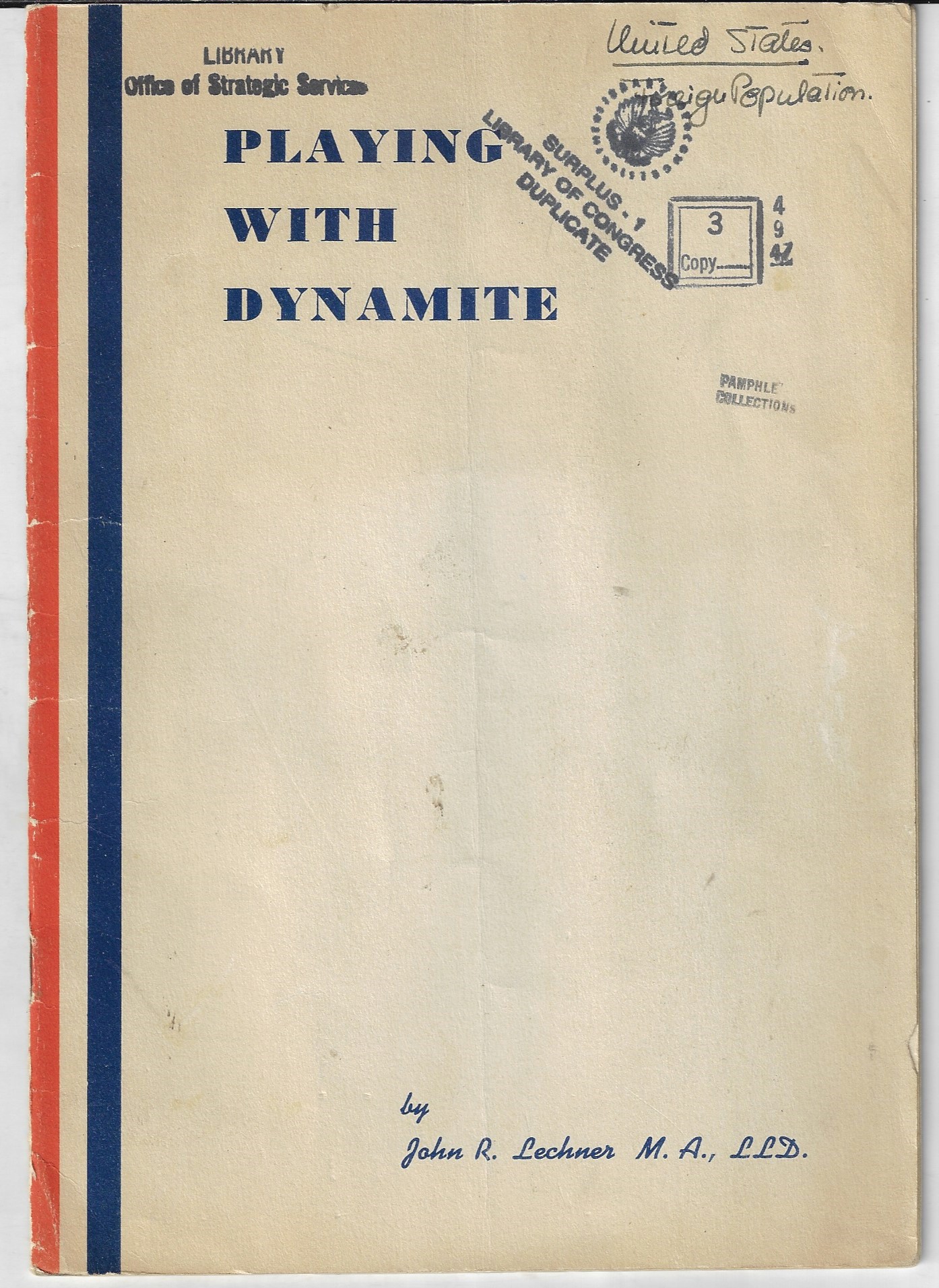
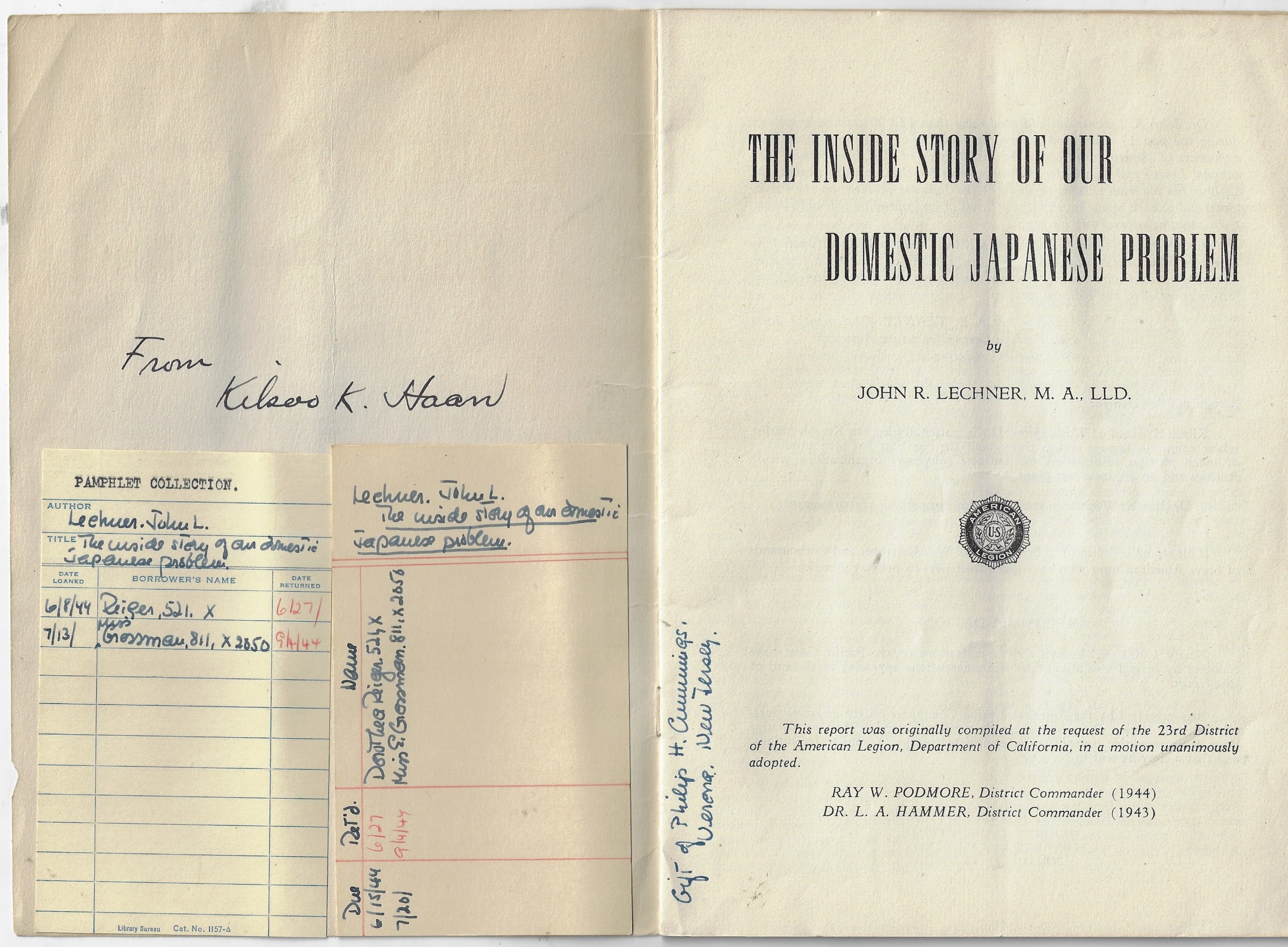
    Lechner1, John R. The Inside Story of our Domestic Japanese Problem. (1944) American Legion of California. 10”x 7”, 18pp. Provenance: Kilsoo K. Haan2, to Phillip H. Cummings, who gave this to the Library of the Office of Strategic Services (OSS, precursor of the CIA), and from there to the Library of Congress. Rubber stamps for the OSS library and for the Library of Congress.

    Only 5 copies located in WorldCat (all in the U.S.) There is also an OSS borrowing slip (with two entries) in the rear pocket of the pamphlet.

    Condition: there is an old vertical fold that runs through the pamphlet. A GOOD copy. $350

    Lechner _2_Lechner—a one-time champion of the Japanese in the U.S. Turned completely against his old allies following some extended interlude after Pearl Harbor, and became a virulent proponent for the military control and incarceration of Japanese-descent people in the U.S. He also proposed the incarceration of all people of Japanese descent in the U.S., including Hawaiians. This pamphlet outlines some of his theories about people of Japanese descent in the U.S., how they planned to sabotage the country, and how they must be removed from the areas around the U.S. and never be allowed to be part of national society again without adopting certain Japanese principles (including the renouncing of Shintoism).

    To give you some ides of the depth of Lechner’s anti-Japanese thinking, here are some of the pamphlet’s section subheads: “Japanese Language Schools” under consideration for subversive activity; “Japanese Children Attending Public School” (to “preserve the magnificent Japanese culture”; “Imperial Educational Association”, “…the control exercised by Japan…over Japanese-American youth”; “Nisei as Propaganda Agents for Japan”; “The Future Road of the Nisei”(on the role of Nisei working for the interests of Japan); “Kebei Organizations (“…brazen violation of mutual friendship …(via) an enticement of Nisei to pursue cultural training in Japan”); “Kebei Organizations” (stating that these cultural organizations are part of Japan’s “shrewd” conduct of their total war against the U.S.); “Japanese Conscription of the Nisei”; “Local Japanese Subversive Organizations”; “Imperial Comradeship Society”, (“arm of the Imperial Black Dragon Society, most powerful and most feared secret organization in the Japanese Empire…to eradicate Occidental influence in the Far East”); “Behind the Scenes at Manzanar”, (on riot and resistance at the camp); and of course “Bacteria Warfare”, (“this was to be accomplished by dropping vials containing germs, to spread bubonic plague…”). Finishing up the pamphlet is “No Time for Sentiment” (“No Christian leader can find fault with the the human treatment if the Japanese by our government”) and that there was no “race hatred” because there was a fallacious logic involved in “not understanding the meaning of race hatred”. Lastly there is a small section called “American Appeasers” listing nine U.S. Organizations working in the interest of Japanese Americans (including the (American) Civil Liberties Union

    Lechner addresses the fact that no sabotage had been committed by any Japanese-American to 1944 as an instance of them being instructed by Japan “NOT to commit sabotage in the first stage of the war”, a classic bad logic (that I’ve seen often in these documents) where something is proved to be so precisely because there was no existing evidence to show it to be the case.

    Lechner _1_

    Notes

    1. “Americanization” and anti-Communist activist. “Dr.” John Lechner (1900–67), first allied himself with Nisei patriotic efforts just prior to World War II, then became one of the most strident voices for the mass eviction of Japanese Americans from the West Coast and against their return –https://encyclopedia.densho.org/search/

    2. “Kilsoo Haan was a Korean nationalist figure who rose to prominence in Hawai’i in the 1930s and the U.S. mainland in the early 1940s, engaging in intelligence activities through the Sino-Peoples League. Claiming that Koreans in Manchuria, Siberia, China, and America could be indispensable in aiding the United States against Japanese militarism, Haan drew considerable attention from the American public as well as from U.S. government and military officials.” https://encyclopedia.densho.org/search/

    ·Posted by :

    ·in:

    —
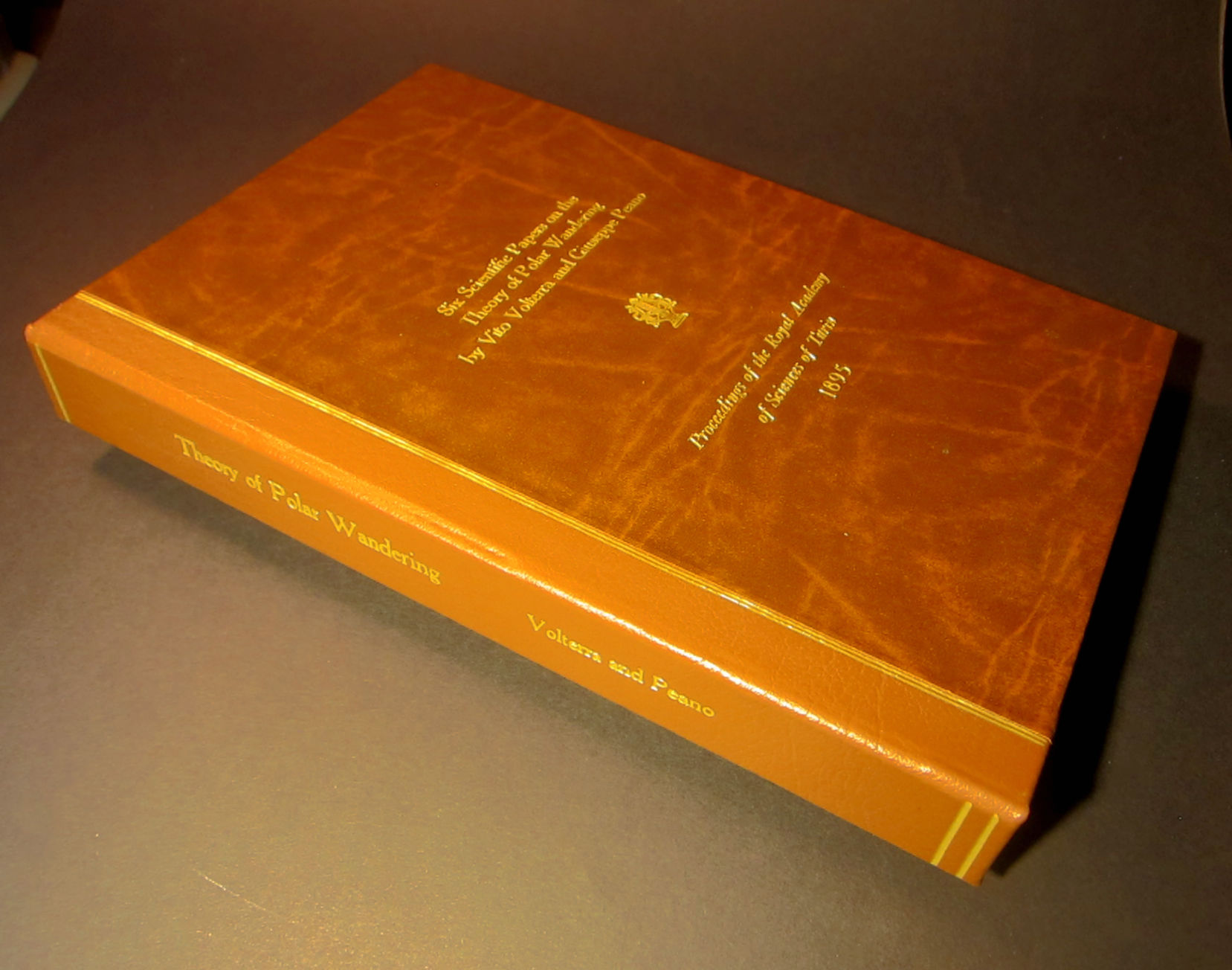
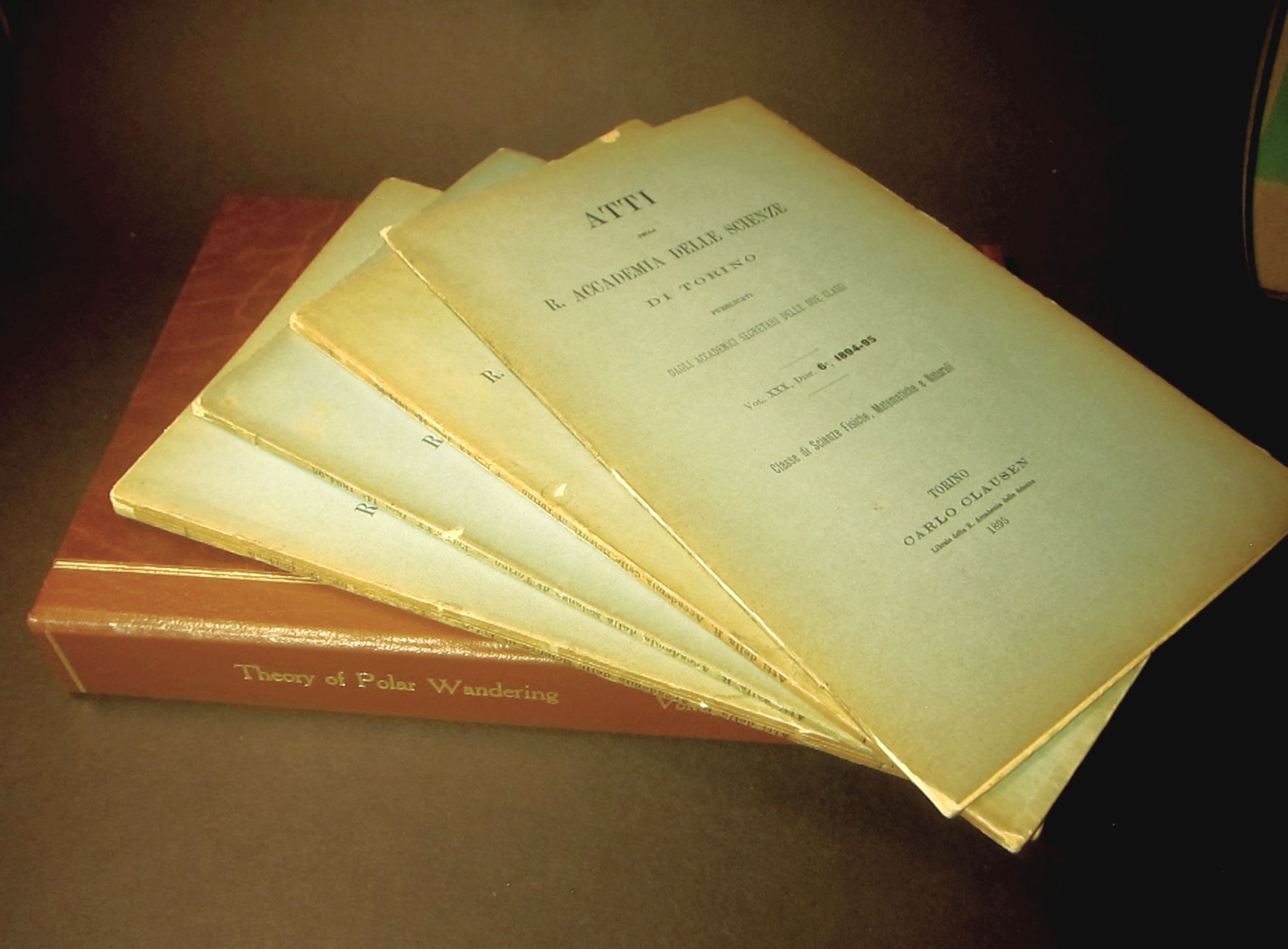
  • Volterra Vito 1860 1940 And Giuseppe Peano 1858 1932 Six Papers In Four Parts 1895 On The Theory Of Polar Wandering

    VOLTERRA, Vito (1860-1940) and Giuseppe Peano (1858-1932), Six papers in four parts, 1895, on the Theory of Polar Wandering, all in Atti della R. Accademia delle Scienze di Torino. These include: “Sopra lo spostamento del polo sulla terra” (30 No. 12 pp. 515-523, May 1895); “Sul moto del polo terrestre”, 30 No. 15 pp. 845-852, June 1895) by Giuseppe Peano AND “Sulla Teoria dei moti del Polo Terrestre” 30 No. 6 pp. 167-172, February 1895); “Sui moti periodici del polo terrestre” 30 No. 12 pp. 815-816, May 1895); “Sulla Teoria dei moti del Pollo nella Ipotesti della Plasticita Terrestre” 30 No. 14 pp. 461-474, June 1895) and “Osservazioni sulla mia Nota: ‘Sui moti periodici del polo terrestre’ ” 30 No. 15 pp. 815-816, June 1895), all by Vito Volterra. The four issues are in their original wrappers in Very Good condition and are housed in a beautiful custom clamshell box. $1250

    Volterra _2_
    Volterra _2_

    “Polar wandering is the shifting of the Earth’s axis of rotation over time, a phenomenon associated with continental drift. Polar wandering was first proposed by the Compte de Buffon, but Italian mathematicians Guiseppe Peano and Vito Volterra were the first two scientists to study it rigorously, with their first reports appearing in 1895 in these four issues of the Proceedings of the Royal Academy of Sciences of Turin. Peano’s papers are titled: “Concerning the movement of the Earth’s poles” and “On the movement of the Earth’s pole.” Volterra’s papers are titled: “On the Theory of the Earth”s Polar motions;” “On the periodic motions of the earth’s pole;” “On the theory of the motions of the poles in the hypothesis of Terrestrial Plasticity;” and “Observations on my Note: ‘On the periodic motions of the earth’s pole’.”

    Arthur A. Meyerhoff, et al,, Surge Tectonics: A New Hypothesis of Global Geodynamics (Kluwer, 1996), pointing out that the Buffon idea was generally adrift in his massive 44-volume work, and only gained popularity with the work of Peano and Volerra.

    ·Posted by :

    ·in:

  • Balmer Johann Notiz ÜBer Die Spectrallinien Des Wasserstoffs Note On The Spectral Lines Of Hydrogen In Annalen

    BALMER, Johann. “Notiz über die Spectrallinien des Wasserstoffs” (“Note on the spectral lines of hydrogen”) in Annalen der Physik und Chemie, 1885, 25 pp. 80–87, 1885). Volume in contemporary cloth and boards. Small sticker to spine. Interior clean  and fresh and with no marks. Almost fine. $600

    “In 1885…Balmer create(d) a simple mathematical formula to list the particular wavelengths at which a hydrogen atom radiates light and publishes it in [this paper].” Claire Parkinson, Breakthroughs p. 409.

    “In 1885, Johann Jakob Balmer (1825–1898), a Swiss mathematics teacher, published the “Balmer formula” for the spectral lines in the hydrogen spectrum without stating any underlying physical theory. He had noticed that every line in the hydrogen spectrum in the visible light region was related to a single number (364.56 nanometers), and from this concocted a formula that correctly predicted other spectral lines in the visible and infrared spectrum (the “Balmer series”).” Wenner, History of Physics

    “Balmer’s major article on the hydrogen spectrum is “Notiz ūber die Spektrallinien desPage Wasserstoffs,” in Verhandlungen der Naturforschenden Gesellschaft in Basel, 7 (1885), 548-560, 750-752; also in Annalen der Physik, 3rd ser., 25 (1885), 80-87.”–DSB online

    “The Balmer series, or Balmer lines in atomic physics, is one of a set of six named series describing the spectral line emissions of the hydrogen atom. The Balmer series is calculated using the Balmer formula, an empirical equation discovered by Johann Balmer in 1885.”–Wikipedia

    ”Although physicists were aware of atomic emissions before 1885, they lacked a tool to accurately predict where the spectral lines should appear. The Balmer equation predicts the four visible spectral lines of hydrogen with high accuracy. Balmer’s equation inspired the Rydberg equation as a generalization of it, and this in turn led physicists to find the Lyman, Paschen, and Brackett series, which predicted other spectral lines of hydrogen found outside the visible spectrum.”–Wolfram

    “In 1913 Bohr proposed his quantized shell model of the atom (see Bohr atomic model) to explain how electrons can have stable orbits around the nucleus. The motion of the electrons in the Rutherford model was unstable because, according to classical mechanics and electromagnetic theory, any charged particle moving on a curved path emits electromagnetic radiation; thus, the electrons would lose energy and spiral into the nucleus…Bohr’s model accounts for the stability of atoms because the electron cannot lose more energy than it has in the smallest orbit, the one with n = 1. The model also explains the Balmer formula for the spectral lines of hydrogen. The light energy is the difference in energies between the two orbits in the Bohr formula. Using Einstein’s formula to deduce the frequency of the light, Bohr not only explained the form of the Balmer formula but also explained accurately the value of the constant of proportionality R.”–Encyclopedia Britannica

    ·Posted by :

    ·in:

  • Feynman Rp And Others In The Physical Review Volume 75 January 1 June 151949 Entire Volume Pp 1 2012 Very Sturdy Bla

    FEYNMAN, R.P. and others in the Physical Review, Volume 75, January 1-June 15,1949. Entire volume, pp 1-2012. Very sturdy black cloth. Provenance “USRL” (stamped at foot of spine),  stamp on front free endpaper, missing library car pocket at rear paste down, otherwise very clean and bright. A Fine copy.

    FEYNMAN, Richard P. and N. Metropolis, and E. Teller. “Equations of State of Elements Based on the Generalized Fermi-Thomas Theory.” Lancaster: American Physical Society, 1949. The Physical Review vol 75 number 10, May 15, 1949. Pp 1561-1573. From the PROLA part of the APS website: “The Fermi-Thomas model has been used to derive the equation of state of matter at high pressures and at various temperatures. Calculations have been carried out both without and with the exchange terms. Discussion of similarity transformations lead to the viral theorem and to correlation of solutions for different Z values.”

    Also in this volume:

    • BARDEEN, John and Walter Brattain: Physical Principles Involved in Transistor Action, pp 1208-1226, the work for which Bardeen shared the Nobel Prize for physics in 1972.
    • BARDEEN, Pressure Change of Resistance of Tellurium , Letter in Volume 75, No.11, June 1, 1949 at pp. 1777.
    • FERMI, E. On the Origin of the Cosmic Radiation , pp 1169-1174
    • DYSON, F. “The Radiation Theories of Tomonaga, Schwinger, and Feynman”, pp 486-502
    • DYSON, F. S-Matrix in Quantum Electrodynamics, p 1736
    • SCHWINGER, J. “Quantum Electrodynamics. II. Vacuum Polarization and Self-Energy”, pp 651-679 ALFVEN, H. “On the Origin of Cosmic Rays”, pp 892-3
    • ALPHER, Ralph and Robert Herman, Remarks on the evolution of the expanding universe , p. 1089

    ·Posted by :

    ·in:

  • Dirac Pam Quantum Theory Of Localizable Dynamic Systems American Physical Society In The Physical Review 739 1 May 1

    DIRAC, P.A.M. “Quantum Theory of Localizable Dynamic Systems”, American Physical Society, in the Physical Review, 73/9, 1 May 1948. Original printed wrappers. Very good condition. $250

    Abstract from AIP’s great PROLA website: “A dynamical system is called localizable if its wave functions can be expressed in terms of variables, each referring to physical conditions at only one point in space-time. These variables may be at points on any three-dimensional space-like surface in space-time. A general investigation is made of how the wave function varies when the surface is varied in any way. The variation of the wave function is given by equations of the Schroedinger type involving certain operators Hn(u) which play the role of Hamiltonians. The commutation relations for these operators are obtained. The theory works entirely with relativistic concepts and it provides the general pattern which any relativistic quantum theory must conform to, provided the dynamical system is localizable.”

    AND: “Dirac was also original in his conception of the role of probability in quantum mechanics. He thought that probabilities entered into the description of quantum phenomena only in the determination of the initial state (still described in terms of p s and q s), and not necessarily in the behavior of an isolated system. But, as Bohr had said at the Solvay Conference in 1927, isolated systems were unobservable. Dirac then assumed that the state of the world was represented by its wave function …; and that it changed abruptly during a measurement, whereupon nature made a choice.” — Complete Dictionary of Scientific Biography, vol. 17, Charles Scribner’s Sons, 2008, pp. 224-233. 

    ·Posted by :

    ·in:

    —
  • From the Earliest Period of pre-Cinematography (1894)


    MAREY, Étienne-Jules.“Des mouvements que certains animaux exécutent pour retomber sur leurs pieds, lorsqu’ils sont précipités d’un lieu élevé” by Étienne-Jules Marey (Comptes rendus 119, pp. 714–718, 1894). A big volume bound in contemporary leather and boards. Some wear to spine leather; otherwise fine inside and out. 1250.00

    “Étienne-Jules Marey was a French scientist, physiologist and chronophotographer, best known for the invention and use of a chronophotographic gun, an instrument capable of taking 12 consecutive frames a second, with all the frames recorded on the same picture. Using these pictures he studied the motion of a wide range of animals called Marey’s ‘animated zoo’”.–Wenner, History of Physics

    This paper contains the famous falling/dropped/thrown cat experiment in which Marey shows that when dropped with its back towards the ground a cat will respond and right itself via muscular reaction to land on its feet, all of the time. It was not a trick of “air pressure” or other such thing which Marey dismissed, as once the action of the fall is slowed so that the whole of the activity can be intelligently observed, and it was by the animal’s movement alone that brings it to land on its feet. It is Marey’s instrumentation that takes the day, using a camera capable of making 60 images per second, which was a huge advance over his chronophotographic gun of 1882 which made 12 images/second. Marey remarks that this animal action is true in other animals, giving the examples of rabbit and dog.

    Marey is a rather stiff writer and takes his time to explain himself in extended detail—this isn’t an entertaining story though the results are of course fantastic.

    That piece of needling aside, Marey is one of my favorite 19th century science figures. He worked across numerous fields, though I think his great importance is in the invisible-to-visible part–that he was able to make was were essentially moving pictures of complex and/or fast action, displaying motion in shockingly easy manner. His work opened as much of a new and surprising world as that of Lippershey/Galileo and Co. with the telescope and Janssen/Leeuwenhoek/ and the others with the microscope.  

    “In Marey’s view, physiology “is itself but the study of organic movements,” and the graph best represents all the variations that such phenomena undergo. Marey believed, however, that these motions ultimately were to be explained by laws of physics and chemistry. Furthermore, while he accepted the application of physiological research to medical problems, he subordinated this utilitarian purpose to a more abstract goal: “analyzing the conditions which modify the functions of life and … better determining the laws which regulate these functions.” Toward this end medicine served only as one further means of analysis.”–Complete DSB.  “Marey constructs, according to the reversible principle of the chronophotograph, an apparatus for the projection on a screen of series of pictures taken by the aforementioned apparatus and thus realizes the photographic synthesis of motion.”–Eder, History of Photography.   See: Tosi, Virgilio, Cinema before cinema : the origins of scientific cinematography. London : British Universities Film & Video Council, 2005. Also: ARTE France. Roll on, Cinema. NY, Infobase, 2014. [Video]. Also: Alder Anderson, Analysing motion. Marlborough, England: Adam Matthew Digital, [2012]. Laurent Mannoni, Marie-Sophie Corcy, Thierry Pozzo … [et al.]. Images, science, mouvement : Autour de Marey. Paris : Harmattan, 2003. 

    For further reading see G. Gbur’s Falling Felines and Fundamental Physics, Yale, 2009.


    ·Posted by :

    ·in:

    —

Recent Posts

Archives

Categories