A Daily History of Holes, Dots, Lines, Science, History, Math, Physics, Art, the Unintentional Absurd, Architecture, Maps, Data Visualization, Blank and Missing Things, and so on. |1.6 million words, 7500 images, 4.9 million hits| Press & appearances in The Times, Le Figaro, Mensa, The Economist, The Guardian, Discovery News, Slate, Le Monde, Sci American Blogs, Le Pont, and many other places… 5000+ total posts since 2008.

  • Boltzmannludwig ÜBer Eine Von Hrn Bartoli Entdeckte Beziehung Der WäRmestrahlung Zum Zweiten Hauptsatze And With

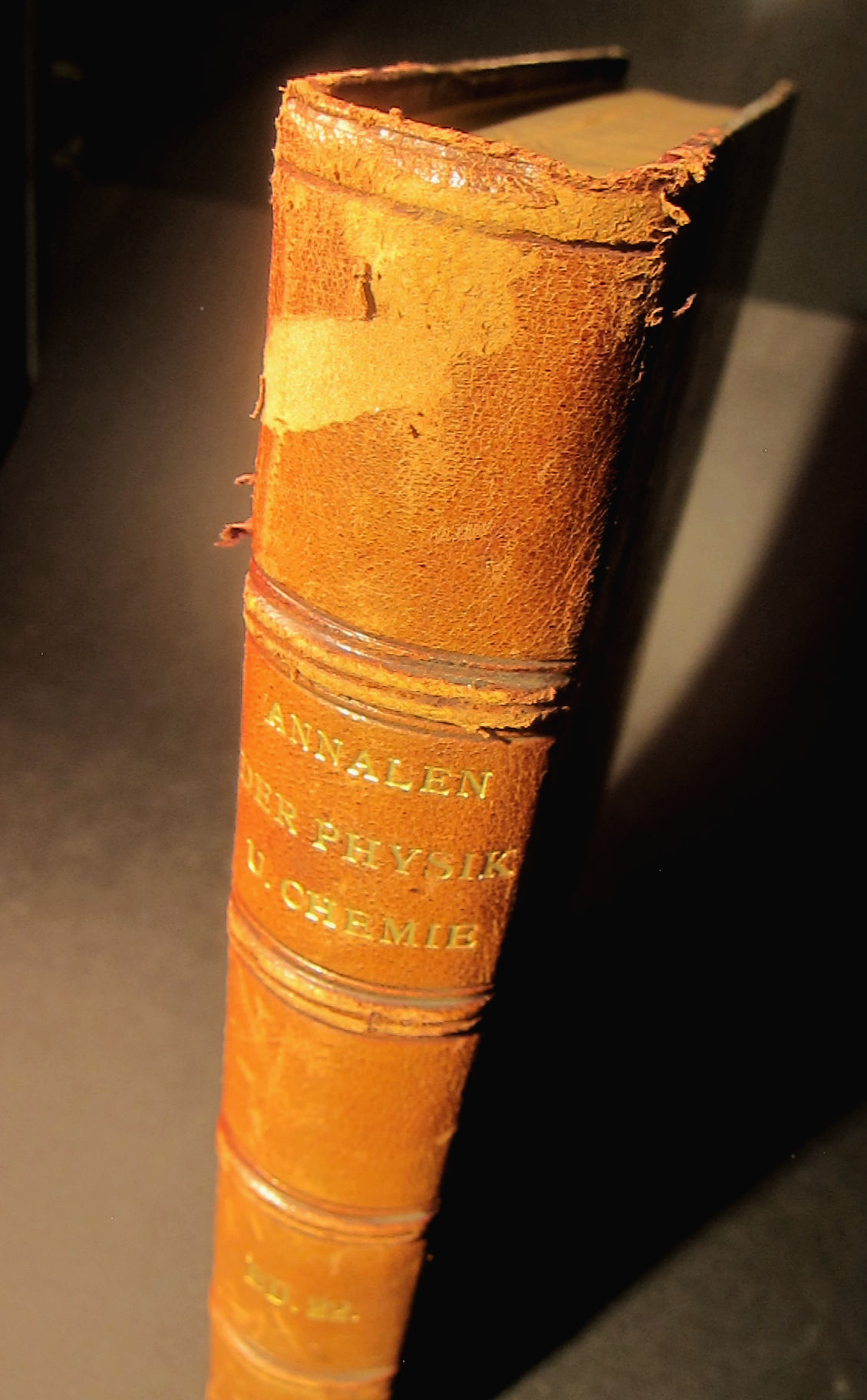
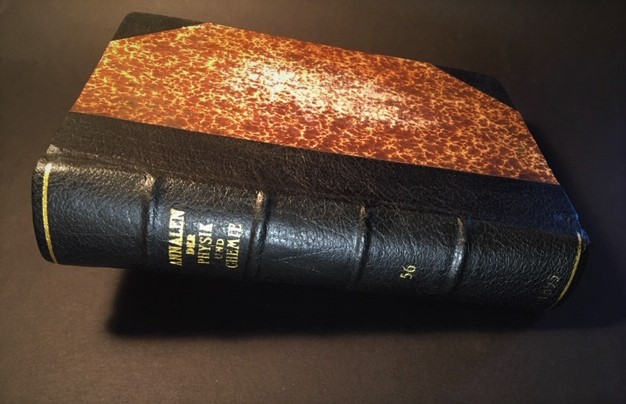
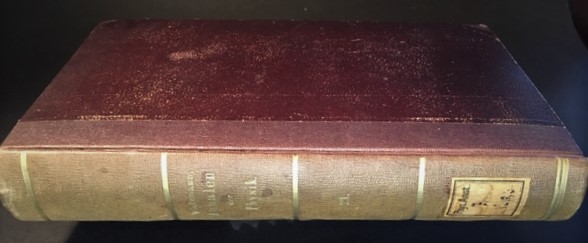
    BOLTZMANN,Ludwig. “Über eine von Hrn. Bartoli entdeckte Beziehung der Wärmestrahlung zum zweiten Hauptsatze” AND WITH “Ableitung des Stefan’schen Gesetzes, betreffend die Abhängigkeit der Wärmestrahlung von der Temperatur aus der electromagnetischen Lichttheorie” [Derivation of Stefan’s law, concerning the dependency of heat radiation on temperature, from the electromagnetic theory of light], both in Annalen der Physik und Chemie, 1884, vol 22 pp. 31–39 and 291-294 in the volume of 616pp (with 9 folding plates).


    Boltzmann _1_

    Bound in contemporary calf with raised bands, and decorated boards, marbled edges. There is some small bit of rubbing two scrapes, but the volume still has a very nice appearance, and is quite tight and fresh. A near-fine copy, overall. $650

    These two papers by Ludwig Boltzmann leading to the derivation of the Stefan-Boltzmann law. “A derivation of the law from theoretical considerations was presented by Ludwig Boltzmann (1844–1906) in 1884, drawing upon the work of Adolfo Bartoli…(who) in 1876 had derived the existence of radiation pressure from the principles of thermodynamics. Following Bartoli, Boltzmann considered an ideal heat engine using electromagnetic radiation instead of an ideal gas as working matter.”–Wikipedia

    Boltzmann _1_

    “Bartoli’s reasoning stimulated Boltzmann to work out a theoretical derivation, based on the second law of thermodynamics and Maxwell’s electromagnetic theory, of the fourth—power law previously found experimentally by Stefan…Although at the time the “Stefan-Boltzmann law” for radiation seemed to be an isolated result with no further consequences, it did at least show a possible connection between thermodynamics and electromagnetism that was exploited in the later quantum theory. In the 1920’s it was applied by Eddington and others in explaining the equilibrium of stellar atmospheres.”–Complete Dictionary of Scientific Biography online

    (“The Stefan–Boltzmann law describes the power radiated from a black body in terms of its temperature. Specifically, the Stefan–Boltzmann law states that the total energy radiated per unit surface area of a black body across all wavelengths per unit time  (also known as the black-body radiant emittance) is directly proportional to the fourth power of the black body’s thermodynamic temperature T”–Wikipedia)

    Boltzmann _1_

    ·Posted by :

    ·in:

  • The Four Color Theorem

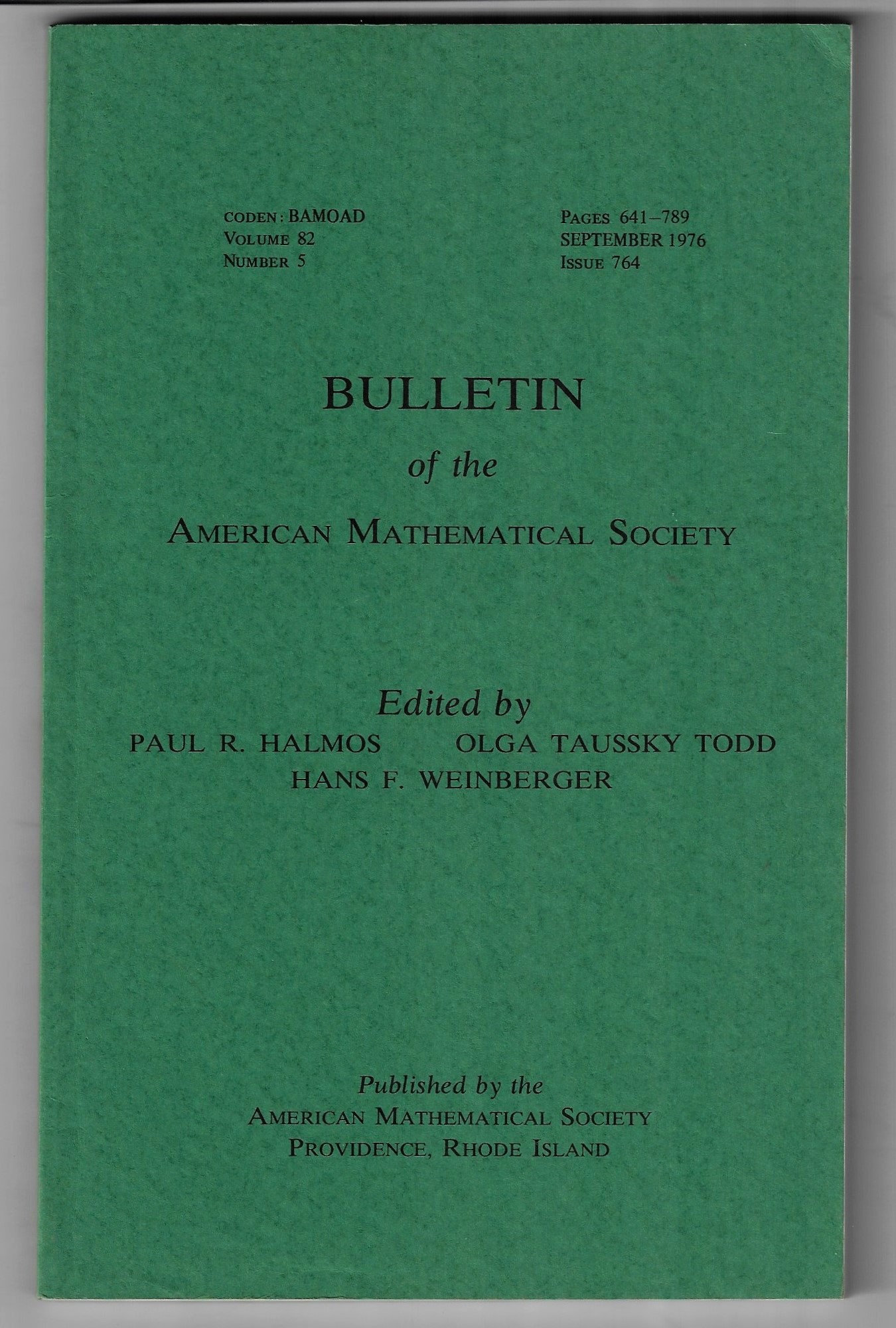
    APPEL, Kenneth and Wolfgang Haken, “Every Planar Map is Four Colorable”, in Bulletin of the American Mathematical Society, 1976, vol 82 No. 5 pp. 711-712, September 1976, in the issue of pp 641-789. Original wrappers. Very fine copy—beautiful. . $450

    4CCThis is the announcement of the proof of the four color conjecture (4CC), cited 1800+ times.

    “The four color theorem is a theorem in topology that states that no more than four colors are required to ensure than no two contiguous regions on a map have the same color. The question was first posed by Francis Guthrie in 1852 but wasn’t proven until 1976 when University of Illinois mathematicians Kenneth Appel and Wolfgang Haken proved it using a computer. This was the first major theorem proven using a computer [using 1200 hours of 1975/6 computer time].”–Wenner, History of Physics

    “The four-color theorem states that any map in a plane can be colored using four-colors in such a way that regions sharing a common boundary (other than a single point) do not share the same color. This problem is sometimes also called Guthrie’s problem after F. Guthrie, who first conjectured the theorem in 1852. The conjecture was then communicated to de Morgan and thence into the general community. In 1878, Cayley wrote the first paper on the conjectureSix colors can be proven to suffice for the  case, and this number can easily be reduced to five, but reducing the number of colors all the way to four proved very difficult. This result was finally obtained by Appel and Haken (1977), who constructed a computer-assisted proof that four colors were sufficient. However, because part of the proof consisted of an exhaustive analysis of many discrete cases by a computer, some mathematicians do not accept it. However, no flaws have yet been found, so the proof appears valid. ”–Wolfram Mathworld,

    ·Posted by :

    ·in:

  • The Photoelectric Effect (1888)

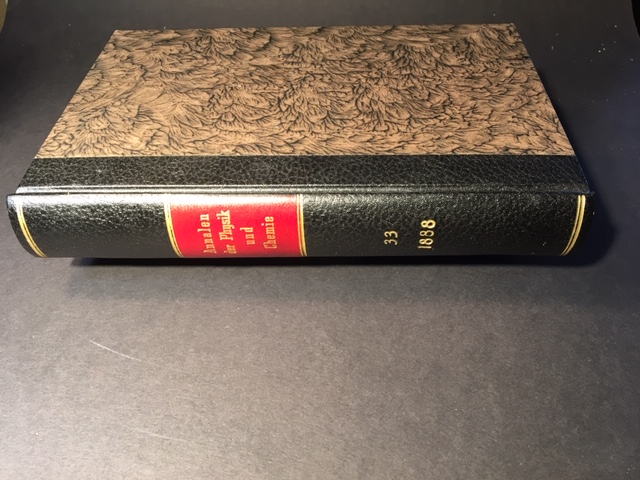
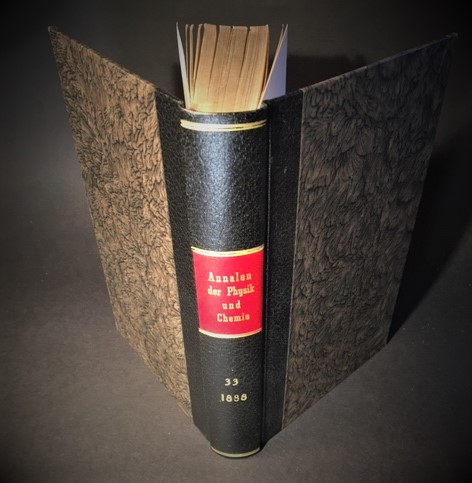
    HALLWACHS, Wihelm. “Über den Einfluss des Lichtes auf electrostatisch geladene Körper” by Wilhelm Hallwachs” in Annalen der Physik und Chemie, 1888; Leipzig, Johann Ambrosius Barth, vol 33 pp. 301– 312. Recently bound in period style leather and boards. Appears pristine other than very small very light library stamp on title page. $550

    Hallwachs 1888 _2_

    “Hallwachs (1859-1922) was one of the pioneers of modern physics. An experimental physicist, he laid the foundations for research on photoelectric processes…At Leipzig in 1888 he investigated, following the model of Heinrich Hertz’s studies, photoelectric activity, establishing that through absorption of ultraviolet light, negatively charged metal plates discharge and uncharged metal plates become positively charged. This process, which is called the photoelectric effect or Hallwachs effect, forms the basis for the physics of the photoelectric cell and was theoretically interpreted in 1905 in Einstein’s work on light quanta….”–Complete Dictionary of Scientific Biography online

     “Hallwachs wrote about 50 scientific papers. The most important are “Ueber den Einfluss des Lichtes auf electrostatisch geladene Körper,”[this paper] in Annalen der Physik und Chemie, n.s. 33 (1888), 301–312; “Ueber die Electrisierung von Metallplatten durch Bestrahlung mit electrischem Licht,” ibid., n.s. 34 (1888), 731–734; “Ueber den Zusammenhang des Electricitätsverlustes durch Beleuchtung mit der Lichtabsorption,” ibid., n.s. 37 (1889), 666–675.”–DSB

    ”In 1888 Hallwachs formulated the hypothesis that a conductive plate on which to focus ultraviolet light carries a positive charge because the electrons are gouged out. This happened with more intensity in selenium. The phenomenon was seen in the same year by A. Righi. The phenomenon was called ‘Hallwachs-Effekt’, now called the photoelectric effect. The investigation of the photoelectric effect laid the foundation for the development of the photoelectric cell, photo electricity and Albert Einstein’s quantum light hypothesis.”–Wikipedia

    “The photoelectric effect forms the basis for the physics of the photoelectric cell and was theoretically interpreted in 1905 in Einstein’s work on light quanta.  Hallwachs’ observations laid the foundation for the later development of photo cells, TV camera imaging and other light-sensitive electronic devices.”–Lisa Ann Pinkerton, “Photoelectric Effect Discovery Leads to Photo Cell Development”–Technica Communications.

    See also: Harald Goldbeck-Lowe, “The Hallwachs-Effect – The Photoelectric effect – Gate to Quantum Physics “- Poster DIN A0, 2012, Conference: IX. International Conference for the History of Science in Science Education. Project: Roots of Quantum Physics.

    Hallwachs 1888 _1_

    ·Posted by :

    ·in:

    —
  • Einthoven Willem Eine Isolationsvorrichtung Gegen Erschutterungen Der Umgebung In Annalen Der Physik Und Chemie 1895 Vol

    EINTHOVEN, Willem. “Eine Isolationsvorrichtung gegen Erschutterungen der Umgebung”, in Annalen der Physik und Chemie, 1895, vol 56, pp. 161- 166. Bound in period style leather and boards. Number on title page; otherwise beautiful, fine and clean  $350.00

    “In 1895, after the London physiologist A. D. Waller had published the curve for the action current of the heart as deduced from the body surface and had announced that he was unable to calculate its true shape (as recorded with Lippmann’s capillary electometer), Einthoven repeated this experiment. He defined the physical constants of the capillary electrometer and calculated the true curve, which he called the electrocardiogram.” – DSB.

    EInthoven

    “The first accurate recording of the electrocardiogram ...Einthoven, using an improved electrometer and a correction formula developed independently of Burch, distinguishes five deflections which he names P, Q, R, S and T.”–ECG Libvrary

    “Einthoven derived a correction formula that compensated for the inertia and friction when using the mercury column of the Lippmann capillary electrometer….and…superimposed the mathematically corrected curve on the uncorrected curve. He had previously used ABCD to indicate the waves in the uncorrected tracing, and was forced to find other letters to label his corrected curve.”–Dr. Mike Cadogan, “History of the Electrocardiogram”.

    Einthoven received the Nobel Prize in 1924 “for his discovery of the mechanism of the electrocardiogram.” Nobel, the Man and his Prizes, pp. 262-265.

    Wasson, Nobel Prize Winners, pp. 294-295

  • Clausius Rudolf ÜBer Einen Auf Die WäRme Anwendbaren Mechanischen Satz Eine VeräNderte Form Des Zweiten Hauptgesatzes

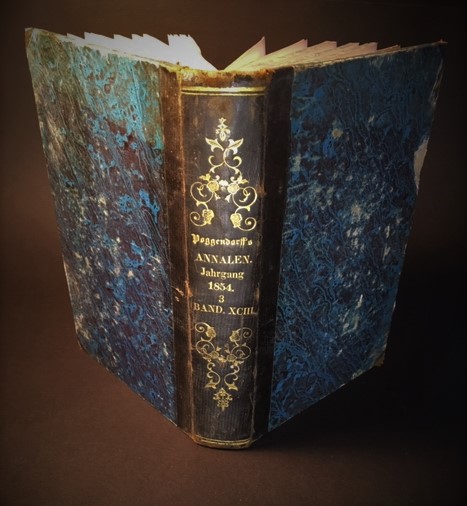
    CLAUSIUS, Rudolf. “Über einen auf die Wärme anwendbaren mechanischen Satz eine veränderte Form des zweiten Hauptgesatzes der mechanichen Wärmetheorie” in the Annalen der Physik und Chemie, 1854, vol 93, pp. 481–506. Contemporary leather and boards, somewhat worn. Elaborately engraved spine. Marbled edges match boards. Spotting to preliminaries and plates at end. Not ex-library and no interior marks. An excellent if not carefully and occasionally used volume. $1700

    “Clausius’ most famous statement of thermodynamics second law was published in German in 1854, and in English in 1856. ‘Heat can never pass from a colder to a warmer body without some other change, connected therewith, occurring at the same time.’”–Wikipedia

    Clausius 1854 _1_

    The 1854 paper in which Clausius proposes his famous heat formulation in restating the second law of thermodynamics: “Asserting that in any irreversible change the entropy of the system will increqse” C Parkinson, Breakthroughs. This the second of three of the fundamental papers that he contributed to the birth of thermodynamics (the others being an earlier 1850 paper, when Clausius established the foundations for modern thermodynamics in his first great paper on the theory of heat, “Ueber die bewegende Kraft der Warme,”) and a later in 1865 in which he gives the concept of the measure of transformation equivalence developed in 1854 the name of “entropy”).

    “Clausius did not introduce the symbol T for this universal function of temperature (a + t) until his second important paper, “Ueber eine veranderte Form des zweiten Hauptsatzes der mechanischen Wärmetheorie,”[this paper]  in which he developed the concept of entropy.

    Clausius did not propose the name “entropy” at this time, calling the new theorem simply the principle of the equivalence of transformations. This accorded well with the unique engine cycle that he had conceived to establish the theorem, a cycle portraying two important types of transformation: a conversion of heat into work at one temperature and a transfer of heat from a higher to lower temperature. The two transformations were called equivalent because they could replace one another. For example, suppose that the transfer of heat had occurred. By operating the cycle in reverse, Clausius argued, the heat could be restored to its original temperature and there would be a conversion of work into heat.”–Complete Dictionary of Scientific Biography online

    ·Posted by :

    ·in:

  • Hittorf Johann Wilhelm ÜBer Die ElectricitäTsleitung Der Gase In Annalen Der Physik Und Chemie 1884 21 Pp 901

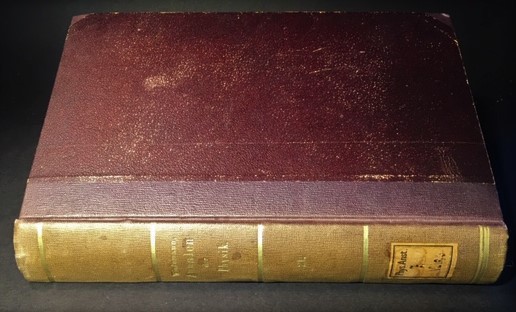
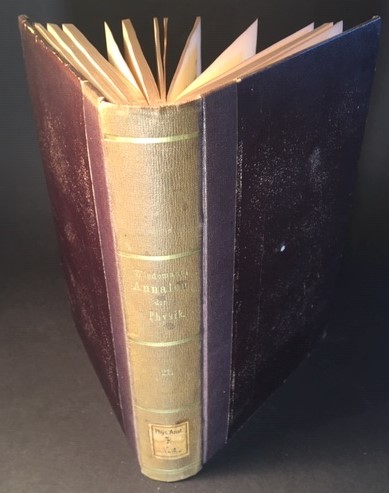
    HITTORF, Johann Wilhelm. “Über die Electricitätsleitung der Gase” in Annalen der Physik und Chemie, 1884, 21 pp. 90–139; and “Über die Emission der Warme von unebenen Oberflachen” by Christian Christiansen in Annalen der Physik und Chemie, 1884, vol 21 pp. 364–369, 1884). Volume in contemporary cloth and boards. Some wear to boards. Small sticker to spine. Interior clean with no marks. Near fine, very pretty copy. $375

    Hittorf _2_

    “Hittorf is remembered primarily for his experimental work in the transport of charge by ions in electrolytic solutions and the study of electrical conduction through gases.  Hittorf’s experimental contributions to physical science included early researches on the allotropic forms of selenium and phosphorus (1851–1865); investigations of the variations in the concentrations of electrolytes during electrolysis (1853–1859); the discovery,Page 439  |  Top of Articlewith Plücker, of the presence of both band and bright line spectra in the discharges of electricity through a gas at low pressures (1865); the examination and description of gaseous discharges and cathode-ray phenomena (1869–1884); and investigations of the passivity of metals (1900).”

    “Following Plücker’s studies, in 1869 Hittorf began a series of investigations of the discharge phenomena. He verified the effect of the magnetic field on the glow discharge and the fluorescence of the glass tube itself. He found that any solid or fluid body, whether an insulator or a coductor, when placed in front of the cathode cut off the glow. By constructing an L-shaped tube with the electrodes at the two ends, Hittorf was able to establish that the glow was confined to the arm in which the cathode was located. He concluded that the glow was generated from a point cathode and traveled in straight lines. “We will therefore speak of rectilinear paths or rays of glow, and consider any point of the cathode as the source of a cone of rays” [This paper.] These results led to the brilliant researches on gaseous conduction by Crookes ten years later (1879) and the eventual identification of the cathode rays as electrons by J. J. Thomson (1897).” Complete Dictionary of Scientific Biography online

    “While experimenting with a cathode ray tube, Hittorf was one of the first to observe thermionic emission when he noticed that when he heated the cathode to incandescence, even a small voltage differential would cause a large current to flow. Christensen presents his experimental confirmation of Josef Stefan’s formula for the total energy output by a black body depending on temperature.” Wenner, History of Physics

    Also bound with: “Über die Emission der Warme von unebenen Oberflachen” by Christian Christiansen, pp pp. 364–369. The first modern calculation of planet temperature using Stefan’s law.”

    “The Stefan-Boltzmann law, also known as Stefan’s Law, is a law that expresses the total power per unit surface area (otherwise known as the intensity) that is radiated by an object, often taken to be a blackbody. … The law also predicts how much heat the Earth radiates into space. “–Wikipedia


    Hittorf _2_
    Hittorf _2_

    ·Posted by :

    ·in:

  • Nuclear Fission in 1939 from Three Major Journal Sources

    Here we three get collections of papers on nuclear fission (and more) in the 1939 volumes of three leading physics journals: The Physical Review, Revue Scientifique, and the Comptes Rendus…de l’Academie des Sciences.  

    Oppenheimer, Gamow, Feynman, Szilard, Bohr, Bethe, Rabi, and others all in the Physical Review, 1939

    “On continued gravitational contraction” and many other papers offered in one monumental year of the Physical Review for 1939.

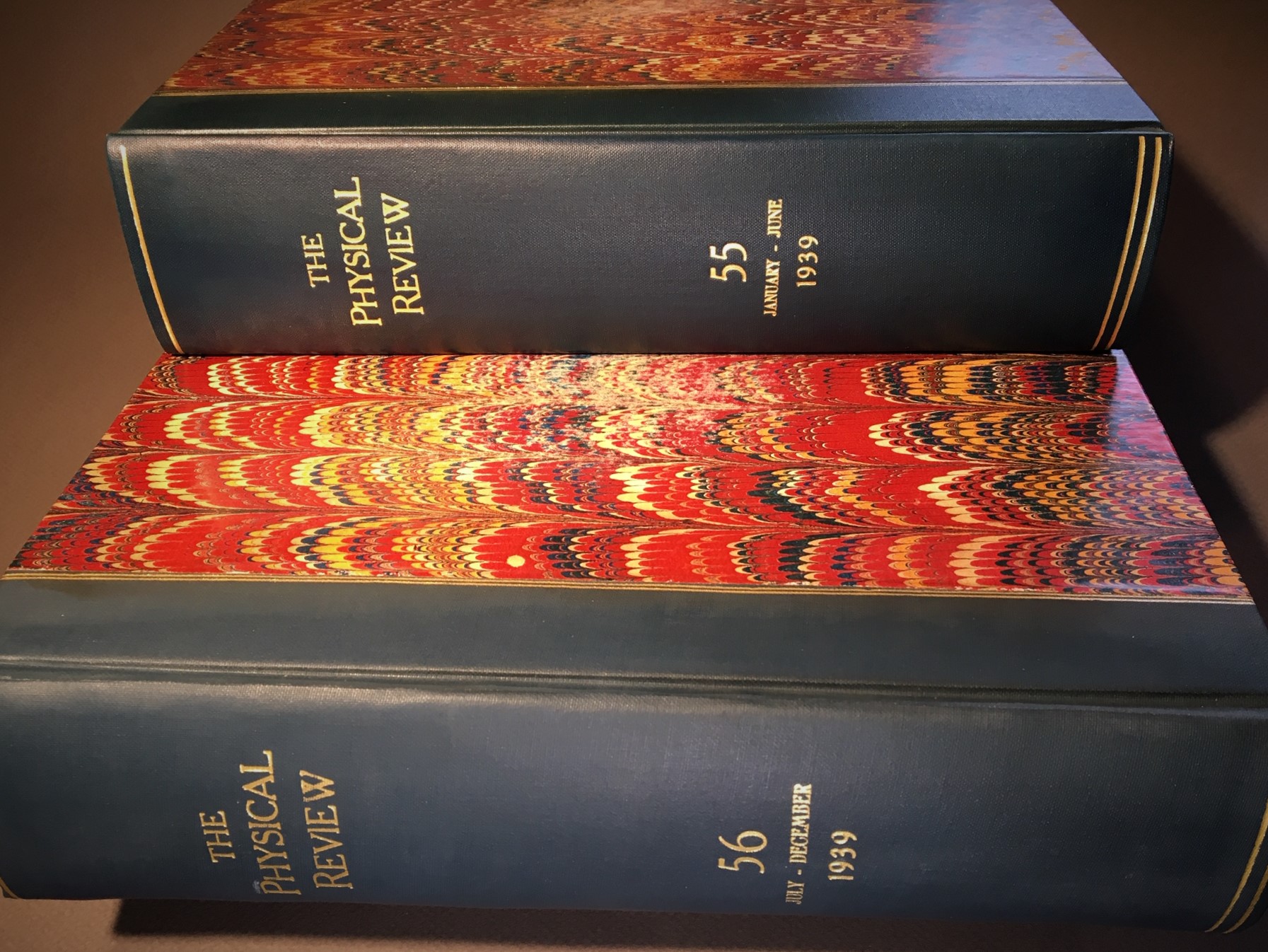
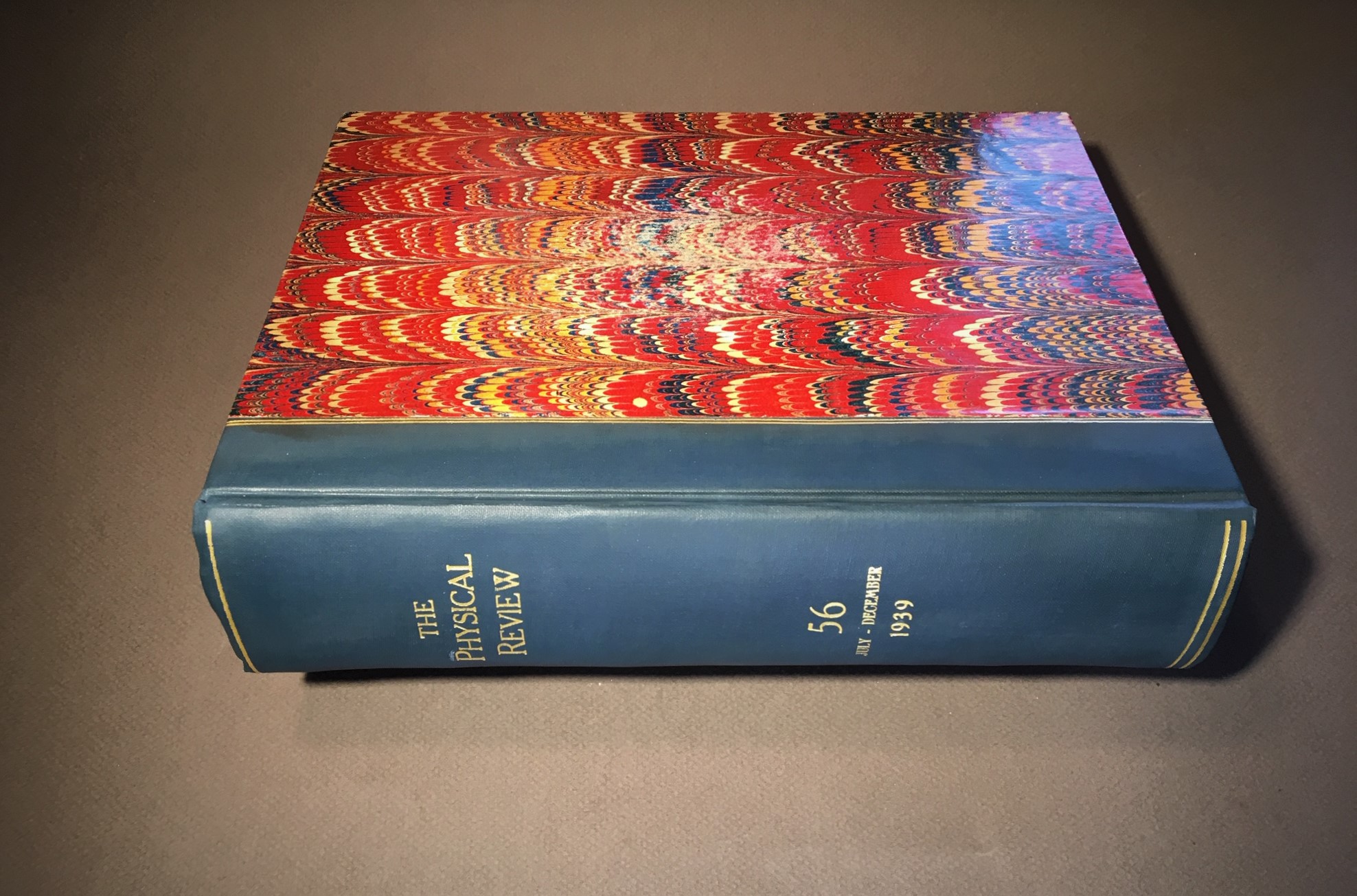
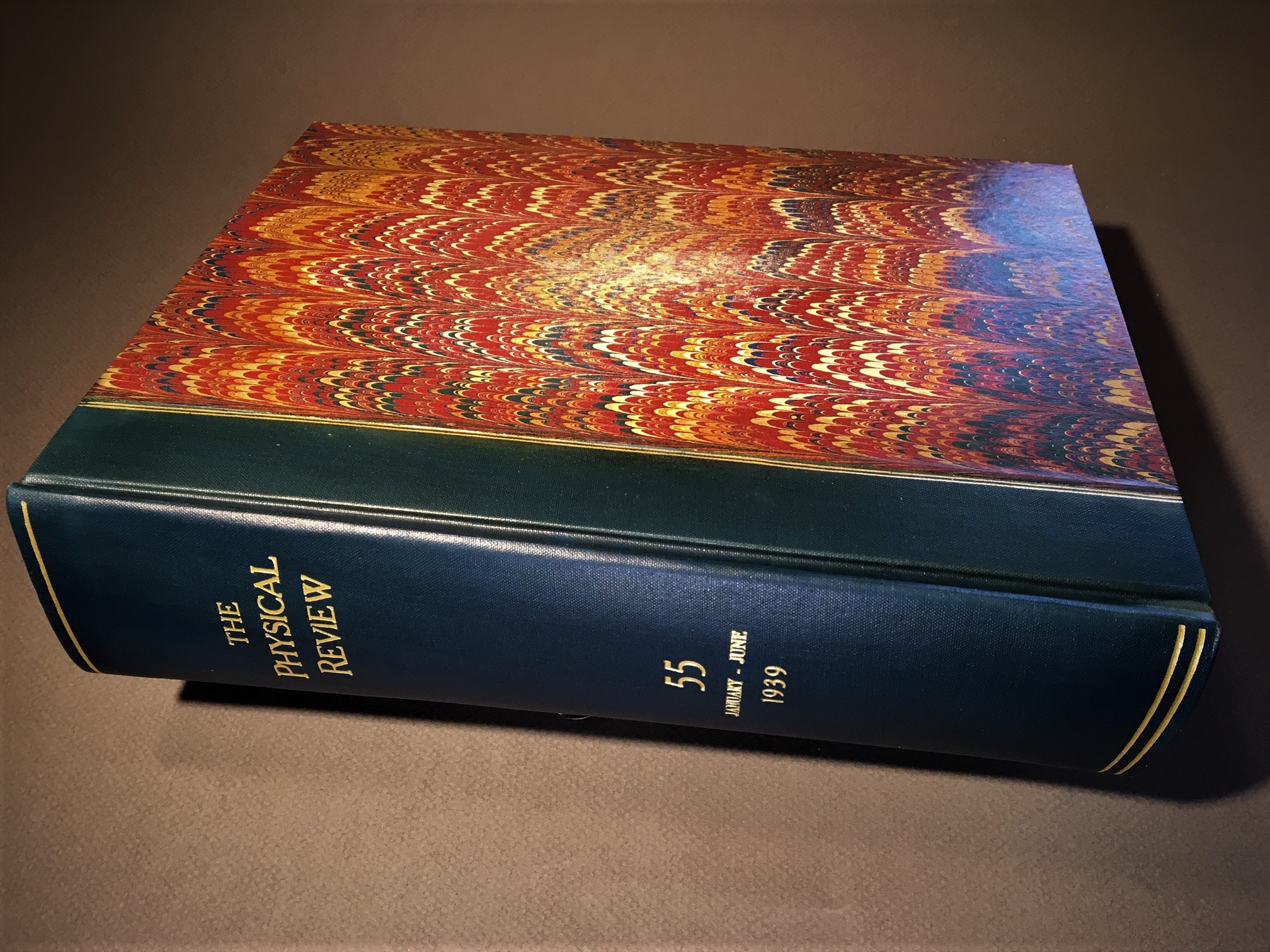
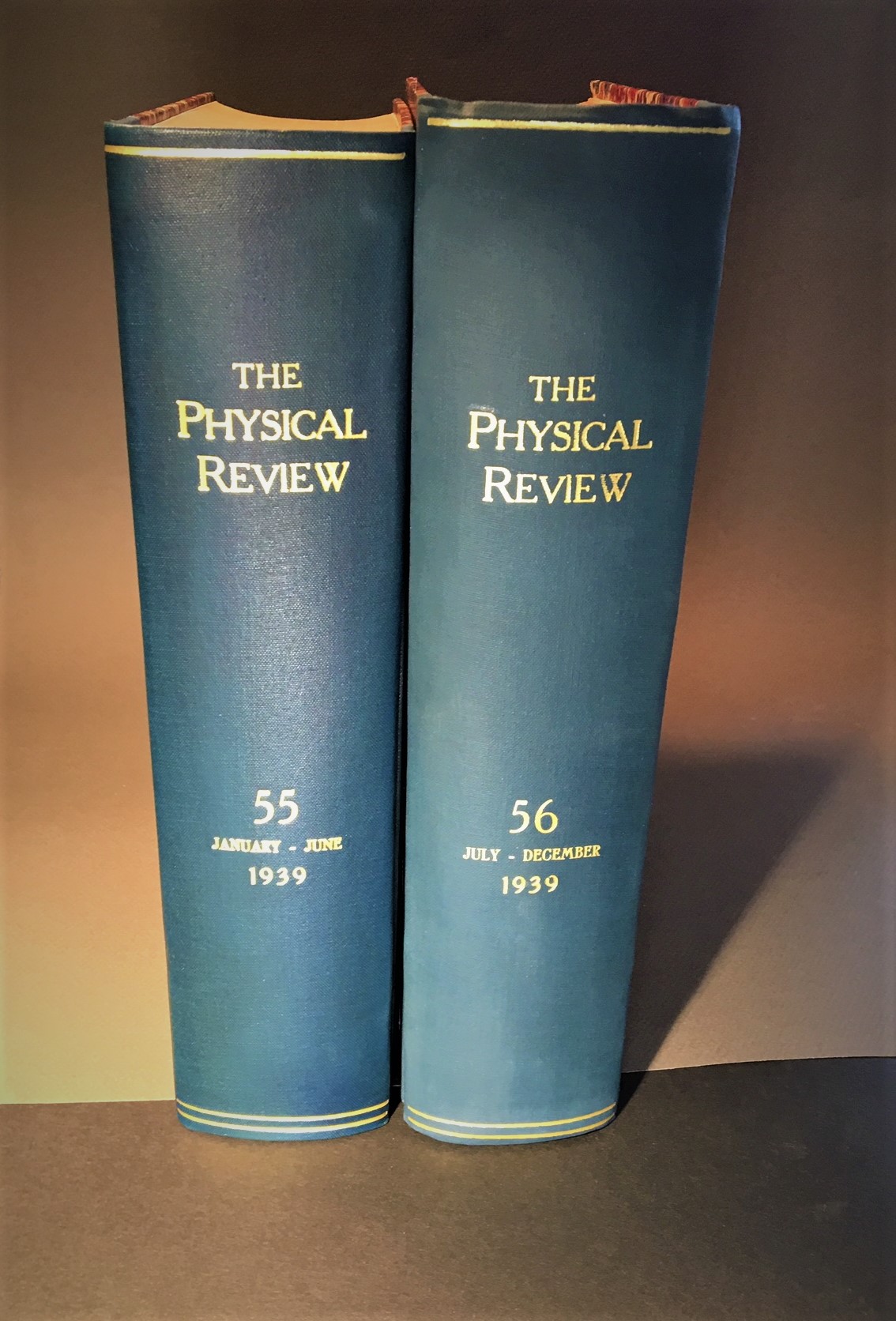
    American Physical Society, Lancaster Pa., January-December 1939. Two volumes: x, 1294pp & x,1300pp. The two volumes, complete. Finely and sturdily rebound in cloth and marbled boards. Very stout, readable volumes. Fine condition. Few scant ownership stamps on some of the individual issues’ first page. $2250

    This is a remarkable volume for one of the most electrifying years in the history of modern phsyics, ranking alongside the great years of 1859, 1932, and 1948 for the sheer weight of highly significant papers from many sources. Included are papers by Oppenheimer, Gamow, Feynman, Szilard, Bethe, Rabi, Anderson, Tolman, Morrison, Kusch, Abelson, and many others. Astonishing, really.

    Some of the most significant papers include:

    OPPENHEIMER, Robert and Hartland Snyder, “On continued gravitational contraction”, September 1, 1939, Vol. 56, #5, pp. 426-50

    The Oppenheimer and Snyder (a graduate assistant) paper is one of the most prescient in the history of modern physics, correctly physically describing (where Chandrasekhar and Eddington in their discussions did not) what happens in a particular collapse of a neutron star, and still today reads as fresh and and brightly as it did in 1939.  Really, it is an extraordinary work, and a foundation paper in the history of gravitation, the application of RT, singularity, and astrophysics.  (The Southampton GR Explorer site nicely states it this way: “This paper has strong claims to being one of the most prophetic ever written in this field of research. Today, 60 years later, this paper needs little revision – even the terminology is undated!”)

    In an often-repeated quotation, they write, somewhat in irony and in a certain and understated manner on page 456: “The star thus tends to close itself off from any communication with a distant observer; only its gravitational field persists”. And later: “When all thermonuclear sources of energy are exhausted, a sufficiently heavy star will collapse. Unless fission due to rotation, the radiation of mass, or the blowing off of mass by radiation, reduce the star’s mass to the order of that of the sun, this contraction will continue indefinitely”, they wrote.

    BOHR, Niels and J.A. Wheeler, “The mechanism of nuclear fission”, September 1, 1939, Vol. 56, pp. 455-459. This is the experimental foundation stone (on the basis of the liquid drop model of atomic nuclei) of nuclear fission and the great leap forward in the construction of the atomic bomb.

    From the abstract: “On the basis of the liquid drop model of atomic nuclei, an account is given of the mechanism of nuclear fission. In particular, conclusions are drawn regarding the variation from nucleus to nucleus of the critical energy required for fission, and regarding the dependence of fission cross section for a given nucleus on energy of the exciting agency. A detailed discussion of the observations is presented on the basis of the theoretical considerations. Theory and experiment fit together in a reasonable way to give a satisfactory picture of nuclear fission”.

    BOHR, Niels. “Resonance in Uranium and Thorium Disintegrations and the Phenomenon of Nuclear Fission”;

    BETHE,  Hans.  “Meson Theory of Nuclear Forces.”  Lancaster, PA:  American Physical Society,  1939.  1st edition.  Physical Review, Vol 55, 2nd series, number 12; June 15, 1939.  1261-1264

    BETHE, Hans. “Energy Production in Stars” no 1. January 1, 1939 -and- Energy Production in Stars IIno. 5 March 1, 1939). Awarded the Nobel Prize (the first time the award was given for astrophysics) 1967 “for his contributions to the theory of nuclear reactions, especially his discoveries concerning the energy production in stars”)

    OPPENHEIMER, J. Robert and G.M. Volkhoff in the 15 February 1939 issue. Here (along with a preceding paper by Richard C. Tolman, issued in the same issue just above Oppenheimer, which were the analytic analysis used by O+V to base their estimates of nuclear forces) was established the Tolman-Oppenheimer-Volkhoff limit, which stated that if the state of evolution of  neutrons forming a degenerate Fermi gas of extremely dense masses in neutron stars was more  massive than .07 solar masses that it would collapse into a black hole or exotic/quark star; if the mass was below that limit, the star would not collapse due to the degeneracy pressure of neutrons and the strong force.  The black hole part was left really to a second paper of 1 September 1939 (the day that the Nazis attacked Poland and the fighting began in World War II in Europe) .

    GAMOW, George and Edward Teller, “On the Origin of Great Nebulae”, in Physical Review, volume 55, number 7, April 1, 1939, pp 654-657, in the weekly issue of pp 609-671. 

    FEYNMAN, Richard. “Forces in Molecules”, pp. 340-43. Feynman’s undergraduate thesis at MIT, know known as Feynman-Hellmann theorem – “This work treated the problem of molecular forces from a thoroughly quantum-mechanical point of view, arriving at a simple means of calculating the energy of a molecular system that continues to guide quantum chemists.” (Complete DSB online)

    SLIZARD, Leo and ZINN’s landmark “Instantaneous Emission of Fast Neutrons in the Interaction of Slow Neutrons with Uranium” confirmed ‘instantaneous’ neutron multiplication, showing that it meets the requirement for nuclear bombs. Some argue this is one of the most important papers in atomic/nuclear physic

    ANDERSON, Herbert L, Fermi, Enrico & Hanstein, H. B. “Production of Neutrons in Uranium Bombarded by Neutrons”, vol 55, pp. 415-419;

    TOLMAN, Richard, “Static Solutions of Einstein’s Field Equations for Spheres of Fluid”, vol 55, pp. 799-800;

    RABI, I, Millman, S., Kusch, P. & Zacharias J. R. “The Molecular Beam Resonance Method for Measuring Nuclear Magnetic Moments ()”, vol 55, pp 526-535, vol 55, 1939

    WEISSKOPF, Viktor. “On the Self-Energy and the Electromagnetic Field of the Electron”, 56 No. 1 pp. 72–85, July 1, 1939 . Also bound in the same issue with:   “Weisskopf demonstrates that QED diverges at all levels of perturbation theory.”  “Weisskopf was a major figure in the golden age of quantum mechanics, who made seminal contributions to the quantum theory of radiative transitions, the self-energy of the electron, the electrodynamic properties of the vacuum, and to the theory of nuclear reactions.”– “Vicktor Weisskop 1908—2002”  by J. David Jackson and Kurt Gottfried, in Memoirs of the National Academy of Sciences.

    This paper reproduced in full as paper 6 in Julian Schwinger’s Selected Papers on Quantum Electrodynamics. See also Jo Bovy (Ghent University), 

    ABELSON, Philip. “Investigation of the Products of the Disintegration of Uranium by Neutrons”, July 1, 1939, pp 1-9.

    RABI, I.I., Kellogg, J. M. B. “The magnetic moment of the proton and the deuteron. The radiofrequency spectrum of H2 in various magnetic fields” , vol. 56, No. 8., pp 728-743.


    Nuclear Fission/Atomic Bomb in the Revue Scientifique, 1939

    Revue Scientifique, January-August, 1939, volume 77, numbers 1-8, quarto, 551pp. Wrappers (front and back) bound in at the rear of the volume, with supplemental ads throughout the volume. Bound in an attractive red cloth. Tidy institutional bookplate; institutional rubber stamp on first page of each monthly issue as well as one rubber stamp on wrapper covers. Fine copy, very tight and fresh. $750.

    This volume contains a couple of original articles of interest to the development of nuclear fission as well as 16 articles that are reviewed/abstracted/somewhat reprinted from other journals (in the February, March, and April issues), and when not in French written in or translated into French, which in many cases are the first translations of some of the great papers in this period of nuclear physics. The great majority are one or two columns in length.

    Included are works by Thibaud, Savitch, Joliot, Frisch, von Halban, Meitner, Feather, Bretscher, Heyn, Strassmann, Curie and others–these are rapidly published translations/reviews, in many cases coming jsut weeks after the original paper was published.  

    • Issue for February, 1939 

    VEIL, S. “Les controls chimiques de transmutations d’atomes”, p 111-112.

    And unattributed in the “echos” section:

    “La Rupture Explosive des noyaux d’uranium et de throium dans l’Action des Neutrons”. One column article on page 133, citing Fermi/Amaldi 1934, Curie/Savitch 1938, Hahn and Strassmann (Jan 1939).

    Then:

    “Un nouveau type de reaction nucleaire”, Nature, 143, 233, 1939, translated by S. Veil—this is the “introductory” statement in Nature preceding the Meitner/Frisch paper a few pages later.

    MEITNER, Lise and O. Frisch. “Disintegration de l’uranium par les neutrons: un nouveau type de reaction nucleaire”, translated by S. Veil, pp 133-4, and which appeared in Nature, 143, 233, 1939.

    JOLIOT, F and J. Perrin. “Preuve experimentale de la rupture, explosive des noyaux d’uranium et de thorium sous l’action des neutrons”, from Comptes Rendus, vol 208, 199, 341-343, and here appearing in two columns on one full page (135).

    CURIE, I. And P. Savitch. “Sur les radioelements formes dans l’uranium et le thorium irradies par les neutrons”, from Comptes Rendus, volume 208, 1939, p 343-346, and here on one full page (136).

    • The issue for March, 1939 77/3, pp (139)-218 is very interesting:

    THIBAUD, Jean and A. Moussa. “La cassure de l’uranium, la formation d’un halogene et la liberation d’energie qui en resulte”, pp 182-185.

    And then, in the “echo et information” section, which is basically a reporting section on work that was published elsewhere (though not necessarily in French), we find abstracts and announcements of a number of very significant publications:

    THIBAUD, Jean and Andre Moussa. “Sur la rupture des noyaux d’uranium sous l’action des neutrons et la liberation d’energie qui en resulte”, from the Comptes Rendus 208, 1939, pp 744-6, p 211-212.

    SAVITCH, Paul. “Sur un radioelement gazeux forme dans l’Uraium bombarde par les neutrons”, from Comptes Rendus, 208, 1939, pp 646-647, this all on a long columns on page 212.

    JOLIOT, F. “Observation par la methode de Wilson des trajectoires de brouillard des produits de l’explosion des noyaux d’uranium”, from Comptes Rendus, vol 208, 1939, pp 647-649. one and a half columns, with photo illustration.

    FRISCH, O. “Evidence physique de rupture du noyaux lourds sous bombardement de neutrons”, in Nature, 143, 1939, p 276. This 1.25 columns.

    Von HALBAN, H. and F. Joliot. “Liberation de neutrons dans l’explosion nucleaire de l’uranium”, from Nature, 143, 1939, p 470. This pp 214-215.

    MEITNER, L. and O.R. Frisch. “Les Produits de rupture du noyaux f’uranium”, in Nature143, p 471, 1939. This is all on page 215, in two full columns.

    • The issue for April, 1939: pp 186-298

    FEATHER, N. and E. Bretscher. “La Rupture Explosive des Noyaux d’Uranium”, from Nature, 143, p 516, 1939. Here occupies 1 column.

    HEYN, F. and Aten and Bakker. “Transmutations d’uranium et de thorium par neutrons”, from Nature, 143, 516, 1939. Here occupies two full columns.

    BRETWCHER, E. and L.G. Cook. “Transmutations de noyaux d’uraniumet de thorium en moyen de neutrons”, from Nature, 143, p 559, 1939. Here the work occupies a full column.

    FEATHER, N. “La duree du processis de rupture nucleaire”, from Nature, 143, p 597, 1939. Here the work occupies two columns.

    THIBAUD, J. and A.Moussa. “La disintegration de l’uranium par l;effet des neutrons et la partition de cet element”, from Comptes Rendus, 208, 652-4, 1939. Here the artcile occupies two columns on page 293.

    DODE, M. and von Halban and Joliot. “Sur l’energies des neutrons libertes lors de la partition nucleaire de l’uranium”, (no mention of origin). This is one full column on page 294. 

    • Issue for June-July 1939, pp 371-455

    COUFFIGNAL, L. reviews/abstracts/summarizes A. Einstein and L Infeld “L’Evolution des Idees en Physique”, pp 427-8

    Also for interest in the history of computer science: Nice article on Maurice d’Ocagne (1862-1938) by Louis COUFFIGNAL and Rene Harmegnies.Fe 1939, p 70 p. 67-76 Feb 1939


    The Atomic Bomb–the French Contribution in the Comptes Rendus, 1939

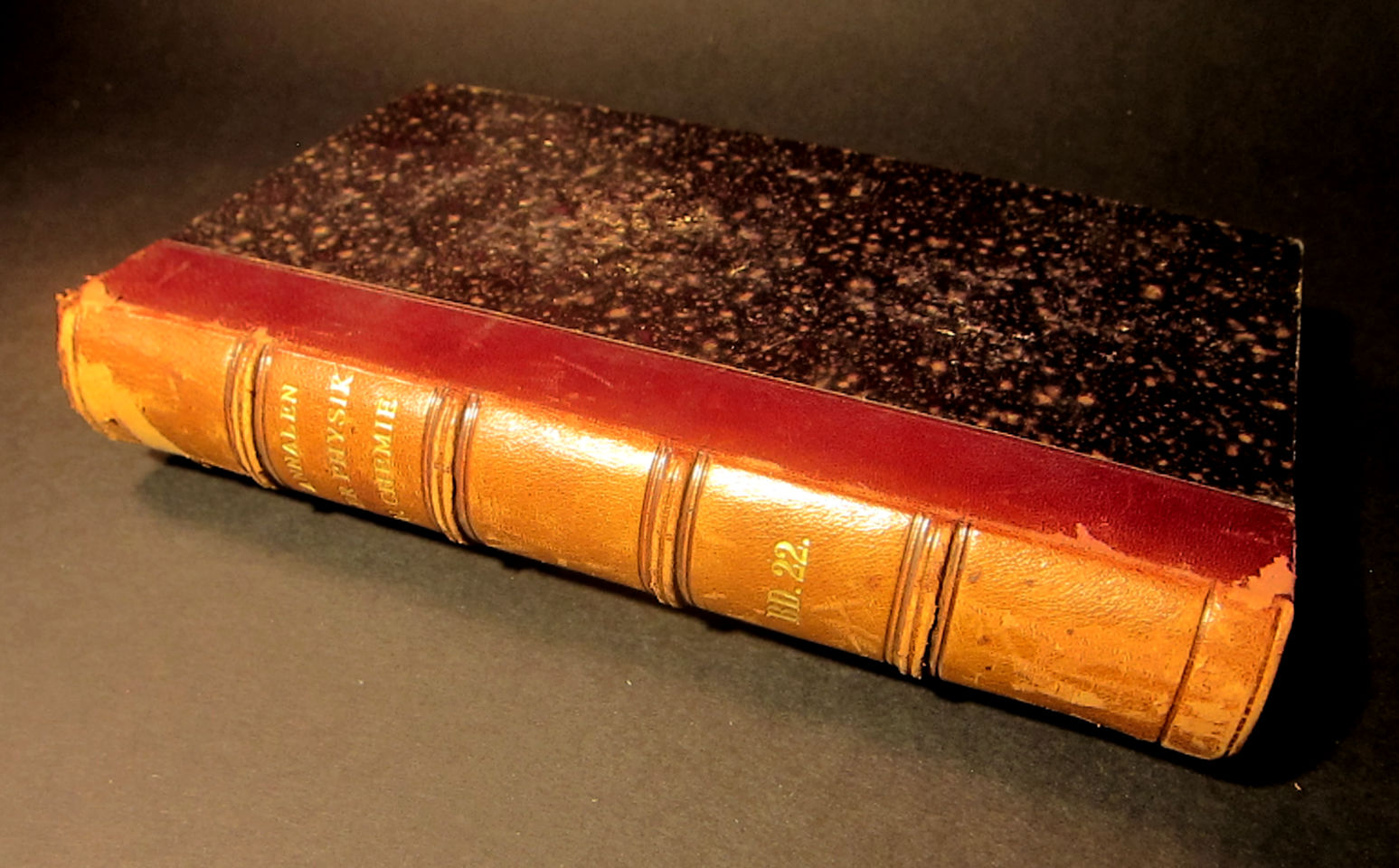
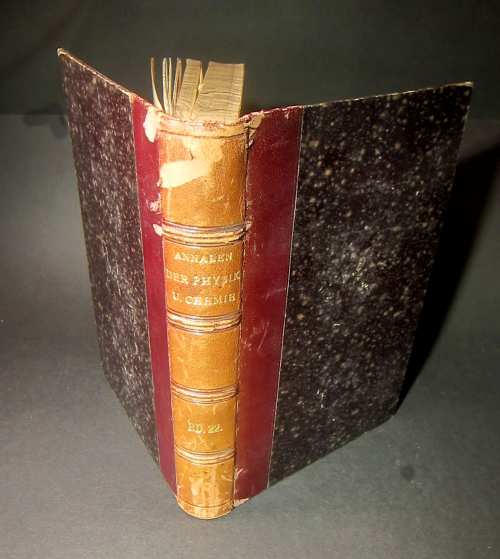
    14 major papers (in 12 different weekly issues) in the history of nuclear fission, all published in Comptes Rendus hebdomadaires des Séances de l’Academie des Sciences, volume 208, January-June 1939, 2250pp, a single bound volume, thick and stout. Ex-libris, with a bookplate–also, each title-page of each weekly issue (of which there are 26 in this volume), has a small round rubber stamp of the library. Cloth binding. ca. 1950. Nice condition.  There is a faded, old vertical fold that extends through the text, no doubt from when the original owner folded the issues in half…over the years in binding, the fold is mostly gone.   $1500

    Included are the following:

    BECK, Guido and Peter Havas, “La dissymetrie de la rupture de l’uranium”, 3 April 1939, no. 14,  pp 1084-1086

    BECK, Guido and Peter Havas, “Sur le ralentissement dans l’air des fragments atomique résultant de l’explosion de l’uranium”,  22 May 1939, no. 21, pp 1643-1645;

    *CURIE, Irene and Paul Savitch. “Sur les radioelements formes dans l’uranium et le thorium irradies par les neutrons”, 30 January 1939 (one of two papers in this issue), pp 343-346; 

    DODE, Maurice, Hans von Halban, Frederic Joliot, Lew Kowarski. “Sur l’energie des neutrons liberes lors de la partion nucleairede l’uranium”, 27 March 1939,  p 995-997

    HAENNY, Charles and Albert Rosenberg. “Émission de neutrons lors de la rupture provoquée du noyau d’uranium. Possibilité de réaction par chaine” “20 March 1939, no 12, pp 898-900;  

    **JOLIOT, Frederic. “Preuve experimentale de la rupture explosive des nayaux d’uranium et de thoriumsous l’action des neutrons” 30 January 1939,  p 341-343– THE FIRST INDEPENDENT CONFIRMATION OF NUCLEAR FISSION. 

    *JOLIOT, Frederic. “Observations par la methode de Wilson des trajecoires de brouillard des produits de l’explosion des noyaux d’uranium”, 27 February 1939, p 647-649

    MAGNAN, Claude, “Sur la cassure des noyaux éléments plus légers que l’uranium, sous le bombardement des neutrons”, 6 March 1939, no. 10, pp 742-4;

    MAGNAN, Claude. “Sur les neutrons emis lors de la bipartition de l’uraniumsous l’action des neutrons”, 17 April 1939, pp 1218-1220

    *PERRIN, Francis. “Calcul relatif aux conditions éventuelles de transmutation en chaine de l’uranium”, 1 May 1939, no 18,  pp 1394-1396; 

    *PERRIN, Francis. “Calcul relatif aux conditions éventuelles de transmutation en chaine de l’uranium”, 15 May 1939, no. 20, pp 1573-1575; 

    *THIBAUD, Jean Thibaud and Andre Moussa. “Sur la rupture des noyaux d’uranium sous l’action des neutrons et la libération d’énergie qui en résulte”,  6 March 1939, no. 10 (second article of the issue) 744-6;

    von HALBAN, Hans, Lew Kowarski, Paul Savitch. ” Sur la capture simple des neutrons thermiques et des neutrons de resonance par l’uranium”, 1 May 1939, no 18 (second article in this issue) pp 1396-1398; 

    von Halban, Hans, Lew Kowarski, Michael Magot. “Sur l’intensite des neutrons dans le radiation cosmique”, 20 February 1939, pp 572-574.
     

    ·Posted by :

    ·in:

    —
  • Einstein Albert Quantentheorie Des Einatomigen Idealen Gases Quantum Theory Of The Monatomic Ideal Gas In Sit

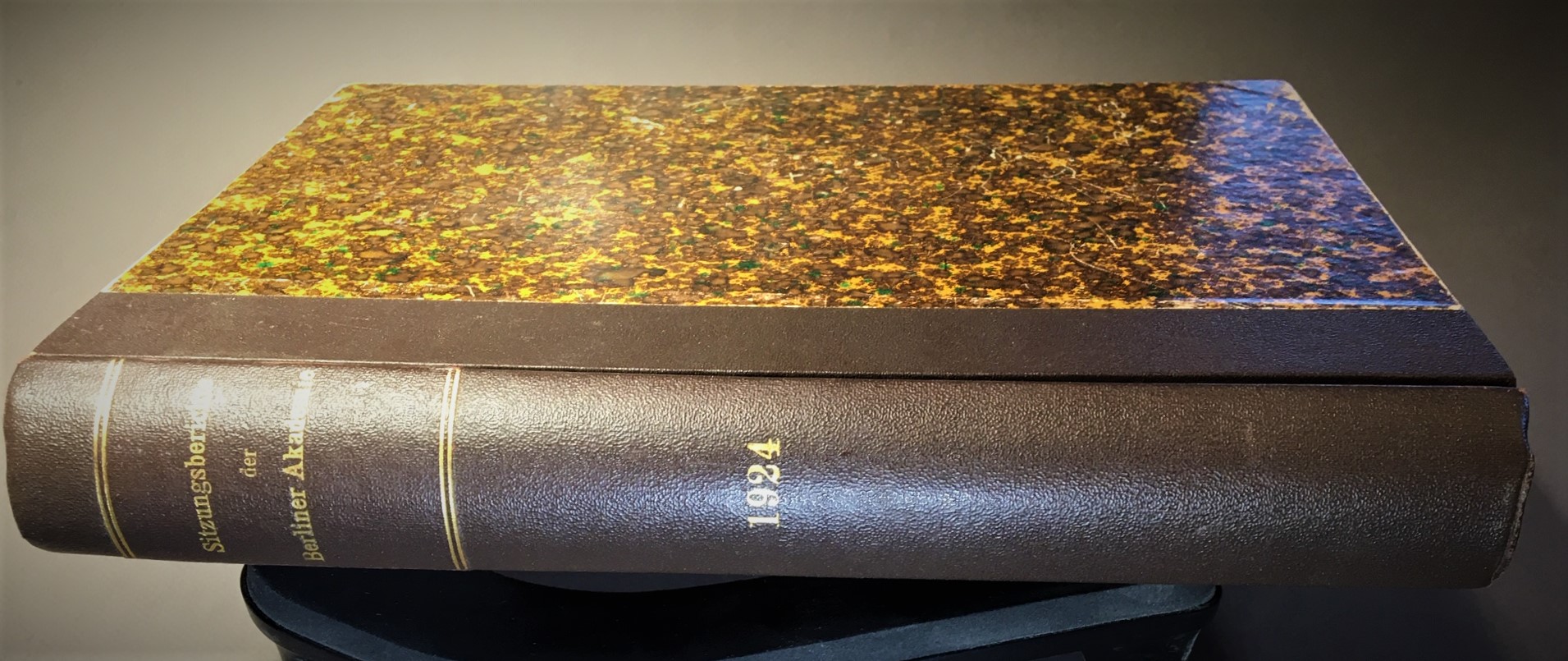
    EINSTEIN, Albert. “Quantentheorie des einatomigen idealen Gases” (“Quantum Theory of the Monatomic Ideal Gas”) in Sitzungsberichte der Königlich Preussischen Akademie der Wissenschaften, Physikalisch-mathematische Klasse, 1924, pp. 261–267 in the volume of pp CXLIX, 360. .Bound in the original publisher’s cloth and marbled boards with cloth tips, in near fine condition. $500.00

    “This is the first of three papers by Einstein on Bose-Einstein condensation, the phenomenon that causes bosons to become a superfluid at low temperatures.”

    Einstein 1924 Wenner

    ·Posted by :

    ·in:

    —
  • Oppenheimer, Gamow, Feynman, Szilard, Bohr, Bethe, Rabi, and others in the Monumental “Physical Review” for 1939


    OPPENHEIMER, J. Robert. “On continued gravitational contraction” and many other papers offered in one monumental year of the Physical Review for 1939.

    American Physical Society, Lancaster Pa., January-December 1939. Two volumes: x, 1294pp & x,1300pp. The two volumes, complete. Finely and sturdily rebound in cloth and marbled boards. Very stout, readable volumes. Fine condition. Few scant ownership stamps on some of the individual issues’ first page. $2250

    This is a remarkable volume for one of the most electrifying years in the history of modern phsyics, ranking alongside the great years of 1859, 1932, and 1948 for the sheer weight of highly significant papers from many sources. Included are papers by Oppenheimer, Gamow, Feynman, Szilard, Bethe, Rabi, Anderson, Tolman, Morrison, Kusch, Abelson, and many others. Astonishing, really.

    Some of the most significant papers include:

    OPPENHEIMER, Robert and Hartland Snyder, “On continued gravitational contraction”, September 1, 1939, Vol. 56, #5, pp. 426-50  The Oppenheimer and Snyder (a graduate assistant) paper is one of the most prescient in the history of modern physics, correctly physically describing (where Chandrasekhar and Eddington in their discussions did not) what happens in a particular collapse of a neutron star, and still today reads as fresh and and brightly as it did in 1939.  Really, it is an extraordinary work, and a foundation paper in the history of gravitation, the application of RT, singularity, and astrophysics.  (The Southampton GR Explorer site nicely states it this way: “This paper has strong claims to being one of the most prophetic ever written in this field of research. Today, 60 years later, this paper needs little revision – even the terminology is undated!”)

    In an often-repeated quotation, they write, somewhat in irony and in a certain and understated manner on page 456: “The star thus tends to close itself off from any communication with a distant observer; only its gravitational field persists”. And later: “When all thermonuclear sources of energy are exhausted, a sufficiently heavy star will collapse. Unless fission due to rotation, the radiation of mass, or the blowing off of mass by radiation, reduce the star’s mass to the order of that of the sun, this contraction will continue indefinitely”, they wrote.


    Phys Rev Wenner _1_

    BOHR, Niels and J.A. Wheeler, “The mechanism of nuclear fission”, September 1, 1939, Vol. 56, pp. 455-459. This is the experimental foundation stone (on the basis of the liquid drop model of atomic nuclei) of nuclear fission and the great leap forward in the construction of the atomic bomb.

    From the abstract: “On the basis of the liquid drop model of atomic nuclei, an account is given of the mechanism of nuclear fission. In particular, conclusions are drawn regarding the variation from nucleus to nucleus of the critical energy required for fission, and regarding the dependence of fission cross section for a given nucleus on energy of the exciting agency. A detailed discussion of the observations is presented on the basis of the theoretical considerations. Theory and experiment fit together in a reasonable way to give a satisfactory picture of nuclear fission”.

    BOHR, Niels. “Resonance in Uranium and Thorium Disintegrations and the Phenomenon of Nuclear Fission”;

    BETHE,  Hans.  “Meson Theory of Nuclear Forces.”  Vol 55, 2nd series, number 12; June 15, 1939, 1261-1264

    BETHE, Hans. “Energy Production in Stars” no 1. January 1, 1939 -and- “Energy Production in Stars II”, no. 5 March 1, 1939). Awarded the Nobel Prize (the first time the award was given for astrophysics) 1967 “for his contributions to the theory of nuclear reactions, especially his discoveries concerning the energy production in stars”)

    OPPENHEIMER, J. Robert and G.M. Volkhoff in the 15 February 1939 issue. Here (along with a preceding paper by Richard C. Tolman, issued in the same issue just above Oppenheimer, which were the analytic analysis used by O+V to base their estimates of nuclear forces) was established the Tolman-Oppenheimer-Volkhoff limit, which stated that if the state of evolution of  neutrons forming a degenerate Fermi gas of extremely dense masses in neutron stars was more  massive than .07 solar masses that it would collapse into a black hole or exotic/quark star; if the mass was below that limit, the star would not collapse due to the degeneracy pressure of neutrons and the strong force.  The black hole part was left really to a second paper of 1 September 1939 (the day that the Nazis attacked Poland and the fighting began in World War II in Europe) .

    GAMOW, George and Edward Teller, “On the Origin of Great Nebulae”, volume 55, number 7, April 1, 1939, pp 654-657, in the weekly issue of pp 609-671. 

    FEYNMAN, Richard. “Forces in Molecules”, pp. 340-43. Feynman’s undergraduate thesis at MIT, know known as Feynman-Hellmann theorem – “This work treated the problem of molecular forces from a thoroughly quantum-mechanical point of view, arriving at a simple means of calculating the energy of a molecular system that continues to guide quantum chemists.” (Complete DSB online)

    Phys Rev Wenner _1_
    Phys Rev Wenner _1_

    SLIZARD, Leo and ZINN’s landmark “Instantaneous Emission of Fast Neutrons in the Interaction of Slow Neutrons with Uranium” confirmed ‘instantaneous’ neutron multiplication, showing that it meets the requirement for nuclear bombs. Some argue this is one of the most important papers in atomic/nuclear physic

    ANDERSON, Herbert L, Fermi, Enrico & Hanstein, H. B. “Production of Neutrons in Uranium Bombarded by Neutrons”, vol 55, pp. 415-419;

    TOLMAN, Richard, “Static Solutions of Einstein’s Field Equations for Spheres of Fluid”, vol 55, pp. 799-800;

    RABI, I, Millman, S., Kusch, P. & Zacharias J. R. “The Molecular Beam Resonance Method for Measuring Nuclear Magnetic Moments ()”, vol 55, pp 526-535;

    WEISSKOPF, Viktor. “On the Self-Energy and the Electromagnetic Field of the Electron”, 56 No. 1 pp. 72–85, July 1, 1939 . Also bound in the same issue with:   “Weisskopf demonstrates that QED diverges at all levels of perturbation theory.” –This paper reproduced in full as paper 6 in Julian Schwinger’s Selected Papers on Quantum Electrodynamics. See also Jo Bovy (Ghent University), 

    ABELSON, Philip. “Investigation of the Products of the Disintegration of Uranium by Neutrons”, July 1, 1939, pp 1-9.

    RABI, I.I., Kellogg, J. M. B. “The magnetic moment of the proton and the deuteron. The radiofrequency spectrum of H2 in various magnetic fields” , vol. 56, No. 8., pp 728-743.


    Phys Rev Wenner _1_

  • First French Edition of the First Weather Map (1687)

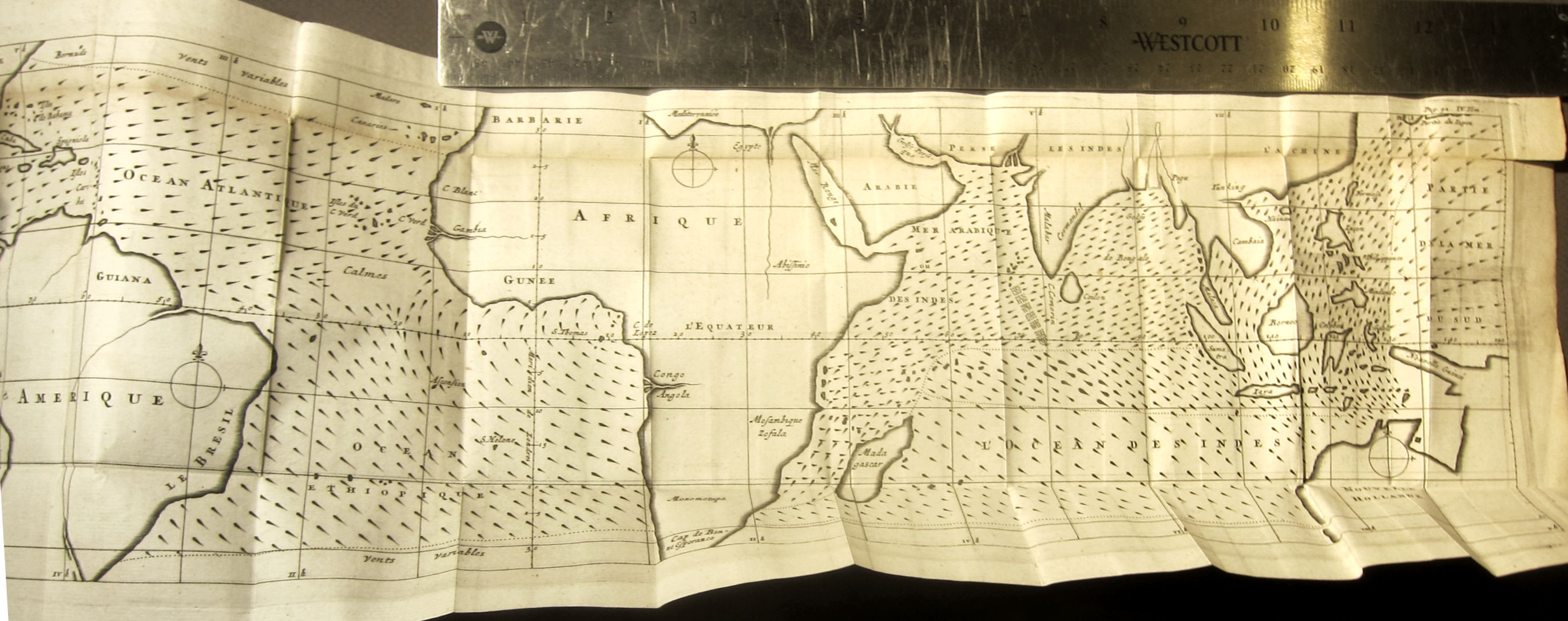
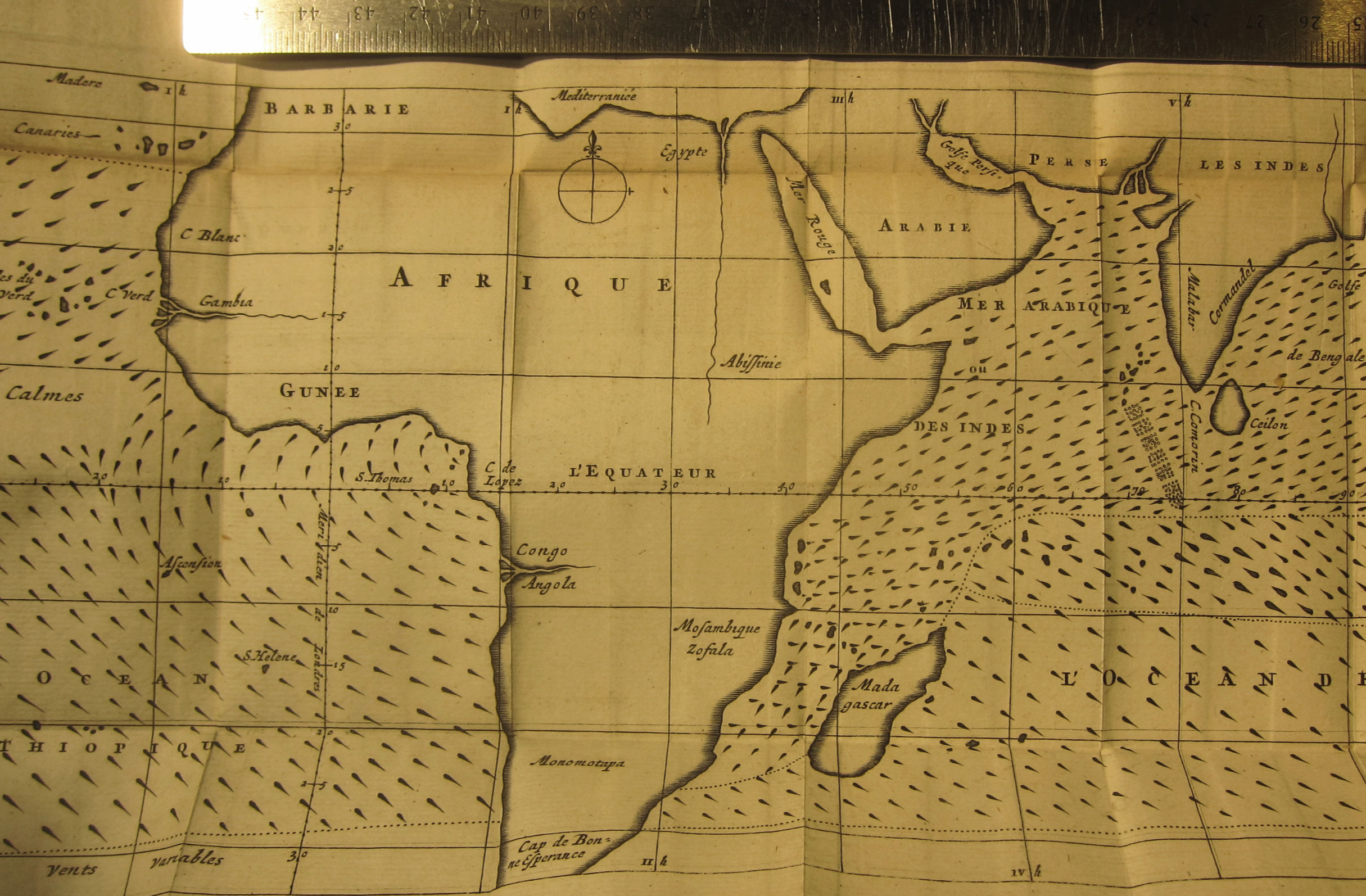
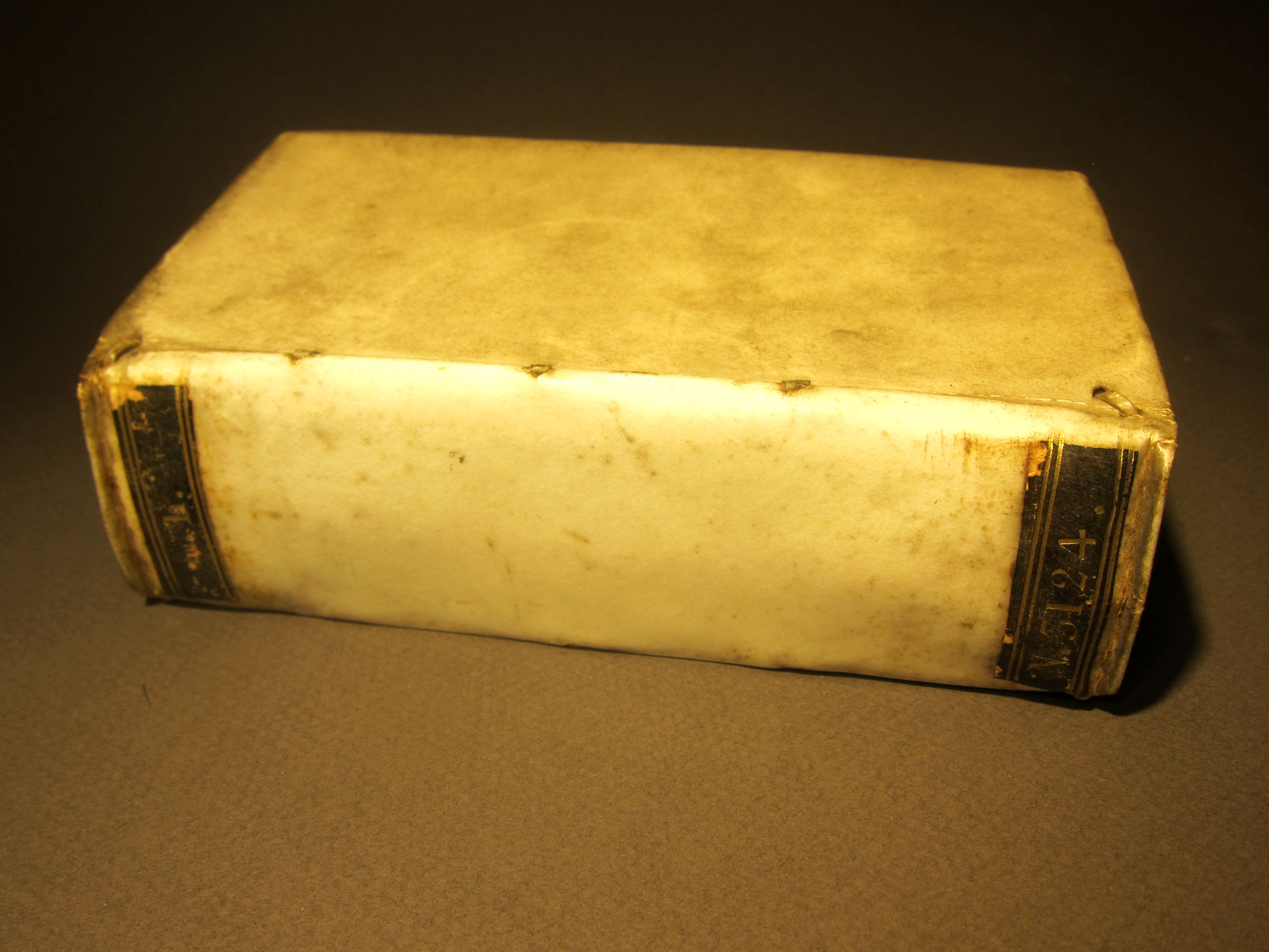
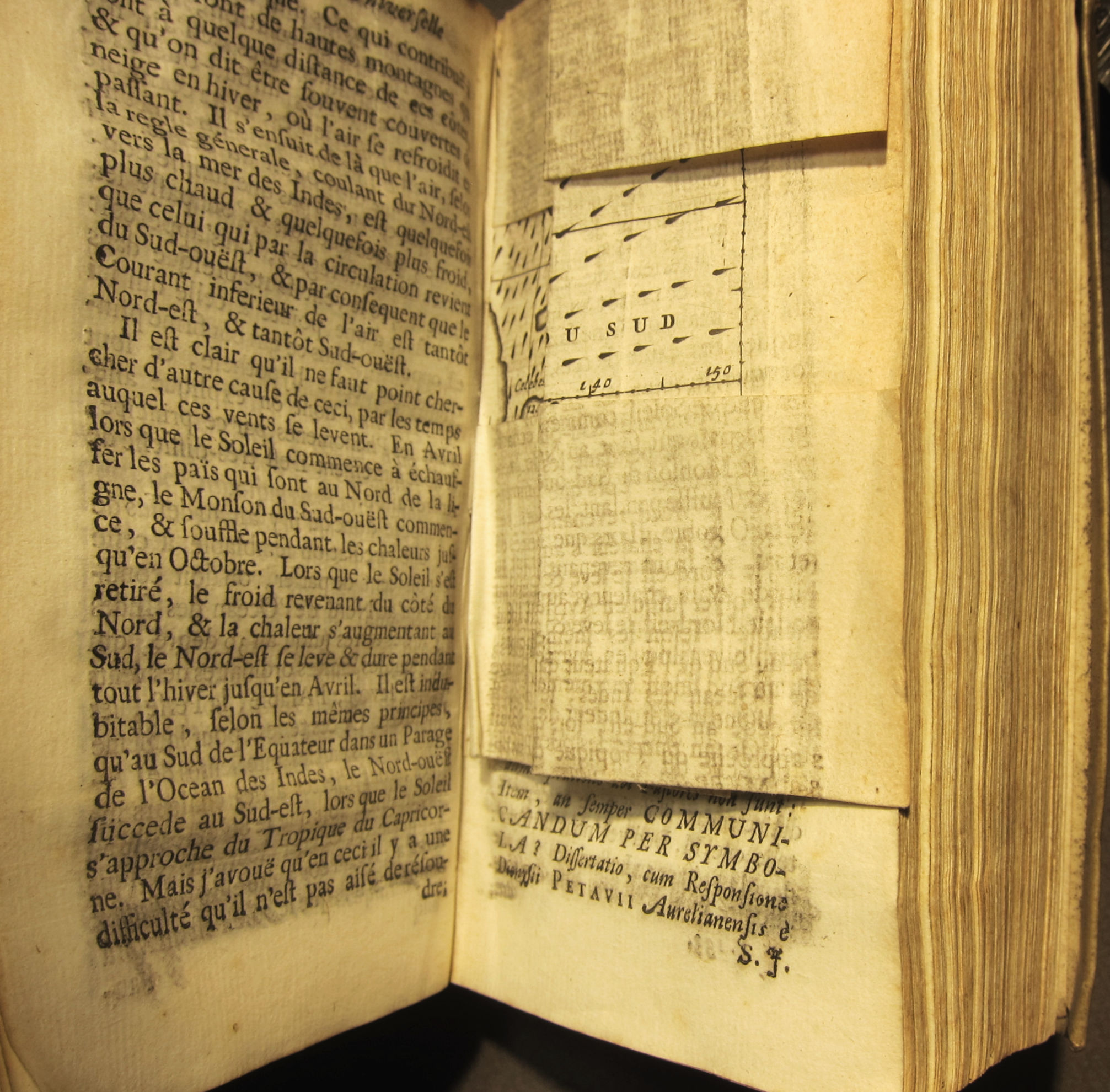
    HALLEY, Edmund. “Extrait du Journal D’Angleterre, contenant one Relation Historique des Vents reglez & des Monsons que l’on remarque dans les Mers qui sont entre les Tropiques, ou qui n’en sont pas éloignées, avec un Essai de Physique touchant leurs causes naturelles par Mr. Halley”, in Bibliothèque universelle et historique, Amsterdam, 1687, published by Warsbergew, Boom, and VanSomeren; vol 4, pp. 66-93 in the volume of (18), 552, (22)pp, with two folding plates, one of which is the first weather map. 142X80mm, bound in vellum.   $1250

    The famous map (14.8 × 48 cm) is very fresh and strong, and has only one minor defect—a small 1/2” teat at upper right edge. Other than that it is in excellent condition.

    Halley _4_


    This is the French translation of Halley’s “An Historical Account of the Trade Winds, and Monsoons, Observable in the Seas between and near the Tropicks, with an Attempt to Assign the Phisical Cause of the Said Wind,” that appeared several months earlier in the Philosophical Transactions of the Royal Society (1686, in issue no. 183).

    Here is a summary of the map from the Princeton University site dedicated to thematic maps:

    • “First meteorological map, charting the directions of trade winds and monsoons. Having collected information from navigators familiar with ocean transits, and also from his own tropical experience on St. Helena (1677–1678), Halley sought to rectify the work of earlier writers on the subject. He attributes the circulation of prevailing winds to the solar heating of volumes of atmosphere as the earth revolves, which thus draw air after them, forming a generally easterly wind; as the sun departs, the air reverses direction to establish equilibrium. He argues that the effects of continents (and other landmasses) and latitudes complicate but do not compromise the basic principle. (Today, of course, solar heating is viewed as only a piece in the puzzle of winds; ocean currents would be another. Adding Halley’s wind map data to Eberhard Happel’s 1675 map of ocean currents [see his entry in the Hydrography section] would make an interesting thematic map.) Elsewhere in the article, Halley correctly identifies the West Indies as the source of hurricanes in the Atlantic.

    “On the map, rows of brief lines show the course of the winds; the sharp ends of those lines point to wind sources. Where winds go back and forth, notably in the monsoon-prone area of the Indian Ocean, the lines are thicker than elsewhere and point both ways.”

    Had Halley–called Father of Dynamical Meteorology—not made his important contributions to astronomy and other fields he would have been remember for being the first geophysicist, and also perhaps the earliest thematic mapmaker.

    Halley _4_
    Halley _4_

    Halley _4_

    ·Posted by :

    ·in:

    —
  • The First Demonstration of Piezoelectricity (1880)

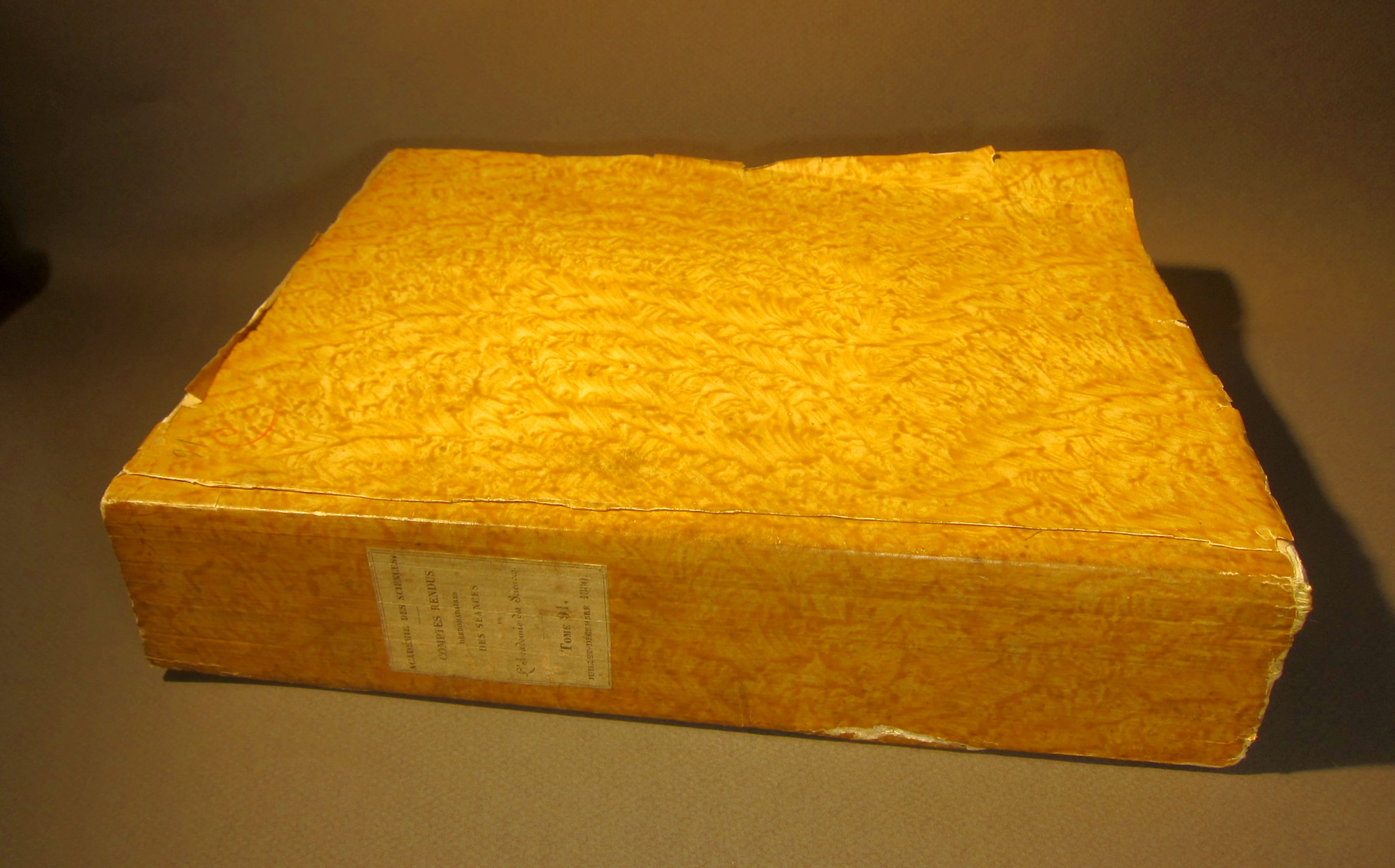
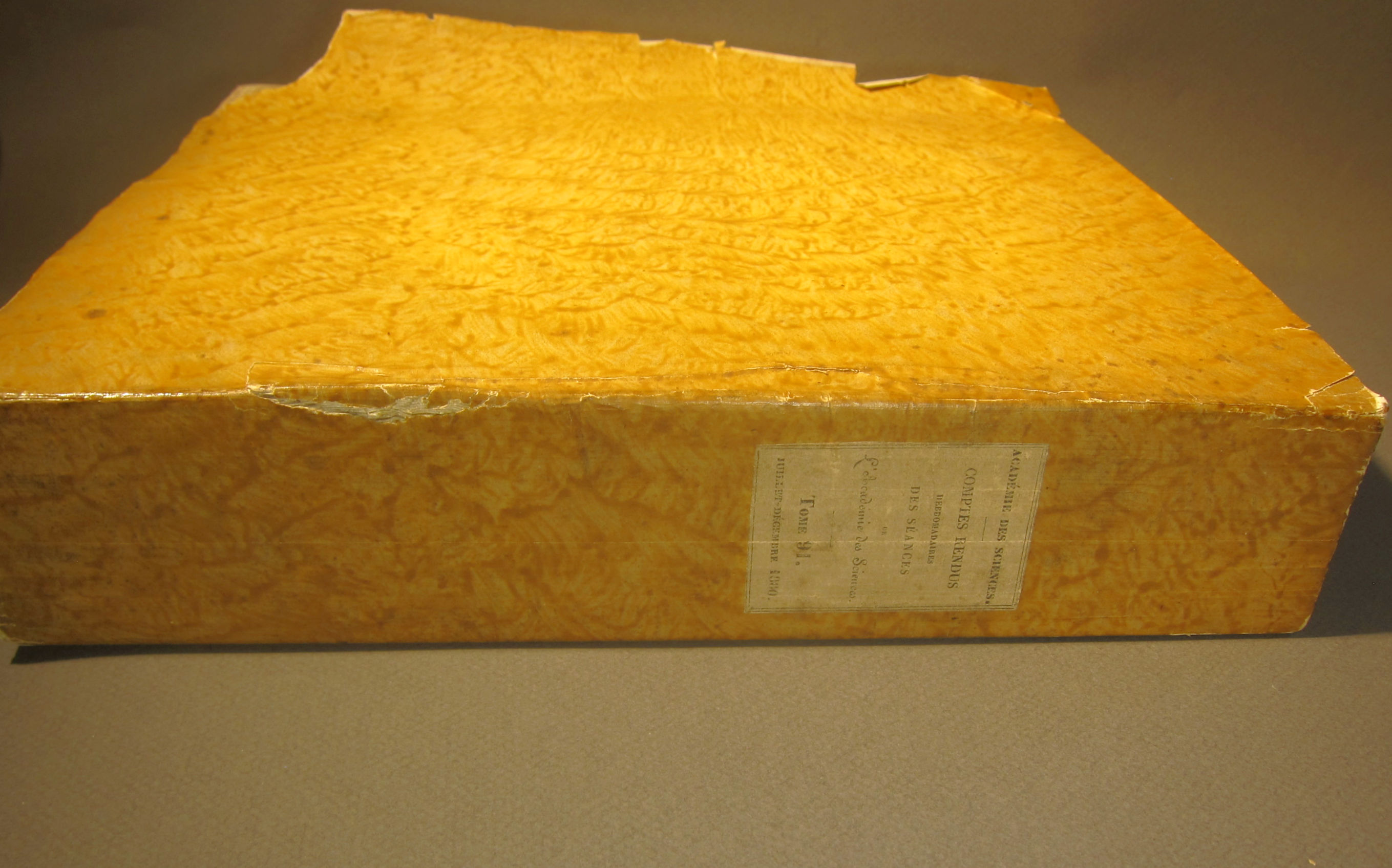
    CURIE, Pierre and Jean-Jacques Curie, “Développement, par pression, de l’électricité polaire dans les cristaux hémièdres à faces inclinées” and “Sur l’électricité polaire dans les cristaux hémièdres à faces inclinées” in Comptes rendus hebdomadaires des séances de l’Académie des sciences, 1880, vol 91, pp. 294–295 and 383-386. In the original (very thin) wrappers for this large volume, complete with the original paper spine label. Lovely copy. Partially unopened. Fine condition. $750.00

    “Microphones, quartz watches, and inkjet printers all rely on an unusual phenomenon known as the piezoelectric effect found in various crystals, ceramics, and even bone. It was discovered by none other than French physicist Pierre Curie, working with his older brother Jacques, who found that putting pressure on these materials created electricity…”–APS News, march 2014, vol 23 #3.

    Piezo _2_“His first important scientific collaboration was with his older brother, Jacques. By the time Pierre was 21 and Jacques 24, the brothers had discovered the piezoelectric effect (from the Greek word meaning “to press”). The Curie brothers had found that when pressure is applied to certain crystals, they generate electrical voltage. Reciprocally, when placed in an electric field these same crystals become compressed. Recognizing the connection between the two phenomena helped Pierre to develop pioneering ideas about the fundamental role of symmetry in the laws of physics.”–American Institute of Physics site, history of physics, “Pierre Curie”.

    “Piezoelectricity is an electric charge that is produced by many crystals and some ceramics and other materials when they are compressed. Materials that create piezoelectricity also exhibit the “reverse piezoelectric effect,” a change in dimension when an electric potential is applied. Piezoelectricity and the reverse piezoelectric effect have a wide range of applications from the scanning probe microscope to the ignition of propane barbecues.’ Wenner, History of Physics.

    “The first experimental demonstration of a connection between macroscopic piezoelectric phenomena and crystallographic structure was published in 1880 by Pierre and Jacques Curie. Their experiment consisted of a conclusive measurement of surface charges appearing on specially prepared crystals (tourmaline, quartz, topaz, cane sugar and Rochelle salt among them) which were subjected to mechanical stress. These results were a credit to the Curies’ imagination and perseverance, considering that they were obtained with nothing more than tinfoil, glue, wire, magnets and a jeweler’s saw.

    “In the scientific circles of the day, this effect was considered quite a “discovery,” and was quickly dubbed as “piezoelectricity” in order to distinguish it from other areas of scientific phenomenological experience such as “contact electricity” (friction generated static electricity) and “pyroelectricity” (electricity generated from crystals by heating).”–”The History of Piezoelectricity, from Discovery & Insights to the Search for High Volume Piezoelectric Markets”, by Piezo dot Com.

    See also: KATZIR S. “The Discovery of the Piezoelectric Effect” in Katzir (eds) The Beginnnings of Piezoelectricity, Boston Studies in the Philosophy of Science, vol 246

    Piezo _1_


    ·Posted by :

    ·in:

Recent Posts

Archives

Categories