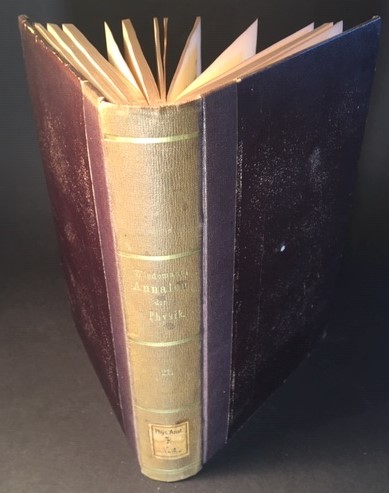
HITTORF, Johann Wilhelm. “Über die Electricitätsleitung der Gase” in Annalen der Physik und Chemie, 1884, 21 pp. 90–139; and “Über die Emission der Warme von unebenen Oberflachen” by Christian Christiansen in Annalen der Physik und Chemie, 1884, vol 21 pp. 364–369, 1884). Volume in contemporary cloth and boards. Some wear to boards. Small sticker to spine. Interior clean with no marks. Near fine, very pretty copy. $375
“Hittorf is remembered primarily for his experimental work in the transport of charge by ions in electrolytic solutions and the study of electrical conduction through gases. Hittorf’s experimental contributions to physical science included early researches on the allotropic forms of selenium and phosphorus (1851–1865); investigations of the variations in the concentrations of electrolytes during electrolysis (1853–1859); the discovery,Page 439 | Top of Articlewith Plücker, of the presence of both band and bright line spectra in the discharges of electricity through a gas at low pressures (1865); the examination and description of gaseous discharges and cathode-ray phenomena (1869–1884); and investigations of the passivity of metals (1900).”
“Following Plücker’s studies, in 1869 Hittorf began a series of investigations of the discharge phenomena. He verified the effect of the magnetic field on the glow discharge and the fluorescence of the glass tube itself. He found that any solid or fluid body, whether an insulator or a coductor, when placed in front of the cathode cut off the glow. By constructing an L-shaped tube with the electrodes at the two ends, Hittorf was able to establish that the glow was confined to the arm in which the cathode was located. He concluded that the glow was generated from a point cathode and traveled in straight lines. “We will therefore speak of rectilinear paths or rays of glow, and consider any point of the cathode as the source of a cone of rays” [This paper.] These results led to the brilliant researches on gaseous conduction by Crookes ten years later (1879) and the eventual identification of the cathode rays as electrons by J. J. Thomson (1897).” Complete Dictionary of Scientific Biography online
“While experimenting with a cathode ray tube, Hittorf was one of the first to observe thermionic emission when he noticed that when he heated the cathode to incandescence, even a small voltage differential would cause a large current to flow. Christensen presents his experimental confirmation of Josef Stefan’s formula for the total energy output by a black body depending on temperature.” Wenner, History of Physics
Also bound with: “Über die Emission der Warme von unebenen Oberflachen” by Christian Christiansen, pp pp. 364–369. The first modern calculation of planet temperature using Stefan’s law.”
“The Stefan-Boltzmann law, also known as Stefan’s Law, is a law that expresses the total power per unit surface area (otherwise known as the intensity) that is radiated by an object, often taken to be a blackbody. … The law also predicts how much heat the Earth radiates into space. “–Wikipedia