CLAUSIUS, Rudolf. “Über einen auf die Wärme anwendbaren mechanischen Satz eine veränderte Form des zweiten Hauptgesatzes der mechanichen Wärmetheorie” in the Annalen der Physik und Chemie, 1854, vol 93, pp. 481–506. Contemporary leather and boards, somewhat worn. Elaborately engraved spine. Marbled edges match boards. Spotting to preliminaries and plates at end. Not ex-library and no interior marks. An excellent if not carefully and occasionally used volume. $1700
“Clausius’ most famous statement of thermodynamics second law was published in German in 1854, and in English in 1856. ‘Heat can never pass from a colder to a warmer body without some other change, connected therewith, occurring at the same time.’”–Wikipedia
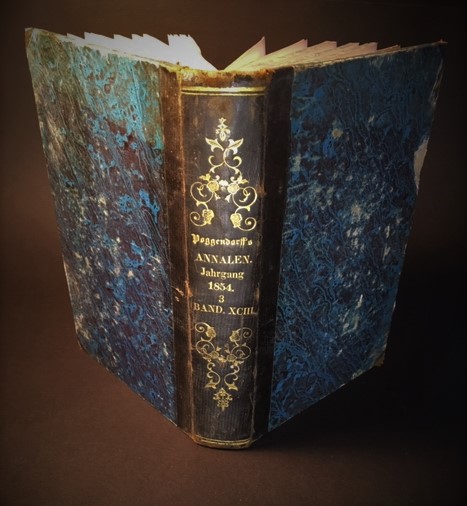
The 1854 paper in which Clausius proposes his famous heat formulation in restating the second law of thermodynamics: “Asserting that in any irreversible change the entropy of the system will increqse” C Parkinson, Breakthroughs. This the second of three of the fundamental papers that he contributed to the birth of thermodynamics (the others being an earlier 1850 paper, when Clausius established the foundations for modern thermodynamics in his first great paper on the theory of heat, “Ueber die bewegende Kraft der Warme,”) and a later in 1865 in which he gives the concept of the measure of transformation equivalence developed in 1854 the name of “entropy”).
“Clausius did not introduce the symbol T for this universal function of temperature (a + t) until his second important paper, “Ueber eine veranderte Form des zweiten Hauptsatzes der mechanischen Wärmetheorie,”[this paper] in which he developed the concept of entropy.
Clausius did not propose the name “entropy” at this time, calling the new theorem simply the principle of the equivalence of transformations. This accorded well with the unique engine cycle that he had conceived to establish the theorem, a cycle portraying two important types of transformation: a conversion of heat into work at one temperature and a transfer of heat from a higher to lower temperature. The two transformations were called equivalent because they could replace one another. For example, suppose that the transfer of heat had occurred. By operating the cycle in reverse, Clausius argued, the heat could be restored to its original temperature and there would be a conversion of work into heat.”–Complete Dictionary of Scientific Biography online