A Daily History of Holes, Dots, Lines, Science, History, Math, Physics, Art, the Unintentional Absurd, Architecture, Maps, Data Visualization, Blank and Missing Things, and so on. |1.6 million words, 7500 images, 4.9 million hits| Press & appearances in The Times, Le Figaro, Mensa, The Economist, The Guardian, Discovery News, Slate, Le Monde, Sci American Blogs, Le Pont, and many other places… 5000+ total posts since 2008.

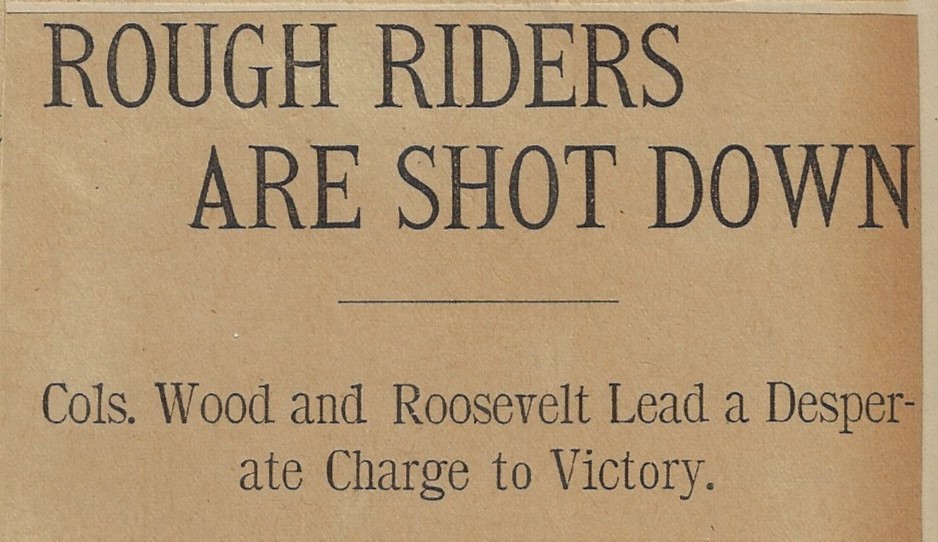
  • Spanish-American War in Cuba Scrapbook, 1898

    Spanish American War scrapbook _1_Spanish-American War Scrapbook, February-July 1898. 11”x 9”, 30 cardboard sheets nicely filled front and back with newspaper clippings principally from Washington D.C. newspapers of the major events. This had been bound at top with red, white, and blue ribbon through three-hole punched (at top and bottom) ready-made scrapbook (sold by “Baum’s”, 416 7th St.,Washington DC.) $400

    The ribbon binding has come apart, and there is significant short chipping around the edges of the cardboard wrappers and page edges. Overall though the work is extremely tidy, and the glue used to adhere the clippings to the boards has not bled through (as it does in many cases of these home-made efforts). VG condition. $400

    This scrapbook follows the course of the short-lived war in Cuba between Spain and the United States. (The war/insurrection in the Philippines that is another result of this war was an entirely different and much more complicated and bloody matter.) Most of the major aspects of the Cuba 1898 conflict are seen in these pages, along with a few references to Col. Theodore Roosevelt and the Rough Riders.

    Spanish American War scrapbook rough riders

    ·Posted by :

    ·in:

  • The World Dope Menace and the U.S. Contribution To It (1923)

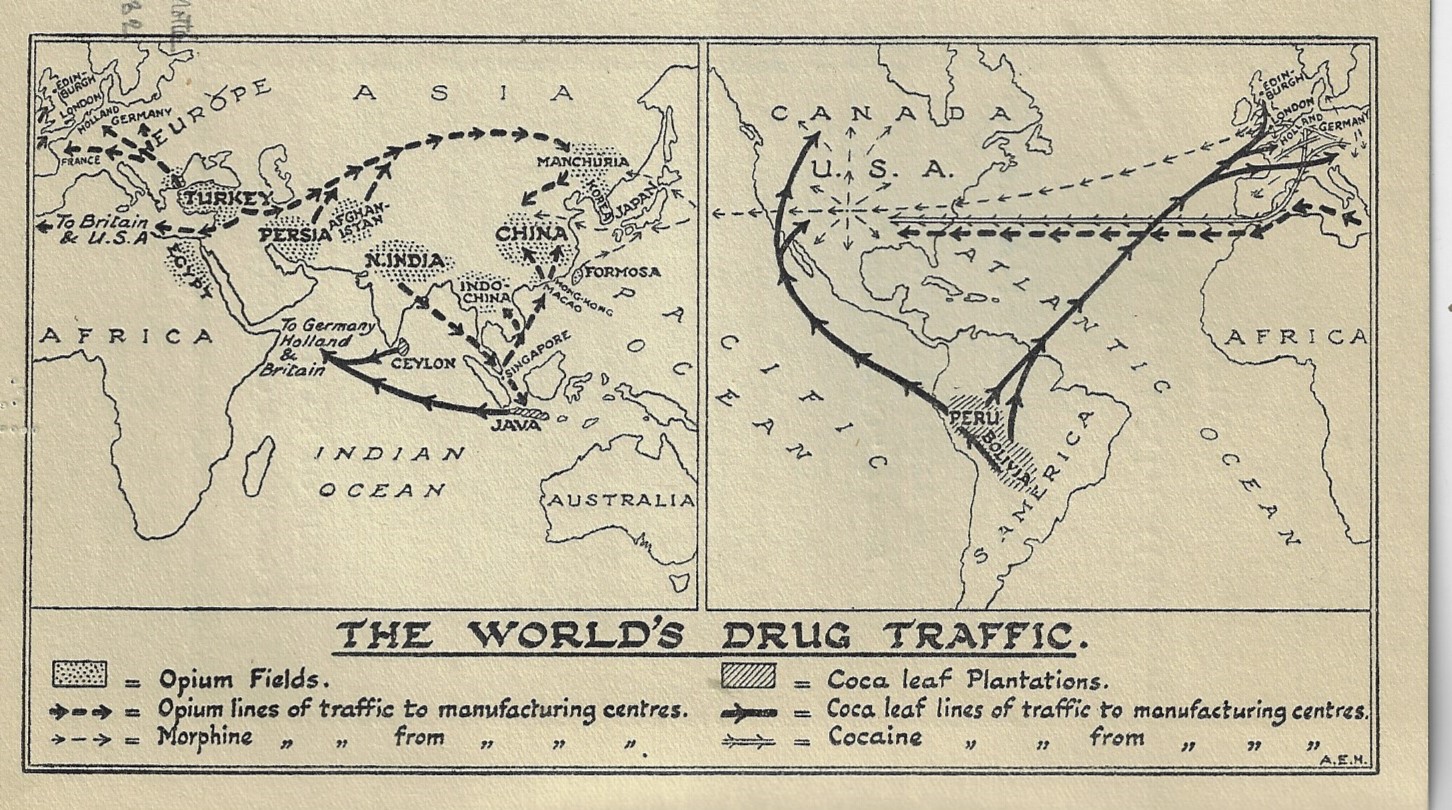
    Basil Mathews, The World “Dope” Menace and the League of Nations. London, the League of Nations Union, 1923. 7″x 5″, 24pp. Original wrappers.  VG copy. $95

    A sober and clinical appraisal of the amount of narcotics being smuggled and consumed in Hong Kong, China, Japan, french Indochina, Ceylon, Mauritius, and others.

    He also states the amounts that Western countries export to (in this case) Japan: England 10,000 lbs, France 8,000 lbs, Germany 2.800 lbs, Belgium 2800 lbs, Switzerland 4400 lbs, Holland 250 lbs, USA 18,500 lbs.

    World Dope menace map

    “In cold literal fact men in Britain and America and Japan have grown rich by debauching of China’s morphino maniacs who are now innumerable.”

    “The seriousness of morphine addiction can be understood from the opinion of an expert authority who says Morphine is not only ten times more deadly than opium but is more seductive and overwhelming in results. The addict becomes an absolute slave entirely powerless for not only are his will and moral fibre entirely rotted by the drug itself but he becomes the victim of the most dreadful tortures directly that he is robbed of his doses nervous tortures so terrible that they often drive him mad and end in death.”–from the pamphlet, p. 15.


    Basil Mathews, The World “Dope” Menace and the League of Nations. London, the League of Nations Union, 1923. 7″x 5″, 24pp. Original wrappers.  VG copy. $95

    A sober and clinical appraisal of the amount of narcotics being smuggled and consumed in Hong Kong, China, Japan, french Indochina, Ceylon, Mauritius, and others.

    He also states the amounts that Western countries export to (in this case) Japan: England 10,000 lbs, France 8,000 lbs, Germany 2.800 lbs, Belgium 2800 lbs, Switzerland 4400 lbs, Holland 250 lbs, USA 18,500 lbs.

    “In cold literal fact men in Britain and America and Japan have grown rich by debauching of China’s morphino maniacs who are now innumerable.”

    “The seriousness of morphine addiction can be understood from the opinion of an expert authority who says Morphine is not only ten times more deadly than opium but is more seductive and overwhelming in results. The addict becomes an absolute slave entirely powerless for not only are his will and moral fibre entirely rotted by the drug itself but he becomes the victim of the most dreadful tortures directly that he is robbed of his doses nervous tortures so terrible that they often drive him mad and end in death.”–from the pamphlet, p. 15.

  • Scarce Princeton Title in Physics (1935)

    CONDON, Edward U. Selected Topics in Theoretical Physics. Notes by Rubby Sherr. 1935.  

    This is an offset and stapled low-run production of lecture notes taken by Rubby Sherr of a course given by E.U. Condon at Princeton in 1935. Condon was at Princeton from 1928-1937, and the very young Sherr (only 22 at the time) would go on to make his mark for decades in the physics community at Los Alamos and Princeton.  Condon of course was a mega-figure in the world physics community.  

    11″ x 8.5″, mimeographed from typed sheets with reproductions of manuscript equations; stapled.  GOOD copy, only.  

    Provenance: Library of Congress (with their surplus stamp on the front cover), given to them (as noted by a penciled note on the back of the cover) from the Institute for Advanced Study, Feb 1 1937.  
    Nice association copy of a very scarce document.  $150

    “In 1942, Sherr joined the MIT Radiation Laboratory, where he worked to develop new airborne radar systems. In 1944, he became involved with the Manhattan Project, which was tasked with creating the first nuclear weapon. Together with Klaus Fuchs, Sherr developed a key component of the bomb’s triggering mechanism, the Fuchs–Sherr polonium-beryllium modulated neutron initiator. On July 16, 1945, Sherr was present at the Trinity nuclear test in New Mexico. He later recalled thinking during the test, “‘This is the greatest scientific experiment of all time’ – it was certainly the biggest. Then the horror sank in that the thing had actually worked, followed by relief that the atmosphere hadn’t ignited, as some had feared it would.”–Wikipedia

    “Edward Uhler Condon (March 2, 1902 – March 26, 1974) was a distinguished American nuclear physicist, a pioneer in quantum mechanics, and a participant in the development of radar and nuclear weapons during World War II as part of the Manhattan Project. The Franck–Condon principle and the Slater–Condon rules are co-named after him. He was the director of the National Bureau of Standards (now NIST) from 1945 to 1951. In 1946, Condon was president of the American Physical Society, and in 1953 was president of the American Association for the Advancement of Science.”

    WorldCat locates only 6 copies–none at Princeton. 

    ·Posted by :

    ·in:

  • Admiral Wainwright’s Working Copy of the Preliminaries for the Third Hague Conference

    Wainwright _1_
    WAINWRIGHT, Richard, Admiral. Spanish-American War hero, Medal of Honor, Superintendant of the US Naval Academy (1900-1902), and etc.

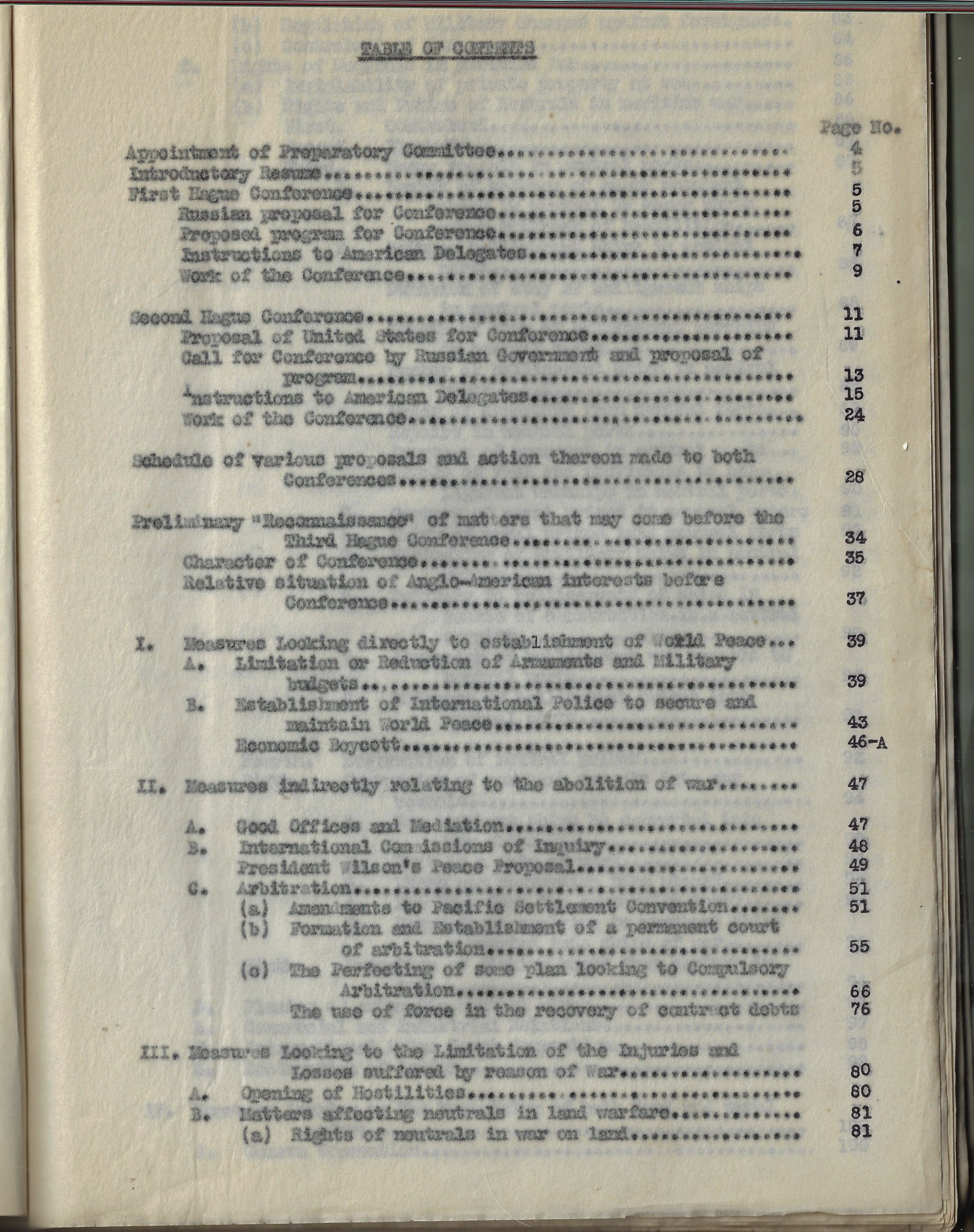
    Memorandum, Preliminary Study, Preparatory Committee of the United States for the Third Hague Conference.

    Carbon copy on very thin, onion-skin-like paper. Ca. 1913. 11”x 8.5”, 296 leaves, partially paginated: (3),134 lvs, (14 lvs), (41 lvs), (6 lvs), (3 lvs), (13 lvs), (82 lvs); approximately 75,000 words. Bound in a contemporary store-bought “Shipman’s Common Sense binder”. VG copy.

    WorldCat does NOT locate this version of a subsequently-published report. $1750

    Provenance: Admiral Richard Wainwright, then to the Navy Department library (received 30 Sept 1926), then to the Library of Congress

    Various library stamps: mostly-removed Navy Department ex-libris; rubber stamp “Discarded/Navy Department Library”, rubber stamp of receipt by Navy on front free endpaper; “Admiral Wainwright” in a fine hand in ink at the top of front free endpaper; rubber stamp “Surplus Library of Congress Duplicate” on rear endpaper.

    This seems to be a preliminary edition of Preliminary Report of the Preparatory Committee of the United States for the Third Hague Conference, to which Admiral Wainwright and two others were appointed by President Taft. “The committee appointed by President Taft June 10, 1912 consists of Hon J Reuben Clark ex Solicitor for the Department of State; Gen Enoch H Crowder, Judge Advocate General of the United States Army; and Rear Admiral Wainwright of the United States Navy. The report begins with the letter of Secretary Knox to President Taft April 5 1912 recommending the appointment of such a committee This letter suggests the importance of such a committee that the Government of the United States might be informed precisely of its relations to the Hague Conference The committee was appointed with the understanding that it represent the United States upon the international preparatory committee contemplated by the Second Hague and that the members should be technical delegates to the Third Hague Conference This letter also sets forth that since in the practical application of the principles and rules of international law all responsibility falls upon the Department of State the War Department and the Navy Department therefore the committee might well be made up of a representative of each department The committee which is to serve continuously until the close of the Third Hague Conference was set the task of preparing a general program for the participation of the United States in a Third Hague Conference While as suggested by the title the report submitted is but preliminary to the formal report hereafter to be submitted the general …”–Advocate of Peace, Washington D.C., 1914., Vol 76 #1.

    ·Posted by :

    ·in:

    —
  • Great and Fantastic Images from Kircher’s “Mundus Subterreneus…” 1678


    I’m offering for sale some engravings from Athanasius Kircher’s Mundus subterraneus… (1678) which, in spite of its title, explores/classifies/theorizes on the grand scheme of all creation, hardly limited to just the world going on underground.  Kircher (who has appeared on this blog numerous times, simply enter his name in the Google search box at left and you’ll find many entries) approaches the nature of terrestrial heat, volcanoes, the origins of lakes and rivers, optics, fossils/agates (in “de lapide philosopherum”), distillation, alchemy, ocean currents, insects, plant life, and so on, a real summa cum laude  tour de force, Kircher being the Renaissance man’s Renaissance man.

    All images are printed on 14 3/4 x 8 7/8″ sheets (375x220mm) and have been removed from a defeated and dead copy of the book, the full title of which is Athanasii Kircheri … Mundus subterraneus, in XII libros digestus: quo divinum subterrestris mundi opificium, mira ergasteriorum naturae in eo distributio … universae denique naturae maiestatis & divitiae summa rerum varietate exponuntur …   This copy (lacking the title page and much else) I believe was printed in Amsterdam in 1668 (I believe–the other somewhat later editions to 1678 that I have checked all seem to have added material and different and later pagination, leading me to believe that this is an earlier edition.) The pagination ran 346+487pp, being two volumes printed as one.

    • Please keep in mind that the scans leave off the top 1.5″ or so of each image as well as the bottom half-inch–the paper was simply too long for the scanner bed. The pages are complete (in real life).

    And so the list (of 18), thus far:

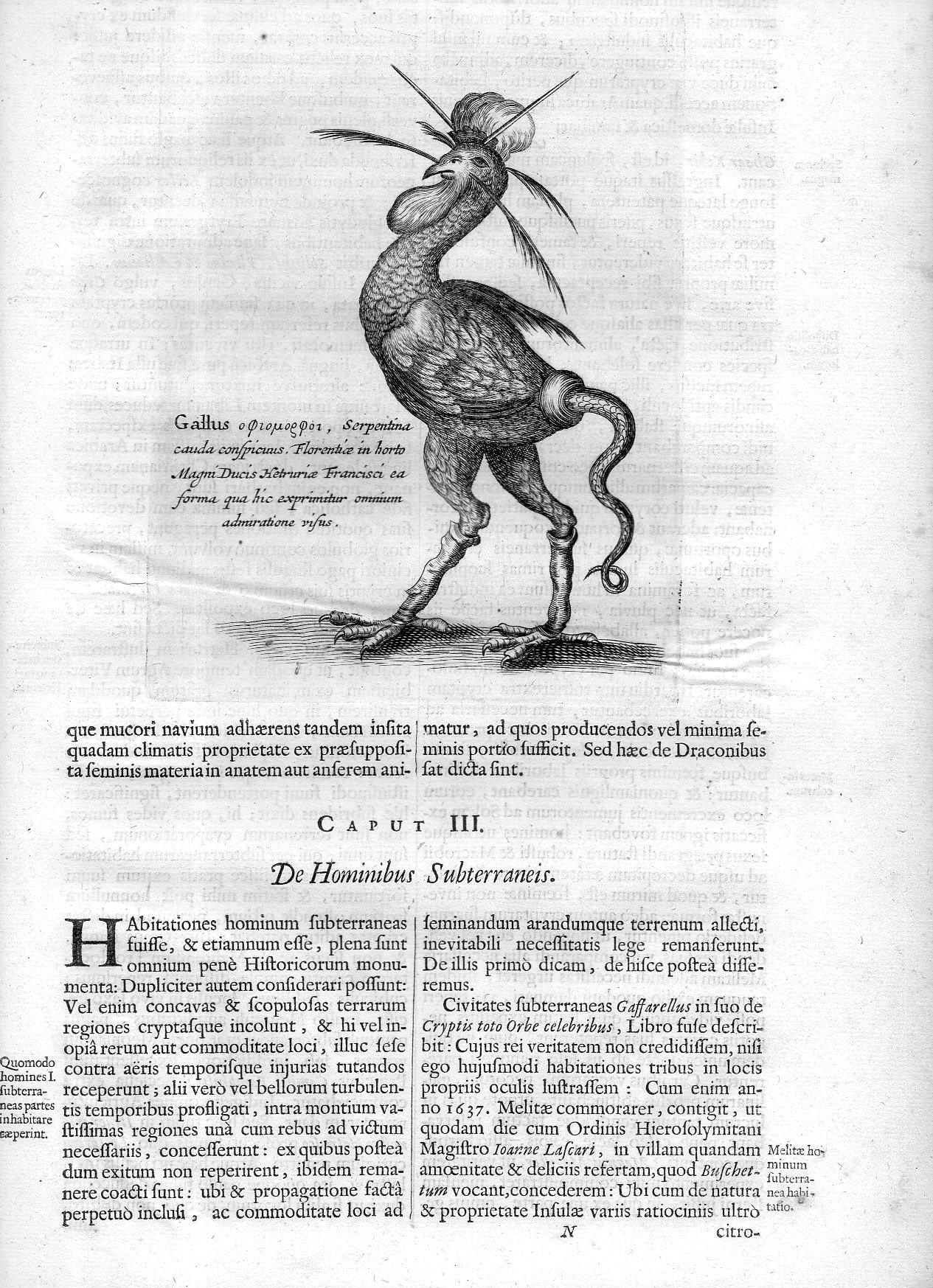
    Gallus…serpentina cauda conspicuus…In the chapter, “de Animalibus Subterraneis”, p 97.

    Kircher 97039Image 6 1/2 x 5 inches, 160x120mm.  $300 (There is some chipping at the top of the sheet, though it does not extend into the sub-head.)  

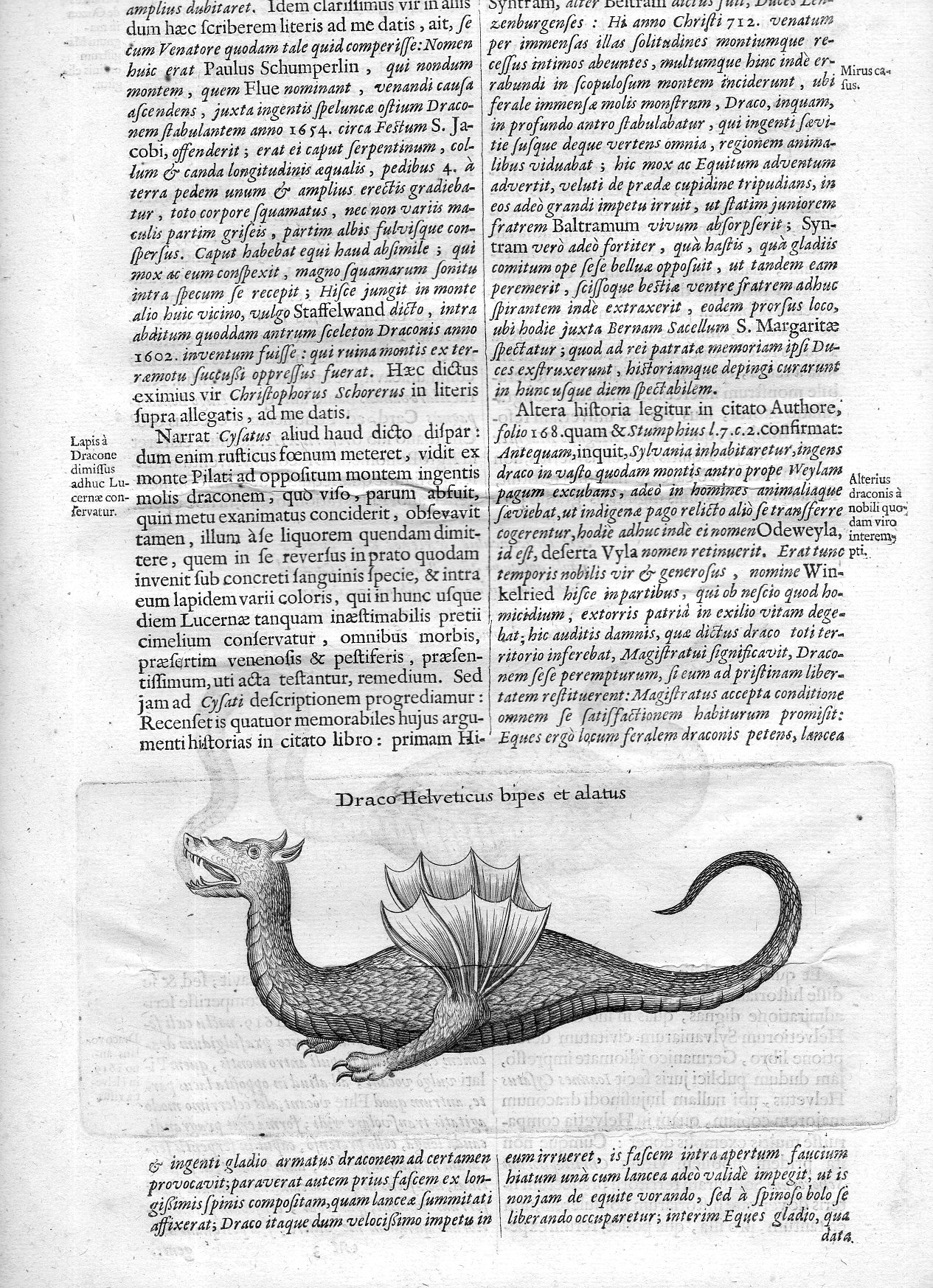
    (Underground animals) Draco Helveticus bipes et alatus.

    Kircher 93040Image 3 1/4 x 7 1/2″, 80x185mm.  $375

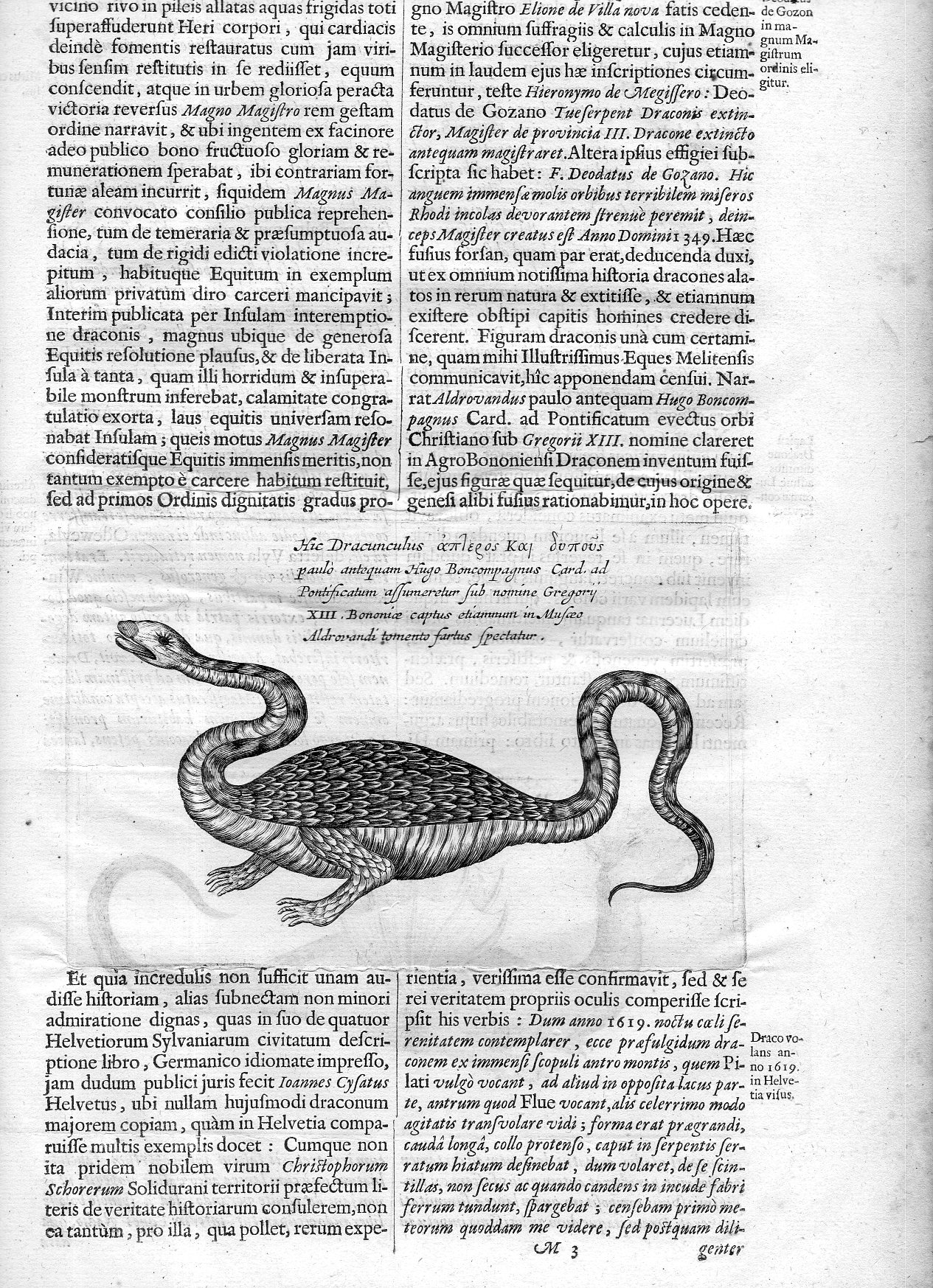
    On the other side of the page: Hic Dracunuculus…

    Kircher 94041Image 4×6″, 115x160mm. 

  • Rare Eyewitness Account of the Surrender of Japan (1945)

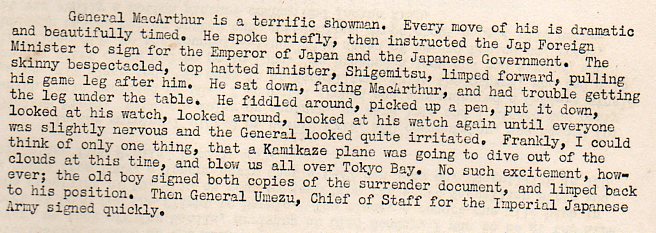
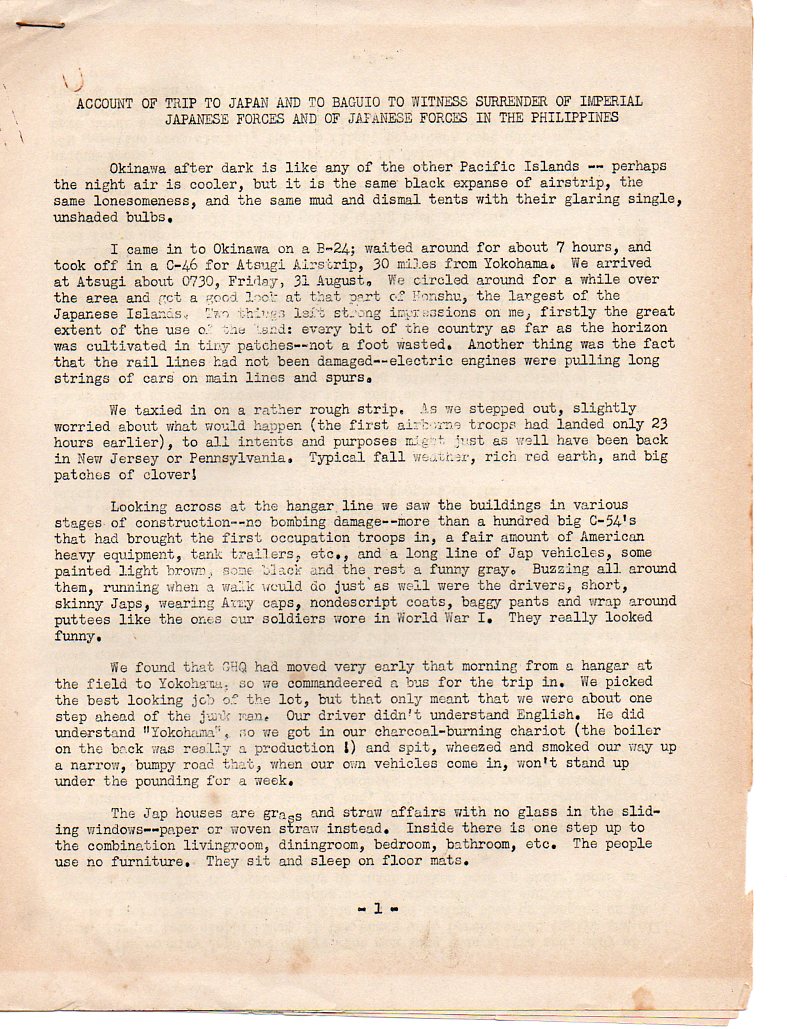
    Deglin, Lt. Col T.L.  Account of a Trip to Japan and to Baguio to Witness Surrender of Imperial Japanese Forces and of Japanese Forces in the Philippines. 1945  5pp.  Very good condition.  $450


    Deglin c det956
    After serving as public relations director for Madison Square Garden (1935-1942), T.L. Deglin became a Lt. Col. in the U.S. Army in a public relations capacity, finding himself a witness on 2 September 1945 to the Japanese surrender on the U.S.S. Missouri and at Baguio (in the Philippines). what follows below is his five-page (1750 word) description of those events.  The report is an offset-printed production, so it did see some sort of distribution, but I can find no mention of it anywhere. 

    My copy came as part of a large group of material (known as “The Pamphlet Collection”) that I purchased of the Library of Congress some years ago–the one cohesive factor to the collection-without-a-purpose was that the material was by and large no located in other libraries.  This may have been because of the great ephemeral nature of some of them, but the pamphlets saw very restricted play in the library circulation game. 

    [Content warning–there’s some very place/time/situation-specific derogatory language here.]

    Deglin a953

    I reproduce the document in full, below.  

    ·Posted by :

    ·in:

  • 21 Papers by Fizeau and Foucault (1843-1862)

    Fizeau, Armand Hippolyte Louis. “Ueber die zur Erzeugung der Moser’schen Bilder-beitragenden Ursachen”, which is the first German edition of “Sur les causes qui concouraent a la production des images de Moser” from the Comptes Rendus de l’Academie des Sciences 1842, volume 15. In Annalen der Physik, volume 58, 1843, No. 4, part VII, pp 592-593 in the issue of pp (521)-668 (with one folding plate). This issue is removed from a larger bound volume, with no outer wrappers. Very Good. Other works include those of C.F. Naumann, G.B. Airy, Faraday, Arago, and a longer piece by Daguerre. (“Ueber ein neues Versahren, die zu photographischen Bildern bestimmten Platten zu poliren, welches, so lange di eSufsern Umstande gleich bleiben, einerlei Resultate gicht”, pp 586-592, translated from the Comptes Rendus de l’Academie des Sciences volume 16, p. 588.) SOLD

    Fizeau, Armand Hippolyte Louis. “Sur les effets resultant de certaines procedes employes pour abreger le temps necessaire a la formation des images photographiques”, in Comptes Rendus de l’Academie des Sciences, 1843, volume 16, pp 759-761. This is offered in the weekly issue, removed from a larger bound volume, and without wrappers. Very Good. $175

    • “On 19 August 1839 Arago made public a description of a new process of “light painting” or heliography that had been invented by L.-J.-M. Daguerre. The daguerrotype, as the result of this process soon came to be called, was a crude forerunner of the modern photograph. Fitzeau’s earliest work in science was an attempt to improve Daguerre’s process and to make the heliograph an instrument of science. He showed that by covering the surface of the developed plate with a salt of gold, oxidation of the surface chemicals could be prevented and the contrasts between light and dark could be considerably heightened. He is often credited with the first use of bromine vapors to hasten the development of the photographic image, but this seems uncertain. Fizeau also introduced a widely used but unpatented method for turning a photograph into a photoetching.”–Dictionary of Scientific Biography

    Fizeau, Armand Hippolyte Louis. “Sur le phenomene des interferences entre deux rayons de lumiere dans le case de randes differences de marche”, in Comptes Rendus de l’Academie des Sciences de l’Academie des Sciences, 1845, volume 21, offered in the weekly issue, the article occupying pp 1155-1158. The issue is removed from a larger bound volume, and offered with the wrappers. Very Good. $300

    • “From 1844 Fizeau and Foucault undertook a series of precise and mechanically ingenious optical experiments that would ultimately have a profound effect on the course of physics. By the middle of the nineteenth century, most scientists had come to accept the wave theory of light, formulated near the beginning of the century by Thomas Young and Augustin Fresnel. There remained, however, several gaps in the investigation of the experimental consequences of the theory. For example, in the study of interference fringes produced by two rays of light issuing from the same source, only several dozen fringes on each side of the central band had been observed.”–Dictionary of Scientific Biography

    Fizeau, Armand Hippolyte Louis. “L’Action des rayons rouges sur les plaques daguerriennes”, in Comptes Rendus de l’Academie des Sciences, 1846, the article occupying pp 679-682 in the weekly issue, and removed from a larger bound volume. There is some water staining to this volume, and so is in GOOD condition, only. $100

    ·Posted by :

    ·in:

  • Manuscript and Rare Material on a Bombing Survey of Japan, October 1945

    This small archive—from the estate of J.D. Coker, who served in the U.S. Navy on the US Strategic Bombing Survey Ships’ Bombardment section, and who later became a leading official in the U.S. Atomic Preparedness programs (such as the President’s Committee on Emergency Preparedness)—are mimeographs and manuscripts that comprise what seems to be the summary of the Navy’s bombardment of Kamaishi, Muroran, Hitachi, Kushimoto, Shimizu, Hakodate, Nojima, Saki, and Hamamatsu.  This was about the extent of the Allied naval bombardments against Japan, as it was not possible for battleships to maneuver close enough to the Japanese homeland to fire against industrial and production centers.  (It may have also been the case that the aircraft used to protect the assaulting ships could have perhaps done as much damage to the targets as the ships themselves.) $1750

    Ships Bombardment Surveys Original, Confidential Material

    Group of 14 documents of 63 leaves concerning the bombing surveys at Hamamatsu, Hitachi, Kamaishi, Hakodate, Kushimoto, Nojima Saki (Japan) in 1945. Includes the following sections:

    (1) “Memo from the Chairman”

    Marked CONFIDENTIAL.

    “Preliminary Summary of report on Ships’ Bombardment Survey Party.”

    8vo, 7pp, carbon typescript on onion skin paper, heavily annotated and corrected in pencil.

    By N.A. Chapin, Capt., USN.

    This detailed report reviews the damage done to the areas under bombardment including Kamaishi, Hamamatsu, Hitachi, Muroran, Shimizu, Shionomisaki, Nojima Saki

    “Primary task of units attacking first four objectives was bombardment, and principal components of these Task Units in general were fast battleships and heavy cruisers. Attacks on the last three were secondary tasks during anti-shipping sweeps … .In general the mission assigned by commander Third Fleet was to bombard certain vital areas of Japanese Mainland in order to destroy vital industries and demoralize transportation, and lower will to resist of Japanese people”.

    (2) ”Ships’ Bombardment Survey Party, Order of Publication of Reports”

    8vo, 18pp, carbon typescripts on onion skin paper. Outlines this segment of the survey and provides statement on the distribution of bombing data, how reports are to be made, structure of reports. For example, for “Japan Iron Works” in Kamaishi the order of report should be the decription of target (functional and physical), followed by analysis of damage (physical, funcitonal, fall of shot and general damage plot, photos of Japan Iron Works and machinery; building and machinery layouts; tablesof production. This is the general outline and does NOT include the actual data, though it does outline about three dozen target areas. (Dated as revised in December 1945.)

    • 2a-3f are all ship-board mimeographic reports, staple bound, of the six target areas outlined above.

    (2a) ”Ships’ Bombardment Party. Field Memo No. 1. U.S.S. Haines, at Sea, 2 October 1945.”

    Marked CONFIDENTIAL. 3pp.

    Data recorded summary includes, for example:

    Kamaishi area.

    Target: Japan Iron Works. Invloving the ships USS Indiana, South Dakota, Massachusetts, using 16” guns, delivering 802 rounds on 14 July 1945.

    (2b) “Ships’ Bombardment Party/. Field Memorandum No.2 U.S.S. Haines, at Sea 7 October 1945”

    Includes data on Nihon Steel Works and Wanishi Iron Works under bombardment by USS Missouri, Iowa Wisconsin, all 16^, delivering 434 rounds. Also provides coordinates for target areas. 2pp.

    (2c) “Ships’ Bombardment Party/Confidential/ Field Memorandum No.3 U.S.S. Haines, at Sea, 16 October 1945.”

    CONFIDENTIAL.

    Objectives/bomb targets: RADAR Installation (Iso Saki), Hitachi Steel Works. Hitachi Arms Factory, and several others.

    The battleships involved include North Carolina, Alabama, Wisconsin, Missouri, Iowa (all 16”), plus Atlanta and Dayton (6”).

    (2d) ”Ships’ Bombardment Party/ Field Memorandum No.4. U.S.S. Haines, at Sea, 3 Novmber 1945”

    CONFIDENTIAL. Offset printed. 3pp.

    Kushimoto area (seaplane base, airfield, urban area, radio station). Targets distributed among the 5” and 6” guns of the USS Pasadena, Springfield, Astoria, Wilkes Barre, Wedderburn, Twining, Stockham, Uhlmann, Cushing, Colahan, Benham.

    (2e) “Ships’ Bombardment Party, Field Memo No.5 U.S.S. Haines, at Sea; 6 November, 1945”. Offset printed.2pp.

    Shimizu area (metal alumina plant, oil refinery, railroad area, urban area). Targets were bombarded by the USS McKee, Murray, Rodgers, Harrison, Ringold, Schroeder, Dashiell, with 1063 rounds.

    (2f) ”Ships’ Bombardment Party, Field Memo No. 6 U.S.S. Haines, at Sea, 6 November 1945”. 3pp. Offset printed. Hamamatsu area; (Japan Musical Company (?), railroad station, military barracks, railway, loom works, tool works, and more). Bombardment data from the USS Massachusetts, Indiana, South Dakota, all 16”; plus the Chicago, St. Paul, Boston, Quincy, all at 8”, laying in about 1200 rounds.

    ( 3) “Economic Effects of Incendiary Attack of 19 July 1945 on Hitachi Urban Area.” 16pp. Typewritten carbon sheets. Discusses damage done to the Hitachi works as wells to the civilian population (in an attack that killed 700). Including “Hitachi Economic Effects” pp 1-4; “Hitachi Mine”, 2pp; Utilities, 2pp; “Morale”, 2pp; “Effect of Attack Upon Public Health”, 1pp, plus 5pp of stats.

    ·Posted by :

    ·in:

  • Very Scarce Reports on the USSR, including a Report on Forced Labor–1931

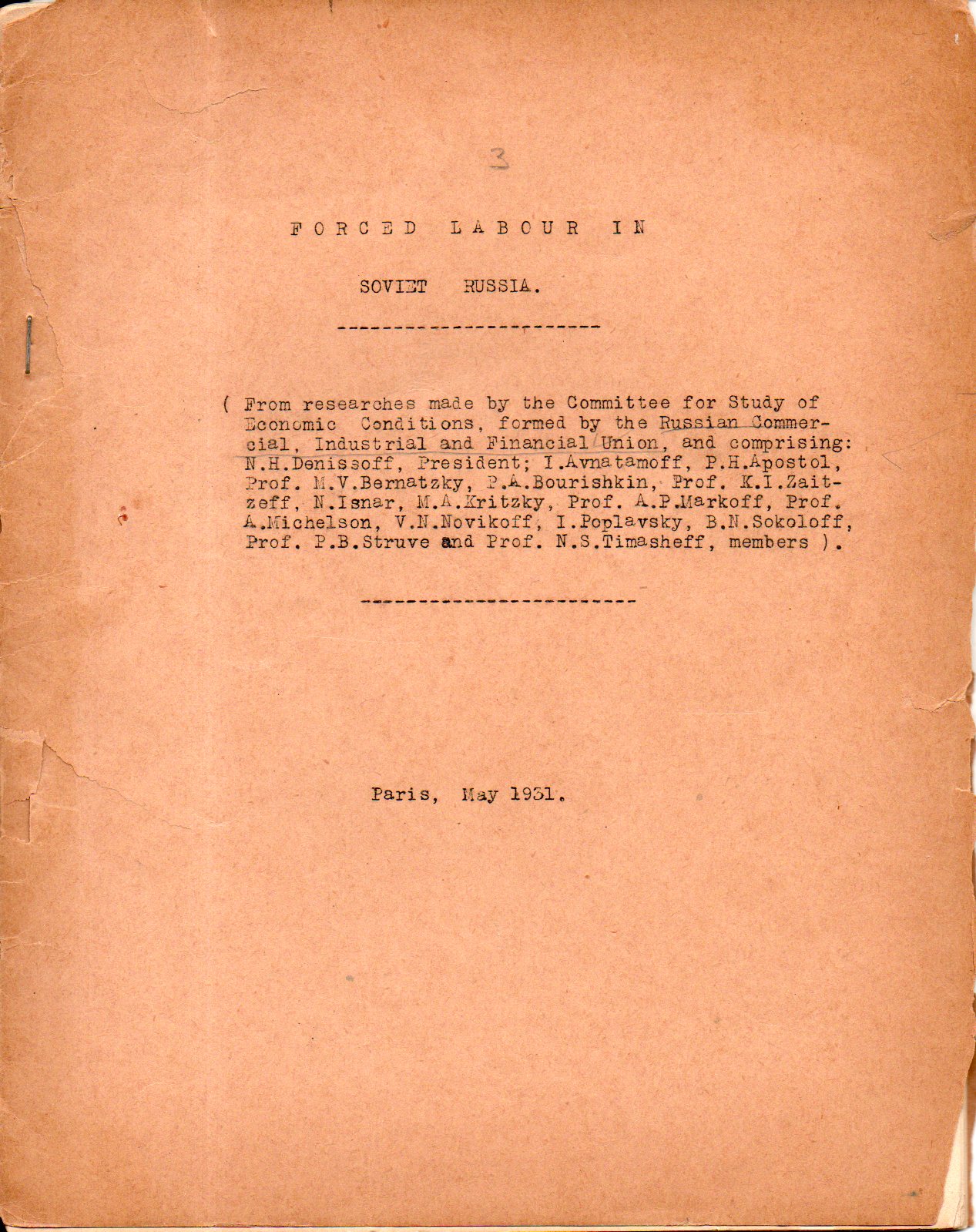
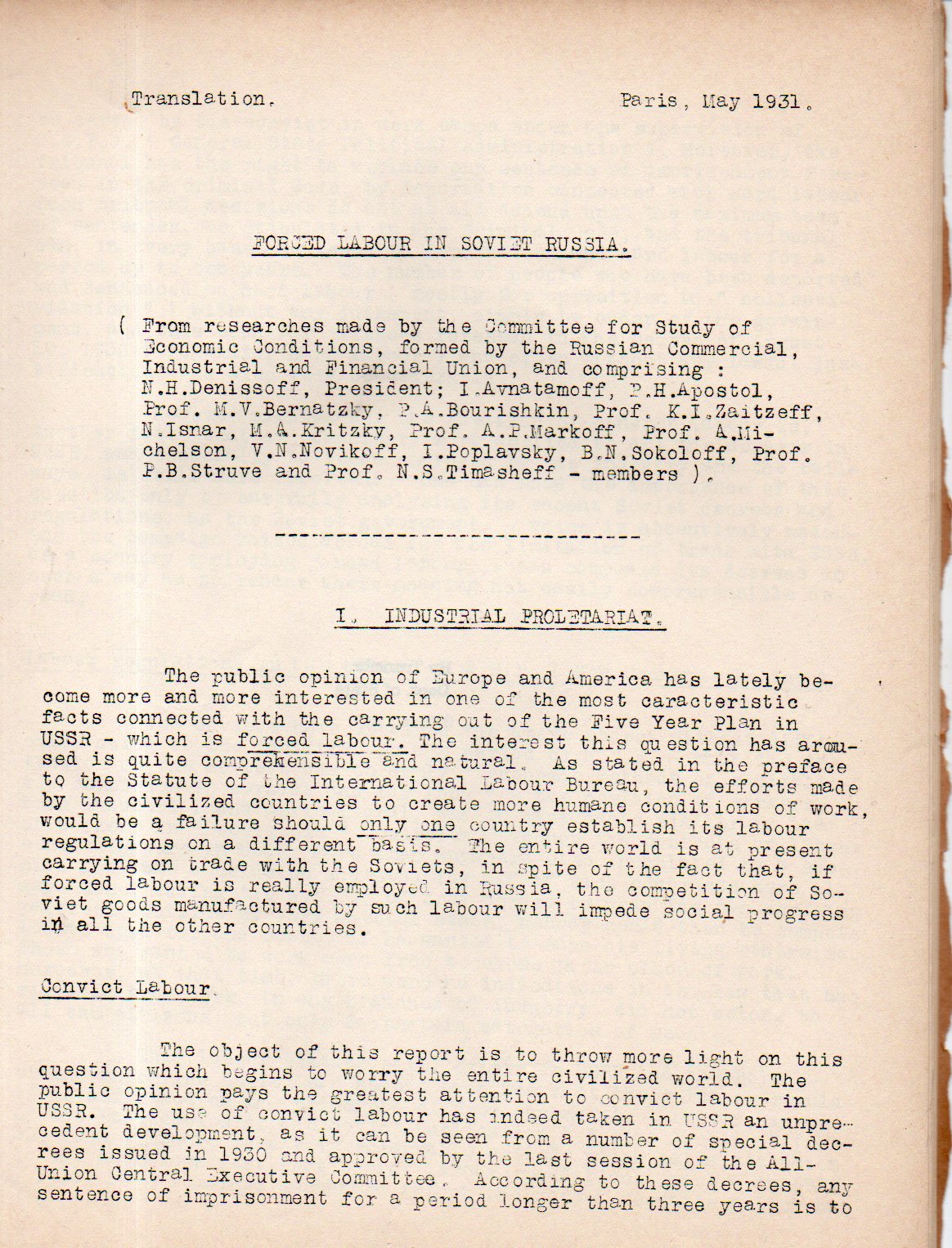
    Including a Report on Forced Labor in the Soviet Union, 1931

    “The Committee for Carrying Fight Against the Soviet Economic Policy has until now issued and diffused in all countries, free of charge, bulletins, published in French and English, on the following subjects” “From the Researches Made by the Committee for the Study of Economic Conditions, formed by the Russian Financial, Commercial and Industrial Union…” 

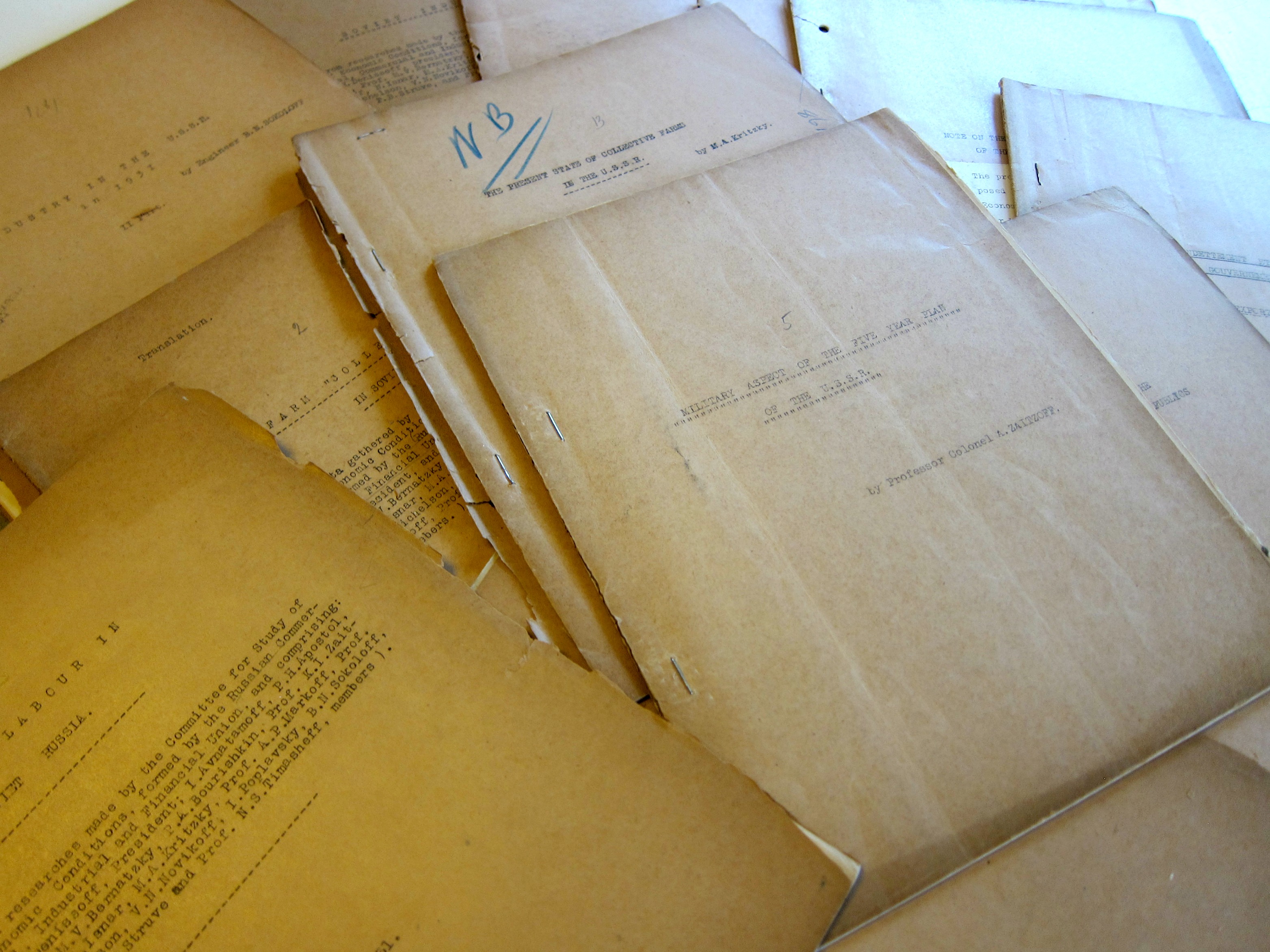
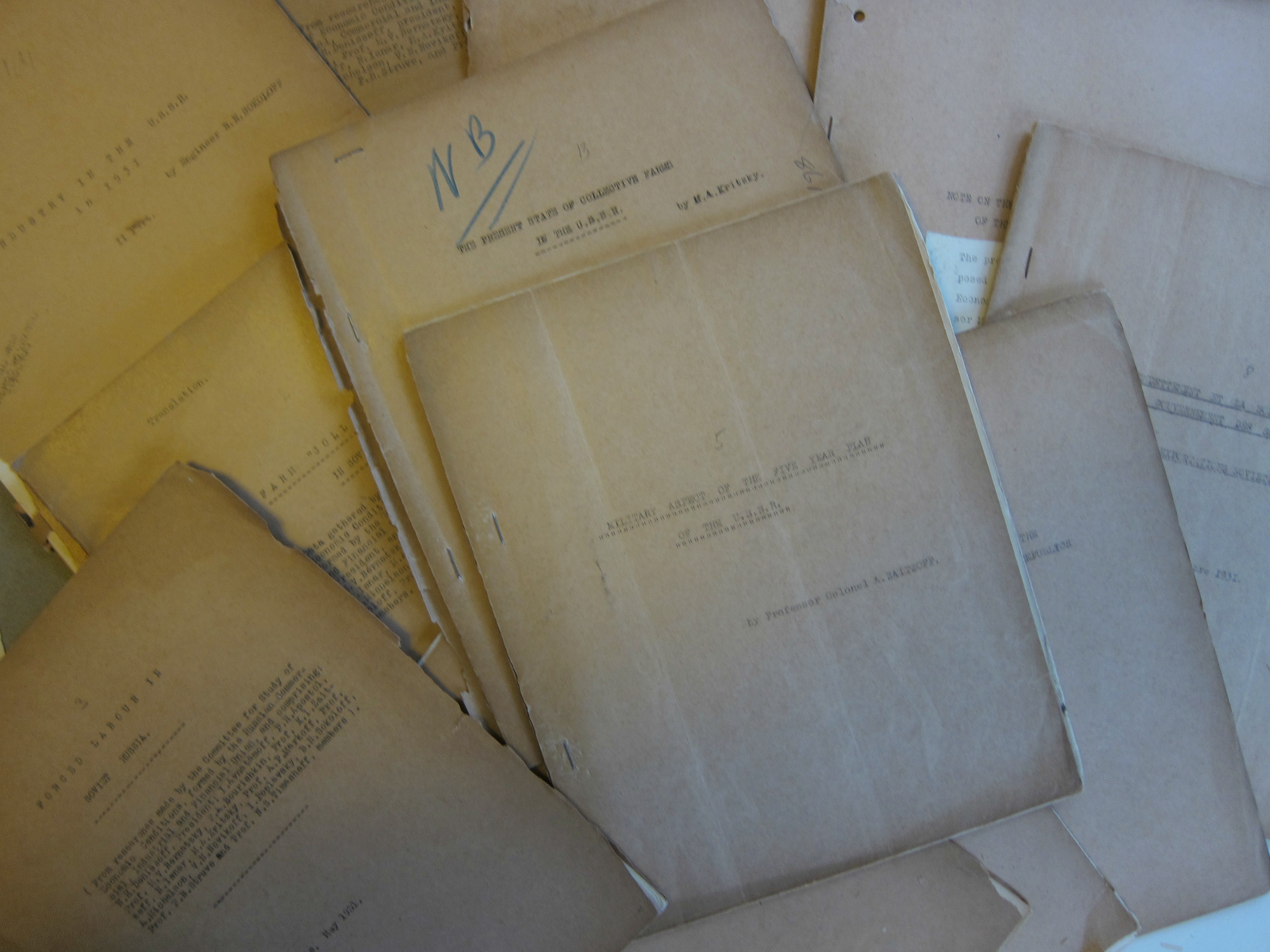
    Soviet Reports 1931

    • This is a collection of 13 translations of summaries of various social, economic, and political situations in the Soviet Union in 1931. There is an overview sheet (in tatters) which states that there should be 13 sections overall—however, this set below (from the Library of Congress) has three sections on Soviet industry rather than one, and lacks the French translation of #5, and also #11, the “Russian Organization Abroad”.  #12 is present though this is a different title than the one called for in the overview. 

    WorldCat locates only four of the thirteen papers: “Forced Labor” with 2 copies located, “Notes on Indebtedness” with 4, “Present State” with 3, and “Dumping” with 6. The others are not located.

    Soviet Reports 1931b

    The pamphlets are all 11×8” and are stapled together at the left side with two staples. Each section has a brown cover though they are all brittle—the text of the works however are on much better paper and are not brittle. Nearly all are stamped “Library of Congress Surplus/Duplicate” on the back cover.  

    • Overall: 13 items/papers, including 11 of the called-for 13 parts, totaling 211pp. Very scarce. WorldCat locates only four of the thirteen papers: “Forced Labor” had  2 copies, “Notes on Indebtedness” had 4, “Present State” had 3, and “Dumping” had 6. The others were unlocated in WorldCat. 
    • Provenance: U.S. Department of State, transferred to the Library of Congress in 1940. $3000

    The set includes:

    (1.)  “Soviet Industry. Paris”, June 1931. 23 leaves. (No date of publication list)

    (1a) “Industry in the USSR in 1931, Part I.” (by Engineer B.N. Sokoloff). 16 leaves.

    (1b) “Industry in the USSR in 1931, Part II.” (by Engineer B.N. Sokoloff). 16 leaves. (March, 1932)

    (2)  “Farm Collectivization in Soviet Russia.” May 1931. 19 leaves. “Data gathered by the “Committee for the Study oif Economic Conditions”. This committee has been formed by the Russian Commercial, Industrial, and Financial Union, and includes: N.H. Denissoff, President, and I. Avanatamoff, P.H. Apostol, Prof M.V. Bernatzky, and eight others.)  

    (3)  “Forced Labor in Soviet Russia”, May 1931, 20 leaves.  (Cover detached.)

    (4) “Soviet Dumping”, by Engineer B.N. Sokolov. April, 1931. 17lvs (Corn, coal, and various ores.)

    (5)  “Military Aspects of the Five Year Plan of the USSR”, by Prof. Colonel A.. Zaitzoff, 18 lvs. (Plus one duplicate.)

    (7)  “Note on the Indebtedness and Credit of the Soviet Government. October 1931, presented by Prof. M.V. Bernatzky. 11 leaves

    (8) “L’Endettement et la Solvabilite du Gouvernement des Soviets. La Crise des Exportations Sovietiques de Ble” October, 1931. 12 leaves.

    (9) “Memorandum on the Present Conditions of the Union of the Soviet Socialistic Republics and its Population.” October 1931. 13 leaves.

    (10) “The Communist International and the United States of America.” October 1931. 13 leaves.

    (12) “The Economic Situation of the USSR and the Development of Soviet Foreign trade.” 10 leaves.

    (13) “The Present State of Collective Farms, by M.A. Kritsky.” 24 leaves.

    Note: the cover sheet (only) as mentioned and described above is found online in the State Department archives with the following classification: “Records of the Department of State Relating to Internal Affairs of the Soviet Union, 1930-1939 › Industrial Matters: Monopolies, Concessions, Contracts, Bounties, Subsidies, Cartels, Trades, Expositions And Exhibitions › 861.60 › “

    Russia h139


    Russia h140


    ·Posted by :

    ·in:

  • An Alphabet of Whiskey Names Drawn from the Bible of Booze

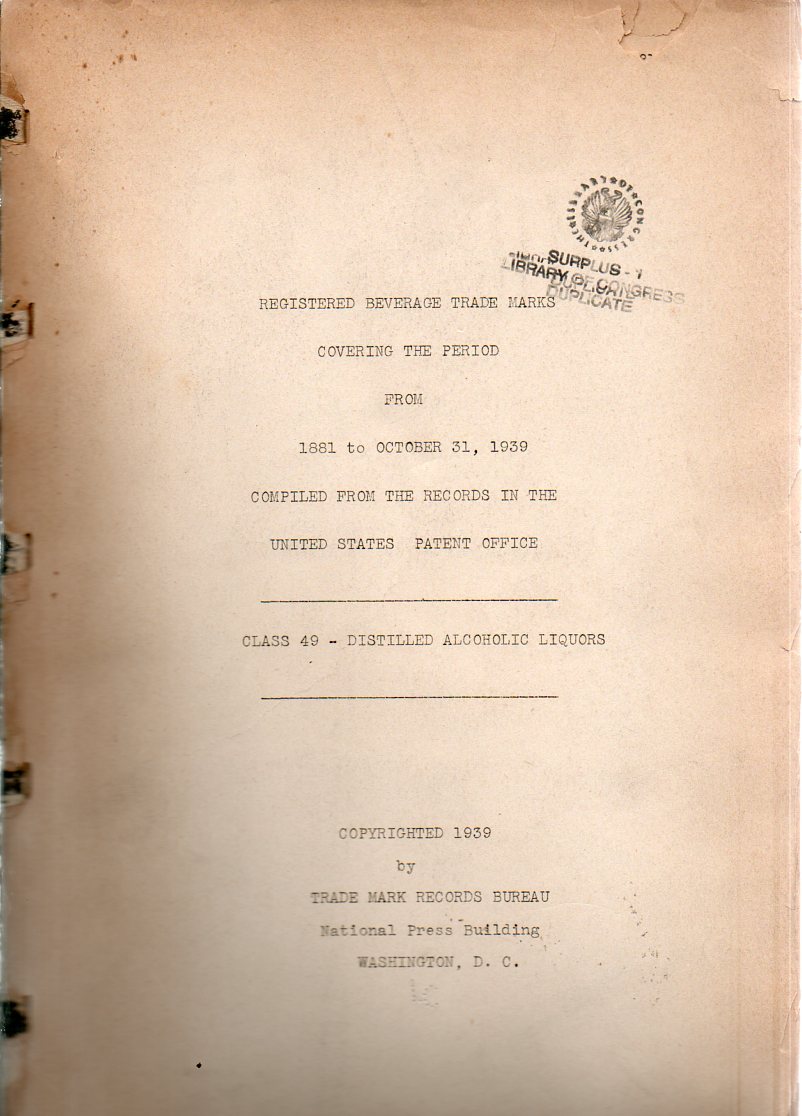
    This document–Registered Beverage Trade Marks Covering the Period from 1881 to 1939 Compiled from the records in the United States Patent Office (Distilled Alcoholic Liquors)–may be the keys to the kingdom of names of booze(s) trademarked in this country.  15″ tall, an inch thick, and 296 sheets big, this work (copyrighted by the Trademark Records Bureau (in the National Press Club Building in DC, the one with the problematic parking garage) lists some 7,500 names of whiskey, cordials, gin, rye, bourbon and who knows what else. RARE.  I cannot find another copy, nor is there any scent of it in the WorldCat/OCLC. This is from the Library of Congress, with a few scant LC stamps.  $2000.
    Booze alphabet532

    So I sat down with this book for an hour pulling out interesting, odd, out-of-place, from-another time and bizarre names, including all manner of expected animal names like bull and elk, and then unicorn; and lots of sunny this-and-that, sloping/sunny/grassy hills, mountains, clubs; and of course the Old _____  category seem fairly filled up. 

    If I spent a little more time on this entire alphabets could be produced relating to nothing but names from the animal kingdom, flora, the sciences, professions, religion, states of mind, altered states,  literature, and the labels that suggest a possible medical benefit.  One of my favorite categories is the “conversational liquor label”, the label that speaks to you, invites you, tells you what to do with the bottle of booze:  Hava Cocktail and Uneeda Whiskey are good examples of that, as are You’re Lookin Good, Uvanta and Yugeta whiskeys. Another is the liquor name ending in “o”, like the beautiful Famo, from St. Jo, MO, which unfortunately wasn’t trademarked in ’00.  The label of suggested promise and outcome is another good one:  Kentucky Courage, Pleasant Dreams, Invincible Rye, Solace Whiskey and Ready Money are all good examples of the implied end-of-bottle pillow-fluffer…maybe, especially, The Old Solution whiskey.

    And then of course, there are those where the (creative) spirit has just flown away, like the lumpily-named Standard Spirits Whiskey, its hometown of New Orleans embarrassed by the lack of effort–especially in the light of some many hundreds of imaginative creations, like the fabulous Bone Factor Whiskey (1903), which like so many other great names  (Yellow Hammer Whiskey) comes from Louisville, Kentucky.

    Antediluvium Whiskey, NYC, 1898; Anti-Grippine Whiskey, Philadelphia, 1906; Ash Cake Whiskey, Lynchburg, VA. 1899, Auto Crat Whiskey (St. Louis, MO), 1905

    Bank Check Whiskey, Boston, 1900; Bone Factor, 1903;

    Caloric Whiskey, 1904; Cremo Whiskey, 1902; and the confusing Chickencock “potable spirits”, 1929

    Devil’s Island Benefactor Gin, 1905; Daily Mash Whiskey, 1935; Dandilyon Whiskey, Columbus, OH, 1906;

    Electric Whiskey, Cincinnati, 1890;

    Flow Whiskey, Pittsburgh, 1908; Famo Whiskey, St. Jo, Mo 1894; Faust’s Own Whiskey,  Phila, 1900.

    Gopher Gin, St. Paul, 1902; Gas Away, Columbus OH, 1902; Galoxy Whiskey, NYC, 1905; Gong “ethyl alcohol, etc,” 1932′ Georgia Watermelon, 1911

    Hen Bolt Whiskey, 1889;  Hava Cocktail, NYC, 1933; Hospitality Gin, Louisville, KY, 1900

    Index Whiskey, Cincinnati, 1906; Invincible Rye, 1900

    Jupiter Gin, Boston, 1905; Judge’s Preference, Boston, 1905;

    Kentucky Courage Whiskey, Lexington, 1900

    Marconi Whiskey, Birmingham, 1903

    Old Tom Gin, 1887 (There are any number of Old ____ labels: Old Crow, Old Man River, Old Count, Old Court, Old Coon, Old King Cole, Old Rock, Old Moss, Old Soldier, and so on–there’s a specialized sub-alphabet in this category, alone.)  Perhaps my favorite “old” is The Old Solution, Baltimore, 1900.

    Peeper Whiskey, Lexington, KY, 1880; Pen and Pencil Club Rye, Phila, 1894; Pleasant Dreams Whiskey

    Radium Whiskey, Terre Haute, 1905; Rolling Fork Whiskey, Lexington, KY, 1876; Ready Money Whiskey

    Sun Shot Cordial, Birmingham, AL, 1901; [SWASTIKA emblem, no name] Whiskey, Frankfort, KY,  1902; Suburban Whiskey, Boston, 1909; Solace Whiskey, Balto, 1900

    Tidal Wave Whiskey, Houston, 1905

    Uncle Tom Whiskey, Cincinnati, 1905; Uneedda Whiskey, Davenport IA, 1899;  Uvanta Whiskey, Louisville, KY, 1905

    Vitoline Brandy,  St. Paul, 1897

    Yugeta Whiskey, Plymouth, PA, 1906; You’re Lookin Good Whiskey, D.C., 1902; Yellow Hammer Whiskey, Louisville, 1905

    Zeno, Ace of  Clubs Whiskey

    And to sew up the specialty market in school-named liquors, Lawrence McCormick of Baltimore trademarked whiskey names for Brown, Yale, Harvard, Princeton, Cambridge, Cornell, Swarthmore, Chicago, Oxford and of course Lehigh University, not to mention various label designs that featured books and “philosophical instruments” emblazoned on shields and rocks and such, all perhaps for those in search of higher education.


  • On Dealing with Post-War Nazism (May, 1945)

    Algernon D. Black, Ethical Issues in the News: The Nazi Surrender. Radio announcement and delivery by Black, “Leader of the Society for Ethical Culture”, May 3rd, 1945, station WQXR. 11”x 8.5”, 5 lvs., about 2000 words. Offset printed from typed originals. Stapled, front page detached. Scarce document. $150

    Black (1900-1993) was a long-time leader of the Ethical Society (“Faith without God”) who for decades delivered radio addresses, including this one on station WQXR. The present address discuses the final weeks of the war, and the important steps that need to be taken post-war to understand who the Nazis were and how they manufactured and managed the war.

    • “…even the surrender by Nazi generals and suicides by Nazi leaders is no guarantee of a surrender of Nazi will and the defeat of Nazi ideology. In he moment of defeat, the Nazis have done things to assure the rebirth of the Nazi movement. They have hidden some of their Gestapo, SS and some o their Nazi leaders in the army and among civilians in as a complete disguise as possible.” Distractions fighting the “world’s greatest enemy”, the Bolsheviks…they would like us to believe that the mass murders in prisons and concentration camps do not matter because their victims were Jews…”
    • “When we have accepted the Nazi surrender, our real difficulties will begin.”

    Black goes on to speak about the need to separate out the Nazis from the Nazi supporters and then the anti-Nazis in order to reintroduce Germany “into civilized society”. Part of that process is to understand the propaganda and lies that were propagated to facilitate the war, and to know who and what Hitler was.

    • “Let nothing divert us from dealing…with the task of seeing to it that Nazism is really ended in this world.”


    ·Posted by :

    ·in:

Recent Posts

Archives

Categories