A Daily History of Holes, Dots, Lines, Science, History, Math, Physics, Art, the Unintentional Absurd, Architecture, Maps, Data Visualization, Blank and Missing Things, and so on. |1.6 million words, 7500 images, 4.9 million hits| Press & appearances in The Times, Le Figaro, Mensa, The Economist, The Guardian, Discovery News, Slate, Le Monde, Sci American Blogs, Le Pont, and many other places… 5000+ total posts since 2008.

  • A Call to Arms Against Hitler’s Germany (France, ca. 1935)

    Une questio de vie ou de mort!  Jugez vous memes. Dans son livre Mein Kampf, hitler le maitre inconteste de l’Allemangne actuelle,…

    One sheet/leaflet, printed on one side only. 10”x 8”. Ca. Mid 1930’s?   $150
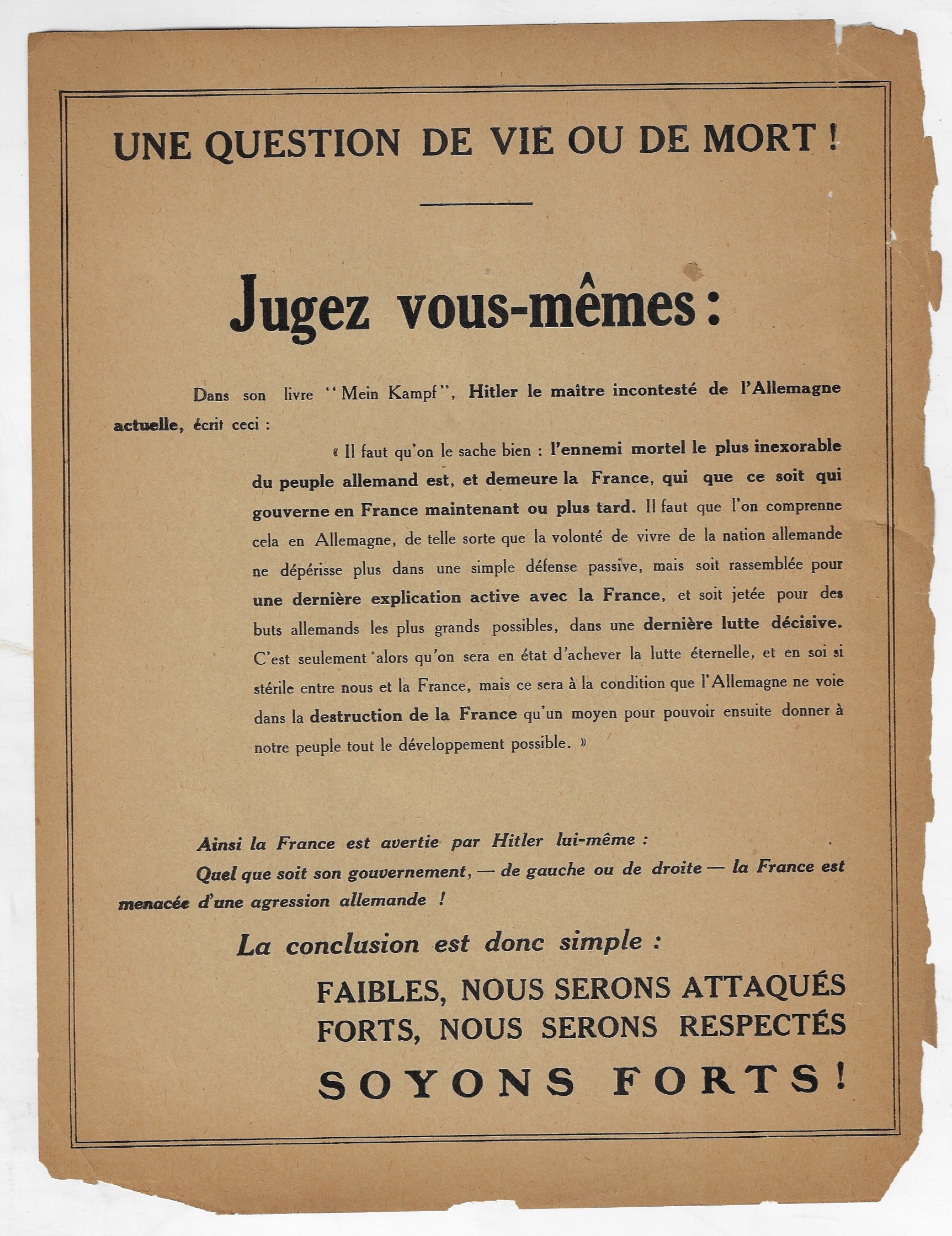
    French poster Jugez vous-memesThis is a leaflet or broadsheet making the point that France and Germany are mortal enemies—it attracts attention by boldly stating in the first line that the situation/question is a matter of life and death. .(This is more of a statement than an interrogatory, as there are no questions on the sheet.) The writer makes the point clearly with a long extract from Mein Kampf:

    “Il faut qu’on le scahe bien l’ennemi mortel le plus inexorable du peuple allemand est et demeure la France …” (“We have to be clear about the most inexorable mortal enemy of the German people is and remains France…”) Not only is France the mortal enemy, but it and its people should be destroyed in the coming great decisive battle (“derniere lutte decisive”).

    And so France is warned by Hitler himself. The author of the leaflet does have a solution, and it involves solidarity and strength from all of the people of France regardless of the sort of government you support, if you are on the Left or Right. (“Ainsi la France est avwertie par Hitler lui-meme: quel que soit son gouvernement—de gauche ou de droite—la France est menacee d’une aggression allemande!”)

    The concolusion is simple: “We will make a strong attack, we will be respected, we will be strong.”

    (“Faibles, nous serons attaques forts, nous serons respectes soyons forts.”) Come 1940, though…
    ·Posted by :

    ·in:

  • Public Opnion Documents on Japan, 1943-4

    Three opinion collection documents, printed

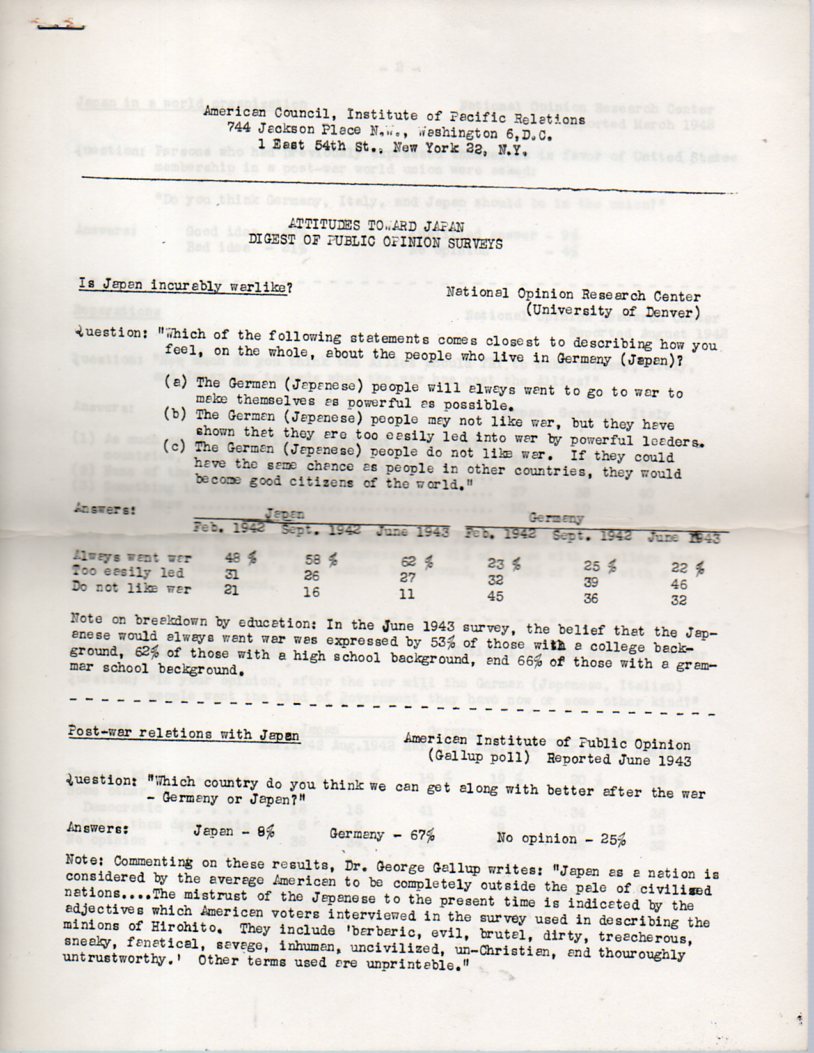
    • 1) Attitudes Toward Japan, Digest of Public Opinion Surveys.  11″x 8.5″, offset printed from typed originals. 2 lvs. Stapled. 1944.
    • 2) Expert Opinion on Post-War Treatment of Japan. 11″x 8.5″, offset printed from typed originals. 4 lvs. Stapled. 1944.
    • 3)  The Treatment of Japan.   11″x 8.5″, offset printed from typed originals. 4 lvs. Stapled. 1944.

    The three (all quite scarce): SOLD

    I uncovered a few interesting documents this morning from The American Council, Institute of Pacific Relations (in 1944 at the address 744 Jackson Place, N.W., D.C.) relating to collecting opinions on Japan and the Japanese, right at the height of the war.   And this is what the American Council was doing–prep work to assess the extent of public opinion on the treatment of Japan post-war, which entailed reviewing existing polling data (from Gallup) was well as conducting their own original research.The “first” issue (so far as I can determine)  was perhaps the most aggressive:

    Is Japan incurably warlike?

    Japan Public Opinion889

    The question was asked of an undefined group over three periods of time  (February 1942 to June 1943) for both Japan and Germany, the statements the respondents having to choose from being: “always want war”, “too easily led” and “do not like war” at three different times, from February 1942 to June 1943.  From Feb ’42 to June ’43, people’s opinions that the Japanese “always want war” went up from 48% to 62%, while for the same time the same question regarding the Germans stayed about the same, 22%.  The Gallup Poll for June 1943 reported that for 75% of the respondents only 8% of the folks thought that “we can get along” with the Japanese, while 67% favored our chances with the Germans. 

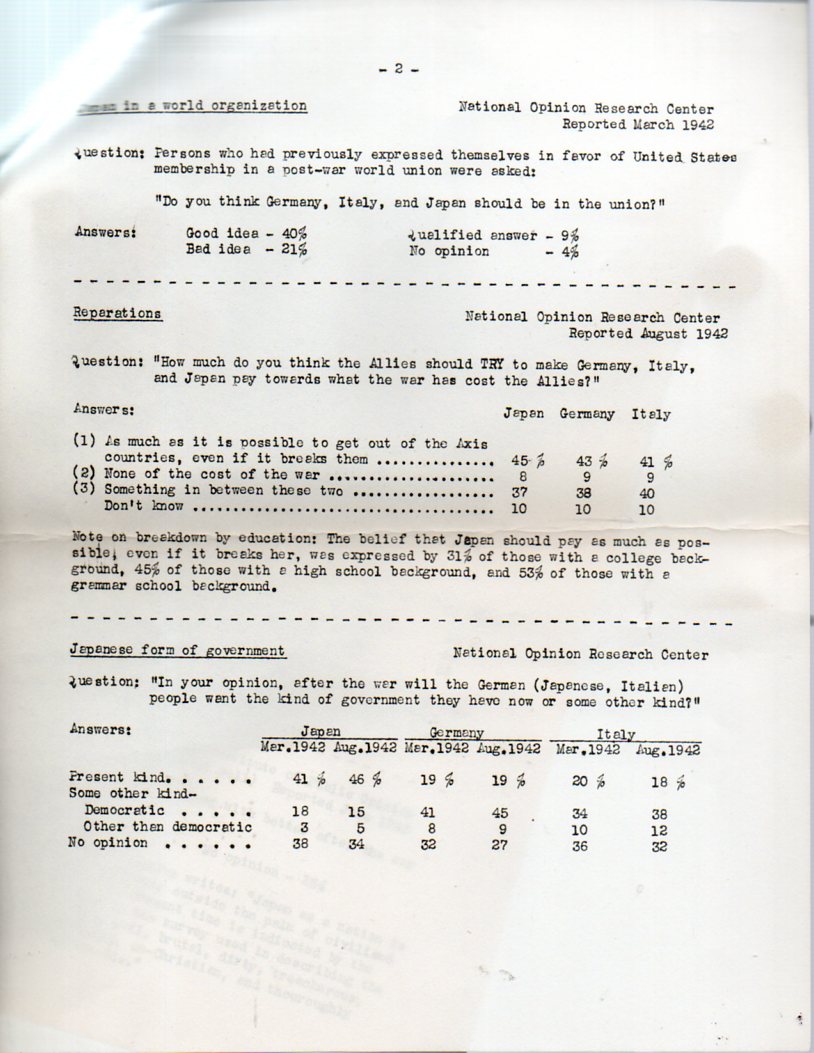
    Get along with them or not, or feeling that they are war-like or not, had little to do with the opinions of people (reported by the National Opinion research Center, August 1942) who thought that reparations should be paid, and paid hard, by the Axis powers across the board, “as much as it is possible to get out of the Axis countries, even if it breaks them”.

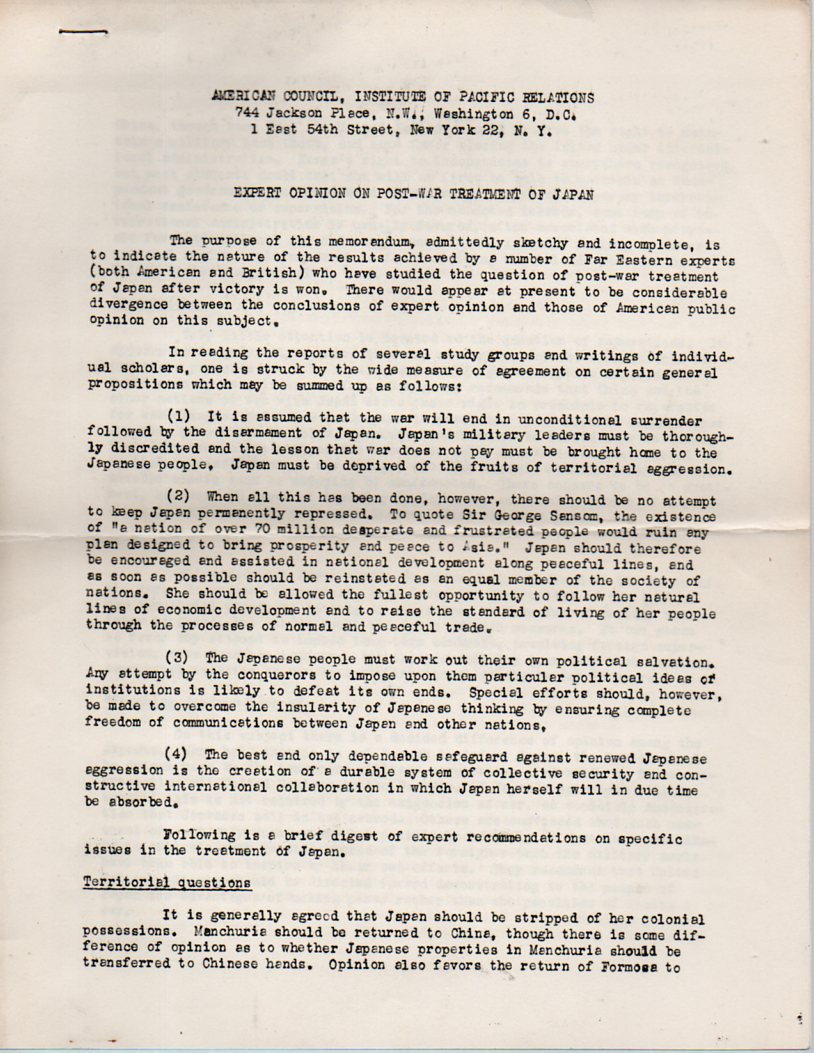
    The following two papers came a little later, closer to the realization that victory was coming, that the war would be over, that victory would be taken–probably at the end of 1944 or the beginning of 1945, when position statements were more circumspect than the earlier public opinions.  “Expert Opinion on Post-War Treatment of Japan”  was more understanding when speaking to the post-war existence of Japan, stating in a number of different ways that “there should be no attempt to keep Japan permanently repressed” and “the Japanese people must work out their own political salvation”.  Also that there would be no “continuing burden of reparations payments…as done with Germany after the last war”. 

    Japan Public Opinion treatment after891

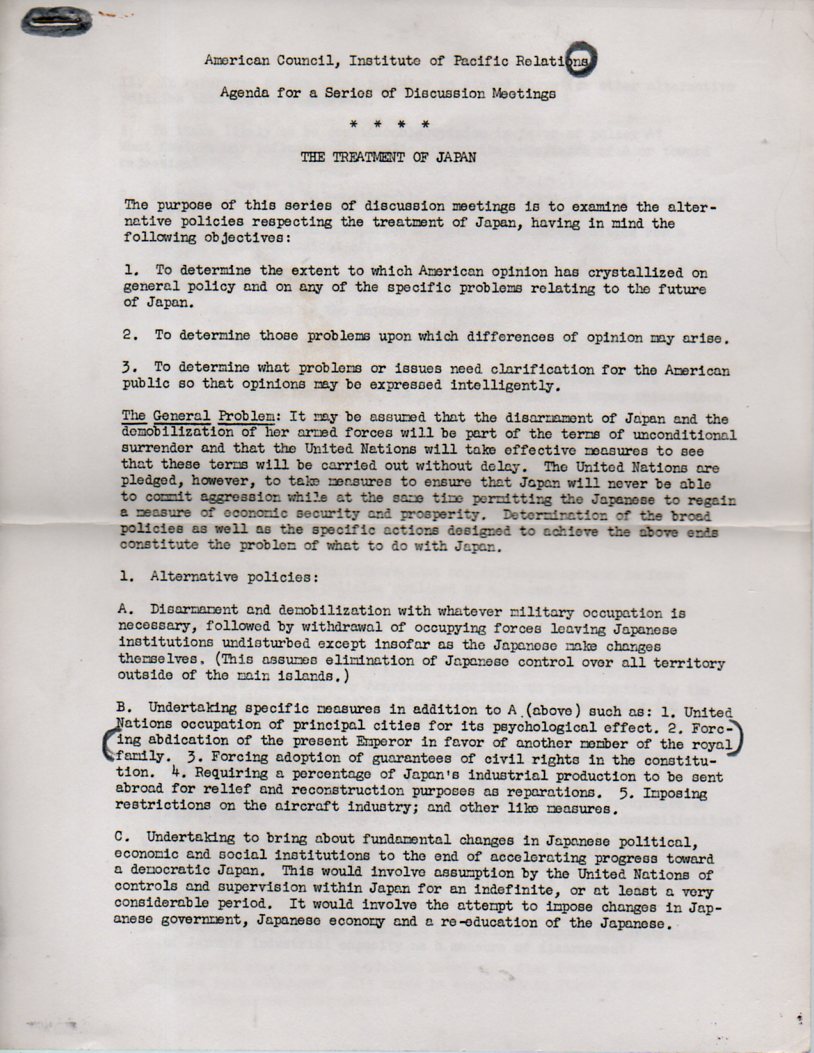
    The overall feeling of this and the following document (“The Treatment of Japan”) can be found in the section “Teaching Japan a Lesson”:  “United Nations effort should be directed toward demonstrating to the people of Japan the advantages of making peace rather than the penalties of losing a war”.  The issue regarding the Emperor and whether or not he should or could stay–an issue that would stay with high command right through the second week of August 1945. 

    Japan Public Opinion treatment after892

    Japan Public Opinion890

    ·Posted by :

    ·in:

  • Planning for a Postwar Germany, 1944

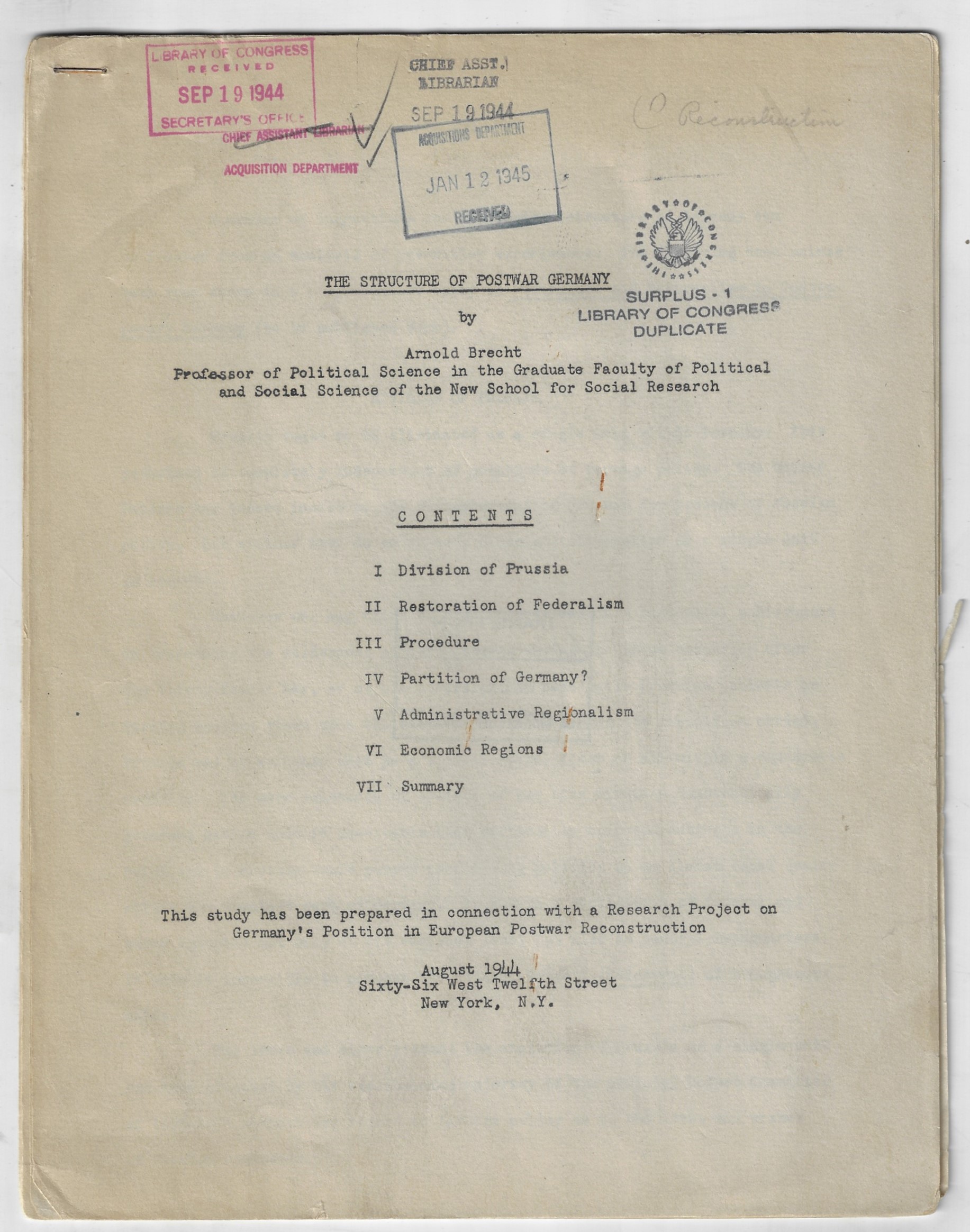
    Brecht GermanyArnold Brecht. The Structure of Postwar Germany.

    11″x 8.5″, offset printed from typed originals, 13 lvs, Provenance: Librarian’s Office, Library of Congress.  VG copy.  Scarce. $250

    • (“Arnold Brecht (January 26, 1884 – September 11, 1977) was a German jurist and one of the leading government officials in the Weimar Republic. He was one of the few democratically minded high-placed officials that opposed the Machtergreifung in 1933. An alumnus of the University of Göttingen, Brecht served as a government official from 1918 to 1933. He was dismissed from his post shortly after the Nazi seizure of power, and emigrated to the United States. He became a lecturer at The New School, and also a foreign policy adviser to the United States government. After World War II he returned to Germany and helped drafting the Basic Law for the Federal Republic of Germany. In 1959 he received the Federal Cross of Merit. Brecht also made contributions to political science. Brecht’s law is the academic basis for one of the components of the equalization payments between the states of Germany.”–Wikipedia)

    ·Posted by :

    ·in:

  • Among the Last Surrenders of Japanese Forces, September 1945–Rare Document

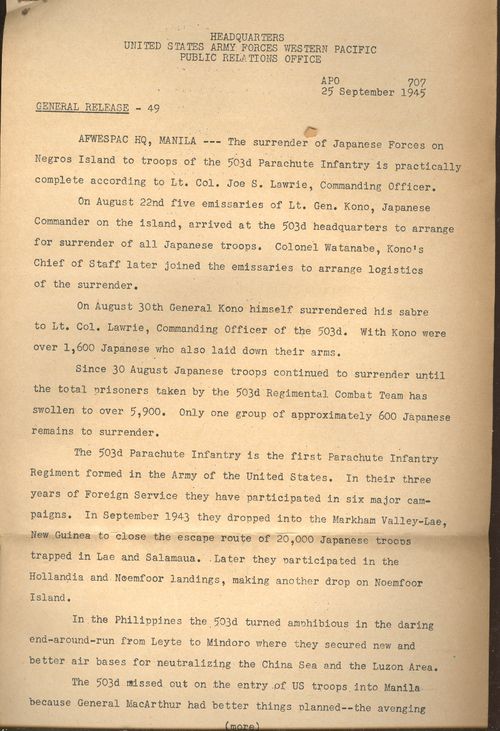
    Announcement of the Final Surrenders of Japanese Troops including Gen Yamashita

    Headquarters, United States Army Forces Western Pacific (AFWESPAC HQ), Manila

    General Release, APO 707, 25 September 1945. 13” x8”, 2 lvs, 3pp, approximately 500 words. Offset printed. Document produced by the Public Relations Office. Tinted on newsprint, stapled. Good copy of a rare document. $750

    This document contains two reports of what were among the very last surrenders of sizable numbers of Japanese troops.

    General Release 45 (in two parts)

    [First] Surrender of Japanese forces on Negros Island to troops of the 503d Parachute Infantry…

    and

    [Second] Surrender of 40,000-70,000 Japanese forces (under command of General Yamashita)…

    [First] :Surrender of Lt. Gen. Kono, first meeting on 22 August to arrange with the 503d for final surrender. Surrender continued to 30 Aug to include Kono himself to Lt. Col Joe S. Lawrie, 1,600 troops accompanied Kono. From 30 August to the posting date in September more than 5,900 Japanese troops surrendered. As of that date, “only one group of approximately 6090 Japanese remains to surrender”.

    Following the surrender details were two paragraphs of a short history of the 503 Parachute Regimental Combat team, or PRCT) operations during the war, winding up to the 16 Feb 1945 deployment to Corregidor,(campaign from 16-26 February) in an attempt to recapture the Bantaan Peninsula, where they inflicted 10,000 Japanese fatalities. (The totals on this campaign varying from about 6,600 Japanese soldiers killed to 10,00; it seems as though the U.S. Suffered 207 killed.)

    [Second]

    Surrender of more than 40,000 Japanese troops to American forces on Luzon on 19 September to Maj. Gen. Robert S. Beightler (Commanding General, Luzon Area Command). The commander of the Japanese troops was the infamous General Yamashita. The total number of surrenders included about 70,000 troops, including dozens of generals and admirals. Yamashita faced war crime charges and was executed for his terrible crimes over the years.

    It was determined that the Japanese forces had no U.S. Or Allied prisoners—interrogations provided that the claim the POWs were earlier sent to Japan was shown to be false, and that the prisoners had probably been murdered.

    Another issue was protecting the surrendered Japanese from Philippine civilians, who in the past sought revenge on their oppressors.

    Japanese surrender 25 September Yamashita _2_

    ·Posted by :

    ·in:

  • Scarce Work on Migrant Workers during the Great Depression, 1937-1939

    Surfacing today in the warehouse was a collection of papers, all bound together punch-bound in a makeshift manila binding, all on the subject of mechanization and its impact on the migrant worker, and all from 1936-1939 or so.It was the mechanization of farming chores following the recession after WWI which contributed to over-farming and over-production of farming land, and that, combined with with this soil erosion with drought, contributed to the Dust Bowl and the vast migration of the Great Depression.

    The work:

    • Mechanization in Agriculture, Migration.  A collection of papers on the impact of farm implements on farmers and laborers. 15 papers, 7 papers printed via offset, one carbon copy of a report on Texas migrants, two composed of newspaper clippings, and generally-published works.  All are bound in a manila punch binder, hand-lettered on the cover.  $350

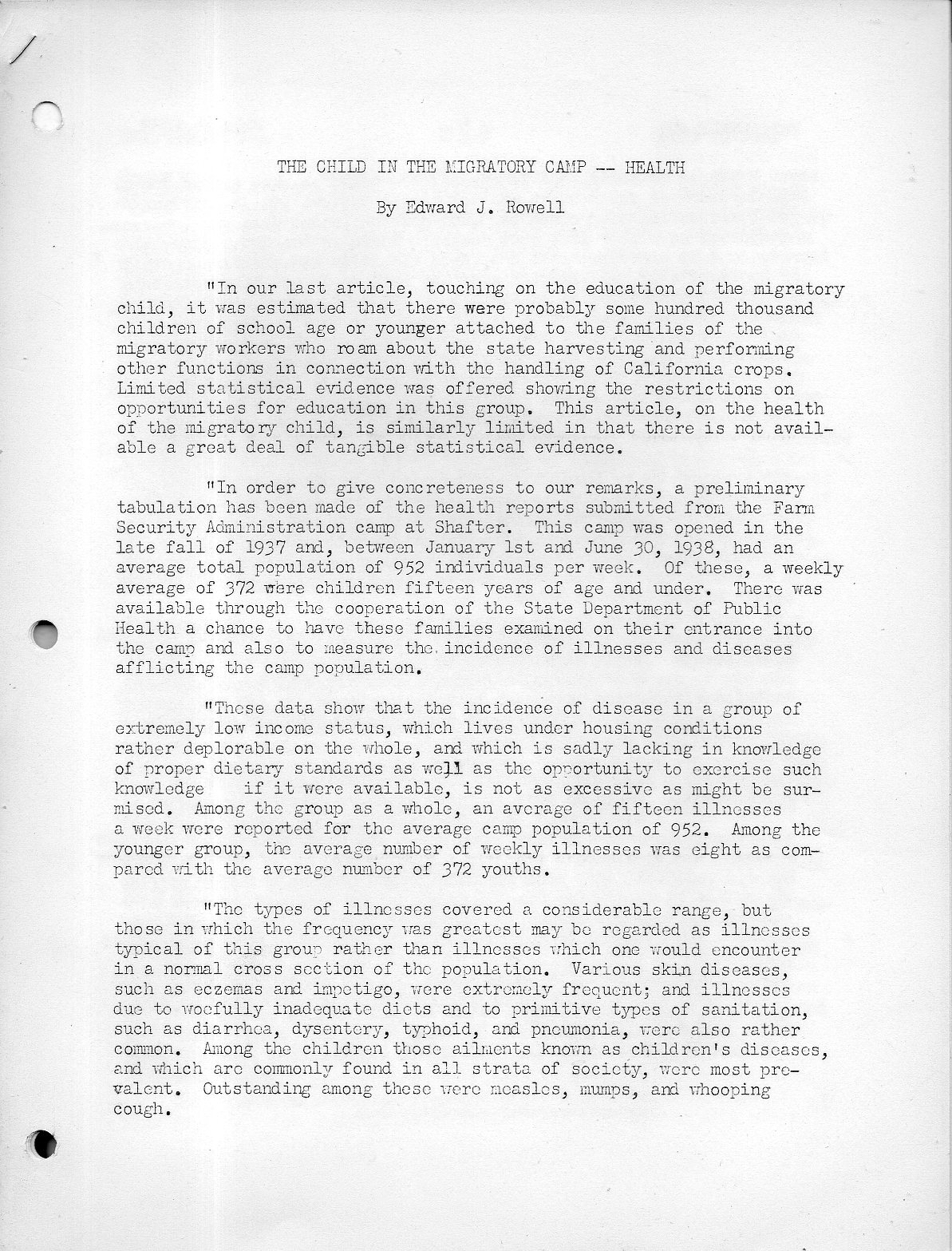
    Among the papers on new farm implements and the millions of people on the move was “The Child in the Migratory Camp—Health”, by Edward J. Rowell, a slim but telling four pages on the plight of kids in migrant camps. This paper was published in California Children, Sept 1938, pp 1-4, and is referenced in James Noble Gregory, American Exodus: The Dust Bowl Migration and Okie Culture in California, p 289. It is a very sobering read, and I reproduce it below in full as there are but a few references to it. 

    • [As one migrant child told John Steinbeck, “When they need us they call us migrants, and when we’ve picked their crop, we’re bums and we got to get out” (Steinbeck, “Harvest Gypsies” 1. after his In Dubious Battle, a work that deals with the migrant worker and which was published in 1936, Steinbeck was given an assignment and space to further document the situation of the mobile workers in the San Francisco News, the stories appearing October 5-12, 1936. These seven articles were later published together—along with 22 photographs by Dorothea Lange—in a work called Their Blood is Strong, appearing in 1938.)]

    Other papers in this collection include:

    Summary Report and Recommendation of the Migratory Labor Problem in Texas, 1938? 22pp. Carbon copies of the original, on onion paper.

    Edward J. Rowell, The Child in Migration Camp–Education, 5pp. Offset from typed originals. (1939?)

    Edward J. Rowell, The Child in the Migratory Camp—Health. 4pp. Offset from typed originals. (1939?)

    Outline of Migration Labor Camp Program, USDA, FSA, 4pp. Offset printed from typed originals.

    G. Horace Hamilton, The Social Effects of Recent Trends in Mechanization, 1938, 13pp, offset printed from typed originals.

    Mechanization in Agriculture and its Effect on Labor, 1937, 9pp.

    (The Problem of Farm Tenancy), 9pp, 1937.

    Power Farming and Labor Displacement in the Cotton Belt, 1937, Parts I and II (1937) 29pp. Government publication.

    …and seven other papers.  Scarce publication, unique in this format.  

    Migratory camp798


    ·Posted by :

    ·in:

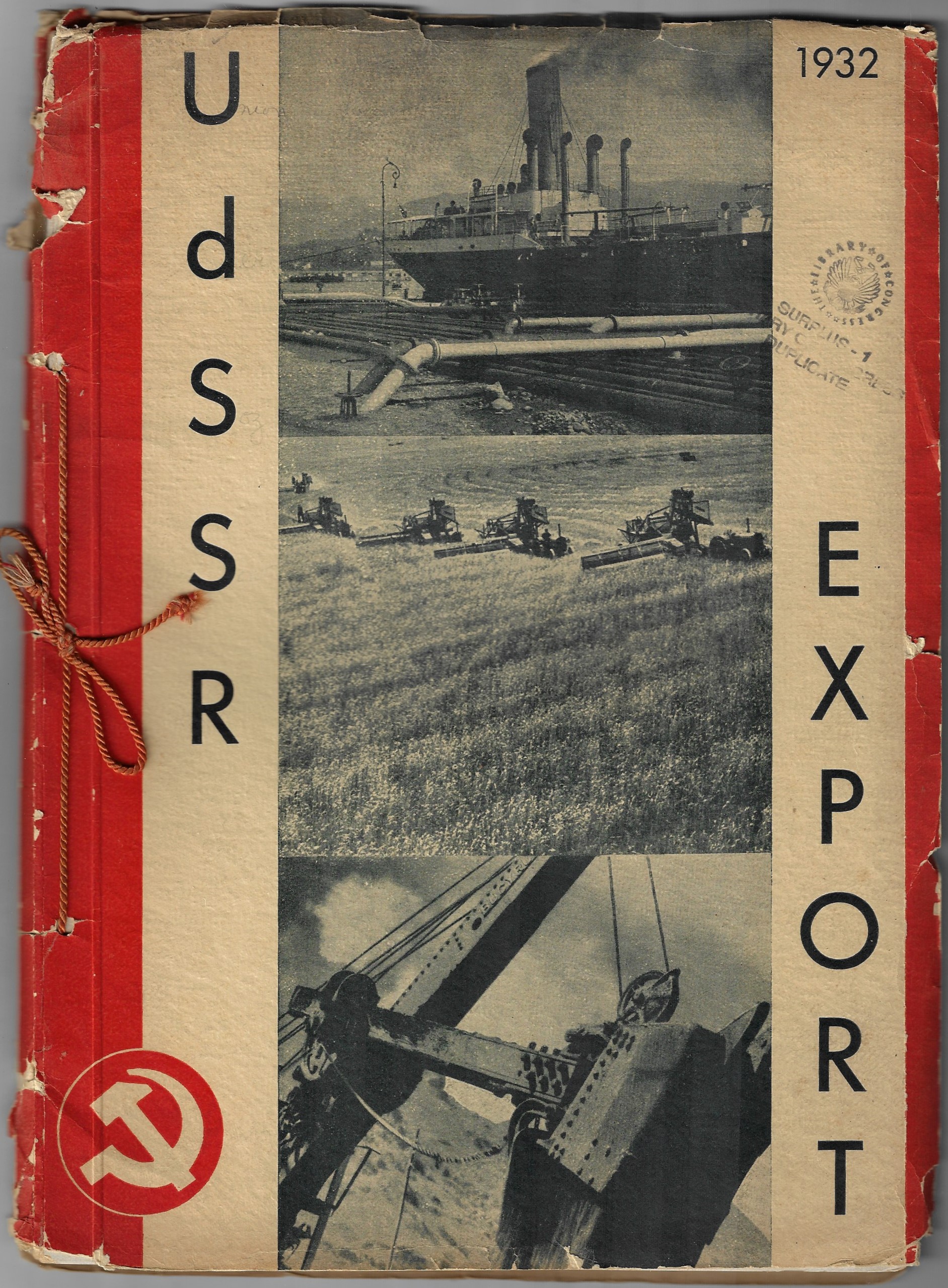
  • Udssr Export In Deutschland Berlin Handelsvertretung Der Udssr In Deutschland 1932 12 X 8 144Pp In 26 Parts 1 26

    UdSSRUdSSR Export in Deutschland, Berlin, Handelsvertretung der UdSSR in Deutschland, 1932. 12” x 8”, 144pp in 26 parts (1-26). Paper wrappers, tie bound. Printed on heavier, semi-glossy paper. With illustrations, mostly on the first page of each section. Good condition. It seems as though only five copies of this appears in WorldCat/OCLC. $350

    This is collection of 26 catalogs of Soviet materials for export, and published in Berlin. Each section is refereed to as “Katalog #__”, and the categories include: wood, pelts, wheat, fish, fruit and wine, tobacco and cigarettes, pharmaceuticals, flax, cotton, animal skins, cheese, butter and eggs, chemicals and candies, coal, minerals, oil, rubber, rare earths, movies, tourism, textiles, books, and book design. Of course at this time,, in 1932, the USSR should not have been exporting a lot of these products—especially the food—given the terrible state of affairs in the country and the disposition of its people; there was of course also the Great Famine of 1932-1933, a catastrophe of high proportions, and this catalog shows the availability of wheat and other mainstays for export at a time when the regions—particularly in Ukraine—were experiencing terrifying and preventable starving deaths of millions of people.

    ·Posted by :

    ·in:

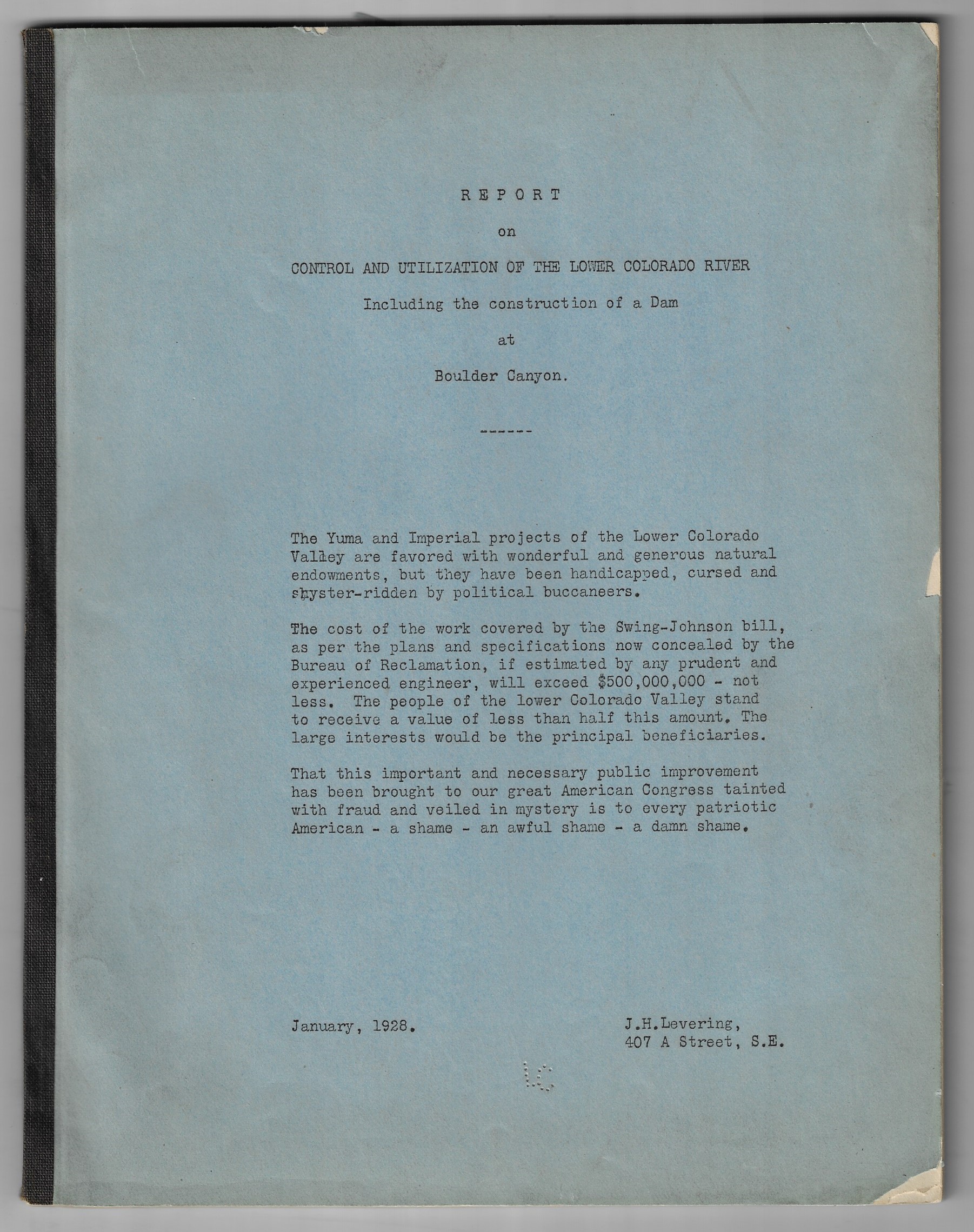
  • Scarce Prospectus for the Boulder Dam (1928)

    J.H. Levering, Elwood Mead; R M Priest . Report on Control and Utilization of the Lower Colorado River including the Construction of a Dam at Boulder Canyon. Privately printed in Washington D.C. 1928. 11”x 8.5”, 28pp plus 6pp appendix, p;us 9 plates (8 photos), plus two folding plates (including one map). Printed wrapper, cloth-covered spine. VG condition. Provenance: Library of Congress, with their tiny 6mm “LC” perforated stamp on the bottom of the cover and their LC rubber atamp on rear cover. WorldCat locates only ONE copy (Arizona State Library). $175.00

    Boulder Dam

  • Rare and Very Detailed Report on the Johnstown Flood, 1936

    Johnstown Flood, 1936 Mimeograph Report

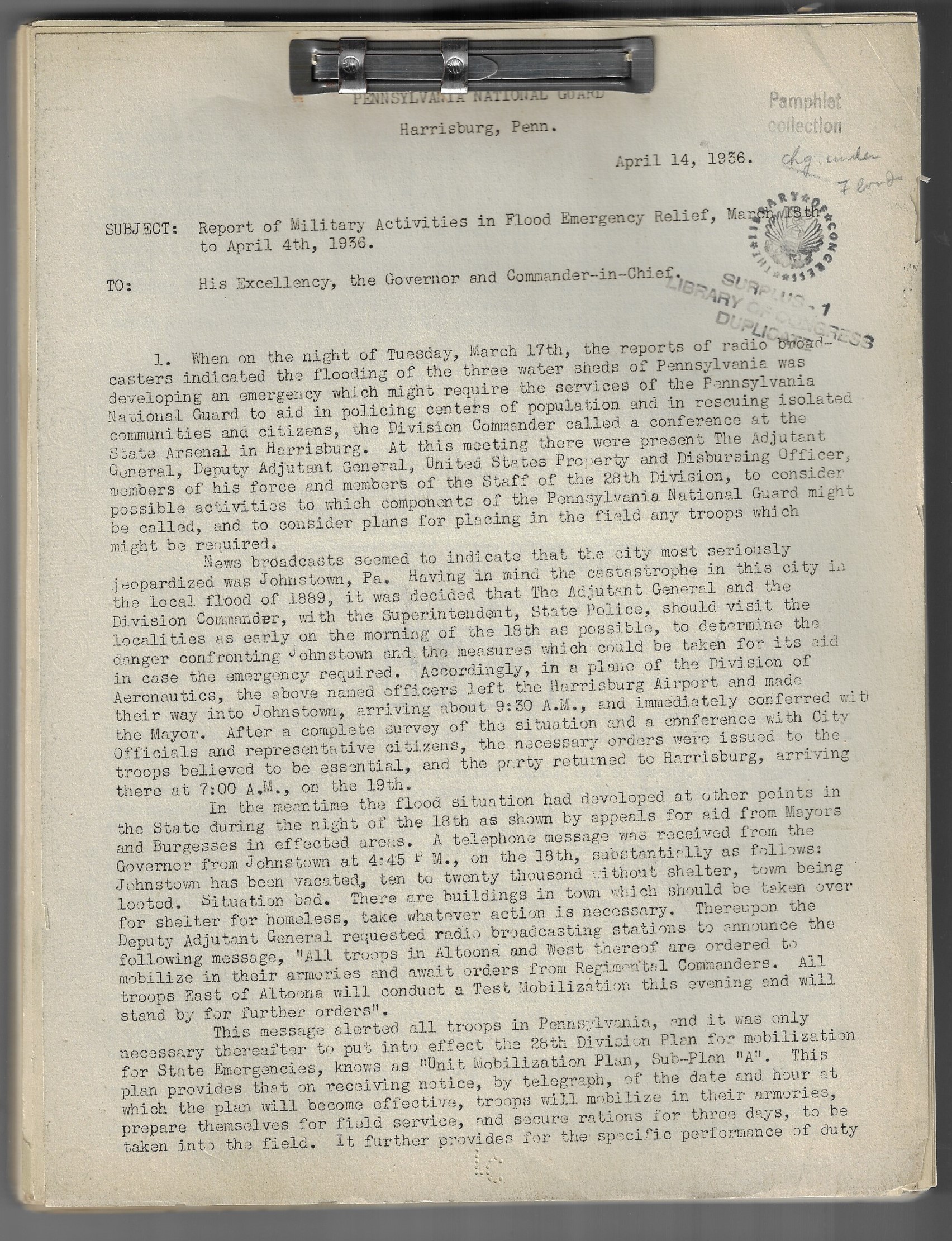
    Johnstown Flood _1_Edward Caswell Shannon, Major-General; Pennsylvania. Militia.; Pennsylvania. Governor (1935-1939). Report of Military Activities in Flood Emergency Relief, March 18 to April 4th, 1936.

    Scarce. $450

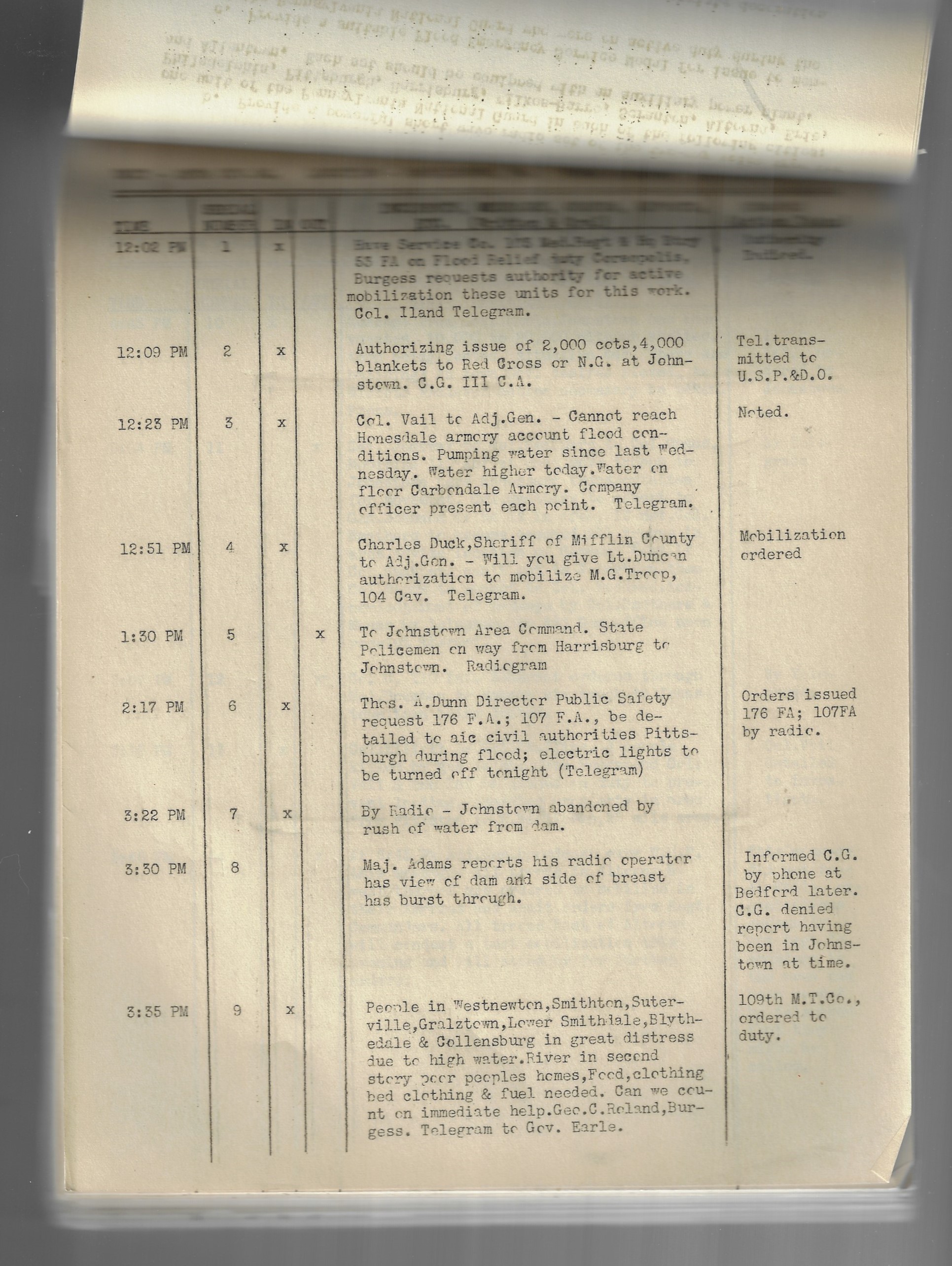
    This is a very uncommon and exhaustive summary of the Pennsylvania state response to the disastrous “Johnstown Flood” of 1936, covering the period March 18 through April 14, 1936. There is a 91-lv section with an hour-by-hour summary of responses by the PA National Guard as well as general announcements that they were reacting to.

    11” x 8.5”, 113 leaves (printed one side only). Offset printed—no indicator of printer or author. I suspect that this wasn’t so much a “publication” as it was a circular. Gathered at top with a two-pronged metal clasp and in the original heavy manila binder. The text is a solid VG, though the binder has seen better days, as it has dings and tears. The text has been pulled away from the rear of the manila back cover. Overall, still VG.

    A typewritten annotation on the homemade/typed paper label on the front cover states “Copy #33”.

    NO copies located in WorldCat (currently; an older Google search found two copies listed).

    Provenance: Library of Congress, with their tiny 6mm “LC” perforated stamp on the foot of page one and their LC surplus rubber stamp on front top corner page 1.

    3pp introduction, followed by:

    Overview of troops dispatched and help given, pp 4-9. All 15 sections and commands (Johnstown and Pittsburgh) were evaluated in nine categories of aid and help rendered (including a “remarks”) section, including data of the troops deployed (designated) and who they reported to, area under water (city blocks and %); how many homeless there were and how they how the homeless were fed, clothed, and who housed by.

    The next section is a listing of city and government officials and who they reported to and for, pp 10-11, along with a graph of deployment if PA National Guard.

    Johnstown Flood _2_

    General Order #2: Flood Emergency Mobilization, Flood Emergency Commendation, pp 12-

    The last section is a 10pp tabular listing ofg the every day use of the National Guard during the flood emergency, including the units; deployment duties; types of military personnel, location, and casualties.

    ·Posted by :

    ·in:

  • The RCA TV Field Test, 1936

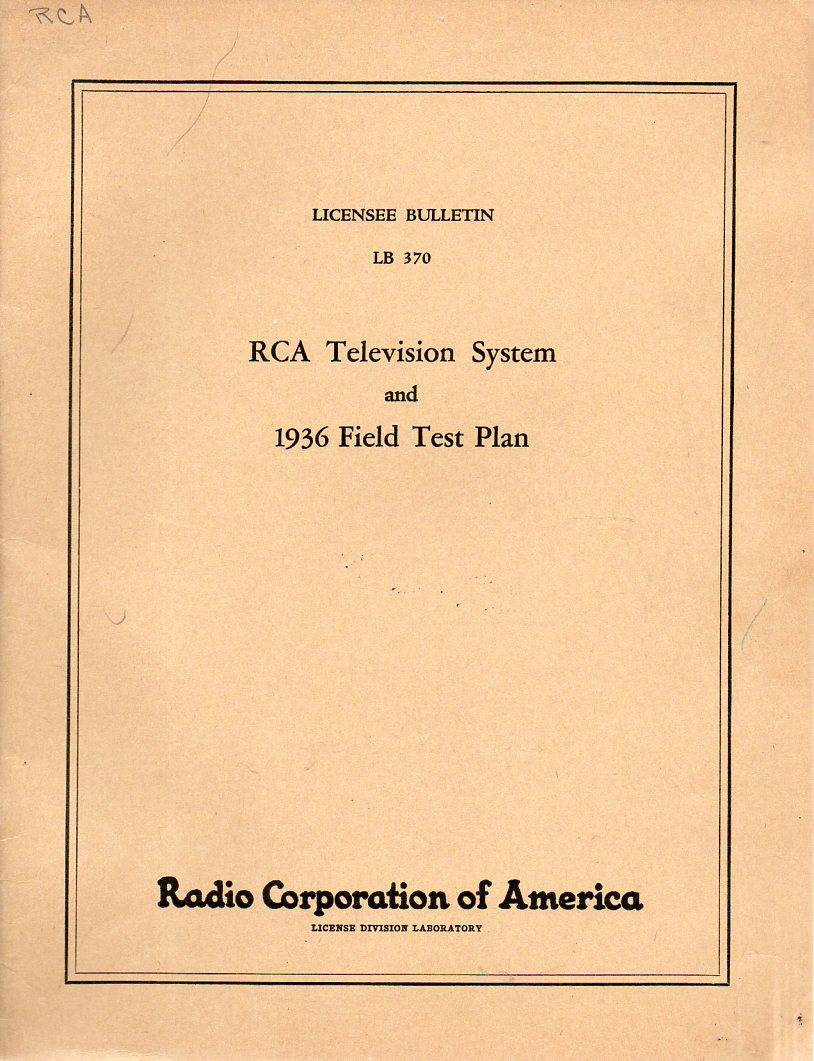
    RCA field Test _1_RCA Television and 1936 Field Test. Licensee Bulletin LB 370, Radio Corporation of America, 1936. 11” x 8.5”, 26pp, photos and schematics. Original wrapper, Fine copy. $300

    The first broadcast images in the history of television transmission were revolutionary if not very interesting in themselves.  Beginning in 1928 the first experimental Radio Corporation of America (RCA, via the National Broadcasting Company, NBC, its broadcasting division) images were of Felix the Cat, and something that would be received with 60-line clarity on a two-inch display.  For the most part, the daily two-hour broadcasts consisted of Felix or test patterns, broadcast from NYC, until 1931.  

    Image quality increased markedly by the 1932 field trials with the use of iconoscope cameras, which allowed for 240-line reception though still with very noticeable flickering. The 1934 trials were improved further to 343 lines and with some less amount of flicker. For the 1936 field test the transmitting station and offices for NBC and RCA were located in the Empire State Building (utilizing the mooring mast at the top of the building for the antenna, as well as some of the upper floors for the transmitter and offices on the 52nd floor, while the transmitting studio was located in the RCA building in Rockefeller Center).  The broadcast began on 29 June 1936 from W2XF/W2XK “to an audience of some 75 receivers in the homes of high level RCA staff and a dozen or so sets in a closed circuit viewing room…(in the RCA building)” (See: The Television Museum, at Earlytelevision DOT org.)

    The rare pamphlet [available for purchase from our blog bookstore, here] that I uncovered in the attic speaks to the first public demonstration. “The first public demonstration of these field trials took place on July 7, 1936 to RCA’s 225 licensees. Major General J. G. Harbord, chairman of the board of RCA announced that there were three sets in operation at the time, the most distant in Harrison, N. J.”2  It addresses the history of the field tests as well as the tech specs for the 1936 test, as well as the need to address the fuller and complicated issues of establishing a network of transmission capabilities:  “Television services required the creation of a system, not merely the commercial development of apparatus.”–July, 1936, RCA Field Test Plan, page 8.

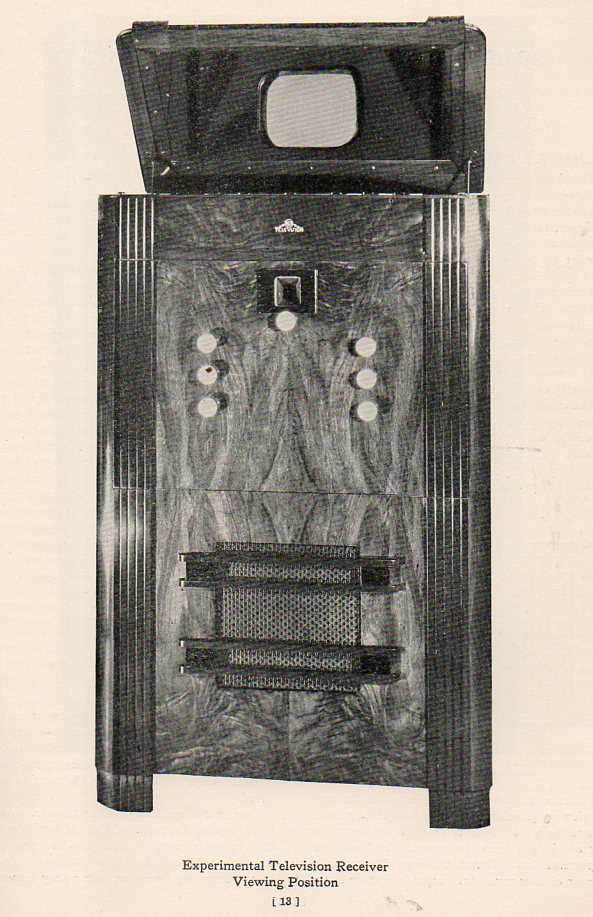
    The set on which the transmission was received was the RCA RR-359 trial set:

    RCA field test _2_

  • Chinese Propagandist Publication on the February 28th Incident (2-28) (1947)

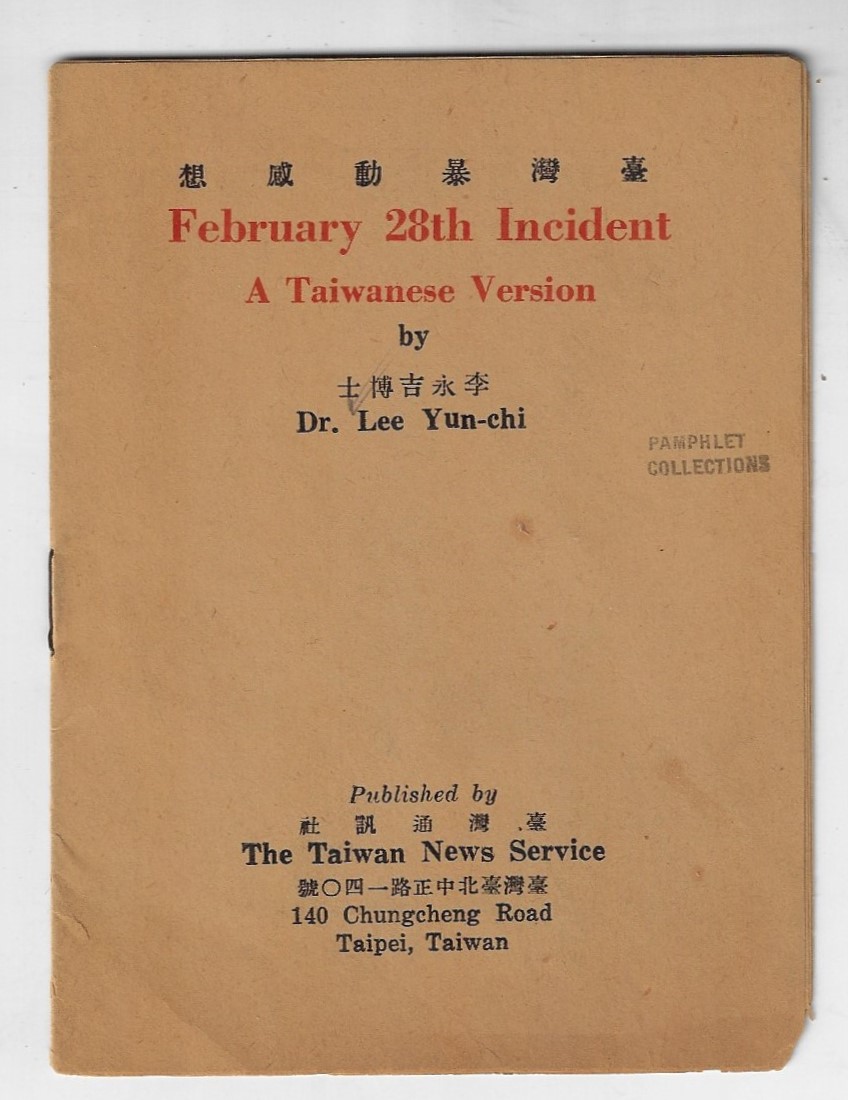
    Taiwan Incident Lee Yun-chi, February 28th Incident, a Taiwanese Version. Published by the Taiwan New Service, Taipei, Taiwan (“printed by the Mercury Press”), [1947] . 5″x 3.75”, 7pp. Wrappers. Printed on inexpensive newsprint, and the pages are now browned. Good condition, though better than what might expected from the origin of the paper. Provenance: Library of Congress, with their rubber stamp on the rear wrapper. 

    Only two copies located in WorldCat: Cornell and Yale. $250

    This is a propaganda piece on the “February 28th Incident” (“2-28”), which was a brutal suppression of a Taiwanese social movement by the government of China, resulting in the death of thousands of Taiwanese over a period of weeks (1). The author of this pamphlet insists on being Taiwanese eyewitness and lays the blame for the all that happened and all of the atrocities with the Taiwanese.

    Here are some examples of the vicious sentiments of the (supposed) author:

    • “Indiscriminate beatings of all Mandarin Chinese women and pregnant women and children…”
    • “Taiwanese no longer they respect themselves as citizens of China but the old slaves of the Japs. Their sadism was immediately manifest.”
    • “They lynched the Chinese, some dead some half-dead”;
    • Taiwanese atrocities similar to those of the Japanese during WWII;
    • Attacks by groups of “ruffians” and students;
    • Taiwanese in “relentless hunt”for Mainland Chinese;
    • Established the 2-28 committee to create peace by Taiwanese elements used it as a way to try to gain political power;
    • The greatest shortcoming of Chen Yi administration is “granting democratic rights to my fellow Taiwanese…;
    • Taiwanese never learned humanitarian love”;
    • “The aggressive Japs taught the Taiwanese VIOLENCE”;
    • The author claimed that years of re-education (of the Taiwanese) was needed.
    • The “responsibility for the present chaos….is simple politicians, Communists, Jap instigators, and rascals…I hope the government will take adequate steps to exterminate these bugbears…”
    • The ending sentence: “The future of Taiwan is bright and rosy.”

    ·Posted by :

    ·in:

    —
  • Two Unlocated (?) Items by a Yugoslavian Freedom Fighter (1944)

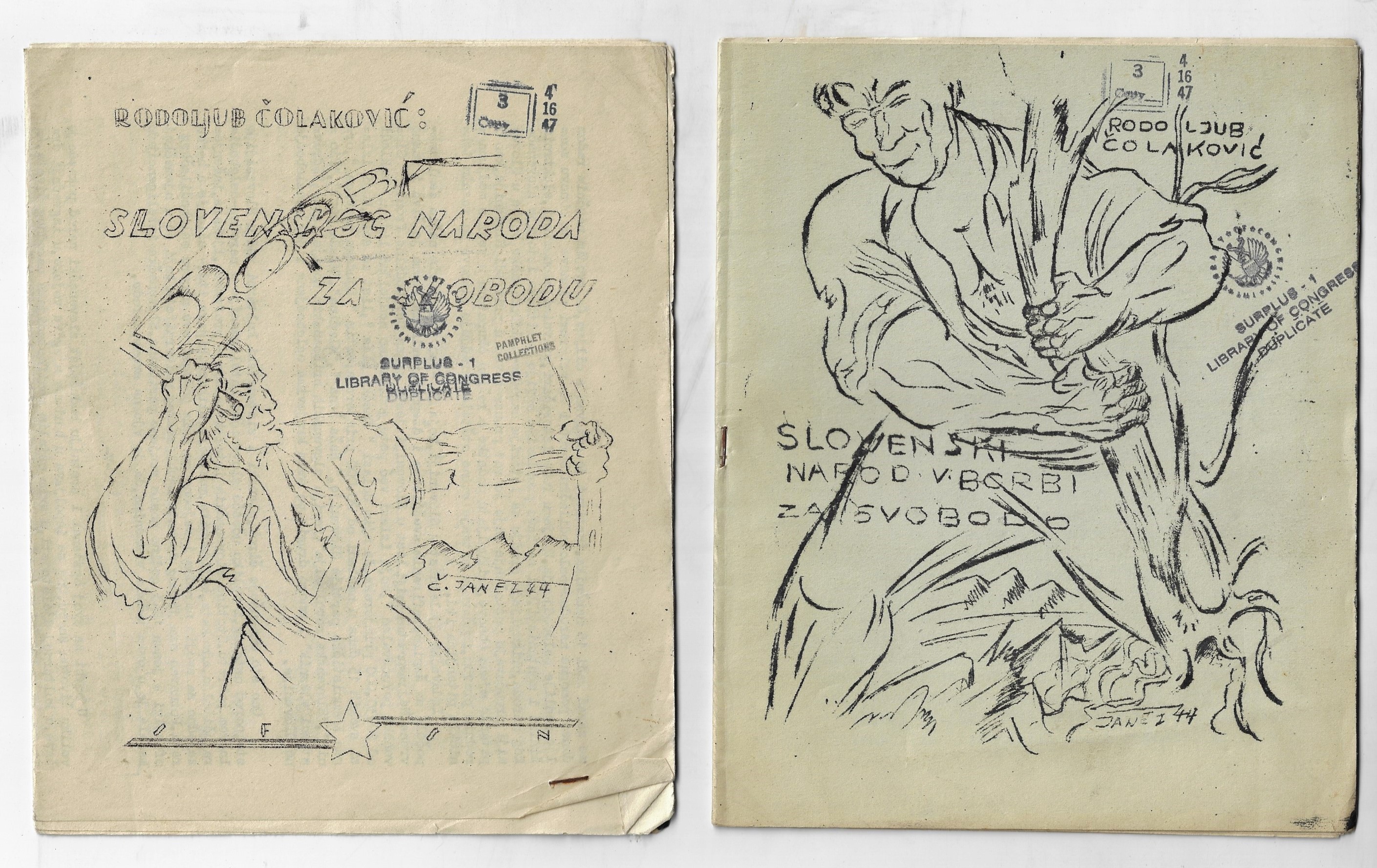
    COLAKOVIC, Rodoljub. Slovenski Narod V Borbi za Svobodo. (From the “Neve Jugoslaije”, St. 4-, 20 aprila 1944.
    8×6″, 16pp, wrappers.
    with:
    another version of the above, this with a different introduction (so far as I can determine) with the rest of the contents
    looking the same as the above, except in a different format. This version: folded 11×8″ sheets, and printed vertically
    on three sheets of paper.

    Provenance: Library of Congress. Neither is located in the WorldCat/OCLC. I did find a couple of references to this
    title being published as part of a larger, edited work, but for 1945. Both of these pamphlets feature artwork on the
    cover dated 1944. $300

    Yugoslavian freedom fighter


    ·Posted by :

    ·in:

    —

Recent Posts

Archives

Categories