A Daily History of Holes, Dots, Lines, Science, History, Math, Physics, Art, the Unintentional Absurd, Architecture, Maps, Data Visualization, Blank and Missing Things, and so on. |1.6 million words, 7500 images, 4.9 million hits| Press & appearances in The Times, Le Figaro, Mensa, The Economist, The Guardian, Discovery News, Slate, Le Monde, Sci American Blogs, Le Pont, and many other places… 5000+ total posts since 2008.

  • Rare Work on the Sociological State of the USSR, Summer 1933

    Philena Weller Montgomery and John Ferguson Montgomery, Traveling Hard Through the USSR. Printed by the authors, 1105 Morrison Ave, Bronx, NYC, 1934.

    Unusual and detailed travelogue through the Soviet Union in the summer of 1933.

    11”x 8.5”, 77 leaves (printed on one side only), approximately 35-40,000 words, printed from the typed originals by mimeograph (?), with occasional line drawings in text by the authors. Perfect bound in wrappers with a cloth-covered spine. Front stiff wrapper is pretty tender, but overall the condition is VG. $2000

    • WorldCat locates only one other copy (Antioch, where the two Montgomerys went to school). It seems to me that the work was printed but not published, as there is no trail for the work, anywhere. This copy is from the Library of Congress, and I suspect that the authors sent at least one copy there for the sake of posterity, and another copy was left with alma mater. I cannot find any reference to this work in any of the standard histories of this period.

    The authors left with a group of 10 other people (fellow students?) for a loosely-guided trip through the Soviet Union in the summer of 1933. They write that even though they had a guide that they were in no way constrained from wandering off or speaking to anyone they wished; they felt that there was no control over their activity outside of the route they were following for their visit. The fact that they saw so much poverty and hardship, and interviewed whomever they pleased, attests to the limited control the state placed on their tour.

    Their adventure begins in Leningrad, and moves to Moscow, Gorki, Kaza, Samara, Saratov, Stalingrad, Rostov, Yalta, Odessa, and then back west via Kiev. The authors write that if the USSR were really trying to control what the visitors saw that they would positively not send people out of or into the country via Kiev because of the state of the city and the people. More on that later.

    The real flavor of this work, to me, is the ability of the writers to see the small local, personal detail—they weren’t interested so much in a grand building, but rather the women who were scrubbing the marble floors with some evil-smelling something because there was a shortage of soap; and not so much the boat they were passengers on, but rather the shabby dress whites of the captain and how he moved through the crew and how the crew responded to that; not the grand vistas of old St. Petersburg but rather the dirty shop windows that displayed pictures of items that they didn’t have in stock. That sort. It was a very interesting and unusual read.Here are some notes from my reading:

    Kiev

    • pale children working elevators at night of their hotel;

    • more Bezpreysosny (orphans) here than they saw in all the rest of the Soviet Union combined;

    • city swarmed with red Soldiers and OGPU;

    • shop windows displayed odd assortments—corks, urinals, bridge lamps, washboards, side-by-side, with very little consumer goods;

    • buildings were shabby as were the people, especially the children, “who show the effects of suffering”’;

    • visit to a Jewish collective farm

    • prophylactorium mostly for the peasants

    • doling out gold colored safety pins to a throng of 30 women;

    • Pechersk Monastery, with a translated story of the 1905 Revolution;

    • the authors remarked that if the Soviet government wanted to give a good impression of their country that it would be best for them to leave Kiev out of the picture, as it “leaves a bad taste in your mouth”.
    ·Posted by :

    ·in:

  • Indoor Air Pollution, 1871

    W.H. Churchman, The Air We Breathe. Being An Essay Upon the Sources, Prevalence, Nature and Morbific Influence of Atmospheric Impurities, As Well As the Principles of Ventilation, and the Most Approved Appliances for Warming Buildings (paper presented at the Western Social Science Association Annual Meeting, Chicago, IL, 7-8 June 1870). 9″ x 5.5″,, 53pp.  Indianapolis, Indiana, 1871.  Original wrappers. About a third of the spine cover is missing, otherwise in nice condition. G/VG copy. Provenance: Library of Congress, with their 6mm perforated “LC” on the title page and rubber stamp on the rear cover.  $85  Scarce.  WorldCat locates 10 copies.  

    “Writing in 1870, W.H. Churchman of Indianapolis declared that “[p]urity in the air we breathe is one of the prime necessities of life, and, therefore, an essential condition of physical and mental health.”296 While Churchman was primarily concerned with indoor air quality, his essay is noteworthy because its contents demonstrate that certain substances were known to be toxic and lethal if airborne. For example, Churchman listed pollutants such as lead, copper, arsenic, and sulfur, as well as carbonic acid (now known as carbon dioxide), carbonic oxide (the archaic term for carbon monoxide), and carburetted hydrogen (the old term for methane)…”– Ruth Diane Reichard, Infrasructure, Separation, and Inequality…MA thesis, Dept History, Indiana, Univ, 2008.


    ·Posted by :

    ·in:

  • With a Map of the Geography of Prostitution in Portland

    Talbot, Henry Russell. Report of the Portland Vice Commission to the Mayor and City Council of the City of Portland, Oregon.. Portland, 1913. 9”x 6”, 216pp. Original stiff wrappers. Provenance: Library of Congress via the Washington DC Public Library. Condition: there are six small stamps for the libraries located on title page, end papers, and one on the front cover. Overall, a GOOD+/solid copy.  $200

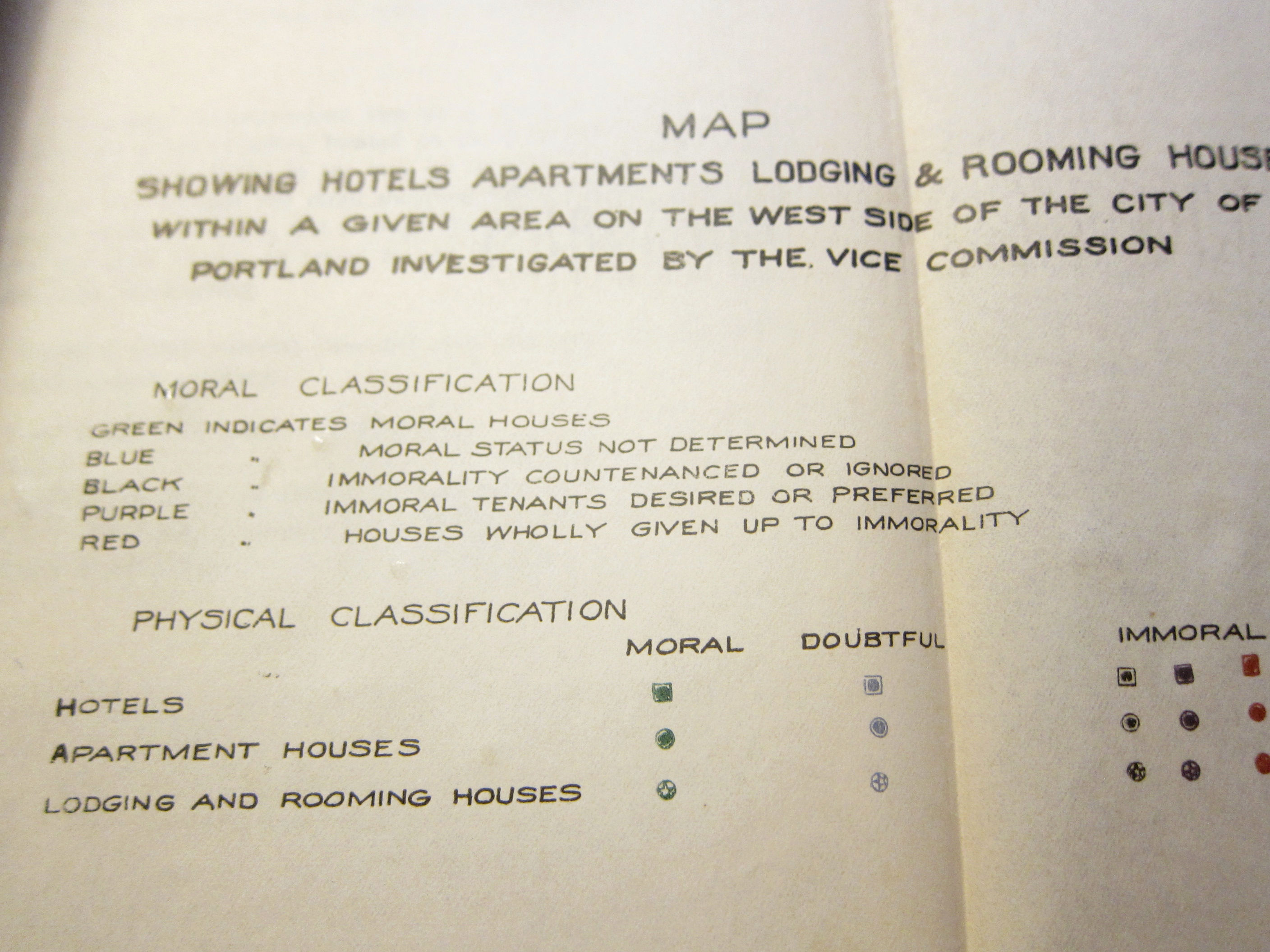
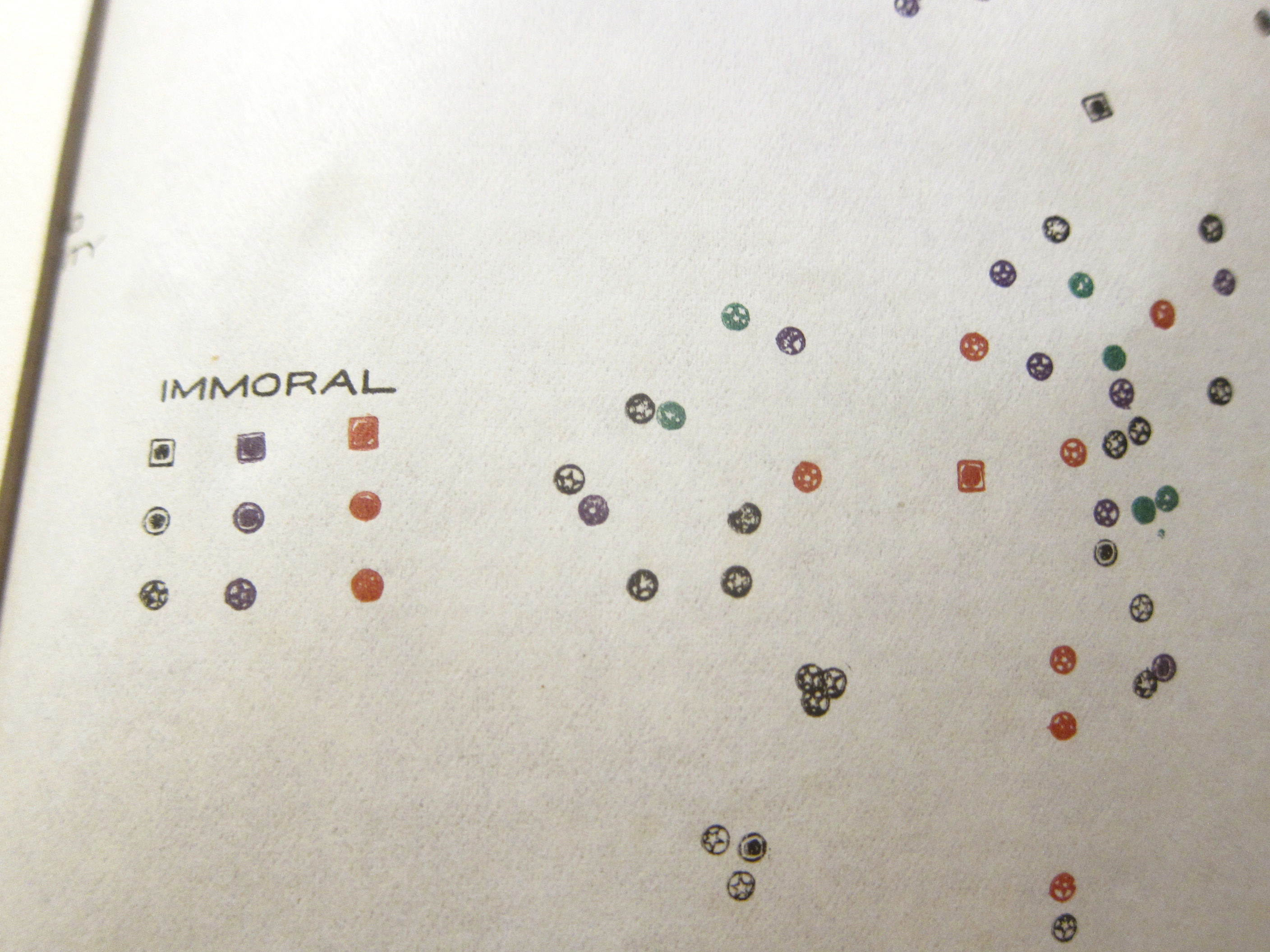
    This is a survey of prostitution in Portland in one section of the city (Irving Street-Hall Street-23rd St-Harbor line) which investigated 547 buildings/rooming houses finding 98 to be “moral” and 431 to be “immoral”) with 98 in a gray-ish “doubtful” category. The publication includes the following sections: “A Report on the Social Evil, as affecting places of public resort and accommodation; hotels, apartment houses, rooming and lodging houses”, pp 4-81; “On the Legal and Police Aspects of the Social Evil”, pp 81-122; “A Report on the Juvenile Aspect”, pp 123-164; “Report on the Economic Aspect”, pp 165-202; “Report on a Segregated District”, pp 203-216.

    The contents are fascinating. For example, there is a section on interviews with proprietors, which includes a number of very colorful quotes, including one “madame” from a bawdy house on Sixth Street, who claimed “Portland is the best town on the coast for a sporting woman to make money in.” Other madams agree! There are interviews with “sources of vice” (“grills, chauffeurs, pool rooms, messenger boys newsboys…”), efficiency of the police and civil service.  A good standard example of a description of one of the bawdy houses reads: “Hotel [unnamed and with no street address identified] Taylor Street. Shabby place of 46 rooms. Run by man and woman, who occupy front rooms, one of which the woman uses as a parlor, the other as a bed room for immoral business. Three prostitutes work for management, paying one-half of their earnings from bed money. Liquor sold.”

    The “study of the docket” is a listing of occupations of prostitutes, arrests, charges, fines, and wages paid the prostitute; there is a section on “testimony” in which the sex worker tells her story, and another section on the general living conditions in the bawdy houses. The last section in the publication deals with “segregation”, though the type of segregation here has nothing to do with race, and simply means that there would be a set-aside space for sex businesses in Portland.

    There is also a very daring and fascinating map in the first section which identifies hundreds of the Social Evils establishments. They are classified top -to-bottom in the following way: “Moral houses”, followed by moral status not determined” and then steeping into “immortality countenanced or ignored”, to “immoral tenants desired or preferred”, and then finally to “house wholly given up to immorality”. The odd thing about the map is that it is an overlay, meaning that the details of the actual geographical part of the map are left out and there is no underlying map on which this skeleton map is laid (as published), which I guess was a preventative measure to squash the possible plans of some enterprising people to use a detailed map as a guidebook to Portland Houses of Ill Repute.

    Portland Vice Map
    Portland Vice Map

    There is an endless amount of social commentary and history that lives and thrives in these pages.

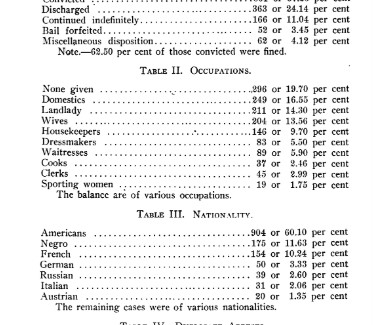
    One unexpected find: on page 96 there is a listing of nationalities of prostitutes arrested—in the accompanying table the leading nationality is “American” followed by “Negro” and then “German”…which seems to me that U.S. Citizenship is being denied to African Americans on the basis of race, and that, evidently, “Negroes” are not American citizens. And according to the law and the constitution in the state of Oregon, “Negroes” were not even allowed to migrate to the state, stated as such right in the Oregon constitution—a law that was not addressed and eliminated until 1924. I suspect that African Americans were illegally in the state and thus, somehow, had their rights of citizenship in the USA stripped away.

    Negro Nationality


    ·Posted by :

    ·in:

  • Several Papers by Bohr in “Zeitschrift fur Physik”, 1920-1923

    BOHR, Niels. “Zur Frage der Polarisation der Strahlung in der Quantentheorie”, in Zeitschrift fur Physik, 1921, vol. 6., pp 1-9, offered in the entire volume of pp iv, 416pp. This is an institutional copy, with (tasteful) bookplate and a few round rubber stamps on the interior–no exterior markings.  This is a FINE copy, and it feels as though it was very infrequently used. .  A very nice copy.  $300

    “[T]here was rarely in the history of physics a comprehensive theory which owed so much to one principle as quantum mechanics owed to Bohr’s correspondence principle” (Jammer 1966, p. 118), from the Stanford Encyclopedia of Philosophy, here.

     A faint damp stain in right margin. First edition. “.in the hands of Bohr and his school the correspondence principle was like “a magic wand that allowed the results of the classical wave theory to be of use for the quantum theory.but a costly price had to be paid. For taking resort to classical physics in order to establish quantum-theoretic predictions, or in other words, constructing a theory whose corroboration depends on premises which conflict with the substance of the theory, is of course a serious inconsistency from the logical point of view. Being fully aware of this difficulty, Bohr attempted repeatedly to show “the correspondence principle must be regarded purely as a law of quantum theory, which can in no way diminish the contrast between the postulates and electrodynamic theory.” The earliest allusion to such a conception may perhaps be found as early as 1921 in a paper (the paper offered) in which Bohr briefly discussed the function of the principle.”(Max Jammer).

    The First Appearance of  “Correspondence Principle”

    BOHR, Niels.  “Über die Serienspektra der Element”, in Zeitschrift für Physik, 1920, volume 2, pp 423-478.   Very prettily bound in reddish cloth and matching marbled boards, red cloth tips. This is an institutional copy, with (tasteful) bookplate and a few round rubber stamps on the interior–no exterior markings.  This is a FINE copy, and it feels as though it was very infrequently used. 

    “[T]here was rarely in the history of physics a comprehensive theory which owed so much to one principle as quantum mechanics owed to Bohr’s correspondence principle” (Jammer, The Conceptual Development of Quantum Mechanics, p 118, 1966)  The correspondence principle was first articulated (Stanford Encyclopedia of Philosophy) in 1913 in “On the constitution of atoms and molecules”, Philosophical Magazine, 26: 1–25, 476–502, 857–75, then again in 1918, and then formulated here in the 1920 paper (“On the series spectra of the elements”), In  where the terms “correspondence” and “correspondence principle” first appear (Nielsen, “Introduction to Niels Bohr Collected Works, Vol. 3”, in Bohr (1976), pp. 3–46. 1976, p. 21, and Stanford Encyclopedia of Philosophy.)

    BOHR, Niels. Ueber die Anwendung der Quantentheorie auf den Atombau. I. Die Grundpostulate der Quantentheorie. In Zeitschrift fur Physik, volume 13, 1923, pp 117-165. (“On the application of the quantum theory to atomic structure,” Proceedings of the Cambridge Philosophical Society (supplement), Cambridge: Cambridge University Press, pp. 1–42. First published in Zeitschrift für Physik, 13 (1923)) Very prettily bound in reddish cloth and matching marbled boards, red cloth tips. This is an institutional copy, with (tasteful) bookplate and a few round rubber stamps on the interior–no exterior markings.  This is a FINE copy, and it feels as though it was very infrequently used. $350

    ·Posted by :

    ·in:

  • A Lovely Paper and its Display of Speech Waveforms (1931)

    Harvey Fletcher. “Some Physical Characteristics of Speech  and Music”, in Reviews of Modern Physics, volume 3 issue 2, pp 258-279, numerous illustrations, 1931. Original front wrapper.  This issue of RMP has been removed from a larger bound volume, and include the front wrapper only. The issue is an extract and is bound in itself but shows signs of removal on the spine.  Fresh copy.  $200 
    
    Fascinating article by a contributor to many fields, not the least of which is acoustics—their the physicist (whose thesis adviser was Robert Millikan) is widely recognizing as the father of stereophonic sound. This paper is of particular interest for the gathering and display of data and its depiction of speech and the graphical illustration of its waveforms.  

    Abstract: “Kinematic and statistical descriptions of the physical aspects of speech and music are given in this paper. As the speech or music proceeds, the kinematic description consists in giving the principal melodic stream, namely, the pitch variation and also the intensity and the quality variations. For speech and song, the quality changes are principally described by giving, besides the main melodic stream, two secondary melodic streams corresponding, respectively, to the resonant pitches of the throat and mouth cavities. To this must also be added the positions of the stops and the high pitched components of the fricative consonant sounds as functions of the time. The statistical description consists in giving the average, the peak, and the probable variations of the power involved as the various kinds of speech and music proceed. These general ideas are illustrated by numerous experimental data taken by various instrumental devices which have been evolved in the Laboratories during the past fifteen years.”

    “An example of how this analysis of speech may be made consider the sentence “Joe took father’s shoe bench out”…this silly sentence was chosen because it is used in our laboratory for making tests on the efficiency of telephonic transmitters…Speech then consists of a series of comparatively steady states of vibrations joined together in time…each one of these steady states is characterized by a pitch and tone quality, and the sequence is essentially a melody.”

    The contents of this issue includes: Irving Langmuir and Karl T. Compton   Electrical Discharges in Gases Part II.   Fundamental Phenomena in Electrical Discharges,
    191—257; Harvey Fletcher Some Physical Characteristics of Speech and Music, 258—279; David M. Dennison The Infrared Spectra of Polyatomic Molecules
    Part I, 280—345.

     “As a graduate student at the University of Chicago, his dissertation research was on methods to determine the charge of an electron. This included the now famous oil drop experiment commonly attributed to his advisor and collaborator, Robert Andrews Millikan. Professor Millikan took sole credit, in return for Fletcher claiming full authorship on a related result for his dissertation. Fletcher’s contributions were detail-oriented but necessary for a successful experiment, in which he incorporated, among other things, experience with projection lanterns. Millikan went on to win [be awarded] the 1923 Nobel Prize for Physics, in part for this work, and Fletcher kept the agreement a secret until his death .”–Wiki, citing  Harvey Fletcher (June 1982). “My Work with Millikan on the Oil-drop Experiment”. Physics Today: 43.


    ·Posted by :

    ·in:

  • Rare Protest Broadside in Support of Jailed Indian Congress Members, 1944

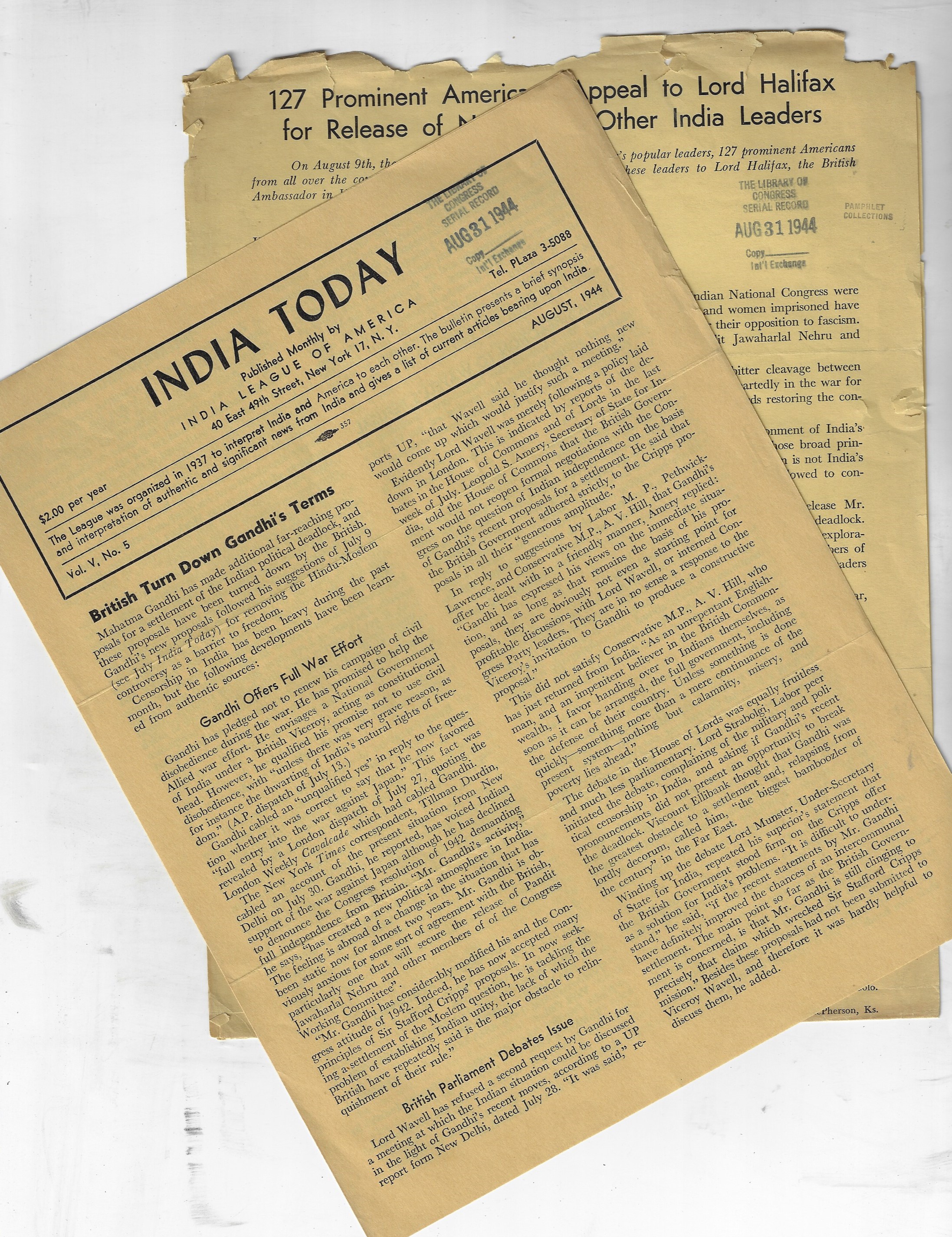
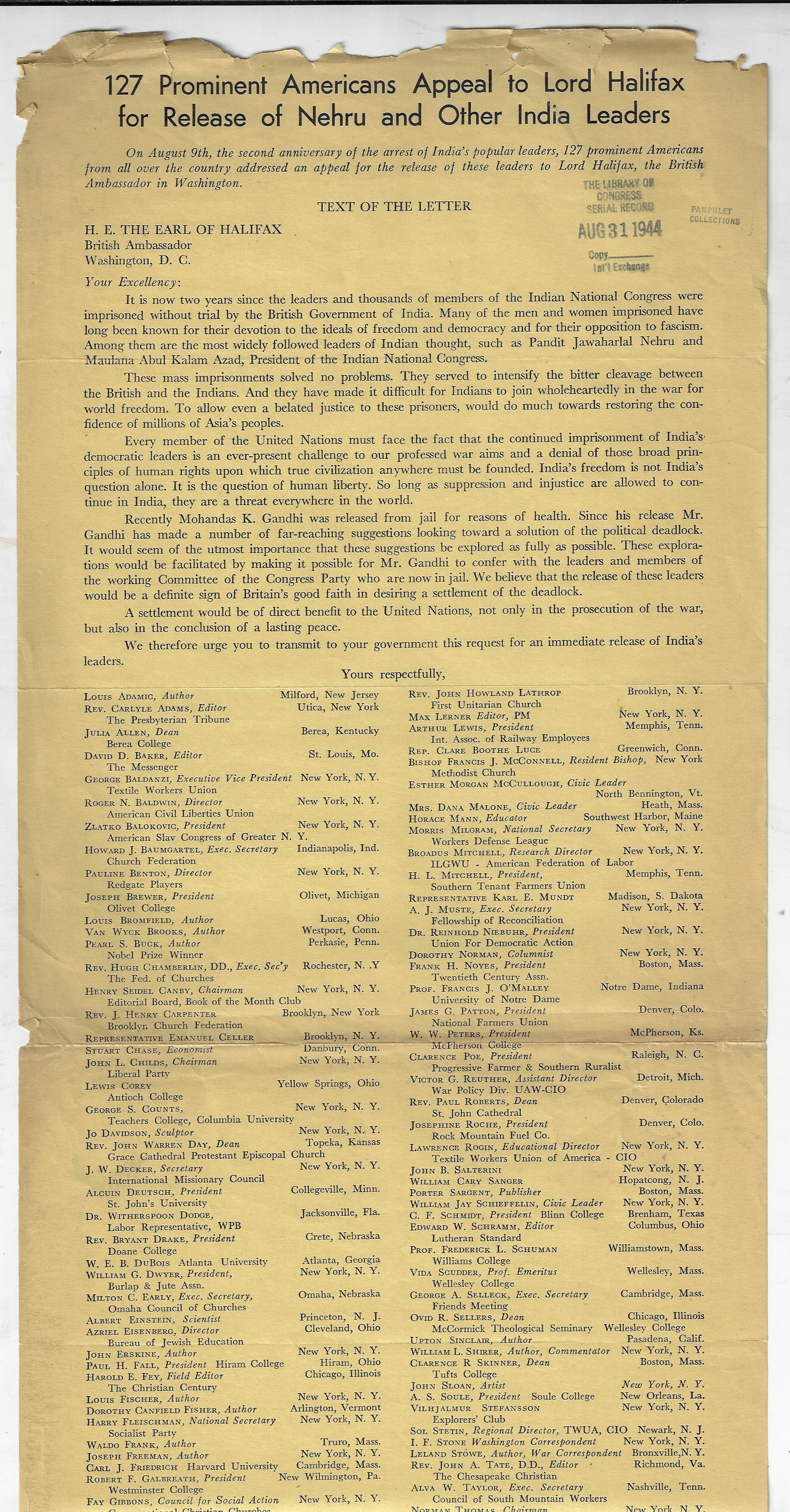
    India 127 cover 127 Prominent Americans Appeal to Lord Halifax or Release of Nehru and Other India Leaders. Published by the India League of America, NYC, (1944). Broadsheet/poster, 22” x 8.5”. The top of the document is a bit tattered and torn and missing in some sections, though not affecting the text. Provenance: Library of Congress Pamphlet Collections. Good copy. Scarce. Only one copy located in WorldCat. $450

    I’m pretty sure that the broadside came folded in quarters in the August 1944 issue of India Today (4pp). Currently the broadside is folded in half but there are very dim remnants of the two other quarter folds.

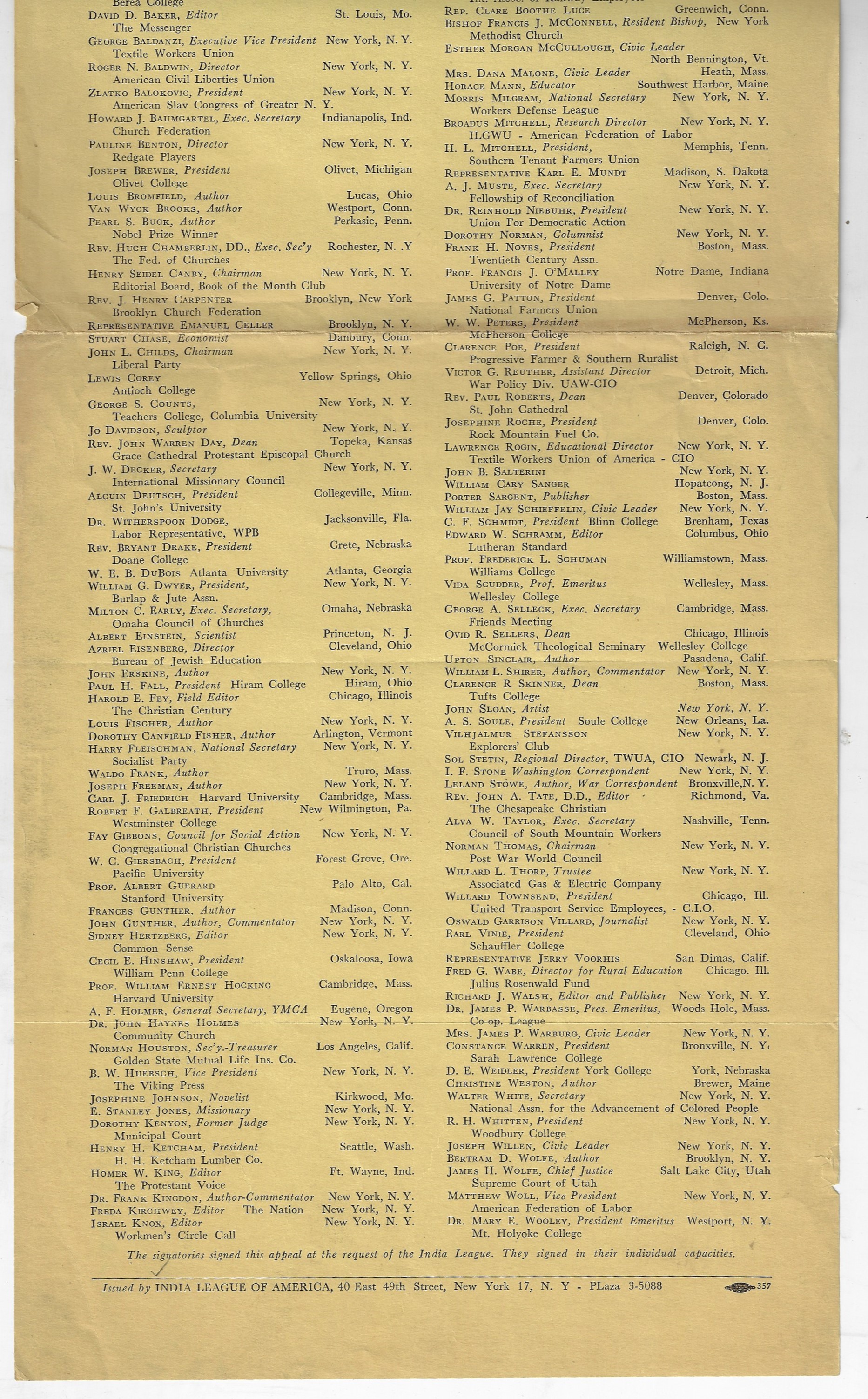
    “On August 9th, the second anniversary of the arrest of India’s popular leaders, 127 prominent Americans from all over the country addressed an appeal for the release of these leaders to Lord Halifax, the British Ambassador in Washington.”


    India 127 cover

    The anniversary referenced here is the 9 August 1942 arrest of Gandhi by British officials in their hope to suppress a civil disobedience program aimed at the Raj and UK leadership to gain the independence of India. This followed the August 7-8th All India Congress voting to pass the Quit India Resolution. Gandhi’s arrest was followed by those of nearly the entire leadership of the Indian National Congress..and another 60,000 or so other people over the following few months.

    The petition is signed by many luminaries, including Albert Einstein, Louis Adamic, Louis Bromfield, Van Wyck Brooks, Pearl Buck, Max Lerner (editor of the great PM), , Horace Mann, Reinhold Niebuhr, Claire Booth Luce, William Shirer, Upton Sinclair, IF Stone, and many others.

    India 127 cover

    ·Posted by :

    ·in:

  • A Wealth of Papers on Foucault and Fizeau (1851)

    [FOUCAULT & Fizeau] Fizeau, “Upon the hypotheses relative to Luminous Ether, and upon an experiment which seems to demonstrate that the motion of Bodies changes the velocity with which light is propagated within them”, appearing in the December issue and translating the Fizeau paper of September 1851 (. “Sur les hypothèses relatives à l’éther lumineux”. Comptes Rendus. 33: 349–355). It seems as though the first English translation appears in the Philosophical Magazine Series 4 vol 2 pp 568-573; this JFI appearance seems to be the first English translation published in the U.S. In:  Journal of the Franklin Institute, 1851, vol 22 (third series, and vol 52 overall). Half-calf and marbled boards. Ex-library, with a few stamps on the title page, plus bookplate; the front joint is sprung but the book is still quite tight and intact. Good solid copy. $450

    Also: John Tyndall, “On the Velocity of Light—experimental Proof of the Theory of Undulation”, pp 104-108, in which Tyndall reviews the two excellent Comptes Rendus papers of Foucault and Hippolyte Fizeau (from May 6 1850 and June 17 1850, respectively). The Foucault is a big paper on the particle v. wave theories of light, part of the issues of which lie int eh experimental measure of the speed of light, and in this paper he succeeds in establishing the fundamental constant at 2.98 x 1010 cm/sec. .

    And another “Exposition of Foucault’s Experiment, pp 352-355;

    And another, On Foucault’s Pendulum Experiments, pp 419-421;

    ALSO: Charles Allen, “Investigation of Foucault’s Pendulum” AND “Demonstration of Foucault’s Experiment”, The Foucault experiment occupies pp 38-42 in the July issue and pp 103-104. On the Charles Allen papers: the news of Foucault’s experiment (released to the world just a few months earlier in February) raced through the U.S., the news of the experiment reported in dozens of newspapers within just a couple of months. It has been written that0 for some reason the news and subsequent U.S.-based reproductions of the experiment were lagging in the New England and mid-Atlantic regions—for what reasons, I don’t know. The Franklin Institute contribution to the Foucault phenomenon was significant because it was among the very early reports on the evaluation of the experiment that was published in a scientific/technical journal. It is not the very first, but it is quite early.

    There are of course a hundred interesting entries in this volume, including:

    Michael Faraday, On Atmospheric Magnetism, pp 115-118;

    John C. Trautwine, A New Method of Calculating the Cubic Contents of Excavations and Embankments, pp (1)-13, 146-158;

    B.F, Isherwood, Remarks on Nystrom’s Screw Propeller, pp42-48;

    Turnbull, A Series of Lectures on the Telegraph, pp 118-128, 185-194, 256-266, 335-339, 406-414 (with a beautiful plate of a printing telegraph);

    Robert Hunt, Recent Improvements in Photography, pp 196-202;

    John Nystrom, A Few Suggestions as to the Manner of Laying out a Propeller…, pp 321-332, with two beautiful plates.


    ·Posted by :

    ·in:

    —
  • H.L. Mencken’s Copy

    Catheryne Cooke Gilman. Responsibility for Better Motion Pictures. Women’s Co-operative Alliance, Inc., Minneapolis, 1929. 9”x 6”, 16pp. Original wrappers. Provenance: Library of Congress (with their rubber stamp on rear cover). Given to the LC by H.L. Mencken, with a notation in pencil on the back of the title page attesting to that. VG copy. $95 Only two copies located in WorldCat/OCLC (MoMA and Columbia).  $95

    Gilman was a renowned social work, early sex educator, general secretary of the Women’s Co-operative Alliance, and president of the Federal Motion Picture Council in America, Inc.

    ·Posted by :

    ·in:

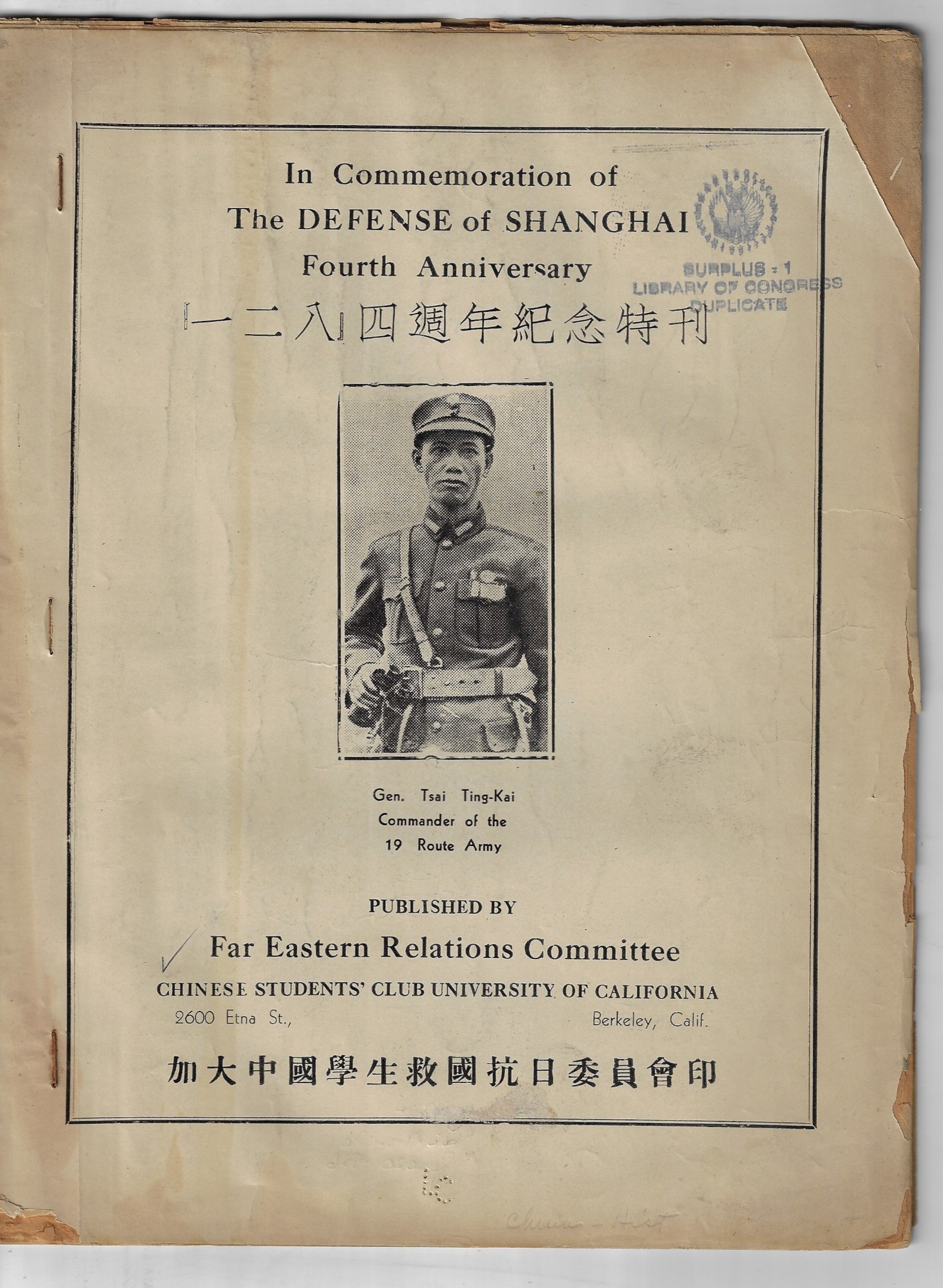
  • The Savior of Shanghai

    Defense of ShanghaiIn Commemoration of the Defense of Shanghai, Fourth Anniversary.

    Published by Far Eastern Relations Committee, Chinese Students’ Club University of California, Berkeley, California. 22pp. Printed on very inexpensive newsprint, Bound in original pictorial wrappers with a portrait of Gen. Tsai Tin-Kai on the cover. Provenance: Library of Congress, with their rubber atam on the front cover. Given the quality of the paper there is a good amount of chipping along the page and wrappers—that and the text is brittle. Careful use must be practiced. That said, there are NO copies located in any libraries worldwide via WorldCat/OCLC. Rare. $250

    “Cai Tingkai (1892–1968) was a Chinese general in overall command of the 19th Route Army of the Republic of China’s National Revolutionary Army and other Chinese forces responsible for holding off the Imperial Japanese Army during the Shanghai War of 1932 on 28 January 1932. In November 1933 Cai and fellow 19th Route Army officer Li Jishen rebelled against the ruling Kuomintang regime and, with Jiang Guangnai, established the Fujian People’s Government on 22 November 1933. However, the rebellion–known as the Fujian Incident–did not receive Communist support and, on 21 January 1934, it was defeated by the Kuomintang and Cai was forced to leave China for several years. Later, in the Second Sino-Japanese War (World War II), Cai returned to command the 26th Army Group in the Battle of South Guangxi. He also traveled to the United States to gain support from Chinese-Americans for the war effort.

    During the final stages of the Chinese Civil War Cai supported the Chinese Communists and was a signer of the “Proclamation of the Central People’s Government of the People’s Republic of China” of 1 October 1949.”–Wikipedia

    ·Posted by :

    ·in:

  • Dm Stauffer The Use Of Compressed Air In Tubular Foundations And Its Employment At The South St Bridge Philadelphia Pp 3 1

    D.M. Stauffer, “The Use of Compressed Air in Tubular Foundations and its Employment at the South St Bridge, Philadelphia”, pp 320-334 (with two fine folding plates of the apparatus). In: Journal of the Franklin Institute, July-December 1872, vol 64 (third series) and vol 94 (whole series), 426 (vi)pp. Ex-library, with just a few odd stamps on the title page. VG condition, except for one page being detached. $150

    Edwin J. Houston, On the Nature of White Light, pp 184-197;

    David Brooks, Lightning and Lightning Rods, pp 132-143;

    I.A. Lapham, List of the Great Storms, Hurricanes and Tornadoes of the United States, pp 210-216, with a list of these occurrences dating from 1635 and numbering about 200 entries;

    Coleman Sellers, Transmission of Motion, pp 233-243, 305-319;

    Alex L. Holley, Bessemer Machinery, pp 252-265 (with three folding plates), 391-399 (with two folding plates).

    ·Posted by :

    ·in:

  • Correlation Coefficient Calculator (1926)

    Stuart C. Dodd. “The Applications and Mechanical Calculation of Correlation Coefficients”, in Journal of the Franklin Institute, vol 201, no. 3, March 1926, pp 337-350 in the volume of 886pp, with several illustrations, including a photo of the preliminary model of the correlation machine.  Library cloth binding, with call number on spine and a library bookplate and a few stamps on the title page, otherwise a very nice, solid copy.  $250

    • “Around 1925 Stuart C. Dodd, a psychologist at Princeton University, made a simpler correlation calculator. This machine (Figure 6) contained drums on which square numbers where represented by pins of different lengths (separate pins for units and tens). These drums are the square number equivalent of the multiplication bodies as used in the Millionaire calculator. Dodd designed different versions of this device. Later development was continued by the Cambridge Instrument Co. Inc., New York, who sold these correlation machines to the universities of Harvard, Berkeley, and Chicago.”–“Correlation Machine” article in “The contribution of psychologists to mechanical computing” via google sites.  

    ·Posted by :

    ·in:

Recent Posts

Archives

Categories