A Daily History of Holes, Dots, Lines, Science, History, Math, Physics, Art, the Unintentional Absurd, Architecture, Maps, Data Visualization, Blank and Missing Things, and so on. |1.6 million words, 7500 images, 4.9 million hits| Press & appearances in The Times, Le Figaro, Mensa, The Economist, The Guardian, Discovery News, Slate, Le Monde, Sci American Blogs, Le Pont, and many othr places… 5000+ total posts since 2008. Contact johnfptak at gmail dot com

  • An Early Paper Approaching the Cosmic Microwave Background (1946)

    DICKE, Robert H. R. Beringer, R. L. Kyhl, and A. B. Vane,  “Atmospheric Absorption Measurements with a Microwave Radiometer”, in Physical Review, volume 70/5+6, September 1 and 15, 1946.   In the original wrappers,  fine copy. $250

    •  See: Henry Stroke, The Physical Review, the First Hundred Years, 1995, reproduced in full in the Gravity Physics and Cosmology section, pp 497-505.  See also John Boslough and John Mather The Very First Light: The True Inside Story of the Scientific Journey Back to the Light at the dawn of the Universe.

      “In 1946, Robert Dicke and coworkers at MIT tested equipment that could test a cosmic microwave background of intensity corresponding to about 20K in the microwave region. However, they did not refer to such a background, but only to ‘radiation from cosmic matter’. Also, this work was unrelated to cosmology and is only mentioned because it suggests that by 1950, detection of the background radiation might have been technically possible, and also because of Dicke’s later role in the discovery”.– Kragh, H. (1999). Cosmology and Controversy: The Historical Development of Two Theories of the Universe. 

    ·Posted by :

    ·in:

  • Earbuds, 1891

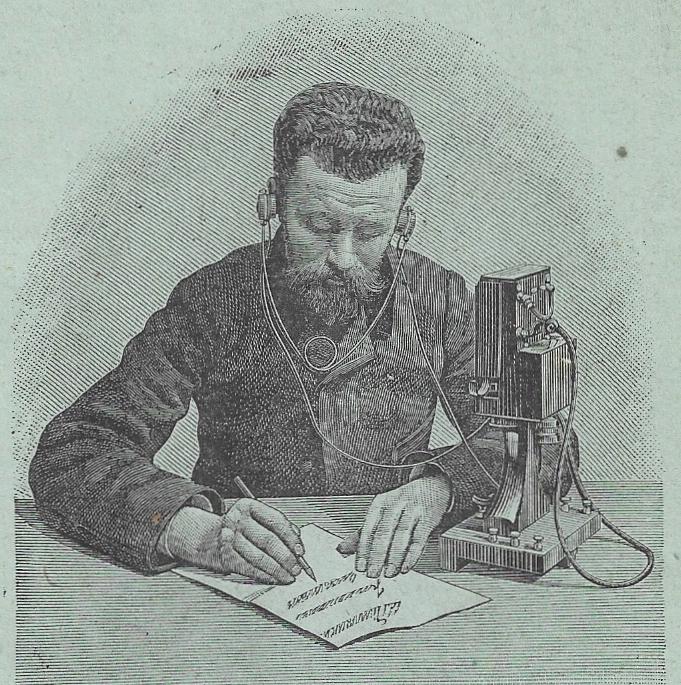
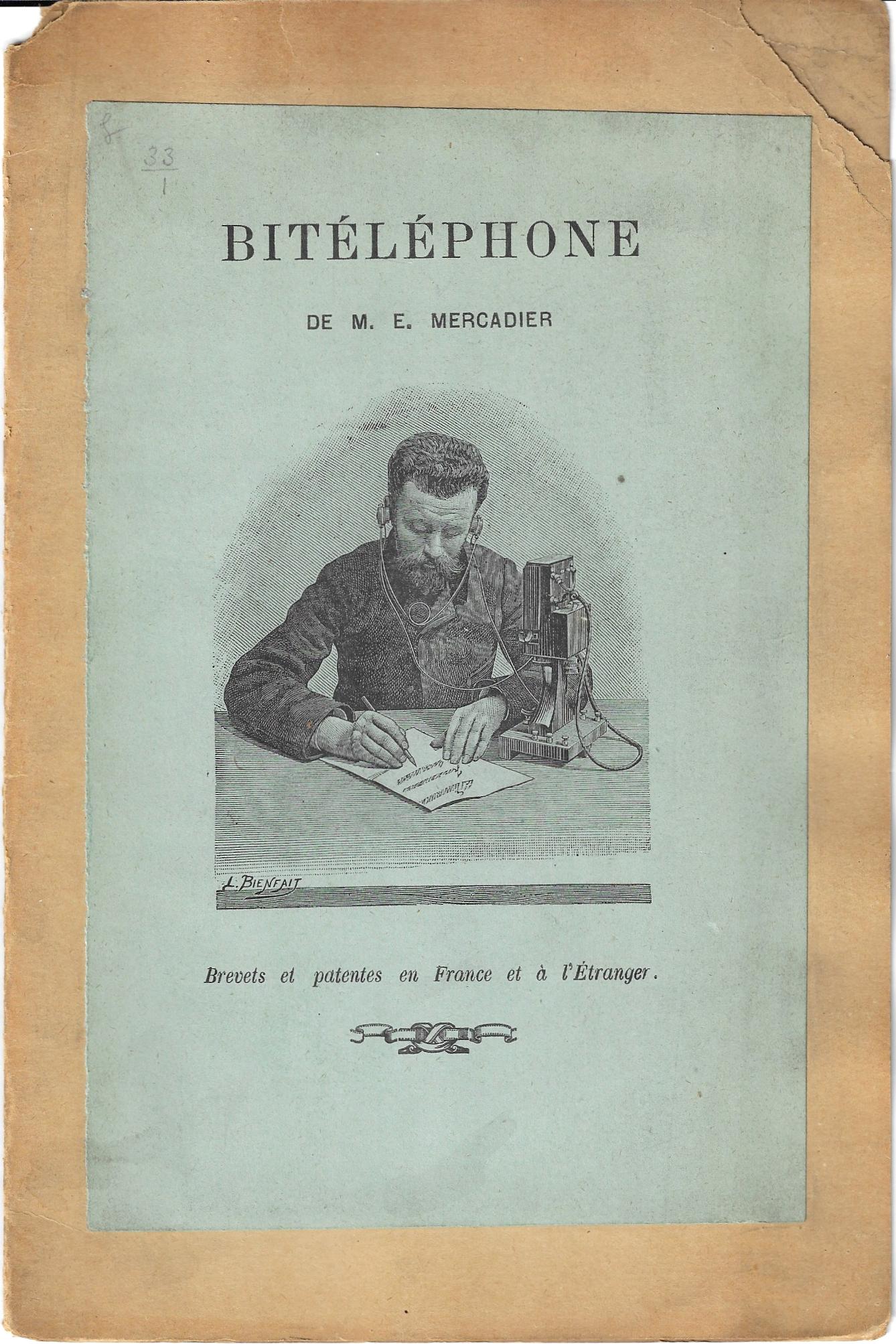
    Ernest Jules Pierre Mercadier, Bitelephone.  Printed by Jamin in Laval, ca. 1891-3 (though no later than 1893). 21×13.5cm, 15pp, 6 text illustrations showing the device. The author announces that there are patents for his invention at home and abroad: “Brevets et patents en France et a l’Etranger”. This is the original pamphlet in wrappers, though at some very early point the pamphlet was bound into a larger manila-folder-like paper cover measuring 25x17cm; the front wrapper of the pamphlet was removed and pasted on the front cover of the new binding. The rear cover is intact. SO, that said, this is a not-perfect copy of the pamphlet, though the much-reproduced and striking cover is present. PROVENANCE: Library of Congress Smithsonian Deposit, accessed in October 1893. Also, the LC surplus rubber stamp is on the back cover.  Good copy. There are NO copies located in WorldCat/OCLC  Rare. $1250

    Bitelephone _2_


    BitelephoneMercadier (1836-1911, electrical engineer and director at Ecole Polytechnique) may well have introduced the first “ear buds1” into the technical world. His apparatus–small listening devices of 1.752 ounces that were padded and fit into the ear–was made for the operator of a telephone so that they could listen and speak and have free use of their hands for notes and such, as pictured on the front cover of this pamphlet. This would have been a shocking thing to see, I think, back there in 1891, only 15 years into the age of the telephone and about half of that for the time in which the still-a-luxury telephone could be accessed by relatively upper-middle-class folks. (In 1881 there were approximately 50,000 Bell telephone stations; in 1885, the year ATT was formed, there were about 150,000; in 1890, 200k and then 600k in 1900. It was in the first decade of the new century where telephone rental/ownership/accessibility really began to spread, with 2.2 million in 1905 and 5.8 million in 1910. Remember that the telephone was only one aspect of communication–all of the massive amount of infrastructure to connect thousands of telephones wasn’t yet created.) 

    Mercadier was well acquainted with the new device (having written Etudes Sur La Theorie Du Telephone five years earlier in 1886, plus other works on the telegraph and associated beginning in 1881), though what made his instrument so softly revolutionary was that it was one of the first entries into the world of communications microminiaturization–a concept we normally associate with computer development in the middle/late 1950’s. As a “headphone” this device is also extremely early though not the first3, though to my eye it is certainly the most elegant, at least that suited to its purpose. The earbud, even though it appears here in 1891, really takes another ten decades to come into its own.

    Notes:

    1. “Who Made that Earbud?”, NYT, May 16, 2014 https://www.nytimes.com/2014/05/18/magazine/who-made-that-earbud.html
    2.  From the Smithsonian Magazine on Mercadier’s invnetion:  “…improvements in telephone-receivers…which shall be light enough to be carried while in use on the head of the operator.” After extensive testing and optimization of telephone receivers, Mercadier was able to produce miniature receivers that weighed less than 1 3/4 ounces and were “adapted for insertion into the ear.” His design is an incredible feat of miniaturization and is remarkably similar to contemporary earbud headphones, down to the use of a rubber cover “to lessen the friction against the orifice of the ear… effectually close the ear to external sounds.”  : http://www.smithsonianmag.com/arts-culture/a-partial-history-of-headphones-4693742/#4c4flaaUUVCDrfVX.99  Also a nice notice in an article by The Guardian, “10 Most Influential Headphones”.  
       
    3. An interesting article in the SVG blog by Mark Schubin (http://www.sportsvideo.org/blogs/?blog=schubin-cafe&news=headphones-history-hysteria) points to the Mercadier device for being perhaps the third earliest headphone, following some others (issuing beginning in 1881) that were earlier but a lot more cumbersome. The Mercadier really were much smaller, more elegant, and a lot lighter than its 19th century companions. That said, the Mercadier device was more a candidate for the earliest earbuds more so than a straightforward headphone.  

    For a good timeline on the development of the telephone/telephone system, see: http://www.telephonetribute.com/timeline.html

  • Wide-Ranging Results of Work Completed by the French Academy of Sciences for 1729–

    Histoire de l’ Academie Royale des Sciences. Annee M. DCCXXIX Avec le memoires de mathematique & de physique, pour la meme annee. Tires des registres de cette academie. Printed in Amsterdam by Pierre Coup, 1733, four years after the first French edition (Paris 1729). [Histoire de l’ Academie Royale des Sciences] vii, 164pp; [Memoires de mathematique & de physique] 595pp (in two vols paginated vii,164, 256 and pp257-595, plus 27 folding engraved plates.

    16.5×9.5cm. Very nicely bound in full leather, with decorated six decorated spine panels. Fine condition.  $350

    The volumes for this issue of the meetings, experiments and communications of the French academy of Sciences include:

    In the review/Histoire section is an interesting “Sur les Machines a remonter les Bateaux”, pp 112-121;

    Mairan, J-J.D. “Nouvelles conjectures sur la cause du mouvement diurne de la Terre sur son Axe d’Occident en Orient”, pp 54-92, with 3 plates. Jean-Jacques Dortous de Mairan (1678-1771,”was a mathematician and an enthusiastic experimenter whose major works were on the formation of ice and on the aurora borealis. However, he was also interested in all the important topics addressed the scientific community in the eighteenth century, among them, the shape of Earth, light, colors, sound, the composition of matter, and vis viva (the debate around the force of moving bodies and the conservation of matter).”–DSB  

    Cl. An. Couplet (1742-1722, architectural engineer and treasurer of the French Academy of Sciences, and son of former Academician P. Couplet)

    “…stdides frictionless systems…deriving (with extraordinary elaboration) a set of [11] theorems and corollaries from fundamental propositions…” This is one of two major papers delivered by Couplet in the Memoires that “[took] a remarkable step forward from de la Hire and Belidor”, so states Edoardo Benvenuto in the chapter “First Theories About Statics of Arches and Domes”, in An Introduction to the History of Structural Mechanics:, pp 339-340.

    Couplet, C. “De la Poussee des Voutes”, pp 107-163, with 5 folding plates.

    Louville, “Sur la Theorie des Mouvemes Varies’, pp 213-256;

    Nicole, ‘Traite es Kignes du troisieme Ordre ou des Courbes du Seconde Genre”, 272-310;;

    Hunauld, “Observations sur la structure et de l’action des quelques muscles de doigts”,  346;

    Molieres, l’Abbe “Probleme Physico-Mathematiques, dont la solutio tend a servir de Reponse a un des Objections de M. Newton contre la possibilite des Tourbillons calesses”, p 333-346. “Privat de Molieres [1676-1742, physicist and mathematician, member of the Royal Academy, and professor at the College Royal] was one of those who most vigorously opposed the introduction into France of Newton’s theories of gravitation , to which he opposed the Cartesian conception of planetary movements. Subsequently, in a series of memoirs and articles published by the Academy of Sciences and Trevoux’s Journal , he tried to reconcile the two systems by using Malebranche’s ideas on vortices or “small vortices.” –Wiki

    Maupertuis, ‘Sur quelques affections des courbes’ (reflecting on the theory of curves);

    Rene Antoine de Reamur (1683-1757), “Second mémoire sur la porcelaine, ou suite of the principes qui doivent conduire dans la composition des porcelaines de différents genres etc.”;

    Réaumur, “Quelle et la Principle cause d’alteration de la blancheur des Platres des batimens neufs” (on why the whiteness of the stone facades of new buildings do not stay that way);

    Henri Pitot, “Comparison entre quelques machines mues par les courants des Fluides…”, which is an interesting section on the blades of paddle wheels and other machines utilizing water power;

    And as usual set throughout the work are three works by Cassini on astronomical observations and eclipses…

    ·Posted by :

    ·in:

  • Bunsen and Kirchhoff, 1860

    Bunsen, Robert & Gutav Kirchhoff.  “Chemische Analyse durch Spectralbeobachtungen”, in Annalen der Physik volume 110, no. 6, pp 161-189 (1860)   First edition.  The discovery of cesium by Bunsen via spectroscopic analysis led to Kirchhoff’s “black-body” radiation (and otherwise at this time known as black radiation) discovery.  Very nice copy.  The entire volume of 660pp (with 8 engraved plates) is offered:  $500

    • Condition:  Ex-libris Deutsche Akademie der Luftfahrtforschung, then Wright Patterson Field Library (USAF), then Library of Congress.  Library markings:  small gilt-stamped “Akademie der Luftfahrtforschung”, page edges stamped “Wright Field Library/Dayton, Ohio” on top and bottom. Contents quite nice

    “Bunsen was exploring the possibility of analyzing salts on the basis of the distinctive colors they gave to flames containing them; he had tried with some success to use colored pieces of glass or solutions to distinguish similarly colored flames. Kirchhoff pointed out that a much finer and surer distinction could be obtained from the characteristic spectra of such colored flames; unknown to him, the approach had been tried before, if only in a dilettantish way. By rigorous experimentation, however, Bunsen and Kirchhoff soon put the method on a firm basis. The burner invented by Bunsen gave a flame of very high temperature and low luminosity, which emitted line spectra of great sharpness The power and importance of spectral analysis became immediately apparent: its very first systematic application to alkali compounds led Bunsen to the discovery of two new alkaline elements, cesium and rubidium.” [Dictionary of Scientific Biography (online), Vol. VII]

    ·Posted by :

    ·in:

    —
  • Blackbody Radiation, 1900

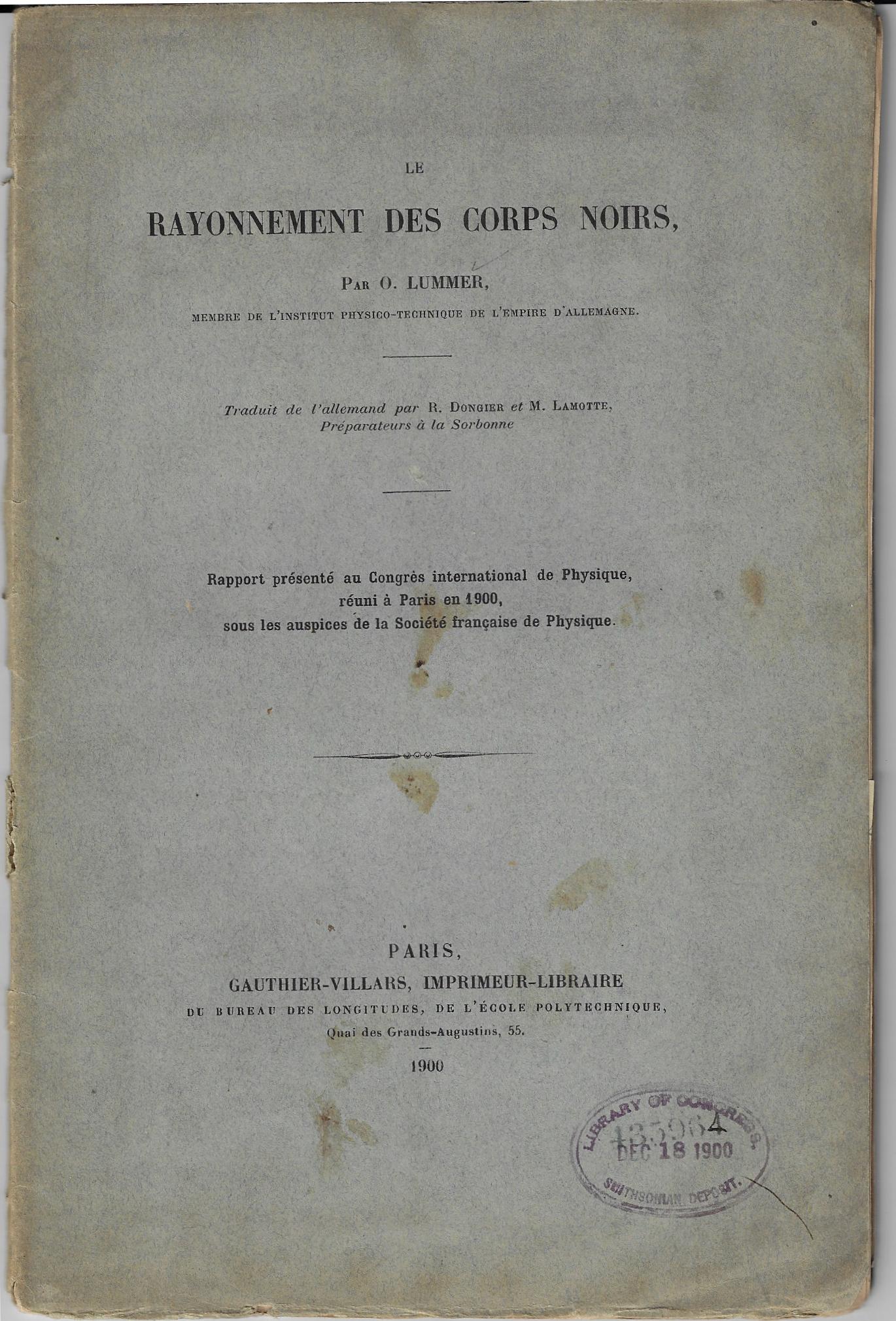
    Lummer black bodyLummer, O(tto) (Richard), (1860-1925).  “Le Rayonnement des Corps Noirs”. Report presente au Congres International de Physique reuni a Paris en 1900, sous les auspices de la Societe francaise de Physique.  

    Published in Paris by Gauthier-Villars, 1900, pp (41)-99. Original wrappers.  Good copy.  $95

    This was a paper given by Lummer following two in this area published with Ernst Pringsheim in 1899. (See The Intellectual Mastery of Nature. Theoretical Physics from Ohm to Einstein ...by Christa Jungnickel, Russell McCormmach, pg 259.)

    “Otto Richard Lummer was a German physicist and researcher. He was born in the city of Gera, Germany. With Leon Arons, Lummer helped to design and build the Arons–Lummer mercury-vapor lamp. Lummer primarily worked in the field of optics and thermal radiation. Lummer’s findings, along with others, on black body radiators led Max Planck to reconcile his earlier Planck’s law of black-body radiation by introducing the quantum hypothesis in 1900.”–Wiki

    Lummer was also early on in his career an assistant to Hermann von Helmholtz, who had a life-long influence on him.  

    ·Posted by :

    ·in:

  • K: Humason’s Data Supporting Expansion of the Universe//A Key Role in the Determination of the Hubble Constant (1929)

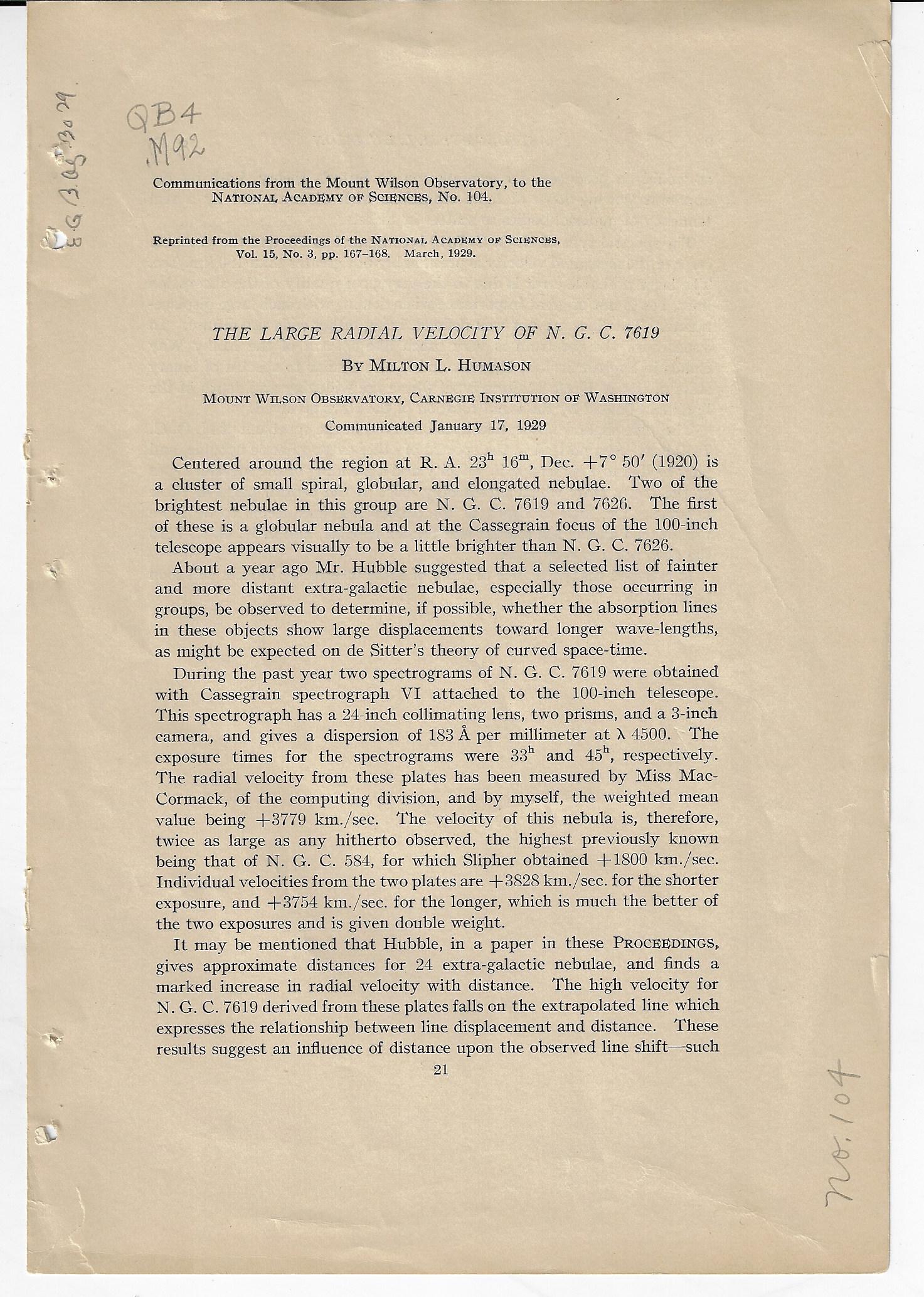
    Humanson, Milton L.  “The Large Radial Velocity of N.G.C. 7619”, Communications from the Mount Wilson Observatory, to the National Academy of Science, No. 104; reprinted from the Proceedings of the National Academy of Sciences, vol 15, no. 3, pp 167-168, March 1929. Paginated here as pp (1)-2, plus 2pp blanks. 6 small punched holes for some sort of binding, along with 3 small groups of penciled cataloging numbers.  Good copy. Scarce.  $[Hold]

    • Humason provides significant support for Hubble’s 1929 paper (” A Relation between Distance and Radial Velocity among Extra-Galactic Nebulae”)  which is nearly universally acknowledged as a turning point in 20th c astronomy and the end of the static universe theory  as well of course for the foundational work that he co-authored with Hubble in the Velocity-Distance paper of 1931. (It is interesting to note that Fred Hoyle mentioned this as “the famous Hubble-Humason velocity-distance relation”, see Helge Krage and Robert Smith, “Who Discovered the Expanding Universe?”, in Hist Sci, xli, 2003.) (“…[T]he velocities over the entire range increase directly with distances, and the linear relation holds as closely as distances can be estimated”–E. Hubble, The Realm of the Nebulae, 1936, pg 117.)
    • “Satisfied that they had the evidence they needed to promote Hubble’s new observed relationship between velocity and distance, the two decided to publish their findings separately in the proceedings of the National Academy of Sciences. The two papers were communicated to the body of the academy on January 17, 1929. In his one-page  [sic] paper, entitled “The Large Radial Velocity of NGC 7619,” Humason laid out the stellar coordinates of the galaxy and wrote briefly about the region of the sky where it sits and of Hubble’s plan to see if a relationship between velocity and distance could be observed. He mentioned Slipher’s previous velocity for NGC 584 and hinted at Hubble’s velocity to distance relationship that followed immediately after his own. Hubble’s paper, “A Relation Between Distance and Radial Velocity Among Extra-Galactic Nebulae,” exposed the world for the first time to the notion that the universe was expanding…” –Ronald Veller, The Muleskinner and the Stars, the Life and Times of Milton La Salle Humason,  Springer, 2016

    “To establish his now-famous relation between radial velocity and distance, Hubble needed data for many more extragalactic nebulae. In 1929, Humason observed a radial velocity for the galaxy NGC 7619…twice as great as the highest previously known galaxy” the results of the observation published in this (offered) paper. Encyclopedia of Cosmology (Routledge Revivals): Historical, Philosophical …edited by Norriss S. Hetherington , pg 298  

    “What is certain, is that Hubble had held his paper for over a year before submitting it for publication, 96 a delay probably due to a desire of Hubble to have available some radial velocity measurements by Humason…In 1929 he was resolved to throw his relation “into the blue”, with himself securing the distances to the galaxies and Humason the radial velocities. Hubble, then, had presented evidence for the existence of a linear redshift distance relation and further observations would reveal if it could be carried farther into extragalactic space…” The Origins of the Velocity-Distance Relation”, R. W. Smith, pg 150-151, Journal for the History of Astronomy, 1979.

    “Hubble discovered the linear law connecting redshifts and distances, but this does not mean that he also discovered the expansion of the universe. Nowhere in his paper did he conclude that the galaxies were actually receding from us or otherwise suggest that the universe was expanding. He did present the law in terms of velocities, but he referred to ‘apparent velocities’, that is, redshifts that could be conveniently transformed to velocities by means of the Doppler formula but for which other interpretations might be equally valid. ‘We [Hubble and Humason] use the term “apparent” in order to emphasize the empirical features of the correlation,’ he wrote to de Sitter in 1931. ‘The interpretation, we feel, should be left to you and the very few others who are competent to discuss the matter with authority.’ Humason followed Hubble in his cautious attitude and wrote that the observations could be explained ‘both by the apparent slowing-down of light vibrations with distance and by a real tendency of material bodies to scatter in space.”(footnote 64, this paper).–Kragh, Helge S. Conceptions of Cosmos : From Myths to the Accelerating Universe: A History of Cosmology.  Oxford, 2007, pg 146 (“Conception of Cosmos”)

    “Credits Hubble [in this paper] with having suggested this test of the expanding universe theory some time earlier”–Paul S Braterman , From Stars to Stalagmites (World Scientific, 2012, pg 283) (“It may be mentioned that Hubble, in a paper in these PROCEEDINGS, gives approximate distances for 24 extra-galactic nebulae, and finds a marked increase in radial velocity with distance. The high velocity for N. G. C. 7619 derived from these plates falls on the extrapolated line which expresses the relationship between line displacement and distance.”)

    Humason’s paper appears just four pages before Hubble’s famous 1929 paper in which appears the iconic velocity-distance graph (figure 1, pg 172, same issue as the above). See Marcia Bartusiak, The Day We Found the Universe, pg 282. 

    “This was the first time that Humason used the formula velocity equals distance time K, or more significantly distance equals velocity divided by K” and thus found that NGC 7619 was moving at the “breakneck speed” of 3,779 kilometers/hour. George Johnson, Miss Leavitt’s Stars: The Untold Story of the Woman Who Discovered How to …pg 105

    Humanson 1929


    ·Posted by :

    ·in:

  • An Interesting Note on Life in the Universe, 1933

    Frederick Leonard. “Life on Other Worlds”, in Popular Astronomy, May 1933, vol 41 no. 5., pp 260-3 in the issue of pp 239-294. Original front outer wrapper, the issue removed from a larger bound volume.  $75  Very Good.  

    In the year that the human race started its very real plunge into the Wasteland, Frederick L. Leonard (Chair of the astronomy department at UCLA) had his eyes on another prize. In a short article in Popular Astronomy, Prof. Leonard spent a few pages discussing the possibility of extraterrestrial life. He kept the discussion in one and two syllable words and was very straightforward, winding up talking about the possibilities of “life” in our own solar system. He quickly dismisses all of the planets as contenders save for Venus and mars, and then wasn’t really happy with that, at all, and opened the discussion more as to “life” might be. 

    There were several surprises in the article, including one about the authors of Astronomy ( Henry Norris Russell; Raymond Smith Dugan; John Quincy Stewart,  Astronomy: A Revision of Young’s Manual of Astronomy …) being “surprised” that there was no oxygen found on Venus. The bigger moment though was saved for Percival Lowell, who had long labored in support of advanced lifeforms on Mars, though the quote from him regarding extraterrestrial life was really very good. Leonard quotes him so:

    “If astronomy has taught us anything it is that man is but a detail in the universe, and the resemblants though diverse detail are inevitably to be expected…[humans] are destined to discover any number of cousins scattered through space.”

    The odds favor a statement like this, that human life is a “detail” of the universe and that there are not doubt other ‘details” to be found, resembling earth life or not. Odd as weren’t so much with Lowell in keeping with his intelligent lifeforms being on Mars, which is just a step or two away. In any event, I found the Lowell statement to be a pretty sober appraisal of the possibility of Life Elsewhere.  

    ·Posted by :

    ·in:

  • A Smart Piece of Thinking that also Touches on Extraterrestrial Origins of Life on Earth (1875)

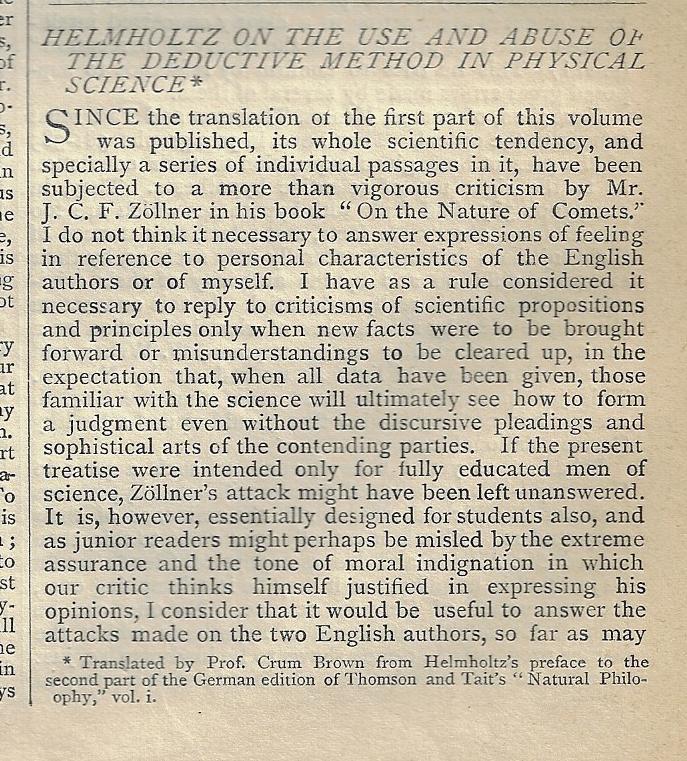
    Hermann von Helmholtz. “On the Use and Abuse of the Deductive Method in Physical Science”, in a two-part article over two months in Nature:

    • December 24, 1874, pp 149-151 in the issue of pp 141-160 and
    • January 14, 1875,  pp 211-212 in the January 14, 1875 of 201-220pp.  

    The two issues are offered together, $125  (Also the entire text is reproduced below.)

    Helmholtz pansperma one _1_

    (Translated by Crum Brown for Nature.)

    These two piece by von Helmholtz are just very nice pieces of thinking, delivering several wonderful insights into the nature of reasoning which spread out into other areas, one of which, interestingly, is on the origins of life. For example, in the first paper, in addition to defending his version of deductive reasoning he drops this bon mot into the equation in mentioning the infection of metaphysics in science:

    “Among the scientific investigators who have especially directed their efforts towards the purification of physical science from all metaphysical infection and from all arbitrary hypotheses, and, on the contrary, have striven to make it more and more a simple and faithful expression of the laws of the facts, Sir W. Thomson occupies one of the first places…”–pg 150

    In continuing in the second paper, von Helmholtz goes on to make a statement on the probable great longevity of life in the universe in general, and of the possibility that life could be as old as the universe (“whether it  [life] is as old as matter”), and that some germs could have been brought to Earth (for example) on meteorites, meaning that the origins of life could be extraterrestrial.  Helmholtz points out that William Thompson had addressed this issue in 1871, though Helmholtz himself ad spoken on the issue months before that. In any event, here is von Helmholtz again talking about the origin of life and cosmic pansperma, in 1875.

    “I will mention one other objection of similar scientific value, because it refers to Sir W. Thomson, though not to a passage of this book. The point in question is whether
    it is possible for organic germs to be present in meteoric stones, and so to be conveyed to worlds which have become cool. In his introductory address to the British Association at Edinburgh, in the autumn of 1871, Sir W. Thomson characterised this view as “not unscientific.” Here, too, if an error has been committed, I must profess myself a sharer in it. I had, in fact, indicated the same view as a possible explanation of the transmission of organisms through interstellar spaces at a somewhat earlier date than Sir W. Thomson—in a lecture which was delivered at Heidelberg and at Cologne in the spring of the same year, but is still unpublished. If anyone chooses to regard this hypothesis as highly or even as extremely improbable, I have nothing to object. But if failure attends all our efforts to obtain a generation of organisms from lifeless matter, it seems to me a thoroughly correct scientific procedure to inquire whether there has ever been an origination of life, or whether it is not as old as matter, and whether its germs, borne from one world to another, have not been developed wherever they have found a favourable soil. The physical reasons alleged by Mr. Zollner against the view in question are of very little weight. He points to the heating of the meteoric stones, and adds (p. 26) : ” Thus, even if we suppose that when the parent body was shattered, the meteoric stone covered with organisms escaped with a whole skin, and did not share the general rise of temperature, it was still necessary for it to pass through the terrestrial atmosphere before it could discharge its organisms to people the earth.”–pg 212

    There is a tremendous amount going on in just these few pages of created by one of the most able and expansive scientific minds of the 19th century.  

    ·Posted by :

    ·in:

    —
  • The Discoveries of Transuranium Elements 97, 98, 99, 100, 101

    The Discovery of Berkelium, Element 97, the 5th Transuranium

    S.G. Thompson, A. Ghirorso, G.T. Seaborg. “Element 97”. In: Physical Review, vol 77, no 6, March 15, 1950, pp 838-9 in the issue of pp 765-872, viiipp. Original green wrappers. Fine copy.

    offered with another issue of the PR:

    _____. “The New Element Berkelium (Atomic Number 97)” In: Physical Review, vol 80, no. 5, December 1, 1950, in the issue of pp 771-926, this article occupying pp 871-790. Original Green wrappers. Fine copy. The pair: $350

    “Berkelium is a transuranic radioactive chemical element with symbol Bk and atomic number 97. It is a member of the actinide and transuranium element series. It is named after the city of Berkeley, California, the location of the Lawrence Berkeley National Laboratory (then the University of California Radiational Laboratory) where it was discovered in December 1949. Berkelium was the fifth transuranium element discovered after neptunium, plutonium, curium and americium.”

    “The major isotope of berkelium, 249Bk, is synthesized in minute quantities in dedicated high-flux nuclear reactors, mainly at the Oak Ridge National Laboratory in Tennessee, USA, and at the Research Institute of Atomic Reactors in Dimitrovgrad, Russia…”–Wiki

    Element 98

     S. G. Thompson; K. Street Jr.; A. Ghiorso; G. T. Seaborg . “Element 98”. In Physical Review, 1950, volume 78, no. 3, pp 298–299. This is an issue of the Physical Review with the original wrappers, removed froma larger bound volume, though it has no backstrip to the spine. That said, it is a Fine copy. $125

    S.G. Thompson, A. Ghiorso, B.G. Harvey, G.R. Choppin. “Transcurium Isotpes Produced in the Neutron Radiation of Plutonium”. In: Physical Review, p. 980 in the issue of pp 655-954

    Also in this issue: Flowler, .B.et al. “Production of Heavy Unstable Particles by Negative Pions”, pp 861-867.

    Offered in the original green wrappers. Fine condition. $200

    Elements 99 and 100

    G.R. Choppin, S.G. Thompson, A. Ghiorso, B.G. Harevy. Nuclear Properties of some Isotopes of Californium, Elements 99 and 100 Pp 1080-1081.

    and with, in the same issue:

    ____. “New Isotopes of Americium, Berkelium, and Californium”. Pp 1081.

    Both in the Physical Review, volume 94, no. 4, May 15, 1954.

    Einsteinium and Fermium, Atomic Numbers 99 and 100

    A. Ghiorso; S. G. Thompson; G. H. Higgins; G. T. Seaborg; M. H. Studier; P. R. Fields; S. M. Fried; H. Diamond; J. F. Mech; G. L. Pyle; J. R. Huizenga; A. Hirsch; W. M. Manning; C. I. Browne; H. L. Smith; R. W. Spence. “New Elements Einsteinium and Fermium, Atomic Numbers 99 and 100”. In  Physical Review, 1955, volume. 99 (3): 1048–1049. Original wrappers, a FINE copy removed from a larger bound volume. $150

    Element 101

    A. Ghiorsom B.G. Harvey, G.R. Choppin, S.G. Thomson, and G.T. Seaborg. “New Element Mendelevium, Atomic Number 101”. Physical Review, volume 98 no. 5, June 1, 1955, this article occupying pp 1518-9.

    Followed in the same issue by G.R. Choppin, B.G. Harvey, S.G. Thompson, A. Ghiorsom. “Nuclear Properties of 100^256.” Same issue, pp 1519-1520

    Both offered in the bound volume 98, May-June, 1955, pp 847-1936. Bound in red cloth, without wrappers, the entire volume offered. Fine copy. $125
    ·Posted by :

    ·in:

  • On the Starvation Conditions in Europe, 1946

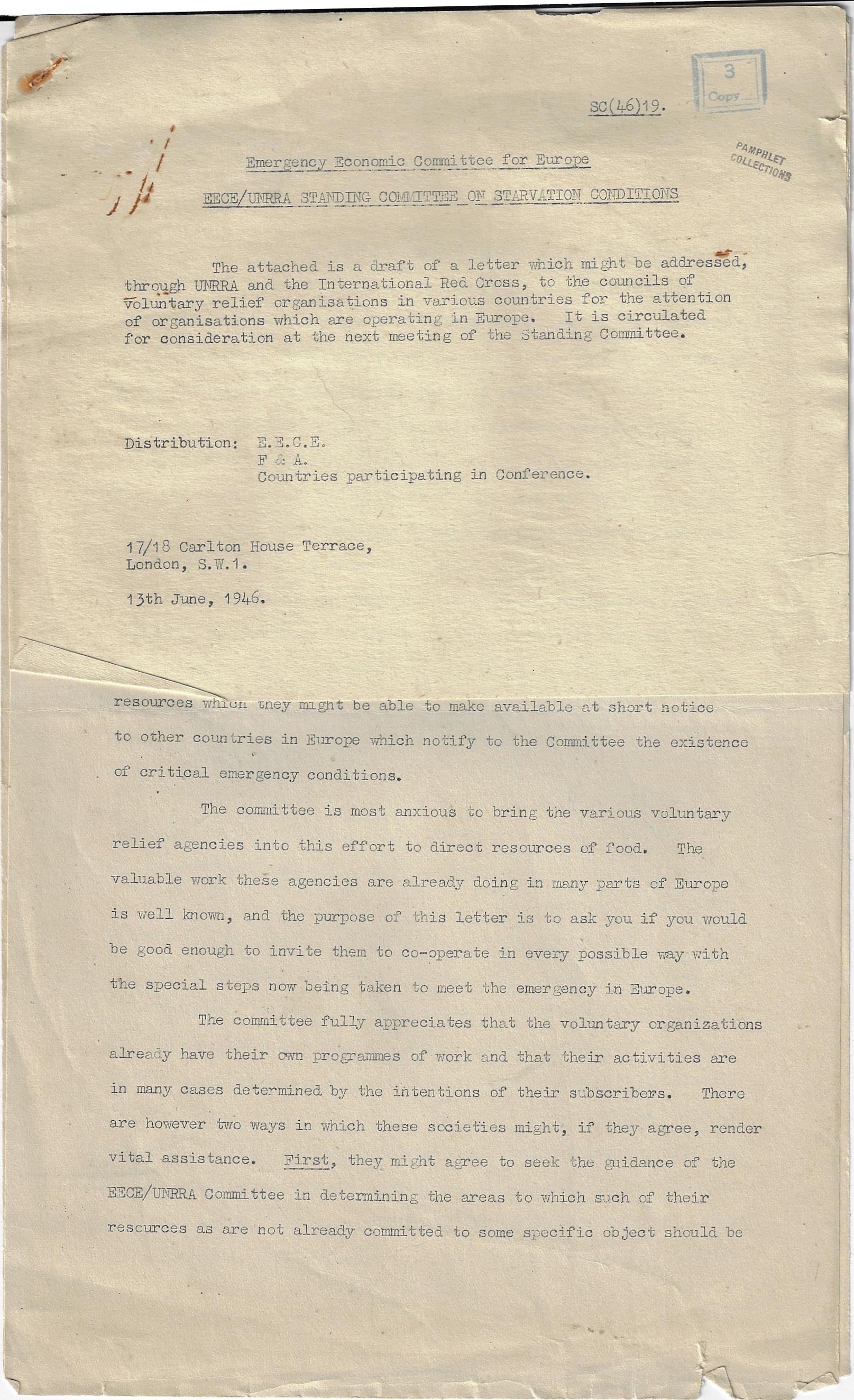
    Starvation _1_Emergency Economic Committee for Europe, EECE UNRA Standing Committee on Starvation Conditions SC(46)19  12.5×8.5″, 5pp, 3 sheets, including a truncated cover sheet. Provenance: Library of Congress, with their surplus/duplicate stamp on the rear of the last sheet. Very Good condition.  $150 

    I reproduce the entire document, below. It is interesting to note that this deals just with Europe, with no mention of, say, the Ukraine (which was suffering from famine already by 1945), or of the artificially-famine-induced Soviet Union.  

    The United Nations Relief and Rehabilitation Administration (UNRRA, 1943-1947) was established to “plan, co-ordinate, administer or arrange for the administration of measures for the relief of victims of war in any area under the control of any of the United Nations through the provision of food, fuel, clothing, shelter and other basic necessities, medical and other essential services…By 1947, UNRRA was running nearly 800 resettlement camps, housing seven million people. Forty-four nations contributed to funding, supplying, and staffing the agency, of which the United States was the leading donor. The largest recipients of UNRRA commodity aid, in millions of US dollars were China, $518; Poland – $478; Italy – $418; Yugoslavia – $416; Greece – $347; Czechoslovakia – $261; Ukraine (USSR) – $188; and Austria – $136.”–wikipedia


    ·Posted by :

    ·in:

    —

Recent Posts

Archives

Categories