A Daily History of Holes, Dots, Lines, Science, History, Math, Physics, Art, the Unintentional Absurd, Architecture, Maps, Data Visualization, Blank and Missing Things, and so on. |1.6 million words, 7500 images, 4.9 million hits| Press & appearances in The Times, Le Figaro, Mensa, The Economist, The Guardian, Discovery News, Slate, Le Monde, Sci American Blogs, Le Pont, and many other places… 5000+ total posts since 2008.

  • Anderson Hl Fermi Long Nagle Total Cross Sections Of Positive Pions In Hydrogen Physical Review Volume 855

    ANDERSON, H.L., Fermi, Long, Nagle. “ Total cross sections of positive pions in hydrogen.” Physical Review, volume 85/5, p. 936 (letter to the editor), 1952. Nice copy, few old ink smudges on front wrappers. Very good. Reproduced in full in Henry Stokes’ The Physical Review, the First Hundred Years, a Selection of Seminal Papers and Commentaries (1995). $175

    _____. Another copy, original wrappers, removed from larger bound volume. $100

    ANDERSON, H. L., E. Fermi, and Leo Szilard, “Neutron Production and Absorption in Uranium”, Physical Review. Volume 56, Issue 3, 284 – 286 (1939). Very good copy in the original wrappers with a bit of a red splotch on the wrapper spine being the result of an odd de-accessioning process.  About a VG copy.  $200

    ·Posted by :

    ·in:

  • Becquerel and Uranium, in English, June 1896

    [Becquerel] “Uranium”, in Nature, June 4, 1896, volume 54, pp 116-7 (in the issue of pp 97-120) being a three-paragraph note of about 500 words. Offered in the weekly issue, with the scarce outer wrappers (including 4pp of nicely illustrated advertisements including several for x-ray apparatus). This weekly issue is removed from  a larger bound volume. Provenance: Smithsonian Institution Astrophysical Observatory with their rubber stamp on the upper right corner of the front wrapper. Very Good copy.   $250

    Becquerel began presenting his results in the discovery of radioactivity of uranium (uranyl sulfate) to the Academy beginning 24 February 1896 and “[with his] last announcement, on 18 May, Becquerel’s discovery of radioactivity was complete, although he continued with ionization studies of his penetrating radiation until the following spring”.

     “Of more importance, he had shown that the power of emitting penetrating rays was a particular property of uranium. However, the implications of this second conclusion were by no means clear at the time. Becquerel characterized his own achievement as the first observation of phosphorescence in a metal. His immediate successors, G. C. Schmidt and Marie Curie, started with quite conventional views about the rays and came only gradually to realize that such radiation might also be emitted by other elements. Both then searched among the known elements, finding that only thorium was also a ray-emitter. Marie Curie and her husband, Pierre, pushed on to search for unknown elements with the same property, however, and so discovered polonium and radium. With these discoveries, the field of radioactivity (a term that the Curies coined) was fully established. Nothing that Becquerel subsequently accomplished was as important as this discovery, by which he opened the way to nuclear physics.”–Dictionary of Scientific Biography  

    This announcement in Nature 4 June is a very early English-language notice on his work on uranium. The first half of the short notice discusses Moissan with the second to Becquerel.  

    ·Posted by :

    ·in:

  • Four Early X-Ray Papers from Nature, 1896

    J.J. Thomson,  “The Rontgen Rays”, in Nature, July 30, 1896, volume 54, pp 302-306 (approximately 4500 words) in the issue of pp 289-312.   Offered in the weekly issue, with the scarce outer wrappers (including 4pp of nicely illustrated advertisements including several for x-ray apparatus). This weekly issue is removed from  a larger bound volume. Provenance: Smithsonian Institution Astrophysical Observatory with their rubber stamp on the upper right corner of the front wrapper. Very Good copy. $75

    A.A. Michelson,  “A Theory of the X-Rays”, in Nature, May 21, 1896, volume 54, pp 66-7 (about 1000 words) in the issue of pp 49-72. Offered in the weekly issue, with the scarce outer wrappers (including 4pp of nicely illustrated advertisements including several for x-ray apparatus. This weekly issue is removed from  a larger bound volume. Provenance: Smithsonian Institution Astrophysical Observatory with their rubber stamp on the upper right corner of the front wrapper. Very Good copy. $50

    Alexander Meek, “A Biological Application of Rontgen Photography”, in Nature, May 7, 1896. volume 54, page 8, with what is no doubt the first published photo of an x-ray of a starfish. Offered in the weekly issue, with the scarce outer wrappers (including 4pp of nicely illustrated advertisements including several for x-ray apparatus. This weekly issue is removed from  a larger bound volume. Provenance: Smithsonian Institution Astrophysical Observatory, with their rubber stamp on the upper right corner of the front wrapper. Very Good copy. $35

    G.G. Stokes, “On the Rontgen Rays”, in Nature, September 3, 1896, volume 54, pp 427-430 (which is somewhat longish for the journal at this time, running about 4,000 words) in the issue of pp 409-432. Offered in the weekly issue, with the scarce outer wrappers (including 4pp of nicely illustrated advertisements including several for x-ray apparatus. This weekly issue is removed from  a larger bound volume. Provenance: Smithsonian Institution Astrophysical Observatory with their rubber stamp on the upper right corner of the front wrapper. Very Good copy. $45
     

    ·Posted by :

    ·in:

  • “The Fatal Deadfall of Abolition”–Threatening the Newly-Freed Southern Slaves, 1867

    JF Ptak Science Books 

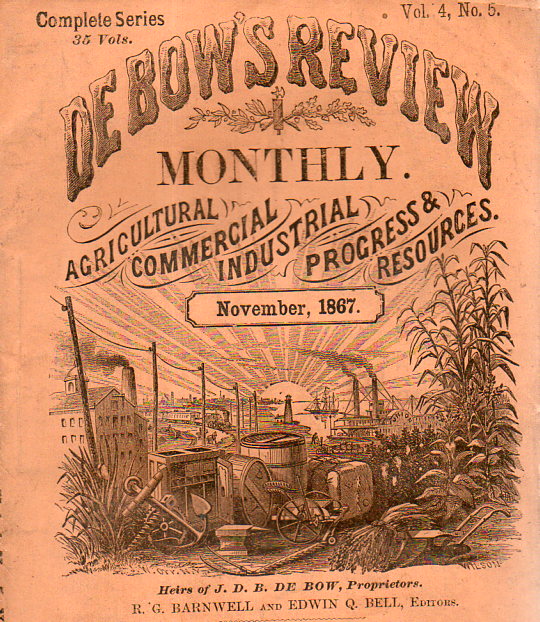
    De Bow’s Review in 1867, in the dire straights of the Southern doom and despair of the just-finished war, lashed out like a wicked conspiratorial rant against the Northern states and anyone who comforted them.  Published in Nashville, all I have of the magazine presently is this loose issue for November 1867, and in spite of the energetically positive view depicted on the cover of the magazine had little to do with what you found in the writing inside.  

    De Bow175

    The leading article is an odd one, yelling about Great Britain manufacturing the cause of anti-slavery in the United States, which pretty much is made abundantly clear in the title,  “Black Republicanism, the Dupe and Agent of British Policy in Respect to American Interests”. The “scheme of so-called Negro Emancipation…is a British Invention” crushing the U.S. which “suffered immeasurably” under the Abolition Program, “the fatal deadfall of the abolition trap“, all of which in the end will “crush the innards out of the “Black Republican Yankee”.  It was the Brits according to the writer of this article who FORCED THE UNITED STATES TO ABOLISH SLAVERY” [caps in the original]. 

    The second article is called “No Treason” and makes the case for the Confederacy for not having committed treasonous acts.  

    The article ends with the following enormously assumptive and categorical statements:

     This might be the bones of this issue, but the next article, comes the marrow: “The Future of the Blacks”. It is here where “the Blacks” are threatened with death as a race should they become politically and economically mobile, and threatened in such a way that they were being given advice for their own good should the “blacks” (with a little “b”) “forget their true position”:

    The short article was long on advice for the newly-freed slaves of the United States to abide. For example, in citing a letter to the freedmen of Lowndes county, Mississippi (by the same author as this article, still unnamed), the writer admonishes “Mingling in politics never did any man any good, and may prove your ruin”. And more:


    Add on it goes, this bitter article, into its long, fearful, vengeful, and sweaty night.  

    Notes:

    1. The variations in the title of the magazine gives you a pretty good idea of what they’re about: 1846-June 1850, The Commercial review of the South and West (caption title, 1846-Jan. 1847, July 1848-June 1850,  The Commercial Review; from  Feb. 1847-June 1850: De Bow’s commercial review of the South and West)–July 1850-Dec. 1852, De Bow’s review of the Southern and Western States (caption title: De Bow’s southern and western review); 1853-July/Aug. 1864, De Bow’s Review and Industrial Resources, Statistics, etc.’ 1866-Dec. 1867, De Bow’s review, devoted to the restoration of the Southern States, and the development of the wealth and resources of the country…

    ·Posted by :

    ·in:

  • The Beginning of the Electron Microscope (1936)

    BRUCHE, Ernst & W. Henneberg.  Geometrische Elektronenoptik. Berlin, Springer:  1936.  8vo, pp. 366-419.  Offprint:  Ergebnisse derExaktenn Naturwissenschaften.  Wrappers, holes punched for a two-ring binder.  Good.  $95  
    First printing, with a very interesting association:  signed “vom verfass.”to Dr. L. Marton”–all parties involved were working on the birth of the electron micoscope!  Bruche and Henneberg  continue on–in this and subsequent papers–to work out the associated problems of electron optics.

    ·Posted by :

    ·in:

  • Molecular Architecture and Medical Progress, 1946

    PAULING,  Linus. “Molecular Architecture and Medical Progress, a Radio Talk by Dr. Linus Pauling”, published by the United States Rubber Company, 1946,  9×6″ pamphlet, 1 sheet folded making 3pp of text. 

    This is formerly one of the U.S. Copyright Deposit copy, with their small stamps at the bottom of the inside front cover, via the Library of Congress.  Fine copy.  $75  See full text at Linus Pauling/Day-by-day, October 18, 1946.

    ·Posted by :

    ·in:

  • J.J. Thomson, 1912

    J.J. Thomson. “Ionization by Moving Electrified Particles”. in The London, Edinburgh and Dublin Philosophical Magazine…, Sixth Series, Vol. 23, No. 136, April 1912, double number, the article occupying pp 449-458 in the issue of pp 449-688. The (highly cited, 440+) issue offered in the original wrappers. Also includes some significant work by murders’ row of great physicists O.W. Richardson, George von Hevesy, Karl T. Compton, William H. Bragg, H.A. Wilson, , C.G. Darwin, Norman Campbell, among others.  Very nice copy, with some chipping along the edges of the spine top and bottom. $350

    “Ionization by Moving Electrified Particles”, JJ Thomson. “A theoretical paper developing a theory based on the following assumptions: Cathode or positive rays when they pass through an atom repel or attract the corpuscles in it and thereby give kinetic energy to them. When the energy imparted to a corpuscle is greater than a certain definite value the value required to ionize the atom a corpuscle escapes from the atom producing a free corpuscle and positively charged atom. Philos Mag April 1912.”  in Electrical World, May 11, 1912

    “Three characteristics of these Applications  [of Dynamics to Physics and Chemistry, 1888] deserve notice. For one, Thomson shows himself a master of the literature, not excluding the pertinent papers of German experimentalists. He was to keep fully abreast of the journals (from which he sometimes took ideas whose origin he later forgot) until World War  I… Second, the moderate phenomenology of the Applications, a work which eschews the specification of dynamical processes, recurs in much of Thomson’s later work. His pioneering theory of the conduction of electricity in gases, for example, merely assumes the existence of ions, and describes their behavior not in terms of the electrodynamics of their interactions, but via parameters–especially measures of mobility and recombination–to be fixed by experiment. Only later [the paper offered here] did he sketch a theory of the process of ionization.”–Dictionary of Scientific Biography

    ·Posted by :

    ·in:

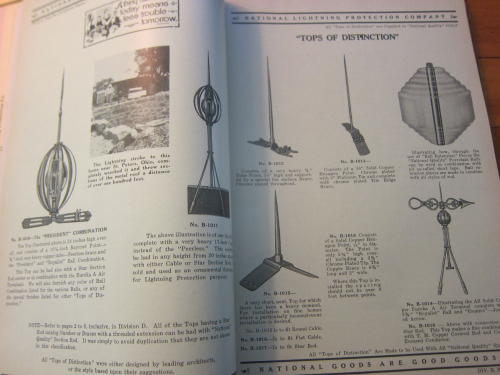
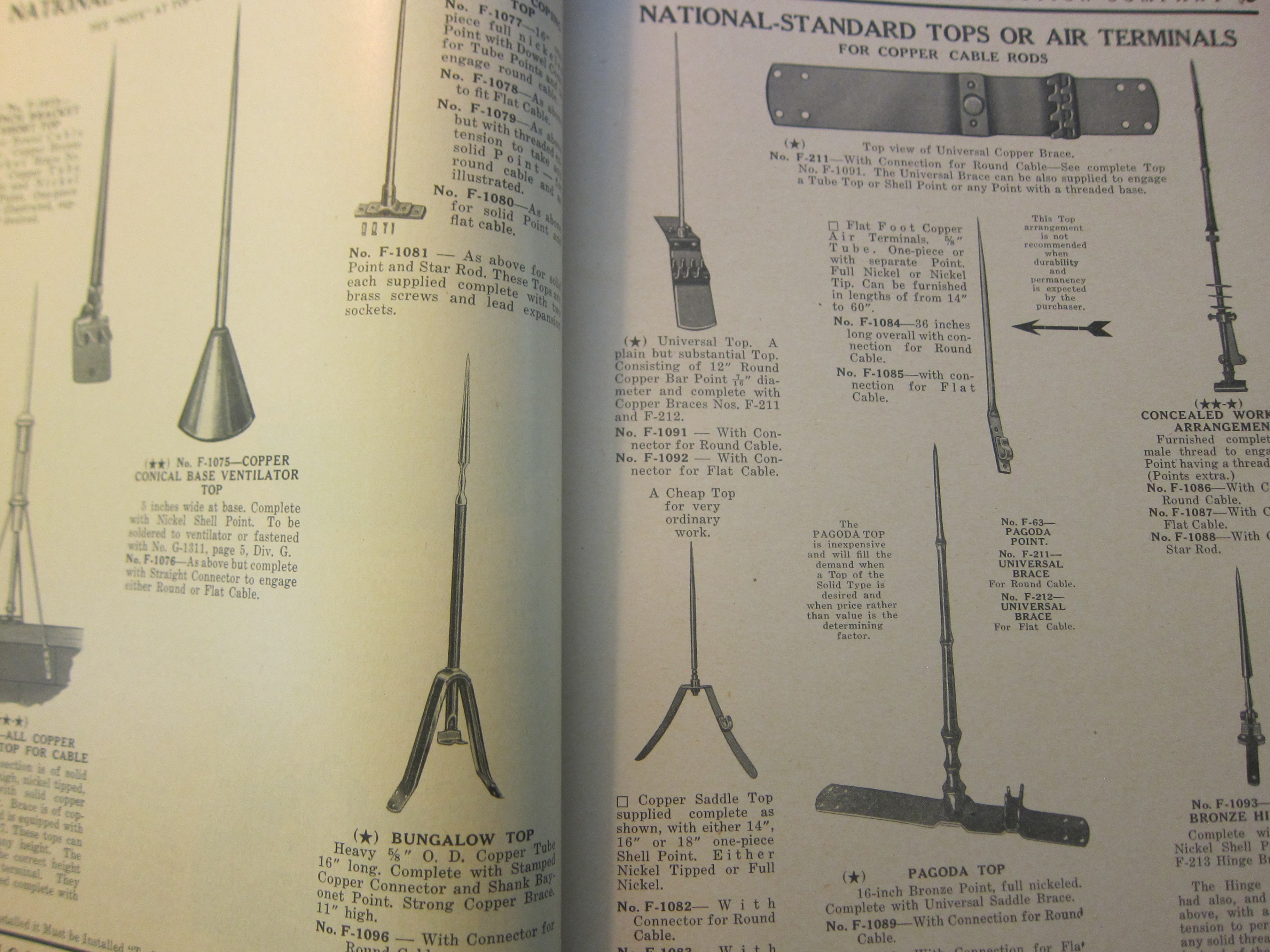
  • An Outstanding Manufacturer’s Catalog for Lightning Protection (1937)

    Text Book, Sales Manual, And Catalog. National Lightning Protection Company. Manufacturers of Quality Lightning Protection Systems, Fixtures, Ornaments and Accessories. St. Louis, Mo. 1937. 11.5 x 9″, 13 sections, 286pp, with hundreds of illustrations. Scarce. 

    IMG_8802

    Heavy paper wrappers decorated with a lightning strike,  bound in a 3 brass screw binding. Lovely copy. Provenance: Library of Congress via the copyright office. There are just a few, small Library marks in the pamphlet, including a 6mm “LC” perforated stamp on the title page, and a very faded LC surplus rubber stamp on the rear cover.  Fine copy. $350   

    IMG_8803

    • Division A: introductory explanation, 14pp;
    • Division B, Star Selection Lighting Rod and Special Equipment, 17pp;
    • Division C, National-Standard Section Rods, 2pp;
    • Division D, Copper Cable conductors and Special fixtures, including Rods, 10pp;
    • Division E, Copper Cable Conductors, 2pp;
    • Division F, Fixtures and Ornaments, including weather vanes, 38pp; 
    • Division G, Accessories, 8pp;
    • Division H, sundries, including fire alarms, 6pp;
    • Division I, lightning protection systems for heavy duty chimneys, 14pp;
    • Division J, National tree protection systems, 6pp;
    • Division K, Lightning protection against oil, gas, and petroleum storage, Tank and Dust Explosion Hazards, 6pp;
    • Division L, Installation requirements and instructions, (incl perhaps 100+ architectural plans), 62pp;
    • Division M, General information. numerous photos of different installations, including Washington Monument, 97pp.

    ·Posted by :

    ·in:

  • Alpher’s Most Important Source of Data on Neutron Capture Cross Sections (1946)

    HUGHES, D.J. “Radiative Capture Cross Sections for Fast Neutrons”, in Physical Review, volume 70, numbers 1 & 2, July 1 & 15, 1946. Original wrappers. Very Good copy.  pp 106-7. (Al Wattenberg’s copy, with his “A.W.” at top right corner of the front wrapper.) $250

    PJE Peebles writes (in his “Discovery of the hot Big Bang: What happened in 1948” published in he European Physical Journal H, 2014, Vol. 39,Issue 2, pp. 205 – 223): “Kragh (1996) reports that Alpher attended a talk by…Hughes at a meeting of the American Physical Society (June 20-22 1946) on capture cross section measurements [and published as the paper offered above in the PR], which led him to Hughes’ declassified document on measurements that used ‘1-MeV pile neutrons’… This is Alpher’s most important source of data on neutron capture cross sections…”

    Peebles establishes eleven major papers in the history of the hot Big Bang, and the Alpher 1948 paper resulting from his long work and his exposure to the Hughes’ data is the first of these eleven. (On those eleven papers Peebles states that “The idea that the universe is filled with the thermal radiation now termed the Cosmic Microwave Background was discussed in eleven publications in the year 1948. These papers offer a detailed example of the process of development of a new and now very productive line of research, and of the confusion that can attend new ideas…”)

    Kragh writes on the use of the Hughes data by Alpher that “…Alpher came to think of…their use, not in nuclear reactor design, but in the design of the universe. When Alpher studied the data he saw in them a key to understanding the cosmic distribution of the elements.” —Helge Kragh , Cosmology and Controversy: The Historical Development of Two Theories of the Two Theories, .p 112

    ·Posted by :

    ·in:

  • Dirac: “Quantum Theory of Localizable Dynamical Systems”

    Dirac, P.A.M. “Quantum Theory of Localizable Dynamical Systems”, American Physical Society, in the Physical Review, 73/9, 1 May 1948. Original printed wrappers. Very good condition.  $175

    Abstract from AIP’s great PROLA website: “A dynamical system is called localizable if its wave functions can be expressed in terms of variables, each referring to physical conditions at only one point in space-time. These variables may be at points on any three-dimensional space-like surface in space-time. A general investigation is made of how the wave function varies when the surface is varied in any way. The variation of the wave function is given by equations of the Schroedinger type involving certain operators Hn(u) which play the role of Hamiltonians. The commutation relations for these operators are obtained. The theory works entirely with relativistic concepts and it provides the general pattern which any relativistic quantum theory must conform to, provided the dynamical system is localizable.”

    “Dirac was also original in his conception of the role of probability in quantum mechanics. He thought that probabilities entered into the description of quantum phenomena only in the determination of the initial state (still described in terms of p’s and q’s), and not necessarily in the behavior of an isolated system. But, as Bohr had said at the Solvay Conference in 1927, isolated systems were unobservable. Dirac then assumed that the state of the world was represented by its wave function Ψ and that it changed abruptly during a measurement, whereupon “nature made a choice.”– Complete Dictionary of Scientific Biography, vol. 17, Charles Scribner’s Sons, 2008, pp. 224-233.

    Also in the same issue are papers by Eugene Wigner, Aage Bohr, G.T. Seaborg (“Skaborg” on the table of contents!) “Nuclear Properties of  93237 “(which appears in Seaborg’s collected papers book, Modern Alchemy as paper #le)

    ·Posted by :

    ·in:

  • “Dynamical Structure and Definition of Energy in General Relativity”

    ARNOWITT, Richard L., Stanley Deser, Charles W. Misner. “Dynamical Structure and Definition of Energy in General Relativity” December,  1959 Physical Review, vol 116 (1959) 1322-1330. Nice sharp copy, in original wrappers, removed from a larger bound volume. $125

    • “In the context of general relativity, he was best known for his development (with Stanley Deser and Charles Misner) of the ADM formalism, roughly speaking a way of describing spacetime as space evolving in time, which allows a recasting of Einstein’s theory in terms of a more general formalism used in physics to describe dynamical systems, namely the Hamiltonian formalism. In the framework of that formalism, there is also a straightforward way to globally define quantities like energy or, equivalently, mass (so-called ADM mass/energy) which, in general relativity, is not trivial at all.”–Wiki

    Also:

    _____. “Canonical Variables for General Relativity”, in Physical Review, volume 117, no. 6, March 15, 1960, pp 1595-1603.  Original wrappers.  Fine copy.  $225

    ·Posted by :

    ·in:

Recent Posts

Archives

Categories