A Daily History of Holes, Dots, Lines, Science, History, Math, Physics, Art, the Unintentional Absurd, Architecture, Maps, Data Visualization, Blank and Missing Things, and so on. |1.6 million words, 7500 images, 4.9 million hits| Press & appearances in The Times, Le Figaro, Mensa, The Economist, The Guardian, Discovery News, Slate, Le Monde, Sci American Blogs, Le Pont, and many other places… 5000+ total posts since 2008.

  • On the Medical Aspects of Ventilating Houses (1866)

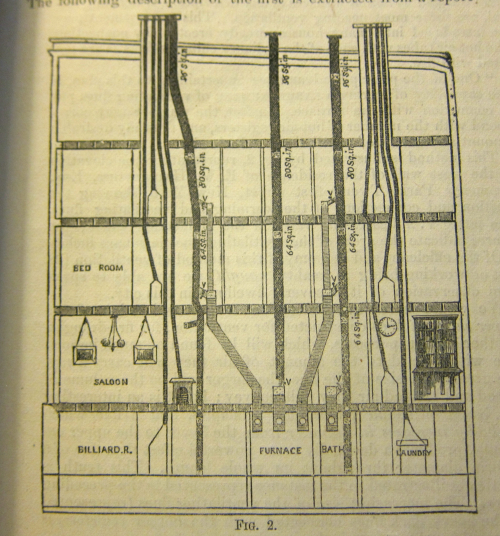
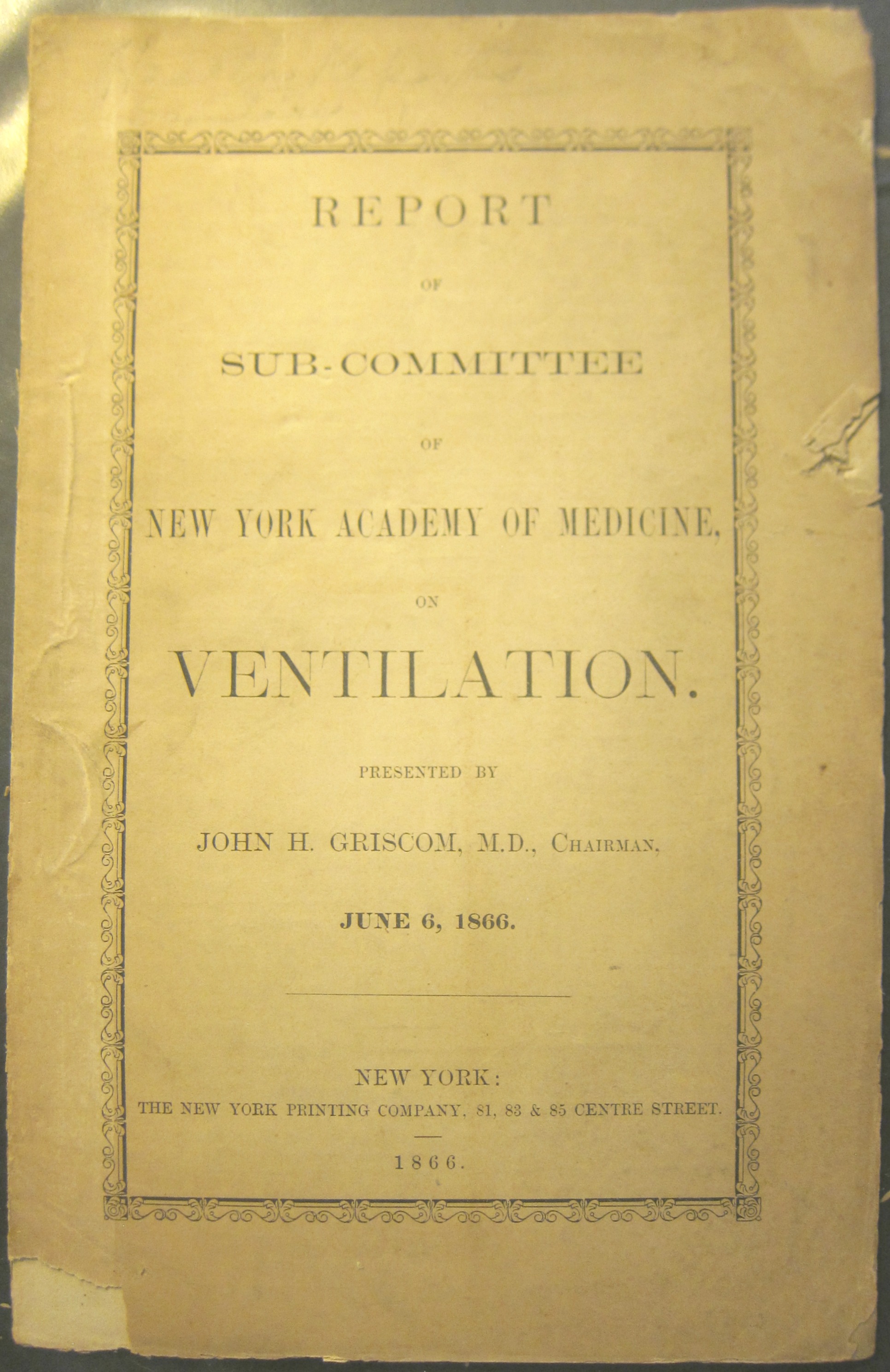
    Ventilation _1_John H. Griscom, M.D., Report of Sub-Committee of New York Academy of Medicine on Ventilation…June 6, 1866.

    Printed in New York by the New York Printing Company, 1866. 23cm, 10pp, with 4 figures in text, plus a large illustrated ad on the rear cover.  Original wrappers are fairly chipped and becoming loose. Altogether, a GOOD copy of a scarce pamphlet.  WorldCat/OCLC locates only four copies (LC, Harvard, Minnesota, Rochester Medical). $100  [Griscom (1809-1874) wrote a number of books, including teh related and interestingly-titled The uses and abuses of air: showing its influence in sustaining life, and producing disease; with remarks on the ventilation of houses, and the best methods of securing a pure and wholesome atmosphere inside of dwellings, churches, courtrooms, workshops, and buildings of all kinds. New York, Redfield, 1854.]

    Ventilation _3_


    ·Posted by :

    ·in:

  • Reviewing Wells’ “The Time Machine”, July 1895, in NATURE

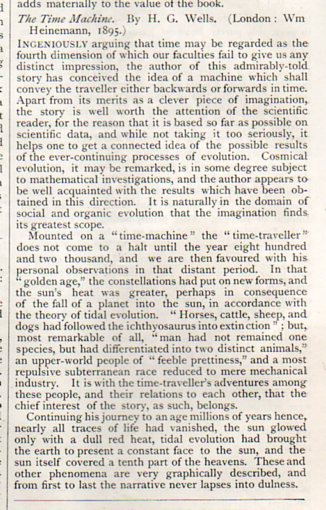
    ITEM:  [Wells H.G. ] Review of Wells’ The Time Machine in Nature, 18 July 1895.  We offer the issue for the week (pp 265-188, plus 8pp advertisements numbered pp xc-xcvi), removed from a larger bound volume, complete with the scarce outer wrappers. Provenance:  Smithsonian Astrophysical Obervatory Library, via the Library of Congress.  Very nice copy. Very good condition.  SOLD

    Wells699I found this interesting 400-word bit in the 18 July 1895 issue of Nature (A Weekly Illustrated Journal of Science) coming just 7 or so weeks after the book was published in England on 29 May. (Nature then is Nature now, and of course still very much alive and still a great publishing scientific powerhouse.)  As Wells’ treatment of time as a fourth dimension was still quite speculative, and his creation of the time machine as we now came from his hands, and as its reception by some literary journals was not very cordial, it is particularly interesting to see the positive review from this science journal.  As reported by Paul J. Nahin in Time Machines, Time Travel in Physics, Metaphysics and Science Fiction (published by Springer Verlag in a second edition in 1999, a graceful book of splendid observations with an introduction by Kip Thorne, Cal Tech’s Feynman Professor of Theoretical Physics), Wells’ book was seen as “hocus pocus”  and a “fanciful and lively dream” by  The Spectator and “bizarre” by the Daily Chronicle.

    Nature’s editors says of the book:

    “…apart from its merits as a clever piece of imagination, the story is well worth the attention of the scientific reader, for the reason that it is based as far as possible on scientific data…”

    “It is naturally in he domain of social and organic evolution that the imagination finds its greatest scope.”

    “From first to last the narrative never lapses into dullness.”

    And so Wells–who had cleaned up and rewritten an earlier version of thi sbook from 1885–received a happy review from one of the leading scientific magazines of the time. It is not because of a wide interest of Wells in the fourth dimension per se, but rather in rattling Victorian sniffy conceits of his day. 

    Wells698
    *Time as the fourth dimension is a concept not much older than Well’s idea, one of the earliest publications of the idea appearing ten years earlier (and written anonymously by “S”) in Nature.  Charles Hinton, the person we most associate with the introduction of the fourth dimension  (or at least so on a popular level) didn’t really establish time as the fourth dimension. (Hinton led a colorful, or at least interesting life–he was a brilliant guy, and also a convicted bigamist who was married to George Boole’s daughter, and creator of an automatic baseball pitching machine. His books on the fourth dimension certainly were influential, and in the estimation of Florence was a contributor to the ideas of the coming modern art movements of the 1890-1910 period.)

    And there were certainly many who came before Wells on the subject of the fourth dimension (though not many on the subject of time as the fourth dimension):  R.C. Archibald wrote on d’Alembert’s (1754) use of time as a fourth dimension (in the Bulletin of the American Mathematical Society for May 1914); Cayley’s “Analytical Geometry of n-Dimensions (Cambridge Mathematical Journal, 1843);  Grassmann’s Die Lineale aus Dehnungslehre (1844); Riemann’s 1854 effort on curved space (translated in 1873 for Nature by W. Kingdom Clifford); Beltrami’s introduction of the pseudosphere in 1868;  J.J. Sylvester (again in Nature for 30 December 1869); Hermann von Helmholtz and his curvature for three-dimensional spaces; and Poincare’s work in 1900, among others.  There is a rich field of these efforts, beautifully investgated for the general reader by Linda Dalrmple Henderson in her classic The Fourth Dimension and Non-Euclidean Geometry in Modern Art (Princeton 1983). 

  • William H Pickering A Method Of Measuring The Absolute Sensitiveness Of Photographic Dry Plates Offprint Proceedings Of

    William H. Pickering, “A Method of Measuring the Absolute Sensitiveness of Photographic Dry Plates”.

    Offprint, Proceedings of the American Academy of Arts and Sciences, pp 159-162. 

    • Paper a bit fragile at the edges; also, there’s an old vertical fold through the publication.  Good copy, only, though it is signed by Pickering.  
    • Signed “with the compliments of / the author”

    “[Pickering] graduated from Massachusetts Institute of Technology in 1879. He taught there for a time and was appointed an assistant professor at Harvard observatory in 1887. In 1891 he set up Harvard’s Boyden Station at Arequipa, Peru. Around 1900 he led expeditions to Jamaica, and from 1911 he was in charge of a permanent Harvard observing station here. Upon his retirement in 1924 the station became Pickering’s private observatory. Pickering was a pioneer in dry-plate celestial photography, and the Harvard photographic sky survey was undertaken at his suggestion. He took some of the earliest photographs of Mars (1888), and the lunar photographs he obtained in Jamaica (1900) were long the finest and most complete.” Dictionary of Scientific Biography

    ·Posted by :

    ·in:

  • Henry Norris Russell Dark Nebulae Offprint Proceedings Of The National Academy Of Sciences Vol 8 Pp 115 118 May 1922 C

    Henry Norris Russell.  “Dark Nebulae”,  Offprint, Proceedings of the National Academy of Sciences, vol 8, pp 115-118, May 1922, Communications to the National Academy of Sciences, No 77, Carnegie Institution of Washington, Mount Wilson Observatory, 4pp.  Original wrappers. Very fine copy.  

    _____.  “The Intensities of Lines in Multiplets, I, Theory; The Intensities of Lines in Multiplets, II, Observed Data.  Offprint, Proceedings of the National Academy of Sciences, vol 11, pp 314-328, June 1925. Communications to the National Academy of Sciences, No 93, Carnegie Institution of Washington, Mount Wilson Observatory, 4pp.  Original wrappers. Fine copy.  

    _____.  “The Constitution and Evolution of the Stars”, offprint from the Smithsonian Report for 1923, pages 145-158, publication 2759, Washington DC, Government Printing Office, 1925.  Original wrappers, removed from a larger bound volume. 

    3 items: $125

    ·Posted by :

    ·in:

  • Walter S Adams What Lies Between The Stars Offprint The Smithsonian Report For 1941 Pages 141 149 With 4 Plates Publi

    Walter S. Adams. “What Lies Between the Stars.” Offprint, the Smithsonian Report for 1941, pages 141-149 (with 4 plates), publication 3652, Smithsonian Institution, Washington DC.  Very fine copy in original wrappers.  $45

    • “Walter Sydney Adams (1876-1956, APS 1915), astronomer, explored the uses of spectroscopy, investigated sunspots and the rotation of the Sun, the velocities and distances of thousands of stars, and planetary atmospheres. Adams served as acting director and director of Mount Wilson Observatory from 1909 until 1946. Adams was the astronomer of stellar spectroscopy at Mount Wilson Observatory, 1904-1923, and Director, 1923-1946.”–http://socialarchive.iath.virginia.edu/ark:/99166/w63n23sm


    ·Posted by :

    ·in:

  • Heber D Curtis Modern Theories Of The Spiral Nebulae Offprint Smithsonian Report For 1919 Pp 123 132 Publication 2591

    Heber D. Curtis. Modern Theories of the Spiral Nebulae. Offprint: Smithsonian Report for 1919, pp 123-132, publication 2591, Washington, DC, Government Printing Office, 1921.  Original wrappers. Fine copy.  $65

    • On Curtis, see Robert G. Aitken, “Heber Doust Curtis 1872–1942,” in Biographical Memoirs. National Academy of Sciences, 22 (1943), 275–294.

    ·Posted by :

    ·in:

  • John von Neumann

    von NEUMANN, John. “Beweis des Ergodensatzes und des H-Theorems in der neuen Mechanik”, in Zeitschrift fuer Physik, volume 57, pp. 30-70, offered in the entire volume of viii, 872 pp. Cloth binding, small institutional gilt-stamped library slug at spine bottom, along with bookplate, and half-faded rubber stamps on the wrapper cover and on the title page.  Still, a nice, free copy. $250

    von NEUMANN, John. “Einige Bemerkungen zur Diracschen Theorie des relativistischen Drehelektrons”, in Zeitschrift fuer Physik, volume 48, 1928, pp 868-881, offered in the original volume of pp 891.  The von Neumann section, band 11/12 for the year, comes with the original wrappers, bound in at the end.  Cloth binding, small institutional gilt-stamped library slug at spine bottom, along with bookplate, and half-faded rubber stamps on the wrapper cover and on the title page.  Still, a nice, free copy.  $750

    “Von Neumann’s most famous work in theoretical physics is his axiomatization of quantum mechanics. When he began work in that field in 1927, the methods used by its founders were hard to formulate in precise mathematical terms; “operator” on “functions” were handled without much consideration of their domain or definition to their topological properties: and it was blithely assumed that such “operators,” when self-adjoint, could always be “diagonalized” (as in th finite dimensional case), at the expense of introducing “Dirac functions” as “eigenvectors.” Von Neumann showed that mathematical rigor could be restored by taking as basic axioms the assumptions that the states of a physical system were poinds of a Hilbert space and that the measurable quantities were Hermitian (generally unbounded) operators densely efined in that space. This formalism. the practical use of which became available after von Neumann had developed the spectral theory of unbounded Hermitian operators (1929), has survived subsequent developments of quantum mechanics and is still the basisi of non relativistic quantum theory; with the introduction of the theory of distributions, it has even become possible to interpret its results in a way similar to Dirac’s original intuition”–Dictionary of Scientific Biography, volume 14, page 91

    ·Posted by :

    ·in:

  • Uranium- and Nuclear-Laced Volume (1939)

    [ATOMIC BOMB]  Uranium- and Nuclear-Laced Volume (1939) 

    Revue Scientifique, January-August, 1939, volume 77, numbers 1-8, quarto, 551pp. Wrappers (front and back) bound in at the rear of the volume, with supplemental ads throughout the volume. Bound in an attractive red cloth. Tidy institutional bookplate; institutional rubber stamp on first page of each monthly issue as well as one rubber stamp on wrapper covers. Fine copy, very tight and fresh. $750.

    This volume contains a couple of original articles of interest to the development of nuclear fission as well as 16 articles that are reviewed/abstracted/somewhat reprinted from other journals (in the February, March, and April issues), and when not in French written in or translated into French, which in many cases are the first translations of some of the great papers in this period of nuclear physics. The great majority are one or two columns in length.

    Included are works by Thibaud, Savitch, Joliot, Frisch, von Halban, Meitner, Feather, Bretscher, Heyn, Strassmann, Curie and others–these are rapidly published translations/reviews, in many cases coming jsut weeks after the original paper was published.  

    • Issue for February, 1939 

    VEIL, S. “Les controls chimiques de transmutations d’atomes”, p 111-112.

    And unattributed in the “echos” section:

    “La Rupture Explosive des noyaux d’uranium et de throium dans l’Action des Neutrons”. One column article on page 133, citing Fermi/Amaldi 1934, Curie/Savitch 1938, Hahn and Strassmann (Jan 1939).

    Then:

    “Un nouveau type de reaction nucleaire”, Nature, 143, 233, 1939, translated by S. Veil—this is the “introductory” statement in Nature preceding the Meitner/Frisch paper a few pages later.

    MEITNER, Lise and O. Frisch. “Disintegration de l’uranium par les neutrons: un nouveau type de reaction nucleaire”, translated by S. Veil, pp 133-4, and which appeared in Nature, 143, 233, 1939.

    JOLIOT, F and J. Perrin. “Preuve experimentale de la rupture, explosive des noyaux d’uranium et de thorium sous l’action des neutrons”, from Comptes Rendus, vol 208, 199, 341-343, and here appearing in two columns on one full page (135).

    CURIE, I. And P. Savitch. “Sur les radioelements formes dans l’uranium et le thorium irradies par les neutrons”, from Comptes Rendus, volume 208, 1939, p 343-346, and here on one full page (136).

    • The issue for March, 1939 77/3, pp (139)-218 is very interesting:

    THIBAUD, Jean and A. Moussa. “La cassure de l’uranium, la formation d’un halogene et la liberation d’energie qui en resulte”, pp 182-185.

    And then, in the “echo et information” section, which is basically a reporting section on work that was published elsewhere (though not necessarily in French), we find abstracts and announcements of a number of very significant publications:

    THIBAUD, Jean and Andre Moussa. “Sur la rupture des noyaux d’uranium sous l’action des neutrons et la liberation d’energie qui en resulte”, from the Comptes Rendus 208, 1939, pp 744-6, p 211-212.

    SAVITCH, Paul. “Sur un radioelement gazeux forme dans l’Uraium bombarde par les neutrons”, from Comptes Rendus, 208, 1939, pp 646-647, this all on a long columns on page 212.

    JOLIOT, F. “Observation par la methode de Wilson des trajectoires de brouillard des produits de l’explosion des noyaux d’uranium”, from Comptes Rendus, vol 208, 1939, pp 647-649. one and a half columns, with photo illustration.

    FRISCH, O. “Evidence physique de rupture du noyaux lourds sous bombardement de neutrons”, in Nature, 143, 1939, p 276. This 1.25 columns.

    Von HALBAN, H. and F. Joliot. “Liberation de neutrons dans l’explosion nucleaire de l’uranium”, from Nature, 143, 1939, p 470. This pp 214-215.

    MEITNER, L. and O.R. Frisch. “Les Produits de rupture du noyaux f’uranium”, in Nature143, p 471, 1939. This is all on page 215, in two full columns.

    • The issue for April, 1939: pp 186-298

    FEATHER, N. and E. Bretscher. “La Rupture Explosive des Noyaux d’Uranium”, from Nature, 143, p 516, 1939. Here occupies 1 column.

    HEYN, F. and Aten and Bakker. “Transmutations d’uranium et de thorium par neutrons”, from Nature, 143, 516, 1939. Here occupies two full columns.

    BRETWCHER, E. and L.G. Cook. “Transmutations de noyaux d’uraniumet de thorium en moyen de neutrons”, from Nature, 143, p 559, 1939. Here the work occupies a full column.

    FEATHER, N. “La duree du processis de rupture nucleaire”, from Nature, 143, p 597, 1939. Here the work occupies two columns.

    THIBAUD, J. and A.Moussa. “La disintegration de l’uranium par l;effet des neutrons et la partition de cet element”, from Comptes Rendus, 208, 652-4, 1939. Here the artcile occupies two columns on page 293.

    DODE, M. and von Halban and Joliot. “Sur l’energies des neutrons libertes lors de la partition nucleaire de l’uranium”, (no mention of origin). This is one full column on page 294. 

    • Issue for June-July 1939, pp 371-455

    COUFFIGNAL, L. reviews/abstracts/summarizes A. Einstein and L Infeld “L’Evolution des Idees en Physique”, pp 427-8

    Also for interest in the history of computer science: Nice article on Maurice d’Ocagne (1862-1938) by Louis COUFFIGNAL and Rene Harmegnies.Fe 1939, p 70 p. 67-76 Feb 1939
    ·Posted by :

    ·in:

    —
  • Oppenheimerjr Ueber Die Strahlung Der Freien Elektronen Im Coloumb Feld In Zeitschrift Fuer Physik Volume 551112 1929

    OPPENHEIMER, J.R. “Ueber die Strahlung der Freien Elektronen im Coloumb-feld”, in Zeitschrift fuer Physik, volume 55/11+12, 1929, pp 725-737, offered in the entire volume of 821pp.

    Bound with the original wrappers for this issue only.

    Cloth binding, small institutional gilt-stamped library slug at spine bottom, along with bookplate, and half-faded rubber stamps on the wrapper cover and on the title page.  Still, a nice, free copy.  $500

    ·Posted by :

    ·in:

  • A Study of the Demography of Nuclear War

    [ATOMIC Bomb / Nuclear War] Pendleton, William H.  A Study of the Demography of Nuclear War.  Human Sciences Research Inc., 1966.  11×8 inches, 103pp, gvc/plastic comb binding.  Very good copy.  Rare.   

    • Offered with: Pendleton, William W.  A Second Study of the Demography of Nuclear War.  Human Sciences Research Inc, August, 1967.  11×8 inches, 134, xiii pp.  Perfect bound.  Fine condition.
    • Offered with:  Jeffrey Hadden, Edgar Borgatta, A Study of the Demography of Nuclear War, Empirical Guidelines for the Selection of Demographic Variables and Areal Units for Studying Postattack Society. Appendix I. Human Sciences Research, Inc., May 1966, Office of Civil Defense, Postattack Research Division, Washington D.C. 11×8 inches, 108pp.  GVC bound. Fine copy.  The three: $450

    ·Posted by :

    ·in:

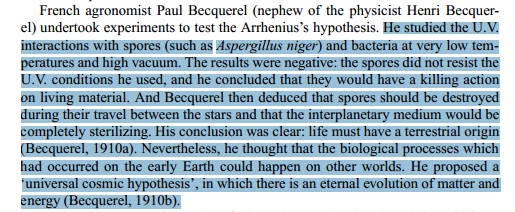
  • Early Astrobiology Refuting Cosmic Panspermia


    BECQUEREL, Paul.  L’Action Abiotique de l’Ultraviolet et le Hypothese de l’Origine Cosmique de la Vie”. In Comptes Rendus, volume 151, 1910, pp 86-88, January 1, 1910.  Offered with:  “Recherches Experimentales sur la Vie Latente des Spores des Mucorinees et des Ascomycetes”, in Comptes Rendus, 1910, volume 150, pp 1437-1439.  The two issues, removed from a larger bound volume, $300

    Cosmic panspermia

    –Raulin-Cerenceau, F. “From Panspermia to Bioastronomy, the Evolution of the Hypothesis of Universal Life”, Kluwer, 1998, pp 597-612.  

    ·Posted by :

    ·in:

Recent Posts

Archives

Categories