A Daily History of Holes, Dots, Lines, Science, History, Math, Physics, Art, the Unintentional Absurd, Architecture, Maps, Data Visualization, Blank and Missing Things, and so on. |1.6 million words, 7500 images, 4.9 million hits| Press & appearances in The Times, Le Figaro, Mensa, The Economist, The Guardian, Discovery News, Slate, Le Monde, Sci American Blogs, Le Pont, and many other places… 5000+ total posts since 2008.

  • Early Darwin in German along with a Cartographic Masterpiece (1841 & 1845)

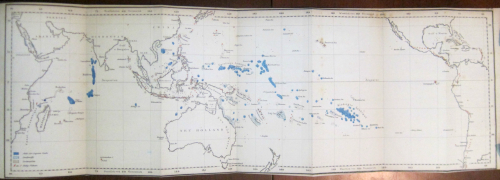
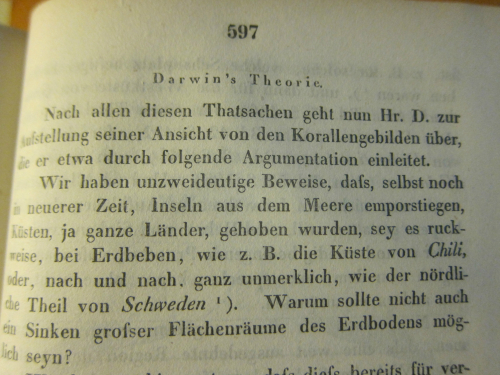
     (Darwin, Charles.) “Ueber Verbreitung, Beschaffenheit und Entstehung der Korallen-Inseln” [nach Darwin], in Annalen der Physik und Chemie, 1845, series II volume 64, pp 563-614 (about 15,000 words).  (“The distribution, character, and origin of the coral islands.”, “after Darwin”.)  It seems as though this (and the following) Darwin are rarely mentioned in the usual resources–in fact I have not yet been able to find a mention of them outside of a Google search which finds it in a general index to the second series of the Annalen.  Having worked with the Annalen for many years (principally the Annalen from 1799 to the early 1930’s) it was my overall impression that the appearance of contributions in the natural sciences were not at all common and had become less so by the time of the Darwin-related paper.  Perhaps the lack of reference is due to the unexpected (to me, at least) appearance of the work in the great physics/chemistry journal. In any event, here it is, with a lovely copy of the wonderful map.

    PROVENANCE: Provinzial-Gewerbschule zu Aachen (with their small, oval rubber stamp on the title page; then on to the Deutsche Akademie der Luftfahrtforsuchung (with their name stamped in gilt at the spine bottom); and then on to Wright Patterson Air Force Base Field, with their rubber stamp on the page edges (exterior) top and bottom. Lastly, the Library of Congress, with their “surplus” stamp on the rear endpapers.

    CONDITION: there are three scratches on the front cover (the largest 3mmx20mm) as well as three spots of heavier wear that has removed some of the design in the marbling on the front board; also, there is some scattered foxing. That said, this is still a solid, VERY GOOD copy, tight and crisp.  MAP: 19x28cm, with four old vertical folds, and is printed and trimmed nearly to the borders. There is some occasional and very light foxing, but in general the map is very bright, crisp, and fresh, and no doubt had received very very little attention. The map’s condition is FINE to VERY FINE.  $950
    Darwin annalen _4_

    I was surprised to find this long and early (1845) contribution on Darwin and his ambitious work on coral reefs in the generally physical-sciences-heavy Annalen der Physik. The surprise was ever more so because of the illustration for the article–a German version of the coral islands/reefs map that appears as the frontispiece to Darwin’s The Structure and Distribution of Coral Reefs…appeared three years earlier in 1842.  (Darwin’s Journal of Researches...,  today more commonly known as the Voyage of the Beagle, which was the third volume of Narrative of the Surveying Voyage of His Majesty’s Ships Adventure and Beagle…… was published in 1839, and his first publication of any kind appeared ten years earlier in 1829; the first German translation of the Narrative appeared in 1845 as  Naturwissenschaftliche Reise. As John van Wyhe–the founder and curator of the fantastic resource Darwin Online–points out the German translations were significant because “It was in German…that Darwin influenced the founder of genetics Gregor Mendel, and the pioneering evolutionists August Weismann and Ernst Haeckel”–van Wyhe, “Darwin in Translation”.)
    Darwin annalen _2_

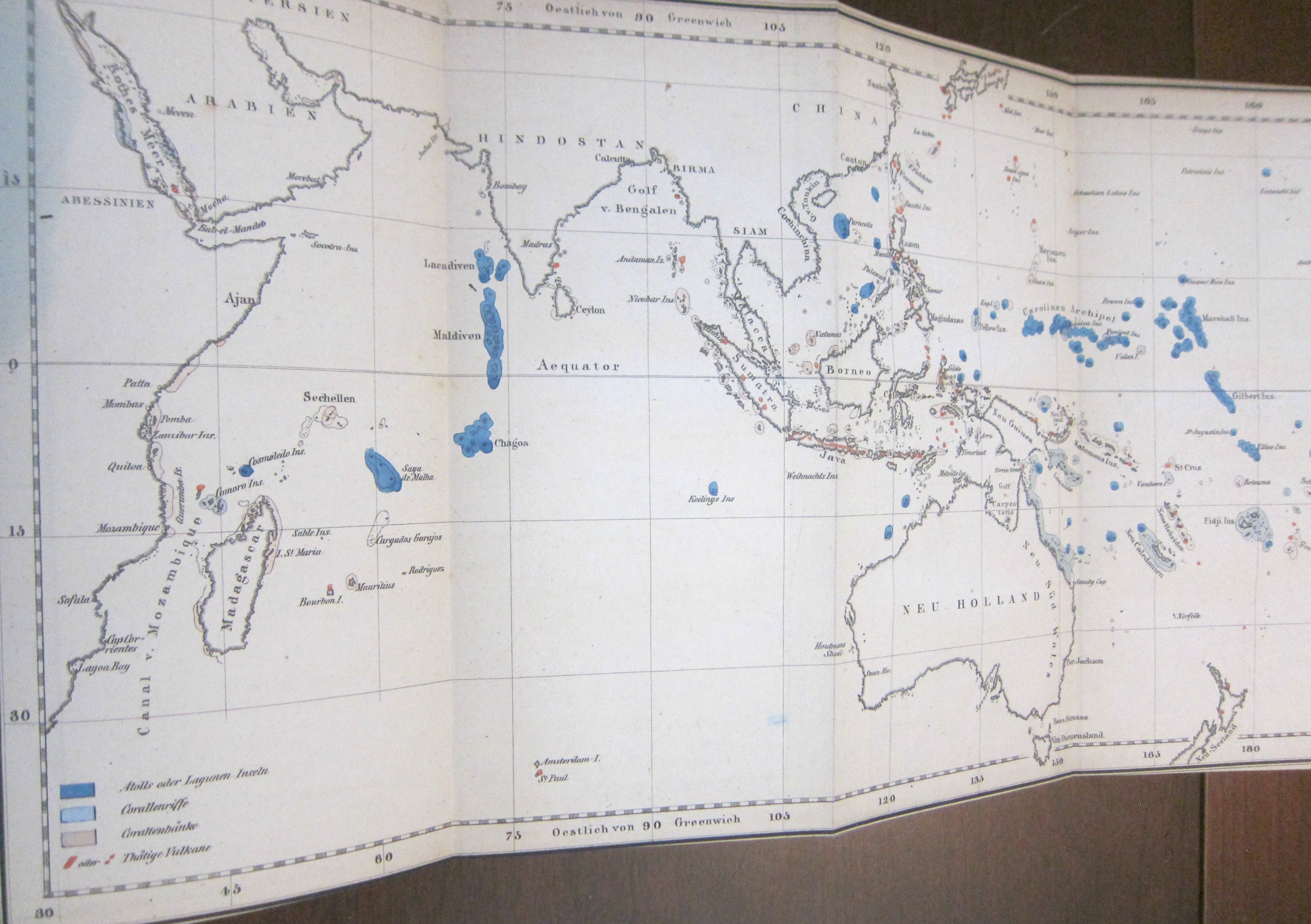
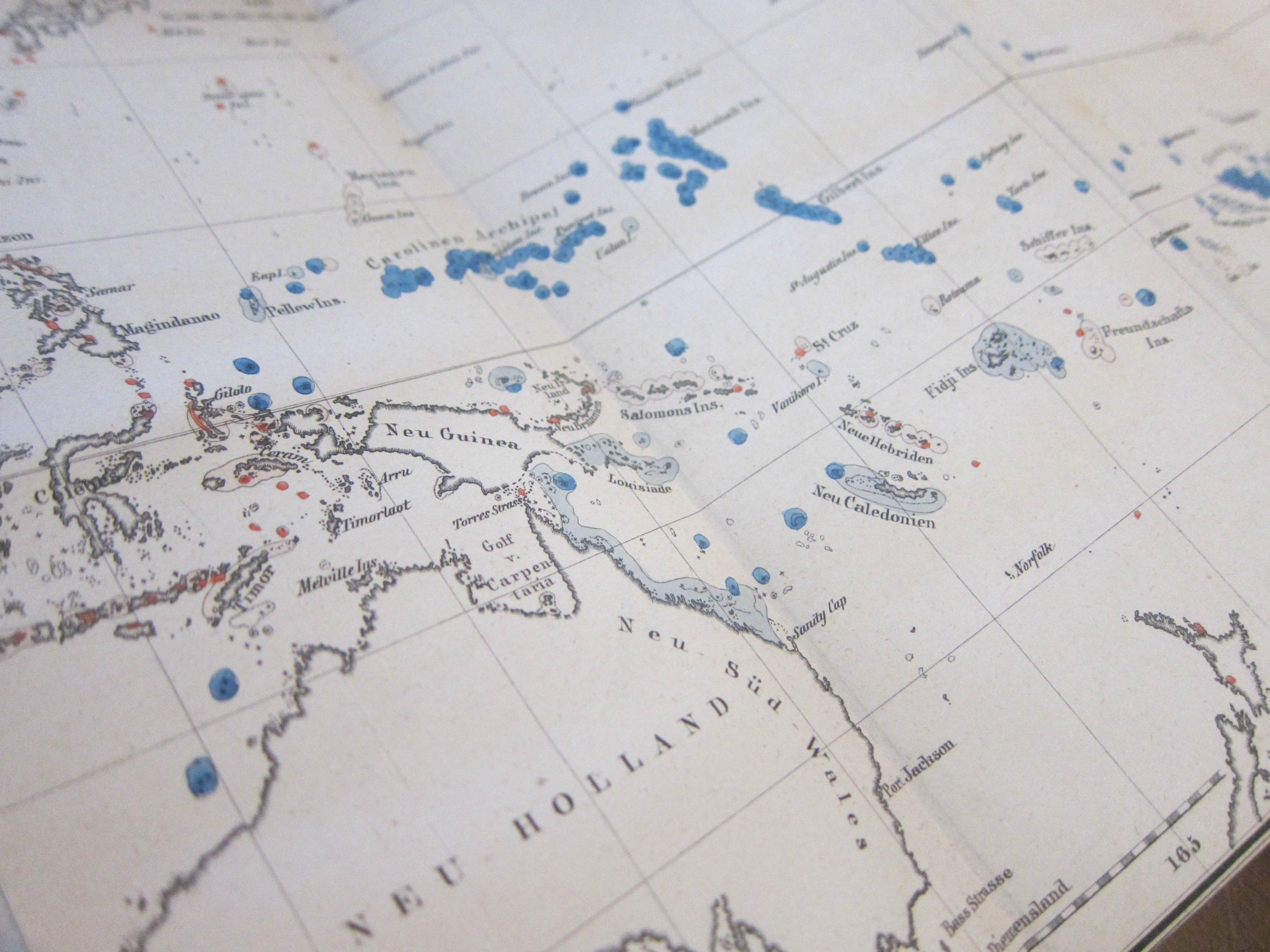
    The original map is titled “Plate 3–Shewing the Distribution of the Different Kinds of Coral Reefs, together with the Position of Active Volcanoes in the Map” and was engraved by J. & C Walker, and printed by Smith & Elder. The Annalen map measures 19x28cm and has no title or indication of engraver. 
     

    Darwin annalen _3_

    Here’s an appreciation of the map from the University of Maryland’s Integration and Application Network, Dr. Bill Dennison, “Ten Classic Maps” (http://ian.umces.edu/blog/2013/12/27/ten-classic-scientific-maps/): 

    “Coral reefs: The map of coral reefs throughout the Pacific Ocean created by Charles Darwin in 1842 as part of his first science book, The Structure and Distribution of Coral Reefs is a masterpiece. Although Darwin’s subsequent books about natural selection eclipsed his insights into coral reefs, this coral reef map is part of the theory that Darwin had about the formation of coral reefs. Darwin correctly hypothesized that coral reefs were formed by the limestone accumulation by corals and that extinct volcanos were buried beneath modern coral atolls. It was over one hundred years before drilling associated with the nuclear testing on Bikini atoll that Darwin’s theory was confirmed. Darwin did a couple of important things with this map: he color coded the reefs that were subsiding (blue) and uplifting (red) and he produced a large foldout to cover the entire tropical Pacific Ocean in a single contiguous map. In this manner, viewing the map instantly reveals the “magnificent and harmonious picture” of the broad patterns that Darwin observed. I am convinced that this is the first important piece of evidence supporting plate tectonics and the Pacific ‘Ring of Fire‘, and that if Darwin had a bit more information available at the time, that he would have actually come up with the theory of plate tectonics.”
    Darwin annalen

    Also available:

    Darwin, Charles. “Zusammenhang der vulkan. Phaenomene in Sudamerika und Bildung von Bergketten und Vulkanen als Wirkungderselben Kraft, durch welche Continente erhoben Werden”,  In Annalen der Physik, 1841, volume 52, pp 484-494.    This is a abridged translation of  “On the Connexion of certain Volcanic Phenomena in South America; and on the Formation of Mountain Chains and Volcanos, as the Effect of the same Power by which Continents are elevated” in Transactions of the Geological Society of London, S2, 5, 601-631, 1840. [From the opening paragraph of the original edition: “Introduction. The object of the present memoir is to describe the principal phenomena generally accompanying the earthquakes on the west coast of South America; and more especially those which attended the shock that overthrew the city…”] The (simple) map and three text illustrations in the original 1840 London edition are not printed in the German 1841 translation.

    Bound in cloth-backed marbled boards.  PROVENANCE:  Deutsche Akademie der Luftfahrtforsuchung (with their name stamped in gilt at the spine bottom); and then on to Wright Patterson Air Force Base Field, with their rubber stamp on the page edges (exterior) top and bottom. Lastly, the Library of Congress, with their “surplus” stamp on the rear endpapers.  $350

    This is a very early appearance of Darwin in German (and the third overall in German, I believe), the first appearance coming in 1839 with a short work ‘Über der Luftshifferei der Spinnen’ in Neue Notizen aus dem Gebiete der Natur- und Heilkunde, which was an extract from Darwin’s Journal of Researches (1839, pp. 187-188, this from John van Wyhe n Darwin Online).


    ·Posted by :

    ·in:

  • Important Work by Clausius on the 2nd Law

    Clausius, Rudolf. “Ueber die Anwendung der mechanischen Wärmetheorie auf die Dampfmachine”, in: “Annalen der Physik und Chimie, Leipzig, Johann Ambrosius Barth, edited by J.C. Poggendorff, 1856, volume 97, series II, sections 3+4. pp 441-476 and pp 513-559. Offered in the entire volume of (x), 644 pp., with 5 folded engraved plates.  PROVENANCE: Provinzial-Gewerbschule zu Aachen (with their small, oval rubber stamp on the title page; then on to the Deutsche Akademie der Luftfahrtforsuchung (with their name stamped in gilt at the spine bottom); and then on to Wright Patterson Air Force Base Field, with their rubber stamp on the page edges (exterior) top and bottom. Lastly, the Library of Congress, with their “surplus” stamp on the rear endpapers. All that said, this is a nice, clean, crisp copy. VG $500

    The volume contains other significant works:

    Thomson, W. (Lord Kelvin) & J.P. Joule, “Ueber die Wärmewirkung bewegter Flüssigkeiten” (On the Thermal Effects of Fluids in Motion”, 1853),pp. 576-414. First edition in German om the Joule-Thomson Effect.

    Kohlrausch, R. “Ueber die elektrischen Vorgänge bei der Elektrolyse”, a two-part paper, pp. 397-414 and 559-575.

    ·Posted by :

    ·in:

  • Laplace on the Mathematics of Capillary Action, 1809

    Laplace, Pierre-Simone de. “Theorie der Kraft. 1.-4 Haupttheil. (1. Welche in den Haarröhren und bei ähnlichen Erscheinungen wirkt.   2. Die Wirkung der Haaröhren-Kraft auf eine neue Art Betrachtet.  3. Theorie des Anziehens und Abstossens schwimmender Körper, der Adhäsion einer Scheibe an einer Flüssigen Oberfläche, und der Figur eines grossen Quecksilber-Tropfens mit prüfenden Versuchen von Gay-Lussac. -4. Allgemeine Betrachtungen über die Haarröhen-Kraft und über die Kräfte der chemischen Verwandschaft.”) AND  “Übersetzt von Brande und Gilbert. (Mit Anmerkungen).” AND “Zwei Berichte.Als Einleitung zu dem folgenden Aufsätze.(Theil 3 und Theil 4). Frei übersetzt von Gilbert.” 

    • Each section in which the Laplace contribution is printed (sections [Stuck] 9-12 contains the two pages of outer wrappers, bound in, making this a scarce publication.  

    Published in the Annalen der Physik, series 1, volume 33, published in Leipzig by J. Ambrosius Barth, and printed  in 1809.  We offer the entire volume of  (12),452 pages and with 4 folding engraved plates, with the Laplace contributions on  pp. 1-114, pp. 141-182, pp. 273-293, pp. 293-338 and pp. 373-394. Each section is complete

    Provenance: from the Library of Bernhard Meining; then, the Deutsche Akademie der Luftfahtforschung; and on the USAAF library at Wright Patterson, and finally to the Library of Congress.  Very well traveled. Nice copy.  $500

    ·Posted by :

    ·in:

  • Georg Simon Ohm (Five Papers, 1825-1853)

    First Appearance of Ohm’s Law, May 1825

    OHM, Georg Simon (1789-1854). “Vorläufige Anzeige des Gesetzes, nach welchem Metalle die Contakteletricität leiten”,  in: Annalen der Physik, 1825, series II vol. 4, part 1, section 5, pp. 79-83. Offered in the entire volume of [12], 476 pp, with  4 folding charts, 6 engraved plates (2 folding, including one of the barometric pressures of the North Pole region and North America). Nice condition, crisp and fresh, in cloth-backed marbled boards (ca. 1940). There is a small punch/hole of about 3mm at the bottom right corner of the spine.  $1300

    This is Ohm’s first appearance in print, and the first appearance of milestone Die Galvanische Kette Mathematische Bearbeitet  (published in 1827, and which was the  fully developed presentation of his theory of electricity), known as Ohm’s Law.

    Provenance: formerly from the Library of Bernhard Meining; then, the Deutsche Akademie der Luftfahtforschung; and on the USAAF library at Wright Patterson, and finally to the Library of Congress. “Wright Field Library” is rubber stamped on the text block’s top and bottom. Very well traveled.  

    • AND bound with: LENZ, E. “Bemerkungen ueber di eTemperatur des Weltmeers in verschiedenen Tiefen”, pp 616-626.

    OHM, Georg S.  “Versuch einer Theorie der durch galvaische Krafte hervorgebrachten elektroptischen Erscheinungen”, in Annalen der Physik, 1826, series II/volume 6, section 4, part 4, pp 459-469, offered in the entire volume of (viii), 514, (ii)pp with six folding plates.  Bound in black cloth, marbled boards, and with cloth tips.  

    Provenance:  from the”Provinzil-Gewesschule zu Aachen”. then, the Deutsche Akademie der Luftfahtforschung; and on to the USAAF library at Wright Patterson, and finally to the Library of Congress. “Wright Field Library” is rubber stamped on the text block’s top and bottom. Nice copy.   

    “In February and April 1826, Ohm published two important papers that dealt separately with the two major aspects of his ultimately unified theory of galvanic electricity. The first, “Bestimmung des Gesetzes, nach welchem Metalle die Contaktelektricitä leiten, nebst einem Entwurfe zu einer Theorie des Voltaischen Apparates und des Schweiggerschen Multiplicators,” announced a comprehensive law for electric current that brought order into the hitherto confused collection of phenomena pertaining to the closed circuit, including the solution to the problem of conductibility as he and others had conceived of it.[in Schweigger’s Journal für Chemie und Physik, 46 (1826), 137–166.] The second paper, “Versuch einer Theorie der durch galvanische Kräfte hervorgebrachten elektroskopischen Erscheinungen,”[offered above] broke new ground in associating an electric tension with both open and closed galvanic circuits.” [DSB referencing  Poggendorff’s Annalen der Physik und Chemie, 6 (1826, 459–469; ibid., AND  volume 7(1826), 45–54, 117–118 in footnote 6 [offered below].

    Offered with:

    • OHM, Georg S. “Versuch einer Theorie der durch galvaische Krafte hervorgebrachten elektroptischen Erscheinungen”, in Annalen der Physik, 1826, series II/volume 7, pp 45-54  Bound as volume 6, above, with the same provenance.

    And bound with:

    • (OHM) “Ein Nachtrag aus dem vorrstehenden Aufsatz de Hrn Dr. Ohm”, same volume, pp 117-118.  

    OHM, Georg S. “Ueber die Definition des Tones , nebst daran geknupster Theorie der Sirene und oehnlicher tonbildender Vorrichtungen”, in Annalen der Physik, volume 59, 1843, pp 513-565. Black cloth-backed marbled boards with cloth tips. 

    Provenance: formerly from the library of the Deutsche Akademie der Luftfahtforschung; and on the USAAF library at Wright Patterson, and finally to the Library of Congress.  Few interior stamps, plus “Wright Field Library” rubber stamped on the text block’s top and bottom.  That all said, a very nice copy.  $400 Offered in the full volume of 644pp. 

    The Bookman’s Bus will definitely take you from point A to Point B, though it might not be a direct route, even when the direct route is the only route–there are stops to be made, turns to be taken, and of course turns to be built before they can be taken; eventually though you’ll get to your destination, or not.  And the destination can change, according to what is found along the way–it can get closer, or farther, as necessary.  It is in the getting-there that some real stuff may happen. 

    I was looking for the Annalen der Physik publication by Gauss and Weber on the first use of an electromagnetic telegraph, but I was looking in 1843 rather than 1833, which is a mistake I often make (which is weird because Morse’s telegraph appears in 1837 and his code in 1843, so the date mix-up is a mystery. So with the retrieved volume 59 I realized that I was ten years off from where I wanted to be, but like any practicing reader I browsed–and my general book browsing practice is back-to-front, which is how I found a good article by Clapeyron, almost at the end of the book in the 8th section. I went a little further to see the neighbors for the Clapeyron in the 644-page book and the very paper preceding turned out to be a fairly significant paper in the history of physics and acoustics–Georg Simon Ohm’s on what would be known as Ohm’s Law of Acoustics. That would be the other Ohm’s law.  The big Ohm (published in his pamphlet Die Galvanische Kette in 1827) is one of the most powerful of the 19th century, and states “a relationship between the voltage across an electric circuit, the electrical resistance in the circuit, and the current in the circuit.”(–Dictionary of Scientific Biography.) Ohm’s law of acoustics doesn’t take such a big bite out of the not-determined but is significant in the history of acoustics: “The proposition that the human auditory system responds to a complex sound by generating sensations of the separate components of the sound rather than a sensation of a single integrated sound; thus when we listen to an orchestra we hear the separate instruments although the ears receive only a single complex sound wave.”(–Oxford Reference)  And for the record the paper’s title: “Ueber die Definition des Tones , nebst daran geknupster Theorie der Sirene und oehnlicher tonbildender Vorrichtungen”, pp 513-565).

    There were other interesting papers populating this volume, several of which had to do with early photography, including a work on using the Daguerreotype with the microscope, along with two papers by Moser (one of which was the first German translation of his work on “Invisible Light”), and another on shortening the time of exposures by the soon-to-be-very-famous H. Fizeau. Also there are two not-so famous papers by the famous Lenz (a two-parter, actually, on heat flow). There are others, not the least of which is a paper famous perhaps not for the complicated theory on the development of mountain ranges that was wrong, but for the data that was collected for the construction of the not very good theory–that was the work of Jean-Baptiste Elie de Beaumont, who had a long and distinguished career though not for his mountain theory.  

    So. There was a lot in this volume, and a lot of it turned out to be very interesting, in spite of teh fact that I had selected the wrong volume to begin with.  

    OHM, Georg S. “Galvanische Einzelnheiten”, in Annalen der Physik, II/63, 1844, pp 389-405. Offered in the full volume of viii, 597, (ii)pp.   Black cloth-backed marbled boards with cloth tips. Formerly from the library of the Deutsche Akademie der Luftfahtforschung; and on the USAAF library at Wright Patterson, and finally to the Library of Congress.  Few interior stamps, plus “Wright Field Library” rubber stamped on the textblock’s top and bottom.  That all said, a very nice copy.  $500

    OHM, Georg S. “Ueber eine Interferenz-erscheinung bei ein axigen Krystallplatten in geradling polarisirtem Lichte”, in Annalen der Physik, 1853, series II/volume 90, pp 327-332.  Formerly from the library of the Deutsche Akademie der Luftfahtforschung; and on the USAAF library at Wright Patterson, and finally to the Library of Congress.  Few interior stamps, plus “Wright Field Library” rubber stamped on the textblock’s top and bottom.  That all said, a very nice copy.  $250

    ·Posted by :

    ·in:

  • Foundation Stone of Electrochemistry (1808)

    Foundation Stone of Electrochemistry

    DAVY, Humphrey. “Ueber die chemischen Wirkungen der Electricitat” AND “Ueber die chemischen Wirkungen der Electricitat…Zeite Halfte”. Both in Annalen der Physik, volume 28, 1808, parts I and II, appearing on pp 1-43 (part 1) and (161)-202 (part II).  

    Both are offered in the full volume of (vi), 496pp, in four sections, each section with the original wrappers bound in.  

    These are the first appearances in German of Davy’s major paper that appeared in November 1806 and December 1807 as the Bakerian Lectures before the Royal Society. Bound in cloth-backed boards.

    Provenance: Deutsche Akademie der Luftfahtforschung; then the USAAF library at Wright Patterson, and finally to the Library of Congress. Stamped “Wright Field Library, Dayton, Ohio” on the top and bottom of the textblock. Very nice, fresh copy.  $950

    ·Posted by :

    ·in:

  • Weighing the Earth (1799)

    Weighing the Earth in 1799

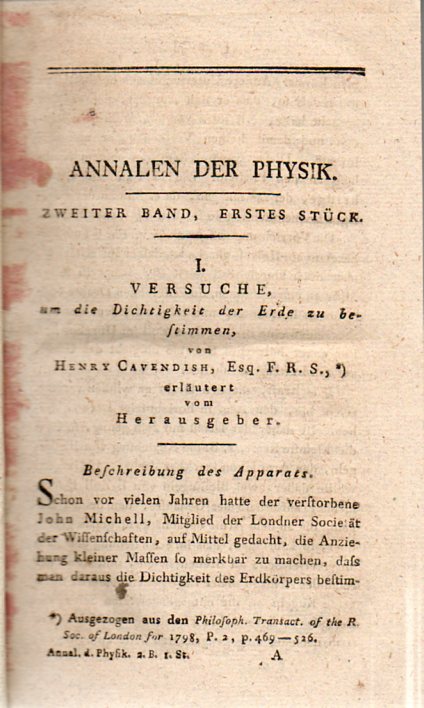
    CAVENDISH, Henry. “Versuche über die Dichtigkeit der Erde zu Bestimmen.” Halle, Rengerschen Buchhandlung, 1799, and published  in Annalen der Physik, edited by Ludwig Wilhelm Gilbert, series I volume 2,  120pp in this section, 488pp overall in in the entire volume, with 9 plates.  Cavendish’s paper occupies pp 1-62, with two plates  (with Michell’s torsion balance being examined on one of the plates).  First edition in German of this important paper.  

    Provenance:  Ex-libris Deutsche Akademie der Luftfahrtforschung, then Wright Patterson Field Library (USAF), then Library of Congress.  Library markings:  small gilt-stamped “Akademie der Luftfahrtforschung”, page edges stamped “Wright Field Library/Dayton, Ohio” on top and bottom. Contents quite nice.  $450

    Cavendish131

    In this experiment–the first appearance in German following the original paper “Experiments to determine the Density of the Earth” that appeared in the Philosophical Transactions in 1798.–the great and somewhat mysterious (and odd) Henry Cavendish determined to, of all things, weigh the Earth.  Now there are certain remarkable things to be achieved in the 18th century, and of course the idea of measuring the weight of the Earth was a high intellectual achievement.  He set off to measure the force of attraction between large and small lead balls using his dead friend John Michell’s torsion balance (which he had created in 1783), and using of course Newton’s laws showing that the force of gravity between two objects depends on their masses as well as the distance between them.  Michell had thought of the experiment years before but died before he could present; Cavendish carried on and up, and out. Mind he wasn’t the first on the spot, or the first with the idea–he was the first to complete it, though, taking the difference in the measures on the very sensitive balance from a distance using a telescope so as to not disturb the readings.  It was a lovely idea, and  a fantastic piece of work. 

    “Henry Cavendish had fitful habits of publication that did not at all reveal the universal scope of his natural philosophy. He wrote no books and fewer than twenty articles in a career of nearly fifty years. Only one major paper was theoretical, a study of electricity in 1771; the remainder of his major papers were carefully delimited experimental inquiries, the most important of which were those on pneumatic chemistry in 1766 and 1783–1788, on freezing temperatures in 1783–1788, and on the density of the earth in 1798.” (D.S.B. III, p. 155).

    ·Posted by :

    ·in:

  • Clausius, von Helmholtz, Bunsen, Plucker, and others (1854)

    Clausius, Rudolf. “Ueber einige Stellen in der Schrift von Helmholtz “Ueber die Erhaltung der Kraft”, zweite Notiz”, pp 601-605

    (Clausius) Helmholtz, Herman von. “Erwiederung auf die Bemerkungen von Hrn. Clausius”, pp 241-260;

    Bunsen, Robert. “Ueber die Darstellung von metallishcen Chrom auf galvanischem Wege. Aus einem Briefe des Prof. Bunsen”, Pp 619-625;

    Plucker, Julius. “Ueber das Gesetz der Induction bei paramagnetischen und diamanetischen Substanzen”, pp 1-56;

    Kohlrausch, R. “Theorie des elektrischen Ruckstandes in der Leidner Flasche”, pp 56-83; and pp179-214;

    G.G. Stokes, “Ueber die Aenderung der Brecharkeit des Lichts”, pp 158-161.

    All in Annalen der Physik, 1854, series II/91, Johann Barth; x, 628pp, nine plates. Bound in cloth-backed marbled boards. PROVENANCE: Provinzial-Gewerbschule zu Aachen (with their small, oval rubber stamp on the title page; then on to the Deutsche Akademie der Luftfahrtforsuchung (with their name stamped in gilt at the spine bottom); and then on to Wright Patterson Air Force Base Field, with their rubber stamp on the page edges (exterior) top and bottom. Lastly, the Library of Congress, with their “surplus” stamp on the rear endpapers. All that said, this is a nice, clean, crisp copy. VG $500

    ·Posted by :

    ·in:

  • A Major Improvement in the Safety Conditions for Miners (1862)

    Alphonse. Dumas and Camille Benoit. “Physique Appliquée — Note sur un appareil propre à éclairer les ouvriers mineurs dans leurs travaux souterrains au moyen de la lumière d’induction”, in  Comptes Rendus, 1862, vol. 55, pages 439-440. Offered in the weekly issue, with the original wrappers, removed from alarger bound volume. (Title translated: “Applied physics — Note on an apparatus suitable for providing light for miners in their underground work by means of the induction lamp”.). Very Good copy.  $200

    “In several of Jules Verne’s science-fiction novels, so-called “Ruhmkorff lamps” are mentioned. These were an early form of portable electric lamp. The lamp consisted of a Geissler tube that was excited by a battery-powered Ruhmkorff induction coil. Initially the lamp generated white light by using a Geissler tube filled with carbon dioxide. However, the carbon dioxide tended to break down. Hence in later lamps, the Geissler tube was filled with nitrogen (which generated red light), and the glass was replaced with glass containing uranium salts (which fluoresced with a green light).”

    “Intended for use by miners, the lamp was actually developed both by Alphonse Dumas, an engineer at the iron mines of Saint-Priest and of Lac, near Privas, in the départment of Ardèche, France, and by Dr. Camille Benoît, a medical doctor in Privas.[their results and announcement occurred in the paper offered here]. In 1864, the French Academy of Sciences awarded Dumas and Benoît a prize of 1,000 francs for their invention.”–Wikipedia

    ·Posted by :

    ·in:

  • Buys Ballot Law (1857)

    Buys Ballot, Christoph. “Note sur le rapport de l’intensité et de la direction du vent avec les écarts simultanés du baromètre”, in Comptes rendus hebdomadaires de l’Académie des sciences, 1857, volume 45, pp 765-768. Offered in the original weekly issue, without the outer wrappers, removed from a larger bound volume.  $250

    “Buys Ballot’s law may be expressed as follows: In the Northern Hemisphere, if a person stands with his back to the wind, the atmospheric pressure is low to the left, high to the right.” “[It] asserts that actual winds are approximately geostrophic, that is, such as to balance the pressure gradient and Coriolis forces”–Claire Parkinson, Breakthroughs (for 1857).  The law was first deduced by the American meteorologists J.H. Coffin and William Ferrel, is a direct consequence of Ferrel’s law. The law takes its name from C. H. D. Buys Ballot, a Dutch meteorologist, who published it in the Comptes Rendus, November 1857.[The issue offered here.]While William Ferrel theorized this first in 1856, Buys Ballot was the first to provide an empirical validation.”–Wikipedia  ([Buys-Ballot] derived the law empirically, unaware that it already had been deduced theoretically by the U.S. meteorologist William Ferrel, whose priority Buys Ballot later acknowledged.”–Ency Britannica) 

    “The underlying principles of Buys Ballot’s law state that for anyone ashore in the Northern Hemisphere and in the path of a hurricane, the most dangerous place to be is in the right front quadrant of the storm. There, the observed wind speed of the storm is the sum of the speed of wind in the storm circulation plus the velocity of the storms forward movement. Buys Ballot’s Law calls this the “Dangerous Quadrant”. “–Wikipedia

    ·Posted by :

    ·in:

  • On Nearly Discovering Radioactivity in 1857

    Niépce de Saint-Victor “Mémoire sur une nouvelle action de la lumière”, Comptes rendus … , (1857) , vol. 45, pages 811-815. (“On a new action of light”). In the weekly issue, offered removed from a larger bound volume, without the outer wrappers. Very Good copy. $125

    On Niepce de Saint-Victor’s near-discovery of radioactivity:

     “In the 1850s, Niépce de Saint-Victor was trying to develop color photography, using light-sensitive metal salts. Beginning in 1857, long before Henri Becquerel’s famous serendipitous discovery of radioactivity in 1896, Niépce de Saint-Victor observed that, even in complete darkness, certain salts could expose photographic emulsions. [The paper offered here.] He soon realized that uranium salts were responsible for this anomalous phenomenon. [This was offered in a second Memoire in the next volume of the Comptes Rendus in the same year and a fifth memoire in 1861.] Niépce recognized that the “light” that was exposing his photographic plates was neither conventional phosphorescence nor fluorescence: the salts could expose photographic plates long after the salts had last been exposed to sunlight. Niépce’s superior, Michel Eugène Chevreul, recognized the phenomenon as a fundamental discovery (“une découverte capitale”), pointing out that uranium salts retained their power to expose photographic plates even after six months in the dark (“encore actif six mois après son insolation”). By 1861, Niépce stated frankly that uranium salts emitted some sort of radiation that was invisible to the human eye…”–Wikipedia 

    “Claude Félix Abel Niépce de Saint-Victor (1805-1870) was a French photographic inventor. An army lieutenant and cousin of Nicéphore Niépce, he first experimented in 1847 with negatives made with albumen on glass, a method subsequently used by the Langenheim brothers for their lantern slides. At his laboratory near Paris, Niépce de Saint-Victor worked on the fixation of natural photographic colour as well as the perfection of his cousin’s heliographic process for photomechanical printing. His method of photomechanical printing, called heliogravure…”–Wikipedia


    ·Posted by :

    ·in:

  • The Jamin Interferometer, 1856

    Jamin, Jules Célestin. “Description d′un nouvel appareil de recherches, fondé sur les interférences”, in  Comptes rendus hebdomadaires des séances de l’Académie des sciences, 1856, vol 42,  pp 482-5 in the weekly issue, the issue removed from a larger bound volume (with no outer wrappers). Very Good condition.  $125

    “Jules Célestin Jamin was a French physicist. He was professor of physics at École Polytechnique from 1852 to 1881 and received the Rumford Medal in 1858 for his work on light. The Jamin interferometer is a type of interferometer, related to the Mach-Zehnder interferometer. It was developed in 1856 by the French physicist Jules Jamin. The interferometer is made up of two mirrors, made of the thickest glass possible. The Fresnel reflection from the first surface of the mirror acts as a beam splitter. The incident light is split into two rays, parallel to each other and displaced by an amount depending on the thickness of the mirror. The rays are recombined at the second mirror, and ultimately imaged onto a screen. If a phase-shifting element is added to one arm of the interferometer, then the displacement it causes can be determined by simply counting the interference fringes, i.e., the minima. The Jamin interferometer allows very exact measurements of the refractive index and dispersion of gases; a transparent pressure chamber can be positioned in the instrument. The phase shift due to changes in pressure is quite easy to measure.”–Wikipedia, “Jules Jamin” [An article also appeared in the Annalen in the same year: “Neuer Interferential-Refractor”, Annalen der Physik und Chemie, 1856, 174 (98) (6): 345–349.]

    ·Posted by :

    ·in:

Recent Posts

Archives

Categories