A Daily History of Holes, Dots, Lines, Science, History, Math, Physics, Art, the Unintentional Absurd, Architecture, Maps, Data Visualization, Blank and Missing Things, and so on. |1.6 million words, 7500 images, 4.9 million hits| Press & appearances in The Times, Le Figaro, Mensa, The Economist, The Guardian, Discovery News, Slate, Le Monde, Sci American Blogs, Le Pont, and many other places… 5000+ total posts since 2008.

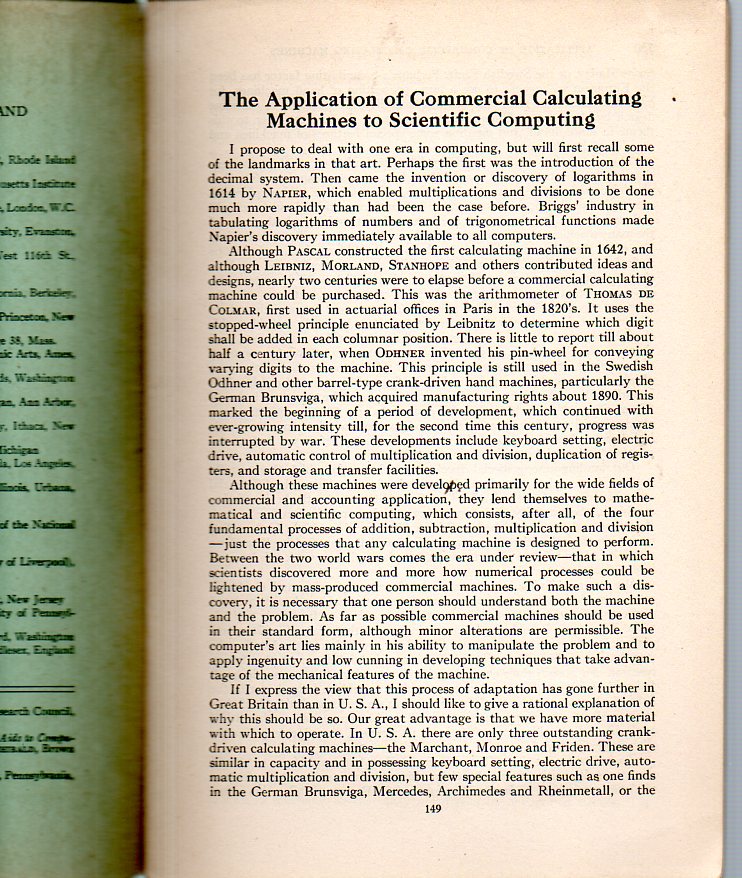
  • Early Paper on the Use of Commercial Calculators to Scientific Computing (1946)

    COMRIE,  Leslie.  “The Application of Commercial Calculating Machines to Scientific Computing”.  Washington DC:  National Research Council,  1946.  1st edition.  Mathematical Tables and other Aids to Computation, II/16  Pp 149-196  8vo.  Original printed wrappers.  Very good condition.  Original owner’s name has been rubber stamped twice on the cover.  $250

    Comrie MTAC449

    This pamphlet is offered in its original green wrappers for the month of October 1946.  “Comrie pioneered the use of commercial accounting machines in scientific applications, especially in the production of mathematical tables. The above article describes the first use of a punched-card tabulating system in a purely scientific application. The following on Comrie from Columbia University: Leslie J. Comrie, Ph.D, (1893-1950): astronomer and pioneer in mechanical computation, born in Pukekohe, New Zealand, and educated at Auckland University College, University College London, and Cambridge University, where he received a Ph.D. in astronomy.  Like his American contemporary, Columbia University Astronomy Professor Wallace Eckert, Comrie was a pioneer in the application of punched-card machinery to astronomical calculations and the production of astronomical and mathematical tables: the first scientific use of these machines, which had been designed purely for business use.”

  • Hopkinsonjohnoriginal Papers By The Late John Hopkinson Volume I Technical Papers Volume Ii Scientific Papers Cambri

    HOPKINSON,  John.  Original papers by the Late John Hopkinson . Volume I: Technical Papers; volume II, Scientific Papers. 

    Cambridge:  Cambridge University Press,  1901.  294+390pp  8vo.  Cloth.  Very fine condition.  But for a small smudge on the spine of volume one, this is a superior set. $200

    “In addition to having been elected fellow of the Royal Society at twenty-nine, he was twice president of the Institution of Electrical Engineers. At the age of forty-nine Hopkinson, with three of his children [another, Bertram, wrote the 58-page Biography in this volume], was killed in a mountain climbing accident in the Alps” –Bern Dibner in D. S. B. VI: 504). Some of the contents of interest: On Electric Lighthouses, pp 6-33; On Electric Lighting, pp 33-56; and Dynamo-Electric Machinery pp 84-121.  

    ·Posted by :

    ·in:

  • Early paper on his educational/interactive machines (1964)

    PASK, Gordon.  “Adaptive Teaching Systems and a Minima, Cybernetic Model for Designing Them”, in Cybernetica, vol 7 #2, Namur, 1964, pp 125-143 (with numerous illustrations) in the issue of pp (73)-143. Nice sharp copy, with the original wrappers, this removed from a larger bound volume, and so there is no cover to the spine. Very good copy.  $150  Early paper on his educational/interactive machines.   

    “Dr. Pask received his M.A. in Natural Sciences at Cambridge in 1952, and his Ph.D. in Psychology from London University in 1964. He founded System Research Ltd. in Richmond, Surrey, England, an institute devoted to the study of adaptive teaching machines and self-organized learning systems. He has held a number of positions including Research Director of System Research Ltd.; Professor in the Institute of Cybernetics, Brunel University; Associate Professor: University of Illinois, University of Mexico, Georgia Institute of Technology, University of Oregon, and Open University. He has also served as Consultant, Solartron Electron Ltd.; and Member of Editorial Board, International Journal of Man-Machine Studies.”–Cybnerticians, from the George Washington University website, here.

  • Anti-KKK and anti-Catholic (1923)

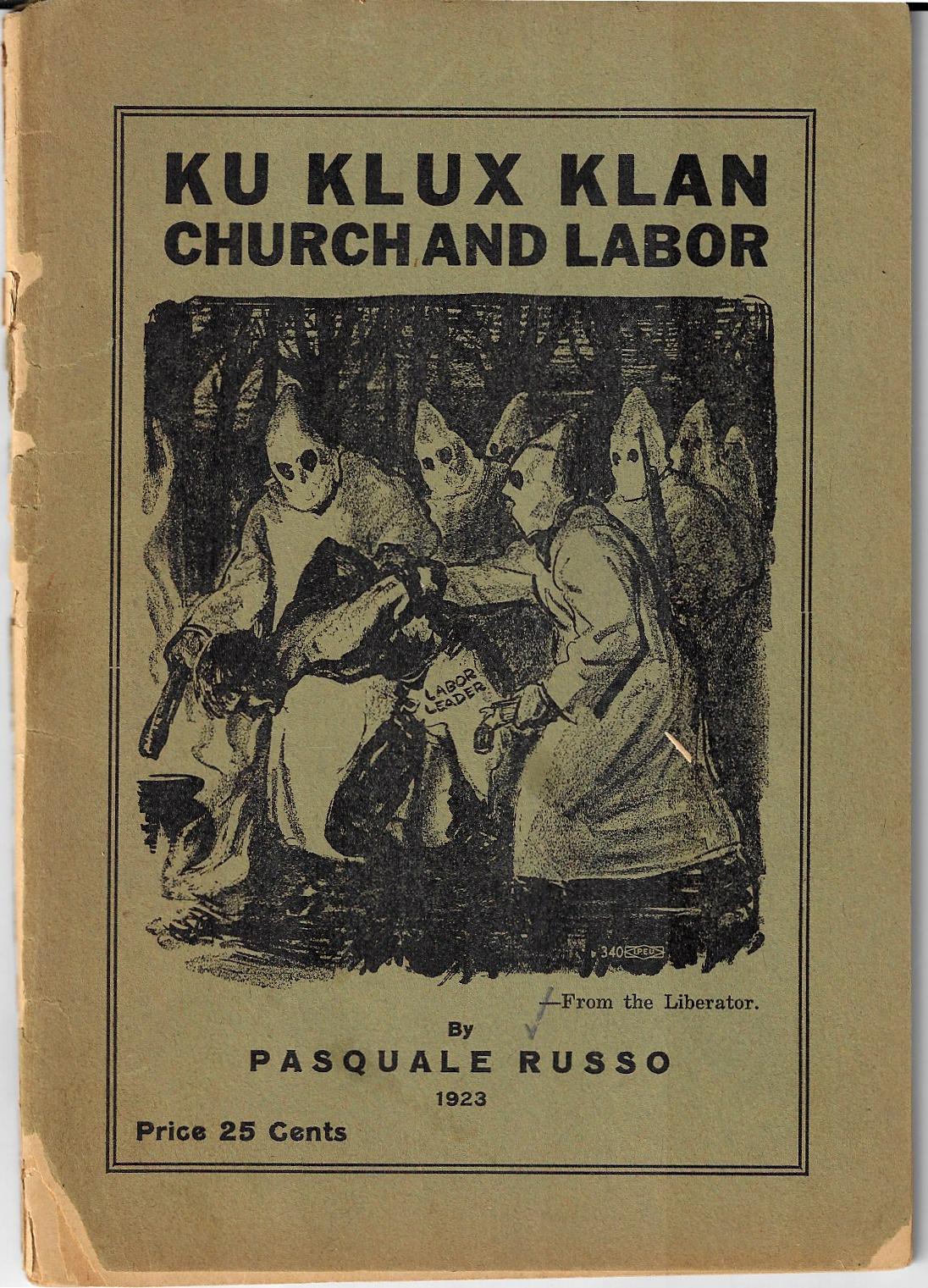
    Pasquale Russo, Ku Klux Klan, Church and Labor, 1923; published by Mr. Russo in Chicago (833 Sedgwick Street). 7×5″, 59pp.  Original wrappers.  Fair copy, only, as the pamphlet was printed on inferior stock and is coming apart with use (the covers are detached, several pages have been pulled away…) Provenance: Library of Congress, with their surplus/duplicate rubber stamp on the rear cover.  WorldCat/OCLC locates 16 copies, though I have not been able to find any other copies for sale.  $50

    KKK Church and Labor 1923Mr. Russo (also the author of “Negro Slavery or Crime of the Clergy” and “Tony the Immigrant” among others) makes a case against the KKK, and also manages a conjoined condemnation against the “Church”–and that being, so far as I can tell, the Catholic Church–all the while building a very strong pro-labor (Socialist?) overview for the improvement of the condition of the working classes. This seems a little unusual to me as the KKK was also anti-Catholic, making similar arguments against that religion as Mr. Russo. Mr. Russo’s reasoning behind the attack here seems to be that the Church was in its way complicit with the actions of the KKK by being against labor, as was the Klan, and so with this thinking the Church was pro-KKK and anti-working class by restricting the freedom of the laborer, and against “the solidarity of the white and colored”.  There is very strong support in the pamphlet for the Negro worker (the “N” in “Negro” being capitalized at a time when even that small dignity was rejected by many in the publishing industry), railing against the  segregationist policies of the “United Federation of Scabs” (the American Federation of Labor, A.F.L.) and Samuel Gompers and for being the “lickspittles” of the ownership class. The pamphlet was published at an interesting time–1923–for the main aspects of the work: there was significant anti-Catholic leanings high and low throughout the country; the KKK was about halfway through its second very short-lived revival before its collapse later on in the decade; the African American as a race and as a worker class was still very abused; and the infatuation with Socialism and the newly-formed Soviet Union was young and growing. So the pieces of history were there, though they are in a jumble. 

    The pamphlet is a highly problematic but forensically-interesting work, and speaks to its times in a number of ways–that said, I am not sure where this fits in with anything, and how much of Mr. Russo’s self-published philosophy was shared and how much of it was simply an externalized internal insight. 


    ·Posted by :

    ·in:

  • An Early Case against the Wobblies and the Espionage Act of 1917 (1918)

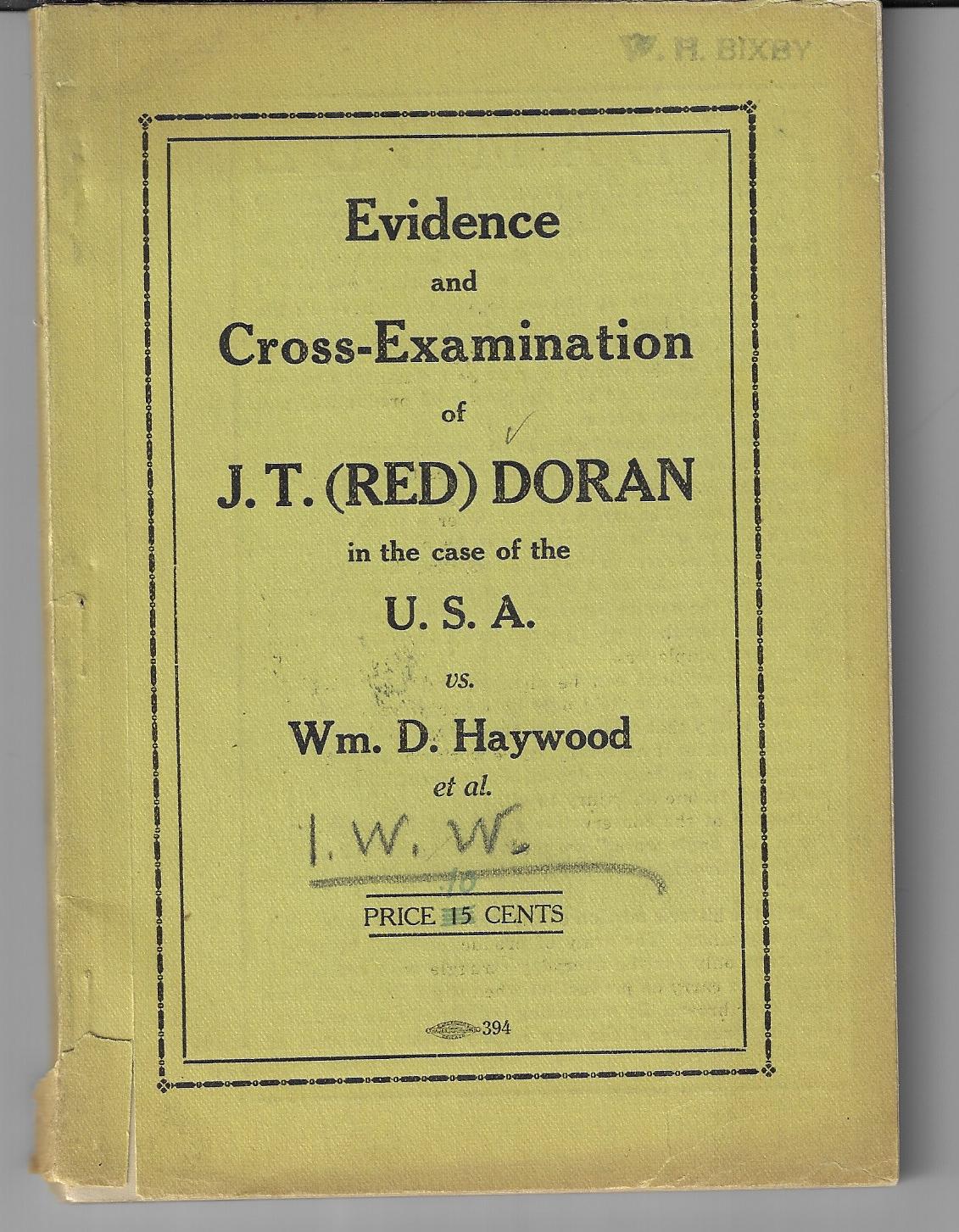
    Books Red DoranJohn T Doran; Otto Christensen; Frank Knowlton Nebeker; United States. District Court (Illinois : Northern District); Evidence and cross examination of J.T. (Red) Doran in the case of the U.S.A. vs. Wm. D. Haywood, et al. [Chicago], [General Defense Committee], [1918?] 7×4.5”, 151pp. Original wrappers. The copy of W.H. Bixby (with his name rubber stamped on the front cover top right).  Bit of chipping at spine, otherwise in VG condition. Provenance: General W.H. Bixby, and then the Library of Congress (with their rubber stamp on the rear cover).  $137.

    (General) W.H. Bixby was one of a number of society leaders who protested the rough treatment of the IWW members (including Mr. Doran) accused under the Espionage Act of 1917, and who would plead for amnesty on their behalf.  (General William Herbert Bixby (1849-1928), USMA 1876,  served in the Corps of Engineers and was president of the Mississippi River Commission in 1908-10 and 1917-18.)

    We IWW’s say “Listen What is the good of buying railroads We don t want to buy railroads. We don’t want to buy brickyards nor the mills nor the factories. We don t have to indulge in a co operative plan or operative program. This is what we mean to do organize the slaves in the brickyards and then we own the brickyards. Organize the slaves on the railroads and then we own the railroads. Organize the slaves everywhere and all these things are ours. But to buy them and attempt to compete with the capitalistic masses it is nonsense. We are not there.” (page 36)

    ·Posted by :

    ·in:

  • Sound Mills (Phonometers) 1884

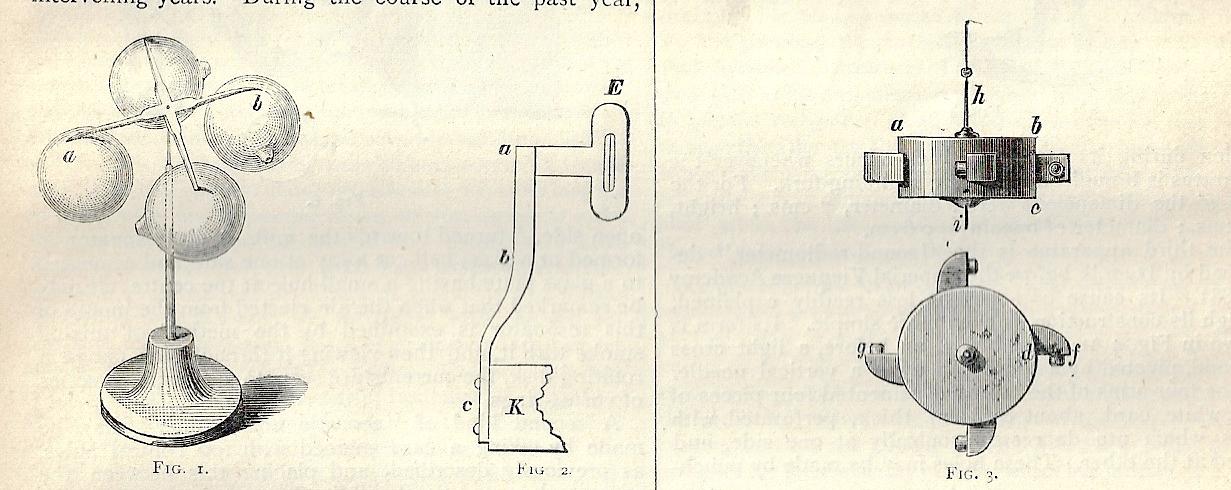
    Sylvanus P. Thompson. “Sound-Mills”  in Nature, February 14, 1884, pp 363-364, in the weekly issue of pp 353-376, and with several text illustrations. Nice copy, the weekly issue removed from a larger bound volume. Very Good.  $45

    Nature 1884 SOund mills

    The opening paragraph of the Thompson paper describes the instrument in general, and introduces the work of Dvorak:

    “After the notable researches of [Sir William] Crookes on radiation, which culminated in the discovery of the radiometer, or lightmill, it was a natural transition of thought which suggested to several minds almost simultaneously the possibility of devising an apparatus which should rotate under the influence of sound waves as does the radiometer under the influence of the rays of light and heat. Such instruments were indeed devised independently about six years ago by Lord Rayleigh, by Prof Alfred M. Mayer of Hoboken, by Mr Edison, the well-known inventor, by Prof Mach of Prague, by Dr A. Haberditzel of Vienna, and by Prof Dvorak of the University of Agram (in Croatia). These researches, though of great scientific interest, have been somewhat overlooked in the rush of scientific inventions during the intervening years. During the course of the past year, however, Dvorak has given to the world, in the pages of the Zeitschrift der Instrumentenkunde (vol. iii, Heft 4), a detailed account of his experiments, together with figures of various piece of apparatus hitherto undescribed. We propose to give a resume of the principal points of Dvorak’s researches…”

    Much of the rest of the paper describes four different Dvorak instruments.  

    ·Posted by :

    ·in:

    —
  • James E Keeler The Spectroscope Of The Alleghany Observatory Offprint Astronomy And Astro Physics No 111 November 1893

    James E. Keeler, “The Spectroscope of the Alleghany Observatory. Offprint: Astronomy and Astro-Physics No. 111 (November 1893).  245x155mm, 11pp, 3 plates (of the instrument, plates numbered V, VI, VII). Original wrappers.  Condition: the pamphlet is in two pieces, the heavy paper plates I think were too much for the paper binding, and so it came apart in two parts at the plates. Also, there is an old vertical fold that runs through the publication.  But for that, a Good copy.  Not the best condition, but it is a rare thing. A nice contribution by a siginficant figure in teh history of modern astrophysics (see Donald E. Osterbrock, James E. Keeler: Pioneer American Astrophysicist: And the Early Development of American Astrophysics, Cambridge UP, 1984.  $100

    “The spectroscope which is illustrated in the accompanying plates is the most important recent addition to the instrumental equipment of the Allegheny Observatory. Although not strictly a universal instrument it is intended to be used for several different kinds of work and to be efficient in all of them In a previous article f I have stated the general principles which must be observed in constructing a spectroscope for any given purpose It is not an easy task to design a spectroscope which shall satisfactorily meet a number of very different requirements and in presenting the Allegheny spectroscope as one solution of this difficult problem. I wish to point out that some additions and conveniences which might easily have been added were rejected because it was thought that they might compromise the utility of the instrument in some one of its applications. After testing the spectroscope in both visual and photographic observations although as yet only in a preliminary manner there are very few changes that I should wish to make in the original design. The instrument is large and powerful enough to compare favorably with others of the highest class designed for the same kinds of work yet light enough to be readily mounted and dismounted and to be carried by a telescope of moderate dimensions…”–from the offprint

    ·Posted by :

    ·in:

  • Gotthilf Heinrich Von Schubert Vom Dem Vengehen Und Bestehen Der Galtungen Und Arten In Der Organischen Natur Printed In Mu

     Gotthilf Heinrich von Schubert. Vom dem Vengehen und Bestehen der Galtungen und Arten in der organischen Natur, printed in Munich by Anton Weber, 1830., 25x21cm, 20pp.  Original wrappers. There are no copies of this publication located in WorldCat/OCLC. 

    • Provenance: Smithsonian Deposit (it looks like it was entered in 1865 or thereabouts according to the quite faded rubber stamp on the title page), and then on to the Library of Congress, with their rubber stamp on the back extra/outer wrappers.  Noted as being purchased, I guess, from “Okens sale, 1853”.  Condition: the original wrappered pamphlet is bound in a newer plain manila wrappers which are very chipped, which by and large kept the original wrappers good and intact. The interior of the pamphlet has some dampstaining but is otherwise crisp.  Good copy.  $125
    • I can’t really tell what Herr von Schubert is getting to in this publication, though there is a lot here regarding the soul and the cosmos and a concept of nature that I do not understand.

    Gotthilf Heinrich von Schubert 1780-1860, “…was a German physician and naturalist…He gave renowned lectures on fringe science (animal magnetism, clairvoyance and dream), and in 1819 he occupied the chair in natural history in Erlangen where he studied botany, forestry, mineralogy and geognosy…Schubert aimed to create a religiously-grounded interpretation of the cosmos. Contemporaries that included Johann Wolfgang von Goethe, Jean Paul, Justinus Kerner and Heinrich von Kleist were favorable to his work. His masterpiece, Symbolism of Dreams (1814) was one of the most famous books of its time, exercising influence over E. T. A. Hoffmann, and later on, Sigmund Freud and C. G. Jung. Schubert advocated an ecumenical “awakened Christianity” which found evidence for God both in Nature and in the human soul. Synthesising the Bible with the philosophy of Schelling, he was a major figure in the “later Enlightenment”. In his History of the Soul (1830), Schubert again attempted to fuse the philosophy of Herder and Schelling with the Christian tradition.”–Wikipedia


    ·Posted by :

    ·in:

  • Champion Paul Professor Of Chemistryde La Spectrometrie Spectronatrometre Paris Librarie Polytechnique De J Baudr

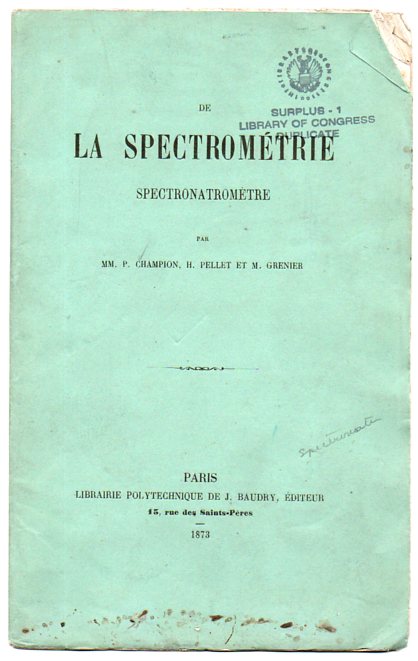
    Champion,  Paul (“professor of chemistry”).  De la Spectrometrie Spectronatrometre. 

    Paris:  Librarie Polytechnique de J. Baudry,  1873.  1st edition.  15pp.   Original printed wrappers.  Good condition.Provenance: Library of Congress, with their surplus stamp on the front wrapper.  

    Books spectrometrie

    This rare pamphlet–only one copy (in the British Library) located in OCLC/WorldCat–was written by Paul Champion with Henri Pellet and Charles Grenier, and is illustrated with a full-page original photograph of the apparatus. There is one old rubber stamp from the former owner (The Library of Congress) and a few bends here and there in the wrappers; otherwise this is quite a nice pamphlet.   $150 (Interestingly, one of the very few references that I can find for this work online is for volume 16 of  Foote’s The Naturalists’ Leisure Hour and Monthly Bulletin: Science … where the pamphlet was offered for sale for 35 cents. There were other, rarer, and more sumptuous books offered for sale in this journal as well, so it makes for a curious browse.)


    ·Posted by :

    ·in:

  • Very Early Papers on the Telephone, 1876-1880


    (Bell, Alexander G.) The Scientific American, 1876 (the entire volume, sumptuously illustrated with all manner of technical objects, in two parts (bound in one volume)), 414+414pp each.  Very fresh copy, bound in black library cloth. Very good copy.  $950
    Bell patent close
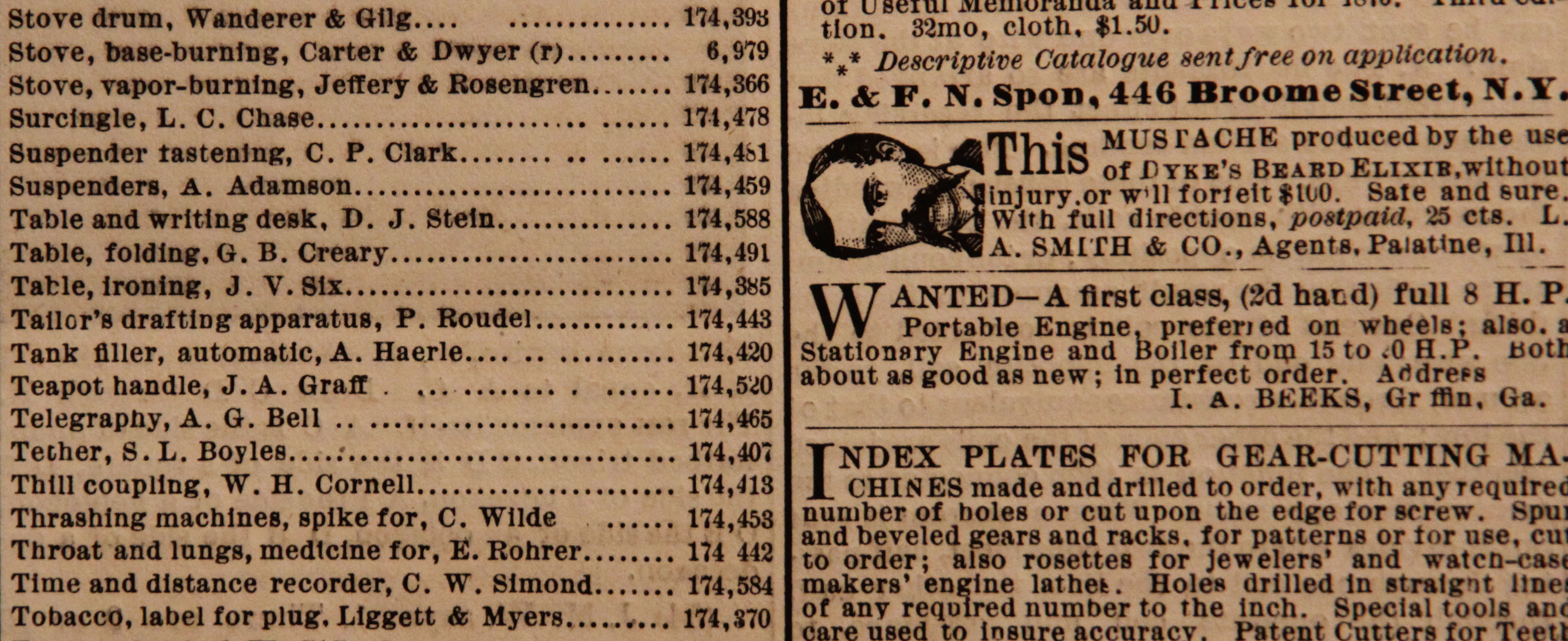
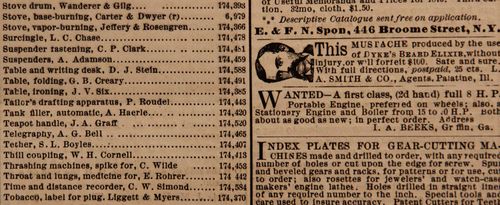
    Besides it being the Centennial year, 1876 saw a number of major games in the history of human thinking. Sometimes the announcements or earliest public appearances of these breakthroughs didn’t get all that much attention.  As one of the major means of transferring technical and applied science info to the general public, it is interesting to see how Scientific American reacted to such innovations.  For the thick, heavy volume for 1876, amid patent announcements and articles on telegraphic fire alarms, electro-harmonic multiplex telegraphs, recording telegraphs, electro-magnetic telegraph railroad car signals, signal box telegraphs, underground telegraphs, telegraph keys and armature, acoustic telegraphs and the l;ike (though there weren’t that many reported, not really, just on the order of dozens), we find one of the most important of them all, patent # 174,465, by Alexander Graham Bell, appearing 8 April 1876.  It would be a rude resumption of being here in the future of this event to call the coverage short-sighted

     In an earlier article in the 4 March 1876 issue of SA, there appeared “The Invention of the Telephone”, by P.H. Vander Weyde, in which there is yet any mention of Mr. Bell.  There is an illustration of one of his precursors in the field, the Reuss telephone, with ample description. (This was actually Philipp Reis and his telephone really wouldn’t work to transmit the human voice, though did so work for music to some degree.)  Bell’s patent  would be at the Patent Office in March, and would appear as a one-line notice (among a hundred others), the patent stating it was “the method of, and apparatus for, transmitting vocal or other sounds telegraphically … by causing electrical undulations, similar in form to the vibrations of the air accompanying the said vocal or other sound”.  (The first image above is a detail; the second image a longer version, which is really only less than half of what the real-life version looks like in the tall listing.)

    Weeks later, Elisha Gray’s (on 13 May) telegraphic telephone patent (175071) appears in the Scientific American, and later, on 9 September, on page 163, there is the article “The Human Voice Transmitted by Telegraph”, on the successful transmission by Graham Bell. 

    Admittedly there were a number of developments in the production of the speaking telephone at this time, though in general there seems to have been no great attention paid them in the pages of the Scientific American than pipe cutting machine improvements or improved gravel separators.  Obviously the great impact of the invention was yet to be appreciated, even in any sort of fictional way.

    [Bell & Early Telephone] (Well, not-Bell) “Telephones and Other Applications of Electricity”, a fine review article in Nature, August 24, 1876, p. 353-355, and with five illustration, offered in the weekly issue of pp345-364.  This review is issued just months after the Bell patent–Bell and his work are not mentioned in this article. Very good condition, $200

    [BELL, Alexander Graham.] “Talking by Telegraph”, in The Popular Science Monthly, February 1877, vol 58, pp 507-8 in the issue of pp 385-512.  Offered in the original wrappers, removed from larger volume, which means that there is no spine cover for the wrappers.  Attractive Library of Congress exlibris on front cover,  along with an old faded rubberstamp of the Library of Congress Copyright Office at the top of the front wrapper.  Nice copy.  This is a very early report on the Bell telephone demonstration of November 1876.  $150

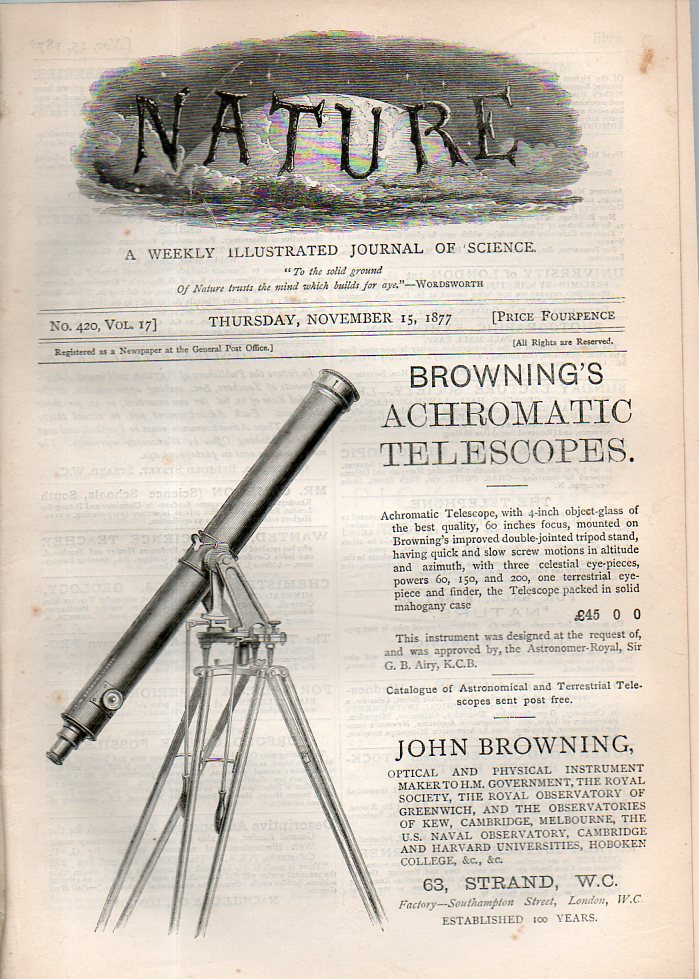
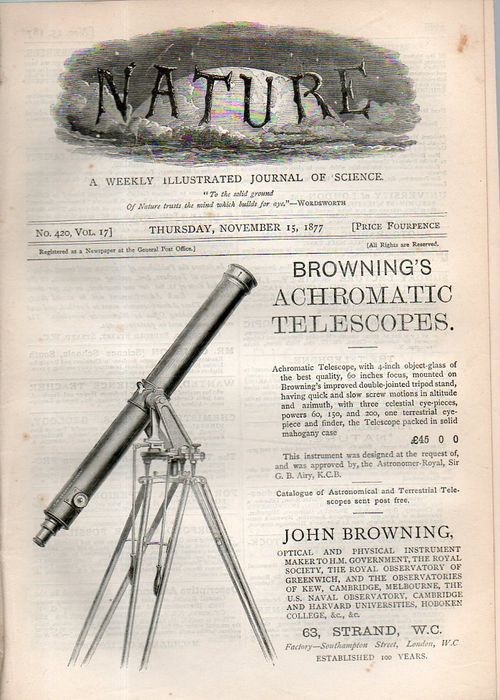
    [Bell & the Early Telephone] Bell,  Alexander Graham.  “The Telephone”.  London:  Nature,  1877.  November 15, 1877  8vo.  Original printed wrappers.  Very good condition.  This is an early appearance of the Bell telephone in Nature magazine, occupying pp 48-49 (in the issue of pp 41-56), in three densely packed columns of about 1500 words. This issue is removed from a larger, bound collection, but includes its original printed wrappers front cover and ads. The article describes Bell’s October 31 1877 lecture before the British Society of Telegraph Engineers.  $350.00
    Bell telephone100


    [Bell & the Early Telephone] Lockyer, J. Norman. “Telephones and Other Applications of Electricity”.  London, Nature, August 24, 1876.  Pp 353-355 of the weekly issue.  Offered in the original printed wrappers, removed from a larger bound volume.  Nice condition.  $150

    Lockyer, the editor of Nature, foresees the possibility (as with the earlier work by Munro, above) of having a dance party and being entertained remotely by a paid musician, somewhere, the music transmitted via telephone.  He steps firmly into 2013 when he slyly laments that the children of 1876 may better understand the apparatus than the adults, ending his review saying “Perhaps our children may find the thing simple enough”.

    [Bell & the Early Telephone] Munro, J.  “On the Telephone, an Instrument for Transmitting Musical Notes by Means of Electricity”.London, Nature:  May 11, 1876.  Pp 30-32, with 3 woodcut diagrams in the text.  Offered with the original printed wrappers, removed from a larger volume.  Addressed the Elisha Gray machine.  $150

    [Bell & Early Telephone]  Munro,  J.  “Telephones and other Applications of Electricity”,  London:  Nature,  1876.  1st edition.  Nature, an Illustrated Weekly…, 24 August 1876  Royal 8vo.  Original printed wrappers.  We offer the entire weekly issue complete with its scarce outer wrappers, cleanly removed from a larger bound volume. $150

    Munro (who would go on to write an early and authoritative work on the history of the telephone (Heroes of the Telegraph) reviews the advancements made in the invention–still, as earlier, not mentioning Bell at all, and still championing the priority of Elisha Gray. It was at about this very time in the autumn of 1876 that William Thomson first presents the telephone to European ears. Munro waxes a bit about the use of the telephone, still identifying it as a musical device, not discussing its possibilities as a speaking instrument–this is precisely what Thomson does, and forcibly so, after hearing it function in the Philadelphia Centennial Exhibition, referring to the telephone as the perfect advancement of the telegraph (and also referring to it as a “speaking telegraph”.) But Munro continues on with the telephone’s musical virtuosity. “There is a possibility here, we must admit, of a curious use of electricity. When we are going to a dancing party there will be no need to provide a musician”, as the dancers will be able to pay their electrician for the privilege of getting their piano via wire.

    [Bell & the Early Telephone] Rontgen,  Wilhelm Conrad.  “A Telephonic Alarum”.  Nature, December 27, 1877  Royal  8vo.  Original printed wrappers.  Very good condition. $175

    This very early paper by Rontgen (who would in 18 years make his announcement on the X-Ray and who would also not stop publishing for another 30 years after that) occupies p 164 of this weekly issue and contains about 750 words and one illustration. The article is  removed from a larger bound collection but comes with the uncommon (and decorated) front wrapper as well as the read ads. 

    [Bell & the Early Telephone] Barrett,  William.  “Early Electric Telephony”.  London:  Nature,  1878.  1st edition.  Nature, vol 17, # 443, April 25, 1878  8vo.  Original printed wrappers.  Very good condition.  By Nature standards Barrett contributes a long (5-column, 5-illustration) look at Philip Reis’ electric telephone of 1861.Occupies pp 510-512 in the issue of pp 501-520. Offered with the original front wrapper and 5pp ads; removed from larger bound collection. $150

    [Bell & the Early Telephone] Sabine,  Robert.  “The Telephone.”  London:  Nature,  1878.  1st edition.  Nature, vol 17, # 437, Mar 14, 1878  8vo.  Original printed wrappers.  Very good condition.  Two dense columns of letters to the editor viz the telephone, including one by Sabine (above) and two by Herbert Tomlinson and Aurel de Ratti Offered with the original front wrapper and 5pp ads; removed from larger bound collection.   $125.00

    [Bell & the Early Telephone] Romanis, James M..  “New Form of Telephone”.   1st edition.  Nature, Jan 10, 1878, vol 17 #428  8vo.  Original printed wrappers.  Very good condition.  Two-column (and illustrated) article, (pp. 200-201) in this weekly issue of pp 197-216. Includes article on Jules Verne plus contributions by George Romanes and William Crookes. Offered with the original front wrapper and 5pp ads; removed from larger bound collection.   $150

    [Bell & the Early Telephone] Page,  F.J.M..  “Demonstrations of Currents Originated by the Voice in Bell’s Telephone”.  1st edition.  Nature, Feb 7, 1878, vol 17 #432  8vo.  Original printed wrappers.  Very good condition.  Page’s article occupies pp 283-4 of this issue of 277-296pp. Also included in a three page continuation of J. Clerk Maxwell’s review of a work (by his friend) P.G. Tait. Offered with the original front wrapper and 5pp ads; removed from larger bound collection.  $150

    [Bell & Telephone]   Thompson, Sylvanus P.  “Graham Bell’s Experiments in Binaural Audition”, in Nature, Ovtober 21,1880, pp 586-587, with illustration.  Nice copy in wrappers, extracted from larger bound volume.  $85


    BELL,  Alexander Graham.  The Photophone: 5 articles from the journal Nature, 1880. 


    London:  1880-1881, Nature: September 23, 1880, Nov 4 & 18, 1880; February 10, 1881  Original printed wrappers, the weekly issues removed from larger bound volumes.  Fine condition. Four papers, $400, as follows:

    Offered are the following three issues of Nature covering the initial announcements of Bell’s future-provoking invention of the PHOTOPHONE:

    • THOMPSON, Sylvanus P.  “The Photophone”, in Nature, volume 22,  23 September 1880, page 481, the lead article of the issue, one+ full-column, about 500 words, announcing the Bell photophone.  Wrappers, removed from a larger bound volume. 
    • BELL, Alexander Graham. “Selenium and the Photophone”, 23 September 1880, pp 500-503, with wrappers, extracted from larger bound volume. 
    • “Bell’s Photophone”, pp 15-19, with illustrations of the apparatus, running approximately 3000 words.
    • BIDWELL, Shelford. “Bell’s Photophone”, in 18 November 1880, pp 58-9, approximately 1750 words.  
    • “Photophone Experiments”, in 10 February 1881, page 354, approximately 400 words, two illustrations.

    Alexander Graham Bell was already mega-famous by the time he unveiled what he considered to be one of his greatest inventions.  Working at his L Street lab as well as from his home (which was just a few blocks away from my store in Georgetown, which was at the 34th & Volta Place, also just a few doors away from Alger Hiss’ old place, and a few doors the other way from Warren Christopher’s house where he slipped and fell on his last day in DC on the snowy steps and sidewalk that he never shoveled, and so on) he developed the photophone.  In the day, in 1880, when it was completed he considered the work so substantial and filled with so much potential that he left his plans on deposit in a sealed something-or-other until he announced the results for real, which came at a public lecture on August 27, 1880.  (This perhaps for the big taste of legal trouble he got into with his telephone–troubles and contentiousness that would continue for years. Also there was something in the air about this, so to speak, with an article in Nature attesting to rivals of the ingenious invention coming in the 23 May issue of the same year.) In any event, he found this invention to surpass his telephone and phonograph–except that few people today recall the instrument, much less what it did1.  

    It was a fantastic thing, an elegant device utilizing his discovery of the photoacoustic effect–basically, transmitting wireless telephone conversations, transmitting speech on light rays, a feat that would not be utilized until the last two decades of the 20th century, a precursor to fibre-optic communication–it was just decades away from practical application.  

    In his article in Nature of September 23, 1880, electrical pioneer Sylvanus Thompson writes (opening that weekly issue) that “sounds can be transmitted from one station to another wherever a beam of light can be flashed; …we may expect the slow spelling out of words in flashing signals of the heliograph to be superceded by the more expeditious whispers of the photophone” (page 481). Actually it seems that this paper beat the sponsor organization of Bell’s August address into general print, though The Electrician seems to have bested them both with an article on September 18.

    Bell was happy.  According to Ben Richmond (at Motherboard) Bell wrote a lovely note to his father on his success: 

    “I have heard articulate speech by sunlight! I have heard a ray of the sun laugh and cough and sing! …I have been able to hear a shadow and I have even perceived by ear the passage of a cloud across the sun’s disk.”

    Notes:

    1.  Wiki quotes Donald J.C.  Phillipson and Neilson, Laura, entry on Bell in the  Canadian Encyclopedia online. “Of the 18 patents granted in Bell’s name alone, and the 12 he shared with his collaborators, four were for the photophone, which Bell referred to as his ‘greatest achievement’, telling a reporter shortly before his death that the photophone was “the greatest invention [I have] ever made, greater than the telephone.” Wiki and Philipson/Neilson.

    These are among the earliest articles on Bell’s fantastic invention utilizing his discovery of the photoacoustic effect–basically, transmitting wireless telephone conversations, a feat that would not be utilized until the last two decades of the 10th century. /// We offer the three issues in their original wrappers, cleanly removed from a larger bound volume with only trace elements of the removal visible at their spines. Nice copies.

    Bell believed that the photophone–developed most fully in his Volta Street lab, which was just three blocks away from where my store stood for nine years–as a machine that transmitted speech on light rays, was by far his most important invention.

    BELL,  Alexander Graham.  “Experiments in Mechanical Flight”.  London:  Nature Magazine, May 28, 1896,  1896.  From: Nature, vol 54, May 28, 1896  Pp 73-96  Royal 8vo.  Printed wrappers, removed cleanly from a larger bound volume.  Very good copy. (On Samuel P. Langley’s aerodrome.) $135
    ·Posted by :

    ·in:

  • The First Published Image of an Actual Baseball Game Printed in the USA–1857

    The Spirit of the Times: A Chronicle of the Turf, Agriculture, Field Sports, Literature and the Stage, published in New York City by William T. Porter. Volume 3, #s 1-26, September 5, 1857 through February 27, 1858. 15×11″, 412pp, several illustrations.  There’s a lot of very early baseball coverage in the newspaper (see below), as well as the first image of adults playing a game of baseball printed in the U.S. 

    Crisp copy. Ex-library, though the only signs of this are the call numbers stamped at the bottom of the spine and a few rubber stamps on the rear endpaper and pastedowns. This is really a very nice copy, bound in a very stout and workable black cloth. Not common.  SOLD

    Spirit of times baseball scene detail

    The Spirit of the Times was an “American weekly newspaper published in New York City….aimed for an upper-class readership made up largely of sportsmen. The Spirit also included humorous material, much of it based on experience of settlers near the southwestern frontier. Theatre news was a third important component” –Wiki  It was evidently “the only major sporting paper in the U.S.” as William J. Ryczek writes in his book, Baseball’s First Inning: A History of the National Pastime Through the Civil War, pg 163

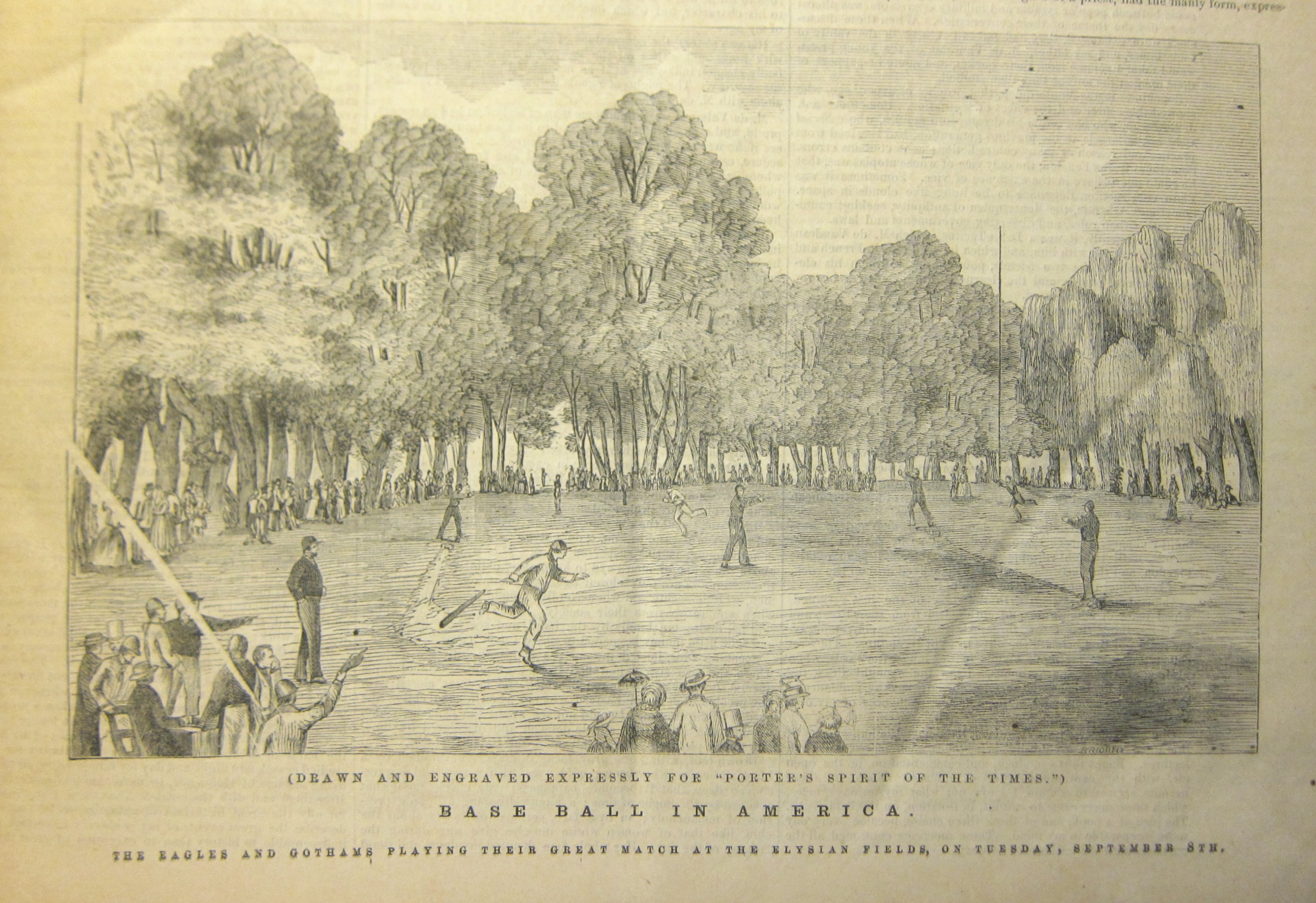
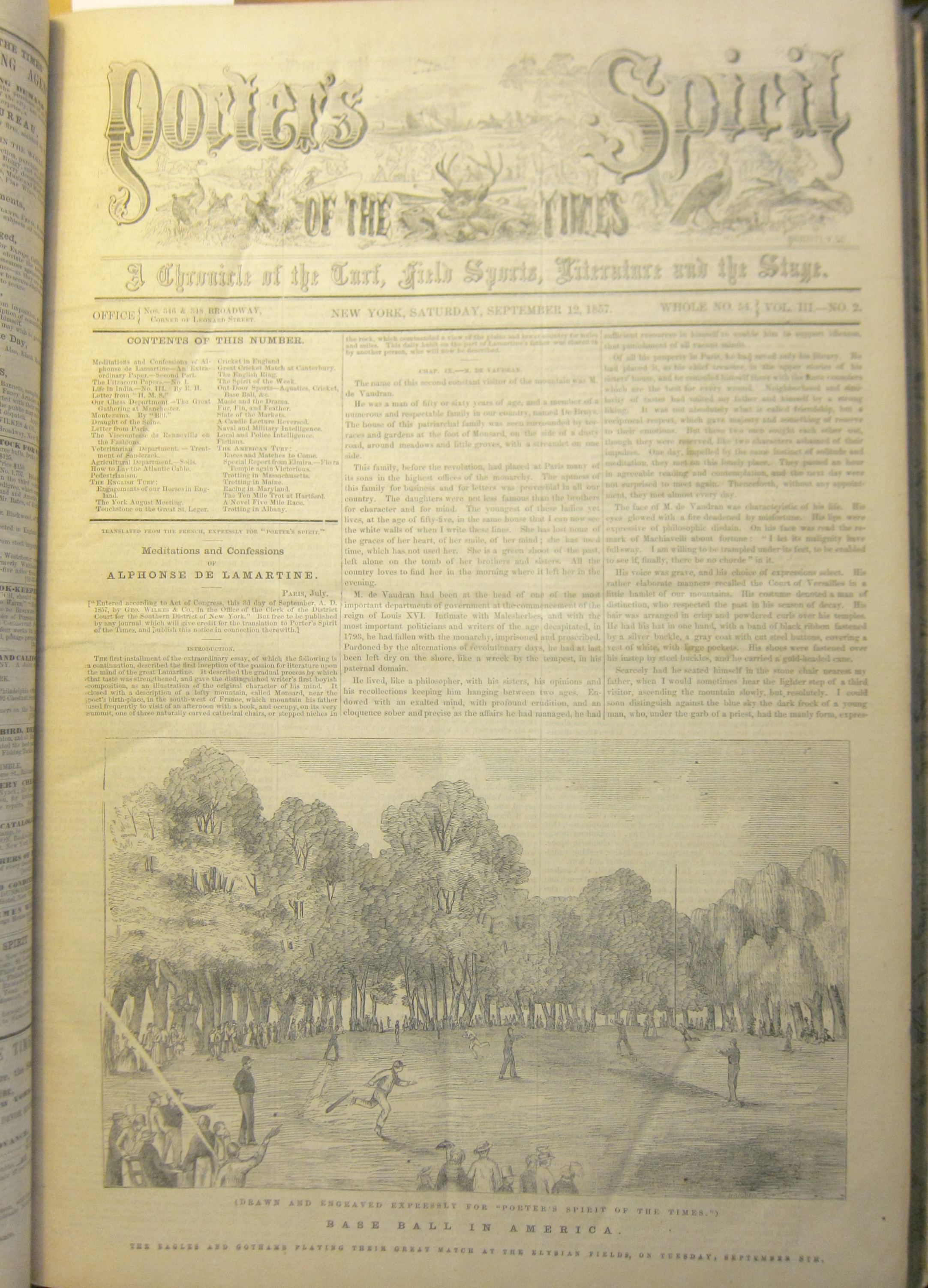
    Of great interest here is the wood engraving on the cover of the September 12, 1857 which is the first image of a specific baseball game in progress, and is captioned: “Drawn And Engraved Expressly For “Porter’s Spirit of the Times.” – Base Ball In America – The Eagles and Gothams Playing Their Great Match At The Elysian Fields, On Tuesday, September 8th.” (It seems that the first image of a baseball game in general (played by children in this case) appeared in Robin Carver’s The Book of Sports and published in Boston in 1834.) Another version of this image appeared just a week later, in the New York Clipper , on September 19, 1857.

    • “For the remainder of the 1850’s, Porter’s Spirit excelled in its baseball coverage, recording several pioneering firsts. Most noteworthy is the front page of the September 12th 1857 issue, which feature the earliest illustration of adults playing a baseball match” (the Eagle and Gotham Clubs on the Elysian Fields in Hoboken, NJ)–David Block, Baseball Before We Knew It: A Search for the Roots of the Game,  page 226.
    • The image is “…believed [to be] the first published drawing of an American Baseball game. It was published on September 12, 1857 in Porter’s Spirit of the Times”. -https://www.awesomestories.com/asset/view/First-Published-Picture-of-an-American-Baseball-Game
    • The image is also reproduced and commented on as the “First -ever depiction in the press of an actual baseball game in progress” by Peter J. Nash in Baseball Legends of Brooklyn’s Green-Wood Cemetery, pg 35.

    • Also, a less categorical but still stimulating observation is made by Joel Zoss, John Bowman, John Stewart in Diamonds in the Rough: The Untold History of Baseball, page 233, that the wood engraving “may well be the earliest known drawing [sic] of grown men playing what is clearly a game of baseball”.  Pretty much the same testament is written by Steven A. Riess in his Sports in America from Colonial Times to the Twenty-First Century…

    Spirit of times baseball full pageThere is baseball coverage in 20 of the 26 issues, mostly densely-packed single-column length reporting on games, scores, and general observations, the average weekly coverage being about 1000 words–so, overall, there’s about 15k words of baseball for 1857 and into early 1858, which is, well, considerable.

    The issues containing baseball (“base ball”) reports include 9/12/1857, 9/19, 9/26, 10/3, 10/10, 10/17, 10/24, 10/31, 11/7, 11/14,  11/21, 11/28, 12/5, 12/12, 12/19/, 12/26, 1/2/1858, 1/9, and 1/16/1858–basically a straight weekly run from 9/12/1857 through 1/16/1858.  

    There’s a lot of other material on pistols, pigeon shooting, “fistiana”, billiards, cricket, “fur/fin/feather”, fishing, veterinary reports, columns for checkers and chess, and of course there was a lot of horse racing coverage–all of which are a far second to the great game.  

    And just for the record there is a sub-series within the series of articles on baseball, the articles numbered 2-13 and beginning 31 October 1857–I could find no evidence of a number 1 even though there eight previous baseball articles before the #2. 

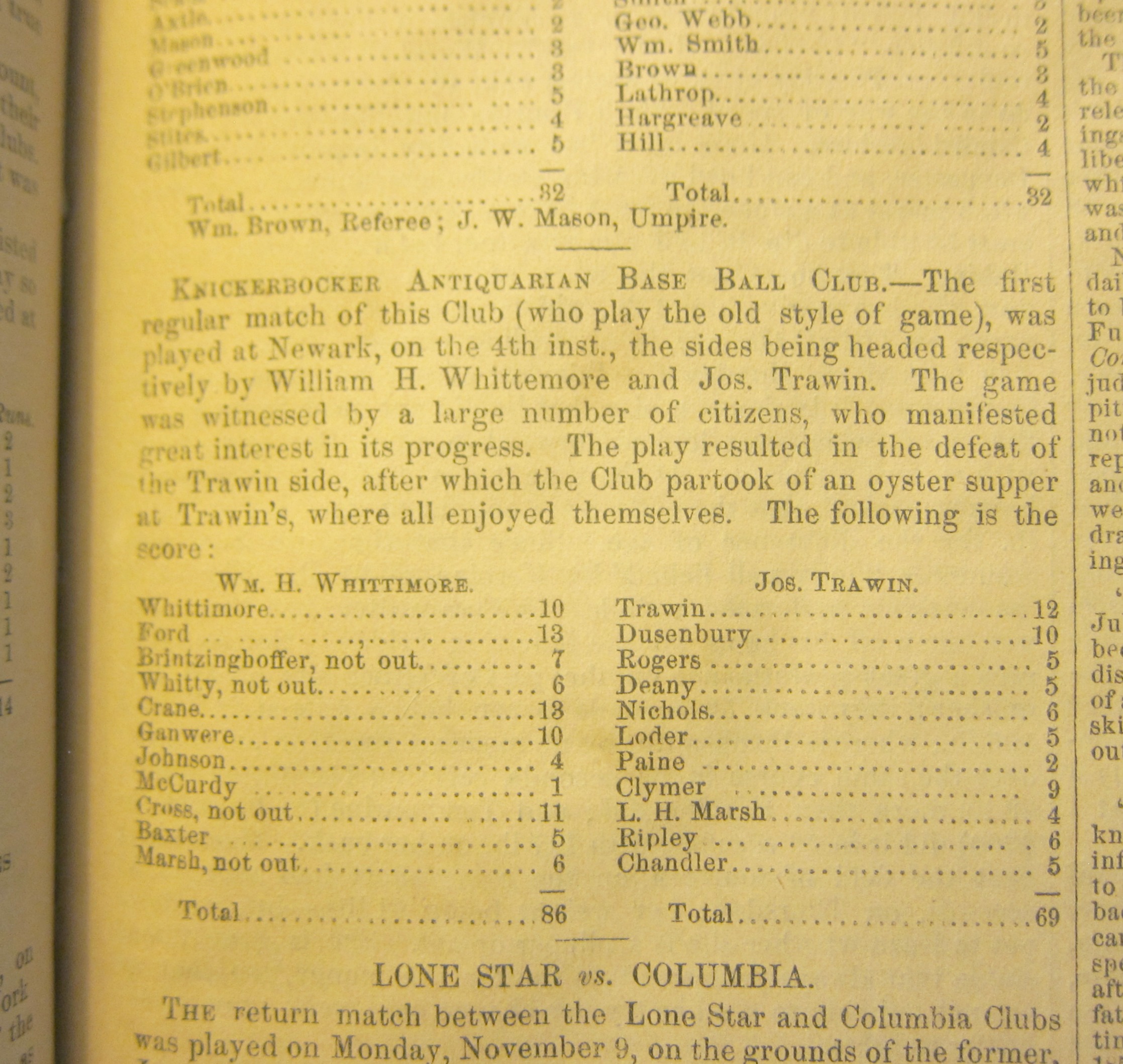
    Also, here’s a report about a club playing an “antiquarian” version of the game–I have no idea what that was…

    Spirit of times antiquartian bb

    ·Posted by :

    ·in:

Recent Posts

Archives

Categories