A Daily History of Holes, Dots, Lines, Science, History, Math, Physics, Art, the Unintentional Absurd, Architecture, Maps, Data Visualization, Blank and Missing Things, and so on. |1.6 million words, 7500 images, 4.9 million hits| Press & appearances in The Times, Le Figaro, Mensa, The Economist, The Guardian, Discovery News, Slate, Le Monde, Sci American Blogs, Le Pont, and many other places… 5000+ total posts since 2008.

  • An Uncommon Essay on Relativity Theory, 1921

    George de Bothezat (1882-1940) The Einstein Theory of Relativity, a Glance into the Nature of the Question. Carbon copy from typed sheets, I believe, 1921. 11×8, 12 leaves. The leaves seem to be glued together as a binding along the left edge of the sheets; the cover is present but detached, or loose. There are also two punch holes for binding.  I can find only one listing for this 1921 work in WorldCat/OCLC.  $450
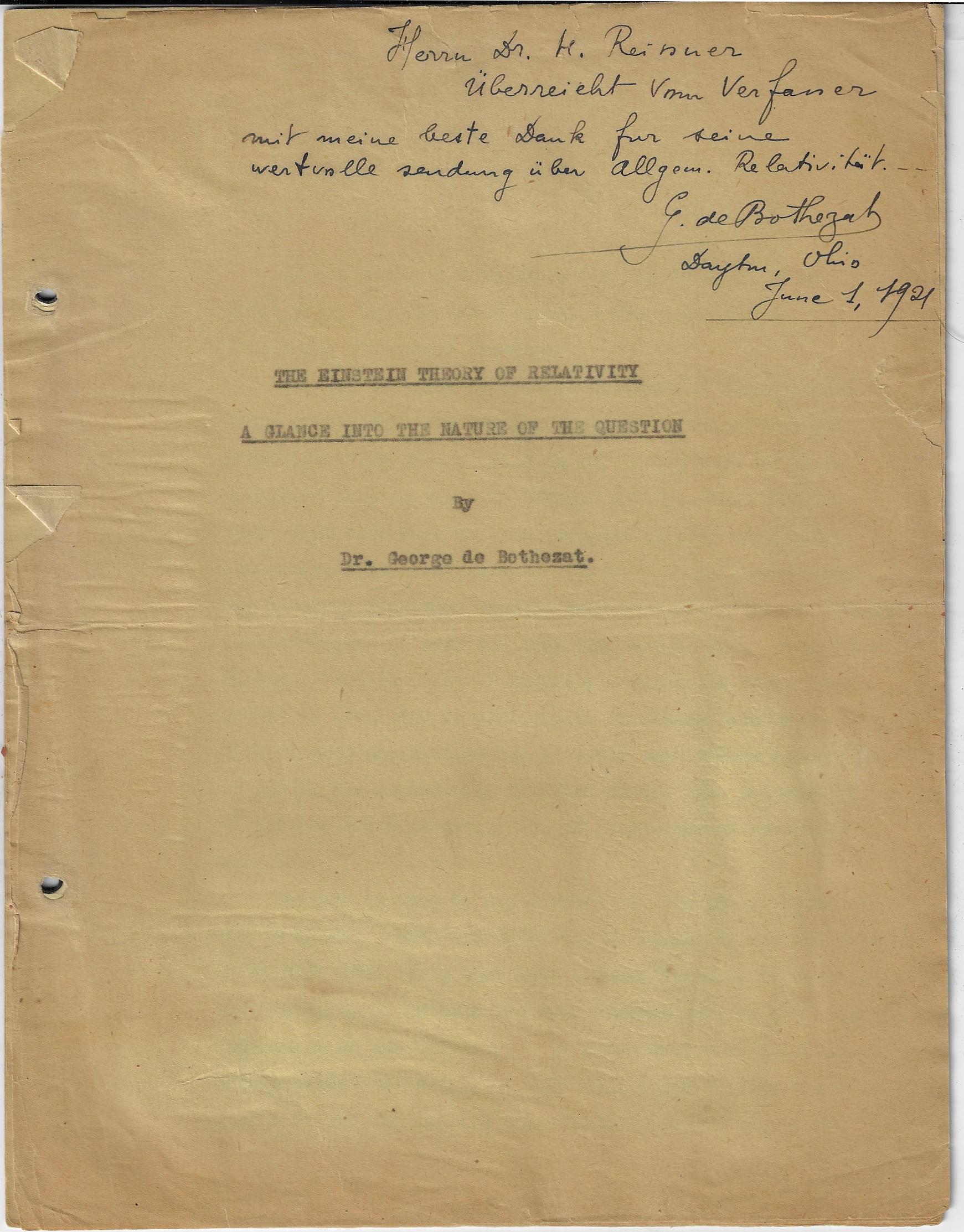
    BothezatPresentation copy to Prof. Hans J. Reissner (Reissner-Nordstrom metric among much else)–I imagine that de Bothezat would have been well familiar with the early flight engineering work of Reissner as well as his terrific contribution on the Einstein metric. Condition: a good copy, with perhaps either some damp staining that led to some pressure marks in the paper, or perhaps these were just pressure marks, from pressure. In any event, the paper it was printed on was inferior even when new, and so it has browning and is brittle here and there.  Apart from the general history of the theory de Bothezat seems to be very uneasy with Einstein in this paper, and I cannot find any mention of it in the usual Einstein sources.  In any event, it is a very scarce thing. (A 7pp paper by this name of was published in the journal The New World in November, 1930, pp 105-112, but I cannot locate a copy to compare the two efforts. de Bothezat would return later to Einstein in a book titled Back to Newton..., in which he refutes the theory of relativity (and a lot of modern  physics). Oh, well. 

    • George Bothezat (1882-1940) was a Russian-American engineer, mostly remembered today for his early engineering work on helicopters and aerodynamics. “In May 1918, with his homeland in the throes of the Russian Revolution, de Bothezat fled from the Bolsheviks to the United States. In June 1918, he was hired by the National Advisory Committee for Aeronautics. He lectured at the Massachusetts Institute of Technology and the Columbia University. …In 1921, the US Army Air Service hired de Bothezat to build a prototype helicopter. The quadrotor helicopter, known simply as the de Bothezat helicopter, was built by de Bothezat and Ivan Jerome in the hangars of Wright Field near Dayton, Ohio. The first flight turned out to be surprisingly successful for a machine that had been built without prototyping. In 1922, their “flying octopus” flew many times, although slowly and at low altitudes. In fact, its horizontal motion was induced by wind more than by the pilot’s controls. The Army, now more interested in autogyros, cancelled the underperforming project.”–Wiki
    • “Hans J. Reissner (1874-1967) was a leading German pioneer in aeronautics and aeronautical engineering and mathematical physics. He was appointed to the chair vacated by Arnold Sommerfeld at the Technische Hochschul at Aachen, where he established the aerodynamics laboratory and designed the great experimental wind tunnel at Aachen where he was the second director (after T. von Karman). He went on to the University of Berlin where he remained until 1938, when he left Germany for the United States. Reissner held a chair at the Illinois Institute of Technology and in 1944 joined the faculty at Brooklyn Polytechnic Institute.  Van Karman spoke very highly of Reissner and attributed his work in aerodynamics to be as important as those advances made by Prandtl (see von Karman’s Wind and Beyond). Reissner was also celebrated with two anniversary volumes of Applied Mathematiics for his 60th and 75th birthdays (in 1934 and 1949).”

    Also see:  Michael J. Hirschberg, “A Perspective on the First Century of Vertical Flight”, SAE International website.
    ·Posted by :

    ·in:

    —
  • “The Labor Revolt in India” (1920)


    Basanta Koomar Roy, “The Labor Revolt in India” (1920), published in New York by the Friends of Freedom for India. 9×6″, 23pp, original wrappers. Provenance: Library of Congress, with thei rsurplus/duplicate rubber stamp on front cover.  Very crisp and bright copy.  VG  $75 

    Basanta Roy (d.1949) was the first Indian-American journalist, “author, political activist for the Friends of Freedom for India, editor of the India News Service.”–Wikisource

    “The (b)ooklet titled “The Labor Revolt in India” by Basanta Koomar Roy, published by the Friends of Freedom for India in 1920… is statistics-heavy, and asserts that “the entire world seems to be aflame with the fire of labor unrest […] [a]nd India is only playing her part in this great drama of Humanity.” Includes a list of the board of directors, national council, executive committee, and Hindusthanee advisory board of the Friends of Freedom for India organization. “–from the South Asian American Digital Archive

    ·Posted by :

    ·in:

  • A Very Early Treatment on Psychodrama by its Founder (1939)

    Julius Levy Moreno. Psychodramatic Shock Therapy, a Sociometric Approach to the Problem of Mental Disorders.  Offprint: Sociometry, a Journal of Inter-personal relations, volume II, No. 1, January 1939. 8.25×5.5″, pp (1)-30. Original wrappers. Very Good copy. Scarce.  $350

    “Jacob Levy Moreno (born Iacob Levy; May 18, 1889 – May 14, 1974) was an Austrian-American psychiatrist, psychosociologist, and educator, the founder of psychodrama, and the foremost pioneer of group psychotherapy.”–Wikipedia

    “While living in Vienna in the early 1900s Moreno started an improvisational theater company, Stegreiftheater, the Theater of Spontaneity where he formulated a form of psychotherapy he called psychodrama, which employed improvised dramatizations, role-plays and other therapeutic, spontaneous dramatic expressions that utilized and unleashed the spontaneity and creativity of the group and its individual members  Moreno saw “psychodrama as the next logical step beyond psychoanalysis.” It was “an opportunity to get into action instead of just talking, to take the role of the important people in our lives to understand them better, to confront them imaginatively in the safety of the therapeutic theater, and most of all to become more creative and spotantaneous human beings.”–Wikipedia

    “J. L. Moreno, M.D., is recognized as the originator of sociometry and psychodrama, and was a prodigious creator of methods and theories of creativity, society, and human behavior. The methods and techniques he authored have been widely adopted…”–John Nolte, The Philosophy, Theory and Methods of J. L. Moreno, Routledge, 2014, preface

    “Moreno was among the first to recognise the healing power of a group, including the importance of self-help groups, where each person becomes the healing agent of the other, without any special training or knowledge other than his or her own experience. Moreno later coined the phrase “group psychotherapy” to recognise this particular form of treatment.”–“A Brief History of Psychodrama”, Birmingham Institute for Pscyhodrama.

    ·Posted by :

    ·in:

  • A Selection of Edwin Hubble Papers

    (Edwin Hubble) Two contributions by the astronomer/astrophysicist/cosmologist Edwin Hubble in the Astrophysical Journal, volume 76, July-December 1932. The entire volume offered with the extra treat of the front wrapper for each of the six issues bound in.  9.5×6.5″, bound in cloth, 334pp, with 14 photo plates on glossy paper. This is an ex-library copy, decently bound, and in nice condition, with the following faults: call numbers are gilt stamped on the spine, the library name is rubber stamped on the text block top and bottom; there is a bookplate on the front pastedown, and each front wrapper has a red rubber stamp of the library name in the right upper corner. That said, this is fresh, rock-solid copy.  $200

    • Edwin Hubble, “Nebulous Objects in Messier 31 Provisionally Identified as Globular Clusters”, pp 44-69, plates VII-X

    On this paper from National Academy of Science’s Biographical Memoirs (Hubble), 1970, page 198: “Hubble continued his detailed studies of the nearer spiral systems, and in this paper he reported the discovery of 140 “nebulous objects” in and around the Andromeda nebula. These objects he described as “nebulous stars— small, highly concentrated, round and perfectly symmetrical. . . . The observed characteristics of the objects appear to admit of but one interpretation. On the basis of structure, luminosity, diameters and colors, the objects are provisionally identified as globular star clusters. Their absolute magnitudes are systematically fainter by one or two magnitudes than the absolute magnitudes of the globular clusters in the galactic system derived from Shapley’s distances.” Hubble lived to learn the reason for this discrepancy: the Cepheid distance criterion as formulated by Shapley gave distances too small by a factor of two, as reported in 1952 by Baade.”

    • Edwin Hubble, “The Surface Brightness of Threshold Images”, in number 2, September 1932, pp 106-117. 

    Other contributors to this volume include Edison Pettit, Otto Struve (5), Philip Keenan, Milton Humason, and others.  

    And:

    Paul Merrill, Milton Humason, Cora Burwell, “Discovery and Observations of Stars of Class Be: second paper”,  PP 156-183. 

    Edwin Hubble. “Effects of Red Shifts on the Distribution of Nebulae.” In Astrophysical Journal, volume 84, number 5, December 1936, pp 517-555 in the issue of pp 481-622. The issue is removed from a larger bound volume though it does have the scarce wrappers. Condition: this is a nice, fresh copy; being removed from a larger volume means that this copy does not have a backstrip cover for the spine of the wrappers. In any event, this is still probably a VERY GOOD copy.  $250

    “In this paper Hubble added two additional groups of nebular counts to the three groups already discussed in his 1935 paper with Tolman. After a detailed analysis of the observational data, and a comparison with the theoretical models computed with Tolman, Hubble found that “the observations may be fitted into either of two quite different types of universes. If the red-shifts are velocity shifts, the model is closed, small and dense. It is rapidly expanding, but over a long period the rate of expansion has been steadily diminishing. Existing instruments range through a large fraction of the entire volume and, perhaps, through a considerable fraction of past time since the expansion began. “On the other hand, if red-shifts are not primarily due to velocity shifts, the Observable Region loses much of its significance. The velocity-distance relation is linear; the distribution of nebulae is uniform; there is no evidence of expansion, no trace of curvature, no restriction to the time scale. The sample, it seems, is too small to indicate the particular type of universe we inhabit.”–National Academy of Sciences, Biographical Memoirs, 1970


    Edwin Hubble. “The Luminosity Function of Nebulae. 1. The Luminosity Function of resolved Nebulae as Indicted by their Brightest Stars”. In Astrophysical Journal, volume 84, number 2, September 1936, pp 158-179 in the issue of pp 113-240. The issue comes with the original wrappers, removed from a larger bound volume. Condition: this is a crisp copy, though being removed it has no spine backstrip; also, the front wrapper is detached. Good copy. $150

    “Consider all the nebulae in a given volume of space,” Hubble wrote in The Realm of the Nebulae (p. 59). “The relative numbers of giants and dwarfs and normal objects—more precisely, the frequency-distribution of absolute magnitudes (candle powers) among these nebulae—form the ‘luminosity-function.’ It was assumed that the luminosity-function remains constant throughout the regions covered by the surveys—that the function is independent of distance or direction—that the giants do not tend to congregate in one region and the dwarfs in another region. The assumption has not been fully established by direct observations, but it seems reasonable and it is consistent with all information available at the present time.” In this paper Hubble attempted to estimate the luminosity function for the nebulae, and he did so by two separate methods: (1) the luminosity function of resolved nebulae as indicated by their brightest stars, and (2) the luminosity function as indicated by residuals in velocity-magnitude relations…”–National Academy of Sciences, Biographical Memoirs, 1970


    Hubble, 1939

    Hubble nature nebulae

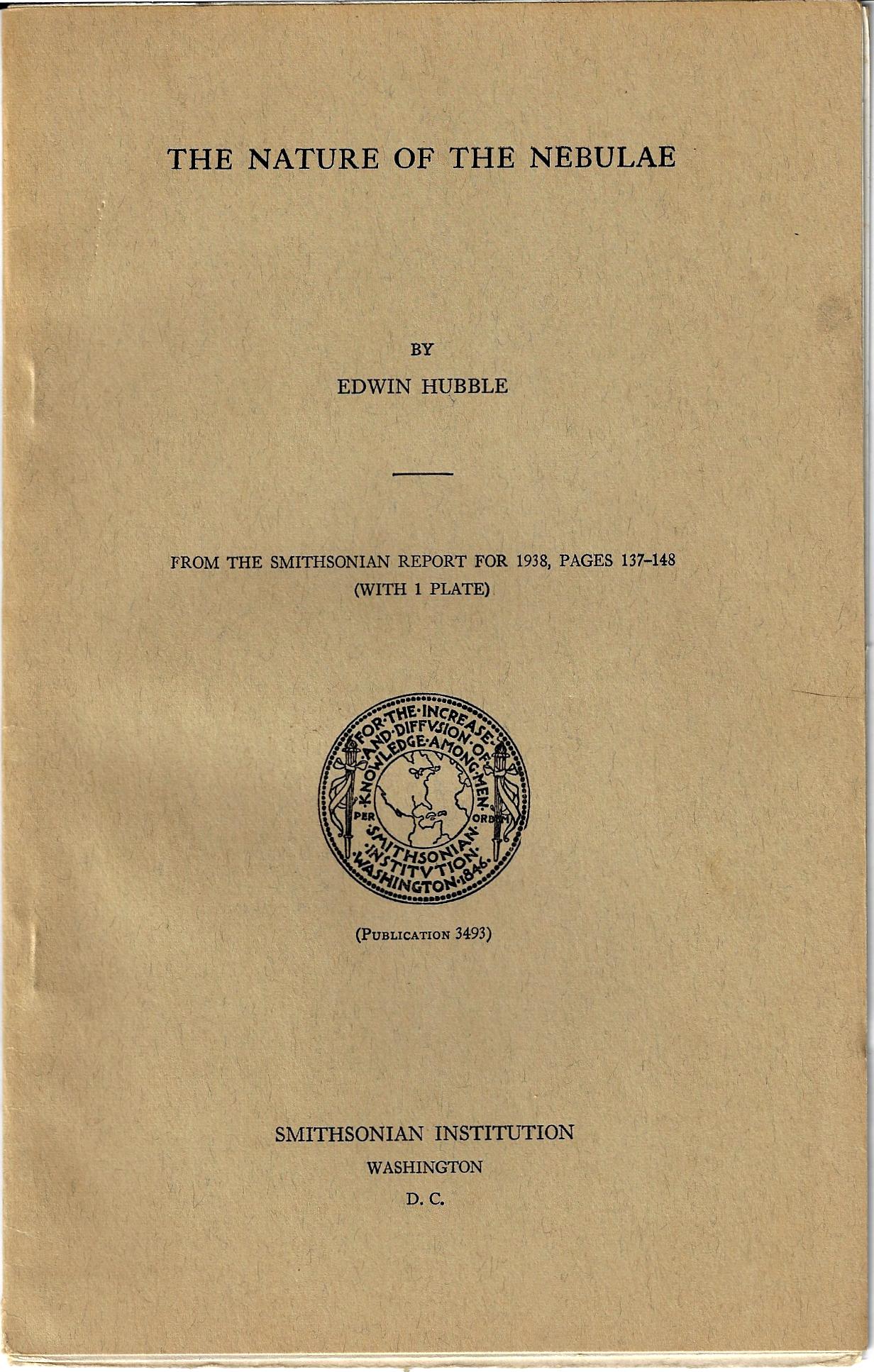
    Edwin Hubble, “The Nature of the Nebulae”, offprint from the Smithsonian Report for 1938, pages 137-148, with one plate), publication 3493. Published by the Smithsonian Institution in Washington, D.C., 1939.  24cm.

    Original wrappers.  Very fine condition, and save for a faded 5mm blemish on upper front cover right corner, in nearly new condition.  $95

    “Hubble was the founder of modern extragalactic astronomy and the first to provide observational evidence for the expansion of the universe Hubble was the first to introduce a significant classification system for galaxies  He presented this at the meeting of the International Astronomical Union at Cambridge, England, in 1925 and it was published the next year in the Astrophysical Journal… The classification was essentially empirical and independent of any assumptions concerning the evolution of galaxies. ..”

    “Despite the advance in knowledge in the last forty years, Hubble’s claim to have introduced order into the apparent confusion of nebular forms and to have shown that galaxies are closely related members of a singly family stands. It must be regarded as one of his most significant achievements.

    By 1929 Hubble had obtained distances for eighteen isolated galaxies and for four members of the Virgo cluster. In that year he used this somewhat restricted body of data to make the most remarkable of all his discoveries and the one that made his name famous far beyond the ranks of professional astronomers.”

    Hubble’s (and Humason’s ) observations on the greater distances of fainter galaxies…”Hubble’s law was extended to a distance of over 100 million light-years, the straight-line relationship between velocity and distance being maintained. This result has come to be generally regarded as the outstanding discovery in twentieth-century astronomy. It made as great a change in man’s conception of the universe as the Copernican revolution 400 years before. For, instead of an overall static picture of the cosmos, it seemed that the universe must be regarded as expanding, the rate of the mutual recession of its parts increasing with their relative distance….”–DSB

    The Problem of the Expanding Universe, 1943

    Hubble expanding052

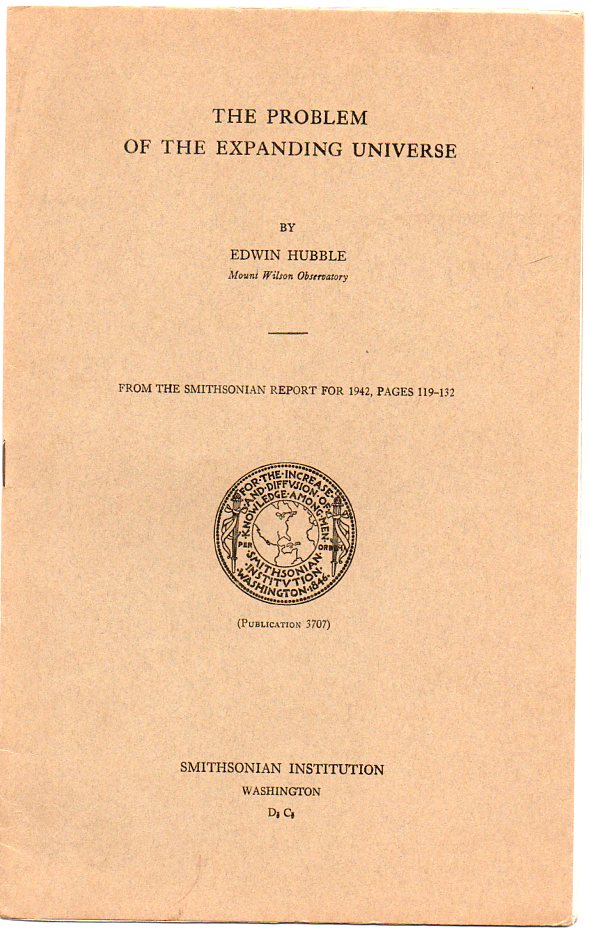
    In his great summary (The Problem of the Expanding Universe) of the development of the velocity-distance relation, the Big Bang and all that,  Edwin Hubble offers concise appraisal of the research to this point (in which Hubble and his assistant Milton Humason were prominent members of its founding studies). Hubble provided the first experimental data supporting the expanding universe theory of Georges Lemaitre’s cosmology (the “hypothesis of the primeval atom”), Einstein’s GRT and the mathematical equations of Alex. Friedmann, finding that the distance of galaxies were proportional to their redshifts (Hubble’s Law, 1929).  The whole thing enjoyed a bigger, more explosive life once it had been given its  more provocative and user-friendly name by Sir Fred Hoyle, who called the idea “the Big Bang” in 1949.  (Sir Fred was actually attacking the idea and must’ve thought his tag was to be demeaning, but as a proponent of the steady state theory, Hoyle’s plan backfired, a proof that irony exists.) The steady state model was more or less put to sleep when the cosmic microwave background radiation (first proposed by George Gamow, Ralph Alpher and Robert Herman in 1939) was “discovered ” in 1964 by Penzias and Wilson, this providing further experimental confirmation for the Big Bang hypothesis. 

    “Meanwhile, on the basis of the evidence now available, apparent discrepancies between theory and observation must be recognized. A choice is presented, as once before in the days of Copernicus, between a strangely small, finite universe and a sensibly infinite universe plus a new principle of nature.”

    It is an excellent approximation for a semi-general-public speech (to the Smithsonian Institution crowd during the war in 1943), and reminds me of one of his other, similarly spot-on statements, one of the greatest understatements in 20th century astrophysics The statement appears in a further report on Hubble/Humason studies in The Velocity-Distance Relation Among Extra-Galactic Nebulae  (Mount Wilson Observatory,  1931) ,  a regarding their understanding of the phenomena and the expanding universe, the authors take many steps back, and say in the concluding paragraph:

    “…the writers are constrained to describe the apparent velocity-distance displacements without venturing on the interpretation and its cosmological significance”.

    They basically lay out the functioning of the universe and the best understanding of how we got to where we are in the cosmos (Vesto Slipher notwithstanding), and how according to their understanding that the universe is expanding and is consistent with all known laws, that they decide to not say anything, um, philosophical, in the light of disrupting the idea of the creation of all things.

    Hubble did have a way with words, his own way, though he was able to communicate a difficult series of ideas simply, as we can see in the opening of his Expanding Universe paper: 

    “Mathematicians deal with possible worlds, with an infinite number of logically consistent systems. Observers explore the one particular world we inhabit. Between the two stands the theorist He studies possible worlds but only those which are compatible with the information furnished by observers. In other words, theory attempts to segregate the minimum number of possible worlds which must include the actual world we inhabit. Then the observer, with new factual information, attempts to reduce the list still further. And so it goes, observation and theory advancing together toward the common goal of science, knowledge of the structure and behavior of the physical universe.”

    And this lovely summation:

    “Current theory starts with two fundamental principles : general relativity and the cosmological principle. General relativity states that the geometry of space is determined by the contents of space, and formulates the nature of the relation. Crudely put, the principle states that space is curved in the vicinity of matter, and that the amount of curvature depends upon the amount of matter. Because of the irregular distribution of matter in our world, the small scale structure of space is highly complex. However, if the universe is sufficiently homogeneous on the large scale, we may adopt a general curvature for the universe, or for the observable region as a whole, just as we speak of the general curvature of the earth’s surface, disregarding the mountains and ocean basins. The nature of the spatial curvature, whether it is positive or negative, and the numerical value, is a subject for empirical investigation.”

    “The second, or cosmological principle is a pure assumption – the very simple postulate that, on the grand scale, the universe will appear much the same from whatever position it may be explored. In other words, there is no favored position in the universe, no center, no boundaries. If we, on the earth, see the universe expanding in all directions, then any other observer, no matter where he is located, will also see the universe expanding in the same manner. The postulate, it may be added, implies that, on the grand scale, the universe is homogeneous and isotropic – very much the same everywhere and in all directions.”

    “Modern cosmological theory attempts to describe the types of universes that are compatible with the two principles, general relativity and the cosmological principle. Profound analysis of the problem leads to the following conclusions. Such universes are unstable. They might be momentarily in equilibrium, but the slightest internal disturbance would destroy the balance, and disturbances must occur. Therefore, these possible worlds are not stationary. They are, in general, either contracting or expanding, although theory in its present form does not indicate either the direction of change or the rate of change. At this point, the theorist turned to the reports of the observers. The empirical law of red shifts was accepted as visible evidence that the universe is expanding in a particular manner and at a known rate. This arose the conception of homogeneous expanding universe of general relativity.”

    I like Hubble.

    Notes:

    The paper begins:

    “I PROPOSE to discuss the problem of the expanding universe from the observational point of view. The fact that such a venture is permissible is emphatic evidence that empirical research has definitely entered the field of cosmology. The exploration of space has swept outward in successive waves, first, through the system of the planets, then, through the stellar system, and, finally, into the realm of the nebulae. Today we study a region of space so vast and so homogeneous that it may well be a fair sample of the universe. At any rate, we are justified in adopting the assumption as a working hypothesis and attempting to infer the nature of the universe from the observed characteristics of the sample. One phase of this ambitious project is the observational test of the current theory of the expanding universes of general relativity. ” 

    ·Posted by :

    ·in:

  • Rare Early Paper on Instrument Flying (1931)

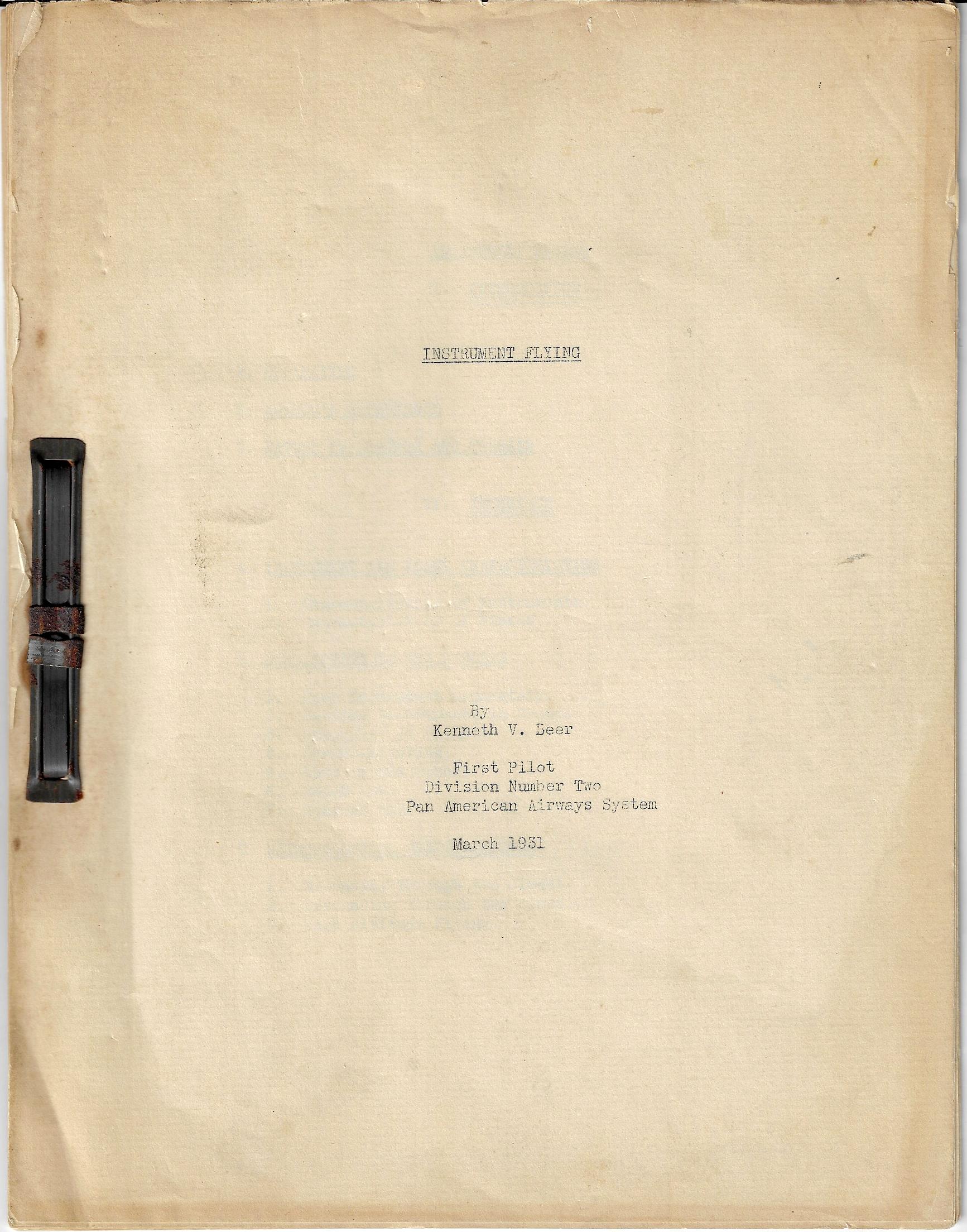
    BEER, Kenneth V.  Instrument Flying.  (Pan American Airways System) March 1931, 11×8.5″, 19 leaves, offset printing.  Two-hole punch at the left margin, bound with metal flexible clasps.   Between Good and Very Good condition.  Not located in the OCLC/WorldCat.  $750  

    Beer was “First Pilot, Division Number Two, Pan American Airways System”) and was evidently testing systems out for PanAm–and had in fact been doing so for two years at this point. He states in the introduction that “because (instrument flying) is important…and there doesn’t seem much known about it, and still less written concerning it…” as the reasons why he undertook to gather his thoughts on the subject. He then gives a broad overview of the subject, looking at “technique” (including characteristics of instruments), “description of the process” (“each instrument separately”, “reading instruments in groups”, “synchronization”, “rough air”, “loss of one engine”), “meteorological considerations” (“ascending through clouds”, “high altitude flying” for example). A third section is “tests with instrument flying/instruction plane”, looking at the methods of conducting tests (for various types of turns and dives, glides, tight spiral, spins); a fourth on “psychology” (“at first pilot has erroneous feelings”) and then a fifth and final section on dangers and advantages.  All in all a very interesting, concise, and broad review of the earliest days of instrument flying, and gives a real taste for the difficulties in flight when discussing how useful instrument flying would prove in conditions of low visibility/clouds/fogs and that sort of now-easily-surmountable early flight troubles.

    Beer instrument flying

    It is interesting to note that Beer writes about seven instruments–one more than the RAF established as their basic instrumentation. Included in this report are the unnamed turn indicator, bank indicator, climb indicator, and then the airspeed meter, compass, and altimeter. (No mention of Jimmy Doolittle’s historic first take/off and landing by instruments in 1929!) 

    “CAPTAIN KENNETH V. BEER has flown 27 years for Pan American. He has 23,000 pilot hours and is PAA’s senior captain in the Pacific Division. He was the 26th pilot to join Pan American.” –Pan American’s “Meet Your Captain” brochure, 1952

    “Forming the nucleus for expanded operations, veteran Pan American pilots piled up thousands of additional hours of wartime flying. Capt. Kenneth V. Beer now in charge of flight training, added some 1,340 hours of wartime flying to a 13,ooo-odd peacetime log which included the first passenger flight to New Zealand. Incidentally, he was one of three Coronado pilots who rushed :Marine torpedo bomber ground crews to Midway during the crucial hours of that decisive battle in 1942.”–Aircraft Yearbook, 1945


    ·Posted by :

    ·in:

    —
  • Mayor LaGuardia’s Report on the Progress of the WPA in NYC (1938)

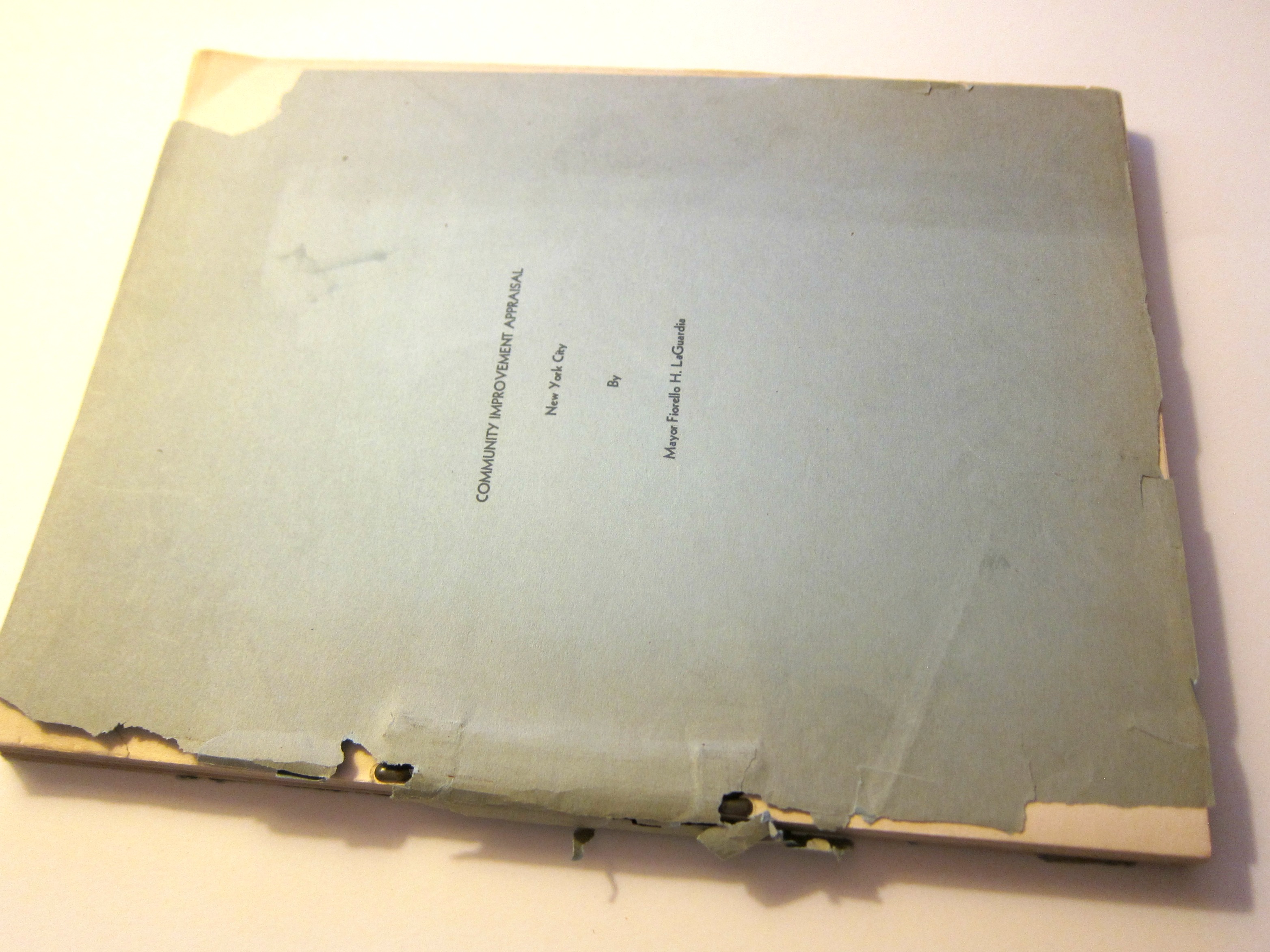
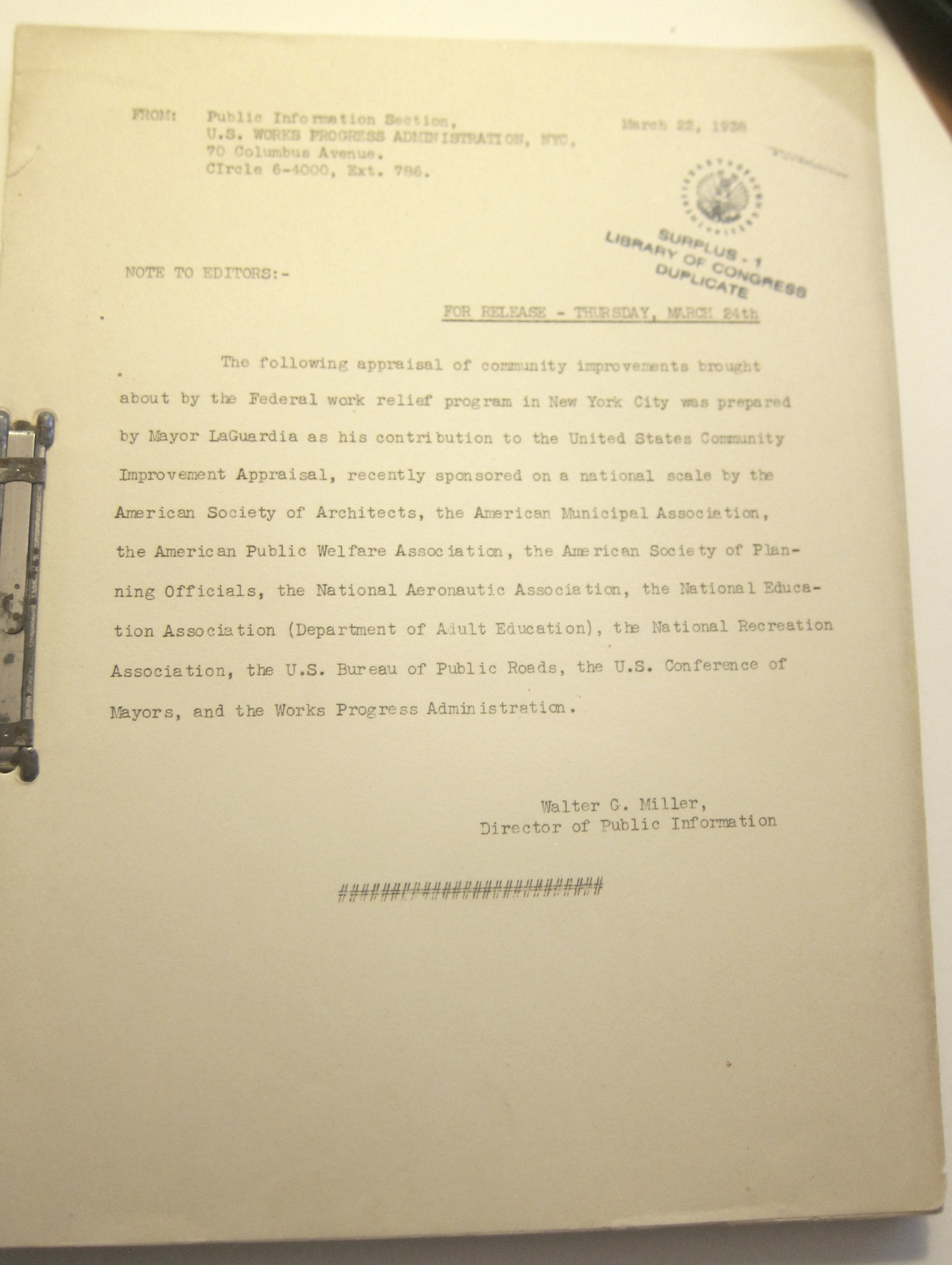
    Fiorello LaGuardia, Community Improvement Appraisal, New York City. Published by the Public Information Section, U.S. Works Progress Administration, NYC, March 22, 1938.  11×8.5″, 103 leaves, offset from typed originals.  Punch-bound with flexible metallic clasps. Provenance: Library of Congress. Condition: the original wrappers are somewhat chipped and in two pieces; the text, however, is still crisp and bright and in great condition. Also, there is a Library of Congress surplus stamp on the first page.  Raritythere are four copies of the printed version found in WorldCat/OCLC (opposed to holdings for a digital version), making this a scarce WPA collectible and an interesting document about the new public works in NYC constructed during the 1930’s.  $250

    LaGuardia improvement

    This document reviews new construction and improvements to existing structures  in the following areas: buildings (58 new large structures, 379 new buildings, 1,740 reconditionings) n schools and colleges, hospital, health centers, public libraries, public markets, prisons; parks (including 287 rehabilitate and 197 new playgrounds built); highways, sewers, water supply, bridges, tunnels, piers, “demolition and slum clearing”, marsh drainage, airports, police traffic signals, ferries, boardwalks, free lunches for schools, and educational programs.  

    LaGuardia improvement _2_

    ·Posted by :

    ·in:

    —
  • Skylight and Greenhouse Manufacturer’s Catalog, 1901

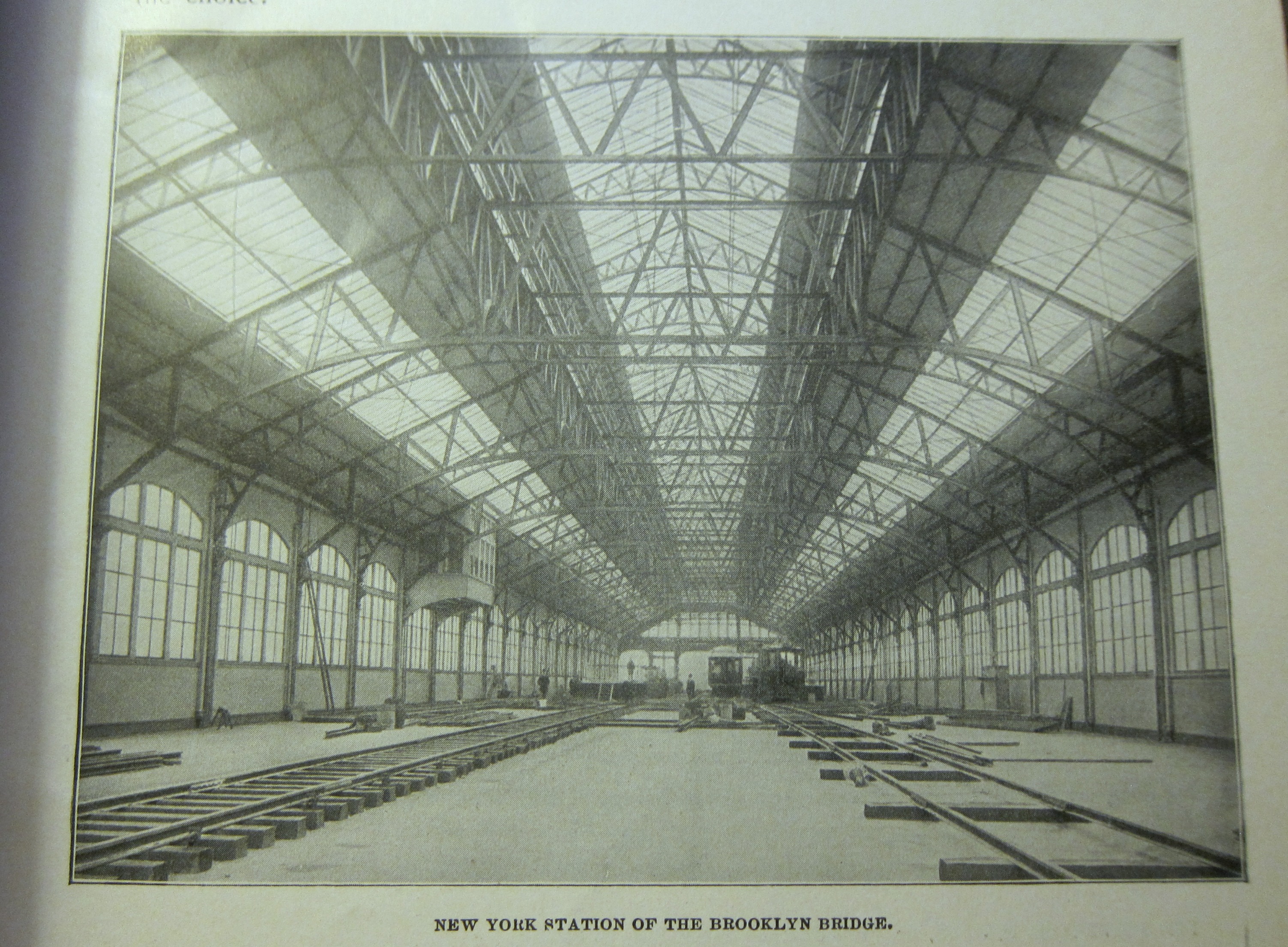
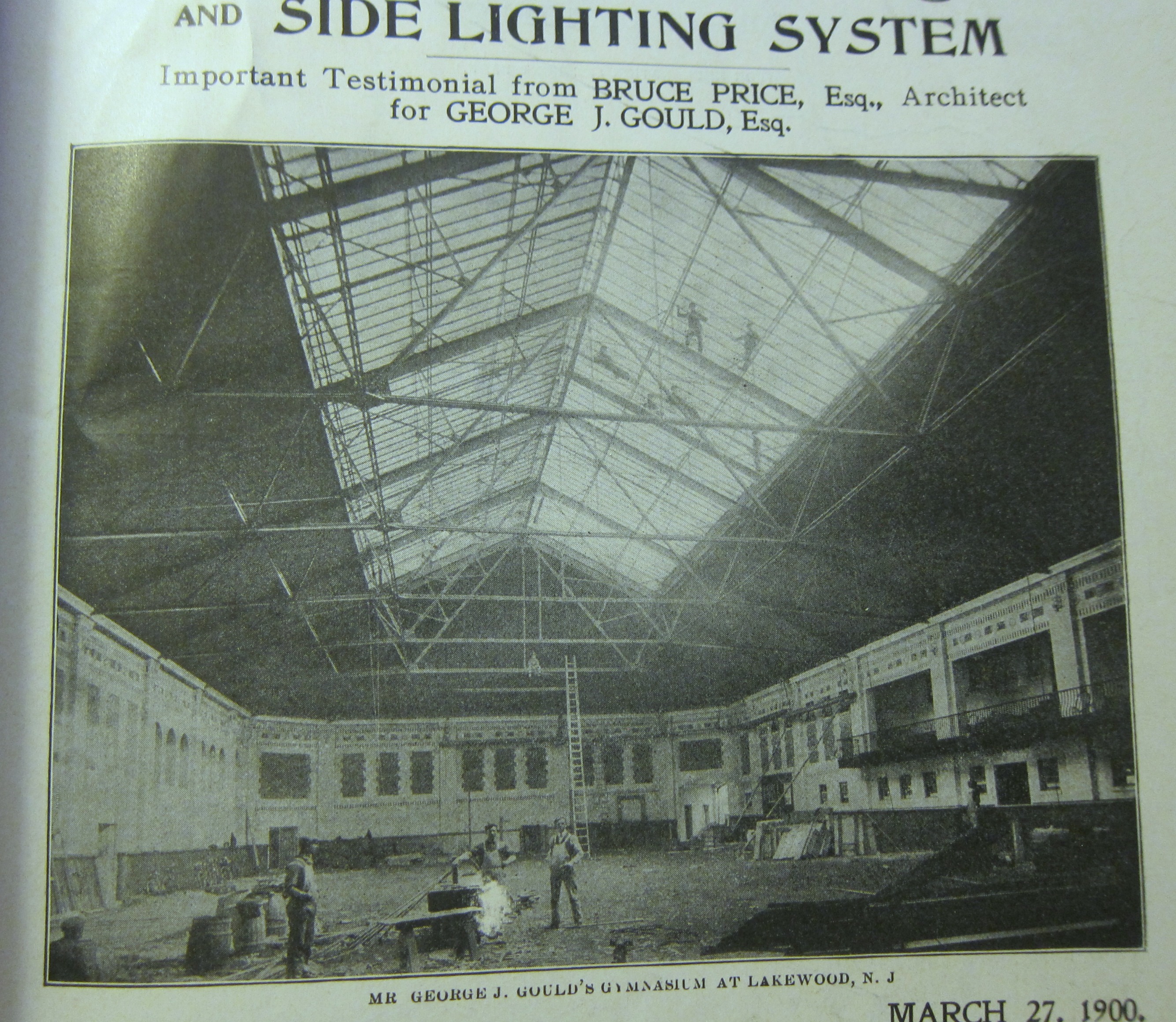
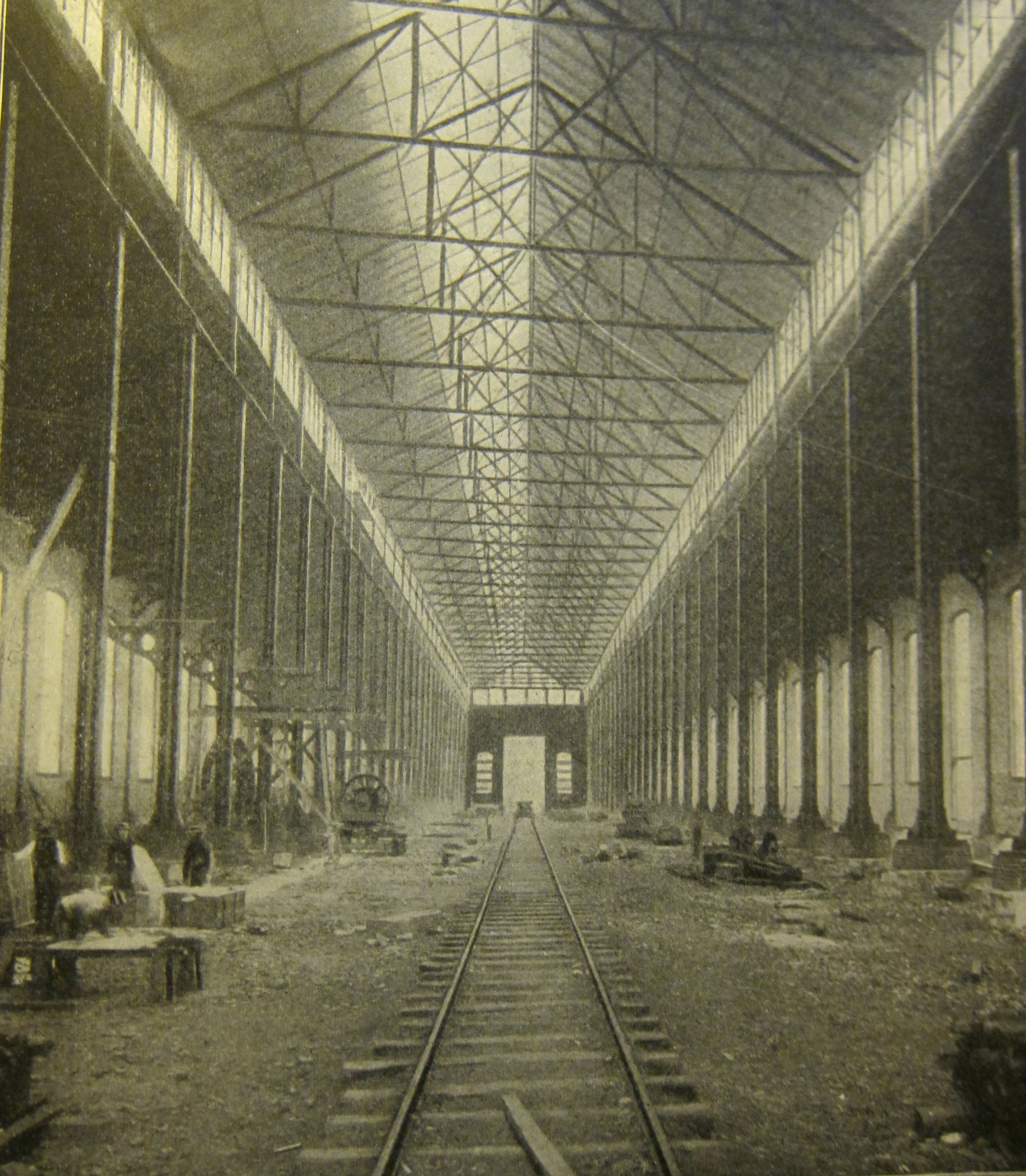
    Rendle’s Paradigm Skylights and Greenhouse Construction.  Manufacturer’s Catalog of Arthur E. Rendle Company (116 Nassau Street, NYC), June 1901 catalog.  26x20xm, 40pp, fully illustrated with captivating photos of mostly in-progress installations of the skylights, as well as the occasional schematic.  In the original wrappers.  

    There is only ONE copy located in WorldCat/OCLC (in Montreal).  Condition: there are two short tears going up along the spine cover top and bottom, though the wrappers are still strong and intact.  Very Good condition.  $250

    There are several lovely and unexpected images int eh catalog, including the train station on the Brooklyn end of the Brooklyn Bridge:

    Paradigm _1_


    Paradigm _2_

    Also the Bethlehem Iron Co. machine shop in Bethlehem, Pa.:

    Paradigm _3_


    ·Posted by :

    ·in:

  • Poster Advertising in Switzerland

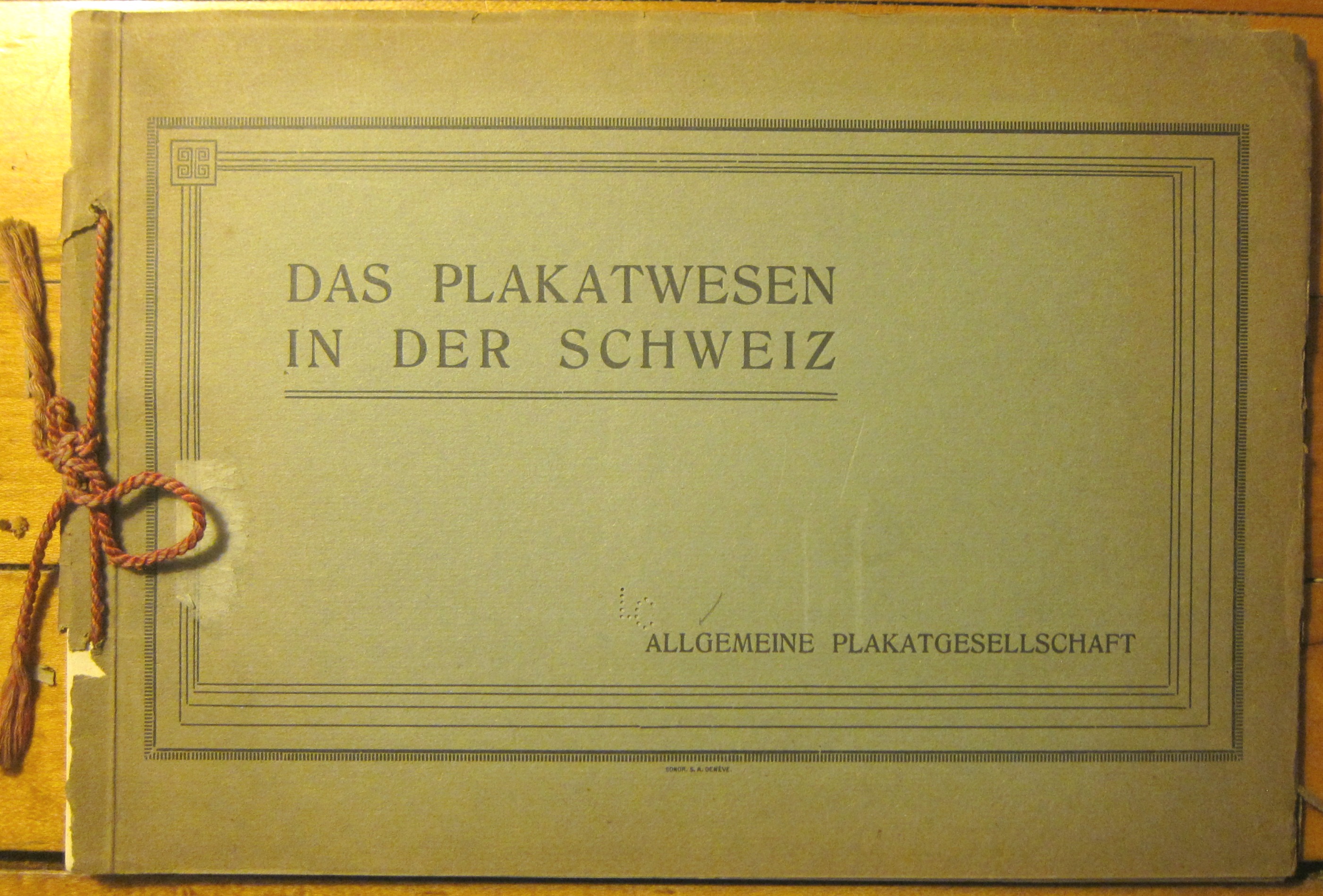
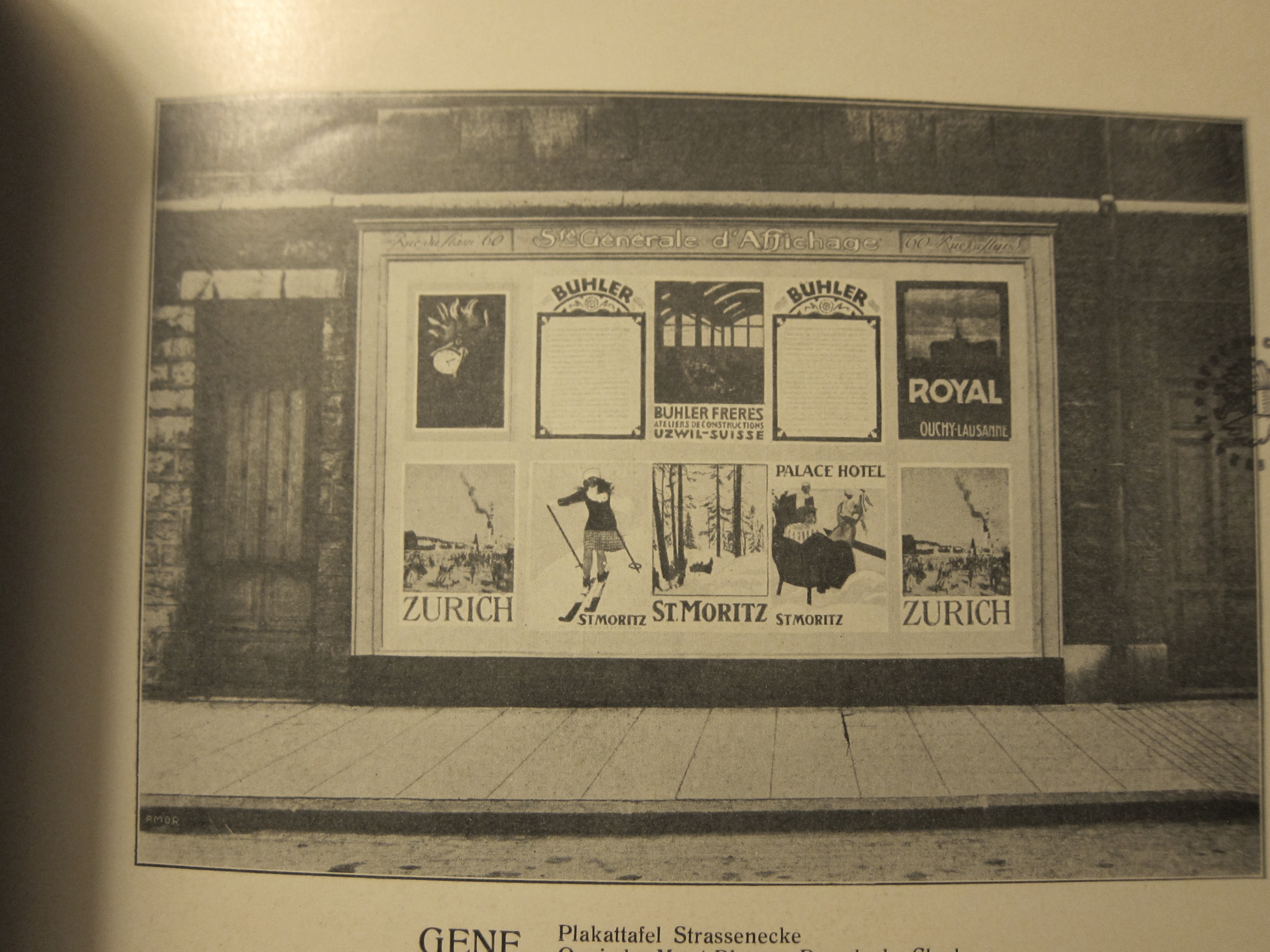
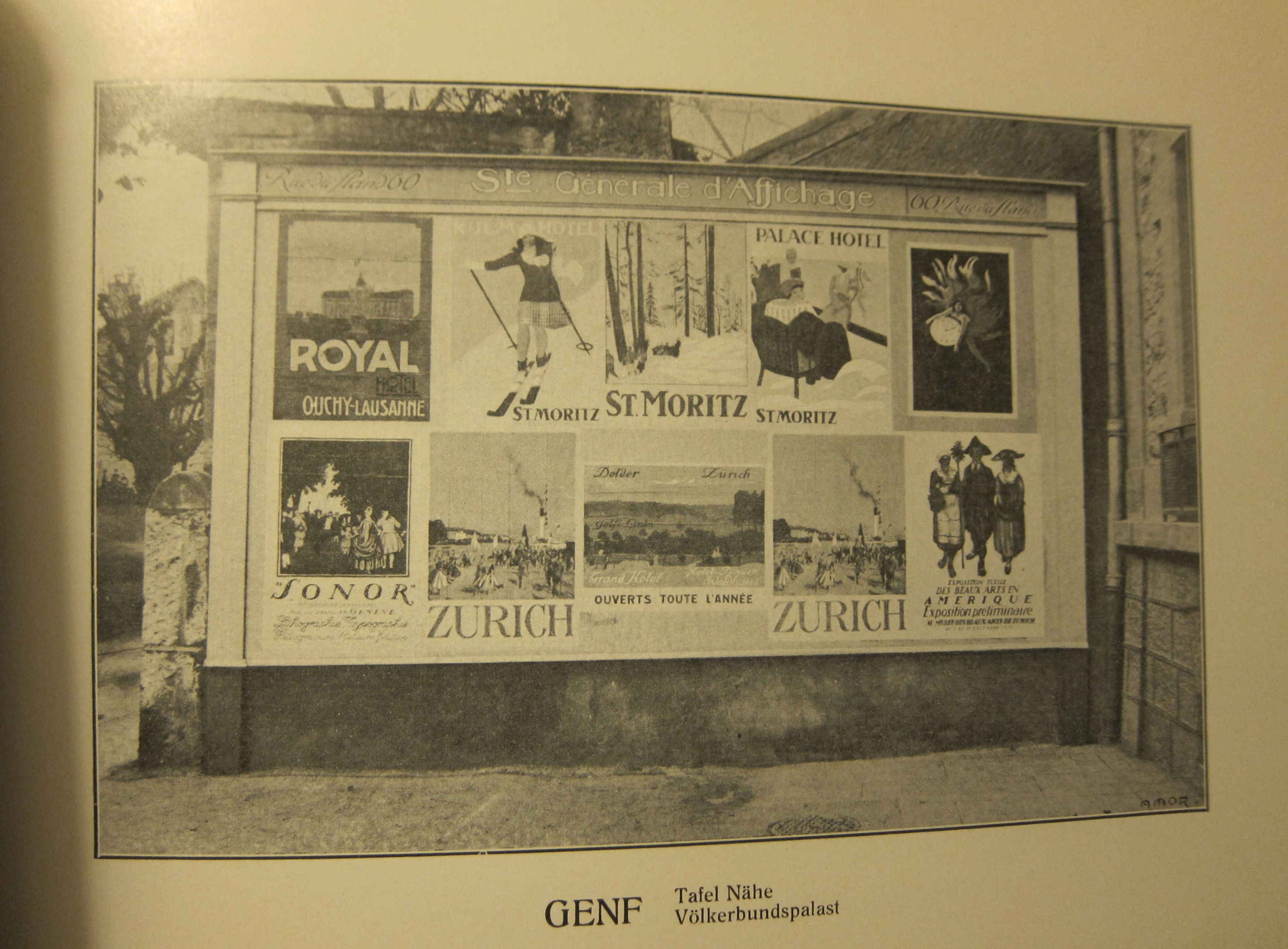
    Das Plakatwesen in der Schweiz. Allgemeine Plakatgesellschaft.  Printed by Sonor in Geneva, circa 1928-1932 (?).  17x24cm, 16 leaves, all of which are photos of outdoor poster advertising (as seen in the examples here). Bound in paper wrappers with a cord tie.  $250 

    Provenance: Library of Congress, with their 6mm perforated “LC” on the front wrapper and their rubber stamp “surplus duplicate” on the first page/photo

    Condition: the wrappers were made to fail, I think, being made to overhang the text block by a few millimeters, and so ensuring that most of the edges have gotten dinged and banged up. The spine cover has come away, leaving two pieces for the cover, though those are held in place by the binding.  Overall, still a GOOD copy.__+__

    This is an unusual work showing examples of Swiss poster advertising.  So far as I can determine, there are NO copies of this work in the OCLC/WorldCat.  Curious and scarce. 

    Swiss advertising _1_ cover

    Swiss advertising _2_

    Swiss advertising _3_


    ·Posted by :

    ·in:

  • Rare Work on the Illano Estacado (1936)

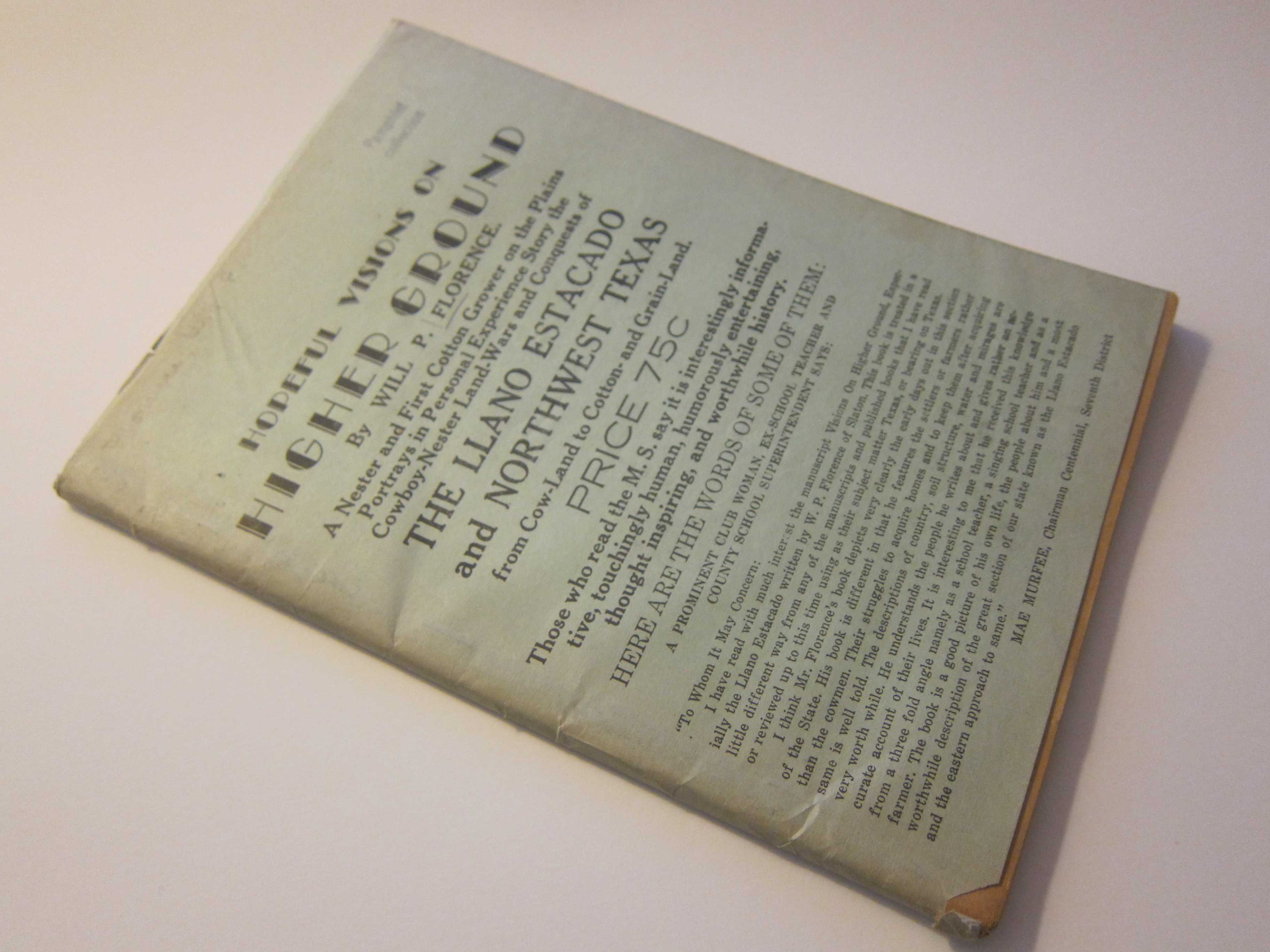
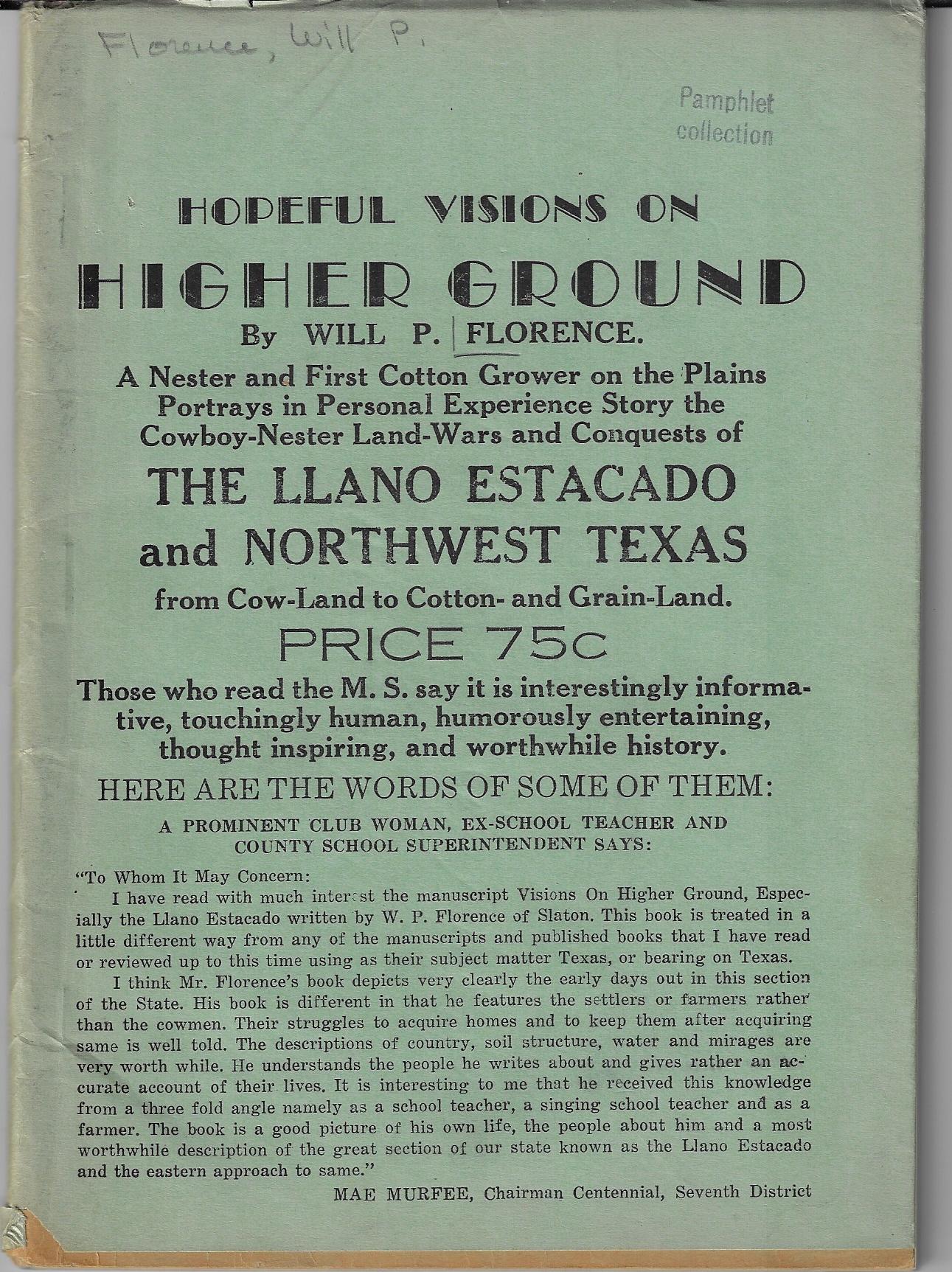
    IMG_8869Will P. Florence, Hopeful Visions on Higher Ground. A Nester and First Cotton Grower on the Plains Portrays in Personal Experience Story the Cowboy-Nester Land-Wars and Conquests of the Llano Estacado from Cow-Land to Cotton- and Grain-Land.  Printed by the Slatonite in Slaton, Texas. Very nice copy, fresh and crisp, a fine copy in a very good dust jacket.    $350

    “Personal narrative story of the Cowboy and Nester contests for West Texas, especially the Llano Estacado, portraying the country’s scenery, resources and development in human history.”

    8.5×6.25″ (22cm), 92pp.  Bound in stiff wrappers WITH a dust jacket (!)  Provenance: Library of Congress, with a small “pamphlet collection” stamp on the front cover and the LC surplus/duplicate stamp on the rear cover.  

    Full text:  https://swco-ir.tdl.org/swco-ir/handle/10605/89474?show=full

    Llano estacado

    ·Posted by :

    ·in:

  • Poincarehenri Sur Le Dynamique De Lelectron Incomptes Rendusparis 1905 Volume 140 Pp 1504 1508 Offered In The Entire

    POINCARE, Henri. “Sur le dynamique de l’electron”, in Comptes Rendus, Paris,  1905, volume 140, pp 1504-1508, offered in the entire bound volume of 1749pp for the half year.  Bound in boards and  leather spine, the spine cover nearly detached.  A good copy.  $550  (English translation found here.)

    “HENRI POINCARE’S major work on a theory of the electron is “Sur la dynamique de l’electron”.  It is considered, by some, as evidence that POINCARE, more than anyone else in the late 19th and early 20th centuries, anticipated EINSTEIN’S 1905 theory of relativity.”

    “This study will focus on POINCARE’S attempt in “Sur la dynamique…” to formulate a purely electromagnetic theory of a deformable electron that is consonant with his conception of the principle of relativity. PPoincare believed that if all physical processes could be reduced ultimately to the interaction of charged particles which move about in LORENTZ’S all-pervasive ether, then such a theory would be an important step toward a unified description of nature. Thus,  the laws of the various branches of physics, and in particular NEWTON’S second law,  could be derived from those of electromagnetism. This scientific viewpoint (or  Weltbild) will hereafter be referred to as the “electromagnetic world-picture. ”…–From the introduction of Arthur Miller’s fine study of this paper in Archive for History of Exact Sciences, Vol. 10, No. 3/4/5 (18.IX.1973), pp. 207-328, “A Study of Henri Poincaré’s “Sur la Dynamique de l’Électron”.”

    It has always seemed strange to me that Poincare never followed up on this paper, nor did he seem publicly (?) interested in Einstein’s great work of 1905; nor did Einstein show much interest in Poincare’s work on this topic (or nearly any other), and was otherwise indisposed when he was approached to write an appreciation of Poincare upon is death six years later. 

    ·Posted by :

    ·in:

    —
  • Soem Work by the Discipline-Bending Nicholas Rashevsky

    RASHEVSKY, Nicholas.  “Mathematical Biology of Learning to Drive and Automobile”, in the Bulletin of Mathematical Biophysics, March, 1963, volume 25/1, pp 51-9, offered in the monthly issue of pp 1-123. Original wrappers. VG copy. SOLD

    _____.  “The Geometrization of Biology”,  in the Bulletin of Mathematical Biophysics, volume 18/1, pp 31-57.  In the full monthly issue of 87pp.  Formerly from the library of the Committee on Mathematical Biology, University of Chicago,(mostly blacked-out with magic marker on the front wrapper) the publishers of the Bulletin. This was H.D. Landahl’s copy, with his name at top front wrapper.  SOLD

    _____.  “Mathematical Biophysics of Growth”, in The Bulletin of Mathematical Biophysics, volume 1, number 3, September 1939, pp 119-128 in the monthly issue of pp 119-149. Original wrappers. Very nice copy; there’s a tear in the upper third wrapper spine. This is a scarce copy of the publication in the original (white) wrappers.  SOLD

Recent Posts

Archives

Categories