A Daily History of Holes, Dots, Lines, Science, History, Math, Physics, Art, the Unintentional Absurd, Architecture, Maps, Data Visualization, Blank and Missing Things, and so on. |1.6 million words, 7500 images, 4.9 million hits| Press & appearances in The Times, Le Figaro, Mensa, The Economist, The Guardian, Discovery News, Slate, Le Monde, Sci American Blogs, Le Pont, and many other places… 5000+ total posts since 2008.

Category: Technology, History of

  • Mr. Burns, X-Rays, and the How to Answer a Telephone Call in 1877

    JF Ptak Science Books  Post 2906 (Overall post 5113)
    IMG_3383Mr. Burns, the terminally-alive money monster from The Simpsons, evidently gets it right when he answers his telephone with the phrase “ahoy ahoy”. It seems to me that was the established courtesy in the very earliest stages of telephonic communication. But how did you know the telephone was “ringing” to answer it in 1877 if there was no “ringer”?

    In 1877, Alex Graham Bell’s invention and demonstration of the telephone was only about a year old and was followed immediately by worldwide interest and experimentation. One aspect of the telephone that I hadn’t thought about before but stumbled upon last night1 is something seemingly simple—how did you know to answer a telephone call in 1877? Evidently, you did it with some difficulty, as there seems yet to have been a ringer/notification that a person was receiving a call.

    It seems that the first person to address this issue in a published paper was—unexpectedly–the discoverer of the x-ray, Wilhelm Rontgen.

    Rontgen (1845-1923) was still quite young and a lecturer at Strasbourg in 1877, publishing in the area of thermal conductivity of crystals (1870) and specific heats of gases; and he was still eighteen years away from his own epochal contribution to the history of science  (“Ueber eine neue Art von Strahlen”, “On a New Type of Ray” in 1895) and then for reasons presently unknown to me he was attracted to an issue with the new and magnificent invention of the telephone.
    He states the case pretty clearly in the opening paragraph of his 600-word article:

    “THE speaking of the telephone is admittedly so weak that it can only be caught by keeping the instrument in

    immediate contact with the ear. Hence there is transmitted through the telephone in its present

    form no sound which would be intense enough to announce to any one who was in a large room and who

    did not hold the telephone close to his ear, that a message was about to be sent from the transmitting station. 

    The consequence is that a warning apparatus must be attached to the telephone, so  that there may be no fear

    of missing a projected telephonic conversation.”

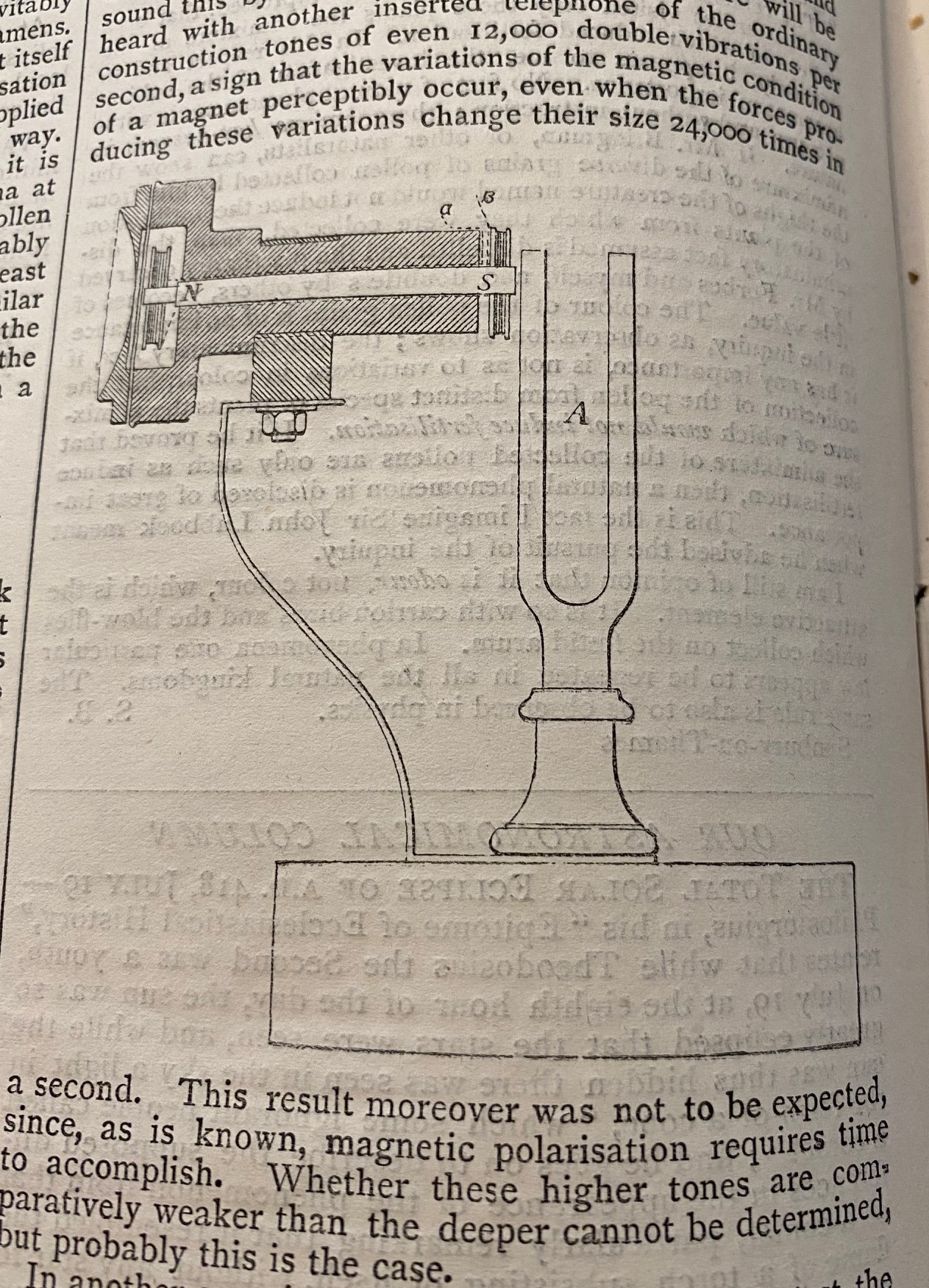
    Rontgen proceeds to experiment with an unused part of the telephone magnet attaching various tuning forks to the device which would become part of the circuit. He writes that:

    “the currents thereby induced in the coil are powerful enough to set the fork of the receiving station in such intense vibration that the sound may be distinctly heard in a large room; warned by this signal a person can in the usual way put the telephone to his ear and listen to the words of from the transmitting station. And so vice versa. “

    I’m not sure when a bell or warning device becomes part of the telephone experience after this, though I assume it comes quickly, once the issue had been identified. 

    Notes:

    Rontgen, W.C. “A Telephonic Alarum”, In NATURE, volume 17, no. 426, December 27, 1877, p165.

  • Where Suspended Railroads and Elevated Highways Meet: Los Angeles Traffic, 1939

    JF Ptak Science Books  Quick Post

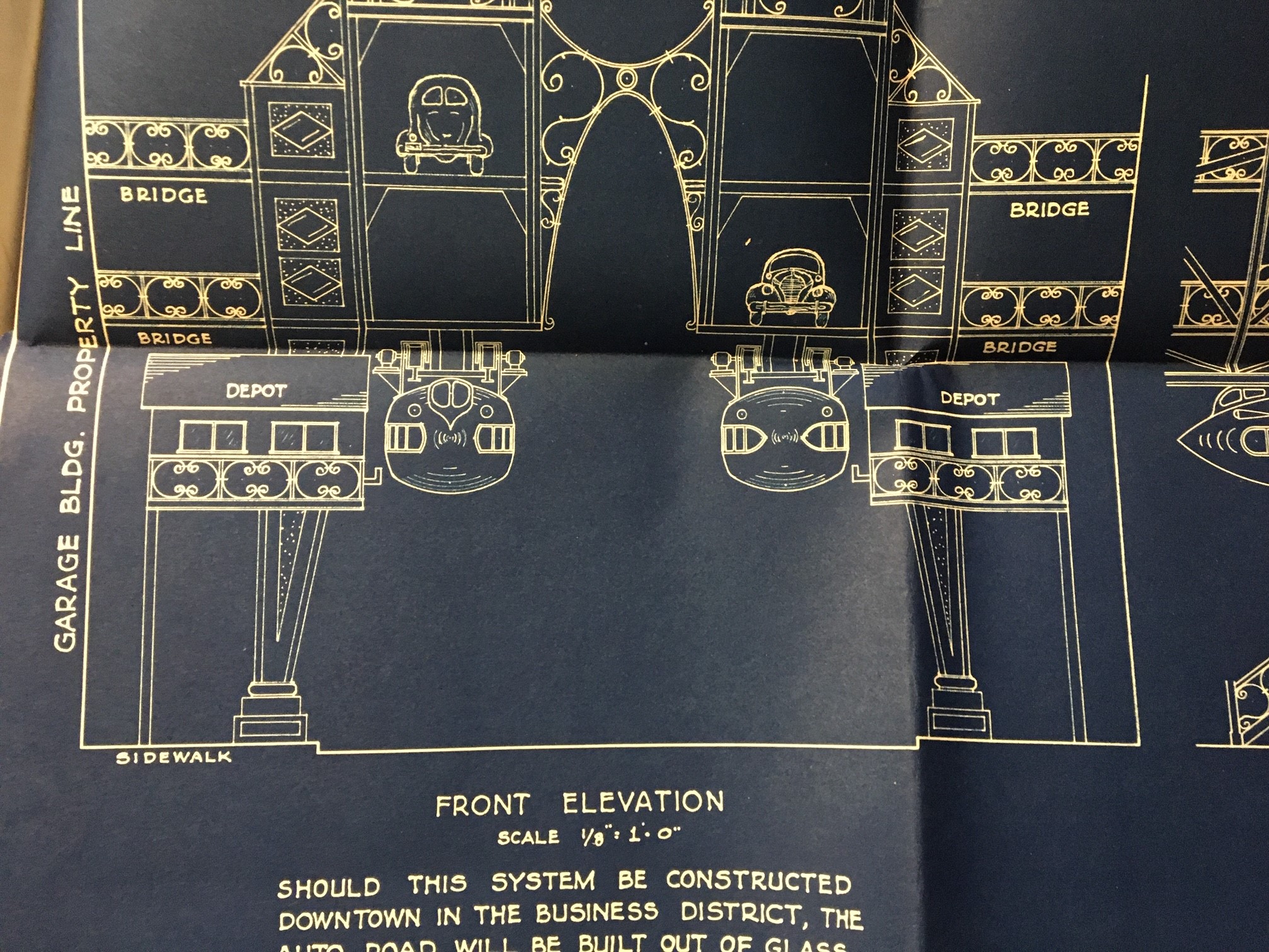
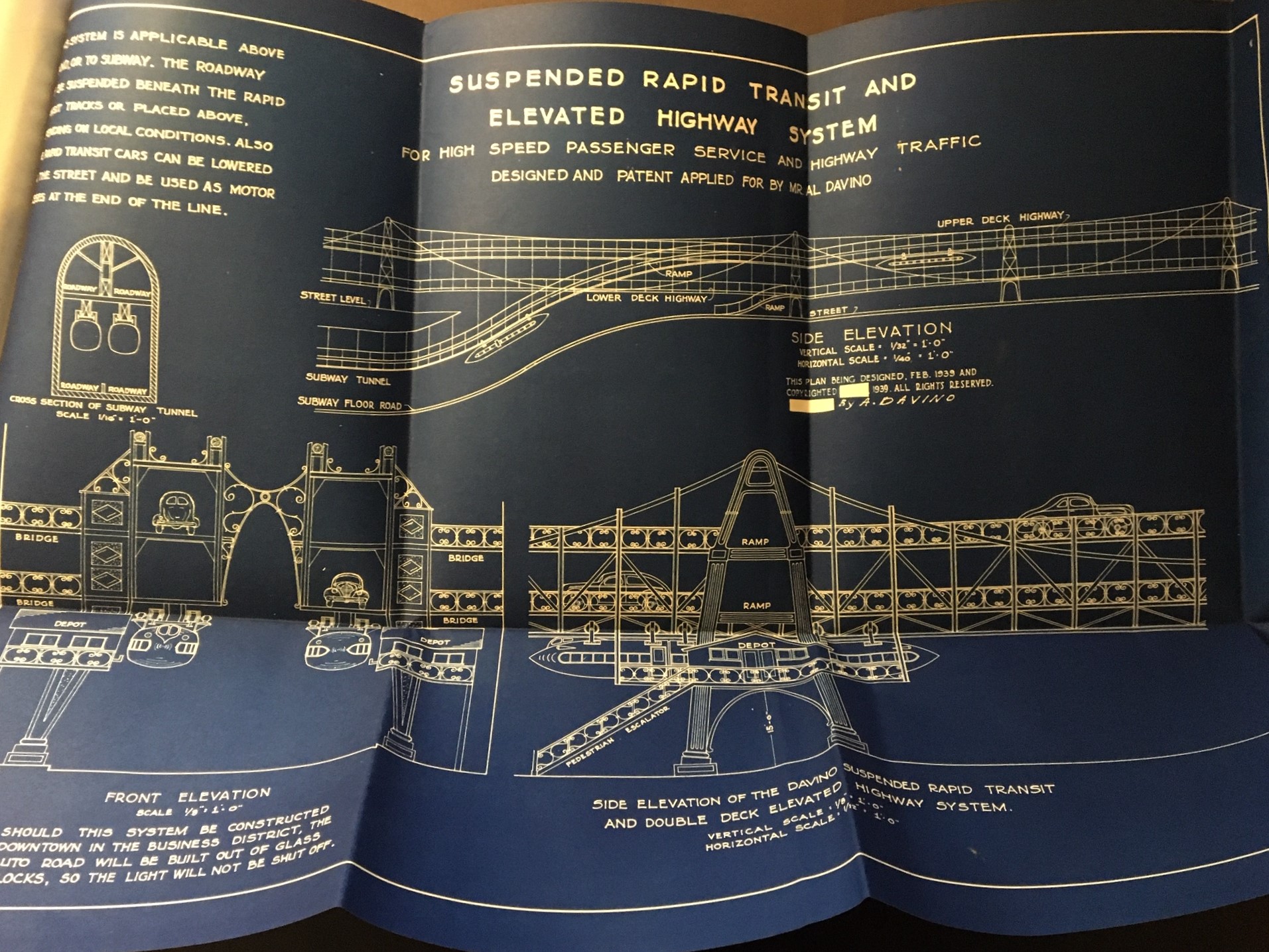
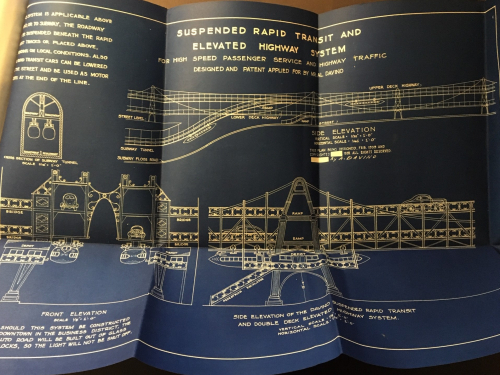
    Here we go: I unearthed a beautiful if not a very good solution to the traffic congestion problems in 1939 Los Angeles. It is a rare, self-published work of what seems to have received almost no attention, suggesting a combination of suspended railways and elevated roads to free up more space on the streets of L.A. It is the work of Alphonso Davino (1888-1965?) who wrote A Brief analysis of the Traffic Congestion Problem and its Economical Solution1 and presented it to city planners in 1939.  Mr. Davino had an entire system of transportation, though he seems to have luck in getting the ideas across a wider population in only occasional and obscure publications. 

    IMG_2251

    I can not find very much at all for Mr. Davino, though he is a patent holder for at least three associated designs/ideas dating from 1926 to 1950. [Semirigid Suspended Railway Structures, 1607875, (1923); Aerial Railway Apparatus patent 2234487 (1943); Suspended Rapid Transit System 2781001A (1950), (suspended vehicles with self-propelled vehicles).] I also found a reference to a suspended transportation system of some sort offered by him through his business “Aerial Apparatus” of Los Angeles (in the Mining Journal, vol 110, 6 November 1920, p 910).

    IMG_2254


  • Surfacing Underwater Work–the Ambrose Canal Dredging Measured in Woolworth Buildings (1913)

    JF Ptak Science Books  Quick Post

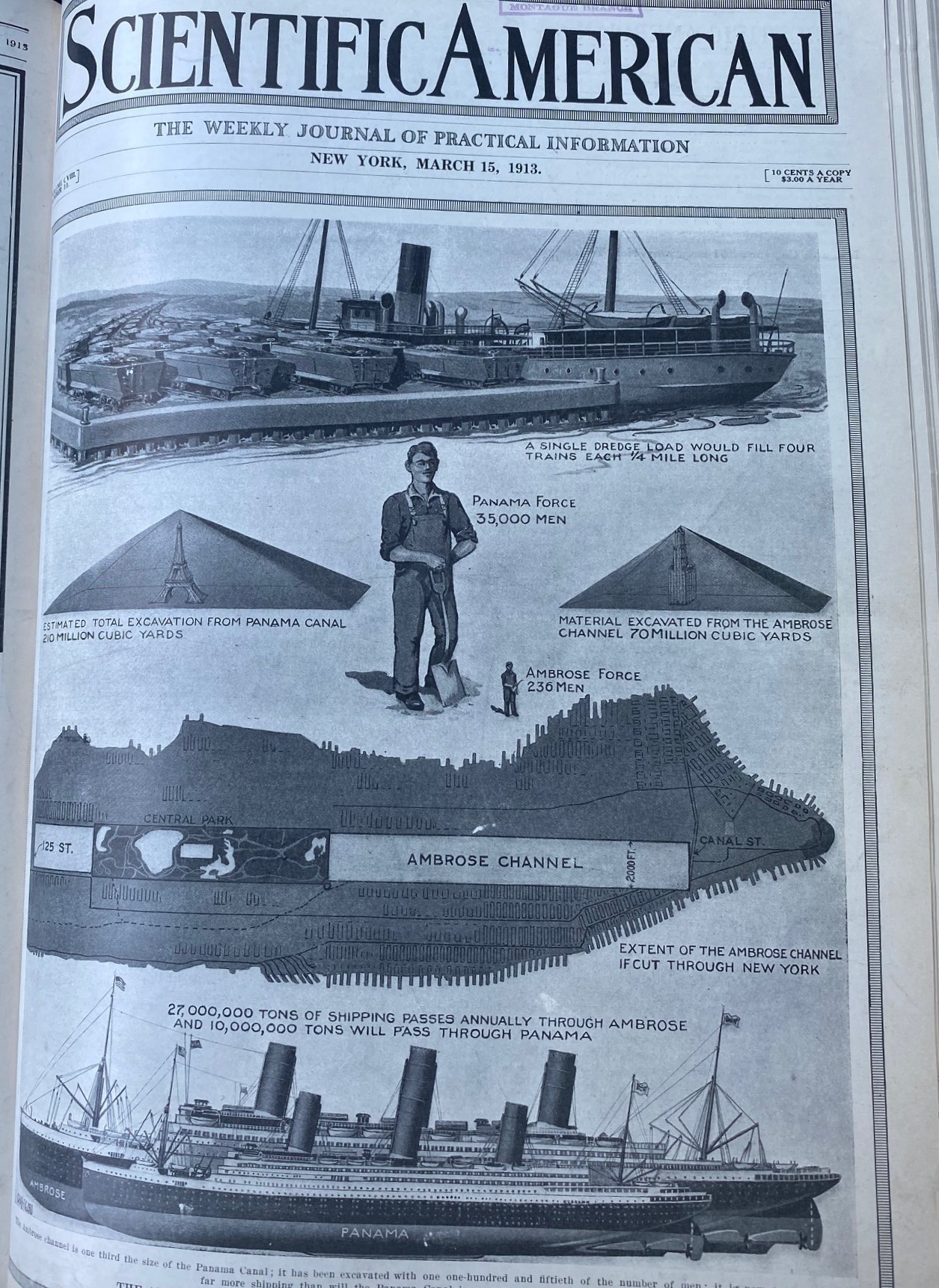
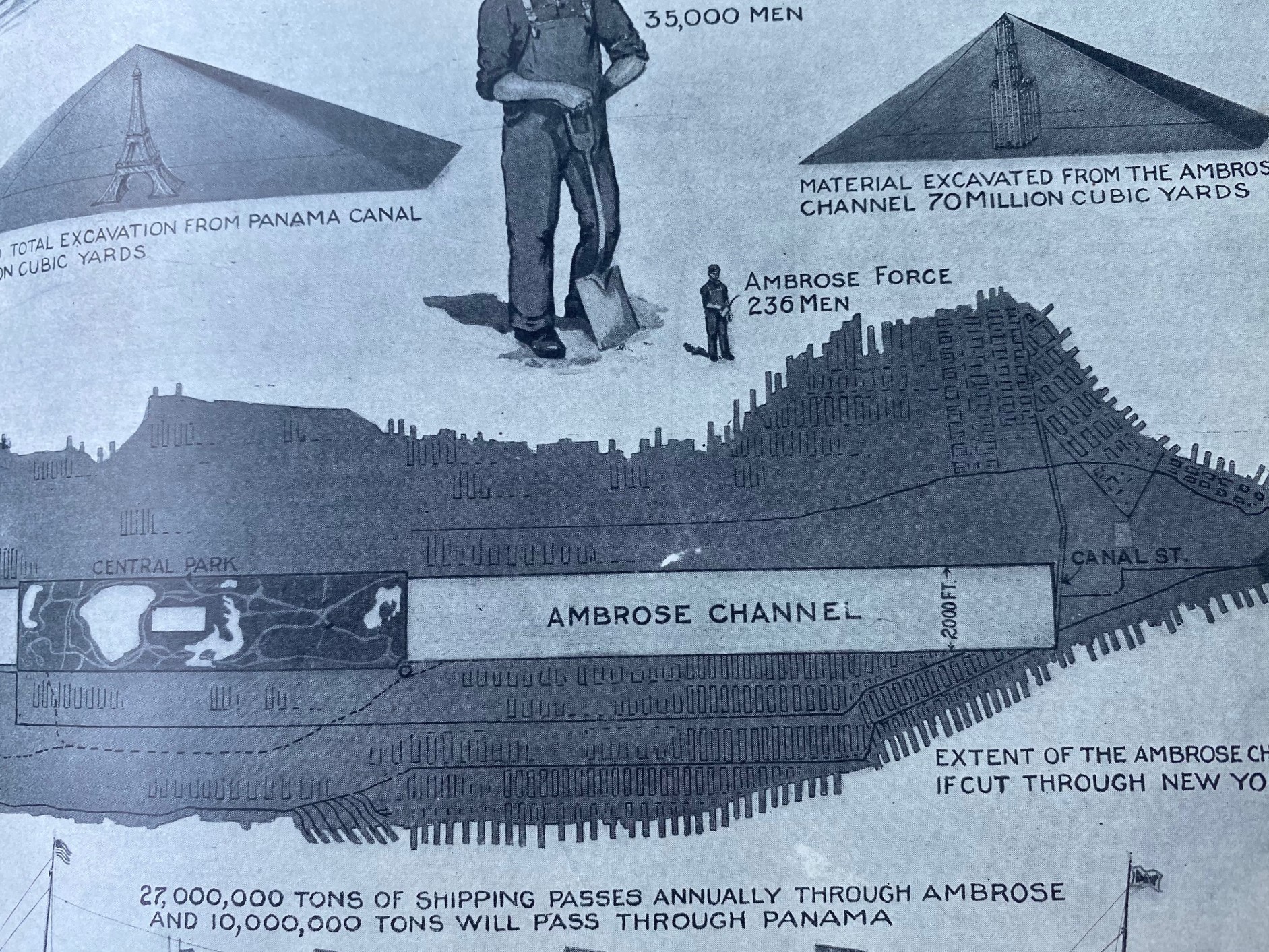
    IMG_2334 (1)Another great example of the artistic display of information using alternative comparison, and this just hours after finding/writing  about another example in this area.  This morning’s find uses several different types of comparisons, the first of which–like last night’s—is using a comparable entity to value the expression of quantity. And again, like last night’s, this short article (from Scientific American for 15 March 1913) uses the newly crowned Woolworth Building to illustrate how much dirt was removed in the dredging of the Ambrose Channel in NYC.  (The Ambrose Channel is in the entrance to NYC harbor, and it seems as though the dredging the author is talking about lies in the lower NYC harbor out past the Narrows.1)

    What was weighing on the mind of the writer was that this project removed  a very considerable amount of soil and was in some high fraction a comparable to the excavation of the Panama Canal, except that you couldn’t see any of the Ambrose project given that it was all taking place underwater. This effort in the SciAm was made to give some surfaceable form to the work going on  under the water in the Narrows. 

    There was a very considerable amount of earth removed, no doubt–difficult work, but not exactly an engineering feat like the Panama Canal that it was being compared to. Nevertheless the interesting minds of SciAm showed what the invisible channel would look like if it was dredging a 40’x15′ by multi-mile section of Manhattan, which is an excavation that would stretch from downtown to north of Central Park.  

    In any event, this reporting job must have been a good bit of fun (and it shows), and was a fairly elegant and memorable means of communicating some big numbers of an invisible project. 

    IMG_2335 (2)

    Notes:

    1. “Ambrose Channel is the only shipping channel in and out of the Port of New York and New Jersey. The channel is considered to be part of Lower New York Bay and is located several miles off the coasts of Sandy Hook, New Jersey, and Breezy Point, New York. Ambrose Channel terminates at Ambrose Anchorage, just south of the Verrazano Narrows Bridge, the gateway to New York Harbor, where it becomes known as the Anchorage Channel.”–Wikipedia


  • The Normandie That Failed (1942)

    JF Ptak Science Books  Post 2905

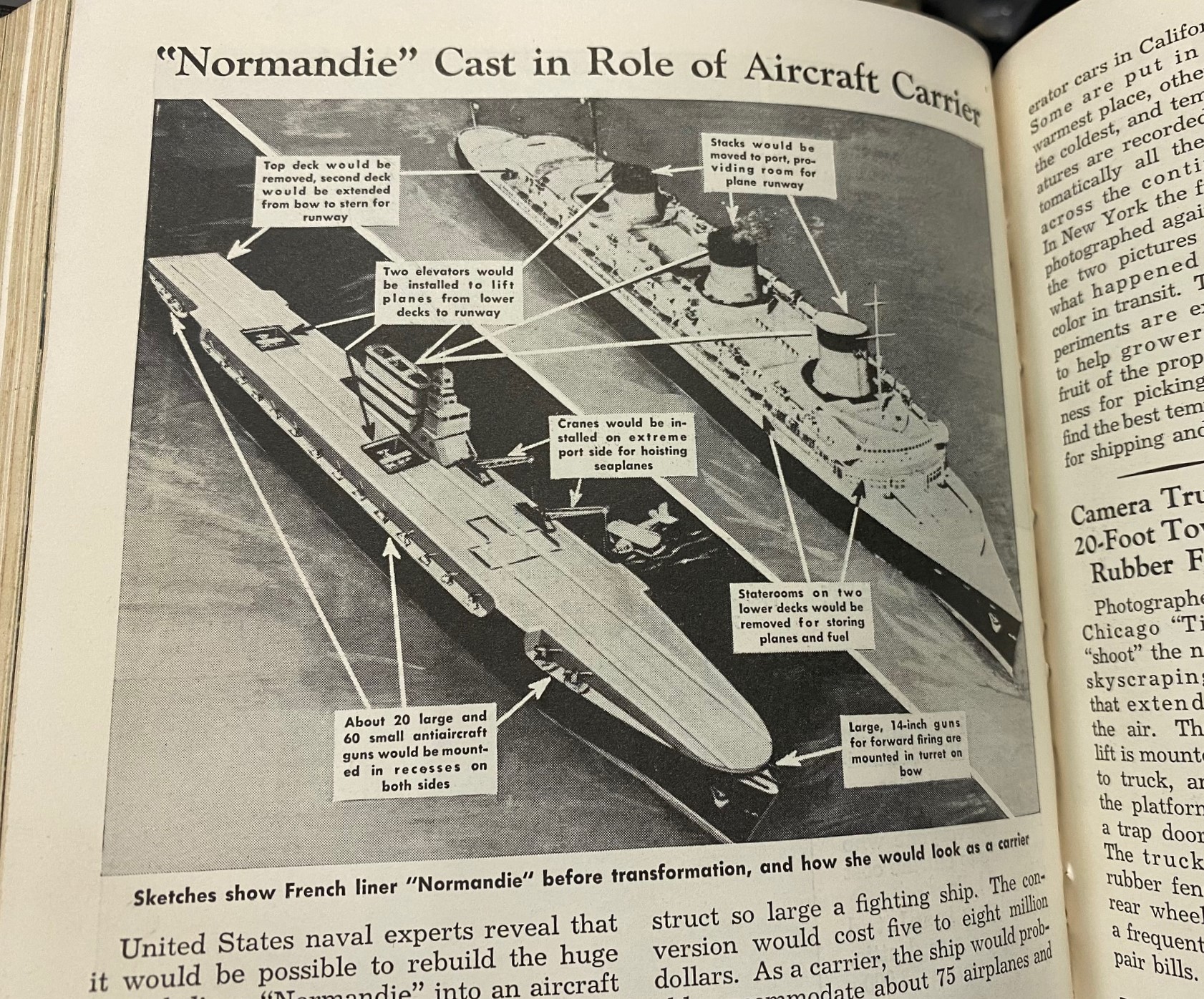
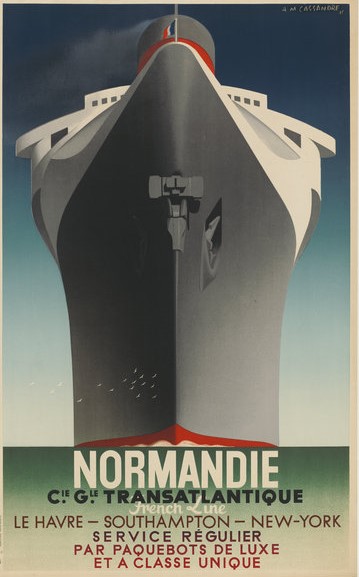
    Breezing through a volume of Popular Mechanic for 1942 I came across an article on refitting the French ocean liner, the Normandie.  The only thing I knew about her was that the ship was the subject of one of the all-time great travel posters (pictured below). The imagery for February 1942 was vastly different. It turns out that when the general war began in Europe the Normandie was in NYC harbor where it was more or less immediately interned. As a matter of fact after just a short while this great ship was tied up next to the RMS Queen Elizabeth and the Queen Mary, which meant the world’s three largest ocean liners were cheek and jowl to one another in NYC.  After Pearl Harbor the ship was put under the command of the U.S. Coast Guard, and after a very brief period the command was transferred to the USN. That’s where these plans come in, to re-purpose the ship into an aircraft carrier:

    IMG_2477

    But that was not to be and construction plans were made to transform the ship into a troop transport

    2017KC2259_jpg_lThen came the Great Misfortune.  In February 1942–the month that this Popular Mechanics was issued–the Normandie (renamed the USS Lafayette) caught fire, flamed out, capsized, and died. There was some amount of rumor and innuendo that the ship was sunk as a result of foreign intrigue, but a board of inquiry found otherwise.1 It seems that in the course of refitting that a blow ironically and tragically set on fire a pile of life preservers that were made of very buoyant by highly flammable fibre from the great kapok tree. The very effective fire suppressor was disengaged after the French sailors were led off, and, well, seemingly a lot of other unfortunate things played into one another to the critical result. It was a fatal fire for the ship. I recall seeing very unsettling pictures of the Normandie in LIFE magazine, capsized in shallow water and winter ice mud.

     There were efforts to revive her, retrieve her, bring the great ship back to life in one way or another, but all attempts failed, and the Normandie was sold for scrap in 1946 and was completely gone by 1948.

    Notes.

    1. “The investigation found evidence of carelessness, rule violations, lack of coordination between the various parties on board, lack of clear command structure during the fire, and a hasty, poorly-planned conversion effort.”–Wikipedia


  • An Episode in the History of Electro-LUXurient Parisian Dumbwaiters (1913)

    JF Ptak Science Books  Quick Post

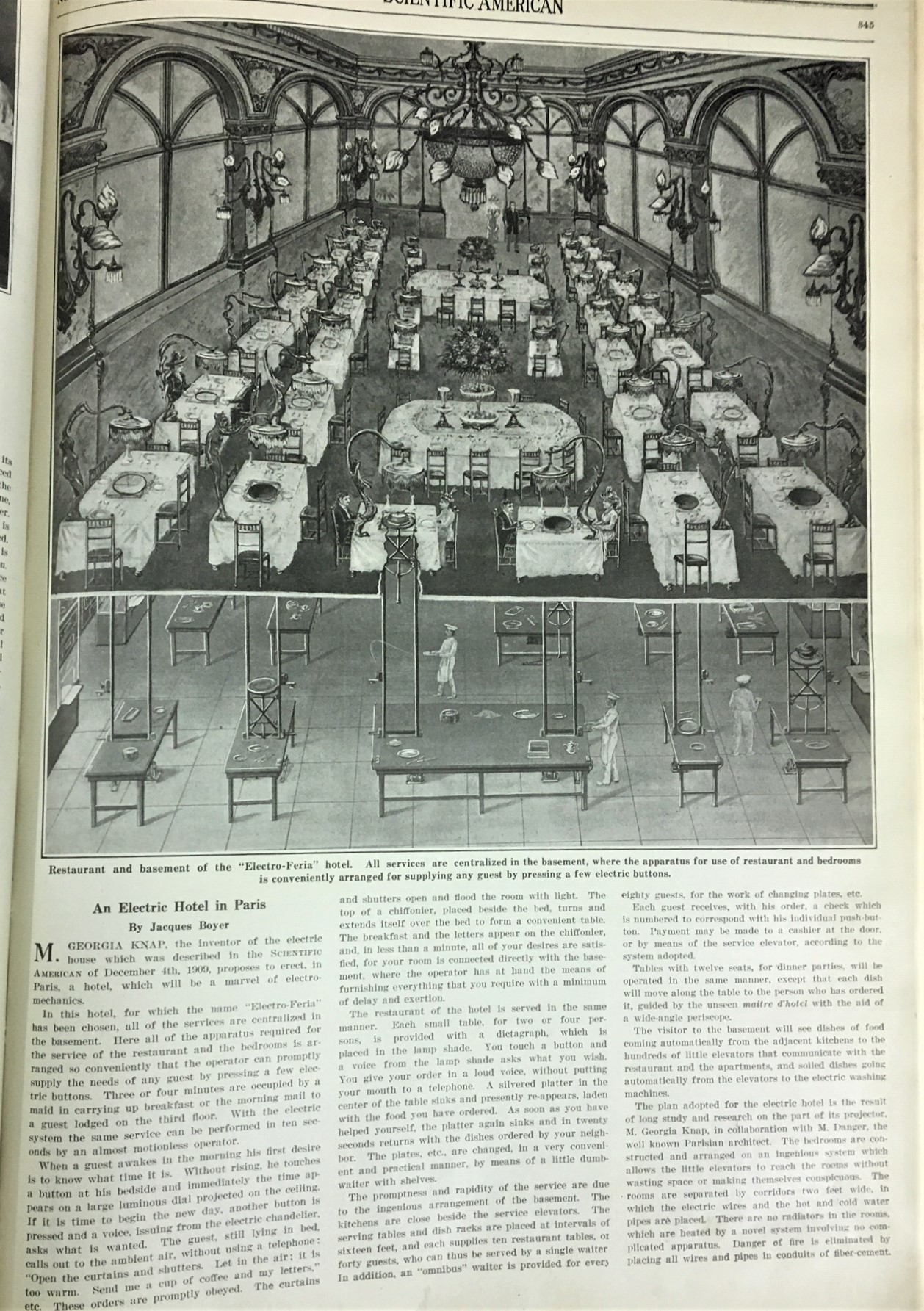
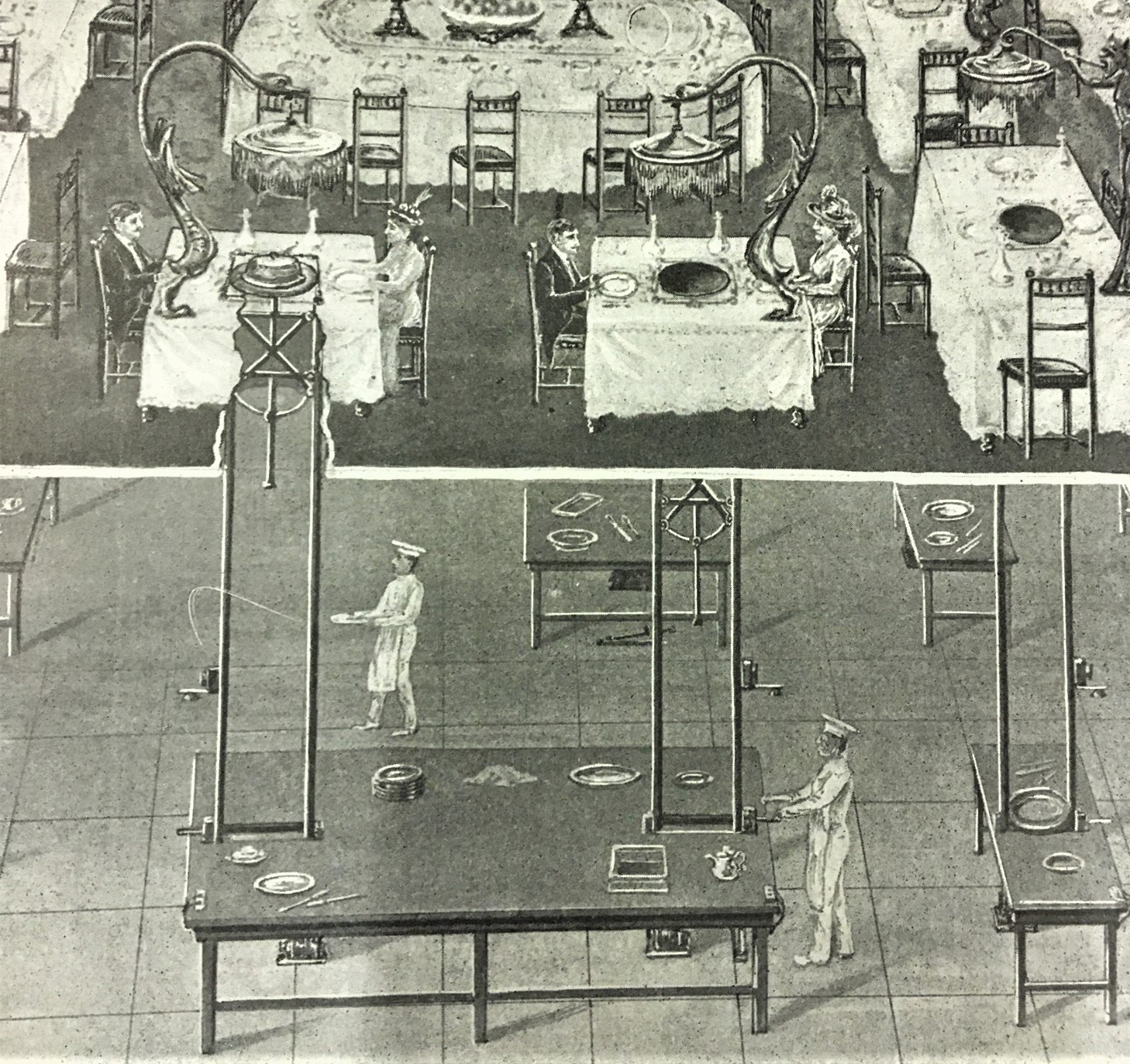
    Welcome to the push button electro-deluxe-lux world of 1913 of the marvel of electro-mechanics, the (proposed) Hotel Electro-Ferla. I read in the issue of Scientific American for 1 November 1913 (p 345) that the design is that of M. Georgia Knapp, the design of another all-electric house that appeared in the pages of the SciAm just a year earlier. (M. Knapp appears to have been a busy person in a number of different fields…)  The hotel design is Electro-Luxurient–we read in the caption that a person staying at the hotel, waking on the third floor, only had to speak out loud to have the time illuminated on their ceiling; another series of vocal commands opens the shutters and window, delivers their coffee, and retrieves the paper and mail. Another command sends his breakfast up through the hotel in a dumbwaiter to a device that gets his plates right to his bed. we are told that these electric commands respond with good delivered in 10 seconds, whereas telephoning the front desk and getting everything operated and delivered by hand would take four minutes (!)…so, think of the time saved. 

    IMG_2279 (1)
    IMG_2279 (1)

    And of course we have the electric dining room, which is the subject of the illustration for the short article. You can see clearly in the detail that all of the service is taking place in the basement of the hotel, with each table having a tiered dumbwaiter that connects it the the kitchens down below. The diner speaks their wants, and the stuff appears, plate after plate. Evidently there is one waitstaff member per tables, though who knows how many people are wailing away at the varied kitchens in the basement.

    It seems like a scary situation…particularly when you read that there are hundreds of these dumbwaiters snaking their way through the hotel in a Terry Gilliam-like ductwork maze of tunnels and tubes.  


  • A Proposed Solution for Traffic Congestion, Los Angeles, 1939: Suspended Roadways and MonorailsÂ

    JF Ptak Science Books  Quick Post

    This Quick Post entry is a simple one, repeating an entry that I’ve made to the bookstore section of this blog–I’m doing so just to make the info available, as the booklet is interesting and rare, and possibly a unique.  It is a work by A(lphonse) Davino, of Los Angeles, who had evidently maintained a lifelong interest in advanced transportation systems for cities–in this case, Mr. Davino approached the city of Los Angeles with his system. From what I can see the Davino System was a series of suspended monorails and auto lanes that would be used in conjunction with existing roads to address the increasing metropolitan congestion. If nothing else, Mr. Davino’s plans are really quite lovely.  Here’s a blueprint for the mainstay structures of the plan:

    IMG_2251


  • Defining What “Flying” Is, or Was (1894)

    JF Ptak Science Books  Post 2899    

    What does “flight” mean, anyway? How much do you have to be off the ground for something to be “flying”? If the answer is “two feet off the ground for 500 feet”, then Hiram Maxim did indeed succeed in being the first to construct a heavier-than-air aircraft that “flew”. Perhaps this definition might be a little broad, or narrow, though it does make falling sound like flying, too.

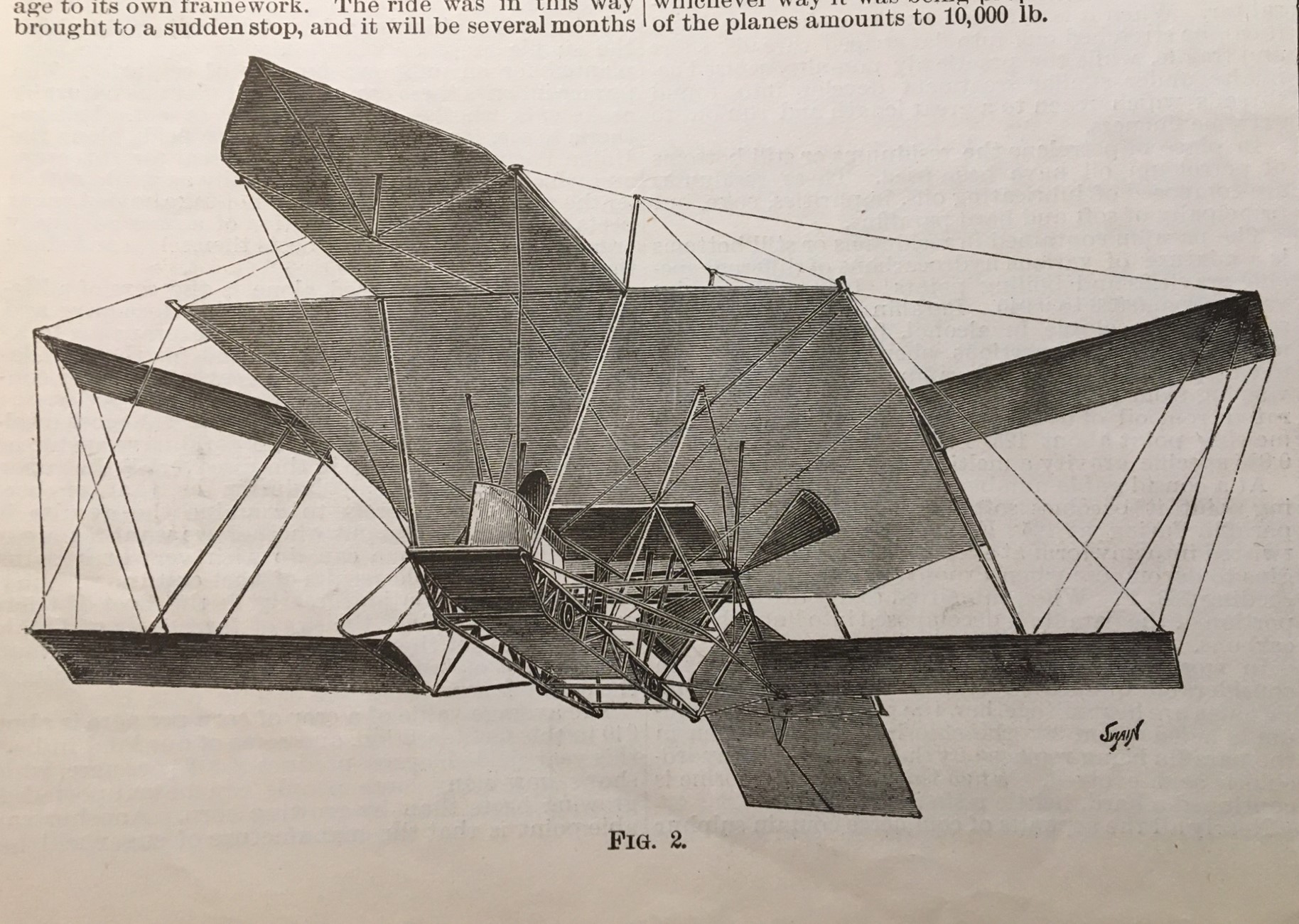
    IMG_2168In any event, that is what Mr. Maxim (1840-1916) did on 31 July 1894 with his enormous aeroplane as reported in the Scientific American of 15 September 1894 (“Maxim’s Flying Machine”).  He invested a good amount of money in the project funded by his tremendously successful “Hiram gun”, creating a number of aircraft before settling in on a great beast of a flying machine in 1894.

    The image of the aircraft is a perspective looking up at it, as though it were in flight. It wasn’t, though it was a semi-romantical thought and presentation. It had big numbers: 7000 pounds, 17.5′ diameter propellers, 2 steam-powered 180hp engines, 120′ long and 105′ wide, and 8” cylinders with a 5” stroke. Big numbers.

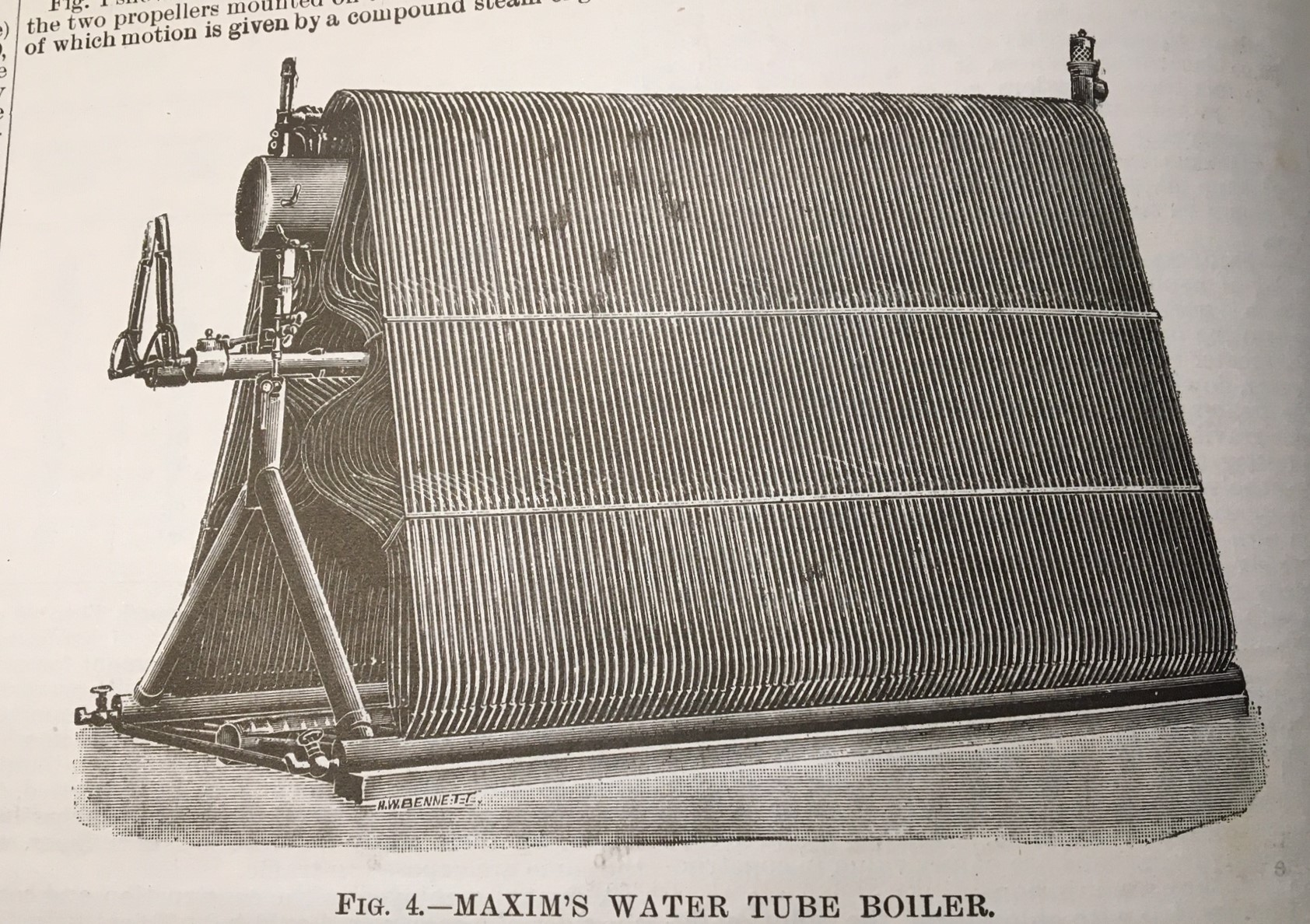
    One of the images that really struck me though was the steam chamber, which looks absolutely huge (though I can’t find dimensions for it), but you can make it out on the aircraft’s bow. For test runs 600 pounds of water were needed—2500 pound were needed to generate lift. IMG_2169

    So back to the “flight” issue; Mr. Maxim was on board the 3-person-crew aircraft on the day of the test. The aircraft was tethered to an 1800′ wooden rail to prevent it from actually taking off if it could…I think mainly because they were really just testing lift, as controlled flight was still yet another enormous issue. The aircraft did manage to achieve lift two feet above the rail, but the force was so great it ripped up the rail and crashed. (Mr. maxim found himself in a somewhat similar position to that of Frankenstein when overpowered by the monster which he himself had fabricated and endowed with life.”) No one was hurt, though the aircraft was decimated. As the writer in the Sci Am stated, “the ride in this way was brought to a sudden stop, and it will be several months before it can be renewed”. It isn’t anything like the Wright’s flight nine years later, though some do consider this Maxim experiment to constitute a “first flight”.

    One thing is certain: it was a lovely and impressive thing that Maxim built–it wasn’t elegant by any means, though it had a certain crushing charm to it.  

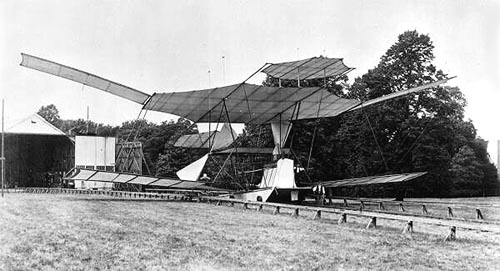
    Here’s a photo of the aircraft (with a person standing right there in front of it, for scale):

    Maxim aeroplane

    (Image source: ctie.monesh.edu.au/hargrave/maxim.html)


  • Light Bombs, 1913

    JF Ptak Science Books  Post 2897

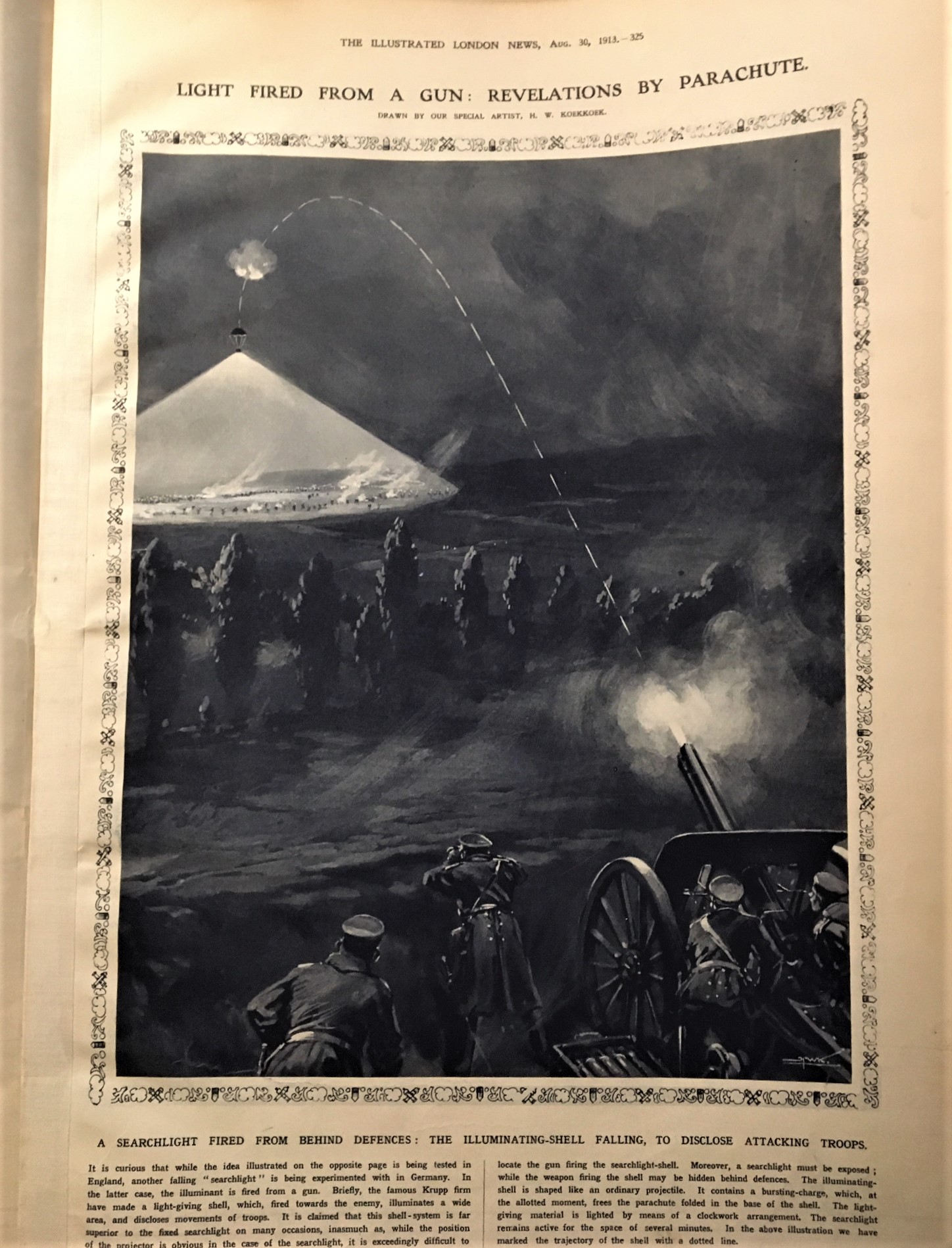
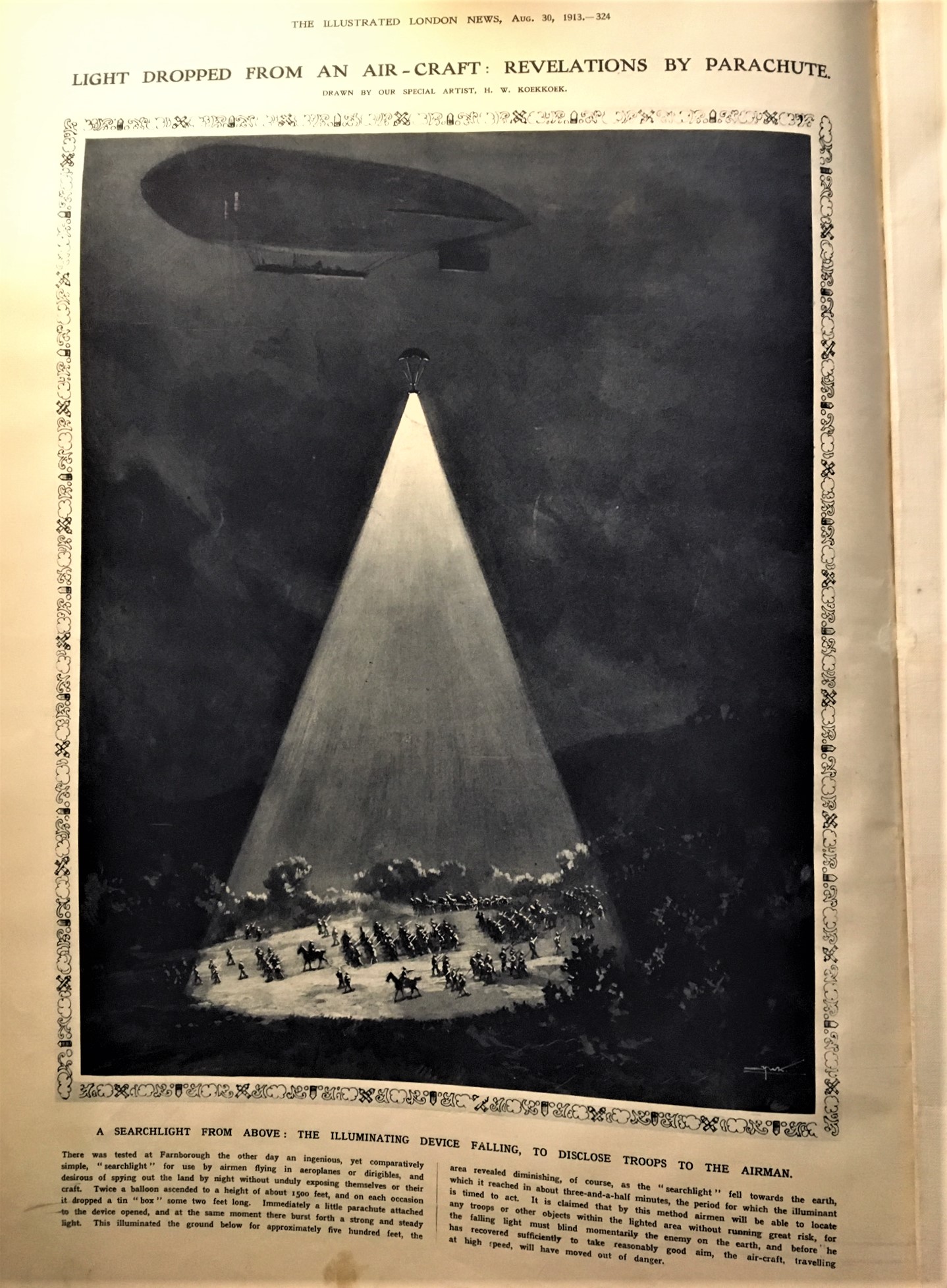
    In the earliest periods of the history of bombing it seems as though the among the first generations of “bombs” dropped from flying machines were “light” or light sources, as we can see in this pair of illustrations from the Illustrated London News for 30 August 1913. These weapons appeared almost two years after Lt. Giulio Gavotti dropped an actual explosive from his plane on 1 November 1911 in a battle of the Italo-Turkish War1. Not that the exploding bombs weren’t  heavy (they weren’t) but that the feature of the weapon dropped in the 1913 case was capable of generating a penetrating or at least illuminating light.  We are told in the legend of the print that the light-bomb dropped from the dirigible was attached to a parachute which opened immediately, and from the height of 1500 ‘ at release the writer states that it would take the weapon three minutes to descend to the ground. (Of course the illuminated area would get together an tighter in descent, though it seems like there would be a good minute of so where there was some intelligence gathering possibilities.)

    Even though this package wasn’t exploding, it did provide the observers from above time to gather information on the position of the enemy and relay that data so it could be employed in tactical or strategic manners.  

    Notes:

    1. Lt. Gavotti (1882-1939) actually dropped four four-pound grenades from a height of 600′ from his Etrich Taube monoplane in action against the Ottoman Turks in Libya. This was the first instance of bombing from a heavier-than-air aircraft, bombs being dropped from balloons for several decades already by the turn of the century. Dropping bombs from balloons was deemed an illegal act of war and outlawed in the Hague Convention of 1899–but as the Wright flight was still a few years away at that point there was no provision established for bombing from aircraft that didn’t yet exist.  There were other instances of bombing from aircraft before the start of WWI, with the first instance during the Great War occurring when German Zeppelins bombed the city center of Antwerp a few weeks after the war began on 24 August 1914. The Brits launched an aeroplane attack  against two Zep bases in Cologne and Dusseldorf in response, and, well, and so on, raids and bombs becoming more sophisticated, cities becoming targets, and the race to destruction became developed. 

    ILN 1913 Light BombILN 1913 Light Bomb


  • Delightful Maps of the IRT, NYC, 1923.

    JF Ptak Science Books   Quick Post

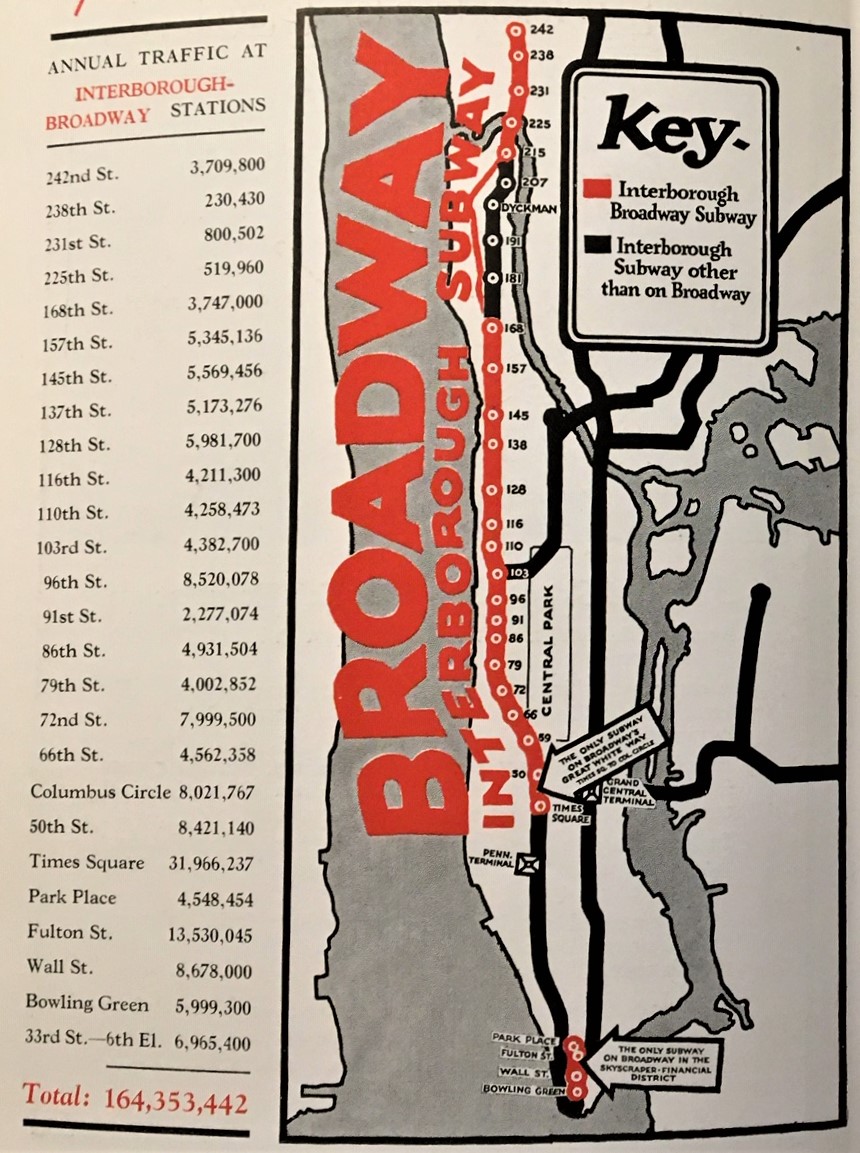
    I’ve just found this delightful little publication beautifully extolling the possible advertising advantages of the Interborough Subway and Elevated Lines of New York City, Artemas Ward’s New York’s Rapid Transit Traffic in the Graphic, from 1923. It really does present the numbers and highlights them with some unusual and bright maps of the subway system. This was the IRT (the Interborough Rapid Transit system), which was a private concern that operated from 1903 until 1940, when it was purchased by NYC.  This subway system in general was, well, entirely different from the one that I traveled 1968-1974 or so, back when you could barely see through the car windows because they were so heavily coated with graffiti…Anyway, I’ve  reproduced  most  of  it  below as there are no copies of the pamphlet in any library according to WorldCat.    The design of the first one–with the giant “Broadway”–is terrific.                                                              IMG_2100 (1)


  • A Lovely, Interesting, and Semi-Outsider Piece of Logi (Radio, Wireless, and TV Ciphers, Codes, Language (1936-1937)

    JF Ptak Science Books  Post 2891

    Carlo Spartari created some interesting if not enigmatic approaches to transmitting thoughts and information via radio back in the mid 1930’s. The first example of his work—nowadays I think mostly forgotten and I imagine pretty obscure—is his book on a new radio language entitled: Spartari Radio Language, Sirela: Spatari Radio Language: A Word-of-mouth Code Easily Understood by Listeners of Many Nationalities Without Need of Memorizing for Use in International Radio Broadcasting, which was evidently self-published in 1937. (“SIRELA” I assume would stand for something like “Spartari International Radio Elementary Language” or something along these lines.

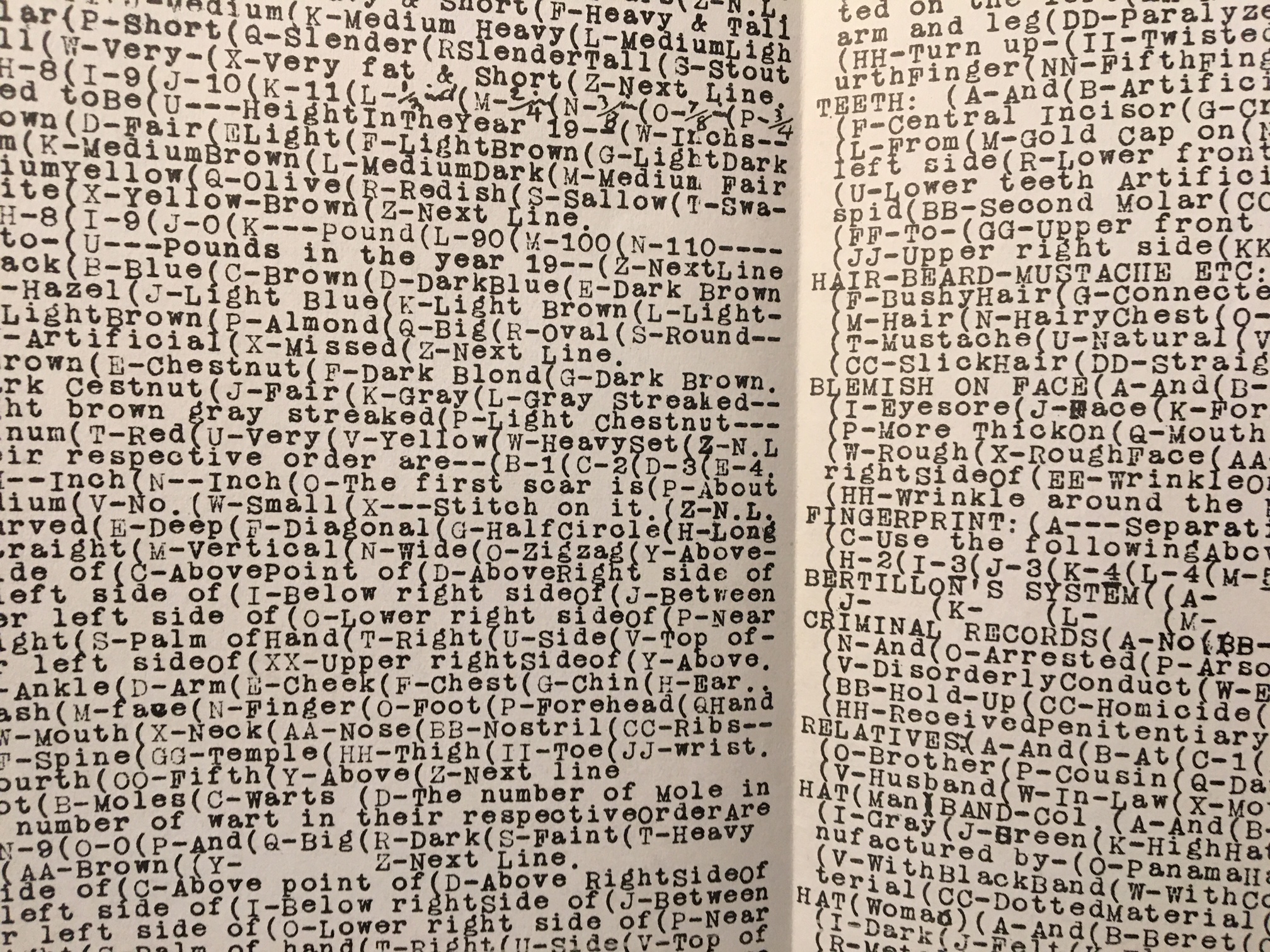
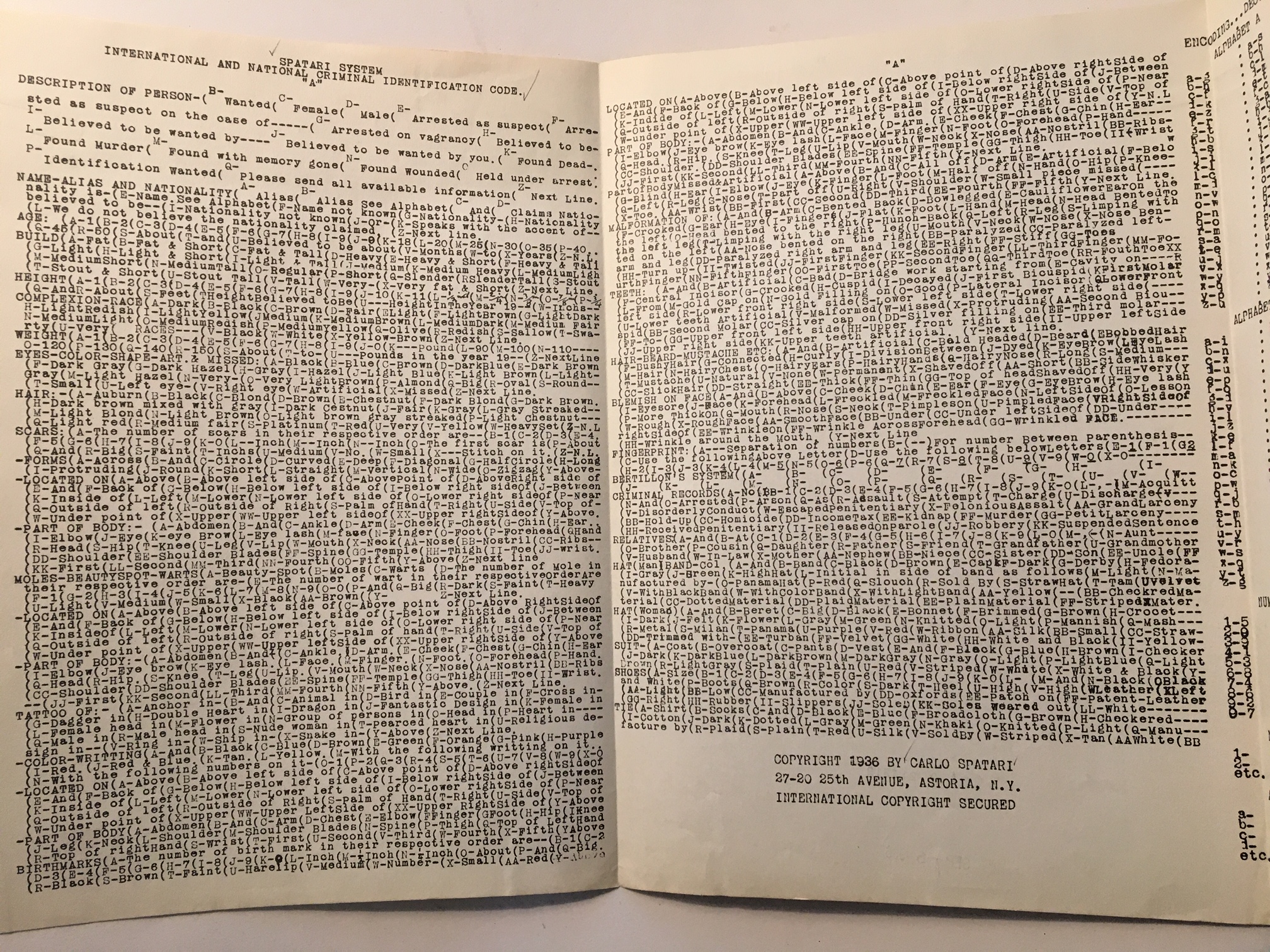
    Taken out of context and working with the text as a visual element, these works seem to me to have more than a heavy touch of an Outsider artistic quality. I find them to be sort of beautiful in their own complex ways:

    IMG_1650

    If nothing else it is easily the tallest book (18”) on radio codes and ciphers that I have seen, Carlo Spartari invented a rather clever and interesting radio language. It was based upon the seven musical notes of the diatonic scale–DO, RE, MI, FA, SO, LA, and SI—which took no translation to understand, and the notes of course are pronounced in about the same way, everywhere,   as la  Italiano. On the one hand it seems to me to be whimsical, and on the other, it seems brilliant. That’s the problem sometimes with challenging new ideas—they can be excellent almost as easily as they can be meshugina.

    This work was accompanied by another, the Spatari International and National Criminal Identification Code, which are basically two very compacted sheets entirely filled with a cipher capable of describing a rather wide variety of appearances of a person with a relatively short number of words. If time was an element in a criminal pursuit, then the Spartari code could perhaps have proved invaluable to law enforcement folks, whereby a lot of data can be transmitted in a short, alpha-abbreviated message via radio or wireless. There are codes to describe the following characteristics of the person of interest: name, alias, nationality, build (“fat/fat and short/fat and tall”), weight, eye color, hair, scars (and their various forms and locations), moles, tattoos, birthmarks, malformations, teeth, hair/beard. Fingerprints, relatives, g\hat style, shoes, tie, and suit, all of which can be described in some detail in the code.

    IMG_1649

    That said, they are using radio here, so, it might be almost as easy to just say what it was needed to be said rather than worry about a time-saving cipher. It really seems like this would be more valuable used in conjunction with the third part of this publication, which is Spatari Television Code for Facsimile Transmission. Certainly in this instance where time and space were critical then the abbreviations and associated ciphers used by Spartari would do well in fax transmission more so than spoken language.

    IMG_1652

    “Back in 1905 a young musician was so impressed by the fact that the language of music is universal, that he decided to develop a language based on music. The result is the Spatari Radio Language, an ingenious system of speech based on the notes of the musical scale, capable of being understood by anyone, regardless of his native language, and requiring no study of grammar, vocabulary or syntax. The entire language consists of only the seven notes DO, RE, MI, FA, SO, LA, and SI, and the symbol BO. Capable of being combined into nearly a million different words or groups, these symbols can be pronounced on sight, and easily written down as soon as heard. The “secret” of the language is that each group of symbols represents an entire thought, or sentence. It is not intended that anyone memorize the symbols, as they can be written down as heard, and found quickly in the Spatari dictionary later.”–World Radio History online, Radex

    Also see Jerome S. Berg, On the Short Waves, 1923-1945: Broadcast Listening in the Pioneer Days of Radio.