JF Ptak Science Books LLC Post #98
It’s intriguing to think of writing systems standing for things other than words—for example, one has the whole of the mathematical sciences, chemical notation, Feynman diagrams, weather patterns, and on and on. Lines and dots and squiggles and the like, not forming words, but something entirely else, an amanuensis for words.
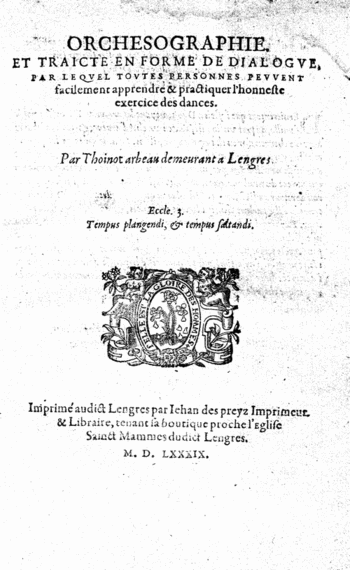
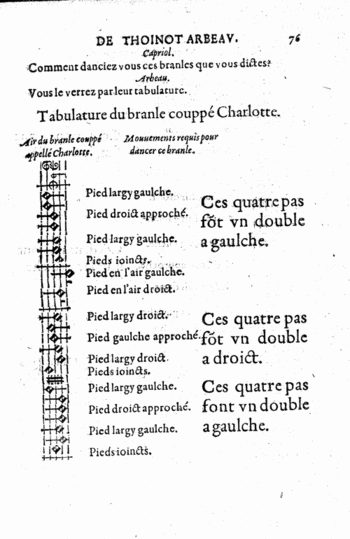
The idea of adopting a written dance iconography—replacing drawings and written descriptions of dances—is nearly as old as the dance instructional itself. The notation used by Lana in the 1920’s was the first image that came into my mind for this alternative wiring scheme, but in fact there were several systems for recording the simple movement and placement of the feet that reach back into the 16th century. The first of these books to attempt to codify the movement of dance via non-descriptive writing is the letter codes employed by Thoinot Arbeau in his 1588 book Orchesographie. In this Socratic introduction to dance Arbeau showed foot and movement patterns and linked them (visually) with the music. What Arbeau was describing was solely the movements of the feet—everything else beyond that—position of the legs,
arms, head, etc.—was left unaddressed in the iconographie though he did connect them with engravings showing how the rest of the body should look at some point during the dance.
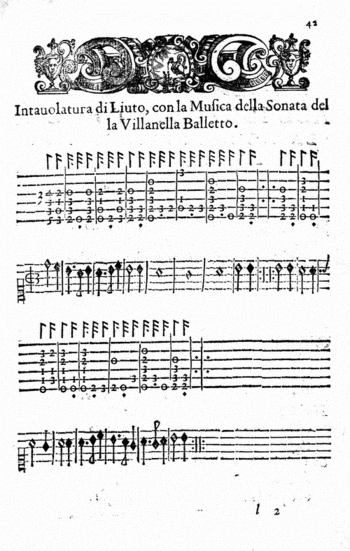
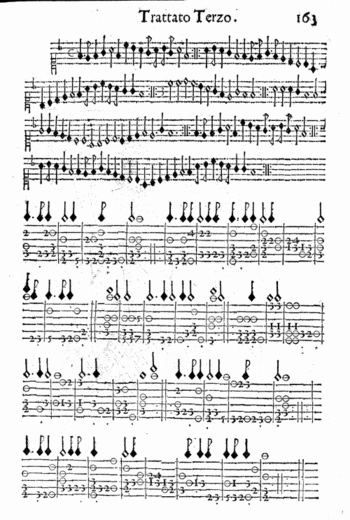
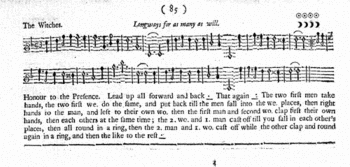
A similar system was employed in the 1680 Nvove inventioni di balli; opera…(left) , and then again in The dancing master; or, Directions for dancing country dances, with the tunes to each dance, for the treble-violin, “10th ed. corrected; with addition of several new dances and tunes never before printed”, by Henry Playford (in London) in 1698 (below).
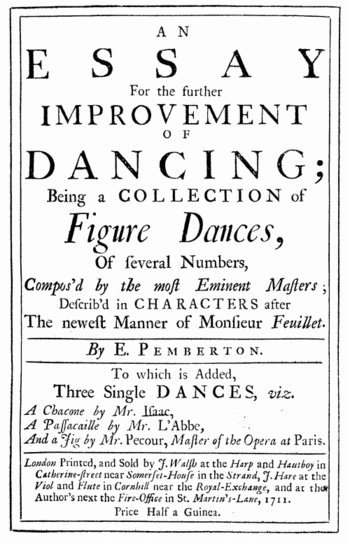
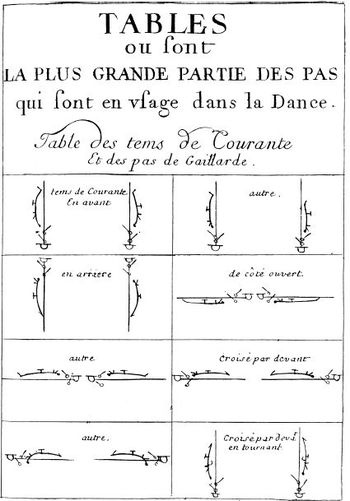
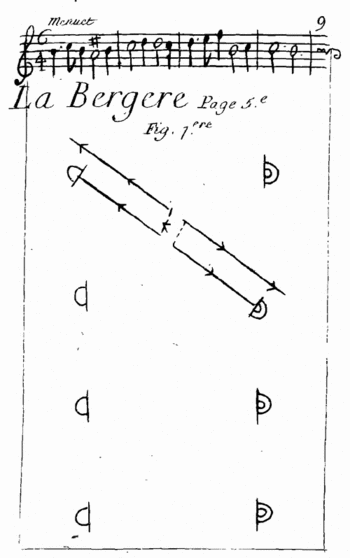
A major development occurs in the Choregraphie of Pierre Beauchamps (and published by Raoul Feuillet, and known perhaps unfairly as the”Feuillet System”), which instituted a floor plan of sorts, showing the movement of the feet by symbol and viewed from . As better described by the Library of Congress site: “Feuillet’s procedure was analytical; he broke up the steps into their mechanical parts, invented symbols for each of those parts, and organized them temporally by bars on the progression line. These bars reflect the temporal sequence of the steps according to the musical score.” (The Feuillet illustration is below.)
The view from above, or bird’s-eye view, was replaced in one 19th century system of annotation with stick figures, which were viewed from the front. Again, from the Library of Congress: . “In his Stenochorégraphie, published in Paris and St Petersburg in 1852, Arthur Saint-Léon used a scheme consisting of five horizontal lines for the movements of the legs and one additional line for the actions of the upper body. The figurative notation signs appear directly above the musical score, relating them approximately to the musical values.”
Movement was also recorded on whatr appears to be a musical template, using bars an staffs and musical-note-like notation to record movement, which seems to hjave possessed a more lyrical quality, with the potential for capturing more of the movemente than foot arrangements and speed of motion. The Library of Congress writes about this in reference to the system of Vladimir Stpeanov’s 1892 Alphabet du Corps Humain, “…Procedures of sound notation are transferred to movement notation: addition (a movement is, just like a musical sound, the sum of several elements) and duration (the temporal value of a movement is indicated by the time value of the note). described the human body within a scheme consisting of nine lines, divided into three parts. The top two lines are used for the movements of the head and torso, the three middle lines indicate the actions of the arms, and the bottom four lines the movements of the legs. The position of the tail of a note indicates whether the movement concerns the left or the right body part: for the left parts, the tail is directed upwards, for the right parts, it is directed downwards. “
In 1910 Vaclav Nijinsky published a very similar system of notation to Stepanov, using the basic template and then adding five more lines to the figure to denote movements throughout the core of the body.
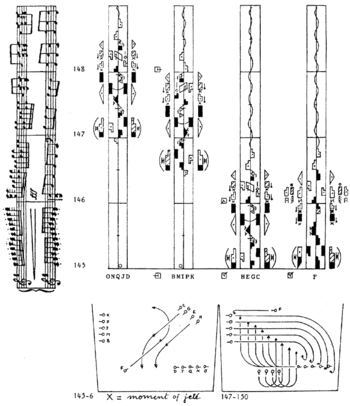
It seems to me that the greatest pre-WWII advancements in all of this is Kinetography Laban (and afterwards known as Labanotation), which belongs to Rudolf von Laban, who seems to have incorporated movement of the feet, the body, the head, arms, as well as expression and speed, as well as relating it all to music in his own (famous) writing system. I call again on the authorless Library of Congress work on dance notation to for a superior and extended description of the notation:
“Kinetography, and Labanotation use geometrical shapes as symbols that indicate not only directions, but also specific levels and duration. Direction symbols modify the basic rectangular shape and show the directions forwards/backwards and left/right as well as the diagonal directions in between; the shading of the shape indicates the direction upwards/downwards, and its length shows duration. The body is represented within a vertical system from behind that is to be read from the bottom of the paper towards the top: following the central line, the right side of the dancer is also the right side of notation. The central line represents the vertical centre line of the body, and also the progression of the movement. Next to this line, on both sides, there are the columns for all movements transferring weight. The body parts themselves are identified by particular symbols. Their various movements are observed and notated separately and then synchronized in the notation score.”
This post would somehow seem incomplete without at least mentioning the contrary to this notation–the warnings by some religions that The Dance itself would lead humans directly to Hell. So, not only should people not have recorded dance, but they shouldn’t be dancing in the first place. OR thinking about dancing, for that matter.
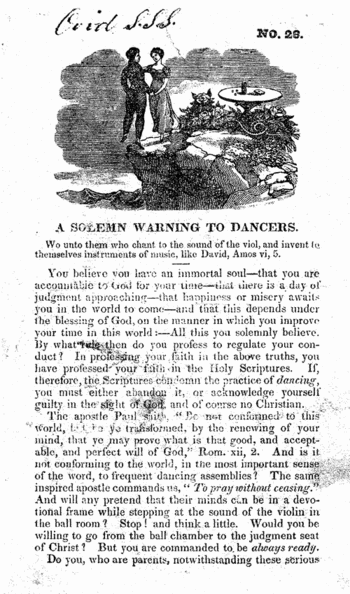
The article that I have quoted from here is found HERE.
Some other interesting, and beautiful alternative means of writing in regard to recording dance include:
Wilson, Thomas dancing master; An analysis of country dancing: wherein are displayed all the figures ever used in country dances, in a way so easy and familiar, that persons of the meanest capacity may in a short time acquire (without the aid of a master) a complete knowledge of that rational and polite amusement. To which are added, instructions for dancing some entire new reels; together with the rules, regulations, and complete etiquette of the ball room. By T. Wilson … Embellished and illustrated with engravings on wood, by J. Berryman; London, Printed by W. Calvert, to be had to Mr. Dutton [etc.] 1808
Nvove inventioni di balli; opera vaghissima nella quale si danno i giusti modi del ben portar la vita, et di accommodarsi con ogni leggiadria di movimento alle creanze et gratie d’amore. Convenevoli a tutti i cavalieri, & dame, per ogni sorte di ballo, balletto, & brando d’Italia, di Spagna & di Francia. Con figure … in rame et regole della musica et intavolatura quali si richieggono al suono et al canto. Divisa in tre trattati …