A Daily History of Holes, Dots, Lines, Science, History, Math, Physics, Art, the Unintentional Absurd, Architecture, Maps, Data Visualization, Blank and Missing Things, and so on. |1.6 million words, 7500 images, 4.9 million hits| Press & appearances in The Times, Le Figaro, Mensa, The Economist, The Guardian, Discovery News, Slate, Le Monde, Sci American Blogs, Le Pont, and many other places… 5000+ total posts since 2008.

Category: Art History

  • Dr. Seuss and the 236 Words that Changed Reading Forever

    JF Ptak Science Books

    I think that it is difficult to overstate the importance and long-term significance of Dr. Seuss‘ (Theodor Seuss Geisel, 1904-1991, son and grandson of brewmasters) contribution to childhood.  I think that it is impossible to calculate the overall impact of his bringing young people to the joy of reading, and to the familiarization  with the bare mechanics of how to read.  Of course he told a great story, but his books were literally page-tuners—they were simply written with words useful to children, with few words per page, thereby allowing the child to see the pictures, read all of the words, and turn the page, giving them a sense of accomplishment along with enjoying  a fine story.   Perhaps it is the getting-the-kids-used –to-reading that was his most fantastic accomplishment—and something that few others have achieved, measuring by just pure numbers. 

    Blogcathatbook

    And the way in which he did this was to artistically use an extremely limited budget of words—Dr. Seuss used precisely 236 different words to write The Cat in the Hat.

    It is certainly true that there have been many sparse, relatively wispy papers in the history of science form which enormous change has sprung..   Pound-for-pound though The Cat in the Hat holds its own. 

    I’ll give the entire list of words below—just have a peek, and try to imagine writing something interesting with just this palette. 
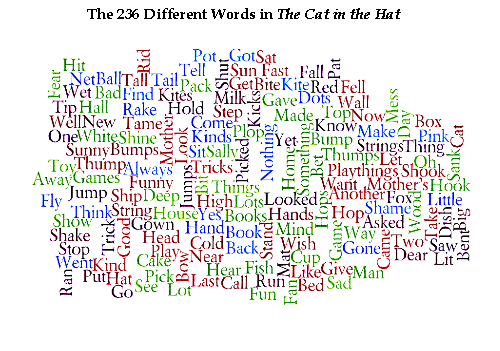
    Wordle--cat in the hat

    It isn’t fair at all to compare this masterpiece with others in different genres, but just to give you an idea of its relative simplicity I’ll quote some numbers taken from an incredible study conducted by Zachary Booth Simpson (“Vocabulary Analysis of Project Gutenberg”).  Simpson’s interpretation is more complex than the story I’ll tell here, but basically he looks at the numbers of words in a piece of literature (for example) and then convenes the number of different words, deducing the actual and then relative density of word usage, which is pretty interesting (and verifies that pit-of-the-stomach feeling about which authors use more words in smaller space). 

    Gibbon’s Decline and Fall seems to lead the way in the absolute number of different words used (43,113!!, which is astonishing), in the 1.5 million word text, while old Uncle Bill uses 4,842 words in the 32,000-word Hamlet—meaning that Measure for Measure (sorry) Mr. Gibbon out-Bills Bill, which I thought was very hard to do.  Other interesting bits are Hugh Lofting’s Doctor Doolittle, who tells the story with 2759 words; Moby Dick, told with a spectrum of 17,227 words; and Les Miserables is painted with 23,334 different words.  The only work that comes close to Seuss in Mr. Simpson’s very considerable list is the New McGuffey Reader, which is really, actually, a tough go, and uses 630 words.

    Unfortunately I do not know about the Dick and Jane readers But they’re no match whatsoever for the Good Doctor.

    So my hat is off and off and off to Theodor Geisel, aka Dr.Seuss—on the anniversary of his anniversary in Seussland, where it is Seussqunetennial every day.
  • The Sovietesque Disappearance of Pacioli’s Rhombicuboctahedron

    JF Ptak Science Books LLC  Post 23

    What?

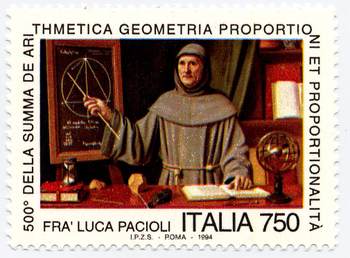
    I’m lodging a complaint, 16 years after the fact (though new to me), about the Italian commemorative stamp honoringBlogpacioli
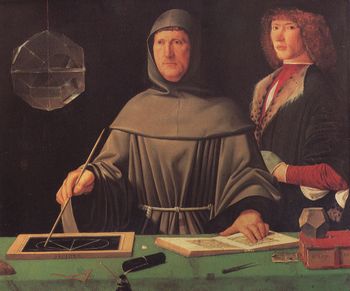
    the great Fra Luca Pacioli—a great mathematician, inventor of modern bookkeeping, and friend and dispersal-agent of/for Leonardo da Vinci—it also seems to be the first representation of a living mathematician.  The stamp is based upon and freely rearranges (to the point of obsidian abstraction) elements of the famous painting by (perhaps) Jacopo Barbari (and painted in 1495), which now hangs in the Museo di Capodimonte (Naples). 

    The painting has been reproduced in mathematics books and such many times over—with good reason, as it is a gorgeous work and is filled with lots of mathematical bits and pieces. 

    The stamp, however, is a curious and annoying work if you are at all familiar with the original.  The most glaring but not most important change is the Soviet-like loss of the figure to the right of Pacioli—althoughBlogpacioli_stamp
    not positively identified, some believe it is Guidobaldo, and others believe it to be the very pretty Albrecht Durer.  He’s gone, replaced by some sort of out-of-century bookcase.  I’m not saying that whoever this happened to be needed Stalinist disappearing  for political reasons, but it upsets the entire composition of the painting, and leads to other more foul errors. 

    The closed red book on the table is moved and an hour glass is placed on top of it, taking up the slate that was there in its place in the original, which is now hanging on the wall.  It is highly unlikely that Pacioli would provide a demonstration in this matter. 

    Also the mathematical notes here are slightly different from the (correct) references to Euclid’s Elements Book XIII, proposition 12 (If an equilateral triangle is inscribed in a circle, then the square on
    the side of the triangle is triple the square on the radius of the
    circle.)

    An armillary sphere makes a curious appearance, and a few of the mathematical tools on the table top make disappearances.  The sphere may be the artist’s attempt to make up for the loss of other symbols, as the sphere represents the Platonic music of the spheres, successive levels of forms being built one on the other and so representing the universe.  (Plato’s
    Republic, where, in the Myth of Er he wrote,
    “. . . Upon each of its circles
    stood a siren who was carried round with its movements, uttering the
    concords of a single scale.”
    [Republic p.  354])

    The important item that is kept on the stamp from the original (though moved) is the polyhedra form, the dodechahedron, one of the great Platonic solids, and a figure composed of 12 pentagons.  It is a highly symbolic link between ancient thought and the rise of the new mathematics and even newer art. 

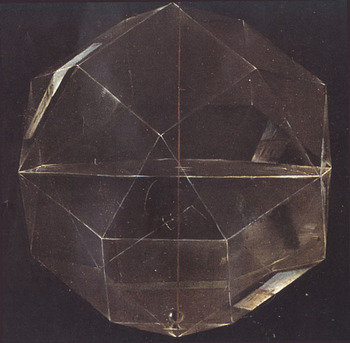
    The most important missing item, though, is the glass object hanging at the left of the painting—it is theBlogpacioli_rhomhb_close
    rhombicuboctahedron.  This object is one of the thirteen semi-regular (or Archimedean) solids, and has 26 faces made of 18 squares and 8 equilateral triangles, with 24 vertices and 48 edges.  It is constructed of glass and hangs by a string, and is half-filled with water.  It is spectacularly shown in the painting by Barbari—it is simply a glorious achievement of perspective and light and shadow.

    And, as it turns out, reflection.   In a superb 90-page article by Nick Mackinnon: (“The portrait of Fra Luca Pacioli”, The Mathematical Gazette, 77 (1993) pp. 130 – 219).  Mackinnon combs through the painting with microscopic precision, and in this case reveals that there is an exterior reflection (of s house) on one of the bottom panels of the figure. (Good work!  He even goes on to try and figure out what it is we are looking at in the reflection.) 
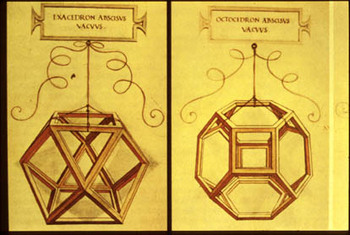
    It is annoying for this figure (or a shadow or hint of this figure) not to be on the stamp because of its beauty and symbolism.  It is none other than Pacioli’s friend, Leonardo, who illustrates his book Divina proportione—a masterpiece of thinking and illustrating, introducing the concept of the divine proportion (phi) and its importance in design and in nature in general. Perhaps of greatest significance though are the illustrations of some of the figures in the book, which I believe are the first time that people are able to see geometrical drawings in perspective, which is a very big deal. 

    Unfortunately this link is pretty much missing without the Rhombicuboctahedron—you don’t have to know how toBlogpacioli_da_vinci
    say it to appreciate it.  (Or as Bernard Malamud writes in the Natural, when discussing a spaghetti dinner “I don’t know how to spell it, but it sure eats good”.)

    All I’m saying is that the designer for the stamp shouldn’t been consulted, and the Italian government should just have used the original as the basis for the stamp.  After all, they didn’t remove the backgrounds of the Mona Lisa or the Last Super because they were too-conflicty with their subjects in those commemorative issue stamps, did they?

    Oh, I forgot–they did. 

    Here are a few good books to consult if you’re interested in polyhedra:

    H.S.M. Coxeter, Regular Polytopes.  Coxeter was perhaps the most impressive geometer of the 20th century.
    Peter R. Cromwell, Polyhedra.
    H. Martyn Cundy and A.P. Rollett, Mathematical Models
    Alan Holden, Shapes, Spaces and Symmetry. (Very pretty!)
    Peter Pearce, Structure in Nature is a Strategy for Design.
    Magnus Wenninger, Polyhedron Models.  (Paper construction!)

    ·Posted by :

    ·in:

    —