A Daily History of Holes, Dots, Lines, Science, History, Math, Physics, Art, the Unintentional Absurd, Architecture, Maps, Data Visualization, Blank and Missing Things, and so on. |1.6 million words, 7500 images, 4.9 million hits| Press & appearances in The Times, Le Figaro, Mensa, The Economist, The Guardian, Discovery News, Slate, Le Monde, Sci American Blogs, Le Pont, and many other places… 5000+ total posts since 2008.

Category: Atomic and Nuclear weapons

  • Early “Image” of Hiroshima–as a Cartoon

    JF Ptak Science Books  Quick Post         Part of the Atomic and Nuclear Weapons series

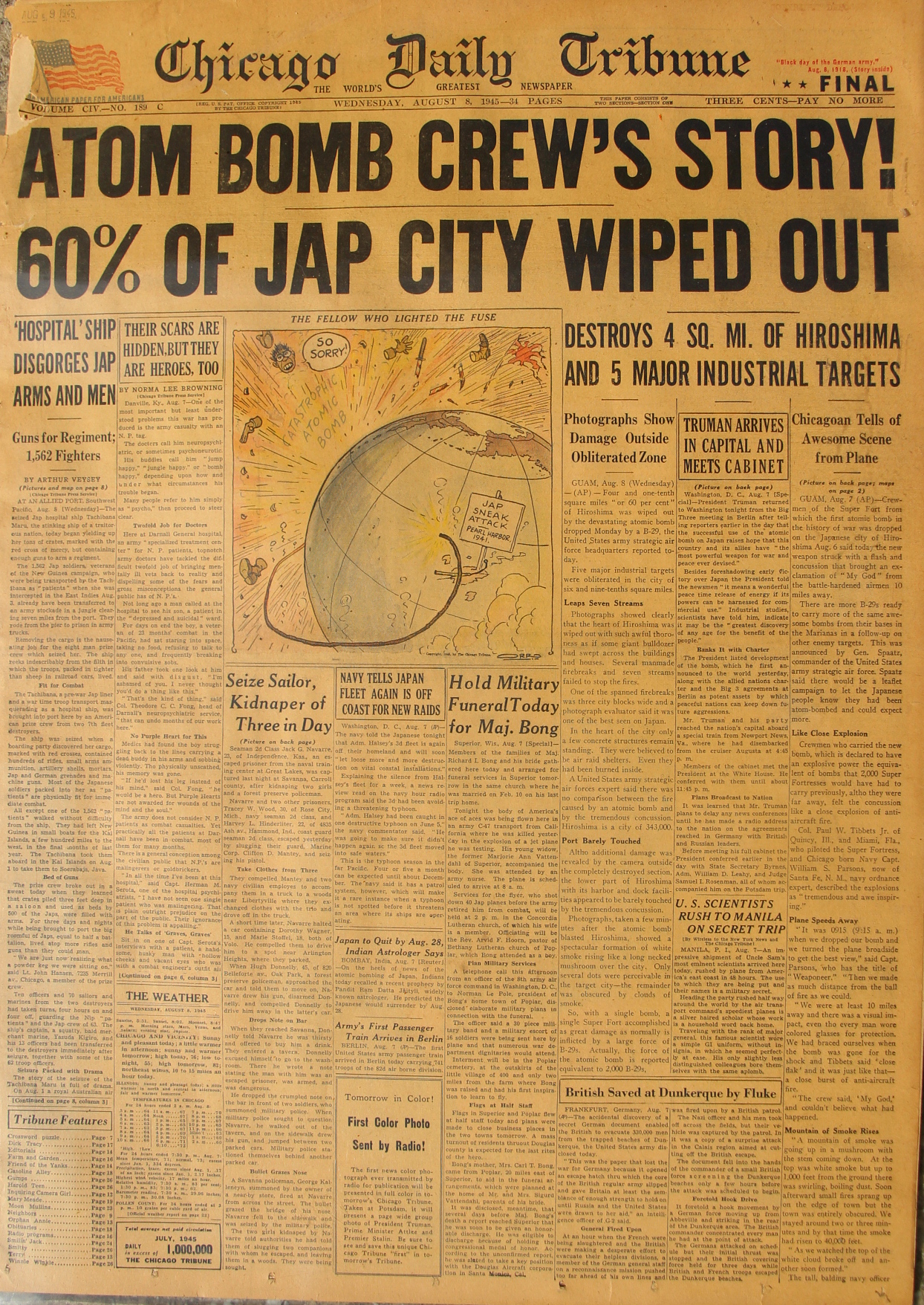
    The Chicago Daily Tribune covered the Hiroshima bombing of 6 August with a number of different articles, including statements from the Enola Gay crew members, explanations of how atomic bombs “worked” from the physics aspects, President Truman’s bearing on the proceedings, news of a number of other B-29’s ready and waiting to be sent on missions with similar bombs, and so on.  That “so on” doesn’t actually include that much coverage at this stage, amounting probably to two or three full pages of text. There were no pictures yet though there were reports of images made from the aircraft showing 4 square miles of total devastation at Hiroshima. 

    The only illustration to speak of was this–a very graphic graphic to be sure, which under the circumstances, I suspect was to be expected. 

    Hiroshima newspaper detail


    Hiroshima newspaper full

    ·Posted by :

    ·in:


  • Atomic Bomb Dreams of Safety and Annihilation: 1950’s Public Service Films.

    JF Ptak Science Books  Quick Post

    Part of a long series on  Atomic and Nuclear Weapons

    I’ve collected a sextet of films I found and posted on twitter at one point or another, collected here and placed on one soft pillow.  They all seem to be made in 1950-1952, at the beginning of the Great Red Scare of the 1950’s. There was a certain amount of fear and loathing about the USSR and the bomb beginning soon after the U.S. use of it in August 1945, though the Soviets didn’t successfully test their first weapon until August 29, 1949 (called “Joe 1” in the United States). There was a slow march to the first air drop (1951) to the development of the first Soviet hydrogen bomb in 1954.  There was a constant bombardment of popular culture by atomic threat beginning shortly after 1945, with atomic attacks, atomic super heroes, atomic villains, atomic mutants, atomic super races, and so on, and that all accelerated with Soviet nuclear weapons progress through the early/mid-50’s. The films and public announcements below represent an early rush of film media to deal with the possibility of ….Atomic Attack.  

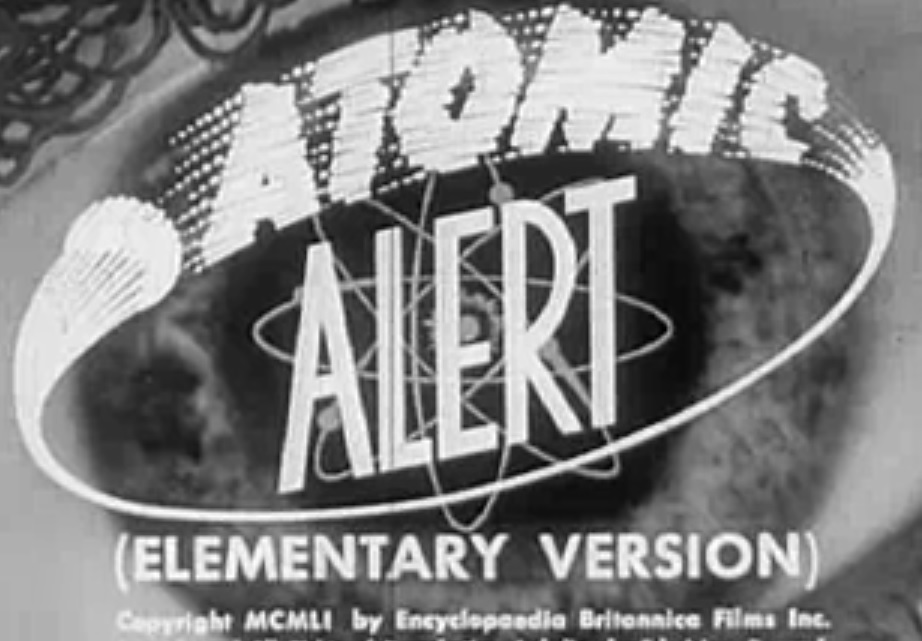
    Atomic Alert, (“elementary version”),  1951–a Bomb awareness film.

    Atomic alert 1951

    Source:  Internet Archive http://ow.ly/Mqa0q 


    ·Posted by :

    ·in:


  • Dr. Lise Meitner, Fission, and Comic Books (1946)

    JF Ptak Science Books   Post 2448

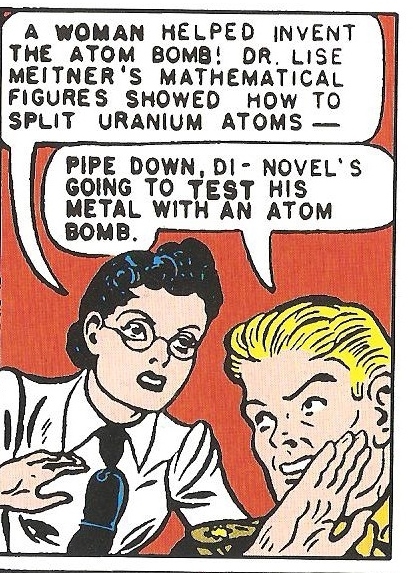
    I don’t often venture into the comic book world unless I’m looking for something, and in a hunt for atomic bomb references in comics <1955 I stumbled upon a reference to Dr. Lise Meitner. (A good short bio and summary of her work can be found here at the American Nuclear Society.) Seeing great physicists in comic books is evidently not common, as  subsequent series of searches seem to indicate.  The Meitner (1878-1968) mention in Wonder Woman, though, was pretty interesting.  Meitner did get a lot of press coverage when she made her tour of the USA in 1946, which I guess led to the panel.  She would have been more famous if she had been properly treated by the Nobel committee when they awarded the Nobel Prize in Chemistry of 1944 to Otto Hahn for work (“for his discovery of the fission of heavy nuclei”)  that she and Hahn had carried out jointly for years.  But it didn’t happen, for various reasons, and she really didn’t get an official prize/award of recognition for her work until 1966 when she was given the Enrico Fermi award.  She did receive an ultimate honor in 1997 when the chemical element with the atomic number of 109 was named (discovered in 1982) was named “Meitnerium” in her honor–the only non-mythological woman’s name to be used in designating a chemical element. And she is featured on a few stamps, but outside the general physics community she sort of languished in obscurity for decades–odd since she was about the most significant woman in the history of 20th century physics.  
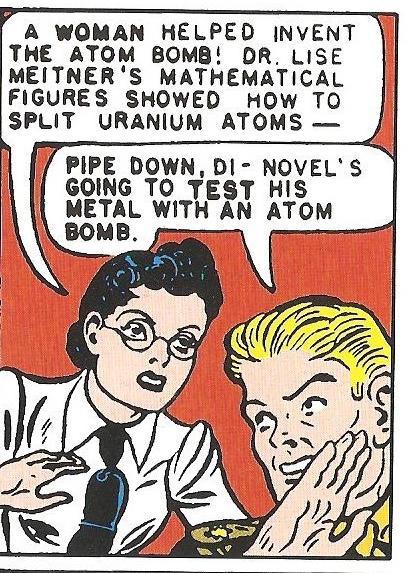
    Scientists in comics meitner

    [Source: found in the blog Shakeville, here.Wonder Woman, 1946.]

    “Disintegration of Uranium by Neutrons: A New Type of Nuclear Reaction”, by Lise Meitner and Otto R. Frisch; Nature, 143, 239-240, (Feb. 11, 1939). Full text here via Atomic Archive.

    See below for the Meitner/Frisch paper from Nature 1939, and also the footnotes for papers cited (a number of which may be purchased via the blog bookstore id you were so inclined to own documents like this).  

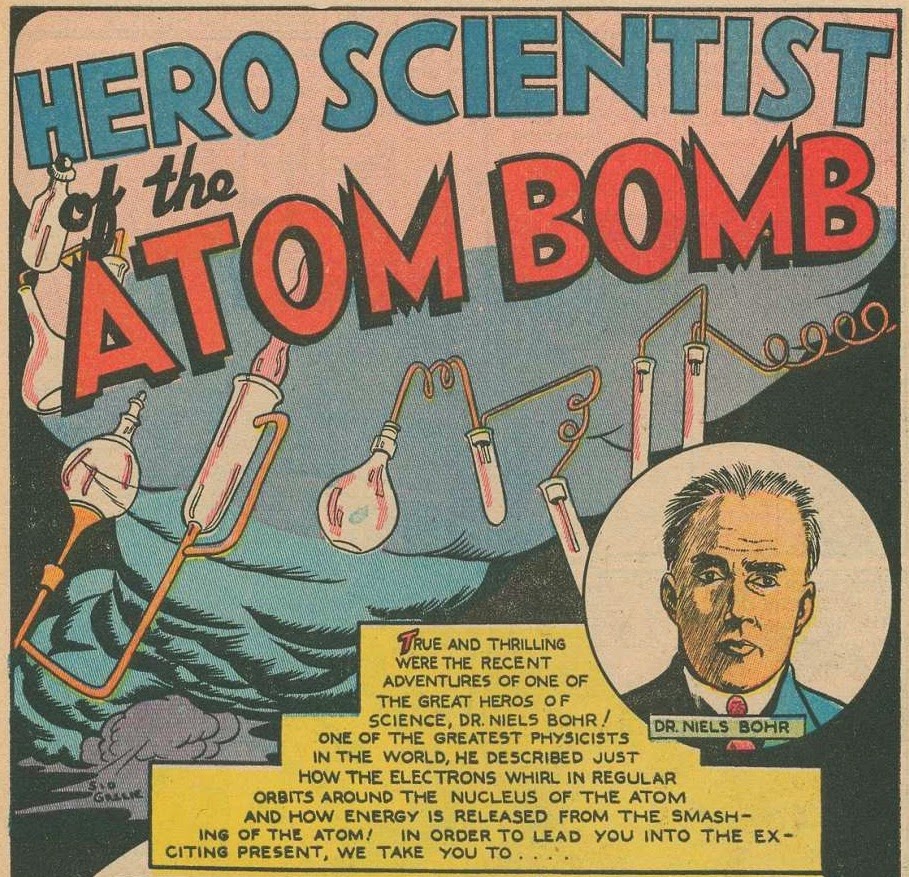
    And here’s a surprise appearance of Niels Bohr!
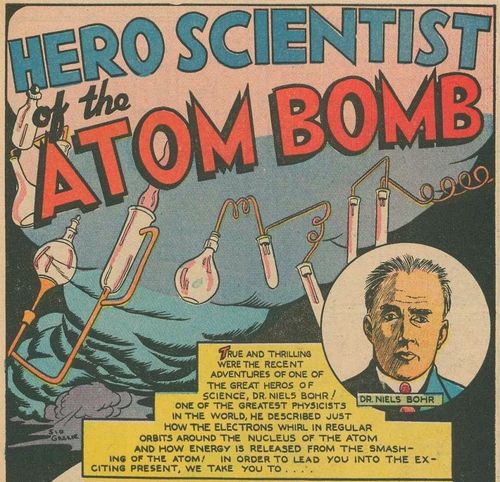
    Scientisits in comics Bohr

    http://physicsbuzz.physicscentral.com/2014/06/7-public-domain-physics-comics-worth.html


    Papers cited in Meitner/Frisch Nature 1939:

    1. Fermi, E., Amaldi, F., d’Agostino, O., Rasetti, F., and Segré, E. Proc. Roy. Soc., A, 146, 483 (1934).
    2. See Meitner, L., Hahn, O., and Strassmann, F., Z. Phys., 106, 249 (1937).
    3. Curie, I., and Savitch, P., C.R., 208, 906, 1643 (1938).
    4. Hahn, O., and Strassmann, F., Naturwiss., 26, 756 (1938).
    5. Hahn, O., and Strassmann, F., Naturwiss., 27, 11 (1939).
    6. Bohr, N., NATURE, 137, 344, 351 (1936).
    7. Bohr, N., and Kalckar, F., Kgl. Danske Vis. Selskab, Math. Phys. Medd. 14, Nr. 10 (1937).
    8. See Meithner, L., Strassmann, F., and Hahn, O., Z. Phys. 109, 538 (1938).
    9. Bethe, A. H., and Placzec, G., Phys. Rev., 51, 405 (1937).

  • Images of Manhattan Destroyed–Additions, 1951 and 1953

    JF Ptak Science Books   Quick Post 
    Follow Me on Pinterest
     

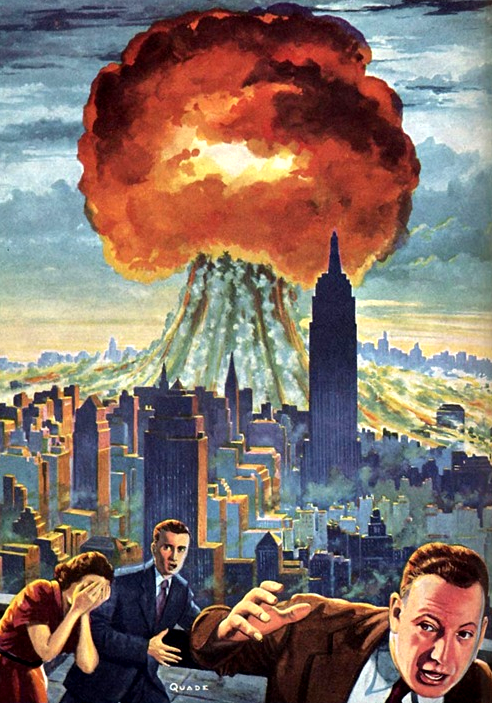
    There’s a sotto voce sub-series on the destruction of Manhattan in this blog’s longer series on atomic/nuclear weapons. (There are a number of them–if you’re interested search those terms in the Google search box at left.)  I’ve found three more from 1951/2 that I’ve included below.  At some point I’ll gather all of the Destroyed Cities and makes a larger post of them. 

    Manhattan destroyed R McQuade

    [Source: ‘We have now entered the Atomic Age’, artwork by Lester Quade, in 1952.]

    ·Posted by :

    ·in:


  • Under Under-Statements on the Bomb

    JF Ptak Science Books   Post 2447

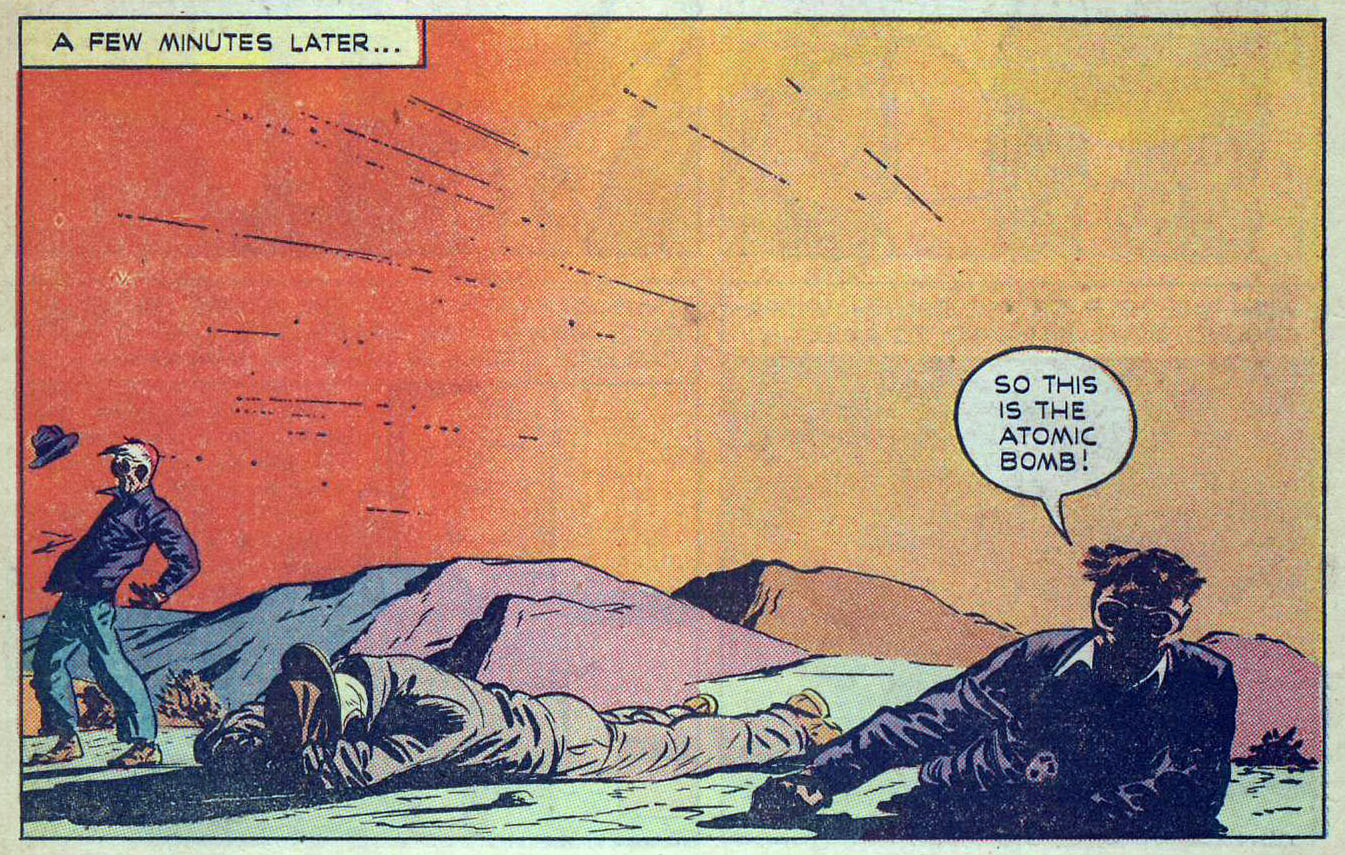
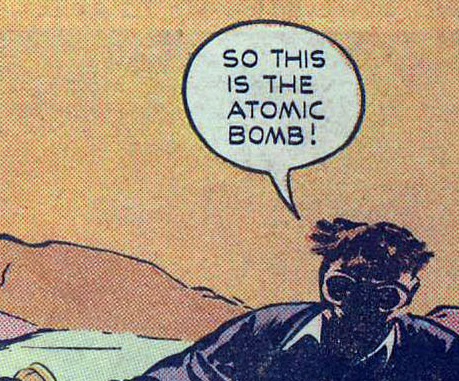
    There’s nothing quite so ironic as understatement when the understatement is understated even in advance of itself.  I’ve noticed this here and there with the depictions of atomic/nuclear war in the bomb’s early history, say 1946-1960, as seen in comic books.  For example, here’s something I posted last week that is a fairly representative understatement done in a small way about a big thing: 

    Atomic_ so this is the atom bomb

    See here.

    It is I think representative of an entire class of mid-century image of atomic understatement.

    Having found this one others were quick to follow. 

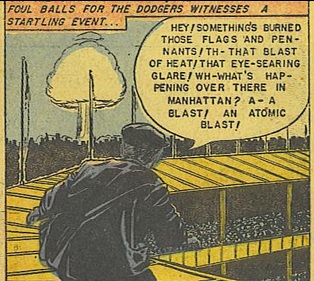
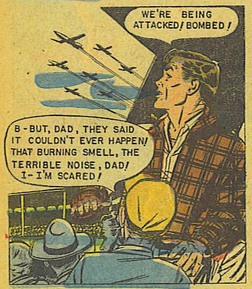
    The comic World War III is a  caustic of advanced crispy-crunchiness, and set in the year 1980, where the future found the Brooklyn Dodgers still playing in NYC.  For some reason, the photographer on the roof of the Polo Grounds takes a slow burn of realization that something big was going on, processing the burned pennants /heat/glare before settling on the enormous mushroom cloud rising four miles above Manhattan… 

    Atomic blast Dodgers game

    [Via the Internet Archive,  full text & lurid illustrations here http://ow.ly/Mqcox ]

    Atomic bomb polo ground

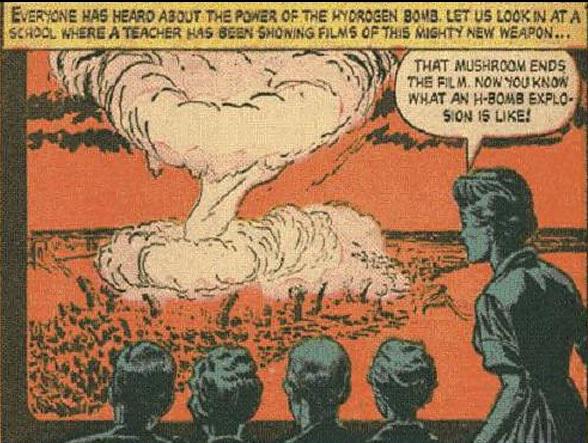
    And another fine example, this graduating to a hydrogen bomb later in the decade, a bomb far more unimaginably powerful than the unimaginably powerful 20kt bombs of 1945. Okay, there are red skies and a firestorm the width of a city, and the “mushroom” ends the film, but there is only a perfunctory statement of the too-close-together heads that they now know what a hydrogen bomb explosion was, or is, or could be:

    Embedded image permalink

    [Source and full text via the Internet Archive,  http://ow.ly/Mqbpw ]

    I know it is difficult to describe the Grand Canyon as it would be to witness a nuclear explosion (let alone be in one).  But these under-nucleated statements is sort of the equivalent of describing the Grand Canyon as something along the lines of “We’re here now and looking down”.  

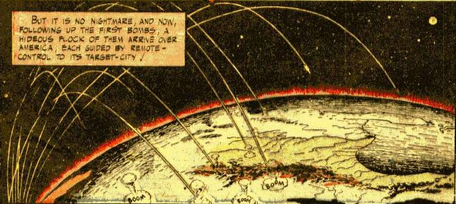
    And this is about as loud as the screaming gets in Capt. Marvel’s adventures with the atomic bomb. This is surprising mainly because the comic was published only about a year after Hiroshima/Nagasaki, and imaging a “flock” of missile launched atomic weapons falling all over the U.S. was a salient look into the possible future.  

    Atomic war capt marvel

    [Source: http://ow.ly/MqlGV] 

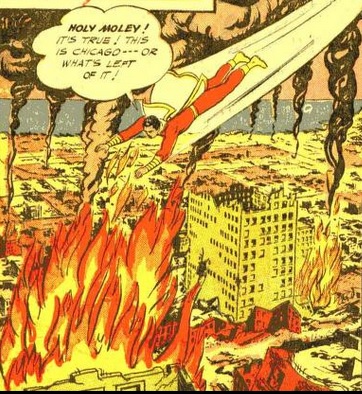
    And in the face of the unspeakable, Capt Marvel seems unflappable:

    Atomic bomb holey moley

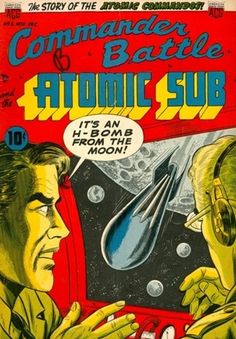
    On the other hand there are excitable statements regarding the bomb:

    Atomic bomb from moon

     But it does make one wonder about featuring shock-of-recognition statements about the apocalyptic  bell ringing of nuclear weapons as expressed in comic books as a comparative whisper in the description of the thing.  It is almost as though if the Cornishman spoke quietly enough he wouldn’t make the wakening giant angry.  


  • Hot Bunks and Cool Air in (All White?) Community Fallout Shelters

    JF Ptak Science Books  Post 2453

    I will not go down under the ground
    Because someone tells me that death’s comin’ round;
    I will not carry myself down to die
    When I go to my grave my head will be high —

    CHORUS:
    Let me die in my footsteps
    Before I go down under the ground.–Bob Dylan, “Let Me Die in My Footsteps”, 1962

    Why they were more often called “Fallout Shelters” and not the more demonstrable “Bomb Shelters”? I suspect that was so because the former implies that unless you’re a corpse or incinerated that you’ve survived the initial blast and concussion and fire and firestorm of swirling sharp trash and now need to come to grips with the blast’s aftermath, so “fallout shelter” it must be.  

    And in the many pictures and plans for survival pods that I have seen I cannot recall one that included a non-white member of the community. The maps I’ve seen showing locations of fallout shelters for Manhattan have a smattering of shelters at the top of Central Park/110th St, but not all that many for Harlem. (I’ve never seen an official map of the placement of the shelters, just reconstructions thus far.) No doubt there were many shelters in Harlem–I just don’t know how many or in what regard they compared to other areas downtown  for percentage of people who could be accommodated. Perhaps a bigger and more obvious question would be what sort of rules there would be in the deep South for the use of shelters, and whether in 1962 if they would be segregated or not.

    • “If there are shelters in the black belt, no one knows where they are…” –Dr. Nathan Hare, “Can Negroes Survive a Nuclear War”, in Negro Digest, May, 1963, pp 26-33.  Full text at Afrocentric News, here.  

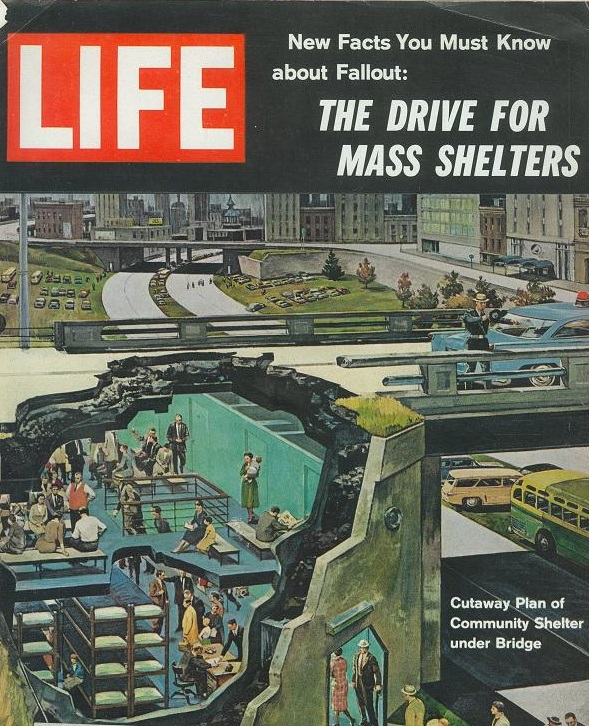
    This issue of LIFE magazine is a classic, with a number of pages and a few big image splashes dealing with the possibility of building mass  shelters for clumps of the population, preparing for the Soviets to start launching thousands of warheads our way. The people gathering here are remarkably calm, wearing sports coats and ties, and hats, with enough reserve to be holding the door open for the next person. Cars that pulled off the highway reacting no doubt to air raid sirens are neat and orderly, adding to the tidy and ship-shape scene that was so important to sear into the creative futuro-vision of Americans waiting for the Great Bad Thing to occur.  Images like this created the impression that no matter how many megatons could fall, there is a guy, in a hat, and coat, and tie, at the door, holding it open, for you.  

    Atomic bomb life mag cover

     [Source for this and for the image following all from Drexel University:  http://www.pages.drexel.edu/~ina22/+301/$301-texts-Life-shelters.html]

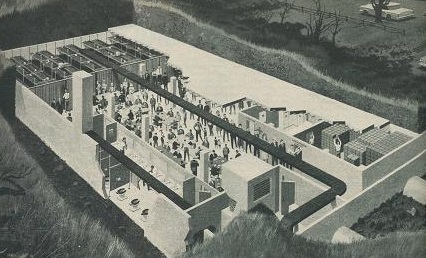
    Here’s an example of a calm, composed, considerate, commendable. concretized community, enjoying their ample and regulated spacing, hanging out and waiting to not-die:

    Atomic shelter LIFE community

    “A WELL-PLANNED COMMUNITY SHELTER: Neat concrete box, reinforced and buried under earth or a highway, would reduce fallout radiation to a thousandth of that outside and would give occupants some protection from blast. Useful as a recreation or meeting hall in normal times, it could shelter 500 persons in event of attack. Stocked with food, water. first aid and sanitary equipment, it also has ventilating system to draw fresh air from filtered intake (center foreground). A source of oxygen not dependent on outside air would give protection against firestorms. Space-saving tiered bunks rely on “hot bunk” system, with sleepers taking turns.”  LIFE magazine, January 12, 1962

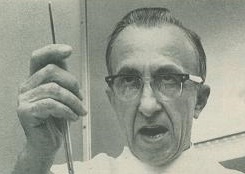
    Some people were asked in a man-on-the-street fashion about shelters–this barber thought it was a money scam:

    Atomic bomb shelters cabbie

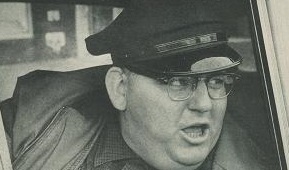
    And this cabbie thought that if he couldn’t ride out The Big One in his basement, then, well. “the hell with it”:

    Atomic shelter cabbie2

    I’m pretty much okay with both of these guys.


    ·Posted by :

    ·in:


  • Atomic Explosion Tourism

    JF Ptak Science Books   Quick Post

    Part of the series on the History of Atomic and Nuclear Weapons

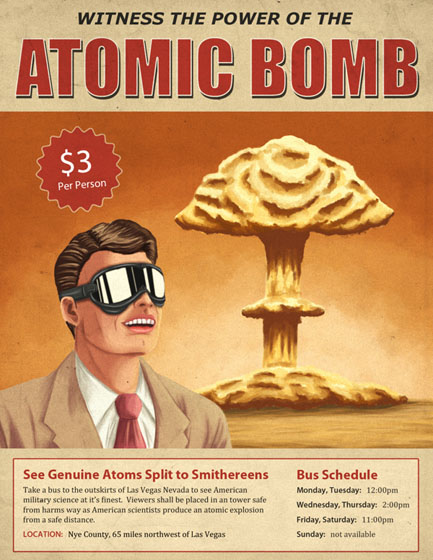
    I am certain that in all of the posts I’ve made in this blog that I’ve never considered atomic explosion tourism–vintage, semi-antique, see it-while-it-happened tourism.  I’m not talking about going out to the Jounada del Muerto to see Trinity, or taking a bus to Chernobyl, or checking out the sites ad the corner of Trinity and Oppenheimer, as we would now–but witnessing an actual explosion, then.  And there were plenty of opportunities to witness one, especially if you were in Vegas,and more so if you took the trouble to disrupt your activities to search for the mushroom cloud rising 5 miles away.  

    And in the case of the leaflet below, you could take a bus for three bucks and have a clearer view of the detonation.  

    Just be sure to remember your tie.  

    Atomic bomb tourism det


    Atomic bomb tourism[Source: Nevada Public radio, KPNR–see here for a few more examples.]

    ·Posted by :

    ·in:


  • Reporting the Hiroshima Bomb the Day After, 7 August 1945. AND The First Map of NYC A-Bombed

    JF Ptak Science Books   Blog Bookstore  Part of the Atomic and Nuclear Weapons Series 

    [In which me meet exceptional coverage of a mammoth day-old event and what must be the first map of NYC under atomic attack.]

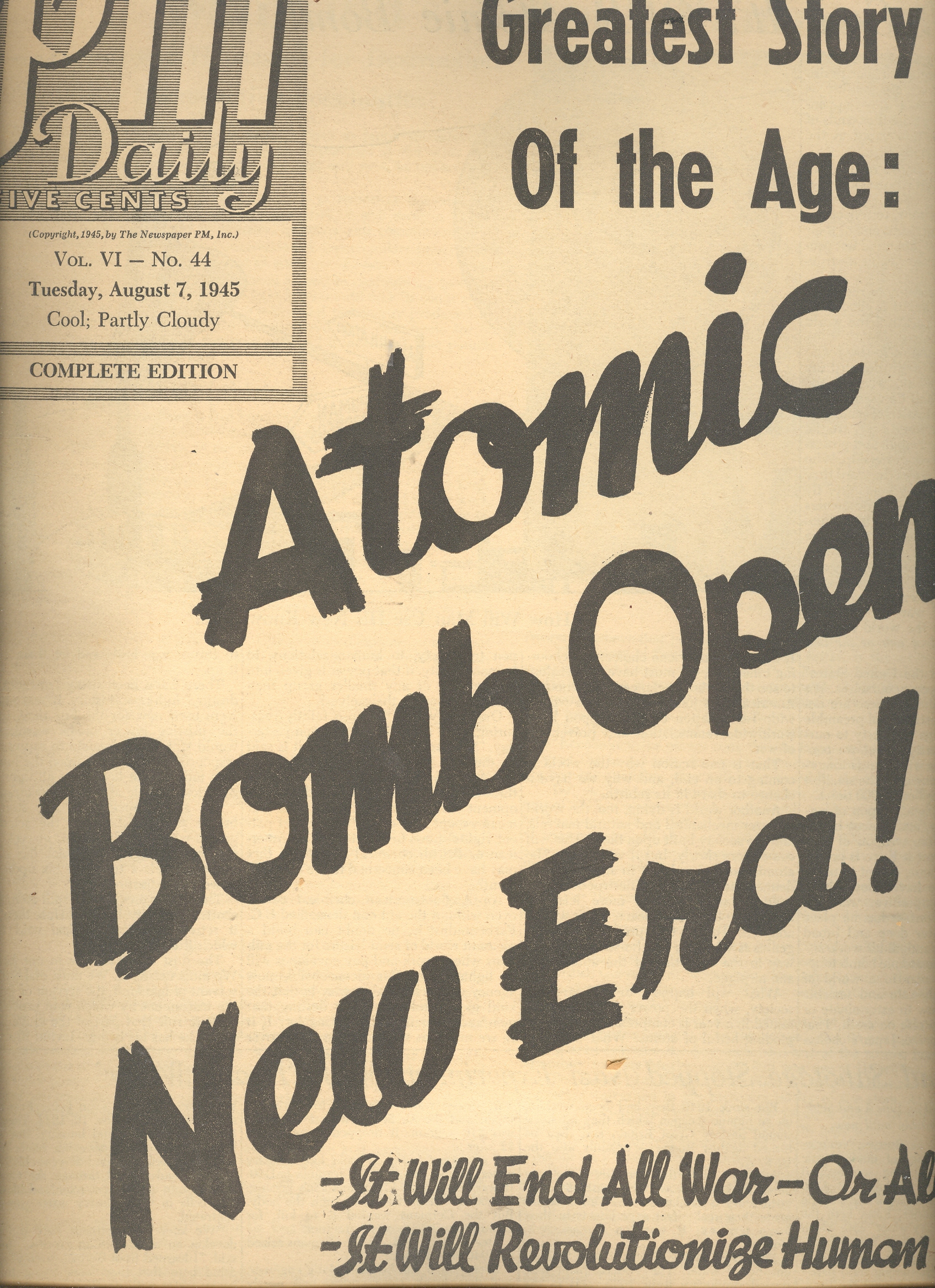
    ==Blog July 26=PM cvr bomb

    The news coverage of the 6 August 1945 bombing of Hiroshima was covered in spectacular (all things and time considered) detail in the 7 August issue of the daily newspaper, PM.1  The entire issue of 12 pages (with no advertisement2) was dedicated to the event—I have no idea, really, how they were able to put together this amount of good tough data so very quickly, nimbly and intelligently, as the bomb was detonated at Hiroshima only the day before.

    • This item is available for purchase via the blog’s bookstore, here.  

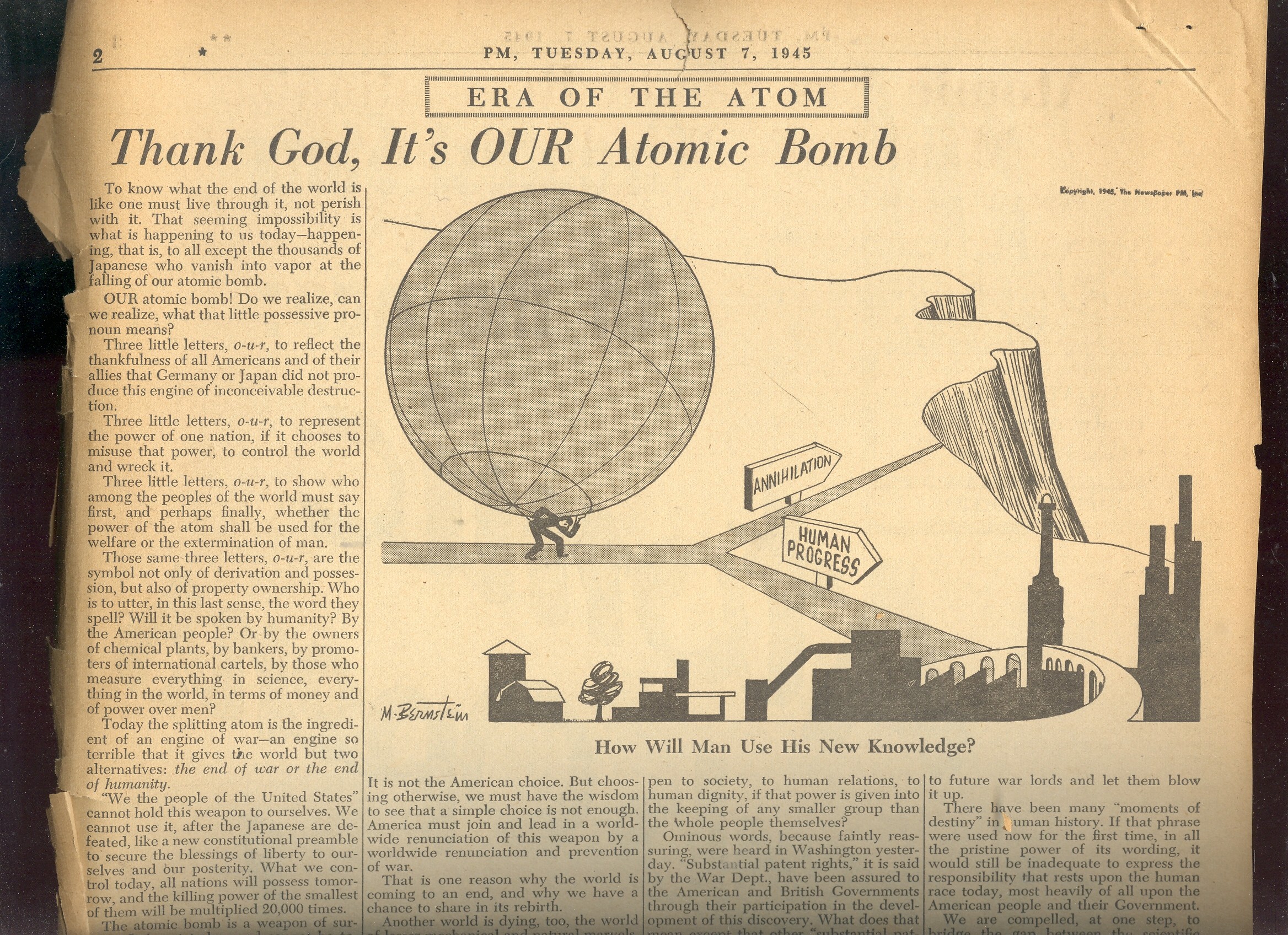
    It is odd how well the case is covered, and it is positively issued on the day after –it isn’t the case that it was issued for the week of 7 August and released on 13 August, which I thought was a possibility of explaining the deep coverage.  But there’s no mention of Nagasaki (which would come in two days), so I am certain that the coverage was all accomplished within 24 hours of the use of the weapon. The newspaper distinguishes itself by not screaming something about the “Jap city” being wiped out (as so many other newspapers did), with its front page summarizing beyond the bomb.  (“It Will End all War—Or all Men” and “It Will Revolutionize Human Life” as sub-heads; the first being accurate, while the second being nearly so.) 

    The editorial, “Thank God its OUR Bomb”, by Irving Brant, is a lovely piece of thoughtful interpretation in the opening moments of the nuclear age. He writes: “America must join and lead in a worldwide renunciation of this worldwide renunciation and prevention of war”,and “What will happen to industry, to society, when the power of all the coal mined in a year is compressed into an exploding fistful of atoms?” And further:“There is no escape.  The split atom may shatter humanity, but not before then will it retreat into the physical void from which it came.  The dust of creation is in our hands.  We must master it.” Not bad stuff for having a few hours or so to think this  through. 

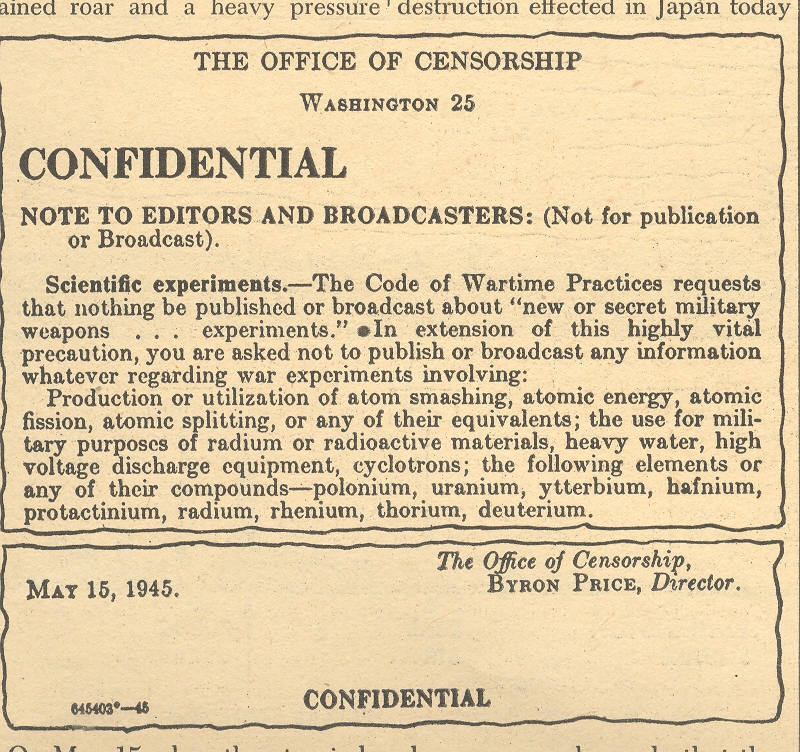
     ==Blog July 26=PM cvr bomb censor


    The other articles included “Bombs and Sabotage Stopped Nazi Experiment with Heavy Water”, “New Atomic Era Could Revolutionize Mankind’s Whole Manner of Life/Power Harnessed for Destruction Has Limitless Constructive Possibilities”, big two-page story “Stimson Reveals How Work on Bomb Was Organized”, “Bomb’s Death Range Believed to be 4 Miles”, “Four Scientists who Will Plan Postwar Uses of Atomic Energy”, “Harnessing of Atomic Power research Strengthens US Research”, “If a Piece of the Sun Were Placed on Earth”, “End Not Yet Truman Tells the Japanese”, and another 12 articles.


    There’s another baffling article “Steel Tower Vaporized in First Test”, discussing the shot at Alamagordo—it must have been the case that there was an enormous amount of material divulged by the government in the hours after the explosion at Hiroshima .  The work at Columbia is also chronicled, as is the personal life of the man in control, General Leslie Grove (and how completely in the dark his wife was, and so on). 

    ==Blog July 26=PM cvr bomb artoon

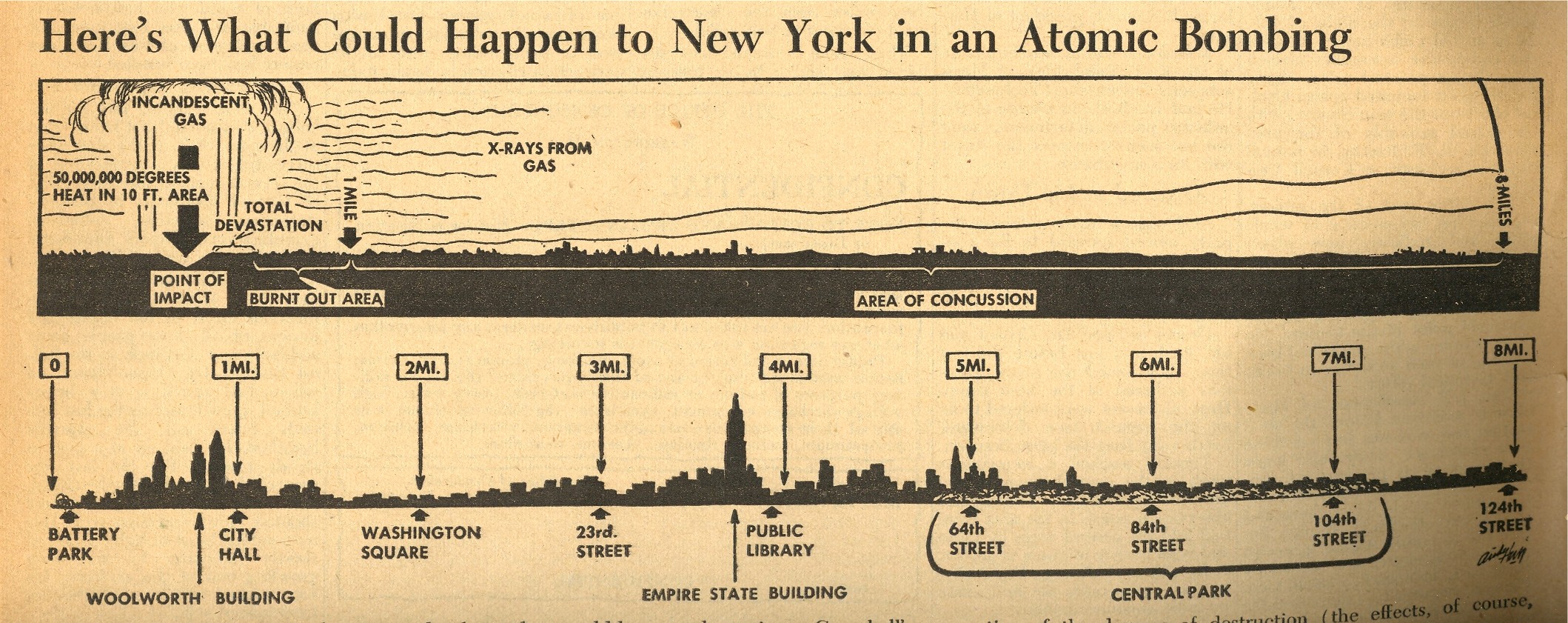
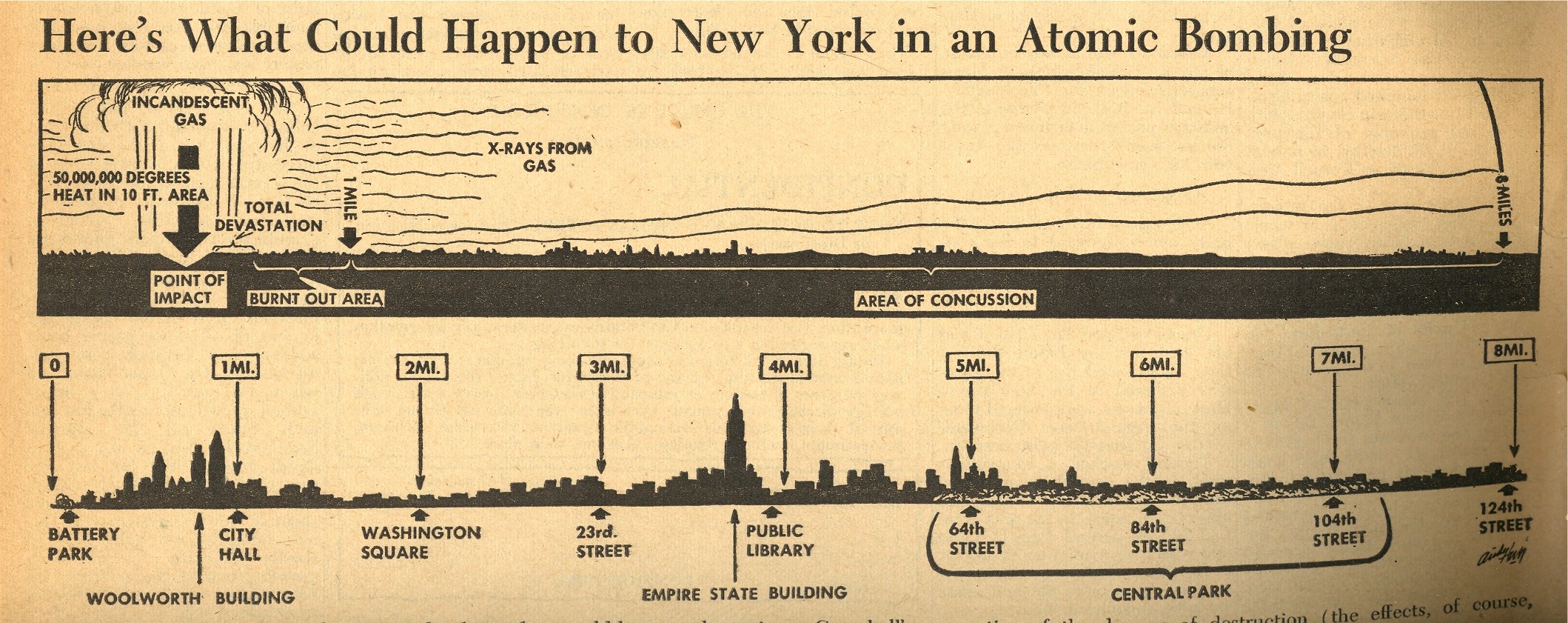
    One of the most interesting objects to me though is the small graphic on page 7 which shows what effect the Hiroshima atomic bomb would have if dropped on New York City—it was no doubt gigantically sobering to anyone who looked at it, and brought the power of the bomb and its destruction to a common, understandable point.  I’m not an historian of the first newspaper coverage of the bomb, but it strikes me that this may well be the first graphic to depict the effects of an atomic bomb exploded over NYC.

    ==Blog July 26=PM cvr bomb map

     
    In any event, the overall coverage of the event was stunning given the short amount of time to do the research, writing, and publication.  Truly a great effort. 

    Notes:

    1. PM (1940-1948) was a left-wing newspaper funded by Marshall Field III, and was home to excellent reporting.  See here for more details. Among the staff writers was I.F.Stone and staff photographers Margaret Bourke-White.  Other contributors included Heywood Hale Broun; James Thurber; (the great) Dorothy Parker; Ernest Hemingway; Eugene Lyons; Ben Stolberg; Malcolm Cowley; Tip O’Neill;and Ben Hecht.

    2. Actually, NO issue of PM had advertisements–it was entirely ad-free. (And even so it still came close to making money after 8 years.)

    PM‘s stated mission:

    PM is against people who push other people around.   PM accepts no advertising. PM belongs to no political party. PM is absolutely free and uncensored. PM’s sole source of income is its readers–to whom it alone is responsible.PM us one newspaper that can and dares to tell the truth.

    Theodore Geisel (Dr. Seuss) was a cartoonist for PM (see here for his War cartoons) as was the great Crockett Johnson.

    ·Posted by :

    ·in:


  • What Happens To Essential Personnel in a Nuclear Attack? (1956)

    JF Ptak Science Books   Post 2452

    Perhaps nothing is obvious unless it is established or labeled so; perhaps the obviousness must be stated at least once before it can be officially, recognizably, the case.  And perhaps the greater the obviousness is, the more the need to make it officially so.  Perhaps nothing is so incredibly obvious that it can be studied and dissected and established.

    This seems to be more the case in more recent history than in time more further removed: that millions of dollars can be spent “proving” that children do not like to be separated from their mothers, or that cars will go faster downhill than up, or that people will respond to proper medication better than not, and so on, so on into the night, just seem not to need a vastly-funded proof.

    And so the case with nuclear warfare, people, and cities.

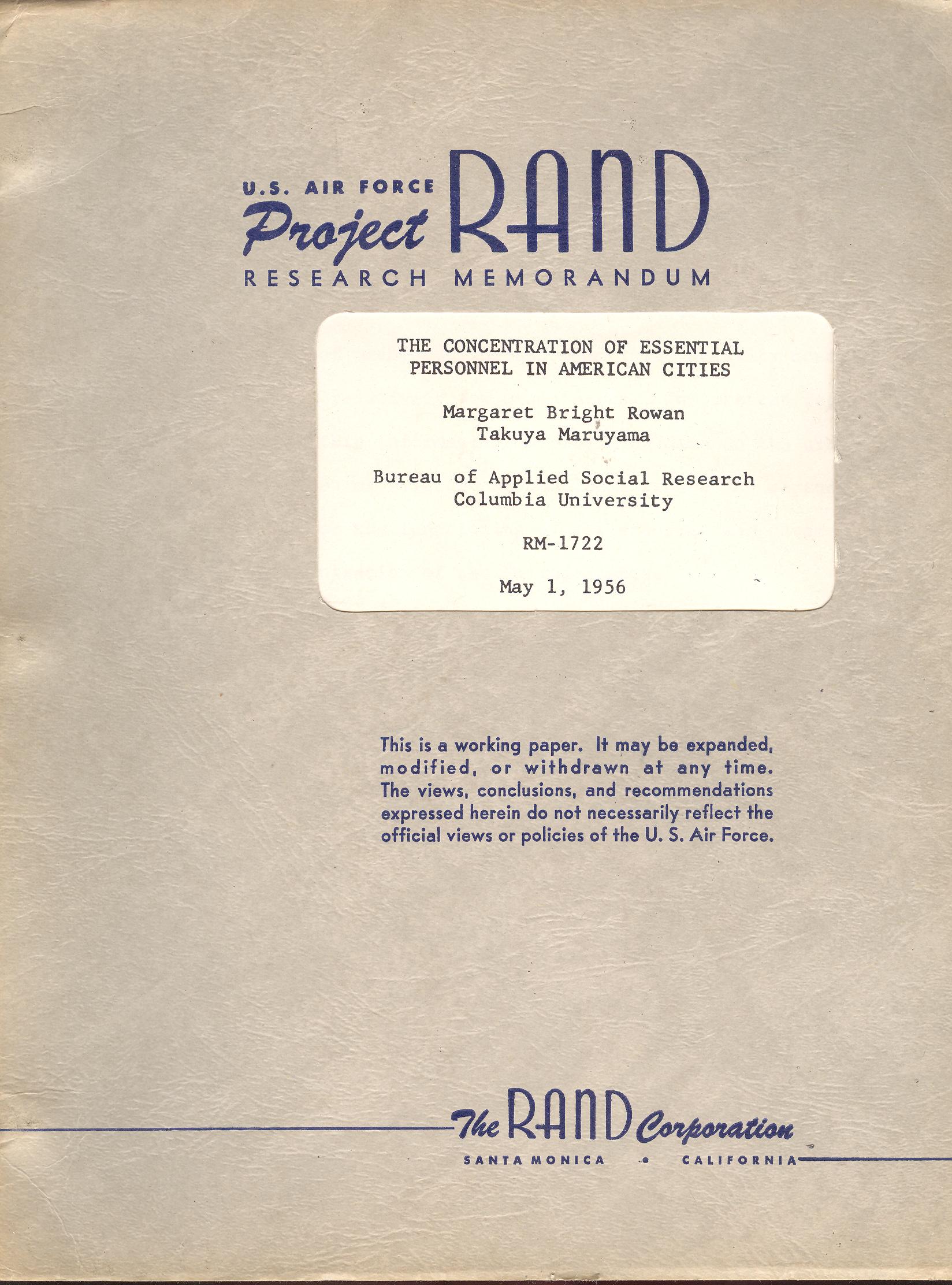
    In this RAND report from 19561, the great issue seems to be laid to rest, once and for all: the problem with nuclear weapons being exploded in/over cities is that since cities are filled with people, people will be killed.  And if those people in the cities are there because of professions that depend on city-settings, then more of those people will be killed than not.  

    Rand report


    • This work is available at our blog bookstore, here. 

    But what this report was really about was the unfortunate aspect of the impact if nuclear warfare on leadership and working positions in significant and strategic industrial/business/government professions.  And what the report finds is this: since the vast majority of these positions are located in cities (defined as 100,000 population and above), and since cities will be the major targets in a nuclear “exchange”, the overwhelming majority of these people will be killed, thus leading to strategic human resource vacancies post-war. 

    It seems that 95% of aeronautical engineers in the U.S. would be killed in a nuclear war, which I guess would mean that it would be difficult to design new aircraft and such in the post apocalypse world.  Of course these people would be killed because it was their industrial base that was being targeted and they were collateral damage, so there wouldn’t be any industrial base to produce the components necessary to build, say, a B-52.  That part of the equation is not addressed here, though.  Nor is there any sort of recommendation presented to fix the problem.

    The RAND document just painfully points out the obvious, once and for all; no one really knew what to do with the information now that it was there, in black and white. Certain people could be evacuated, saved from the maelstrom; but saved for what?  There were other evacuation plans that were completely doomed from the beginning, sheltering plans, Dr. Strangelove arrangements, but all of that would come into their pitiful being later on.

    First, though, the bitter reality of what everyone already knew–one of the greatest of all obviousnesses–had to be make its appearance in print.  And so it did.

    Notes

    1.  The Concentration of Essential Personnel in American Cities. Margaret Bright Rowan.  The RAND Corporation, May 1956.  72pp.  11×8 inches.  RARE. No copies located in WorldCat/OCLC 

    ATOMIC BOMB.  The Concentration of Essential Personnel in American Cities. Margaret Bright Rowan.  The RAND Corporation, May 1956.  72pp.  11×8 inches.  RARE. No copies located in WorldCat/OCLC $350.00

    ·Posted by :

    ·in:


  • An Exercise in Understatement: So This is the Atomic Bomb (1946)

    JF Ptak Science Books  Post 2441

    Now we are all sons of bitches—Kenneth Bainbridge, Trinity Director.

    Atomic_ so this is the atom bomb detail 2

    • [Image source: the interesting Gray Flannel Suit site, here:  http://www.grayflannelsuit.net/blog/so-this-is-the-atomic-bomb-true-comics-march-1946]Atomic_ so this is the atom bomb

    I couldn’t help but take out the trusty paper microscope for a good strong look at this image. It appeared anonymously in True Comics (issue #47, March 1946) and depicts the explosion of the atomic bomb at the Trinity site Alamogordo on July 16, 1945.  I might have given the statement a little more emphasis–maybe an extra exclamation point.  

    There were many profound thoughts in many profound for-real heads there in the desert, at the reaches of the Jornarda del Muerto(“The Dead Man’s Walk”, a formerly nearly-impenetrable stretch of desert in  the Llano Estacado) at Trinity.  Robert Oppenheimer famously cited the Gita (“Now I am Become Death, the Destroyer of Worlds…”); Enrico Fermi was so busy with his little and excruciatingly wonderful experiment with strips of paper calculating the effect of the blast (he reckoned a very-close 10,000 tons) that he didn’t actually hear the explosion; Edward Teller thought Tellerian thoughts, and so on.  Actually the observation points (like S-10000 and Campania Hill) were crowded with big brains:  in addition to Oppenheimer, Teller and Fermi were people like Hans Bethe, James Chadwick (whose discovery of the neutron sort of started the whole thing), Richard Feynman, George Kistiakowsky, Phil Morrison, Robert Serber, Vannevar Bush, James Conant, and many others.  The were all thinking pretty big things (except for the occasional so-terrific-it-can’t-be-real-but-it-must-be-because-Richard Rhodes-documents-it stuff like that which maybe came from Feynman’s mouth, which was “hot dog!”).  I think that Bainbridge’s statement was the best, and truest, summation of the morning’s activities, in spite of the necessity to make the whole thing happen.  There was just no way that it wouldn’t be done.

    Anyway, “So this is the atomic bomb” is pretty weak.

    And this:

    Atomic_ so this is the atom bomb detail 1