A Daily History of Holes, Dots, Lines, Science, History, Math, Physics, Art, the Unintentional Absurd, Architecture, Maps, Data Visualization, Blank and Missing Things, and so on. |1.6 million words, 7500 images, 4.9 million hits| Press & appearances in The Times, Le Figaro, Mensa, The Economist, The Guardian, Discovery News, Slate, Le Monde, Sci American Blogs, Le Pont, and many other places… 5000+ total posts since 2008.

Category: Atomic and Nuclear weapons

  • Figuring Out What’s What After a Nuclear Exchange, 1954

    JF Ptak Science Books   Post 2401
    Bomb damage261

    [Original document available from the blog’s bookstore.]

    The spoiler answer to this:  make sure to account for the nukes dropped on you  when figuring out what you’ve got left to work with.

    ITEM:  The Bomb Damage Problem, AFAPA-4-4, published in 1954 by the Directorate of Management Analysis (DCS/Comptroller at the  Headquarters of the U.S. Air Force).  11×8 inches.  GVC binding. 22pp.  Very good condition. RARE.  No copies located in WorldCat.  $175.

    This seems a tautologically  tongue-twisting, not-quite-right title for this post, and indeed it might be.  But that’s the way the pamphlet I’m reporting on read, a sometimes resilient-to- inspection rubberie beastie whose basis for being written was to report on an great oversight that doesn’t really want to be recognized, even if it is the title of the work.

    The Bomb Damage Problem, AFAPA-4-4, published in 1954 by the Directorate of Management Analysis (DCS/Comptroller at the  Headquarters of the U.S. Air Force) is a pamphlet of discovery–or rather, the discovery of the lack of discovery.

    The work is an introduction to some aspects of  nuclear exchange post-attack predictive capacity–particularly with the ability of American industry “to support a war plan”.  

    The anonymous pamphlet gets straight away to the discovery part–that previous predictions of post-attack capacity were “probably completely unrealistic” because “[they] did not take account of the likely bomb damage to the U.S. production facilities”.  

    I would think that even at this relatively early point of planning for possible Soviet nuclear attack that war game scenarios would have taken bomb damage to industry a”and accompanying manpower losses” into account of how the war machine would react after the bombs began to explode.  Though it seems not. I’ve looked to see how I could be misreading this thing because it seems like too monumental an oversight to make. But I can’t find where I’m making my interpretative mistake.  

    Ultimately the authors focuses on saving the corpus of the overall works, saying that this oversight does not damage the “important thinking” that had gone on it spite of this error. 

    The word “error: is not used in the text of course.  This is how it is described: “In connection with this critical new obstacle to intelligent military planning, it is essential that speculation be minimized.” The error is actually redefined as a “critical new obstacle” the effect of which heightens “speculation”.   Which is all true.

    I suppose what is really going on his the formation of some bedrock stuff formulating information gathering for creating a computer program for deeper analytical study of the effects of nuke warfare on post-attack industry.  1954 is about right for the time for this to happen, and the DMA–as the home for the creation of linear programming among countless other things–would’ve been the place for this work to happen.  

    But I keep coming back to what seem to be enormous understatements–even giving plenty of allowance for the time–that keep cropping up in the pamphlet.  Perhaps it is just stating the obvious for te first time that makes all of these seem so potentially underwhelming, like this nugget:   “numerous measures of the importance of each target may eventually be needed….” (Page 7).  

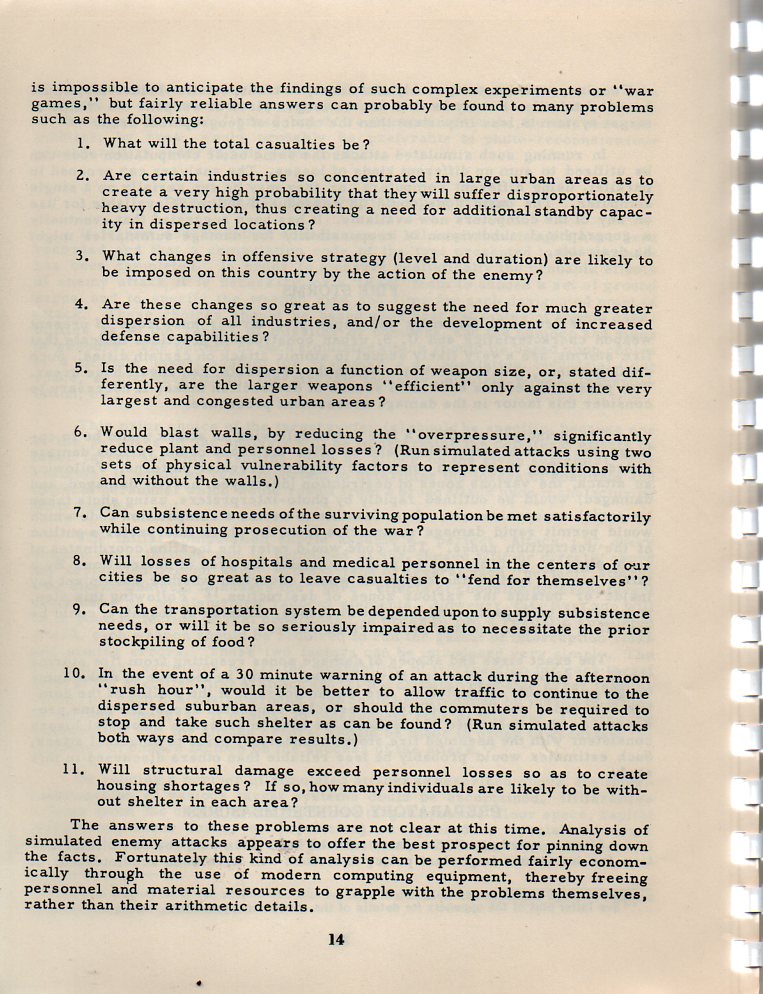
    There’s plenty of more detail though that occurs in the pamphlet, as in figuring out damage to structures by the yield of the explosion and distance from the target and the composition of the target’s structure, and so on. 

    And then we get back to the obvious: “the principal effect of a fire storm following an attack would be to enlarge the area of destruction and to alter the shape of the various damage zones, changing them from concentric rings to irregular patterns. “.  As I said, maybe it is just a case of a “Call me Ishmael”, or stating that lines and points in space exist for the purpose of geometry.  Still, it rubs me the wrong way, all over.

    And just to make this point perfectly clear:  the “bomb damage” problem is to take into account bomb damage to U.S. war-making, bomb-producing capacity, in a sort of BIBO (bomb in, bomb out)  version of a SISO (shit in, shit out).
    Bomb damage b262

    ·Posted by :

    ·in:


  • Inventory of the Apocalypse (1964)

    JF Ptak Science Books    Post 2398 

    Describing computer programs “Picnic” for biological/chem weapons damage,  and “Dusty” , for radioactive casualties

    This was an interesting read, though it took a little while to actually understand what it was I was reading.  Mathematics and Computation Laboratory, National Resource Evaluation Center, Analytical Program Compendium NREC Technical Manual No. 119 (Revised) was pritned on December 1964, housed in the covers of the  Executive Office of the President NREC/Office of Emergency Planning. The prose is mostly congestive, but after a bit you can pick up the rhythm and it becomes more user-friendly.  

    Preface signed by Joseph D. Coker, Chief, National resource Evaluation Center, who writes: “The Analytical Program Compendium gives a brief description of the National Resource Evaluation Center’s current general purpose analytical programs and replaces earlier editions of the NREC Glossary of Damage Assessment Programs. It is intended as a guide for users and potential users of these programs to indicate the various programs that are presently available and those that are being produced. Separate Technical Reports or Technical Manuals are available for the standard operating programs and for a number of those which are in preparation. Reference to these manuals and reports can be obtained in the Bibliography of Publications (Technical Manual No. 121) published by the NREC. The Compendium contains descriptions of the computer programs of a substantive nature.”  

    Nrec 664


    [Can’t live without this Cold War document? See out blog bookstore to purchase the original.]

    The list of the contents of the 92-page work is pretty interesting, the book presented in eight sections (or “casualty classes programs”):  (I) Attack Analysis Programs; (II) Vulnerability Analysis Programs; (III) Damage Assessment Programs (Direct Effects, sections dedicated to nuclear shots Dusty III, Flame I, Jumbo III, Streak IV, Dart II, Dart III, Picnic, Ready I.(IV) Resource Evaluation Programs; (V) Economic Analysis Programs ; (VI) Resource Management Programs; (VII) Mapping and Display; (VIII) Manual Procedures for Damage Assessment and Resource Evaluation.  The last section describes programs of manual damage assessment (“developed by agency representatives for use when computer estimates are not available”).
    Nrec 663


    Under section III are described the various other programs computing availability of surviving resources and damages to the rest, and to assess capability and loss. For example:  Weapons Edit III (working on an 1103 AS or 1105 computer) calculates missile availability; Dusty III (fallout intensity “…at weapon oriented points”; Flame I (“computes an estimate of the extent of the spread of uncontrolled fire”) and can compute fire maps; Jumbo III (a casualty assessment program); Attack Environment III (“determines the blast effect from the dominant weapon and combines the separate effects of fallout and from from all weapons that affect each resource point”); Facility Assessment (Namepoint) III ( for physical damage to facilities); Time-Phased Accessibility  (“listing of accessibility of resources in various conditions of damage after an attack”); Population III (summing up casualties in populations after attack; Manpower III (translating population losses into labor losses and how it would affect x,y, and z); Livestock III (keeping tabs on livestock “and livestock products”); Streak IV (‘high speed estimate of blast and fallout casualties, estimates of damage and denial of facilities…”); Picnic (!, estimating casualties from biological or chemical weapons), and a number of other programs. 
    There are some other interesting programs for end game times: Net Inventory (“(a) routine (that) is a balance sheet between supply (inventory and production) and demands (requirements)” and Amounts of Production (“a routine (showing) the production based in facility damage and labor casualties; and of course Survival II, which computes “the total requirements…for regions”.

    Of course it was necessary to figure all of this stuff out so that in the event of The Big One there is a certain control over what is where and what is left and what is needed and so on.  

    There is no mention made to where these computers are housed. 

    It certainly seems that if there was to be a nuclear holocaust, it would be well-enumerated.  

    ·Posted by :

    ·in:


  • Dr. Strangelove’s Computer

    JF Ptak Science Books   Post 2405

    ‘Russia reveals Cobalt Bomb; Total World Destruction Ahead”, ending of Philip K. Dick’s “Exhibit Piece”, 1952

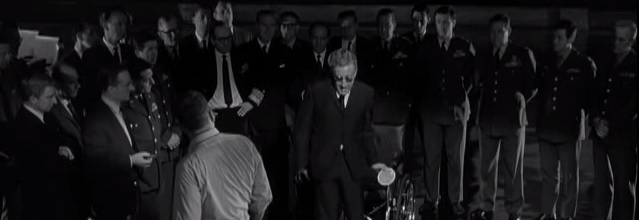
    I never really thought that much about what Dr. Strangelove was fiddling with to calculate the “half life of cobalt thorium-G” in Stanley Kubrick’s mega-dystopian steam-nuke 1962 film, Dr. Strangelove. (We’ve looked at this film a number of times on this blog–just search the title in the Google search box to see the others.) So I went to some clips online and found a still showing him putting away his circular slide, which turns out to be the 1962 version of the “Nuclear Bomb Effects Computer” that was published and issued along with Sam Glasstone’s The Effects of Nuclear Weapons (published by the Department of the Army as No 39-3, one edition n a continuing series.

    Dr. strangelove computer 1964

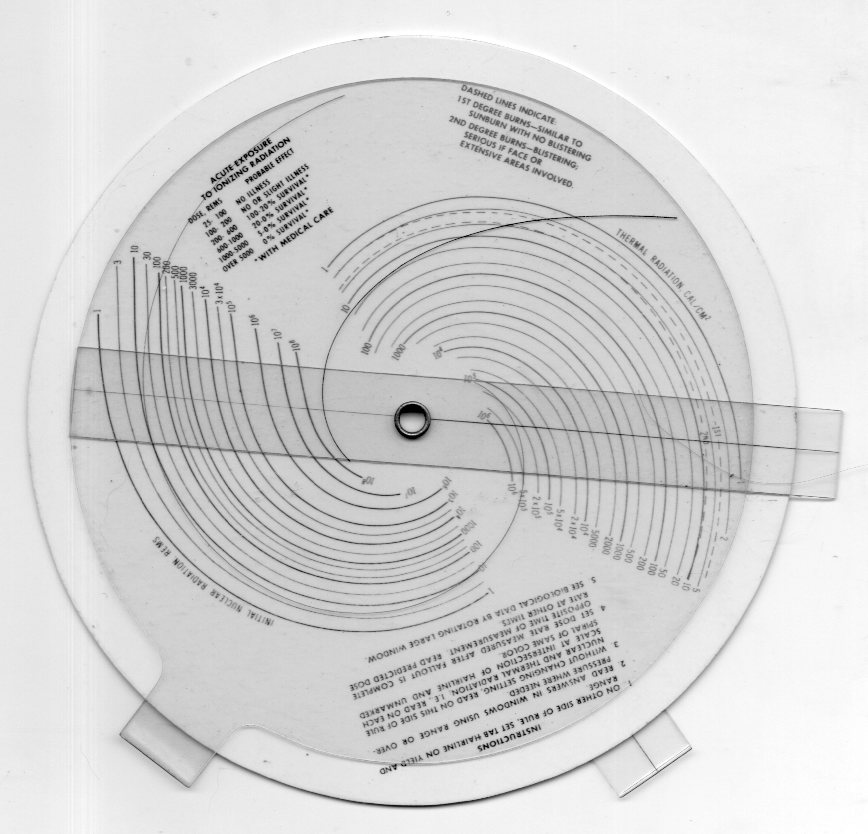
    My calculator is actually from the 1964 edition of the work–there seems to be no difference from computer to computer, but there are differences in the text of the book, one of which relates directly to Dr. Strangelove.  There is a very brief, barely-two-page section called “Radiological Warfare” in the chapter dealing with radioactive contamination from nuclear weapons. there is nothing overtly technical in it, though the writers seem not to like the idea, given the inherent difficulties in producing and storing such advanced gamma radiation weapons, saying too the the use of such beasts would be either “impossible of very hazardous”. The author also makes the point that the high fission energy yields of the new bombs, which make them “in effect, weapons of radiological warfare”.1

    Here’s the reverse of the computer, rendered in black and white:

    Nuclear bomb computer677

    So, that’s it. Dr. Strangelove though wasn’t the first to discus a cobalt-laced dirty dirty dirty bomb, with the idea managing to surface several times in the ’50’s (as with the PKD example, above, and Fritz Lieber’s Moon is Green, 1952, where there are cobalt bombs galore, then things happen, and then everything goes badly). The ideas of total destruction+total destruction=total destruction seems to have originated with Leo Szillard in a radio broadcast from the University of Chicago in February 1950 with the introduction of the cobalt-based bomb, which produces a far more intense radiation than U-238. Szillard presented his case as a what-we-will-soon-be-capable-of argument, putting not the destruction of entire cities into question, but the entire planet.  

    Dr stangelove computer bThis is about the final minute of the movie, when Dr. Strangelove  finds himself rising and walking by a secret Fuhrer-based miracle, his little computer still in his hand.  And then seconds later the really bad stuff happens.  

    ·Posted by :

    ·in:


  • 53 Very Well Chosen Words Outlining the Atomic Bomb (Nov 1945)

    JF Ptak Sciene Books   Post 2382

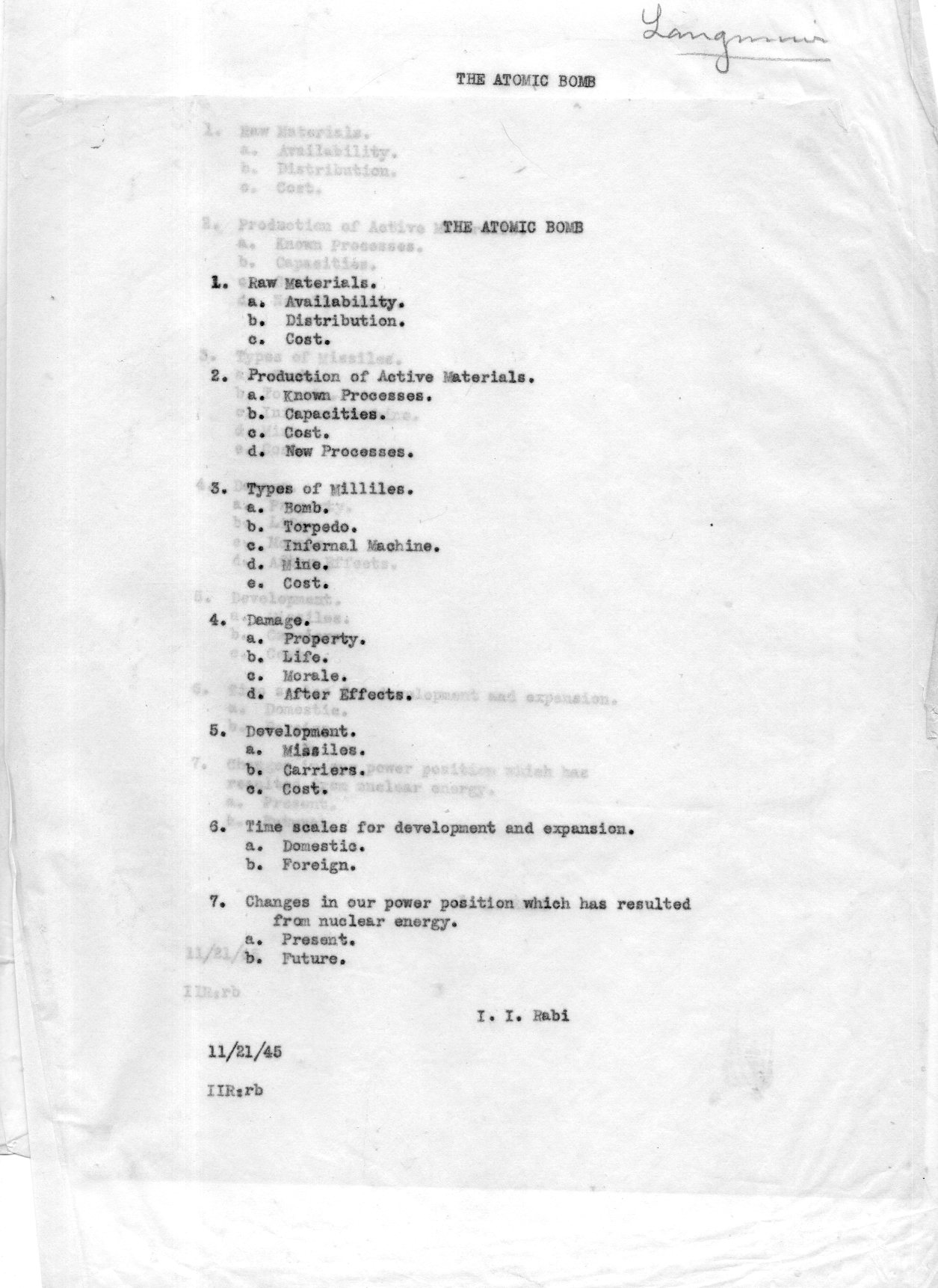
    Rabi593

    This is a duplicate of a carbon copy document by I.I. Rabi, and is one of 35 documents1 relating to the development of U.S. atomic policy, October 1945-January 1946, that comes from the library of Caryl Haskins2, a close and long-time friend of Vannevar Bush, who worked with Bush throughout World War II at the OSRD, and was executive assistant to Bush at NSRD 1941-1945. Vannevar Bush, one of the most important scientist-advisers of World War II, foresaw the development of the atomic arms race in 1943, and by 1945 became a fundamental thinker and advocate of addressing the problem of atomic information control.  The 35 documents in this collection are–almost without exception–by aides and close colleagues of Bush  who assisted him in formulating the positions and issues, dating from October 1945 through January 1946.   They consist of background papers, drafts of proposals, informal studies, as well as mature statements of thought that would become implemented in the core of U.S. policy regarding the spread and control of atomic weapons.  They are generally carbon typescripts and necessarily of extremely limited distribution, generally have no letterheads, occasionally carry the authors’ full names (although sometimes only initials are used), and 18 are stamped or typed “Secret”.

    The sheet by Rabi (1898-1988) is simple but interesting, and in 53 words outlines the issues of the atomic bomb–it is dated November 21, 1945.  IT was typed for Rabi by an assistant (“rb”), and at the bottom as being by Rabi.  Rabi of course played key roles in the development of the bomb, as well as playing a very crucial and critical role in the discussion of the future of atomic weapons. 

    Rabi592[These are the two copies of the Rabi outline–the second was Irving Langmuir’s copy. There couldn’t’ve been too many of these made–there would be the original, then perhaps six carbon copies. I any event, it is a rare thing. The original is for sale here at our blog bookstore.]

    ·Posted by :

    ·in:


  • Dentists and Mushroom Clouds–the Mundane in Planning for the Thermonuclear Post-Apocalypse

    JF Ptak Science Books     Part of a long series on Atomic and Nuclear Weapons History

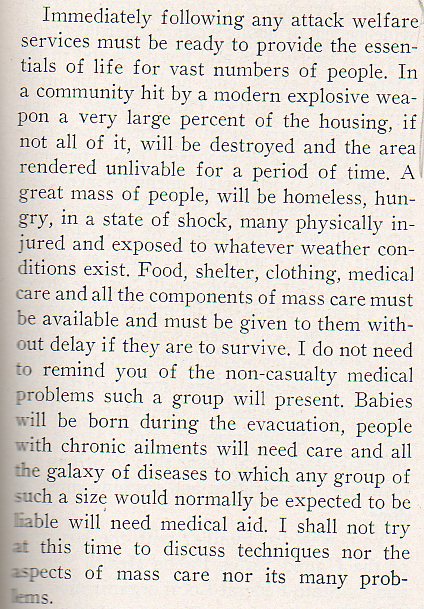
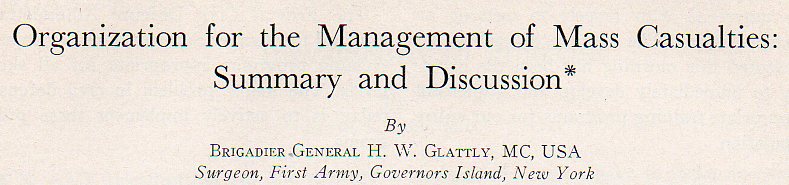
    The sotto voce singing of the oblivious obvious/mundane is slung throughout the nearly 200pp-work “Mass Casualties, Principles Involved in Management”,  which were papers delivered at the 62nd annual convention of the Association of Military Surgeons, published in 1956 in Military Medicine.  

    For example:

    Nuke--nuke detonation313 Nuke--nuke detonation315


    How can a person–how can I–write about Nuclear Holocaust as being mundane? When it comes to reading how some people mundanely responded to planning for surviving it.

    It is a very deep Disturbia into which people fall when writing about the millions of details in accounting for the unaccountable, writing about the medical/physical/psychical consequences of surviving a bomb when dozens might well be detonated at the same time, the millions of details overtaken by billions of other details not mentioned and perhaps not imagined. 

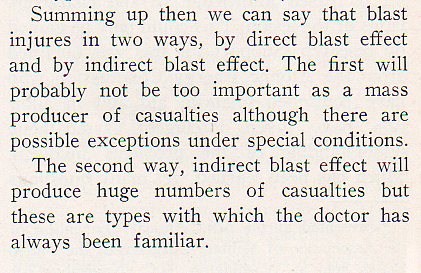
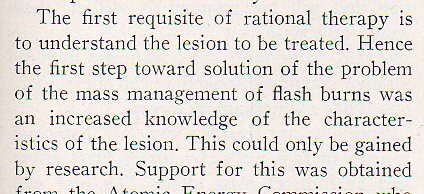
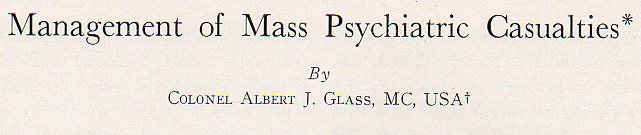
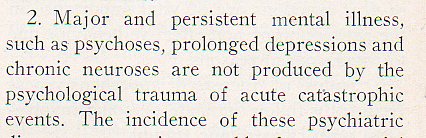
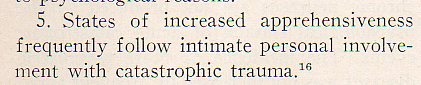
    I’ve collected some wide non sequiturs dealing with the matters of the nuclear apocalypse from a publication calledMilitary Medicine in an article entitled “Mass Casualties, Principles Involved in Management”,  which were papers delivered at the 62nd annual convention of the Association of Military Surgeons, 1956.  Sometimes the chapter heading says it all, giving wide pause; and sometimes you have to wade in a little, but you don’t need to go very far, or very deep.  Overall the issue of the absolutely overwhelming devastation and the impossibility of dealing with the human consequences of nuclear war do absolutely get written about, but it occurs somewhere inside each contribution, which is front-loaded with pop-iconic understatement and then followed up with vast simplification. 

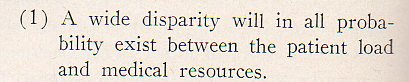
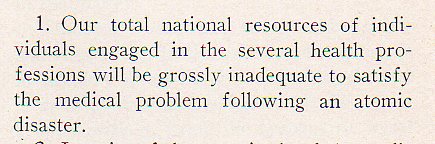
    Then of course there is the official-speak in quietly stating screamingly bad things: “a wide disparity will in all probability exist between patient load and medical resources”.  There’s so much like that in this publication that it is hard to keep up, like differentiating sands on a beach. 

    [I resisted including the section on the use of dentists in the post apocalypse–it was too painful, and I ran out of steam.]


     Nuke--mass cas priciple320
    Nuke--mass cas priciple321


    Nuke--secondary missile316Nuke--secondary missile317

    Nuke--thermal318
    Nuke--thermal319
     Nuke--mass psych324
    Nuke--mass psych325
    Nuke--mass psych326
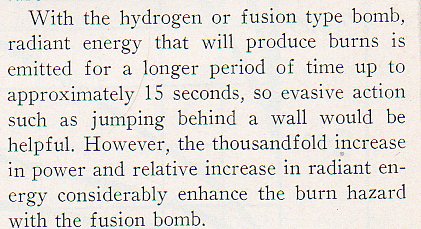
    Nuke--mass thermal burns322
    Nuke--mass thermal burns323
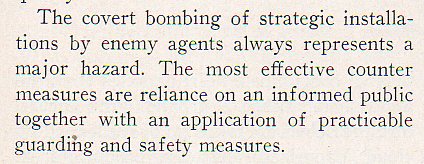
    Nuke--public health327 

    Nuke--public health328

    Nuke--public health329 
    Nuke--public health330

    Nuke--organiz336
    Nuke--organiz337

    Nuke--vet334
    Nuke--vet335

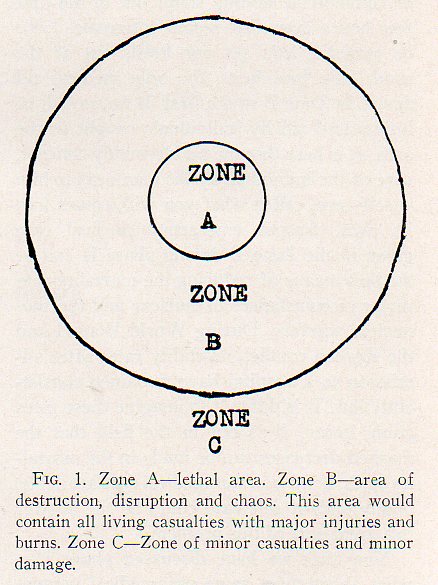
    Fabulous graphic:
    Nuke--enlisted331
    Nuke--enlisted332

    ·Posted by :

    ·in:


  • The Hell Bomb, 1951

    JF Ptak Science Books  Quick Post

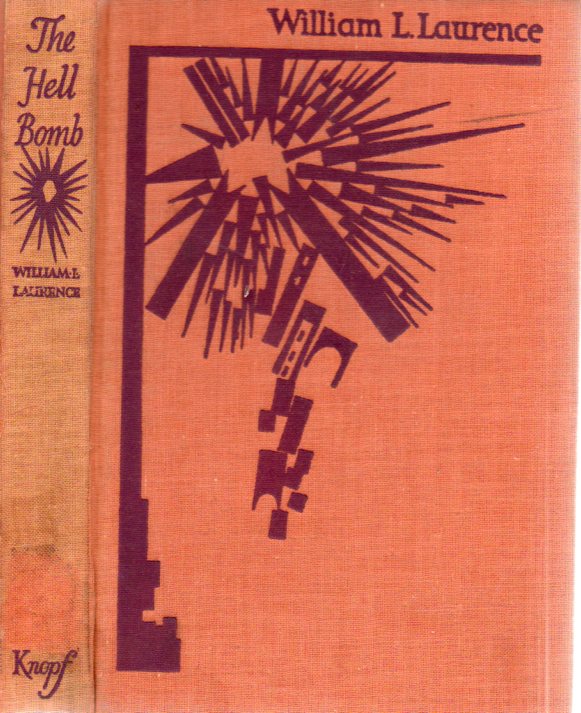
    I kept this book mainly for the cover art, though the writer–William L. Laurence–did a commendable job of looking at the Hell Bomb (the hydrogen bomb) and provided a useful chronology at the end of the book for attempts at nuclear control.  Laurence was a science writer for the New York Times and was also the official historian of the Manhattan Project–he was also about the first person to write for a mass audience on the coming of what he would eventually coin “the atomic age” in a 1940 NYT article1.  

    Hell bomb386

    The book is agile but also a very slight read with not much detail, published without a single footnote, and without a bibliography, sort of like a long newspaper article.  One thing is for sure though–he was right about the “hell” part. 

    Notes: 

    1. “Vast Power Source in Atomic Energy”. New York Times. May 5, 1940

    Here’s an interesting article on the popular reception of the possibilities of atomic power if not an atomic weapon, found in the NY Times, 1938-1940:  http://ansnuclearcafe.org/2013/11/26/excitement-about-u-235-as-coal-competitor-circa-1939-1940/

    ·Posted by :

    ·in:


  • History of Mattresses: the Suspended Sleep of the Atomic Bomb, 1945

    JF Ptak Science Books    Post 2336

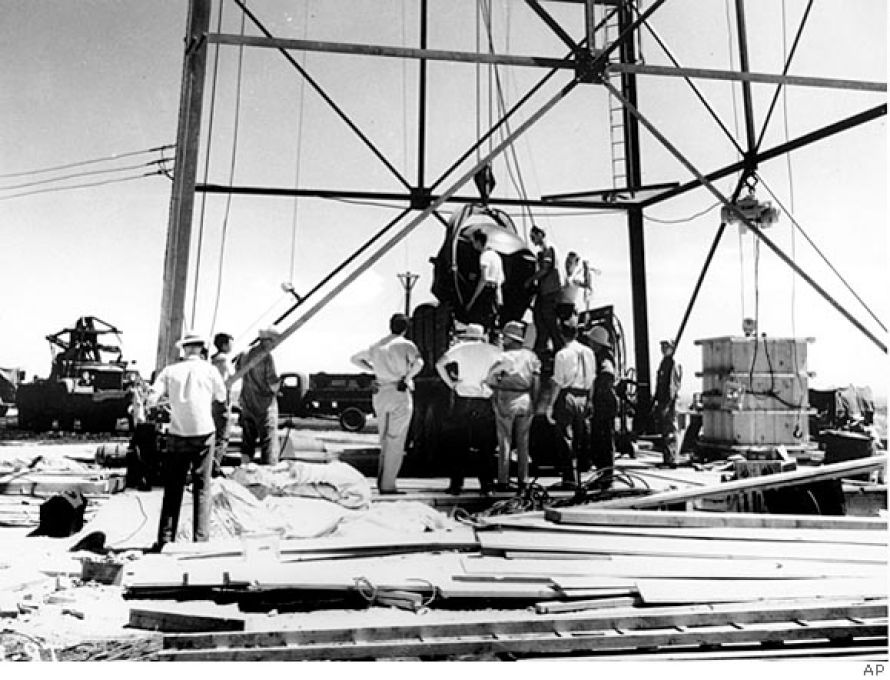
    Atomic bomb trinity tower[The preparation of the bomb, at center, before being quite armed and hoisted–(AP Photo/File)]

    The “Princess and the Pea” comes to mind with this story, except that the pea was located above the mattresses, suspended from cable above them. It was the ultimate pea.

    That “pea” was an atomic bomb. It was suspended in inside a 100-foot tall metal tower in the desert of Alamagordo, in the Jornado del Muerto, the test shot to see if the bomb worked, the near-culmination of the work of 100,000 people and billions of dollars, and the great potential decision-maker on the outcome of WWII

    This was the Trinity Test–July 16, 1945. 

    The bomb was hauled up to its position in the tower, dangling there, not much protected from the elements which that night of the test threatened lightning and wind.  What of the cables failed? And the bomb fell?  

    The last-minute fail safe was a large pile of mattresses.  They would cushion the fall.  The bomb would not explode, but it could be heavily damaged. And in this makeshift way the enormous investment was protected.

    The bomb was detonated at 5:29 that morning, creating at 1100′-wide crater, causing the atmosphere around the explosion to turn blue from heavy radiation, and raising a 40,000′-tall mountain of smoke, a result of its 15kt yield.

    The tower of course was vaporized.

    I assumed too so were the mattresses–even if they were Army-issue.  

    It is a secret irony of some sort that while pre-detonation betting was going on by the scientists about the yield of the device with a side wager on whether or not the atmosphere would be set on fire, that the stop gap measure preotecting the bomb if it fell was a pile of mattresses.  

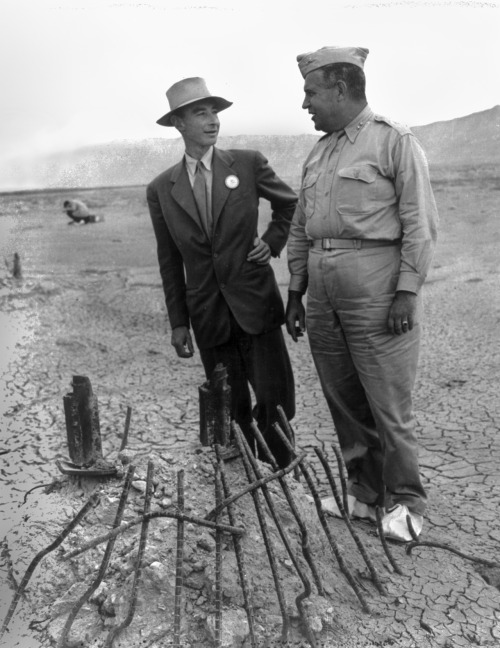
    Atomic bomb trinity oppenheimer groves

    [Oppenheimer and General Groves–standing too close for comfort–at the footings of the dissolved tower, afterwards, their whie footies in place for radiation protection.]

    But it all worked out.  

    ·Posted by :

    ·in:


  • Popular Atomic- and Nuclear-Named Stuff, Mostly Bomb-Related

    JF Ptak Science Books   Quick Post

    Below are 66 examples of Cold War era stuff and consumer bits relating to atomic/nuclear weapons.  All are found in my pinterest page, here.  

    Canadian Cold War Poster: "Bea Alerte Says, 'Disaster May Never Occur Here...'"


    "ATO McBOMB" ATOMIC BOMB-INSPIRED MYSTERY CHARACTER BUTTON. ~1940s


    ·Posted by :

    ·in:


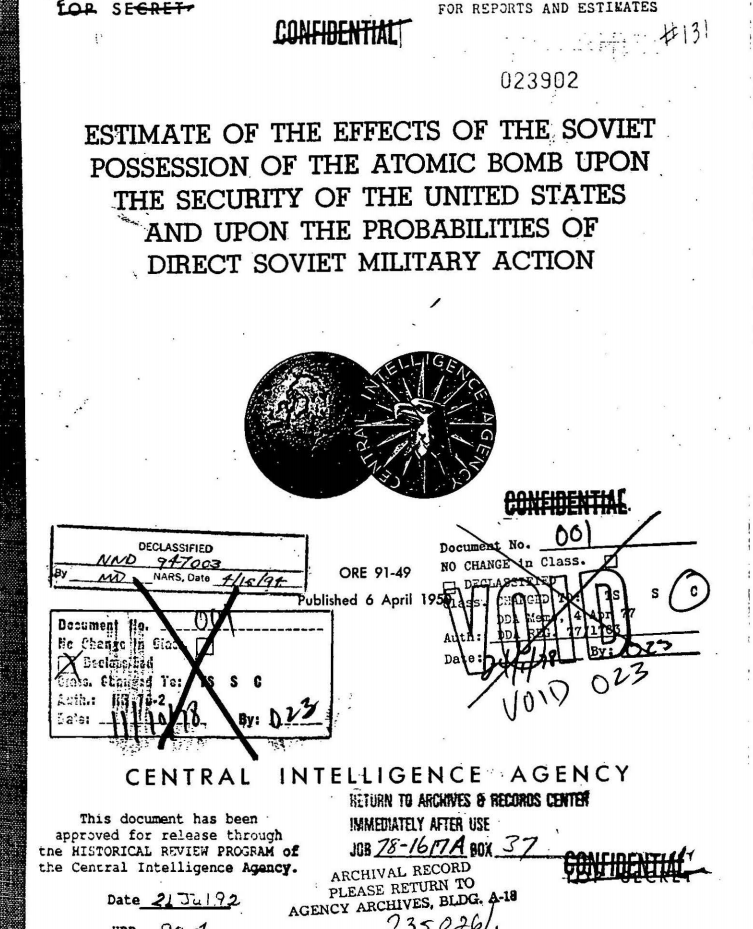
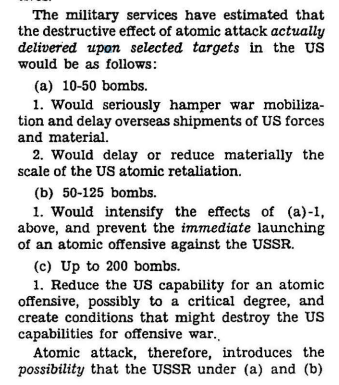
  • On the “Hampering” Effect of a Soviet Nuclear Strike

    JF Ptak Science Books   Quick Post  

    From the Department of Vast Understatement:

    CIA USSR Nukes 2Source: the National Archives.

    CIA USSR NUKES 3

    CIA USSR Nukes 1


    ·Posted by :

    ·in:


  • Buck Rogers and the Failure of Imagery in WW-Last, 1946

    JF Ptak Science Books  Post 2246  [Part of the series on Atomic Weapons]

    Atomic war buck rogers683
    Atomic war buck rogers685
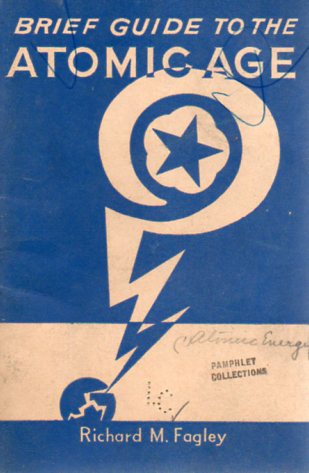
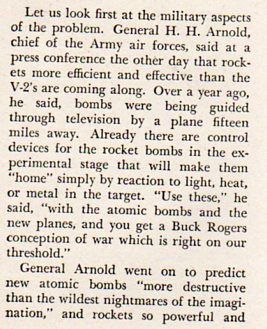
    Richard Fagley–author of Brief Guide to the Atomic Age, 1946– took a sleepy, elementary side step through the coming decade or so in the future of atomic weaponry.  The thing is, he got a bunch of it right.  But where he took a wide and missed turn, where he misunderstood the power of atom weapons, was that they would provide the future us with a “Buck Rogers” style of war.

    Now of course in 1946 the Soviets hadn’t developed a Bomb, but anyone who knew anything knew that it would be just a matter of time before they did.  Smart estimates were coming in at a decade or more–few people were prepared for the Soviet announcement in 1949 that they had achieved that goal

    Fagley missed the impact of atomic warfare of the future not on his own accord–he was quoting someone who knew far more and knew better–General Hap Arnold, the Commanding General of the U.S. Air Force.  But as it turns out, Arnold really didn’t have the vocabulary or this discussion, and couldn’t really estimate the “effectiveness” of the use of the new weapons. 

    Atomic war buck rogers684

    So far as I know, Buck Rogers didn’t have weapons like atomic bombs, at least I think in his original appeaarance as Anthony (and later “Buck”) Rogers in Armageddon 2419, back in 1928, when he made his first appearance. As it turns out Buck was born in 1898, and owing to a mining disster breathed in some radioactive gas that put him to sleep until the 25th century. He wakes up in a very jaundiced post-Yellow-peril world in which America has been defeated by the “Mongols” of the East (who had beaten the “Russian Soviets” who had in turn had conquered Europe), wherein begins his mighty struggle to get America back on its feet and defeat the great menace.  The idea of Rogers becomes very popular in popular culture, and he moves from this story into many other print versions, getting movies and a radio show (from 1932-1947) in the process. Somewhere in there is where he acquires his atomic pistol (called “U 235”), though the thing necessarily does not come close to what the real stuff would bring in the very near future.

    In Fagley’s war of the future there wouldn’t be many survivors, though his vision of the massive atomic bombing outcome seems not very proximate to what the horrible coarseness of what the real thing could be–perhaps because that amount of destruction was still unimaginable when the pamphlet was being written in 1946. Buck Rogers didn’t have the vocabulary for such enormous power and mass destruction, either. In any event, words to describe the coming possibility of vast annihilation just didn’t seem to be at hand in 1946–the words and ideas, and the weapons, would soon (in the Ulam-Teller hydrogen bomb, 1951) be at hand to flesh out the possible true-to-life nightmares of the nuclear future. Even in a 25th century armageddon, old Buck’s idea of power and devastation couldn’t come close to imagining the power of the real thing.  

    Buck Rogers Will Wake Up In A 3D Future image