A Daily History of Holes, Dots, Lines, Science, History, Math, Physics, Art, the Unintentional Absurd, Architecture, Maps, Data Visualization, Blank and Missing Things, and so on. |1.6 million words, 7500 images, 4.9 million hits| Press & appearances in The Times, Le Figaro, Mensa, The Economist, The Guardian, Discovery News, Slate, Le Monde, Sci American Blogs, Le Pont, and many other places… 5000+ total posts since 2008.
I’m introducing some of the images from my 3,500-item Pinterest collection. The following is a subset of the Department of Atomic Bomb Hopes and Fears. The original sources for the images can be found in the links in the Pinterests categories.
I have a pinterest account with 50 categories and over 3,500 images–the images below form a subset of the Department of Atomic Hope and Fears: Atomic Stuff (with 150 or so atomic/nuclear images overall). The source for each can be found on the Pinterest site.
[Still from the IBM 2013 video “A Boy and His Atom”, where a team manipulated carbon monoxide atoms on a 45×25 nanometer frame. Just for reference a human hair is 105 nm, and there are 24×109 nanometers to the inch. Small.]
I was looking around, trying to figure out a chronology of small, of how small things can really be, when I decided to check out the basic terms of conversation in the Oxford English Dictionary. I was surprised to see that the first reference to “sub-atomic” was much earlier than I expected, finding a place in the five-year-old science journal Nature, in 1874. Just for the sake of it I’ve made a list of the atomic-related words that came to mind, just to see how they were entering relatively common usage in English. And so, below: sub-atomic, inter-atomic, atom, split the atom, proton, electron, and neutron.
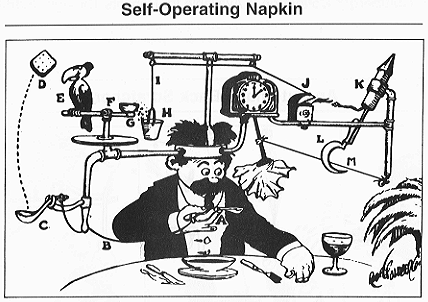
I think no plumb line was ever so worked with pulleys and wheels, strings and catclaws and other Rube Goldberg devices as were the demographic studies of nuclear warfare.It is as though their compass rose had no compass, with everything centered on the center, no way out, no way in. just there.A faceless clock face describing “G-2 o’clock” whenever it pleased.These studies seem to me the nuclear warfare equivalent of the Bellman’s map (described earlier in this blog as the most perfect map ever constructed): a pretty polygon describing a totally blank surface.
I have a number of these things here, some of which are restricted-distribution publications, works of statistical fancy/fantasy meant for other eyes in the same community dedicated to the fancies described, a tautological audience for self-referential.
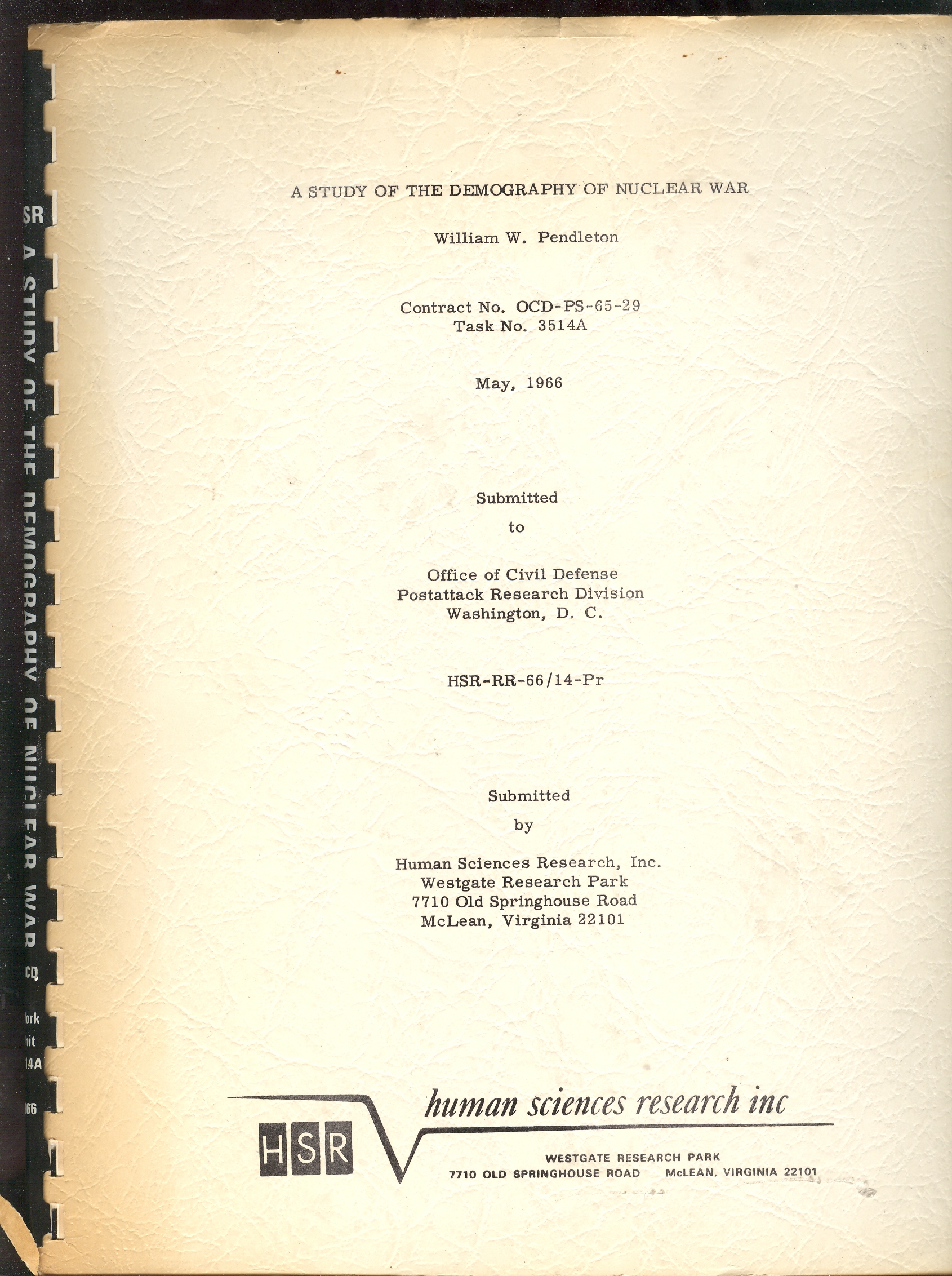
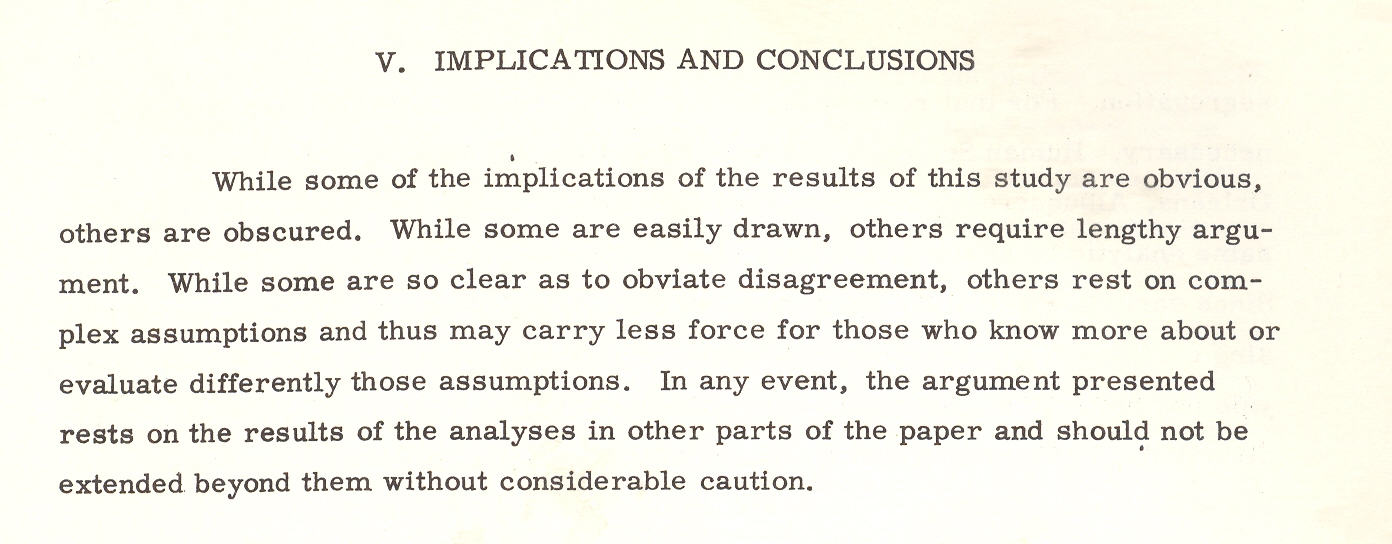
One such bit, plucked from this pile is William W. Pendleton’s A Study of the Demography of Nuclear War produced by “Human Sciences Research, Inc.” [This item is available for purchase from our blog bookstore.] Outside of its statistical foray in survivability and the procreative prospects of the left-overs of vast nuclear exchanges, the work is a solemn attempt at institutionalizing the death requirements of nuclear combat.The necessity of overwhelming carnage is presented in ironic and underwhelming language, the first bits of which are seen in the conclusion of pamphlet’s abstract1:
“Cities differ in the kinds and magnitudes of change to which they might be subjected. Considerable variation in the demography of surviving populations can be expected; that variation would be related to policy decisions; and those decisions should therefore be examined for their demographic implications.” [Emphasis mine.]
Put another way, the city is the main focus of the survivability equations, and the chances of the humans being bombed in those cities would change with—god help us—the amount of bombing.
Cities differ in the kinds and magnitudes of change to which they might be subjected.
This is the key I think to understanding documents like this, making a simple foundation statement so convoluted and tortured that it and most of what follows make any sense outside of restating themselves. Which I guess is a strength.
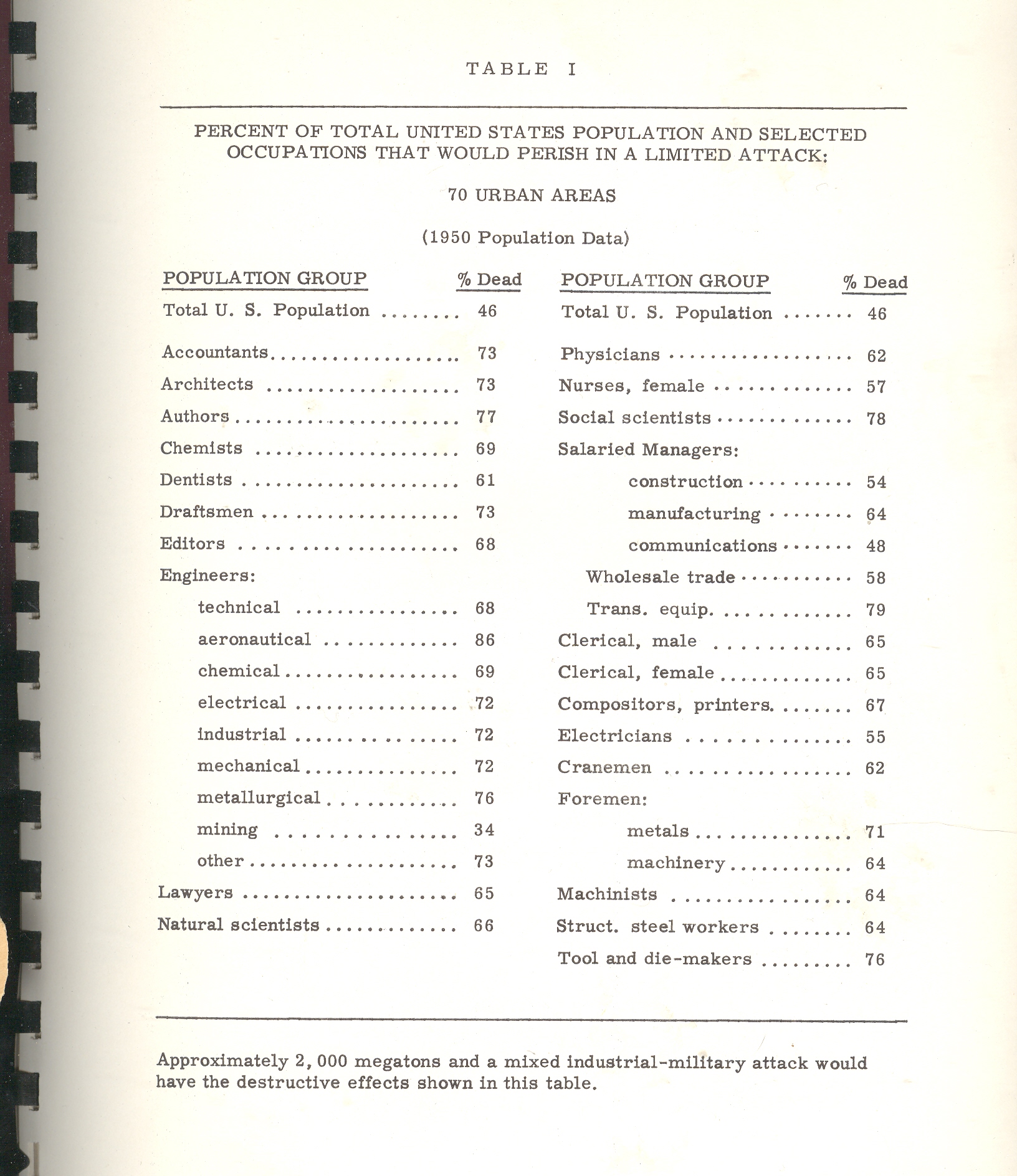
Back to the pamphlet and the interesting table that attracted my attention.According to one study [and for the sake of brevity I’m not going to describe the scenarios or data estimation methods and so on] the U.S. would suffer 46% casualties [meaning immediate deaths and not as a result of radiation or illness or starvation or the encyclopedia of whatever that would lead to death somewhere down the road].The resulting demographic of the “perished” by job description postulates that the most-killed category of worker would be: (#1) aeronautical engineers, 86% dead; (#2) transportation equipment salaried manager, with 79% killed; (#3), social scientists, with 78% of them going down with their clients; (#4), authors, with 76% gone.
Authors?Of what, I wonder?The good ones with the bad?Are authors different from writers?And what do you call folks who produce tv shows?Since the stats here are for 70 cities there’s no wonder that there aren’t any farmers in this table, as the majority target areas (some 450 cities cited elsewhere as targetable, including my own little burgh of Asheville, N.C.) would naturally have city folk in them.And so I’m guessing that three-quarters of all “authors” in 1960/6 were living in these target cities and were going to go up in smoke.The aeronautical engineers category is more understandable as every one of those industries employing 50 or more people would be a target; frankly I’m surprised that given the possible firepower of the Soviet Union in 1966 that 14% would survive; I’d guess offhand that the number would be 2%.
Even though this stuff is spread out in only 98 pages or so it would keep a person busy segregating the Orwellian gems from those not; it would be a tricky business as most of the “text” in the “not” category would be largely limited to prepositions.
Here’s another bit:a parenthetic poke at the post-attack composition of Congress. It is stated that the “postattack” (hyphenated no longer) Congress would be “quite different”.It would also be (“in their eyes”) “more Conservative than the pre-attack (hyphenated!)Congress.It isn’t a cause for great prognosticational (?) liberty to assume that the Congress might be more Conservative, but why on Earth did the author qualify the assumption by saying “their eyes”?Pish and posh.
The paper goes on its merry way, connecting the necessaries of Goldbergian delight, and somehow nothing ever happened, which to me is a secret miracle.Especially given the weight of papers like this one, which seems to medicate the effects of war, assuming that there will be a Congress and that people will report back to work once the factories are rebuilt and that there will be more segregation in the colossal world of post-attack America, and on and on into the red dawn.
Mr. Mencken’s view of Warren Harding comes to mind when I read this stuff and wonder about how it was that we didn’t blow the whole place up:
“I rise to pay my small tribute to Dr. Harding. Setting aside a college professor or two and a half dozen dipsomaniacal newspaper reporters, he takes the first place in my Valhalla of literati. That is to say, he writes the worst English that I have ever encountered. It reminds me of a string of wet sponges; it reminds me of tattered washing on the line; it reminds me of stale bean soup, of college yells, of dogs barking idiotically through endless nights. It is so bad that a sort of grandeur creeps into it. It drags itself out of the dark abysm of pish, and crawls insanely up to the topmost pinnacle of posh. It is rumble and bumble. It is flap and doodle. It is balder and dash.”
Notes
1. The abstract from the above paper: “The basic problem with which this report is concerned is that of determining the kinds of demographic change that might result from a range of nuclear attacks, ascertaining the effects of those changes on the future of the surviving populations, and indicating possible areas for Civil Defense action and planning. Earlier studies of the demography of nuclear war were examined and their relevant conclusions and methodology incorporated in the report. A different methodology–expected to be more sensitive to compositional effects–was then designed. The new methodology was tested and found to be more effective than the old. Surviving populations representing a wide range of variation in attack conditions were created on the basis of both old and new methodologies, and the demographic significance of these populations was examined. Assuming a range of post-attack demographic conditions, a series of projections was made on the surviving populations. The demographic significance of the recovering populations was then examined. On the basis of the analysis a series of recommendations relevant to Civil Defense planning was made: Within the framework of this analysis the crucial variable is the demographic pattern of the city. Changes in composition, as well as size, could be of substantial magnitude and would last for generations in some cases. Cities differ in the kinds and magnitudes of change to which they might be subjected. Considerable variation in the demography of surviving populations can be expected; that variation would be related to policy decisions; and those decisions should therefore be examined for their demographic implications.”
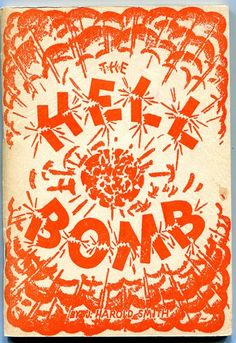
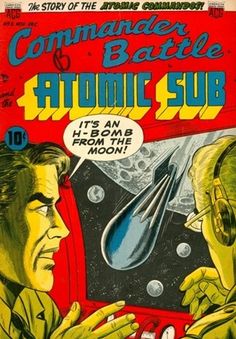
This is part of a collection of popular-culture images of the atomic bomb cloud–an x-ray of cloud bones, if you will. These (along with their attributions) can all be found on my pinterest page in the “Atomic Hopes and Fear” section. There is also a 100+-post section on this blog for Atomic and Nuclear Weapons.
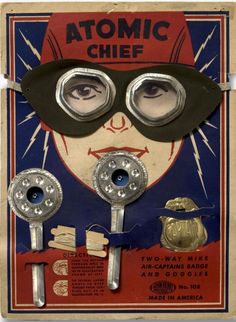
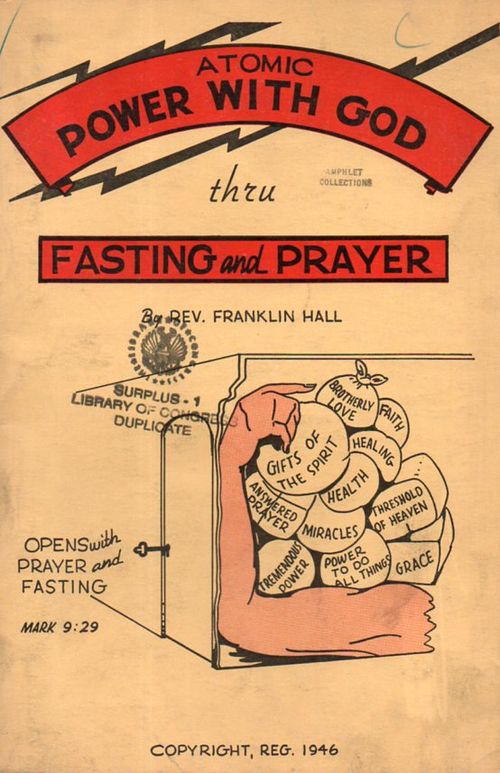
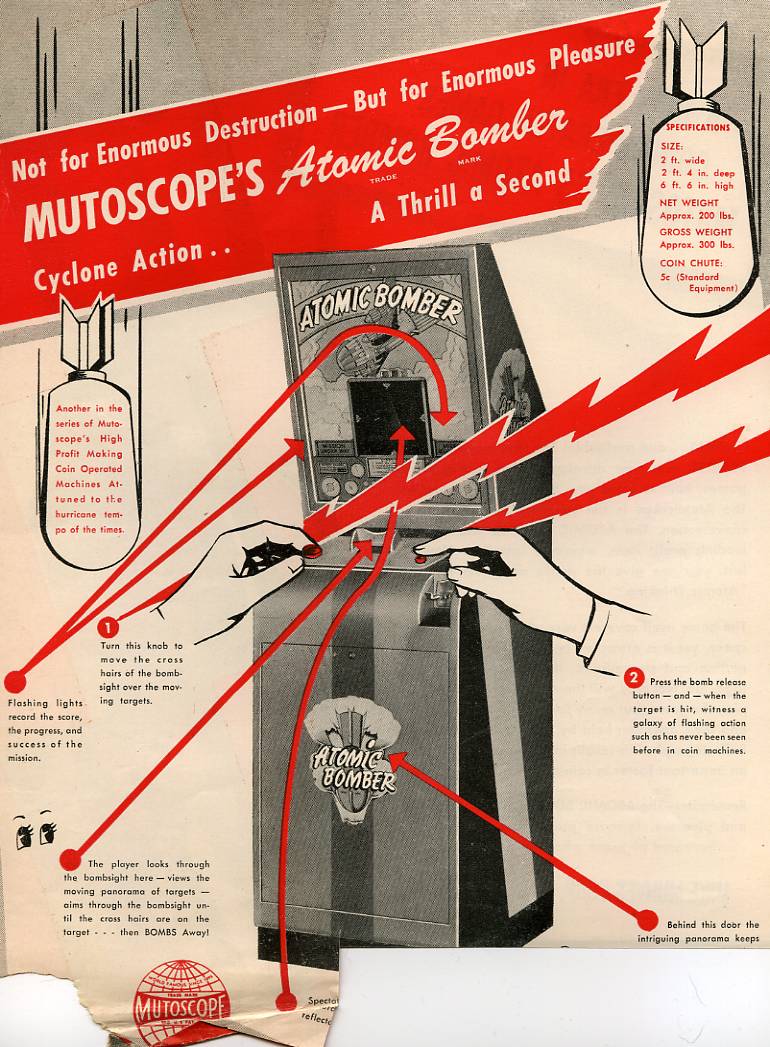
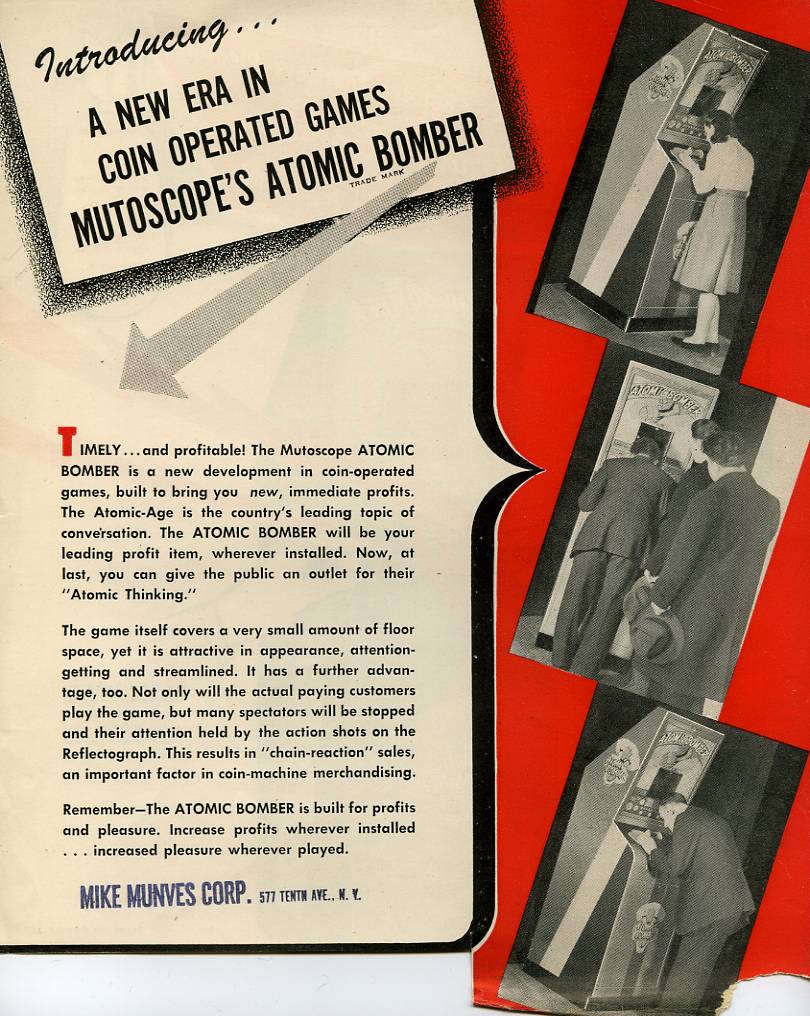
At about the same time as the introductions of innumerable Atomic Cafes and Atomic Times and Atomic Bakeries and the application of the “atomic” prefix to just about any business (there at the tail-end of 1945), there were also atomic toys. Unlike the business names, which generally had absolutely nothing to do with the atomic bomb (Atomic Safety Razor) or the atomic prefix, the toys generally did. There were puzzles and bombing games and science projects and bombers and comics, and generally they involved the use of the atomic bomb. I guess this could be a debate on the sins of commission versus the sins of omission.
Perhaps the most fantastic of the atomic toys was this 1946 “Atomic Bomber” arcade game by Mutoscope–“not for enormous destruction–but for enormous pleasure”:
[Images hosted at Pinrepair http://www.pinrepair.com/arcade/atombom.htm]
Pinrepair writes:
“Description: Atomic Bomber, International Mutoscope, 8/46, came in two different versions using different backglasses. The first version had a see-through window on the backglass. The second version had a light up city being bombed, and also added clouds to the bomb viewer window. The player looks through a bomb viewer, and lines up a set of cross hairs to colored dots on the rotating drum. On the second version there’s a second clear drum with clouds on it, which makes the bomb viewing look more realistic (like a bombardier would see through a bomb drop window.) If a hit is achieved, a bomb blast is seen on the backglass.”–Pinrepair site
We saw it, and prepared for it, the Impossible Thing, the oncoming of megakilll, or what Henry Adams called The Distinguished Thing, acknowledged and prepared and built ourselves a reserve of anti-fear for it.
Once the Soviets demonstrated their capacity to field and then deliver an atomic weapon in August 1949, the great race to Armageddon was underway, a zero-sum game of nuclear dimensions, where an canonical victor is mostly that in name once the million-megaton war was fought and over.
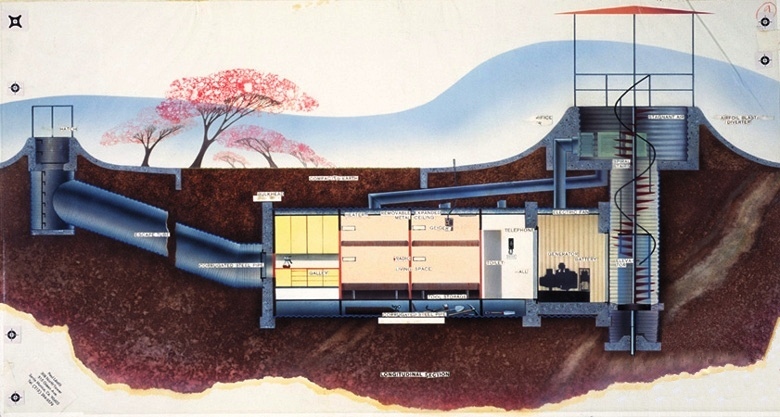
The best that could be done so far as the general American population was concerned was to stockpile foods, recognize the sounds and sights of an attack, pay attention to the EBS, and possibly prepare for teh worst by digging a fallout shelter, or hide under your wooden desk at school, or wear an atom bomb suit, or build an atom bomb house. Of course if you lived in the 100+ metro areas that were deemed targetable you could also plan your escape route; however, since hundreds of thousands
(and more) other drivers would be thinking the same thing, getting out of town might not be a possibility. (This was true even if you paid to one of the government-issue nuclear attack evac maps and stayed to the even/east odd/west as dictated by your car’s tags, there would still be an impossible mess.)
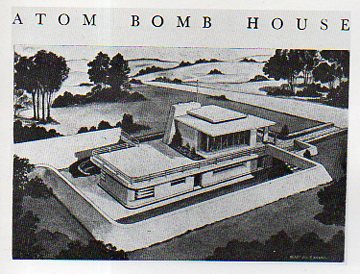
The Atom Bomb House, by Robert C. Scull and Jacques Martini, was designed and published in 1946, and for all intents and purposes supposed that the house and furnishing and all inside it would be safe from an atomic attack. The blast walls around the house’s perimeter are a curious touch, and actually look pretty nice–I don’t know how much they would deflect the effects of an atomic bomb, though. Still, it was a way around thinking about the impossible.
Making the next logical leap, I guess, the architect Paul Laszlo presented Atomville in 1954, which was a collection of dwellings and structures that were bomb-survival as part of a design-survivable community.
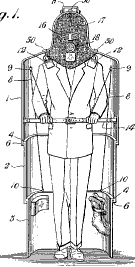
And of course there was some thinking about making each person their own Atomville, with atomic bomb suits (which I wrote about earlier on this blog, here):
So for 15 or 20 years of getting ready for the Soviets to attack Americans were probably desensitized to what that attack actually meant–after hundreds or thousands of warnings and exposure to the possibility of war and nuclear holocaust, many people grew immune to what it all actually meant, swirling away in the mists of Mutually Assured Destruction like a bad song that you know by heart because you’ve heard it on the radio fifty times.
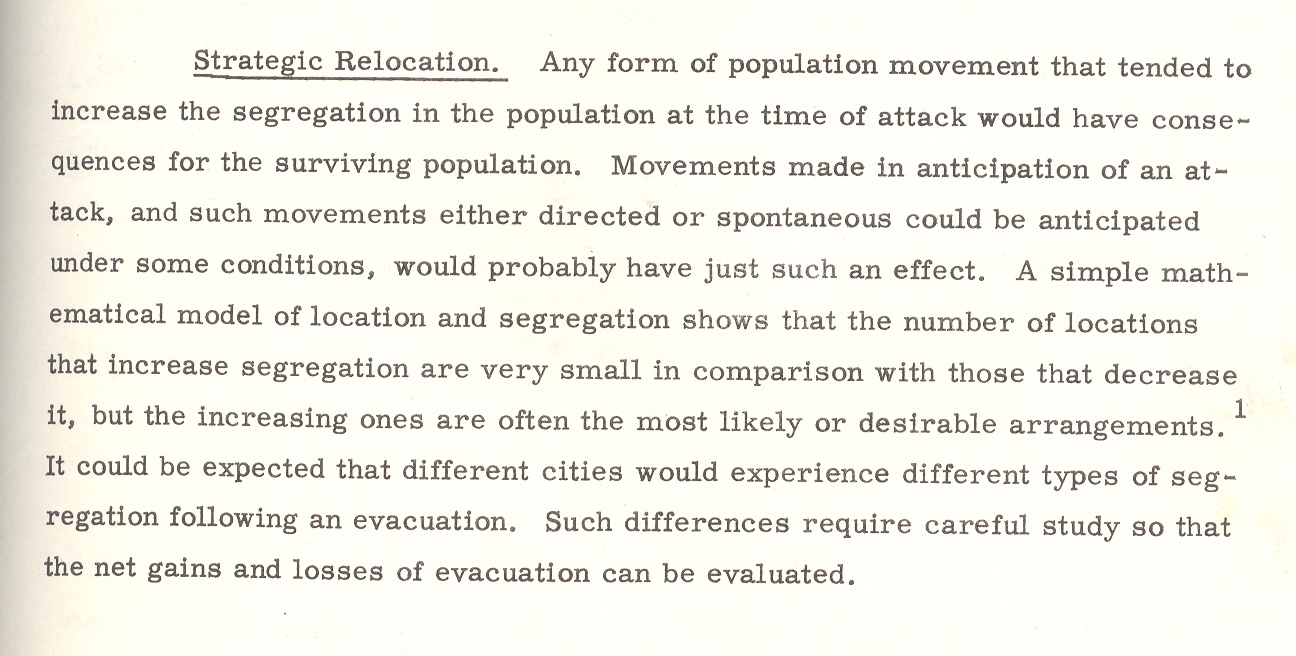
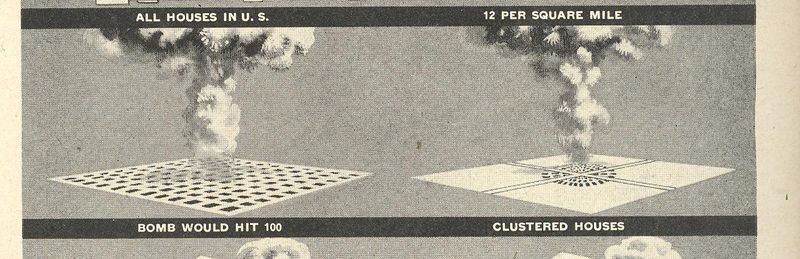
Then there were those like Ed Teller who thought to spend the equivalent of many multiples of trillions of dollars in the hopes of spreading the country out so that there was an equal distribution of people and factories and such, making the U.S. impossible to attack because there were no centers of population and industry, meaning that the USSR would have to attack everything, everywhere. This would have involved building 20 million new homes and all of the infrastructure that goes along with that, as well as moving all business andf relocating all of the means of production in the United States. That was a towering idea that towered low, but it did represent another line of thinking on survivability that moved from the Atom Bomb House to Atomville to the seeming opposite of those, to AtomExUrbia. (See here for the fuller story.)
So preparing for the worst, preparing for the thing that you really couldn’t prepare for, became an object of desire.
It was as though people could not see the forest for the trees–which is quite ionic, because one piece of nuclear weapon test films that is no doubt very familiar to most anyone over 40 depicts a “forest” being blown apart by a blast. The “forest” was actually a stand of trees constructed in the Nevada desert to see what would happen to flammable trees in a nuclear conflagration. (“…The U.S. Forest Service brought 145 ponderosa pines from a nearby canyon
and cemented them into holes lined up in tidy rows in an area called
Frenchman Flat, 6,500 feet from ground zero. Then the Department of
Defense air-dropped a 27-kiloton bomb that exploded 2,423 feet above the
model forest…” on May 8, 1953.1) Not surprisingly, they were mostly destroyed, even using a tactical nuclear weapon. I guess that the issue was not if they would be destroyed but how destroyed they would be. Still, looking at a forest and looking at a nuclear weapons test would leave little doubt that the forest would be pretty-well destroyed–it’s just the distance that the destruction would reach would be open to question.
Notes
1. Check here for the atomic bomb test on the artifical forest in the Nevada desert (an article by Ann Finkbeiner in Slate).
1945, Autumn: the question is, now that “we” have the atomic bomb, what can be done with it?
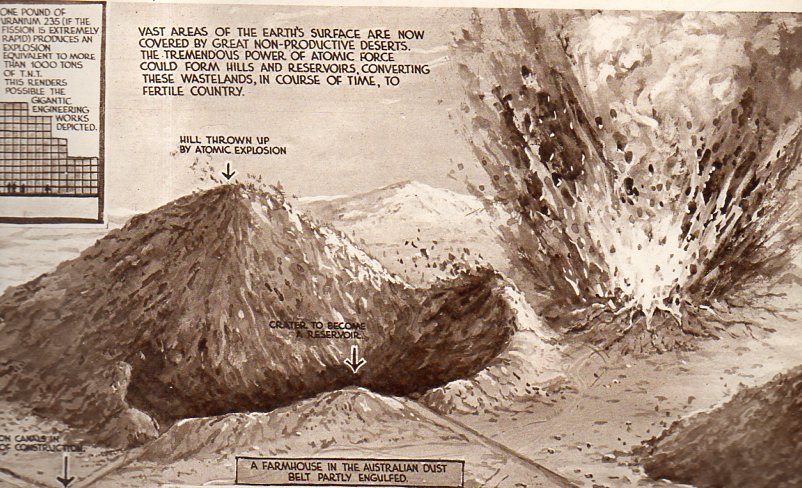
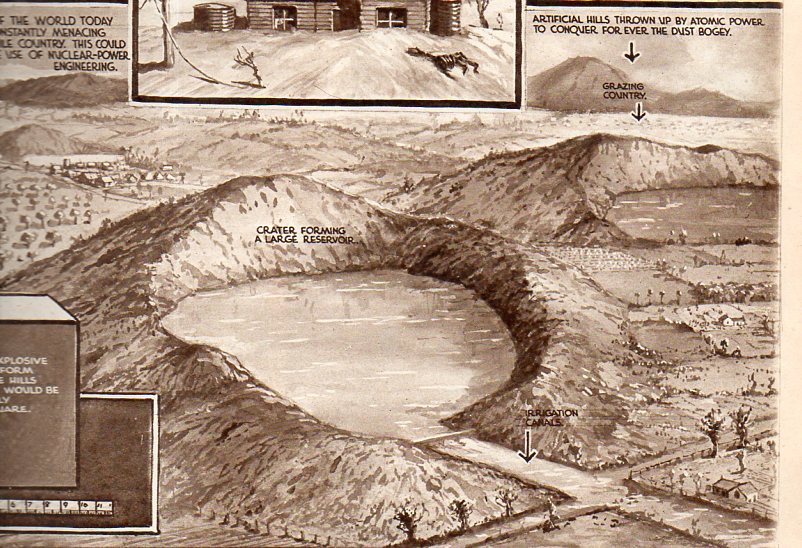
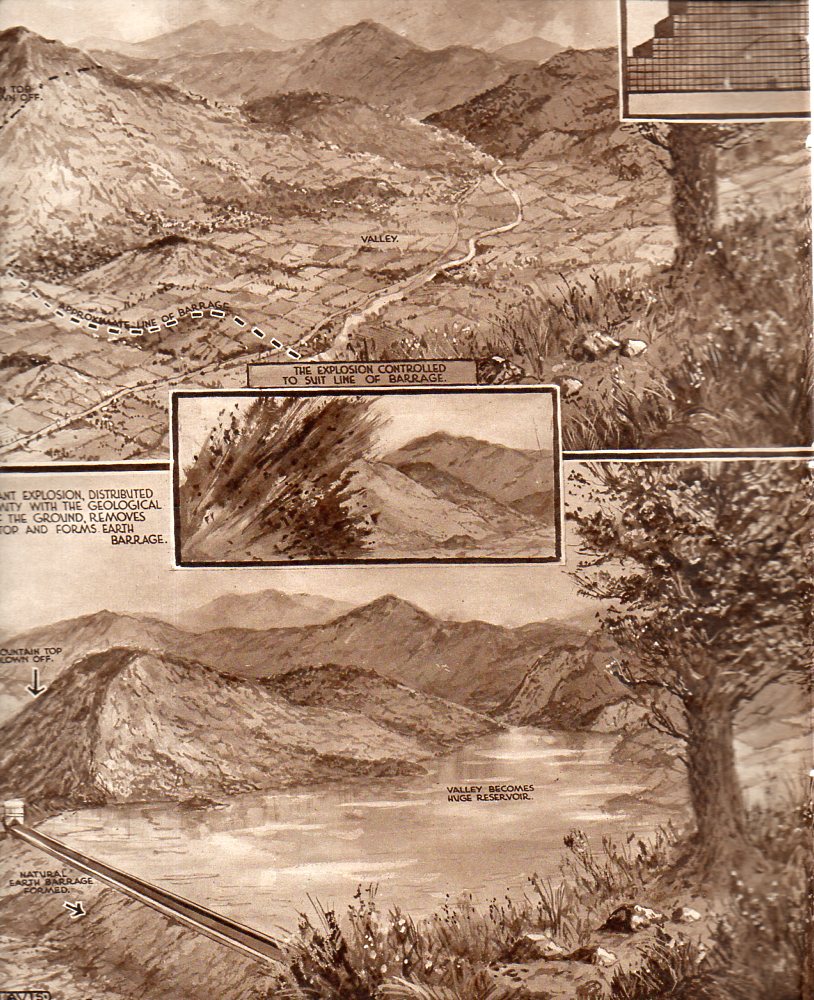
One thing is for certain–it could be used not only to make big holes out of little ones, but also make big mounds of dirt where there were none. This stands to reason, of course, because if you are producing massive holes in the Earth then the dirt and other hole-filling stuff must go somewhere (as Beakman says in his often-repeated admonition and perhaps the most important thing that is said on this kid-based science show, “everything goes somewhere”). Unfortunately the mountain of hole-dirt doesn’t get made quite like the way it was envisioned in this article in the Illustrated London News for 17 November 1945, but they were trying, and it was still a very young and tender period in the history of public discussion on the atomic bomb/bombing.
Still, “The Force Which Can Move Mountains: Harnessing the Atom to Vast Projects for the Benefit of Mankind” imagined an atomic-bomb-fueled set of public works projects that were of Pyramidally-historic proportions, and was among the first fissionally-inspired public portrayals of the peaceful uses of atomic bombs. (The “Peaceful Uses of Atomic Energy” UN-based conferences and etc. would come later.) Engineering with atomic bombs does have some considerable issues, like radioactivity, but some of those issues were worked out somewhat–but that came later on.
Back in 1945 the bomb was being discussed as a hole-maker for reservoirs and for making mountains in the deserts of the world to cut down on the sandstorms and related problems (the “dust bogey” from the fantastic quote in the heading of this post). More thought would be given to this issue on the peaceful applications of nuclear weapons in such platforms as Operation Plowshare1, an American undertaking begun in 1961, which entertained half-fantastical thoughts of widening the Panama Canal and creating–through a series of five hydrogen bomb detonations–a new harbor at Cape Thompson, Alaska. Some of the dirtiest of all nuclear detonations were associated with Plowshare–like the Sedan shot of 1962 which displaced 12 million tons of dirt and made a really big hole but which also contributed something on the order of 7% of all fallout contamination of the total
amount of radiation which fell on the U.S. population during all of the
nuclear tests at Nuclear Test Site. It is still the largest man-made hole in the U.S. and for what it is worth it is listed on the National Register of Historic Places. Over the years such testing for Plowshare (alone) cost the U.S. about 700 million dollars, which seems like a wildly undervalued estimate of costs.
In any event, I liked this story form the ILN and for the hope that it represented, coming at the earliest public history of the use of atomic weapons.
Notes.
1. Perhaps people felt a little kinder towards monster ideas like this if the name of the proceedings found its origins in the Old Testament, like this one: Isaiah 2:3–5, “And he shall judge among the nations, and shall rebuke many people: and they shall beat their swords into plowshares, and their spears into pruning hooks: nation shall not lift up sword against nation, neither shall they learn war any more”.
“What is the appropriate behavior for a man or a woman
in the midst of this world, where each person is clinging to his piece
of debris? What’s the proper salutation between people as they pass each
other in this flood?” Siddhartha Guatama Buddha (thanks to Patti Digh for the quote).
In a world where mass extinction of human beings by nuclear weapons was hypothesized, theorized, and nearly implemented, there was certainly a lot of room for discussion about what would come after the Big Event. Great and massive and insignificant and small were all on the board for conversation and study; in a new world of hyper-change, anything and everything could be an issue–well, everything and nothing, nothing and everything, because in an exchange of a million megaton, everything starts to look like nothing. But be that as it may, planners needed to plan for eventual changes in what we humans would call “daily life”. Sometimes that everything was big, sometimes not, and sometimes the big stuff just looked little.
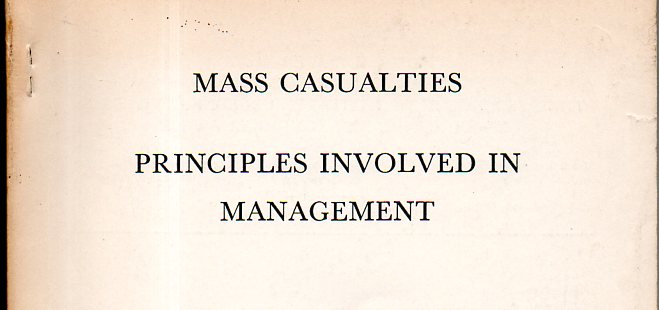
For example, the pamphlet Mass Casualties, Principles Involved in Management, published as an offprint from the journal Military Medicine (April, 1956), is filled with numbing categories of thought, and doubly-numbing sub-categories, all of which needed a thinking-out, because when you have to make plans for the destruction of all things, there must be some sort of planning for what happens when the fires go out.
There were the cautious introductory overviews, chapters on casualty estimates, initial aid and rescue, effects of fallout, emergency medical care, and the like. The work starts to get a little less oblique when the chapters become a little more detailed, like that one devoted to “Mass Thermal Burns”. But what happens in these more-detailed headings is that the treatment of its subject gets less-detailed. (“…the thousandfold increase in power and relative increase in radiant energy considerably enhance the burn hazard with the fusion bomb” “…although the ideal treatment must be somewhat compromised in handling massive numbers of burn patients…” (page 319)).
Ditto the chapter for “Management of Mass Psychiatric Casualties”. And “Public Health and Sanitation Problems of Nuclear Warfare”. These topics sound a little not-quite-right, and almost like a bad joke, but they are deadly serious.
“Organization for the Sorting of Casualties” is another. Now even in this pamphlet the authors/editors were talking about massive exchange, which means that the “sorting” process would be involving tens of millions of people. And who knows who would be the sorting stuff in such a situation, or if there would be a sorting place or doctors, or hospitals. Nevertheless, this chapter underwhelms the overwhelming, which is a common occurrence in works like this.
“A wide disparity will in all probability exist between the patient and the medical resource”.
“All available medical forces will be used to the maximum for the care of the wounded”.
And so on.
It wasn’t just the care of human survivors that came under auspices of this work–there was also the matter of the social structure, which is what happens in “Welfare Problems in Nuclear Warfare”. In four short pages the chapter addresses the need to deal with the care of the survivability of the social network. And money.
“Ordinary jobs as people knew them would be nonexistent. Income from private investments, private insurance, social insurance, public assistance, government employment or any other source will be disrupted. A whole income maintenance system will need to be developed and be ready so that income will either be in cash or in kind and be available when it is needed.” (Page 389)
“Any attack will bring in its wake a multitude of personal rehabilitation problems”.
The author does get to the crux of the biscuit, finally, saying that after everything was said and done, that “much either medical or social care would have to be self-care in so far as humanly possible…” (Page 388).
So what can one say to as a drowning person to another drowning person in a flood? Best to look for higher ground? There’s really not much that can be said, and I am sure that at the end of the day that these well-meaning contributors knew that there would not be much working following the nuclear dumpster fire–but I guess you have to plan for it anyway, just in case.
I’ve found this to be a very useful tool in the past and decided to strip it out of the Internet Archive copy of the 1946 book and post it separately.
Bibliography of

NUCLEAR FISSION
and
ATOMIC ENERGY
by
WILLIAM E. STEPHENS (editor)

and PARK HAYS MILLER, JR. BERNARD GOODMAN, KNUT KRIEGER, WALTER E. MEYERHOF,
MARGARET N. LEWIS, BERNARD SERIN, SIMON PASTERNACK, ROBERT H. VOUGHT
Members of the Staff of the University of Pennsylvania

THE SCIENCE PRESS
Lancaster, Pa.
1948

Source:  Internet Archive

PARTIAL BIBLIOGRAPHY ON NUCLEAR FISSION AND
TRANSURANIC ELEMENTS