A Daily History of Holes, Dots, Lines, Science, History, Math, Physics, Art, the Unintentional Absurd, Architecture, Maps, Data Visualization, Blank and Missing Things, and so on. |1.6 million words, 7500 images, 4.9 million hits| Press & appearances in The Times, Le Figaro, Mensa, The Economist, The Guardian, Discovery News, Slate, Le Monde, Sci American Blogs, Le Pont, and many other places… 5000+ total posts since 2008.

Category: Atomic and Nuclear weapons

  • Letters of Warning: Einstein and Szilard on the Atomic Bomb, 1939-1945

    Einstein’s Letters of 1939 and 1945 and Szilard’s Petition of 1945

    There were certainly a number of cautionary flags waved at the Executive Branch in the period just before the atomic bomb was first used against a Japanese target.  As I wrote in an earlier post here, Dwight Eisenhower was adamantly opposed to the use of the bomb on a city, preferring an example to be made of the thing on an unpopulated area; in his memoirs, General Spaatz (who had received the only written communication authorizing the use of the bomb) was privately against using the weapon on a city. As early as 1939 Albert Einstein famously communicated with Franklin Roosevelt his concerns on the possibility of the terrifying nature of a bomb produced by his early efforts and those of Fermi and Szilard and many others.  In all Einstein wrote four letters to the President, the first part of the first letter is shown below:


  • The Awful Problem–the Bomb, August, 1945

    JF Ptak Science Books    Post 1868 [Part of a long series on the History of Atomic and Nuclear Weapons, here.]

    The fate of failed Japan was being decided in the hands of the United States in the middle of July, 1945.  The Imperial Navy and Air Force was basically finished, leaving the sea and sky open for complete domination, and the Imperial Army was still fit to fight, if not well supplied.  That said, there was still the issue of possible invasion, and of fighting on a mountainous battlefield against a dedicated indigenous population  that could still field millions of more fighters if not soldiers.

    As Secretary of War Henry Stimson outlined in his Top Secret memo to President Truman on 2 July 1945, “Proposed Program for Japan”, there was little left to fight:

    Japan has no allies.

    Her navy is nearly destroyed and she is vulnerable to a surface and underwater blockade which can deprive her of sufficient food and supplies for her population.

    She is terribly vulnerable to our concentrated air attack upon her crowded cities, industrial and food resources

    She has against her not only the Anglo-American forces but the rising forces of China and the ominous threat of Russia.

    We have inexhaustible and untouched industrial resources to bring to bear against her diminishing potential. 

    We have great moral superiority through being the victim of her first sneak attack.

    —Source: The Nuclear Files, here.

    Little left, of course, save for the millions of defenders fighting on their own soil for their own soil. Which, in the end, turns out to be almost everything insofar as the use of the atomic bomb is concerned.

    This is of course a very complex and long story on the decision to use the bomb, and I don’t pretend to even begin such a thing here. But what I would like to just point out, that in the middle of all of the discussion, the supreme commander of the allied forces in Europe, General Dwight Eisenhower, was not in favor of using the bomb. Eisenhower was with Stimson when the Secretary of War received the coded telegram giving him the positive results of the atomic test in the Jornada del Muerto, the Trinity test, at Alamogordo, New Mexico. Eisenhower wrote of the experience:

    “The cable was in code, you know the way they do it. “The lamb is born”: or some damn thing like that. So then he (meaning Stimson) told me they were going to drop it on the Japanese. Well, I listened, and I didn’t volunteer anything because, after all, my war was over in Europe and it wasn’t up to me. But I was getting more and more depressed just thinking about it. Then he asked for my opinion, so I told him I was against it on two counts. First, the Japanese were ready to surrender and it wasn’t necessary to hit them with that awful thing. Second, I hated to see our country be the first to use such a weapon. Well … the old gentleman got furious. And I can see how he would. After all, it had been his responsibility to push for all the huge expenditure to develop the bomb, which of course he had a right to do, and was right to do. Still, it was an awful problem1.”–Richard Rhodes, The Making Of The Atomic Bomb (Touchstone Books, 1986), page 688 (though not an expert in this collection of areas when he started, and not an historian of science, Rhodes has written perhaps the definitive history of the Project).  

    It wasn’t entirely clear that the Japanese were ready to surrender at this point as Eisenhower said, not really.  And it also wasn’t necessarily the case that the entrance of the Soviet Union into the war in the Pacific would have resulted in an easier time in fighting on the ground.  And General LeMay–who strategized that he could destroy the Japanese capacity for war from the air by bombing 30-60 cities over the June-August period–had actually carried out his plan, striking 58 cities and nearly destroying half of Tokyo, but still the Japanese fought on.

    But it is interesting that after all of this time, and dozens of millions dead, that Eisenhower would be so circumspect in using the atomic bomb to finally force the hand of the Japanese in resignation. 

    The fact remains though that it still took several days after the dropping of the second atomic bomb on Nagasaki for the Japanese to accept what were essentially the same pre-bomb terms of surrender.

    Notes

    1. I should point out that Stimson’s liability in the decision to build the bomb (if such a thing existed) was relieved when the bomb was tested successfully–its actual employment was beyond the judgment of his actions. (Stimson himself said that he was relieved of the responsibility of having spent “two billions of dollars” on the bomb and that he no longer would have to fear spending years in prison for a failed effort.
  • What Did the Delivery of the Plutonium for the First Atomic Bomb Look Like?

    JF Ptak Science Books  Post 1863

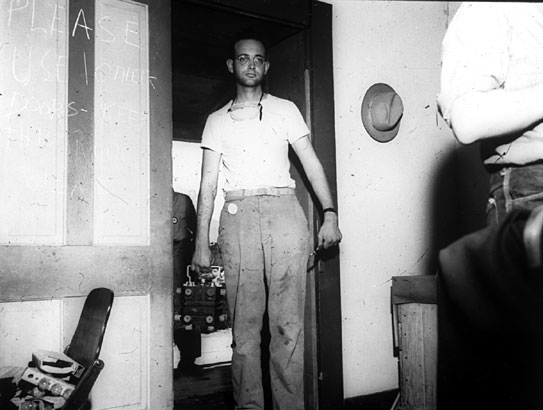
    After billions of work hours invested in the Absolutely Enormous project to build atomic weapons in WWII, much of it (for a short period of time, anyway) was balanced in the hand of Sergeant Herbert Lehr:

    Atomic bomb herbert Lehr
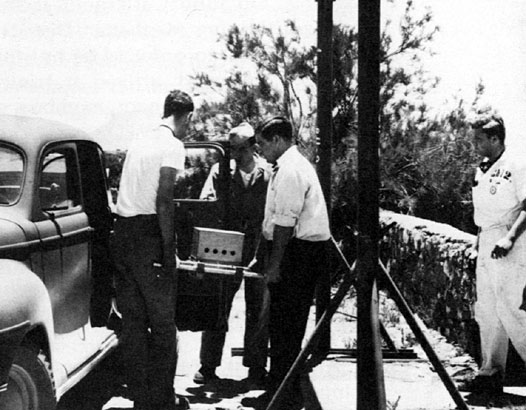
    This was the plutonium core (or in one caption, “half” of it), being transported by the sergeant, the plutonium housed in a shock-proof carrying device, passing through the door to the assembly area at  the George McDonald Ranch farmhouse. (The image first spotted by me in Richard Hewlett’s The New World, 1939/1946, Volume 1, a History of the United States Atomic Energy Commission, 1962.)

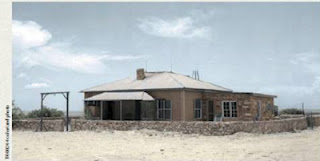
    Atomic bomb plutonium deliveryThe photo above shows the plutonium being delivered to the McDonald Ranch, carried from the Plymouth through the small wooden structure that we can clearly see in the color photo below, in which you can also see the short stone fence that surrounds (in a roughly 85’x85′ square) the compound.  The plutonium was then sent into the dining room, which had been converted into a clean room, where the device was assembled. 

    Atomic bomb macdonald
    (Source: Nuclear Weapons Journal, March-April 2003, p. 21, via the very interesting Diehard Empiricist site.)

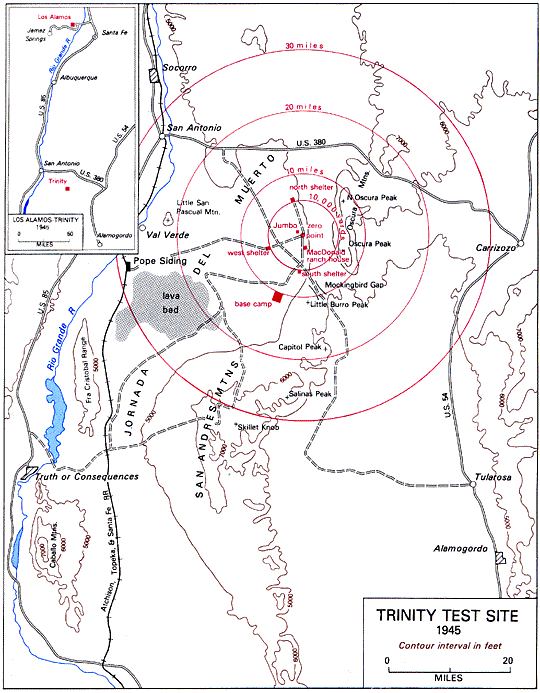
    The McDonald Ranch was right there at the heart of the Trinity Test Site, or nearly so (the explosion on 16 July 1945 being about two miles away, slightly damaging the structure), in the Llano Estacado.  This is a section of New Mexico and Texas  (the “Staked Plain”), which had for centuries been a ruthlessly mercy-free zones for people for centuries until it was conquered in the late 19th century–a hard and arid place where people disappeared.  Much of the Trinity Site was actually located in the Jornada del Muerto, or “Path of the Dead Man”, or more poetically, the “Dead Man’s Walk”.

    Trinity_small(Source:  Trinity Remembered site, here.)

    In any event, seeing the plutonium core taken out of a Plymouth and moved into a converted farmhouse and ultimately carried in one hand by a U.S. army sergeant into an assembly area that used to be a bedroom created an odd emotion, one that I’m still trying to identify, seeing the smallness of it all the result of enormous expenditures of energy and effort and brainpower over a thousand-day period all represented in the hand of one man.

    See also:  ALSOS:  Trinity Remembered, here  and Atomic Archive

    ·Posted by :

    ·in:


  • Booze-Vision Atomic Farming and Other Nuclear Dreams

    JF Ptak Science Books  (Expanding an Earlier Post)

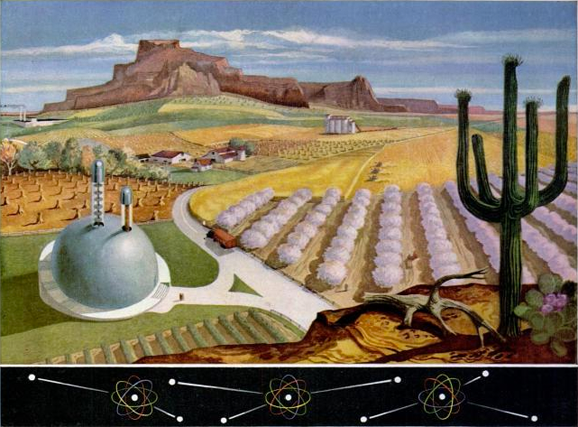
    Seagrams V.O. Canadian Whiskey powered the future through a series of a dozen or so ads for itself in the 1945-1947 period, taking a usually-strangled though occasionally interesting peep into what the future might bring.  (And of course the future is brought by men who drink Seagrams.)  In this ad, appearing in the 12 May 1947 issue of LIFE Magazine, we are told “deserts will bloom through atomic power”–how this might happen is left to the imagination. Also left to fantasy is what exactly is being farmed there in front of the incongruous “atomic energy plant”. Plastic smoke?  Taking a fractured approach to the possibilities one might say that atomic bomb mushroom clouds are being grown from seedlings here from the ground up, nurtured until the day they too will be as big as the blasts of August 1945.

    Atomic garden

    Oddly enough, the illustrator–who after all was just trying to sell alcohol–came pretty close to the truth, except that they got the power source wrong.  Rather than nuclear energy, it would be petrochemical industries that would lie there at the heart of America’s farm production (via seeds and fertilizers and so on)–I’m sure that it would’ve made more sense in a weak way back there in 1947 to believe the atomic story rather than the possibility that it would be petroleum that would drive the entire production of food forward. 

    There were many proposed uses for atomic energy over the next few decades, most not very good–the Ford Nucleon, a screamer with a 5,000-mile cruising range powered by a steam engine driven by a small uranium fission muscle box in the car’s rear, was one of those ideas.  The nuclear-powered submarine, which sounded like the Nucleon in 1946, was a solid workable idea, a science fiction come true in 1954 with the launch of the USS Nautilus (SSN-571).

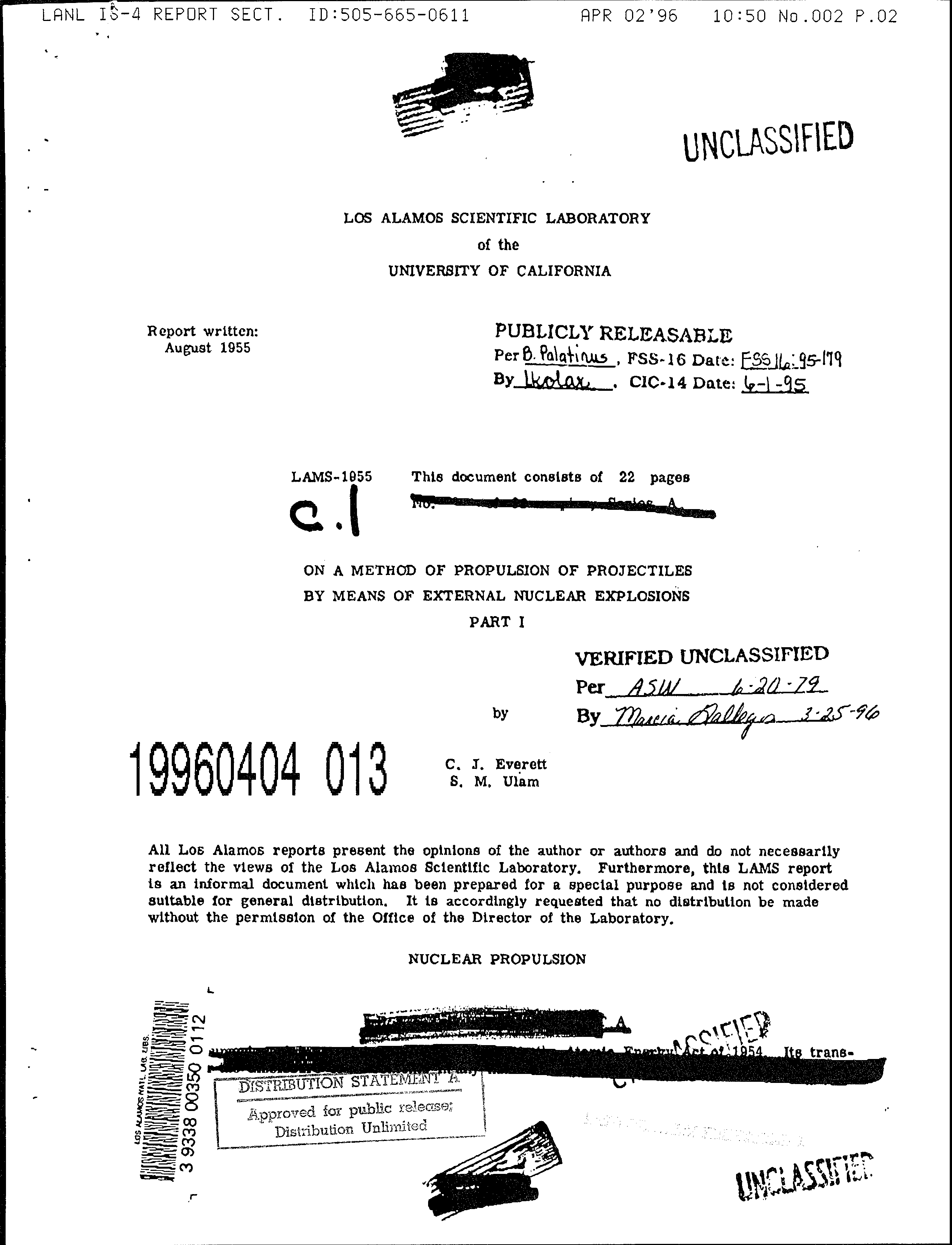
    Ford nucleonNuclear medicine–although not powering an atomic heart–was a very important development that seemed not conceivable in the decade preceding its development.  Atomic-powered helicopters, trains and planes are other examples of the not-good-idea variety.  The nuclear powered space vehicle, which was first proposed in 1946 by Stan Ulam (and then in a report written by him and C.J. Everet  On a Method of Propulsion of Projectiles by Means of External Nuclear Explosions. Part I. University of California, Los Alamos Scientific Laboratory, August 1955, pictured and linked below), has morphed into something monumental in Project Orion, and to me sounds like a fabulous idea:

    [Source here.]

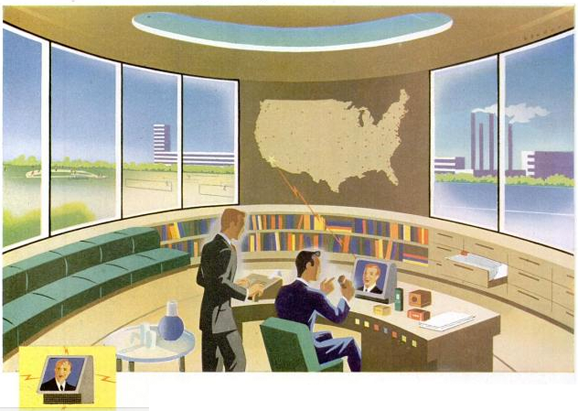
    IBut getting back to the liquor ads, here’s an weirdly prescien and naive image–“weird” anyway for a quick effort made by an artist trying to sell drunk juice–is this proto-internet office view, made in May 1945. There’s lots of passive solar going on here(though not really very effective when you consider the other ways of directing and filtering exterior light inside) in the office of tomorrow, but more important is the desk and the file cabinets.  The seated man is talking to someone across the country  via phone/wireless, with data en masse at his fingertips, a “computer” (in the old sense of the word, that being a person–and usually a women–given the charge of adding long columns of number or whatever and then doing the arithmetic, like a comptometer) working some sort of calculating interest on the largish calculating instrument. In general we see a decision-maker awash in responsibility connecting all of the parts of his world: a primitive, secular, analog internet.  And this too just at about the same time that Vannevar Bush introduced his own vision of the informational future with his superb Memex (which I wrote about earlier on this blog here.)

    Internet 1945


  • NYC as an Atomic Ground Zero, 1946

    JF Ptak Science Books    Quick Post  (Part of a Series on the History of Atomic and Nuclear Weapons)

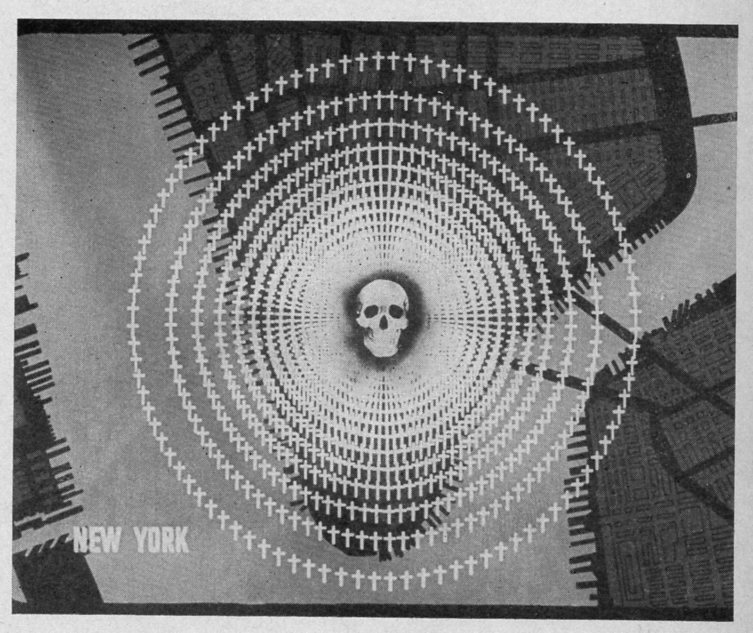
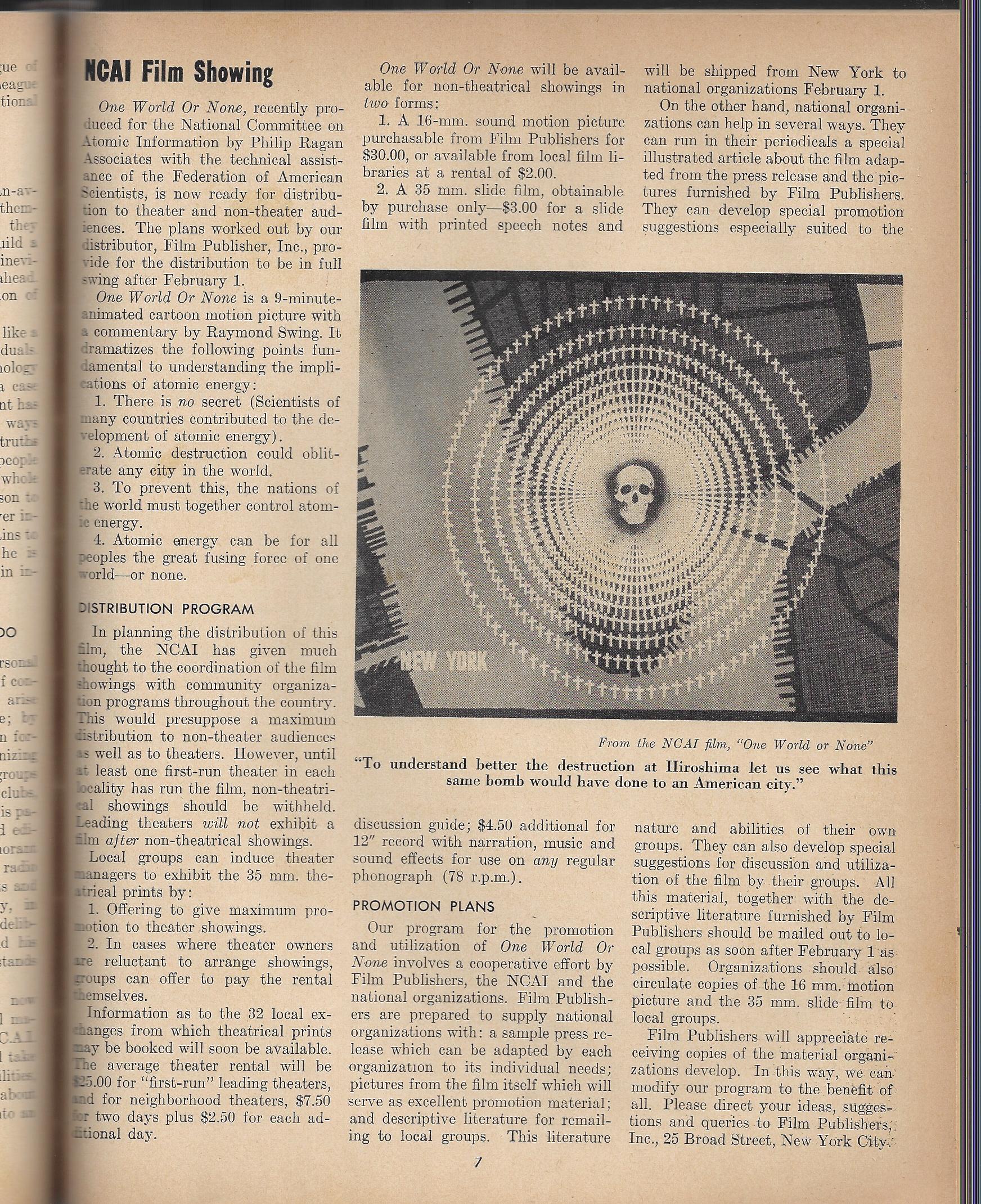
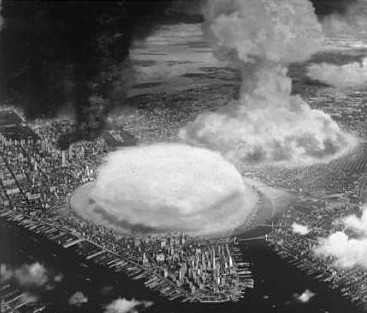
    Atom bomb nyc721 Atomic bomb nyc 1946 filmThis arresting image is a still from an extraordinary and scary 1946 film “One World or None” (published by the National Committee on Atomic Information and located (here)  held at the Prelinger Archive. It shows video graphics of New York City (and Chicago, Los Angeles and San Francisco) being attacked and bombed with atomic weapons.  The unfolding darkness very effectively shows the reach and extent of damage associated with each single explosion, and makes an effective and chilling point about the control of atomic weapons. (I’ve also included the particulars for renting and showing the film from  a short one-page notice in the journal Atomic Information, published by the L Street D.C. NCAI, published January 20, 1947, volume 2/1.)

    It is also part of a continuing sub-series on this blog relating images of antique images showing NYC destroyed, and include the following posts:


    and others, including a few posts that shows Manhattan sinking under its own weight, floating in the air, and set adrift in the Hudson. 


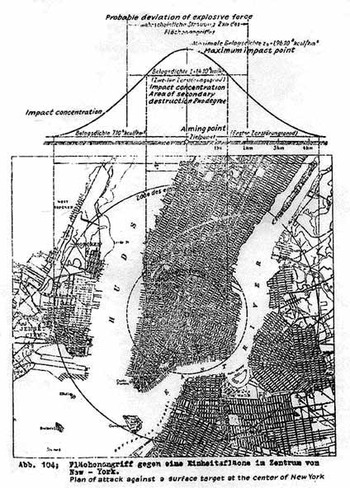
     And here is a detail of Manhattan as ground zero from the Sanger paper:

    Manhattan_bombed_4And Manhattan being hit by multiple atomic weapons (from this post):
    Atomic nyc


    ·Posted by :

    ·in:


  • Complete Destruction of an Entire Country: Japan, 1945

    JF Ptak Science Books   Post 1861

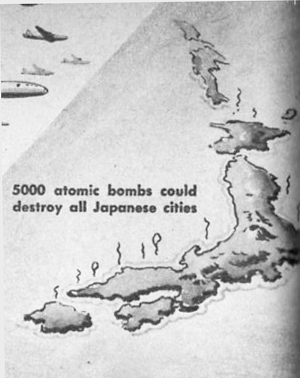
    Atom bomb 720
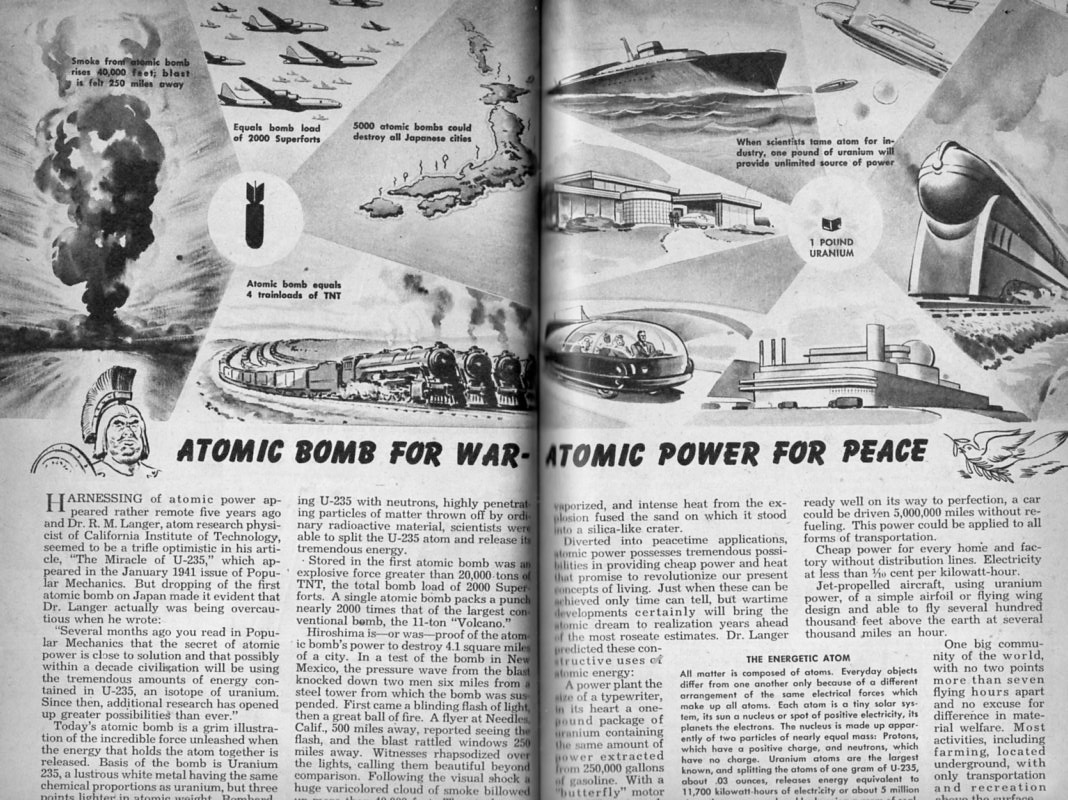
    The October 1945 issue of Popular Mechanics carried a story “Atomic Bomb for War / Atomic Bomb for Peace” as a reminder, I guess, to its readers that the vast destructive power of the atomic bomb was just one example of what nuclear power might be–and that there could be incredible and wide-reaching benefits of the process for peaceful uses. This work came about eight weeks after the bombings of Hiroshima and Nagasaki, and seems to be only the second post-use story on the weapon. 

    Atom bomb 719
    Half of the article’s illustration is dedicated to military applications of atomic energy, and the other to the peaceful; and in the upper-middle of the military side we are told that if necessary that every city in Japan could be completely destroyed with “5,000 atomic bombs”.  The truth of the matter is that a great percentage of the major  (and minor-major and major-minor) cities had already been pretty much decommissioned. (Just weeks before the bomb came the massive firebombing of Tokyo–334 of  General Curtis LeMay B-29’s were loaded to utmost capacity with the newly-conceived M-69s bomb, an incendiary so vicious  that the fires it produced were all but inextinguishable.  The B29’s bombed Tokyo for hours, killing 100,000+ people and making over a million homeless.)  And so I’m not sure what the message was, here, except to establish that the complete destruction of a city with weapons dropped from planes was now a possibility.  It was probably right at about this point that this idea became a real possibility–and so to for its extension, that given enough of these weapons, that the entire world could be bombed out of existence.


  • Atomic Power with God, 1946

    JF Ptak Science Books   Post 1854

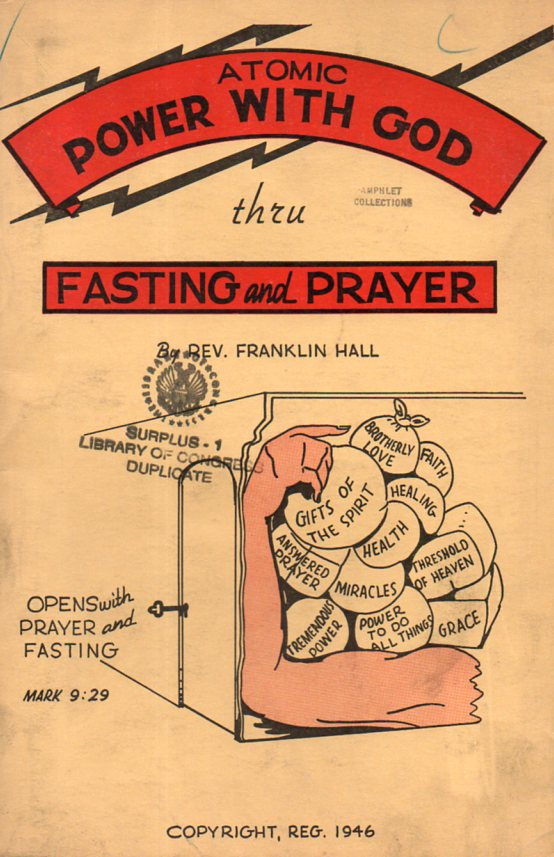
    Atomic power with god628
    Rev. Franklin Hall was a busy man:  with detritus haloes of failing humanity floating above everyone  (making them susceptible to the eternal lake of fire), he was on a concerted mission to save as many people as who would listen to his special message. Hall’s litany was equal parts simple and complex, as we can see even by just the title of one of his pamphlets: Because of Your Unbelief , Chains of Bondage, Food Slaves, Belly Worshippers, Fleshly Lusts, Unbelief, Doubts & Fears, Carnality (which I wrote about here), which was a short work of considerable claims with no basis of correctness or proof.

    He moved on, assuredly inspired by the use of the atomic bomb in August 1945, to write Atomic Power with God thru Fasting and Prayer (received by the Copyright Office in September 1946). As much as this might sound like an adult beverage of your choice, it is not; he set his course not on atomic power per se, but on the connection of fasting and prayer, because, as he writes on page 37, “the Bible is Ahead of Science”. (There haven’t been very many books at all written with the words “God” and “atomic” in their titles1–and this is one of those few.  And the Hall book is actually four of them, as this very small work went through  a number of revisions and four editions.)

    Which I guess is all fine and good, to a point, so long as the health debits do not pile up too high; the rest is a subject of faith, and about there there is not much that can be said that would be of any use.  In the long run it was rather tempestuous of Mr. Hall to assume that using the words “atomic” and “power” in the title of his re-polished gem-let was good to win him a few new readers, surfing on the tide of everything else in the world that was just at that time adding the prefix “atomic” to whatever product there was to be sold2.  And God evidently was right there among them. 

    Notes:


  • A Note on Fear: The Blob, Elvis, Dien Bien Phu, & Gay Marriage.

    JF Ptak Science Books     Post 1814

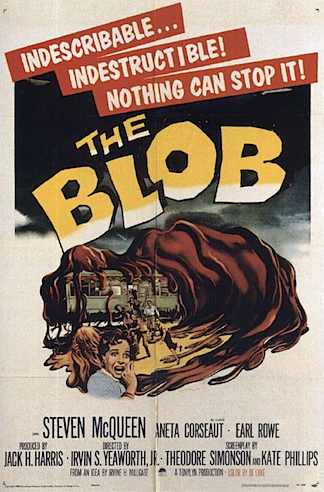
    BlobThe Blob is probably not a “science fiction” movie because, well, it has very few science-y bits to it; it is also probably not a “monster” movie, either, as the Jell-O-like gelatinous character moved like an ancient stub-legged fat-dog that a person could slowly out-crawl to make good an escape. Maybe it really wasn’t so much a “movie” at all, but more like a tonic, a slight refresher enjoyed only at the film’s ending when you’ve realized that a cool 75 minutes was had in a refrigerated environment scooped out of a hot August day in 1958.

    It was about a creeping fear of some sort. I doubt that the screenwriters had anything more to say about fear than that they would fear if their movie didn’t generate some human monies.  But fear was big and very creeping in the United States at that time–the fullness of the Cold War was really just coming into its monumental and grinding play, with nuclear catastrophe lurking at every other corner.  Literally–city life was festooned with traffic signals and Civil Defense signs, the later showing the way for folks to crowd into underground or moderately protected areas to outweigh the cold heat of radioactivity and protect them from megatons of explosive sewage. Children at school were to take refuge from the

    giant fireball under wooden desks1, families built bomb shelter (complete with food and weapons to ensure the food stayed in the family), orderly evacuation plans for millions of cars were devised to empty out NYC and Boston and Chicago so that the even/odd license plates could be distributed properly into the countryside, plans were made to de-centralize cities so that the entire country would be a massive suburb, and on and on, into the empty nuclear night.

    Nuclear annihilation was the great, arching fear above the still-massive supporting fear of Communism, the destroyer of decency and morality and god and individuality and everything else that there was to lose.  Overt fear coming from the USSR; covert fear coming in the form of Fifth Column folks, infiltrators,  screenwriters, conning actors, deviant milkmen, mischevious politicos, liberals, artists:  everywhere from anything.  Spot the Red/or Make me Dead.

    Creeping Communism was everywhere and from everywhere the battle of fear must have been fought, which partially explains America’s growing involvement with the doomed French as that country strained against all reasonableness to maintain control of the country of Vietnam. Fighting Ho Chi Minh since the end of the Second World War, the French finally ran out of themselves at Dien Bien Phu, which also marked the real beginning of U.S. involvement there (having already spent some billions in an ill-advised support of the cancerous French occupational effort).  Among the first American casualties in that long war would be an Army officer whose last words before being killed were in French: “Je suis Americaine”. (The first true casualty in that war–as Goethe has said–was truth).

    There was much in the science fiction world that suggested this fear, utter and complete devastation via aliens invasion or runaway nuclear strikes, all of which could be read about or seen in the movies, all supplements to the Great Fear going on outside.  Television would occasionally address these issues but in far lesser numbers than cloak-and-dagger great-goodness of the pathology of nice that was seen going on throughout America, the stuff that makes many people nostalgic for those times–Leave it to Beaver and such.  June Cleaver never had to deal with her boys getting burnt to a crisp at school under their desks. 

    [1951]

    The Blob’s monster wasn’t as fantastic as others, and its arrival was never really a question for consideration.  The teens depicted in the movie (including the lead-teen, played by just-shy-of-30 Steve McQueen) weren’t really rebelling against anything except for a ruffled deputy sheriff, and at he generations managed to pull themselves together with much fuss to fight the strange invader.

    There were of course no Black people in this movie.  Perhaps to white America, Blacks were another creeping fear coming in the guise of desegregation in the great and powerful landmark case of Brown v Board of Education. And Elvis.  Elvis, as the personification of early Rock and Roll, was seen as subjugating the morality of youth and corrupting culture in general with his music, much of which owed its existence to Black people. 

    Back to The Blob:  the cure to the terror of its creep was easily found; and, once so, its disposal was just  a matter of short time.  It was a ridiculously easily solution. Cold.  The great creeping terror was frozen immutable by cold, and dropped (by parachute) somewhere near the North Pole, where it was to stay frozen forever.  Not so much with Slim Pickens/Major Kong riding his “Hey John” nuke down the throat of the Russkie first strike capacity, which in Dr. Strangelove found fire fighting fire, with everything ending up in flame.  In the simple The Blob, perhaps the feel-good message was the Cold War being won in the cold?  Well, I doubt that highly–int he end, it was just a not-good film, signifying nothing.  But the rest of all the other fears were very real. 


    It is remarkable though that one of the greatest fears invented by humans in the 20th century–nuclear annihilation–is today pretty much abandoned, save for the rogue elements here and there trying to deliver a dirty bomb to some populous place.  Certainly discussions of Mutually Assured Destruction (MAD) doesn’t pop up anymore except in history classes.  And so fear comes and goes.  Such a fear was created with the adoption of equal (Voting) rights for women, and the equalizing of human rights for Black people.  The consequences of these changes were enormously fear by the status quo; a few decades later, the fear and its representations look silly (as in “how-could-that-possibily-have-been?)  to our children.  It makes me wonder what that Great Fear that beguiles so many today will be an embarrassment in 2030?  Gay marriage?  Immigration?  Both are excellent candidates.  Problem is, there are many others. 


  • Atomic Aircraft, 1946-1961

    JF Ptak Science Books    Post 1810

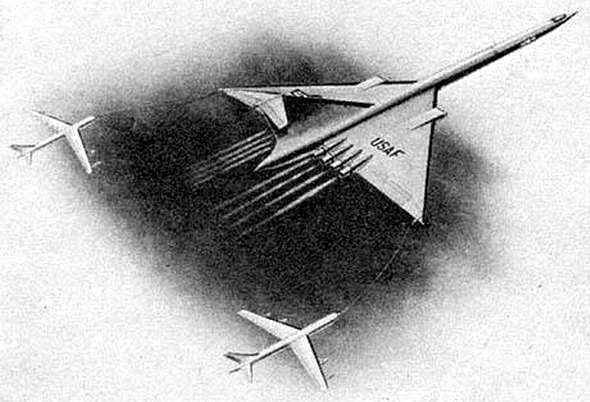
    Shooting Down the Nuclear Plane,  by W. Henry Lambright, (Inter-University Case Program #104, Bobbs-Merrill Co., 1964), is an interesting and nicely-documented history of an idea whose firm grasp on reality night not be terribly firm.  Of course it would be possible to prodce such a thing (at about this same time in 1961 appeared a cover for Popular Mechanics for an atomic-powered car from which two cowboys went a-hunting) if there was the collective will to do so, and there almost was.  Let’s just say then that the atomic-poweredness of our domestic defense was limited to aircraft carriers and submarines, and the atomic-powererd aircraft were left to science fiction .

    In general though it was at this time, from  about 1946 thorugh the late 1950s’, that people were thinking of refitting standard power systems with atomic energy. 

    Here are a few ideas for alternative approaches to flight, provided by the happy folks known as Atomic Energy:

    Another possibility for a nculear powered aircraft, by Northrup:

    [Source]  Another interesting design–a nuclear-powered prop plane, X-6, “derived from the Corvair B-36”:


  • Outline for Disucssing the Atomic Bomb–I.I. Rabi, November 1945

    JF Ptak Science Books   Post 1793   Part of a series on development, use and control of atomic and nuclear weapons

    [My apologies for the spacing below–Typepad has refused to allow paragraphs today for some reason.]

    “As yet, if a man has no feeling for art he is considered narrow-minded, but if he has no feeling for science this is considered quite normal. This is a fundamental weakness.”–I.I. Rabi  In Kermit Lansner, Second-Rate Brains: A Factual, Perceptive Report by Top Scientists, Educators, Journalists, and Their Urgent Recommendations (1958).

    The Nobel Prize in Physics 1944 was awarded to Isidor Isaac Rabi “for his resonance method for recording the magnetic properties of atomic nuclei”.–NobelPrize .org

    “Suddenly, there was an enormous flash of light, the brightest light I have ever seen or that I think anyone has ever seen. It blasted; it pounced; it bored its way into you. It was a vision which was seen with more than the eye. It was seen to last forever. You would wish it would stop; altogether it lasted about two seconds.”
    [Witnessing the first atomic bomb test explosion.] — Isidor Isaac Rabi  Science: the Center of Culture (1970).
    “To me, science is an expression of the human spirit, which reaches every sphere of human culture. It gives an aim and meaning to existence as well as a knowledge, understanding, love, and admiration for the world. It gives a deeper meaning to morality and another dimension to esthetics.” 1970
    Rabi470

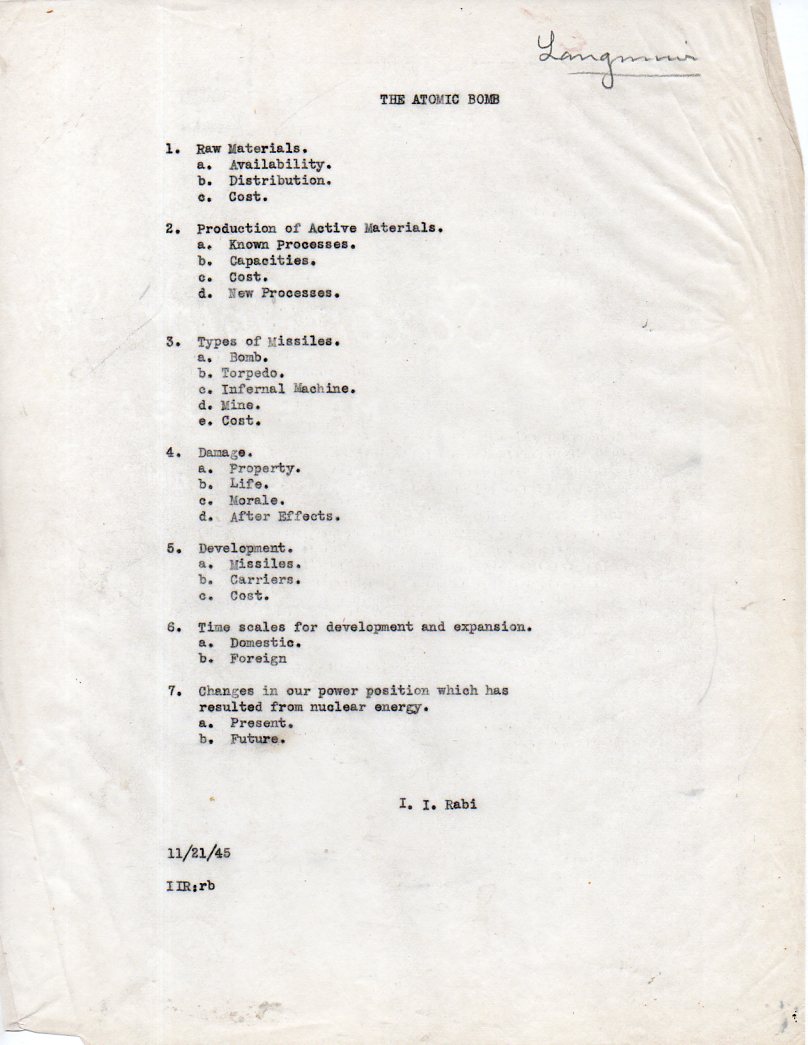
    I came across this interesting sheet of paper in my files, a neglected part of a larger archive  of background and draft papers and proposals by the Vannevar Bush group working on the question of the control of atomic weapons and the formalization of the American position regarding the use and control of atomic weapons (and dated from October 1945 to February 1946).   (Other contributors to this archive include President Harry Truman, Secretary of State James Byrnes, Dr. Vannevar Bush, (future AEC director) Carroll Wilson, Alger Hiss, I.I. Rabi, William Shockley, Frederick Dunn, Joseph E. Johnson, Leo Pasvolsky, Philip Morrison, Col. Nichols, William McRae, Admiral W.H.P. Blandy, George L. Harrison, and others).  The archive (which I’ve written about elsewhere on this blog) are remarkable for their foresight and logic, and addressed the implications and future of the atomic bomb at the earliest stages of its existence.
    Rabi was a great physicist (being awarded the Nobel for physics in 1944) who was of course deeply involved in the technical/scientific end of fighting World War II.  It was his conviction that his brain was best used  in the development of radar and could not be convinced to spend all of his efforts in the Manhattan Project at Los Alamos, feeling that the further development of radar was more important and more immediately applicable to the winning of the war than the longer-range prospects and use of the atomic bomb.  He worked at the MIT Radiation Laboratory working on radar for the duration–except (and this was a great exception) for being a frequent consultant and visitor to bomb works in the desert. (Access to Los Alamos during this time was extremely tight–there were very few other people among the many thousands who worked there who were able to simply “visit” the facilities as their expertise was needed.)
    And so at the end of the war, Rabi became part of the Bush group that was given the task of trying to figure out what to do about the bomb–its control, its possible use, its proliferation, and so on). At some point, months into this process, it looks as though Rabi created a single-page outline of discussion points on atomic bomb issues.  It is very succinct and crisp, with nothing more than the bare essentials. This is a carbon copy of the original, and evidently was meant for Irving Langmuir.