A Daily History of Holes, Dots, Lines, Science, History, Math, Physics, Art, the Unintentional Absurd, Architecture, Maps, Data Visualization, Blank and Missing Things, and so on. |1.6 million words, 7500 images, 4.9 million hits| Press & appearances in The Times, Le Figaro, Mensa, The Economist, The Guardian, Discovery News, Slate, Le Monde, Sci American Blogs, Le Pont, and many other places… 5000+ total posts since 2008.

Category: Atomic and Nuclear weapons

  • Virtuosic Apocalypticism: Maps and Charts of Nuclear Exchange, 1964

    JF Ptak Science Books LLC  Post 1555  {Part of a long series on atomic and nuclear weapons].

    Today is the 66th anniversary of the first detonation of an atomic weapon at Alamogordo, New Mexico, July 16, 1945.

    March 3--cvr

    “…our choice of path may be delayed too long… “  Dante, Divine Comedy, Inferno, Canto XII, line XIII, 2nd level of Hell (envy).

    The NATO Conference on Damage Assessment Summary Report (May 5-6, 1964) was not one written for its outcome, necessarily, but the means of getting there. The outcomes were highly differentiated levels of sameness, a strategic tour of Dante’s creation cataloging the layers of deep destruction like those of his funneling pit. [This book is available through our blog bookstore, here.]

    Professionally  the paper dealt with several different ways of computing nuclear exchange scenarios (given names of understated inelegance like Jumbo, Brisk, Frisky, Dart and Dusk) with lots of smokily mirrored hocus pocus, the necessary ingredient of the philosophical technology of Mutually Assured Destruction. MAD.  Somehow it all worked out without any exchange ever happening. (The principal contributor here was James Coker, chief of the National resource Evaluation Center, Office of Emergency Planning, Executive off of the President.)

    March 3--20 mt blast “Which utterly with sadness had confused me,  New torments I behold, and new tormented Around me, whichsoever way I move,  And whichsoever way I turn, and gaze.”  Dante, Divine Comedy, Inferno, Canto VI, third circle, gluttony.


    The first image shows the effects of a 20 megaton nuclear blast detonated in in a city, presenting an incredible picture of absolute destruction, reaching out from ground zero for more than 11 miles.    


    This doesn’t begin to measure the overall damage inflicted by radiation, which is deeply, extraordinarily, severe.  This again is the effect of one weapon, the 100%  fatality rate eventually reaching out 12 miles; 90% reaching over 40 miles.  General casualties extend to 80% up to 70 miles from ground zero. 

    March 3--20 mt det blast
    March 3--spear

    The emergency planning end of the paper comes in at about this point.The fallout map of the U.S. shows a possible situation of an unspecified (though wide-ranging) attack (on a “spring day”) and its effects on the population as it is housed in various shelters and bunkers, suggesting the amount of time needed to “survive” the attack by staying inside the fail safe habitation.

    March 3--spring day

    The following chart, “Lifesaving Potential of Improved Strategic Defense” (in millions of people) shows the effect of the installation of the shelters and bunkers.  In this scenario, in  a massive strike, the fatality rate in the U.S. of an unprotected population was 65%, or 144 million.  On the other end of the extreme was “ballistic missile defense plus blast shelters plus fallout shelters”, or a massively- protected population of fictional expanse shows that in spite of all precautions 45.2 million people would die (as “unavoidable fatalities”). 

    March 3--life saving potential

    “These have no longer any hope of death;  And this blind life of theirs is so debased,    They envious are of every other fate.” Canto III, Vestibule of Hell, the Opportunists.
    This document is nothing if not a death sentence had the massive strike ever been launched.  In the dozens of such reports that I’ve seen, there hasn’t been one with the Really Big One with thousands of euphemistically-named “exchanges”, which I assume would make all  of these others pale by comparison.


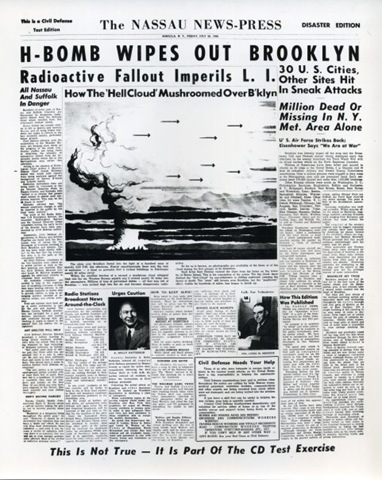
  • H-Bomb Wipes out Brooklyn. And Chicago. And New York.

    JF Ptak Science Books  Post 1527          Part of the Atomic and Nuclear Weapons series

    Wipe out Brooklyn

     [Source:  Conelrad blog and also at the website]
    I stumbled on this bombing of Brooklyn article at the excellent Conelrad website–it is an excellent addition to my slight collection of vintage depictions of American cities being nuked.  As part of the necessary scare tactics in the pursuit of the arms end of MAD, the destructive power of these weapons were shown against a background that Americans could readily understand.  Thinking of atomic and then nuclear holocaust in terms of multiple units of Hiroshimas and Nagasakis was one thing–showing the effects of these weapons on an American grid was something else.

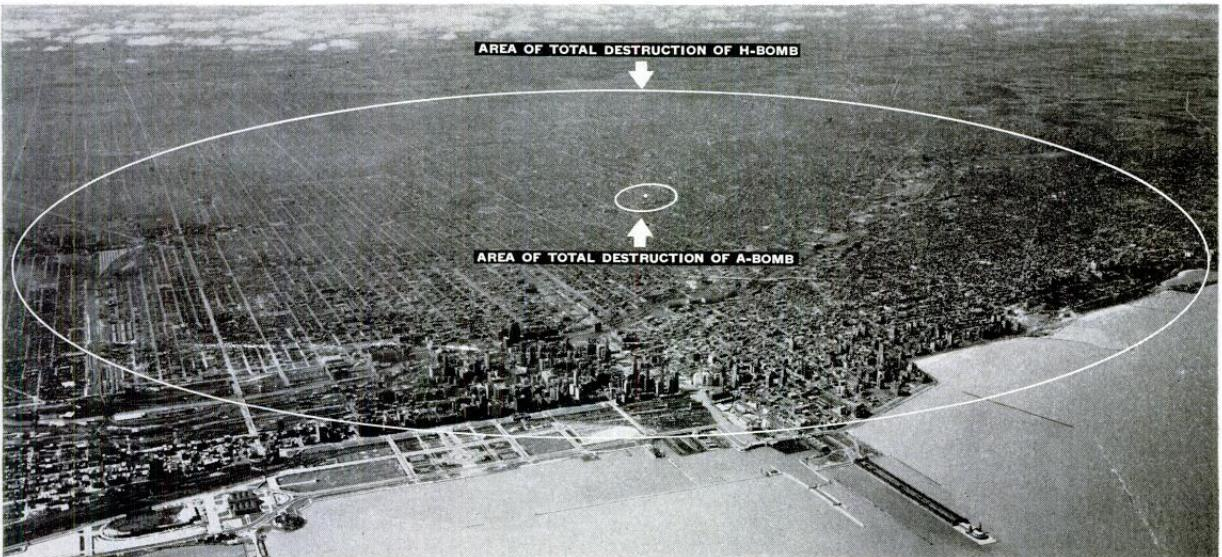
    This next  graphic shows the difference in destructive capacity of an atomic bomb (small circle beneath an air-burst detonation) and a hydrogen bomb (the large circle showing area of total destruction, which in this case would be about 50 square miles) on the city of Chicago.

    Wipe out chicago
    [Source:  LIFE Magazine, 30 Jine, 1950]

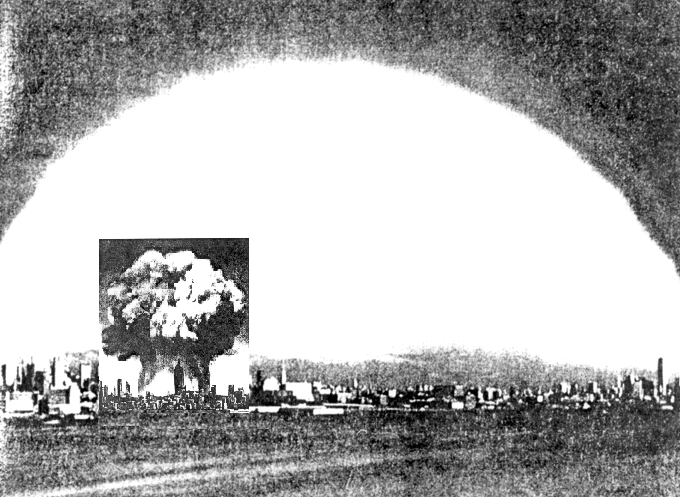
     The next image is much like the preceding, only showing a profile of Manhattan and the difference between the explosions of a Hiroshima bomb and a hydrogen bomb (of 20 megatons).

    http://bioinfo.mbb.yale.edu/~mbg/fun/both-bombs.gif

    [Source: BioInformatics Lab, Yale  http://bioinfo.mbb.yale.edu/~mbg/fun/both-bombs.gif]]

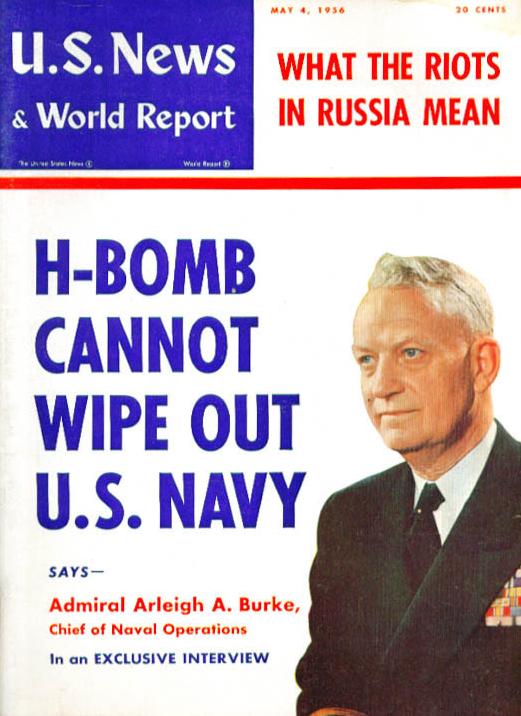
    But don’t worry, even if the Chicago and Brooklyn and New York and so on were destroyed, the U.S. Navy would survive, which would  be either great or horrible if you were a sailor:]

      H-Bomb  WIpe out NAvy
    And as usual, the point is made with one weapon being detonated, rather than the x-number that would actually be deployed.  Depicting, say, 10 weapons being used against these cities–while being a more accurate portrayal of what nuclear war might look like–might have looked like something beyond the usefulness of propaganda. 


  • George and Archie: Two Misty Names in Making Everything Into Nothing. Hiroshima, 1945.

    JF Ptak Science Books   Post  1523

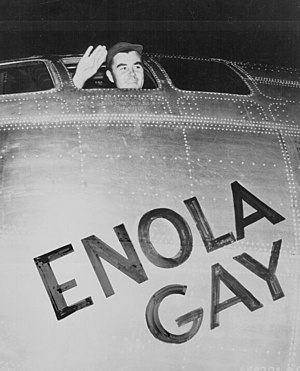
    http://upload.wikimedia.org/wikipedia/commons/thumb/9/93/Tibbets-wave.jpg/300px-Tibbets-wave.jpg

    The names of Col. Paul Tibbets and the Enola Gay are instantly recognizable, instantly placeable in the history of the twentieth century.  Fact is though that Tibbets didn’t pilot his (well, Capt. Robert A. Lewis’)1 B-29 all the way to Hiroshima and back, and wasn’t at the controls when the bomb was released.  Tibbets (also known as “Old Bull”) shared some of the tactically flawless mission with his co-pilot  Capt. Lewis, and also with George.  Well, its actually “George”,  the personified names for the autopilot of the aircraft, and I guess on the long road to splitting the atom it doesn’t matter much who did what at the final moments, especially if you were on the ground in Hiroshima. 

    It was Tibbets who flew the Enola Gay most of the way, through perfect skies, nothing to stand in the way of the aircraft and the completed mission–no Japanese fighter aircraft to haunt and hunt, and no anti-aircraft coming from the ground, at least not at their  low altitude.2 “George” was at the controls at 0815 on 6 August 1945–Tibbets would take control of the plane as the bomb fell away3, ripping the plane into a steep bank in trying to put as much distance between the aircraft and the bomb in the 43 or so seconds that they had before the explosion. Everything else about the bomb and the mission at the moment of release was controlled by a human–except for the flying of the aircraft. “

    “Archie”4 is the other name not so much remembered on this morning.  This was the name given to the apparatus (there were actually four of them on the bomb) that would initiate the final arming sequence for the MK1 bomb, “Little Boy”, one of a component of a fusing system that triggers the firing system.  It was a nicer handle I guess than its official name, which was AP-13.

    Notes:

    1.  Lewis was the original pilot of the aircraft until Tibbets was chosen to lead the mission against Hiroshima.  Tibbetts was named on 5 August and acted very quickly to get a painter to paint a name on the fuselage of B-29 82–so quickly that the guy who painted Tibbets’ mother’s name on the plane had to be pulled out of a baseball game to do the job.  When Lewis saw it, saw his plane with “Enola Gay” on it, he reacted badly, as he was mighty pissed.  He confronted Tibbets about it, but the Colonel informed the Captain that there was nothing to discuss. 

    2. Intelligence reported that the only antiaircraft resistance that could be expected were from heavier guns, which also happen to be very ineffective at the low altitude at which the Enola Gay flew.  This also benefited another aspect of the flight plan, which was fuel consumption–coming in low meant a big fuel savings, which in this case was very important because of the enormous load that the aircraft was hauling. 

    3. The Enola Gay would climb at last to 31,000 feet to release the bomb, which exploded at about 1980 feet above the ground. 

    4.  An interesting document from General Groves sums up the Archies nicely:  “Memorandum dated 24 August 1944 to Major General L. R. Groves from R. N. Brode, subject: Personnel with Radar Experience. According to the latter, the APS-13 was originally called the “Charlie” and those units to be adapted to atomic bombs were to be rigged to operate at selectable frequencies between 250 and 500 megahertz. By 1 January 1945, the “Archies,” with a “natural” range of 405 to 435 MHz, could be tuned between 325 and 485 MHz.  (“Interim Report Archie Frequency Range,” Lt. Leo Gross, 1 January 1945)–The History of U.S. Electronic Warfare, by Alfred Price, Association of Old Crows, Alexandria, Virginia, 1984, p. 232.”

    “By the spring of 1944, the APS-13 “tail warning device” was under study for use as a radar fuse. Originally designed to warn a pilot of another aircraft approaching the rear of his plane, the “Archie” had an effective range of about 2,000 to 2,500 feet.” Source: The Swords of Armageddon: U.S. Nuclear Weapons Development since 1945, Chuck Hansen, September 4, 1995, vol. VIII, pp. 3-45.

    And more:

    “Four “Archies” were used on each bomb, with a network of relays so that when any two of the units signaled, stored current was sent into the detonators (one on the MK I and 32 on the MK III). The antennas for the “Archies” were attached to the sides of the bomb casings.

    “A barometric pressure-sensing switch closed when the bomb passed 7,000 feet; the bombs were dropped from altitudes between 31,000 and 32,000 feet. A bank of clock-operated timer switches, started by arming wires pulled out when the bomb was dropped, closed 15 seconds after release to prevent the “Archies” from being triggered, in case of baroswitch short-circuit, by radar signals reflected from the delivery aircraft.

    “The arming and firing sequence for the first two atomic bombs was (1) 15 seconds after release, when the weapon had fallen 3,600 feet, the timer switches closed part of the firing circuit; (2) at an altitude of 7,000 feet, the barometric switch closed another part of the firing circuit and allowed electrical current from batteries in the bomb to charge a number of capacitors and turn on the radar fuses; (3) at an altitude of about 1,800 feet, radar signals emanating from the “Archies” and reflecting from the ground completed the last part of the firing circuit and triggered the detonation signal.”


  • Questionable Quidity: Swimming Pool Atomic Bomb Shelter -with- Nuclear Weapons Explosion Direction Finder.

    JF Ptak Science Books   Post 1506

    Part of the long series on Atomic and Nuclear Weapons

    At first this patent sounded somewhat reasonable–assuming that you were going to build an in-ground pool, and assuming that you thought that the Soviets were going to be bombing soon, and assuming that you weren’t living in an area of the United States that would be pulverized by thousands of megatons of nuclear explosives, then it might actually make sense to build this thing.  At the very least, if you lived in Tornado Alley, the bomb shelter could be very useful in non-bomb but tornado-threatening scenarios.  Of course, you wouldn’t have to build anything so substantial (with a pool attached) to survive a tornado attack, but if Uncle was in the cement business, you might as well. 

    This next bit might not really belong in the Questionable Quidities department, as it doe shave some real utility for the survivors of nuclear holocaust.  After the explosions are done, and after the firestorms have burned themselves out because there’s nothing left to combust and, well, also because the “local” oxygen in the vicinity of the intense fires has been used up, after people have determined that they have survived, it would be important to know from which direction the blast came.  If you know the direction of the explosion, and some of the atmospheric conditions at the time of the blast and immediately following, and had some tech equipment,and medical stuff, you might be able to figure out the coming effects of the attack. What you do with that, I’m not so sure. 

    Another major conditional here is that there was only one blast. If the place that was being bombed was worthy of one warhead, it was worthy of more, usually; so the collapsable sphere might be bent in from all directions, if there were two or three blasts, which means I guess that the thing wasn’t worth installing to begin with.  ALso, if you’re in a vicinity that could require one of these buggers and you were just the recipient of, say, 200 megatons of explosions, and survived the blast, you could probably just reach for your KYAG Handbook to see how many hours you had left on the planet. 

    Then again this really wasn’t meant as a civilian app. 

    Another


  • Atom Bombs: the Game.

    JF Ptak Science Books   Post 1497

    Atomicbomb pieces I do not know the precise date when displaying the death of children was used to sell detergent.  There were deep hints of a child’s death in a Twilight Zone episode (selling Borax) in the ate 1950’s, but in general I think that killing kids on television for story development and entertainment is more an ’80’s creation than anything else.  Children dying in stories on television had been verbotten, a non-starter, for decades; now kids die in Dr. House’s hands and all over the rest of that wasteland place and there’s barely a wrinkle in the entertainment continuum.

    Killing children in literature is entirely different, and of course much older.  Given the overwhelmingly and horrible basis of the news reports of the Old Testament, I wonder what the great flood would’ve looked like on OT TV?  After all, it was reported that the creator did away with almost everything on Earth–men, women, and of course  every child and baby on the planet, drowned like rats in a bag, but without a bag–kids left to float away from their parents, and then drown, sinking into the cold black sea created by the very thing that created them.

    Kids killing things in play is another matter, especially since it is done so for fun. I guess they smote or smitted things for time immemorial, but it wasn’t until very recently, and mostly with the invention of the middle class and the creation of disposable income, that killing toys were sold to kids in stores. Toy guns and knives and other implements of destruction at least made whatever the kids were doing a face-to-face activity.  When the atomic bomb toys started to appear in the late  ’40’s, killing stuff took on the potential of worldwide destruction.  Of course I doubt that any kid playing with these atom bomb toys had an inkling of what it meant to use the weapon in the real world, but the appearance of atomic bomb toys–while not quite yet at the level of Auschwitz board games–is on the revolting side.  On the other hand the destruction of entire galaxies has been witnessed by kids in any number of movies and television programs, what with billions of living being killed in the process.

    I don’t know what the effect is of exposing children to mass killings in the name of grand theft auto, let alone opening apocalyptic floodgates by putting nuclear weapons within their reach.  It just isn’t right.

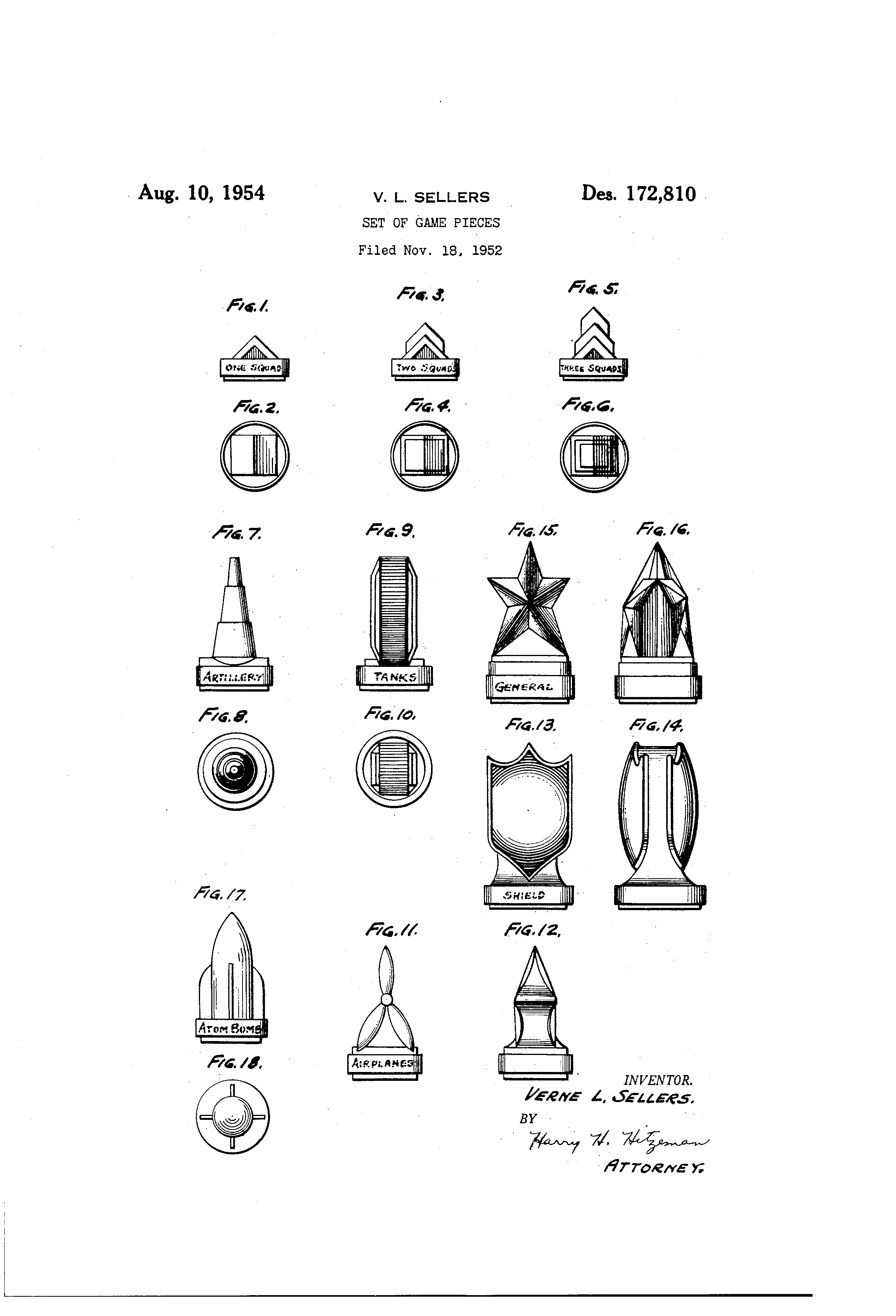
    Does these things, below, seem appropriate to you?  Take for example a simple matter in this detail from a U.S. Patent Office report for game pieces for a board game–the pieces were described; the game wasn’t.  The inventor, Verne Sellers, provided tanks, artillery, an air power of some sort, a “shield”, a general, a few undesignated items, and of course an atom bomb.  The atom bomb would make things all right. 


    Games atom bomb[Source: atomic bomb game pieces from US Patent and Trademark Office via Google Patents: http://www.google.com/patents/USD172810?dq=atom+bomb+game]

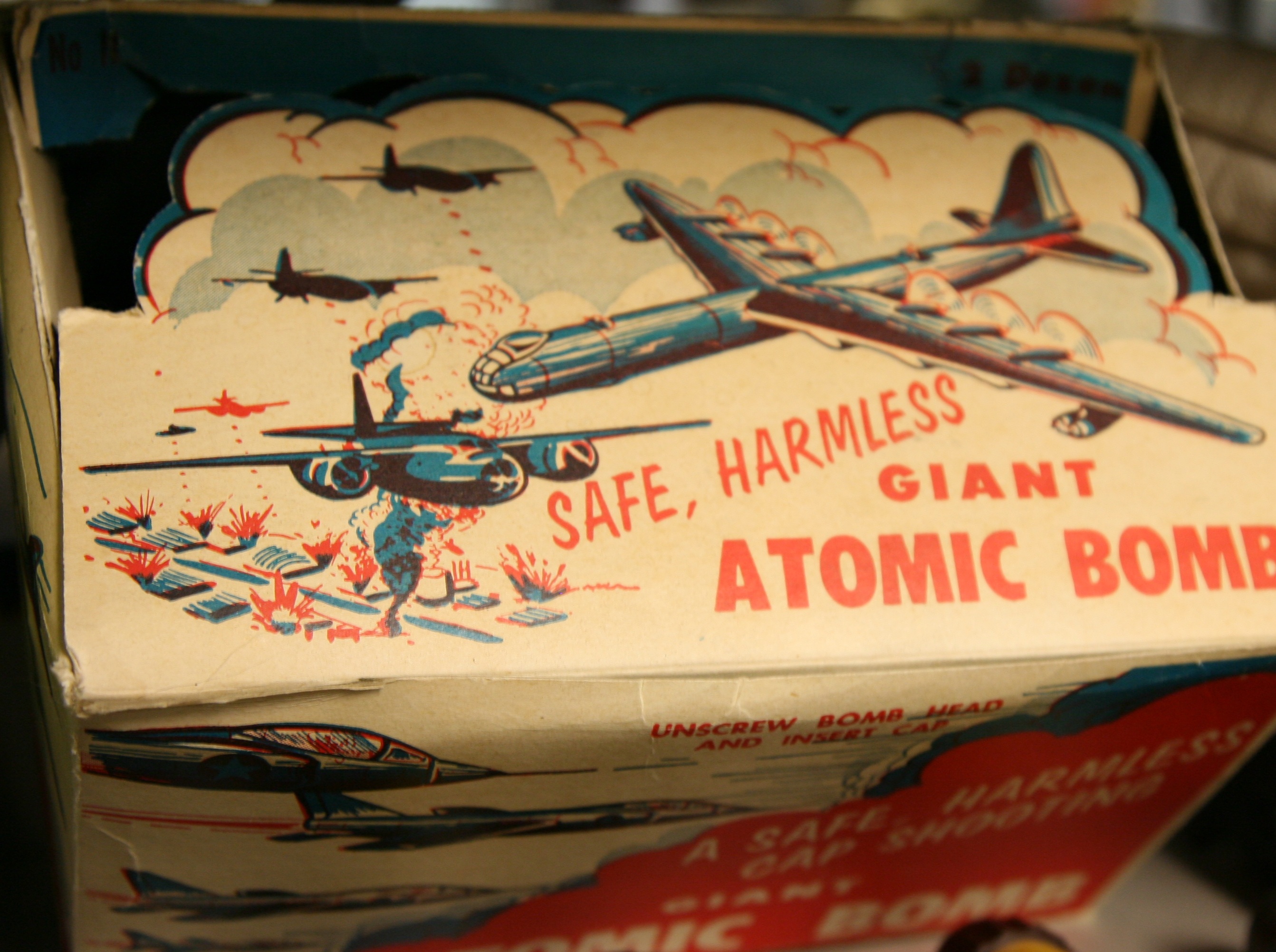
    And then there is the “Safe, Harmless, Giant Atomic Bomb”, which is something that is made to sound so much like nothing that it gives “nothing” a new meaning.

    Atomic bomb toy

    [Source: Pinterest https://www.pinterest.com/electrichermit/atomic-age-america/]


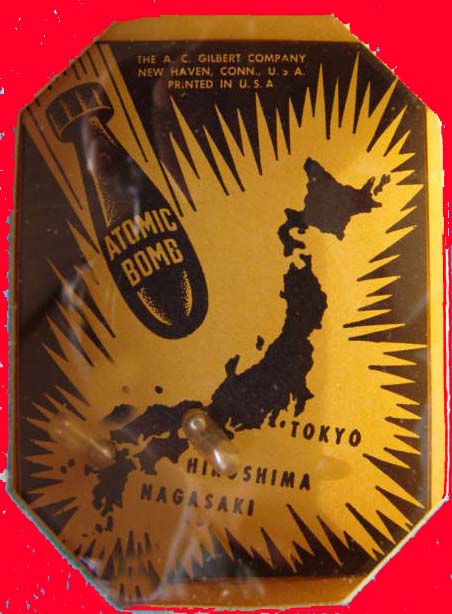
    Then this lovely thing, a small and cheap dexterity toy that places atomic destruction in the sphere of a semi-mindless time-killing toy, a real neutralizer to the significance of the thing it portrays:

    Atomic Bomb dexterity game

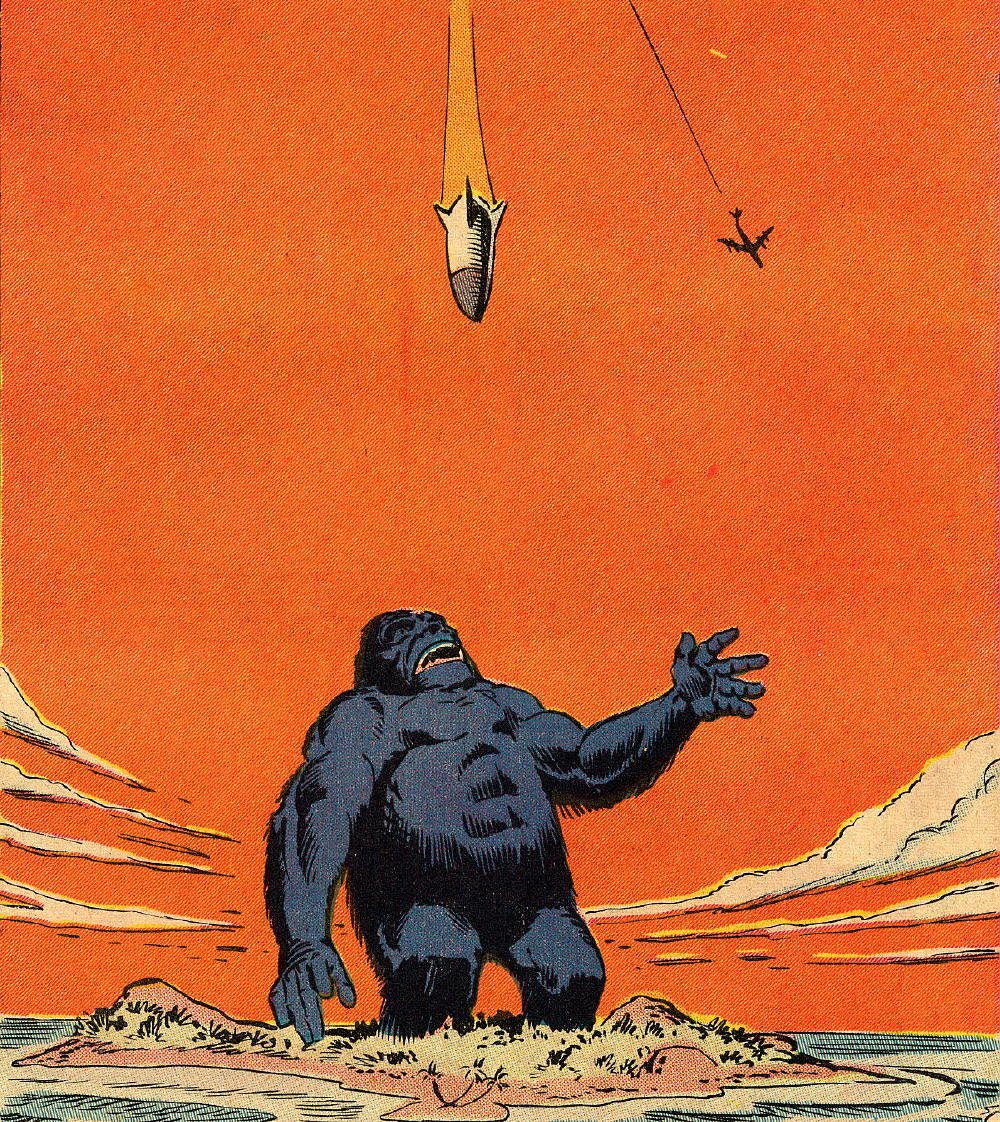
      I can’t imagine many people wouldn’t feel some sort of sympathy for this gigantic King Kong, who looks up just in time to see the massive nuke falling on his head, personalizing the delivery system of mass destruction:

    http://4.bp.blogspot.com/_xKCH2IWimP8/TKo0NZZutWI/AAAAAAAABgY/RbpLA7QTTD8/s1600/Konga+Atomic+Bomb.jpg

    Total destruction as a game, or game piece; an oxymoronic trivial pursuit.


  • Questionable Quidity: the Preservation of Decay–Atomic Bomb Suits

    JF Ptak Science Books   Post 1486

    Part of this blog’s long series on Atomic and Nuclear Weapons


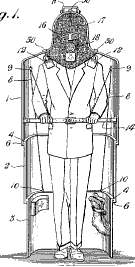
     Is there anything more revolting than this solitary, encapsulated,  iron maidenesque survival sarcophagus and its promised hope of survivability? 

    Perhaps not.  This patent application for an individual survival suit from 1958 gives us something to think about, perhaps gives us the cause to imagine what the world would look like from the inside of that portable evacuation chamber (that had its own attache case for storage).

     
    Atomic suit 2
     
     
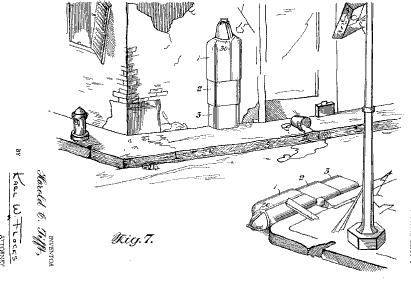
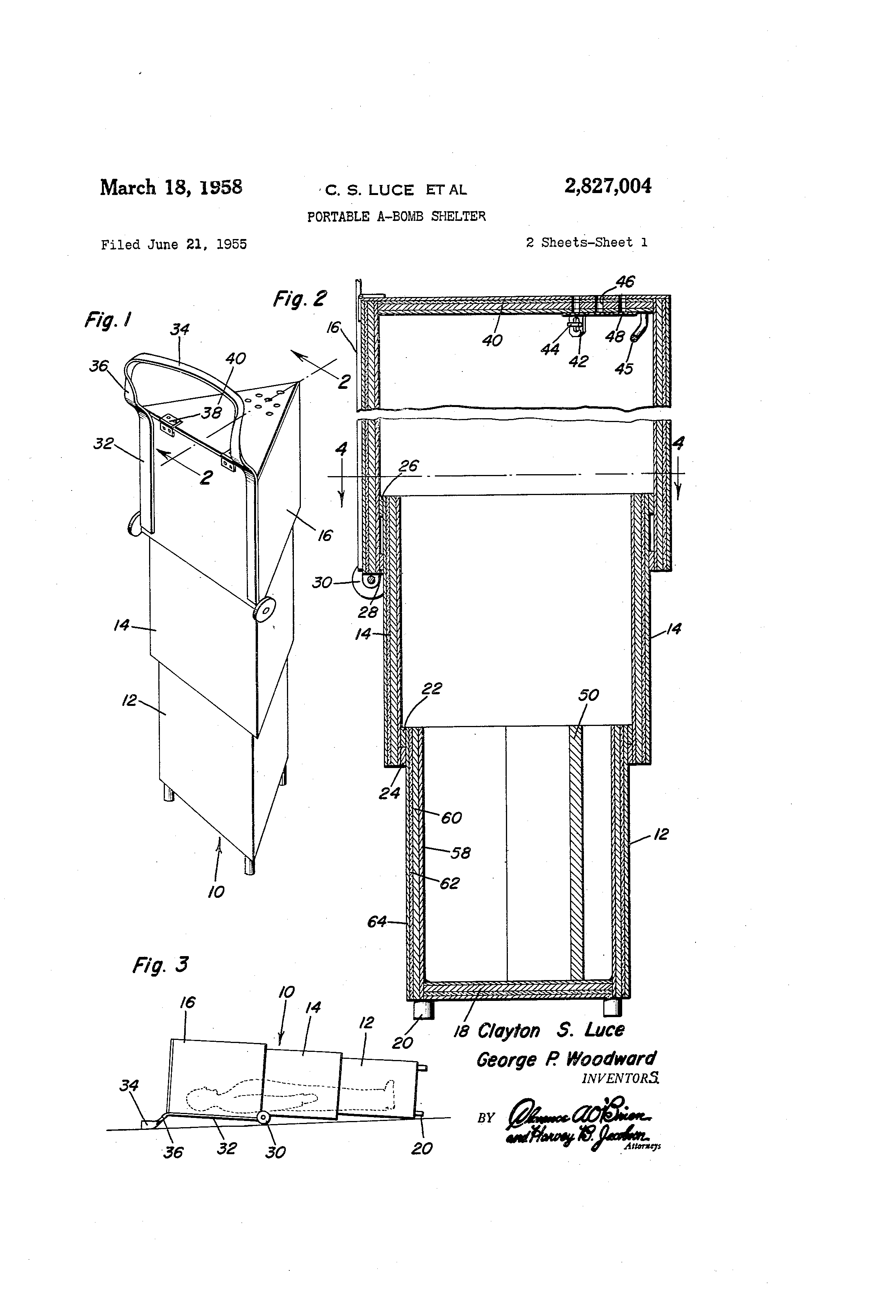
    Another variant, from 1958, shows a handy, mobile triangular leaf-incinerator-like environment that you wheel into position, put on its side, and then crawl into and die:
     
    The bomb(s) would go off, and there you would be, standing with your back against the wall, or laying in the gutter pressed against the curb, just another piece of the dead city, another piece of metal waiting to decay.  I’m not sure what is going on in this scene, which while being crude is still steeped in a high-creep factor.  I get the impression of slow time in these images, as though the atom-bomb-suited people have been there for a long time, though I suspect that we are seeing an urban area just after a blast.  It is a wincingly bad scene. 


    Atom bomb suit
    (Why is it that when seeing Civil Defense films and etc from this period we see people ducking-and-covering from one bomb?  Since the great majority of Americans lived in one of the 75 “essential delivery acquisitions” areas (I forget now the source for this phrase) it was exceptionally unlikely that people would be dealing with a single acquisitions implement, since the Soviet stockpile of nuclear weapons would’ve been at probably half-par with the U.S., which at this point (1958 or so) would be around 18,000.)
     
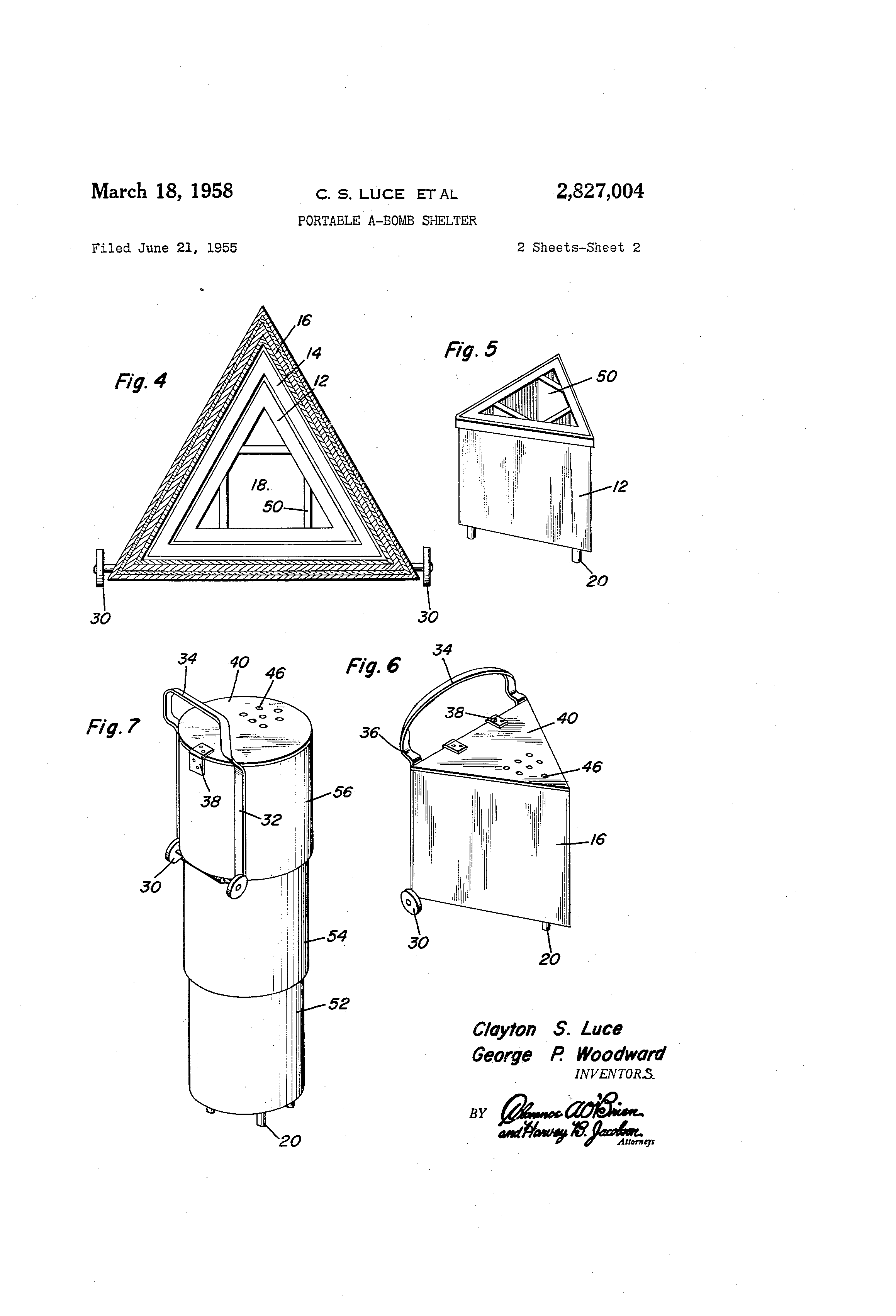
    Here’s another example of some unusual thinking on surviving nuclear holocaust, 1958, only these–while solitary–are not terribly mobile, even if they did come with wheels. (Didn’t it bother anyone that something that was supposed to prevent you from flying glass and bricks and the terrestrial ring of fire could be moved around on such tiny wheels?) They look more like waste receptacles.  Maybe that’s what they would wind up being, if they were ever used for their intended purpose. 
    Atom bomb proof suit prone

    [Source: Google patents, http://www.google.com/patents/US2827004]

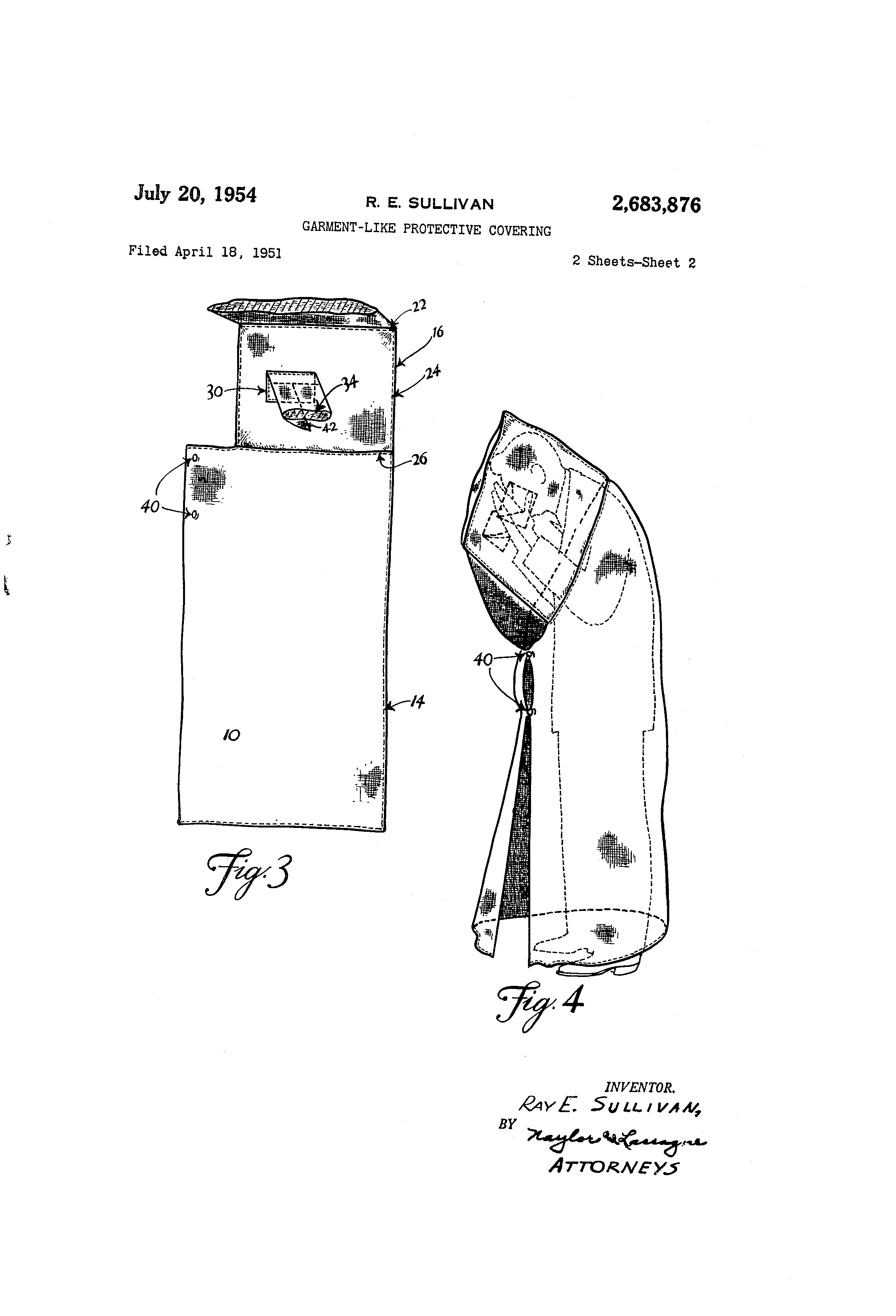
    And another atomic bomb “garment-like” thing–this looks like it might actually be useful on airplanes, because most people who die in crashes do so from smoke inhalation…but providing one of these per person would be a bad flying vibe, just like seat belts (so ferociously resisted by Mr. Iacocca) were seen by the car industry as an unnecessary reminder of how dangerous cars were/are).

    Atom bomb proof suit 1958

    [Source: Google patents, http://www.google.com/patents/US2827004]

    Anyway, the only way these things might be useful in times of such an emergency as atomic holocaust would be as a burial shroud.  And since a bunch of people would (presumably) already be wearing them at the time of attack, the job of burying them would be that much less work, since they were already shrouded.  Of course, that’s assuming (a) that people would or could be buried, and (b) that there was anyone left to do the burying. 

    Atom bomb suit bent over

    [Source: Google Patents, http://www.google.com/patents/US2683876]


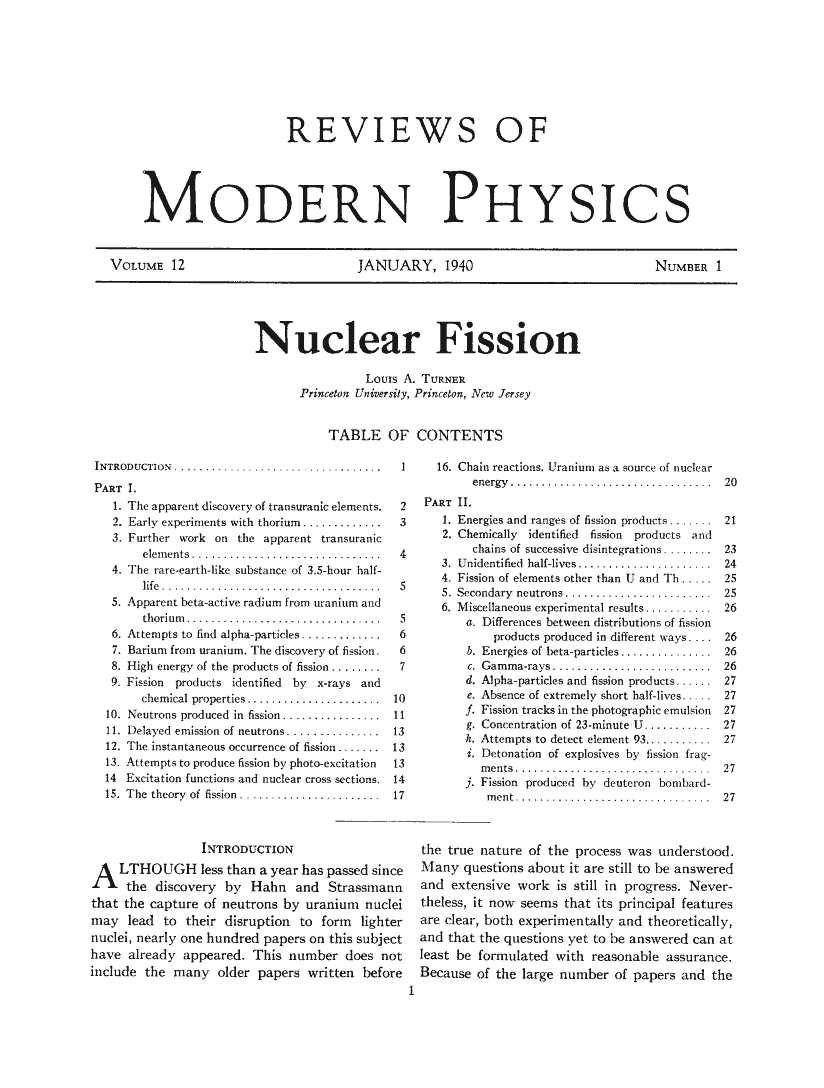
  • Louis Turner’s Review of Published Work on Nuclear Fission, 1934-1940.

    With a List of Turner’s References (Below)

    JF Ptak Science Books    Quick Post

    I’ve found this article1 by physicist Louis A. Turner to be very helpful over the years.  He was an I-was-there guy (and actually an I-am-here guy) who wrote a stuccato article on the history of nuclear fission which was top heavy in references, and did so in 1940, just before the clamp came down on publication on the topic.  Certainly there are other more modern efforts in this area that are far more detailed, but few have managed to do so good a job in as limited space as Turner, which the fabulous John A. Wheeler recognized as a “great and timely” review2.

    Notes:

    1. Louis Turner. “Nuclear Fission.”  Lancaster:  American Physical Society,  1940. An article in the  Reviews of Modern Physics, vol 12/1, January 1940, pp 1-30  of an issue of 85pp   Original orange wrappers.  Fine condition.  Also contains articles by Seaborg and Zwicky.   

    2.  J.A. Wheeler, “Fission in 1939, the Puzzle and the Promise” Annual Reviews, 1989. 

    The original article can be purchased through our blog bookstore, here.

    Turner fission
    His 133 references can be read as a succession of one-line histories of the subject (barring the permissions to reproduce the entire article):

    1. E. Fermi, Nature 133, 898 1934.
    2. E. Amaldi, O. D’Agostino, F. Rassetti and E. Segrè, Proc. Roy. Soc. A146, 483 1934.
    3. I. Noddack, Zeits. f. angew. Chimie. 37, 653 1934.
    4. O. D’Agostino and E. Segrè, Gaz. Chim. Ital. 65, 1088 1935.
    5. I. Curie, H. von Halban and P. Preiswerk, J. de phys. [7] 6, 361 1935; C.R. 200, 1841 1935; 200, 2079 1935.

    ·Posted by :

    ·in:

    —

  • Monumentally Bad Writing: Recovery from Thermonuclear War, Loan Forgiveness, and Taxes, 1966

    JF Ptak Science Books   Post 1430

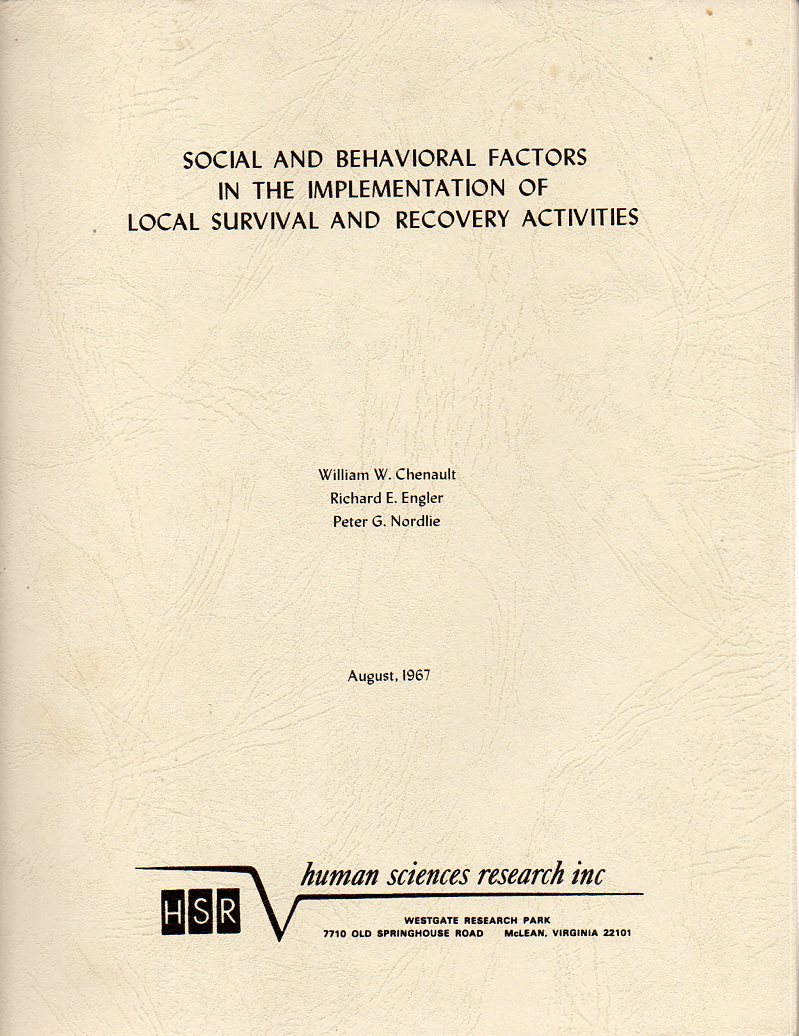
    In the entirety of the text of Social and Behavioral Factors in the Implementation of Local Survival and Recovery Activities (written by William Chenault, Richard Engler and Peter G. Nordhie in August 19671) there is little evidence that its authors fought to rid themselves of their Thesaurus of Obfuscation.  A dissected version of their effort would’ve made for good, clean fun, adding their bits to a Menckenian database of extraordinarily-written governmentese, but since all of this involved surviving thermonuclear war, the “fun” part is obliterated.  What, exactly, was it that the authors were trying to accomplish?  Perhaps in all of it they weren’t constructing anything devious at all–perhaps their incredible assault on meaning was simply written in a language understood by their audience.  That, or they really didn’t intend to have heard what they were trying to say,, if there was anything that was being said at all. (This report is available from our blog bookstore.)

    Nuclear war surviva;355

    The baseline to this pamphlet is this:  that in a post-thermonuclear war United States there will be survivors; the survivors will have “hardships”, but the hardships will be overcome; the key issue is to get survivors to work together to put the country back on its feet militarily and economically;  survivors will need “incentives” to work together; the strong will survive, and others will have to be thrown under the bus.  There will be worries about compensation for destroyed property, shipping schedules, trust in money, and a certain amount of debt forgiveness.  There will be tax–sales tax.

    There is no mention of the amount of death or the continuation of the dying in the year or two post-attack, but there is a graph, and the graphs not pretty.  It doesn’t get very much mention. 

    “…communities of [nuclear] disaster struck individuals need to define their needs and activities in the immediate context of the community”. pg. 5.

     “The tendency of nuclear disaster is to isolate communities..” pg 6

    I’ve written often on this blog1 about spectacularly bad thinking in planning for post-Apocalypse thermonuclear war America, mostly on government/agency reports that write about the impossible being done by survivors in impossible ways, painting the specter of impossibility and liquid death in turgid, unprovable prose.

    This study reports of the ways in which American society can survive and rebuild following a devastating nuclear/thermonuclear war. The authors list five consequences of “severe attack”:

    #1. Tremendous destruction of property…

    #2. Disruption of transportation and shortage of fuel for motive power together with an associated disruption of regional specialization and significant breaks in geographical continuity.

    #3. Drastic reorientation of effective economic demand”

    #4 . General disruptions of normal interindustry flows

    #5. Shortages of technical and professional manpower in some fields.

    I particularly like #3. Also the use of words like “shortages” and “disruption”.  And why they stopped there I really don’t know. 

    Much of the report is an examination of how to get the surviving elements of society back on its feet via carrot-and-stick methods, coaxing people into working together, with the eventual goal of restructuring the country, building America back again, observing capitalism, the tax codes, exchanging labor exchange units for goods and services.

    “Personal and group motivations would continue to be related to economic organization and production as they are in the preattack society” (pg 1)

    “It follows that the nature and direction of many recovery activities will be determined by national, not local, requirements” (pg 3)

    “Individuals must be motivated to implement policies and perform activities dictated by national economic interests”. (pg 4)

    It is assumed that the character of the post-attack country would be pretty much the same as it was before thermonuclear war, and that we all want to return there. The report states that one of the most important elements of that society is the military and its capacity to protect people and industry. Therefore the survivors of nuclear war must be induced to work on a national scale to maintain the military and thus the stability of whatever was left of society, in spite of the fact that “in the heaviest attack, the loss of familiar landmarks, relationships and dependencies would be unsettling to survivors”.  (I’m not sure what “dependencies” relates to, whether they are child or the need for pharmaceuticals or the need to watch the news on television. This is unclear.)

    Generally, there are a host of activities suggested to compel compliance, depending on where a community is in a 9-part destruction grid. There are incentives like food and water, medical treatment, and of course loan forgiveness. These inducements must be considered because enforcing compliance militarily is not an option, as the report states:

    “It is doubtful whether a very widespread employment of a force to secure participation in recovery activities is feasible” (pg 7)

    Meaning I guess that the U.S. Armed Forces will no the enforcing mandatory compliance schedules for recovery—or at least they weren’t writing about it “preattack”.

    But the authors clearly assume that there will be something approximately preattack life in the post-attack world. Amidst the horror and chaos, we read that

    “Businessmen, in particular, but others as well, would experience disturbing and subtle changes in familiar institutions and in such bases of mutual trust as methods of establishing or verifying credit…or estimating delivery dates”–pg 11.

    “Disturbing and subtle” changes to delivery, indeed.

    We further read of “widespread readjustments of status, status symbols, and values” (page 11) which no doubt would come if all of your possessions were burned up, or lost or destroyed in some way, along with the owner. It is definitely difficult to maintain status relationships in the evidence of no status and no relationships. Of course this whole deal is complicated by the issue that status symbols are also relationships and associations, much of which could also be gone in the same fire cloud.

    If your valuables and house and such weren’t destroyed, then you were expected to go out and work for the community, and not spend your time inside your house protecting it from people who didn’t have anything.  This issue is sort of addressed here:

    “Measures for the control of displaced persons, obviating the necessity of individuals devoting their time to the protection of their homes, represent one form of indirect influence on the motivation of potential workers to abandon maintenance activities.” (pg 50).

    Which means, I think, that there will be some sort of control or protection so that people don’t need to spend their time securing their possessions. 

    But the thing that will make people work for the greater good, the compliance with the orders of rebuilding the country, will be “economic incentives…or a penalty for nonparticipation)”.  Payment would be made with money or food.  The next incentive:  housing, or “more desirable dwelling places for those participating in recovery activities”.    It remained to be seen though in this report what it was specifically that represented “recovery activities” or how the compensation per work bit was handed out. 

    One way to raise the necessary capital to fund this post-attack world was through taxes, “a structure of indirect taxes could be developed, with higher rates applied to non-essential goods”.  (pg 53).    On the other hand, just a few paragraphs later, the authors discuss getting rid of an income tax in favor of direct taxes, which means that taxes survive  the atomic nightmare. 

    This continues on and on, a cascade of some wincing ideas tumbling over themselves, settling into a confusing mist of wording and logic that is difficult to translate.  Perhaps that was the inention.  Perhaps not.  There’s not much left in the bottom of a smoking, radioactive hole, except for smoke and radiation.
    Lastly, I wonder why “post-attack” is hyphenated in these reports and “preattack” isn’t?

    Notes

    1. See for example Bad Grandeur, Predicting Post-Nuke USA (1966) and the Loss of 76% of all Authors

    The Nonsense of Strategically Meaningful Phrases, Finding Pillows int eh Post-Nuclear Attack World, 1968

    Ueber-Spectacular Understatement Department, the Happy Post-Apocalyptic America and the “Awkwardness of Nuclear Holocaust, and others.)


  • Dentists and Mushroom Clouds–the Nuclear Mundane in Planning for the Thermonuclear Post-Apocalypse

    JF Ptak Science Books  Post 1428    Part of a long series on Atomic and Nuclear Weapons History

    How can a person–how can I–write about Nuclear Holocaust as being mundane? When it comes to reading how some people mundanely responded to planning for surviving it.

    It is a very deep Disturbia into which people fall when writing about the millions of details in accounting for the unaccountable, writing about the medical/physical/psychical consequences of surviving a bomb when dozens might well be detonated at the same time, the millions of details overtaken by billions of other details not mentioned and perhaps not imagined. 

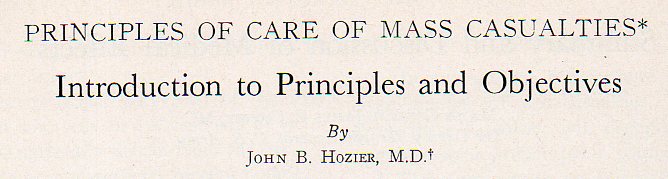
    I’ve collected some wide non sequiturs dealing with the matters of the nuclear apocalypse from a publication called Military Medicine in an article entitled “Mass Casualties, Principles Involved in Management”,  which were papers delivered at the 62nd annual convention of the Association of Military Surgeons, 1956.  Sometimes the chapter heading says it all, giving wide pause; and sometimes you have to wade in a little, but you don’t need to go very far, or very deep.  Overall the issue of the absolutely overwhelming devastation and the impossibility of dealing with the human consequences of nuclear war do absolutely get written about, but it occurs somewhere inside each contribution, which is front-loaded with pop-iconic understatement and then followed up with vast simplification. 

    Then of course there is the official-speak in quietly stating screamingly bad things: “a wide disparity will in all probability exist between patient load and medical resources”.  There’s so much like that in this publication that it is hard to keep up, like differentiating sands on a beach. 

    [I resisted including the section on the use of dentists in the post apocalypse–it was too painful, and I ran out of steam.]

    Nuke--nuke detonation313  Nuke--nuke detonation315

      Nuke--mass cas priciple320
    Nuke--mass cas priciple321


  • Miss Atomic Bomb: the A-Bomb in Popular Culture–Comics, Cakes and the Will of God

    JF Ptak Science Books   Post 1425 
    Follow Me on Pinterest


    I’ve written dozens of posts on this blog about atomic bomb history and where the bomb has shown up in popular culture.  This installment is on the bomb in very popular culture
    Miss Atomic Bomb is an icon of some sort for the relationship of the bomb with society, or, perhaps the bomb and Vegas, which is where this picture was taken. I guess there are reasons to put pretty women in front of computers (in the 1950’s/60’s), cigarettes and automobiles–why not with The Bomb?
    Atomic Bomb Miss
    The atomic cake (with matching headware):

    Atomic cake

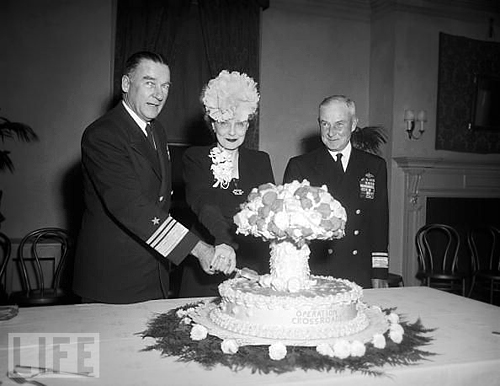
    The caption to this story from Life magazine (1946) reads: “U.S. Navy Vice Admiral William H. P. Blandy, his wife, and Rear Admiral Frank J. Lowry cut a cake made in the shape of a mushroom cloud at a reception for Operation Crossroads, November 6, 1946.”  Actually Blandy was an early (August 1945 or thereabouts) forward thinker about how to deal with the U.S. owning the bomb and  international control.  I have little doubt that he probably thought that the cake was a bad idea, but, well, he did what he needed to do.

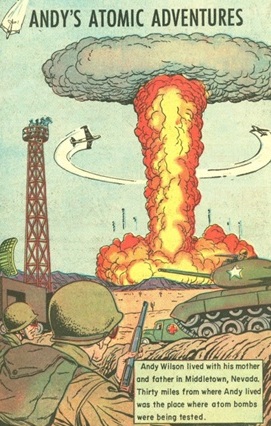
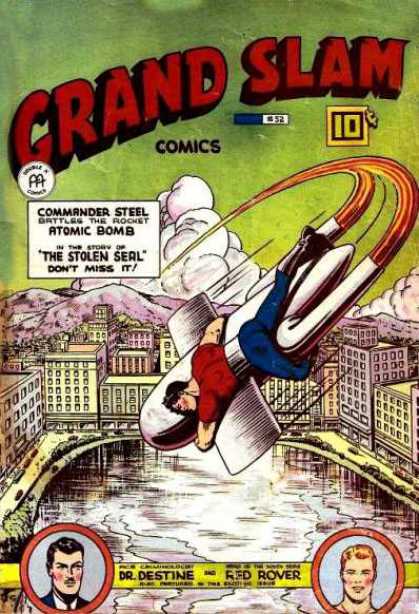
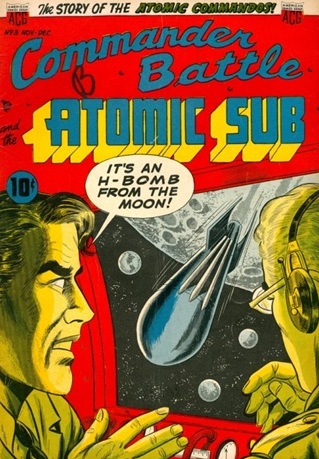
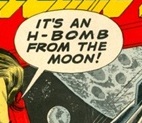
    There were all sorts of comic book adventures dealing withe the atomic bomb, right from the very beginnig (as it seems the earliest of them appears a month after the Hiroshima bombing).  These are just a few examples with the a-bomb on the comic’s cover(s):

    Atomic andy

    Atomic grand slam
     
    Atomic  h bomb from moon

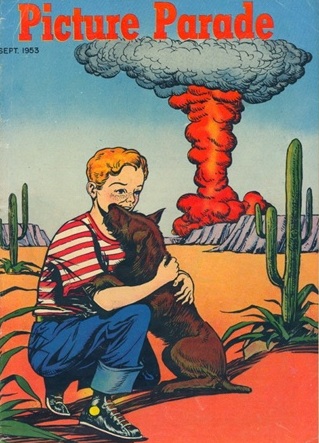
    AtomicbombBizarro–I don’t know the story of this image in Picture Parade, only having the cover graphic–perhaps that’s enough, perhaps we don’t need anything more, perhaps the backstory would spoil a perfectly bizarre image with something perfectly benign.  Or perhaps not. 

    Atomic bomb biazzaro
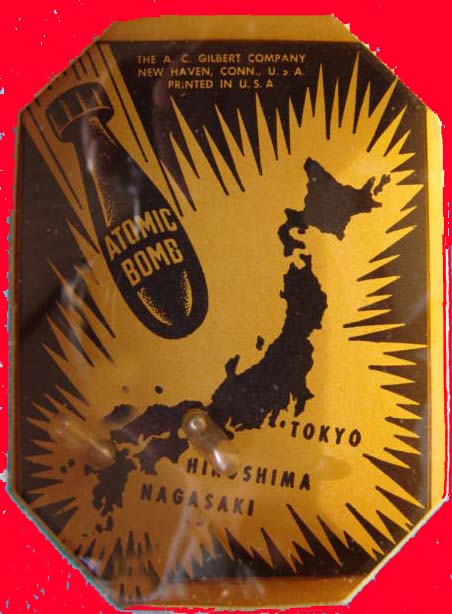
    Bizarre but for different reasons–a pocket-sized ball bearing patience game. Tokyo is included as a target for this game but in actuality was not considered atomic-bomb-worthy, mainly because it was decimated,  blanketed with a firebombing  that destroyed a host of the city just weeks before the first blast. (On March 9-10, 1945, 339 B-29’s dropped 2000 tons (4 million pounds, about 496,000 bombs) of the incendiary M-69 on Tokyo.  Two initial passes were made on the city, marking a large, burning “X” in the city.  Each plane had the capacity to cover a drop area of 350 feet by 2000 feet, which means a much greater area was affected. The citizens of Tokyo met their ends with buckets of water and brooms in defense. Hours later fifteen square miles of the city were destroyed.  In the months prior to Hiroshima and Nagasaki, 66 cities were bombed with M-69, killing about a million people, and wounding more.)  Fresh cities were needed for the atomic weapons so that there effectiveness could be judged against a palette of a normal. intact city, and not one that had been previously attacked. 

    Atomic Bomb dexterity game
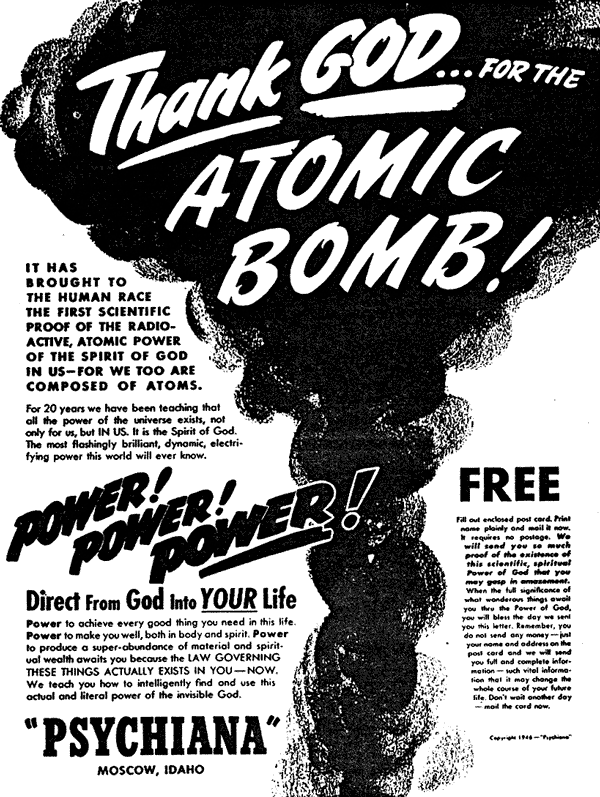
      And still more bizarre, when you combine all of the aspects of the race to the bomb with the race to god and the people who would believe such a thing.  This advertisement belonged to a mail order religico empire builder, Frank B. Robinson, (1886-1948), who claimed himself to be a prophet of god, had conversations with the Creator, and in general used whatever was of interest in the newspapers to drive interest in his ministry by mail.  It looked like his creation–Psychiana–wasn’t much more than a feel-good, self affirming, positive-thinking enterprise driven by a man with a personality big enough to be on speaking terms with the god, who in the ad below somehow was selling “the atomic power of the spirit of god in us”  because we are composed of atoms.

    Atomic bomb thankgod

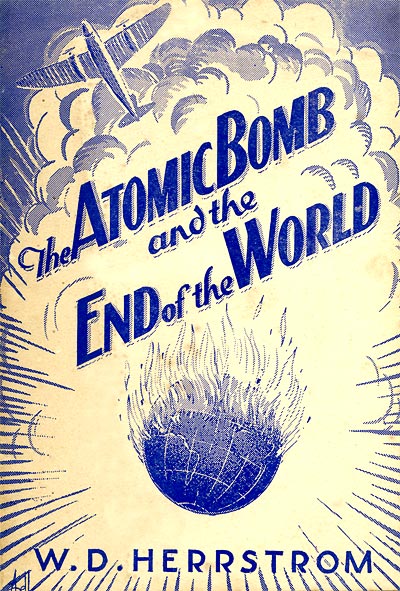
    And of course on the other end of this:

    Atomic_bomb_end_of_world

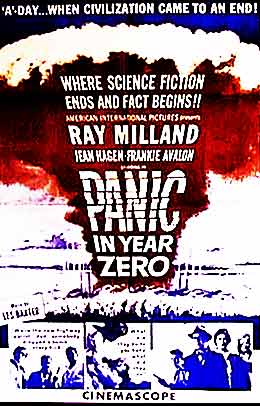
    This is an example of a host of end-of-the-world, post apocalypse movies (and books, and short stories, and so on) made to scare and entertain.  Judging from the trailer the more-modern television series Jericho owes a lot to Ray Milland. 
    Atomic panic-in-year-zero

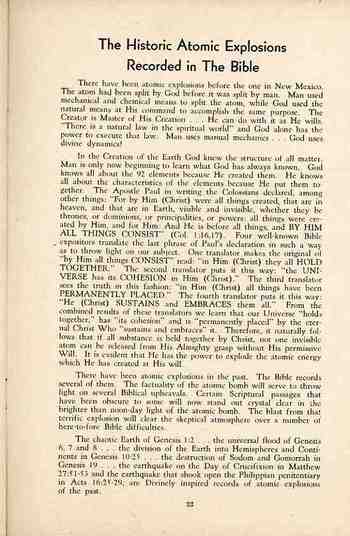
    Mel Morris  published God’s Atomic Bomb  in 1945, which means he must’ve worked a little feverishly to pump up his bible prophesy and history to include the new atomic weapon to replace whatever else he had been using as a prophecy for end of times.  (As it turns out, “God’s Atomic Bomb” was more tempest and disaster in the bible, and not (whew!) the bomb itself.  Though as we’ve learned from scientologists and the sort-of creative mind of Ron Hubbard, a civilization came to the earth thousands of years ago and pummeled it with “atomic bombs” and other nastiness, polluting humans for milennia to come.  But that’s another story–suffice to say that Morris found many dozens of examples of “God’s Atomic Bomb” being used in the deep biblical past, and that the use of the real atomic bomb in 1945 was pre-ordained, and not without its figurative historical counterparts.  I’m not sure why any of this was necessary outside of proving to some small minority that these preachers could at least be contemporary and topical. 

    Blogsept_2_atomic_bomb_god_2txt483

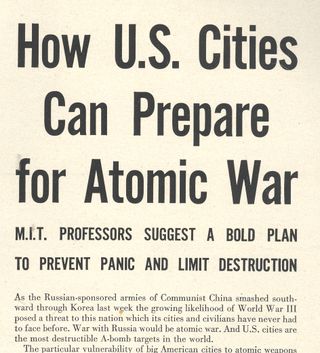
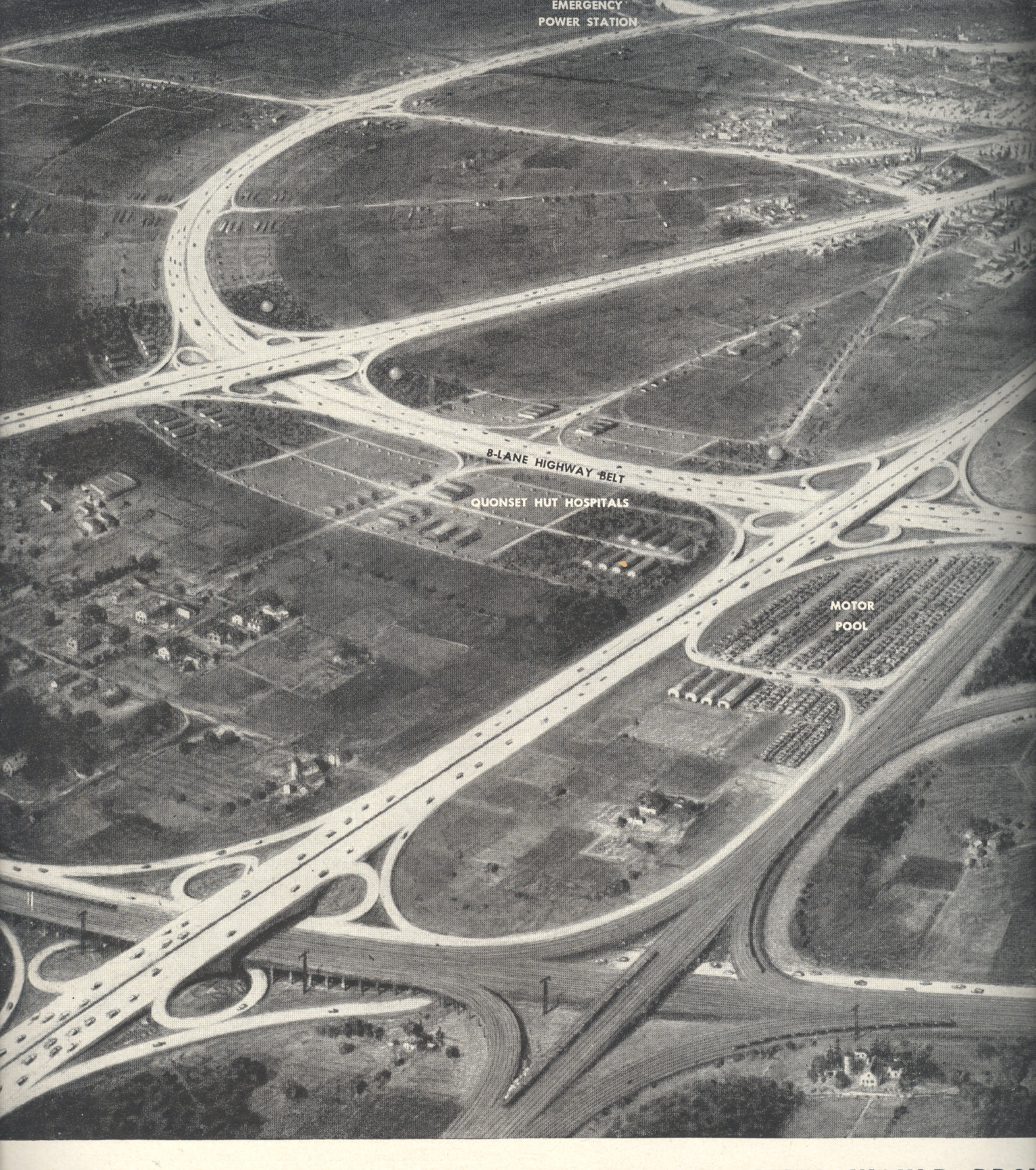
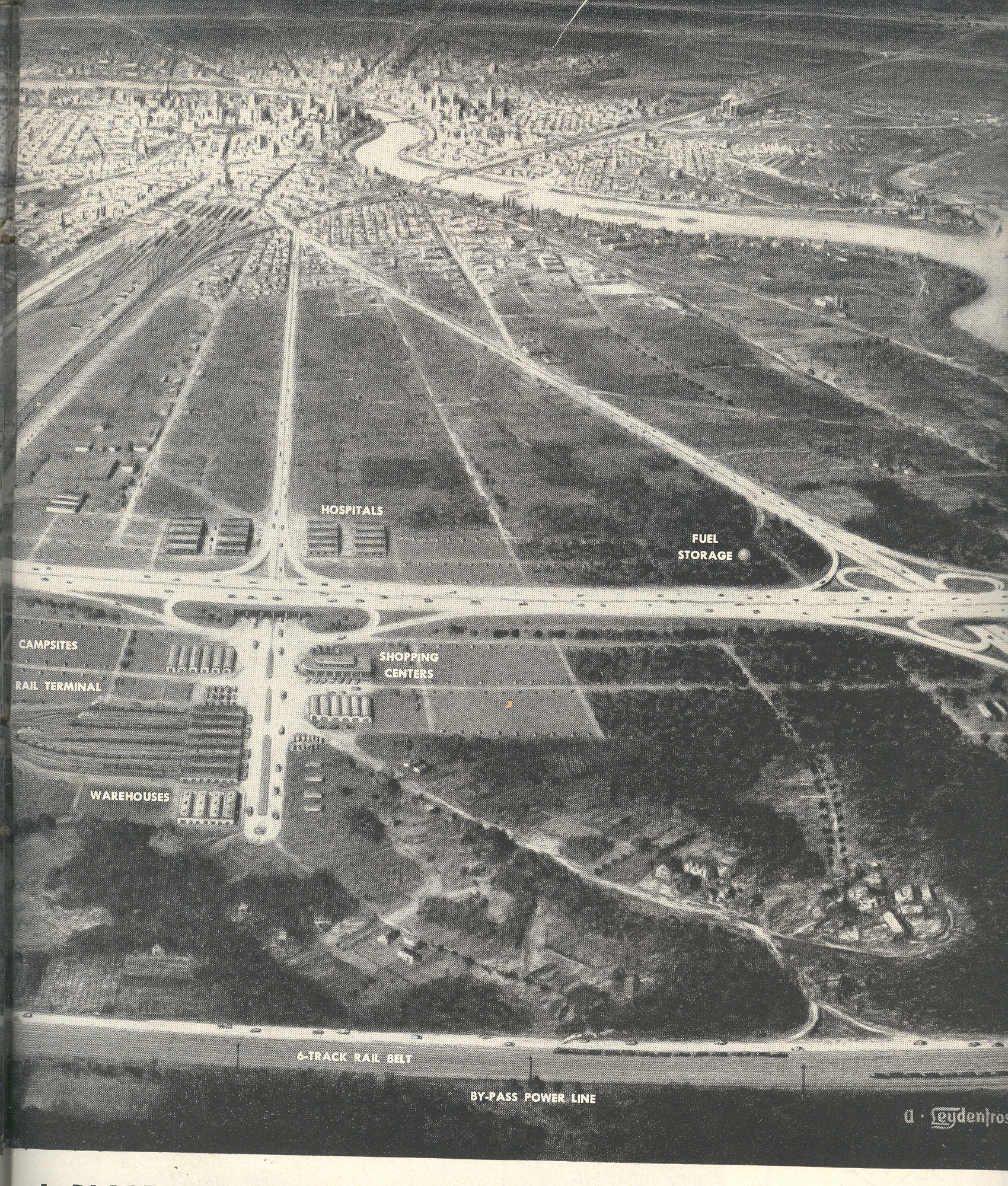
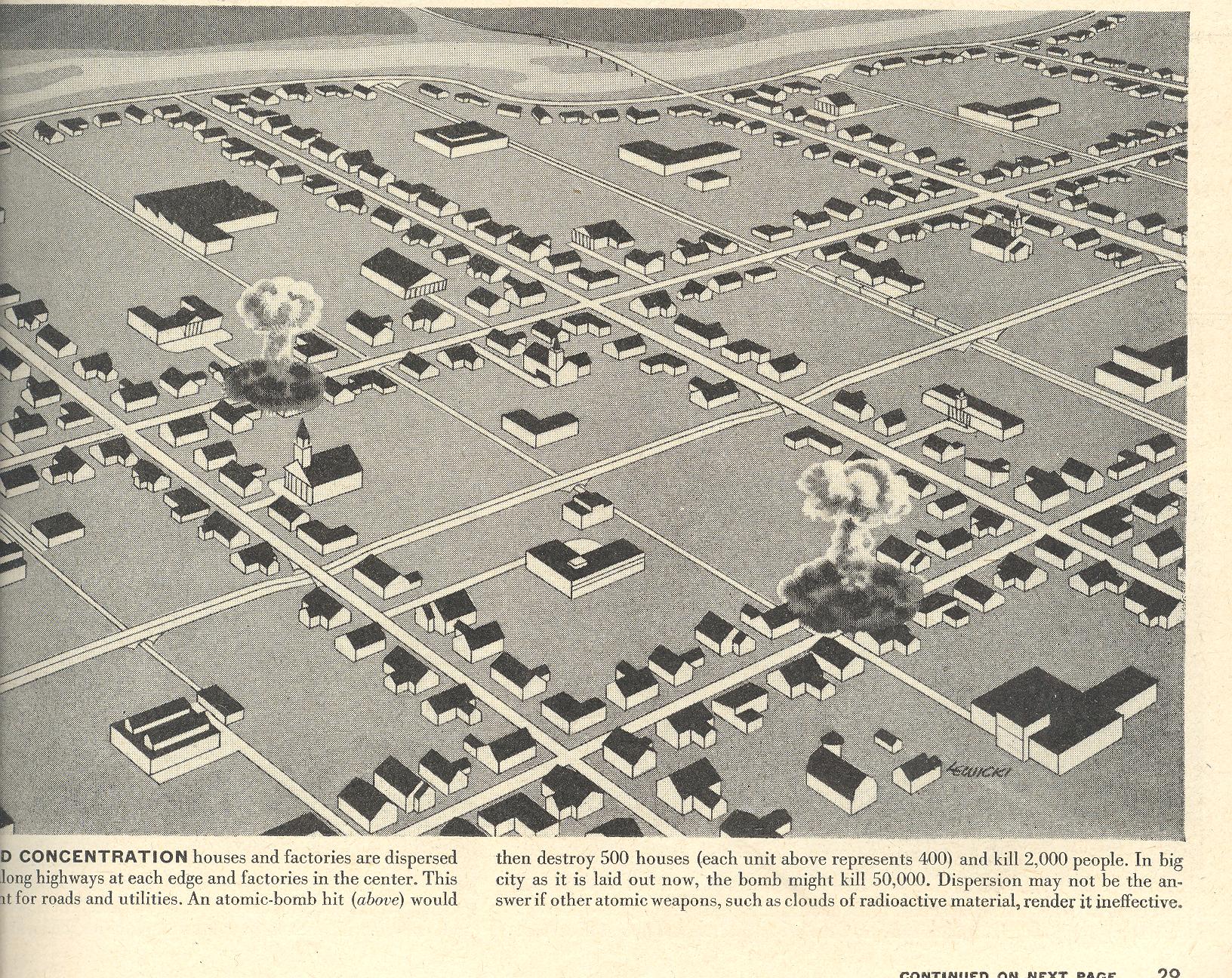
    The following is not the worst idea regarding the survival of nuclear holocaust, though it is an extremely bad one.  (Atomurbia, which makes the entire country a suburb to itself and therefore nothing, and which I write about below, is perhaps the worst idea that I have seen on combating the Soviet menace.)   But this one, which appeared in Life magazine in 1950, does come close, setting up post-attack suburbs (for “refugees”) and which takes some pre-attack city planning into some account.  There is a lot of planning for people in cars to make their way out of the city, which reminds me of the evacuation maps of Washington D.C. (which were still being handed out in the early 1980’s), which sends people on their way east and west depending upon the last digit of their car’s license plate being an odd or even number. 

    Atomic city plan war

    ==Blog July 27=wiener left

    One reaction to impending Doomsday was to construct concentric outer highways around metropolitan areas, “life belts around cities (which) would provide a place for bombed-out refugees to go”. In the birds eye view provided here, we see the plan in action, the main parts of which are an 8-lane “express” highway belt 10 miles away “from the built up edges of the city” , and a 6-track railway belt five miles further out, these accompanied by various feeder arms stretching straight-away from downtown.  In between the two outer rings would be land that would be kept free of development, so that farms and tent cities could be constructed after the attack. There would also be major collections of hospital and fuel depots in the greenbelt area.  Infrastructure would already be in place (gas and electricity, supplied with power from who-knows-where).   Shopping centers and a giant “motor pool:” would also already be in place, waiting for the Doomsday clock to strike midnight. 

    ==Blog July 27=wiener right

    This idea of city planning was one of many offering the prospect of safety from nuclear attack by spacing out the population of the United States so that the Soviet Union wouldn’t have enough nuclear warheads to take everyone out.  It called for the redistribution and resettlement of virtually everyone in the country, and is one of the most spectacularly bad ideas that I have come across in this field.  (I wrote about it earlier in this blog, here.)

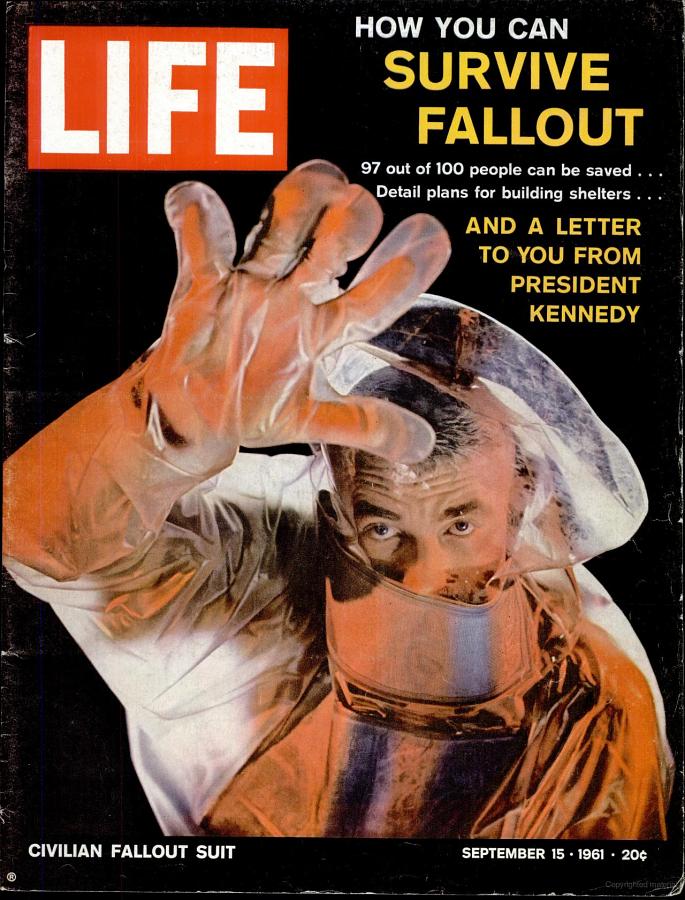
    1-may 3-atomic 4

    This issue of Life offered the possibility of hope that 97% of the American population could survive a nuclear attack by the Soviet Union. It was a hard sell of a bad idea of insane optimism.

    Books_004


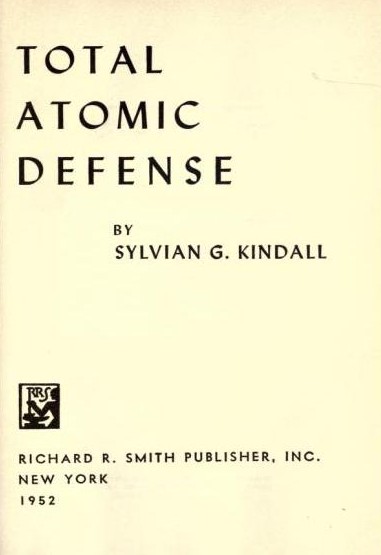
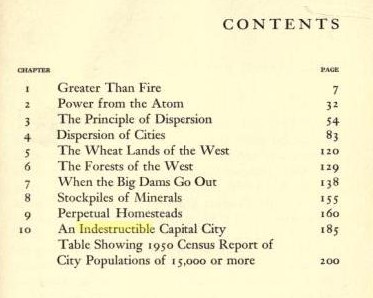
     Sylvian Kindall’s Total Atomic Defense (published by a very severely right-wing publisher in 1952) is one of a series of books made for a deceived American population, offering the general reader both fear and hope, often from the same, exact source. But Kindall has a  somewhat diffident approach, offering his belief that the country and its population can largely  survive an all-out nuclear waBlog--untinkable tpr–intact.  Chapter 10 tells the remarkable story of how to make the captial city of America atom-bomb proof, mostly by digging it into the side of a mountain.

     
    Blog--unthinkable


    Again, this is just the barest touch of the top of a huge pile of such stuff–and I’ve not even mentioned duck-and-cover films.