A Daily History of Holes, Dots, Lines, Science, History, Math, Physics, Art, the Unintentional Absurd, Architecture, Maps, Data Visualization, Blank and Missing Things, and so on. |1.6 million words, 7500 images, 4.9 million hits| Press & appearances in The Times, Le Figaro, Mensa, The Economist, The Guardian, Discovery News, Slate, Le Monde, Sci American Blogs, Le Pont, and many other places… 5000+ total posts since 2008.

Category: Atomic and Nuclear weapons

  • The Decision to Use the Bomb, 17 July-6 August, 1945

    JF Ptak Science Books  Post 1720

    July 17, 1945 (Trinity +1 or Hiroshima -20), the day after the Trinity test of the first atomic weapon, was the first day in which very concerted, very real discussions ensued about what to do with the bomb and where to us it.  Actually the discussions were mostly on the “where” than on the “whether”.  (As it turns out part of a minor segment of the “whether” part was Leo Szilard’s petition to President Truman not to use the bomb and which was signed by 155 Manhattan Project scientists, and which had reached its final version on this day.)

    The truth of the matter was that it was a very complex issue, an easily misunderstood tapestry of circumstance and consequence. The major issue of course was that the Japanese would not surrender, and that there would be “fanatical resistance” once the invasion of the Japanese islands had begun.    The battle of Okinawa had just been fought—it was a horrible confrontation taking 12,5000 American lives and more than 1000,000 Japanese , demonstrating that even in impossible circumstances that the Japanese simply would not surrender (unconditionally).   This is just one instance—there are many others, not the least of which was t he recent firebombing of Tokyo, taking 150,000 lives.  Air strikes in general seemed to not make a difference in the will of Japan to fight—as was demonstrated again and again in the British and American bombing of Germany—as was further demonstrated in General Curtis LeMay’s and General Hap Arnold’s  60-city attack in the May-August span.  The thought was that if there was an invasion that it could well cost the U.S. 1000,000+ casualties and would be completely devastating to Japan.

    ·Posted by :

    ·in:


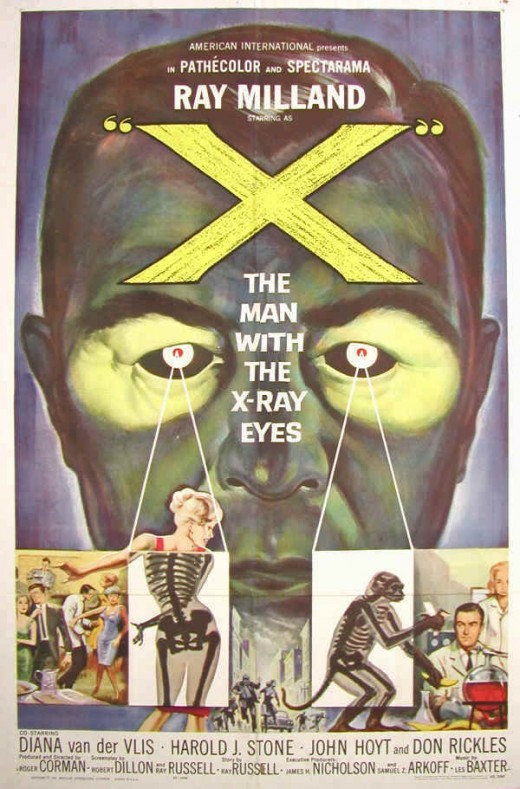
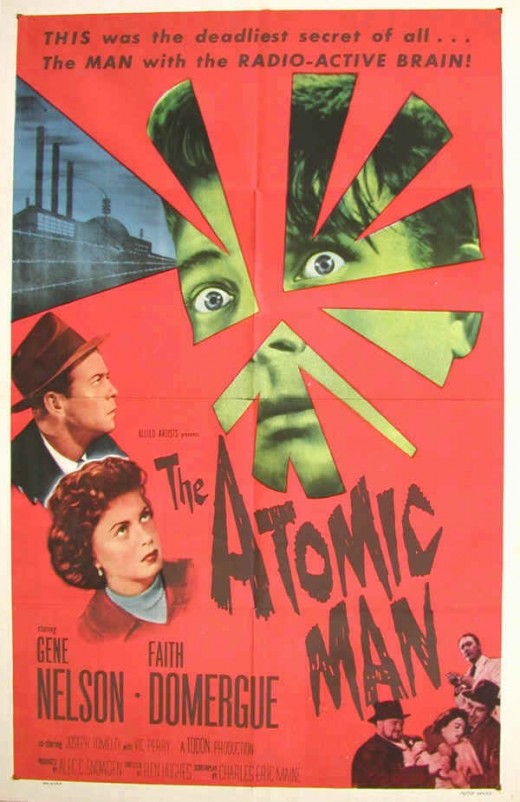
  • Atom Eyes in Hollywoodland, 1950’s

    JF Ptak Science Books   Quick Post

    (An earlier post on 1950’s atomic bomb popular culture appears here.)

    I strongly doubt that anyone could “read” or dowse or interpret eyeballs in these movie advertisements and take very much away from them at all outside of the big atomo-nuclear death-fear that gripped most people in the U.S. and the U.S.S.R in the 1950’s and 1960’s.  That, and it made for a good way of selling the promised fear in these movies, gentle as they were by curernt standards, but fearsome nonetheless in context with their time.   

    [Images from the wonderful Retronaut site, here.]

    Atomic bomb movie 8b Atomic bomb movie 8

    It is a little difficult watching even the clip of the Ray Milland movie in that he wasn’t really that much more different than the people around him, judging him.  And it turns out that in this differentially-abled-free world, where everyone looked like the white couple in some commercial for Borax, that his weirdish blackish eyes were deemed so incredibly repulsive–though since not having slickee-boy hair was enough to be set apart from most groups, or at least those in this movie, its not that surprising that he would be turned into a monster.  It didn’t take all that much to get down Monster Road, then. 

    Atomic bomb movie 6b

    Atomic bomb movie 6


  • Empty Words & Controlling the Vocabulary of Mass Destruction

    Vocabuilarly mass destructionJF Ptak Science Books   Post 1643

    [Part of the Atomic and Nuclear Weapons series and the History of Blank, Empty and Missing Things series.] 

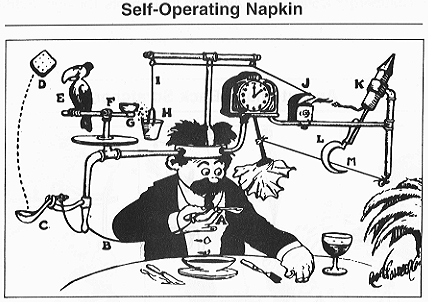
    I think no plumb line was ever so worked with pulleys and wheels, strings and catclaws and other Rube Goldberg devices as were the demographic studies of nuclear warfare.  It is as though their compass rose had no compass, with everything centered on the center, no way out, no way in: just there.  A faceless clock face describing “G-2 o’clock” whenever it pleased.  These studies seem to me the nuclear warfare equivalent of the Bellman’s map (described earlier in this blog as the most perfect map ever constructed): a pretty polygon describing a totally blank surface.

    Atomic goldberg

    I have a number of these things here, some of which are restricted-distribution publications, works of statistical fancy/fantasy meant for other eyes in the same community dedicated to the fancies described, a tautological audience for self-referential. 

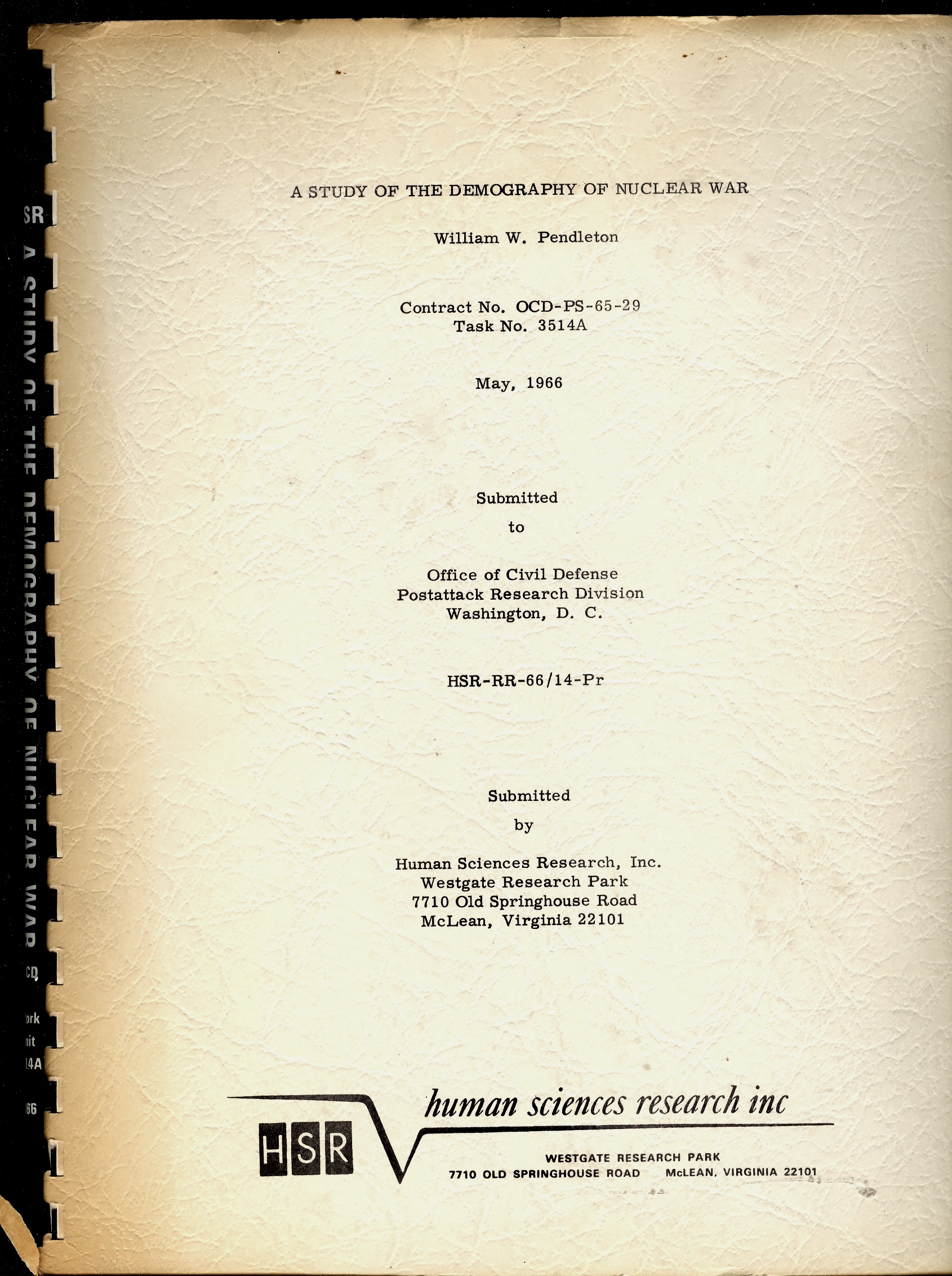
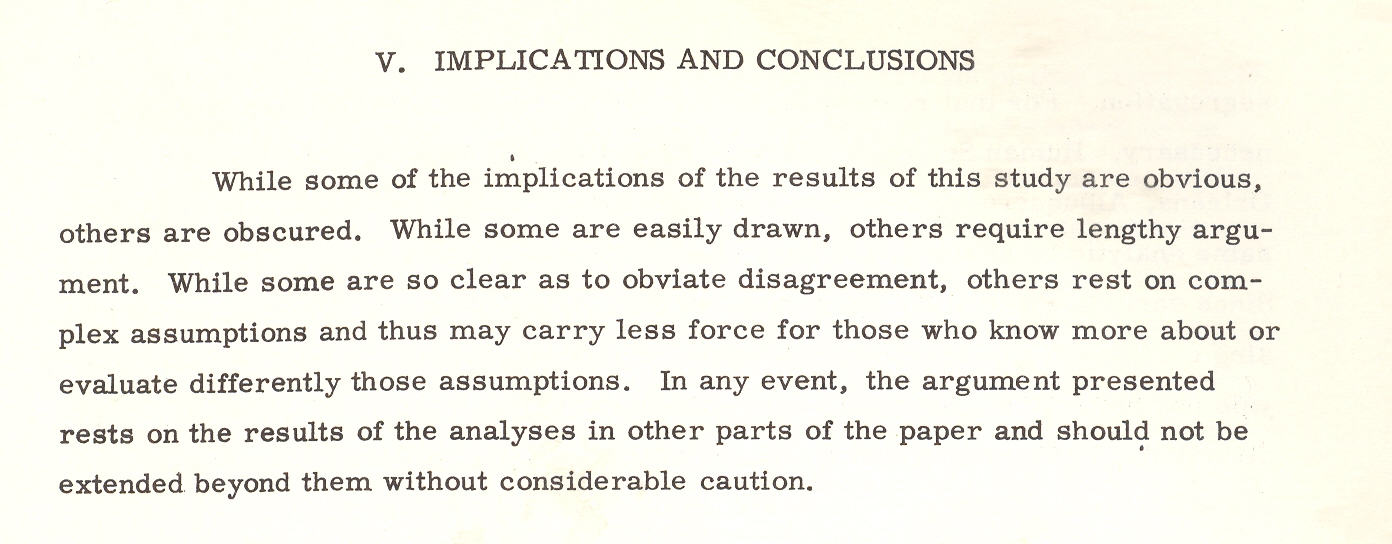
    One such bit, plucked from this pile is William W. Pendleton’s A Study of the Demography of Nuclear War produced by “Human Sciences Research, Inc.” [This item is available for purchase from our blog bookstore.] Outside of its statistical foray in survivability and the procreative prospects of the left-overs of vast nuclear exchanges, the work is a solemn attempt at institutionalizing the death requirements of nuclear combat.  The necessity of overwhelming carnage is presented in ironic and underwhelming language, the first bits of which are seen in the conclusion of pamphlet’s abstract1:

    “Cities differ in the kinds and magnitudes of change to which they might be subjected. Considerable variation in the demography of surviving populations can be expected; that variation would be related to policy decisions; and those decisions should therefore be examined for their demographic implications.” [Emphasis mine.]

    Put another way, the city is the main focus of the survivability equations, and the chances of the humans being bombed in those cities would change with—god help us—the amount of bombing.

    Cities differ in the kinds and magnitudes of change to which they might be subjected.

    This is the key I think to understanding documents like this, making a simple foundation statement so convoluted and tortured that it and most of what follows make any sense outside of restating themselves. Which I guess is a strength.Abomb-conclu 1

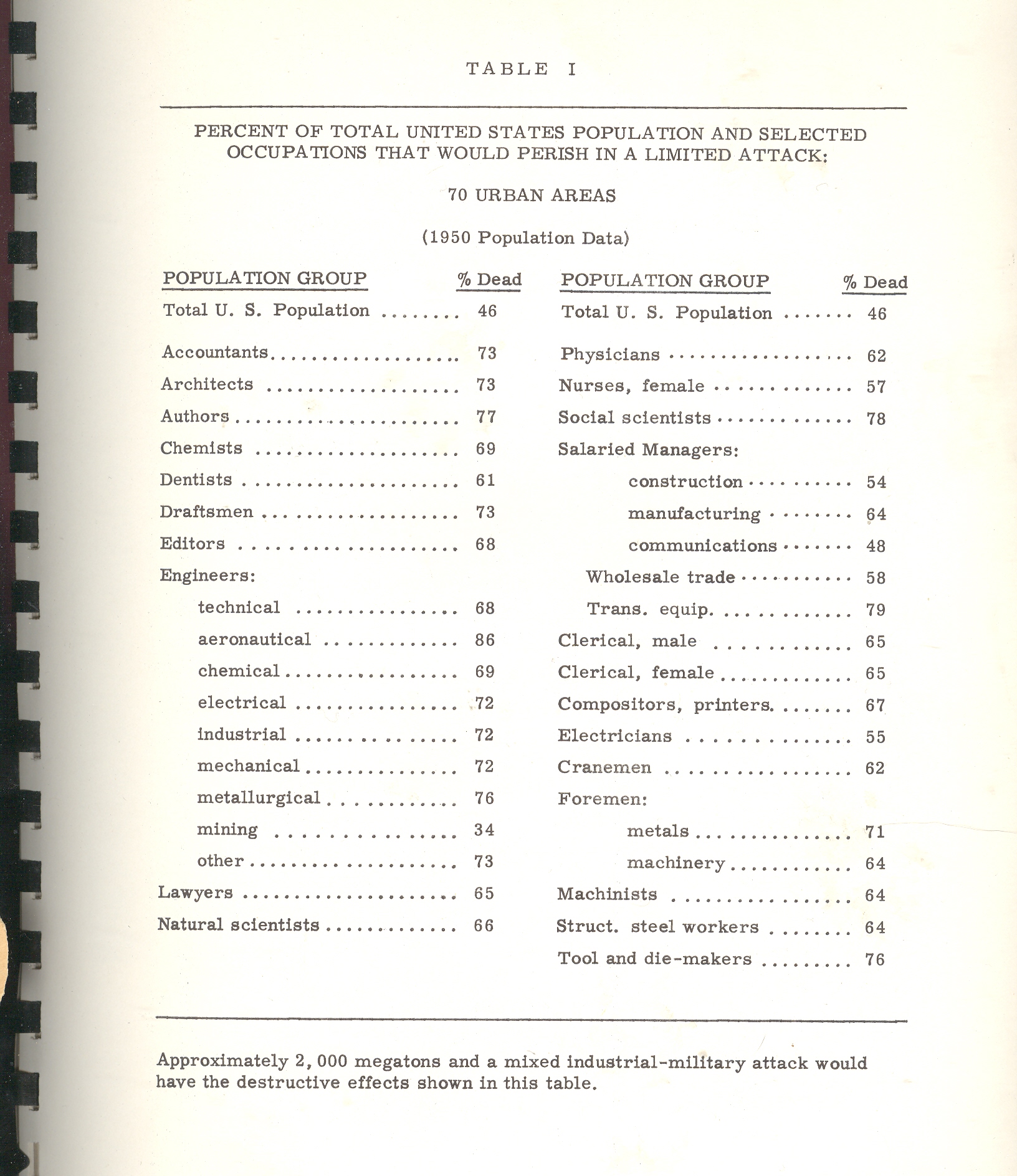
    Back to the pamphlet and the interesting table that attracted my attention.  According to one study [and for the sake of brevity I’m not going to describe the scenarios or data estimation methods and so on] the U.S. would suffer 46% casualties [meaning immediate deaths and not as a result of radiation or illness or starvation or the encyclopedia of whatever that would lead to death somewhere down the road].  The resulting demographic of the “perished” by job description postulates that the most-killed category of worker would be: (#1) aeronautical engineers, 86% dead; (#2) transportation equipment salaried manager, with 79% killed; (#3), social scientists, with 78% of them going down with their clients; (#4), authors, with 76% gone.

    Abomb-casualties2

    Authors?  Of what, I wonder?  The good ones with the bad?  Are authors different from writers?  And what do you call folks who produce tv shows?  Since the stats here are for 70 cities there’s no wonder that there aren’t any farmers in this table, as the majority target areas (some 450 cities cited elsewhere as targetable, including my own little burgh of Asheville, N.C.) would naturally have city folk in them.  And so I’m guessing that three-quarters of all “authors” in 1960/6 were living in these target cities and were going to go up in smoke.  The aeronautical engineers category is more understandable as every one of those industries employing 50 or more people would be a target; frankly I’m surprised that given the possible firepower of the Soviet Union in 1966 that 14% would survive; I’d guess offhand that the number would be 2%. 

    Abomb-conclu 2
    Even though this stuff is spread out in only 98 pages or so it would keep a person busy segregating the Orwellian gems from those not; it would be a tricky business as most of the “text” in the “not” category would be largely limited to prepositions. 

    Here’s another bit:  a parenthetic poke at the post-attack composition of Congress. It is stated that the “postattack” (hyphenated no longer) Congress would be “quite different”. It would also be (“in their eyes”) “more Conservative than the pre-attack (hyphenated!)  Congress.  It isn’t a cause for great prognosticational (?) liberty to assume that the Congress might be more Conservative, but why on Earth did the author qualify the assumption by saying “their eyes”?  Pish and posh.

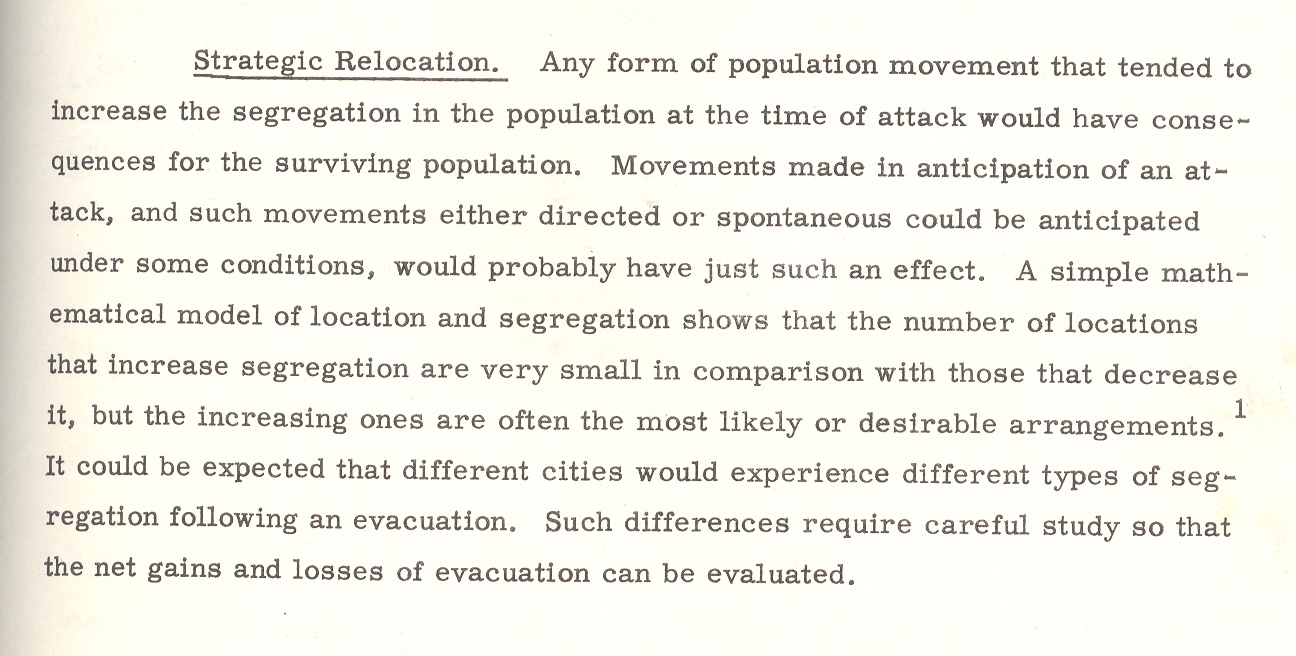
    The paper goes on its merry way, connecting the necessaries of Goldbergian delight, and somehow nothing ever happened, which to me is a secret miracle.  Especially given the weight of papers like this one, which seems to medicate the effects of war, assuming that there will be a Congress and that people will report back to work once the factories are rebuilt and that there will be more segregation in the colossal world of post-attack America, and on and on into the red dawn. 


    Mr. Mencken’s view of Warren Harding comes to mind when I read this stuff and wonder about how it was that we didn’t blow the whole place up:

    “I rise to pay my small tribute to Dr. Harding. Setting aside a college professor or two and a half dozen dipsomaniacal newspaper reporters, he takes the first place in my Valhalla of literati. That is to say, he writes the worst English that I have ever encountered. It reminds me of a string of wet sponges; it reminds me of tattered washing on the line; it reminds me of stale bean soup, of college yells, of dogs barking idiotically through endless nights. It is so bad that a sort of grandeur creeps into it. It drags itself out of the dark abysm of pish, and crawls insanely up to the topmost pinnacle of posh. It is rumble and bumble. It is flap and doodle. It is balder and dash.”

    Notes

    1. The abstract from the above paper: “The basic problem with which this report is concerned is that of determining the kinds of demographic change that might result from a range of nuclear attacks, ascertaining the effects of those changes on the future of the surviving populations, and indicating possible areas for Civil Defense action and planning. Earlier studies of the demography of nuclear war were examined and their relevant conclusions and methodology incorporated in the report. A different methodology–expected to be more sensitive to compositional effects–was then designed. The new methodology was tested and found to be more effective than the old. Surviving populations representing a wide range of variation in attack conditions were created on the basis of both old and new methodologies, and the demographic significance of these populations was examined. Assuming a range of post-attack demographic conditions, a series of projections was made on the surviving populations. The demographic significance of the recovering populations was then examined. On the basis of the analysis a series of recommendations relevant to Civil Defense planning was made: Within the framework of this analysis the crucial variable is the demographic pattern of the city. Changes in composition, as well as size, could be of substantial magnitude and would last for generations in some cases. Cities differ in the kinds and magnitudes of change to which they might be subjected. Considerable variation in the demography of surviving populations can be expected; that variation would be related to policy decisions; and those decisions should therefore be examined for their demographic implications.”


  • The Holocaust-Denying Discoverer of the Atomic Bomb in the Bible (1945)

    JF Ptak Science Books  Post 1597 [Part of the Atomic and Nuclear Weapons series]
    Atomic bomb god723
    It is astonishing sometimes to think of all of the subterranean atom-bomb-applicable cultural subcultures that quickly/instantly popped into existence following the use of the weapon on 6 August 1945.  The United States, for one, became an atom-crazed country, from atomic laundry flakes to milkshakes to hotels to condoms. This exuberant atommannia knew no bounds, and leechingly found its way into religious messages.  One thing that the atom bomb seemed to be that few people anticipated was its popular impact on the general population, as well as its extraordinarily broad base of applications. 

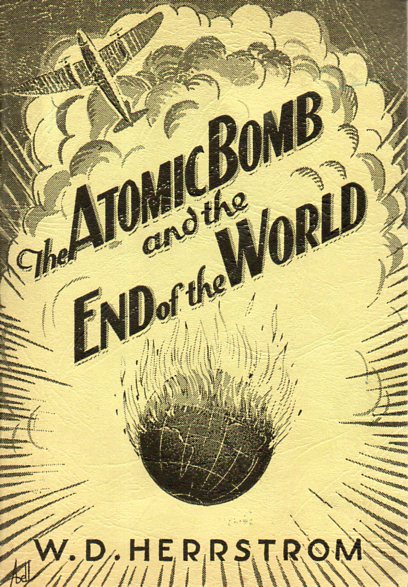
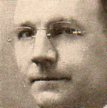
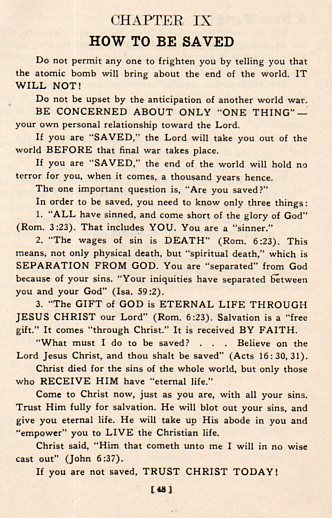
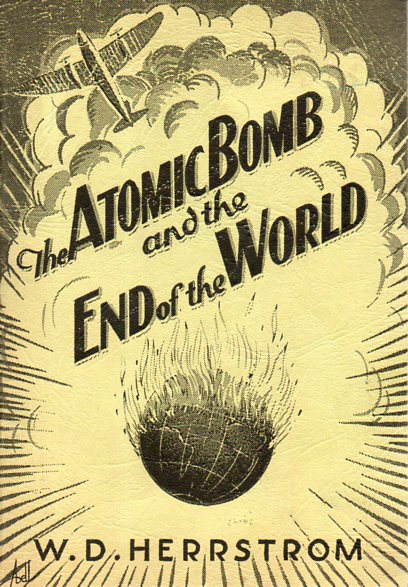
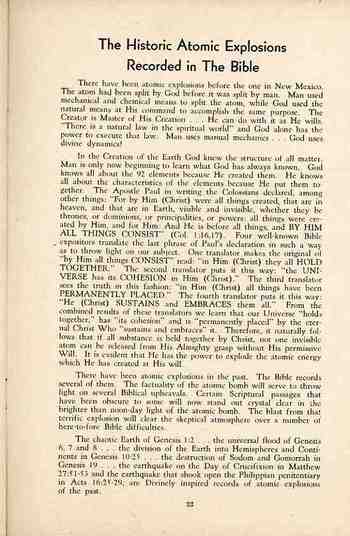
    Atomic bomb god724 The man trying to look into your soul from around the edges of his glasses, the man looking annoyed and reproachful and judgmental with his thin-lipped contempt, is W(illiam D(ewey) Herrstrom, the author of The Atomic Bomb and the End of the World, written in 1945, and published by Bible News Flashes of Minneapolis, Minnesota1. This is an unhappy little pamphlet filled with massive fear and innuendo, and calls for its readers to address that fear and all uncertainty by embracing Jesus Christ.  After all, it is not the Atomic Bomb that we need to worry about, says the author: it is our salvation and the potential wrath of the creator for all sinners.  Herrstrom shouts out that the atomic bomb will not end the world or set it on fire–that job is left for god, so we need to address god before we do so the bomb.  He writes:

    “The scientists who say that the heavens could be ignited by man to bring about the end of the world may be right.  But there is at least one good reason why this will never happen.  That reason is clearly stated in II Peter 3:7.  God has “RESERVED” this for his own time.”

    Mr. Herrstrom’s–who may have believed too much in the transliteration of his name from the German, which would be “Mr. Power”– message was one of fear and perdition, of the End Times coming true, of prophesies found in the Bible that were being unearthed right there in 1945–luckily, Mr. Herrstrom was ready to supply all of the necessary information about dealing with such stuff in his Bible News Flashes magazine, every month, which was somehow available for the subscription of 25 cents per year.  He had earlier addressed these issues in his Judgment Day for Everybody (improbably in its second edition) and The Revived Roman Empire, both of which were skinny, and both published in 1939–not that he was taking advantage of any situation in particular to press forward his bitter and hard nail visions of the future of our souls and the coming death of a sinful world. 

    “The Bible is history pre-written and God’s book is scientifically correct…and is ahead of the human race…”

    And as proof of these revelations the author offers bits like the following, in this case, a Bible quotation as proof of foretelling the invention of the jet plane:  “Like…chariots on the tops of the mountains they shall leap” (Joel 2:5).  And this for the atom bomb:  “And men were scorched with great heat, and blasphemed the name of God” (Rev 16: 18-20) and seven more pages of other large-print proof2.

    Herrstrom advertisers himself–on the title page, and in his interior full-page portrait–as a “World Traveler, Prophetic Analyst” and editor of Bible News Flashes, the Illustrated Prophetic Monthly Magazine, which is advertised on the back cover of the pamphlet, and where Herrstrom adds “News photographer” to his credits.

    One thing he doesn’t credit himself with and for which he should receive major recognition is for being one of America’s earliest and ugliest Holocaust deniers. The fantastic all-things-atomic  Conelrad blog, which has written another story on Herrstrom and his work, finds Herrstrom in Deborah Lipstadt’s book3,4:

    “In 1952 W. D. Herrstrom, an American antisemite, declared in Bible News Flashes that there were five million illegal aliens in the United States, most of whom were Jews. These were the Jews who were supposed to have died in the Holocaust. “No use looking in Shickelgruber’s [Hitler’s] ovens for them. Walk down the streets of any American city. There they are.” pp 66-67

    Well, as confessions of a hating faith-based ignorance, one could scarcely find better examples than these. 

    Notes:

    1. (Unfortunately, the only address given on the pamphlet is for a PO Box for Lake St. Station. Herrstrom’s other pamphlets include:  Mussolini & Facism, 1937, Wichita Falls, Kansas, Defender Publishers (?!), 49pp;  Will This War End Armageddon, 1941, 47pp; Golden Key to Bible Interpretation, 48pp, 3rd revised edition (again, ?!), 1940; Is God  a Jew, 1943, 24pp; Judgment Day, 1943, 64pp; Revival of the Roman Empire, 1939, 48pp.  Herrstrom had a few years where he was on fire,m from 1937-1945, during which most of this stuff was written.  It is noteworthy that hewrote books that were mainly 24 or 48 pages long.  His Bible News Flash appeared from 1943-1949, and is located in six libraries in the U.S., which makes it on the rare side.  Somehow, The Atomic Bomb and the End of the World is not located in the massive database for worldwide library holdings. 

    2. Herrstrom was hardy alone in laying claim to the ecumenicism of the atomic bomb.  There was also, for example the following:

    Mel Morris  published God’s Atomic Bomb  in 1945, which means he must’ve worked a little feverishly to pump up his bible prophesy and history to include the new atomic weapon to replace whatever else he had been using as a prophecy for end of times.  (As it turns out, “God’s Atomic Bomb” was more tempest and disaster in the bible, and not (whew!) the bomb itself.  Though as we’ve learned from scientologists and the sort-of creative mind of Ron Hubbard, a civilization came to the earth thousands of years ago and pummeled it with “atomic bombs” and other nastiness, polluting humans for milennia to come.  But that’s another story–suffice to say that Morris found many dozens of examples of “God’s Atomic Bomb” being used in the deep biblical past, and that the use of the real atomic bomb in 1945 was pre-ordained, and not without its figurative historical counterparts.  I’m not sure why any of this was necessary outside of proving to some small minority that these preachers could at least be contemporary and topical. 
    Blogsept_2_atomic_bomb_god_2txt483

    3 Deborah E. Lipstadt, Denying the Holocaust, the Growing Assault on Truth and Memory, 1993.

    4.  Conelrad also found Herrstrom’s longest book,  Seventy Five Reasons Why Community Water Supplies Should Not be Fluoridated.  Good work, Conelrad!

    5. Bibliographic note–I’ve seen this cover now in three different colors (red, blue, green) and I believe now that it wasn’t so much a factor of a number of different printings being done of the work over time, but rather of using whatever cover stock in whatever color happened to be on hand for the first printing. 

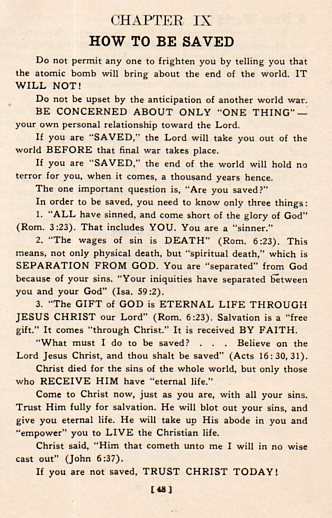
    Here’s a note from Herrstrom on how to get into Heaven:
      Atomic bomb god722


  • Buck Rogers and the Failure of Imagery in WWIII, 1946

    JF Ptak Science Books   Quick Post  [Part of the series on Atomic Weapons]

    Atomic war buck rogers683
    Atomic war buck rogers685
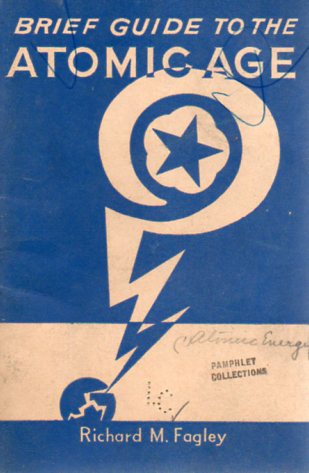
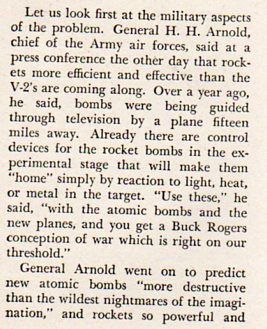
    Richard Fagley took a sleepy, 4th grade side step through the coming decade or so in the future of atomic weaponry.  The thign is, he got a bunch of it right.  But where he missed a bunch of it, where he underestimated the power of atom weapons, was that they would provide the future us with a “Buck Rogers” style of war.

    Now of course in 1946 the Soviets hadn’t developed a Bomb, but anyone who knew anything knew that it would be just a matter of time before they did.  Smart estimates were coming in at a decade or more–few people were prepared for the Soviet announcement in 1949 that they had achieved that goal

    Fagley missed the impact of atomic warfare of the future not on his own accord–he was quoting someone who knew far more and knew better–General Hap Arnold, the Commanding General of the U.S. Air Force.  But as it turns out, Arnold really didn’t have the vocabulary or this discussion, and couldn’t really estimate the “effectiveness” of the use of 

    Atomic war buck rogers684

    the new weapons. 

    So far as I know, Buck Rogers didn’t have weapons like atomic bombs; the war of the future, even though Fagley says that there wouldn’t be many survivors, would be far worse than they could imagine it to be–perhaps because that amount of destruction was still unimaginable. Buck Rogers just didn’t have the vocabulary for such enormous power and mass destruction, unless he had a planet-eater or something that I don’t know about.  In any event, words to describe the coming possibility of vast annihilation just didn’t seem to be at hand in 1946–the words and ideas, and the weapons, would soon (in the Ulam-Teller hydrogen bomb, 1951) be at hand, though. 

    Buck Rogers Will Wake Up In A 3D Future image


  • Atomic Bomb Civilian Defense Posters

    JF Ptak Science Books   Quick Post

    [50s+bomb+poster.jpg]

    [AmerUndrComm.jpg]


  • Apocalypse Then–World War III, The 36-Hour War of 1948

    JF Ptak Science Books   Post 1585  [Part of a long series on atomic and nuclear weapons]

    This is also part of a sub-series on the invasion of attack on America; examples of other posts include: Mapping the Invasion of America, 1942 (which is the most-viewed post from this blog, with over 500k readers), The Invasion of America, 1935,  Bombing Manhattan and the Amerika Bomber, 1943, and The Invasion of America, 1942, Part II .

    In the very near wake of the bombing of Hiroshima and Nagasaki, the editors of Life magazine published a prescient bit of propaganda on the coming of the Cold War.  I guess though that the Cold War had already begun by Yalta1, when the sick and basically-terminal FDR seems to have been corralled by Bloody Joe Stalin, leaving the new President Truman on alert for the possible coming aggressiveness of the Soviet Union.  The article appeared in the 19 November 1945 issue (pp 28-39), and it was a longish one, with nine illustrations (by A. Leydenfrost), and as articles go in Life from this time, this one was heavy. 

    It built itself up on a report generated from the offices of General Hap Arnold, and reckoned a new war, a New War, World War III, to occur in 1948–except that this time there were no natural difficulties that the U.S. could hide behind. (Arnold said: “…with present equipment an enemy air power can without warning, pass over all formerly visualized barriers and can deliver devastating blows at our population centers”.) The threat would come from above, and there would be little accurate defenses against them. 

    There would be survivors but massive destruction and death–and remember that this was at the point of the simple atomic weapon, before the development of the big stuff.  In the opening images of the article, a chilling two-pager showing eight major American cities being struck by atomic weapons, resulting in at least 10,000,000 casualties.

    But as grisly as all of this was, the American reader was told the the United States would prevail, and that our rockets “would lay waste” to the enemy’s cities; “the U.S. wins the atomic war”.

    [Image sources:  I’ve used the image from the Drexel University site as my copy of this issue of Life is in a massive half-yearly bound volume, impossible to scan.]

    This is what New York City was supposed to look like, afterwards, with inspectors sizing up the radiological waste of what was left of the NYPL at 412nd Street:

     Notes:

    1. The Yalta Conference was the third meeting between the leaders of the U.S., the United Kingdom and the Soviet Union, held 4-11 February 1945.  It came after the Tehran and Cairo Conferences, and preceded the final Potsdam Conference on 17 July- 2August 1945.

    More illustrations:


  • Mitigating and Matriculating Apocalyptic Nuclear Exchanges, 1959

    JF Ptak Science Books  Post 1559

    [This is part of a series of posts on planning for the post-apocalyptic nuclear war world.  Others include Virtuosic Apocalypticism:  Maps anbd Charts of Nuclear Exchange, 1964,  Taxes Trump Death in the Post-Nuclear-Attack World, 1964, and others which are linked to those two posts.]

    There is nothing quite like reading turgid handbooks filled with impossible hope for recovery from un-recoverable situations.  Of course, there are few situations that might actually occur in which recovery (to anything like the “life” that existed before the event) would be impossible:  enormous meteorites making impact with the Earth would certainly be one, and there is little else besides this, really, outside of an enormous nuclear war.  And it is exactly this, this second scenario, that the U.S. Government planned for to great lengths for decades on end–it was expected to be investigated, of course, because there was little else that could be done short of doing away with nuclear weapons, which was/is an action that would not be a serious consideration. 

    Planning for post-Armageddon was a solid, white-collar job that kept thousands of people employed for 30+ years.  The idea behind the smiling mask was simple–that in an “exchange” (an uncommonly milky euphemism for launching nuclear weapons between enemies) there would be winners and losers, and in spite of tens of thousands of megatons of nuclear weapons being detonated, there would be enough infrastructure that would survive to be able to declare one of the smoke-filled-holes a winner in the conflict. 

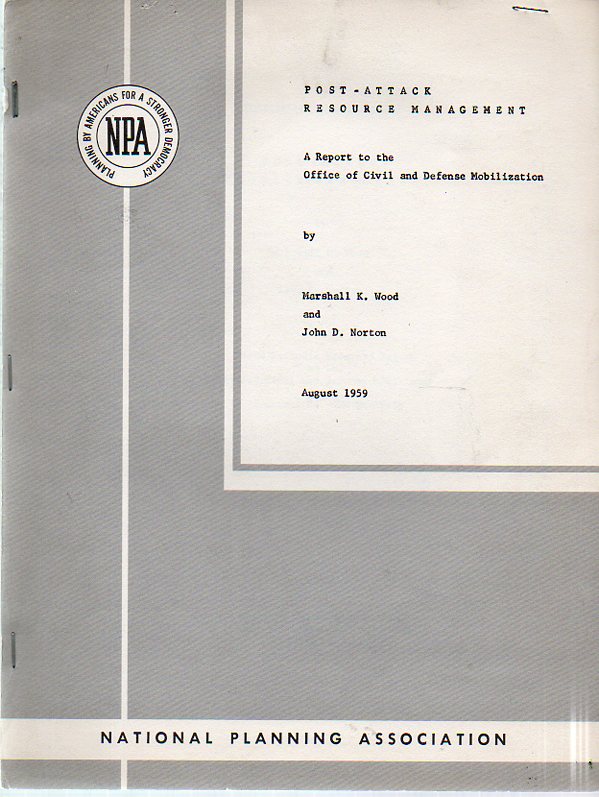
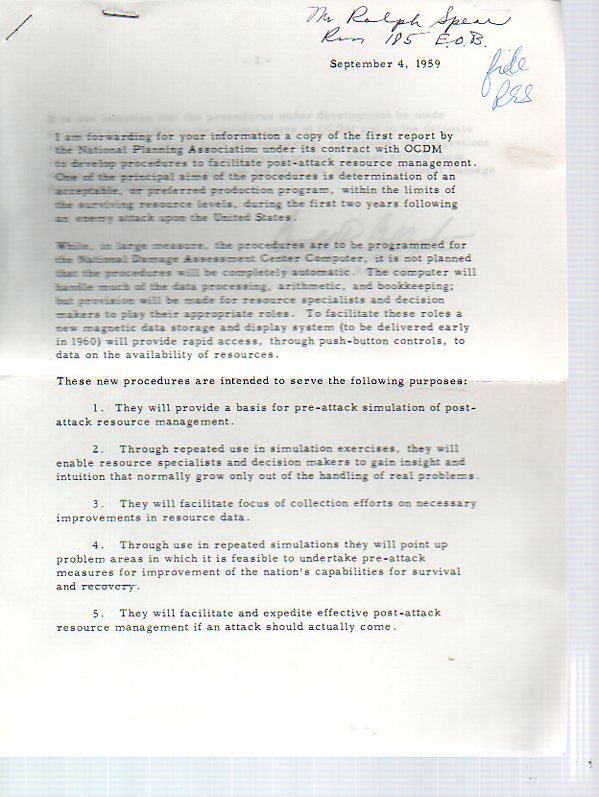
    ATOMIC BOMB POST-ATTOMIC PLANNING613 That is certainly the optimistic outlook of a preliminary report issued by Marshall K. Wood and John D. Martin, who issued this working paper on the state of a computer program that was being constructed to assist post-attack planners in re-establishing the broken remains of the country.  Post-Attack Resource Management (PARM) was being compiled for the National Damage Assessment Center, under the National Planning Association, under the Office of Emergency Planning, in the Executive Office of the President,  to be run on the UNIVAC Scientific and the Sperry Rand ERA 1103A computers, and made to assess national economic and military recovery of the U.S. post-nuke-war.  This of course is a gargantuan, staggering task, given the number of changing variables, but someone had to give it a try.

    Just collecting the existing data on x-number of ATOMIC BOMB POST-ATTOMIC PLANNING614 eco-industrial-military-medical-human variables that make to country run is a daunting thing; try to imagine that as you added the Factors of Change in a nuclear war, trying to determine how thousands of explosions over the breadth of the country would affect the national infrastructure if these thousands of bombs were exploded in place A1-A1xN over periods of time T1-TX.  It would be a phenomenal task to try and determine what results there would be on the country following thousands of different attack models.  And then, after everything was said and done, there just wouldn’t be very much left. 

    Maybe the thing worked.  Maybe by planning for a survivable outcome to an unsurvivable situation enticed the actors to wait and prepare their weaponry to such a point where they would be the one certain to survive a nuclear war.  In this way the build-up would continue forever, as no one party could achieve any sort of dominance in a first strike capacity to be able to wipe out their adversary’s war-making capability before they had a chance to employ it.  Perhaps in some weird, sick way this sort of planning for post-war activity kept the war from ever occurring by virtue of no one actor being able to achieve a superiority.  Or perhaps not. 


  • Virtuosic Apocalypticism: Maps and Charts of Nuclear Exchange, 1964

    JF Ptak Science Books LLC  Post 1555  {Part of a long series on atomic and nuclear weapons].

    Today is the 66th anniversary of the first detonation of an atomic weapon at Alamogordo, New Mexico, July 16, 1945.

    March 3--cvr

    “…our choice of path may be delayed too long… “  Dante, Divine Comedy, Inferno, Canto XII, line XIII, 2nd level of Hell (envy).

    The NATO Conference on Damage Assessment Summary Report (May 5-6, 1964) was not one written for its outcome, necessarily, but the means of getting there. The outcomes were highly differentiated levels of sameness, a strategic tour of Dante’s creation cataloging the layers of deep destruction like those of his funneling pit. [This book is available through our blog bookstore, here.]

    Professionally  the paper dealt with several different ways of computing nuclear exchange scenarios (given names of understated inelegance like Jumbo, Brisk, Frisky, Dart and Dusk) with lots of smokily mirrored hocus pocus, the necessary ingredient of the philosophical technology of Mutually Assured Destruction. MAD.  Somehow it all worked out without any exchange ever happening. (The principal contributor here was James Coker, chief of the National resource Evaluation Center, Office of Emergency Planning, Executive off of the President.)

    March 3--20 mt blast “Which utterly with sadness had confused me,  New torments I behold, and new tormented Around me, whichsoever way I move,  And whichsoever way I turn, and gaze.”  Dante, Divine Comedy, Inferno, Canto VI, third circle, gluttony.


    The first image shows the effects of a 20 megaton nuclear blast detonated in in a city, presenting an incredible picture of absolute destruction, reaching out from ground zero for more than 11 miles.    


    This doesn’t begin to measure the overall damage inflicted by radiation, which is deeply, extraordinarily, severe.  This again is the effect of one weapon, the 100%  fatality rate eventually reaching out 12 miles; 90% reaching over 40 miles.  General casualties extend to 80% up to 70 miles from ground zero. 

    March 3--20 mt det blast
    March 3--spear

    The emergency planning end of the paper comes in at about this point.The fallout map of the U.S. shows a possible situation of an unspecified (though wide-ranging) attack (on a “spring day”) and its effects on the population as it is housed in various shelters and bunkers, suggesting the amount of time needed to “survive” the attack by staying inside the fail safe habitation.

    March 3--spring day

    The following chart, “Lifesaving Potential of Improved Strategic Defense” (in millions of people) shows the effect of the installation of the shelters and bunkers.  In this scenario, in  a massive strike, the fatality rate in the U.S. of an unprotected population was 65%, or 144 million.  On the other end of the extreme was “ballistic missile defense plus blast shelters plus fallout shelters”, or a massively- protected population of fictional expanse shows that in spite of all precautions 45.2 million people would die (as “unavoidable fatalities”). 

    March 3--life saving potential

    “These have no longer any hope of death;  And this blind life of theirs is so debased,    They envious are of every other fate.” Canto III, Vestibule of Hell, the Opportunists.
    This document is nothing if not a death sentence had the massive strike ever been launched.  In the dozens of such reports that I’ve seen, there hasn’t been one with the Really Big One with thousands of euphemistically-named “exchanges”, which I assume would make all  of these others pale by comparison.


  • Taxes Trump Death in the Post Nuclear Attack World, 1964

    JF Ptak Science Books   Post 1553

    Atomic bomb taxes detail583

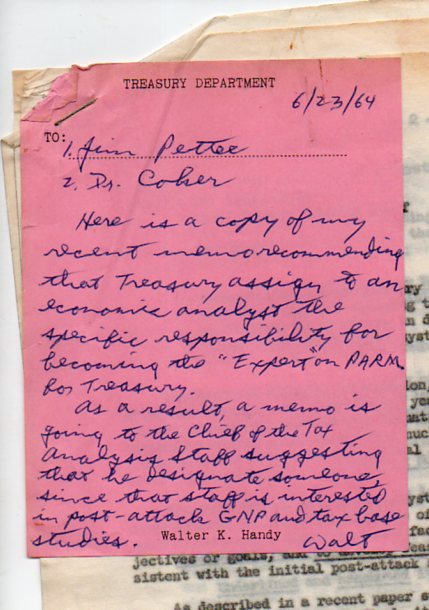
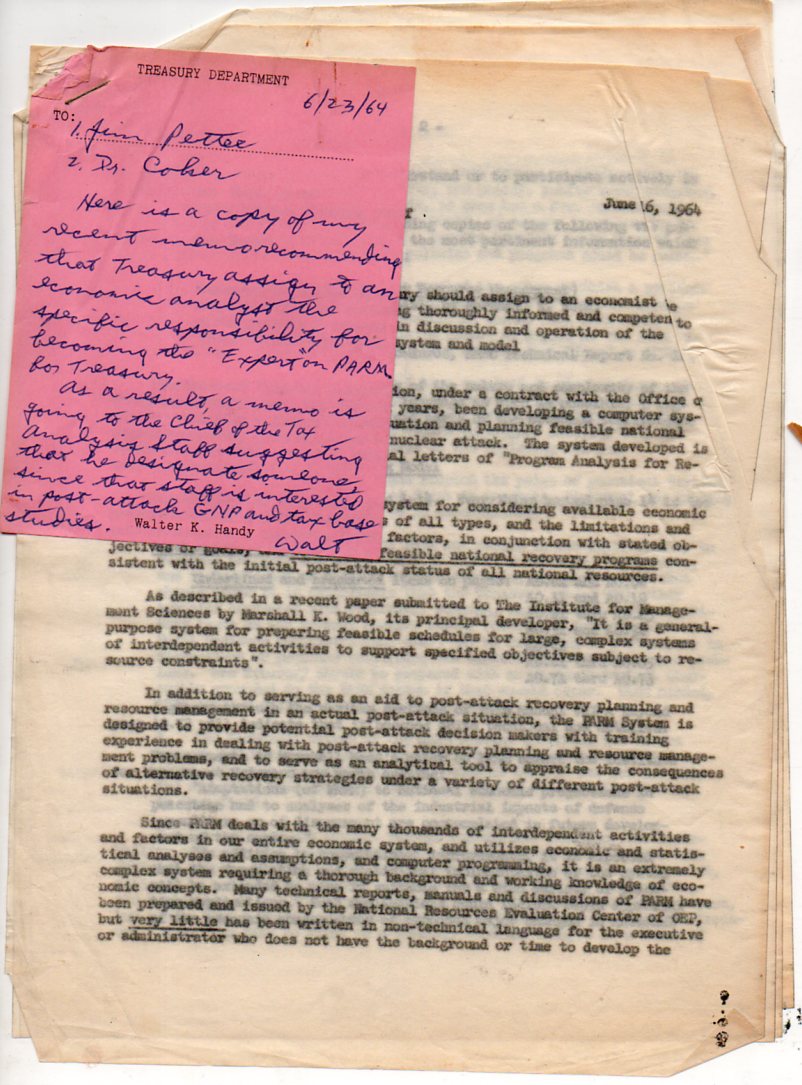
    There are a number of posts on this blog relating to the post-nuclear-attack world, and they seem to cover all aspects of what to expect of society and government after devastating nuclear weapons exchanges.  The posts are part of  a long series (75+ posts) on the history of atomic and nuclear weapons,  but also extend to Armageddon and fat thinking about survivability.   A good example of the unusual aspects of covering all uncovered angles is  Ueber-Spectacular Understatement Dept.: the Happy Post-Apocalyptic America and the “Awkwardness” of Holocaust, 1962 ,  as well as this one on job description and personnel issues post-attack.  But what I’m edging for tonight is the taxman and the business of funding government and the military post-attack, which appeared in a very structured 1967 piece here.  The issue of establishing and collecting taxes in the post nuclear weapons exchange world has come to life again, finding as I did an obscure reference to the nasty business in an attached note to a more formidable folder of other post-attack bureaucratic minutiae. 

    Its a simple thing, really–this is what struck me so heavily about it.  Just a short note about moving mid-level people around for becoming expert in this and that simulation and so on, a little hand-written note, from 1964.  But it suggests that a person from the “Tax Analysis Staff” of the post-attack studies world be the designated expertee, since “that staff is interested in post-attack GNP and tax base studies”. 

    There’s just so much expectation and projection in that last line that I’m not quite sure that it exists. In the real world. 

    Atomic bomb taxes582
    I guess the simple explanation is that after the (radioactive) dust settles following the massive exchange, that people will pick themselves up, brush themselves off, and start all over again (as the song goes).  And somewhere in that killer dust and devastated death a magnificent thing lurks–a GNP.   And inside that GNP its guts–money and taxes–have survived the annihilation of almost everybody.  Which perhaps disproves that old adage, and that in the end, the only thing you really can depend on is, well, taxes, because the dead go away, and the taxes remain.