A Daily History of Holes, Dots, Lines, Science, History, Math, Physics, Art, the Unintentional Absurd, Architecture, Maps, Data Visualization, Blank and Missing Things, and so on. |1.6 million words, 7500 images, 4.9 million hits| Press & appearances in The Times, Le Figaro, Mensa, The Economist, The Guardian, Discovery News, Slate, Le Monde, Sci American Blogs, Le Pont, and many other places… 5000+ total posts since 2008.

Category: Atomic and Nuclear weapons

  • The First X-Ray of an Atomic Explosion Inside a Person? Superboy/Superman & the Atomic Bomb, 1945-1964

    JF Ptak Science Books  (Continuing  Post 1140)

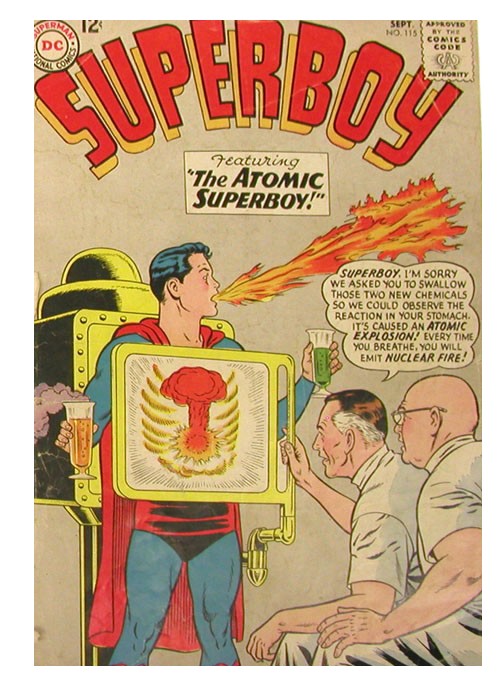
    I don’t know why, but I cannot remember ever having seen an x-ray of an atomic explosion taking place inside of a person, before today.  I guess that Superboy’s body is susceptible to x-rays but is also at the same exact time capable of preventing a nuclear explosion from escaping his body–all except for the “nuclear fire” coming from his mouth.Now that’s some sort of body control! The men in white seem pretty confident, being so close to the Trinity-like action and all.

    Atomic explos superboy
    Superboy evidently needs fewer ribs than humans, and it looks like the detonation point is right on the transpyloric plane, taking out kidney, liver, gall bladder and just about everything else.  And his spine doesn’t show up, either–along with a lot of other innards.

    Atomic explos superb deta 

    The original (published in September 1964) comes from the Oak Ridge Associated Universities, and they point out that this issue comes right after the signing of in-air nuclear weapons testing ban (after a speech by JFK in June 1963, marked by a memorial that was about 10 feet away from where I used to practice the shot put in D.C.)

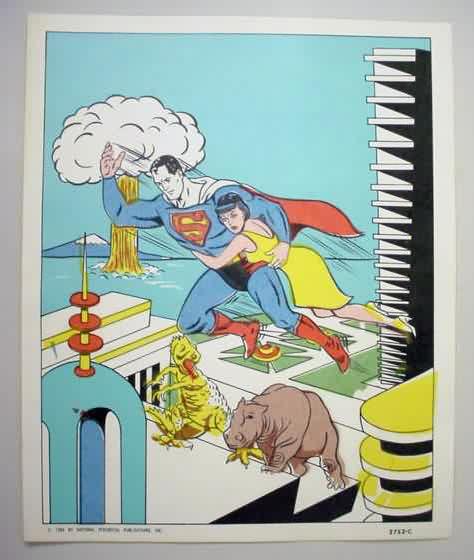
    This mushroom cloud doesn’t take place inside of Superman, but it does seem to take place, well, oddly–there was no text that I could find that accompanied this image, so we’ll have to leave the story arc to imagination. 

    Supermanrubon-rhinoclean

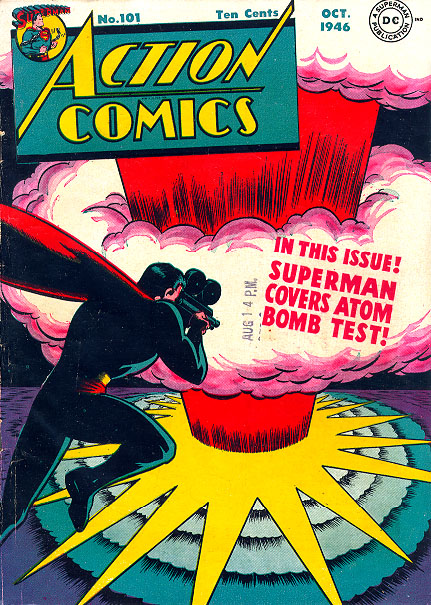
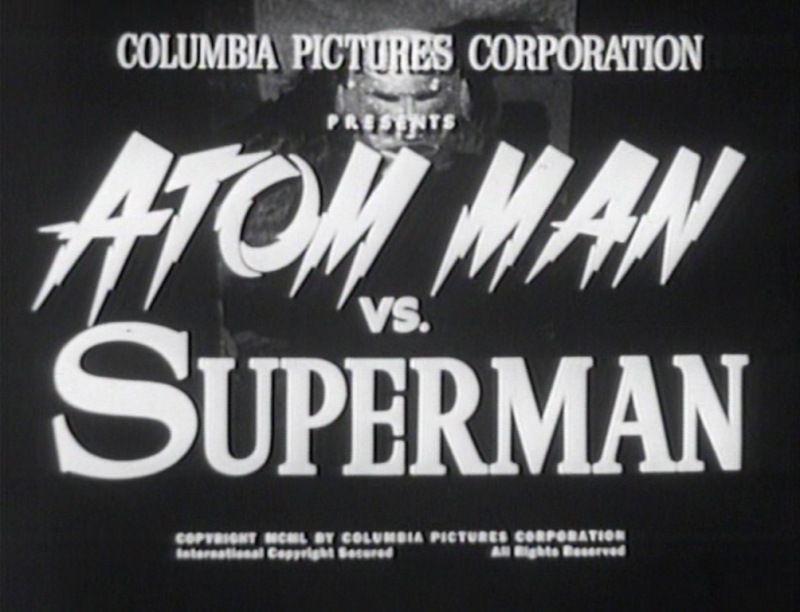
    And, well, if you’re not having an atomic explosion in your stomach and not combating one, I guess as Superman you could cover one (image found here):

    \Atom Action#101Med

    Atomic Superman50Title


  • How YOU Can be One of the 97% of Americans Who Survive Nuclear Holocaust, 1961

    JF Ptak Science Books  Post 1378

    Books_004

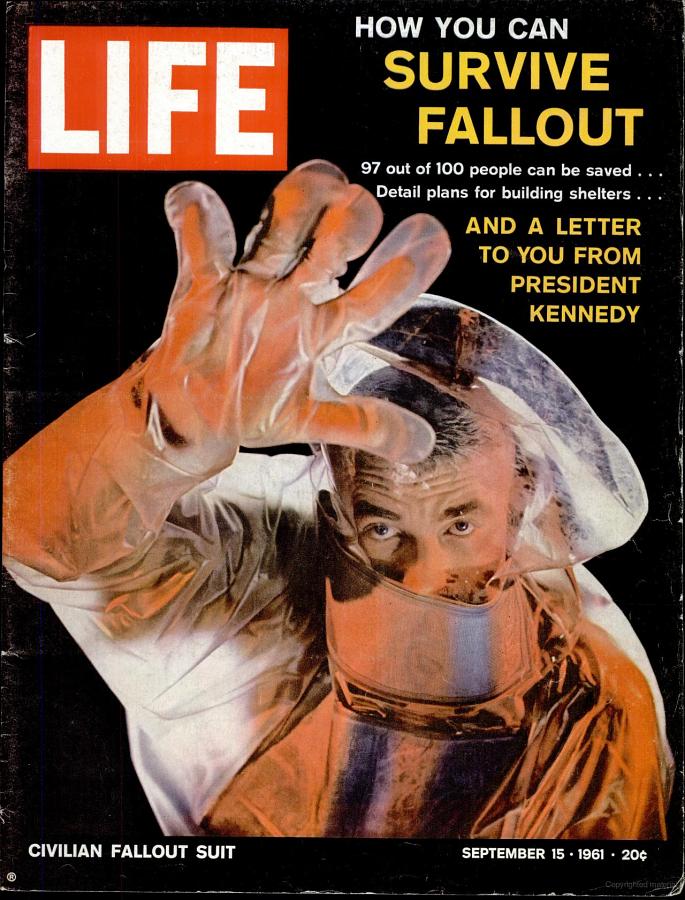
    Well, I’d think that this issue of LIFE magazine would’ve sold in the hundreds of millions with the promise it makes here–right on the front cover–that 97 out ot 100 Americans could survive a nuclear slugfest–if only they were to follow the instructions of this article.

    We only get to the marrow of the issue after wading through a few articles and ads for Hires Root Beer, Maiden bras, silk skin girdles, Bayer aspirin, Schlitz beer, Old Taylor Whiskey, Ge “telephone color” night table clocks, scotchguard raincoats, Lanolin Plus Hair Spray Net, Marja bras, Red Rose cologne, nylon carpet, Maidenform girdles, NY Life, Sealy mattresses, Metrecal, Corn Flakes, Hammond organ, John Hancock Life Insurance, Friskies dog food, Cahmpion spark plugs, Budweiser, BF Goodrich tires, Tang, RCA, Anacin, Speedstick deodorant, Castro convertibles, B+W Whiskey, Kodak and  Vista TV.  Probably I missed a few. When you get to the big ad for Royal Crown Colas with the white-hatted BBQ cook getting a kiss with a big wiener on a stick, you’ve arrived at the article on saving the life of your family and your country.

    If only we could build enough shelters–and by “we” I mean “you”, and build them properly, and outfit them, and are able to get to them in the 14 minutes that you might have to get to your destination, and you stay down long enough and the attack light enough, then probably some people will survive.  How these folks got the 97% number is an issue of faith–I think that they must’ve steeped themselves in mystical prayers to secretly reformulate the percentage “23” into “97” without actually telling anyone.  I figure that this was the key to survival.

    I’ve written many times on this theology of survivability (see the series on atomic and nuclear weapons on this blog, here) but seldom does one see such an incredible, indefensible claim such as this, and splashed across the cover of America’s most popular picture magazine, accompanied by a letter of support from Camelot.  Somehow in the great looming nuclear confrontation that actually comes to pass, somehow “only”3% of the population doesn’t make it.  Of course if there was a natural catastrophe in which 3% of the country was killed–that would be about 4.5 million in 1961 population or about 9 million in 2011–it would be an absolutely phenomenal tragedy. (Ofcourse there were many European countries that lost more than 3% of their populations during WWI and WWII, but that’s another story).  But to escape nuclear Armageddon in this country with 3% loss is much better than other government figures published around the same time that predicted casualty rates exceeding 100 million. 

    But hearts and minds are won abroad and at home, so the homefires must have been stoked to prevent a colossal depression from befalling the country, which of course goes hand-in-hand with the policy of Mutually Assured Destruction, with all policies somehow making it possible for the rush to the abyss to be the one thing that was keeping us (in a Zeno-ish paradox) from falling into it. 

    But 97%?  You can read the article here from page 95 for the full story. 


  • Outrageous Analogy Dept: How Hitler Can Help in the Post-Nuclear-Attack USA, 1967

    JF Ptak Science Books  Post 1371

    “Understanding, n.  A cerebral secretion that enables one having it to know a house from a horse by the roof on the house.  Its nature and laws have been exhaustively expounded by Locke, who rode a house, and Kant, who lived in a horse.”  Ambrose Bierce, The Devil’s Dictionary

    “The German experience in reordering an industrial economy for total war in the midst of conflict offers insights into planning for postattack conditions”–Stanford Research Institute, 1967

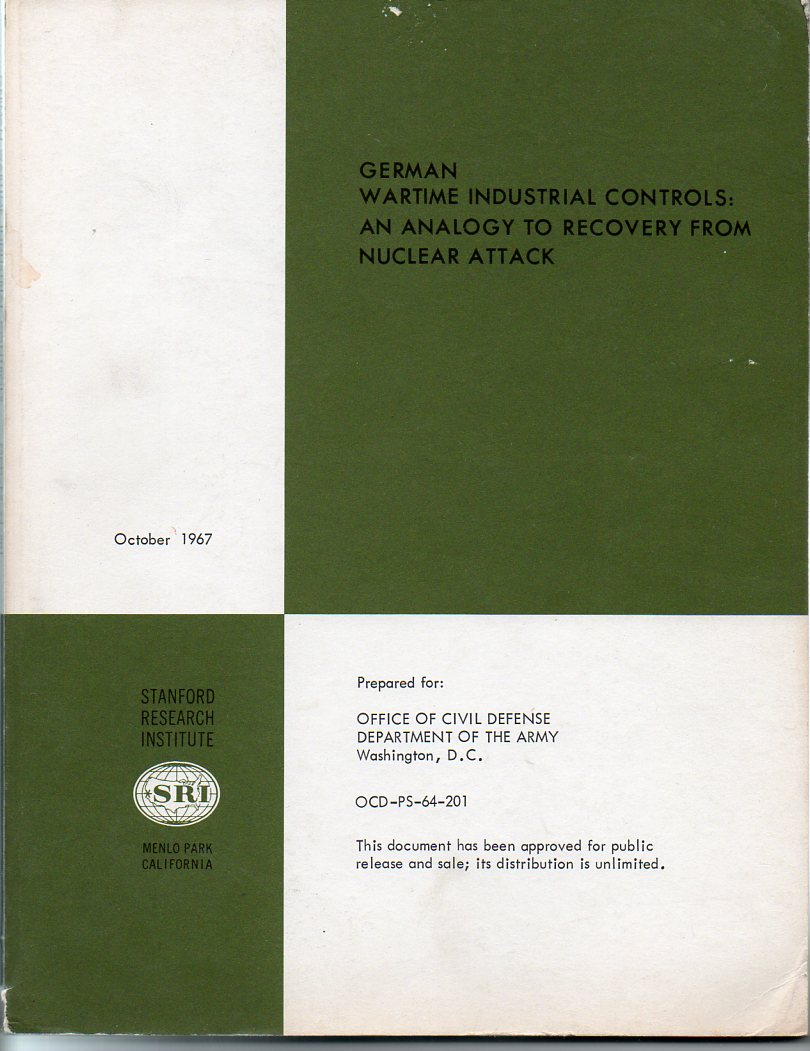
    If such is the case for understanding, then I think that those responsible for the pamphlet German Wartime Industrial Controls:  an Analogy to Recovery from Nuclear Attack intended to ride their house in the Kentucky Derby and upgrade the kitchen in their horse.  After all, ideas are just connections among words, though it seems that here it might be just between words, or suggestions between letters, although the words might all be privately defined. [The original document is available form our blog bookstore, here.]

    This pamphlet is another one of those monuments of living proof showing the impossibility of defining where the “bottom” might be in the well of bad ideas–even when you strangle this Nazi business into its own, narrowly-defined category, trying to extricate the logic of its titanically bad idea, the pamphlet instantly ignites when removed from its ether-y vacuum of under- and over-think and  exposed to oxygen. 

    It was the Stanford Research Institute (Menlo Park, California) that produced this thing, carved whole and with precision from a quivering block of fat and federal dollars.  If the title doesn’t stop time, the first page will.  There we are introduced to Albert Speer (1905-1981), Minister of Armaments and War Production and architectural joyboy for Adolph Hitler.  We are told about the basis for his exceptional achievement in reordering the German economy to all-out war production thus:

        “…a vast armament production would have to be obtained through scrupulous attention to increased production efficiencies and the most effective use of fixed supplies and essential materials and skilled labor.  Speer developed a unique variant of conventional economic planning for a controlled economy and applied it successfully…” (from page 1.)

    Speer, a high-ranking Nazi party member since 1931 and intimate of Hitler, was convicted of crimes against humanity and war crimes at the Nuremberg Trials in 1946, and sentenced to 20 years at Spandau prison, not the least of which was for his broad and acknowledged use of slave labor.  The “P” in the square standing on its edge at the top of this post is the symbol worn by a Polish slave laborer–there were some 12 million people abducted/arrested/stolen by the Nazis to work on various parts of German society. 

    Buna069

    Perhaps this was part of the “scrupulous” detail and the “effective use” of fixed supplies that the author of the Stanford paper was writing about?  Surely anyone studying Speer’s methods would have known this–that the author would chose to ignore this sets every moral compass everywhere into free spin. 

    But such is the realm of the coin in the ugly, a bubbling bulk of post-attack scenario scripting done at the taxpayers’ vast expense in waging the Cold War is littered with vocabulary meant to redirect the attention, essentially to change the meaning of words in discussing the outcomes of vast nuclear war.   For example, we find the phrases “period of fractionation“, “the break in traditional economic time series” and “production degradation” in certain documents  (which I discuss in an earlier post here)  used to describe the breakdown of the American social and  industrial base following a nuclear war.. These are just three of thousands of such examples, not the least of which is nuclear “exchange”, which is a conceit suggesting something less than the U.S. and the Soviet Union blasting away at one another with spectacularly deadly weapons. (Perhaps the thinking is that such a situation wouldn’t necessarily be a “war”, and so it is something less than that, like the Korean War really wasn’t one but a U.N. policing action.)

    But enough of this, were not even a full page into the report, which I remind you tells us we can find useful lessons in Hitler’s monstrosity, particularly about war production–that is producing materials post-attack so that we can either defend ourselves or attack again, all by taking a look at Germany, and particularly  “the improvisation by gifted industrialists driven to the limits of their power and imagination” (page 12 of the report).  It is difficult to want to read this report because everywhere I look there are Orwellian Ghosts–half-referenced facts wrapped in Newspeak, available at random.  For example, on page 31, in discussing oil and rubber production, I find:”The output of the new synthetic Buna-s rubber was increased to 22,000 tons in 1939 and to 69,000 tons ion 1942 by accelerated production of new plant.”  The “new plant” is the think tank version of “new plants” (the plural is left off of many things for unknown reasons but I guess mostly for a form that seems to have more economo-cache than the simple English expedient), which is a very simplistic way of telling of the enormous production battles in Germany to come up with their own, home-brewed (and not foreign-dependent) rubber (the super-necessity of all things military).1 The other part not mentioned here in what seems to be a disingenuous appraisal of Nazi rubber production is the increase in 1943/1944, particularly from the “new plant” at Monowitz, which was also known as the Buna Works, and better known yet at Auschwitz III, where slave laborers were put into work-or-die situations producing Buna-s as part of the overall Auschwitz complex of forty camps and subsidiaries. 

    Here’s another example, tying Hiter and (Fritz) Todt and Speer together–Todt was “one of Hitler’s most important administrators”, who would be replaced by Speer “who had been an assistant to Todt”–though not mentioning that Todt had used millions of slave laborers (Zwangsarbeiter) in doing his “administrating”.  Speer would do the same.  

    ANd so on and on this paper crawls until it reaches its end, which is published on detachable sheets on pages one through three, pullaways for the executive summary so that the text and subsequent documentation and analysis could be discarded.  It seems to have been a waste of detachable paper when the whole thing could be thrown away at once.  The author makes a case for studying the Nazi situation because it was the closest thing in modern times to use as an analogy to the possible scenario in America after nuclear war, and then launches into an analysis of Nazi “competitiveness”.  The author never comes close to making a compelling argument for the closeness of fit for its major assumption, though, and as far as I can tell the logic of it just doesn’t work,which makes the rest of what follows unnecessary.  I guess they could’ve kept their federal grant by identifying ideas that wouldn’t work as America post-attack analogies–which is also useful–and could’ve easily used what they had here for that purpose.   But at that point I’m not sure what is the more ridiculously-titled idea–I couldn’t imagine someone reading the report on why Nazi industrial controls weren’t a good analogy, because it seems tautological and unnecessary; and yet the opposite is what gets thought about and published, in all of its error and omission, swimming in its own turgid muck.  This is what people were thinking about in 1967 when, evidently, houses didn’t have roofs. 

    ______

    1.  Germans were forbidden to import chemicals and food from 1933-1937, forcing Germany industry to come up with their own versions of things like rubber, meaning that there were many new places in which Buna-s (BUtdiane & NAtrium) was produced.  That rubber production increased so much was a function also of not being able to import the stuff. 


  • The Nonsense of Strategically Meaningful Phrases–Finding Pillows in the Post-Nuclear-Attack World, 1968/9

     JF Ptak Science Books  Post 1356

    Caveat: this story is of course forever and best told by Stanley Kubrick’s Dr. Strangelove.

    Researching a study on the usefulness of the actions of Adolf Hitler amd their application to the U.S. government’s planning possibilities for post-nuclear-holocaust existence (German Wartime Industrial Controls: an Analogy to Recovery from Nuclear Attack, Stanford Research Institute, 1968, review coming soon), I came across the following related studies, all of which are available at the Storming Media website, here.

    The titles are incredible, the abstracts more so–but some phrasing in the abs were absolutely, sensationally, bad. 

    I can imagine a play, a scenario leaning heavily on Samuel Beckett’s Krapp’s Last Tape, men sitting in front of reel-to-reel tape recorders, listening to themselves describing the impossible language that they were using to transmit the ideas of surviving nuclear Armageddon–brilliantly lit from single spots directly above the seated figures and with all else absolutely black, they play these snippets, and try to explain what the language actually meant. Perhaps they try to talk over the recordings, only to have the recorded audio get a little louder, and multiply, a la Steve Reich’s Come Out.

    I understand that in order to talk about a complicated and complex landscape that you need to establish certain words and phrases to mean one thing and one thing only so that information can be transmitted and analysis with common denominators can take place.  At the same time these phrases loosen the reality of what they represented, removing the implications of fighting such a war, and thereby making the button-pushing a little easier.  Perhaps the launch business becomes more automated this way, even in considering the theoretical end of the actions of nuclear war.  Like the soldiers who were endlessly trained to turn the keys and punch the buttons at this country’s x-number of launch facilities, trained countlessly and tirelessly, so that when the real call came in they could just do the job, follow the instructions as they had 2,000 times before, and launch the missiles that would kill tomorrow.

    And so in 15 minutes I found these impressive examples of polyprhases that meant both something and nothing:

    Paper 1

    “Period of fractionation”–describing the civil circumstance directly after nuclear exchange.  Found in Scenario for Postattack Social Reorganization, : Raymond D. Gastil; William Schneider Jr; HUDSON INST INC CROTON-ON-HUDSON N Y

    This paper also provides us with “historical disasters that were somewhat comparable to nuclear war” as well as “return to normalcy” as the sixth part of a six-part post-nuclear landscape.  And this is all just in the abstract. 

    “Abstract: This approach to postattack analysis was meant to explore the possible contribution that a documented scenario could make to postattack research on organizational problems. Using knowledge of historical disasters that were somewhat comparable to nuclear war, we divided the scenario into the following periods: Pre-attack, the disaster; period of fractionation; survival and reconstruction; innovation and control; and, return to normalcy. The scenario covers a period of more than two years (1970-1972), and the attack was OCD’s CIV-LOG ’65 in which 2000 megatons were used. [Emphasis mine.] Appendices explore more analytically certain issues raised by the scenario. (Author)”

    Paper 2

    “The break in traditional economic time series…”  Meaning that there were new timetables in how things got done and how we communicate, in business, following a nuclear war.  Found in: Information Needs for Postattack Recovery Management, 1968.  {Actually the entire abstract is worth a quote.]


    Abstract: “The study is concerned primarily with information needed for monitoring the effects of actions taken by governmental bodies at federal, state, and local levels in a postulated postattack period and for providing business management with the overall information it needs for making business decisions in the absence of undistorted indicators of economic developments. The break in traditional economic time series and the need for drastic reorientation of industrial efforts in ..”

     Paper 3

    “interdiction of normal business channels” Found in Institutional Factors in Total Vulnerability,  1968

    and 

    “None of the problems [in surviving nuclear attack] would pose insurmountable difficulties but all would require prompt attention and appropriate resolution within the first two months after a nuclear attack”

    Authors:  Francis W. Dresch; Hazel B. Ellis; STANFORD RESEARCH INST MENLO PARK CA

    “A systems approach was used to identify institutional problems likely to be neglected in analyses of the vulnerability of physical systems at risk from nuclear attack. This report discusses six specific problems (solvency, credit, business organization and management, interdiction of normal business channels, legislative imbalance, and disruption of election machinery) and their implications for the assessment of national vulnerability. None of the problems would pose insurmountable difficulties but all would require prompt attention and appropriate resolution within the first two months after a nuclear attack.

    Paper 4

    “nature of demands for labor in a postattack world” and of course “post-attack economy” found in Preliminary Estimates for Labor Demands in a Post Attack Economy, 1968. Authors:  Stephen Baer; INSTITUTE FOR DEFENSE ANALYSES ARLINGTON VA PROGRAM ANALYSIS DIV

    “Abstract: This is an informal exploration of ways to determine the nature of demands for labor in a postattack world. An attempt is made to determine the needs for labor and the demands of consumers after a nuclear attack based on preattack patterns, community sizes and income levels. (Author)”

    Paper 5

    “using retired boxcars for simulating urban area fires” [ignited by thousands of megatons of explosives] found in Feasbilities and Representativeness of Large-Scale Boxcar Burns, 1968

    Authors:  Frederick Salzberg; IIT RESEARCH INST CHICAGO ILL ENGINEERING MECHANICS DIV

    “Abstract: the study deals with the feasibility of using retired boxcars for simulating urban area fires. Considerations are given to the representativeness of boxcars fires, development of an experimental plan, and a cost analysis. An outline is given of experimental series designed to study various aspects of urban area fires by means of boxcar fires. Included are studies of fire spread, development of group fires, and behavior of mass fires. (Author) “

    Paper 6

    “production degradation” found in Industrial recovery Model Constraints, 1969.

    “Abstract: The vulnerability of a facility to nuclear blast damage is determined by identifying the industrial facility with a structural type and the type of processing equipment contained therein. Equations are extended to estimate production degradation. Damage repair data and analysis are reviewed and a straight-line function is suggested for relating repair effort and elapsed repair time to overpressure. The functional relationships of industrial recovery are analyzed with respect to target …”

    Paper 7

    “problems of debris removal to achieve specified objectives in urban areas” found in Debris Removal in Civil Defence Operations, 1969.  Authors:  George E. Wickham; STANFORD RESEARCH INST MENLO PARK CALIF

    “Abstract: As a part of the Five-City Study, this report examines the problems of debris removal to achieve specified objectives in urban areas. It details the necessary steps for determination, and provides a quantitative value of the total resources required to accomplish clearing operations. It illustrates the application of methodology developed in research report titled ‘Debris Removal Civil Defense Operations: Volume 1’ so as to provide realistic appraisals …”

    Paper 8

    “disorganization inevitably following a nuclear war” found in Capabilities of Fire Services to Limit Damage from Nuclear Attack. Authors:  S. B. Martin; R. W. Ramstad; URS RESEARCH CO BURLINGAME CALIF

    “Abstract: The report emphasizes the dangers to eventual reconstruction that are posed by the disorganization inevitably following a nuclear war. What can go wrong in this reorganization period is examined by the use of scenarios and analogy. It is then suggested that during the crisis period preceding a nuclear war a number of useful actions enhancing the chance of postattack recovery should be undertaken as part of an emergency mobilization for …”

    These are just eight examples–the problem here is that nearly every paper I looked at on this first page of papers from Storming Media could be used as examples of massive underspeak…the real issue being that there were another 100 pages of these things. So its not as though I even cherry-picked these things–they were all in line on the front page.  That’s the scary part–to see how deep the depth was of these things, an infinite depth of finite measurement. Something in nothing. 

  • The Tipping Point of Degeneracy: a Look Back at Robert Oppenheimer’s Black Hole that Wasn’t his Post War Existence

    JF Ptak Science Books   Post 1354

    Its easy to forget about the pre-Los Alamos Oppenheimer, especially for those who aren’t necessarily interested in the history of 20th century physics. I was preparing to write something about a very brief window that seemed to have been opened in the 72 hours or so after the second atomic bomb was dropped….or perhaps from the time of he Hiroshima bomb.  In any event, it was a short period, measurable in terms of dozens of hours, where people–even Robert Oppenheimer–had a sense of a sea-change regarding the bomb and peace, and that perhaps the thing was so terrible and so controllable that it might bring about the end of war.  But the gloom of the reality of the future of the weapon–and the future weapon systems–settled in, and that illusory window was closed, if indeed it was ever actually open, which it really wasn’t.  

    Not long after this, Oppenheimer was shuttled into the Oval Office to meet for the first time with President Truman–it must’ve been a worlds-in-collision moment, though it seems Oppenheimer was no quite himself, not quite as filled up as he should’ve been.  Depressed, I’m sure, after having just gone through a bit of rough business as to who would be controlling the future of the bomb.  Anyway, he met with Truman on 25 October 1945, in there with Truman for a 10:30 appointment, and things did not go well.  Truman “asked” (apparently rhetorically) Oppenheimer his opinion on when the Soviets would develop the bomb.  Oppenheimer simply said that he didn’t know.  Truman shot back “never”, that the Soviets would never develop the bomb.  I have no idea if Truman believed this or just was pissed with what he thought of his meeting with a “cry baby” Oppenheimer.  Truman evidently told a number of different versions of this story, but one thing was for certain:  he did say that he “never wanted to see that son of a bitch again”.

    If Oppenheimer wasn’t depressed when he went into the Oval Office at 10:30, he was when he was promptly shuttled out for Truman’s 11:00 meeting, which was with the postmaster of Joplin Missouri, Mr. Leslie Travis.  My feeling (completely unsubstantiated) was that equal weight was given by Truman to both the 10:30 and the 11:00.But the man was a definite force in the relatively short time he spent in the high community, from the late 1920’s to about 1942. 

    But just four years before, and the decade or so preceding it, Oppenheimer was a brilliant new force in the American physics community, a  remarkable, brilliant talent with a big insight.  And this is what brought m back to Oppenheimer on the first day of WWII.

    People tend to think of black holes as a Stephen Hawking-era phenomenon while the facts of the matter are that they began perhaps hundreds of year earlier, probably with Cambridge John Michell (1724-1793), back in the year of the end of the American Revolution, 1783 (and perhaps before).  His famous experiment (known as the “Cavendish Experiment”) was really only rediscovered in the 1970’s in Michell’s correspondence with Henry Cavendish.  In those pages he hypothesized that there may evolve a star so massive (which he referred to as a “dark star’ in Newtonian theory) that light itself might not be able to escape fro it, that the escape velocity for the light could never be reached, and that its phenomenal gravity would make the star impossibly dense.  This was very similar to the dark star hypothesis of Simon Pierre de Laplace in his epic Exposition du Systeme du Monde which was published in 1796. Karl Schwarzchild’s 1916 paper using Einstein’s relativity paper of the same year discussed the possibilities of singularity (the Schwazchild limit of the diameter of black holes), as did (the beautiful) Subrahmany Chandrasekhar (one of the last men able to know everything) in 1928. 

    In hunting for a number of Richard Feynman papers here at the warehouse I happened to find this extraordinary effort by J. Robert Oppenheimer and G.M. Volkhoff in the 15 February 1939 issue of America’s greatest journal contribution to physics, The Physical Review.  Here (along with a preceding paper by Richard C. Tolman, issued in the same issue just above Oppenheimer, which were the analytic analysis used by O+V to base their estimates of nuclear forces) was established the Tolman-Oppenheimer-Volkhoff limit, which stated that if the state of evolution of  neutrons forming a degenerate Fermi gas of extremely dense masses in neutron stars was more  massive than .07 solar masses that it would collapse into a black hole or exotic/quark star; if the mass was below that limit, the star would not collapse due to the degeneracy pressure of neutrons and the strong force.  The black hole part was left really to a second paper of 1 September 1939 (the day that the Nazis attacked Poland and the fighting began in World War II in Europe) when Oppenheimer teamed up with Hartland Snyder to write “On Continued Gravitational Contraction”, when the two wrote about the singularity of the event.  the paper met with little appreciation at the time, though the two papers today have lead to some of the most progressive ideas in 21st century astrophysics. (This paper is available at our blog bookstore, here.)


  • Dividing by Zero: David Byrne and Herman (“the Fat Man”) Kahn Sing the Future Blues

    JF Ptak Science Books  Post 1312

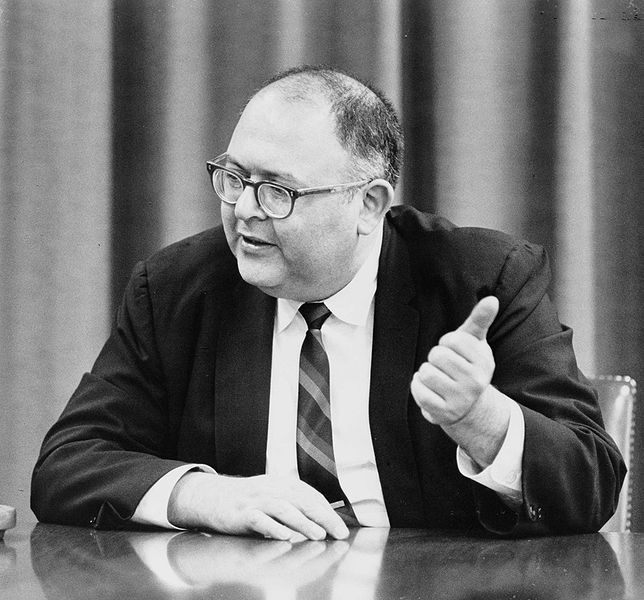
    Earlier in this blog, about two years ago, I wrote a piece on David Byrne’s beautiful Knee Plays, which included a song “In the Future”.  The post was about Byrne’s vision of the future which was bounced off the belly of “futurist” Herman Kahn, a man who was widely influential and whose thinking (I do believe) was widely incorrect.  He was also a proponent of possible first-strike (that is, American-initiated) nuclear warfare, deeming the scenarios “winable”., a broad thinker on Thinking-the-Unthinkable, and coiner of the word “megadeath” when used in conjunction with his nuclear end-game games. A main component of the template for Dr. Strangelove in Kubrick’s movie by that name,  Kahn and the think tank he helped found (the Hudson Institute) had the ear of the Reagan administration, among others, and it shows.

    Here’s the revised post, expanded some.

    0-blog-dec 3 byrne David Byrne, former Talking Heads member, produced a series of twelve short pieces to be used in the Philip Glass (and Robert Wilson*) Opera CIVIL warS  in 1985. (“Opera” may not be the right word for this piece, as I think it was one only in so far as the composition needed an opera house to be performed in.)   The Byrne pieces, called ”Knee Plays”, were meant to fill in the spaces, the spaces in-between,  place holders, between the sections of the day-long multimedia production..  Glass had used this idea of inter-pieces to the whole earlier in 1976 in his at-the-edge Einstein on the Beach, in which the connective elements were meant to not only join the pieces of the production together, but were also meant to stand alone, as a cohesive unit, if removed from the opera.  (Glass said they were “short connecting pieces which appear throughout the work much as prelude, interludes and post-ludes. Taken together they form a play in themselves”)

    0-blog-Dec 3 David_Byrne1991

    One of the Knee Plays, “In the Future” (Knee Play Number 12) is a slippery, stacatto brass section accompanying Byrne’s 51 sophisms about life in the future.  About thirty years earlier, “futurist” and think-tank-filler (or maybe it was “Think Tub”?) Herman Kahn (1922-1983), occupying a lot of space at the RAND and Hudson Institutes  (he was also known in many circles as the “Fat Man”), diligently recorded his myopic views of the future. He is generally regarded as a systems theory and military strategy guy, and is most remembered for (as he claims, perhaps) introducing the term “Vietnamization” which described the ultra-failed de-escalation (?) process and withdrawal for the United States from Vietnam (attention Obama administration).  Superluminarily speaking though his contribution to thought on constructing and implementing thought regarding nuclear weapons exchange (pointless to refer to this as “war”) in several books, including On Thermonuclear War (1960), Thinking About the Unthinkable (1962) and, On Escalation (1965), where he famously put The Bomb on the table of use possibilities.  In addition to these books—which he is busily trying to forget out there in his afterlife, somewhere, maybe in a penitential place where you are forced to think endlessly about paths-to-bad-decisions) is that 1967 peek into the future, The Year 2000.  Petroleum and oil are not issues.  Computers are of minor societal importance.  And then other things of no importance happen.

    0-blog-dec bryne kahn When you take Byrne’s Knee Play 12 and place it next to Kahn and other mis-spent prognosticators, the musician looks positively brilliant.  Some of the stuff has come to pass, some hasn’t; some will, and some won’t.  Some are open to a little interpretation, and some, a lot.  Overall, though, if you think through these little future bullets a little carefully, David Bryne looks very good.  Byrne’s lyrics/list is below.

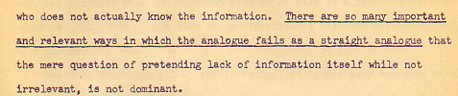
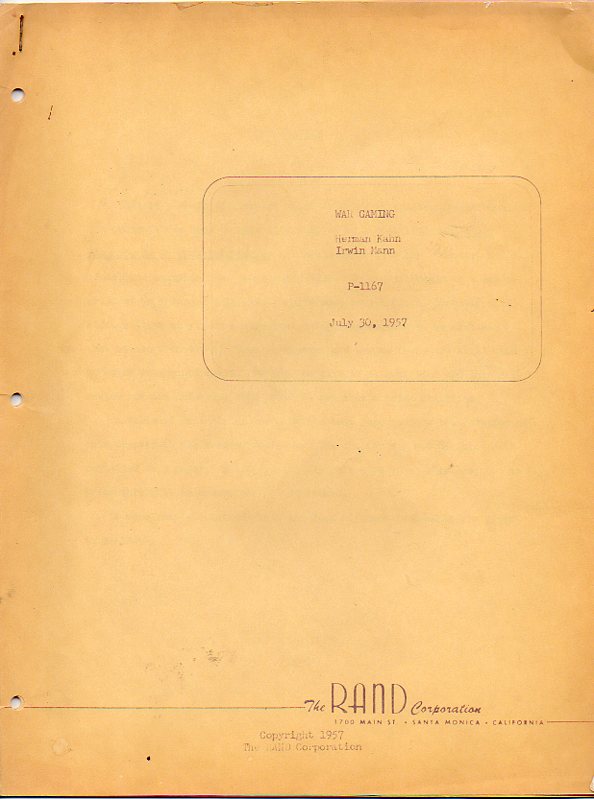
    Kahn’s writing is necessarily less elegant than Byrne’s, and probably less elegant than most other people in general including those who don’t write, though it does lower itself to some height of governmental semi-speak.  For example, from his July 1957 RAND paper “War Gaming” (available at our blog bookstore, HERE), we find this nugget:

    Kahn314

    Kahn315

    I have no doubt that Kahn looks like a warrior to many people–he no doubt was something of one, so long as that warrior could wear a white button-down shirt and not get dirty.  Simply because a person is thought of as a “warrior” doesn’t make them a ‘good” one, either, and I think that I would nominate Herman Kahn as an example of one:  in my own approximation of Kahn-speak, he would  “generate the apparent non-non appearance in definable though undefined parameters as  a non-good non-warrior in circumstances that defined or not define him/them in this semi-stable manner”.

    I think it is important to look at documents like this–documents that helped establish military policy–to see how their authors were able to convince people in government that they could divide by zero.


    *Robert Wilson is a phenomenal conceptualist and theatrical designer.  On the liner notes to CIVIL warS is found the interesting note on Wilson and Byrne:  “At first, Robert Wilson asked David to compose pieces for several sections of The CIVIL warS, but on account of David’s limited time, he composed only The Knee Plays part. The CIVIL warS was supposed to be played in its complete form at the Olympic Games in Los Angeles, but if one plays every part, it takes at least eight hours. There was also a financial problem for playing every part. So only some parts of it were staged there. David himself was very interested in composing for such a play and dance and this time again he enjoyed this work very much. Last time, for The Catherine Wheel, he used recorded tape, but this time he made musicians play on the stage.”

    (Featuring a prominent role for The Tuba)

    IN THE FUTURE (KNEE PLAY 12)

    In the future everyone will have the same haircut and the same clothes
    In the future everyone will be very fat from the starchy diet
    In the future everyone will be very thin from not having enough to eat
    In the future it will be next to impossible to tell girls from boys, even in bed


  • Discovering Something Not Discovered–or, How to Best Figure Out What You’ve Got Left After Being Nuked

    JF Ptak Science Books   Post 1300

    Bomb damage261

    The spoiler answer to this:  make sure to account for the nukes dropped on you  when figuring out what you’ve got left to work with.

    This seems a tautologically  tongue-twisting, not-quite-right title for this post, and indeed it might be.  But that’s the way the pamphlet I’m reporting on read, a sometimes resilient-to- inspection rubbery beastie whose basis for being written was to report on an great oversight that doesn’t really want to be recognized, even if it is the title of the work.

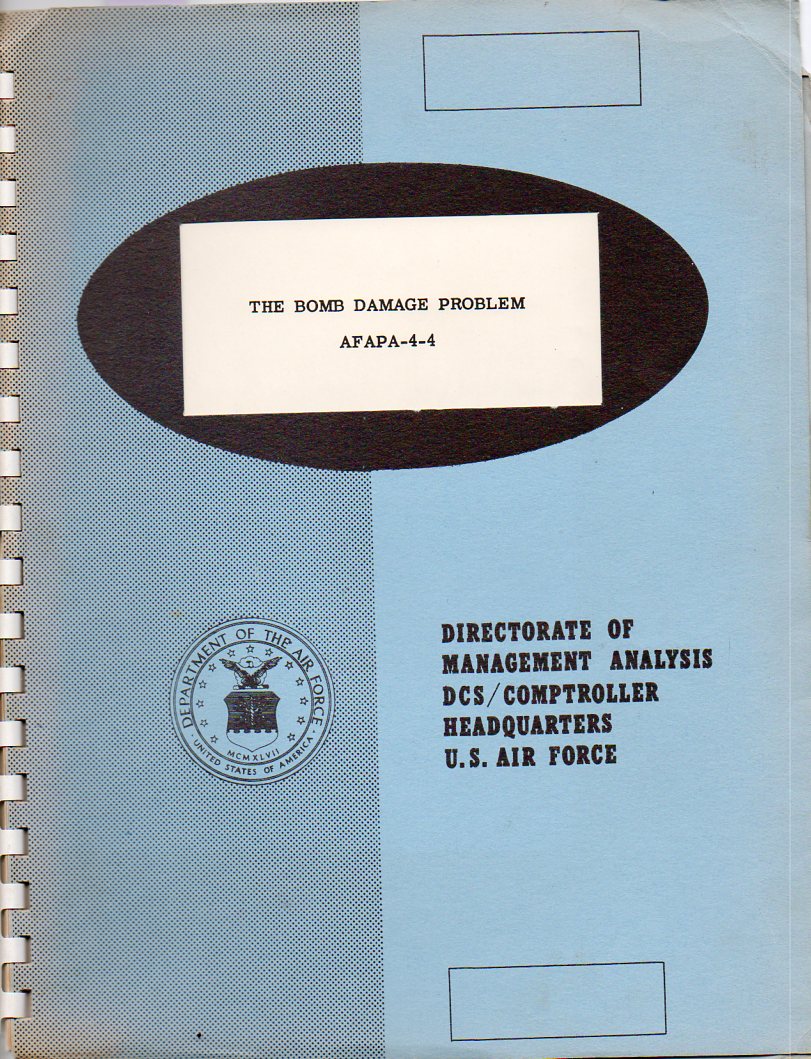
    The Bomb Damage Problem, AFAPA-4-4, published in 1954 by the Directorate of Management Analysis (DCS/Comptroller at the  Headquarters of the U.S. Air Force) is a pamphlet of discovery–or rather, the discovery of the lack of discovery.  (The pamphlet is available from our blog bookstore, here.)

    The work is an introduction to some aspects of  nuclear exchange post-attack predictive capacity–particularly with the ability of American industry “to support a war plan”. 

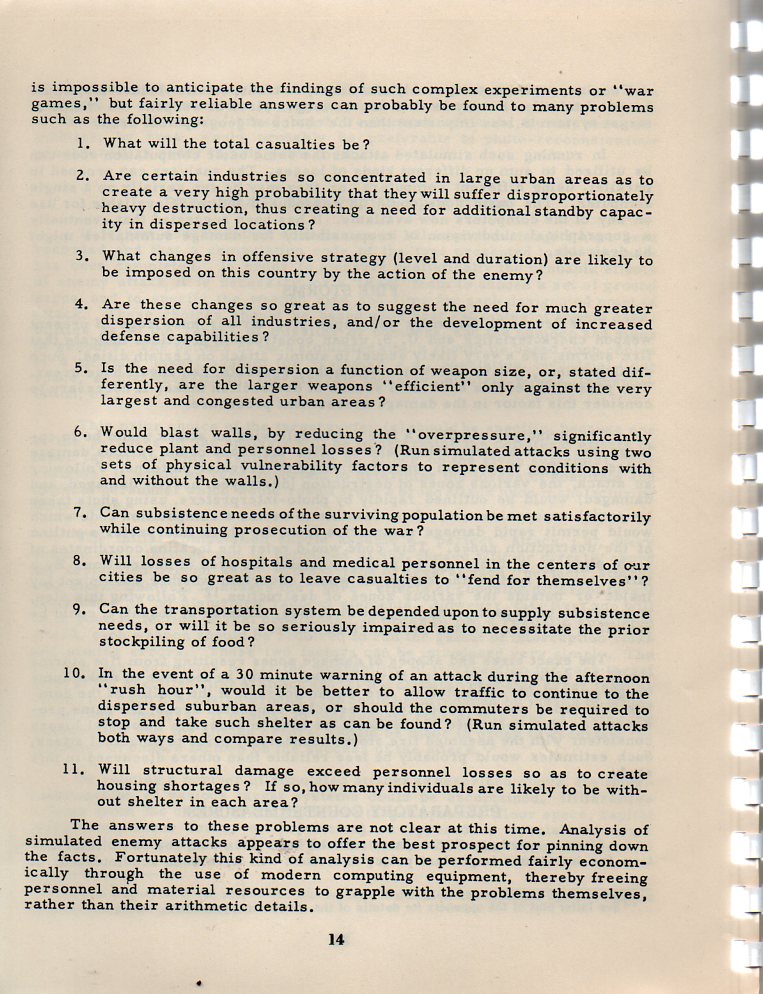
    The anonymous pamphlet gets straight away to the discovery part–that previous predictions of post-attack capacity were “probably completely unrealistic” because “[they] did not take account of the likely bomb damage to the U.S. production facilities”. 

    I would think that even at this relatively early point of planning for possible Soviet nuclear attack that war game scenarios would have taken bomb damage to industry a”and accompanying manpower losses” into account of how the war machine would react after the bombs began to explode.  Though it seems not. I’ve looked to see how I could be misreading this thing because it seems like too monumental an oversight to make. But I can’t find where I’m making my interpretative mistake. 

    Ultimately the authors focuses on saving the corpus of the overall works, saying that this oversight does not damage the “important thinking” that had gone on it spite of this error.

    The word “error: is not used in the text of course.  This is how it is described: “In connection with this critical new obstacle to intelligent military planning, it is essential that speculation be minimized.” The error is actually redefined as a “critical new obstacle” the effect of which heightens “speculation”.   Which is all true.

    I suppose what is really going on his the formation of some bedrock stuff formulating information gathering for creating a computer program for deeper analytical study of the effects of nuke warfare on post-attack industry.  1954 is about right for the time for this to happen, and the DMA–as the home for the creation of linear programming among countless other things–would’ve been the place for this work to happen. 

    But I keep coming back to what seem to be enormous understatements–even giving plenty of allowance for the time–that keep cropping up in the pamphlet.  Perhaps it is just stating the obvious for the first time that makes all of these seem so potentially underwhelming, like this nugget:   “numerous measures of the importance of each target may eventually be needed….” (Page 7). 

    There’s plenty of more detail though that occurs in the pamphlet, as in figuring out damage to structures by the yield of the explosion and distance from the target and the composition of the target’s structure, and so on.

    And then we get back to the obvious: “the principal effect of a fire storm following an attack would be to enlarge the area of destruction and to alter the shape of the various damage zones, changing them from concentric rings to irregular patterns. “.  As I said, maybe it is just a case of a “Call me Ishmael”, or stating that lines and points in space exist for the purpose of geometry.  Still, it rubs me the wrong way, all over.

    And just to make this point perfectly clear:  the “bomb damage” problem is to take into account bomb damage to U.S. war-making, bomb-producing capacity, in a sort of BIBO (bomb in, bomb out)  version of a SISO (shit in, shit out).

    Bomb damage b262


  • Less-than-Optimum Oblivion: Measuring the Bad Side of Advanced Nuclear Exchange, 1956

    JF Ptak Science Books   [Another in a long series of post on atomic and nuclear weapons.]

    Perhaps nothing is obvious unless it is established or labeled so; perhaps the obviousness must be stated at least once before it can be officially, recognizably, the case.  And perhaps the greater the obviousness is, the more the need to make it officially so.  Perhaps nothing is so incredibly obvious that it can be studied and dissected and established.

    This seems to be more the case in more recent history than in time more further removed: that millions of dollars can be spent “proving” that children do not like to be separated from their mothers, or that cars will go faster downhill than up, or that people will respond to proper medication better than not, and so on, so on into the night, just seem not to need a vastly-funded proof.

    And so the case with nuclear warfare, people, and cities.

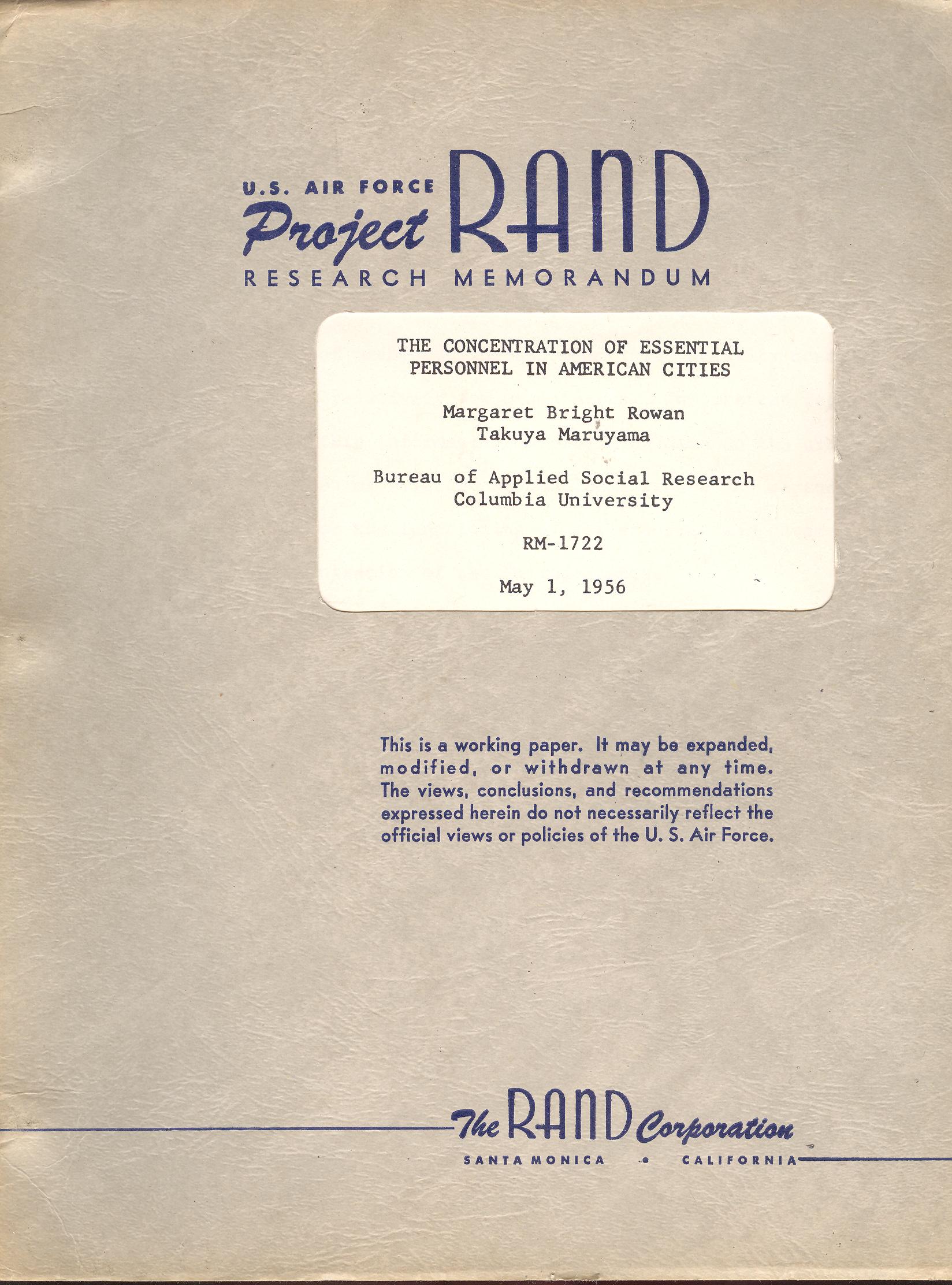
    In this RAND report from 1956, the great issue seems to be laid to rest, once and for all: the problem with nuclear weapons being exploded in/over cities is that since cities are filled with people, people will be killed.  And if those people in the cities are there because of professions that depend on city-settings, then more of those people will be killed than not.  [This rare pamphlet is available from our blog bookstore, here.]

    Rand report

    But what this report was really about was the unfortunate aspect of the impact if nuclear warfare on leadership and working positions in significant and strategic industrial/business/government professions.  And what the report finds is this: since the vast majority of these positions are located in cities (defined as 100,000 population and above), and since cities will be the major targets in a nuclear “exchange”, the overwhelming majority of these people will be killed, thus leading to strategic human resource vacancies post-war. 

    It seems that 95% of aeronautical engineers in the U.S. would be killed in a nuclear war, which I guess would mean that it would be difficult to design new aircraft and such in the post apocalypse world.  Of course these people would be killed because it was their industrial base that was being targeted and they were collateral damage, so there wouldn’t be any industrial base to produce the components necessary to build, say, a B-52.  That part of the equation is not addressed here, though.  Nor is there any sort of recommendation presented to fix the problem.

    The RAND document just painfully points out the obvious, once and for all; no one really knew what to do with the information now that it was there, in black and white. Certain people could be evacuated, saved from the maelstrom; but saved for what?  There were other evacuation plans that were completely doomed from the beginning, sheltering plans, Dr. Strangelove arrangements, but all of that would come into their pitiful being later on.

    First, though, the bitter reality of what everyone already knew–one of the greatest of all obviousnesses–had to be make its appearance in print.  And so it did.


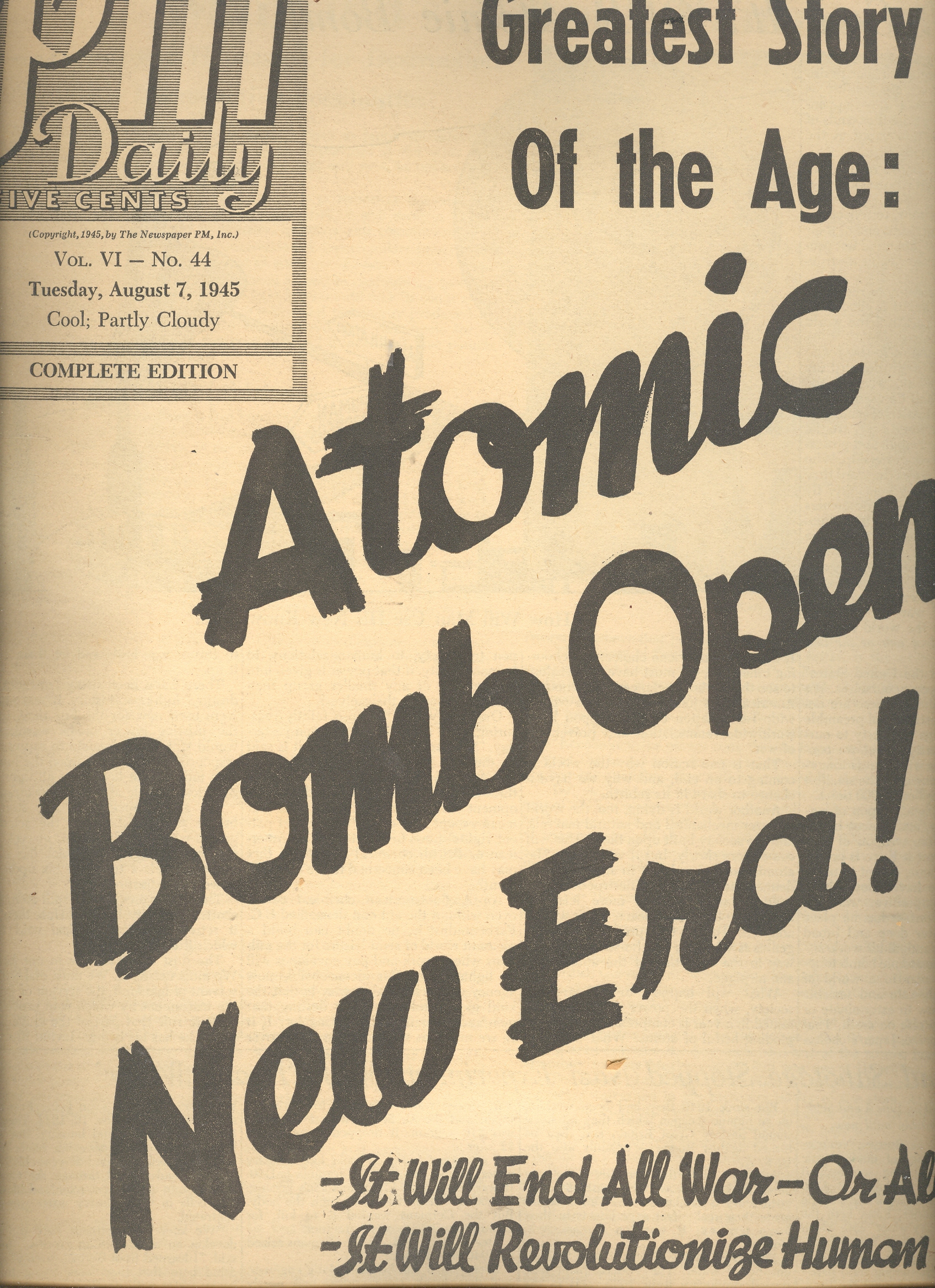
  • Reporting the Hiroshima Bomb the Day After, 7 August 1945. AND the First Graphic of NYC A-Bombed

    JF Ptak Science Books   Blog Bookstore  Post 1257 (continuing post 669)    Atomic and Nuclear Weapons Series

    ==Blog July 26=PM cvr bomb

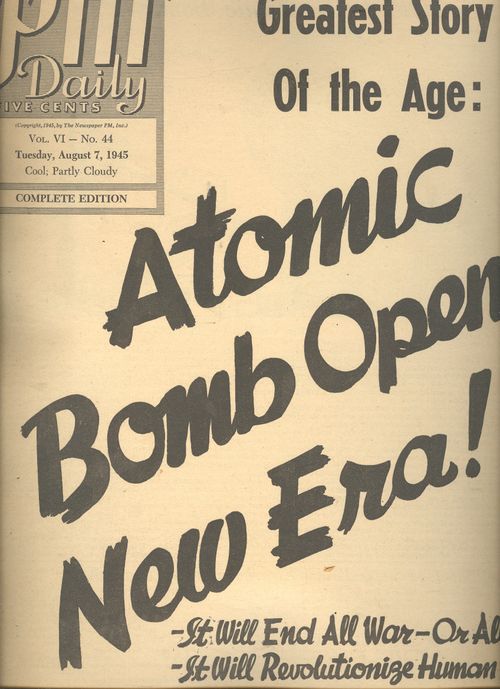
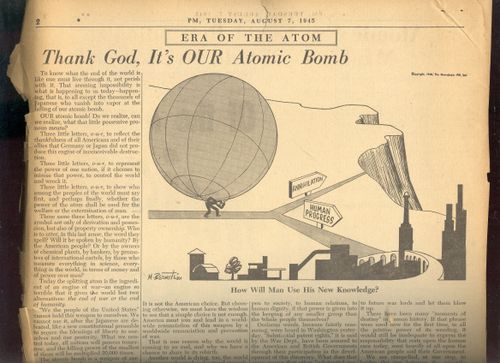
    The news coverage of the 6 August 1945 bombing of Hiroshima was covered in spectacular (all things and time considered) detail in the 7 August issue of the daily newspaper, PM.1  The entire issue of 12 pages (with no advertising2) was dedicated to the event—I have no idea, really, how they were able to put together this amount of good tough data so very quickly, nimbly and intelligently, as the bomb was detonated at Hiroshima only the day before. 

    It is odd how well the case is covered, and it is positively issued on the day after –it isn’t the case that it was issued for the week of 7 August and released on 13 August, which I thought was a possibility of explaining the deep coverage.  But there’s no mention of Nagasaki (which would come in two days), so I am certain that the coverage was all accomplished within 24 hours of the use of the weapon.  The newspaper distinguishes itself by not screaming something about the “Jap city” being wiped out (as so many other newspapers did), with its front page summarizing beyond the bomb.  (“It Will End all War—Or all Men” and “It Will Revolutionize Human Life” as sub-heads; the first being accurate, while the second being nearly so.) 

    The editorial, “Thank God its OUR Bomb”, by Irving Brant, is a lovely piece of thoughtful interpretation in the opening moments of the nuclear age. He writes: “America must join and lead in a worldwide renunciation of this worldwide renunciation and prevention of war”,and “What will happen to industry, to society, when the power of all the coal mined in a year is compressed into an exploding fistful of atoms?” And further:“There is no escape.  The split atom may shatter humanity, but not before then will it retreat into the physical void from which it came.  The dust of creation is in our hands.  We must master it.” Not bad stuff for having a few hours or so to think this  through. 


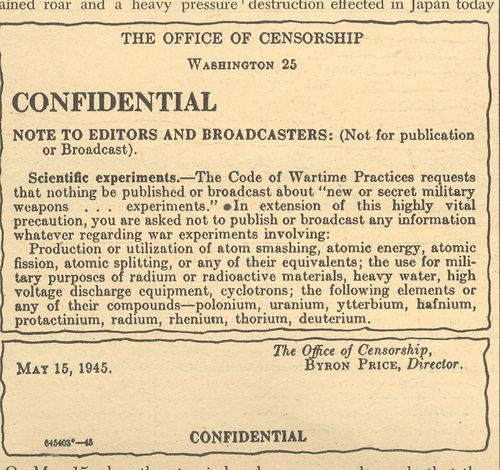
    ==Blog July 26=PM cvr bomb censor


    The other articles included “Bombs and Sabotage Stopped Nazi Experiment with Heavy Water”, “New Atomic Era Could Revolutionize Mankind’s Whole Manner of Life/Power Harnessed for Destruction Has Limitless Constructive Possibilities”, big two-page story “Stimson Reveals How Work on Bomb Was Organized”, “Bomb’s Death Range Believed to be 4 Miles”, “Four Scientists who Will Plan Postwar Uses of Atomic Energy”, “Harnessing of Atomic Power research Strengthens US Research”, “If a Piece of the Sun Were Placed on Earth”, “End Not Yet Truman Tells the Japanese”, and another 12 articles.

     ==Blog July 26=PM cvr bomb artoon

    There’s another baffling article “Steel Tower Vaporized in First Test”, discussing the shot at Alamagordo—it must have been the case that there was an enormous amount of material divulged by the government in the hours after the explosion at Hiroshima .  The work at Columbia is also chronicled, as is the personal life of the man in control, General Leslie Grove (and how completely in the dark his wife was, and so on). 

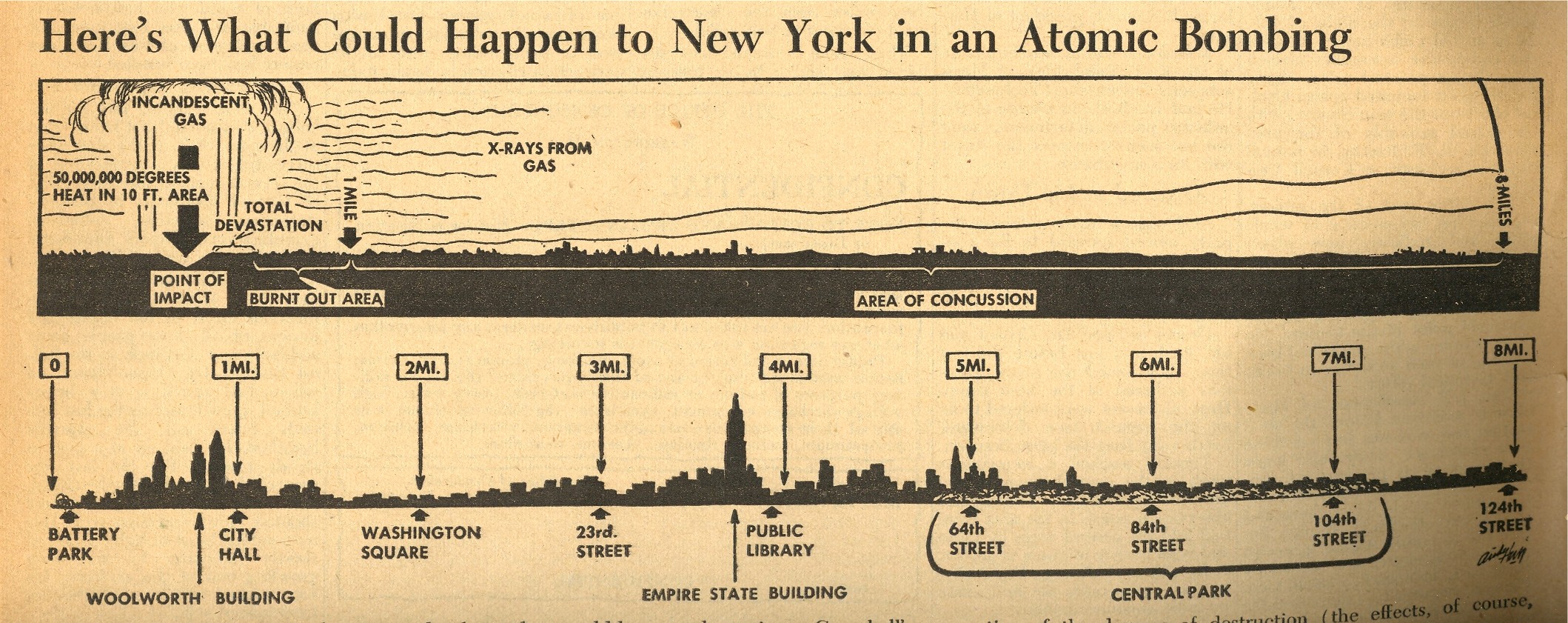
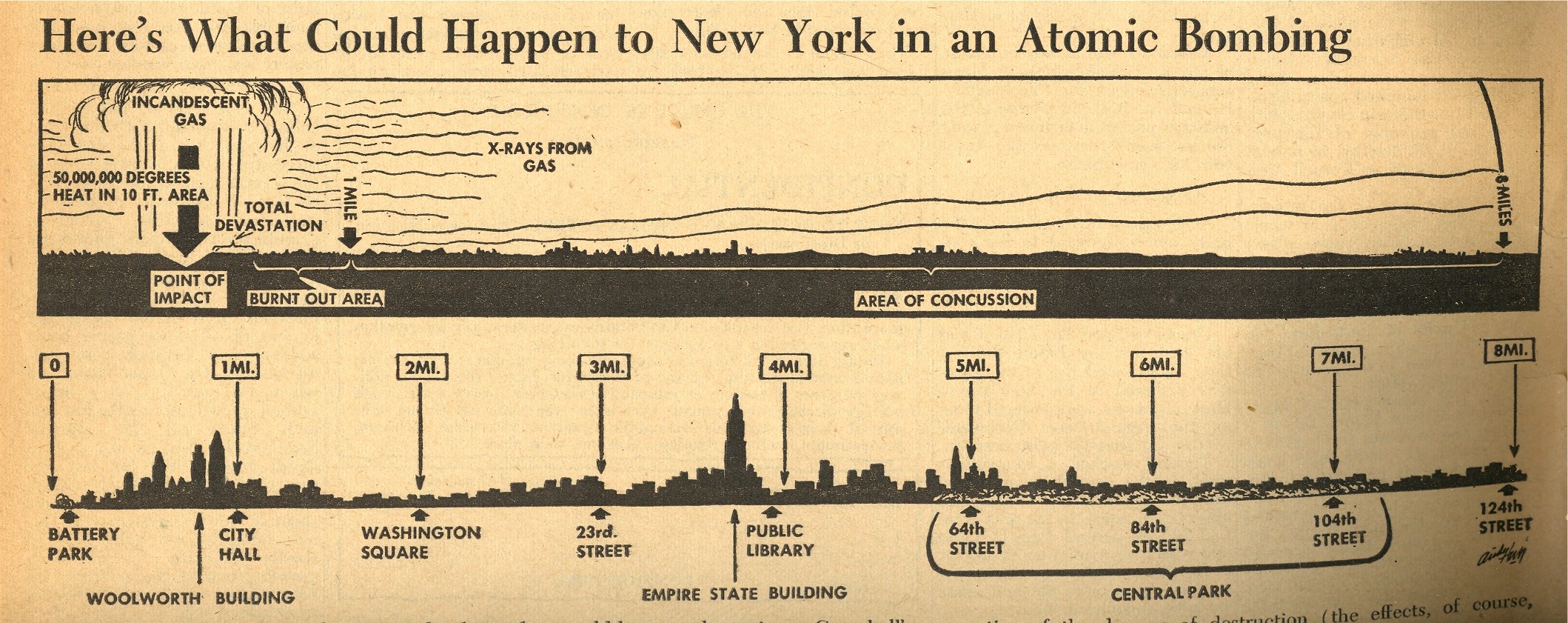
    One of the most interesting objects to me though is the small graphic on page 7 which shows what effect the Hiroshima atomic bomb would have if dropped on New York City—it was no doubt gigantically sobering to anyone who looked at it, and brought the power of the bomb and its destruction to a common, understandable point.  I’m not an historian of the first newspaper coverage of the bomb, but it strikes me that this may well be the first graphic to depict the effects of an atomic bomb exploded over NYC.

    ==Blog July 26=PM cvr bomb map
     

    In any event, the overall coverage of the event was stunning given the short amount of time to do the research, writing, and publication.  Truly a great effort. 

    Notes:

    1. PM (1940-1948) was a left-wing newspaper funded by Marshall Field III, and was home to excellent reporting.  See here for more details. Among the staff writers was I.F.Stone and staff photographers Margaret Bourke-White.  Other contributors included Heywood Hale Broun; James Thurber; (the great) Dorothy Parker; Ernest Hemingway; Eugene Lyons; Ben Stolberg; Malcolm Cowley; Tip O’Neill;and Ben Hecht.

    2. Actually, NO issue of PM had advertisements–it was entirely ad-free. (And even so it still came close to making money after 8 years.)

    PM‘s stated mission:

    PM is against people who push other people around.   PM accepts no advertising. PM belongs to no political party. PM is absolutely free and uncensored. PM’s sole source of income is its readers–to whom it alone is responsible.PM us one newspaper thayt can and dares to tell the truth.

    Theodore Geisel (Dr. Seuss) was a cartoonist for PM (see here for his War cartoons) as was the great Crockett Johnson.


  • Buckle-Up for the Nuclear Holocaust–The Fat Man’s Big and Terrifically Bad Idea

    JF Ptak Science Books LLC  Post 1221
    ==Blog July 27=wiener title

    Atomic and Nuclear Weapons   and The History of Bad Ideas series

    This is one of those ideas that just went viciously bad on contact, turning into an enabler of  the very thing that it was supposed to help prevent:  turning the Easter Bunny into Dr. Strangelove.  In the History of Bad Ideas, this one is top-tier. 

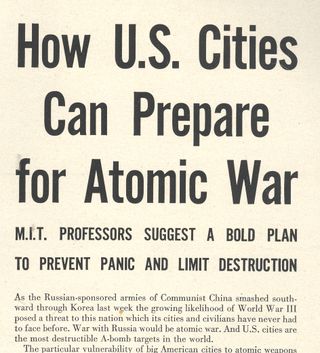
    LIFE magazine published “How U.S. Cities Can Prepare of Atomic War:  How M.I.T. Professors Suggest a Bold Plan to Prevent Panic and Limit Destruction” in their 18 December 1950 weekly issue, just in time for Christmas.  The plan was a partial response to the dire situation faced by the U.S. in Korea and the growing threat of China and of course the Soviet Union’s nuclear arsenal.  The government recognized that there was little planning in place to deal with the outcome of possible nuclear attack, and established the Federal Civil Defense Administration to help deal with the “problem”.  The problem  was how to make U.S. cities somewhat prepared to deal with being bombed with nuclear weapons—given that cities had a hard enough time dealing with 5:30 pm commuter gridlock, throwing a hundred megatons of explosive power into the equation made things more difficult. 

    ==Blog July 27=wiener left

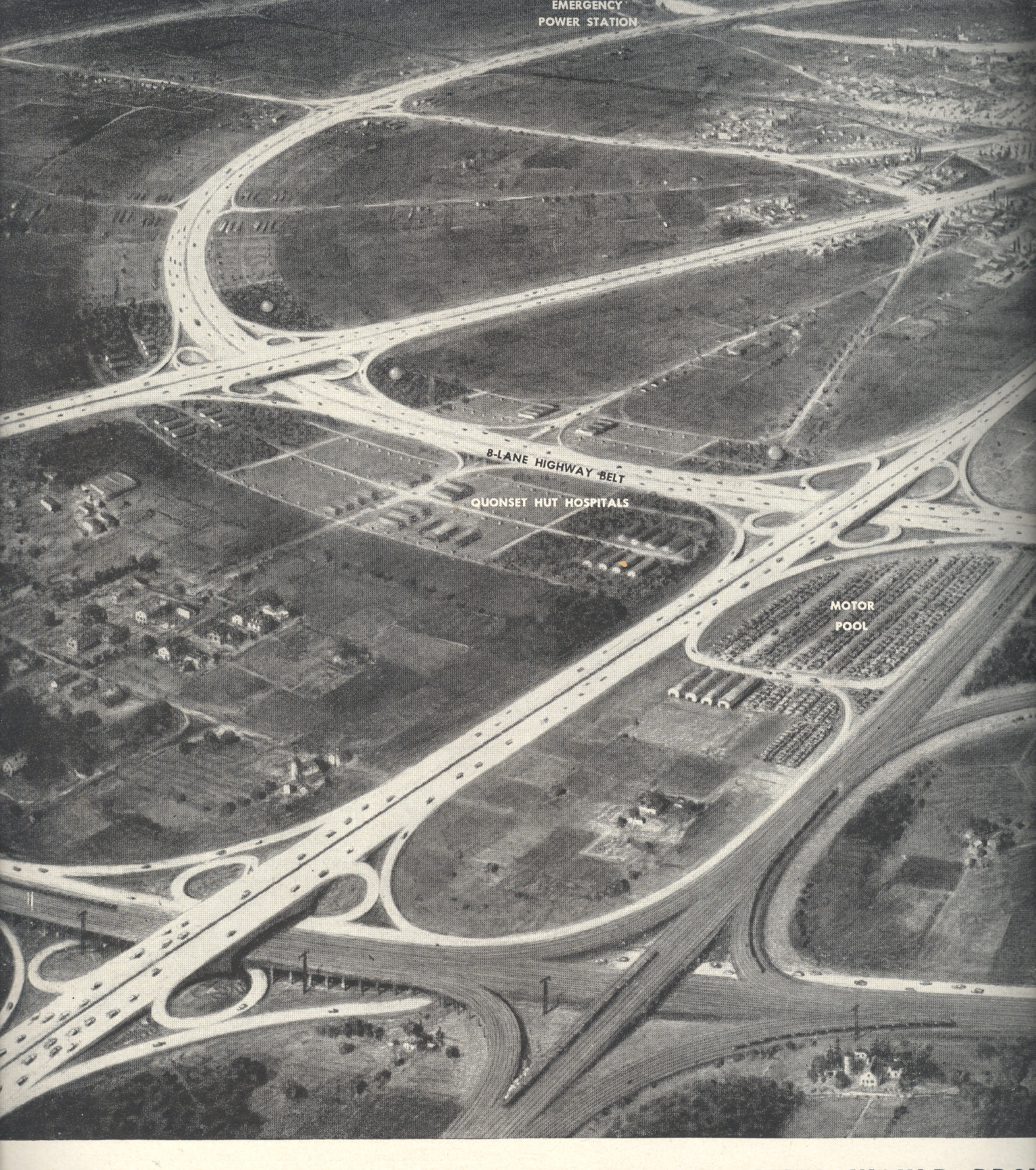
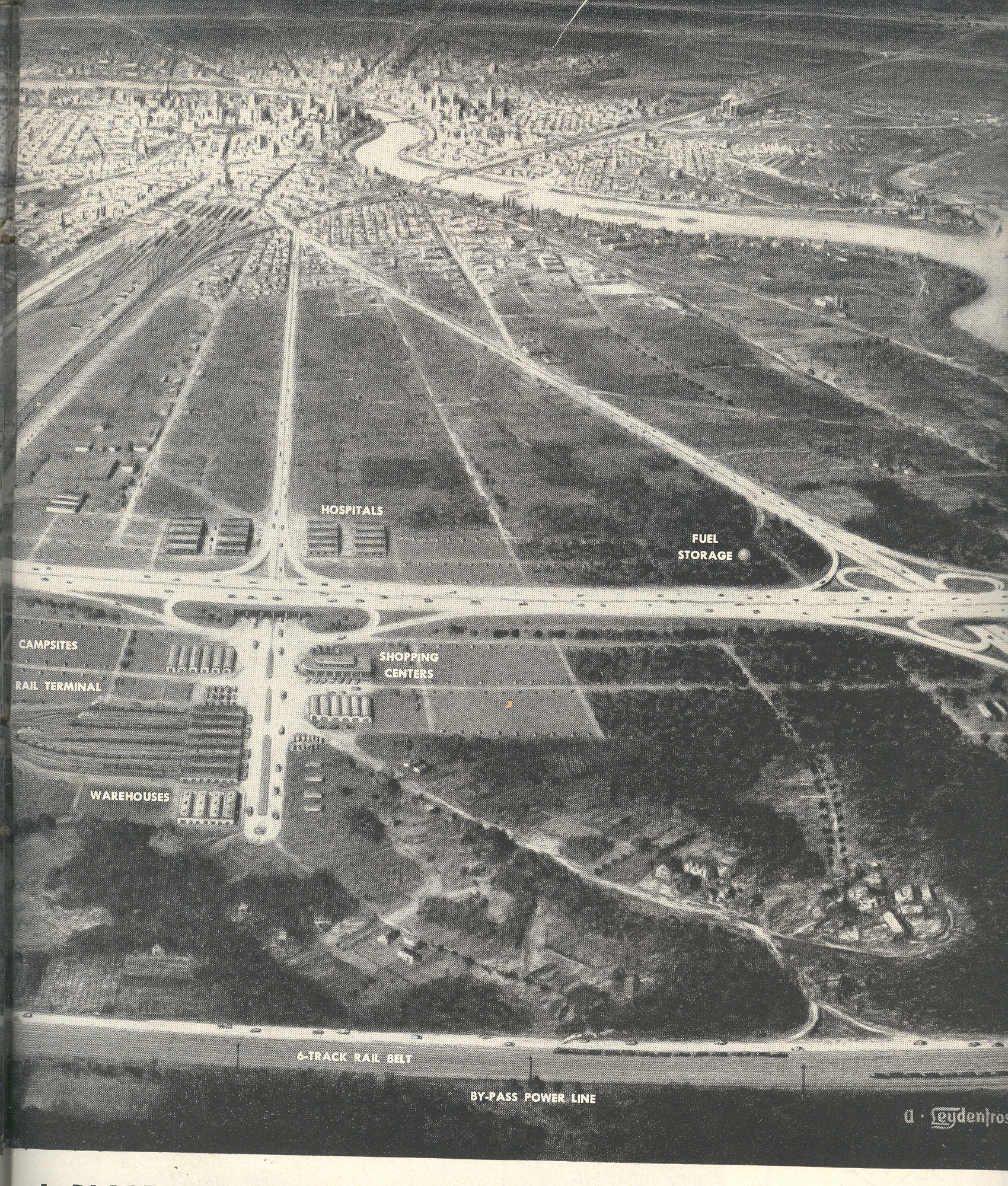
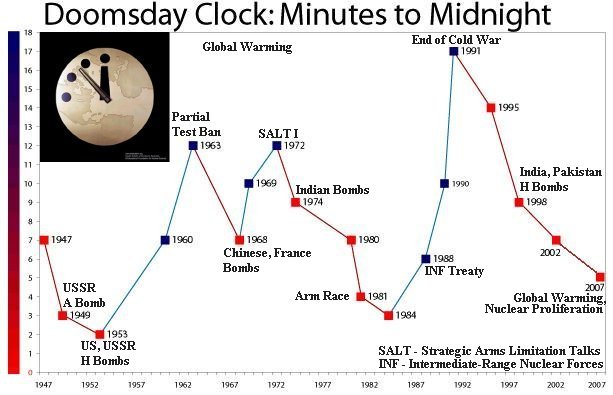
    One reaction was to construct concentric outer highways around metropolitan areas, “life belts around cities (which) would provide a place for bombed-out refugees to go”. In the birds eye view provided here, we see the plan in action, the main parts of which are an 8-lane “express” highway belt 10 miles away “from the built up edges of the city” , and a 6-track railway belt five miles further out, these accompanied by various feeder arms stretching straight-away from downtown.  In between the two outer rings would be land that would be kept free of development, so that farms and tent cities could be constructed after the attack. There would also be major collections of hospital and fuel depots in the greenbelt area.  Infrastructure would already be in place (gas and electricity, supplied with power from who-knows-where).   Shopping centers and a giant “motor pool:” would also already be in place, waiting for the Doomsday clock to strike midnight. 

    ==Blog July 27=wiener right

    One of the overwhelming presumptions here is that the interspersed green life living within the concentric rings of escape and transport routes would survive the attack. As would the highways.  Why on earth wouldn’t that infrastructure be attacked as well? Given the proliferation of weapons, it would seem highly unlikely that The Aggressor would target just downtown areas of major cities—they would of course have to include the safespots as well. Not that there would be that much of a change in targeting parameters:  exploding a series of 1 or 5 or 10 megaton warheads over a city like the one pictured here would pretty much decimate anything within the 15-mile life zone set out for survival.  With weapons in this megatonnage range, we’re talking about an explosive force that would be inconceivable, even using the Hiroshima explosion as a currency.  It is hard to imagine what happens when you deliver 3 or 4 5-megaton weapons to a city like this; when each of them would have the explosive force of 5,000 or so Hiroshimas, it is pretty clear that nothing will be left.

    This planning gap reminds me of the question dealing with UFO running/landing lights:  why are they there?  Even assuming a modest strike in the kiloton range (which simply would not be the case) why would these defensive structures not be a target, particularly, oh dear sweet creator, since they would actually be forming an enormous target, and one that even a half-blind flying pig could find from altitude? Ultimately, it wasn’t a good question to ask because the answer would reveal the helpless, soulless situation for what it was.  It was precisely an adult version of the ‘duck-and-cover” cartoons that showed the good students who got under their (wooden) desks being shielded from the atomic nastiness that just knocked down their school.  And of course these concentric evacuation and mobilization rings, even if they had miraculously survived a purposely modest attack, and even if they actually worked to handle the flow of millions of people in their eight lanes, and even if all of those millions driving these highways didn’t have any accidents that would choke the flow of traffic (and on and on), we still haven’t approached the radiation question.  For it was in the greenspace between the two concentric rings in which tent cities for the evacuees and homeless would come to life, some ten miles from ground zero (if, again, they weren’t themselves directly bombed with weapons in the megaton range). 

    So, in short, the way that these efforts would work is if (a) there was a lot of lead time to the attack, (b) everyone left the city in an orderly fashion, (c) nobody had any traffic choking accidents, (d) there was no radiation, and (e) one and only one “antique” nuclear weapons was used in the attack.  Given these parameters, the plan just might work. 

    One of the authors of this not-particularly well-thought or original idea was in fact a great and original thinker; this enormous and costly and not effective plan was certainly not one of his best moments.  Norbert Wiener (1894-1964), one of the co-conspirators of this idea, was a boy genius who grew into an adult genius, and that growing part didn’t take long at all.  He graduated with a Harvard Ph.D. in 1912 at age 18 and went on to a distinguished early career as a logician, studying under Russell and Hardy and Landau and Hilbert.  He left that part of his life mostly behind by the end of WWI, dedicating  himself to mathematics.  One of Wiener’s great accomplishments was (during the early stages of WWII) designing the capacity for anti-aircraft guns to be self-aiming, improving their accuracy (and effect) immensely.  This was the foundation of his communication theory which became the basis for his creation of cybernetics, a superior creation with vast applications over many fields. 

    By the beginning of the Cold War, Wiener became a pacifist, leading him down a dark and murky road to this “life belt” idea.  Perhaps this approach had precisely the wrong effect:  by lending the idea of sustainable and orderly survivability to nuclear war might have led people top believe that nuclear was survivable; and if there is a game played in which its two players are not necessarily both losers, then the specter of “winning” a nuclear confrontation with the Soviet Union becomes a possibility, making the whole idea of fighting with nuclear weapons feasible. 

    Doomsday

    I’ve not a clue as to what the great Norbert Wiener was thinking when he worked this out; even as a (and perhaps “the”) math guy,  the numbers just don’t add up. 

    When I put on my Jorge Borges x-ray specs the plan looks prettier, and of course involves libraries.  The outer concentric circles are still there, as are the green spaces, and the express/democratic ways of getting there; but what you would find there, on the highway ring, would be a series of libraries and dataports, and endless stream of books, and words, and numbers. 

    Addendum:

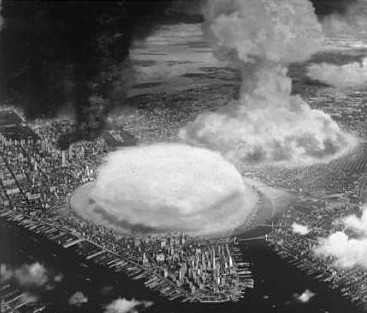
    One of among many things that I didn’t discuss above was the placement of such a greenbelt/lifebelt system for cities like New York, or San Francisco, or Los Angeles.  As we can see in the depiction of a nuclear attack on NYC from Collier’s Magazine (1948) there’s sorry little area for that highway ten miles out from 42nd Street…

    Atomic nyc